Legal Aid by Lawyers
Origins
There is a long tradition in the Low Countries of lawyers[198] providing free legal assistance to the poor.[199] The oldest known example is from Bruges, and there is historical evidence of the lawyers’ brotherhoods of Mons, Antwerp, and Ghent offering free legal aid.[200] These confraternities all honoured Saint Yves, the well-known advocatus pauperum.[201] For instance, in 1677, the Pope gave his permission for the foundation of a confraternity of lawyers in Saint Michael’s church in Ghent, in honour of Saint Yves.[202] Its members all had to assist the poor gratis et sine honorario (“free and without fee”).[203]
These confreries disappeared in the turmoil of the French Revolution.
In France, the Assemblee Constituante had by 1790 abolished bar associations and the lawyers’ monopoly to appear in court.[204] After the annexation of the Belgian territories in 1795 and the introduction of the Code Merlin in 1797, these regulations applied to Belgium.[205]In 1804, Napoleon reinstituted the occupation of lawyer, and in 1810, the ban against bar associations was lifted.[206] The latter is important to the development of legal aid, because in article 24 of the Napoleonic Decree of 14 December 1810, we can find the foundations of the current pro Deo organisation.[207] Napoleon required bar associations to install an Office of Free Consultation (Bureau de consultation gratuite). It had to hold a session once a week for the poor to present their cases. Napoleon urged the Office to devote its greatest attention to these consultations, because he did not want third parties to suffer from vexatious proceedings. The Office had to send the cases it found worthy to the Conseil de discipline, which then distributed them by turns among lawyers.
Napoleon required that young lawyers who were doing their traineeship had to be present at the sessions of the Office of Free Consultation.The Offices of Free Consultation in Belgium: A Long Period of Continuity (1832-1967)
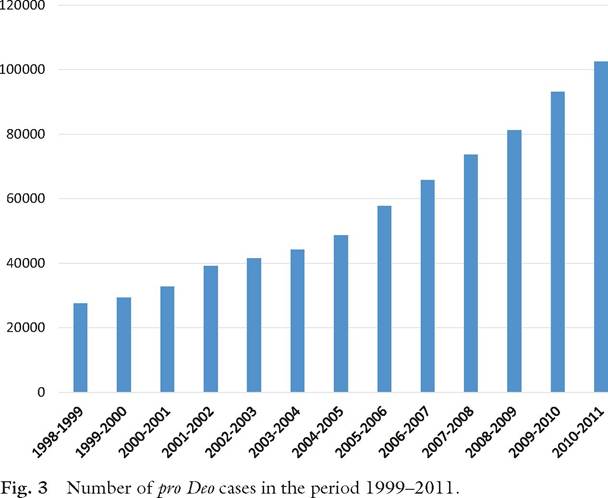
The 1832 Organic Act on Judicial Organisation installed three courts of appeal in Belgium: in Brussels, in Liege, and in Ghent.[208] The Ghent bar association grew and so with it the number of new trainee lawyers (stagi- aires). Following article 24 of the 1810 Napoleonic Decree, the Conseil de discipline installed on 15 October 1832 an Office of Free Consultation with five members.[209] It opened on June 1833 and held hearings every Saturday from 11:00 until noon.[210] Several local newspapers, such as the Messager de Gand,5 the Journal des Flandres, and the Gentschen Mercurius, made public announcements, inviting both the poor and the lawyers in training to the sessions. From 1847 onwards, the sessions were on Wednesdays, in a small room on the ground floor of the new Palace of Justice. Thanks to the Ghent lawyer Victor-Louis-Marie Gaillard,[211] [212] we have some sense of their activities in 1853.[213] For instance, he wrote that everyone could come there and present his or her case. If it was only a small administrative problem, the lawyers explained what needed to be done and which public officials to visit. For other cases—if considered just—the Office invited the adversary party to the next session, in order to settle the matter. Apparently, in many cases, this was sufficient, avoiding costs and “unpleasant affairs” (“et des affaires desagreables”). If the other party did not appear or if the Office could not achieve a conciliation, it appointed a trainee lawyer to handle the case. Interestingly, at the end of his report, Gaillard writes that the Ghent Office never appointed a lawyer in divorce cases.[214] This indicates a rather conservative worldview of the Ghent lawyers at the time.[215] We gleam additional information from the autobiographic novel Ernest Staas, advocaat, written by Anton Bergmann in 1874.[216] Bergmann, a lawyer himself, describes the practices of the Brussels bar around 1870. Bergmann testifies that the Brussels Office of Free Consultation on average rejected 15 out of every 20 requests.[217] He does, however, offer a number of examples where lawyers did provide help: a girl who needed her birth certificate to marry, a French tenant who had a dispute with her proprietor, a man who may have been entitled to an inheritance, and a worker who had problems with his employer. In all these cases, the lawyers were able to resolve the case without having to initiate legal proceedings. In 1875, the sessions of the Brussels Office of Free Consultation were on Saturdays. The trainee lawyers first had to sign the register and then wait until the Office allocated them cases. Each trainee had to attend at least 60 sessions during his three-year traineeship.[218] Although most did their best for their indigent clients, there were also trainee lawyers who too easily concluded that pursuing a case was useless.[219] By the 1880s, reform was needed because of the large number of new trainees in Brussels.[220] There were almost 200 of them, which represented an enormous increase given that there were only 400 senior lawyers at the time. Therefore, the Brussels Bar Association decided in 1887 to change its regulations.[221] The Office of Free Consultation was divided into four sections that each would have one session every other week. According to one statement from 1886, the Brussels Office of Free Consultation was stricter than the courts in determining who was indigent; lawyers in the Office were not satisfied with only a certificate of indigence. They dug deeper asking further questions to determine if the litigant was indeed too poor to pay for a lawyer. They considered this a rational measure that the judges, too, should apply.[222] During the 1889 parliamentary debates on the new pro Deo Act, Catholic Member of Parliament Louis De Sadeleer (1852-1924) emphasised the proper functioning of the Offices of Free Consultation. He stated that intelligent, capable, and dedicated men investigated the claims and that they avoided when possible vexatious trials.[223] Obviously, for the nineteenth-century lawyers, pro Deo was a favour that they did not grant lightly. However, once granted, the trainee lawyer could not charge his client because pro Deo was an act of public charity.[224] There was only one exception to this rule: when the client spontaneously offered a sum of money, but even in this case the Office of Free Consultation had to grant its permission for the lawyer to accept this sum.[225] If the trainee lawyer asked his poor client for fees without the permission of the Office he could be disciplined.[226] In 1878, the young lawyer Hermann Pergameni asked himself why only trainee lawyers had to take pro Deo clients. The answer to Hermann Pergameni’s question was simple: these clients did not bring any profit. The chair of the Brussels Bar Association, Charles Graux, soothed the trainees in 1887 with the prospect that one day they too would become senior lawyers and reap their rewards.73 Not surprisingly, when D. Elias, another young lawyer, launched a call in 1889 in the Journal des Tribunaux to join the trainees in their pro Deo tasks, the majority of senior lawyers became deaf and mute.74 There were, however, examples of senior lawyers who did work gratis for those who could not afford to pay a lawyer. Some of them did this out of charity, as in the Ancien Regime, while others acted as such because of their ideology, such as Jules Destree, one of the first socialist lawyers.75 Destree testified in 1889 that there were at the time three main types of cases in the Offices of Free Consultation: conflicts between parents and children, conflicts between husbands and wives, and workplace accidents.76 The latter are of importance for the history of legal aid in Belgium, and there is a significant link between legal aid and workplace accidents in the Belle Epoque.77 On the one hand, workplace accidents sparked the d'appel. Pourquoi cette charge, tres honorable d’ailleurs, incombe-t-elle seulement aux stagia- ires?” Pergameni (1878). 73 “ Prenez done part, avec zele, d notre oeuvre, mes jeunes confreres. Vous occuperez notre place lorsque le moment sera venu d’en recolter les fruits. ” Graux (1887). 74 “Que ceux qui ont fini leur stage reviennent aux indigents. Quhls shnscrivent pour aider leurs Confreres plus jeunes. Les jeunes; ils commencent. Ils ont besoin d’etre conseilles, soutenus, encourages. Les indigents, ils souffrent. Oh! Que cela suffise! Et—quel que soit d’ailleurs le sys- teme: celui-ld, ou un autre—que la recompense serait belle et grande si, un jour, on disait, au fond de la bure, dans la chaumiere perdue au milieu des champs, dans la froide et sombre man- sarde, partout ou l'on vit au sein de la douleur faite de denuement et ou Von en meurt: cVavocat est Vami du pauvreV” (Elias 1889). The Journal des Tribunaux was the leading legal journal of the Belle Epoque. See Coppein (2015) and Vandenbogaerde (2018). 75 Dumont (1999). 76 Destree (1889). 77The Belle Epoque—French for “beautiful era”—is the period between 1870 and the First World War. It was an optimistic period characterised by progress in science and culture. For the development of Belgian law during this period, see Debaenst (2016). legislative reform of 1889 regarding free proceedings. The original reasons for this reform were problems in the commercial courts with granting jus pro Deo to victims of workplace accidents. On the other hand, legal aid played a pivotal role in the development of workplace accident case law, since it made it possible for such victims to go to court. Research demonstrates that there was a substantial increase in the number of workplace accident trials in the last three decades of the nineteenth century.[228] Moreover, research in the archives of the judicial district of Mons in the South of Belgium revealed that 80% of workplace accidents cases had the benefit of free proceedings.[229] This does not mean that it was easy for the victims of workplace accidents to obtain free legal assistance. Maurice Demeur wrote in 1905 that most workers were not familiar with the rules on tort law in Belgium and that the lawyers had to send away many victims of workplace accidents because they did not present viable cases.[230] However, letters from victims of workplace accidents show that some workers were well aware of the legal aspects of their case.[231] Maximilien Auquiere, whose 17-year-old son Eli Auquiere perished in a workplace accident, wrote, for example, on 15 May 1888 to the public prosecutor that he would deliver his witnesses and his arguments. He referred to tort law and the relevant articles in the Civil Code. It is hard to tell how this worker acquired this specific legal knowledge. Perhaps through fellow workers, who had already been to court. It is more plausible that he had already contacted a lawyer, since he mentions lawyer Leon Jomart who had an office on the Rue des Compagnons 27 in Mons.[232] The judicial archives in Mons also revealed a letter of an indigent client claiming that pro Deo lawyers were not always strong advocates for their clients. On 25 December 1898, 53-year-old miner Joachim Lefrancq asked the public prosecutor for authorisation to make a copy of his criminal file “because the lawyer that the Office of Free Consultation had assigned to him did not have the time to do so.”[233] However, Lefrancq did manage to start a free procedure at the civil tribunal of Mons, showing that his pro Deo lawyer at least did this part of his job properly. The Times Are Changing (1967-1980) In 1967, Parliament enacted a new Judicial Code.[234] It included article 455 which addressed legal aid.[235] The legislature changed the name of the Office of Free Consultation into the Office of Consultation and Defence (Bureau voor consultatie en verdediging—Bureau de consultation et de defense). Further, for the first time, a legislative text mentioned that (only) trainee lawyers had to take pro Deo cases, confirming the long-existing situation.[236] Another provision stated that the Office could determine what fees the impecunious litigants had to pay, either as an advance or as a fee. Most likely, this was just the legislative confirmation of an existing practice. The 1929 Act, discussed earlier, already allowed the remuneration of procurators, bailiffs, and notaries. This could have emboldened lawyers to ask their poor clients for a small honorarium, which was unthinkable in the nineteenth century. As we have seen, lawyers then considered legal aid as an act of public charity and they were strictly forbidden to ask even the smallest fee, under penalty of disciplinary sanctions. During the twentieth century, there must have been a shift in such sentiment. The romantic idea of lawyers graciously rendering their services gratis to the poor—“ l,avocat, l,ami dupauvre”—had made way for a harsher view that even poor people had to pay for legal assistance. This provision in the new 1967 Judicial Code made perfectly clear that pro Deo at least at that time was no longer by definition “for free.” Lawyers were motivated to ask impecunious litigants for a fee for at least two reasons: avoiding vexatious trials and appeasing trainee lawyers who handled the pro Deo cases. A study of the practices of the Ghent Office of Free Consultation in 1970 mentions the following: Imagine a man with a monthly income of 5.000 Belgian Frank and a family burden of two. He comes to the Office to ask a pro Deo lawyer about a dispute regarding a common wall (often a way to pour fuel on the fire between two neighbours!). The Office will charge him 300 Belgian Frank. In many of these cases, the man will just drop his request.[237] Only in exceptional circumstances—some 20% of cases—pro Deo was completely free. The Offices had their own (unwritten) criteria to determine the indigence of those seeking legal services. Lawyers started with critically examining official documents, as they were not always accurate. They then proceeded to question the individual: “Which lawsuits would you like to start? Will they be long, costly? How is your income related to your family burden? Does your wife work? If not, why does she not work? Do you have your own car? What do you do on Sundays? Do you have your own television set? Do you go on expensive excursions? What do you do during your holidays?”[238] Based on the answers, the Office decided how much a potential client had to pay for the services of his or her “free” lawyer. Obviously, such interrogation was not the best advertisement for a service that historically had enhanced lawyers’ reputation. In addition, lawyers started to have competition. In 1972, in the wake of May 1968, a group of progressive law students started the first so-called wetswιnkel (“legal shop”) in Ghent.[239] In their eyes, legal assistance was too expensive for the poor. Inspired by Dutch and English examples, they decided to give free legal advice to everyone who could not afford a lawyer. The Wetswinkel was an instant success, and in 1977, its volunteers provided consultation 18 hours a week, which illustrated the existing need for this kind of free legal advice. Not surprisingly, the new initiative immediately met fierce resistance by the bar associations. Three days after the opening of the Wetswinkel, the Ghent bar association forbade its members to assist in its activities. In 1974, five Members of Parliament who were also active as lawyers at the Brussels bar even tried to pass a legislative proposal that would forbid these new practices, but to no avail.[240] Nevertheless, it was clear to everyone, lawyers included, that the existing situation needed to change. The Belgian National Order of Bar Associations took the initiative and the Minister of Justice created a committee that in 1977 provided written advice. It stated that the state should pay for the services that lawyers rendered to the poor. Moreover, it recommended that all lawyers participate in the pro Deo system, not only trainees.[241] Parliament decided that it was indeed necessary that the state should intervene financially, but only for trainee lawyers, who it deemed most in need of extra income.[242] State-Financed Legal Aid (1980-Present) In 1980, with the introduction of a new article 455bis in the Judicial Code,[243] the legislature finally decided to provide financial compensation for the services that trainee lawyers rendered to their poor clients. However, Fig. 2 State budget for legal aid by lawyers. it would take until 1984 before the programme was funded, and even then, the budget would remain very modest for a number of years. Beginning in the 1990s, more funds became available for the pro Deo system, as shown in Fig. 2.[244] The financial intervention by the state was an important paradigm shift with far-reaching long-term consequences. With the increase of the budget, the desire of senior lawyers to earn fees from pro Deo clients grew.[245] In 1995, the legislator met their demands, and in 1998, they were finally remunerated for their services to the poor.[246] It was the official end of the long-lasting “monopoly” trainee lawyers had on pro Deo clients.[247] The remuneration of the pro Deo services had another, rather unexpected consequence: the split of the National Belgian Order of Bar Associations into a Flemish and a French- and German-speaking Order.[248] Each year, the Flemish and French-speaking lawyers discussed the division of pro Deo funds. In the eyes of the Flemish, the French-speaking lawyers were too generous in granting legal aid.[249] Moreover, sample controls of the books showed that there were irregularities at some French-speaking bar associations. The Flemish lawyers wanted more control, even externally, which the French-speaking lawyers bluntly refused. As a result, the Flemish bar associations decided to leave the National Order and start their own Order. There were already long-standing fundamental problems between the lawyers of the two different language groups in Belgium, but the pro Deo discussions were the final issue that caused the definitive split. Through its financial contribution, the state also received the authority to dictate the organisation of the pro Deo system. This became especially important after constitutional changes in 1994 and the introduction of the right to legal aid.[250] Legal aid was no longer a favour that lawyers generously and rather arbitrarily provided out of charity. Under international influence of the European Convention on Human Rights (ECHR),[251] it became a constitutional right, requiring objective criteria that the legislature introduced in 1998.[252]2 The 1998 Legal Aid Act, for instance, gave the possibility of appealing the decisions of the Offices of Legal Assistance.[253] It also stipulated which documents should be used to demonstrate indigence.[254] For the first time, the same rules and documents applied for both historical categories of legal aid: legal assistance as well as court fees and documents. The 1998 Legal Aid Act also introduced the distinction between primary and secondary types of legal aid. Primary legal aid (juridische eersteli- jnsbijstand, aide juridique de premiere ligne) refers to first consultations, where anyone, regardless of his or her financial situation, may receive practical information or legal advice free of charge. Many provide such advice, including justices of the peace, “houses of justice” (justitiehuizen, maisons de justice),[255] certain administrative bodies, public welfare centres, and non-profit organisations. In the case of the “houses of justice,” lawyers collaborate in the system. Secondary legal aid (juridische tweedelijnsbi- jstand, aide juridique de deuxieme instance) refers to legal aid by a lawyer.[256] The 1998 Act also transformed the Office of Consultation and Defence into the Office of Legal Aid (Bureau voor Juridische Bijstand, Bureau d'Aide Juridique).[257] Since 1998, there has been an enormous increase in the number of pro Deo cases. As can be seen in Fig. 3, the number quadrupled between 1999 and 2011.[258] There are a number of possible explanations for this growth. It may just reflect the general increase of legal problems, since people rely more heavily on courts to settle their differences and because society has become more legally complex. There has also been an increase in specific categories of pro Deo, such as asylum seekers, who are automatically entitled to legal aid. Further, more people fit the income criteria for legal aid, not only because of increasing poverty and social circumstances but also because the government has been raising the income limits, so that more people can benefit from the system. Finally, the government made numerous efforts to improve access to justice, erasing many of the previous formal and informal blockages. Even if there are multiple reasons to see the increase in the number of pro Deo cases as positive, it has also spurred criticism. A group of researchers concluded in 2012 that there was an overconsumption of pro Deo resources.[259] They made a number of recommendations, which sound very familiar from a legal historical perspective. They, for example, proposed to limit free access to justice to the most serious cases and to discourage smaller claims by requiring the client to pay a fee. This, of course, had been the practice in the Offices of Free Consultation in 1970 in Ghent. They also proposed to investigate more thoroughly the real income of those seeking services at the Offices of Legal Aid, by requesting greater documentation. As we have seen, this was a recurrent problem throughout the history of legal aid in Belgium. They also sought to put more emphasis on alternative conflict resolution—as the Ghent lawyers in the mid-nineteenth century had done. With the 2016 Act on Secondary Legal Aid, the legislature tried to address the problem of overconsumption.[260] The Act created stricter controls and a sanctioning mechanism regarding the indigent.[261] It also introduced the obligation for every pro Deo client to pay a small fee. In 2018, the Constitutional Court annulled this provision, for violation of article 23 of the Constitution, which provides the right to legal aid.[262] Further, the 2016 legislation provided Offices of Legal Aid with more autonomy in rejecting client demands and ending certain ongoing cases. It also further harmonised the conditions for access to both systems—legal aid by lawyers and exemption from procedural costs. The minister of justice is now working on a digital pro Deo platform that will centralise all applications.[263] It would be the end of the historical division between the two systems.


More on the topic Legal Aid by Lawyers:
- Conclusion
- The Greek Advisory Model
- Early History of Lawyers 1300-1700
- Introduction
- LEGAL TRAINING IN AFRICA
- International and European Constitutional Advice
- Maintaining the detachment between legal accountability and social justice
- Tribunals
- Appendix 3 Judicial evidence to Select Committees 2006 to August 2012
- Opportunities for parliamentary accountability