The Long-Term History of Legal Aid in Belgium Visualised (1841-2016)
After having studied the institutional history of both aspects of legal aid in Belgium, we can make an integrated analysis of its long-term history.[264] To do so, I have extracted from the judicial statistics the numbers of requests for the jus pro Deo in civil matters at the Tribunals of First Instance in Belgium.
Strictly speaking, these numbers only give information on the cases where litigants asked for the exemption of procedural costs, but they are in fact also indicative of the aspect of legal assistance by lawyers, since they go hand in hand. In most cases, the poor first seek the help of a lawВyer and then ask for the exemption of the procedural costs—if necessary. Therefore, if there is an increase or decrease in one category, this will automatically affect the other.Figure 4 clearly shows a number of successive phases in the long-term evolution of legal aid in Belgium and one can discern the following:
1) During most of the nineteenth century, there were relatively few cases, due to a combination of conservative lawyers’ focus on arbiВtration and a lengthy procedure to receive an exemption of proceВdural costs.
25000
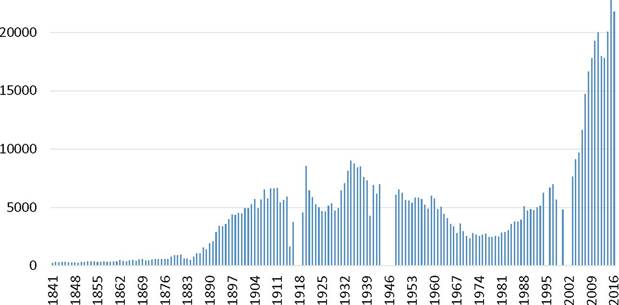
Fig. 4 Number of requests for the jus pro Deo in civil matters brought before the Tribunals of First Instance in Belgium (1840-2016). (From 1841 until 1996, the judicial statistics are available online via http://www.digithemis.be/index.php/ en/ressources/statistiques-judiciaires/stat, accessed 5 May 2020. There are no statistics for 1917 and 1918, probably due to the war and a strike of the judiciary. The statistics for the years 1944-1947 are lacking. The data for the year 1995 was incomplete, with the numbers of a few districts lacking, so I did not add the numВber of this year in the figure.
For the period 1997-2010, I received the judicial statistics from the Steundienst van het College van hoven en rechtbanken/Service d’appui du College des cours et tribunaux, but the years 1999, 2001, and 2002 are lacking. The judicial statistics for the years 2010-2016 are on the website of the Justice Department, https://justitie.belgium.be/nl/statistieken/justitie_in_cijfers, accessed 5 May 2020)2) From the end of the nineteenth century until 1934, we see a gradВual increase in the number of cases. Workplace accidents played a pivotal role. In 1889, they sparked the simplification of the proceВdure regarding the exemption of procedural costs and the enlargeВment of its field of application. They also constitute a large portion of the increase of pro Deo cases in the Belle Epoque (1870-1914). More generally, lawyers seem to have become more liberal and benevolent towards the poor. socialist lawyers especially considered pro Deo as a service towards their voting audience. During the inter- bellum period, the economic crisis also might have had some impact on such increase.
3) From 1934 until the 1970s, we see a gradual decline in the numbers of requests for the jus pro Deo. There are indications that lawyers were responsible for this decline. In the Offices of Free Consultations, they used deterrent techniques to scare away the poor. They interВrogated them harshly about their financial situation and they charged most of them a small fee. Progressive law students reacted, in 1972, by creating a legal shop that provided free legal advice to anyone who could not afford a lawyer. Their initiative showed that there was a problem with legal aid as provided by lawyers, which led to the legislature intervening in 1980.
4) From 1980 onwards, the figures slowly increased. One could again mention the economic crisis in this period, but the main game changer was probably the state paying lawyers for their pro Deo serВvice. In 1994, legal aid became a constitutional right and in 1998, senior lawyers were finally allowed to be remunerated for providing legal assistance to the poor.
5) Because of a number of specific reasons discussed above, there was an exponential increase of cases in the twenty-first century. There was a staggering 22,750 requests in 2015.
6) In 2016, the legislature intervened again, this time to restrain such growth. Thus, we can expect to see a stabilisation or even decrease in the number of requests for the jus pro Deo.