Abbreviations
an URSR Akademiia nauk Ukrainska radianska Sotsialistychna respublika (Academy of Sciences of the Ukrainian Soviet Socialist Republic), Kyiv
CIUS Canadian Institute of Ukrainian Studies, Edmonton and Toronto
MHSO Multicultural History Society of Ontario, Toronto
NANU Natsionalna akademiia nauk Ukrainy (National Academy of Sciences of Ukraine), Kyiv
NTSh Naukove tovarystvo im.
Shevchenka (Shevchenko ScientificSociety)
PAU Polska academia umiej⅞tnosci (Polish Academy of Learning), Cracow
PIW Panstwowy Instytut wydawniczy (State Publishing Institute), Warsaw
PSB Polski slownik biograficzny (Polish Biographical Dictionary)
PWN Panstwowe wydawnictwo naukowe (State Publishing House), Warsaw
RM Russian Museum, St Petersburg
RSFSR Rossiiskaia Sovetskaia Federativnaia Sotsialisticheskaia Respublika (Russian Federal Soviet Socialist Republic)
TG Tretiakov Gallery, Moscow
U kSSR Ukrainian Soviet Socialist Republic
USSR Union of Soviet Socialist Republics
UVAN Ukrainska vilna akademiia nauk (Ukrainian Academy of Sciences in the United States), New York
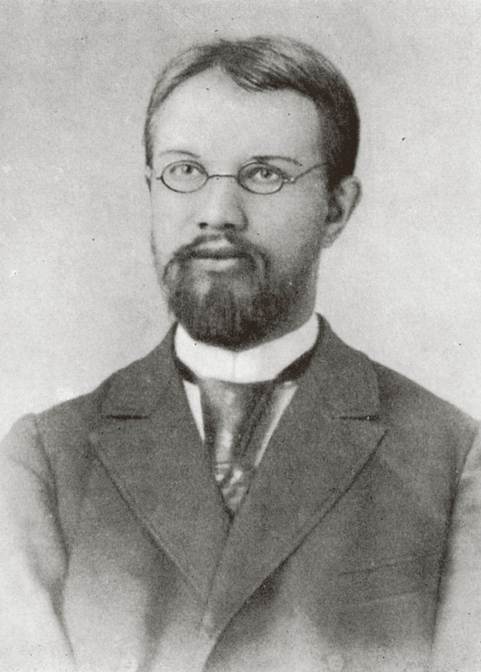
figure 1. Ahatanhel Krymsky. From A. Krymsky, Tvory vp’iaty tomakh, vol. III (Kyiv: Naukova dumka, 1973), frontispiece.
Ahatanhel Krymsky (1871-1942) was an outstanding Ukrainian Middle East scholar, an “Orientalist.” Krymsky (Figure 1), as his surname indicates, was of Crimean Tatar background and sympathies, but also accepted a clearly Ukrainian national identity and was dedicated to the national awakening. He wrote extensively on Islamic and Middle Eastern culture in both Russian and Ukrainian and was an expert on the various Steppe peoples of central Asia, especially those of Turkic linguistic affiliation.
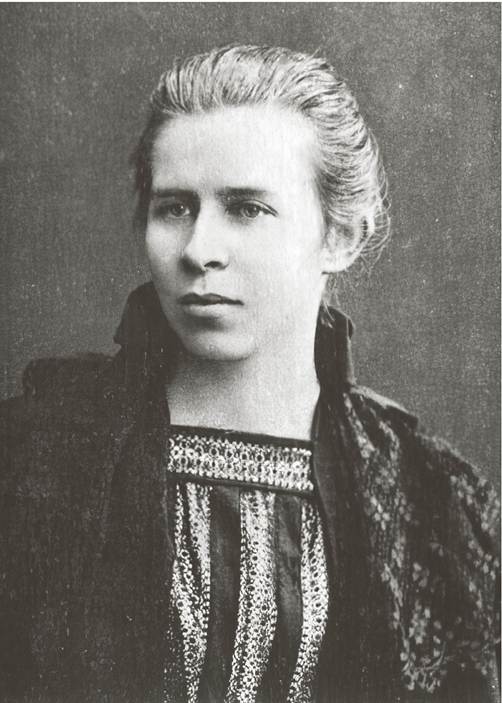
figure 2.
Lesya Ukrainka, early-twentieth- century illustration.Krymsky's contemporary Lesya Ukrainka (Figure 2) - the pen name of Larysa Kosach (1871-1913) - was a great poet. She spoke about ten languages and translated numerous western European works into Ukrainian. She was outraged by the historical enslavement of so many Ukrainians by the Turks and Tatars, but also visited Egypt, wrote a cycle of poetry on Egyptian themes, and penned a play on the love between the Prophet Mohammed and his young wife Aisha.
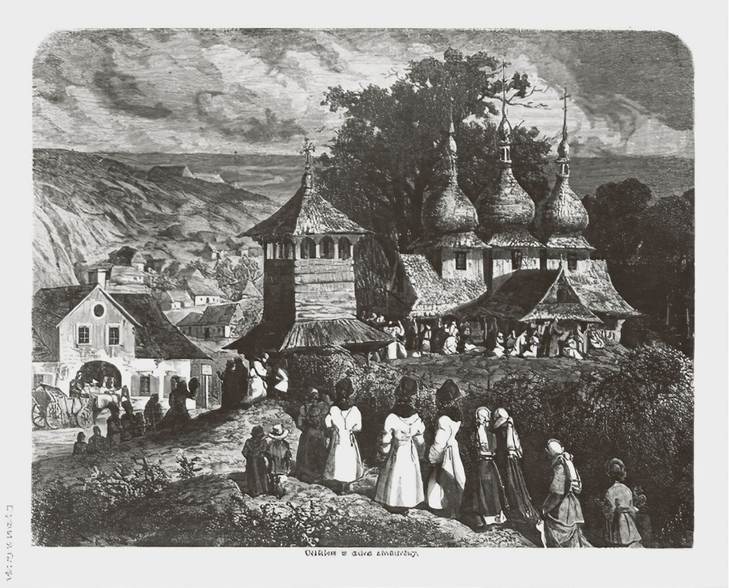
figure 3. Ruthenian Country Folk in Austrian Galicia Going to Church on Sunday, by Juliusz Kossak (1824-1899), illustration. From Wladislaw Zawadzki, Obrazy Rusi Czerwonej (Poznan, 1869), 1.
When the Austrians annexed Galicia in the 1790s, they knew a bit about the Poles in its western parts, but little about its eastern inhabitants, with their different language and form of Christianity. The Austrians revived the old Latin term “Ruthenian” to designate the Eastern Rite residents and renamed their church “Greek Catholic” to raise its stature and bring it on a par with the Poles' “Roman Catholic” church. The Polish painter Juliusz Kossak (1824-1899) toured the province and depicted its peoples in an album published in 1869. In Figure 3, devout country folk head to a wooden Ruthenian church in the foothills of the Carpathians, with the rolling plains of Podolia in the far distance. In 1906 a group of Ruthenians went as pilgrims to the Holy Land led by Metropolitan Andrei Sheptytsky.
id="Picutre 6" class="lazyload" data-src="/files/uch_group78/uch_pgroup304/uch_uch7226/image/image004.jpg">
figure 4. The Church of Saint Sophia (Kyiv), by Abraham van Westerveldt.
From a sketch (1650s), reproduced from O.I. Rudenko and N.B. Petrenko, Vichnyi iak narod: Storinky do biohrafii T.H. Shevchenka (Kyiv: Lybid, 1998).
The great Metropolitan Cathedral of St Sophia in Kyiv (Figure 4), a UNESCO World Heritage Site, founded in 1011, as pictured in the 1650s by the Dutch painter Abraham van Westerfeldt (1620-1692); and the ruins of the Golden (Southern, or Great) Gate of Kyiv (Figure 5) depicted in 1870 by the Polish graphic artist Napoleon Orda (1807-1883).
In the 1650s, the Poles and the Cossacks were still struggling for control of the city, and the drawing shows the Orthodox style of the church and Roman Catholic influences in the great crucifix in the square before it. Just as the Church of St Sophia symbolized the continuity of Ukrainian Christianity from medieval to modern times, so the ruins of the Golden Gate symbolized the destruction caused to Kyivan Rus' by thirteenth-century Mongol invaders from the east.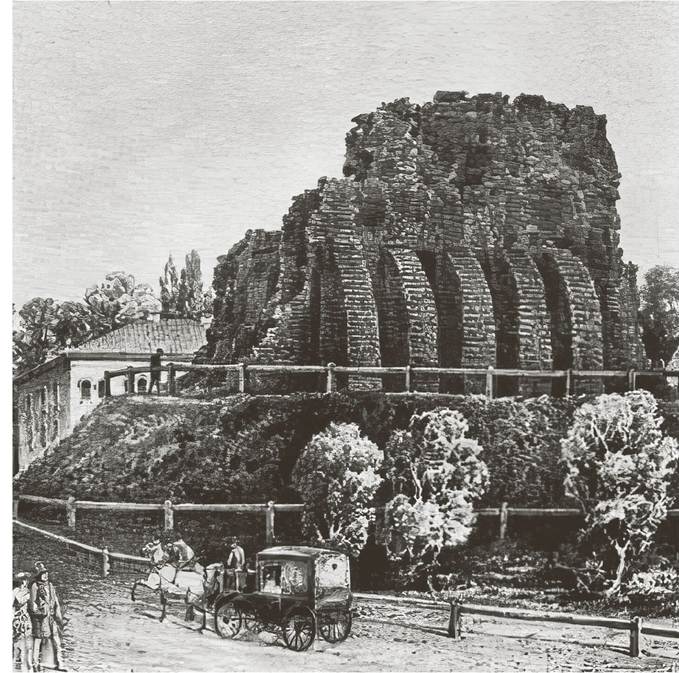
figure 5. The Ruins of the Golden Gates in Kyiv (1870), by Napoleon Orda. From a drawing from “Zoloti vorota,” in Kyiv entsyklopediia online at http ://wek. Kyiv.ua/uk.
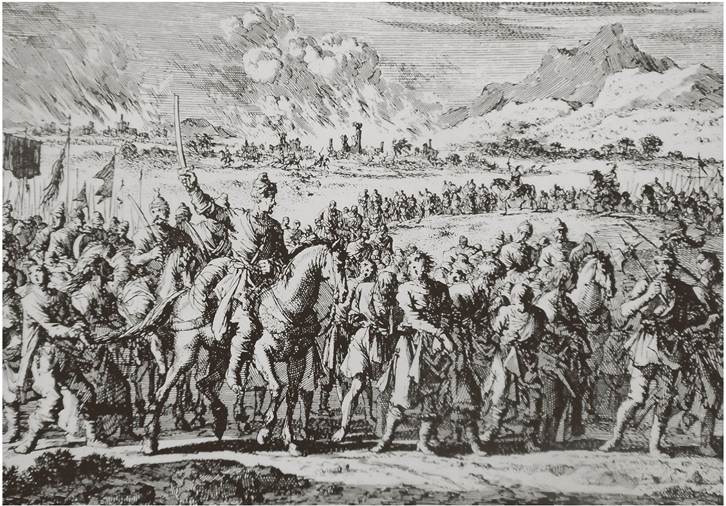
figure 6. Tatars Taking Ukrainians into Slavery, undated engraving. Courtesy of Andrew Gregorovich, Forum: A Ukrainian Review, no. 44 (spring 1980), 32, from the collection of Eugene Kurdydyk.
From about 1450 to about 1750, Tatar raiding parties (heirs of the Mongols) systematically carried off hundreds of thousands of country folk, townsfolk, and others into captivity, perhaps a million or more in total, although statistics are sketchy. Many, especially the old, the weak, and children, did not make it even as far as the Crimea. Those who survived were sold into slavery, many in the slave markets of Istanbul and other cities of the Ottoman Empire. Christian raiders in the Mediterranean, such as the Knights of St John in Malta, attacked Muslim shipping and North African coastal cities to free Christian slaves and carried off many Muslims into captivity, although the Tatar raids on the Ukrainian Steppes seem to have been more intense, more regular, and more destructive.
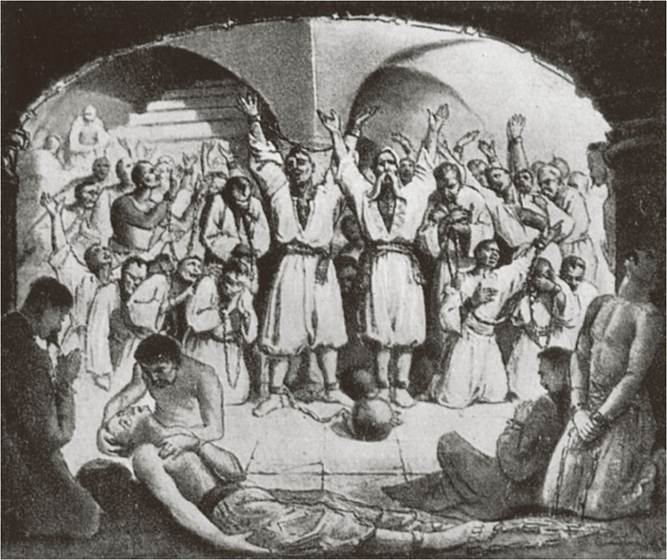
figure 7. Liberation of the Slaves from Turkish Captivity, by Opanas Slastion, drawing.
From Shevchenkivskyi slovnyk, 2 vols. (Kiev: Instytut Iiteratury im Shevchenka, 1976), I, plate between pp. 208 and 209.Figure 7 portrays a scene from Taras Shevchenko's “Hamaliya,” about the liberation of Ukrainian slaves in Turkey by the Cossack Hamaliya. The poem was inspired by a story by the neo-Cossack Mykhailo Chaikovsky / Michal Czajkowski (a.k.a. Sadyk Pasha) and by various reflective songs (dumas) and other sources.
In the nineteenth century, folklore about Tatar slave raiding and Turkish captivity was kept alive by itinerant blind minstrels, such as Dmytro Skoryk (Figure 8), who played their kobzas (multi-stringed instruments) and sang their mournful dumas, usually travelling with a young guide. Heading the list of dumas inscribed on Skoryk's portrait is the legendary Plach nevolnykiv (Lament of the Slaves).
Both drawings are by museum curator, artist, and illustrator Opanas Slastion (1855-1933), who also played the kobza.
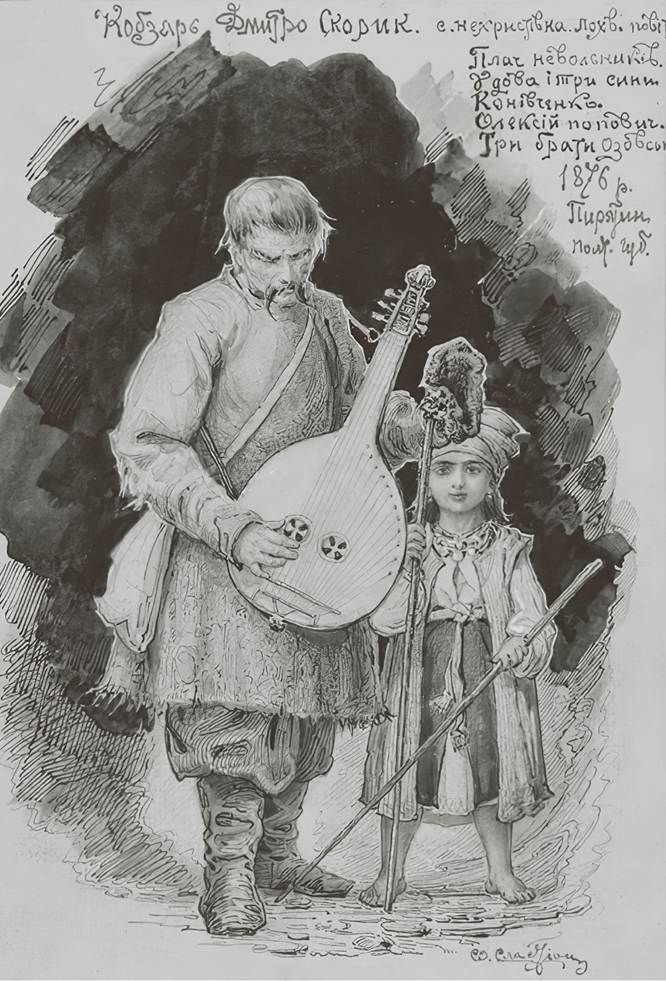
figure 8. Kobzar Dmytro Skoryk, by Opanas Slastion, drawing (before 1930).
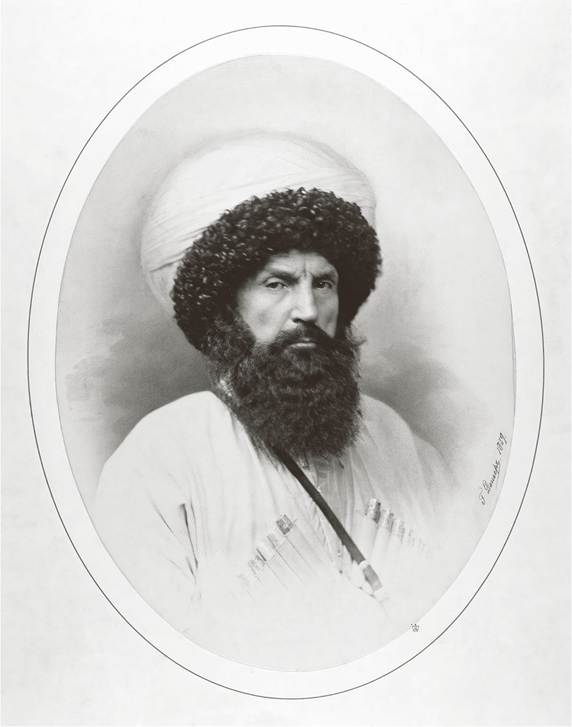
figure 9. Imam Shamil, nineteenth-century magazine illustration.
Imam Shamil ruled Dagestan 1834-59 and became renowned for his forces' resistance to Russian invaders. His mountaineer's dress seemingly was paralleled by the Russian and Ukrainian Cossacks sent to oppose him, and the lines of cartridges along his chest, and kinjal (long knife) hanging at his side, became standard Cossack dress by the end of the nineteenth century.
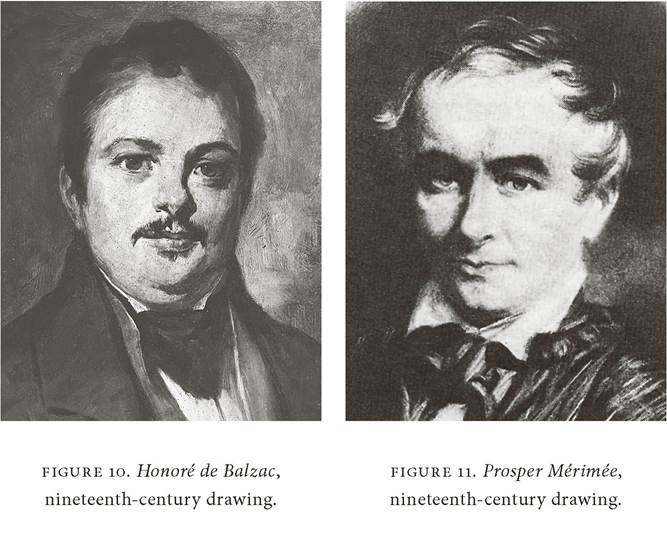
Portraits of the writers as young men: Honore de Balzac (Figure 10), rendered in 1901 by J. Allen St John (1875-1957), based on a drawing by Louis Boulanger, and Prosper Merimee (Figure 11). Balzac, a royalist and deeply conservative, lived in Ukraine 1848-50, but it seems to have been for him an unrealistic dreamland about which he knew little, apart from his brilliant and devoted wife, Ewelina Hanska, nee Rzewuska, and her magnificent chateau, Verkhivnia.
The liberal Merimee wrote much more about Ukraine, but never visited it. While critical of Russian serfdom, he was generally quite russophile. He was fascinated by the freedom-loving Ukrainian Cossacks and by the Ukrainian writer Nikolai Gogol, and wrote a biography of the Cossack hetman Bohdan Khmelnytsky.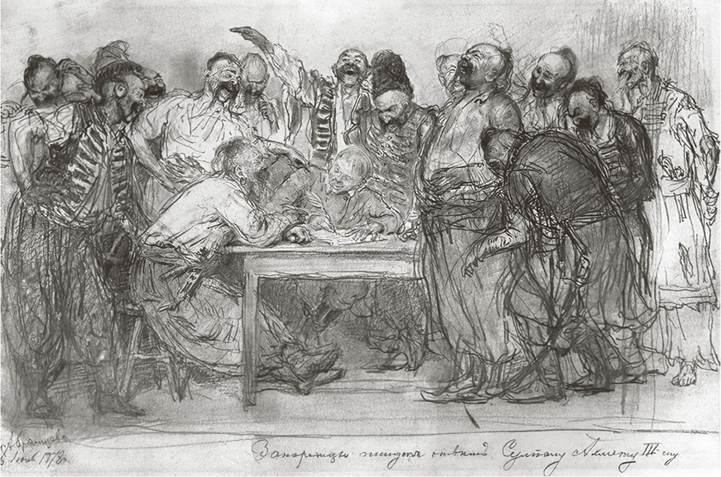
figure 12. Sketch of Ilya Repin’s Defiant Zaporozhians (1878), by Ilya Repin, pencil drawing.
Zaporozhian Cossacks Writing a Satirical Letter to the Turkish Sultan (1891) (see Plate 13) was Ilya Repin's (1844-1930) masterpiece. He worked on it from 1878 to 1891. Although he kept adding new elements, his original, 1878 conception of happy Cossacks grouped around a table, with the secretary of the army penning the letter, never changed. His inspiration came from an article by the Ukrainian historian Mykola Kostomarov. Though living near Moscow and later near St Petersburg, Repin always remembered Ukraine and returned to Cossack themes when in self-imposed exile in Finland, just outside St Petersburg.
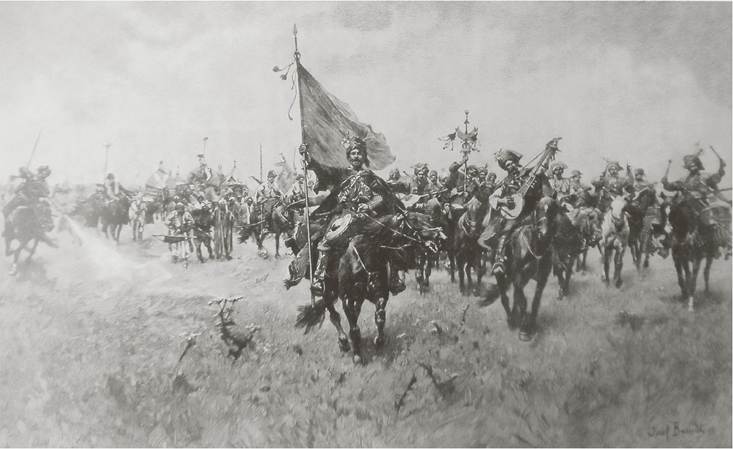
figure 13. Victory Song of the Zaporozhians, by Jozef Brandt. Nineteenth-century magazine illustration from Volodymyr Nadiak, Ukraina kozatska derzhava (Kyiv: Emma, 2007), 301.
Polish artist Jozef Brandt (1841-1915) loved to paint Cossacks, Tatars, horses, and cavalry scenes. He rendered action and movement superbly, but spent very little time on faces. By contrast, the Ukrainian master Ilya Repin was a magnificent portrait artist, but seldom depicted movement. Brandt's Victory Song of the Zaporozhians was exhibited in St Petersburg at the same time in 1891 as Repin's Zaporozhian Cossacks and attracted some attention. But Ukrainians, perhaps partly out of national pride, much preferred Repin's canvas. Nevertheless, Brandt's mounted Cossacks helped create the modern idea of Cossacks as wild but very skilled cavalrymen.
In fact, they began as daring river boatmen (some even crossing the Black Sea to raid the Ottoman Empire), became famous as courageous infantrymen under Hetman Bohdan Khmelnytsky, and only much later developed renown as horsemen.ПРО „СТАГГ ЧАСИ НА У H F А I H І.
ІЛЮСТРОВАНА ІСТОРІЯ УКРАЇНИ НЕ ГРУШЕВСЬКОГО І НЕ АРКАСА.
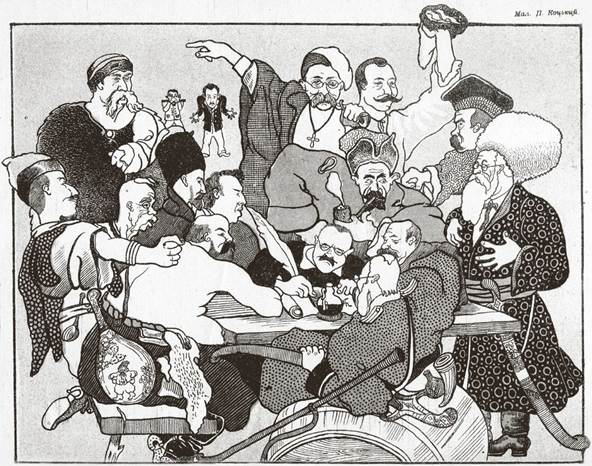
figure 14. Professor Mykhailo Hrushevsky and His Government as Repin’s Defiant Zaporozhians, by Jozef Brandt. Magazine illustration from Volodymyr Nadiak, Ukraina kozatska derzhava (Kyiv: Emma, 2007), 301.
During the Ukrainian Revolution of 1917, the graphic artist P. Kotsky recalled “The Olden Days in Ukraine” in this caricature of Ivan Repin's iconic Zaporozhian Cossacks (see Figure 12; Plates 13, 14), which shows Professor Mykhailo Hrushevsky and his colleagues of the Ukrainian Central Rada (the autonomous Ukrainian government), in Kyiv. They were struggling against the centralizing tendencies of Kerensky's Russian Provisional Government in Petrograd. Hrushevsky is the white- bearded, Taras Bulba figure on the far right; Oleksander Lototsky, his minister for religious affairs, is either the secretary writing the Cossack letter to Sultan Kerensky, or the bespectacled Cossack pointing him out in the distance; the Cossack at the back holding his cap up high is probably the historian Dmytro Doroshenko; and Symon Petliura is the clean-shaven Cossack sitting opposite Professor Hrushevsky.
Steppes, forets, deserts victor Hugo, “Mazeppa” (1829),1 describing Ukraine
Ukrainians are one of the most orientalized... of the western peoples. mykhailo hrushevsky (1918)
“Ukraine, like [the god] Janus of [ancient] Rome, has two faces: one turned towards the West, and a second turned towards the East.” But of this second, eastern face, we know practically nothing. ivan Krypiakevych (1966)