Background
The years 1340 to 1772 comprise the Polish era of Galician history. This era actually began with a transition period following the assassination in 1340 of lurii II, the last Romanovych ruler of the Galician-Volhynian Kingdom, and the entry of Polish forces dispatched by Casimir the Great (reigned 1333-1370), who laid dynastic claims to Galicia as part of his expansive drive toward the east.
For close to half a century, from 1340 to 1387, Galicia was to experience almost continuous instability because of foreign invasion by Tatars and by various claimants to rule Galicia and Volhynia, as well as revolts led by local boyars. Among the claimants to the Galician-Volhynian patrimony were its neighbors, Poland, Lithuania, and Hungary, each of which ruled the territory for varying periods of time. Finally, by 1387, Poland reached agreements with Lithuania and Hungary, so that from that time Galicia remained under the jurisdiction of the kings of Poland. As for the principality of Belz (which since 1234 had been part of Galicia), it too came under Polish sovereignty, but first as part of Mazovia and then as a distinct palatinate; neighboring Volhynia was incorporated into the Grand Duchy of Lithuania.Within Poland, Galicia was initially known as the Rus’ land (Ziemia Ruska or Rus Czerwona). Its boundaries more or less coincided with those of the medieval principality of Galicia (before the 1234 acquisition of Belz), and it was ruled by deputies (starosta) appointed by the king to handle administrative, legal, and military affairs. During the first decades of the fifteenth century, Galicia was administratively integrated with other lands in the Polish Kingdom, and it became the Rus’ palatinate (WojewodztwoRuskie) with its administrative center in L’viv. The Rus’ palatinate was further divided into four administrative-territorial units known as lands (ziemie)·.
L’viv, Halych, Przemysl, and Sanok. During the sixteenth century, a fifth land, Chelm, was added to the Rus’ palatinate. By 1434, the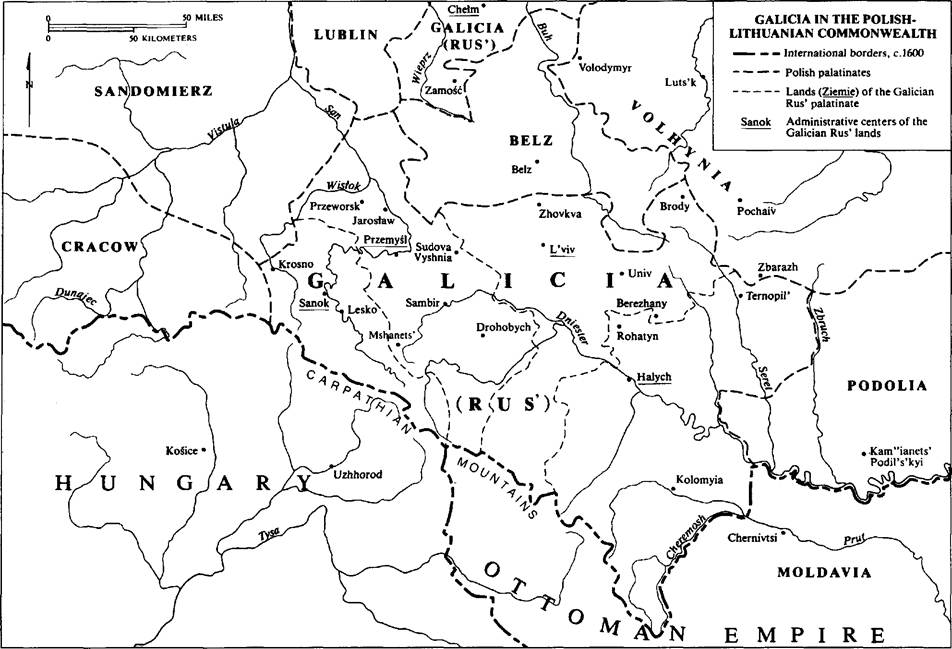
Polish court system was introduced and the Galician nobility was given more clearly defined privileges by the king.
Even before consolidating its control in 1387, Poland’s rulers tried to make Galicia politically, socially, and culturally a part of Poland. With regard to Galicia’s traditional ruling class, the landowning boyars, those who had fought against Polish expansion were forced to give up their holdings and emigrate to Orthodox Rus’ lands held by Lithuania in the east or to Orthodox Moldavia and Wallachia in the south. On the other hand, many boyars received charters from Polish kings confirming their property rights and even awarding them new lands. A portion of the Galician ruling elite was thereby co-opted into the new political system, and although they retained their Rus’ faith, as members of Poland’s heraldic nobility (szlachta) they later came to consider themselves Poles in terms of political loyalty. Noble status was particularly important in Poland, because by the sixteenth century that country had, in essence, become a “republic of nobles,” in which at the national and in particular the local level, political, legal, socioeconomic, and to a large extent cultural life was controlled or directed by the nobility. To be sure, there were great discrepancies between wealth and therefore power in the different strata of the nobility-magnates, gentry, petty gentry-but in theory all were politically equal and held hereditary rank. The desire among Galicians to enjoy all the privileges and social prestige of noble status in Poland led many to abandon their Rus’-Ukrainian faith and language for Roman Catholicism and Polish culture. This assimilatory trend among the upper strata of Galician-Ukrainian society was particularly marked beginning with the second half of the sixteenth century.
Polish rule also brought into the Galician countryside an influx of Polish and central European nobles as well as Roman Catholic peasants. In towns and cities, the numbers of Germans, Poles, and Armenians increased, and these were later joined by Jews. Since the noble’s wealth depended on landholding and the exploitation of agriculture, and since Poland’s economy was restructured to respond to the demand for grain exports during the sixteenth century, the need for a fixed labor supply became paramount, resulting in the legal enserfment of the peasantry. Although there were variations throughout Galicia, by the end of the sixteenth century, serfdom was the norm and some peasants were obliged to provide an ever increasing number of work days for the domains of their lords.
The Polish presence in Galicia also affected culture. As in the rest of Poland, Latin became the official language of administration. The Roman Catholic church expanded its activity, establishing a Latin rite archdiocese in Halych as early as 1365; it was later transferred to L’viv in 1414. The L’viv archdiocese also became the metropolitan see for Roman Catholic dioceses serving not only the Rus’ palatinate (L’viv-Halych, Przemysl, Chetm), but all the Ukrainian lands as well. Concomitantly, there was a decline in the status of the Orthodox church (comprising the dioceses of Halych-L’viv, Chehn, and Przemysl in Galicia). The distinct Galician Orthodox metropolitanate formed at the outset of the fourteenth century to unite these dioceses fell victim to the complexities of eastern church politics, especially the opposition from the metropolitan of Kiev and all Rus’ residing in Moscow. In 1401, the Galician metropolitanate was abolished and its dioceses made subordinate once again to the metropolitan see of Kiev. Even more serious was the fact that the Orthodox bishop of Halych was not replaced after 1406, and for the next 130 years the diocese was administered by lay persons, many of whom were appointed by the Roman Catholic archbishop of L’viv-Halych.
Although the Orthodox bishopric of Halych was restored in 1539, the fate of the Orthodox church in Galicia-which was the symbol of Rus’-Ukrainian culture in the region-continued to decline.The Ukrainian reaction to these developments took different forms. Whereas the increase in serfdom prompted sporadic peasant uprisings, the most famous being one in southeastern Galicia in 1490-1492, led by a Moldavian named Mukha, a more typical pattern was flight eastward. In fact, much of the virgin Ukrainian steppe in the Dnieper valley was settled during the sixteenth and seventeenth century by peasants fleeing Galicia.
On the cultural front, there occurred a revival during the sixteenth century aimed at restoring the legal and moral status of the Orthodox church and in improving its intellectual standards. First led in the 1570s by Orthodox nobles from Galicia and most especially Volhynian magnates led by Prince Konstantyn of Ostrih (1527-1608), the cultural and religious revival was before long centered in the cities, especially L’viv. There, in the 1580s, a group of townsmen and petty nobles founded a brotherhood in association with the Orthodox Church of the Assumption. Although established at lay initiative, the L’viv Assumption Brotherhood strove to enhance the status of the Orthodox church and community through the establishment of schools, printing houses, hospitals, and orphanages. Most important, the L’viv brotherhood received, in 1589, the status of staurope- gia, that is, it was responsible only to the patriarch, or head of the Orthodox church in Constantinople, and not to the local Orthodox bishop. The L’viv Assumption, or Stauropegial Brotherhood, also became the leader and provided the model for other brotherhoods that were established not only in Galicia (Przemysl, Rohatyn, Horodok) but also in Kiev and other cities of Volhynia and Belorussia.
In a sense, by the late sixteenth century, Galicia, and especially L’viv, became the most important center of religious and intellectual life for all Orthodox Rus’ lands within Poland.
It is, therefore, not surprising that the controversial question of church unity was related in large measure to developments in Galicia. Actually, since the split between Rome and Constantinople in 1054, there had been several attempts to unite the Catholic and Orthodox worlds. Even the magnates who led the Orthodox Rus’ cultural revival in Poland during the 1570s discussed the feasibility of church union.It was actually the Orthodox bishop of L’viv, Gedeon Balaban (1530-1607, consecrated 1569), who initiated a new attempt at union. Jealous of the prerogatives and what he perceived as interference in church affairs by the Stauropegial Brotherhood, Balaban turned to the Roman Catholic archbishop of L’viv and began to discuss the possibility of union. Balaban was joined by several other Orthodox bishops and the metropolitan of Kiev; encouraged by the Polish king, two Orthodox hierarchs journeyed to Rome and declared for union. Upon their return they called a synod at Brest in 1596 and proclaimed the union. In the meantime, however, Bishop Balaban had changed his mind, and backed by several Orthodox magnates and the brotherhood, he opposed the Union of Brest that had brought into being the so-called Uniate church, that is, one whose liturgy and practices (including married clergy) remained Eastern Orthodox but which recognized the Pope as supreme authority. For his part, the Polish king not only recognized the new Uniate church as legal, he at the same time outlawed the Orthodox church and its supporters.
The precarious position of the Orthodox church in Galicia and other Rus’ lands within Poland was somewhat improved by the issuance of several decrees legalizing its existence and culminating in a royal charter of 1632. However, after the Zaporozhian Cossack revolution of 1648, the position of the Orthodox church worsened considerably and Orthodox hierarchs in Galicia at first secretly and then openly passed over to the Uniate church. Finally, in 1708, the Stauropegial Brotherhood, which from its establishment had been the primary defender of Orthodoxy, became Uniate.
While the more than century-long struggle since the Union of Brest resulted in the abolition of Orthodoxy in Galicia, it also prompted a spirited Uniate-Orthodox polemic enhanced by numerous publications produced on local printing presses and written by talented authors like Ivan Vyshens’kyi (c. 1550-1620) and Lavrentii Zyzanii (d.c. 1634), who were either natives of or worked in Galicia. The territory also produced a number of Orthodox leaders who emigrated eastward where they played an important role in Ukrainian developments, such as the Zaporozhian Cossack hetman, Petro Konashevych Sahaidach- nyi (d. 1622); archimandrite of the Monastery of the Caves in Kiev, lelysei Pletenets’kyi (1550-1624); and metropolitan of Kiev, lov Borets’kyi (d. 1631, consecrated 1620). Finally, while.the Uniate church was subordinate to Rome, it did maintain the liturgy and traditions of the Orthodox world, so that by the eighteenth century this hybrid ecclesiastical structure was well on its way to becoming the symbol of Galician-Ukrainian culture and identity.In reality, Galician society during the Polish era became divided into several different classes that coincided largely with different ethnic groups. The Ukrainians comprised the vast majority of the enserfed peasant masses and a small strata of Orthodox and later Uniate clergy. The Ukrainian elite, that is, the few magnates and larger number of gentry who had at least retained their ancestral Orthodox faith before the Union of Brest, rapidly converted to Latin Rite Catholicism and assimilated totally to Polish culture during the seventeenth century. This process was to a lesser degree true among the petty gentry (especially in the villages), many of whom remained adherents of the eastern church and continued to use Ukrainian in their everyday lives. As for burghers, these were primarily Jews and smaller numbers of Armenians and Germans who dominated urban and smalltown commercial and artisan activity. The Poles, including some rural peasants and urban dwellers, dominated the administrative/noble class, which was made up either of individuals who had immigrated from western Polish lands or local polonized Ukrainians.
Polish domination over Galicia-both political and cultural-seemed complete during the late seventeenth and most of the eighteenth centuries. The only brief threat came during the great Cossack revolution of 1648 led by Hetman Bohdan Khmel’nyts’kyi (c. 1595-1657). Khmel’nyts’kyi invaded Galicia twice and laid siege to L’viv in 1648 and 1655, but his presence did not alter the existing sociopolitical system, although discontented peasants revolted and then fled eastward when the Cossacks retreated.
Another form of protest against Polish rule-peasant uprisings and the brigand movement iopry shky)-occurred during the late seventeenth and early eighteenth centuries. However, the peasant movement was sporadic, while the brigands restricted their activity to the Carpathian Mountains and the Pokuttia region as far as the Dniester River. Thus, Polish rule remained firmly entrenched in Galicia and was basically undisturbed by internal developments. It was only the international situation of the 1770s, leading to the first partition of Poland by her neighbors, that was to have a decisive impact on Galicia’s future.
More on the topic Background:
- Background Context
- The Iconoclastic Controversy
- KARAITES
- Introduction: Repurposing an Extant Constitution
- Conclusions
- NIGERIA: PLURALISM AND THE POLITICS OF ISLAMIZATION
- Conclusion
- In speaking of “African constitutionalism” throughout this book, I am neither implying that there is a specific type of constitutionalism that is peculiarly African, nor suggesting that the experience or feature I am discussing is true or applicable for the whole continent.
- Introduction
- EAST AFRICA