41 Carpatho-Ukraine, 1938-1939
Ukrainian territories located farthest to the west—specifically Subcarpathian Rus’ (present-day Transcarpathia) in interwar Czechoslovakia—were the first to be affected by rapidly changing political developments of late-1930s Europe that were to lead to the outbreak of World War II.
Ever since the conclusion of the various treaties connected with the Paris Peace Conference (Versailles, St Germain, Trianon, Sèvres), Europe had been divided among those states which wanted to maintain the political status quo (Great Britain, France, Poland, Czechoslovakia, Romania, Yugoslavia), and those which called for the revision of existing borders (Germany, Italy, Hungary, and Bulgaria).
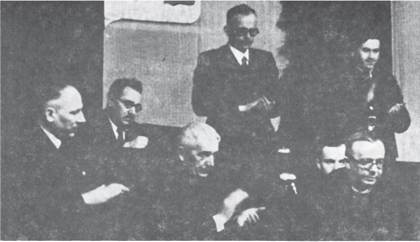
41.1 Subcarpathian deputies and senators in the Czechoslovak parliament, October 1938; all national orientations worked for implementation of autonomy, including the Russophile Stepan Fentsyk (seated far left), the Rusynophile Andrii Brodii (seated far right), and the Ukrainophile Iuliian Revai (standing far right).
MAP 41 CARPATHO-UKRAINE, 1938-1939

The largest revisionist state was Germany, which from the outset of 1933 was governed by the Nazi party under its undisputed dictator, Adolf Hitler. Central to Hitler’s plans for a new Germany was territorial expansion in order to assure that the German people had sufficient “living space” (Lebensraum). Central and eastern Europe, including Ukraine, were earmarked for Nazi Germany’s territorial expansion.
Hitler first turned to his immediate neighbors, annexing Austria in March 1938 and then making threatening gestures toward Czechoslovakia. He accused that Slavic state of violating the rights of its three-million strong German minority living in the so-called Sudetenland along the edges of the triangle that formed the western part (Bohemia and Moravia) of Czechoslovakia.
The growing political crisis and possible war over the Sudetenland was averted when Czechoslovakia’s allies, Britain and France, refused to come to the assistance of their ally and capitulated to Hitler’s demands. They were outlined in what became known as the Munich Pact of September 28-29, 1938. The result of what became known as appeasement was Nazi Germany’s annexation of the Sudetenland as the first stage in border revision directed at Czechoslovakia. The second stage came a few weeks later, when, as a result of the First Vienna Award (November 2, 1938), Germany’s ally Hungary was given the southern, mostly Magyar-inhabited regions of Czechoslovakia’s two eastern provinces, Slovakia and Subcarpathian Rus’.
41.2 The Magyar inhabitants of Berehovo welcome Hungarian troops in November 1938, the first stage in Hungary’s territorial expansion. The Hungarian-language heading reads: The Return of Subcarpathia.
What remained after these border changes was a fractured or “rump” Czechoslovakia. Post-Munich Czechoslovakia was also structurally transformed, so that Subcarpathian Rus’ as well as Slovakia, which throughout the interwar years had demanded the implementation of full autonomy, were finally granted their wishes. On October 11, 1938, autonomous Subcarpathian Rus’ received its first governmental cabinet made up of local leaders primarily of Rusynophile and Russophile national orientation. Within two weeks, however, the Czechoslovak government appointed a new cabinet dominated by local Ukrainophiles under the leadership of the Greek Catholic priest and educator, Avhustyn Voloshyn.
Autonomous Subcarpathian Rus’ was actually a quite small territory. After the November 2 territorial award to Hungary, the autonomous province lost its three largest cities (Uzhhorod, Mukachevo, and Berehovo), forcing the government to make its capital in the small town of Khust farther east.
What remained of Subcarpathian Rus’ measured only 4,300 square miles (11,000 square kilometers) with a population of 552,000, of whom 75 percent were indigenous Slavs who identified themselves as either Russians, Rusyns, or Ukrainians.Despite the yet-undecided nationality question, Voloshyn’s government tried to transform Czechoslovakia’s far eastern autonomous province into a Ukrainian mini-state. Its name was popularly (although not formally) changed to Carpatho-Ukraine, Ukrainian was made the official language, and elections to a diet were held on a one-party Ukrainian slate (February 1939). Carpatho-Ukraine also attracted the attention of Ukrainian communities throughout central Europe and North America who saw the small region as a possible territorial base (as Piedmont had been for nineteenth-century Italy) from which a larger independent Ukrainian state might develop. Galician Ukrainians and members of the underground Organization of Ukrainian Nationalists (OUN) flocked to the region to join the Carpathian Sich, a military force authorized by Voloshyn’s government to defend the autonomous territory from incursions carried out by Hungary from the south and Poland from the north. Even some circles in the Nazi hierarchy toyed with the Ukrainian Piedmont idea, and Germany opened a consulate in Carpatho-Ukraine’s capital of Khust, which gave encouragement to the political hopes of local Ukrainophile activists.
Hitler had more grandiose plans for Ukraine, however, and tiny Carpatho-Ukraine was simply too unimportant to be a part of them. On March 14, 1939, Nazi Germany destroyed what remained of rump Czechoslovakia. That very day Germany annexed the rest of Bohemia and Moravia. Hitler also allowed the Slovaks to create an “independent” state in close alliance with Nazi Germany and he authorized Hungary to annex the rest of Subcarpathian Rus’, that is, Carpatho-Ukraine. As Hungarian troops were marching on Khust, Carpatho-Ukraine’s recently-elected diet hastily convened on March 15, 1939, and declared independence, giving rise to the somewhat ironic epithet of Carpatho-Ukraine as “the republic for a day.” The Carpathian Sich military put up resistance, but within three days all of Subcarpathian Rus’/Carpatho-Ukraine was reannexed to Hungary.
It was to remain a part of that country until the autumn of 1944.
41.3 Seat of Carpatho-Ukraine’s government in Khust, 1939.
41.4 The Greek Catholic priest, Avhustyn Voloshyn (1874-1945), seated far right, is elected president of Carpatho-Ukraine, March 15, 1939.

41.5 A Hungarian soldier (on the right) greets his Polish counterpart on the northern edge of Carpatho-Ukraine, which after March 15, 1939 was the common border between Poland and Hungary.