40 Ukrainian Lands in Interwar Romania and Czechoslovakia
Ukrainian-inhabited lands in interwar Romania were found in three distinct areas—Bessarabia, Maramure§, and Bukovina—which before World War I had belonged to three different political entities.
In terms of the number of inhabitants (461,000), the largest of Romania’s Ukrainian lands was the Black Sea coastal region between the mouths of the Dniester and Danube rivers; that is, the southernmost section of the former tsarist Russian province of Bessarabia.Following the 1917 revolutions in the Russian Empire, Bessarabia’s majority population, the Romanians, formed an independent republic of Moldavia (January 1918), which two months later proclaimed its unity with the neighboring Kingdom of Romania. International recognition was slow in coming, until on October 28, 1920, several European states signed the Bessarabian Protocol, which recognized Romania’s acquisition. Notably, Soviet Russia did not sign the protocol and therefore never accepted what it considered Romania’s “occupation” of Bessarabia. Bolshevik leaders in Moscow argued that Bessarabia had been part of the Russian imperial heritage and therefore it should belong to the Soviet Union. For its part, the Ukrainian population concentrated in southern Bessarabia did not have a high level of national consciousness. Nevertheless, during the interwar years the Romanian government did permit Ukrainian-language instruction in about 120 schools and the operation of some agricultural cooperatives.

40.1 Bessarabian Ukrainian farmers at rest alongside their field sheds.
The smallest of Ukrainian lands in Romania was the Maramure§ Region, which until 1918 had formed the southernmost part of the Hungarian county of Maramaros. Romania’s Maramure§ Region included about 17,000 East Slavs who called themselves Rusyns or Hutsuls and who were cut off from their brethren north of the Tisza/Tysa River in that part of former Maramaros county annexed to Czechoslovakia.
As in Bessarabia, so too in Romania’s Maramure§ Region, the level of Ukrainian national consciousness was low to non-existent.Much different was the situation in Romania’s third Ukrainian-inhabited land. This was Bukovina, which before World War I was an Austrian province of the Habsburg Empire. About 302,000 Ukrainians lived in the northern and western parts of the province. Immediately following the collapse of Austria-Hungary, in November 1918 local Romanian activists invited armed forces from the Kingdom of Romania to enter and annex all of Bukovina. Romania’s annexation was subsequently confirmed at the Paris Peace Conference’s Treaty of St Germain-en-Laye (September 10, 1919).
Under prewar Habsburg rule the Romanians of Bukovina had to be content with the status of political equality alongside Germans, Ukrainians, and Jews. Now, during the interwar years and in “their” state, Bukovina’s Romanians felt they finally had the opportunity to refashion their regional homeland into a bastion of Romanianness. Symbolic of these efforts was the former Habsburg provincial capital of Czernowitz (Ukrainian: Chernivtsi), which as Cernăuţi was rapidly transformed into a center for Romanian civic, cultural, and religious life.
The new political conditions were to have a profound impact on Bukovina’s East Slavic population, which, as a result of favorable political conditions in prewar Habsburg-ruled Bukovina, had acquired a highly developed Ukrainian national identity. This was to be of particular concern to the authorities of interwar Romania, who were determined to create a centralized state in which no region would have any special status and in which the Romanian language and culture would be the dominant element. All of the distinct administrative institutions in Habsburg Bukovina which had brought advantages to Ukrainians were therefore abolished. Instead, Bukovina was ruled by martial law for a decade (19181928), the province as a specific administrative entity with its own elected diet ceased to exist, and the local Orthodox metropolitanate was made jurisdictionally subordinate to the Romanian Orthodox Church and therefore an instrument of state policy.
Government policy was guided by the principle of romanianization, whereby Bukovina’s Ukrainians were formally classified as “Romanians who had lost the native tongue of their ancestors.” Consequently, between 1924 and 1927 the Ukrainian-language elementary educational system built up during Habsburg rule (255 schools) was closed. Also, all Ukrainian-language secondary schools and departments at the University of Chernivtsi were also closed. Clearly, by the end of the interwar years the Ukrainians, especially in Bukovina, were among the worse treated of all Romania’s national minorities.
40.2 The main square in interwar Chernivtsi, renamed Union Square (Romanian: Piaţa Unirii), to remind inhabitants of the November 28, 1918 decision of the Romanian General Council of Bukovina that the city and region are “unconditionally and forever united with Romania.”
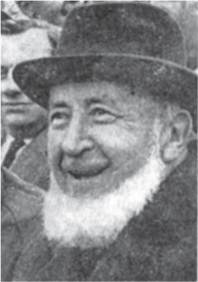
40.3 Volodymyr Zalozets’kyi-Sas (1884-1965), art historian and civic and political activist, from 1927 to 1938 head of the Ukrainian National party and main defender of Ukrainian political and cultural interests in Romanian-ruled Bukovina Czechoslovakia
The situation in the Ukrainian lands of interwar Czechoslovakia was radically different from Romania and for that matter from Poland as well. The East Slavic inhabitants living south of the Carpathian Mountains in the former Hungarian Kingdom, who called themselves Rusyns or Subcarpathian Rusyns, voluntarily joined the new state of Czechoslovakia in May 1919. They lived, moreover, in the only territory within the future Ukraine which was specifically guaranteed self-governing status (autonomy) according to international treaties (St Germain, September 1919, and Trianon, June 1920). Finally, the state of Czechoslovakia remained throughout the interwar years a republic with a functioning democracy headed until 1935 by a founding president (Tomas G.
Masaryk) who was favorably inclined not only to the Subcarpathian Rusyns but also to Ukrainian and Russian political emigres from the Soviet Union who sought refuge in the country.Despite the clauses of the Treaty of St Germain, only a portion of the Rusyns (372,000 in 1921) lived in Czechoslovakia’s far eastern province of Subcarpathian Rus’ (Czech: Podkarpatska Rus), the present-day Transcarpathian oblast of Ukraine. The remainder (86,000) inhabited territory just to the west that was placed under a Slovak administration in the so-called Presov Region in present-day northeastern Slovakia. Subcarpathian Rus’ had its own governor appointed from among the local Rusyn population, as well as a provincial diet (after 1928) and elected representatives in both houses of the national parliament. It is true that the two basic demands of local politicians —implementation of full autonomy and unification of Rusyn-inhabited lands in Slovakia with Subcarpathian Rus’—were not achieved during the interwar years. Nevertheless, Czechoslovakia’s Rusyns did acquire for the first time concrete experience within a working democracy.
The Czechoslovak authorities were particularly helpful in the educational and cultural spheres. During the last years of Hungarian rule, there were only thirty-two elementary schools in which some Rusyn vernacular was taught. In contrast, after two decades of Czechoslovak rule, there were by 1938 over five hundred schools at the elementary, middle, and technical level in which some East Slavic language was taught. The lack of specificity regarding language of instructon in schools was related to the question of national identity.
Subcarpathia’s civic, religious, and cultural activists were divided between those who believed that the local East Slavic inhabitants were either Russians, or Ukrainians, or a distinct Rusyn nationality. Therefore, school classes were taught in one of those three East Slavic languages, depending on the preference of the teacher.
Each of the national orientations (Russophile, Rusynophile, and Ukrainophile) also had its own cultural organizations, newspapers, and publishing houses. As well, the nationality question influenced—and was, in turn, influenced by—religious developments. Until World War I, virtually all Subcarpathia’s East Slavs were Greek Catholic. During the interwar years, however, nearly one-third became Orthodox, and this generally meant accepting a Russian national identity. The Greek Catholic Church, meanwhile, remained the stronghold of the Rusyn and to a lesser degree Ukrainian orientations. While the degree of strength and influence of the three national orientations varied from time to time, by the end of this period the East Slavic population remained more or less evenly divided between Russophiles, Rusynophiles, and Ukrainophiles.
40.4 The Galago district in Uzhhorod, which the Czechoslovak regime transformed in the 1930s from a small village-like town into a modern administrative center.
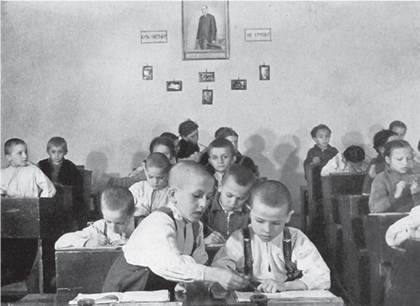
40.5 Pupils in a Rusyn-language school in Subcarpathian Rus’ under a portrait of the founding president of Czechoslovakia, Tomaš G. Masaryk.
Subcarpathian Rus’ was also home to large numbers of Magyars/Hungarians and Jews. The Magyars, who comprised 15 percent of the population, for the most part earned their livelihood as peasant farmers and were concentrated on the lowland plain in the southwestern corner of the province along its border with Hungary. The Jews, representing 14 percent of the population, not only made up a plurality or majority of the population in several cities and smaller towns, but also lived in small mountain villages where they worked the land as small-scale farmers and woodcutters. Both Magyars and Jews, as well as smaller numbers of Germans and Gypsies, had been living alongside Rusyns in the region for centuries.
An entirely new group consisted of Czechs (27,000 by the 1930s), who came to Subcarpathian Rus’ to serve in the provincial government’s civil service, its educational and health systems, and as businessmen.The Magyar population was divided politically between those who favored a return of Hungarian rule and those who were willing to accommodate to the new Czechoslovak regime. The Jews were even more deeply divided between traditional Hasidim fiercely loyal to wonder-working rebbes based in the towns of Mukachevo (Yiddish: Munkatch) and Satu Mare (Yiddish: Satmar) in nearby Romania, and secular Zionists who ostentatiously denigrated the Orthodox way of life and urged assimilation to Czech culture or, preferably, emigration to Palestine.
The democratic nature of the Czechoslovak state tolerated the varied and often conflicting political, cultural, and religious orientations among Subcarpathia’s Rusyns, Magyars, and Jews. The central government based in far-away Prague was less successful, however, in resolving the most difficult problem facing the local population—poverty. Despite large-scale state investments in Subcarpathia’s infrastructure (bridges, roads, hydroelectric systems, hospitals, and schools), over four-fifths of the region’s population (including the large Magyar minority as well as East Slavs) was engaged in small-scale subsistance-level farming and forest-related work. Land reform was instituted, yet by the 1930s nearly 90 percent of peasant farmers still had less than the minimum amount of land (twelve acres or five hectares) needed to support a single family. Local industries were too small in size and limited in number to employ the surplus agricultural work force. The result was mortgage foreclosures, strikes, grain shortages, and even starvation. Such factors contributed to the desperate plight of the population, which regardless of national background continued to support one of the strongest political parties in Czechoslovak-ruled Subcarpathian Rus’ throughout the interwar years, the Communists.

40.6 Subcarpathian Rus’ was one of the few areas in central and eastern Europe where Jews owned and worked the land and forests.