CHAPTER ONE Introduction
In 1848 an anonymous critic dismissed the agricultural success of Men- nonites in New Russia on the grounds that ‘the land of the Mennonites is, as I understand it, not steppe, but...
an oasis on the steppe.’1 Years later a Mennonite described a different scene, recalling his grandmother’s stories about helping to found the village of Gnadenfeld in 1835: ‘They came to a barren steppe... no tree, no bush, only tall, dry, bitter grass and prickly camel fodder grew on the dry, cracked ground.’2Faced with common environmental, economic, and administrative conditions, why did the diverse groups of settlers in the Molochna River Basin of New Russia (now southern Ukraine) pursue sharply divergent paths of development? The starkly contrasting images captured in the above descriptions suggest four interlocking themes that form the foundations of an answer. First, human efforts transformed a near-desert into an ‘oasis.’ When Ukrainian peasants arrived in 1783 they found an isolated, uninhabited stretch of steppe land. Within fifty years, however, the Molochna basin was filled and overflowing, with villages dotting the shoreline of the river and up the banks of its tributaries, and coundess attendant horses, cattle, and sheep pastured across the landscape in search of good grazing. By the mid-nineteenth century ploughed fields were replacing pastures while, here and there, villages had become towns, with textile mills, forges, and brick works to serve the bustling communities. This book examines the processes of colonization, the ways that people transformed their environment on the Ukrainian steppe frontier, and how, in turn, the people were transformed by the environment.
Second, perceptions of the environment on the frontier can be distinguished along cultural lines - Orthodox Christian Ukrainian settlers; sectarian Russian settlers; German-speaking Mennonite, Catholic, and Lutheran settlers; and Turkic-speaking Muslim settlers (Nogai) - and these culturally distinct perceptions translated into distinct agricultural and social practices.
To the semi-nomadic and pastoralist Nogai Tatars the ‘barren steppe’ was not barren at all, for Nogai were accustomed to eking out a living in an arid environment. The transformation of the Molochna basin from ‘cracked ground’ to ‘oasis’ required intensive methods of husbandry, and the social and cultural adjustments demanded by such adaptation would pose an enormous obstacle to Nogai prosperity. In contrast to Nogai, most settlers to Molochna brought with them agricultural systems largely suitable for grain production. They suffered catastrophic crop failures and desperate shortages until they learned to adjust their methods to less intensive forms of agriculture. In exploring these adaptive processes this book forms a comparative study of the ways that differing ethnocultural traditions effected different adaptive strategies to the common conditions of the steppe frontier of New Russia.Third, perceptions notwithstanding, the environment itself placed fixed limits on human adaptation to life in the Molochna River Basin: low precipitation, indifferent soil composition, winter blizzards, and summer dust storms all represented constraints that would not yield to any tradition. By the 1830s animal husbandry dominated Molochna’s agricultural economy, but before long livestock herds would overtax the natural carrying capacity of rangelands. Molochna’s growing population demanded a growing economy, even if livestock herds could not keep pace. The fixed limitations of the environment, interacting with demographic growth and the growth of markets, pushed Molochna’s settlers towards both crop agriculture and industrialization. These economic changes brought social upheavals that took the form of land repartition and economic stagnation in Ukrainian peasant communities, economic differentiation and a ‘landlessness crisis’ in foreign Colonist communities, a decline into poverty and dependency in Nogai communities, and the forcible exile of the Russian sectarian Doukhobors.
The examination of the interaction of environment and society in this study constitutes an attempt to apply the methods of environmental history to our understanding of the expansion of the Russian Empire.Fourth, perceptions of Russian policy differed between the state’s centre and periphery. Administrative inefficiencies were created by disparities between the perceptions of central policy-makers, who thought they were administering an oasis, and settlers who had to marry central policy to the regional reality of arid steppe conditions. The state expected Molochna to grow grain and based its assessment of the inhabitants’ economic condition on crop yields. As a result of this policy, while enjoying exceptional economic prosperity based on wool production, Molochna was for many years officially classified as a ‘grain deficit region’ eligible for tax reductions and grain subsidies. An examination of such specific instances of centre-periphery relations in the Russian Empire offers refinements to existing literature by highlighting the barriers that blocked effective administration and demonstrating that the settlers’ ability to mould the state’s authority to their own needs was a vital factor in their economic success.
These four themes depict the foundation on which all else in the development of Molochna was based. The allocation and use of land became the hub around which public life in Molochna revolved. Decisions about land were affected by a complex matrix of variables involving five broad categories: the environment, markets, population growth, administrative policy, and culture and tradition. Environment and markets limited land use; population growth and administrative policy limited land allocation; and culturally specific perceptions of justice and equity mediated reactions to the environment, markets, and population growth, as well as to administrative policy. Culture and tradition led the decision-making processes of Molochna settlers. Some decisions were bad ones and incongruent with one or another of the limiting factors.
Consequently, some settlers sank into poverty and dependency or left the region altogether. Whether settlers were successful or unsuccessful, however, it is my central contention that in Molochna it was the settlers themselves - and not the state - who ultimately decided how they would adapt to the arid steppe of New Russia.The Molochna River flows out of the Azov Uplands into the Azov Lowlands, terminating at the Molochna Estuary, a salt-water lake separated from the Sea of Azov by a narrow spit of land.3 The Azov Uplands constitute the southern edge of the Ukrainian Crystalline Shield and form the watershed between the Dnieper River and the Sea of Azov. The uplands extend to approximately forty kilometres from the Sea of Azov, the transition point between uplands and lowlands lying roughly along the Iushanlee River. The lower reaches of the Molochna River mark the western border of the lowlands, which extend eastward along the shore of the Sea of Azov for 200 kilometres. A low ridge that rises some forty metres above the steppe parallels the Molochna River on its west bank, separating the Azov Lowlands from the Black Sea Lowlands to the west.
The transition from lowlands to uplands is not obvious to the naked eye, for the increase in elevation is small and gradual. The slightly undulating ground is occasionally dissected by shallow ravines and gullies. It rises to a maximum elevation of 307 metres above sea level eighty kilometres inland near the headwaters of the Tokmak River at the peak of the optimistically named Siniaia Gora (Blue Mountain). Beneath the surface there are, however, critical differences between the two areas. The uplands have chernozem topsoils approximately thirty centimetres in depth, with 4 to 6 per cent humus. While they are not as rich as the soils of the central Ukrainian steppe, they are very fertile. The lowlands have much less fertile chestnut topsoils, twenty centimetres in depth, with humus ranging from 3 per cent in the north to 0.5 per cent in the highly alkaline areas immediately bordering the Sea of Azov.
The flood plain of the Molochna River forms a narrow ribbon of chernozem soils cutting across the chestnut soils of the lowlands.In the twentieth century the entire region was intensively cultivated using chemical fertilizers, and this has left little contrast in vegetation between the two areas. When the first settlers arrived in Molochna, however, the difference must have been clearer.4 The lowlands are wormwood steppe, characterized in their natural state by sparse growths of wormwood grass and, in places along the coast, salt-marsh grass. In contrast, the uplands are feather-grass steppe characterized in their natural state by a luxuriant growth of feather grass intermixed with timothy, spear, and broom grass, wild oats, wild rye, and wild wheat. To the first settlers the difference was crucial; all other factors being equal, the uplands allowed much higher agricultural productivity (see Map 2).
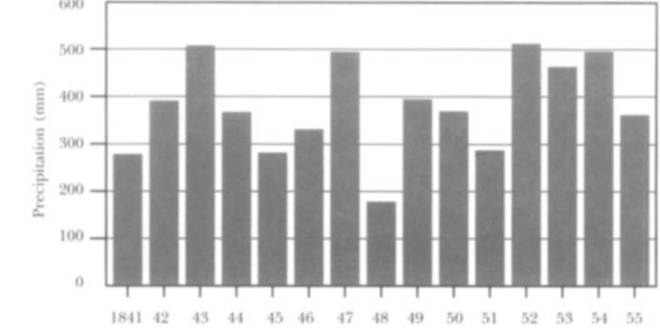
The uplands also benefited from higher levels of precipitation, a critical factor in the arid Molochna region.5 On the coast of the Sea of Azov average annual precipitation was only 320 millimetres; this rose to 380 millimetres at the Iushanlee River and as high as 500 millimetres in the highest areas of the uplands (see Map 3). The difference is vital because most types of grain require at least 400 millimetres of annual precipitation, making arable agriculture a risky undertaking on the lowlands. This question of precipitation is far more complex than simple averages reveal, for the great inconsistency of precipitation from year to year and month to month is as important as total precipitation. As Figure 1.1 shows, annual precipitation at Ohrloff, on the border between the lowlands and the uplands, could drop to as low as 176
Figure 1.1 Annual precipitation at Ohrloff, 1841-1855
Source: 'Niederschlag der... Regen und Schneemengejahrliche,' PJBRMA, file 796.
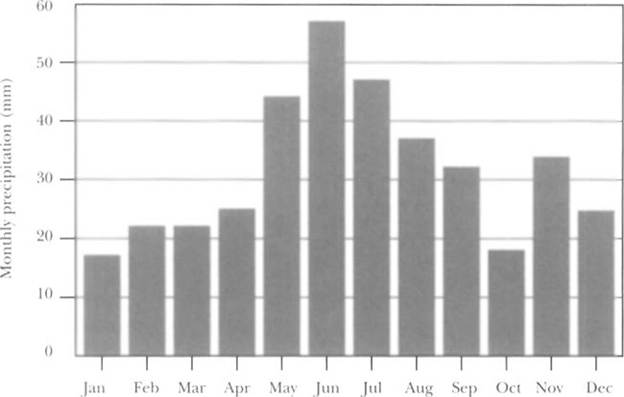
millimetres and climb to as high as 512 millimetres. In the fifteen-year period for which records exist (1841-55), total precipitation fell significantly below the critical 400-millimetre mark eight times, resulting in serious harvest failures and fodder shortages. Even when precipitation was adequate it often failed to come at the time when it was most needed. Ideally, crops need water when they first germinate. In Molochna this means in March and April. However, recorded rainfall in this region was heavily concentrated in the months of May, June, and July (see Figure 1.2).
Inconsistent precipitation made groundwater particularly important. On the high steppe groundwater lay from thirty-five to fifty-five metres below the surface, making well-digging too cosdy to be practical. This sharply restricted viable settlement sites.6 Well water on the flood plain of the Molochna River and the lower reaches of its three major tributaries, the Iushanlee, Kurushan, and Tokmak rivers, could be found at an average depth of 4.6 metres, while along the upper reaches of the tributaries at an average depth of 8.3 metres.7 During years when precipitation was high this difference had no bearing on crop production, but during dry years the significance was enormous; crop yields on the lower flood plain averaged nearly twice those on the upper tributaries (see Table 1.1). The value that settlers placed on flood-plain land is
Figure 1.2 Average monthly precipitation at OhrlofF, 1841-1855
Source: lNiederschlag der... Regen und Schneemengejahrliche,' PJBRMA, file 796.
vividly illustrated by the dispute that took place between the Doukhobor village of Troitskoe and the Mennonite village of Altona concerning which channel of the Molochna River formed the dividing line between their lands.8 The original land survey simply defined the border as the Molochna River; however, at the bend marking the border the river had carved two channels. The protracted dispute launched in 1805, was finally decided in favour of Altona in 1828. This dispute - over a mere five desiatinas (approximately 5.5 hectares or 13.5 acres) of land - began at a time when there was significantly more unsettled than settied land in the region, and it reveals the crucial importance of the flood plain even in the earliest years of settlement.
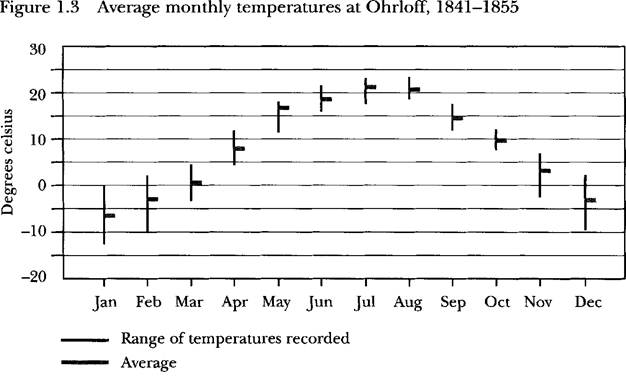
The continental temperature pattern in Molochna, with its moderate temperatures and long average growing season of 180 days is far kinder to agriculture than the precipitation pattern is. Even in the hottest months of June and July temperatures seldom climb above the low twenties (Celsius) (see Figure 1.3), while the short mild winters mean that in most years livestock require fodder only from December to February, and some years it can graze on the steppe year-round. How-
TABLE 1.1
Relationship of crop yields to precipitation
| Year | Annual total precipitation (mm) | Crop Yields (output/seed ratio) | |
| Molochna and lower tributaries | Upper tributaries | ||
| 1845 | 281 | 4.66 | 2.93 |
| 1848 | 176 | 4.21 | 2.28 |
| 1849 | 392 | 3.97 | 4.60 |
| 1854 | 493 | 5.65 | 5.99 |
Sources'. ‘Die Weitzen Ernte 1839,’ 1840, PJBRMA, file 606, 12ob. ‘Kurze Ubersicht,' 1846, PJBRMA, file 110. 'Verzeichnis Qberden Ernte,’ 1855, PJBRMA, file 1749, 1-1 ob.
ever, on occasion the prevailing winds blowing out of the east would bring with them their own unique hardships for settlers. In winter, fierce blizzards with high winds and killing cold sometimes swept across the steppe, decimating livestock herds. Summers could bring week-long windstorms - known to settlers as ‘black blizzards’ - with hot, dry winds that stirred huge dust clouds and sucked the moisture from soil and plants, destroying unharvested crops, and sapping the nutritive value from fodder grasses.
The environment, often harsh and unforgiving, was the one constant in the lives of all Molochna settlers. For although environments are subject to change, and indeed, human habitation necessarily changes them, at any given time in Molochna all settlers experienced a virtually identical environment. This placed limits on the range of possible agricultural adaptations. The different ways in which settlers solved these common problems provides an entry point into the complexities of Molochna society.
In focusing on the reciprocal relationship of environment and society I have been heavily influenced by the work of environmental historians.9 This relatively new field, sometimes called ecological history, has become increasingly influential in the past two decades. Donald Worster, one of its most respected practitioners, defines the task of the environmental historian as ‘the discovery of the structure and distribution of natural environments of the past,’ the study of ‘productive technology as it interacts with the environment,’ and the study of ‘that more intangible, purely mental type of encounter in which perceptions, ideologies, ethics, laws, and myths have become part of an individual’s or
Source: 'Mittlern Temperatur in der Molotschna Mennoniten Kolonie Ohrloff,' 1855, PJBRMA, file 795, 1-12.
group’s dialogue with nature.’10 Notably, it is the environment itself that comes first in Worster’s formula. For some environmental historians the environment alone is the historical subject, and for all of them the roles of natural history, biology, and ecological sciences are basic, although there is little agreement about where the balance between environment and society lies.11 Wherever the dividing point is, it must be made clear from the outset that I make no claim to share this bias towards the environment as subject. Rather, it is the people who occupied the Molochna River Basin who are my subject. This is first and foremost a work of social history, although one that is more than usually cognizant of the interaction of its subjects with their natural surroundings.
Historiographic tradition offers little in telling the story of settlement and adaptation in Molochna. There are many historical monographs on various aspects of Mennonite history, including two histories of the Molochna Mennonite settlement. However, these are notorious for their silence on the subject of Mennonites' interaction with their neighbours.12 Studies by historian David G. Rempel, anthropologist James Urry, and others have made important strides towards refining Mennonite history, but it nevertheless remains a history of the Mennonites alone, with little attention paid to the neighbours of the Mennonites and only
passing mention of the environment.13 Other German-speaking settlers in Molochna, as well as the sectarian Doukhobors, have also received attention in historical literature, but here too the broader story of their interaction with their neighbours and the environment remains untold.14 My debt to all of these specialized studies will be apparent throughout this book.
The closest semblance to a regional history of Molochna is E.I. Druzhinina’s four monographs on the history of New Russia.15 Molochna only occasionally creeps into Druzhinina’s account. More importantly, her allegiance to a Soviet model of historical development in which regional history serves to confirm the place of regions in the orderly development of the empire renders her work of Iitde interpretative value. To cite but one example, Druzhinina claims that Mennonite settlers in Molochna ‘comparatively quickly found their feet and became typical landlords.’16 This statement grossly distorts reality. Druzhinina misses altogether the complexities of a Mennonite community that came to include landlords, tenants, factory owners, wage labourers, merchants, and craftsmen. Still, she provides a wealth of statistical data, from which I have borrowed liberally, and her notes are invaluable aids for locating archival sources.
The historiography of Molochna itself is meagre, but there is a significant body of work dealing with peasant history in general. It is important here to carefully define terms. All but a few hundred of the people in Molochna were ‘state peasants’ by legal estate (soslovιe). In 1858 fully 40 per cent of Russia’s rural population and 37.5 per cent of its total population were state peasants, but the immense void in the historiography of Russia on the subject of the state peasantry means there are few convenient definitions available to delimit just what is meant by ‘state peasant.’17 Juridically, state peasants were defined by the Code of Laws of 1832 as ‘free rural dwellers,’ and they possessed far greater freedoms than serfs did: ‘Unlike serfs, they had civil and political rights. In common with other free classes, they took the oath at the accession of a new tsar. They were represented at consultative assemblies on the rare occasions when these assemblies met... They had personal property rights and could undertake all manner of financial commitments. They could buy land, though not estates with serfs. Their children could enter universities. They could change their place of residence, become townsmen, and renounce their peasant status.’18 Despite these rights there is a consensus among historians that, in their day-to-day life, state peasants were little more than the state’s serfs, or, as Russian historian A.V. Aleksandrov phrases it, they were ‘the peasantry... that lived under state feudalism.’19
The most important study of the state peasantry is N.M. Druzhinin’s seminal book The State Peasantry and the Reforms of P.D. Kiselev. Druzhinin provides an exhaustive account of the administrative structures governing the state peasantry and the reforms overseen by Kiselev and the Ministry of State Domains starting in 1838.20 However, Druzhinin does not find - or even look for - any significant distinctions between state peasants and serfs. Instead, he concentrates on their economic exploitation through unjust and corruptly administered fiscal programs. Records of administrative corruption, venality, and incompetence are common, and indeed, Druzhinin provides ample evidence that such problems were ubiquitous. Druzhinin never asks, though, where it was that the overburdened state peasants found enough money with which to pay so many bribes, nor does he look beyond aggregated economic statistics to ask about regional variations. Druzhinin’s conclusions remain unquestioned in Soviet and Russian historiography - and studies of regions as diverse as Lithuania and Bessarabia claim to find no qualitative difference between state peasants and serfs.21 The most extensive English-language examination of the state peasantry is George Bolotenko’s ‘Administration of the State Peasants’ and it has most of the same shortcomings.22 Although Bolotenko blames malign political and administrative practices rather than economic forces, like Druzhinin he treats the state peasantry as socially and regionally undifferentiated.
Druzhinin and Bolotenko do provide essential background, and I draw heavily upon their work to outline the administrative structures that applied to Molochna state peasants. However, the undifferentiated peasantry they describe bears little resemblance to the state peasants that I will describe here. Molochna setders included industrialists, commercial farmers, merchants, craftsmen, farm labourers, and herders, all legally classified as state peasants. The findings of a study such as this, of an isolated river basin on the Russian Empire’s southern frontier, can make no claim to be representative of the experience of all state peasants; they do, however, challenge the consensus that state peasants were simply undifferentiated ‘state serfs.’
Although the subject of state peasants is underrepresented in the historical literature, there is a rich literature on peasants in general. Anthropologist Eric Wolf s widely accepted generic definition of peasants as ‘rural cultivators whose surpluses are transferred to a dominant group of rulers’ provides a useful starting point.23 It should first be noted that this definition excludes pastoralists, and hence, at times, most Molochna settlers. However, it also, at times, includes most Molochna settlers, and the process of peasantization and de-peasantization is an important concern of this study. The second vital component in Wolfs definition is the transfer of surpluses to ruling elites. Surplus expropriation is an important factor in most definitions of peasants, for it is expropriation that is usually credited with keeping peasants at subsistence levels and preventing them from breaking out of their impoverished and economically stagnant condition.24
The most influential modern scholar of peasant studies is political ScientistJames C. Scott. Primarily concerned with the relationship between subordinate and superordinate classes, Scott is interested in defining the ways subordinates resist superordinates and in explaining how resistance mechanisms shape the larger societies shared by both groups. Scott focuses his research on peasants because it is in the extreme type of subordination experienced by peasants that he finds the subtleties of resistance most clearly exposed.25
As a by-product of his research Scott has found a particularly powerful tool for defining peasant perceptions of justice, showing that redistributive mechanisms in peasant communities should be understood, not as a product of an innately egalitarian ethic, but rather as a logical microeconomic system that has evolved to ensure subsistence under conditions of dearth. He calls the cultural embodiment of this peasant justice system a ‘moral economy.’26 The static nature of peasant societies over time is not a central concern for Scott, and for the most part he takes for granted the role of states and landlords as expropriaters of peasant surpluses and thus as guarantors that the prerequisite condition of dearth remains present.
With its twin focus on peasant resource allocation and peasant resistance Scott’s moral economy thesis has obvious applications to two of the great questions of Russian peasant history, the nature of the peasant commune and the role of the peasantry in Russia’s revolutions. Consequently, Scott’s thesis is widely employed in Russian peasant historiography, providing important insights into subjects as varied as serf estates in the early nineteenth century, migratory labour markets in the late nineteenth century, and collective farms in the mid-twentieth century.27 In the process, the paradigm has undergone a subtle transformation. For Scott the central subject, resistance mechanisms, provides a window onto peasant society, but in recent Russian peasant historiography resistance itself has increasingly been seen as the dominant characteristic of that society. The danger here is that the circumstance prompting resistance - surplus expropriation - is taken for granted as a fixed value in a static model in which peasant culture is seen as less a culture of subsistence than a culture of resistance.
For my own purposes the static assumption of the ‘moral economy’ paradigm is problematic. The conditions of dearth that first shaped the moral economy of peasants in Molochna were not a product of expropriation, but of geographic isolation and environmental constraints. In the absence of state authority, ethnically and culturally distinct groups of Molochna settlers found broadly parallel solutions to dearth. By the time the state was able to penetrate the isolation of Molochna, local society as a whole seemed poised to break the constraints of peasanthood under the centrifugal force of economic differentiation and transform itself into a complex proto-industrial society of commercial farmers, manufacturers, craftsmen, and wage labourers.
To this point the Molochna case seems to support Scott’s paradigm, showing that in the absence of state expropriations the redistributive mechanisms of the moral economy were eroding. However, when the state reasserted its authority the distinct ethnocultural groups that made up Molochna society suddenly diverged sharply from their common developmental path, some reverting to redistributive practices characteristic of the moral economy and others continuing along the path of de-peasantization. The moral economy paradigm, for all its value in explaining internal mechanisms of peasant society, has little utility in explaining such divergent reactions to a common experience of change in relationship to the state. In Molochna, peasants made self-conscious decisions about their relationship to the state, accepting or rejecting state directives to suit their own perceptions of justice and equity. It was not their relationship to the state that made them peasants or determined their path of development. Instead, decisions that the Molochna settlers made in reaction to demographic growth and changing markets under restrictive environmental conditions brought about the characteristics of peasanthood - and the erosion of those characteristics - independent of the subordination posited as necessary by Scott, Wolf, and others.
This monograph is based upon a wide range of archival and secondary sources. Nevertheless, Mennonite records play a central role throughout, and this requires a special note of explanation. Molochna provided a home to the largest settlement of Mennonites in the Russian Empire. Through their industry and innovation Mennonites played a key role in transforming Molochna into one of the most economically dynamic regions in the empire. This alone justifies the attention they receive. It is also justified by the fact that Mennonites were an unusually literate and observant group who left records of both their own history and (to some extent) that of surrounding peoples. The richness of these records is perhaps unequalled for any peripheral region of the Russian Empire in the nineteenth century.
Naturally, this exceptional source of material creates its own problems of interpretation. Mennonites recorded the world from the perspective of Polish/Prussian Anabaptist peasants, with all of the biases that this implies. Yet the Mennonite perspective has unique advantages, as well. Their high level of literacy and reputation for honesty led the Russian state to use Mennonites as agents of imperial colonization policy in Molochna, and thus they provide important insight into that policy. At the same time Mennonites were themselves the subject of colonial policies as the Russian state sought to incorporate them into the state peasant system. As principled defenders of a highly distinct world view, Mennonites frequently found cause to debate among themselves and with their imperial masters the merits of official policy, thereby providing invaluable insight into Russian regional administrative practices. Of unique importance in this regard is the Mennonite Johann Cornies who, by the time of his death in 1848, was arguably the most influential man in all of New Russia. Comies influenced state policy throughout the empire, and consequently this fascinating individual is the subject of my particular attention.
This study proceeds chronologically. Chapters 2 and 3 examine the period from Russia’s acquisition of Molochna in 1783 to the famine of 1833. Chapter 2 reviews the Russian state’s policies towards colonization in New Russia. The extent to which the state had knowledge of the regional environment and the formal Stmctures established to administer it are discussed. The state’s goal for its peasants was the development of agriculturally self-sufficient nuclear villages, and separate policies were established towards each of the ethnocultural groups permitted by the state to settle Molochna - based on the state’s assessment of the group’s level of development as an agriculturally self-sufficient nuclear community. The agricultural adaptations made in the period before 1833 are described in Chapter 3. In the absence of an effective central administration, settlers created unofficial Stmctures of self-administration, forging broadly parallel patterns of adaptation in response to common environmental and market conditions.
The period from the famine of 1833 to the harvest failure and livestock epidemic of 1847-8 is examined in the next three chapters. Chapter 4 describes the 1833 famine and how it demonstrated dramatically to both settlers and the state that existing agricultural methods were inadequate to feed Molochna’s growing population. The famine became a crucial impetus to both administrative and agricultural reforms, which in turn saw efficiency and standardization replace wardship as the central goals of the state. The exile of the Doukhobours from Molochna is detailed as a case study of how the settlers perceived land shortages, and how the state’s lack of control in the region lent itself to the abuse of authority.
Chapter 5 analyses the economic adaptations that the colonists made between 1833 and 1848. Johann Cornies constructed a model of civil society based on a combination of the demands of state policy, Menno- nite norms ofjustice and equity, and his own sophisticated understanding of environmental and market conditions. This model, conceived by Cornies by the early 1820s and refined by experimentation on Nogai Tatars in the late 1820s and early 1830s, was applied rigorously to Men- nonites and to a lesser degree other foreign settlers and Orthodox state peasants in the late 1830s and 1840s. The resulting economic growth helped mitigate the social tensions that had grown out of differentiation in Mennonite society.
Orthodox state peasants developed their own solutions to the problems of overcrowding and land shortages. These are examined in Chapter 6. Poor peasants used the state’s renewed interest in Molochna to apply their definitions ofjustice and equity in land distribution, forcing the introduction of land repartition. As a consequence the Orthodox peasants’ path of economic development diverged sharply from that of foreign colonists, and the peasants sank into economic stagnation.
Chapter 7 addresses the period 1847 to 1861, recounting the harvest failure and livestock epidemic of 1847-8 and showing how they helped to consolidate the transformation to arable husbandry that saw the amount of arable land in Molochna pushed to its natural limits. Interlocking economic developments in Mennonite and Nogai society pushed both groups to the brink of crisis, and this ultimately became a significant catalyst for both the Nogai exodus to Turkey in 1861 and the Mennonite landlessness crisis of the 1860s. The landlessness crisis is the final event examined in this study.
Contrary to conventional wisdom, for state peasants in Molochna, expropriation either by landlords or the state played no necessary role
Introduction 17 in their socioeconomic development. Rather, as the Molochna settlers showed, the state was ill-equipped to administer its own periphery, leaving peasants to accept or reject the centre’s demands on their own terms. The results, whether peasantization or de-peasantization, were a product of ethnocultural conceptions of justice and equity that owed little if anything to the official world of St Petersburg.
More on the topic CHAPTER ONE Introduction:
- CHAPTER I Introduction
- Chapter 1 Introduction
- CHAPTER 1 INTRODUCTION TO THE FIRST EDITION
- CHAPTER 1 INTRODUCTION TO BOND AND MONEY MARKETS
- CHAPTER 1 Introduction to Islamic Legal Theory
- CHAPTER ONE Historical Introduction to Roman Governance and Society
- Chapter I Introduction: The Careless Feeding of Violence in Culture
- CHAPTER SEVENTEEN Introduction to the Law of Obligations and the Law of Contracts
- Chapter 2 Refraining from Seeking Clarification: A Chapter from al-Wafl fl sharh al-Wafiya of al-Acraji (d. 1227/1812)
- Chapter 8 Why Early Muslims Divided into Sects? A Chapter from the Mukhtasar al-usul of cAli b. Muhammad b. al-Walid (d. 612/1215)1
- Chapter 7 The Role of Consensus in Legal Hermeneutics: A Chapter from the
- Chapter 1 Are Rulings of the Prophet Due to Ijtihad and Are all Mujtahids Always Correct? A Chapter from the Sharh. Zubdat al-usul of al-Mazandarani (d. 1081/1670)