CHAPTER IV. THE SCYTHIANS, THEIR CUSTOMS AND RACIAL AFFINITIES.
Perhaps no question touching the ethnography of the ancient world has been more disputed than that of the affinities of the Scythians1. It would seem at first sight that with the mass of details supplied by Herodotus and Hippocrates and the evidence derived from archaeological investigation of their country we ought to be able to arrive at a definite conclusion, but so far no perfectly satisfactory reconciliation of the various views has been reached.
Perhaps the first doubt that arises is whether such a reconciliation is to be sought for; whether the mistake common to almost all writers on the subject may not be that they have rashly attempted to find one answer to the riddle, have said that the Scythians were Mongols or Slavs or Iranians, whereas the truth seems to be that the word Scythian had no ethnological meaning even in the mouth of Herodotus. With him, as I take it, it had a political meaning, whereas with the other authors who make use of the term it is merely geographical.For most Greeks a Scythian, 'Ζκύθης, was any northern barbarian from the east of Europe, just as Γαλάτης was any such from the west.
Herodotus wishing to give a more exact account of the peoples to the n. of the Black Sea tried to draw a line between Scyths and non- Scyths, but he found it hard to make his line consistent. For instance in iv. 81, when he tries to give us some idea of the numbers of the Scythians, he has in his mind two conceptions of the meaning of the term, for he says that he heard that they were exceeding many and also that they were few in number, that is to say the real Scyths (ολίγους ώς Χκυ^ας εΐυαι). At other times he makes careful distinctions between the peoples he calls Scythians and those to whom he denies the name, even when they have Scythian customs and Scythian dress; yet some of these tribes are called Scythian by other authors.
We may take it that Herodotus used the word in a narrow sense to include only the Royal Scyths, possibly together with the Nomads, for it seems hard to establish any clear distinction between them ; and in a wide sense to denote all those tribes, whatever their affinities or state of civilisation, that were under the political domination of the Royal Scyths. Each of these uses is more definite than the ordinary Greek use against which there is an under-current of protest in the repeated asseverations of Herodotus that such and such a tribe is not Scythian : perhaps he is contradicting Heca- taeus. After the time of Herodotus the vague use returns. Thucydides21 For a short history of the Scythian question, see the Appendix at the end of this chapter, and the chief solutions that have been proposed, 2 11. 96, 97.
for instance must mean all the people of Scythia together when he says that, uncivilised though the Scythians were, no single nation of Europe or Asia could stand against them in war, if but they were all of one mind.
In late writers such as Trogus Pompeius1 and Diodorus Siculus (1. 55, 11. 43) we have what purports to be very early history of the Scythians, who according to Trogus always claimed to be the most ancient of races. These authors speak of conquests pushed by the Scythians to the borders of Egypt and of an empire of Asia lasting fifteen hundred years and ending with the rise of Ninus. Fr. Hommel (v. inf. p. 99 n. 10) thinks that this is an echo of the Hittite rule, but it would be rash to conjecture what may be the foundation for these stories, which come in a suspicious company of Amazons and Hyperboreans. They look like the reflex of the Egyptian stories in Herodotus (11. 103 and 110) who speaks of Sesostris having conquered the Scythians and Thracians. These are mere exaggerations of the real campaigns of Rameses pushed to the limits of the world and slenderly supported by mysterious rock carvings and such facts as the resemblance between the Colchians and the Egyptians.
Trogus Pompeius idealizing the Scythians has made their exploits balance and surpass those of the nation whose claim to greater antiquity he dismisses.The greater part of the information as to manners and customs given by Herodotus and the physical details in Hippocrates evidently refer to the Royal Scyths. On the other hand some statements seem quite inconsistent with their manner of life, and we are in our rights in supposing that such details apply to the settled tribes in Western Scythia about whom information would be easily available at Olbia. Less information is given about them because they did not offer so much novelty to interest the Greeks and also they do not play a prominent part in the story of the expedition of Darius, wherein ex hypothesi nomads and nomads only could be the protagonists.
Are we then to take the Scythians settled and nomad to be one race in two states of culture, or have we to do with the subjection of a peaceful agricultural people established in an open country and the domination of an intrusive horde of alien nomads ?
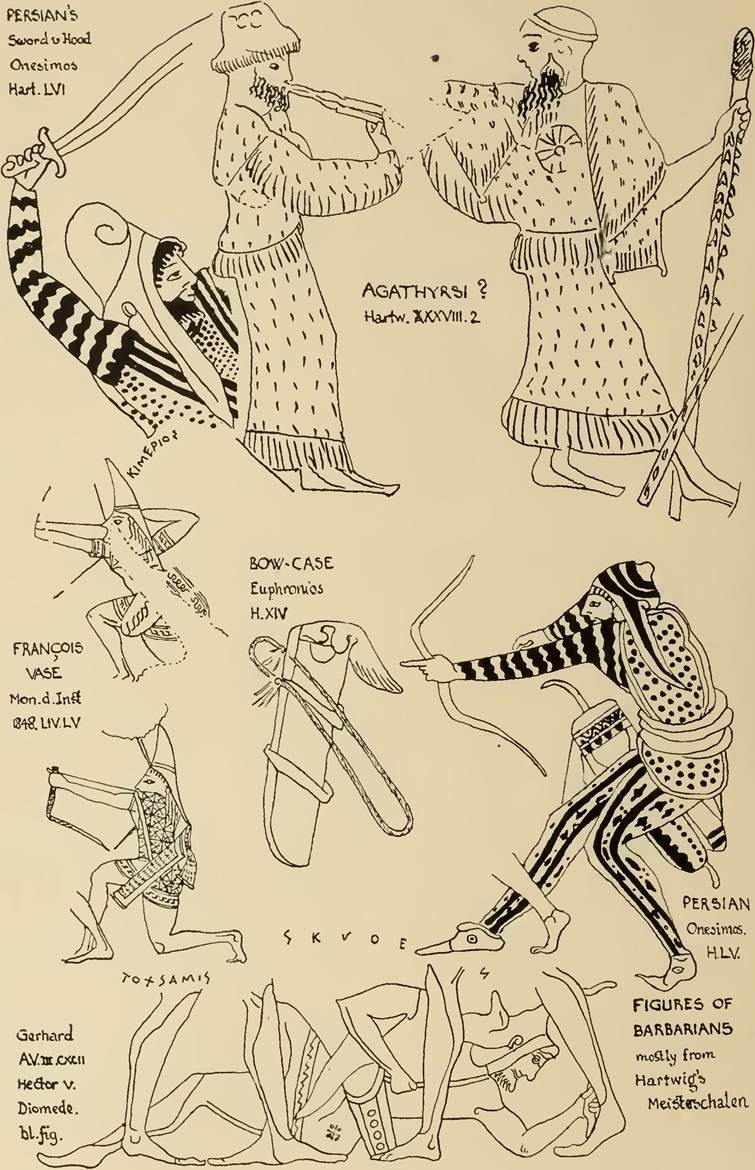
If the wider sense of Scythian in Herodotus is taken to be political, the sharp line drawn by Herodotus between the agricultural Scythians and the Neuri, Agathyrsi and Getae need not have any ethnological significance, that is that even if we suppose the Neuri to be Slavonic and the latter two Thracian, there is no reason against taking these “ Scythians ” to belong to either of these races. The general view is that both agricultural and nomad Scythians were Iranian[75]. There can be no doubt that up to the coming of the Goths and later the Huns, the Euxine steppes were ^chiefly inhabited by an Iranian population, and even Tn tfie steppes population does not. change as easily as iff used to be thought. It took the long continued storms of the great.migrations from the coming of the Huns to that of the Tartars to sweep away this Iranian population and pen its survivors into the high valleys of Ossetia.
ap. Justin, 1. i., 11. i. sqq.
iv] Iranians in S. Russia. Ossetes. Names in Inscriptions 37
Professor Vsevolod Miller[76] has given the clearest demonstration of the process by which this retrenchment of the Pontic Iranians came about. He shews that the place-names about the Ossetes in countries now peopled by Tartar-speaking tribes prove that they formerly extended over a greater area. Next he shews their identity with the Jasy of Russian chronicles, the Ossi of the Georgians.
Klaproth first proved in 1822 that the Ossetes are the same as the Caucasian Alans, and this is supported by the testimony of chroniclers Russian, Georgian, Greek and Arab[77]. From Ammianus Marcellinus (xxxi. ii. 16—25) we know that at the time of the Huns’ invasion these Alans pastured their herds over the plains to the N. of the Caucasus and made raids upon the coast of the Maeotis and the peninsula of Taman. The Huns passed through their land, plundering them, but afterwards made alliance with them against Ermanrich the king of the Goths. Ammianus means by Alans all the nomadic tribes about the Tanais and gives a description of their habits borrowed from the account of the Scythians in Herodotus. For the first three centuries of our era we find these Alans mentioned[78] [79] as neighbours of the Sarmatians on this side or the other of the Don, living the same life and counting as one of their tribes. That is that Ossetes, Jasy, Alans, Sarmatians, are all of one stock, once nomad now confined to the valleys of the central chain of the Caucasus. The Ossetes are tall, well made, and inclined to be fair, corresponding to the description of the Alans in Ammianus (xxxi. ii. 21), and their Iranian language answers to the accounts of the Sarmatians whom Pliny calls “Medorum ut fertmt soboles\" In a large number of inscriptions from the Greek cities along the Euxine shore we meet with several hundred barbarian names, and these give more or less trustworthy material for investigation. schen Scythen und Monatsbeiicht derk. Preuss. Akad. d. IP. 1866 p. 549 sqq., reprinted in DA. ill. p. 101 sqq., 1892. Cf. Sir H. Howorth, Journal of Anthrop. Inst. VI. 1877, p. 41 sqq. 6 First in an article in Journ. Alin. Publ. Instr. St P. Oct. 1886, p. 232, entitled “Epigraphic Traces of Iranian Population on the North Coast of the Euxine,” and again in the third volume of his Ossetian Studies. names shewing Old Persian forms and those which resemble Ossetian. The former are mostly names very familiar to the Greek world and in common use in the Hellenised provinces of the Persian Empire, especially Asia Minor: they are many of them royal names and testify to the political and general influence of the Persian Empire rather than to an Iranian population. Such would be Ariarathes, Ariaramnes, Arsaces, Achaemenes, Orontes, Pharnaces, Mithradates, Ariobarzanes, Machares and many more. The true native Iranian names are almost confined to Olbia and Tanais, others in the Bosporan kingdom may well have found their way in through Tanais. All these names are late in date, mostly of the 11. and m. centuries a.d., the time when the Sarmatians spread from Hungary to the Caspian. At that time no doubt there was a broad band of Iranians right across, but it looks as if along the coast there long remained representatives of some other population, Getae in the west about the Ister and Tyras, and perhaps in the Olbia district, Tauri in the Crimean mountains, and tribes of the Caucasus stock to the south-east of the sea of Azov. From the western aboriginal tribes the Greeks may have heard the names of the rivers Borysthenes, Hypanis, Tyras, and Ister, names for which no satisfactory explanation has been suggested, and once sanctioned by classical usage these names continued to be used by the Greeks as long as they were in continuous occupation of this coast. But this tradition was broken by the destruction of the colonies Tyras and Olbia, and when the Greeks again had dealings with this coast they learnt other native names which only appear in authors who preferred actuality to classical correctness—AapaTrpis in Periplus anonymi (86 (60)), Boyou and AapacrT/Hs in Constantine Porphy- rogenitus (de adm. Imp. 42). Now these names seem to contain the Ossetian Don a river, at least they have never been satisfactorily explained from the Slavonic ; and the occurrence of Dan in river names just coincides with the extension of the Iranians in South Russia. The mouth of the Tanais being already in Iranian hands the Greeks at once adopted its Iranian name. The Iranian names for the western streams may be just as old, but they were not current on the seaboard and only found their way into Greek speech when the Greeks had, as it were, to rediscover the region after considerable changes of population. Maybe by then they learnt them not from the Iranians, but from Slavs who had borrowed them. The name of the Bugh has its counterpart in the Northern Bugh, also a Slavonic river, but it may be the same as Bogh = God, which is regarded as a loan-word from the Iranian Baga. I have never seen any other explanation of the curious fact that the present names for these rivers being apparently Iranian are first recorded just about the time that the Iranian population was succumbing to Slavonic and other invaders. In later times we get a fresh set of river names of Turkish origin. Only in the east part of the Crimea the Iranians seem to have touched the iv] Names in Inscriptions and Authors. River names 39 Black Sea coast, for *Ap3a/33a='ETrra^eos (Anon. 77 (51)), “Tauric” or Alan for Theodosia, seems clearly to contain Ossetian avd= seven, and ard may be according to Mtillenhoff eredhwa high, Lat. arduus. Vs. Miller says sevensided, but that does not seem a near translation. So Sou-ySata, Sudak is no doubt Os. suydag holy, cf. Sogdiana. Whereas the Iranian character of the Sarmatian language and even a numerically preponderant Iranian element in the population has been generally accepted, the case of the Scyths is by no means as clear. What reliance can be put on the statement of Herodotus (iv. 117) that the Sarmatians speak the same language as the Scyths, but speak it incorrectly ? While Herodotus is not altogether to be trusted in his statements about language, still he occasionally notices points bearing upon it, for instance when he mentions the seven languages required along the trade route to the ne. up to the Arimaspians. And the fact of the resemblance and the difference between the Scythian and Sarmatian dialects is the only explanation for the invention of the aetiological myth about the Sarmatians being descended from young Scyths and Amazons (iv. 110-7). The other main difference between the two peoples, the free position of women among the Sarmatians, is also accounted for by the myth. Curiously enough the Ossetes still have legends of warlike women, and such stories are abroad throughout the Caucasus : among the Circassians is a literal reproduction of this tale in Herodotus. When we come to examine the Scythian names and words in the Greek texts it is disappointing to find how few are readily to be explained from Iranian. Some words are quite clear, e.g. ’Epapees = ’Xv8p6yvvot, (Hippocrates, De aere, speaks of the d.vavBpei'r] of his ctpapie;) from a privative and Sk. Zd. nar, nara man. So ’E^ap,7ra?o9 = 'Ipai. 6801 from Zd. asha, ashavan pure, pathi path. Arimaspi may be connected with Zd. airima loneliness, oneness, and spit may be from the root ppap, Lat. specio. Mtillenhoff objects to these and wants e.g. to translate Arimaspi “having obedient horses,” saying that the others would be *Arimaspui, but it seems more likely that a Greek would make a mistake in dropping a termination and yet get the meaning right, than that he should invent an entirely wrong meaning which should still yield a form so near to what he reported. In olopirara = d.v^>poKTovot there seems to be possibly a misunderstanding. The first part is clearly Zd. Sk. vira man : the second half is rather paiti lord than from pat to fell, causative of pat to fall. Some of the Sarmatians were regularly called rupatKOKparoupepou The fact that Herodotus has in these cases furnished a translation is decisive. Also one or two of the proper names are evidently Iranian, e.g. Ariapithes, Spargapithes. So most of the names in the “ Scythian ” legend of their own origin (iv. 5, 7) have quite an Iranian look. Targitaos (?Tirgataos, cf. Ttpyaracy, queen of the Maeotae)1 may well be Tighra tava sharp and strong: and the names of the three brothers in recall Avestic yshaya lord; so Colaxais would equal Archistratus[80]. Whereas no satisfactory Iranian explanation of the names of deities has been put forward, on the other hand Schiefner absolutely annihilated K. Neumann’s attempts to derive any Scythian words from Mongolian[81]. 1 Poliaenus, vni. 55. Making all allowances for the inaccuracy with which Herodotus represented Scythian sounds, the corruption of the forms in our mss. and the fact that we have to place beside these forms languages considerably removed either in time or collaterally from what Scythian may have been, we must allow that the comparative success attained with Sarmatian forms suggests that there were foreign elements in Scythian which exercised much influence on the stock of names in use or in tradition. Founding any argument on personal names is singularly unsatisfactory. All history tells us that easily as nations change their language, they change their names still more easily. There are hardly a dozen English personal names in use or a dozen Russian, we must not therefore infer that Russians or English are descended from Greeks and Romans and Jews. So Persian names were common all over the East far beyond the extension of the Persian nationality, and it is hard to say whether the Persian names that we find in Herodotus as borne by Scythians are due to an original community of origin, or a borrowing at a time when the Scyths had warlike dealings with Persia either in Europe or Asia, or whether they are not merely given to personages in the same way as figures are given names on Greek vases. The Darius vase would be a peculiarly apt example, for on it Greek and Persian names are given indifferently to the barbarians hunting griffins and other monsters, just to lend them more individual interest. Such must almost certainly be the case with Spargapithes the Agathyrse[82]. Knowledge of the nationality of the Cimmerians whom the Scyths dispossessed would throw some light on the affinities if not of the Scyths themselves at least of the steppe population they found at their coming. The resemblance of the name Cimmerius with Cimber already made Poseidonius3 imagine that there was some connection between them and the barbarians from the far north-west4, and modern writers have further compared the name of the Cymry and supposed that these were one and the same people, Kelts5. There is no impossibility in a migration from Central Europe to the steppes of the Black Sea in times before history, just as in historic times Central Europe has sent out conquerors to every corner of the continent, and Kelts actually did reach the neighbourhood of Olbia in the time of Protogenes, not to speak of their raids upon Delphi and Asia Minor. Further the bronze civilisation of the Koban necropolis certainly offers such analogies with that of Hallstadt that it is hard to believe that they are not connected. If only there were any finds of Hallstadt types between Hungary and the Caucasus offering evidence that the people who owned the Koban bronzes had settled in the steppes, the Cimmerians might have been thought of, but people who settled long enough to leave the earthworks of which Herodotus makes mention (iv. 12) must have left weapons by which their course could be traced. And save for a single stopped axe-head from Kerch figured by its owner Canon Greenwell1 no Koban or Hallstadt implements seem to have been found in South Russia. The fiat-ended hair-pins found by Count Bobrinskoj at Gulaj Gorod2, and the spirals found by him at Feklino3, seem to be rather eastern outliers from Central Europe than links between it and the Caucasus. H. Schmidt4 has the same difficulty to face in maintaining that the makers of the late bronze things from Hungary were Thracians and that these Thracians were the Koban people in the Caucasus (v. inf. p. 259) and that the Cimmerians of the plains between were Thracians as well. It is true that the Cimmerian raids were made in common with the Thracians, but we have to account for the Iranians north of the Euxine. Mollenhoff8 supposes that there never were any Cimmerians at all north of the Euxine, that they are only known in Asia Minor, that their name was traditionally assigned to the earthworks and settlements about the Bosporus, just ’ as now earthworks in eastern Europe are assigned to Trajan far beyond the limits of the Roman Empire, and that they were really invaders from Thrace or the parts beyond, men of darkness who joined with Treres and other Thracian tribes in invading Asia Minor. It is hard to think that Herodotus simply invented all the story of the Cimmerians coming from the N. side of the Pontus, though even so it is at first sight difficult to see precisely how things happened; how if the Cimmerians fled se. there should have been their kings’ tomb on the Tyras; and how they should have formed their connection with the Treres. But that invaders from the east should have cut them into two is not inconceivable. Part went into Thrace, produced a turmoil there and finally, with Thracian tribes they had disturbed, entered Asia Minor by the nw. ; part were pressed towards the Caucasus and passed it, not as Herodotus says along the coast of the Black Sea, for no army has ever passed that way (Mithridates in his famous flight was accompanied only by a small guard), but by the central pass of Darial, through which, as the Georgian annals shew, the northern peoples have often forced their way. Though the idea of the Cimmerians being cut in two seems hard to accept, the analogy offered by the fate of the Alans shews that it is not without the bounds of possibility. On the coming of the Huns part of these was forced westward, joined the Germans against whom they were thrown and ended as the inseparable companions of the Vandals in North Africa. Part of them was, as we have seen, pressed up against the Caucasus and remains there to this day : and about them are the Tartar tribes that penned them in. So likewise the Magyars were driven by the Pechenegs partly w. across the Dnepr, partly through the Caucasus, where they were called Sevordik'8. So the Scyths drove 1 Archaeologia, Vol. Lvm. Pt I. p. 12. 4 Zt.f. Ethnologie, xxxvi. (1904), p. 630. 2 Govt of Kiev, Sm. I. No. XLI. p. 102 and 115 6 DA. HI., p. 19 sqq. and pl. IX. 7, 8. 6 J. Marquart, Osteuropäische und Ostasiatische 3 Sm. in. CCCi.xvii. pp. 19 and 23 and pl. 11. 4 Streifzüge, p. 36. and 9. Μ. 6 the Cimmerians through the Caucasus and followed them. Then both peoples came within the sweep of Assyrian policy[83]. Here we get another view of them. We find the Cimmerians, Gimirrai, first n. of Urartu (Ararat). Hence they are driven out by As-gu-za-ai (Asarhaddon) or Is-ku-za-ai (Sun Oracle). These names are and of Genesis x., where the latter form is miswritten for T’DE'N. The first syllable. is added as usual in Semitic languages to help out such a combination as sk at the beginning of a word, so that the identity with the Greek Kt/z/zepio? and tKvOys is almost complete. So too the leader of the Asguzai Bartatua is Protothyes father of Madyes in Herodotus (i. 103) and Tugdammi the Cimmerian is AvySa/zi? in Strabo (1. iii. 21) for Av-y§a/zis. Lygdamis was a familiar name and the copyist was misled. The Cimmerians driven s. from Urartu attacked Man a kingdom under Assyrian suzerainty. The Assyrians supported their vassals and found allies in the Scythians who were already enemies of the Cimmerians. This hostility turned the Cimmerians westward against Gugu, Gyges of Lydia (Herodotus says Ardys 1. 15), and one horde was destroyed by Madys (Strabo) in Cilicia, whereas Lydia was under their dominion till the time of Sadyattes, and Sinope and Antandrus were long occupied by Cimmerians. Meanwhile the Scythians as allies of the Assyrians tried to raise the siege of Nineveh which was being prosecuted by the Medes; hence a conflict between Scythians and Medes and apparently an overrunning of Media by the Scythians[84]. Scyths also made their appearance further to the sw., apparently being sent by Assyria against Egypt, but bought off by Psammetichus. Thus they are referred to by the Hebrew Prophets[85] and engaged in the sack of Ascalon where some contracted a disease ascribed by Herodotus (1. 105) to the hostility of Aphrodite. A colony of them is said to have settled at Beth-shean hence called Scythopolis[86]. Evidence of intercourse between Assyria and the Scyths may be seen in the gold dagger sheaths from the Oxus (p. 255, f. 173), from Melgunov’s Barrow (p. 171, ff. 65—6-7) and from Kelermes, and also the unique axe from the latter (p. 222 ; cf. p. 263). It has been supposed that the Scythians that overran western Asia were Sacae from the e. of the Caspian, and that such incursions were always possible we learn from subsequent history, but the Assyrian evidence goes to shew that Scythians had penetrated through the Caucasus. A curious point is that the son of Tugdammi, Sandakhsathra®, has a name clearly Iranian, and it is hard to suppose that the Cimmerians had yet come under Median influence. Does it mean that the Cimmerians had Iranian affinities? It looks as if the “Royal” Scyths, whoever they may have been, were invaders from the far North-east who found in the steppes a population of Iranian stock whom they called men of darkness, i.e. Westerners (cp. p. 100), partly nomad and partly settled, drove some of this population out, and established a dominion over the remainder. originally meant for the Scythians was worked over to make it do for the Chaldaeans. Ez. xxxviii. and xxxix. to 16 is even less exact. 4 Josephus, Ant. Jud. XII. viii. 5. 5 Sa-an-dak-sat-ru,Justi, Iranisches Namenbuch, p. 283. By the time of Herodotus they may have become almost blended with their nomad underlings; such blending takes place far more easily with nomads than with agricultural populations: they may have even adopted their language, retaining the names of persons and gods which are so difficult of interpretation in the light of Iranian vocabularies. JThe conception of displacements of whole populations is being superseded by the recognition of the fact that in most countries the mass of the people has remained much the same as far back as we can trace its characteristics. I he general type of skull and build in any given locality docs not easily alter. From time to time conquests change the national name, the language talkOT by all, the ethnological character of the upper classes or even of all the warrior caste: to outside observers it seems as if a new race had been substituted for a former one, but in a few generations the aborigines again come to the top and in time the physical type of the invaders becomes almost extinct. Only a long succession of conquests of a country peculiarly open to attack can really sweep away a whole population, where that has been at all thick and where the disparity of development is not too great. We are so used to the cases of the North American Indians, the Tasmanians, and other instances of utterly barbarous tribes really disappearing before the invader, that we do not realize that such conditions rarely obtained in the old world. To the north of the Euxine it took the successive hordes of the Huns, Avars, Khazars, Pechenegs, Polovtses and Tartars, to say nothing of less important tribes, to sweep the Iranian folk clean off the plains over which they had wandered; and they only succumbed to this fate because they were living in perfectly open country upon a highway of nations. Four legends as to the origin of the Scythians. In the first, which is told by the Scythians of themselves1, they say that they are the newest of races and spring from Targitaus son of Zeus and a daughter of the Borysthenes. Targitaus had three sons, Lipoxais, Harpoxais and Colaxais, of whom the youngest obtained the kingdom by the ordeal of approaching four sacred gold objects that fell burning from heaven. These sacred gold objects were a plough and a yoke and an axe and a cup. From these three sons three tribes, Catiari, Traspies and Paralatae, are descended, and the whole nation is called Scoloti ; Scythae being the Greek name: and the gold objects are kept sacred until this day. The next story (c. 8 sqq.) is told by the Pontic Greeks. In it Heracles plays the part of Zeus; Echidna, half woman, half serpent, bears three sons to him. The ordeal is the stringing of the bow left by the hero and the knotting of the belt with its cup attached. The two elder sons, Gelonus and Agathyrsus, fail and become fathers of peoples outside Scythia, the third Scythes remaining in the land. These two stories are substantially the same. Only the second has been even more Hellenised than the first. The Scythians are represented as autochthonous even though Targitaus only dates back a thousand years before Darius. Three sons in each case submit to an ordeal in 1 Her. iv. 5 sqq. which, as usual in folk tales, the youngest is successful. From the sons tribes are descended; in the one case well-known neighbouring nations whose names the Greeks knew, in the other obscure septs among the Scythians, to whom as a whole is given the native name Scoloti. None of these names meet us elsewhere except a bare mention in Pliny[87] taken from Herodotus. The scene of both stories is laid in West Scythia: in both there comes a mention of a golden cup—now no representation of a Scythian with a cup at his belt has been found—and more remarkable still a golden plough is one of the holy objects. The man who keeps them is given land for his very own, as much as he can ride round in a day. This legend in two forms can only apply to the agricultural West-Scythians. Hitherto writers who wished to be more than usually exact have called the Royal Scyths Scoloti, but this legend would suggest that just these did not call themselves Scoloti, which was really the native name for the royal clan among some tribe of the western Scythians about Olbia[88]. Mishchenko[89] examining these legends thinks they apply to the reigning clan of the Royal Scyths, but that perhaps their real scene is central Asia. He takes Pliny as a serious witness to the survival of these clans. I cannot follow him in this, though I have come to much the same conclusions in most things. Another account in Herodotus (iv. 11), to which he himself chiefly inclines, definitely names the nomad Scyths and brings them out of Asia (that is to say Asia in the ordinary sense, not according to the Herodo- tean definition of it), across the Araxes (apparently the Volga), into the land of the Cimmerians; and then follows the story of how the latter fled into Asia across the Caucasus and the Scythians pursued them. This account represents the Massagetae as responsible for the first impulse, but Aristeas says that it was the Arimaspians that fell upon the Issedones and that these fell upon the Scyths and drove them against the Cimmerians. At any rate it is clearly stated that the Scyths came from the East. Diodorus Siculus has made a contamination of these accounts and while letting the Scythians come from Western Asia has brought in the Echidna of the Greek legend (n. 43 sqq.). His story with its explanation of the history of Sarmatians and Amazons reads plausibly, being eked out with details which apply to the rise of every tribe that ever rose to power in Asia; compare the accounts of how Chingiz Khan became great and spread abroad the dominion of the Mongols; but his anachronisms enable his reader to estimate his account at its real worth. Of course the Asiatic origin of the nomad Scyths is no bar to their Iranian affinity, but it makes a non-Aryan derivation conceivable. Physical characteristics. The supporters of the Mongol theory of the Scyths rely chiefly on the evidence of Hippocrates in his treatise on Airs, Waters and Places[90]. The evidence of the first of Greek physicians ought to be conclusive, but 3 Journ. Min. Pub. Instr. St P., 1886, Jan. 4 cc. 24—30. There is a translation by F. Adams in Transactions of the Sydenham Society, Vol. I. pp. 187-8, 207—218. mode of life, the men riding on horseback and the women on waggons, and to the continuous cold and fog of their country, he hardly defines in a convincing way. It amounts to a tendency to fatness, slackness and excess of humours, and a singular mutual resemblance due to all living under the same conditions. Th is slackness they counteract by a custom of branding themselves on various parts of the body[91]. Further he says that the cold makes their colouring vruppos, which seems to mean a reddish brown, the colour that fair people get from being much in the open. It cannot be any kind of yellow[92]. The colour of the^Tartars was not far from reddish. Kublai Khan had a white and red complexion, yet Chingiz Khan was surprised at his being so brown, as most of his family had blue eyes and reddish hair[93]. So too Batu is described by Rubruck as perfusus gutta rosea which du Cange takes == rubidus in facie ; so Hakluyt and Bergeron, but Rockhill is probably right in translating “ his face was all covered with red spots[94] [95].” The Chinese describe one of the five tribes of Hiung-nu as fair. Lastly Hippocrates observes in both men and women a sexual indifference that amounts in some of the men to actual impotence ; these are the Anaries of whom Herodotus also speaks, ascribing their disease to the wrath of the goddess at Ascalon whose temple they had plundered at the time of their invasion of Asia[96] [97]. But Hippocrates will have none of this, and says this is a disease just like any other disease[98] and due to excessive Augen und keine fünfzig bis achtzig Barthaare. Wenn nun nach Krankheiten eine unheilbare Entkräftung folgt oder das Alter zunimmt, so wird die Haut des ganzen Korpersauserordentlich runz- lich und die wenigen Barthaare fallen aus und der Mann bekommt ein ganz weibliches Ansehen. Er wird zum Beischlaf untüchtig und seine Empfindungen und Handlungen haben allen Männlichen entsagt. In diesem Zustande muss er der Männer Gesellschaft fliehen: er bleibt unter der Weiben, kleidet sich wie ein Weib, und man konnte tausend gegen eins wetten dass dieser Mann würklich ein altes Weib und zwar ein recht hässliches altes Weib sei.” Neumann, p. 164, quotes curiously enough from an English translation which I have not seen, and translates back into German. The disease described by Pallas (Voyages en plusieurs provinces, Paris, II. 8°, 11., p. 135 sqq.) does not appear cognate with this, though some riding. But all this, he says definitely, applies only to the most noble and rich among them. With the common folk it is entirely otherwise. This whole description seems to suggest the condition of an Asiatic race in the last stage of degeneration, when the descendants of a small band of conquerors have reached a state of effete sloth and are ready to make way for a more vigorous stock. The chief question that is raised by this description is as to the amount of trust that can be put in the statement that the ruling caste of Scyths is quite unlike any other kind of man. In the representations on works of art (v. p. 57 n.) the nomads do not appear so very unlike any other northern people, their resemblance to modern Russian peasants has often been pointed out; though this resemblance is superficial, due rather to certain similarities of costume and to the way in which an abundant growth of hair disguises the individuality of a type, than to a deep-seated likeness. The similarities of costume are due to the fact that the Russians have borrowed many details of their dress from nomad tribes through the intervention of the Cossacks, whose mode of life had much in common with that of their hereditary foes. The words for clothes in Russian are mostly of Tartar origin1. Still the bearded warriors on the vase from Kul Oba could not possibly be described as ewovyoeiSecrTaTot av0pd>TT(uv. If these are in any sense Scythian they must belong to a later time when the N. Asiatic blood had become completely mixed in. The Tartars of Kazan and the Uzbegs of Turkestan, races in which Altaic blood has been much diluted with Finnish or Iranian, are fully bearded. The Chinese drawings of Kara Kitans (p. 96, f. 27) shew them with full beards. The representations of nomads from Kul Oba seem to belong to about the middle of the fourth century b.c. and by then the peculiar type described by Hippocrates might well have become almost obliterated by intermarriage with earlier inhabitants. Ammianus Marcellinus (xxxi. 11) uses a similar expression of the Huns “spadonibus similes',' and he is not likely to be copying Hippocrates in the same way that he applies to the Alans the description Herodotus gives of the Scythians. It seems as if the Huns, almost undoubted Altaic, produced the same impression on Ammianus as theJScyths on Hippocrates2. The osteological characteristics of the skeletons found in Scythic graves throw very little light on the questions at issue. Had the skulls discovered been uniformly short or long, such uniformity would have been a weighty argument for assigning them to Tartars or Europeans respectively. But the rather scanty observations made hitherto tend to shew that there was considerable variety among individuals who used objects of defined Scythic type. The best known case is that of the five skulls found in Chertomlyk and discussed by K. E. von Baer in ASH. Of these two were short and two were long and one was intermediate, and the data were not sufficiently exact to shew that either lords or servants were one or the other. And even had there been such data they would not have cleared up the question, as it would be possible to argue the greater purity of blood of either rulers or servants ; a priori the latter might be supposed to be imported slaves, but Herodotus distinctly says that they were native Scyths, and he tells of the marriage of Scythian kings with various foreign women. So too some of the skulls illustrated by Count Bobrinskoj in Smela slightly suggest Mongolian forms, others arc purely European[99]. To this same conclusion came Professor Anatole Bogdanov[100] [101], who says that in Scythic tombs the skulls are mostly long though occasionally Mongoloid and notes a general tendency towards brachycephaly during the Scythic period. For strangely enough although Slavs and Finns are now short-headed they seem to have become so only during the last few centuries’. In Hungary c.g. at Keszthely the cemeteries which are referred to the Sarmatians are full of bow-legged skeletons, a characteristic which may be accounted for either by their horsemanship or bya mixture of Altaic blood[102]. symptoms are alike. My friend Dr L. Bousfield suggests that it was very bad orchitis and that Hippocrates may have been right in putting it down to constant riding. 1 V. V. Stasov in his review of Maskell’s Russian Art, Works, Vol. II. iii., p. 823. 2 For the types of variously proportioned mixtures of Iranian and Turko-Tartar blood v. Ch. de Ujfalvy, Les Aryens an Nord et au Sud de 1'Hindou Kouch, Paris, 1896. An Uzbeg with a beard is illustrated in Keane’s Ethnology, p. 312. The process of gradual amalgamation of Central-Asian rulers with an alien subject population under very similar circumstances may be observed in the case of the coins of the Kushanas. Not that a change of racial type can be followed unless Miaus represents the purer blood, but the Indian name Vasudeva, along with the Kushana Vasushka, succeeds to Kujula and Hima Kadphises, Kanishka and Huvishka, without a break to mark a change of dynasty. Their successors the Ephthalite Huns answer decidedly to the type described by Hippocrates but in their case the evolution was cut short by the Turks®. Manner of Life. If we consider the customs which Herodotus ascribes to the Scythians it becomes evident that they form noncoherent whole. Although it is hard to say what various usages may coexist in any given nation, what survivals from an earlier state may continue into a high civilisation, the parts of the picture drawn by Herodotus do not fit together. We see that he has mixed together information drawn from different sources and applying to different tribes. When it comes to endeavouring to determine according to these various customs the affinities of their users we are on very uncertain ground. Analogues for every detail can be found among various nations and as readily among Aryans as among non-Aryans. Most of the usages mentioned are inseparable from a nomadic life and throw no light on the affinities of the people among whom they obtain. The characteristic dress of the Scyths which struck the Greeks so much, is almost the only possible one for a nation of riders living in a cold climate, so too the use of various preparations of mare’s_juilk. butter, kumys and cheese, the felt tents, bows and for a shortened skull lb. XXV. p. 126 f. 18, both from Chersonese. 6 B. Μ. Coin Cat., Greek and Scythic Kings of Bactria and India, by P. Gardner, XXIV. 7, xxv. 1—9, xxix. 10. E. J. Rapson, Grundr. d. IndoArischen Phil. u. Altertunisk., Bd 11. Heft 3 B, Pl. 11. 1, 8—12, iv. 18. I am very grateful to Professor Rapson for indicating this series to me, but cf. O. Franke, “Zur Kenntnis d. Türkvolker u. Sk. Zentral-Asiens,” p. 79 in Abhandl. d. k. pr. Akad. Berlin 1904. The Ephthalites’ coins have tanigi very like those that occur in the Crimea, v. inf. ch. Xi. § 4. arrows, curious methods of cooking owing to the absence of proper fuel, and so on, were conditioned by their general mode of life and could be nearly paralleled among any nomad tribe. As a matter of fact the medieval travellers found all these things in use among the Mongols, and some of the coincidences with facts recorded by Marco Polo, de Plano Carpini, de Rubruck and others are striking. These agreements are not restricted to such necessary similarities ; the accounts of cemeteries and funeral customs, of the religion of the Mongols, of their personal appearance, of the polyandry of the Tibetans, of their way of disposing of the aged, suggest that though it may be going too far to declare positively that the Scyths were Mongolian, we must admit that the Mongols before their conversion whether to Islam or Buddhism were their closest possible analogues. And their fate in western Asia and eastern Europe has been analogous. Already the hordes that Batu led against the West had very few pure Mongols save among the chief leaders, and this strain soon merged in the mixed multitude that it ruled, so that the later khans of the Golden Horde were just like any other west Asiatic monarchs, a mixture of the Turk and the Circassian[103]. This seems the place to give a summary of what our authorities tell us as to the life of the Scythians, especially the Nomads. The main bulk of information is contained in Herodotus (iv. 59—75), and the reader is prayed to have him at hand : some details are filled in from other passages and other authors (especially Hippocrates, De Acre, etc.}. In order to give as complete a picture of nomad life as is possible within narrow limits I have anticipated the archaeological results set forth in the later chapter which describes the tombs found in the Scythic area. Professor Lappo-Danilevskij[104] has arranged the accessible material under convenient headings. In preparing the following summary I have everywhere been indebted to him, though much has been discovered since his book was written. Count Bobrinskoj (Smela passim) also gives a convenient view of what is known of various classes of objects. In spite of the well-known existence of tribes of agricultural Scythians, Scythian always suggested to the Greek the idea of nomadic life. The governing condition of the nomads’ existence was the necessity of finding natural pasture for their cattle, hence their moving from place to place, and this necessitated everything from the form of their dwellings to the cut of their clothes, from their tactics in warfare to their method of cookery. Their chief occupation was looking after their many horses, and of this we have a splendid illustration on the famous Chertomlyk vase (v. pp. 159—162, ff. 46—49), on which we see pourtrayed in greatest detail the process of catching mentality of the western section. Hence from our point of view Hunnish or Turkish comes to the same thing as Mongolian, though a confusing of them may seem to Turcologues unpardonable. But the nature of the material does not allow of greater accuracy seeing that we have an actual case of 100,000 Huns who took the name of the Sien-pi— eastern Mongols—when defeated by them. For the gradual shading of Mongols into Turks (v. p. 91 sqq.), Turks into Ugrians and Ugrians into Finns, and the various crossings of all these races with the “Caucasic” stock, see A. H. Keane, Ethnology, p. 295 sqq., also Franke, loc. cit. 2 Scythian Antiquities, pp. 383 sqq. the wild horse of the steppes or breaking him in. Others have been reminded by it of the story in Aristotle.[105] of the Scythian king’s practice of horse-breeding. On the vase we have two breeds represented ; the tame horse which is being hobbled and the wild ones with hog manes. Professor Anuchin[106] thinks the former is like the Kalmuck breed and the latter the half-wild horses of the royal stud. Professor Ridgeway[107] compares with the former the shaggy horses of the ancient Sigynnac and those of the modern Kirgiz, descendants of the “ Mongolian ” pony. The indocility of this race made the practice of gelding necessary, otherwise it was unknown in the ancient world[108]. Horses were also used for food. Scythians were supposed to like them very high. Next in importance to their horses came the cattle used for drawing their great waggons. Both Hippocrates and Herodotus say that they were hornless. The latter ascribes this to the cold (iv. 29). They had sheep as well, for mutton bones are found in cauldrons in the tombs, as for example at Kul Oba. They made no use of pigs cither in sacrifice or in any other way. So the early Turks regarded swine as tabu[109]. Besides looking after their cattle the Scyths of course engaged in hunting, and we have gold plaques[110] with representations of a Scyth throwing a dart at a hare, reminding us of the story of how the Scyths when drawn up in battle array over against Darius set off after a hare[111]. As hunters they had a taste for representations of animals, especially in combat, and these are very characteristic of objects made for their use. Representations such as those on the Xenophantus vase (ch. xi. § 7) are purely fantastic : more realistic is a hunting scene that appears on the wonderful fragments of ivory with Greek drawing found at Kul Oba (p. 204° : ABC. lxxix. io). Hunting supplied some of their food, more was produced by their cattle especially by their horses. Most characteristic were the products of mare’s milk especially kumys οξύγαλα, the cheese called Ιππάκη, butter and buttermilk[112], also horse-flesh and other meat. Their methods of cooking were conditioned by the scarcity of fuel. Very characteristic are the roundfooted cauldrons in which have_ been found horse~(e.g. Chertomlyk, p. 162, f. 50) and mutton bones (e.g. Kul Oba). They also used some vegetable food such as onions, garlic, and beans[113] as well as grain, and the people about the Maeotis dug up a sweet bulb10 just as the Siberian tribes do with the Martagon lily11. Besides kumys they drank wine readily enough, and Greek amphorae penetrated far into the country : such jars were part of the provision put in a dead man’s tomb : few of the amphorae found far from the coast bear stamps (ch. xi. § 7) : it would seem as if the commoner sorts did for the barbarians. Their habit of drinking it neat especially excited the contempt of the Greeks. 7 Her. iv. c. 134. 8 Cf. Hippocrates, De Morbis, iv. c. v. § 20, and Strabo vii. iv. 6, hence the Homeric epithets ’lirirry/zoX-yoi and yXiiKToS^dyoi, II. xiii. 1. 5, 6. Cf. Rubruquis c. 6, ap. Hakluyt p. 97, Rockhill p. 62. 9 Her. iv. 17.. 10 Theophrastus, Hist. Plantarum vn. xiii. 8 and ix. xiii. 2. 11 For the eating of bulbs among the Turks v. A. Vambery, op. cit., p. 220. M. Scythian Manner of Life [ch. Waggons. As everybody knows, the home of the Scyth was on his cart. Already Hesiod[114] speaks of the waggon-dwellers. Hippocrates[115] gives the fullest description, saying that the smaller ones had four wheels, the larger six, that they were covered with felt and arranged like houses divided into two or three compartments and drawn by two or three yoke of hornless oxen. In these the women lived, whereas the men accompanied them on horseback. Aeschylus sums up their whole life in three lines[116]: “ And thou shalt come to the Scyths, nomads who dwell in wattled huts high in the air upon their fair-wheeled wains, equipped with far-shooting bows.” We have remains of waggons in various Scythic tombs but they seem perhaps rather open funeral cars than the wheeled dwelling (p. 75). It is an open car also that we see on the coin of Scilurus struck at Olbia. Fig. 4. Some light may be thrown by the toy carts found in Greek graves at Kerch treated of by Professor P. Biehkowski of Cracow4. Some are clearly Fig. 5. BCA. IX. Pl. Vd. Kerch. Toy model cart. mere country carts, not unlike those still in use in the Crimea, a body of wicker or skin with wooden framing set upon a pair of axles. Others 4 Wiener Studien, xxiv., p. 394, and BCA. ix., pp. 63—72 and pl. iv.—vm. I have much pleasure in thanking him for allowing me to copy his pictures in the former paper and for sending me an off-print of the latter. Of course the wooden axles have been supplied. arc more like our idea of waggon dwellings, being not merely tilt carts as No. 2 in Fig. 6, but remarkable structures such as No. i b, with a kind of tower in which were windows before and behind set upon a body which itself had windows in the sides between the wheels and also behind. The pyramidal tower may be a tent whether fixed or moveable like those of modern nomads. Or this may have been an arrangement for defence ; for the method of making a lager of waggons has always been a resource of Fig. 6. the nomads. The waggons always had a hole in front for the dissel-boom, and in one case were furnished with a pair of oxen also on wheels..They seem rather late in date, but the types are probably old[117]. If we may judge by the analogy of other Asiatic nomads it is at least a question whether the Scyths were always on wheels, like the gipsies in England. We have no artistic representation of any vehicle quite suitable for such a life. It seems more likely that they carried their tents all standing upon their carts and set them down upon the ground when they came to a halt. The Sarmatian tent represented on the walls of the catacomb of Anthesterius[118] is set upon the ground, and this is the arrangement described by Rubruquis[119]. “Their houses wherein they sleepe they ground upon a round foundation of wickers artificially wrought and compacted together: the roofe whereof consisteth (in like sorte) of wickers meeting above into one little roundell, out of which roundell ascendeth vpward a neckc like vnto a Chimney, which they couer with white felte....The sayd houses they make so large that they conteine thirtie foote in breadth. For measuring once the breadthe betweene the wheele ruts of one of their cartes, I found it to be twenty feete over: and when the house was upon the carte it stretched over the wheeles at each side fine feete at the least: I told 22 oxen in one teame drawing an house upon a cart.... A nd a fellow stood in the doore of the house, vpon the forestall of the carte driuing forth the oxen....When they take down their dwelling houses, they turne the doores alwayes to the South.” Evidently everything was on a much larger scale than with the Scyths, but probably the principle was the same. There were also small permanently covered carts. In later times the clumsy xxm., p. 132. 2 ch. Xi. § 4, CR. 1878, pl. 1. 1. 3 op. cit. c. 2, Hakluyt p. 95, Rockhill p. 54 sqq. 52 Scythian Manner of Life standing tent lifted down bodily from the cart has given place to the folding Jurta of the Kirgiz. The transition is shewn in the annexed picture1. It gives a view of a body of Kundure Tartars who in Pallas’s time were just adopting the Kirgiz dwelling such as is shewn on the extreme left, whereas they had used small white tents which were put bodily on to bullock carts and could be taken off again and set down on the ground. They also had Arbas or two-wheeled waggons with wooden sides and a rounded top, and similar ones are described among the medieval Tartars. The picture gives as good an idea as may be of what must have been the general appearance of a body of Scyths. Towns. Of the towns mentioned by Greek authors as being in Scythia we know neither where they were nor what. The agricultural Scythians may well have had settlements worthy of the name, and even nomads have always had some kind of capital (e.g. Karakorum) and places for trading. In any case they mostly seem to have been either on the coast as Cremni2, or in the western half of Scythia3. 1 P. S. Pallas, Travels in the Southern Provinces of the Russian Empire in the years 1793-4, Eng. Trans. London, 1802, vol. I. pl. 6, p. 172. Cf. E. D. Clarke, Travels, London, 1817, vol. I., p. 394. The covered carts are well described by Josafa Barbaro in his Viaggio alia Tana, ff. 93 sqq., in Ramusio, Navigationi et Viaggi, vol. II., Venice, 1559. Marco Polo, I. lii., Yule3 i. p. 252, 254, n. 2. 2 Westberg, l.c., puts Cremni at Eskykrym, the old capital of the Crimea, to which it has given its name. It seems better to take the name as Greek and the place as a trading station. Besides Herodotus certainly thought of it as on the coast of the Maeotis, for the shipload of Amazons landed there in the Sauromatae legend (iv. no). Even so it is hard to imagine how they should have found their way through the Bosporus: still St Ursula sailing from Britain to Rome was wrecked at Cologne. 3 About Smela are manygorodishcha, entrench ments serving as refuge camps, and some have yielded Sc. objects, e.g. Sm. 11. pp. 52—61. V. A. Gorodtsov’s excavation of one at Belsk is not yet published, but v. inf. pp. 119, 147.. The ancients tell us nothing of the dress of the Scythians except that they wore belts and trousers and pointed caps. We must therefore rely on representations which may be more or less certainly regarded as intended for Scythians. These fall into two classes, those presumably executed north of the Euxine—they are mostly in repousse gold or silver and give us genre scenes—and those, very nearly all vase-paintings, due to Greeks in less close contact with the Scythians. The latter class is thoroughly untrustworthy, as might be expected, and chiefly depicts battle scenes. Among the various barbarians which appear on Greek vases of only two can it be said on the artist’s own authority that he was thinking of northern nomads. On the well-known Francois vase[120] we have three archers (p. 54, fig. 8), one labelled Euthymachos, one Toxamis and one Kimerios. Toxamis, whose name according to one authority “ klingt echt skythisch,” perhaps on the analogy of Lucian’s very suspicious Toxaris, wears a patterned tunic, a quiver and a high pointed headdress. He is shooting with a bow whereon seems to be shewn the lacing which is essential in a composite bow though in its more developed forms it is usually concealed. Kimerios, about whose name there can be no doubt, is similarly equipped but has a bow-case instead of a quiver. But Euthymachos, who may well be a Greek archer, is dressed just the same, and in later vases archers, even though probably Greek, wear barbarian costume[121]. In the case of another painting of barbarians attempts have been made to identify them as Cimmerians. Dr A. S. Murray sees them in a horde of cavalry who are slashing down Greeks on a sarcophagus from Clazomenae[122]. But these people are using great swords such as were not developed in S. Russia until after the Christian era. It is true that they have bow-cases, but these again seem not quite like the gorytus, the combination of bow-case and quiver which is peculiar to the Scythic area. It is hard to judge by mere silhouettes, but the swords and the caps seem much more like those of Central Europe; may not we call these folk Treres, the Thracian allies of the Cimmerians? There is another vase (p. 55, fig. 9) which might conceivably represent Cimmerians rather than Scythians as they have hitherto been called by F. Dummler who published it and others like it which form his class of “Pontic” vases[123]. It is certainly tempting to see in these wearers of peaked hoods some East European Nomads. But all these vases are found in Italy and it would be rash to decide where they were made®. Another case of referring to our region unidentified barbarians is seen vase. She has even been good enough to allow me to reproduce her drawing. Miss Jane Harrison has also helped me very' much in this question of vasepaintings. To both I wish to offer my best thanks. 8 Prof. Furtwängler, Ant. Gemmen, m. p. 88, would assign them to a local Italian make, and Mr H. B. Walters, Hist, of Anc. Pottery I. p. 359, will not decide between Kyme and Italy. in the case of a cylix (Fig. 8, top) figured by Hartwig[124]. He guesses that these strange people are Agathyrsi, but he docs not adduce any evidence : in his discussion he treats Herodotus in the most cavalier fashion and entirely ignores his distinctions between the various neighbours of the Scythians. He thinks the knowledge of detail points to the master having been a Scythian. That there was such an one we know[125] from a signature. One of the supposed Agathyrsi is Wearing on his chest just such a rayed plate as was found at Nymphaeum (v. p. 213, f. 114). We have a tangible reason for referring to a Scyth the fallen figure labelled 5kvoe$ that occurs in a black-figured vase (Fig. 8, below) with the combat of Hector and Diomede3. His hood with a high point behind and perhaps his bow-case, seem accurately remembered, but inasmuch as he wears a sleeveless tunic adorned with crosses and no trousers but greaves, he does not agree with more exact pictures. This freedom of treatment shews that we are not to expect accuracy in cases defined by no inscription, and therefore we cannot deny that a barbarian is meant for a Scythian just because his clothes do not exactly tally. On the other hand figures are much too often described as Scythians. I know of no figure upon a red-figured vase which I could be sure was meant for a Scythian. Phrygians, Persians,' Greek archers equipped in Asiatic guise, most frequent of all,, Amazons have a common dress which is not so far removed from that of the Scythians but that a Greek might apply it to the latter. These people all have a headdress with more or less of a point, but there are nearly always lappets which could be tied about the chin (Fig. 8, top). Their clothes seem made of a thin material, the trousers (or perhaps stockings) usually fitting quite close to the legs and the jersey having sleeves often of the same striking pattern. The close-fitting tunic over these is usually plain and sleeveless, sometimes patterned and sleeved (Fig. 8, below). Another form of tunic is rather flowing and then is generally sleeved or its place is taken by a cloak with sleeves that wave empty behind— perhaps this is the candys. The wearers mostly have axes as well as bows. Their bow-cases have no place for arrows (v. p. 67, f. 17) and their swords are not at all like any Scythic type. Only when they are labelled or when they are hunting griffins or engaging in any other distinctive occupation can we say who they may be. There is no doubting the Persians on Hartwig’s plates lv., lvi., nor the young Athenians on his plate xiv., so on the well-known vase with a Soxt/xacrta of horsemen the central figure is surely not an outer barbarian[126]. Likewise the Amazons are often clear enough[127], in other cases, e.g. Hartwig’s ii. 2 and xm., they are only to be distinguished by the inscriptions[128]. The list of Scythians in Walters (p. 179) contains the examples which I have discussed and others which all appear to me Persian as far as I have been able to see them; so too with Reinach. It is much safer to call such figures oriental archers[129]. An Arimasp such as we find on the calathos from the Great Bliznitsa (ch. xii.) is no doubt an Arimasp, but his dress is purely fantastic. The crowning example of the decorative use of barbarian costume is on the Xenophantus vase, and here we know that all are Persian. Yet Clytios would pass for an Amazon (ch. xi. § 7). So likewise with engraved stones. There is one[130] which represents a barbarian with a long cloak and a tunic leaning on a spear, and there is that signed by Athenades with a man sitting on a folding stool and trying the point of an arrow[131]. Both come from Kerch, yet neither is specifically Scythian but rather Persian : the latter is even closely Fig. io. Terra-cotta Barbarian or Greek in local costume, Kerch. KTR. p. 204, f. 188; CR. 1876, vi. 8. paralleled by a coin of Datames satrap of Tarsus7. Terra-cottas found in the Crimea give us very generalised figures wearing it would seem the native hood and trousers and the Greek chiton : much what we should expect from Dio Chrysostom’s account of the Olbiopolites[132]. But again this is very like Phrygian dress and may be merely another example of influence from Asia Minor, always strong on the northern Euxine. The last classical representation of conventional Scythic dress is on an ivory diptych of the 6th century a,d.9 models of Scythic dress. 6 ch. xi. § 13: KTR. p. 207, f. igo —ABC. xvii. 9. 6 KTR. p. 188, f. 178 = CT?. 1861, pl. vi. 11. 7 KTR. f. 179. 8 Or. xxxvi. p. 50, v. ch. xv. 9 Mon. Piot, viL, p. 79, pl. X.: Dar. et Saglio s.v. Diptychon. Even in the other class of monuments apparently made by Pontic Greeks although they bear every appearance of accuracy we cannot be sure of every detail. Also we must remember that none of the folk represented need necessarily be Scyths in the narrower sense of the word, they are most of them in all probability Sarmatians. They are almost always shewn with beards. They wore close-fitting coats with narrow sleeves, cut rather short behind, but in front coming down much lower to a point. The flaps folded over so that the coat was in some sort double breasted without coming up to the chin. It was apparently trimmed and probably lined with fur. It was adorned with, as it were, orphreys or bands of either embroidery or gold plates following the scams at the inset of the sleeves, down the middle of the back and at the sides. At the sides were little slits to allow free movement as in some modern coats. The round dots on the Kul Oba coats seem rather ornaments than actual buttons in both cases. The belts kept them to. The coat was apparently the only upper garment, for the man facing on the Chertomlyk vase has for some reason freed his right shoulder of his coat and this leaves it bare. The under side of the coat is of different texture from the upper. The belt is apparently of leather and a strap run through a slit in it carries the bow-case. Trousers are either full enough to hang in folds and adorned just with a stripe down the seam, or tighter and covered with stripes round or lengthwise (Kul Oba). They were tucked into soft boots which were tied round the ankle and sometimes the instep as well. The fuller variety were so tucked in as to come down and partly conceal the boot1. Such clothes had no need for fibulae, but we find pins with ornamental heads in Scythic graves. Headdress. We find these men with long hair and considerable beards. They either went bare headed or wore hoods more or less like the Russian bashlyk. It is difficult to tell which forms belong to the nomads and which to the Persians. The Asiatic nomads had very high pointed headgear, according to Herodotus and the Bisutun bas relief of Sakunka the Saka (p. 59, f. 12). But in other cases the apex of the hood is allowed to hang down, and that this is intended is shewn by the pattern on a band round the end of the chief’s hood found at Karagodeuashkh. It contains griffins whose heads are towards the longer side of the band2. A somewhat similar band from Kul Oba goes the other way up and is adorned with figures and foliage3. A very remarkable object, which seems to be a headgear, is a golden truncated cone about io in. high made of four hoops separating three bands of pierced ornament, two of griffins and one between of palmettes set with garnets. This alone shews that its date is comparatively late. It was found by Prof. N. I. Veselovskij at Besle- neevskaja Stanitsa on the Kuban. Another strange head ornament, which may be put down to native influence, though found in a grave near Panticapaeum, is the heavy gold pilos[133] ornamented with volutes. But these stiff metallic headgears must have been rare. More commonly the stuff head covering is adorned with gold plaques, as we see on the Kul Oba vase and find in actual fact. For instance, a man’s skull covered with gold plates of two patterns in situ, which must have been sewn on to a stuff cap. It was found at Sinjavka on the Rossava (Kiev Government)[134]. 1 These details can be best seen on the Kul Oba Vase (pp. 200, 201, ff. 93, 94), the Chertomlyk Vase (pp. 159—162, ff. 46—49), and the Kul Oba Necklet (p. 202, f. 97). Other representations are added from Kul Oba plaques bearing a man shooting a hare (p. 197), two men shooting in opposite directions (p. 197), man and woman with mirror (p. 158, f. 43), man with gorytus (p. 197), two men drinking out of one rhyton (p. 203). Also two men one with a severed head and one with a sword from M. Kurdzhips (p. 223, f. 126, CR. 1895, p. 62, f. 140), the seated man from Axjutintsy (p. 182 f. 75 bis) and two wrestlers from Chmyrev barrow (p. 169, f. 62, CR. 1898, p. 27, f. 24); l.c. f. 26 is an obscure figure which seems to have on a sleeved coat without putting its arms into the sleeves; this seems a Persian fashion. Cf. Persepolitan sculptures, the “Alexander” sarcophagus, etc. Pins, p. 191, f. 83. 2 p. 219, f. 122—Mat. XIII. viii. 1, 2. 3 p. 202, f. the great king is represented on a throne supported by various peoples, such figures occur again4, so on the king’s tomb to the S.E. of the platform called No. 10®. The peoples on these monuments are unfortunately only to be distinguished by their attributes, by the animals that accompany them, and by what we already know of Asiatic dress. The inscriptions do not help us to put names to them, but in some of these tribes we can surely see the Sacae, whom Herodotus puts among the subjects of the great king, and other northern tribes who were tributary or represented as such by the Persian court. Herodotus (vn. 60—66), in his review of the army of Xerxes, gives most of the tribes of Iran and its northern borders much the same clothes, that he says the Persians borrowed of the Medes; the differences seem mainly in the headdresses, tiaras among Medes, Persians and Hyrcanians, Cissii with mitrae, Bactrians and Arii much like the Medes, so too Parthians, Chorasmians, Sogdi, Gandarii and Dadicae, while Sacae had tall-pointed caps. Another picture of Persians and nomads is on a cylinder and represents a Persian king stabbing a of his hood. The attitude is exactly the familiar one of the king slaying a lion or other beast. The barbarian is trying to hit the king with a battle axe. He is bearded, wears a short sleeved coat, trousers and a gorytus just like the men on the Kul Oba vase. Behind each protagonist is an archer shooting. The bows are the typical Asiatic, sigma-shaped, asymmetrical bow suitable for use on horseback. Above all the symbol of the deity lends its countenance to the king’s victory. With all their differences these costumes are essentially the same, the costume which climate and custom force on the nomad, and it is probable that the Persians borrowed it from their nomad neighbours or kept it from the time that they were nomads themselves. A later form of the same costume and especially of the headdress as worn by the Parthians, descendants of conquering Nomads, is shewn on the annexed coin. nomad whom he holds by the top Fig. 13. Persian Cylinder. Combat between Persians and Sacae. Rawlinson, Five Great Monarchies, IV. p. 321. Fig. 14. Coin of Tiridates II. of Parthia b.c. 248—210, shewing pointed bashlyk encircled by diadem and with lappets below. R. Arsaces as Apollo on the Omphalos with hood, trousers and asymmetrical bow. Dalton, Treasure of the Oxus, p. 48, f. 32 b. Women's Dress. Of the women’s dress we have only a vague idea. In Kul Oba and Chertomlyk were found identical plaques with the figure of a woman seated holding a handled mirror and a nomad standing before her and drinking out of a horn1. Over her dress she wears a cloak with hanging sleeves and her head is covered with a kerchief. I he dancers figured on a plaque from Kul Oba2 are Greek and go back to Scopas (compare the dancers on the tiara from Ryzhanovka’) though their kerchiefs rather recall the Scythic fashion. The best view of women’s dress is that furnished by the three-cornered gold plaque from the headdress of the queen at Karagodeuashkh4. On this we see the queen herself sitting as it were in state with a woman attendant on 1 p. 158, f. ^=ABC. xx. 11. Front view, in- 3 Sm. 11. pl. xvi. 3. distinct. \\>.=ASH XXX. 20. 4 p. 218, f. \2o=Mat. XIII. iii. I. 2 p. 197, f. 90 = ^27(7. XX. 5. each side behind her and a man on each side in front. Unluckily the plaque has suffered much from the falling in of the tomb’s roof, but we can still make out that the lady wore a tall conical headdress such as that to which this very plaque belonged. From it a kind of veil fell down behind ; the whole effect being like that of the medieval headdress in which fairies are often represented. Her dress can hardly be seen as she is almost shrouded in a great mantle adorned with dots, which may well represent gold plaques. Some such headdress belonged to the woman in Kul Oba, and about the woman’s head at Chertomlyk could be traced a line of gold plaques (pp. 161 and 158, f. 45 = ASH. xxx. 16) forming a triangle with a rounded top and lines going down thence to the hands, the vestiges of a kind of mitre with long lappets[138]. She was covered with a purple veil of which traces were found. Gold Plaques and Jewelry. Both men and women among the Scythians adorned their clothes with the gold plaques so often referred to. Poorer people wore bronze instead (e.g. the grooms at Chertomlyk), but gold is the characteristic material. The Hermitage is said to possess over 10,000 specimens. The plaques were sewn on to the clothes chiefly along borders and seams, more rarely as it were scattered over the field. They were of every shape and size, and bore figures of men, animals, and conventional patterns, such as palmettes, rosettes, and the pyramids of grains, called wolf’s teeth. Enough specimens to shew their extraordinary variety are illustrated below (e.g. pp. 158, 178, 184, 192, 197, 208, etc., cf. p. 157). Of a special character are the strips which seem to have chiefly adorned headgear. They seem rather of barbarian work, being less adaptable than the plaques, and therefore made on the spot[139]. The plaques are mostly found 011 the floors of tombs, not in situ but fallen from clothes that have rotted away hanging on pegs in the walls. Solid gold also the nomads, both men and women, wore in every conceivable ornament. Herodotus mentions this of the Massagetae (1. 215), and Strabo of the Aorsi (xi. v. 8). Besides the high headgear of which we have already spoken, the women wore frontlets of gold mostly of Greek workmanship, and these were used also to support temple ornaments which took the place of earrings. This fashion is best illustrated by the finds at Kul Oba[140]. So at Ryzhanovka[141] and Darievka8. Earrings were also largely worn. Men it seems only wore one6, women had sometimes several pairs buried with them, at Kul Oba for instance, where the finest pair may be either true earrings or temple ornaments Ryzhanovka8, Karagodeuashkh9, Chertomlyk, Zvenigorodka10. This magnificence is still more marked in the torques and necklaces. The latter, as indeed most of the women’s adornments, are chiefly of Greek 5 Sm. 11. x. 3. 6 p. 237, f. 147= Vettersfelde, 1. 5, e.g. Chertomlyk, KTR. p. 264. " p. 195, f. 88=ABC. xix. 5. p. ty8 = Sm. 11. xvi. 4 and 5. p. 217, f. xiii. pl. in. 6 and 7, 8 9 IV. IO. 10 KTR. p. 290. work, or imitations of it, and present some of the most wonderful examples of goldsmith’s skill that exist. The simplest are such plain circlets as that from Axjutintsy[142], just a thick gold wire, or with nothing more than simple grooves or other mouldings, as at Karagodeuashkh[143]: or a wire adorned at the end with rude animals’ heads, such as one found in Stavropol government[144], at Akhtanizovka on the Taman Peninsula where the wire went round the neck several times and made a kind of collar opening by hinges[145], and at Volkovtsy[146] [147]. At Chertomlyk were gold, silver-gilt and bronze torques, the latter for grooms and servants, the former with lions at the ends or all along the hoop for the king and queen0. At Alexandropol a servant had a bronze hoop[148]. Better work, purely Greek, we find on the Salgir in the Crimea[149], and at Karagodeuashkh[150]; here the ends represent a lion fighting a boar. The best known specimens are those from Kul Oba[151]. Of these, the first, belonging to the king, ended in the excellent representations of nomad horsemen, to which we have already referred. The second belonged to the queen, and ends in lionesses. Of the third only the ends remain, adorned with a lion’s head and bands of enamelled palmettes. So the warrior at Vettersfelde had a gold neck-ring (m. 3). The composition of these rings ending in lions’ heads seems to be a Greek execution of the Iranian design exemplified in the collar and bracelets found at Susa by J. de Morgan[152]. In feeling near akin to the Iranian, are two neck-hoops from Salamatino (Saratov)[153], in style they are almost identical with the Oxus Treasure. Besides the solid gold hoops we have wonderful gold plaits and chains and necklaces, as at Karagodeuashkh[154] and Ryzhanovka14, but they do not equal those found in purely Greek graves as the Great Bliznitsa on the Taman Peninsula and at Theodosia15. Even more varied than the neck rings are the bracelets. At Kul Oba the king had in the sphinx bracelets on his wrists a pair of the most beautiful personal ornaments existing18. But even here under the Greek execution lies an Iranian base; they recall the armilia published by Mr Dalton17. More purely Greek are his queen’s armlets with griffins and deer, and that with Peleus and Thetis from above his right elbow18. Very pleasing are those from Karagodeuashkh 19 ending in sea horses. A pair found near the station Golubinskaja in the country of the Cossacks of the Don, just where it approaches the Volga, is interesting as offering a close analogy both in design and colouring of enamel to armlets from the Oxus Treasure. Simplest of all are mere wire circlets, such as those from Ryzhanovka, in bronze20 and in silver21. Unusual in type are the ribbon-like Pl. IV. V., and E. Pottier, Gazette des Beaux Arts, 1902, p. 32. 12 CR. 1902, p. 139, ff. 246, 247. 13 p. 217, f. ng = Mat. xm. iv. 4, 3 and 1. 14 p. 179, f. 74, ib. p. 37, f. 7 = S>n. 11. xvi. 9. 13 ch.xi.g 12,xu. = CR. 1869,1.13; ABC.xu\2A· 10 p. 199, f. 92=ABC. xiii. 1. 17 Archaeologia, vol. LVin. (Oxus Treasure, No. 116). 18 p. 199, f. g2 = ABC. xm. 2 and 3. 19 p. 217, f. ii9 = J/rt/. xm. iii. 8 and 9. 20 S»i. 11. xvii. 5 and 6. 21 ib. xviii. 8 and 12. armlets found in siln at Volkovtsy and Axjutintsy1. The Vettersfelde warrior had his arm ring2. As well as his Greek armlets the Kul Oba king had almost plain native ones in pale gold or electrum3, one large pair worn upon his upper arm and four as a defence below the elbow. Finger rings were also much worn. For instance at Chertomlyk the queen wore ten rings in all, one on each finger; the king seems to have Fig. 15. CR. 1890, p. 118, f. 71. Golubinskaja Stanitsa. Golden bracelet with enamel inlay, had two, and the servants mostly one each \ They occur of all materials, gold, silver, glass, iron, copper, even stone. Good specimens were found at Karagodeuashkhs and Ryzhanovka6. Three of these are specially interesting as having bezels set with Greek coins whose aesthetic beauty was appreciated in this way (Pl. v. 16). Besides these regular species of adornments, the nomads had a taste for amulets or charms as we call them. Besides various pendants there have occurred animals’ teeth, a natural gold nugget, a flint implement at Vettersfelde (1. 3), an Assyrian engraved cylinder7, even a rough stone (Ryzhanovka). Those who could not afford the precious metals used beads, either home-made of clay or stone, or of glass imported from the Mediterranean area; even cowrie shells found their way so far north8. The best coloured plate shewing the variety of beads found in S. Russia is given by Count Bobrinskoj9. As materials, he enumerates paste, rock crystal, shells, stones, carnelians, gold, silver, amber, birds’ and beasts’ claws and teeth10, and there seems to be also Egyptian porcelain. The glass beads comprise most of 1 v. p. 184, f. 77, No. 425 = 5w. in. p. 85, f. 24; 6 Sm. II. xviii. 5, 9, 10, 11, 13. Rep. Hist. Mus. Moscow, 1906. I. 17. 7 p. 193, f. 85 = 1. p. 77. 2 Furtwängler, 1. 4. 8 Sm. n. v. 1. 3 v. p. 197, f. 90=ABC. xxvi. 3. 9 Sm. in. pl. xiii. 4 Lappo-Danilevskij, Sc. Antiquities, p. 420. 10 p. 208, f. 106 below=C7?. 1877, ii. 13, No. iv. 5 Mat. xiii. iii. 10 and 11. of VII Brothers. Jewelry. Mirrors Mirrors. To admire themselves in all this finery the Scythian women had metal mirrors. These were of three types, that of the ordinary Greek mirror with handle in the same plane ; that with merely a loop behind ; and that in which the loop has been exaggerated to make a kind of handle at right angles to the plane of the back of the mirror[155]. In almost every rich tomb in which a woman was buried, there has been found a mirror. The first type is far the most frequent and corresponds to the common Greek type (there are none like the round handleless Greek mirrors in boxes), and many are of actual Greek work or direct imitations of it: we even get, as in Kul Oba, Scythian patching of Greek objects. It is a mirror of this type that is held by the woman on the plaque already mentioned (p. 158, f. 45). Three very simple examples are figured by Count Bobrinskoj[156], one has a bone, and one a bronze[157] handle nailed on to the bronze disk. Equally clumsy in a different material is that from Kul Oba, on which a 'gold handle of native work has been added to the Greek disk of bronze[158]. Greek mirrors of this type early found their way into Scythia, for some specimens (ch. xi. § 10) belong to the archaic period. Those of which the execution is purely Scythic, shew a reminiscence of Greek models, not merely in the general shape, but in the division of the handles into panels that were filled with characteristically Scythic beast forms’. More often there has been worked out an arrangement thoroughly in the spirit of Minusinsk art, the end of the handle being adorned by an animal in the Beziehungen der Alterthiimer China’s zu denen des skythisch-sibirischen Volkerkreises, Zt. f. Ethn. XXIX. (1897), p. 141. 2 S»i. 11. xiv. 5, and I. x. 2. 3 Sm. in. p. 95, f. 44. 4 p. 201, f. 95 = y4/?C. xxxi. 7. 6 Cf. Arch. Ans. 1904, p. 22, f. 1 ; Khanenko, op. cit. XLVI. 351 b, and those from Hungary, I’oka- falva, and Transylvania, Olach Zsakoda, Hampel, l.c. ff. 25—29. round (bear or wolf, v. p. 178, f. 73) or two beak-heads facing (p. 191, f. 83, No. 351, cf. daggers, p. 249, ff. 169—171, v. p. 266). Thoroughly Scythic are the mirrors with a loop at the back (v. p. 190, f. 82, No. 237). These are mostly smaller and may have developed from the phalerae, from which it is hard to distinguish them. In Siberia and in China, to which this type penetrated, the loop" is sometimes in the shape of an animal, and this form was exaggerated in the west, so that the animal is disproportionately raised[159], or the loop develops into a handle at right angles to the plane of the mirror[160]. Bows, Bow-cases and Arrows. The most characteristic weapon of the nomads was the bow. Owing to its material we cannot depend on actual remains for exact knowledge of it. Two bows have been found in S. Russia[161], one at Michen near Elisavetgrad, the other near Nymphaeum, but they were not in such perfect preservation as to give us an exact idea of the shape. But we have many representations and descriptions by ancient authors. The Scythic bow is compared by Agathon[162] to the letter sigma, probably the four stroke one, not the C, which is suggested by Ammianus Marcellinus (xxn. viii. 37) who likens it to the waning moon. The shape of the Black Sea is continually compared to that of a Scythic bow, the Crimea representing the handle with unequal curves on each side bending round to the string represented by Asia Minor[163]. This agrees fairly well with the bows on the Kul Oba vase (p. 200, f. 93), especially that which the archer is stringing, and with those on the coins of Olbia and Cercinitis (Pl. in. 4, ix. 1), and of Leucon of Panticapaeum (Pl. vi. 16). Compare the bow held by Arsaces, who on the Parthian coins takes the place of the Seleucid Apollo on the Omphalos[164] [165]. The asymmetry is best seen in a bow wielded by an Amazon, and quite possibly copied from a Scythian bow?. It is harder to judge of its shape when it is represented at the moment of aim being taken, as on the handle of the sword from Chertomlyk (p. 163, f. 51), and on the plaque with two nomads shooting in opposite directions8. More often we see it represented in the gorytus or combined bow-case and quiver as on the Kul Oba vase, and the coins of Olbia9. This complicated curve of the bow made it more convenient to use on horseback (the Scyths are called t7T7roTo£oTat, yet we have no view of one ; on pp. 278, 279, ff. 201, 203 we have Siberians), and allowed it to be carried comfortably in the gorytus. The modern Tartar bow seems the very counterpart of the Scythic, and the bows pictured by Chinese artists in the hands of the Hiung-nu are also similar. These latter had bow-case and quiver separate, and the Manchu bow-cases in the British Museum are quite unlike the Scythic ones in all details of their construction10. Cf. snake drawing bow on ring stone, ch. xii. = C7?. 1861, VI. 8, and the Persian’s bow on p. 54, f. 8. 8 p. 197, f. 90. KTR. p. 135, f. \t>o=ABC. XX. 6. 9 Cf. a little model of a bow and bow-case, p. 244, f. I52 = F. R. Martin, L'dge du bronze au Musce de Minoussinsk, XXX. 15, where the asymmetry is well shewn. 10 p. 96, f. 27. Certainly the Scythic bow was not a simple or “self” bow, but composite. For These combined quivers and bow-cases (ywpuro?) were peculiar to the Scythic culture, except in so far as they were borrowed by neighbouring nations. They were worn on the left side. The wooden model from a tomb at Kerch supplements the numerous representations on vases (Kul Oba, p. 201, f. 94) and gold plates (Kul Oba, p. 197, f. 90, Axjutintsy, small Fig. 17. barrow, p. 182, f. 75 bis), on the coins of Olbia (Pl. in. 4), a Greek grave-stone from Chersonese (ch. xvil), and frescoes from Kerch (ch. xi. § 4), also on a cylinder representing the Great King fighting Sacae (p. 61, f. 13), whereupon the latter only have them. The Persians, as shewn on the bas reliefs (p. 59, f. 12), seem to have had simple bow-cases, and of such we have a model in bronze from Minusinsk (p. 244, f. 152). All these enable us to recognise as gorytus-covers three richly repousse gold plates (from Chertomlyk p. 164, f. 53, Karagodeuashkh p. 221, f. 125, in very bad preservation, and from Ujintsy1, district of Lipovets, government of Kiev, a replica of that from Chertomlyk), upon which the adaptation of Greek ornament to Scythic form is specially remarkable (v. p. 284). Less rich was the specimen from Volkovtsy (v. p. 183) of leather with five small gold plates instead of one complete cover. Such plates are the dots in the pictures named above. The quivers were likewise made of leather and adorned with gold plates, but we have none completely covered : at Axjutintsy, large barrow, the deer took up most of the surface (p. 181, f. 75). The three-cornered gold plates found in the vii. Brothers (pp. 209, 211, 213, ff. 108, 111, 114), and one of similar shape from Karagodeuashkh (p. 219, f. 123), are usually explained as the ends of quivers. Their number need not surprise us, seeing that a common man-at- arms among the Mongols was required to have three quivers[166]. In each quiver were very many arrows. At Volkovtsy there were about 300, and similar numbers in those found in other tombs. Each Scyth could well spare an arrow-head for the king’s monumental cauldron[167]. The arrows were made usually of reed, sometimes of wood, and were about 30 in. long (e.g. at Chertomlyk). The bow was about the same length. The gorytus is 49^ cm. and about a quarter of the bow sticks out beyond in the illustrations, so the whole would come to 60 or 70 cm., say 2 ft. 6 in. The fragments of the Nymphaeum bow made up about that amount. The breadth would be about 30 cm., say a foot[168]. this type see H. Balfour, Journal of Anthrop. Inst. xix. (1890), p. 220 FT., xxvi. (1896), p. 210 fif. The Chinese character Kung (inf. l.c.) = bow suggests the four-stroke sigma. An unsymmetrical Manchu bullet-bow from Mukden in the Pitt-Rivers Museum at Oxford exactly resembles the pictures of the Scythic bows. As an indication of the range of such a bow we have an inscription from Olbia, published and discussed by von Stern (App. 6=Trans. Od. Soc. xxm. p. 12 = losPE. iv. 460), making a prize shot to be 282 fathoms, about 660 yards, according to von Luschan (ibid.) too far for a self-bow but not unprecedented with a Turkish bow. Mr C. J. Longman gives 360 yards as the utmost for an English bow, and for a Turkish mentions 482 yards attained by Mahmud Effendi in London in 1795, and 972 yards shot by Sultan Selim in 1798 in the presence of the British Ambassador to the Porte. Selim could shoot farther than any of his subjects {Badminton Archery, pp. 103 and 427). Major Heathcote, a practical archer, suggests to me that for use in war where only point blank shots could be effective, our self-bow would not be as inferior as appears from the above figures : also it did not require such careful protection from damp. Cf. also F. von Luschan, “Überden antiken Bogen,1’ in Festschrift für Otto Benndorf, 1898, pp. 189— 197 ; and Zusammengesetzte und verstärkte Bogen in Verhdl. d. Berlin. Anthrop. Ges. xxxi., 1899, p. 221, as noticed in Centralblatt für Anthropologie, Ethnologie und Urgeschichte, V. (1900), p. 84. The Persian bows were long (/xcydXa), Her. vii. 61, probably self-bows, the Sc. having their local ((TTi^oSpia) bows, C. 64. 1 Arch. Am. 1903, p. 83; BCA. ill. App. p. 51. The arrow-heads are of stone, bone[169] [170] [171], iron, and especially of bronze. A few are the shape of small spear-heads with two cutting edges, but the typical shape is of triangular section. Count Bobrinskoj discusses the various types and illustrates a very varied series®. The triangular ones seem the latest, being furthest from the stone forms. Some have, a small socket, others also a kind of barb or thorn on one side. Many a head has a hole for a sinew to bind it to the shaft. Doubtful traces of feathers have been found by Count Bobrinskoj0. In general arrow-heads are far commoner in Scythic graves than in those of any other people. Of the 200 found in Kul Oba[172] most were gilt, and the bronze is perhaps the hardest known8. Spear-heads were found in most of the well-known tombs, copper in the Round Barrow at Geremes, in Tsymbalka bronze, most often iron, e.g. the Stone Tomb at Krasnokutsk, Chertomlyk and Tomakovka. So, too, many in Count Bobrinskoj’s district about Smela. The shape is that of a leaf with a socket running up into a kind of midrib9. In the frescoes of the tomb of Anthesterius (ch. xi. § 4) the spears are painted of enormous length, 15 or 20 feet apparently, but at Chertomlyk was found one about 7 feet which is much more reasonable. They also used shorter darts, which are mentioned by the ancients, and are represented in the hand of the hare hunter10 and on the Kul Oba vase. Apparently the weapons grew longer with time, for Tacitus11 speaks of the great Sarmatian spears (conti). Swords, Daggers and Sheaths. At close quarters the Scythians used swords or daggers, less characteristic than the bows, but in themselves interesting for their form. Hardly any of them are worthy to be called swords. The longest specimen of the type comes from outside the ordinary region for Scythic finds. It is 113 cm. long, and its Aldoboly, in the county of Haromszek, Hungary'. To judge by their sheaths those from Kul Oba, Chertomlyk and the Don had blades about haft is 18 cm. It was found at 8 ib. 20 gives an arrow nock. The shaft was of ash. had daggers ey^ecptSca, though in iv. c. 70 he speaks of their putting an acinaces into the bowl from which they are to drink for the ceremony of blood brotherhood. But even acinaces need not mean a very long sword, it is usually applied to the Persian sword, which is represented as short 4 Furt. ni. 2. 6 Her. iv. 62. ß Jordanes, Get. c. xxxv., quoting Priscus, fr. 8, Müller, FHG. iv. p. 91. 7 op. cit. p. 49 sqq. on the reliefs of Persepolis. Had he meant an ordinary sword he would have said £ios. The archaeological evidence therefore exactly bears out the natural inference that the Scyths used short swords, hardly more than daggers, and similar to those of the Persians. Besides swords or daggers we find knives in Scythic tombs, seemingly knives for general use rather than weapons. The best example of the type is that from Kul Oba[187], which has an ornamented gold handle and a steel blade. The whole is not unlike a modern table-knife. Usually, as in the country about Kiev, they have plain bone handles[188]. Two similar ones were found at Chertomlyk. Near Zhurovka was found an iron knife, quite recalling the Minusinsk “cash” knife[189]. Axes. Herodotus further speaks of the Scyths as having axes, sagaris; they formed part of the equipment of the Sacae of the Persian host (vn. 64) and were used with the sword in the ceremony of blood brotherhood. The Greeks mostly thought of these as double axes, and it is such that we find in the hands of Amazons and of barbarians, vaguely meant for Scythians, on fantastic works of art. On the coins of Olbia (Pl. in. 4) we find weapons with one cutting edge, and on the other side of the handle a curious projection whose nature it is somewhat hard to make out. On coins of Cercinitis and on the plate from Axjutintsy (p. 182, f. 75 bis) a seated figure holds such an axe. Moreover, actual finds do not help us much to determine the real shape of Scythian axes. It may be noted that most of these finds and the coins likewise come from western Scythia, and it is in the western legend that special mention is made of axes[190]. Earliest in type are axe heads from west Russia about Smela, all unfortunately chance finds. They include a very simple one with the beginnings of flanges[191], and three socketed specimens, distinguished from the ordinary European types by a double loop[192]. Such an one was also found at Olgenfeld[193] (Don Cossacks). Much the same types extend across to Siberia (p. 243, f. 151). A single-looped axe occurred at Pavlovka in Bessarabia[194]. Very modern looking iron axe-heads found by Mazaraki at Popovka (Romny, government Poltava) seem to belong to late Sarmatian times9. More characteristic is a bronze model axe-head from Jarmolintsy; it is not known from what particular barrow. The wrong end is in the form of an animal’s head. Another such model10 has the haft preserved. These objects seem to have been symbolic and call to mind the model picks from Siberia“. The real axes most like those on the coins are an iron specimen from near Romny12, and one in bad preservation from the banks of the Salgir13. It is certainly remarkable that the axe is so rare in characteristically Scythic graves, seeing that the Greeks evidently associated f. 73. A model axe to serve as check-piece of a bit, ib. = Sm. II. iv. 12, and p. 214, f. 115 top. 11 p. 242, f. 150 ; Radloff, Sib. Ant. 1., pl. xvi. and xvii. 12 Khanenko, op. cit. 11. Pt 3, pl. xxxvm. 170. 13 CR. 1891, p. 78, f. 56. V. A. Gorodtsov gives a survey of all types of axes found in Russia in Rep. Hist. Mus. Moscow, 1906, pp. 94—135. the Scyths with axes. At last in 1903 a really fine axe, overlaid with gold work in the Assyrian style, has been found at Kelermes*. Besides axes the Scyths may well have used maces, for instance that figured by Count Bobrinskoj[195] [196], but as this was a chance find it cannot be certainly referred to the Scythic period[197]. The use of lassos by the Sauromatae is mentioned by Pausanias (1. 21. 5). Also sling stones have been found, but to whom they belonged is not clear[198] [199] [200]. To keep his weapons sharp the Scyth always carried with him a perforated whetstone, and no object is so characteristic of the Scythic graves. So de Plano Carpini (c. 1 7 § 6) says of the Tartars that they always carry a file in their quivers to sharpen their arrow-heads. Often the hone is set in gold, plain as at Karagodeuashkh® and Vettersfelde“, more usually adorned with palmettos and other Greek patterns, as at Kul Oba[201] [202] [203], Chertomlyk, Salgir3, and Zubov’s barrows”. At Kostromskaja10 and Grushevka (p. 177, f. 72) were found large slabs of stone which had served as whetstones. Shields and Armour. On the Kul Oba vase (pp. 200, 201, if. 93, 94) we find long-shaped shields, oblongs with rounded corners. Hence Furtwängler has supposed that the Kul Oba deer and the Vettersfelde fish adorned shields of this shape. But at Kostromskaja, a deer very similar in outline to the Kul Oba deer was found attached to a thin round iron shield, 33 cm. across", and it is quite probable that this gives the size and form of the Kul Oba and Vettersfelde shields. Iron scales were found round the gold panther at Kelermes. In any case the shields were quite small and suitable for use on horseback. The oblong gold plate with a deer from Axjutintsy12 may have been a shield ornament or may have decorated a quiver, inasmuch as there was a heap of arrows below it. The round gold saucer from Kul Oba13 was certainly a drinking cup, not a shield boss. Stephani calls it a breast-plate. The oval shields with a lozenge boss borne by combatants on catacomb paintings and shewn on gravestones can hardly be called Scythic. (Ch. xi. 3, 4.) Aelian14 says that the Scythians covered their shields with Taran'dus (reindeer) skin. The only certain breast-plate which appears to have been made for a Scythian is that from Vettersfelde15. Another possible breast-piece is the silver relief of a golden-horned hind with her fawn and an eagle below found in the second of the Seven Brothers1“. This seems to have belonged to a coat of scale armour from the same tumulus and it is clear that scale armour was characteristic of the nomads. Pausanias gives an interesting description of the Sarmatian armour, which seems to have struck him by its ingenuity (1. 21. 6). He and Ammianus Marcellinus (xvn. xii. 1) say 10 p. 225, f. 128= CR. 1897, p. 12, f. 44· 11 Ibid, and p. 226, f. 129 = 67?. 1897, p. 13, f. 46. 12 p. 181, f. 75 = Sw. 11. xxi. 3 and p. 163. 13 p. 204, f. Seven Brothers4, Krasnokutsk and Tsymbalka6, Bezchastnaja6. From Popovka come scales of bone polished on one side. There are other such in the Historical Museum at Moscow. Bronze (Kul Oba) and iron (Alexandropol) scales were sometimes gilt. Further defensive armour consisted in greaves which are always of purely Greek form and work; such were found at Chertomlyk. Unique are a cuirass and a pair of brassarts of vth century Greek workmanship found near Nicopol in 1902 : at Kul Oba were sollerets for the king’s feet7. A helmet of pure Greek work from Galushchino (Kiev) is figured by Khanenko8, and another Greek helmet was found at Volkovtsy. The native helmet seems to have been covered with scales. Lenz (l.c. p. 61) figures what may be part of one, and they are well shewn on the frescoes of the catacombs at Kerch, whereon the people wear scale helmets and coats of scale armour. The latter were so long and awkward that the wearers had to sit their horses sideways. The Greeks wear shorter mail covered with some kind of surcoat9. The pictures are an instructive commentary on the remarks of Tacitus (l.c.) on the clumsy arms and mail of the Sarmatians, which rendered them helpless against the handy weapons of the Roman legionaries. The resemblance of this kind of mail to that worn by the Tartars and to that ascribed by the Chinese to the Hiung-nu need not be insisted upon. Horse trappings. The horse trappings of the Scythians are perhaps the most characteristic of their belongings. In some cases the horse must have been most richly caparisoned, in a style that recalls the magnificence of Oriental equipment from the time of the Assyrians to the present day ; especially the fashions of the Sassanian kings as pourtrayed on dishes and bas reliefs10. When Scythian horsemen are 1 equipped quite simply. Those on 1 Cf. Tacitus, Hist. 1. 79. 2 ABC. xxvii. 3—6. 3 p. 158, f. 45=^6'77. xi. 13. 4 KTR. pp. 273, 276, 277. 5 ib. pp. 268, 270. 6 ib. p. 278. Illustrations shewing the construction may be found in ABC., l.c., JHS. 1884, XLVI. (from Kerch, now in the Ashmolean) ; inf. p. 231, f. 134 (Zubov’s Farm); CR. 1897, p. 13, f. 45 ; Khanenko, op. cit. II., Part 2, pl. vn, Part 3, pl. •epresented by the Greeks they seem the Kul Oba torque11 and the Hare xxxix.; Sm. m. viii. 15—21, cf. 11. p. 173 ; v. inf. p. 188, f. 80. The subject is discussed by E. Lenz, publishing scales from Zhurovka, BCA. xiv. p. 54. 6 Arcliaeol. Citron. of S. Russia, No. 1, 1903, p. 36, pl. v.; ABC. xxviii. 9. 7 op. cit. 11. 2, pl. ix. 218. 8 v. ch. xi. § 4 = CR. 1872, text pl. ix.; and = KTR. p. 211. f. 193. 19 Cf. KTR. pp. 414, 416, ff. 372, 373. 11 p. 202, f. y] = ABC. vili. 1. hunter[204] seem even to be riding bareback; the very spirited sketch of a Scythian being dragged by the reins shews a saddle with some kind of saddle cloth cut into vandykes[205] [206] [207], but is very vague about the girths and so is no evidence as to stirrups. On the Chertomlyk vase (p. 161, f. 48) we have a man hobbling a hog-maned pony with a simple saddle, with a girth and martingale but no crupper, and as it seems no stirrups, though a thong hanging from the girth looks rather like a stirrup leather. So on the Kerch frescoes there seem to be no stirrups. The bridles look much like modern ones, except that the cheek pieces are usually longer than nowadays and generally have three loops in them, probably for two pairs of reins and something answering to a curb. The actual bit is made in two pieces like a modern snaffle. They were sometimes made more effective with ports (e^ieoi)2. The types of bits and cheek pieces (Psa/ia)* are the same right across to the upper Jenisei. Horses slain to accompany their owner into the next world are mostly provided duly with all necessary harness, though in some cases the front row of a number of horses is so equipped, but not the back row, or there is a regular gradation from harness elaborately adorned with gold, to silver, bronze and iron bits. There is said to be a Scythian saddle in the Hermitage, but its provenance does not seem clear[208]. When driven in carts, horses seem to have had much the same bridle, but no saddle. There must have been some kind of collar, but our only view of a Scythian cart, that on the coin of Scilurus[209], shews neither this nor shafts. Of the carts, especially the funeral cars, we have considerable remains, in the Alexandropol barrow a space seven feet long was covered with fragments of the car, at Krasnokutsk and Chertomlyk the pieces were piled in a heap about four feet long by three feet broad and two feet high. Here were found fragments of tires, naves of wheels, nails and bolts, rivets and various strips of metal. At Krasnokutsk there seem to have been eight wheels, but perhaps here were two cars, or else one so great as to compare with those described by Hippocrates or even Rubruquis, as used for carrying the dwelling houses. In most cases the car had been broken up on the site of the tomb, at Karagodeuashkh so effectually that hardly anything was left[210]. Harness and'Cars were decorated with all imaginable metal plates of gold or bronze. Especially important 'were the frontlets and cheek ornaments on the horses’ heads. The finest specimens of all are perhaps those found in Chmyreva barrow[211]. from Volkovtsy, p. 185, f. 78, and others). The elaboration of the bit and bridle was occasioned by the indocility of the northern horse. Hence it is that much the same devices were needed over the whole of his area—whereas the thoroughbred was docile and obeyed a mere halter. (Cf. W. Ridgeway, The Origin of the Thoroughbred Horse, passim.) So too the Scythians alone among the ancients rode geldings: a practice which is described as originally Turkish. (Vdmbdry, op. cit. p. 195.) 5 v. Lappo-Danilevskij, op. cit. p. 456. 0 p. 50, f. ± = KTR. p. 175, f. 170. 7 Mat. Xin. p. 50. s p. 166, ff. 54, 55 =KTR. pp. 269 272, ff. 241 243, from Tsymbalka;.S’w. ill. p. 83 sqq., if. 32, Harness was also adorned by phalerae\ chiefly at points where strap met strap. These may be plain or be decorated, sometimes with the most exquisite Greek work, as in those from Chmyreva. The plain phalerae are hardly to be distinguished from the looped mirrors, and may well have given rise to the type. Many of the plates of bronze and gold found in various graves seem to have decorated straps rather than garments ; and the whole class of so-called Siberian gold plaques seems to have adorned horse trappings. The nomads have always loved to decorate these as well as themselves. As Herodotus says of the Massagetae (l. 215), they adorn their bits and bridles with gold phalerae. Most interesting for their purely Scythic style are the cheek pieces. Something of the sort was necessary if only to prevent the bit being dragged sideways out of the horse’s mouth : specimens which occur without trace of cheek pieces2 may have had them of bone, or possibly some more effective arrangement of straps. They can be well seen in place in the specimens from Bobritsa near Kanev3, and others from the district of Verkhne-dneprovsk4. At Bobritsa there were three bits, and the bridle of one was adorned with four big round silver plaques which came on the horse’s neck, two smaller ones from above his mouth, two long-shaped ones for cheek ornaments and a frontlet 24 cm. long and more or less triangular, adorned with a gold crescent®. At Axjutintsy0 the cheek pieces were still Fig. 19. CCA. iv. p. 33, f. 7. Bronze bit from Constantinovo (Kiev Government). attached to the bit itself, so at Con.stantinovof and Zubov’s Farm8. Separate cheek pieces of interesting style were found in most of the Seven Brothers9, and at Nymphaeum in what seemed otherwise a Greek grave10. The silver trappings from Krasnokutsk are specially remarkable11. 33» 35» 41» or better Khanenko, n. 2, pl. xxi.— XXIII. 401—4O3 = p. 185, f. 78 from Volkovtsy; Sm. in. p. 99, f. 56= Khanenko, 11. Pt 3, pl. lvi. from Berestnjagi; from Chmyreva, p. 169; ff. 60,61, CH. 1898, pp. 27, 28, ff. 27, 30, 31, 37; a frontlet of the same type, but native style, from Alexandropol, p. 158, f. 45=^5//. xiii. 6. 1 Chmyreva, p. 168, ff. 58, 59. Bagaevskaja, CT?. 1904, p. 125, ff. 217, 218. Janchekrak, Rep. Hist. Mus. Moscow, 1907, p. 13, pl. 1. 2 e.g..S'w. 1. v. 10 and 12. 3 Sm. in. xix. 4, and p. 128. 4 p. 191, f. 83 = Khanenko, op. cit. Vol. II. Pt 3, pl. XLI. 334. 5 Sm. in. pp. 127, 128, ff. 64—67. c Sm. 11. xxiii. 9 and 17. 7 БСА. iv. 1902, p. 30, f. i and p. 33, f. 7. 8 p. 231, f. 135, RCA. I. 1901, p. 98, f. 16. 9 p. 214, f. 115, KTR. p. 50, ff. 57—62, p. 517, f. 476, p. 532, f. 478= CT?. 1876, pp. 124—126, 132— 137, and 1877, p. 14. 111 v. p. 215, f. 116, KTR. p. 52, ff. 63—65 = CT?. 1877, pp. 230—2. 11 pp. 167, 168, ff. 56, 57. In the-western district we find cheek pieces made of bone and various other patterned bone ornaments. These give us specimens of the Scythic beast style executed in a fresh materialThe most common pattern which has parallels in bronze[212] [213] [214] [215] [216] has a horse’s head at one end and a hoof at the other. Others have drawings of horses, deer, or beaky birds, the fiat shape necessitated by the weaker material giving a good space for a repeated pattern. There are also bone plaques in the same style. The varieties of metal cheek pieces are more numerous as the material allowed more license. Besides the horse-head and hoof pattern we get model axes2, pick-axes, various monstrous creatures, and merely ornamental shapes1. For pictures of check pieces in use see the Issus Mosaic at Pompeii“, giving a view of the general arrangement of the bridle, and the plaque of the Hare hunter from Kul Oba (v. p. 197, f. 90). In the central tomb and in Chamber III. of Chertomlyk were found what appear to have been whip handles, and in Kul Oba there was one decorated with a gold band twisted round it spirally". Herodotus speaks of the Scyths’ whips in the legend of the slaves’ trench (iv. 3). They were like the nagajkas the Cossacks have adopted from the Tartars. Fig. 20. CR. 1898, p. 80, f. 143. Bronze Standard from Belozerka. “ Standards." With the horse trappings seem to go various ornaments whose exact use is not clear. They all agree in having sockets for mounting them upon staves, and it has been suggested that they arc all ornaments for elaborate funeral cars. Others have seen in some of them standards, in some maces or staves of office. ~ For instance, at Alexandropol there were found bronze sockets like those of spear heads crowned two of them with a kind of three-pronged fork with birds on the top of each prong and bells in the birds’ mouths7, pierced work with a griffin and a row others with simple birds", five with a kind of tree of life and little silver roundels hanging from each branch10; others had a winged female figure very rude in style11. Such are winged monsters from Krasnokutsk 12, birds, griffins two pair with an oblong plate of of oves", also with pendant bells; Lappo-Danilevskij, op. cit. p. 459. " p. 154, f. 4i=//.S’Z/. 11. 1—3 ; R'TR. p. 241, f. 218. * KTR. p. 243, f. 220 =./.S7/. in. i 4, iv. 1 - 4. « ✓/.$//. 11. 6 8. R’TR. p. 243, f. 22i=Z/.S7/. v. 2. 11 p. 154, f. 40 = R’TR. j). 241, f. 217. 12 ASH. xxiv. i, 2, xxvi. 1—4. from Slonovskaja Bliznitsa[217]. At Chertomlyk were four standards with lions[218], four with very much degraded deer[219], and some with birds like those from Alexandropol[220]. Pierced figures of a deer in a like style even more characteristically Scythic were found at Belozerka near Chmyreva barrow[221] [222]. Arrian5 speaks of the dragon standards of the Scythians, but these he describes as being of stuff, and they need bear no relation to the bronze griffins. Still these socketed figures may have crowned the standard staves, as we read of the T‘u-kiie, that a young wolf was upon the top of their standard, because they traced their descent from a wolf. Conceivably deer or griffins held the same place in the estimation of various Scythian tribes as the wolf among the early Turks. Certainly the re-occurrence of representations of these beasts, almost always in much the same attitude, seems due to something more definite than mere decorative fitness. The explanation that in the combats of griffins and deer it is a case of Panticapaeum versus Chersonese cannot of course commend itself in spite of the occurrence of these animals on the coins of the two cities (e.g. Pl. v. 13). On the other hand these ornaments were found by the heap of fragments of the Alexandropol chariot, and with them were other pieces that could only have been nailed on to something, possibly the sides of the chariot. Most of them have something jingling about them, and this is a further point of resemblance to the other class of so-called maces of office. (In Russian Bimchuki or Bultivy, from the word for a Cossack Hetman’s mace.) The general disposition of these is a socket merging into a kind of hollow bulb pierced by three-cornered openings and containing a metal ball which rattles: above all is the figure of an animal. These Bunchuki occur chiefly in West Russia, but some come from the Kuban, from Majkop and Kelermes[223]. The best account of them is given by Count Bobrinskoj[224]. They have been found in Bessarabia, Rumania and Hungary as well as in Russia[225]. Hampel, following J. Smirnov, thinks that from their occurring in pairs or in sets of four these objects cannot be signs of rank, but that they probably adorned the tent upon the waggon. A pair found near Zhurovka shewed no signs of staves but were apparently riveted together in the middle like scissors10. Reinecke in a second paper11 suggests a likeness to a kind of rattle figured in Kin-shih-so (Vol. n.), but there seems a want of intermediate links, and as no one knows what the Chinese object was for, it does not help matters much. The characteristic animal top is also lacking. In the Scythic examples this is always some sort of deer or bird of prey. Here may be mentioned two bone or ivory knobs of Ionic work, both representing lions’ heads12. The style is orientalising, the amber eyes being typical, and the date about the vnth century b.c. 347. v. inf. p. 186, f. 79, also p. 183, f. 76. 9 Cf. J. Hampel, Skythische Denkmäler aus Ungarn in F.thnol. Mittheil, aus Ung., Bd IV. 1895, ff. 1, 2, 3, 5, 6, 7, 8, and P. Reinecke, Die Skythischen Alterthiimer im Mittleren Europa in Zt.f. Ethn. xxviii. (1896). 10 BCA. xiv. p. 34, f. 78. 11 Ueber Einige Beziehungen u. s. w., Zt. f. Ethn. xxix. 1897. 12 Sm. 1. and 11. frontispieces, for latter v. inf. p. 193, f. 85. Bobrinskoj calls them staff-heads. Cauldrons. Of other gear beside what we hr but various kettles or cauldrons or pots. Of these the bronze or copper cauldrons are the most characteristic in form, being with the special daggers and horse trappings the particular marks of Scythic culture. They are found from Krasnojarsk to Budapest, and the type is constant though the workmanship is sometimes native, sometimes quite Greek. Their distinguishing feature is that the body of the cauldron is roughly speaking hemispherical and is supported upon a truncated cone which forms a foot or stand. The handles project upwards from the upper rim. The whole stands from i to 3 feet high, and is 2 ft. 6 in. across. Evidently the people who devised this base had not thought either of suspending the cauldron from a tripod or making it stand on three legs of its ov 2 named the Scythians possessed I* 1G. 21. CR. 1897, p. 82, f. 200. Raskopana Mogila near Mikhailovo-Apostolovo. Kherson Government. Bronze cauldron. J. n. Therefore it is hard to believe F1G. 22. CR. 1899, p. 50, f. 96. Khatazhukaevskij Aul. Bronze cauldron. in Reinecke’s idea that this form is derived from that of the Chinese sacrificial three-footed cauldrons figured in Po-ku-t'u-lu, Kin-shih-so, and the like[226]. True, the handles are set on in much the same way, but the difference in the supports seems decisive. These cauldrons are regularly put in tombs and contain mutton or horse bones, shewing that once there was in them food for the use of the dead. An interesting specimen is that from Chertomlyk[227], which has six goats round its rim instead of handles ; in the same tomb was found a kind of open work saucepan, which may have been used for fishing meat out of the water in which it had been boiled, or for grilling it over the fire[228]: another curious example coming from Mikhailovo-Apos- tolovo in Kherson government and district[229] has pure Greek palmettes decorating its surface[230] [231]. This type is also common in Siberia, and it is there only that the same form occurs in earthenware“. Herodotus speaks of the Scythian cauldrons (iv. 61) and compares them to the Lesbian ones. But this does not help us much. And again (iv. 81) he speaks of the monumental one at Exampaeus as containing 600 amphorae, and being six fingers thick, but such dimensions would make it perfectly useless. Herodotus goes on to say that when they had no cauldron the Scyths boiled the animal in his own skin, making a kind of haggis, as is done by sundry savage nations. He seems scarcely right when he speaks of the bones burning excellently and taking the place of wood. Nowadays the steppe dwellers use kirpich, bricks of dried cow dung, and that answers the purpose, but is ill spared from the enrichment of the fields. But Gmelin Fig. 23. CR. 1891, p. 85, f. 63. Cup from Pavlovka. i· describes ceremonies of burning a victim’s bones and of cooking in skins by means of heated stones as practised by the Buriats in his day[232]. Zamazaevskoe, CR. 1889, p. 93, f. 45 ; see also Sm. III. p. 72. B£la Posta ap. Zichy, Dritte. Asiatischc Forschungsreise, Bd IV. p. 514 sqq. f. 287 sqq. figures many and works out a theory of their development, which appears to apply mostly to the later specimens. Vol. in., p. 69 he says that they occur up to the Xth century A.D. and still survive among the Kirgiz about Turuchansk. 6 inf. p. 246, f. 159, Klements, Antiquities of the Minusinsk Museum, Tomsk, 1886, pl. xix. 14 and 19. There also we find an improved form with a spout, op. cit. pl. XIII. I. Cf. Zichy, op. cit. IV. p. 398, f. 230. 7 Reise in Sibiricn, HL pp. 22—25, 74—76, ap. K. Neumann, p. 264 sqq. De Plano Carpini says that the Mongols never break an animal’s bones but burn them (§ iii. Bergeron, Hague, 1735, p. 30, Rockhill, p. 81, n.). Most of the drinking vessels found in Scythic graves whether they be of metal or of fine pottery are of Cireek workmanship and Greek shape. However, the Kul Oba vase (p. 200, f. 93) seems of native shape, at least it has no counterpart in pure Greek design, save in the companion vases found with it, in one from Katerles[233] and one from Ryzhanovka[234]. It is from such a cup that a nomad is drinking[235] [236], brom Volkovtsy (p. 186, f. 79, No. 451) came two such cups of native work and from Galushchino a similar one but shallower (ib. No. 450) ; the form is common in clay in the Kiev district (p. 82, f. 25). The Scyths also seem to have liked shallow bowls or cylices, and saucers with a boss in the centre. These were all of pure Greek design *. At Pavlovka in Bessarabia was found a shallow cup or saucer of bronze, with a handle riveted on to one side[237]. This and another more or less like it are the only cups that could be carried at the belt according to the legend in Herodotus[238]. Very common in Scythic tombs are the so-called rhyta or drinking horns. They are mostly not the true Greek rhyta, which had a hole in the pointed end from which a stream was let flow into the mouth, as may be seen represented on Greek vases, but horns from the broad ends of which the liquor was drunk. On gold plaques we see pictures of Scythians drinking from such horns, e.g. the man standing before the lady with a mirror[239], and the group of two Scythians apparently drinking blood brotherhood[240]. Actual specimens were found, two at Kul Oba[241], three at Seven Brothers[242] [243] and at Karagodeuashkh “. Others have been found in a less perfect condition or of a less characteristic form, e.g. one from Kerch shaped as a calf’s head with scenes in relief on the neck of the vase[244]. It is remarkable for its extraordinary resemblance to a small bronze vessel figured in Po-ku-t‘u-lu. 'Phis has been noticed by P. Reinecke[245], but the objects are not really comparable, as the exceedingly small size of the Chinese specimen makes it quite a different sort of thing. Moreover that from Kerch does not seem to have occurred in a Scythic grave (v. ch. xi.-§ 11). Unique in its way is the famous Chertomlyk vase (pp. 159—161, ff. 46— 48 and pp. 28S, 9) evidently meant for kumys, as it has a sieve in its neck and at each of the th’ree spouts, shaped two of them as lions’ heads and one as a winged horse. Besides these we have various ladles, colanders, pails, bowls, and other vessels of Greek make. But the most famous Scythian drinking Kessels were not made of gold or silver, but of the skulls of their enemies. Something of this sort has been found in Siberia in the government of Tomsk, a human skull adapted to form part of a cup14. anciens Scythes. A saucer with a loop from near Mariupol. 7 p. 158, f. ^=ABC. xx. 11. 8 Kul Oba, p. 203, f. 98 = ARC. xxxn. 10. u p. 197, f. 90 ; ABC. XXXVi. 4 and 5. 9 pp. 211, 213, ff. 1 io, 114 and CR. 1876, iv. 8, 1877, 1. 5, 6, 7 ; KTR. p. 318 f. 286. 10 p. 219, f. 121, Mat. XIII. p. 140 sqq., ff. 16—23. 11 ABC. xxxvi. 1 and 2 = KTR. p. 87, f. 116. 12 Einige Beziehungen u. s. w. p. 161 in Zt. f. Ethn. xxix. (1897). 11 Her. IV. 65, v. inf. p. 83, f. 26=C/u 1898, p. 83, f. 154. Μ. Scythic pottery has not received much attention. It is always handmade and mostly very rough both in fabric and material. Only in the west, where it really belongs to the native inhabitants, not to the Scythic elements, we find considerable variety of form, and even decoration applied by incising a pattern and filling up the lines with white. The most interesting products id="Picutre 35" class="lazyload" data-src="/files/uch_group78/uch_pgroup304/uch_uch7209/image/image035.jpg"> Fig. 24. BCA. iv. p. 33, f. 4. Constantinovo. Scythic cup. Fig. 25. BCA. IV. p. 31, f. 3. Constantinovo. Scythic pottery. are cups with high handles[246] which have analogies to the south-west[247], and others of the same shape as the Kul Oba vase. They also used dishes made of stone[248]. But the best pottery they imported from the Greeks. Besides the amphorae which were brought merely for the sake of their contents, we have more artistic products occurring far inland (ch. xi. § 7) : that they were highly valued we can judge from their having been mended after ancient breakages. Large vases are comparatively rare, but smaller specimens are not uncommon. They are some help in dating the tombs in which they occur, but not much, as it is hard to say how long they had been in use before being buried. They are mostly of the last period of red-figured ware. Some are evidently manufactured in the Pontic colonies, and not sent from Greece4. There is, for instance, a kind of small ugly cantharos with inferior glaze that is peculiar to the Euxine coast and its sphere of trade influence (figured in ch. xi. § 7). Except in beads, glass does not occur until quite late, probably Roman, times. Vessels were also made of wood ; to this day the Kalmucks value old wooden saucers, something like mediaeval mazers, extravagantly highly, especially if they are well coloured. Herodotus mentions that milk was kept in wooden vessels5. 4 Trans. Od. Soc., Vol. XXII. 1900; E. R. von Stern, On the importance of Ceramic finds in the South of Russia, p. 10 ; Sm. 11. viii. (Axjutintsy), and xix. (Ryzhanovka), and III. xx. (Bobritsa) ; cf. II. p. 126. 5 iv. 2. The particular ferment which made kumys would be better communicated by wooden or leather vessels than by clean metal or earthenware. mount them in ox leather, or 1 Fig. 26. Of the ways of the Scyths in war Herodotus tells us in chapters 64 to 66. A Scyth who has slain an enemy drinks his blood, and cuts off his head, which acts as a voucher in the allotment of booty[249]; then he takes the scalp, scrapes it with the rib of an ox and wears it at his bridle, or even, when he has taken many scalps, and is hence accounted a great warrior, makes a cloak of them. Others use the skins of their enemies’ hands to cover their quivers, or stretch whole skins upon wooden frames and carry them about. Furthermore, they take the skulls of their very greatest enemies or of their own people with whom they have been at feud and whom they have vanquished before the king, saw them off above the eyebrows, clean them out they are rich enough, in gold, and use them as cups. Furthermore, once a year, the headman of each pasture land (may we not say ulus ?) mixes a bowl of wine and there drink of it all who have slain a man. But those who have not are kept away and disgraced accordingly. And those who have slain very many men drink from two cups at a time[250]. More important information as to how Herodotus imagined the Scyths waging war we can gather from the accounts of the contest with Darius, and can supplement by the general testimony of antiquity and Oriental history as to the tactics of the nomads. There is no need to enlarge upon the policy of retirement before the regular troops of the invader, of harassing his rear, cutting his communications and enticing pursuit by pretended flights. In defence, the strength of the nomads lies in the fact that there is nothing for the invader to destroy and no source from which he can get supplies, and he is helpless in the face of the superior mobility of his opponent: for the offensive[251] the nomads are powerful because their whole population can take part in battle, no one is left on the land, as with settled peoples, for there is nothing to defend in detail, also the host carries its own provision with it, and is very mobile. Still the nomads have rarely been successful against settled states in a sound condition. Their inroads have been irresistible only when internal division or decay laid the civilised countries open to them. They are at a great disadvantage when it is a question of walled towns, forests or mountains, and only by becoming settled have they been able to keep moderately permanent dominion over agricultural countries : though they have often exacted blackmail or tribute from powerful states on the borders of their natural sphere of influence, the Euro-Asiatic plain[252]. Thucydides (v. sup. p. 35) exaggerates their power. 3 Arrian, Tact. 16, 6 ascribes to the Scythians attacks in wedge-shaped (Q*3oXo«fi«de Plano Carpini ap. Bergeron (Hague), § IV. p. 39, Rockhill, p. 75, n. 3. The maids and women ride and race upon horseback as skilfully as the men....They drive the carts and load them...and they are most active and strong. All wear trousers, and some of them shoot with the bow like men. 4Ctesias, fr. 25 ap. Diod. Sic. II. xxxiv. v. Muller, pp. 42, 44. Religion. All that we know of the Scythian’s religion is contained in three chapters of Herodotus (iv. 59, 60, 62). The following deities were common to all, Tahiti—Hestia who was the principal object of their veneration, next to her Papaeus—Zeus with Apia — Ge, husband and wife, after them Goetosyrus—Apollo, Argimpasa—Aphrodite Urania, and Ares. Thami- masadas—Poseidon was peculiar to the Royal Scyths. They raised no statues, altars or temples to their gods, save to Ares alone. They sacrificed all sorts of animals after the same manner, but horses were the most usual victims. The beast took his stand with his fore feet tied together and the sacrificer pulling the end of the rope from behind brought him down. Then he called upon the name of the god to whom the sacrifice was offered, slipped a noose over the victim’s head, twisted it up with a stick and so garrotted him : then he turned to flaying and cooking. Sacrifices were made to Ares after another ritual described below. The catalogue of gods hardly tells us more than that the Scyths were no monotheists. The forms of the names arc very uncertain, being variously read in different mss. of Herodotus and in Origen, who quotes them from Cclsus1. Also as Origen says, we cannot tell what meaning we are to attach to the Greek translations; e.g. Apollo or Poseidon. For instance, the latter may have been either the horse-god or the sea-god. However, Zeuss and his followers find that a list including Hestia, Zeus and Earth, Apollo and the Heavenly Aphrodite, and further Poseidon, has an Aryan, even a distinctly Iranian look. So when Theophylactus (vn. 8) says of the Turks “ they excessively reverence and honour fire, also the air and the water : they sing hymns to the earth, but they adore and call god (i.e. the heaven, tangri) only him who created the heaven and the earth : their priests are those who seem to them to have the foretelling of the future—” Zeuss2 has to explain that these Turks were really only Tadzhiks—Iranians under Turkish rule. But this can hardly be said of the Tartars of whom de Plano Carpini says “Les Tartares adorent done le soleil, la lumicrc et le feu comnie ainsi 1’eau er la terre, leur offrant les premices de leur manger et boire3.” G. Nagy, besides pointing out the general analogy between Scythic and Uralo-Altaic religious conceptions, even makes an attempt to explain the actual god-names and succeeds better than those who have sought Iranian derivations: he suggests, for instance, as analogies for Tahiti = Hestia, the Vogul taut, toat, fire: for Papaeus = Zeus, baba = father in most Uralo-Altaic languages, but of course in most other tongues there is something similar ; for Thamimasadas or Thagimasadas (Origen) = Poseidon, the Turkish tengiz, Magyar tenger—sea, and Turkish ata, Magyar atya = father ; the word for sea also occurring in Temarinda { = mater maris* with Turkish ana, Ostjak anka, mother) and Tamyracc (sup. p. 16). The phonetic change is similar to that in cannabis, probably a loan word from the Scythic, and Magyar kender hemp. Less convincing than these but more plausible than the Iranian comparisons are Apia = Ge, cf. Mongolian Abija, fruitful, and Artimpasa = Aphrodite Urania, 1 C. Celsunt, V. 41, 46, VI. 39, Voyyocrvpos, 'Ap- yipiraaa, GayipacriiSa, for MSS. OiTuirvpos, Apiirnatra, Oapipaaabas, Hesych. Voiroavpos, Apriprpilooks like a kind of scapegoat ceremony by which the guilt of dishonest wizardry was purified by fire and scattered over the face of the earth. With their witchcraft goes their rite for taking oaths, and swearing blood brotherhood. They pour wine into great earthenware cups and mix with it blood drawn from the parties to the oath ; then they dip therein a sword, arrows, an axe and a dart, and after praying long over it the contracting parties drink it off together with the chief of their followers1. Parallels for the divination ceremonies and the mode of discovering the man responsible for any disease of the king’s, also for the oath ceremony, may be found in almost any race from Kamchatka to the Cape of Good Hope, and such parallels prove nothing but that the human mind works on similar lines in different countries. We may, however, mention divination by sticks among the early Turks2. So the ceremonies of blood brotherhood may be also paralleled among the Parthians3, also apparently an Uralo-Altaic tribe, the Magyars and the Cumans or Polovtses, whose prince made such a covenant with Philip, son of Nariot de Toucy, and Andronicus the Greek Emperor·1. But it is in their burials that the Scyths and the Hunnish nations most resemble each other. Funeral Customs. The account of Scythic funerals given by Herodotus (iv. 71—73) agrees so well with the archaeological data, as summarised below in the survey of the principal Scythic tombs of South Russia (ch. vm. p. 149 sqq.), that the two sources of information may be used to supplement one another. As to the burials of the kings, Herodotus says that they take place in the land of the Gerrhi (v. p. 29). Here when their king dies they dig a great square pit. When this is ready they take up the corpse, stuff it full of chopped cypress, frankincense, parsley-seed and anise, and put it on a waggon. Their own ears they crop, shear their hair, cut round their arms, slit their, foreheads and noses, and run arrows through their left^ hands. Thus they bring their king to the next tribe on the way to the~Gerrhi and make them mutilate themselves in the same way and follow with them, and so with the next tribe until at last they come to the Gerrhi. There in the place prepared they lay the body upon a mattress, and drive in spears on each side of it in line, and rafters across and make a roof of mats (or wicker work). They strangle and lay in the 1 For a remarkably exact parallel among the 3 Tacitus, Annals, xn. 47. Hiung-nu, see infra, p. 93. 4 Nagy, op. cit. pp. 53, 54 ; Rockhill, Rubruck, 2 Nagy, op. cit. p. 51. p. xxxiii, quotingfrom Joinville, llistoire de S.Louys. vacant room within the tomb one of the dead man’s concubines, and his cupbearer, his cook, his groom, and his messenger and horses, and cups of gold (they use none of silver or copper), and firstlings of all his other possessions. When they have done this they make a great mound, vying with each other to make it as great as possible. After the lapse of a year they take fifty of the king’s best attendants (and these are Scyths born, whomsoever he commands to serve him: no bought slaves serve the king), and fifty of the finest horses, slay them, and stuff them with chaff. Next they fix the felloes of wheels on posts, with the concave side uppermost in pairs, run a stake through each horse lengthwise, and set him on each pair of felloes, so that one supports the shoulders of the horse, the other the hind-quarters, and the legs hang down freely. Bits are put in the horses’ mouths and the reins taken forward, and fastened to a peg. One of the fifty strangled youths is then put astride of each horse, a stake being run up his spine and fixed in a socket in that which runs horizontally through the horse. So these horses are set in a circle about the tomb. Thus are the kings buried. Ordinary Scyths are carried about on a waggon for forty days by their nearest kin and brought to their friends in turn. These feast the bringers and set his share before the dead man (who presumably has been embalmed), and so at last they bury him. It is by the general correspondence of funeral customs that we are enabled to say that certain of the barrows opened in South Russia belonged most probably to the people whom Herodotus and Hippocrates describe. Much has been made of small differences of detail and of the decidedly later date of the works of Greek art found in the tombs of which we have good accounts, but that substantially the very people, of whose funeral ceremonies Herodotus gives so full an account, raised the mounds of Kul Oba, Chertomlyk and Karagodeuashkh, is not open to reasonable doubt. When Herodotus uses the present and speaks as if each of the details he describes were repeated at every king’s funeral there is no need to believe anything but that he has generalised from the current account of the last great royal burial. If we have not yet found remains of a circle of fifty impaled young men upon impaled horses standing on ghastly guard about a Prince’s tomb, it does not mean that the tombs opened so far belong to a different nation, but that we have not come on that in which was laid Octamasades, or whoever it may have been, whose funeral was narrated to Herodotus. Even did we find it we might well discover that rumour had exaggerated the number of sacrifices. Biirial Customs of Mongols and Turks. Yet even such wholesale slaughter can be paralleled from Marco Polo1. “All the great Kaans and all the descendants of Chingis their first lord are carried to the mountain that is called Altay to be interred. Wheresoever the Sovereign may die he is carried to his burial in that mountain with his predecessors no matter an the place of his death were an hundred days’ journey distant, thither must he be carried to his burial. Let me tell you a strange thing too. When they are carrying the body 1 i. li. Yule3, i. p. 246. of any Emperor to be buried with the others, the convoy that goes with the body doth put to the sword all whom they fall in with on the road saying ‘Go and wait upon your Lord in the other world.’...They do the same too with the horses : for when the emperor dies they kill all his best horses in order that he may have the use of them in the other world as they believe. And I tell you as a certain truth that when Mangou Kaan died more than 20,000 persons who chanced to meet the body were slain in the manner I have told.” Mangu died in the heart of China. So Rashid-ud-din (ap. Yule, l.c.) says forty beautiful girls were slain for Chingiz. William de Rubruck[256] says of the Comanians or Polovtses, “ They build a great toomb ouer their dead and erect the image of the dead party thereupon with his face towards the East, holding a drinking cup in his hand before his nauel. They erect also vpon the monuments of rich men Pyramides, that is to say, litle sharpe houses or pinacles.... I saw one newly buried on whose behalfe they hanged up 16 horse hides; vnto each quarter of the world 4, betweene certain high posts; and they set besides his grave Cosmos for him to drink and flesh to eat; and yet they said that he was baptized.” So I bn Batuta[257], who travelled in China in the middle of the fourteenth century, thus describes the funeral of a Khan slain in battle. “The. Khan who had been killed, with about a hundred of his relations was then brought and a large sepulcre was dug for him under the earth, in which a most beautiful couch was spread, and the Khan was with his weapons laid upon it. With him they placed all the gold and silver vessels he had in his house, together with four female slaves and six of his favourite Mamluks with a few vessels of drink. They were then all closed up, and the earth heaped upon them to the height of a large hill. Then they brought four horses which they pierced through at the hill until all motion ceased; they then forced a piece of wood into the hinder part of the animal until it came out at his neck and this they fixed in the earth leaving the horse thus impaled upon the hill. The relatives of the Khan they buried in the same manner putting all their vessels of gold and silver in the grave with them. At the doors of the sepulcres of ten of these they impaled three horses in the manner thus mentioned. At the graves of each of the rest only one horse was impaled.” This was all at El Khansa—Shen-si. And de Plano Carpini[258], of the Mongols, says in Bergeron’s words: “ Quand le capitaine est mort on 1’enterre secretement en la campagne auec sa logo. Il est assis au milieu d’icelle auec vne table deuant luy et un bassin plein de chair et vne tasse de lait de jument. Gn enterre aussi auec lui vne jument auec son poulain & vn cheual selle & bride et mangent vn autre cheual dont ils remplissent la peau de paille puis 1’esleuent en haut sur quatre bastons....Ils enterrent de mesme auec luy son or & son argent. Ils rompent le chariot qui le portait et sa maison est abattue et personne n’ose proferer son nom iusqua la troisieme generation. 3 Paris, 1634, c. iii. The reader will lose nothing by the French translation, though 1 have learnt since this was in type that it was made from Hakluyt’s English. Cf. Rockhill, p. 81. ’ 12 “ Ils ont vne autre fa^on d’enterrer les Grands. C’est qu’ils vont secrette- ment en la campagne et la ostent routes les herbes iusqu’aux racines puis font vne grande fosse: a coste ils en. font vne autre comme vne caue sous terre: puis le seruiteur qui aura este le plus chery du mort est mis sous le corps....Pour le mort ils le mettent dans cette fosse qui est a coste auec toutes les autres choses que nous auons dites cy dessus, puy remplissent ceste autre fosse qui est deuant celle la et mettent de 1’herbe par dessus. “ Et en leur pays ils ont deux lieux de sepulture, 1’un auquel ils enterrent les Empereurs, Princes, Capitaines et autres de leur noblesse seulement & en quelque lieu qu’ils viennent a mourir on les apporte la tant qu’il est possible et on enterre auec eux force or et argent. L’autre lieu est pour 1’en- terrement de ceux qui sont morts en Hongrie. Personne n’ose s’approcher de ces cemetieres la. Si non ceux qui en ont la charge et qui sont establis pour les garder. Et si quelqu’autre en approche il est aussitost pris battu fouette et fort mal traitte.” Nearly every detail of these passages can be paralleled from Herodotus or the excavations. Only the Mongols could do things on a more magnificent scale than the Scyths, who could not rival the horrors of Mangu Khan’s funeral. The mutilation of those who met the funeral car of a Scythian king is mild compared to the wholesale slaughter we find in Asia fifteen hundred years later[259]. Such customs we can trace 800 years earlier among the T'u-kue or Turks as reported by the Chinese[260]. In the second of the inscriptions of the Orkhon, the earliest monuments of Turkish speech, erected by Jolygh Tigin in memory of Bilga or Pitkia, the Khan of the Turks, brother of Kill Tigin, the Khan says “ My Father the Khan died in the year of the dog in the 10th month the 36th day. In the year of the pig in the fifth month the 37th day I made the funeral. Listin (or Li-hiong) tai sangiin (a Chinese ambassador) came to me at the head of 500 men. They brought an infinity of perfumes, gold and silver. They brought musk for the funeral and placed it and sandalwood. All these peoples cut their hair and cropped their ears (and cheeks?): they brought their own good horses, their black Sables and blue squirrels without number and put them down[261].” This inscription is dated a.d. 732, Aug. 1st. It recalls Herodotus also in a passage in which the Khan warns the Turks against the charm of the Chinese and their insinuation, and blames the Turkish nobles who had abandoned their Turkish titles and bore the Chinese titles of dignitaries of China. That is, that the Turks had their Anacharsis and Scyles attracted by the civilisation of the South. And the warning of the Khan was too late, for ten years afterwards the Turkish empire was conquered by the Uigurs, their western neighbours and former subjects[262]. Nagy5 supplies further parallels from among Uralo-Altaic tribes. For Documents Historiques sur les Tou-kiue extraits du Pien-i-tien, Journal Asialique, vi.e sèrie, T. III. et iv., Paris, 1864. 3 Thomsen, op. cit., p. 130. 4 Cf. E. Blochet, Les inscriptions Turques de I’Orkhon, Revue Archeologique, 1898, p. 357, 382. 5 op. cit. pp. 54—57· self-mutilation he instances the Huns at the death of Attila[263] [264], and says that it is still practised among the Turks of Central Asia, who also set up spears in the grave, a custom of which traces survive in Hungary. The horseburial as practised among Indo-Europeans he ascribes entirely to nomads’ influence, and quotes examples among the Avars, Magyars, Old Bolgars and Cumans in Europe. The funeral of a Cuman as described by Joinville, a. d. 1241, very closely recalls the Scythic custom, as with the dead man were buried eight pages and twenty-six horses ; upon them were put planed boards and a great mound quickly heaped up by the assembly. The horses are still stuffed and set over the grave among the Jakuts, Voguls, Ostjaks, and Chuvashes: while among the Kirgiz a horse is devoted to the dead at the funeral and sacrificed on the first anniversary. The interval of forty days before the funeral recalls the identical interval which comes between the death and the wake among the Chuvashes, and the fact that the Voguls believe that the soul does not go to its home in the other world until forty days have elapsed. Nomads of Eastern Asia. Since it is a question of the Scyths coming out of Asia it is worth while to see what the Chinese have to say as to their north-western neighbours. The accounts they give resemble wonderfully the accounts of the Scyths given by the Greeks, but inasmuch as integral parts of China, not mere outlying colonies, were always exposed to serious inroads of the nomads, the latter’s doings were observed and chronicled with far more attention, so that we can watch the process by which the name of one empire succeeds the name of another, while the characters of all are precisely similar. If it be allowed to say so a Plus ga change, plus e’est la meme chose.” The most convenient account of the series is that given by Professor E. H. Parker in A Thousand Years of the Tartars. 1895. he same writer has given literal translations of the original texts in the China Review". In the earliest times we have mention of raids which plagued the Chinese as far back as their traditions went. They say, for instance, that in the time of Yao and Shun, and later under the dynasties T'ang and Yü, b. c. 2356—2208, there were nomads to the north with the same customs as the later Hiung-nu—Hien-yün and Hün-küh (or Hun-yok) to the west, and Shan Zhung to the east. The Emperor Mu of the Chou dynasty, 1001 — 946 b.c., received as tribute or present from the Si Zhung or western nomads, a sword of K'un-wu or steel, which is said to have cut jade like mud[265]. The Hiung-nu, who are perfectly historic, were supposed to trace their descent from Great Yü the founder of the Hia dynasty, b.c. 2205—1766. At this time one Duke Liu took to the nomads’ life and drove them back with their own tactics. They made fresh encroachments, but were once more driven out by Süan, 827—781. Just before the ascent of the Ts‘in dynasty c. 255 b.c. the nomads were decoyed into an ambush and defeated. Several times the Chinese have treated them just as the Medes treated the Scyths. During the troubles arising on the fall of the short-lived dynasty of Ts'in, T'ouman, the head or Zenghi (Shan-yij) of the Hiung-nu, raised their power very high and was succeeded by his son Mao-tun[266], who extended their empire to Kalgan and the borders of Corea. East of the Hiung-nu were the Tung-hu (Tunguz) or eastern nomads, who have produced the ruling tribes of the Wu-huan or Sien-pi, the Kitans or Cathayans and the Manchus. These' were reduced to subjection, and Mao-tun also extended his dominions over the tribes represented by the Kao-ch'e or High Carts, later called Uigurs and the Kirgiz. He also conquered the Yue-chih between K'i-lien and Tun-huang (Western Kan-su) and the Wu-sun by Lop-nor and drove them westward. So he could boast that he was lord of all that use the bow from the horse. By the next Zenghi Kayuk (or Ki-yiik), now allied with the Wu-sun, the Yue-chih were driven part into Tibet, part yet further, out of the Tarim basin to the west of Sogdiana, whence they extended southwards to the Oxus. From Oxiana they moved on and established a lasting kingdom just north of the Hindu Kush. From the chief of their five tribes they took the name of Kushanas. In their advance to the south they drove before them the Sai (Sek, i.e. Saka). Between them they crushed the Graeco-Bactrian state and finally advanced their dominion to India, wherefore they were known to the west as the Indo-Scyths[267]. In all this the settled Iranians were not displaced. The movement is singularly like that to which Herodotus ascribes the coming of the Scyths into Europe, only the line of least resistance led south and not north from the Oxus. Kayuk made a cup of the skull of the Yiie- chih king, and it became an heirloom in his dynasty. He died in b.c. 160. The Chinese sent an ambassador Chang K'ien to the west, 136—126 b.c., to try and make an alliance with the Yue-chih against the Hiung-nu and the Tibetans. They did not succeed but they established intercourse with the west, and at this time various Greek products· first found their way to China[268]. About no b.c. the Hiung-nu were defeated, and in b.c. 90 the eastern nomads, who had recovered their independence, invaded the Hiung-nu territory and desecrated the tombs of former Zenghis : that being the worst injury that could be done, as in the case of the Scyths[269]. Forty years later it looked as if the Hiung-nu dominion was just about to fall, as there was a quarrel between Chih-chih and Hu-han-ya, two heirs to the throne, but Hu-han-ya established his position by a treaty with China in 49 b.c. The Emperor Yuan-Ti’s ambassadors were Ch'ang and Meng. They went up a hill east of the Onon and killed a white lin’s Encyclopaedia and that called Pien-i-tien. See Skrine and Ross, The Heart of Asia, p. 14 sqq.; E. J. Rapson op. cit. (v. p. 47), p. 7; v. inf. pp. 100, 110, 121. 3 Cf. H. A. Giles, China and the Chinese, New York, 1902, p. 130; and F. Hirth, Ueber fremde Einflüsse in der chinesischen Kunst, München and Leipsig, 1896, p. 2 sqq. 4 Her. IV. 127. .v] Nomads Customs in C/linesc Sources 93 horse[270]. The Zenghi took a king-lu knife, some gold and a rice spoon, made with them a mixture of wine and blood, and drank of it with the envoys, himself using the skull of the Yiie-chih king who was killed by Kayuk Zenghi. Soon after this the Hiung-nu divided into a northern and a southern state ; in 87 a.d. the Sien-pi of the eastern nomads attacked the northern horde and took the Zenghi, and skinned him to make a trophy. About 196 a.d. the last remnants of Hiung-nu power were swept away and the people are said to have been driven west, to reappear as the Huns we know in eastern Europe two generations later (inf. p. 122). In the east they were ousted by the Sien-pi ; it is said that when these conquered the northern Hiung-nu 100,000 of the latter submitted and called themselves Sien-pi, though these being eastern nomads differed from them more than any of the western tribes[271]. The eastern tribes were more democratic than the westerners, also dirtier, and they disposed of their dead on platforms instead of burying them. They held their power till about 400 a.d. when they gave way in exactly the same manner to the Zhu-zhu or Zhuan-zhuan, a mixed multitude of western nomads, known to Europe as Avars, but not the false Avars who once ruled Hungary: they held under them an obscure tribe called T'u-kiie or Turks, who did metal work for them. They were a clan of Hiung-nu called A-she-na : and took the title Turk from a mountain near. T'u-men, their Khagan or Khan, having defeated a neighbouring tribe, asked the daughter of the Khan of the Zhuan-zhuan in marriage. He replied, “You are common slaves whom we employ to work us metal, how dare you ask to wed a princess ?” But T'u-men married a Chinese princess and rose against the Zhuan-zhuan power and destroyed it in a.d. 546. Se-kin his successor is described as having a very broad dark red face, and eyes like green glass or lapis lazuli. He defeated the Yi-ta and extended Turkish sway from the Liao Sea to within measurable distance of the Caspian. These Yi-ta, more fully Yen-tai-i-li-to, were formerly called Hua; in the west they are known as the Ephthalite Huns ; a very mixed race, they probably had something in common with the true Huns. They had supplanted the Yiie-chih, and destroyed the kingdom of the Kushanas. We hear of their polyandry, a primitive Malthusianism which seems to have been endemic in their country, as it is ascribed to the Massagetae, to the Yiie-chih and T'u-huo-lo or Tochari, and to the Yi-ta[272]. So to the Turks succeeded the Uigurs, whose ancestors are called Kao-ch'e, High Carts, 'A/za£o/3tot: after them came Kitans from the east. They in turn gave way to the Mongols, and the Manchus have been the last of the nomad tribes to establish an empire. The process is always the same, the great bulk of the conquered horde amalgamates quite readily with the victors, the ruling class and their dependants, if not caught and skinned by their enemies, retire towards China in spite of the attacks made upon it by certain later critics. The modern Peking pronunciation Hsiung-nu has no bearing on the question. 3 Franke, op. c. p. 45, n. 2, thinks the Eph- thalites were true Huns, much mixed. In Sanskrit they were called Huna. or to the West, where they often retrieve their fortunes. Hence the invasions of Huns and Avars and Turks: it was only the Mongols that themselves extended their empire so far. To the north also this influence reached so that most of the Jenisei tribes and most of the Finno-Ugrians have been so much Tartarised that it is hard to reconstitute their original mutual relations. We have only to take the series back one more term and the movement which brought the Scyths into Europe and all the effects of their coming fall perfectly into line. The foregoing sketch of Central Asia from the Chinese standpoint recalls many details in Herodotus, and the complete picture as drawn by the Chinese agrees precisely with his. Take for instance the accounts of the T'u-kiie (c. 550 a.d.). They begin by saying that these are descended from the Hiung-nu and have exactly the same mode of life : that is that details which do not happen to be given as to one tribe may be inferred from their applying to the other. The various Tung-hu or eastern nomads differ considerably. The T'u-kiie were then a tribe of the Hiung-nu and traced their descent from a she-wolf, hence they had a she-wolf on their standards. (We can imagine them to have been like the animals on sockets found at Alexandropol.) Their habits are thus described. They wear their hair long, and throw on their clothes to the left : they live in felt tents and move about according to the abundance of water and grass. They make little of old men and only consider such as are in the prime of life. They have little honesty or proper shame; no rites or justice, like the Hiung-nu. Perhaps this is only one point of view ; another passage says that they are just in their dealings, suggesting the Greek view of nomads, SucatozaTot dvOparn-CDV (v. p. 109). Their arms are bow, arrows, sounding arrows (used for signals), cuirass, lance, dagger and sword. On their standards is a golden she-wolf. Their belts have ornaments engraved and in relief. This reminds us of the universal Scythic gold plates. So Zemarchus at the Turkish court remarked on the profusion of gold[273]. They use notches in wood for counting: elsewhere it says they have an alphabet like other Hu or barbarians. When a man dies he is put dead in his tent. His sons, nephews and relations kill each a sheep or horse and stretch them before the tent as an offering. They cut their faces with a knife[274]. On a favourable day they burn his horse and all his gear[275]. They collect the ashes and bury the dead at particular periods. If a man die in spring or summer they wait for the leaves to fall, if in autumn or winter they wait for leaves and flowers to come out. Then they dig a ditch and bury him. On the day of the funeral they cut their cheeks, and so forth as on the first day. On the tomb they put a tablet and as many stones as the dead man has killed enemies. They sacrifice a horse and a sheep and hang their heads over the tablet. That day the men and women meet at the tomb clothed in their best and feast. These feasts seem to be the occasions when the young men see girls to fall in love with them and ask their hands of their fathers. This whole account seems rather to describe a funeral in two parts or funeral Siberia and in Russia have the wooden erection partly burnt, cf. A. Heikel, Antiquites de la Sibèrie occidentale in Mem. Soc. Filino - Ougrienne vi. (1894), and Radloff, Aus Sibirien, li. chap. vii. and after-funeral than really to imply that the dead were kept according to the time of the year. It corresponds generally with what is found in Scythic tombs and with the account in Herodotus, 1 lieh-li, the last Khan, was buried under a mound, and an attendant willingly sacrificed himself to serve him in the next world[276]. When a man dies his son, younger brother or nephew takes his wives and their sisters to wife. This was the case with the Scyths, e.g. Scyles married Opoea, wife of his father Ariapithes'[277]. Although the T'u-kiie change places, yet they have special land for each family. Agriculture is not unknown to them. The Khan lives at Tu-kin Shan. They revere demons and spiritsand believe in magicians. Their food of milk and cheese and kumys is just what Herodotus describes. A curious point of likeness already referred to is the attraction civilisation exercised upon them, so that individuals were continually trying to imitate Chinese ways, they married Chinese wives, and some could even talk Chinese, and occasionally it required the good sense of Chinese deserters to prevent the nomads giving up their ways and so rendering themselves open to attack. On the other hand, when the Chinese tried to make them adopt small details, Sha-poh-lioh the Khan, 581—587, replied, “We have had our habits for a long time and cannot change them·1.” Just the same opposition is characteristic of the Scyths, some of whom were always hankering after Greek ways, in spite of the disapproval of their fellows. So Marco Polo[278] speaks of the degeneracy of the Tartars, who by his time had adopted the customs of the idolaters in Cathay and of the Saracens in the Levant. Geza Nagys remarks on another point of resemblance between the Scyths and the Turks, their very concrete metaphors. Just as the Scyths replied to the Persians’ defiance by sending the Great King a bird, a mouse, a frog and five arrows, which is rightly interpreted by Gobryas to mean that they will fall by the arrows, unless like birds they can fly into the air, or like mice burrow underground, or like frogs jump into the waters6, so the Turks threatened the Avars that, flee as they might, they would find them upon the face of the ground, for they were not birds to fly up into the air nor fishes to hide themselves in the sea. In just the same way, in a.d. 1303, Toktai sends to Nogai as a declaration of war a hoe, an arrow and a handful of earth ; which being interpreted is, “ I dig you out, I shoot you, better choose the battlefield7.” So the familiar story of Scilurus and his counsel to his sons, illustrated by a bundle of faggots, is told by Hayton the Armenian of Chingiz Khan8. Pictures of Hiung-nu. Not only the verbal accounts agree but also the pictures. In the Pien-i-tien and I-yii-kuo-chih we have pictures of Hiung-nu. They have more 5 op. cit. p. 58. G Her. iv. 130—132. 7 Yule, Marco Polo[279], Vol. II. p. 498, quoting Hammer von Burgstall. s Haithoni Anneni de Tartaris Liber in Novus Orbis of Grynaeus, Basel, 1537, c. xvii. Fig. 27. beard than we might expect. Their tunics lined with fur are not unlike the Scythic tunics on the Kul Oba vase, their soft boots tied about the ankle with a string are very similar, and the bow and bow-case are very much like the western representations. Scyths are always bare-headed or wear a hood, but the Hiung-nu have conical fur-lined caps. The Kara Kitan in the latter book, sitting between the hoofs of his horse who is lying down, reminds us of some of the Siberian gold plates. The bowcase is well shewn on the Pa-li-feng, a kind of Tartar. The horns on the head of the women of the T'u-huo-lo and their neighbours, adorned as they were with gold and silver, resemble the headdress of the Queen at Karagodeuashkh. But these resemblances do not go deep and many of the coincidences in customs may be merely due to like circumstances, still the likenesses are so -great and the barriers between South Russia and Central Asia so often traversed, that it is harder to believe that entirely separate races developed such a similarity of culture than that a horde driven west by some disturbance early in the last millennium b.c. finally found its way to the Euxine steppes. And the character of the objects they had buried with them on their way from the Altai to the Carpathians sets the matter almost beyond doubt. So far we have used no more evidence than was before K. Neumann, the champion of the Mongolian theory, the strength of whose case rests upon coincidences of custom, very close indeed but not sufficient to prove that the Scythians had any real connection with upper Asia, for his philological comparisons have been rejected by serious students of Mongolian, or, was before Mullenhoff, chief defender of the dominant Iranian theory, who supported it on philological grounds, stronger indeed than Neumann’s, but affording too narrow a basis for the weight it has to bear. Neither of these writers has given due weight to the analogies between the remains found in the tombs of Scythia and those that occur in southern Siberia, in the basin of the Jenisei, far beyond the limits of Aryan population. Until the affinities of that civilisation and of the tribes that were influenced by it have been cleared up, the final word cannot be said on the position of the Scythians[280]. SCYTHIAN PROBLEM. BIBLIOGRAPHICAL SUMMARY. So many different views as to the affinities of the Scythians have been propounded that their enumeration seemed too much of a burden for the text of Chapter IV. At the same time their succession has a certain historical interest and space had to be found for a short account of the more important theories. The older writers are more fully dealt with by Dr L. Niederle[281], but one or two useful books have escaped even his marvellously wide reading. The traditional view regarded the Sarmatians, and the Scythians naturally went with them, as the ancestors of the Slavs. For one thing the Byzantine writers applied to the latter these classical names which had already served for the Goths : for another there was no more obvious ancestry for the Slavs to be discerned among nations mentioned by ancient writers, and the Scythians and Sarmatians, though great nations, did not seem to have left any other descendants. This theory naturally appealed to the tendency of chroniclers to push the ancestry of their own nation as far back as possible, and accordingly it is accepted by most of the Slavonic historiographers. Since the appearance of later hypotheses it has been almost dropped in Germany, Cuno, with his fanciful Slavonic etymologies, being a solitary exception in later times[282]. In Russia, however, national feeling has kept it still alive. It gained support from the undoubted superficial resemblance of the Russian muzhik and the figures on the Kul Oba and Chertomlyk vases. The chief exponent of it has been Zabelin[283]. During the eighteenth century there appeared one or two dissentients, but the first to gain general approval with a new theory was B. G. Niebuhr[284]. He made a careful examination of Herodotean geography and referred the Scyths to a stock akin to the Tartars and Mongols. His main arguments were based upon similarity of customs. Grote[285] [286] gives a good statement of this view. Boeckh, in the introduction to Inscriptiones Sarmatiae, etc?, regards the Scyths as Mongolian and the Sarmatae as Slavs with Mongolian mixture, but admits the Iranian element. Niebuhr’s line of proof was carried further by K. Neumann[287], who also adduced etymologies from the Mongolian which were promptly demolished by the great Turcologue Schiefner[288]. Meanwhile Kaspar Zeuss[289] had advanced the view that all the steppe peoples as far as the Argippaei were Iranian. His main argument was the similarity of Scythian and Iranian religion, but he also proposed Iranian etymologies for a certain number of Scythian words. This view gained general favour when supported by K. Mullenhoff, who supplied a large number of Iranian etymologies[290]. Duncker[291] states Miillenhoff’s view without reservation as fact. W. Tomaschek[292] accepted this theory and developed the geography of the subject. Much the same general position was taken by A. von Gutschmid[293], and Th. G. Braun13 follows Tomaschek closely. So, too, Dr Niederle (op. cit.) seems to have not a doubt of the broad truth of Mullenhoff’s view on this matter, though generally inclined to disagree with him14. L. Wilser15 takes the Iranian character of the Scythian language as proven and tries to prove in his turn that it has also special affinities with German. In fact he regards Germans, Scyths, Parthians, Persians and Medes as a series without very considerable gaps between the neighbouring terms, p. 101 sqq. 10 Histoiy of Antiquity, Eng. Trans. 1879, Vol. 111. pp. 228—246. 11 “Kritik der ältesten Nachrichten über den Skythischen Norden. I. Ueber das Arimaspische Gedicht des Aristeas,” Sitzungsber. d. kk. Akad. zu Wien, 1888, cxvi. pp. 715—780. II. “Die Nachrichten Herodot’s über den Skythischen Karawanenenweg nach Innerasien.” Ib. cxvn., pp. 1—70. 12 “Die Skythen,” in Kl. Schriften 111., p. 421, Leipzig, 1892, from this the article in the ninth edition of Encyclopaedia Britannica is shortened. 13 Investigations in the province of Gotho- Slavonic Relations, St Petersburg, 1899. 14 See also Sir H. Howorth,yozzr?z. of Anthrop. Inst. Vi. (1877), pp. 41 sqq. ; H. d’Arbois de Jubainville, Les premiers habitants de fEurope, Paris, 1889, 11. pp. 223—264 ; F. W. Thomas, “Sakastana,”/7?/f 5. 1906, p. 204 regards “Scythic” as an E. Iranian dialect, but he mostly means Indo-Scythic. 16 Cf. Internationales Centralblatt für A nthro- pologie u. s. w. vn. (1902), Heft 6, p. 353, review of L. Wilser ; “ Skythen und Perser,” in Asien— Organ der Deutschen Asiatischen Gesellschaft, 1902. .v] Niebuhr, Müllenhoff, Nagy, Hommel 99 whereas he entirely denies the close connection between the speakers of Sanskrit and the speakers of Zend. Unfortunately, not having seen his paper, I cannot give his arguments for this novel position. Something similar is J. Fressl’s view[294], and E. Bonnell seems to waver between assigning Germans, Lithuanians, Slavs, and Kelts as descendants of the Scythians, whom yet he calls Iranian[295]. Likewise Fr. Spiegel[296] thinks the bulk of Scythians Indo-European, but will not decide between Iranians and Slavs ; still he admits a possibility of Uralo-Altaic Royal Scyths. So, too, Professor Lappo-Danilevskij, in his convenient collection of material concerning Scyths, gives rather an uncertain sound as to their ethnological affinities[297] [298]. Meanwhile Niebuhr’s theory lived on in spite of the Iranian hypothesis of the philologists[299], especially in Hungary, where A. Csengery referred the Scyths to the Uralo-Altaic folk“, perhaps to the Sumer-Akkadians, and Count Geza Kuun[300] to the Turco-Tartars on the ground of the god-names, and A. Vdmbery on the ground of customs[301] [302]. This view finds its most complete expression in a monograph by Geza Nagy". A Magyar has a hereditary right to speak on any question concerning Finno- Ugrians, but he is apt to have his racial prejudices, which act as a corrective to those of the German or the Slav. Accordingly Mr Nagy maintains that the Scyths were Uralo-Altaic, and thinks that an Uralo-Altaic language has always been dominant in the Steppes, save for the comparatively short interval during which the Aryan branch of the Indo-Europeans was making its way from its European home towards Iran and the Panjdb. This view he supports by destructive criticism of the etymologies proposed by Mullenhoff and other advocates of the pure Iranian view, criticism that in truth shews up their mutual disagreement and the arbitrary character of their comparisons. But he in turn advances Uralo-Altaic etymologies equally arbitrary, and in them has recourse to Sumer-Akkadian, a language whose existence is hardly so strongly established as to allow it to lend support to further fabrics of theory1". There follow further arguments drawn from physical type, manner of life, custom and religion, much the same as those advanced above, with the general result that although the author does not deny the existence among the steppe-dwellers of a strong Iranian influence and of a certain Iranian element supplied by the leavings of the great Aryan migration, he takes their main mass to have been Uralo-Altaic in speech, and even distinguishes among them different layers, Finno-Ugrian and Turco-Tartar, and different stages of social development, matriarchal and patriarchal. lation of sw. Asia various writers have already pointed out resemblances between the Hittite and the Scythian dress. Some have brought in the Etruscans too, hoping to solve the three chief problems of the ancient world under one. But there is no physical impossibility about North Asiatics in Asia Minor, as is shewn by the incursions spoken of by the Hebrew prophets and supposed to have changed Beth-shean to Scythopolis. Fr. Hommel (“ Hcthiter und Skythen und das erste Auftreten der Iranier in dor Geschichte,” in Sitz- ungsber. d. k. Bohm. Ges. d. H'iss. Phil.-Hist. Classe, Brag, 1898, vi.) proposes Iranian derivations for the Hittite names on Egyptian and Assyrian monuments, and on this basis goes on to identify Hittites and Scythians, taking the Iranian character of the latter for granted, arguing from the late Greek inscriptions with barbarian names. In support of this surprising hypothesis he quotes the mythical accounts of combats between Sesostris and the Scythians, Herodotus, 11. 103, 110 ; Justin, I. 1 and 11. 3 ; Diodorus, 1. 55, 11. 43, 46, and says that these Scythians were really Hittites (v. p. 36). Karolides, Die sogenannten Assyrochaldiier und Hittiten, Athen, 1898, suggests something of the same sort, to judge bj Jensen’s review in Berl. Phil. W'ochenschr. 1899, p. 1034. Even in etymology he makes out a very good case for the Uralo-Altaic origin of some of the Scythic god-names (v. supra, p. 85). Other words with a likely Uralo- Altaic origin are the Greek τυρός, cf. Magy. ttiro, “ curd,” and Ktp,p.eptot, the men of the darkness, cf. Magy. komor, “dark,” Zyrjan kimor. On the other hand some of the etymologies proposed by the Iranian party are reasonable and G. Nagy’s substitutes very far-fetched. As he applies all the stories of origins to the Altaic tribes and makes even the Cimmerians and agricultural Scythians Altaic, he has to find suitable meanings for Colaxais and his brothers, which leads him very far afield. So too with Oiorpata, Arimaspi, Enarees, Exampaeus, all of which are either obviously or very probably Iranian. The upshot of all this is to prove from the other side that no one etymological key will open all the locks that bar the way to a full understanding of the Scythian problem. This Jurgewicz[303] saw, but endeavoured to explain too much from Mongolian, even those names in the Greek inscriptions that most easily yield Iranian meanings. These have been most satisfactorily interpreted from the Ossetian by Professor Vs. Th. Miller[304]. But his successful use of Iranian has not blinded him to the presence of other elements and he takes an eclectic view, allowing a strong influence and possibly rule exercised upon the Iranians by Uralo-Altaic folk. Professor Th. I. Mishchenko, the Russian translator of Herodotus, sets forth a similar theory in various articles[305], and with these authors’ general views I am in very close agreement. However they have mostly regarded the Sarmatians as an Iranian tribe that has swept away the supposed domination of the Uralo-Altaic horde: but I find it hard to draw any real line of demarcation. Many of the archaeological finds on which I have largely relied for evidence of Uralo-Altaic influence undoubtedly belong to the Sarmatian period. Each people probably consisted of an Iranian-speaking mixed multitude, dominated by a clan of “Turks” whose language died out but supplied many loan-words, particularly special terms touching the official religion and the necessities of Nomad life. The Iranians who took to that life had no such words of their own and had to borrow them of the real steppe folk, together with their customs, dress and art. New possibilities are opened by the surprising discovery made by Dr E. Sieg and Dr W. Siegling[306] [307] that among the MSS. brought by Dr A. von Le Coqs from near Turfan in Eastern Turkestan are fragments of an Indo-European language which as a “centum" language, and, so far as deciphered, in vocabulary, is rather European than Asiatic, but which in its case-formation seems to follow Altaic models. The decipherers call it “Tocharian, the language of the Indo-Scyths,” i.e. of the Yiie-chih, on the ground of the colophon of an Uigur MS. noting a translation made from Indian through “ Τοχπ’[308].” In view of the numerous languages represented in the Le Coq, Grunwedel and Stein MSS. from E. Turkestan, there is not evidence enough for putting a name to the new language (the more that the Uigur for Yue-chih is Kitsi, v. p. 111, n. 2), but its existence and perhaps also the pictures of a blonde race formerly in these parts make us ready to believe that migrations from Europe, subsequent to those of the Indo-Iranians, penetrated the heart of Asia. Any of the peoples of whom we know neither the physical characteristics nor the languages, but only the names upon the map of Scythia in the widest sense, may have been Indo-Europeans of this or some other new branch. One thinks at once of the Wu-sun with red hair and blue eyes set deep in the face, who made the same impression on the Chinese as do Europeans, and of the fair Budini among whom were the Geloni talking something like Greek. We may hope any day for specimens of Saka speech as Dr Le Coq tells me, but I still hold the above view of the Scyths in Europe. January, pp. 39—47, “Legends of the Royal Scyths in Herodotus”; 1896, May, pp. 69—89, “ Ethnography of Russia according to Herodotus,” November, pp. 103—124, “The Information of Herodotus as to the lands in Russia outside Scythia.” 4 SB. d. k. Jr. Akad. d. W. Berlin, 1908, p. 915. 5 Zt.f Ethnologic, 1907, p. 509. 15 F. K. W. Mtiller in SB. d. k. pr. Akad. d. IV. Berlin, 1907, p. 958. TOT