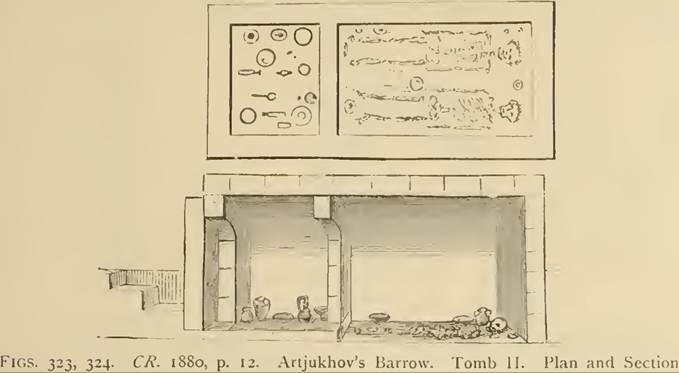
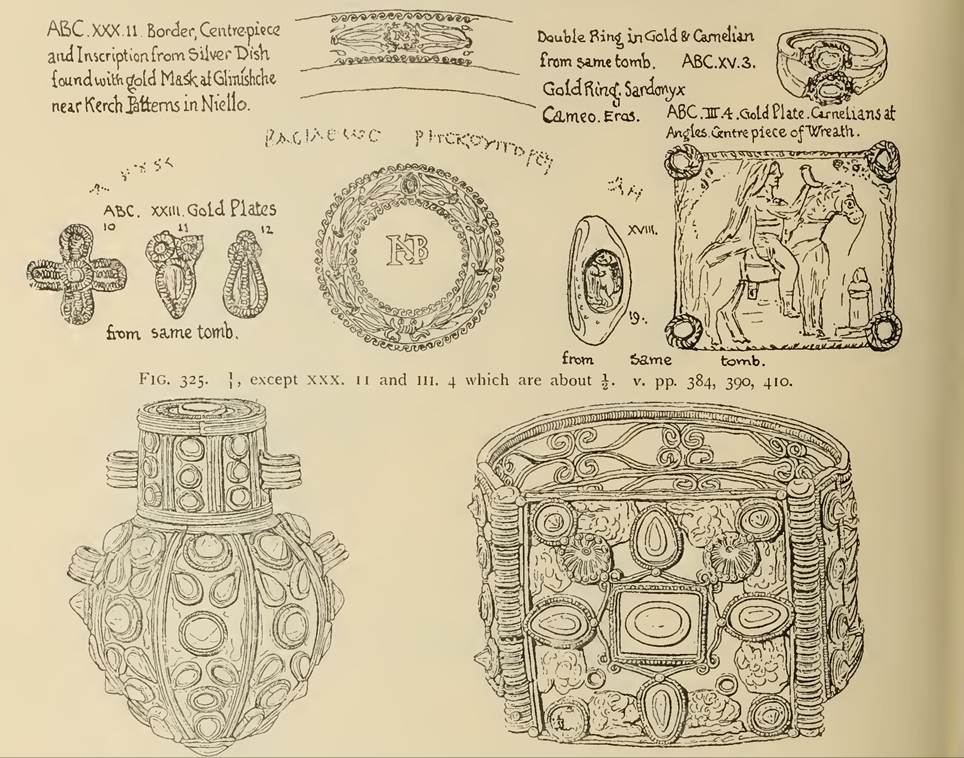
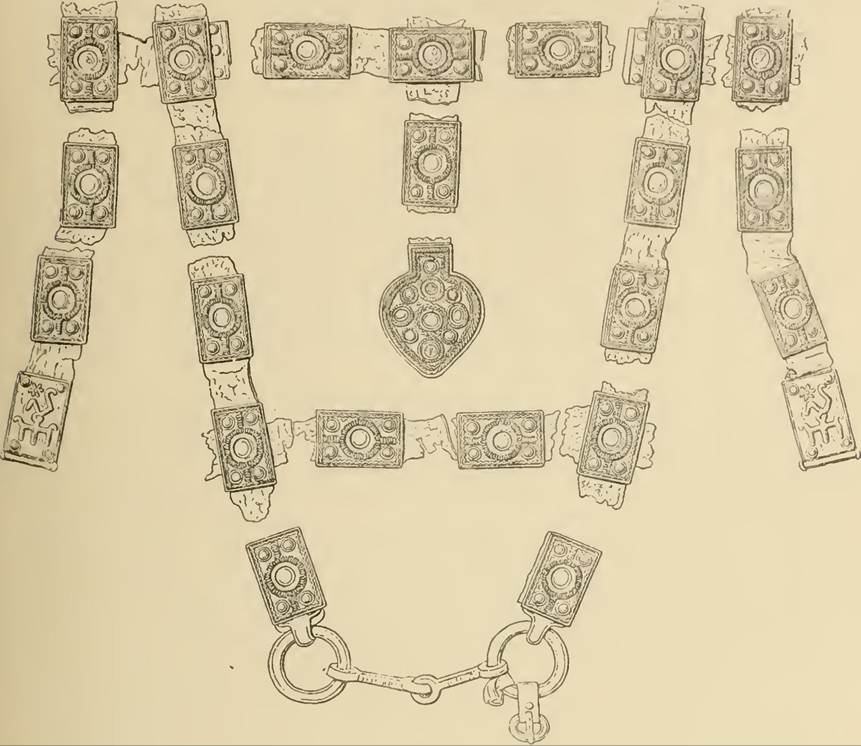
CHAPTER XII. REPRESENTATIVE GREEK TOMBS.
Almost all the objects of Greek art from South Russia occur in tombs, so it seems worth while for that alone to give some account of them and their disposition : on the whole we cannot say that we gain therefrom any knowledge of the special peculiarities among the Greeks of the Scythian coast.
About Kerch graves are noticeably rich in their contents, which may point to a specially lively sense of the duty of providing all necessary for the departed in the next world: also the number of conspicuous barrows seems greater: but speaking broadly such a necropolis as that excavated by Pharmacovskij outside Olbia[965], or by Duhmberg near Kerch[966], is similar e.g. to the well-known necropolis of Myrina[967].Berezan.
Everywhere, though cremation was practised, burial was the more usual rite. The only exception is the very early cemetery on the island Berezan4. Here were found large hollows with smaller ones about them. These latter proved to be grave-pits about iqom. (4 ft. 6 in.) deep and divided by stone walls: in them were urns with ashes, fragments of vases and Olbian asses or fish-coins. The larger proved to be crematoria: one such pit 3*55 m. (11 ft.) deep having its chimney still preserved. In it were found successive layers of cinders and sherds of Ionian and black-figured Attic vases dating the finds as from the vnth to the early vth centuries b.c. (v. supra, p. 338). In some cases the sherds belong to vases of which other fragments were found by the cinerary urns. Each body was burnt at the crematorium, and upon the fire were cast pots, weights, fish-hooks, even a charred semi-circular cake has been preserved ; afterwards all was gathered up and laid in a small pit together with arrow-heads, bits of rouge, coins, lamps and terra-cotta figures, one of which is usually a pot-bellied grotesque6: in large low barrows were several funeral pits together, each containing a number of urns with ashes and similar offerings.
Yet even at Berezan burials are not unexampled. One was covered by a deposit datable c. 600 b.c., but it was without any offering save the skeleton of a bird0: in general the burials are rather poor and belong to the last period of the island’s being inhabited, as with them the vases are ofMyrina, Paris, 1888.
1 v. inf. p. 452, n. 1, and esp. CR. 1904, pp. 41 —49; Arch. Anz. 1905, p. 61.
6 Arch. Anz. 1909, p. 161, f. 24.
0 Trans. Od. Soc. XXIX. Minutes, p. 82: Arch. Anz. 1910, p. 225.
Attic rather than Ionian make : they are set at the feet of the dead and in his hand is put an Olbian fish-coin. Burials are found in small fiat barrows and in the large barrow to the east of the island. The transition to burning is exemplified by partly cremated bodies1, as when only a single vertebra was charred2. An interesting point about Berezan is that the interments were often made not in the necropolis but close to or in the houses, in pits similar in form to the rubbish pits but distinguished from them by the absence of kitchen refuse, the completeness of the pots they contain and the presence of terracotta statuettes and other offerings1.
Olbia.
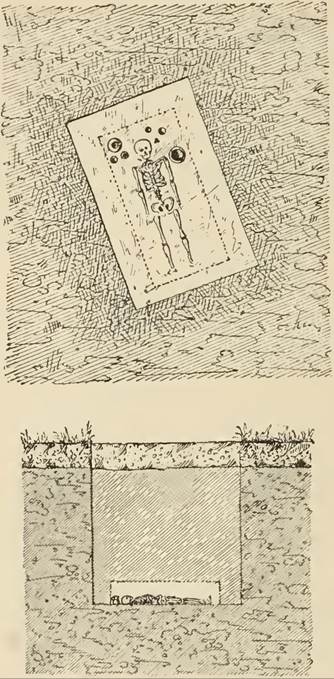
FiGS. 302, 303. Olbia. Simple Pit-grave.
BCA. vm. p. 9, f. 8.
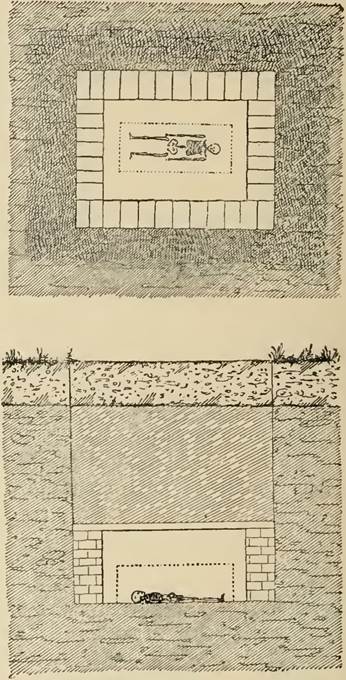
Figs. 304, 305. Olbia. Pit-grave with plank ceiling. BCA. vm. p. 19, f. 11.
At Olbia Pharmacovskij (l.c.) describes three main types of grave ; the simplest is that of graves sunk perpendicularly into the earth, the coffin lying at the bottom and having the earth heaped directly upon it (ff. 302, 303): by a development of this to avoid direct contact with the earth, the pit is lined with stones and planks laid across to make a kind of chamber (ff. 304, 305): the place of such planks has been taken by five amphorae likewise laid
1 Trans.
Od. Soc. xxix. Minutes, p. 45. 2 ib. xxvm. Minutes, p. 141.A different constructional principle is applied by undercutting one of the long sides of the grave-pit and making a recess for the coffin: this was then walled up and the shaft or pit filled in with earth (ff. 306, 307).
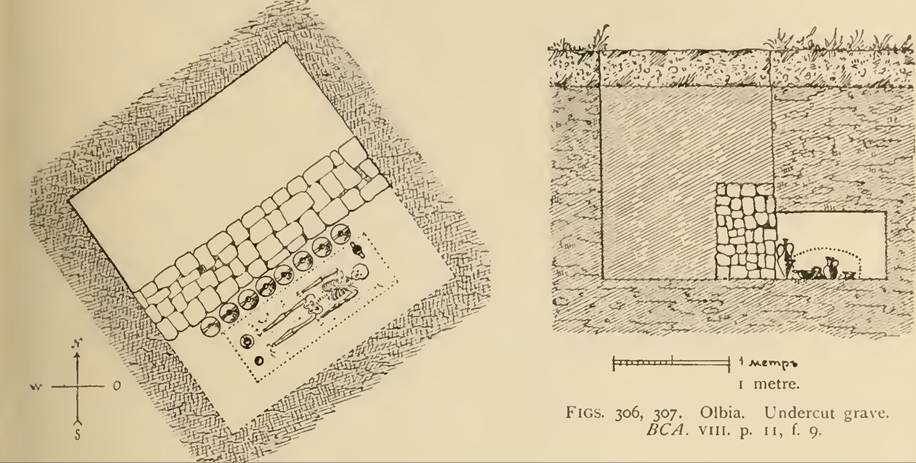
Under special geological conditions at Kerch this form developed into the roomy funeral chamber or catacomb approached by a shaft piercing the particular limestone layer which conveniently held up the roof (v. p. 308). At Olbia, where there was no special advantage in going so deep, the undercut grave did not in its development get beyond a simple 3pop.o$ leading down by earthen steps to the entrance of a bare grave chamber which never approached the size and decoration possible at Kerch : the body was put within, the entrance blocked with a rough wall, the dromos filled up with rammed earth and a monument placed alongside3.
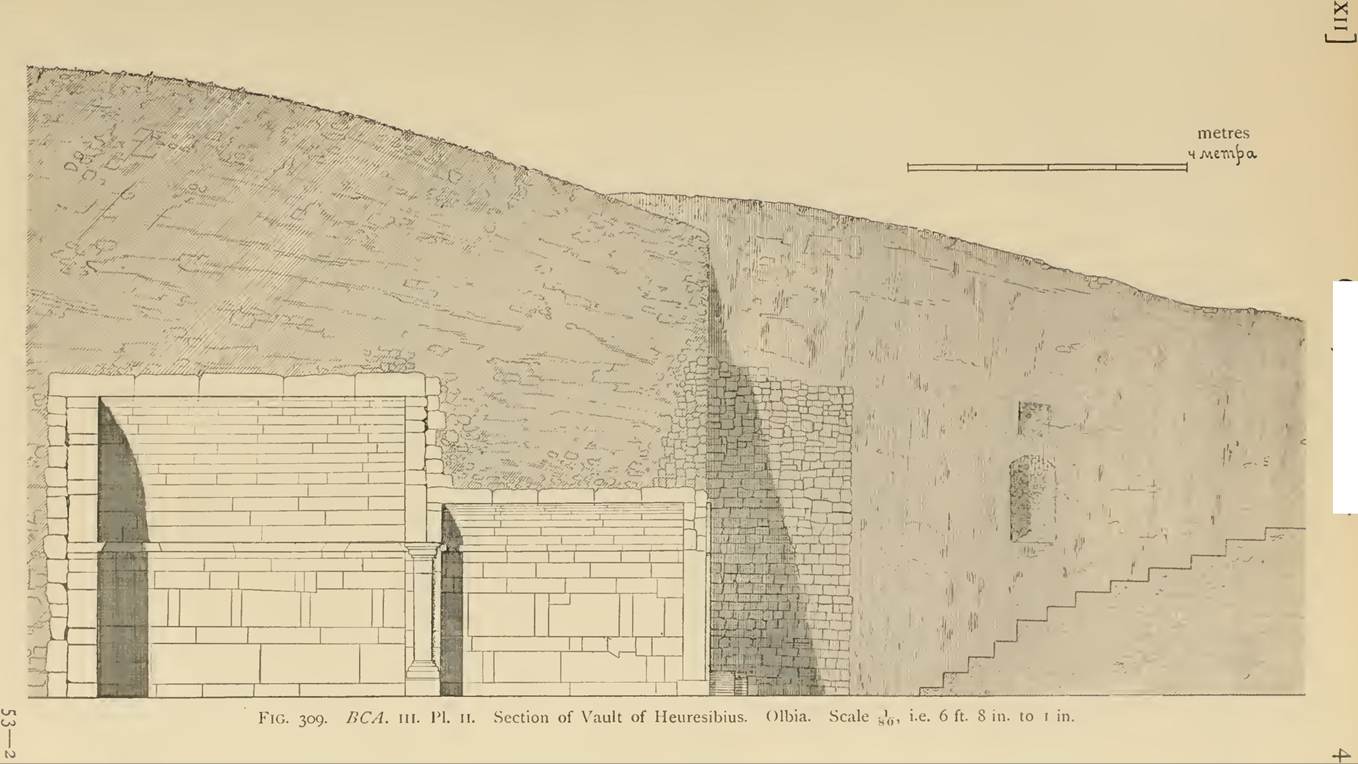
When a more splendid resting place was desired at Olbia a stone vault was built: a late Roman example (c. 200 a.d.) is that of Heuresibius and Arete4, which is identical in plan with the common earthen chamber, save for the addition of a vestibule. Here, as may be seen by the plan and section annexed (ff. 308, 309), the approach with steps cut out of the earth led down to an elaborate erection entirely below the original surface of the ground. A corridor, with its outer door tightly closed by a stone, led through a door flanked by architectural pilasters into the main chamber. Both corridor and inner chamber were covered with true barrel-vaults and adorned with simply
1CR. 1905, p. 34, f. 31; Arch. Am. 1909, 3 JHS. xvi. p. 346; RCA. vm. p. 12, f. 10.
p. 170, f. 30. 4 At XI on the Plan of Olbia, p. 450, f. 330; v.
2 CR. 1904, pp. 34—39, ff 48—55 ; Arch. Am. BCA. III. (1902), pp. 1 20.
1905, p. 64, ff. 11 —13 ; 1909, p. 167, ff. 28, 29.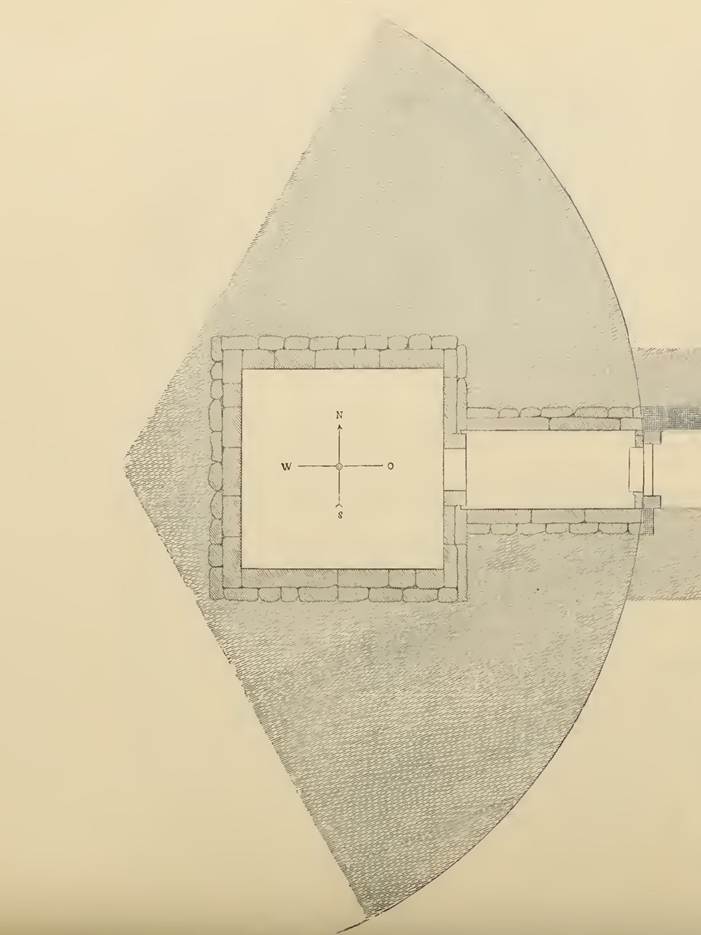
Fig. 308. BCA. in. PI. i. Olbia. Plan of Vault
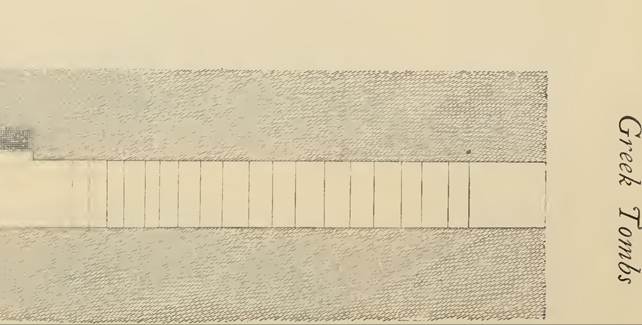
: of Heuresibius. Scale τΛσ, i.e. io ft. to i in.
Olbia, Hеа і'esibìus
moulded cornices. The tomb had been opened both by ancient and modern robbers: the last only found fragments of a bench and a marble table inscribed:
EYPHZI Bl OSK AAAIS® E NOY ZKAlAPETHHAniOY TOMNHMAZnNTEXEAYTOlS IZ
KATESKEYASAN ENHMEPAIZ
Von Stern, who first published the inscription[968], took the Iv T)[iepats tt? to be the addition of modern forgers, and in spite of Latyshev’s defence of them[969] they seem to be the work of the Brothers Hoehmann through whose hands the stones had passed. Pharmacovskij when he carried out his scientific exploration only found one or two bits of a glazed vase (v. supra, p. 357) and of millefiori glass, also a coin of the end of the und century a.d.[970] The approach was filled in with earth as could be seen from the unbroken edges of the earthen steps, and the whole structure covered by a barrow enclosed by such a solid stone plinth that some took it for the foundation of a defensive tower[971].
In the case of another barrow[972] much the same in type just enough of the plinth was preserved to make its restoration possible. It consisted of a rough foundation in the form of two steps, a course of long plain stones laid on their sides, another course of broad rusticated stones laid alternately as headers and stretchers and a simple cornice, making a total height of i’88 m. (6 ft. 2 in.): the stones came from the ruins of the town-wall. The diameter of the circle was 37 m.
(120 ft.) and the original height of the heap some 15 m. or 50 ft. The chamber consisted of an outer and inner room of the same breadth roofed with a barrel-vault. It was absolutely empty, but the resemblance to the masonry of the former barrow argues that it belongs to the same time ; in spite of its imminent fall Olbia must have been flourishing to allow of its citizens having such expensive monuments. The two barrows can be distinctly seen on my view of Olbia from the river (p. 450), but since that was taken they have necessarily been almost destroyed. In the necropolis of Olbia burials are almost universal and cremation occurs only in isolated instances. Except in the very simplest interments the body was put into a shell which was enclosed in a monumental wooden coffin : but Olbia has not yielded any fine· coffins in good preservation[973].One grave discovered at Olbia in 1891 deserves mention because of its exceptional character and the interesting fate of its contents7; unluckily it was ransacked by peasants, so we cannot be sure of its exact arrangement. In a chamber lined with stone lay two skeletons with gold leaves upon eyes, mouths and ears (cf. p. 507, f. 339). Of the man we know no more : the woman, laid on a wooden couch with bronze feet, wore also a funeral wreath, a necklace with many-coloured stones and pastes and a butterfly pendant (cf. p. 406), another of transparent beads, gold and garnet earrings, a silver roundel with Aphrodite and Erotes, and two gold rings with engraved garnets: on her dress were sewn repousse gold plates: in her mouth was a silver coin rather like Pl. in. No. 6 with a countermark dated 1st century a.d. There were also found a plain bronze mirror, a bone spoon, a clay lamp, a small black vase,
Pl. v.—ix.; xxxiii. pp. 107, 108.
6 A sin.pie one on p. 322, f. 232.
7 Mostly figured by A. V. Oreshnikov, Drevnosti, XV. ii. pp. 1 —13, “ Remarks on antiquities found at Parutino in 1891,” or von Stern, Trans.
Od. Soc. xxvn. p. 88, “A Tomb-find made at Olbia in 1891.”a pot shaped like a seated lion (v. p. 346) and a glazed mug with the Judgement of Paris (v. p. 354). In 1905 I saw certain objects professing to come from Olbia, which had been lent to S. Kensington Museum by Mr Pierpont Morgan and obtained by him from Messrs Spink. I was at once struck by their resemblance to the above and had photographs sent to Professor von Stern who proved that they came from this same grave. They include two silver canthari, a bronze hairpin with a silver head (v. p. 383, f. 284) and a glazed oenochoe with dancing skeletons (p. 356, f. 262). The couch, mouthplates and butterfly necklace recall Chersonesan customs so nearly that we may believe that here we have the tomb of a Chersonesite living in Olbia.
Figs. 310, 311.
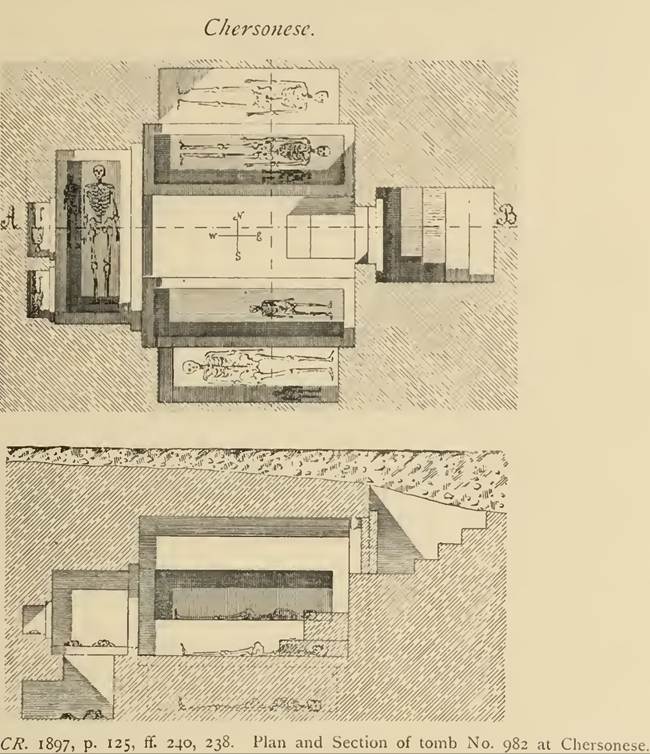
At Chersonese K. K. Kosciuszko-Waluzynicz has given full descriptions of over two thousand graves; they include simple pit-graves, undercut graves and sepulchral chambers, of which the most usual type is square with a pillar in the middle and loculi in the walls*. Figs. 310, 311 which explain
1 CI\. 1892—1906; />CA. 11. sqq.; v. p. 552, bibliography to Ch. XVII.; A'77i. p. 31, ff. 28, 29. themselves shew a more elaborate example adapted to accommodate a large number of persons. Owing to the thinness of the soil most of the excavations had to be hewn in the rock, and were often shallow so that they have usually been plundered or at any rate their contents are in poor preservation. Where the bedrock is not reached the cist of the grave is often formed of tiles. At Chersonese cremation is more general than at Olbia although far less frequent than burial, e.g. the passage under the ivth century town-wall contained six urns with ashes and the beautiful jewelry already mentioned (v. pp. 380, 397—399, 402, 410 n. 1, 499 and inset of Plan vn. p. 493). Near by were two columbaria of Roman date with niches for urns. Reference has been made to the practice at Chersonese of laying gold leaves upon the eyes and mouth of the dead (v. p. 507, f. 339): the nearest analogues are in Seleucid graves dug by Loftus at Warka in Mesopotamia and Mycenaean plates from Cyprus : like the funeral masks they seem to have served to make it less painful to look upon the face of the dead at the time of the funeral ceremony, or to prevent the entrance of demons’.
Bosporzts.
It is in the graves about Kerch that most interest may be felt, since these have yielded the most precious spoil. Duhmberg2 enumerates sundry varieties, simple graves sunk in the earth or hewn out of the rock, covered with boards or tiles or slabs of stone (often enough old gravestones with inscriptions). Sometimes there are cists made of stone slabs. Beside these are the undercut graves and subterranean chambers in which the dead were laid either directly upon the floor as at Olbia or upon a ledge or bench as at Chersonese. Out of 81 graves opened in 1899 only two shewed cremation. Coffins in these lesser graves seem either to have been absent or to have left no traces. These various classes of simple graves are well described in the introduction to ABC.\ and diagrams are added giving the arrangement of the stock sizes of tile to make a cist (Plan B) with plans and sections of stone cists and chambers (Plan C) and accounts of their contents.
The catacombs have been already discussed (v. supra, p. 307), they seem to have exact analogues in other Greek sites. Most characteristic of the environs of Kerch are the more ambitious tombs with barrows. Such occur in other Greek lands and references to their heaping up are common enough in the literature, but I do not know of any Greek site surrounded by the rows and groups of barrows that occur in the neighbourhood of Panticapaeum and Phanagoria (v. p. 435, n. 1). It seems as if native influence had some part in producing this result. It was these conspicuous barrows that first attracted the notice of the various grave robbers of old times and also of the archaeologists of the last century, so that very few are still untouched. Accounts of their contents are to be sought in ABC., and in the older series of the CR.\
1 F. H. Marshall, BM. Jewellery, in. 196.
2 CR. 1899, P· 27; BCA. 1. p. 80, see bibliography to Chap. XIX. for excavations in Bosporan cemeteries.
3 Reinach’s ed. p. 17 sqq.
4 e.g. Pavlovskij barrow, CR. 1859, Pl. V. pp. 6—15, others on Jiiz Oba ridge, ib. pp. ix, x : i860, pp. iii—vi, Pl. vi.: Vitjazevo near Anapa, 1881, p. iv. 1882-8, Pl. I.—VI. pp. 31—38 ; Little Bliznitsa, ib. Pl. vn. pp. 76—82.
and a hasty description of many may be found in Here it will be
sufficient to give some account of the contents of three important tombs ; the Great Bliznitsa and Artjukhov’s barrow, both in the Taman peninsula, and the grave of the Queen in the golden mask at Glinishche north of Kerch.
Great Bliznitsa.
The richest Greek barrow opened near the Bosporus is that called the Great Bliznitsa or Twin near \ yshe-stebleevka north of Lake Tsukur upon the Taman Peninsula·’. Its circumference was about 350 metres and its height 15. Operations were begun on the west side and first there was found an empty masonry chamber with painted architectural adornments (ff. 31 2, 31 3). Near was a plain chamber in which was the tomb of a lady whom Stephani has called a Priestess of Demeter, as the decorations of her elaborate jewelry
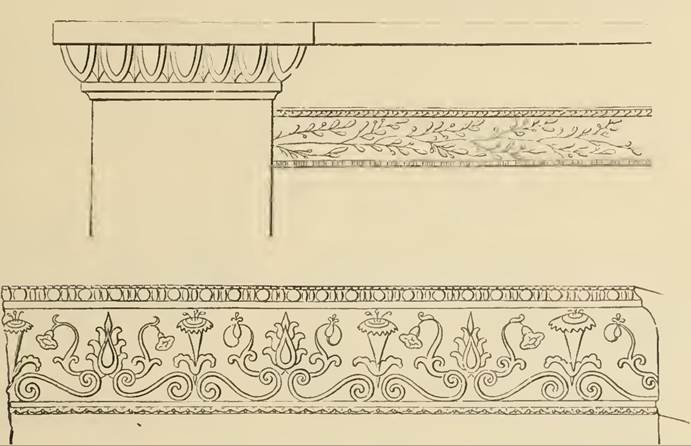
Figs. 312, 313. CR. 1865, p. 14. Great Bliznitsa. Man’s Tomb. Painting in Corridor and Grave-chamber, v. p. 307.
all have reference to the cult of Eleusinian Goddesses. By this was the place upon which a second lady had been burnt, and at a lower level a bricked platform with the traces of the funeral feast. Here an interesting feature was a funnel-shaped hole defined by a limestone plate 1’24 m. x 62 m. in which was an opening '27 m. square shut by a stone fitting it exactly. This
1 pp. 22—69 and 111 sqq.
2 It is a little difficult to obtain a clear idea of the disposition of the Great Bliznitsa as its exploration was not conducted continuously but fell in the years 1864, 1865 and 1868. Accordingly we have accounts of the finding of various interments and objects in them in the formal Report for each of these years, and in the Supplement to the Report for the year following each of these we have Stephani’s elaborated account of the objects themselves. Cf. CR. 1864, p. iv sqq., 1865, p. iii and p. 5, Pl. 1.—vi. ; 1866, p. 5 sqq., Pl. 1.—in.; 1868, p. v; 1869, p. 6, Pl. I.—ill. No plan has been given.
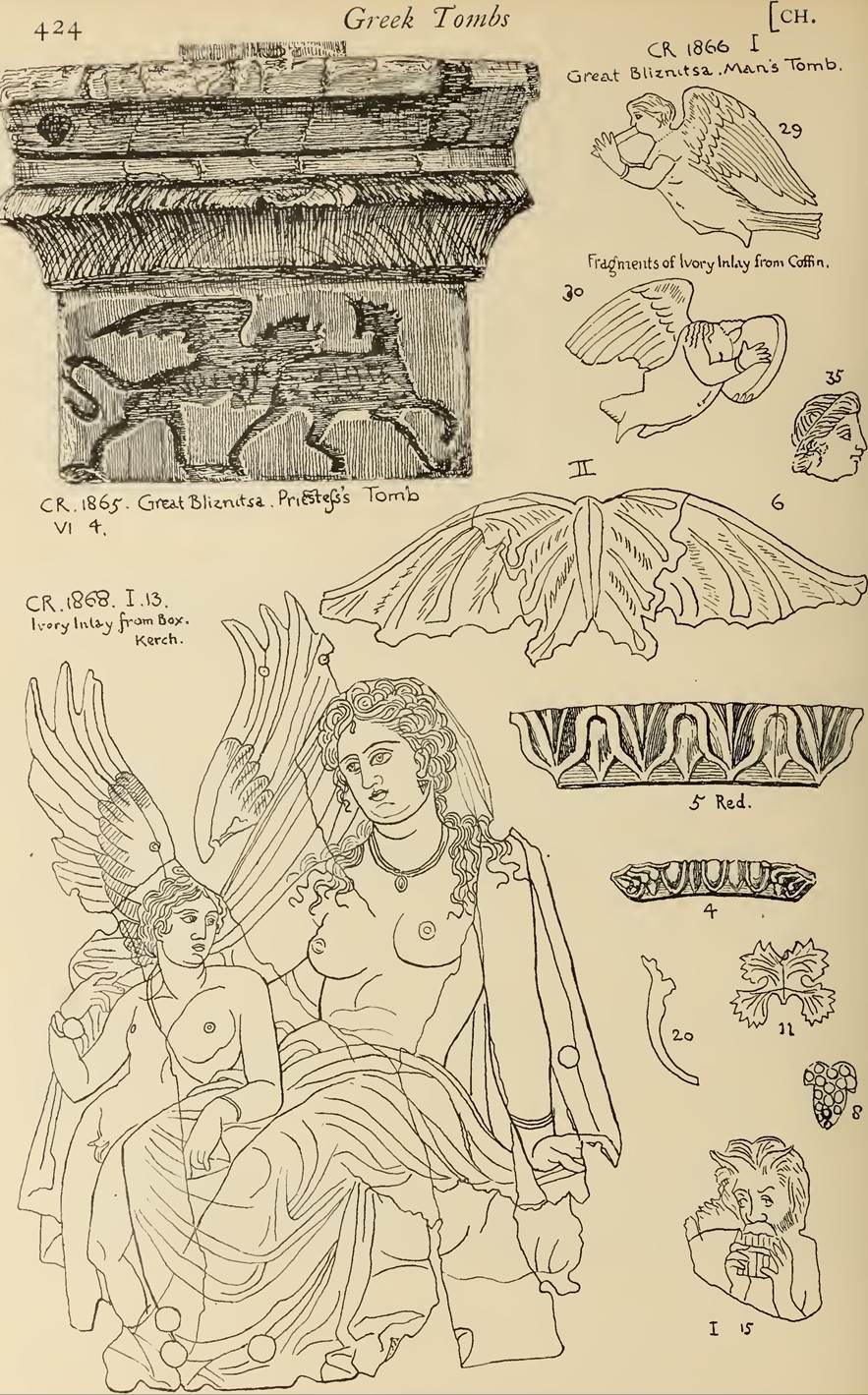
Fig. 314. Inlay, mostly from the Great Bliznitsa. v. pp. 331, 334·
hole went clown into the earth and must have been a ftoOpos' for offering liquids to the dead. Twenty feet to the s.w. were fragments of a dish.
On the south side of the hill were the traces of another funeral feast, and at a higher level a number of amphorae buried, not far from the empty tomb2. In this part also were the traces of a great pyre and another /?o'dpo$. Here belonged a late red-figured vase with Europa3. Near by was a stone tomb with a prismatic vault. This had collapsed and crushed the coffin of the man buried beneath it : but precious fragments of its ivory inlay remain (v. f. 314) and some other objects. Finally in 1868 there was discovered the tomb of a third lady yielding only to that of the first lady in richness.
The accounts of the exploration give such uncertain particulars as to the relative positions and levels of these various finds that it is impossible to say exactly in what order the different people were laid to rest in the barrow : but it is clear that they all belonged to one family in spite of the differences of ritual, and they must have lived at about the same time, for gold plates struck from the same dies occur in different tombs, although they are so delicate that they could not have stood much wear. The date is approximately indicated by the stater of Alexander found on the burning place of the second lady, and the style of all the objects confirms this. The most important of the works of art have been discussed under the categories to which they belong, but the inventories of the different tombs have an interest of their own.
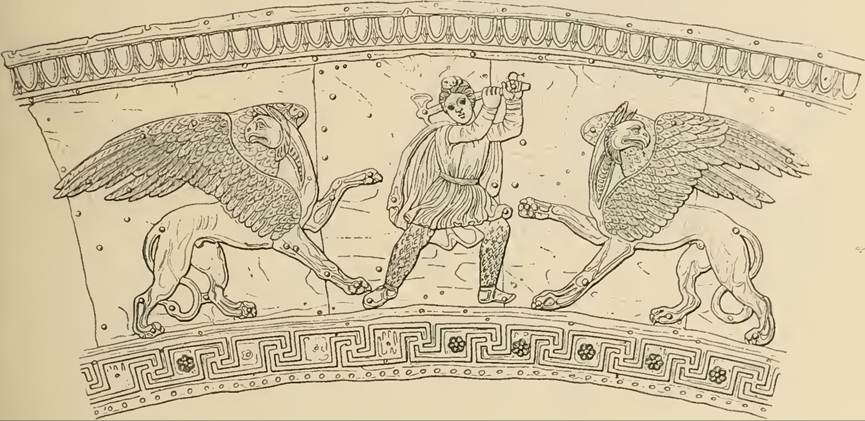
Fig. 315. Centre of Cold Calathos from Great Bliznitsa. Priestess’s tomb. C7C. 1865, 1. 3. 5. v. pp. 56, 391.
The Priestess of Demeter was most completely furnished with all adornments, comprising a best and second-best set. There were in her coffin, itself enriched with inlay4, a gold calathos for state occasions (f. 315) and a simple
2 CR. 1865, p. iii.
3 CR. 1866, m.
4 CR. 1865, vi. 4, 5 on f. 314.
1 Perhaps after all on-») would be the right word, cf. Pausanias, X. iv. io where we have a very similar case on pure Greek soil (Daulis): v. Frazer, ad loc. for parallels from all parts of the world.
M.
54 stlengis, a pair of temple-ornaments (f. 316), and two pairs of earrings, a rich necklace and a simpler one, a pair of gold bracelets (f. 317), four
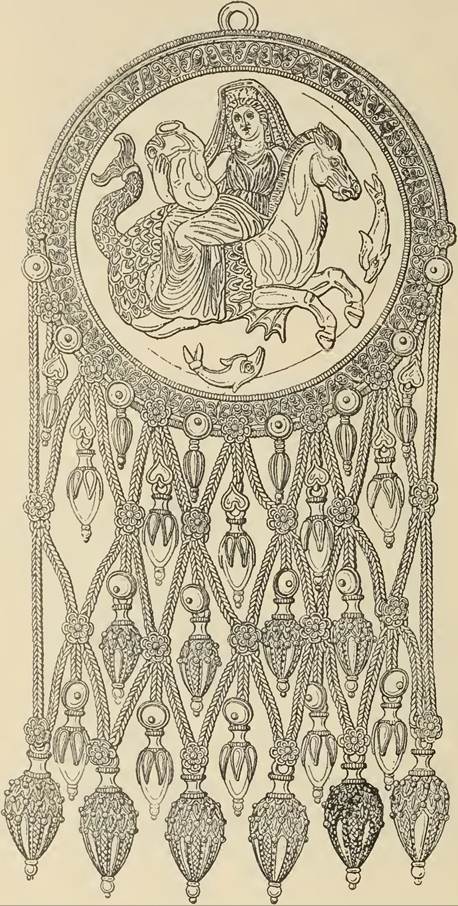
F1G. 316. Great Bliznitsa. Priestess’s Tomb. Gold Temple-ornament. KTR. p. 59, f. 75 = CT?. 1865, n. 1. 1 · v. p. 394. '
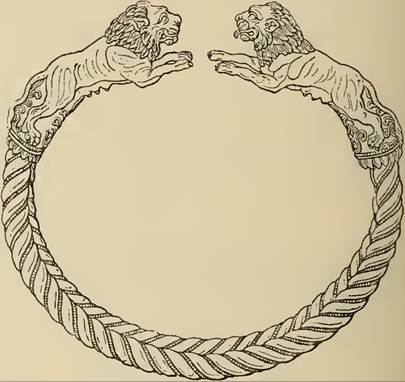
Fig. 317. Great Bliznitsa. Priestess’s Tomb.
Gold Bracelet. KTR. p. 65, f. 84= CR. 1865. 11. 6. }. v. p. 402.
gold rings[974], twenty-two varieties of gold plates making up 1875 in all[975], gold beads, a pair of boots and a mirror handle. Of other objects found near the most important were the remains of the harness of four horses with bronze bits and highly decorated phalerae3.
The tomb of the third lady, found in 1868, offered remarkable analogies to the Priestess’s in the selection of
adornments. Again we have a calathos, this time the figures only were of gold not the ground, they comprised a row of Bacchanals going
3 ib. v. vi., cf. supra p. 155 n. 1.
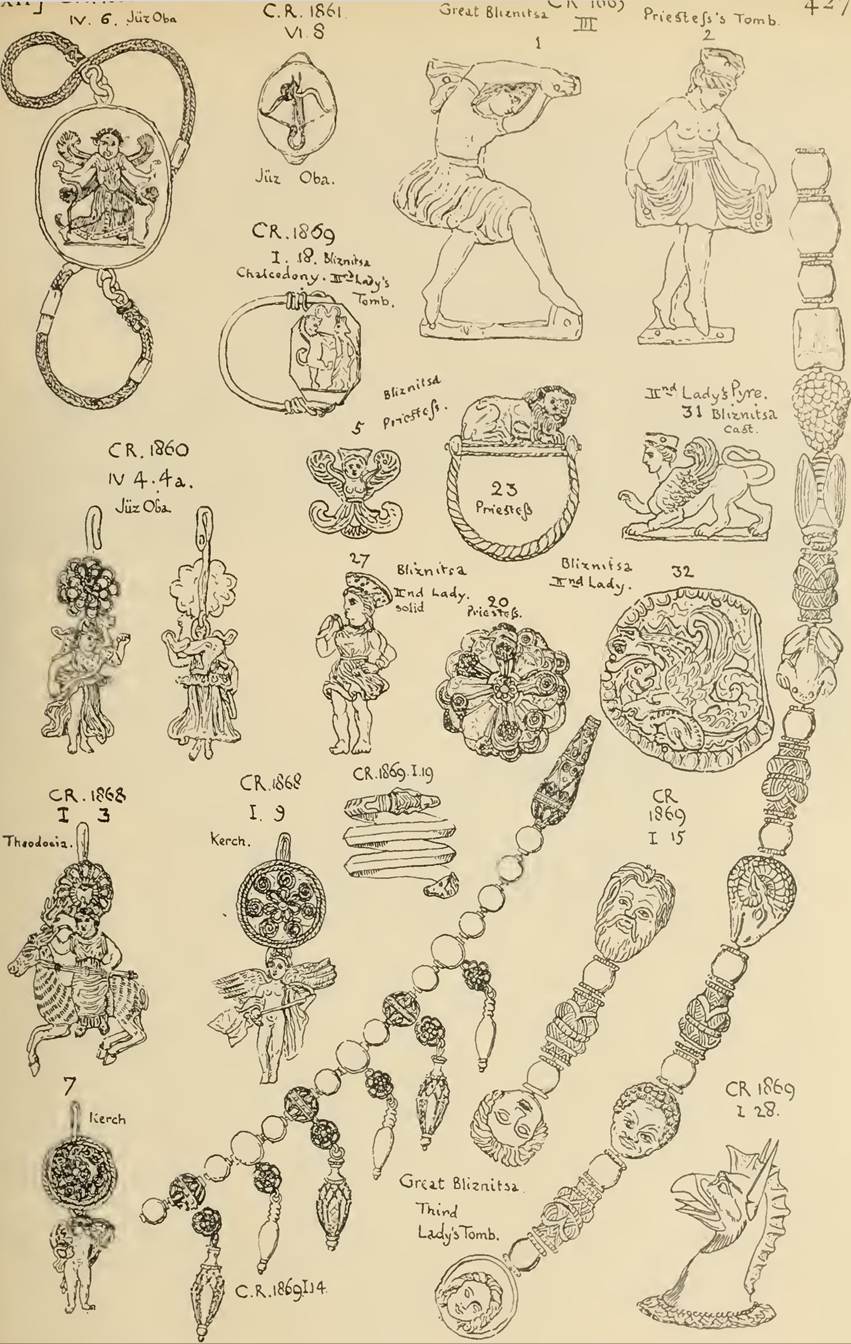
Fig. 318. Jewelry mostly from Juz Oba and the Great Bliznitsa. }. v. pp. 66, n. 7, 374, 392 393, 399, 4'°—4'4, 426-429.
54—2
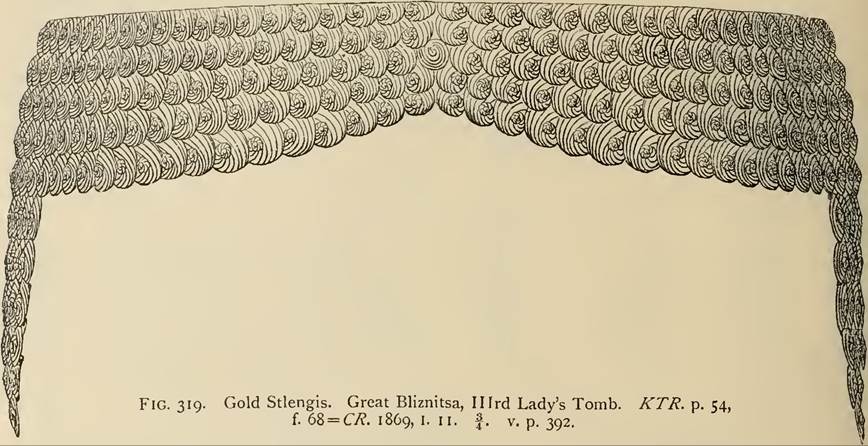
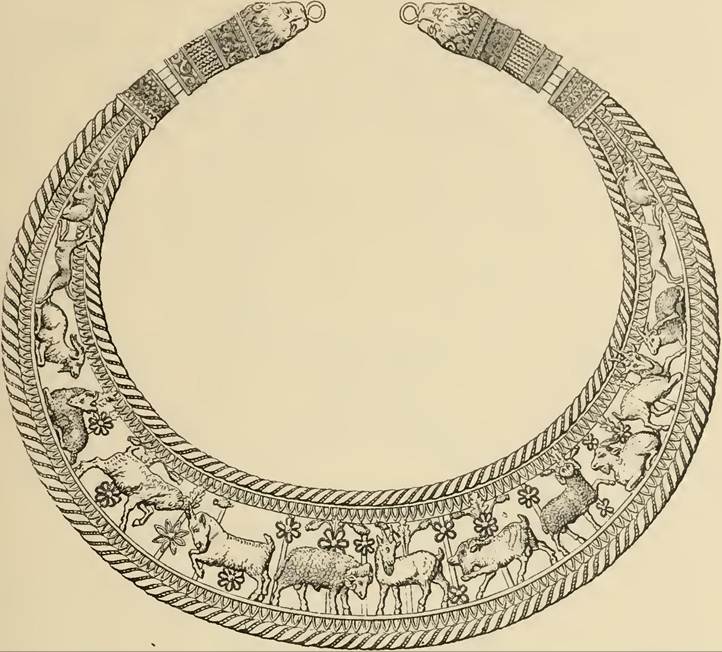
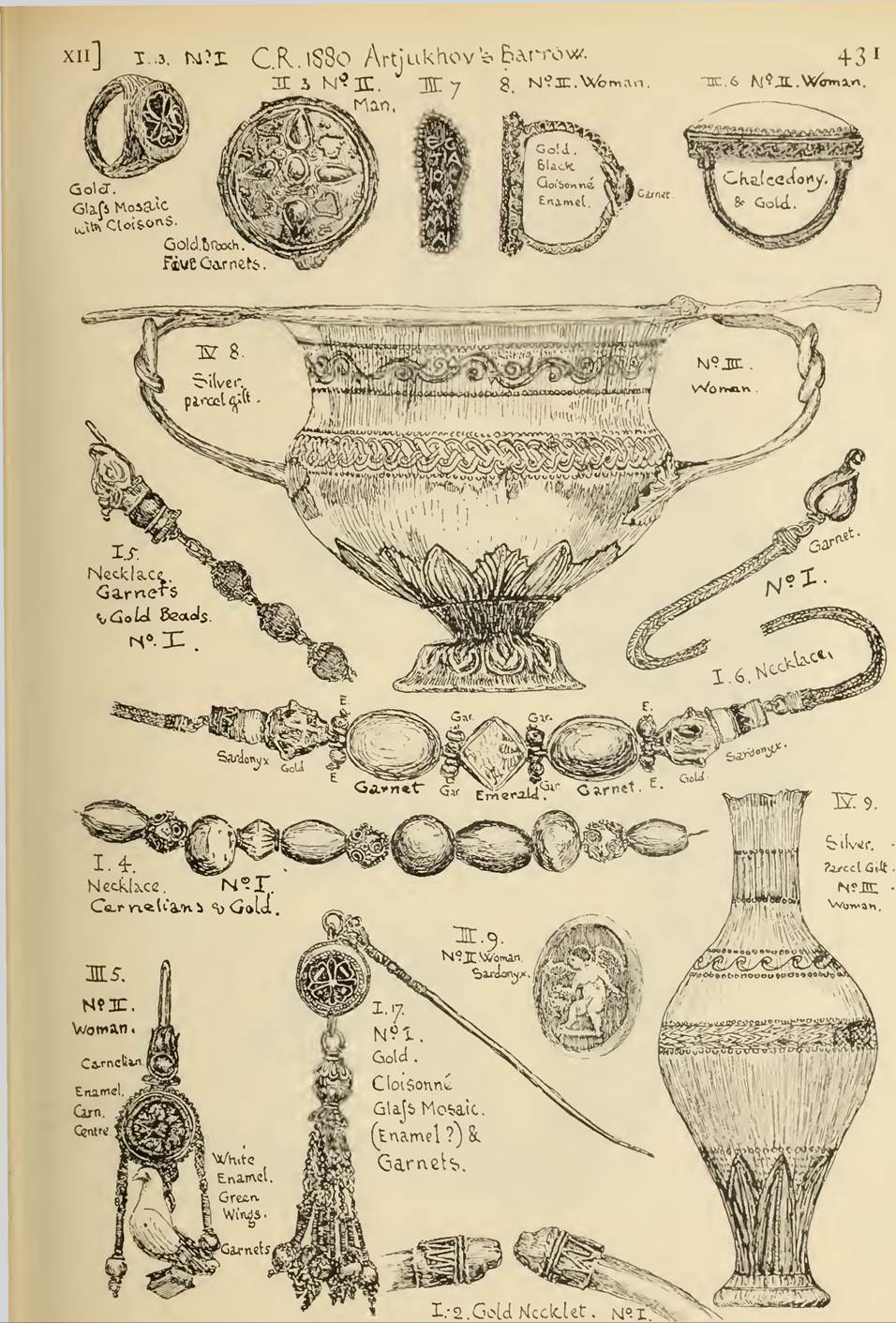
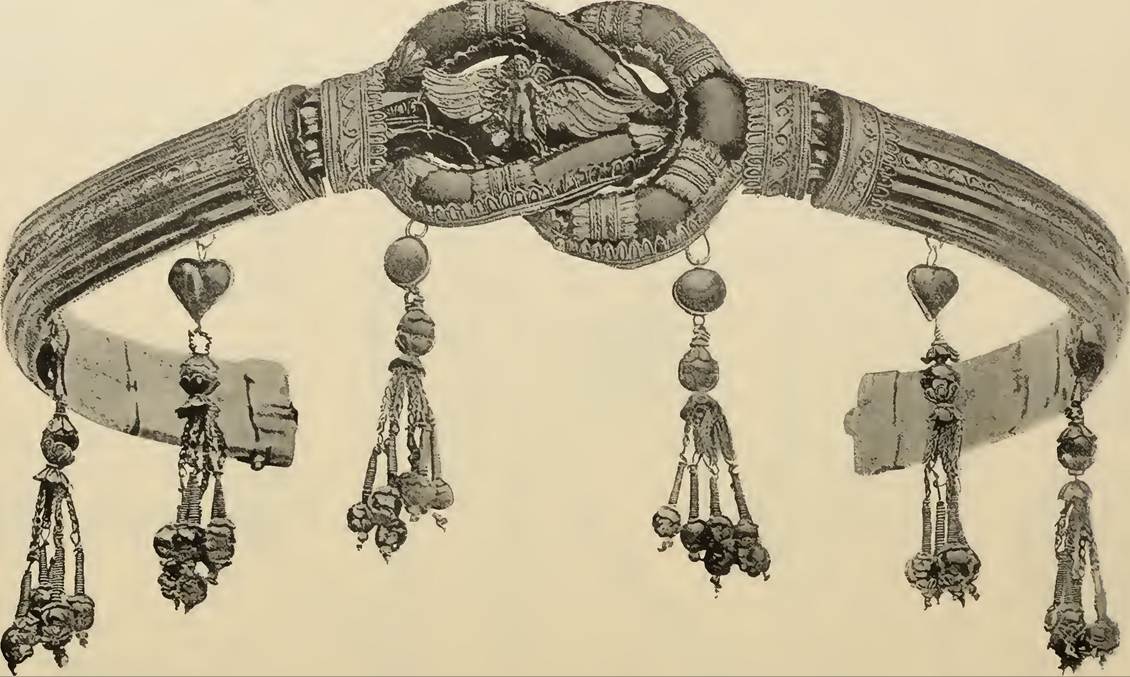
back to the types fixed by Scopas[976], a stlengis (f. 319), earrings, an even fuller set of necklets—the remarkable collar (f. 320) and two necklaces, bracelets, rings, one (chalcedony) with an oriental subject, and another in the shape of a serpent[977] [978], two hundred gold plates in eight varieties some of them identical with the Priestess’s. So far the correspondence is almost complete ; but the differences are very curious. Some may be a matter of date, for of the two the third lady would appear the later, a glass bottle, an Egyptian Bes and the Persian stone might point to the orientalizing work whose influence becomes stronger a very little later. Original are the golden griffin-heads which probably adorned the coffin unless they went along the rim of a Stephane®. To a kind of childishness we may put down a whole series of miniature vessels in bronze and clay, a doll and tiny. cymbals. But only a most perverted taste can have had pleasure in the extraordinary series of terra-cottas[979]· Some are merely Bacchic, some mere genre figures, others caricatures, but several are most obscene. They do not stand alone, but in no other Greek tomb have so many disgusting grotesques been found. Stephani calls them aTroTpoTraia, “lucky,” but they go too far in the direction of aro-nov /cat -yeXotof[980]. The lady (No. 11) who was burnt has naturally left us less on the site of her pyre than her relatives in their graves, still she had her rings and her gold plates : of these there were 322 in eight varieties, some are interestingas being identical with those of the Priestess, others for their technique as being cast not stamped6, and one for being unique in this whole barrow as shewing traces of Scythic influence. It is plearly the barbarous imitation of a Greek group of a sea-griffin devouring a lioness. This touch of the native is interesting, as it strengthens the idea that the great richness of these graves was partly due asserts the sovran power of grotesques and obscenities against the evil eye and instances these examples among others, v. supra p. 369, n. 7. 0 CR. 1865, Hi. 27, 31, 32 on f. 318. to barbarian views of the next world, although the people’s artistic tastes were purely Hellenic. Finally it is in this tomb that we find the stater of Alexander which fixes the earliest date for the whole barrow. The fioOpos associated has always claimed the attention of students of funeral beliefs. It too may be a reflexion of native usage : at any rate the Volga Finns still leave a channel by which nourishment can be poured into the tomb (v. p. 106). Fig. 320. Gold Necklet. Great Bliznitsa. Hird Lady’s Tomb. k’TR. p. 62, f. 8i=C7?. 1869, I. 13. §. v. p. 400. The decoration of the masonry tomb has been discussed elsewhere. The chamber was quite empty, so on what evidence it is said to have been a man’s tomb, is not clear. The other man’s tomb was chiefly interesting for its vault which had fallen in, and for its coffin with ivory inlay (f. 314). Besides there was a most remarkable helmet1, being a translation into bronze of a soft Phrygian cap, two gold rings, one of which had been long in use, and the usual gold plates, over 60 in five varieties, one like that figured from the Priestess’s tomb2, and others which find their analogues in other Kerch tombs. The vase with Europa found by the place of the funeral feast belonged to the last red-figured style. The whole barrow is very remarkable, and it is a pity that a more intelligible account of its contents has never been compiled nor a plan supplied. 1 KTR. p. 48, f. 55 = CR. 1866, frontispiece. 2 CR. 1865, in. 5 on f. 318. A rtjtikhov s Barrow. Belonging to the following century, dated by coins of Lysimachus, we have the rich Barrow of Artjukhov whose importance in the history of jewelry has been pointed out above (p. 404). But having regard to this importance it seems worth while to give a more systematic account of its contents[981]. The tumulus was to the north of Sennaja, the ancient Phanagoria on the Taman peninsula, not far from the site assigned to Cepi. It was opened by Tiesenhausen and Lutsenko. In it were three important tombs. In the east part of the barrow in Tomb I, which was in two compartments, a woman was buried alone; she possessed a gold diadem (f. 322), six necklets[982], four on f. 321, a chain with lion ends and a row of amulets, 3 bracelets, 3 gold earrings; on her left hand she wore a ring with glass mosaic (ib. 1. 13), on the right one with garnet and filigree and a plain carnelian : she had also a medallion with a bust of Aphrodite and a gold pin with a tassel (ib. 1. 17), also four round gold plaques; in silver she had by her a cyathus and two other vessels, a spindle and a saucer on a stand, also a bronze mirror. In the outer compartment were a pot, four saucers, three small bottles, two flutes and part of a lock3. In Tomb II (plan and section, ff. 323, 324) lay a man and a woman. In the vestibule was little but some vessels whose importance has already been discussed (p. 351). On the man’s body were a golden wreath, a gold ring, a medallion with garnets (n. 3 on f. 321), four silver rings and a gold stater of Paeri- sades. The woman by him also had a bay wreath, a neckband or frontlet, a neck-ring, a neck-chain ending in oxen’s heads, two necklaces, a gold medallion, a gold pin, a pair of gold earrings (f. 322, in. 5), a chalcedony ring (ib. in. 6), and a ring with a shoe-shaped bezel in enamel; from the inscription on the ring we may call this pair Hestiaeus and Mammia (ib. in. 7, 8), a cameo of Cupid and a butterfly (ib.. m. 9), four other rings one with an engraved garnet, three round gold plates, a coin of Lysimachus, eight silver vases including cyathi, a saucer on a stand, a box, a silver spindle, in bronze a mirror-box, a lamp4 and another box ; also a pelice like the one from Olbia (p. 350, f. 255). _ In Tomb III again there lay a man and a woman. The man wore a gold wreath with convolvulus and an iron ring, by him were a stlengis and a few clay pots5. The woman also wore a convolvulus wreath, likewise a gold neck-chain, a necklace and bracelet of rock crystal, garnet, chalcedony and smalt, earrings with Erotes, a gold ring with Heracles, an iron finger ring, four gold roundels, and a wrap of felt or fur. By her there were two engraved silver vessels (f. 321, iv. 8, 9), a plain round mirror box, a shell with rouge and white, and several clay vessels. As has been remarked already, in all there is a love of garnets and stones, of vessels, of reef-knots. Specimens also of certain objects occur in more than Fig. 321. Objects from Artjukhov’s Barrow. ]. v. pp. 351, 385, 397, 399, 404—406, 410, 414. Fig. 322. Diadem from Artjukhov’s Barrow, Tomb I. Gold, enamel and carnelians. KTR. p. 57, f. y\=CR. 1880, 1. 1. Slightly reduced, v. pp. 404, 405. XI l] Artjuk/iov s Bar row. Glinishche + 33 one grave, the gold roundels in I, II and III, the plaques with Aphrodite and Eros (similar to that on p. 407, f. 295 I') in I and II, in the same two the silver boxes, spindles, and saucers on stands ; plain saucers and two-handled silver vessels in II and III. The coins of Lysimachus and Paerisades point to the same time, the end of the mrd century or the beginning of the nnd. A tomb opened by Ashik on the way to the old Quarantine in 18391 must have been very similar in its contents to any tomb of this barrow. Glinishche. As a specimen of a rich tomb of the latest period we may take that opened by Ashik at Glinishche near Kerch in 1837. It is usually known as the tomb of the Queen with the Gold Mask. In a barrow he discovered a great marble sarcophagus with a cover ending in pediments. The skeleton within was that of a woman, wearing the golden mask2, and wrapped in a woollen robe with a gold pattern sprinkled with gold plates (f. 325). Her gold wreath was of an ordinary late type with a centre piece of a horseman drinking from a rhyton (ib.)3. Her belongings shewed a strange mixture of Greek and barbarian work : the latter would appear to be her own, the other objects heirlooms. Personal to her must have been her bracelets (f. 327) in gold and garnets, her scent bottle recalling that of Novocherkassk (f. 326, v. p. 409) and the harness adorned with the Bosporan taniga ft (f. 328). She wore three rings, one plain, one double and one bearing an Eros rudely engraved upon a garnet (f. 325) : unluckily it does not seem possible to identify a coin4 found with her; it is in poor preservation. In strong contrast to this rude contemporary work are the various vessels handed down from Hellenistic times. Chief of these is the great dish in silver and niello which must have been made for one of the Diadochi, an Antigonus or an Antiochus: it can hardly have been less than four hundred years old when it was buried. On the back is an inscription with the name of King Rhescuporis, and it is usually referred 1 ABC. p. Ixiii. Reinach, p. 20, v. supra p. 351. 3 ABC. in. 4, 5==A'7'A\ p. 230, f. 204. 2 ib. \ = fCTR. p. 70, f. 94, v. supra p. 390. 4 ABC. lxxxv. 8. M. 55 Figs. 326, 327. Kerch, Glinishche, Tomb of Queen with the Mask. Bottle and Bracelet in Gold and Garnets. ABC. xxiv. 25, xiv. 4. }. v. pp. 235, 280, 409. In finishing this survey of the Greek objects found in South Russia I must ask my readers’ indulgence for not being sufficiently acquainted with the finds in pure Greek lands to institute instructive comparisons. I have endeavoured to put within their reach material that is not very accessible to them, and it is for the student of Greece and the Hellenized East to throw light on this material from the observation of other parts of the Hellenic world. Especially I should like to know whether there appears any substantive [1] This because in the tomb at Hadzhi Mushkai, v. ABC. Reinach, p. 43, containing almost identical diadems (v. p. 390, n. 7), jewelry (v. p. 408) and harness, BCA. xxxvn. p. 33, f. 15, together with old Greek heirlooms, among others apparently a ivth century aryballus, ABC. LVin. 6, 7, were found “indications” of a coin of that king: but the form of the genitive in -ci recalls later coins, v. p. 384. difference in the ordering- of the tombs in South Russia and in I lellas, whether what appears to me quite a singular richness of the former is merely due to the opulence of a commercial community or to the influence of barbarian ideas making people more anxious that the dead should have the richest and fullest provision for the future life : a minor point would be the question whether the Fig. 328. Harness from Glinishche, Kerch. Leather mounted in Gold set with Carnelians. KTlt. p. 314, f. = AHC. xxix. 4. j. v. p. 318 n. 1. immense number of barrows about Olbia, Panticapaeum and Phanagoria can be paralleled in Greece or Asia Minor[983], and if not, whether it is merely a question of soil or of influence exercised by the barrow-heaping tribes of the country. It is not for me who have never been in Greece to answer such questions, but I have supplied one term of comparison, may some one who can supply the other bring his knowledge to bear upon the matter. and Pella, Annals of Archaeology and Anthropology, Liverpool, 11. (1909), p. 159; Peigamum, A th. Mitt. 1907, p. 231 ; 1908, p. 365, and then Sardis which again is not Greek. 436