§ 13. Gems.
The gems found on the north coast of the Euxine are not on the whole of very great importance9: but the two specimens of work by Dexamenus are sufficient to redeem the whole class from insignificance.
Of special local interest are the oriental gems. In many of them strong Greek influence is traceable, and Furtwängler in his discussion attributes almost all of them to Greek artists10. Perhaps the earliest of them is a cylinder from Kerch11 upon which a priest is worshipping a sacred dragon that rises from the symbolic “sea” Apsu; behind are the symbols of Marduk: the elements of the name inscribed are “ Marduk” or “Samas” and “iddin ” or “sum...”: Menant12 assigns this to the Neo-Chaldaean Empire. Other specimens are Achaemenian. Perhaps the most interesting is explained by Menant13 as a forerunner of the scene represented at Bisutun : Darius is slaying Gaumata the Mage and behind him four figures with ropes round their necks represent four rebels subdued ; behind them is a palm tree with fruit. Another notable example comes from Anapa out of the Nereid coffin14 and bears
8 ABC.xv.g, 15 ; also Konelsky’s, v. pp. 384, 385.
9 The largest publication, T. de Kibaltchitch, GAnnies de la Russie Meridionale, 1910.
lu v. p. 56; cf. Stephani’s list in CR. 1881, pp. 81 -88, also 1882-88, pp. 62—66 sqq. ; Furtwängler, Die Antiken Gemmen, III. p. 116 sqq.
11 CR. 1881, V. 6, 7 on f. 298.
12 Glyptique Orientale, Vol. ii. p. 71, Pl. x. 4 and Furtwängler, loc. cit. For the interpretation I am much indebted to Canon C. H. W. Johns, Litt.D., Master of S. Catharine’s College.
13op. cit. Vol. 11. ix. 1 and p. 168, f. \it’] = CR. 1881, v. 9 on f. 298.
14 CR.
1882-8, v. 3, on f. 298, v. p. 324.a king with crenelated crown1 adoring Anaitis who walks upon a lion and is surrounded with rays. The worship of Anaitis was first allowed by Artaxerxes Mnemon2. In the same tomb was a very curious gem, not a cylinder, but a four-sided prism[944]. One face bears a Persian distinguished as such by the shape
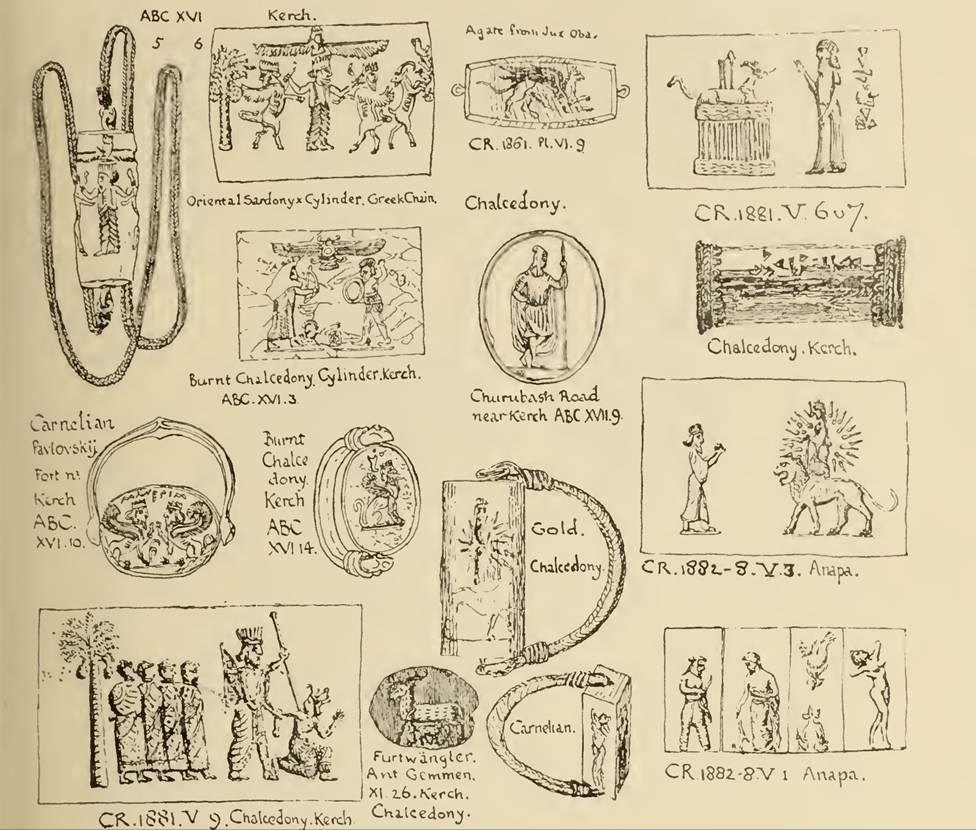
Fig. 298. Oriental and Perso-Greek Gems found about the Bosporus. ]. v. pp. 263, 267.
of his hood, flat on top with its tip hanging backwards[945]; the next has a man with a dog jumping up at him, closely recalling the composition of an Attic grave relief, upon the next is represented a cock fight much as it occurs upon the cylices of the lesser Attic masters, and the last shews a nude woman dancing. The style of the latter cannot be much before the end of the fourth
[1] Cf. Dalton, The Treasure of the Oxus, p. 75.
[1] Menant, op. cit. Vol. 11. p. 175.
century. The whole prism has been at some time shortened so that the feet of the figures and the tail of one cock have been cut off.
Of other cylinders one from Kerch[946] seems purely Persian, shewing a king struggling with two crowned human-headed winged bulls under the overshadowing of the Deity ; beyond is an ibex and a palm tree. Of purely Greek workmanship but clearly made for a Persian is a cylinder bearing a Persian King, his shoulders somewhat damaged by the fire through which the stone has passed, fighting for the body of a slain Greek against another Greek over whom his victory is assured by the protection of the Deity[947]. Stephani gives several plain cylinders in his list. The Greek settings in which these gems are found consist of little gold mouldings round each end of the cylinder and a half hoop ring of twisted gold. The poor cylinder from Kholodnyj Jar (p.
193, f. 85) is interesting mainly for its provenance.Beside the cylinders we have scarabeoids with oriental compositions. Very typical is a longshaped octagon bearing the traditional combat of a king and a lion found in the third lady’s tomb of the Great Bliznitsa[948]. Very typical too is an oval of engraved glass from Nymphaeum out of the tomb which offers such analogies with the VII Brothers. Upon one side of this is a cow, upon the other the emblem of the Deity[949]. To this class also belong two specimens—one with a winged and crowned Sphinx, another with two such affronted with an uninterpreted inscription in what is said to be Lycian[950]. Hence they may both be referred to Asia Minor. With them may be mentioned the chalcedony with a winged monster now at Oxford[951] and one with a winged human-headed ox[952]. The occurrence of these Persian gems does not really seem an evidence of any love of Persian forms due to a community of origin between the natives of these parts and the Iranians, but is merely due to Iran’s having exerted upon Asia Minor and its dependency the Bosporus a general influence, which is most clearly shewn in the distribution of pure Persian proper names. Figures of barbarians occur upon gems of undoubted Greek workmanship made apparently for Greeks, but as has been remarked they are merely generalized barbarians of the Phrygian type[953] or definitely Persian as the Athenades gold bezelled ring which is nearly connected with the coins of the Persian Satrap Datames9. A head with a Phrygian cap has the artist’s name TEP/'A Perga[mos]10. It is said to be too early to have anything to do with the city Pergamum.
The work of a broken scarabeoid11 bearing a cow seen from behind is so rude, shewing clearly the use of a coarse drill, that it is hard to say whether it is very early or very late. The meaningless combination of Egyptian elements seen on a broken carnelian—above, the winged disk, on each side, a hawk wearing the double crown, in the midst, a lotus bud instead of a scarab, and below a boat, all within a twisted border—betrays an Asiatic workman12.
Furtwängler, Ant.
Gem. xm. 5.9 ABC. Reinach, p. 137: CR. 1861, vi. 11: KTR. p. 66, f. 88, p. 88, ff. 178, 179: Furtwängler, Jahrb. d. deutschen Archäol. Inst. 1888, p. 198 and Pl. viii. 3 : Ant. Gem. x. 27.
10 ABC. xvi. 4 and Reinach, p. 58. Furtwängler, Jahrb. 1888, p. 198, Pl. viii. 5 ; Ant. Gem. xm. 2.
11 ABC. xvi. 15.
12 ibid. 13, my authority is Mr F. W. Green: more Egyptian is CR. ^$72, in. 16.
Greek Gems.
1 he oldest undoubted example of absolutely Greek work is a large chalcedony[954] found in the same grave, in Juz Oba, as the beautiful lecane (p. 342, f. 248) ; it bears Medusa in the archaic pose of the Nike of Archermus and the Medusa from Martonosha, she has snakes in her hands and four wings, The dry careful manner is typical of the archaic style, yet it is already shewing signs of coming freedom and has been assigned to the beginning of the vth century. Most of the things in the same grave seem to be of the end of the century and a pair of Maenad earrings still later (f. 318); so the gem must have been worn for a hundred years before burial.
Another gem shewing archaic feeling is a crystal with a sow from No. iv of the VII Brothers[955], noticeable is a nick in its mane seen also on the Vettersfelde boars, this Furtwängler[956] says is a characteristic of Ionian art.
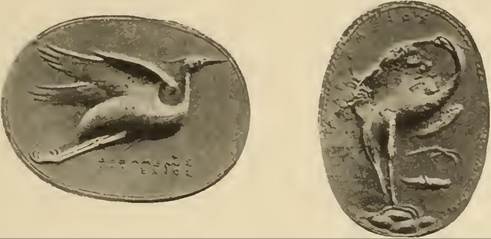
Fig. 299, Jiiz Oba, Chalcedony; Fig. 300, Tainan, Agate. Gems by Dexamenus of Chios.
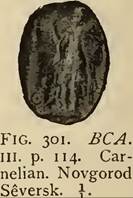
Of the severe style we know no better master than Dexamenus of Chios : there are four known specimens of his signed work and two of them are from South Russia : a heron flying[957] [958], and a heron standing with a cicada before him®. This latter has been damaged in the funeral fire, but the former is the best study of a bird in Greek art; in some ways it rather recalls Japanese work. Of the other Dexamenus gems one at Cambridge shews a lady Mica and her servant, just such a group as served as a model to put on a gravestone, the other has the portrait of an unknown Greek[959], one of the first portraits known. Sir A. J. Evans (loc. cit.) calls it Cimon without obtaining Furtwangler’s agreement. The four gems are placed by Furtwängler (p. 137) in the following chronological order, Mica, the standing heron, the portrait head and the flying heron : he assigns 430 to 420 b.c. as the time when Dexamenus flourished7. This gives a definite point of the utmost use in determining the development of gem-engraving, and the two herons are 5 f. 300; CR. 1865, in. 40: Ant. Gem. in. p. 137, f. 94. 1 am much obliged to Sir A. J. Evans for leave to reproduce his enlarged photographs, Revue Archeologique, xxxn. 1898, p. 337, Pl. vm. 8 CR. 1868,1. 12: Ant. Gem. xiv. 1, larger bi. 8. ’ See also his “ Gemmen mit Kiinstlerinschrif- ten,” Jahrh. d. k. d. Arch. Inst. 1888, pp. 199—204. 4.14 Greek Art. Gems, Cameos, Coins [ch. xi,§I3 among the most important ancient gems in existence because of the undoubted genuineness of their inscriptions, seeing that they have never been bought or sold. Another standing heron or stork on chalcedony from Theodosia does not come up to that by Dexamenus (p. 401, f. 294. 8). A very interesting early ring already mentioned as from Jiiz Oba bears engraved upon the gold bezel the curious device of a snake twined round a bow so as to draw an arrow[960]. Another gold bezel with Nike before a trophy adorns the only good ring from Kerch in the British Museum[961]. Rather later in style come the Asiatic gems spoken of above, that shewing a Phrygian supposed to be Paris, and those with the names Athenades and Perga[mos]. The latter was found in the same grave as a Lysimachus stater and a large burnt chalcedony bearing Apollo Citharoedus (or perhaps a Muse)[962]. A cameo from Artjukhov’s barrow—the earliest known—Eros with a butterfly8, is dated by coins of Lysimachus and Paerisades and the style of the silver vessels (v. p. 351) to about the middle of the mrd century. A fine piece of work from Chersonese is a Medusa head of the beautiful suffering type9 cut in onyx. The same site has produced a pair of ordinary cameo portrait busts10. In this connexion we may mention a brooch with a magnificent portrait of L. Verus in rock crystal though it was found at Batum : the head was sunk from behind and then gilt and so from in front appears as it were in relief11. A very large number of poor gems with commonplace heads, animals or even whole figures, have been found about Kerch, but of recent years few that seemed worth figuring in CR. ; the best in ABC. have been noticed. To stones of Roman date there is no end, but it is curious to find one with a Roman warrior offering a wreath to Hecate, at Novgorod Seversk north of Chernigov in Central Russia (Fig. 301). Cutting coin-dies is an art nearly allied to gem-engraving: what measure of success it attained north of the Euxine, Plates 1.—ix. shew : the gold staters of Panticapaeum are good, some of the rare early types of Chersonese, especially the full-faced ones, and one or two issues of Olbia and Phanagoria are passable, but on the whole the interest that can be claimed for these coins is historical and not artistic.