§ 12. Goldwork and Jewelry.
It is to the magnificent examples of goldwork found in them that the excavations in South Russia owe their world-wide fame. The Hermitage possesses by far the richest collection of such work.
It is therefore impossible to mention at all a large proportion of the specimens exhibited there or described in the various publications, and even such very indifferent completeness as has been reached in other departments is in this unattainable.Moreover, owing to the absence of any treatise dealing generally with Greek goldwork and jewelry, it is harder to determine exactly what relation the style of objects found in South Russia bears to that current in the rest of the Greek world”. Eugene Fontenay’s book[851], attractive from its style and many illustrations and important because of its author’s technical knowledge gained by actual practice, covers too wide a field and in the ancient part loses by the author’s want of familiarity with archaeology. If Dr Hadaczek will make such monographs upon other jewel-forms as he has upon earrings[852] we may hope that he will finally write an all-embracing history of jewelry in the ancient world. Much material for comparison is furnished by the Nelidov Collection, which includes a small number of objects from South Russia but was mostly formed in Constantinople and Rome[853]. Two works by Froehner have the same kind of interest[854], but none of these books give any view of the development of Greek jewelry or the geographical distribution of various types.
The classification of styles in goldwork is rendered particularly difficult by the transportability of the objects. Identical forms occur in South Russia, on the coasts of Asia Minor, in Cyprus, in Syria, in Egypt, in Athens, in South Italy and in Etruria, and there is very little means of judging where we
already in type ; there is not much from S.
Russia : Μ. Rosenberg’s Ges ch. d. Goldschmiedekunst auf Technischer Grundlage, Frankfurt a/M., 1910, also came too late for me.7 Les Bijoux Anciens et Modernes, Paris, 1887.
8 Karl Hadaczek, “ Der Ohrschmuck der Griechen und Etrusker,” Wien, 1903 in Abhandlungen des Archäologisch-Epigraphischen Seminars der Universität Wien, Heft XIV.
9 Klassische Antike Goldschmiede-arbeiten im Besitze Sr. Excellenz A. I. von Nelidow beschrieben und erläutert von L. Pollak, Leipzig, 1903.
10 Collection du Chateau Gotuchbw. L'orfevreiie decrite par W. Froehner, Paris, 1897; and La Collection Tyszkiewicz, München, 1892.
are to seek the centres of distribution. The provenance of a given object is no evidence as to its origin unless in one place we find many specimens of some type which occurs nowhere else: the material gives no such clue as can be derived from marble or clay: there are no inscriptions such as we find on statues and pots and gems: finally we seem to know least about the jewels of those very districts in which we may suppose that the best were made. For, speaking broadly, it is from the edges of the Greek world, where the Greek met the barbarian, that the jewels come—from Cyprus, from Etruria and from South Russia; few from Asia Minor, fewer still from historic Greece. Of Mycenaean jewels there is here no question.
In spite of their richness in this department the South Russian colonics only yield good work of a comparatively late period : as with other arts (save pottery) we must go elsewhere for early specimens, our first examples already belong to the time of highest mastery. No early gold has been found at Berezan, from Olbia we have one find of the vith century b.c. (v. p. 400) and one or two rings from the next. From Greek graves on the Bosporus there does not seem to be any goldwork of the archaic period: there ought to be some, for the coins of Panticapaeum begin fairly early and the pieces found in native graves like Vettersfelde, Melgunov’s barrow, Kul Oba, Kelermes and the VII Brothers must have come in through the Greek ports (v.
Chap. x).We have already discussed the reason for the richness of the finds in South Russia. The Scythians carried out to its farthest logical conclusion the principle of surrounding the dead with all they loved and needed during life, even more so than the Etruscans, whose graves are the other great source of Greek jewelry : and from contact with the natives there seems to have been a strengthening of this feeling in the Greeks among whom it already existed. The example of Kul Oba was, as it were, felt at the Great Bliznitsa.
In attempting therefore to characterize the jewels of South Russia in general we must beware of regarding them too much as one whole and indivisible. Some were probably made in Athens, many in Asia Minor, others shew Egyptian influence, most were very likely made upon the spot. Also they nearly all belong to a time when the early severity was out of fashion. Nevertheless, taking them all round, especially the jewels found about the Bosporus and those in the possession of natives, we are justified in seeing in them a prevalent taste for colour and florid workmanship as against the general Greek feeling for form and restraint. It cannot be mere chance that in this region, with its close and friendly connexion with the Orient, we get the best specimens of Greek enamel (used merely as a filling in patterns of soldered wire which occur equally well without it), the first examples of true cloisonne and the first cameo, as well as an early welcome given to the Oriental love for many-coloured precious stones as opposed to plain gold be it never so cunningly worked.
This taste went on flourishing, and all later jewels depend upon colouristic effects, so that to the jewellers of Panticapaeum has been put down the not quite unwilling elaboration of the “ Migration ” style with its reminiscences of Persian, Scythic and Greek and the production of the Treasures of Petrossa and Nagy Szent Miklos and the models imitated by the Goths and other Teutonic conquerors of Europe (v.
suprap. 282 n. 2).Crowns.
Crowns or wreaths, usually found in place upon the brows of the dead, both men and women, form the most continuous series of gold objects yielded by South Russia. They are surpassed in number by the earrings, but they form a series in that so many of them bear their own approximate date in the shape of an “indication” or impress of a coin which often formed the centrepiece. There must be nearly fifty known, for many have been discovered since Stephani gave a list of nineteen in the Hermitage[855]. The earlier crowns are sometimes of quite artistic workmanship, studies of olive, bay and oak treated both conventionally and naturalistically. Good specimens of conventional treatment are the crowns worn by both man and woman in the second tomb in Artjukhov’s barrow[856]. Here we have intertwined oak and bay with what appear to be acorn-cups forming the centre. More naturalistic is a crown of the same date—mrd century (both graves had coins of
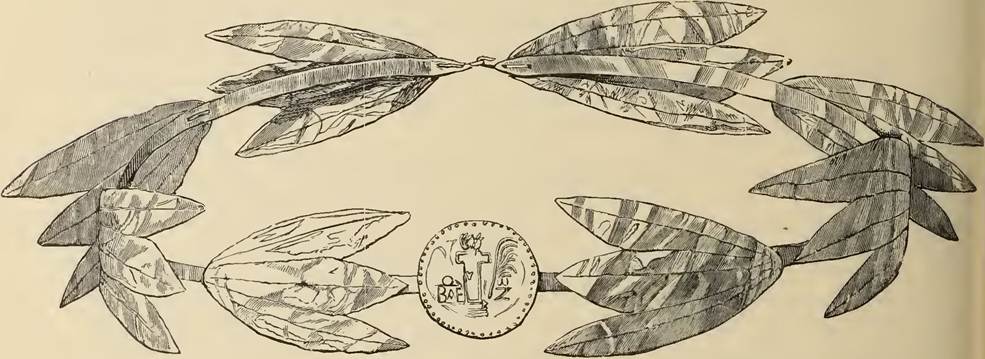
Fig. 285. CR. 1878, p. 115. Kerch. Gold wreath with indication of BAE Coin, cf. inf. Pl. vn. 17.
Lysimachus)—with bay leaves. In front the stems were joined in a reefknot adorned with enamel[857]. The leaf-stalks were inserted into the hollow stems and soldered. In a rather similar but even more naturalistic example[858] [859] they were twisted round the stems. Most beautiful, only surpassed by a wonderful example from South Italy in the Louvre’, is a gold crown consisting of two olive sprays tied together at the back: the rendering of sprays, leaves and berries is well-nigh perfect[860]. Equally beautiful, and to be referred to about the same date, is a kind of aigrette made of barley ears*. Perhaps it was such crowns as these that were granted as rewards to those who had deserved well of the state, Diophantus at Chersonese8, Protogenes and later Theocles and many others at Olbia9 with Cocceius at Tyras10.
8 ABC.
iv. 2 on f. 286; Fontenay, p. 389, cf. ib. p. 387.7 ABC. v. 1 on f. 286; Fontenay, p. 390.
8 App. \H> — IosPE. 1. 185,cf. ib. iv. 68; and the carved crowns of Agasicles App. 17 = ib. 1. 195.
9 App. 7, io = ib. 1. 16, 22.
10 App. 3 = ib. 1. 2.
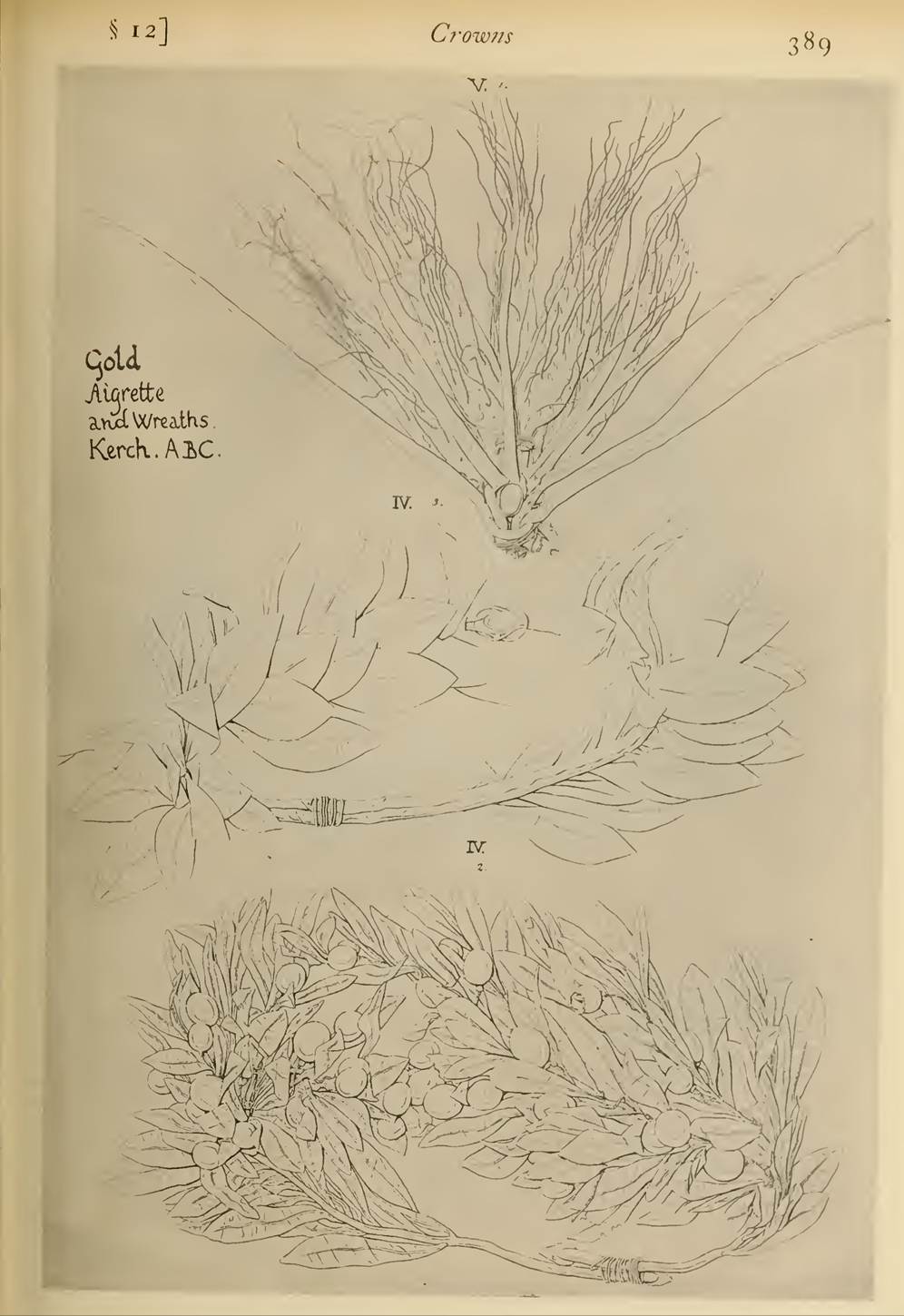
Fig. 286. j.
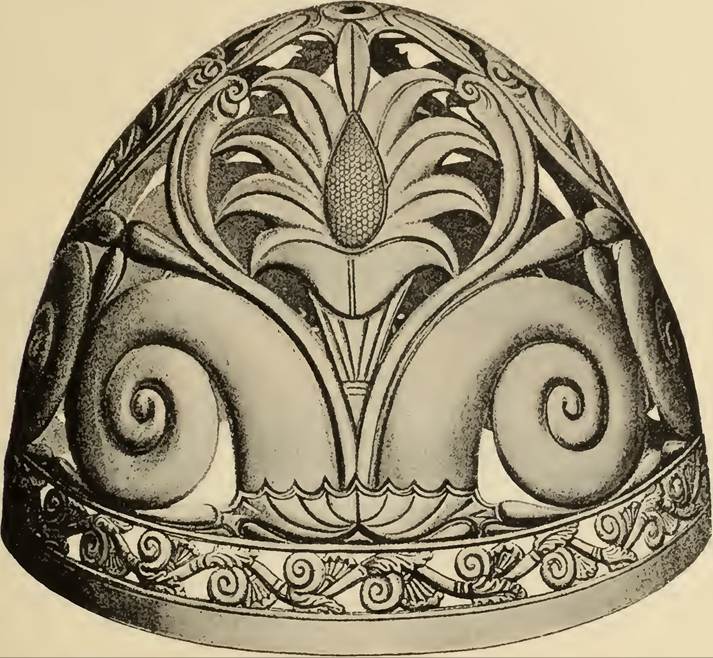
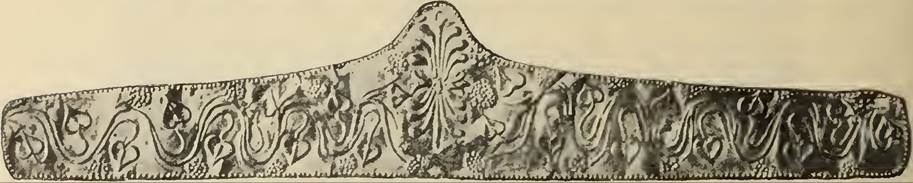
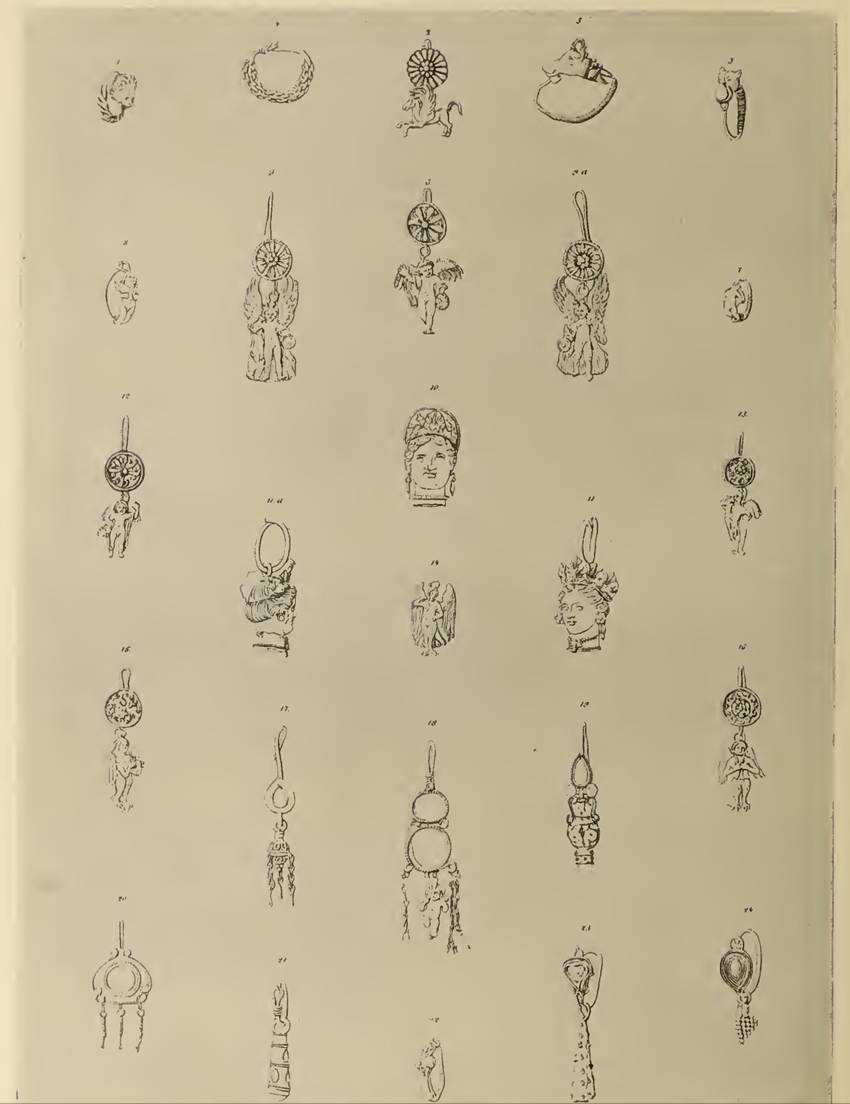
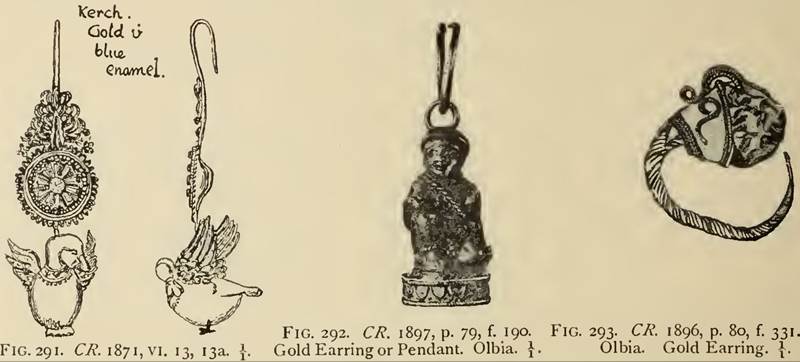
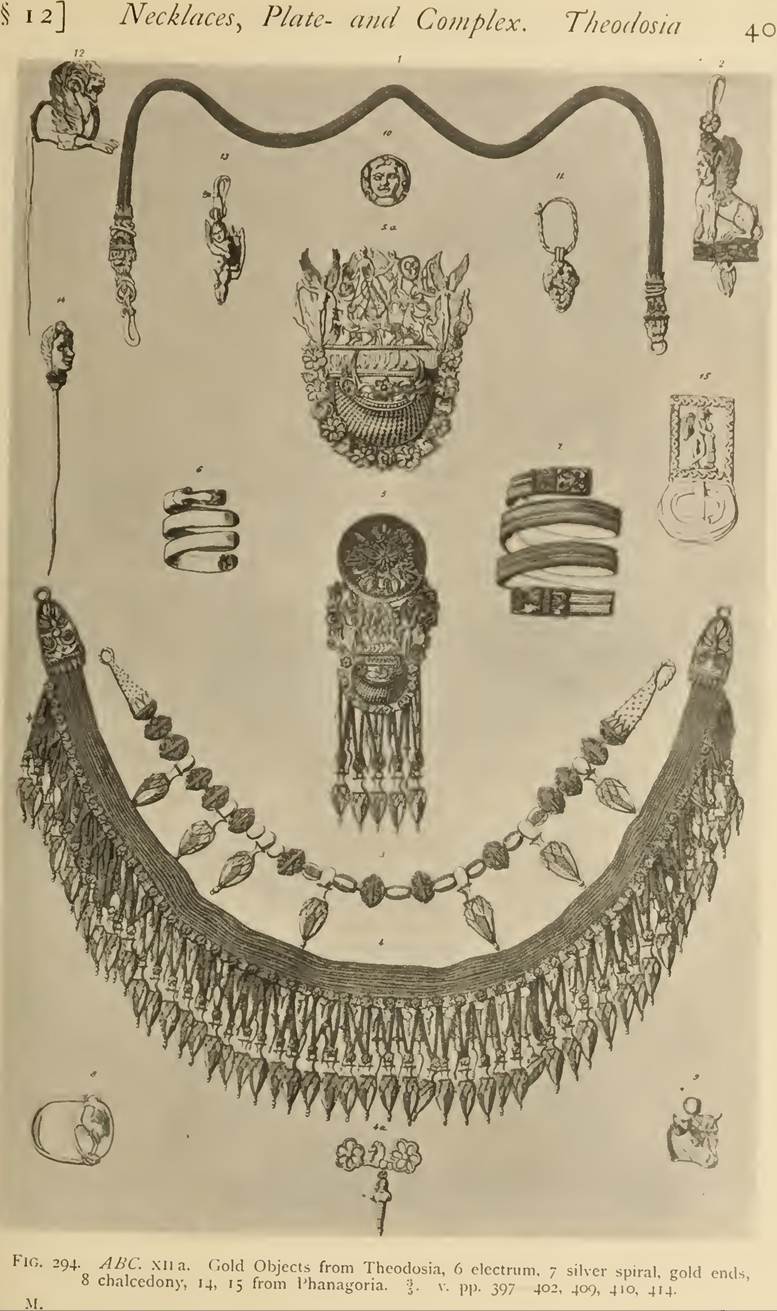
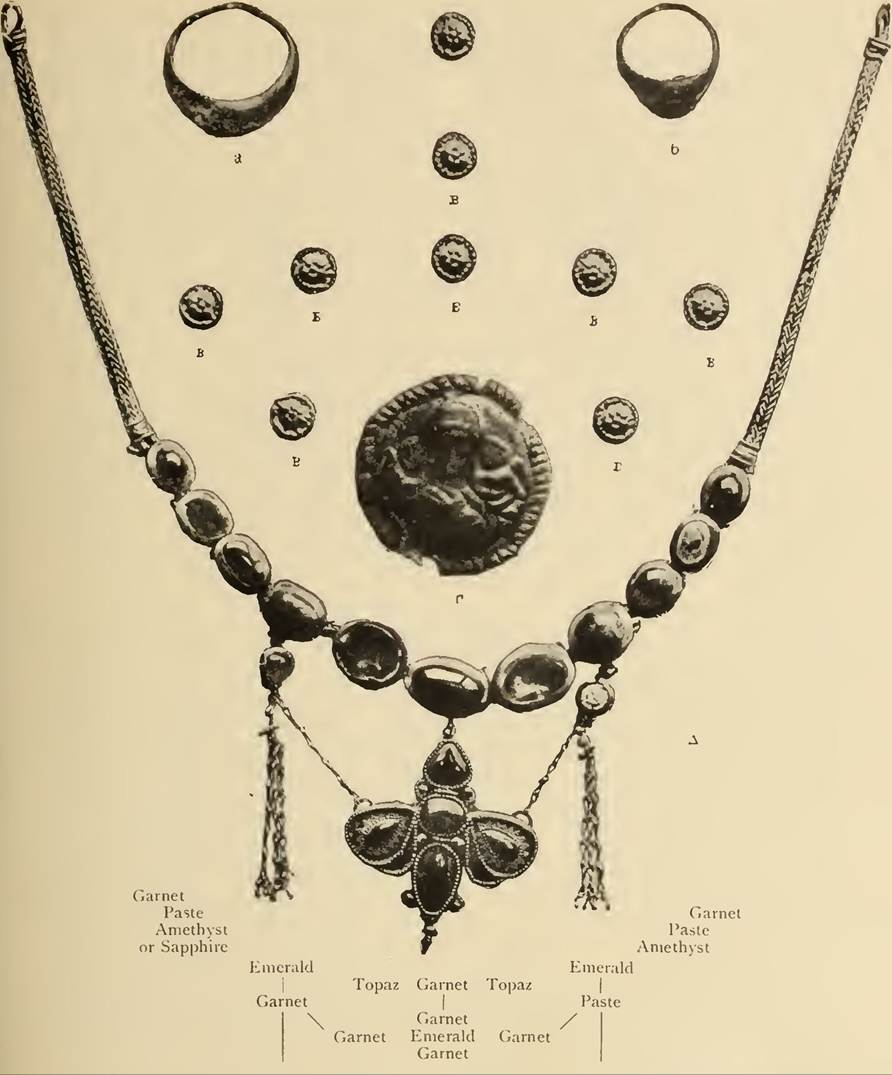
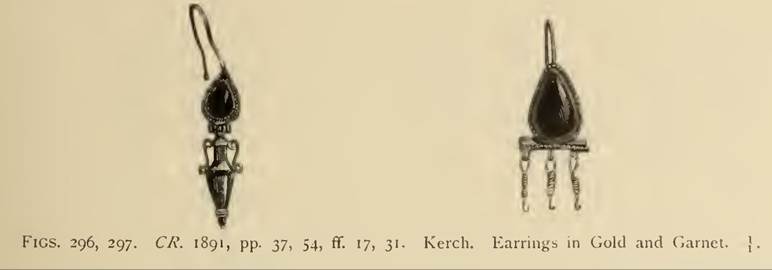
Most of the series belongs to Roman times and is the merest funeral furniture. The crown then consists of a strip of gold leaf, wider in the centre than at the sides, mounted on a foundation of bark or leather, with parsley leaves pointing towards the centre, which is decorated with an indication or a gem or sometimes a repousse plaque. Often the only remains of the crown lie in scattered parsley leaves once sewn on to a stuff ground. For instance, in one case the band was of some dark red material and over the whole there was a kind of veil of the finest crèpe[861]. In the centre was an indication of a coin with the monogram kXe and a Herm. This indication is particularly common on crowns (Fig. 285)2, and is sometimes imitated in freehand drawing[862]. Another king whose coins make indications was Sauromates II[863] [864]. Sometimes coins of distant cities, e.g. Heraclea Pontica[865] [866], very often of Roman emperors6, served the same purpose. Other wreaths of late date have a square plaque with a gem at each corner’, or a gorgoneion[867], a head of Helios9, an engraved gem10, or a plain one11. Some crowns have not even the parsley leaves but only the Trpo^erwTriSiop or centre-piece. Mask and Cap. With the funeral crowns may be mentioned the repousse funeral mask12 of the queen whose tomb was found at Glinishche near Kerch (v. inf. p. 433). It is evidently a portrait executed with the least possible departure from the original, probably from a plaster model. Another piece quite unlike anything else is the gold cap found near Cape Ak-burun in 1875 (Fig. 287). It is in the shape of half an egg lined with leather and felt and made of pierced work ; above a narrow acanthusleaf, stem and tendril border, the design, which is thrice repeated, consists of a pair of broad nautilus spirals curling outwards from an acanthus bract: from between them grows the flower which is usually associated with the p. 434, n. 1, or that found in the tomb of the queen with the mask, ib. f. 325= ABC. ill. 4. 8 CR. 1875, p. 2.^ — KTR. p. 47, f. 53. 9 CR. 1875, P· n=KTR. p. 44, f. 50. 10 Artemis with her bow, CT?. 1875, p. 16 = KTR. p. 45, f. 51. 11 CR. 1875, p. 11 — KTR. p. 43, f. 47. 12 ABC. 1., KTR. p. 70, f. 94. See Benndorf, “Antike Gesichtshelme und Sepulcralmasken,” Denkschr. d. Phil.-hist. Cl. d. k. Akad. d. IV. zu Wien, xxviii. (1878), p. 7, N0. 7, and PI. 11. 13 Published by Count Uvarov, Recherch.es sur les Antiquites de la Russie Meridionals, Paris, 1851, PI. xiv., and Benndorf, op. cit. p. 9, N0. 8, and Pl. XV. 1 ; cf. Nelidov, VII. 40, Sidon. Some Siberian tribes masked the faces of their dead. acanthus flanked by curved stems. All the elements are Greek, but the whole is most unusual. But that its owner was a Greek we may judge from his having a Panathenaic amphora buried with him, and a coin of Alexander gives us some idea of the date. Fig. 287. Gold Cap from Ak-burun. KTR. p. 49, f. 56 = CR. 1876, H. 1. J. Calathi and Frontlets. More normal and very magnificent are the golden calathi found in both the tombs of the Great Bliznitsa. The better of them1, in the first tomb, was covered with thirteen plates of gold nailed on to a light foundation. Along the top was nailed a strip with oves, along the bottom one with a maeander and blue enamelled rosettes. The main space, slightly curved outwards, was decorated with Arimaspians and griffins each made in repousse, cut out and nailed on separately. The whole is effective but rather mechanical. The technique did not encourage any real unity in the pairs of combatants; for instance, in the centre group, in which there are two griffins to one Arimaspian, each of the griffins is symmetrically looking away * CR. 1865, 1. 1—3, V. p 425, f. 315. from their opponent whose stroke will obviously go near neither of them. His clothing is just that of the conventional barbarian—short cloak, chiton and trousers ; he is no Scythian. The decoration of the other lady’s calathos[868] is if anything still less original. The wooden or leather foundation was covered with stuff on which was nailed a row of Bacchic figures, Maenads, griffins and such like. These figures are merely stumpy versions of the usual Neo-Attic types. The calathos, though mostly associated with deities, was evidently commonly worn by real women. These actual specimens are perhaps unique, but we see models of it on such figures as the dancing statuette from the Great Bliznitsa[869] and of the nearly allied Stephane on the elegant pendants or earrings in the shape of women’s heads[870]. Both forms have survived in the Russian kokoshnik which is derived from Byzance. Figs. 288, 289. Gold diadems. Olbia. CR. 1897, pp. 79, 80, ff. 191, 192. I The calathos was certainly kept for high days and holidays. For less important occasions was reserved the crrXeyyis or a/x7ru£ Both the ladies in the Great Bliznitsa had such imitating the texture of the hair either with dose archaic-looking curls, these latter were prolonged downwards over the temple[871], or with more artistic wavy lines[872]. Quite common were strips of thin gold which must have been mounted on something and served as frontlets. Usually their only decoration is some ornament stamped in the gold, for instance two from Olbia, one with pairs of affronted Sphinxes (f. 288), the other (f. 289) rising gracefully to a point in the middle, with a pattern of berried ivy and palmettes6. In the Nelidov Collection are several of this type from the Crimea. One of early ivth-century work has a representation of the Lampadedromia, Nike and a youth on horseback, and is ascribed to an Attic master; others have a composition of Aphrodite between two Erotes7. end; cf. 1859, III. 2, Pavlovskij Barrow; 1882-8, 1. 1. p. 31, Anapa, with lion-masks at the ends and pendants all along in front., 6 Cf. BM. Jewellery, XXVIII. 1610, and several from Cyme, p. 172, Nos. 1612—1614*, ff. 52—54. 7 Nelidov, v. 12, 15—19. Sometimes the simple repoussd strip is embellished with rosettes in enamel, as on the elaborate arabesque of the Kul Oba queen[873], or a figure and rosettes riveted on[874]. Such a strip may also be set off with a knot of filigree[875] or stones and even tassels in the middle ; the pattern (e.g. Demeter looking for Core, and the rape of Core—or a commonplace arrangement of Maenads, tripods and dolphins or of mere arabesques) is often made by being engraved upon a cylinder. In one case we can see where the cylinder had a (law in it[876] [877]. A last type of frontlet is one with little pendants dangling whether from the lower edge0 or from little stalks like davits adorned with rosettes[878]. The diadem from Artjukhov’s barrow (p. 432, f. 322), the most elaborate of all with its big carnelians and tassels, belongs to the later style (v. p. 404). Temple-Medallions. To the end of calathi or heavy frontlets were hung medallions covering the temples—these did not take the place of earrings but were worn in addition to them ; the lady of the first tomb of the Great Bliznitsa was wearing both. Their great size and weight must have made these temple plaques inconvenient, and they are comparatively rare. Far the finest are the famous specimens from Kul Oba so often reproduced for their importance in determining the details of the head of Athena Parthenos as made by Phidias[879]. Dubrux says they were found on the queen’s breast, but they must be the same as those of the Bliznitsa which were found on the pillow. The two heads are identical save that on one Athena is seen in three- quarter face to the right, on the other she is looking to the left. She wears a decorated Stephane and above it a helmet surmounted by three crests, the centre one Scylla, the side ones pegasi; it is flanked by ear-pieces bearing griffins, and these are not drawn symmetrically. Above the rim of the Stephane is a row of griffins’ heads8. Her hair falls on each side in corkscrew curls. Her earrings are of the type with a disk and inverted pyramid such as was found at Karagodeuashkh9. She wears a necklace with pendants. She is attended by her owl and snake. The close similarity to the head of the Varvakion statuette and other known reproductions of the great Parthenos make the identity of the type beyond cavil : the only question is who is responsible for the precise interpretation of the type. Kieseritzky saw in it the work of Attic masters, of representatives of the school which had actually worked at the chryselephantine original. But the proportions of the face are not those of Attic work, being much rounder and plumper. This might perhaps be explained as an accommodation to the shape of the medallion; and the same explanation 7 p. 195, f. 88 = z/Z?C. xix. 1, the heads alone reproduced in the text of Reinach, p. 63 from Kieseritzky, Ath. Mitth. VIII. (1883), 1’1. XV and pp. 291—315, see Reinach for other reproductions. 8 Cf. one figured on p. 427, f. 318 = CR. 1869,1. 28, from the third lady’s tomb of the Great Bliznitsa. 9 v. p. 217, f. 119, III. 6, 7 ; Hadaczek, p. 28. M. 50 might be applied to the proportions of faces upon the Cyzicene staters whose small area gave less freedom than the broad flat silver coins of other states. In fact most full faces on coins are rather round except the curious topsyturvy types of Istrus, where a long narrow face was equally necessitated by the design[880]. The fashionable account is that we have an imitation of Attic types in Ionian proportions, that it is in Asia Minor that we are to seek for the centre of export of gold-work into South Russia[881]. So much more attention has been given to the study of style in sculpture than to that of mere decorative jewelry, that it is to the specimens with reliefs that we must look for light on the question of the origin of all. In this case the frame is worthy of the picture. About the medallion is a border with a wavy pattern of leaves and spirals of twisted wire soldered on, enriched with blue and green enamel. Along the lower edge of the border are enamelled rosettes and leaves disguising loops from which hangs a whole network of fine chains, with other rosettes at the knots serving as points of attachment for pear-shaped vases in the meshes. Each vase has its neck and a little knop at its pointed lower end, and is covered with patterns of gold threads and grains soldered on. In the first tomb of the Great Bliznitsa (p. 426, f. 316) were found similar temple ornaments, slightly smaller but of coarser workmanship. The medallions have Thetis or Nereids riding on sea-horses and bearing arms to Achilles. The composition is again a craftsman’s version of great sculpture, perhaps going back to an original by Scopas: but there is no Scopaic character about the execution. The palmette border again has blue enamel. The arrangement of the network below is very like the Kul Oba work but a little inferior. Unworthy to be mentioned with these are the rough roundels with rough pendants found at Darievka near Shpola, but they must have served the same purpose[882]. They seem to be rude Greek work rather than a native imitation, but it is hard to say. They each consist simply of a large rosette surrounded by a guilloche border to which are hung vase pendants. Earrings. No jewels offer so many varieties as earrings, and they have been well classed by Hadaczek4. Examples of most classes occur in the GraecoScythian area. The oldest piece of pure Greek goldwork, put by him about 600 b.c., is an earring from Vettersfelde5, for Vettersfelde must be considered as an outlier of Scythia. Another archaic type well represented is a kind of double twist such as would just go round two fingers. Each end is adorned with spirals and patterns of gold wire soldered on and finished off with a pyramid of grains. These occur in bronze and silver, but the greater part are in gold. The Hermitage has seven pairs, and Stephani was never sure whether they were earrings, or served to keep thick plaits of hair or possibly § 12J Temple-plaques. Tarrings. Twists. Crescents 395 folds of drapery in place[883]: but Hadaczek proves by coins that they hung from the ear. Macpherson’s plate shews green enamel adorning his specimens[884]. Another early type that 1 ladaczek derives from Ionia, was the “woolsack ” or “ leech," a kind of crescent not flat but thick and hollow; from one end rose a wire which went through the ear and caught on the other end. This seems to have existed in the East from time immemorial[885] and to survive still ; in the Middle Ages it developed into the Russian kolt with its enamel decorations[886] [887] [888]. In Greek hands it was chiefly adorned with patterns of grains soldered on to it3, or wire spirals and plaits8. More ingenious was the device of a goldsmith who saw in it the likeness of a bird and put a head on to the hook end7. Allied in technique is the cone-earring from Romny8. A great many ancient earrings have the hook fixed to a disk. This is usually adorned with a rosette9 and a border. Commonly it has something hung to it in turn. One of the simplest motives is a kind of inverted pyramid. Such an earring is worn by Athena on the Kul Oba plaque. An actual pair comes from Karagodeuashkh10, and another without the disk from the same grave11. Such a one Aphrodite wears as engraved on the inlaid box (p. 424, f. 314). Hadaczek (p. 28) quotes similar specimens from Cyprus, which has very often produced duplicates of South Russian jewelry. In the first Karagodeuashkh specimen little chains hang down on each side of the pyramid12. Very common indeed is the type in which the pendant below the disk takes the shape of a vase with little 8 handles of wire and grain decoration soldered on to the body13. One in the Athens Museum is just like one from Kerch (f. 290. 19)14. Modifications arise by which the vase is flattened into a mere setting for a stone (f. 290. 20) or the handles are absent (ib. 17). More ambitious forms of the disk and pendant type have the half-moon hanging from the disk15 and from it again a network of chains and vases and rosettes such as hangs from the temple ornaments but very much smaller. This development gave room for decorative figures though on the most extraordinarily small scale. The Kul Oba queen had two pair of this type : one has a comparatively simple rosette above and grains upon the crescent 5 Hadaczek, p. 22, f. 40 from VII Brothers = CR. 1876, in. 42 supra, p. 208, f. 106; Hadaczek, f. 41, Eltegen = CR. 1877, in. 33 ; Grushevka, v. p. 177, CR. 1901, p. 105, f. 187 ; Romny, Khanenko, No. 455, on p. 191, f· 83 ; Chmyreva, with a duck at each point and nineteen suspended by chains, Arch. Anz. 1910, p. 215, f. 15 ; cf. Nelidov, x. 191, 192. 6 Olbia, CR. 1903, p. 148, f. 288. ’ Hadaczek, p. 22, f. yi=JHS. v. (1884), xlvi.6. 8 p. 191, f. 83 = Nwz. in. vi. 6. 9 Vogell, Samml., No. 1231, p. 91, f. 60^. 10 p. 217, f. 119, Hi. 6, 7, cf. CR. 1876, v. 7. 11 Mat. xiii. iv. 10. 12Cf. BM. Jewellery, p. 180, ff. 58, 59, Pl. xxx. 1666-7, Cyprus; 1668-9 (?); 1662-5, 1670-3, Cyme. Nelidov, x. 200—202. 13 Hadaczek, p. 34, f. 56; CR. 1878, p. 35. 3, 4. 14 Cf. Fontenay, p. 114; Nelidov, XL 215 sqq.; Goiuchow, viii. 46; Tyszkiewicz, xi. 9 = BM. Jewellery, li. 2331. 15 ib. XXX. 1653, Eretria. Fig. 290. ABC. VII. Gold Earrings from the Bosporus: from various tombs on the Quarantine Road, 1,7, 9, 12, 13; Hadzhi Mushkai, 6, 8, 11, 15, 16,23; Podgornyj Post, 2, 10,20; Kherkheulidzev’s works, 17, 24; near Kerch, 4, 5, 18, 19; Phanagoria, 3, 21, 22; Olbia, 14; 11 has blue enamel, 17 a carnelian, 19 and 23 garnets, 20 an emerald, 24 a turquoise. ij. v. pp. 395—398, 408, 409. with palmettos at its ends, from which spring winged N ike-figures *. The other[889] [890] [891] has richer decoration throughout and hidden in the leaves of the upper rosette are figures of Thetis and the Nereids with the arms of Achilles. It seems to have lost similar side figures, there remain but the stalks to bear them. The lesser rosettes are alternately dull gold and blue enamel ; the egg-and-dart mouldings and some details of the pendants, dark and light blue. Even more wonderful examples of the same kind of work were found at Theodosia. With a similar general design the tiny space above the crescent gives room for a chariot and four horses driven by a winged Nike and containing another figure and flanked by Erotes3; with the earrings was a necklace (Fig. 294. 3, 4) to match. Almost identical earrings, still unpublished, were found under Chersonese wall in urn 4 ; at the side of the quadriga a Muse with a lyre sat in a high spray of foliage[892] [893]. Earrings of this same type also occurred in the two women’s graves of the Great Bliznitsa[894]. In the first they were found in situ worn along with temple-plaques shewing an extraordinary accumulation of jewelry upon one head: in the other tomb only one earring has survived. In these cases the figures are merely a decorative detail not an independent element in the design, but often the pendant which hangs from the disk takes the form of a human or animal figure. Commonest of these are winged human figures, especially Nike6 or Eros. The Erotes are innumerable in all kinds of attitudes, dancing (f. 290. 18), playing the lyre (f. 294. 13), with a mask[895], with a butterfly[896], riding on a bird9, as cupbearers (f. 290. 9, 13), with a caduceus (ib. 12), or a shepherd’s crook10, gesticulating or just quiet11. Less common figures are Sirens (f. 290, 14, 15, 16), Pegasus (ib. 2), Maenads13 and Artemis-Selene13. Another favourite form shews a bird instead of the human figure suspended from the disk. The figure of the bird is generally enamelled white or blue, we have for instance a swan from Taman14 and from Kerch (f. 291), and a dove from Artjukhov’s barrow16. Besides the comparatively light earring-figures hanging from a disk we have whole figures or heads attached to a single hook. Among these it is somewhat difficult to distinguish between a pendant that formed the centre-piece of a necklace and an earring. When they occur in pairs it is clear that they are earrings, e.g. the Ryzhanovka earrings (p. 178, f. 73) which Hadaczek16 calls Graeco-Scythic of the mrd century b.c. : but they would seem to be earlier. Their closest analogues are the Sphinxes from drinische Toreutik,” p. 306, f. 36. 8 CR. 1878-79, Text p. 35. 2. 9 CR. 1889, p. 8, f. 1. ' 10 p. 427, f. 318 = 6'/?. 1868, 1. [8], 9. 11 ibid. [6], 7; 1876, in. 41 ; cf. Nelidov, vm. 56 sqq. ; BM. Jewellery, p. x.xxv., Pl. XXXII. 1858—1915. 12 f. 318 = 67?. 1800, IV. 4, Hadaczek, p. 40, f. 73. 13 f. 318 = 67?. 1868, 1. 2, 3 = Hadaczek, p. 40, f. 74. Reinach, Rep. Stat. II. p. 319. 7. 14 CR. 1870, vi. i2 = Hadaczek, p. 45, f. 84. 15 p. 431, f. 321 = CR. 1880, in. 4, cf. Nelidov, X. 179; BΜ. Jewellery, xxxi. 1677—1682, Vulci. 10 p. 41, f. 76: Sm. Ii. xvi. 4, 5. Deev barrow[897] and lions from the Vogell collection[898]. Something similar but purely Greek is a Sphinx found at Theodosia (f. 294. 2) which seems to be a necklace pendant, another similar pendant comes from Olbia (f. 292) representing a boy. In all these cases the figure is sitting on some kind of base. A free standing figure is an Eros with a mask and a butterfly[899] larger than most earrings and alone, but found upon the dead woman’s pillow. With these go the many women’s heads in stephanae[900] [901] [902] 5 6 which certainly served as earrings : yet they cannot but recall the equally common bulls’ heads’ which still remain hanging to their necklaces. Perhaps the simplest type of all is the earring that is literally a ring”. Such we find perfectly plain and also decorated, whether by a twist or plait[903] or by one end of the ring being enlarged into the head of an animal: a lion[904] [905] *, a bull8 or a lynx (f. 290. 3). Also we get this thickening formed into a human figure, biros[906] or Priapus (f. 290. 22). From these rings we get various charms suspended ; a favourite one is the club of Hercules or a bunch of grapes, but these rather coarse additions mostly belong to the later style when stones had come into fashion (v. p. 409)11. Rather like some earrings are pin-heads decorated with heads or busts of animals. Such are the half-griffin from Theodosia12 or the negro heads from Phanagoria (f. 294. 14) and Kerch13. To a later period belong some found at Chersonese crowned with a bird, a hand and a vase14. CR. 1900, p. 17, f. 31 ; BCA. I. p. 7, urn 1 in the wall; cf. Ohnefalsch-Richter, Kypros, etc., Pl. CLXXXII. 8, CCXVII. 13 — 17, P· 492 sqq. 9 f. 290. 5; CR. 1865, in. 38: from Olbia, CA’. 1899, p. 124, ff. 236, 237, cf. Nelidov, ix. 139. 10 f. 290. 7, 8; CR. 1876, in. 40; 1880, iv. 5, 6. 11 Other pendants from Olbia, a bird, CR. 1903, p. 148, f. 289; a stone wedge, ib. p. 150, f. 297 ; a negro’s head, ib. p. 151, f. 300; flea, BM. Jewellery, lxviii. 2964; tica from Kerch, CR. 1866, n. 34, III. 11 ; cf. Nelidov, XX. 531. 12 f. 294. 12, cf. Nelidov, vi. 33. 13 Report of Arch. Investigations for 1853, No. 74 = ATA’. p. 66, f. 86. 14 CR. 1892, p. 21, ff. 12—14. Necklets. As wonderful as the work of the temple-ornaments and earrings is that of the necklets, and the variety of patterns is very great. The chief classes are the torque, the necklace of beads, the necklace of plates, the chain necklace, the necklace with simple pendants, and that with a whole network of chains and pendants hanging from the main string. The first hardly occurs in Greek graves, those from native graves have been dealt with above (p. 289). There is one in the Artjukhov barrow, an imitation of the form we meet in Kul Oba, but hollow and inferior (p. 431, f. 321 below). Of the necklace of beads a good example is one from Kerch*. The beads are alternately plain and covered with little spirals, while others imitate the shape of a gourd: the work is like that of f. 294. 3. Similar in principle is the necklace from the third lady’s tomb in Great Bliznitsa[907] [908] with a wonderful variety of beads, some of which are artistically worked amulets, in the shape of flies, rams’ heads, negroes’ heads, frogs, bunches of grapes, bearded heads and others. Of simple chains the simplest is such a one as was found at Bulganak, just a chain with a lion’s head at each end[909] [910]. More artistic are round plait chains like those from Melgunov’s barrow—the earliest, perhaps a diadem (p. 172)—Karagodeuashkh (p. 217, f. 119, iv. 4), Theodosia (f. 294. 1) or Chersonese wall, urn 4. In urn 1 the necklace was made up of two flat plaits ending in lion-heads hooking on to a centre-piece, a filigree reef-knot containing an Eros holding a lyre1: the design foreshadows the Artjukhov crown (p. 432, f. 322). Of simple pendants the best usually hang from a string of beads such as one from Theodosia (f. 294. 3) with vase-like drops, or one from Kerch with various charms, lions, combs, birds, shells or amulets against the evil eye: such also hang from plain chains[911]. When we have beautiful plaited ribbons, e.g. the Kul Oba queen’s and its twin from Kerch8, and those from Karagodeuashkh (p. 217, f. 119, iv. 3) and Chersonese wall, urn 41, we generally find the place of the vase-shaped drop taken by a tiny pendant whose outline is the same but whose section is like a three-rayed star, thus giving six surfaces to catch the light at various angles and being more effective than the much more elaborate hollow vase. Necklets in which the chain is more important than the pendants we find in the second best of the third lady in the Great Bliznitsa’ which has a row of beads of three chief types and two sizes, the larger alternately plain and adorned with rosettes about the string hole, the smaller plain towards the end and adorned with spirals in the middle beads·—from every larger bead hangs a rosette and from it alternately a plain and a decorated vase. The ingenious arrangement of the best necklace at Karagodeuashkh (p. 217, f. 119, iv. 1, 2) forms a transition to the necklace of plates. The greater part of the beads arc small and plain : from certain larger ribbed ones hang large vase pendants, to the front of intermediate ones arc fixed X-shaped, G ABC. IX. 1 : the two varieties were called ορροί αμφορέων and λογχωτός, v. BAI. JeiUC llery, p. xxxvi., cf. Pl. XXXIV. 1943—1948, two from Cyme. 7 v. p. 427, f. 3i8 = CA’. 1869, 1. 14. (or “double-axe”) plates each with a rosette in the middle and a palmette above and below, from the lower edge of these plates hang lesser vases. This device of masking the actual string with plates is carried further in the well designed but rudely executed necklace from Ryzhanovka which is made up alternately of round rosette-plates and X-shaped pieces fitting into them (p. 179, f. 74). A like arrangement occurs in the necklace from Kerch in the Ashmolean, Oxford; this has acorns hanging from the rosettes[912]. As usual Deev barrow supplies an analogue to Ryzhanovka, its necklace is as it were double : instead of the rosettes it has fourteen twin half-beads and the plates between them an inch high are cut out on each side to fit into them, so 8185. These plates are of two varieties, in each at the top is a large rosette and at the lower angles two such, but in six the middle space has a whorl of large leaves supporting a rosette, in seven a duck with niello eyes is as it were swimming on it. From each pair of beads and from each plate hangs a vase-pendant: two strings half an inch apart ran through beads and plates alike[913]. The same double effect is seen in a necklace from Kerch: the plates are of much the same shape with forget-me-nots at each end and a woman’s mask in the middle but two separate rows of beads fitted into them, each bead of dull gold representing a knot tied in a textile[914]. The ducks and rosettes reappear at Chmyreva Mogila but on rectangular plates4. A necklace from Olbia, apparently Ionian work of the vith century b.c. and so perhaps the oldest piece of goldwork found in a Greek grave in South Russia, has no beads or chain, but consists of eleven plates, two terminal triangles decorated with palmettes, five squares with rosettes in wire soldered on, and four tall narrow plates with stamped Sphinxes : to each of these hang two barleycorn pendants and to each square three5. With this were found two pendants in the shape of lion-heads. Finally instead of a row of vase pendants, varied though they may be in shape, we may have continued along the whole length of the chain a rich network of chains and vases like that below the more elaborate temple-plaques and earrings. A simple example is the second-best necklace from the first tomb of the Great Bliznitsa. Here we have the plaited ribbon and two rows of the vase-like pendants (cf. Karagodeuashkh), the points of attachment being covered with the usual forget-me-nots. More elaborate is the same lady’s best necklace with three rows of real vases, each vase being covered with ornament of wire soldered on6. The most perfect specimen of this style was found at Theodosia with the wonderful earrings (f. 294. 4, 4«): in this case the upper row of smallest vases gives place to a row of tiny images of the Ephesian Artemis each hanging from a demi-horse put between the enamelled forget-me-nots that mask the attachments of the network chains. Quite unique as a necklet is that found in the third lady’s tomb of the Great Bliznitsa serving her for best (p. 429, f. 320). Its affinities are perhaps rather with the torque than with the necklace. It is in shape a crescent formed by two twists of gold that make the inner and outer circumferences. In the space between them framed by a kind of egg- and-dart we have figures of rams and goats ajoure with poppy plants and rosettes in the background. At each end a dog is pursuing some rodent. The ends of the crescent die into a flat collar, linked by a plait pattern to the lion-heads which hold the fastening rings. These lionheads are also exceptional, for in general a string of beads, or a necklet whose section is round, has lion-heads, whereas the flat necklaces or ribbon chains end in U-shaped pieces each decorated with a palmette. In spite of its strange form there is no doubt that this was a necklet, it recalls most closely the metal neck ornaments (tsata) put on to icons. A rmlets. Various Goldwork. Armlets do not shew so much variety as necklets. The general form is either a smaller torque, a twist encircling the wrist once with animals’ heads at each end, or else a spiral of two or three turns with either a flat section and palmettes as finials or a general representation of a snake. To the first type belongs the magnificent bracelet from Kul Oba worn by the king (p. 199, f. 92. 1). The bold twist wormed with small strands ends in palmette collars which form the transition to the foreparts of Sphinxes whose paws hold a knot between them. Their style is so restrained that they must surely go back to originals of the vth century, although the actual work may belong to the ivth. Somewhat similar are the bracelets from the Great Bliznitsa ending in lionesses (p. 426, f. 317) and silver ones with gold lions’ and rams’ heads from Kerch and Chersonese wall, urn 4, respectively[915]. Among the flat-sectioned spiral bracelets a similar mixture of material is found in a pair from Theodosia (f. 294. 7); each has three turns and ends in flattened lion-heads. Examples of the same type with antelopes’ heads we have from Kerch[916] and with a whole lion from the Great Bliznitsa[917]. At Karagodeuashkh similar armlets end in sea horses with curled tails (p. 217, f. 119, in. 7, 8). Whole serpents appear at Artjukhov’s barrow, tombs 1 and n4. Rather special are the armlet of the queen from Kul Oba, a broad thin plate of gold with two bands of repeated groups—griffins attacking deer, finishing off at each end with four lion-heads in low relief, and a second worn by the king, also a flat band but narrower with a little moulded edge and archaic groups of Eos and Memnon alternating with Peleus and Thetis; the whole studded with blue forget-me-nots (p. 199, f. 92. 2, 3). Among other pieces of Greek goldwork may be mentioned the sheath from Tomakovka and its replica from Vettersfelde (p. 148, f. 45, cf. p. 236). The belt clasp from Kurdzhips seems so far unique (p. 224, f. 127). It is made up of two strips of gold adorned with enamelled rosettes and circles, hooking on to each other, and two side-pieces with an elaborate decoration of intertwined spirals, palmettes and rosettes ; one side-piece was firmly united to one strip, the other hooked on to the free strip. Mention must also be made of the gold repousse and engraved work, the phalerae* for adorning horses, mostly of Hellenistic date, found in native graves such as Chmyreva barrow (pp. 168, 169, ff. 58 61), Akhtanizovka and Siverskaja (p. 215), Fedulovo, Taganrog and Starobelsk (p. 173, n. 3), and latest, Janchekrak (p. 171), and of the smaller plates of greater range in time used for sewing on to clothes[918] [919], and of the innumerable buttons, studs and other small pieces of gold found in some of the richer Greek graves as well. This is particularly the case in the Great Bliznitsa and is one of several points of resemblance which link it on to the Scythic graves in spite of the pure Greek character of everything found in it except one plate from the pyre of the second lady with a combat between a griffin and a lioness represented quite in the Scythic manner. How this piece found itself in such company it is impossible to say[920]. Transition from Goldwork to Stone Jewelry. 1 he goldwork considered hitherto has been goldwork that relied for its effect upon the gold : contrasts of colour were only introduced by the use of enamel which though more general than in other Greek districts was applied in the same primitive way, being run into the spaces it was desired to colour and allowed to keep its natural surface instead of being ground flat. The colours used were also primitive, limited to a light and dark blue and green. This use of gold by itself is characteristic of the Greeks in the best age. Stones only appear in rings (v. p. 410) and occasionally separately as beads. The difficulty of guessing the chief export centre among old Greek lands which supplied the Euxine market with goldwork has been already mentioned. No doubt there is great resemblance between some of the little Attic jewelry known to us and some of the simpler specimens from South Russia. But Athens had no special reputation for ordinary goldwork nor any natural advantages such as she had in silver. The great chryselephantine statues stood quite apart. There is on the other hand a remarkable identity between the elaborate goldwork from South Russia and that found at Cyme in Aeolis[921]. The excessive complication of detail, the insertion of figures on a scale which did not allow of their being satisfactorily executed, the luxuriant curls of the vegetable ornament, the actual material (electrum) of one or two of the older pieces (e.g. f. 294. 6), such details as the Ephesian Artemis on the Theodosian necklace, all suggest Asia Minor. The undoubted supremacy of Athens in its own speciality—pottery—does not preclude the retention by Ionia of its natural importance in other departments. In works which can be judged by the canons applying to sculpture the subjects which are of Attic origin have been reinterpreted in the Ionian manner (v. pp. 284 and 394), and we may well believe that the greater part of the goldwork found north of the Euxine was either imported from Asia Minor or made on the spot by artists under the predominant influence of Asia. But this must not be taken to be without exceptions. Athens had special relations with the Bosporus and there is no need to put everything down to Ionia. As time went on provincialisms tended to disappear in the Greek world, and just as the kolvtj dialect spread everywhere so a common acceptance of artistic and industrial fashions spread the patterns which arose in one town throughout the rest. Hence we find in the British Museum and the Louvre jewelry from Etruria and South Italy identical with that from South Russia preserved in the Hermitage. But as the Greeks came into closer contact with the Eastern barbarians after the conquests of Alexander they suffered to some extent the influence of the people they were ruling. Erom them they learned to rate much higher the beauty of precious stones. At the same time, perhaps from the same cause, they were learning to appreciate colour as well as form, at least their love of colour took a new direction, gratified itself in new ways. They came to prefer sharp contrasts to delicate gradations; as Riegl puts it the colouristic principle with its instant appeal to the senses replaced the tectonic with its appeal to the understanding[922] : it is curious that in ceramics they abandoned painting and took to plastic decoration just at this very period. The question arises as to what part of the barbarian world had most part in this revolution. No doubt the accumulations of the Persian realm in Iran and nearer Asia supplied material for it : for instance, the garnet, the most characteristic jewel of the new movement, is usually referred to Syria : but it is a question whether the impulse was not equally due to Egypt whose artistic influence has been so ably championed by Professor Schreiber[923]. In South Russia the new fashion may be said to make its appearance in the splendid contents of Artjukhov’s barrow (v. p. 430). In that barrow we have for the first time a general use of precious stones, both set and pierced for use as beads, the first cameo, the first example of Greek cloisonne enamel. Such a use of precious stones was common in Egypt from time immemorial : the cloisonne process closely resembles effects produced in Egypt from an early period, the decoration of one of the earrings though in general design quite Greek has among its ornaments the feather and cow-horn crown of Isis-Hathor[924]. Also there were beads of Egyptian manufacture with Egyptian emblems such as the god Bes. At this moment too the reef-knot came into fashion and occurs on very many objects of the second and third centuries b.c. This very pattern occurs in Egypt and on Greek soil seems accompanied by a fashion for tassels very characteristic of the Artjukhov finds[925]. At first the introduction of the new element of precious stones did not make much difference in the jewelry into which it entered. The gold- work of the Artjukhov crown and earring is nearly as fine as that of the pure gold technique of the Bliznitsa. But as time went on, less attention was paid to the gold, and it became coarse and clumsy, and the forms of objects were also changed to receive the stones better. On the whole, however, the same forms went on. op. cit. p. 290 and Pl. 11. f. 8 b', BM. Jewellery, LI. 2328 (Calymnos), 2329—2331. 4 Cf. a necklet (?) from Ithaca, Fontenay, p. 430: a reef-knot with a figure in it from Syria, BM. Jewellery, xxxiv. 2001, cf. xxvii. 1607—1609: for the whole change of taste, ib. p. xlii sqq. \\ e have only one crown of the new style ; those described above belong to the late period, but except the one or two which have a square centrepiece with stones at the corners1, they shew its distinguishing features only by their progressive decadence. This Artjukhov crown (p. 432, f. 322) consists of a hoop formed of thr|p parts joined by hinges, two fluted side-pieces adorned with a wave ornament and finishing in collars with enamel, and a centrepiece in the shape of a reef-knot made of large garnets joined by gold bands. The middle of the knot is taken up by a group of an eagle lifting an Eros : the eagle’s outspread wings are enamelled. From the lower margin of the crown hang six characteristic tassels each consisting of a round or heart-shaped garnet, from which depends a round bead set in gold, the immediate head of the tassel which is made up of six garnets hung on gold chains and wire stalks. It has been doubted whether this can be a diadem because the tassels would get so much in the way of the wearer’s eyes, but it would not be worse than some of the pearl fringes on old Russian headdresses. For neckgear in this Tomb I, we have, beside a simple neck-ring (p. 431, f. 321, I. 2), a chain2, a row of small amulets3, and three necklaces, one of carnelians and gold beads, one of garnets held in gold rosettes (ib. 1. s)4 and one of which the main part is gold chain, but each end has a garnet heart and the centre an emerald between two garnets flanked by lion-busts with bodies of banded stone (ib. 1. 6). The same lady had an armlet of chalcedony balls quite in the barbaric manner5. She also had a pin (f. 321, 1. 17) with a head in the form of a disk decorated with a rosette in real cloisonne enamel offering a smooth surface : from the disk hangs down even such a tassel as hangs from the crown. Her left hand bore a ring with the bezel embellished by a rosette like that on the disk of the pin (ib. 1. 13) and her right a ring with garnets6. This same taste runs through all the graves of the barrow : each lady had such a pin, the lady in the second grave had the earrings with the Egyptian motive (f. 321, m. 5), the well-known ring with a bezel in the form of a shoe-sole bearing the inscription ECTIAIOC MAMMIAI carried out in black enamel and gold cloisons (ib., in. 7, 8) and the cameo of Eros and the butterfly7. The Artjukhov barrow is dated at about halfway through the mrd century by the coins of Lysimachus and Paerisades found in it. This gives just the date for the change of style, for in it not everything has yet conformed to the new fashion. For instance, the ordinary Kul Oba type of neck-ring with lions’ heads at the ends is here but hollow and poor, suggesting that though the form still existed it was no longer held in its old esteem (f. 321 below}. Quite in the old manner arc the snake bracelets6, the Erotes earrings9 and the necklaces of the lady in the second tomb10. The work and general type of the earring with the Isis headdress (f. 321, 11. 4, 5) is just that of the former period but for the introduction of that one detail. An ornament common to all the Artjukhov ladies, and occurring in other contemporary graves, seems to have come in rather late although it docs not shew any distinct trace of the new style. It is a round plaque usually with a border of enamel and bearing some subject such as Aphrodite and Eros. 1 p. 434, f. 325, ABC. III. 3—5. 7 ib. III. 9 on f. 321 ; Fuilwangler, Ant. Gem. 2 CR. 1880, I. 3. 3 ib. 1. 7. in. p. 152, f. 106. 4 Cf. BM. Jewellery, xxxviii. 1961. " CR. 1880, 1. 9. 5 CR. 1880, 1. 8. ib. 1. 14. ■·’ ib. 1. 11, 12. ib. 11. 9. 10, 11. It appears to have been worn at the intersection of the cross-bands[926] over the breast, just where the terra-cottas often indicate a large ornament[927]. Two examples come from Egypt, and this would seem to be one more indication of a connexion between that country and the new fashions. Still we have in two plaques from Kerch (p. 195, f. 88')[928] roundels executed in the old manner with wonderful filigree and quite suitable for the same purpose as the Aphrodite reliefs. One rather similar roundel from a man’s grave in Artjukhov’s barrow (f. 321, 11. 3[929]) is an unmistakable example of the new style, having pastes as well as patterns in gold soldered on. It has been noticed that a love of reef-knots is characteristic of the things found in Artjukhov’s barrow. This same love is exemplified by other jewels which, whether adorned with stones or not, appear to belong to about the same time. The knot became a favourite motive for the middle of diadems5 and necklaces6. In some of these the tassels also occur, and these continue in favour in a simplified form until the barbarous ages when we cannot tell if the dangling chains and stones derive from Greek originals or from the general Finnish love of all kinds of jingles. Necklaces with colozired stones. The Artjukhov necklace (f. 321, 1. 6) is the first of an interesting series. The distinguishing feature is that the middle or front of the necklace consists of several large oval or lozenge-shaped stones of different colours set in gold box-settings and joined by hinges7: the two ends are the ordinary plaited chains. This fashion went on for three hundred years, for a later phase of it is seen in three necklaces which may be dated in the 1st century a.d. The first was found at Olbia in 1891 in the tomb with the glazed pottery (v. p. 420)8. It is the most developed of the series and shews the love of bright-coloured stones and pastes pushed very far. A necklace precisely similar I saw recently in the possession of Messrs Spink in Piccadilly, London. The chains on each side end in lynxes with crystal bodies and golden heads. Between them are five blue pastes, three oval and two square, set in broad bands of gold with lesser pastes and granular patterns. From the middle oval paste hangs a butterfly9 of gold with a paste body, an emerald head, and wings each set with three blue and green pastes. On each side from the square pastes of the main row hang first a round emerald and then a pear-shaped drop of pink paste, each duly set in gold. From the lynxheads to the square pastes, and from these to the butterfly’s wings, hang light chains of gold. In the same grave was found a pair of earrings consisting each of a garnet body set in gold, from which hangs a crystal amphora and several light gold chains (v. p. 408). The distinguishing 6 e.g. ib. xxvii. 1607-9; ABC. vi. 3, 4. 6 ABC. IX. 2, 3, this latter had two knots and is better illustrated in Fontenay, p. 174, where one knot is shewn with the Medusa face that fills it, and the tassels that hang from it; ABC. X. 1, 2, cf. Nelidov, XIII. 329; Gotuchow, vn. 36. 7 Cf. BM. Jewellery, Lvm. 2747; lxi. 2749. 8 Oreshnikov, Drevnosti, XV. ii. (1894) Pl. I. 9 Cf. BM. Jewellery, lxi. 2746, Rome. Fig. 295. CR. 1896, p. 76, f. 323. Chersonese, Tomb No. 630. a, Gold ring with engraved Amethyst. 6, Gold ring with Garnet. H, Gold plates. 1\ Gold roundel with Aphrodite and Eros. Gold Necklace with coloured stones. ]. feature of this chain is the elaboration of the settings of each great paste. In the next butterfly necklace, found at Chersonese in 1896 (f. 295), the stones are smaller, all oval and put in simple settings. The variety is even greater. With this necklace were found two roundels with Aphrodite to wear upon the breast and a wristband[930] made of gold tubes soldered to each other side by side and so building up hexagons and strips which could be threaded together. In 1898 a very similar necklace was found in a leaden urn at Chersonese[931]. It consisted of seven garnets and two green pastes, with two pendants with green pastes and a light blue paste in the head of the butterfly which had a garnet on its wing. There had been other pendants, now lost, and more stones in the butterfly, but the whole shewed signs of having been long used and roughly mended. With it was found other jewelry of much the same character as accompanied the fellow necklaces and also a coin of Domitian and one of Chersonese[932], so that the objects may be referred to the 1st century a.D. confirming the conclusions independently arrived at on the evidence of the other similar finds. Another necklace in the same taste was found at Hadzhi Mushkai near Kerch[933]. This has chain all the way round save for a medallion with an engraved garnet and a fastening disguised by the figure of a ram with its wool curiously rendered by small circles of gold wire soldered on. From the chain hang emeralds, aquamarines and turquoises in box-settings. The ram has been compared to a little lion found at Kurdzhips[934] and recalls another ram on a bracelet from Armavir on the Laba a tributary of the Kuban : but this last is frankly barbarous6. Jewelled Earrings. hereas these many-coloured necklaces are the most extreme examples of the new taste in jewelry, the earrings are the commonest. Inasmuch as almost every grave yields a pair it is useless to multiply references. The interesting point is to observe how the necessity for accommodating the stones led to modifications in design and the weeding out of types unsuited to the new decoration. In the earrings and other minor pieces we meet almost exclusively with garnets. There remained a desire for some contrasting colour, but it could not often be gratified. The disk and amphora earring lent itself well to garnets; one would make the centre of the disk, another perhaps adorn the vase flattened to receive it7; more often, however, it was of gold merely and rather degraded8. In a more ambitious type the disk tends to become a triangle (cf. f. 290. 20), from the base of which hangs a row of chains with an amphora of onyx or crystal in the middle9. The skill to make good figures became rare, and the E rotes had to give way. But the ring-shaped 5 CR. 1896, p. 62, f. 296. 6 CR. 1902, p. 87, f. 196; cf. p. 232, n. 6. 7 ABC. xxiv. 19. 8 e.g. CR. 1892, p. 109, f. 67 ; 1894, p. 63, f. 89, both from Chersonese. 9 Olbia, same tomb, Drevnosti, XV. ii. Pl. 1; Kerch, CR. 1903, p. 45, f. 62. type with a lion’s head continues, the lion’s mouth as at Chersonese, in general the thick end of the ring or pear-shaped stone1. a setting for the stone being put below a double lion’s head (p. 507, f. 339), but is turned merely into a setting for a round To this shape a pendant is often hung, the old amphora (ff. 290. 19; 296) or a bunch of grapes (f. 290. 24, cf. f. 294. 11), a club of Hercules2, and most characteristically a bunch of chains whether forming a tassel (f. 290. 17) or all in a line (ib. 20; f. 297)3: by a survival Eros is even left hanging in the midst (f. 290. 18). Garnet Style. This garnet style becomes more and more barbaric. It is applied to harness4 and to buckles5 6. Some buckles are interesting for the tamga they bear such as has been already mentioned on bronze examples[935]. Other buckles lead on to absolutely barbaric types7. The harness mentioned, which also had the same tamga, was found in the famous tomb at Glinishche (v. p. 433) in which, alongside of the Hellenistic plate already described, was found an armlet which retains some traces of Greek technique, but is directly related to the little bottle found in the same grave (p. 434, ff. 326, 327), and so all such bottles are classed as Greek by Smirnov8 though—with the exception of one from Olbia with a rude lion stopper9—found in most barbarian company, e.g. in the Novocherkassk treasure (p. 234, ff. 141, 14210) and the late Ust Labinskaja barrows11. This is in fact the end of Greek jewelry unless, as von Stern thinks, it was the Greeks of Kerch that began to make the jewelry of the barbarians12. 1KTR. p. 66, f. 86«; CR. 1894, p. 64, f. 93; Hadaczek, p. 52, f. 96. 2 f. 290. 21, 23; Vogell, Sanimi, p. 91, f. 60; BAL Jewellery, Li 1. 2412, 2420*, Olbia; cf. 2417; armlets, ARC. xxiv. 3, 4: CR. 1892, p. 119, f. 74. 3 Also CR. 1892, p. 111, f. 169. 4 p. 435, f. 328; ABC. xxix. 1—5. 5 ABC. xxxii. 16 = KTR. p. 315, f. 280. It is an ox head. 6 ABC. xxxii. 19, 20, cf. supra p. 318, n. 1 [1] ibid. 13, 15 : Trans. Od. Soc. xx. i. 11, 13. 9 CR. 1868, 1. io = Smirnov, xn. 31. 10 Smirnov, xi. 29, gives better photographs of this, also of the box, XI. 30, the cup, x. 25, and the Uvarov cup, XI. 27, v. supra pp. 234, 235, ff. 140, 144. 11 CR. 1902, p. 83, f. i84 = Sinirnov, ex. 280; others from Siberia, Xii. and СХ. 33; Mozara, Kamyshin (CR. 1898, p. 78, f. 137), XU. 34; Sta- rotitorovka, Kuban, cxiu. 242; Novopetrovka, Kherson (CR. 1903, p. 154, f. 305), cxi 11. 279; unknown place, Coll. Botkin, St 1’., CX. 281. 12 Trans. Od. Soc. xx. p. 1. Finger-rings. One more jewel must be mentioned, the finger-ring. In this the occurrence of stones is, of course, no criterion of date. There are rings of the ordinary shape with a bezel set with a stone whether plain or engraved. Others have a gold bezel likewise engraved[936]. Sometimes these engravings afford by their rubbed condition interesting evidence of the continued use of the ring, and warn us afresh that a stone too may have been worn a very long time before being buried with some possessor[937]. Besides ordinary rings there should be noted the rings with a stirrup-like outline[938]. They are usually early, before the ring and the stone had adapted themselves to each other. Interesting are those which have instead of a flat bezel[939] [940] an animal or insect formed in the round. Then there are double rings like that of the masked queen (p. 434, f. 325) and one with four lions upon its. Many of the later ones have dotted inscriptions especially XAPA[941] [942]. A special form is that of the serpent-ring sometimes forming a pendant to a serpent-bracelet'. Some rings such as that with Aphrodite and a trophy and that with a large head of Athena[943] both found with silver vessels on the way to Kerch Quarantine are too big to wear and were probably votive.