CHAPTER IX. SIBERIA AND SURROUNDING COUNTRIES.
In the foregoing pages mention has been macle of the resemblances between the culture I have called Scythic and that of early inhabitants of Siberia. These resemblances are so great that it is impossible to treat the archaeology of South Russia without touching that of Siberia.
This may be called a case of explaining ignotum per igitolius, but in a sense the ethnology of Siberia is less open to question than that of the Euxine steppes, inasmuch as the north of Asia is not exposed to invasions from so many quarters as Eastern Europe and is inhabited by peoples who, whatever their mutual differences, have more ethnological affinity than those we find side by side at the junction of the two continents.The best account of the chief forms of tombs in Siberia and of the civilisations to which they correspond is given by Dr W. Radloff[507].
Radloff describes various types of graves in Siberia, of which the most important division is into graves marked by barrows and graves marked with stones mostly set in rectangles. In the basins of the Irtysh, Tobol and Obj and again in the Kirgiz steppe and in south-west Siberia we mostly have mounds larger or smaller. In the river valleys of the Altai, on the banks of the Jenisei and in the Abakan steppe are found the stone graves, as well as over the Chinese border in Mongolia. In the Altai and on the Bukhtarma we find cairns of stone.
These graves may be referred to four epochs :
(i) All the stone graves in the vale of the Jenisei and the Altai and many of the mounds of the Kirgiz steppe belong to the Copper or Bronze age. '
(ii) Most of the barrows and big cairns belong to the earlier Iron age.
(iii) The smaller barrows called Kirgiz graves are of the later Iron age.
(iv) These shade into barrows which contain even xvnth century coins and modern Russian objects.
In graves of the first period are found many weapons and tools of cast copper and bronze, they have nearly all been plundered so that it is very rare to come upon gold.
Similar tools are found in old gold and copper workings in the Altai mountains, and there is no doubt that these people worked the metals themselves and had attained very considerableVol. 1., and Vol. n. begins with xxvn. See also D. Elements, Antiquities of the Minusinsk Museum, Objects of the Metal Ages, Tomsk, 1886 : a catalogue with very good introduction and with illustrations. These latter are rather superseded by those in Martin, F. R., 1'iige du Bronze an Musee de Minoussinsk, Stockholm, 1892.
M.
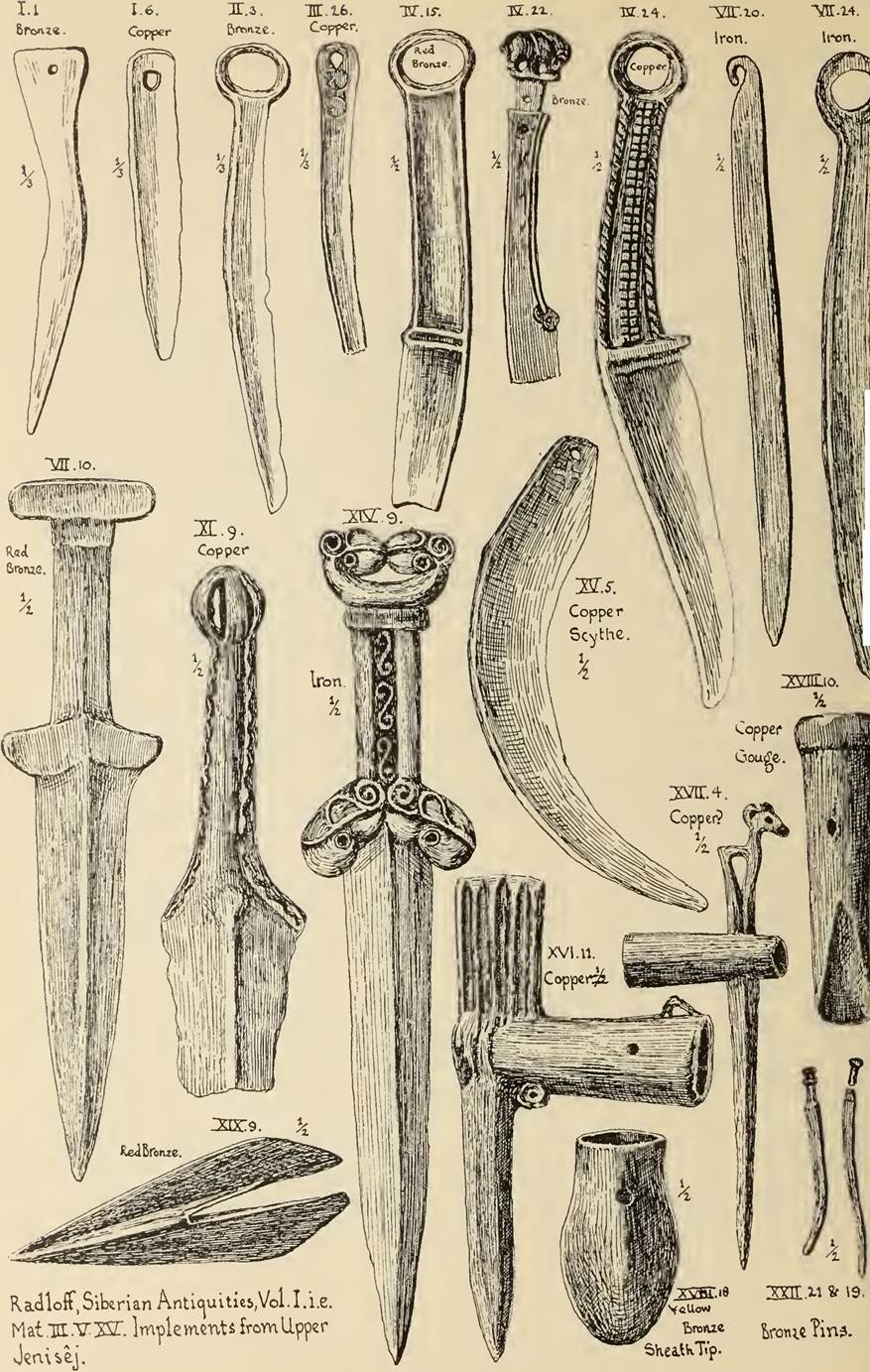
Fig. 150. Picks, p. 244, knives, p. 246, daggers, p. 248.
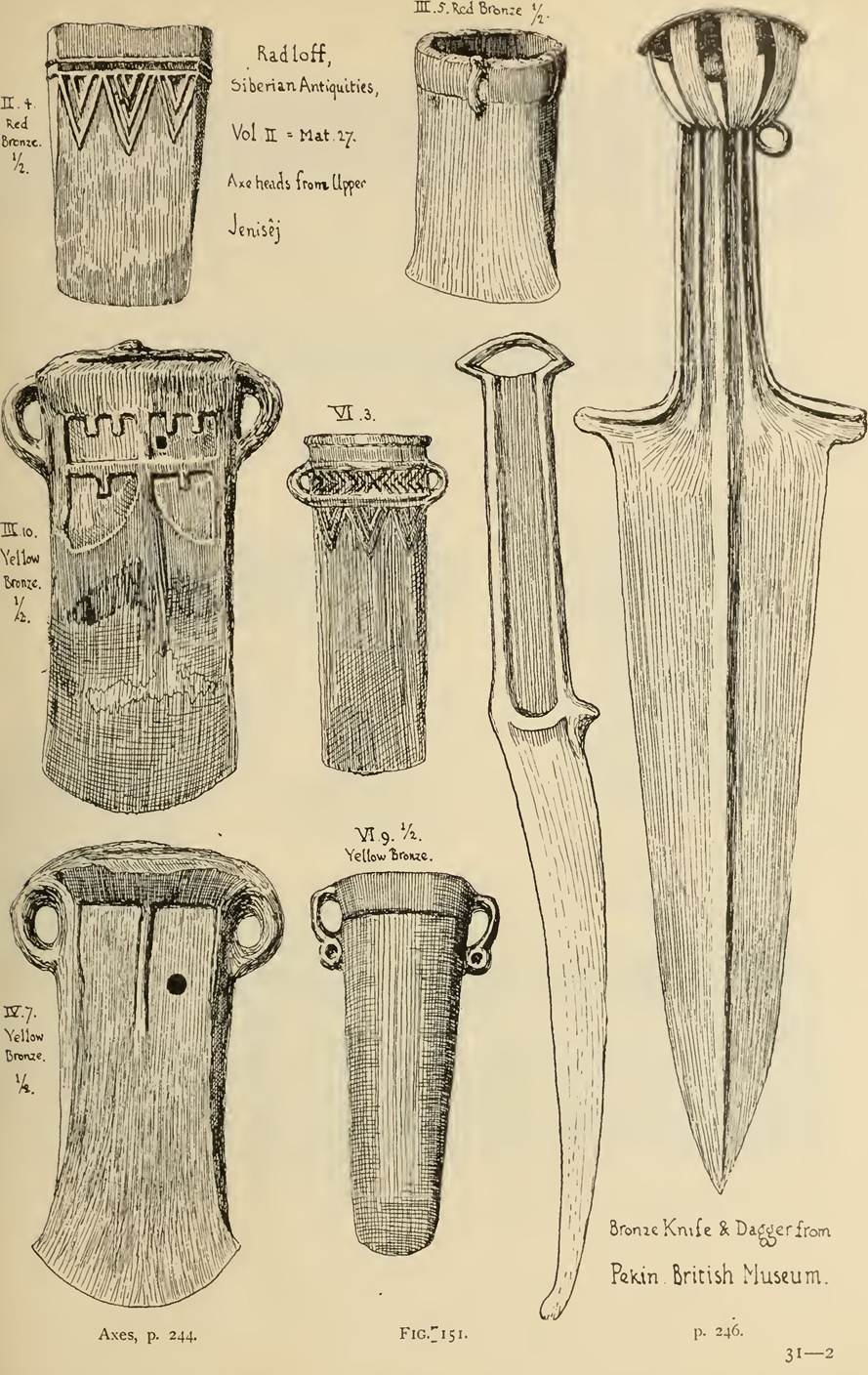
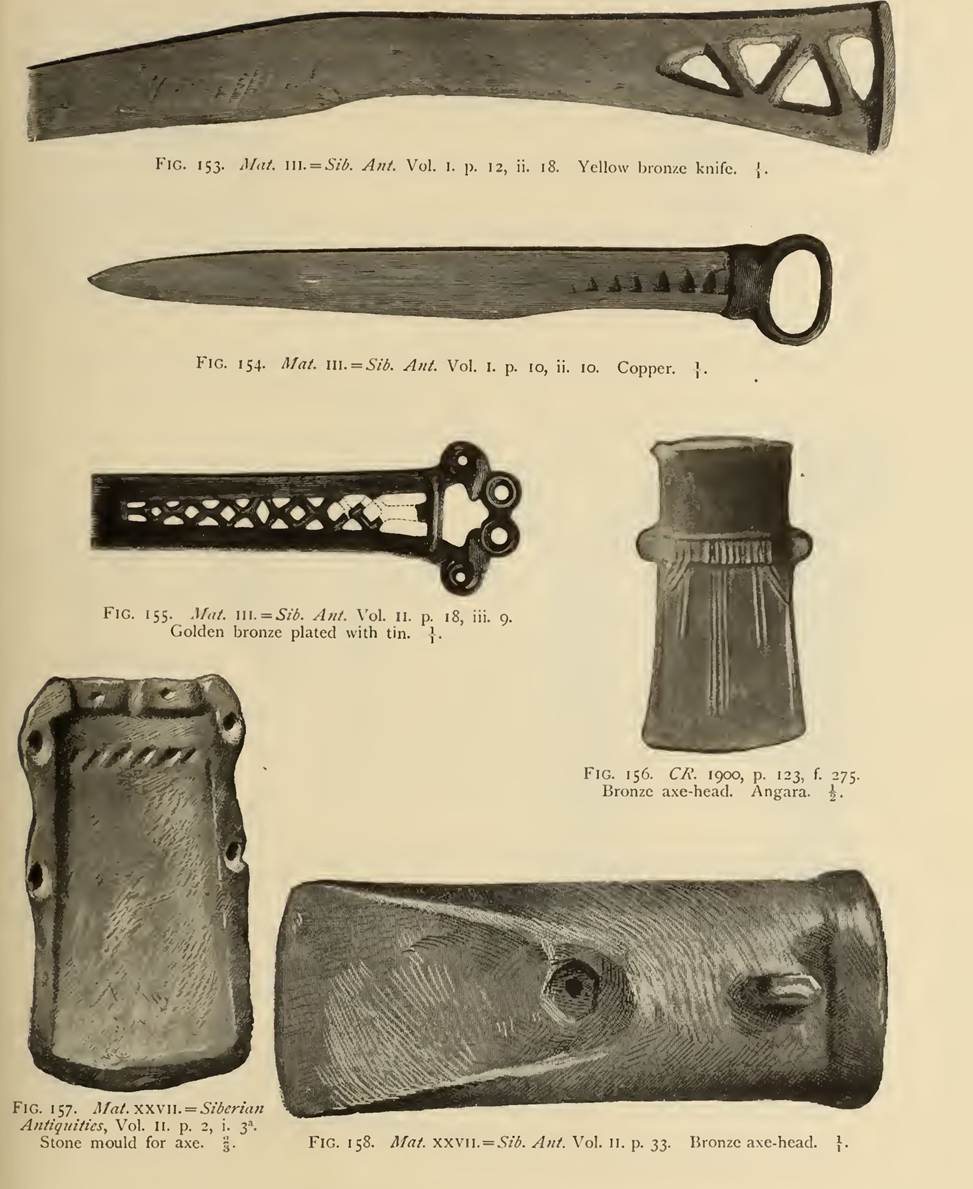
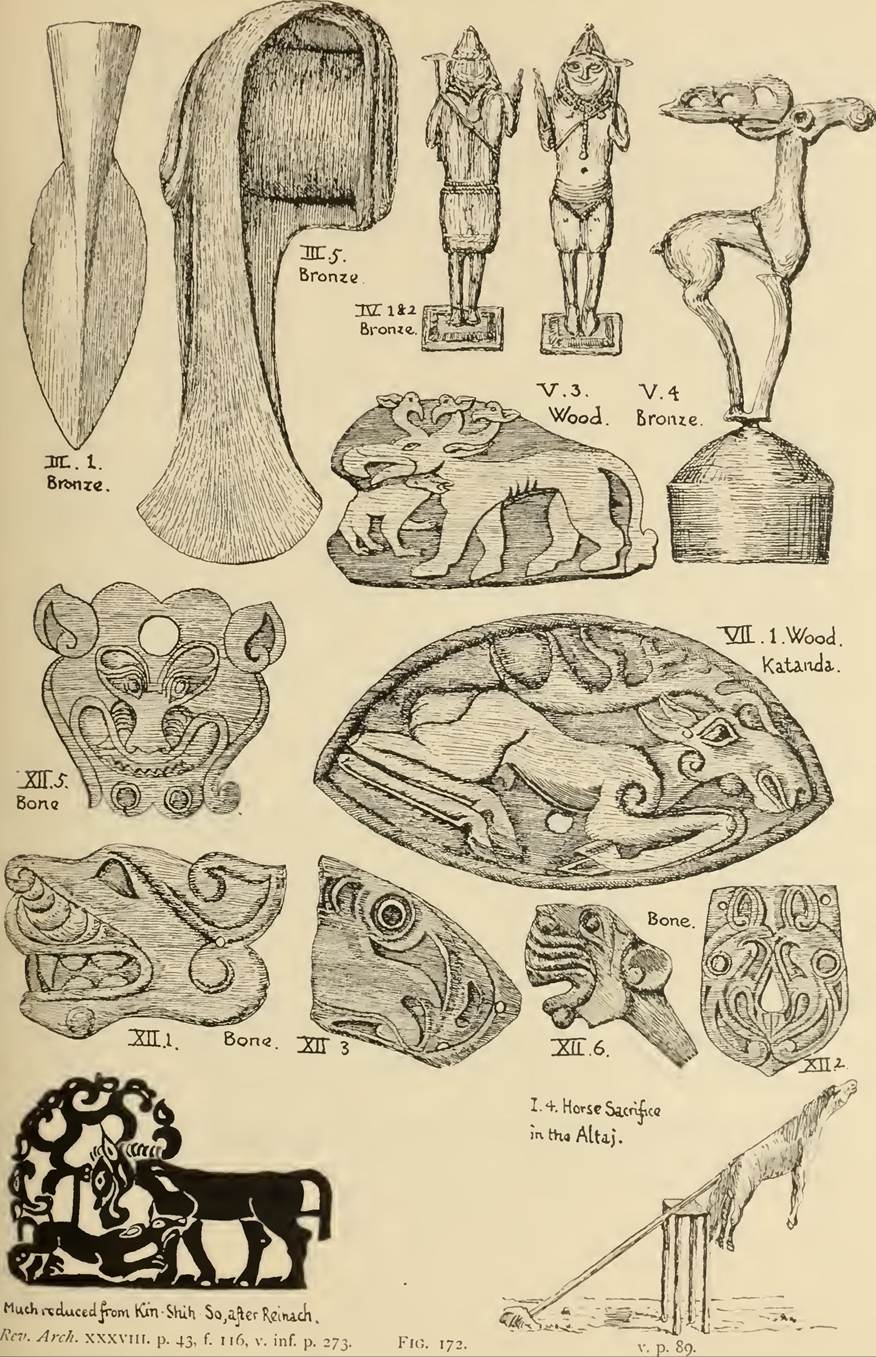
skill. The old workings consist of simple shafts not more than fifty feet deep and indifferently propped up. Working even to such a depth was dangerous and skeletons of miners have been found with pickaxes and sacks to hold the ore. Miners seem to have been in high regard, for Radloff figures a copper statuette of one1 and also wherever these people lived we find elegant models of pickaxes, too delicate for actual use and apparently serving as ornaments or insignia2. Their tools are found in the gold washings as well as in the shafts (called Chud mines). Smelting furnaces have also been found in the Altai, and everywhere about the Abakan, Jenisei and upper Obj we have fragments of copper such as are trimmed off castings. Their bronze, when they made bronze, is of very great hardness, and their castings hardly ever have flaws in them, although they cast cauldrons up to 75 lb. in weight. Well finished and rough tools are found together in the same grave. The chief objects found comprise knives and daggers but few arrowheads or spear-heads. Axe-heads especially the double-looped type (f. 151, cf. p. 261) are common, and pickaxes both serviceable and ornamental. They
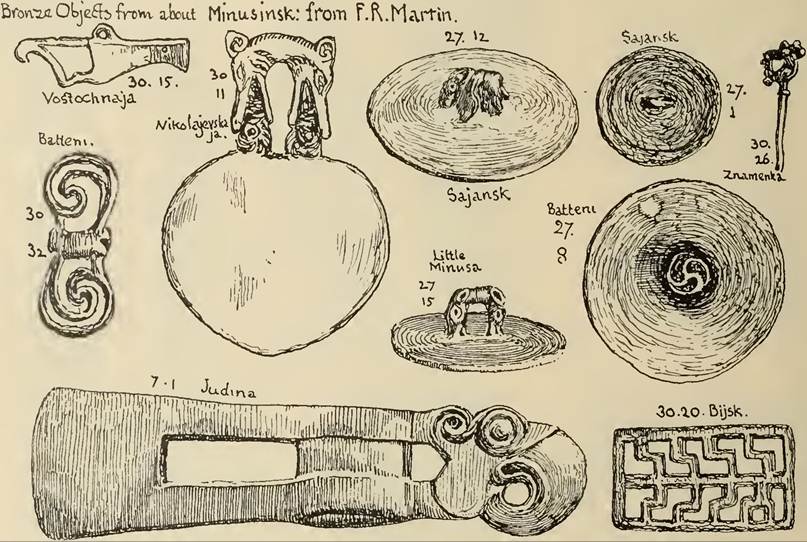
Fig.
152.also made scythes and sickles and copper cauldrons. For their own adornment they had earrings of gold and copper, carnelian and metal beads, beastheaded pins, belt pieces, and disks with loops behind serving either for mirrors or for ornaments. The pottery is very rude and falls far below3 the skill shewn in metal work. They were acquainted with weaving, but
1 Aus Sib. 11. pl. iv. 1 and 2 on fig. 172, p. 251. 2 Sib. Ant. 1. xvi. 11, xvii. 4 on fig. 150.
3 v. Elements, op. cit. pl. xix.
their stuffs were also coarse. They do not appear to have kept cattle, but they do appear to have engaged in agriculture for they have left many copper sickles about the fields, and these fields often have traces of irrigation works. The bone arrow-heads found with their objects and their love of beasts in their ornament suggest that they were hunters as well. They do not seem to have been nomads in any sense. So they had few horsetrappings, and the rock carvings ascribed to them shew the men all on foot.
But it is their metal work which makes them interesting. They appear to have originated many types that were afterwards spread far and wide. Their knives (v. the series on f. 150), in their simplest form mere slips of copper, as it were long narrow triangles with a hole towards the base, were improved into excellent instruments with a well formed ring at one end, sometimes in the form of an animal, a firm handle separated from the blade by a well marked fillet and projection, and a blade bent forward so that the edge made an obtuse angle with the haft. Such a knife recalls irresistibly the Chinese knife which afterwards shortened down into the round cash[508];
and so P. Reinecke2 thinks it an imitation of the Chinese, but just as possibly
it came into China by some early raid
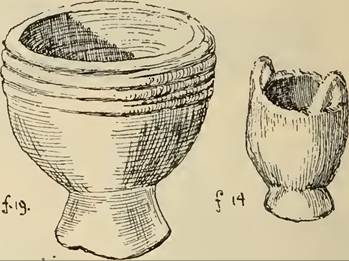
Then the bronze cauldron upon ; was built, a type characteristically Scythic, was made by these people; they alone made the same shape in pottery so they were probably the originators of it.
They also seem to have invented the disc with a loop in the middle of the back, which grew, as it appears, into the mirror used over all northern Asia and in Scythia and the Caucasus. This mirror Reinecke (loc. cit.) also calls a Chinese invention, but it was only introduced into China about 140 b.c. along with other western products. Together with this new form of mirror the Chinese began to use a new name for mirrors with anfrom the north (v. p. 91).
conical base round which the fire
lite. t'GvivvSmSk ttivSeAvVM. Pl XIX. CCavj fVU?.
Fig. 159.
ideogram suggesting metal[509]. The Chinese even followed their models in decorating these mirrors, the loop being formed of the body of an animal just as with the mirrors and knife handles of the Jenisei people (v. f. 152).
Furthermore these early inhabitants of the Jenisei developed a dagger with a curious heart-shaped guard and a well defined knob at the end of the haft, which type is found in Scythic tombs and on the monuments of
to my notice by Mr Reginald A. Smith of the British Museum.
3 Prof. H. A. Giles, China and the Chinese, New York, 1902, p. 132; cf. Po-ku-t'u-lu, in which such mirrors are figured; Hirth, Fremde Einflüsse, ff. 2—16. I am much indebted to Professor Giles for the information about mirrors and for help in consulting Chinese archaeological works.
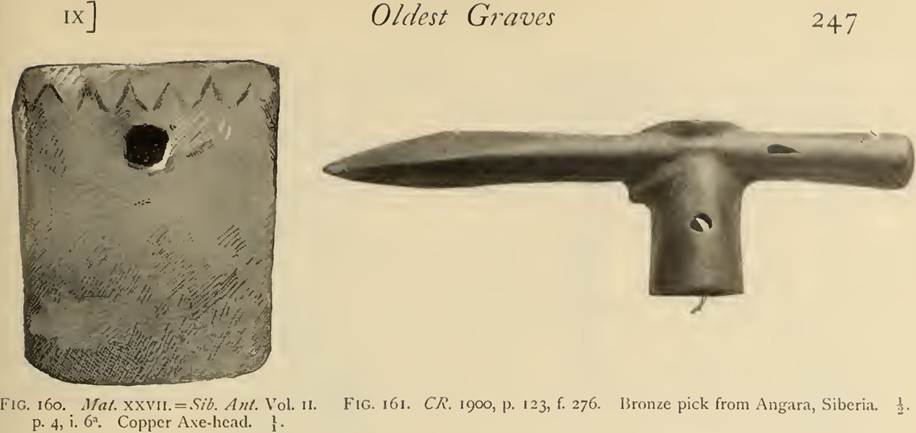
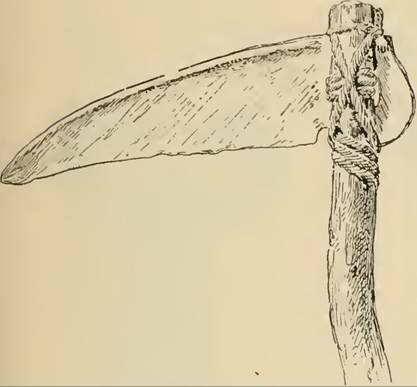
Fig. 162. Mat. xv. = Sib. Ant. Vol. 11. p. 82, xv. 3. Copper Siberian scythe. |.
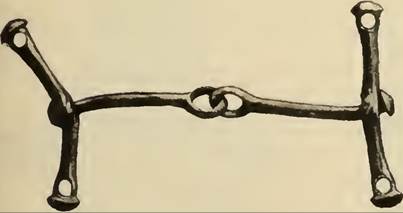
Fig. 163. Mat. XV. Sib. Ant., Vol. 1. p. 131. Bronze bit from Siberia.
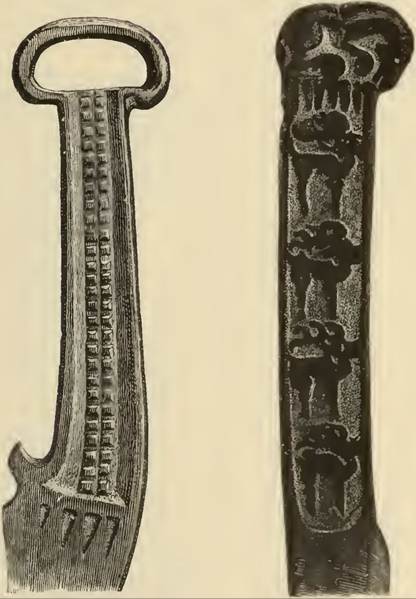
Fig.
164.Mat. v. = Sib. Ant.
Vol. 1. p. 31, v. 8. Copper knife. }.
Fig. 165.
Mat. \\\.=Sib. Ant.
Vol. 1. p. 22, iii. 23. Reddish bronze knife. }.
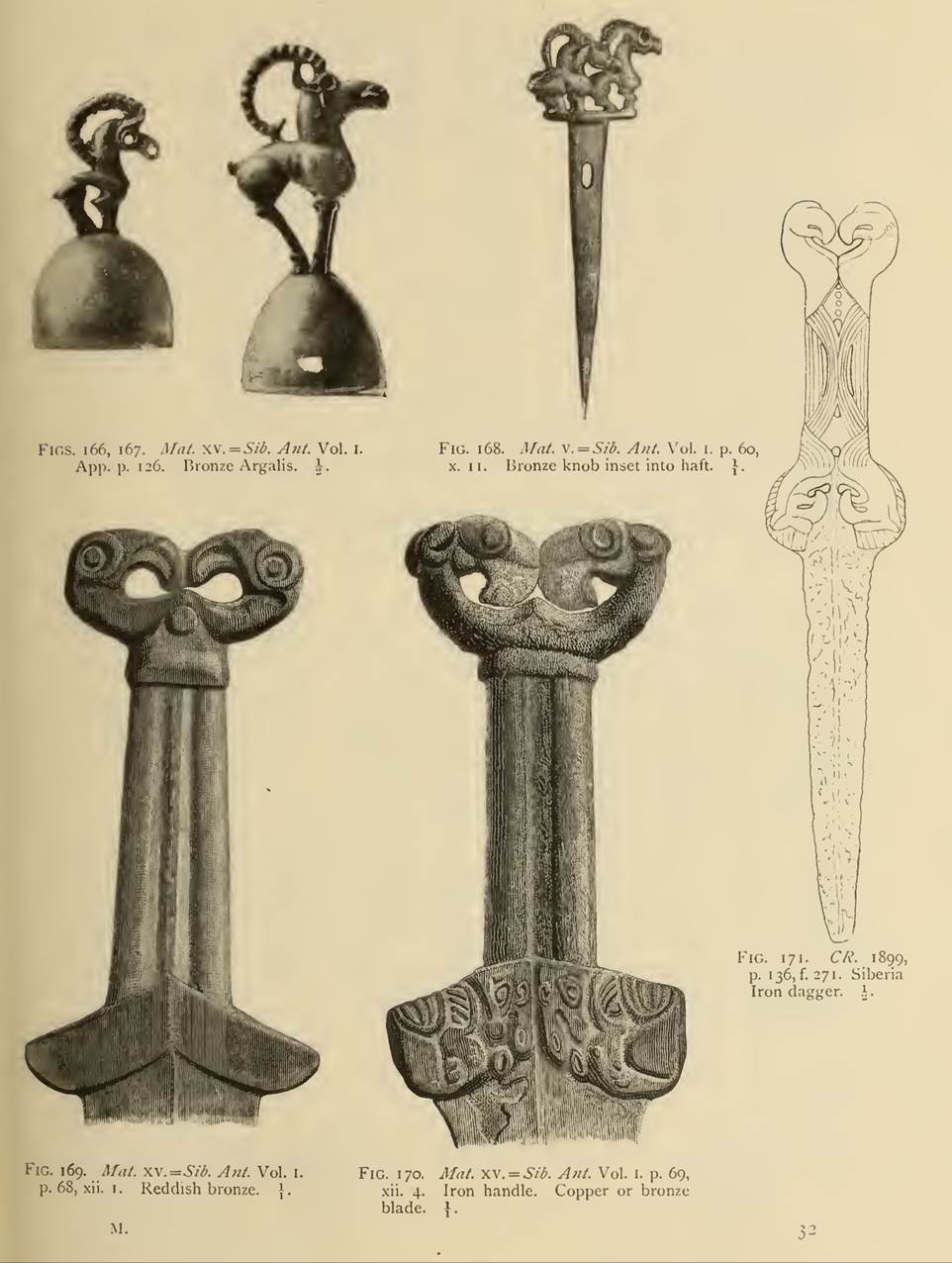
Persepolis[510]. But the interest of these objects is not merely in the types of their weapons but in the style of their ornament. Besides zigzags and simple patterns of straight lines they developed a beast style remarkable for its simplicity and naturalism. They pourtray chiefly bears (ff. 150, 152), deer (f. 165), and argali or ibex (ff. 166—168, 172) and have no tendency to the fantastic combinations of incongruities found in western Asiatic and also in Scythic work.
Early Iron Age. Kalanda.
In the next class of graves, the barrows, we find a different culture belonging to the early iron age. The barrows as usual occur in groups. In such a group on the river Katanda not far from where it falls into the Katunja a tributary of the Obj, Radloff[511] came upon many tombs with interments of men, women and horses, and one in particular yielded very important remains.
The barrow was heaped up of stones and 7 ft. high by 100 ft. in diameter. Attempts had been made to plunder it and in the heap were found in disorder bones of at least six horses, human bones likewise, six iron bits, various iron and bone arrow-heads, an iron spade, an iron and a copper knife, an iron sabre, a mass of blue glass beads and two heart-shaped carnelians from earrings. In the midst of the heap was found the grave pit, 14 ft. long, filled up with big stones and earth; 2 ft. 6 in. below the original surface of the ground the excavators were stopped by coming to earth permanently frozen: water meanwhile trickled into the excavation from all sides and continuance of the work became very difficult: the earth had to be melted with fires and the water and mud baled out. Two fathoms deep they came upon bones of men and horses and also found an iron bit with large rings. Further down were the remains of an oblong erection of larch wood, of which the roof had been destroyed by former plunderers.
Across this building went two thick beams and upon one of them was a big bundle of leather enclosed in a rind of ice six inches thick. The bundle turned out to be a kind of coat of silken stuff, much like a dress coat in shape, lined with sable and edged with leather and little gold plates. The first plunderer had not penetrated beyond this level, at which a layer of birch bark covered the whole tomb. In this was another garment of ermine dyed green and red and adorned with gold buttons and plates; this was likewise rolled up into a bundle and encased in ice. It had a high collar and very narrow sleeves. In it was an ermine gorget, a band of silk on which were fastened horses and monsters of wood, a carved wooden saucer and fantastic deer, bears, etc. Under the birch layer was reached the bottom of the pit whereupon were two low tables hewn out of wood and upon each table an unadorned skeleton. Some fragments of clothing and gold plates were picked up in the bottom of the grave. The skeletons were absolutely decayed. Although the state of the skeletonsIron Are
249
shewed that the grave was of early date, the frozen condition of the ground had preserved the furs and textiles in a manner unparalleled in warmer countries. The same cause also prevented the complete plundering of the grave, although the thief found that which was in the upper layer and threw some of it aside.
Another field of barrows was explored on the river Berel, near the Bukhtanna, an affluent of the Irtysh. In the heap of stones composing one barrow, about 20 feet high and 100 feet across, was found the skeleton of a horse with an iron bit and two iron stirrups. In the natural earth was a great pit 20 x 24 ft., and the ground was frozen: when it was cleared there appeared a layer of wood at the s. end and of birch bark at the N. end, under this latter sixteen horse skeletons in four rows with their heads to the east. The two easternmost rows had iron bits, and were covered with wooden and birch bark ornaments mostly overlaid with gold. In the middle of the wooden platform at the s. end was a tree trunk hollowed out, adorned at each corner with four birds cast in copper. Under this was a gravepit with a horse’s and a man’s skeleton. By the latter were traces of copper and gold. To all appearance this part of the grave had been plundered in antiquity. Other graves about were found to be arranged like those on the Katanda, horse skeletons above and men’s below, and objects of silver and iron, with well-made pottery. The iron knives and daggers were made after the exact fashion of the bronze ones, only the iron hafts were covered, each with a thin gold plate. In one case were found scales of iron armour for sewing on to a leathern jerkin.
The earthen barrows about Barnaul agreed mostly with these, except that they were smaller and the horses were not always buried with the men. They contained similar layers of birch bark and wood. Most of these graves had been plundered.
The graves of the later iron age are much smaller than those already described. They are called Kirgiz graves and may well belong to that people. They shade off into quite modern interments containing e.g. Russian xvuth century coins.
The people of the early iron age are evidently quite different from those of the bronze age. Their burials are different and their manner of life likewise. Evidently the horse played a great part in their existence. Also they have many more weapons found with them. That is to say that they were a nation of warlike nomads. Still their civilisation had much in common with that of their predecessors. They adopted from these the characteristic dagger, the characteristic knife, the cauldron, the mirror; they seem even to have continued their agriculture to some extent, and they also engraved representations of themselves upon cliffs; this time we find the figures predominantly on horseback in place of going afoot. The new comers seem to have brought a knowledge of silver and of iron, and also a distinct taste for the monstrous. With them begins the liking for winged quadrupeds, for horns ending in birds, for inconsequent beak-heads, for conventionalised creatures quite unlike the naturalistic style of their predecessors. Yet the similarity in technique, the imitation of bronze forms in iron (ff. 169—171)—we find even such strange cases as bronze daggers with iron handles—the similar love
IXJ ІГ071 Лр-е
AusSibirien.Vvl.il. Objefti frem th.Attii
32-2
of gold plates as adornments, make it clear that the old tradition lived on. It seems as if this new warlike immigrant people conquered the old miners and metal workers, and used their inherited skill in the carrying out of its own taste and thereby formed a mongrel style which is indistinguishable from the Scythic.
Everything points to this immigrant population having been of what may be called Hunnic stock. Their mode of life, their burial customs, their type as seen in statues and rock carvings, correspond with what we know from Chinese sources of the Hitmg-nu, the T'u-kue, the Tartars, and all other tribes of that stock (see p. 88 sqq.).
The burial customs do not correspond, inasmuch as the Chinese speak of them as burning their dead, whereas no cases of complete cremation have been found. Still near Tobolsk A. Heikel found in a tomb which had much in common with these middle Siberian barrows, that the wooden erection set over the body had been set on fire before the heap was raised[512].
It looks as if they had already learned something from their southern neighbours before they enslaved their northern ones. This would account for much that is in common between Scytho-Siberian art on the one hand and Iranian on the other, and likewise Chinese. This latter resemblance has already been dealt with by P. Reinecke[513], in the article already quoted, and by S. Reinach in the Revue Archeologique*. The former takes for granted that the northern barbarians were only passive, receptive. This may be true in a sense. But inasmuch as they received from all directions it is possible that they transmitted something to the Chinese, whether it was derived from the west or from the Altai miners to the north.
As to the affinities of these latter it is hard to give any opinion. It would be natural to refer them to the Uralo-Altaic tribes and argue that there is much in common between their civilisation and that of the tribes of that race all across from Finland, central Russia and Perm to the Altai, and that to this day most of those regions are peopled by that race where it has not been encroached upon by intrusive Turks. But Radloff is rather inclined to see in them the ancestors of what he calls the Jenisei tribes, who speak a language quite distinct from Uralo-Altaic and Turkish, and who have been mostly assimilated by one or other of the great tribes about them, yet still in some cases have preserved a hereditary skill in metal-working, for instance the Kuznetsy or Smith Tartars, who talk a Turkish tongue but belong to the older race. The Uralo-Altaic peoples never reached so high a state of civilisation. Moreover we know that the T'u-kue in the vith century a.d. had long since held a metal-working race under subjection. This employment of alien craftsmen is characteristic of the nomads. For the T'u-kue there worked Chinese, for Chingiz Khan’s successors Chinese, Persian, even German miners and armourers and a French jeweller4; for Timur were set up the most perfect productions of purely Persian architecture.
Besides the few objects which have been recovered from tombs excavated by a competent archaeologist, there is a whole class of antiquities nearly all of gold, some set with stones, whose provenance is vaguely given as Siberia. Spitsyn refers them more particularly to the basins of the Ishim, the Irtysh and the upper Obj. I hey came to the Hermitage from the collection of the Academy of Sciences of St Petersburg, and they represent the first attempt at an Archaeological Museum, surviving from the Kunstkammer of Peter the Great. They were saved because the attention of his government was at last called to the great spoils collected by the bu&rovshchiki, or mound-diggers, who went out in large parties and systematically robbed the ancient graves, which must have been astonishingly rich in gold. Nowadays no one has hit on such a rich grave still unrifled so as to describe its disposition. Radloff, in an appendix to his “ Siberian Antiquities,” gives extracts from the works of early European travellers in Siberia who tell of the work of spoliation[514].
The collection includes collars, frontlets, figures of birds, animals and men, buckles and plates of various shapes, some with loops behind for straps. The commonest forms are oblong and a kind of co shape which is made to suit the favourite subject of an attack by a carnivore on a pasturing animal very well. Plates of bronze, but exactly similar in shape and design, have been found still nailed symmetrically on to coffins, but they seem too solid for mere funeral furniture and had probably served some purpose in the life of their owner, most likely they had some part in the adornment of his horse or were nailed on to coffers in which he kept his goods. Some idea of date was furnished by their being found with coins of the Han dynasty which circulated from b.c. 118 to a.d, 581[515]. Witsen, to whom some specimens now lost found their way, figures them in company with coins of the Roman emperors, e.g. Gordian, and there is no reason against their belonging together: only his plates give a most miscellaneous lot of things, and we cannot be sure which was found with which. In accordance with these data M. Hoernes[516] thinks that the Siberian Iron Age came in with the Christian Era, but the South Russian analogies point to a much earlier time.
These Siberian gold objects have never been satisfactorily published ; Dr Kieseritzky, the late curator, who referred them to the Massagetac, promised an illustrated Catalogue of all the Scythian and Siberian Antiquities : meanwhile the best pictures of them, some of which I have reproduced below (pp. 272—280), where I treat their style in detail, are in KTR*
de Russie, Paris, Fan 11. 8vo, Vol. v. p. 13, pl. 40 ; Vol. vi. p. 287, pl. 98. A. A. Spitsyn, ERAS. Russo-Slav. Section vm. i. (1906), p. 227, reprints Witsen and Messerschmidt's accounts, and also inventories of such objects sent to the Tsar in 1716 and still to be recognised.
2 Excavations of J. D. Taiko-Hryncewicz on R. Dzhida in the Transbaikal District, as summarised by A. A. Spitsyn, ERAS. xn. (1901) p. 277.
3Natur- and Crgeschichte des Menschen, Wien, 1909, 11 p. 304.
4 PP· 3/9—400, ff. 332—365 ; cf. also Ch. de Linas, Origines de I'OrJcvrerie Cloisontu'e.
Oxus Treasure.
From the southern borders of Siberia, where the steppe marches with Iran, comes a collection of objects in the British Museum. It claims to be one hoard discovered in 1877 near the middle Oxus either at Kabadian or between it and Khulm[517]. It includes a few pieces in style similar to the Siberian Plates, some objects whose artistic affinities are not yet cleared up, several examples of Persian jewelry, and some Greek work including coins. It is most unfortunate that this find was not made within reach of any trustworthy authority. We cannot even be sure that all the objects really belong to the same cache. They found their adventurous way down to India into the hands of ingenious native dealers, who added to their number by forgeries, and by duplicating real antiques in more precious materials. One thing is clear, that of the vast number of objects and coins purporting to be part of the treasure no specimen which belongs to a known art and can be dated approximately is later than about 200 b.c. : there are no Parthian coins and none of Eucratides, though they are common in those parts ; the latest coin belongs to Euthydemus, whereas some of the things go back at least to the vth century b.c. The barbaric pieces recall the undoubted Iranian ones closely, and it is almost inconceivable that if they were imitations of Sassanian work and belonged to the ivth century a.d., chance and the caprice of dealers should have associated just these and no others with this definable find.
Mr Dalton’s identification of the purely Persian style of the griffins and other objects that he published in his preliminary article was afterwards triumphantly vindicated by Mr J. de Morgan’s excavations at Susa. There, in a tomb proved by coins to belong to the early ivth century b.c., were found armlets and other jewels precisely similar to some from the Oxus, save that their preservation is incomparably better. They are adorned with inlays of light and dark blue and red[518].
For a catalogue of the treasure the reader is referred to Mr Dalton’s work. Its chief glory, the pair of griffin armlets (No. 116), of exactly the same style as the collar from Siberia (p. 272, ff. 188, 189) and the best example of the kind of model which inspired later Siberian plates, has no Scythic character and so no place here[519]. The sheath (No. 22) has already been discussed (p. 70, v. inf. pp. 263, 270). It is 10'9 in. = 27’6 cm. long.
The gold plaque (No. 48) with a figure of a man probably a Persian in a costume resembling the Scythian is very valuable as illustrating the latter, but its purpose is not quite evident and in spite of its clearness it lacks artistic style. The ring (No. 111), on the other hand, has very definite Siberian analogies in the manner in which the animal is bent round, and in the hollows left for precious inlays..
He and the Trustees of the British Museum have kindly allowed me to make use of the blocks of Nos. 23 and 111.
2 inf. p. 271, f. 187, J. de Morgan, Dilegation en Perse du Ministere de 1'Instruction Publique, 1897— 1902, p. 93 sqq. and Memoires T. VIII. pp. 29—58, pl. iv. v.; E. Pottier, Gazette des Beaux Arts, 1902, p. 17, “Les Fouilles de Suse.”
3 v. coloured plate xvl in Archaeologia, lviii.
Oxus T rea sure
2.55
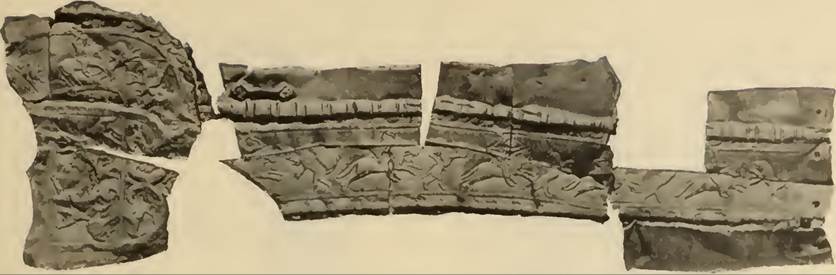
Fig. 173. Gold plate from sword sheath. Oxus Treasure. Dalton, no. 22. A.
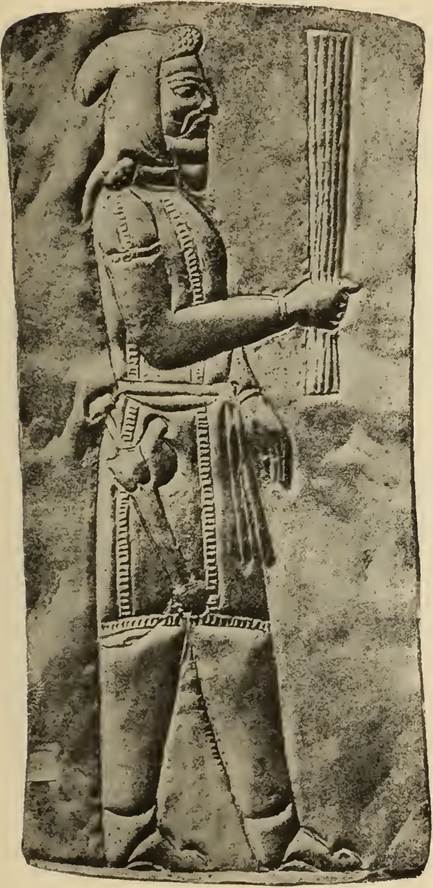
Fig. 174. Gold plaque from Oxus Treasure. Dalton, no. 48. v. p. 58.
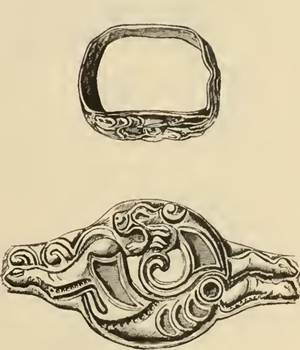
Fig. 175. Gold ring. Oxus Treasure, no. in. }.
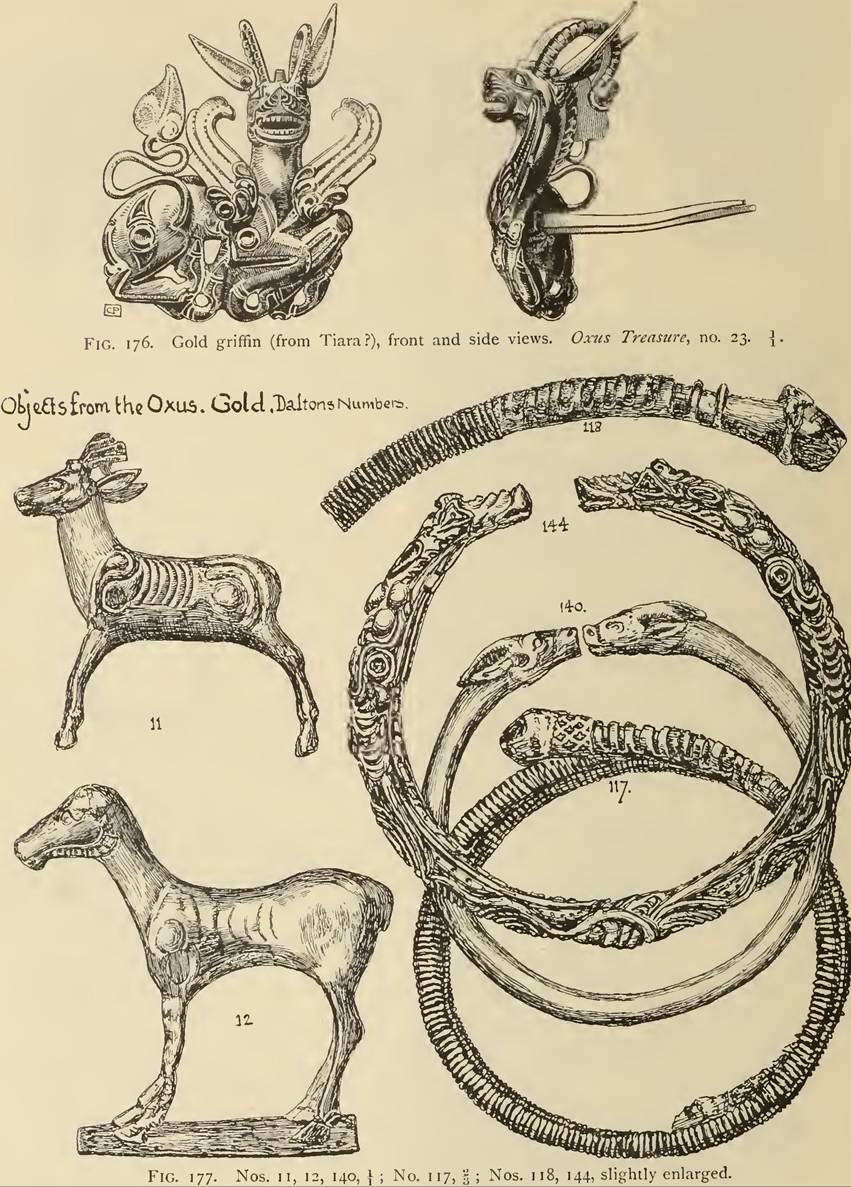
The same may be said of the griffin ornament (No. 23), though it is nearer to its Iranian originals. The armlet (No. 144) is again more barbaric. The beasts upon it are broken-down griffins with intertwined tails. Other armlets (Nos. 117 and 118) are, on the other hand, purely Persian. No. 140 has less definite style. It is singularly like those brought as tribute on Persepolitan sculptures (p. 59, f. 12). The two figures of deer (Nos. 1 1 and 12) are very like such figures from Siberia (inf. p. 272, f. 190). They are given to shew the muscle lines in an early stage before they had become exaggerated. Whatever doubt may be cast on the genuineness* of some of the Oxus treasure these pieces appear to me certain.
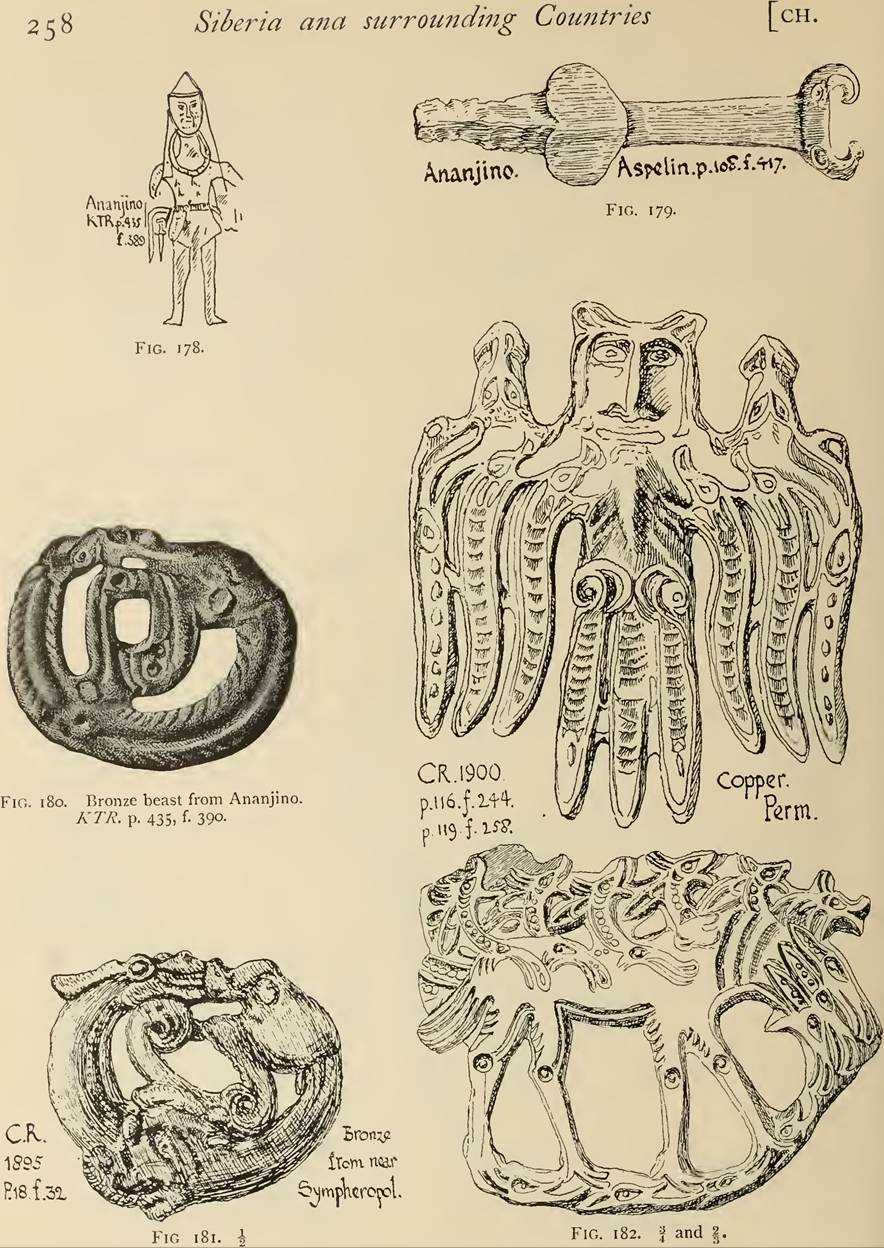
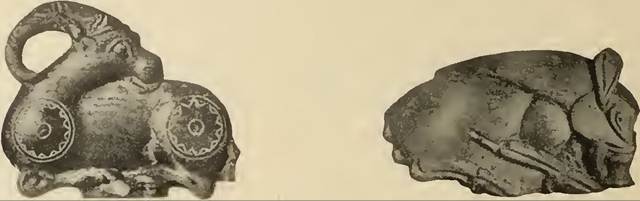
Andnjinot and Perm.
Besides the Altai region and western Siberia, finds of objects of the Scytho-Siberian type are made in the Urals and in the forest region to the west of them. Evidently there was intercourse but no regular domination, such as is suggested by the finds in Little Russia. The best example of a mixed Finno-Scythic culture (it may be premature to name it so, but all likelihood points to such a name being near the mark) is the cemetery of Ananjino, on the river Tojma near Eldbuga, on the lower Kama[520] [521]. Ananjino belongs to the transition from bronze to iron : there are bronze axes and pick-axes, spear and arrow-heads, and iron daggers of Siberian type (f. 1 79) and some beast style ornaments recalling Siberian forms, for instance a twisted up beast (f. 180) whose analogues come from the Crimea (f. i8i)and from Siberia (p. 274, f. 194). On the other hand some things recall the remains found further to the north about Perm and everything is rudely made. The costume on an incised tomb-stone is not unlike the Scythic (f. 178). Further north and west the Siberian dagger penetrated among purely Finnish people such as dwelt in the upper basin of the Kama[522]. This is the country in which are found the wonderful pieces of Graeco-Roman, Byzantine and Sassanian silver plate kept chiefly in the Hermitage and the Stroganov palace at St Petersburg[523]. In this country are found bronze and copper “idols” which have some' connection with things Scythic; they seem rather poor relations than imitations, but the outspread eagle with a human face upon its breast, the emblem of the God of heaven, certainly recalls a favourite Scythic motive, and the many-headed deer is, as it were, an exaggeration of the type best exemplified by that from Axjutintsy8. by A. A. Spitsyn in Mat. xxvi. St P. 1902. Pl. XXVII. 8, a characteristic Scythic iron dagger; pl. xxxv. copper axe-heads. A. Likhachov in Trans, of VIth Russian Archaeological Congress (Odessa, 1886), I. p. 135. 4 KTR. pp. 408 sqq.; Arch. Ans. 1908, pp. 150—162, ff. 1—6. Mr J. I. Smirndv of the Hermitage has made a complete publication of them in his Argenterie Orientale, St P. 1909. 6 J. Abercromby, Finns, Vol. I. p. 118 sqq., p. 240; A. A. Spitsyn, TRAS. Russo-Slav. Section, Vol. vin. (1906), pp. 29 — 145, ff. 1—496, has given a full repertory of such Shaman objects. Μ. 33 La Tenc. On its western border the Scytho-Sibcrian style met with the I lallstatt and later with the La Tene styles. There seems to have been no interaction, but Scythic objects spread into Hungary[524] [525], perhaps in consequence of such movements as that of the Iazyges Mctanastae (v. p. 121). The La Tenc objects found in Russia (hitherto very few) were brought by western invaders, whether German Bastarnae or real Kelts (v. pp. 125, 127). Their incursions were, as we have seen, less important than those from the cast. So far we can speak of the La Tone culture as having been established in Poland and even in Galicia, but as merely sporadic in Podolia and on the lower Dnepr, where the Protogenes inscription is the only witness to the westerners’ raids[526]. It must have been in S. Russia that the Scythic beaststyle, applied to types developed from La Tene, produced the style of the Migration period. Here too perhaps had arisen the fibula with its foot bent back that gave rise to the cross-bow shape. Salin supposes that different modifications of this form, e.g. the radiated and square-headed types, mark different streams of culture diverging from the Crimea as a centre, but he thinks that the Germans’ beast-style was their own and not indebted to the Scythic3. Caucasus. Resemblances have been seen between the metal work of the Caucasus[527] and that of the Scytho-Siberian style, but they do not amount to much : they might be expected when we consider that Assyrian influence reached the Caucasus on one side and dominated Iran on the other, and also that some tribes of the northern plains undoubtedly passed through the mountains (v. supra p. 42). Most curious is a perfectly Minusinsk knife from Kortsa, a little west of Koban[528]. At a comparatively late period the Caucasians seem to have borrowed the characteristic looped mirrors0, and along the northern foot-hills finds of Scythic type are constant. Moreover Gothic jewels have Society, Part 1 with several short articles, and esp. Part viii, Moscow, 1900, which contains a very full summary and many excellent plates, edited by Countess P. S. Uvarov; E. Chantre, Recherch.es Anthropologiques dans le Caucase, Paris, 1885-7; J. de Morgan, Mission Scicntifique au Caucase, Paris, 1889; J. Mourier, LI Art au Caucase, Odessa, 1883 ; R. Virchow, Das Gräberfeld des Kobans, Berlin, 1884; “Ueberdie Culturgeschichtliche Stellung des Kaukasus,” Abhandl. d. kon. pr. Akad. der Wiss. zu Berlin, 1895, I. ; G. Radde, Museum Caucasicum, Bd V, bearbeitet von Gräfin P. S. Uwarow, in Russian and German, Tiflis, 1902 ; see also KTR. p. 437 sqq. There is a good representative collection of objects from Koban and elsewhere in the Museum at St Germain-en-Laye, near Paris. 5 Countess P. S. Uvarov, Mat. Arch. Cauc. vm. p. 180 and pl. LXXVI. 6 op. cit. pl. liv., Dergavs. 33—2 occurred in a great find at Rutkha1 on the Urukh well in the mountains, and typical fibulae and bird’s head ornaments have been found in several localities. Sometimes types characteristic of the mountains are found sporadically in the plains, for instance the singularly elegant axes of the Koban2 recall one or two specimens from Perm, that backwater to which all kinds of flotsam drifted3. But it seems as if the Caucasus threw no light on the early population of the northern steppes. The objects of the Koban cemetery have their analogues in central Europe, whatever the connection may have been4; later sites shew products of Roman craftsmanship, but on the whole archaeology is even more at fault in the mountains than in the plains. 1 op. cit. pl. CI. CH. Vol. I. p. 240, regards these as evidence of the 2 op. cit. pl. in.—viii.; KTI\. p. 462, f. 407. early existence of the Permian trade route. 3 Aspelin, p. 60, f. 237 ; J. Abercromby, Finns, 4 H. Schmidt, Zt.f. Ethn. xxxvi. (1904), p. 620. Fig. 182 bis. Ivory Ibex and Boar from Ephesus, v. p. 263. Constantinople Museum. D. G. Hogarth, Excavations at Ephesus, London, 1908. Ch. ix. “The Ivory Statuettes,” by Sir Cecil Smith. Ibex, p. 163, No. 23, pl. xxi. 5, xxm. 2. Boar, p. 164, No. 26, pl. xxvi. 3 ; cf. p. 177, f. 33, bronze ibex and boar from the Troad. My best thanks are due to the Trustees of the British Museum and to Sir Cecil Smith for leave to reproduce these objects, and to Mr Dalton who called them to my notice. The pictures came too late to go into their right place in the text. The resemblance of these animals to the Scythic is exceedingly close. In the Ibex the attitude of the feet and the way they are conventionalised is just that of the Scythic deer. The manner in which its head is turned round is a Mycenaean survival; Sir Cecil Smith compares the ibex on the Enkomi casket in the British Museum, but in the Scythic area it can be paralleled by a plaque from the Kuban (p. 279, f. 205), and a cheek-piece and a plaque from Zhabotin (p. 188, f. 80, Nos. 540, 539). On this last a mare with her foal bears upon her shoulder a star applied in the same way as the circles upon the ibex. Both star and circles may go back to a swirl of hair such as is just visible upon the shoulders of the lions flanking the tip of the Melgunov sheath (p. 171, f. 65, cf. a rosette in the same position, Layard, Monuments of Nineveh, I. 31). More probably it is due to the practice of adorning the plain surfaces of figures with various decorative motives, a practice common to the Ionian (Sir C. Smith, p. 156) and Scythic styles, and pushed to its furthest in the Kul Oba deer and Vettersfelde fish and in the Siberian plates (e.g. p. 273, f. 197). The boar is also very like Scythic work especially about the feet: it has some resemblance to a gold boar from Alexandropol (KTR. p. 244, f. 223 = ASH. VI. 3). Gold work like some of that from Ephesus, particularly the repoussd plates (Hogarth op. cit. Pl. VIII. ix.), more especially a roundel with a griffin (vill. 3) in which Hogarth sees a Central European look, may have served as a model for similar work in Scythia.