CHAPTER X. SCYTHIC ART AND GREEK ART IN THE SERVICE OF SCYTHIANS.
Scythic art has a character of its own. When we have made all allowance for foreign influence there remains something unlike anything else, the basis of the whole development, that to which imported elements had to conform or else quickly degenerate beyond recognition.
This native element is at its purest in the art of the basin of the upper Jenisei and its centre may be reckoned Minusinsk. Until the true date and affinities of Minusinsk art have been made clear the Scythic problem cannot be said to be solved.Unhappily we are not yet in a position to frame even plausible theories on the subject. In the last chapter I have given the few data available : but they do not take us far. The objects there figured give a fairly representative collection of the different classes of Minusinsk work : sufficient to judge of its character, sufficient to let the reader see for himself affinities with the products of other lands. Mr Seebohm’s Siberia in Asia is, I believe, the only English book in which any of them have been figured. The few specimens he brought home are in the British Museum, wise these things are inaccessible to British archaeologists.
Other-
to be
many
China
does not seem
a local stages : only, as
Almost all the types are peculiar. The knife seems development, at least we seem able to trace it through but this type was not spread over the Scythic area, and in has been said, seems to have its counterpart. The dagger to have attained its development at once. Its less perfect form also appears in China ; but its fully developed type spread westwards as far as Hungary. The mirrors also spread to China and to S. Russia : likewise the cauldrons. The arrow-heads appear nearly all to be of the four faceted1 as against the later triangular shape. The axe heads seem a final improvement of the socketed celt, having a peculiar second loop (p.
243, f. 151). This also spread over the Scythic area (p. 190); later would be that with one loop in the middle of the broad side (p. 243, p. 245, f. 158). Finally we have the beautifully shaped head with a transverse hole for the haft (in. 5 on p. 251). All these types suggest that bronze casting was developed longer and further than in most countries : that an out-of-the-way district was left undisturbed to let its bronze craft evolve independently. Something similar seems true of Hungary.But the ornament has the chief claim to interest and is the greatest puzzle. It is not quite clear which way it is going; whether animal forms are being degraded into easy curves or curves have suddenly been seen to have animal possibilities. To me this latter seems the case. The
1 More or less similar to Nos. 203 to 18 on p. 190, f. 82, but without side spurs. loops of a mirror (p. 244, f. 152) or the ring of a knife handle (ff. 150, 165) suggested, perhaps at first owing to the chances of casting, the shape of an animal with its head down, or of two heads neck to neck ; the loop of an axe-head (f. 151) joined to another small ring looked like a beak and eye and was improved to bring out the resemblance. So the ends of pommel and guard struck the imagination as being ready to make beak-heads, and beak-heads became the regular decoration of the dagger (ff. 169—171). The wrong end of an axe became a beak-head or an argali schematically rendered (ff. 152, 150). Animals so derived from loops and knobs and handles remained simple and geometrical in their lines. The eyes remain ring-like ; the beaks are always curved right round, the bodies lumpy and the limbs thick. Sometimes pure line was sufficient, zigzags in the knife handles (ff. 153, 155), even spirals as on the ornament and mirror from Batteni (f. 152). The ornament from Bijsk (ib.) shews a favourite pattern for incrusted jewelry. When this eye for chance resemblances was turned on to representations of animals it saw them also in antlers or tails in which it was ready to fancy a likeness to other creatures’ heads ; but this development seems subsequent to the introduction of iron and the conquest of the metal workers by nomads who exploited their skill.
It is the distinguishing mark of the Scythic style.There does not seem to me to be anything in the earlier Minusinsk art which need have come in from outside, except perhaps the socketed celt[529]. It was the nomads who brought beasts and monsters from sw. Asia, and perhaps from the coasts of the Euxine. M. Salomon Reinach has seen resemblances between Siberian art and certain points of Mycenaean. If there be such they are in the later Minusinsk, which is identical with Scythic. But this had received Mediterranean elements into itself; archaic Greek art as practised in Ionia had penetrated to it at an early period, and before that there may have been other influences from the Aegean region. These affected Scythic art from the first and would account for any resemblances. So that there may be truth in M. Reinach’s fascinating theory that the representation of a flying gallop in which the animal sticks his legs out in all directions at once, spread from Mycenaean art to some lost Central Asian art and hence through Siberia as far as China, to return to the West and English sporting prints with the Chinoiseries of the xvmth century[530].
Influence of Western Asia and Ionia.
Whatever the ultimate origin of the Minusinsk style, whatever influences it may have felt in spite of its remoteness, upon the coming of the
iron people it became the foundation of their taste and was spread by
them over all the steppes. Thereby it emerged from its isolation and
xxxvi. (1900), pp. 216 and 440; xxxvii. p. 244; xxxviii. (1901), pp. 27 (Scythic style) and 224; xxxix. p. 1, and BCH. 1897, pp. 5—15, “Un Monument oublie de Part Myceneen.”
x] Minusinsk Style. Assyrian, Iranian and Ionian Arts 263 became exposed to the influences of the arts of south-western Asia. But it is beyond us to disentangle these influences, because we are not yet able to clear up the mutual relations of these arts, Assyrian, perhaps N. Syrian and finally Iranian on the one hand, on the other Mycenaean (in survivals) and early Greek.
If, for instance, we take the Ephesus[531] [532] and the Nimrud[533] ivories referred to the vinth and ixth centuries, Sir Cecil Smith3 is inclined to make both groups Greek: Mr Hogarth[534] finds the former Greek under Assyrian influence exerted through the N. Syrians, the latter N. Syrian. Seeing that very similar ivories come from Sparta[535], perhaps rather too much has been made of the Orientalism in the Ionian finds, though the very material suggests the East: that Greeks should have had a hand in the Nimrud ivories seems thereby less probable. The difference touches the Scythic question nearly, inasmuch as one or two of the Ephesus beasts (v. p. 260) are in a style almost identical with the Scythic. With the Ephesus Lions“ may be classed the lion-head from Vasilkov (p. 193, f. 85). But it is precisely in the beasts that Assyrian influence appears most plausible at Ephesus ; yet the features which recall the Scythic do not seem to extend to the basreliefs of N. Syria7 and Assyria, though the small figures in the round are not so very unlike“. It seems therefore justifiable to distinguish two quasi-independent strains that met in Scythic art, the Assyrian to which the Iranian succeeded and the Ionian which never quite gave way to the Attic.The earliest objects from Scythia that we can date, the Melgunov and Kclcrmes sheaths, referred to the vnth and vith centuries b.c., arc under overwhelming Assyrian influence, yet their general forms arc Scythic and the crouching deer upon the side projection is Ionian : in the sheath from the Don (p. 270, f. 186) the two strains are blended. In the Oxus sheath the Scythic element is weaker. Pieces of Iranian work are few in European Scythia, the hilt of the Chertomlyk sword is the best example9; further east we can name the better specimens from the Oxus and one piece of Siberian treasure (p. 272, ff. 188, 189), but its imitation is universal in the Asiatic steppes and is carried by tribal movements into Europe.
In the vnth and vith centuries b.c. Greek and Oriental art were still closely allied, and even later certain classes of objects seem to stand between the two, especially engraved cylinders and gems such as those from S. Russia illustrated in Ch. xi. § 13, f. 298, and others like them from western Asia10, and certain silver work (v. p. 265).In the Greek influence we must distinguish two periods, that of the Ionian archaic art and that of the fully developed Attic art afterwards practised throughout the Greek world. There is something almost barbaric about the Ionian art that makes us barbarians think of our own mediaeval
8 Exc. at Eph. xxi. 1, 3, xxm. 3, xxv. 12.
7 e.g. the deer at Sindzherli, K. Humann u. O. Puchstein, Reisen in Kl. Asien, xi.iv. 1, xi.v. 3.
8 e.g. many with the Nimrud Ivories in the British Museum, cf. Perrot and Chipiez, op. cit. 11. p. 315, f. 193.
8 Yet cf. for the hilt Perrot and Chipiez, op. cit. I. p. 334, two calves’ heads addorsed from Nineveh.
10 Furtwängler, Antike Gemmen, in. p. iiosqq.
work, a decorative quaintness which does not demand for its appreciation so high a level of aesthetic development as that required by the perfect art of the vth century. Hence its easy adoption by neighbouring Asiatic nations and the employment of Greek craftsmen by the Achaemenians. Hence too its spreading among the Scythians. Prepared by the Minusinsk culture and perhaps by some contact with survivals of Mycenaean art, the Scythians made the Ionian archaic style as employed for the representation of beasts their own, and continued to practise it with much spirit, but too little restraint, incorporating into it Minusinsk feeling. The elements that they thus joined were not hopelessly incongruous, but combined to make a whole, with a distinct character of its own and no small decorative merit. Moreover, even when the Pontic Greeks had left it behind, the Scyths having made it their own kept to it fairly consistently : when their models were not beyond them they were capable of assimilating them.
So this descendant of Ionian archaic art lived on until after the Christian era and spread from Siberia to Hungary.The story of Aristeas and the account of the trade route running northeast from the Euxine shews us that there was every reason why products of Ionian art of the viith and vith centuries b.c. should quickly penetrate into the interior of northern Asia, and their style become the property of all the nomad tribes. Hence we can readily admit the possibility that objects of this date found as far north as Minusinsk should recall details of ivory carvings found at Ephesus, and that the Scythic crouching deer itself should be originally Greek. Accordingly in the older period it is very hard, strange as it may appear, to distinguish between Greek and Scythic.
Herodotus (iv. 79) bears witness to a Scyth’s use of Greek style by mentioning the griffins and sphinxes in the palace of Scyles in Olbia; we may picture them as like the griffins from Olympia1.
Archaic Greek Objects in Scythia.
Specimens of this archaic Greek art which penetrated to the Scythians and called forth their imitation are not infrequent. They have with them only the Assyrian work at Kelermes and Melgunov’s Barrow, in cases such as Vettersfelde and the Seven Brothers they make up the greater part of the find, though there are already some later things. Mostly the older pieces are few compared to the products of the later art. Their interest for the moment being the effect they exercised upon the native style we may leave aside such as produced no imitations ; such are the Greek pots, technically as well as artistically inimitable (Ch. xi. § 7), and some of their bronzes (Ch. xi. § 10, ff. 278—281). Furtwängler long ago pointed out that the Vettersfelde objects (v. p. 237) were of pure Greek work, and shewed that the details, especially the Triton on the fish, the friezes of animals rather quietly attacking and flying, the convention by which quadrupeds seen from the side have only two legs, the use made of the graver to put in surface details, the eyes on the sheath so suggestive of Augenschalen, and
1 Olympia iv. pl. xlix., cf. Hogarth, Excav. at Ephesus, pl. xvi. 4; Delphes, v. pl. x.
Archaic Greek Art
the whole spirit of the three chief pieces, belong to Ionian work of the late archaic period. The earring is put down by Hadaczek to an earlier period and is purely Ionian : the dagger sheath just like the one from Tomakovka (p. 158 below) is perhaps later, but likewise entirely Grfcek. But the chief pieces, as shewn by the shape of the sheath and perhaps by the use of small animals to decorate the big fish, mark the interference of the Scythian customer. The Kul Oba deer (p. 203) has only this last point to make it Scythic, its general character is just like the Ephesus ibex down to the details of the feet, which might strike one as barbarous. The Kostromskaja deer (p. 226) represents a decided conventionalising of the same type, and in spite of the grace of line and skill of execution must be native work. The Seven Brothers also yielded much archaic Greek work. Almost all the gold plates on p. 208 are of this class ; such an array of animals would delight a Scythian, and the Asiatic element in Ionian allowed monstrous forms which were not less welcome. On two of the triangular plates, that with the eagle and hare (a well-known design, e.g. the coins of Agrigentum) and that with a lion and ibex, there is only just a touch of archaism (p. 211, f. 112 and p. 209, f. 108); whereas upon a third (p. 213, 11. 6) we can see an archaic model through barbarous execution, and upon another (p. 211, f. 111) though the execution is skilful the incongruous monster suggests barbarism. The breastplate with a gorgoneion (p. 213, 11. 1) offers a type which is very popular on the small plates of gold : the Scythians could attain to such a grotesque. The great silver rhyton (p. 211, f. 110) with a winged ibex from the same tomb, like the lesser golden dog[536] rhyton and those from Kul Oba (p. 197), is a fine specimen of Graeco-Asiatic art, having decided Ionian affinities both in its main lines and in its decoration : compare that from Erzingan in Armenia figured by Dalton[537]. The figure of a sow engraved in rock crystal (p. 208, No. 33) is typically Ionian, as Furtwängler points out[538]. Altogether the Seven Brothers give us Greek things just as they best suited Scythic taste without going out of their way to meet it. The gold saucer (p. 204, f. 99) from Kul Oba appears to me Greek work almost as early, but calculated for a Scythian purchaser, witness the bearded heads. The general scheme of rays or petals recalls the dish from the tomb at Nymphaeum which agrees in so much with the vii Brothers (p. 213, in. 5), or a dish found with the Erzingan rhyton[539]. The manner in which the rays are filled is ingenious: archaic Greek art shared with the barbarians a natural abhorrence of void : but the various elements are rather incongruous, and the leopard-heads upside down shew a disregard of the fitness of things which would hardly have pleased a Greek. Kul Oba had one or two early gold plates for sewing on to clothes, but these are hardly archaic: just these patterns occur also at Alexandropol
the vth century, but a slightly inferior ibex (No. 10 in the Oxus Treasure') of the same style has a palmette on its lower attachment which Dalton puts in the ivth century. All these have the musclemarkings brought out in gold (v. p. 268).
3 Vettersfelde, p. 23 (v. inf. p. 270).
4 Dalton, Oxus Treasure, No. 180; cf. Les Arts, 1. (1902), p. 18 ; cf. No. 18 of the treasure itself.
M,
34
and the Seven Brothers ; probably the dies were in use a long time. In general the Medusa-head plates were best imitated : others produced the poor result we see at Volkovtsy (p. 184). The Ryzhanovka earrings (p. 178) shaped like dumpy griffins with curled-up wings are called by Hadaczek1 masterpieces of Graeco-Scythic work of the mrd century b.c. : they look to me earlier, and certainly go back to archaic originals. Sphinxes from Alexandropol (p. 158, xxx. 24) and from Deev Barrow near Seragozy2 have similar wings. In the case of one or two types we have not found actual Greek originals in the Scythian district, though they are familiar enough elsewhere: such is the winged goddess from Alexandropol (p. 154, f. 40) and the animal on the mirror from Romny (p. 178, f. 73). The ivory lion heads from near Smela3 are, at any rate that shewn on p. 193, good examples of the orientalising Greek style. The mounting of the mirror from Prussy also looks quite Ionian, being identical with a mirror-mount from Olbia, though the beak-heads are very Scythic and perhaps not original4.
Scythic Beast-style.
When the Scythians set to work for themselves one way of attaining decorative effect was the reducing of organic curves to abstract ones as we see on such mirrors as that from Romny or on the Kostromskaja deer. Another was to imitate the practice of the makers of the Vettersfelde fish and the Kul Oba deer and cover the beasts with secondary ornament or turn extremities into heads of other creatures. This we see on the Axjutintsy deer (p. 181) on which the curve of the belly has afforded space for a bird’s eye and beak, and the antlers end in griffins’ heads. The extreme case is seen in the gold plate of another reindeer from Verkhne-udinsk (p. 275, f. 197) which is all over small animals fitted in to cover every space. And the addition of incongruous extremities, especially claws (which give such a good excuse for stone settings), has rendered it impossible for us to define the species of some of the Siberian beasts. However for sheer incongruity nothing can surpass the gryllus from the Seven Brothers (p. 211).
In the adorning of men’s things, especially in horse trappings, this older naturalised style remained supreme. It seems as if the Greeks recognised its suitability, for in what was apparently a purely Greek grave at Nymphaeum there were many psalia quite similar to those from the Scythic Seven Brothers (v. p. 214). So too the hilts of the characteristic Scythic swords and knives are almost all worked in this style, and again are sometimes the only objects of the kind in the tomb8, or else they are Assyrian, as in Melgunov’s Barrow and Kelermes, or Iranian as at Chertomlyk, never as it seems Greek.
Besides the absolutely bizarre and apparently meaningless combinations which seem merely due to the desire for decorative detail or the impulse to complete the chance resemblance which an antler or tail of one animal may bear to the head of another, we also find the well-defined monsters which go back to the symbolic creations of western Asia, sphinxes, griffins
1 Dcr Ohrschmuck dcr Griechen mid Etrusker, 4 p. 191, No. 351, cf. CR. 1905, p. 34, f. 32.
Wien, 1903, p. 41, f. 16 ; Sm. II. p. 143, xvi. 4. 6 e.g. Mirza Kekuvatskij, near Kerch, ABC.
2 BCA. xix. p. 170, pl. xiii., v. p. 170. Reinach, p. 21, pl. xxvn. 9.
3 Frontispieces of Sm. 1. and II.
and such like. The Greeks were prepared to supply these, already themselves sharing them with the East, and they became the stock decoration of objects destined for the Scythian market, and were in high honour among the colonists themselves who put the griffin on the coins of Panticapaeum.
Besides going to the extreme of making an animal more decorative by adding to him the attributes of another, the Scyths were inclined to insist on surface details and use them to make a pleasing pattern. There is this element in one of the little silver gilt vessels from Kul Oba1, and on the dagger sheath from the same grave inscribed FIOPNAXO2; in spite of the Greek model, still archaic though already too far advanced in style for satisfactory imitation, the native taste comes out in the way that the line which indicates musculature on Ninevite sculptures is represented by a volute or
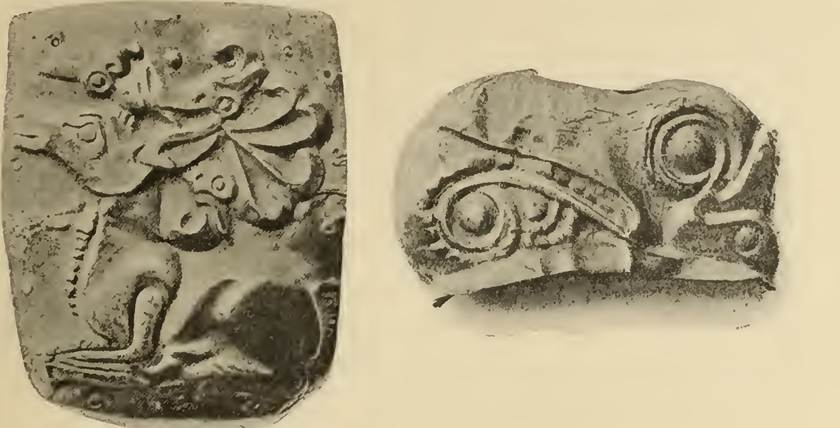
Figs. 183, 184. Gold plates. Ak-Mechet. KTR. pp. 284, 285, ff. 249, 250.
On statuettes in the Oxus treasure we have the muscle markings emphasized decoratively though without entire disregard of natural modelling (p. 256, Nos. 11 and 12). But when the beast came to be felt as merely part of the pattern, there was no reason why this line should not be brought out in colour as well as in form, and on the ibex (No. 10, v. p. 265, n. 2) gilt is used, and finally it became the custom among the Asiatic nomads to adorn the flanks of creatures with blue stone or coral inlaid, and the round or pearshaped forms suggested by the prominence of the muscle were combined into one motive of a dot between two triangles, which has suggested to some writers an eye, to others a beak-head doubled for symmetry[540]. All these modifications and departures from naturalism were due to horror of empty space, which also led to the creatures being twisted about in every way so as exactly to fill the space available.
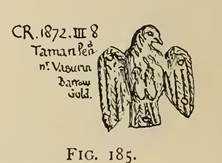
The species represented in Scythic art are many[541]. The lions and other felidae preying upon deer are after Asiatic or Greek models. Their species are hard to define, because the artists did not care to be accurate as to spots and manes and tasselled tails, such details they delighted to add even to lionesses. Chief of the true Scythic beasts is the reindeer who is constantly occurring, mostly in a crouching position with his legs bent under his body— he figures upon quiver covers, breastplates, shields, standards, gold plates for sewing on to clothes, mirrors, bridle cheek-pieces and other trappings, x and upon the one Scythic gem, and in Siberia upon a wood-carved saucer (v. p. 251) and another wrooden fragment. So too a bird of prey is a favourite subject, sometimes with wings deployed to form a gold plaque for sewing on to clothes, more often a mere head and beak, upon standards, horses’ cheek-pieces, no more than beak and eye at Nymphaeum (p. 215, f. 116), ending the horns of the deer or the tail of a monster, the hilt of a sword or the handle of a mirror, second but to the deer. He even occurs double-headed (double
headed eagles seem natural in Russia) on a bronze plaque3.
Besides these the ibex is common, especially on Siberian things, and mostly in the round, as an adornment to edges, as it were upon the sky line, e.g. on the Chertomlyk cauldron (p. 162, f. 50) and the Novocherkassk crown (p. 233, f. 138) side by side with the deer. Characteristic are the bell-like objects with an ibex perched upon them (p. 249,. ff. 166, 167); such a one serves also as a mirror handle (p. 193). The horse is rare except on his own cheek-pieces, which so often end with a hoof at one end and an admirably conventionalised horse’s head at the other (p. 189). The hare is not uncommon (p. 186). In the Siberian plaques the fauna is yet more varied, for we get many different beasts of prey, serpents, eagles, oxen and the yak, as well as horses, dogs and boars, and even human figures.
There is in the productions of this adopted style a unity in the design and execution, an adaptation of the ornament to the form of the object to be
[1] ABC. xxvi. 2 on p. 203. 5 pp. 167, 168, ff. 56, 57 and ASH. XXIII. 4 on
x] Beasts represented. Limitations op Scythic Style 269 decorated, which makes quite rude things satisfactory. It shews that the style had become the natural expression of the people who had developed the characteristic forms of the objects themselves. It is far otherwise with the occasional attempts to apply the; fully developed Greek style to these same objects. The things begin to lose their original shape, and at the same time violence is done to the Greek design which is being borrowed from elsewhere and applied to a new field ; hence the shortcomings we shall have to notice in some of the more ambitious pieces of Greek work from S. Russia. When an actual Greek form suited their purposes the Scythians used it readily enough, as in the case of various pieces of armour and some decorations for horses (e.g. at Tsymbalka and Chmyreva barrows, pp. 166—169, ff. 54, 58—61). This was always the case with women’s belongings which served for pure decoration, so that their forms were not conditioned by necessities of use. Hence we find plenty of later Greek work at the women’s sides, e.g. at Kul Oba and Ryzhanovka. But at the latter we see the miserable attempts of the natives to imitate the higher style, corruptio optimi pessima. Other examples of the same failure are the second frontlet from Tsymbalka (f. 55), and that from Volkovtsy (p. 185), and the plate from Berestnjagi (p. 191, Khan. lxx. x.) in which one can just trace the elegant ivth century griffins.
Especially in representations of the human form did the Scythians fail. They did not do so badly with masks because these derive from the gorgoneion which they received in the archaic phase (v. p. 208), but the Ionian decorative art was not specially fond of the human figure, and the attempts to imitate later models are grotesque without being spirited. Such are plates from Gercmes[542] and Kurdzhips[543]. The badness of the figures on the Karagodeuashkh headdress (p. 218) may be due to the treatment the plate has received. Most of the thin gold figures in the Oxus treasure, though they are not exactly Scythic, are equally bad[544], but one is fairly good (p. 255, f I74)·. _..
As with the early Turks so with the Scyths, gold is the favourite material. We know of hardly anything but their gold work. A certain number of similar objects in bronze, a few silver cups and horns, their iron sword blades, some bits of carved wood from Siberia, and the interesting carved bone work from the Kiev and Kuban districts, make up all that is left in any other material4. We can well believe that their tents were spread with carpets of their own make, and their garments may have had other decoration more suitable than the innumerable gold plates : but of this we have no remains5. In the western district, where pottery had been successfully practised before the Scythic period, some of their earthenware was pleasing in shape, with a dark ground and incised patterns filled in with white (p. 82, ff. 24, 25), but native work could not compete with Greek pottery; for a nomad with close communication with the Ural and the Altai gold was the special medium for artistic work, accessible, portable and instantly effective.
Scythic Style in Northern Asia.
In the borders of European Russia the place of discovery makes very little difference as to style. There may be a rather greater proportion of pure Greek things about the Bosporus, but as pure a Greek style occurs round Kiev or on the Dnepr bend, and some objects even at Kul Oba are absolutely Scythic. As against the Asiatic steppes there is a difference: there the Iranian influence is much stronger, and objects made in Iran, so rare in the West, can be quoted from the Oxus treasure and the Siberian finds : whereas actual Greek work has not been found beyond the Oxus, though we have seen that Ionian art made its influence felt far to the North East.
Still the first art, to which we can point and say that we have actual examples which found their way into the possession of the Scyths and therefore could attract them, was the Assyrian. This contact must have taken place in Asia, and the Melgunov and Kelermes finds must have travelled westwards, the Oxus sheath, which may be Iranian, eastwards. The mixture of Assyrian and Scythic motives is much more intimate upon the sheath from the Don. As regards form it does not seem to have possessed the characteristic projection by the hilt, but agrees with the other early specimens in its shortness and broadness. Upon it are three beasts ; a boar, whose muscles and ear are rendered in a way which will soon let them degenerate into merely decorative curls—his mane has not the gap seen upon the Vettersfelde hog—is pursued by a lion. The lion’s mane is represented as though it were a separate cape put on ; his tail looks like a string of vertebrae ending in a beak-head (on Melgunov’s sheath we have cape-like manes and scorpion tails, pp. 171, 172, ff. 65, 67) ; his muscles have the S curve and similar mannerisms. The last beast is a lion, just like the other, save that his hindquarters are twisted round so as to bring the feet against the top margin—a most Siberian attitude—and M. Reinach would say most Mycenaean1. In this sheath, which cannot be later than the vith century b.c. because of its closeness to Assyrian models,
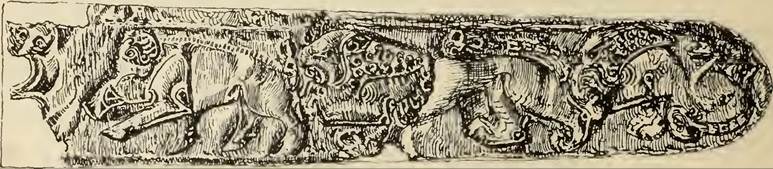
Scabbard from the Dorx,An;haolcg«'sclxer/\nwtfe'' l9o1- 9 Fig. 186. My thanks are due to Dr A. Conze for leave to copy this.
we see the Scythic style already sufficiently independent to introduce considerable modifications into the model provided by a higher art, modifications dictated by a spirit we can trace for another eight centuries.
The Iranian art was a more permanent neighbour than the Assyrian, just so much higher than the Scythic as to encourage imitation. In Europe its direct contributions are limited to the Chertomlyk hilt2 and a seal cylinder
1 Cf. inf. p. 276, f. = KTR. p. 391, f. 351; duction in Pridik, Melgunov, pl. v. 1, and compare
Reinach, Rev. Arch, xxxvin. p. 39. the round silver plaque from the Oxus Treasure,
2 p. 163, f. 51, but see the photographic repro- No. 24.
In Asia, Assyrian and Iranian Influence 271
(p. 193, f. 85) found at Kholodnyj Jar near Smela1; but to the eastwards Iran is supreme. We can see what part it played by merely looking at the pictures of the Oxus treasure. Here, discovered on
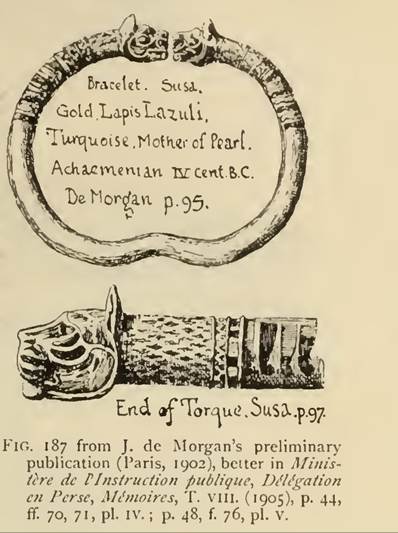
the borders between Iran and the steppes, we have an ensemble of objects which includes, on the one hand, the most considerable, till de Morgan’s find at Susa, almost the only collection of ancient Persian goldwork known : on the other, barbarous imitations of the Persian style strongly coloured by the Scythic character, shading off into the regular Scytho-Siberian work : the Greek things are as it were intrusive, isolated: other objects are unfamiliar in style, and cannot be referred to any known school, though there is no reason to doubt their genuineness. A comparison of these objects from Susa with Nos. 117 and 118 of the Oxus treasure shews their identity in general composition and even in style, allowing for the rough treatment suffered by the latter. Everything in the Oxus treasure has lost its stones. It almost looks as if the things had been prepared for melting down. The mutilated necklet
from Kul Oba (p. 197) with enamel in place of stone inlay shews the same scheme as treated by a Greek ; the original model was Assyrian2.
Siberian Goldwork.
Of purely Persian style, identical with that of the great Oxus griffinbracelet which Dalton puts in the vth century B.C., is one piece from Siberia acquired in the same way as the generality of Siberian plates (v. supra, p. 253). It is hardly needed to prove that Persian originals penetrated far northwards, we could deduce that from the imitations, but its presence makes quite certain. It is a necklet3 in the shape of an overlapping ring, 19 cm. across, made up of two hollow gold tubes, each of which ends in a winged lion. The picture shews the hollows prepared to receive precious stones, turquoise or lazulite ; they mark the lines of the face, the ridges of the horns the shaggy mane, to which is applied a scale ornament which is so effective in any cloisonne technique, the shorter feathers of the wings, the curves of the ribs and, specially typical, the muscles of the hindquarters. Here already the intelligible lines of such a figure as the Oxus deer have given rise to a roundel representing the projection of the hip bone, flanked by hollow triangles that only distantly recall muscle lines (v. above, p. 268). Perhaps the true origin of this pattern is in the purely inconsequent decoration
1 Perhaps it is rash to call this or Nos. 8 and 30 Perrot and Chipiez, Sardinia, etc., II. p. 243, f. 370,
below on p. 208 specifically Iranian. N. Syrian bracelet.
2 Layard, Mon. of Nineveh, XXIV. LI. 11 ; cf. 3 ff. 188, 189, cf. Oxus Treasure, p. 28, f. 18.
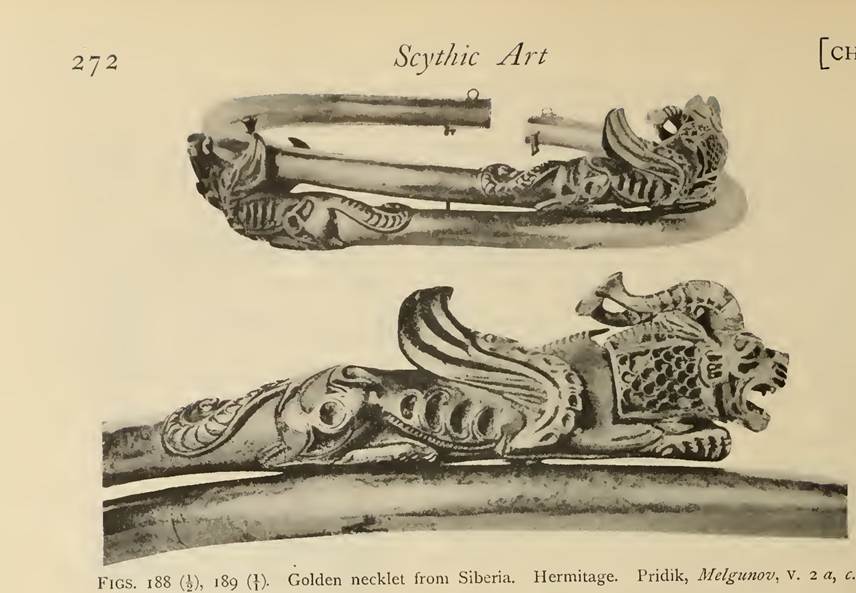
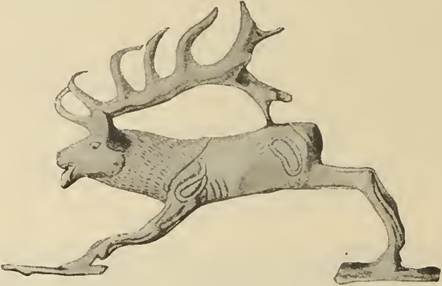
Fig. 190. Gold figure of a reindeer from Siberia. Hermitage. KTR. p· 3&b f· 335·
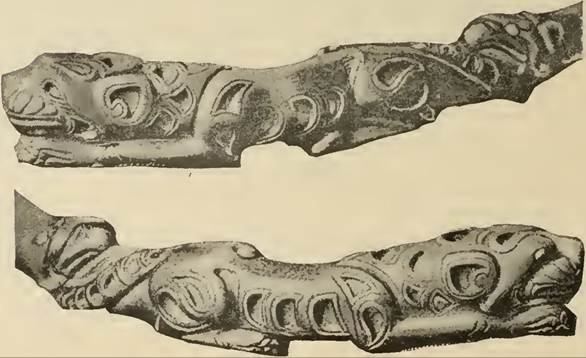
Fig. 191. Ends of a torque in gold from Siberia. Hermitage. KTR. p. 383, f. 339.
x] Siberian Goldmark 273
л
of the Zhabotin horse or the Ephesus ibex : but the deer here figured (f. 190) has markings which might well develope into such as adorn the lion.
Another torque is not far removed from the Persian style of the first, but in spite of their spirit the lions that form its ends are distinctly inferior to it, especially in fineness of execution (f. 191).
A similar falling off is noticeable in a great figure of an eagle1 with a kind of reptile head devouring an ibex. Especially coarse arc the doisons on the neck, breast and upper wings. They were once Idled with red stones. The tail feathers seem to have been supplemented by real feathers slipped in. The ibex has the · ornament. 11 is hindquarters are slewed round in a way that can be better seen on other examples (e.g. p. 276, f. 198).
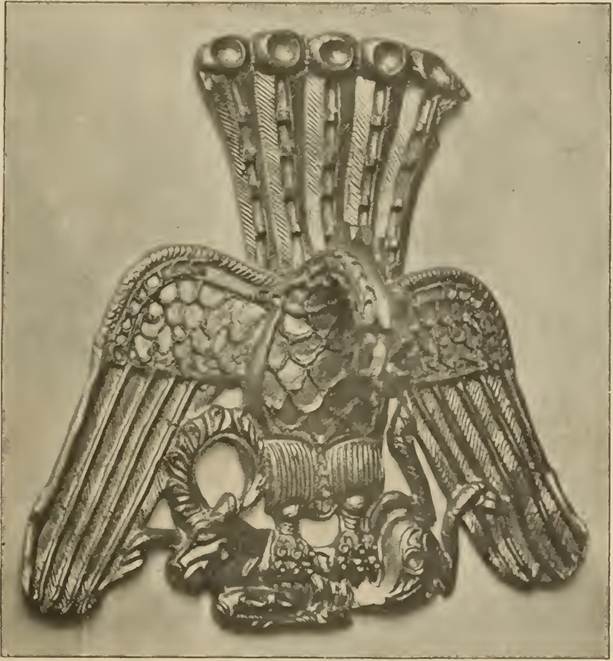
Fig. 192. Gold Plate from Siberia, probably a crest. Hermitage.
From an Electrotype in S. Kensington Museum.
Of unusual form is a buckle (p. 274, f. 193), of which the pierced work distinctly recalls the late Roman pierced work figured by Riegl2, and a buckle from Chersonese3. This, with the Novocherkassk treasure and the coins of Gordian and the Younger Han, confirm the belief that this
style lasted well on into the time of
1 First figured in Archaeologia, II. pl. xv., also Dalton, ib. I.VIII. p. 255, f. 19. 1 have to thank him and the Society of Antiquaries for an electrotype of his block. KTJi. p. 379, ff. 332, 333 ; De Linas,
the Roman ernpirc.
Chinine·;, II. p. 196.
- Die Spätromische Kunstindustrie nach den Funden in Oesterreich-Ungarn, pl. xii.
3 Ch. xvii. f. 333- CK. 1894, p. 74, f. 107.
Another curious form is a strap ornament formed of a lioness, bent right round until she has almost lost the shape of a beast. Yet exactly the same pattern in bronze and with less complete conventionalising comes from Sympheropol, and another example of still ruder workmanship from Anan- jino (p. 258, ff. 180, 181), shewing how even the less important Scythic types spread just beyond the borders of the steppes.
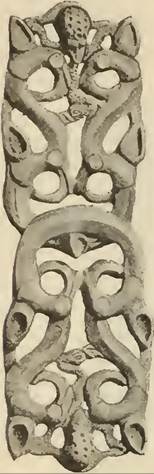
Fig. 193. Gold buckle from Siberia. Hermitage. KTR. p. 385, f. 342. §.
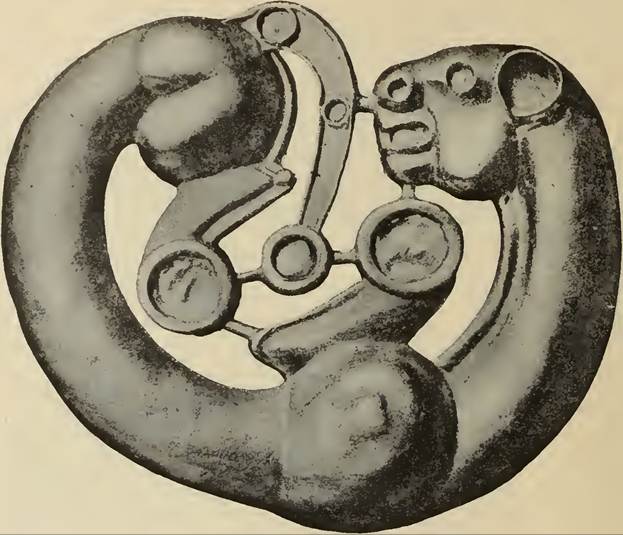
Fig. 194. Gold^beast from Siberia. Hermitage. KTR. p. 398, f. 362.
It has been remarked (p. 253) that the typical plates of this style are either in a kind of oblong frame or of a co shape. As a specimen of the former we have a combat between a boar (bear ?) and a great serpent (f. 195). The boar has claws, but all animals in this style have claws, they give such a good excuse for inlaying. In this case there are comparatively few stones. The next (f. 196) is more typical; upon it a griffin and another monster, as it seems a carnivore with horns ending in beak-heads, attack a tiger whose stripes give excellent excuse for inlays.
Of the co shape a simple instance is a figure of a deer with antlers ending in beak-heads, a tail ending in the same and with the fore part of its body covered by a whole bird, and its hinder parts decorated with an entirely inconsequent head. Some sort of small carnivore is attacking it in front. Attention has already been called to the analogies offered by this to the Kul Oba and Axjutintsy deer. This particular example is interesting because its provenance is known; it was brought from Verkhne-udinsk A specimen much like it found its way to China and is figured in Kin-shih-so as a coin with the type of a hind suckling her fawn1.
1 p. 251, f. 172, cf. S. Reinacb, “ Representation “Ueber einige Beziehungen, u.s.w.,” Zt. f. Ethnol. du galop,” Rev. Archiol. 1900—1901, P. Reinecke, xxix. (1897) p. 161; Odobesco, Petrossa, p. 512.
Siberian Goldwork
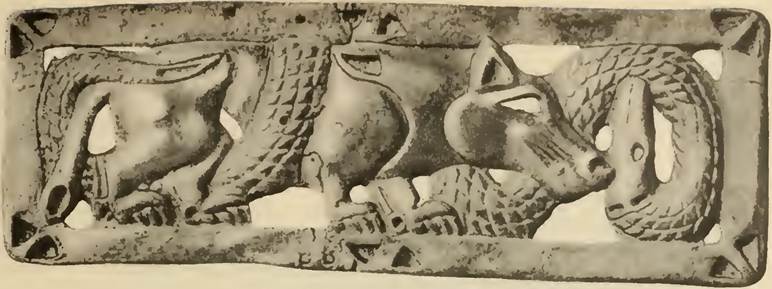
PiG. 195. Gold plate from Siberia. Hermitage. KTll. p. 386, f. 344,
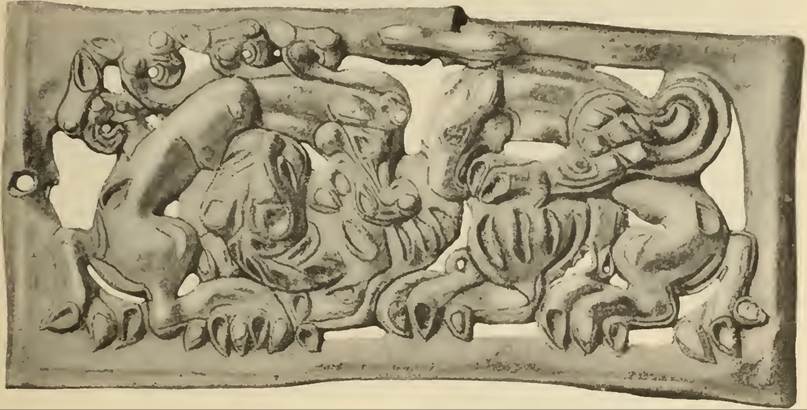
Fig. 196. Gold plate from Siberia. Hermitage. KTH. p. 387, f. 345.
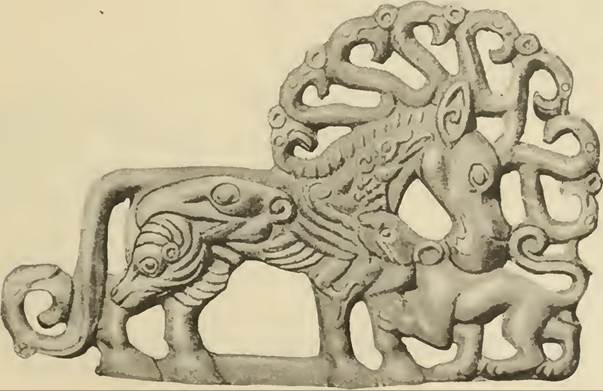
Fig. 197. Gold plate from Verkhne-udinsk. Hermitage. KTH. p. 389, f. 348.
In the combat of griffin and horse we have a good instance of the favourite mannerism, by which creatures’ hindquarters are decorated with a pattern of a circle between two triangles, and of another by which an animal is represented as having twisted its hindquarters right round in the
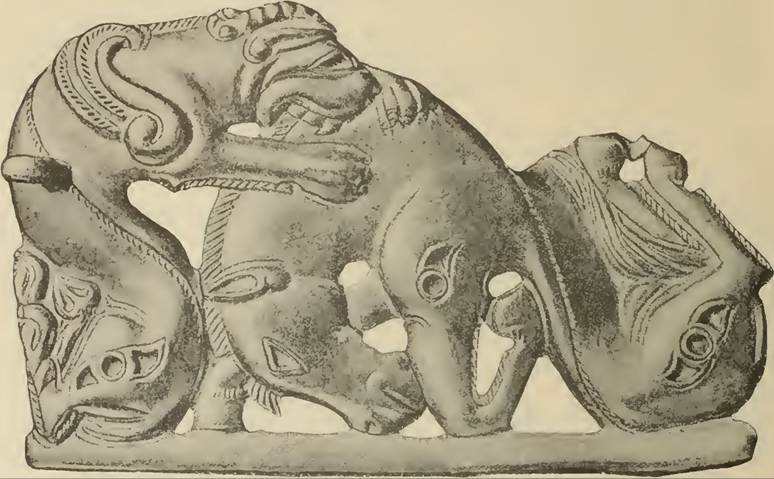
Fig. 198. Gold plate from Siberia. Hermitage. KTR. p. 391, f. 351.
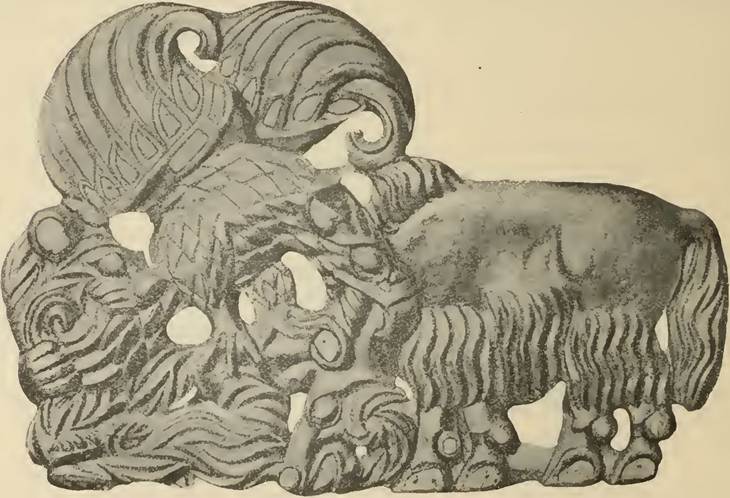
Fig. 199. Gold plate with coloured inlay from Siberia. Hermitage. KTR. p. 393, f. 354.
agony of combat. The ibex in the grasp of the eagle above exhibits both features. The griffin’s wings arc becoming rudimentary. Next we have an eagle and another creature attacking a yak whose presence shews that these plates must have originated in the higher parts of Asia.
Very decorative is another version of the combat between boarand serpent. The fellow to this was brought to Holland by Witsen, but is now lost[545].
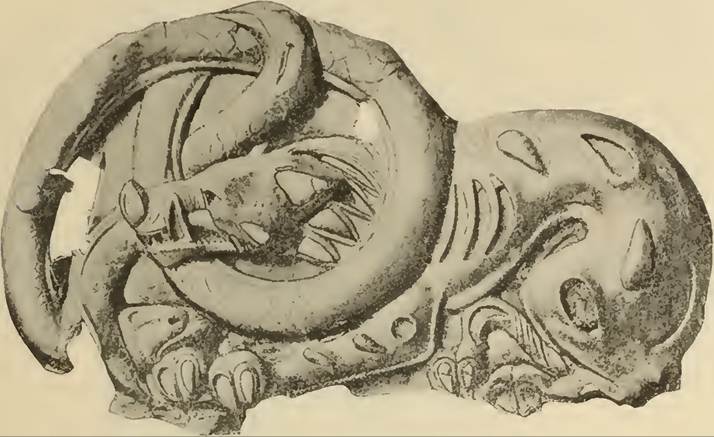
Fig. 200. Gold plate with coloured inlay from Siberia. Hermitage. A'77u p. 394, f. 357.
Interesting for its subject is the following plaque (f. 201)—a boar hunt— a perfect illustration to Herodotus (iv. 22, v. p. 107) and his account of the lyrcae. We have the man ambushed in the tree with his horse waiting quietly below him and the dog in the corner, and then later we see him pursuing his quarry at full gallop.
In the last (f. 202) we have a representation of the people for whom these were made and of their horses. They are not much like representations of Scyths. They had real saddles with hanging straps that might serve for stirrups. The bow-case is still much the same ; the figure that may well be a woman wears a tall cap, like the Karagodeuashkh queen (p. 218, f. 120) or the Chinese pictures of T'u-huo-lo (v. p. iio, n, 2).
There is a small statuette (ff. 203, 204) of a mounted horseman of this race, but the only clear point about his dress is the heart-shaped panel on his back, shewn also on the boar hunt.
The style of these Siberian plates with coloured stones does not penetrate far into Europe. On the Kuban it occurs most generally on circular plates or bosses with an animal twisted round upon itself[546]. On a larger scale we
p. 230, f. 132; Kazanskaja, CR. 1901, p. 71, f. 137; Ladozhskaja, CR. 1902, p. 77, f. 161, and Ust- Labinskaja, ib. p. 78, f. 164, p. 82, f. 177; v. p. 232, nn. 4, 6.
see it on a plate of which the exact provenance is not given. It shews us a most typical Siberian griffin with rather ill-developed wings. To judge from the photograph the gold lacks the extravagant solidity of the Siberian work. The griffin is no longer upon his native gold mountains (f. 205).
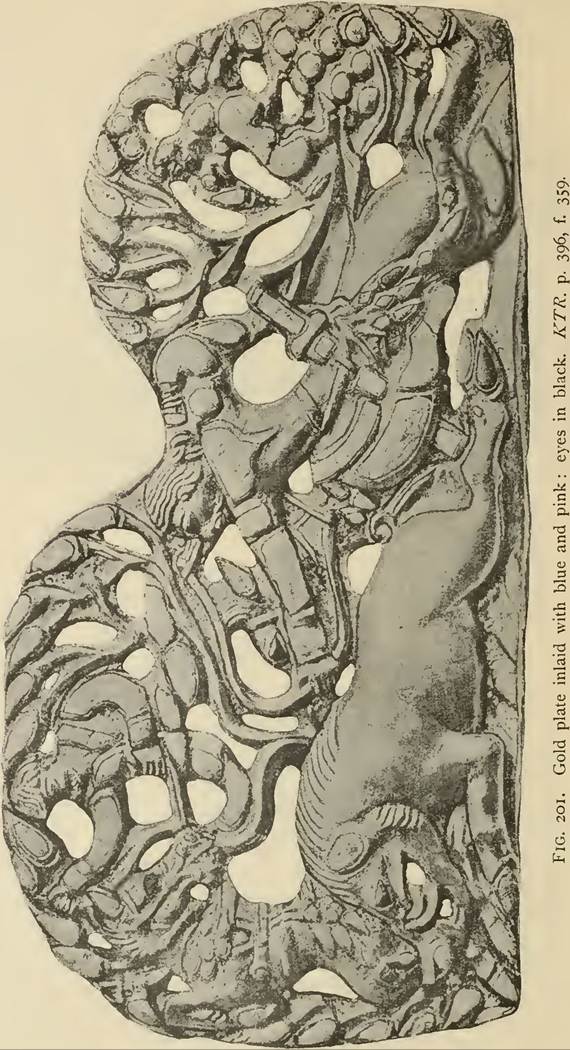
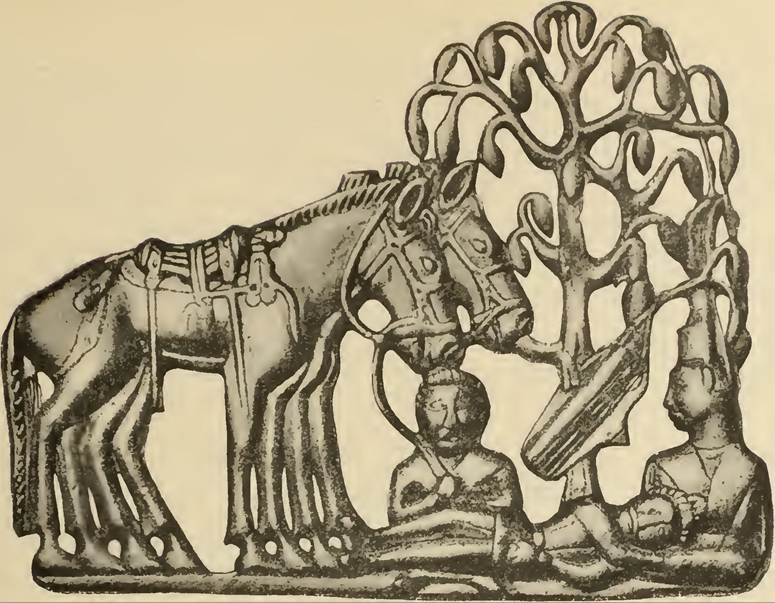
Fig. 202. Gold plate from Siberia. Hermitage. KTR. p. 397, f. 360.
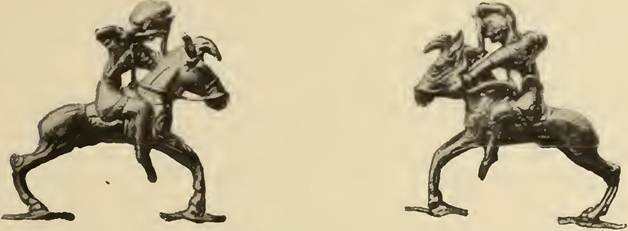
Figs. 203, 204. Mat. xv. = Sib. Ant. vol. 1. p. 123, Appendix. Gold. Siberian Horseman. KTR. p. 383, f. 338.
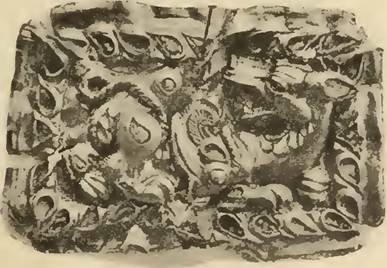
Fig. 205. Gold plate from the Kuban district. KTR. p. 486, f. 440.
Finally we have the Novocherkassk treasure (v. p. 233). In this the great crown shews a strange mixture of elements. The animals along the upper edge and the birds between the great stones on the hoop are typically Siberian, even recalling early Minusinsk productions ; the idea of the whole is perhaps Asiatic, the beading along each edge and the pendants below are debased Greek, and in the middle of the front is a Graeco-Roman bust of an empress, shewing that the whole must be of about the mrd century a.d. On the collar, shallow box (p. 234, ff. 139, 140) and bracelet[547] we have the Siberian style, but it has not the expression of ill-regulated vigour that even the rudest of the former plates presented. The animals are rectilinear, and the settings for stones are nearly all of the simple pear shape. In spite of the complications there is no more the same play of fancy. The bottle (f. 141) is interesting because it also offers some indication of date, for a bottle of just the same shape and of similar technique, though not covered with animals, was found in the tomb of the queen with the gold mask. In it was also found a dish[548] inscribed with the name of Rhescuporis, and it is ascribed to the Rhescuporis who reigned from a.d. 212—229. This would agree with the date assigned to the Novocherkassk treasure, but it does not go for much as there were so many kings called Rhescuporis (v. Chapter xix.). Among the Novocherkassk objects some (e.g. p. 235, f. 143) presented the usual technique of the well-known jewelry inlaid with garnets that has been called Gothic, before which the Siberian style gave place. This is the final stage of its development under predominant Iranian influence.
The remarkable art of which the examples have been discussed in the preceding pages evidently flourished in the Asiatic steppes. One specimen (p. 251), generally similar to the plate from Verkhne-udinsk, found its way to China and is figured in the Chinese archaeological work Kin-s/iih-so. There is some resemblance in character between Siberian and Chinese art; it may be due to some community of race, or perhaps one may have influenced the other; the connection may go back even to Minusinsk days. Or again, the resemblance may be due to both having borrowed from Iranian or some other central Asian art: in each case we seem to have an intrusion of monsters ultimately derived from Mesopotamia, the great breeding ground of monsters. And so they finally penetrated to the borders of China, just as the Aramaic scripts twice traversed the same stretch in the cases of the Turkish and Uigur alphabets. The early Chinese bronzes and jade earrings, figured in such books as Po-kti-tzii-lti and Kiu-shih-so, are very much conventionalised ; we have the face T'ao-t'ieh, or else the patterns are for the most part merely geometrical. The Dragon, Tiger, and Phoenix only come in under the Han Dynasty and decidedly recall Persian types, e.g. the Simurg[549], but the way in which their bodies are twisted about is rather in the Siberian spirit4.
The westward movement of the central Asian tribes, described above, brought the users of this style into Europe, but here there were neither the gold nor the precious stones, nor perhaps the skill to make the things. For we must suppose that the nomads employed some other race, either their original helots from Minusinsk or, very possibly, Tadzhiks, men of Iranian blood from the borders of Iran and Turan, if one may still speak of Turan. Through all their history the nomads have been ready to borrow or rather seize their neighbours’ tastes. In Europe the objects are decidedly decadent both in material, size and style. For the evolution and decay of the art we have to allow many centuries. The description of the panther from Kelermes (p. 222) sounds as if it was either an early specimen or a direct model, and that is referred to the vith century b.c. The Novocherkassk treasure belongs to the mrd century a.d. The names of the peoples in the steppes change many times during these eight centuries: it is clear that we cannot connect the style with any single historical name. Kieseritzky thought that the objects belonged to the Massagetae, of whom Herodotus says that they wear gold upon their belts and headdresses (1. 215): others have mentioned the gold ornaments of the Aorsi[550], and the gold ornaments of the Turks as seen by Zemarchus[551]. The latter are of course too late in date, but both the former attributions may be right. A nomad has no other use for gold but to make of it personal adornments. The Scyths of Herodotus presumably used the Scythic style which shews traces of Ionian archaic art; in time they or the earlier Sarmatians imported much made in the fully developed or Hellenistic styles : but towards the end of the und century b.c. the intercourse of coast and hinterland became less friendly, and the new tribes which arrived—lazyges or Alans—brought with them their own things and had less to do with the Greeks. These Alans came into close touch with the Teutonic tribes pressing down from the north-west: and the latter acquired from them a taste for gold and jewels, which they could not have developed in their own country, and some new elements of a beast-style. Hence a decided resemblance between the art of the Great Migration period and the Scytho-Siberian. Riegl (op. cit.) maintained that this art of the western barbarians was really an art of the Roman provinces developed according to a new “colouristic” principle. By this he meant that taste had shifted away from an appreciation of the delicate gradations of light and shade, the subtle modelling and the absolute disregard of the background which mark Classical art with its essentially plastic basis, towards strong contrasts either of light and shade (obtained by deep undercutting in plastic work) or of opposed colours, and towards a care for the shape of the background as well as for the subject or pattern, so that when the evolution is complete one cannot say which is background and which pattern. Modern decoration has shewn a very similar tendency. This is true of Roman art and to a much greater degree, especially as regards colour, of barbarian art of the period, so that the change of taste in the Graeco-Roman world prepared it to receive the foreign elements that came in from the east and north. But Riegl wanted to make out that the character of the barbarian things was the result of the Roman change of taste. Hence he had to make the Siberian style, in which if anywhere the “ colouristic ” principle is predominant, late enough to be an effect of a process which began about the Christian era. How he would have done it we cannot tell, for the volume in which he was to have treated of the barbarian arts has never appeared : and now it never can.
This much seems clear: that the Siberian art as exemplified in the Novocherkassk treasure would naturally lead on to the “Gothic” style, the ornamental style of the barbarians that overran the Roman empire. Specimens of this work are distributed from Stockholm to Spain and from Ireland to the Caucasus, but there seems good reason to suppose that it arose in southern Russia, where alone could be a meeting point for the various influences of which it shews traces. The chief characteristics of the style are great love for beast-forms especially those of birds of prey, whose representations, reduced to a hooky beak and an eye, persist when all the other lines have become purely geometrical, and a way of incrusting the surface of an object with flat plates of stones or pastes, especially garnets or their equivalents, separated by cloisons of gold. The beast-style seems to derive from the Scytho-Siberian, the bright stones from the east, probably from Persia: but the mixing of these streams was not effected without Greek help, probably that of the goldsmiths of Panticapaeum who under oriental influence had long moved in the direction of a prodigal use of various coloured stones, especially almandines. That the origin of the style is to be sought in the east is shewn by the regular degradation of form, material and technique as we go westward, until in Anglo-Saxon graves we have stiff rectilinear designs, mere beak-heads, red glass and gilt bronze instead of conventional but spirited animals and garnets or emeralds upon gold.
The beast patterns already foreshadowed by the horse trappings from Krasnokutsk held their own longest as “Island varieties” in Ireland and Scandinavia, where they came to be thought autochthonous and characteristically Keltic or Northern. The way in which the handle of a bell from Llangwynodl Church, Carnarvonshire[552], is treated might be Scythic. It has a head at each attachment just like the mirror from Sajansk and the ornament from Nicolaevskaja on p. 244, whereas the ornament on the same page from Bijsk has a pattern of right angles which is a very favourite one on the Teutonic cloisonne work[553].
Scythic Copies of developed Greek Style.
Thus the Ionian style or an adaptation of it survived in Scythia for many centuries after giving place in its own country and among its own people to the style of the great Attic masters. The Greeks in S. Russia followed the fashions of Hellas, so the productions of the finest period and later of the Hellenistic found their way to the Scythians who evidently admired and valued them. But here was something too high for them to make their own,
Budapest, 1885 ; O. M. Dalton, “On some points in the Histoiy of Inlaid Jewellery,” Archaeologia, Lvni. (1902), p. 237 (bibliography, p. 239, n. b.); Treasure of the Oxus, London, 1905, p. 24. Finds in S. Russia; E. R. von Stern, “On the question of the origin of the 1 Gothic’ Style of Jewelry,’’ Trans. Od. Soc. XX. p. 1 ; D. MacPherson, Kertch, pl. V.; A. A. Spitsyn, BCA. XVII. p. 115 ; N. I. Repnikov, BCA. xix. p. 1 : Caucasus, supra, p. 260.
x] “ Gothic” Jewelry. Imitation of late)' Greek Art 283 and when they tried imitation the result was, as we have observed, hopelessly barbarous and made no approach to style, even the Kul Oba sheath[554] shews something of this.
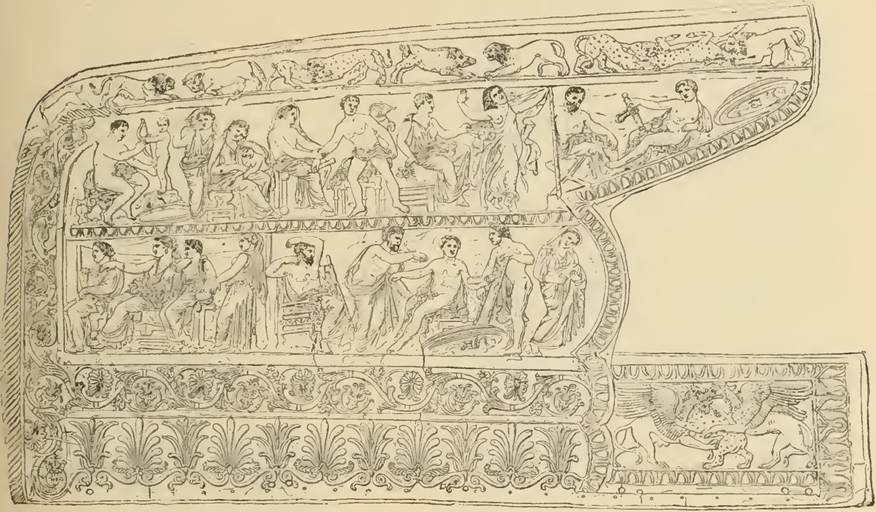
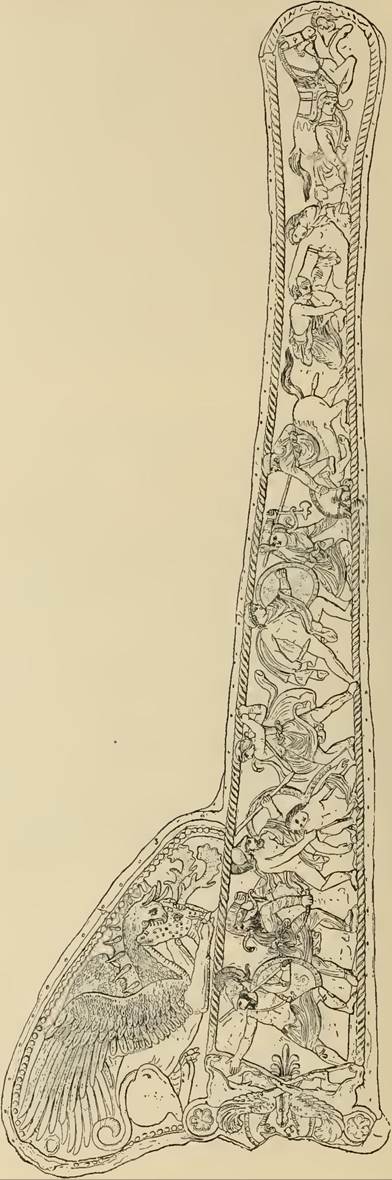
Fairly good specimens of the more advanced style in barbarous versions are the quiver-cover from Prussy[555], the Karagodeuashkh head-piece (p. 218), and many of the small gold plaques, e.g. the griffins from Darievka[556], others from Oguz[557] [558] [559], also perhaps the gold band with dancers, a native interpretation of two of the Neo-Attic types3, and the necklace from Ryzhanovka (p. 179, f. 74), and the plaques from Dbrt Oba near Sympheropol". The two horse frontlets from Tsymbalka (p. 166, ff. 54, 55), one of Greek work, the other an imitation of a very similar design, let us gauge the difference precisely. The Volkovtsy frontlet is another such curious perversion of the gorgoneion and two griffins (p. 185, f. 78). But mostly the Scythic interpretations of Greek motives arc beyond words barbarous. Sometimes perhaps they were produced, like the indications from coins so common on Bosporan gold wreaths, by laying a slip of gold upon a relief, and so taking an impression. Such very thin leaves are peculiarly liable to crumpling in the earth, and when they are crumpled photographs do them even less than justice, so that they may not have looked as bad as the pictures of them do now. Also such flimsy work may well have been done just for funeral purposes, yet, all allowance made, the later Scythian craftsman made astonishingly bad copies of Greek originals of the free style. Nothing could be worse than some of the gold strips from Chertomlyk7, Kul Obas, or Ryzhanovka9, and some of the plates for sewing on to clothes, more especially the masks10. So too nearly all other things from Volkovtsy (v. p. 183 sqq.) shew a singular miscopying of Greek originals. The wearers just wanted the sparkle of the gold and did not much care about the design. This rudeness makes it particularly difficult to detect forgeries of Graeco-Scythic work. The forger and the ancient barbarian copyist were so much in the same position towards their models that the results are much the same. All such work is infinitely inferior to the barbarous but spirited productions of the old native art, marked by a distinct and constant style, or its adaptation of archaic Greek work. Greek Work for Scythian Market. In sharp contrast with the Scythic attempts to copy Greek work come the objects which, be they never so Scythic in shape and purpose, were evidently executed by Greeks on purpose for the Scythian market. Though some of them are disappointing on closer examination, yet they bear witness to the facile skill of Greek craftsmen and the energy of the Greek trader who studied the necessities of his barbarian customer and secured for him what would be a delight to his eyes, and at the same time useful and fitted 0 CR. 1892, p. 9, ff. 4 and 5. 7 p. 157, f. 44 and K7'R. p. 309, ff. 269, 270. s ABC. 11. 2. 9 Sm. 11. xviii. 14. 10 e.g. Sm. 11. pl. Xi- and xxn.; ABC. xxn. etc. for the necessities of his life. Some of the finer things may well have been presented by the Dynasts of the Bosporus or the governments of other Greek states to important chieftains among the natives, such presents as the tiara of Saitapharnes professed to be; some were probably executed on the spot by craftsmen who had tried their fortune in the service of native chiefs; but the greater part probably found their way through Bosporan middlemen from the workshops of Asia Minor or Panticapaeum to the treasures of Scythian x chieftains. The details of such pieces as the Chertomlyk and Kul Oba vases and the Kul Oba necklet, as well as of several minor representations of Scyths,. shew that some Greek artists must have been familiar with people and country, and the presence of Greek workmen in the interior of Scythia is K evidenced by the existence of such tombs as Ogiiz (p. 170, ff. 63, 64) with carefully fitted stones and characteristic Greek clamps. But that objects were exported from Greece itself on purpose for the Scythian market, is shewn by the occurrence far in the interior of the productions of Attic ceramics, x and the disproportionate frequency upon them of griffins and such like subjects supposed to be specially suitable. Chertomlyk Bow-case and Sheath. The most famous object made by Greek workmen to a Scythic pattern is the gold plaque from Chertomlyk that once covered the king’s Gorytus (v. p. 164, f. 53 for the style, ff. 206, 207, for the compositions). Stephani[560], who first wrote about it, took it to be Attic workmanship and interpreted the scene by the obscure Attic legend of Alope. This opinion was usually accepted[561], until Furtwängler, in treating of the Vettersfelde find (op. cit. p. 47), pointed out that its true affinities are rather with Ionian work than with Attic, previous critics having been led astray by the evident reminiscence of the Parthenon frieze seen on the left of the lower tier of figures. Furtwängler, and after him F. Hauser[562], were unnecessarily hard upon the composition, the first accusing the maker of having merely filled up a given space with perfectly meaningless and unconnected figures from his sketch book ; the latter making out that he did not even draw the figures himself, but that both they and the ornamental members were produced from ready made dies. A. N. Schwartz[563] quotes Furtwängler and Hauser, and agrees with the latter, and at the same time points to the peculiar squat proportions of the figures, the prudish arrangement of the drapery[564], and the luxuriance of the ornament, all of which can be matched in later Ionian art, while the reminiscences of Attic compositions remodelled according to Ionian taste remind him of the treatment of X Attic themes on the coinage of Cyzicus6. 17—34, “On the History of ancient Greek reliefs on gold objects found in S. Russia.” 6 Cf. B. Graef, “ Die Schamhaftigkeit der Skythen,” in Hermes, xxxvi. (1901), pp. 86—94. Graef is very hard on the composition and even on the patterns, which he makes out to be very late. 6 He quotes Canon Greenwell, “Coinage of Cyzicus,” Numismatic Chronicle, 1887, p. 1. C/iertomlyk Bow-case 285 More recently Prof. C. Robert1 has, to some extent, restored the > reputation of the artist by proposing a new interpretation of the subject. He suggests that it is the discovery of Achilles among the daughters of Lycomedes in Scyros, only that the scene has been snipped in half so that the figures of seated women ought to come on the right side of the girl rushing to the right. So we have Achilles, with his hair done like a woman’s, seizing a dagger and restrained by Diomede, while an elderly nurse holds back Deidamia. This latter, her secret discovered, is rushing towards her mother who sits between her other daughters attended by another maid-servant. Further to the right we have Lycomedes in a chair and by him two other men of Scyros examining arms brought by Ulysses, who has disguised himself as a crutched pedlar. More arms are justifiably used to fill in vacant spaces. I he corners of the design are taken up with a scene of teaching a boy to shoot, and with the nurse bearing away Neoptolemus. All this goes back, according to Robert, to a picture of Achilles in Scyros painted by Polygnotus2, Fig. 206. Mat. xiii. p. 57, f. ^ = CR. 1864, pl. iv. Chcrtomlyk bow-casc. and such episodes would be just in the manner of that artist. Hence coinci- < dences with the Gjolbashi Heroum well known to reflect his school. But the craftsman who made the relief was singularly awkward in his manner of adapting the design to the space he had to fill. He did not use ready made dies, traces of their edges would have shewn on the plate, and the ornamental strips narrow towards the left side, so that no arrangement like a bookbinder’s roll could be used. But he has cut the composition in half at Archliol. Anzeiger, 1889, p. 151. 2 Pausanias, I. xxii. 6. ' a critical point, so that the women are looking at nothing at all; and he was quite at a loss to fill in the right hand acute angle. The best he could do was to repeat the reclining young Seyran from below and put in a perfectly inconsequent elderly man sitting on a camp-stool with a staff against his right shoulder, but no right arm whatsoever. So again the left end of the animal frieze is very clumsily managed; and yet through all the imperfections of the copy the grace of the single figures of the original shines clear. Robert’s interpretation is fully accepted by W. Malmberg[565], who shews also that enough of the Kara- godeuashkh cover (pp. 220, 221, ff. 124, 125) is left to make us sure that it was identical in style and similar in disposition to the perfect Chertomlyk specimen. He suggests that it is derived from the Iliu Persis of the same master, but there is not enough left to judge by and certainly Robert’s restoration of that picture does not endorse his view. Malmberg takes the two as a text for a detailed study in the affinities of this whole class of objects and accordingly deals with the Chertomlyk sheath which is of much the same character. He begins by pointing out that the subject of the latter is not, as has been supposed, a combat of Greeks and Scyths, but of Greeks and Persians, and refers it likewise to the school of Polygnotus, to the Marathon painted in the Srod ttoikcXt? at Athens by his pupils Micon and Panaenus. Here again the craftsman has not arranged his material with much skill. For instance the x] Chertomlyk Bow-case and Sheath. Kai Oba Kase 287 two first figures on the left are known elsewhere, one at Gjolbashi, the other in the guise of an Amazon on a vase which he figures ; but the Greek is calling forward his men, and his attitude has no meaning if there be no men on that side, whereas he pays no attention to the Persian who is about to cut him down, for he does not belong here but to a scene of single combat with an antagonist in a corresponding position*. So too the Persian horseman farther along has no lower part to his body, his shoulders are immediately above the saddle. His horse can be paralleled from Gjol- bashi. The horse at the encl fills the space rather well but the helmet does not come in satisfactorily. The two griffins at the hilt are not very happy, and in the original, which must have been something like the group on the Chertomlyk vase, the griffin upon the characteristic projection could not have been occupied merely with the head of a deer[566] [567]. Fig. 207. Mat. xiii. p. 179, f. () = CR. 1864, pl. V. 1. Gold sheath plate. Chertomlyk. In a review of Malmberg’s essay[568] S. A. Zhebelev enters a protest against his tendency to assign everything to Polygnotus and warns us not to attribute everything to Ionia and nothing to Athens. He does not however offer any definite valid reasons against putting these pieces down as Asiatic. The whole question receives fresh light from the discovery made by General Brandenbourg of an almost exact replica of the Chertomlyk cover in a Scythic grave near Iljintsy (government of Kiev). Kieseritzky[569] says that the only differences are that the quality of the gold is much inferior and that there is different application of dotted work. He maintains that the two objects were made upon the same die, instead of being repousse freely. This argues that the Scythian trade was important enough for it to be worth a Greek’s while to make not merely isolated specimens of objects for specifically Scythian use, but to prepare for producing several replicas of one pattern. It emphasizes the distinction between the first-rate works of art destined for the Scythians, works which may be taken to be presents from Greek rulers, and the mere trade productions exported for barbarians whose critical faculty was not too highly developed. It does not touch the question whether the designer of the die had heaped together absolutely unmeaning figures or spoilt a ready-made composition in adapting it to fill a strange space. Kieseritzky rejects Robert’s interpretation and regards the design as disjecta membra of various cycles of representations. Kul Oba Vase. Of quite another character is the work on the well-known electrum vase from Kul Oba (p. 200, f. 93). The form of the vessel is apparently Scythic. It can be paralleled by three others from the same tomb, two others from near Kerch6, one from Ryzhanovka", and two from Volkovtsy7. It may well be developed from such round bottomed pots as are figured Wars,” ib. X. (1899), p. 114, supports Malmberg. 4 Arch. Ans. 1903, p. 83; BCA. ill. app. p. 51. 5 p. 198, f. 91, ABC. XXXIV. and xxxv. e Sm. 11. xvi. 7. " Khanenko, ii. 2, XXX. 451 and 452 on p. 186. 288 Scythic Art. Greek Work for Scythians [ch. by Bobrinskoj[570] [571]. An intermediate stage is furnished by a wide-mouthed silver vessel from Galushchino (p. 186, No. 450), resembling the rest of the silver ones in material, but decorated much in the same way as the clay pots. One scheme of ornament is common to almost the whole class, a simple fluting and a guilloche which may go back to Assyrian models : the more elaborate examples have a frieze with beasts, and this one specimen genre scenes from nomad life. There can be no question but that these were executed by a Greek in the ivth century, when the tendency to realism had succeeded to the period of ideal art. The artist must have enjoyed pourtraying a subject so full of local colour, and he has taken pleasure in representing every detail. Characteristic of the stage of art is the accuracy with which the expressions of pain, care and effort are rendered on the faces. Of the other vases of the type, one with a beast frieze is of Scythic work as has been seen, the other Kerch examples seem rather Greek, those from Little Russia apparently of native execution. The technique is always the same, repousse and parcel gilt. Cheriomlyk Vase. Not less than the artist of the Kul Oba vase, that of the Chertomlyk (often called Nicopol, pp. 159—161, ff. 46—49s) vase must have studied the Scythians at first hand. But in this case there has been no native influence upon either form or design. Only the purpose is Scythic, for there can be little doubt that the vase was meant for kumys. It stands about 2 ft. 4 in. (70 cm.) high with a greatest breadth of about half as much and is in the form of an amphora with a base instead of a point below. In the neck is a fine strainer and there are strainers in the three outlets. Of these the principal in the midst of the main front of the vase is in the form of a horse’s head, itself treated realistically but surrounded by a kind of frill taken from the rayed comb (Strahlenkamity of griffins, flanked by great wings. The side outlets are rather conventional lion-heads. Each outlet was furnished with a plug attached by a chain. This arrangement suggests that the vase was meant for some liquid with scum or dregs, most probably kumys: strainers are common in rich Scythic graves. Below the neck, which is left plain, the shoulders of the vase are decorated by two bands of reliefs. The upper one, slightly repousse and heightened with gilding, offers on each side a scene of two griffins attacking a stag. The band below this goes continuously round the vase and bears the well-known scene of breaking in a filly, or whatever it may be (v. p. 48) ; the technique is curious. The figures have been separately cast solid, gilded and soldered on to the ground. Lassos and reins were in silver wire now broken away but remaining in the grasp of some figures. It is not necessary to insist on but for this we must await the Hermitage catalogue. This applies to most of the Scythic antiquities found about that period. Maskell’s figure {Russian Art, London, 1884, p. 44) is independent but unsatisfactory, better in Rayet, op. cit. p. 225. x] Kul Oba and Chertomlyk Vases. Neck-rings y etc. 289 the ethnographic importance of this scene, nor on its artistic perfection. Its exactness is shewn by the care with which two different breeds of horses are distinguished. These cast figures are in equally high relief on all sides, but the repoussd work is higher at the front and shades off so that behind forms are only indicated by engraving and gilding. Below the band of Scythians the whole surface of the vase is covered with arabesques made up of palmettos, flowers, tendrils and leaves of acanthus with storks and other birds about the branches. Some have found this a reminiscence of the luxuriant vegetation of the steppe! The whole work is perhaps the finest extant example of toreutic at the moment of its most consummate mastery, when it was ministering to the suddenly blown luxury of the newly founded Hellenistic kingdoms. An artist of such skill could hardly have been under the necessity of seeking his fortune in the perilous chances of nomad life. Shall we not rather see in it a gift ordered of some Asiatic master by a ruler of the Bosporus or of Olbia, who gave him opportunities for studying the natives, whom he wished to delight with a suitable present ? This is no mere botching for commercial purposes such as we have already discussed. This is a masterpiece produced when the very highest art was no longer flourishing, but such decorative work as this was at its very best. Prof. Furtwängler in an obiter dictum' assigns the vase to the end of the vth century, but he gives no grounds and it is hard to think that either figures or ornament can be anything like so early. It corresponds with the naturalistic treatment of barbarians characteristic of the Pergamene school, as in the statues set up by Attalus at Athens, e.g. the motive of the Scyth with one shoulder bared which recalls the Persian at Aix[572] [573]. Other ornaments made for Scythians. We may say something similar of the Kul Oba king’s necklet (p. 202, f. 97) that ends in Scythic horsemen. The artist had probably seen Scyths and worked in their country : also in his design he has probably but improved upon a native model. The ordinary ending is a lion’s head as with the broken specimen[574]. This cannot fail to recall the disposition of the inlaid Persian necklets and bracelets above illustrated (p. 271), and the resemblance is increased by the occurrence of colour, blue enamel in the palmettes, in the Kul Oba example, though enamel is not unknown in Greek work outside South Russia. The queen’s necklet with a whole lion and the simple bead ornament also suggests native models[575]: and similar treatment occurs on the necklet from Karagodeuashkh[576] with its particularly spirited treatment of a lion and boar. Very like the Kul Oba lion-head necklet is that from the Salgir[577]. Identical design and execution are seen on the whetstone mountings, for instance one from that same tomb[578], from Kul Oba8 and others, all no doubt made for Scythian use (v. p. 73). light on Chertomlyk, esp. the gorytus, v. Addenda. 3 ABC. viii. 3 on p. 197; cf. p. 205, n. 2. 4 ABC. viii. 2 on p. 197. ' 11. 5, 8, 9 on p. 217. 6 CR. 1891, p. 78, f. 58. " ABC. xxx. 7 on p. 197. 7 l.c. f. 57. 37 Another ornament which could not very well have been made for any other than barbarian use is the curious three-storied tiara from Besle- neevskaja (p. 58, f. 11); its work is rather mechanical and the use of almandines suggests a late date : but only a Greek could have made it. A Greek design, which may yet go back to underlying Scythic ideas, is that of the silver pectoral, or whatever it may be, from No. 11 of the VII Brothers (p. 207, f. 105). Above we have the hind with the golden horns, which must have come into Greek mythology from the North—for among deer only the reindeer female has horns—suckling her fawn, below an eagle displayed with gilt wings and tail. This latter is conventionalized in the archaic spirit which recalls the Scythic manner, and the horns are treated much in the same way ; but we cannot be sure that it was definitely made for Scythians ; the like is true of the rhyta from the same barrows (p. 211, f. no, p. 210, n. 1, 2), from Kul Oba (p. 197, f. 90, p. 196 and from Tanais1, all archaic in feeling. The three rhyta from Karagodeuashkh are in the free style. They are not in very good preservation but appear to have been of excellent work. One of them bears figures of barbarian horsemen which would indicate special preparation for its destined owners2. Malmberg makes a great point of the particular species of deer represented on one of them, a deer with palmate antlers (irpo^) confined, he says, to Asia Minor and unknown to the European Greeks. Hence the artist must have come from Asia. This argument would apply to the Chertomlyk sheath and gorytus. A curious example of Greek work made on a purely Scythic model is the unique cauldron found by Prof. D. I. Evarnitskij in a barrow called Raskopana Mogila (the dug-out tomb) near Mikhailovo-Apostolovo in the district of Kherson (p. 79, f. 21). It is more regular in shape than any other and has three bands of ornament produced by applying thick wire to the surface of the vessel. The upper band has conventionalized bucrania and roundels, the lower is a simple zigzag, between them runs a row of palmettes. The superior workmanship of the whole proves a Greek artificer. The palmettes and especially the bucrania suggest a comparatively late date. As it weighs more than forty pounds this can hardly have been an article for export. It may have been made in the country under the direction of a Greek adventurer. As has been already remarked the Greek style influenced horses’ gear least of all, but one horse’s frontlet of Greek work from Tsymbalka has already been mentioned in connexion with a very similar design of Scythic execution from the same tomb, and it is accompanied by a cheek-piece also apparently Greek3. These are quite elegant, but are far surpassed by the set found in Chmyreva barrow in the same district by the bend of the Dnepr4. Here we have a curious forehead ornament (purely Scythic examples of the same type were at Alexandropol, Krasnokutsk, Chertomlyk and Ogiizs) that has a distinctly eastern look, and one or two pieces are barbarous imitations of Greek originals : but we have round and oval plates embossed 1 Arch. Am. 1910, p. 204, f. 5, BCA. xxxv. 3 p. 166, ff. 54, 55 and KTR. p. 270, f. 242. p. 86 sqq. 4 v. p. 168 ; CR. 1898, p. 27 sqq. ff. 27—34. 2 p. 219, f. 121 ; Mat. xiii., Lappo-Danilevskij, 6 p. 158, f. 4$=AS/7. xm. 6,7 ; ib. vn. 5 ; xxm. p. 76, and Malmberg, p. 140. 2, 3; xxvm. 5, 6; BCA. XIX. p. 159, Nos. 9, 10. and then finished with the burin, large ones representing the head of Hercules in his lion’s skin, smaller ones with Medusa and cheek plates both of the common wing shape (as at Tsymbalka and Voikovtsy) and of a special singularly elegant pattern. All are executed in the manner of the best early Hellenistic style. Interesting is the treatment of the gorgoneion. As has been seen, the Scyths had long been accustomed to the archaic round-faced type with the tongue out, and here we have the same type translated into the less naive forms of later art without approaching the refined beauty of the Rondanini type'. Finally one cannot but think that the great mass of gold embossed plates was consciously intended for the Scythian market : such a large proportion of them bear Scythian scenes (pp. 158, 197) or the monsters connected with Scythia in the popular mind, that it is fair to say that most of them were always destined thither. By these plates alone we could trace Greek art from the late archaic stage, to which belong some of the Medusa-heads[579] [580] and others[581] recalling early vth century coin types down to the Hellenistic times. Those found in Scythic graves are of precisely the same style as most of the others and all were probably prepared by the same set of merchants trading with Scythia4. Strips of gold5, popular as they were with the natives who largely imitated them (p. 157, f. 44), were also worn as head bands by the Greeks themselves and occur in purely Greek graves both in Kerch and near Olbia (p. 392, ff. 288, 289). They did not require to be made specially. A more difficult question is raised by some pieces that have nothing barbaric about them except that they were found in Scythic graves and shew a certain prodigality of gold that hardly agrees with our idea of Greek taste. But this taste for heavy ornaments, were it in its origin barbarous or no, was certainly shared by inhabitants of the Greek coast cities. The weight of the Kul Oba temple-ornaments with the medallions of Athena does not far surpass those with Nereids carrying the arms of Achilles found in the Taman Bliznitsa, the tomb of a priestess of Demeter: and this lady’s calathos and other head-gear were heavier than anything in Kul Oba (pp. 425, 426, IT. 315, 316). Other large ornaments have been found in unGreek graves at Theodosia (p. 401, f. 294) and in the tomb under the town wall at Chersonese (pp. 397, 422). The Kul Oba Sphinx bracelet in spite of its massiveness seems too elegant to have been made for a barbarian king: much more the Peleus and Thetis bracelet with its reminiscence of archaic art, and perhaps the queen’s bracelet of griffins in spite of its subject. The same is true of the more delicate jewelry from Karagodeuashkh and Ryzhanovka. Here a curious example of Greek art work, produced with no thought of Scythians’ taste, yet appreciated by them, is afforded by the Panticapaean staters set in rings'·’. In general the Greek things found in Scythic tombs arc just those which were in use among the Greek coast population and so were on the spot to be offered in barter to the natives and to attract their taste. Of such the next chapter treats.
More on the topic CHAPTER X. SCYTHIC ART AND GREEK ART IN THE SERVICE OF SCYTHIANS.:
- Minns E.H.. Scythians and Greeks. A survey of ancient history and archaeology on the north coast of the Euxine from the Danube to the Caucasus. Cambridge: University Press,1913. — 720 p., 1913
- The Scythians
- Ever since the Kievan period, literature, art, and architecture in Ukraine had been closely linked to religion.
- 3 Greeks and scythians
- Comparing traditional aid policies and the ART Initiative
- RELIGION AND THE ORIGINS OF ART
- PORTRAITURE IN ISLAMIC ART
- In June 1951 hundreds of Ukrainian writers, actors, musicians, and artists arrived in Moscow for a dekada (ten-day festival) of Ukrainian art
- THE GENTLE ART OF TRAMPING
- The Art of Misunderstanding