3 Greeks and scythians
Archeological evidence has revealed that the territory of Ukraine was inhabited since the Stone Age, from its earliest chronological phase (the Paleolithic, between about 1,000,000 and 8000 BCE) to its most recent phase (the Neolithic, ca.
8000-5000 BCE). During this prehistorical era, the most important change occurred at the very beginning of the neolithic period (ca. 5000 BCE) when Ukraine’s inhabitants changed their means of livelihood from that of mobile hunter-gatherers to sedentary agriculture and livestock raising.It is during the last phase of the prehistoric era, from about 750 BCE to 850 CE, that the first sedentary as well as longer term semi-sedentary civilizations were formed in Ukrainian lands. In the course of these sixteen centuries, much of Ukrainian territory was divided into two distinct geopolitical and economic zones: (1) the coastal regions along the Black Sea and Sea of Azov; and (2) the steppe hinterland, including the mountainous hinterlands of the Crimean peninsula. The coastal regions were settled by urban based civilizations from the Aegean-Mediterranean world of ancient Greece; the hinterland was dominated by nomadic tribes, mostly from Asia, who dominated the sedentary dwellers they found living in Ukraine upon their arrival on the Ukrainian steppe.
The coastal regions were settled by colonists fleeing civil strife in the Greek city-states near and along the Aegean Sea. Between 650 and 450 BCE these colonists established several cities, including Tiras at the mouth of the Dniester River, Olbia near the mouths of the Dnieper and Southern Buh rivers, Chersonesus and Theodosia along the southern shores of the Crimea, and Panticapaeum on the western shore of the Straits of Kerch. Like the city-states in the Aegean-Mediterranean homeland, southern Ukraine’s Greek city-states were independent of each other.
Each of the Black Sea settlements was, however, dependent on the city from which its original colonists came, such as Megara just west of Athens and, in particular, Miletus in southwestern Asia Minor.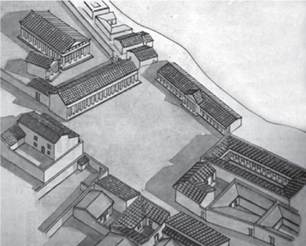
3.1 Reconstruction of the central part of the Black Sea Greek city of Olbia at the mouth the Southern Buh (Hypanis) River.
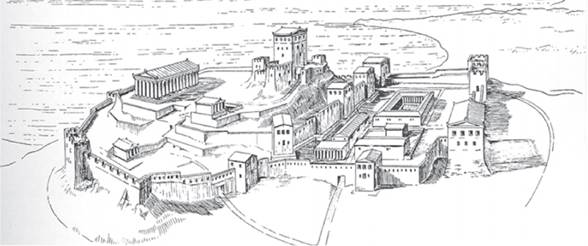
3.2 Reconstruction of the acropolis of Panticapeum, the center of the Bosporan Kingdom, as it may have appeared in the second century BCE.
At certain times some of the Black Sea cities joined together in a federation. The most important of these federations was one led by Panticapaeum, which about 480 BCE brought under its hegemony the Kerch and Taman peninsulas together with the eastern shore of the Sea of Azov. The resultant formation came to be known as the Bosporan Kingdom. Headed by its own royal dynasty, the Bosporan Kingdom, which in its first phase lasted for more than four centuries until the year 63 BCE, may be considered the first state structure to have existed on Ukrainian territory.
The city-states of the Black and Azov seas depended for their existence on fishing, wine making, small-scale artisan craftsmanship, and, most especially, the grain trade. The grain came largely from the steppe hinterland and together with fish was sold to the homeland Greek city-states along the coasts of the Aegean Sea. As classic middlemen between the Ukrainian steppe and the Aegean-Mediterranean markets, it was in the interests of the Greek coastal cities on the Black and Azov seas to maintain good relations with the rulers of the hinterland.
The open steppe hinterland was by its very geographical characteristics easily accessible to nomadic invaders. The most important of these were the Scythians, that is, tribes of Iranian origin who moved westward, settling first in the Kuban’ Region and Taman Peninsula (700-550 BCE), then along the lower Dnieper River and Crimean hinterland in an area that eventually came to be known as Scythia Minor.
There the Scythian polity reached its height between 350 and 250 BCE. Although the Scythians themselves were nomads, they ruled over the sedentary population living in a large sphere that is today central and eastern Ukraine and beyond. The success of the Scythian political order, or Pax Scythica, which lasted for about half a millennium in Ukraine (750-250 BCE), depended on two factors: the extraction of foodstuffs (grain and fish) from the hinterland’s sedentary inhabitants; and the ability of Scythians to sell these products to the merchants of the Greek cities on the Black and Azov seas. The Scythians themselves also established fortified centers to coordinate their trade. The largest of these were Helon/Bil’sk and the two Scythian capitals of Kamianka (from the late fifth century BCE) near the second bend just south of the Dnieper River and Neapolis (from the second century BCE) in the Crimean hinterland.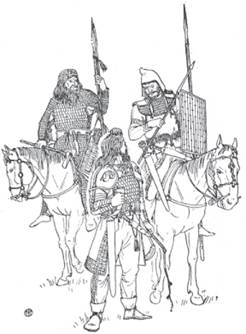
3.3 Scythian nomadic warriors from the fifth century BCE, based on remains found in burial mounds (kurhany).
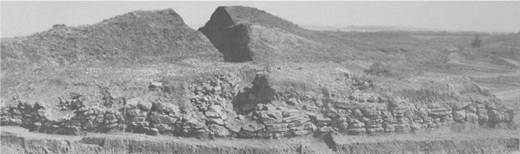
3.4 Excavation of the Scythian burial mound (kurhan) at Chortomlyk, just northwest of Kamianka, measured 20 meters high and 350 meters in diameter.
The Scythians are best remembered, however, not for their trading practices but for the finely wrought sculpture, ornamentation, and jewelry, primarily in gold, which they left behind in burial mounds known as kurhany, or barrows. Likely fashioned by Greek artisans, it is this “Scythian gold” which is best known to the modern-day museum visitor and which present-day Ukraine claims as one of the country’s finest contributions to world culture.
Sometime around 250 BCE, the political stability epitomized by the economic interde-pendency between the Greek coastal cities and Scythian hinterland began to break down.
New nomadic tribes known generally as Sarmatians—consisting of Iranian groups such as Roxolani and Alans among others—disrupted the generally peaceful conditions associated with the Pax Scythica. Such stability was restored only partially when the Roman Empire took over the Black Sea and Sea of Azov coastal areas in 63 BCE. Under Roman hegemony the Bosporan Kingdom was revived and trade relations were established with what by then was the Sarmatian-controlled hinterland.Three centuries later and already into the Common Era (or AD, after the birth of Christ) there began yet another era of instability caused by the arrival of new aggressive nomadic tribes from the north (Goths) and east (Huns, Avars, and Bulgars). While most of the Ukrainian hinterland was being periodically ravaged between about 250 and 650 CE, the Black Sea coastal cities were, in contrast, protected and revived under the hegemony of the Eastern Roman, or Byzantine Empire. Beginning with the reign of Emperor Justinian I(r. 527-565) Ukraine’s Black Sea coastal cities received Byzantine garrisons and were transformed into centers of Hellenic Greek culture in the form of Eastern Christianity. Byzantium’s administrative center for the northern Black Sea littoral was Chersonesus, on the western tip of the Crimea, from whence Christian influence was eventually to radiate to other parts of Ukraine and beyond.
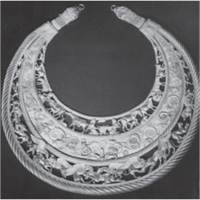
3.5 (Above) Golden pectoral from the Scythian burial mound at Krasnokuts’k (Tovsta) northwest of Kami-anka, early third century BCE.
As was the case throughout the prehistoric era, the prosperity of the Black Sea city-states depended on a politically stable Ukrainian hinterland with which they could trade. The Byzantines were finally able to find a reliable partner (as had the Greeks previously with the Scythians), when after 650 CE a new state came into being that was eventually to control the steppe hinterland north and east of the Black Sea. This was the Khazar Kaganate.
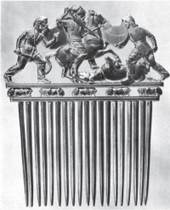
3.6 (Below right) Scythians in combat depicted on a golden hairpin from a burial mound at Solokha, just west of Kamianka.
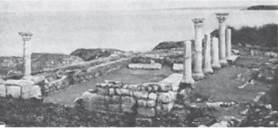
3.7 Remnants of the sixth-century Byzantine Christian basilica in Chersonesus on the southern coast of the Crimea near present-day Sevastopol’.
More on the topic 3 Greeks and scythians:
- BIBLIOGRAPHY.
- CHAPTER IX. SIBERIA AND SURROUNDING COUNTRIES.
- CHAPTER TWO Poles and Cossacks: Kamyanets Podilsky