4 Khazars
The name Khazars refers to several Turkic-speaking tribes that appeared as early as the fourth century CE in the steppes north of the Caspian Sea. By the second half of the seventh century they were concentrated in the region just east of present-day Ukraine, between the Black and Caspian Seas.
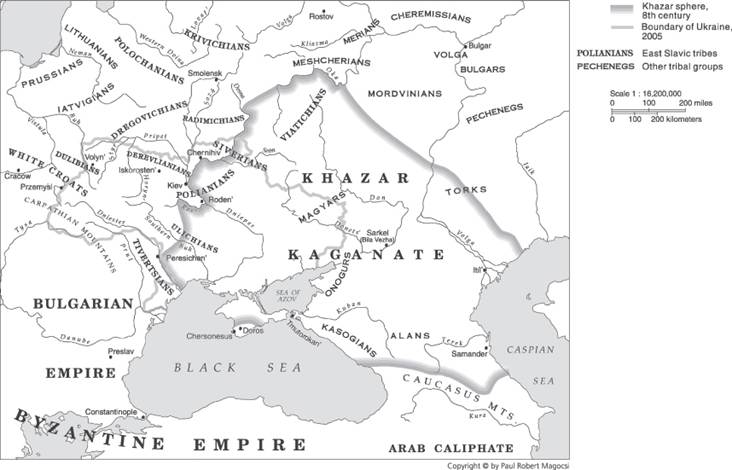
Originally nomads, the Khazars turned to sedentary farming and trade, and sometime around 650 they created a state structure known in history as the Khazar Kaganate. In contrast to the nomadic peoples from the north and east who preceded them during the three centuries before, the Khazars were interested in practicing diplomacy to settle conflicts and create political stability that, in turn, would enhance their commercial and trading interests. The Byzantine Empire, ever anxious to protect its Black Sea possessions, welcomed the opportunity to cooperate with a northern neighbor such as the Khazars.The Khazar Kaganate was initially concentrated in a triangular area bordered by the lower Don, the lower Volga, and the Caucasus Mountains, but it gradually expanded its sphere of influence as far as the Oka River in the north and the Ukrainian steppelands in the west as far as the Dnieper, Ros’, and lower Dniester rivers. In order to maintain control over this vast area, in the mid-eighth century the Khazars moved their capital from Samandar below the Caucasus to Itil’ in the delta of the Volga River. In 835 they built a fortified city at Sarkel on the lower Don, and they maintained an outpost as far as Kiev on the middle Dnieper River.
The Kaganate derived its wealth primarily from duties levied on the merchants who used the several international trade routes that converged on Khazar territory. From Itil’ and Sarkel the Khazars themselves traded products that arrived in their territory along the Silk Route from China in the east or from the Volga Bulgars in the north, and then were moved further southward across the Caspian Sea to Baghdad in the Arab Caliphate, or westward down the Don River across the Sea of Azov and Black Sea to the capital of the Byzantine Empire, Constantinople (see Map 6).
Khazar military forces were strong enough to fulfill the state’s diplomatic objectives. The Kaganate’s rulers succeeded in neutralizing the nomadic tribes still arriving from the east (including Bulgars, Alans, Magyars, and Onogurs) as well as Slavic tribes along the western edge of its sphere of influence. These nomadic groups either passed through the Kaganate’s sphere of influence or functioned as vassals under Khazar hegemony. The Khazars also stabilized their northern border with the Volga Bulgars, their southern border along the Caucasus Mountains with the Arab Caliphate, and in the Crimea with the Byzantine Empire. After some clashes at the end of the seventh century in what by then was the Byzantine-controlled Bosporan Kingdom, the Khazars built the fortress of Tmutorokan (Tamatarcha) on eastern shore of the Straits of Kerch and then agreed to share control of the Crimean Peninsula, leaving the southern coastal towns, including Chersonesus and the mountain stronghold of the Goths at Doros, under Byzantine hegemony.
MAP 4 THE EAST SLAVIC TRIBES AND THE KHAZARS
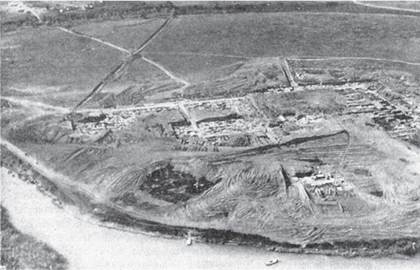
4.1 Archeological site of the Khazar capital at Sarkel along the lower Don River.
The extensive international commercial relations conducted by the Khazars helped to transform their kaganate into a fertile ground for cultural development. Originally believers in Shamanism, the Khazars were eventually most influenced by Islam. Their ruling elite did, however, welcome Christian missions (including one led in the early 860s by the “Apostles to the Slavs,” Cyril and Methodius) and for a time (789-809) they embraced Judaism. Hence, the Khazar kaganate was the only state in history whose ruling elite converted, however briefly, to Judaism. This fact has given rise to subsequent Jewish legends and theories, which argue that eastern Europe’s Jews are descendants of the Khazars.
The most important aspect of the Khazars and their kaganate, however, was that for at least two centuries — approximately 650 to 850 — they fostered stability in a wide region that contained within it and just beyond several peoples who found it more advantageous to trade and live in peace than to provoke war and conflict. The Khazar Order, or Pax Chazarica, in its role as protector of the eastern and southern frontiers of Europe, has been likened to Charles Martel and the Franks in protecting western Europe from the incursions of Arabic Muslims from the south. The Pax Chazarica did in fact cushion its part of Europe from the destructive aspects of Central Asian nomadic invaders as well as from incursions by the Persians and later Arabs from beyond the Caucasus Mountains. Finally, the Khazar sphere of influence provided a protective shield for the peoples living along its western flank. These were the Slavs (in particular the East Slavic Polianians, Dulibians, Derevlianians, and Siverians) who were to play a central role in further developments within Ukrainian lands.
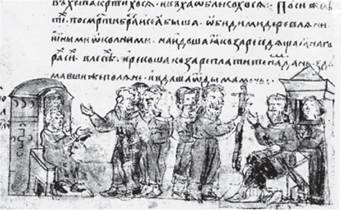
4.2 East Slavic tribes paying tribute to the Khazars, as depicted in the 15th-century Radziwiłł Chronicle.