5 The Original Homeland of the Slavs
The vast majority of Ukraine’s population today as well as for the past several centuries is ethnically Ukrainian. Since Ukrainians are a Slavic people, it is not surprising that the origin of the Slavs has been a topic of interest among countless generations of scholars and other writers.
The very concept of Slavs is based on linguistic criteria; that is, it refers to several distinct peoples speaking cognate languages. At present linguists speak of fourteen written or literary Slavic languages that are traditionally divided into three groups: East Slavic (Russian, Belarusan, Ukrainian, and Rusyn), West Slavic (Polish, Kashubian, Sorbian, Czech, and Slovak), and South Slavic (Slovenian, Croatian, Serbian, Macedonian, and Bulgarian).The preceding classification scheme is, of course, a modern construct, and it is very problematic to apply it to earlier periods, when differentiation between various Slavic peoples and their languages had not yet taken place or existed in a configuration different from what it subsequently became. Nevertheless, people in the modern age seem to have a strong intellectual and even psychological need to know the origin of their particular group. Scholars, therefore, have spent enormous effort at trying to determine the origins of the Slavs in general as well as the ethnogenesis of individual Slavic groups. The quest for origins is made more complex by the fact that the early Slavs left no written records. Consequently, scholars have had to rely on indirect evidence, such as archeological artifacts (dwellings, household implements, military equipment, burial sites, coins, and most especially pottery) and linguistic evidence (names of peoples, rivers, places, plants, and animals). The presence of archeological artifacts or places where names of Slavic origin survive allegedly provide proof of the presence of Slavic peoples in a particular place.
The problem with this indirect approach is that it is just that: indirect and therefore open to interpretation and counter-interpretation. In short, virtually any proposition about the origins of the Slavs in general or of a specific Slavic people is met with an often equally convincing alternative or even contradictory explanation.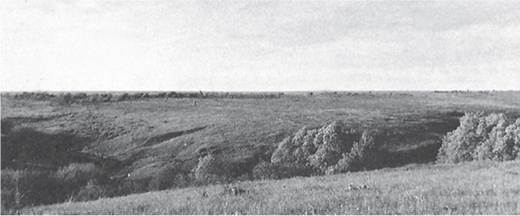
5.1 Typical appearance of the forest steppe zone.
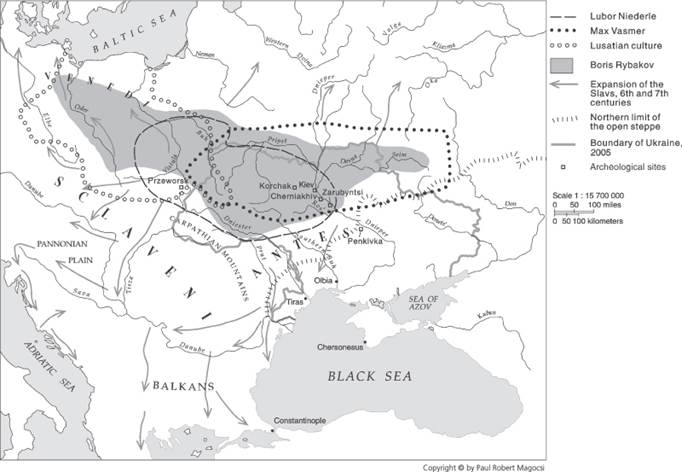
MAP 5 THE ORIGINAL HOMELAND OF THE SLAVS
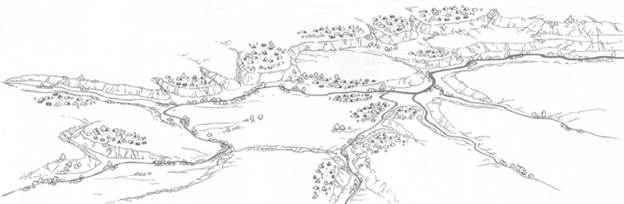
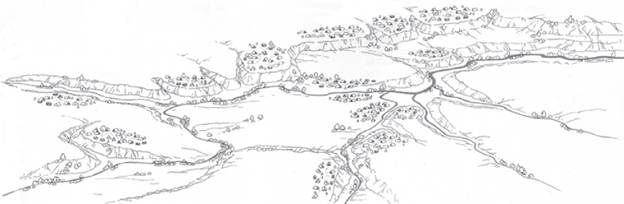
5.2 Typical proto-Slavic settlement pattern along a valley in the forest steppe zone.
The original homeland of the Slavs is just such a controversial problem. Among alternative views proposing a location have been the middle and lower Danube valley, the Carpathian Mountains, or the Pripet Marshes. By the first half of the twentieth century at least four theories became widespread. Three of these (that of Lubor Niederle, that of the proponents of the Lusatian Culture, and that of Boris Rybakov with other Soviet, Polish, and Czech colleagues) are based on archeological artifacts; Max Vasmer’s view rests on linguistic evidence. As indicated on the accompanying Map 5, the farthest extent of the proposed original Slavic homeland stretches from the middle Elbe valley in the west to the upper Don valley on the east, and from the Baltic Sea in the north to the upper Elbe and Oder river valleys and Carpathian Mountain crests in the south.
5.3 Bronze artifacts and pottery associated with the Zarubyntsi culture along the middle Dnieper region, second century BCE.
Although their territorial extents differ, these four viewpoints do agree that the original homeland of the Slavs was north of the Carpathian Mountains within the forest steppe zone beyond the northern limit of the open steppe.
Specifically this area was concentrated between the middle Vistula valley in the west, the lower Buh and Pripet valleys in the north, and the middle Dnieper in the east. In contemporary terms the area comprises north-central and western Ukraine, southwestern Belarus, and south-central and southeastern Poland. Nevertheless, other views about the original Slavic homeland continue to be put forward. Some archeologists have argued for Bohemia (Ivan Borkovsky) or Pannonia (Josip Korošec), while others have gone back to the earlier theories of the lower Danube (Florian Curta), or the marshes in the Pripet River valley along the present Belarus-Ukrainian border (Irena Rusanova), or to the Carpathian Mountains, more specifically its northern foothills on both sides of the present Polish-Ukrainian border in historic Galicia (Volodymyr Baran).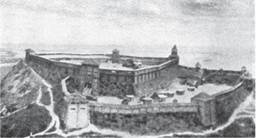
5.4 Reconstruction of a Polianian tribal hill-fort (horodyshche) at Chuchyn along the Right Bank of the Dnieper River.
Aside from the problem of location, there is the question of chronology. In other words, when is it possible to speak of the existence of Slavic, or proto-Slavic peoples? Some authors speak of proto-Slavs in their homeland already during the last millennium BCE and that, therefore, the sedentary population serving under the Scythians may, in part, have been Slavs. The validity of such assumptions is questionable, precisely because it assumes that cultural entities based on archeological evidence can be directly related to specific peoples, Slavs or otherwise. Alternatively, until about 500 CE one can at best speak of several cultural groups (determined for the most part by similarities in pottery and dwellings) on territories that in historic times we know were inhabited by Slavic peoples. These cultures were usually named after a specific archeological site that is considered representative of the entire area.
Among the cultures found on the territory of Ukraine during the last centuries before the Common Era (BCE) and the first millennium of the Common Era (CE) are the Przeworsk, Zarubyntsi, Cherniakhiv, Carpathian Barrows, Kievan, Korchak, and Penkivka.Authors who associate these cultures with Slavs assume their presence in Ukraine at the very latest during the first centuries of the Common Era. By that time Greek and Gothic historians left written evidence about three groups of Slavic peoples beyond the borders of the Roman Empire: the Venedi, the Sclaveni, and Antae. The Antae were said to inhabit the Ukrainian steppe north of the Black Sea between the Prut and Southern Buh rivers.
Originally a tribe of Sarmatian Alans (who were of Iranic origin), the Antae were believed to have organized Slavic and other tribes in their midst. Beginning in the fourth century, and from a base between the lower Prut and Dniester Rivers, the Antae gradually moved northward, bringing under their control northwest Ukraine (Volhynia) and its middle Dnieper region. During this process, as the Antae brought more and more Slavs under their hegemony, these subordinates eventually replaced the ruling Irano-Alanic elite. The fifth century CE marked the apogee of Antaen-Slav power on Ukrainian territories. By then they had established several hill-forts (horodyshcha) whose inhabitants produced metalwares and carried on a brisk trade with Roman and Byzantine markets to the south. Latter-day historians have made much of the Antaen era. The patriarch of Ukrainian historiography, Mykhailo Hrushevs’kyi, considered the Antae the ancestors of the Ukrainians and by extension the creators of the first “Ukrainian” state. Moreover, the founding of the country’s capital city, Kiev, sometime in the early sixth century by the semi-legendary Polianian prince Kyi, is connected with the Antaen era.

5.5 Monumental statue of the legendary founders of Kiev: Prince Kyi, his brothers Shchek and Khoryv, and their sister Lybid’, erected in Kiev, 1982.
The arrival of new Central Asian nomadic warriors on their way across Ukraine toward central Europe, in particular the Avars during the second half of the sixth century, resulted in the destruction of the Antaen hegemony. After the year 602, the Antae were heard of no more. In their stead, the Slavs on Ukrainian territory functioned as separate tribal units that after 650, in the wake of the Avar departure, gradually were drawn as vassals into the sphere of the Khazar Kaganate just to the east (see Map 4). Among the East Slavic tribes in Ukraine were the Siverians in the northeast, the Polianians along the middle Dnieper and Ros’ valleys, the Derevlianians south of the Pripet River, the Dulibians between the Styr and Vistula Rivers, the White Croats on the northern slopes of the Carpathians, and to the southwest the Ulichians and Tivertsians along the Southern Buh and Prut river basins. Each of these groups had centers that eventually grew from hill-forts into small towns: Chernihiv for the Siverians, Kiev for the Polianians, Iskorosten’ for the Derevlianians, Volyn’ for the Dulibians, Przemysl for the White Croats, and Peresichen’ for the Ulichians (see Map 4).

5.6 The Byzantine monks Cyril and Methodius translating Biblical texts into Old Slavonic as depicted in the in the 15th-century Radziwiłł Chronicle.
The ninth century proved to be an important turning point in the history of the early Slavs. In the 860s two monks from Byzantium, Cyril and Methodius, formulated a written language as part of their mission to bring Christianity to the Slavs. They first spread the Christian message to the Slavic peoples of Greater Moravia (based in the present-day Czech Republic and Slovakia), whose sphere of influence reached the farthest western regions of present-day Ukraine (Transcarpathia and western Galicia). The literary language that Cyril and Methodius created, known as Old Slavonic and later Church Slavonic, was written in the Glagolitic and Cyrillic alphabets. The latter was developed during the tenth century among the South Slavic peoples living in the Bulgarian Empire, and from there it spread to the East Slavs of Kievan Rus’.
The ninth century was also a time of political change. Some East Slavic tribal leaders were becoming increasingly resentful of their vassal-like relationship with the Khazar Kaganate. By itself, no individual tribe had the strength to confront alone the Khazar military. This became possible only after the arrival of a new element in the region—Varangian trader-warriors from Scandinavia.