CHAPTER VIII. SCYTHIC TOMBS.
Il·' Herodotus is the main source of our information as to the population of the north shore of the Euxine during the flourishing time of its Greek Polonies we are hardly less indebted to the finds made in the barrows of the country, finds which on the whole bear out what Herodotus has said and supplement it with many details throwing much light upon the elements which went to make up the mixed culture of the inhabitants.
From about the viith century b.c. to a little after our era is the period to which may be referred a series of tombs that seem to belong to peoples all closely connected with each other in funeral customs and general mode of life. To give any ethnic name to this class of grave is begging the question of their origin, yet it is impossible to habitually refer to them as “graves of nomadic tribes in contact with central Asian and Greek civilisations.” They are generally called “ Scythian ” or “ Scytho- Sarmatian,” or those shewing Greek influence are called “Scythian,” those with Roman manufactures or coins “Sarmatian.” This latter distinction is certainly unsatisfactory, for the name of Sarmatian had spread over the European steppes certainly before Roman influence had been brought to bear on these countries. In fact as will be seen the greater part of the tombs usually called “Scythian” appears to belong to a time when the Scyths of Herodotus had disappeared. On the other hand the general agreement between the archaeological evidence and the information furnished by Herodotus argues the substantial identity of the cultures described in these different sources. This all points to there being but little real difference between Scyth and Sarmate. The latter were apparently nearer the Iranians of Iran both in language and dress, but in both there seems to have been an Altaic element.I propose then to call the class of tombs, which I shall now describe, “Scythic,” not wishing to assert thereby that they belonged exclusively to Scyths, but suggesting that they are the most typical tombs of the inhabitants of Scythia, when that was the general name for the Euxine steppes ; still there can be little doubt that the true royal Scyths of Herodotus were among the tribes that buried in this fashion, although no tomb has been found which could be referred to the particular generation observed by him.
Unfortunately in spite of the enlightened efforts made by the Russian government to protect these remains, and in turn to explore them with the best archaeological skill, we cannot point to any first-class normal Scythic tomb which fate has reserved for quite satisfactory exploration. · The great majority was plundered long ago, as it seems in most cases, shortly after the very funeral, in other cases the discovery has been made by peasants searching for treasure, or amateurs who have neglected to keep a minute account of all details as to the position in which everything was found ; finally it has happened that an excavation already almost brought to a successful conclusion has been ruined by the insufficiency of the guard set over it. Hence our picture of a Scythic interment must be pieced together from the best preserved parts of many tombs. It is impossible to take one tomb, even Kul Oba or Karagodeuashkh, describe it fully, and make it a norm, treating all others as varieties. Besides, enough remains to shew that each great tomb had its own peculiar features which have their interest in filling in the general outlines of Scythic life.
In the following enumeration of the most important tombs the older finds, particulars of which are more accessible, will be treated as briefly as possible ; further particulars can be found in books so easily obtainable as S. Reinach’s reprints of the Antiquitds du Bosphore Cimmcrien [ABC.) and of Kondakov and Tolstojs Antiquity de la Rttssie Mfridionale [KTR.). Descriptions derived from the Antiquitds de la Scythie d' Hero dote [ASH.), from the Compte Rendu de la Commission Archdologique [CR.), especially since it has been published in Russian, from the Bulletin de la Commission Archdologique [BCA.) and from other Russian publications will be given more fully.
The distribution of these Scythic barrows reaches from Podolia and the Kiev government southwards to the Euxine and eastwards to the valley of the Kuban on the northern slopes of the Caucasus.
The finest of them are about the bend of the Dnepr, near Alexandropol, near where we should put the land of Gerrhus ; a special character marks those in the governments of Kiev and Poltava ; a few occur about the Greek towns of the Bosporus on each side of the strait, and the Kuban series is hardly second to the Dnepr group. Isolated is the remarkable find of Vettersfelde in Lower Lusatia. Also a burial of somewhat similar type has been found in Thrace, Dukhova Mogila near Philippopolis1. Further, as has been said, objects of a type resembling the barbarian element in Scythic tombs can be traced right across to Krasnojarsk beyond the Altai. To the west also, in Hungary, objects of Scythic type have been found2.The question of dating and classifying these tombs is very difficult. Our only criteria are the objects of Greek art found in them. Yet these only give us the earliest date possible. And even as to this there is some doubt, for various judges make more or less allowance, for barbarous influence, for the difference between the best art and that of articles made for export, and for the time necessary for new fashions in art to penetrate to such remote regions.
Moreover, unfortunately none of the tombs with the most archaic Greek objects have been opened by skilled archaeologists. For instance, the tomb at Martonosha (p. 173) may well have belonged to a contemporary of Herodotus. The amphora handle seems to be vith century work, and the other objects are not definitely late in date; but we shall never know, for our account of the excavation is derived from peasants nearly twenty years after the event, and we know yet less of the circumstances under which were discovered the archaic “Cybele”3 or the mirror handle with almost the earliest nude female of archaic (rather than primitive) Greek art4.
In the account which follows the barrows are arranged rather geographically than chronologically, though in the first group their dates would seem to
1 BCH.
XXV. (1901), p. 168, G. Seure. Mittheilungen aus Ungarn, IV. 1895, pp. 1—26.2 Dr P. Reinecke, “Die skythischen Alter- 3 CR. 1896, p. 82, f. 337.
thümer im mittleren Europa,” Zt. für Ethnologie, 4 CR. 1897, p. 78, f. 186. All these three bronzes
xxvm. 1896, pp. 1—42, and J. Hampel, “Sky- are illustrated in Chap. XI. § 10, if. 278—281. thische Denkmäler aus Ungarn,” Ethnologische
viii] Distribution. Poor Class i 5 1
be in the order I have given. Each barrow described has its own features of interest, and from them all some idea of the Scythic type can be formed. Fewer descriptions would have left out interesting points, more would have wearied the reader without attaining completeness ; many important excavations have for this cause been necessarily omitted, for them the reader must be referred to the CR., RCrl., and other special publications.
Poor Class. 7'wins.
Professor A. Lappo-Danilevskij[438], in his review of the various types of Scythic graves, divides them into four classes. His first class seems not clearly to be distinguished from the class of coloured skeletons of which we have already treated, except that the colouring is not predominant. The bad preservation of the bones, the poverty of the objects found with them, the large number of burials in one mound, rank tombs like the Pointed Tomb on the Tomakovka, the Pound Kurgan ( = barrow) at Geremes (variously written Guerthnesov, Heremesse, Germesov), the Long Tomb near Alexandropol, all on the right bank of the Dnepr near the great bend, with the BezschAstnaja (unlucky) Tomb on the opposite bank, which distinctly contained coloured bones[439]. It is remarkable that all these are near the land Gerrhus, it seems as if the Scyths had adopted the sacred burial district of earlier inhabitants. Lappo-Danilevskij takes these great barrows with as many as fourteen separate interments to have been burying places of comparatively obscure families which heaped up great mounds when enough dead had been accumulated : but more probably the distinction between these and the following graves is one not merely of social position, but of time and race.
We may put them down as of the last pre-Scythic phase, for the skeletons are not coloured, and are not all doubled up, and there are a few objects of copper or bronze ; but there arc no chambers hollowed out, no horse graves, and none of those mines by which the rich booty of the true Scythic type of graves was carried off by men who well knew what they were doing. In this class there was nothing to tempt them.An isolated example recalling this type is the barrow called Perepjatikha, in the district of Vasilkov (Kiev government), opened in 1845. It is far to the west of the central Scythic group, but cannot be classed with the generality of Scythic barrows in Kiev government. It contained fourteen skeletons under a wooden roof upon which stones had been piled ; by four of them were lumps of paint, necklets, metal disks, one bronze arrow, two iron axes, an earthen vessel with a stone stand, and 24 gold plaques of griffins once sewn on to a whitey-yellow stuff. This is not a normal Scythic tomb, and the paint suggests an early date ; perhaps the Scythic objects belong to an intruded interment[440].
A fairly simple example of a Scythic grave (Lappo-Danilevskij’s second class)[441] is the Stone Tomb {Kamciinaja TMogila') near Krasnokutsk, between
in KTR. p. 289, f. 254, shewing a very steep barrow surrounded at some distance by a bank and a group of lesser mounds. Cf. too Lappo-Danilevskij, op. cit. p. 487 sqq., who classes it rather with the other west-Scythic barrows.
1 op. cit. p. 470; KIR. p. 268; ASH. plan E.
Nicopol and Ekaterinoslav. The tomb derives its name from the fact that all the skirts of the heap and the central portion above the actual grave consist of stone. The main grave contained a human skeleton and those of two horses, three spears, scales from armour, fragments of amphorae, and of an alabastron and a jug, but all was in confusion. In a separate grave was the skeleton of another horse with a bridle adorned with bronze plates and with an iron bit.
This would appear to be the grave of an ordinary cavalier whose position did not allow him the elaborate funerals of greater men. Yet the barrow is a considerable size, 19 feet high and 200 in diameter.The third class consists of so-called twins (Bliznitsy)'. Best known are the Geremes, Tomakovka and Slonovskij twins, all in the same district. In these we have two mounds close to each other, one flat-topped with steep sides fortified with stone, containing one human grave, horse graves and various gear including Greek wares, the other round-topped with many poor graves. Moreover, only in the chief mound are there traces of thieves’ mines ; about the chief of the Geremes and Slonovskij twins is a ditch and bank: in these chief twins also there seem to have been one grave chamber and a side chamber for the horse grave. But as all have been plundered in ancient times we cannot be sure of their disposition or
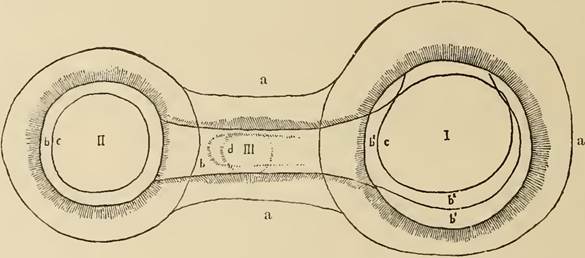
Fig. 39. CR. 1891, p. 161, f. 195. Double barrow at Pavlovka. I. Barrow with core c of rammed earth. Circumference 160 paces. Diameter about 36 m. Height 3’5 m. II. Barrow with core c of stones. Circumference 100 paces. Diameter 20 m. Height 2 m. III. Joining bank with small tumulus d, 30 paces long, 15 m. broad, 1’4 m. high. aaa. Extreme circumference. b' pits dug. The original interments were of red skeletons, others of later nomads, but none, it seems, Scythic.
contents. They offer close analogies to the next class, but are on a smaller scale; it is suggested that in them small tribal chieftains were buried, and that the ordinary folk of the tribe rest in the lesser twin alongside.
Big B arrows.
The fourth and chief class is that of the so-called Big Barrows (Tolstya Mogfly)\ Chief of these are that near Alexandropol, often called the Meadow Barrow (Lugovaja Mogila}, and the ChertomlyE or Nicopol Barrow. Others are that at Krasnokutsk, the Tsymbalka, the Orphan’s Grave (Sirotina Mogila), Chmyreva barrow, Ogiiz near Serogozy in the
1 Lappo-Danilevskij, p. 471 ; ASH. plans E, D.
2 Strictly speaking Kurgan (Turkish = OE. burh) is used in Great Russian for a barrow and
Mogila for a grave, but in the language of Lit. Russia where all the Sc. tombs are, Mohila = barrow.
vi ii] Twin Bar rows. Big Barrows 153
Melitopol district (Tauric govt), and Martonosha in that of Elisavetgrad (Kherson govt). In height they vary from 30 to 70 feet, and they may be from 400 to 1200 feet round at the base. On the top there is always a Hat space some 50 feet or more across. Hence the sides are rather steep, especially on the north. The heap during its progress was rammed down hard and further fortified by a basement of stones ; about the mound would be a ditch and bank with gaps for entrance, The grave chamber is from 9 ft. 6 in. to 15 ft. long by 7 or 7 ft. 6 in. broad and sunk into the earth itself to the level of a layer of clay that runs under the black soil at a depth of from 9 ft. 6 in. to 42 ft. (at Chertomlyk barrow). The sides of the grave chamber were sometimes smoothed and plastered with clay, in other cases traces may be seen of the narrow wooden spade with which they were dug out; such a spade was found near Smcla1. Beside the main chamber there are side chambers (“catacombs”), varying in number. In the Krasnokutsk barrow one only beside a horse grave, in Tsymbalka two, five each at Alexandropol and Chertomlyk. These chambers are generally on the north side of the main chamber. Beside these chambers for the burial of the king’s servants and the storing of his gear were horse graves, always to the w. of the central grave, and in the Chertomlyk barrow two graves near them for the grooms. These chambers are roofed with unsquared tree trunks.
The king was brought to his tomb on a funeral car, of which the remains have been found, well bearing out the description of Herodotus. The car was left for the dead man to use, being broken up and buried in the heap or led down into the grave chamber. So too the horses, whose lives were even more prodigally wasted at these funerals than those of human beings. In the Ulskij barrow on the Kuban were found over four hundred horses (v. p. 227). At Krasnokutsk and Alexandropol the remains of a second car were found. On this probably the dead man’s favourite wife rode to her fate.
None of the Big Barrows have been left unplundered, so we cannot know the exact disposition of the most precious objects about the principal bodies, but in chamber No. v of Chertomlyk king’s and queen’s things seem put apart from each other in niches. Amphorae and other vessels, mostly of Greek workmanship, were put on the floor and clothes hung on pegs in the wall. The body was usually laid on some kind of mattress which at Chertomlyk was covered with a pall adorned with gold plates. In the Alexandropol barrow there were only two servants buried with their master, in Chertomlyk five with their feet towards him ready to stand up and face him at his call. In the Krasnokutsk and Alexandropol tombs were also found heaps of human and horses’ bones. When the way into the tomb had been filled up, upon the flat space where the barrow was soon to be raised was held the funeral feast, well marked at Chertomlyk and elsewhere by fragments of amphorae, horses’ bones, and things lost by the revellers. z\fter that the barrow was heaped up ; but, as it seems, before all knowledge of plan and contents was lost, daring robbers sank mines into it from the north side, the side on which the heap was steepest, towards which there were always extra chambers, and braved not only the vengeance of the dead man and that of his successors (the Mongols had guards to watch their burial places), but 1 Sm. m. p. 53, f. 12.
M. the chance of a fall of those tunnels, that the secrecy of their operations made it impossible to support properly. Since then, Genoese on the coast and Cossacks on the plains, and in modern times the neighbouring peasants, have made a regular practice of seeking the dead men’s gold. It is no wonder that the archaeologist often finds himself forestalled. His only comfort is that the bronzes are almost as interesting as the gold work, and that the thieves left everything but the precious metal. If only they had not thrown everything about in seeking for that[442], we should be better pleased.
20
Alexandropol Barrow.
Of the barrows about the Dnepr, those most remarkable for the variety of their contents are that near Alexandropol and that at Chertomlyk, twelve miles n.w. of Nicopol.
The full report of the excavation of the former is given in ASH. with plan and sections and many plates, and a well illustrated summary in KTR.
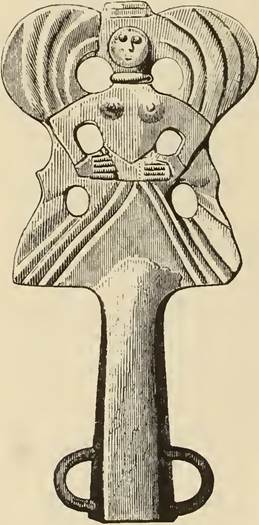
Fig. 40. Alexandropol. Bronze
standard? KTR. p. 241, f. 217 = ASH. 1. 8.
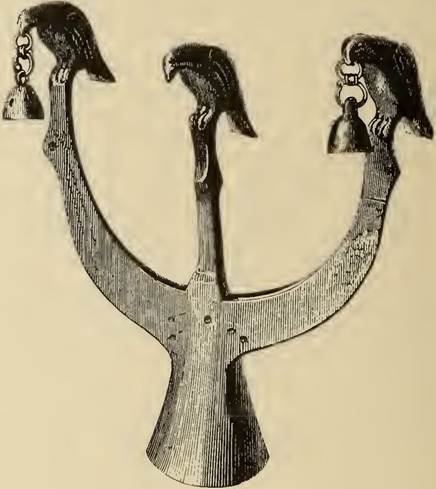
Fig. 41.
Alexandropol. Bronze standard? p. 241, f. 218 = ASH. II. 1.
KTR.
(pp. 238—251), but the exploration was so desultory and the sepulchre itself and all the objects belonging to it had been so thoroughly ransacked by thieves who, after an unsuccessful attempt, finally reached the central chamber, that it is hard to get a clear idea of the whole, and the main interest belongs
Barbara alia Tana,” in Ramusio, Navigation! et
Viaggi, Vol. II. Venice, 1559, ff. 91 sqq.
to the accessories, the remains of two chariots, the. horse tombs, and the bronze “standards” (ff. 40, 41), while little is left of the riches of the actual occupant but gold plates, many very similar to those of Kul Oba (f. 42, others on p. 158, f. 45, also a horse frontlet, an armour scale and a bone arrowhead). Clearly the plunderers had not time to seek trifles. 1'or dating
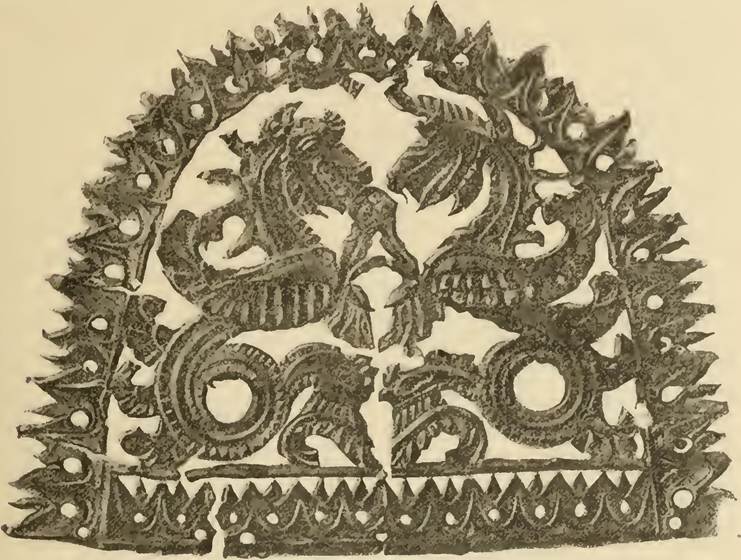
Fig. 42. Gold plate from Alexandropol. KRR. p. 249, t. 22% = ASH. xn. 6.
Scythic things, certain round and oblong silver plates that formed part of the harness are very important, as their style seems late Hellenistic[443]. Other things in the tomb look at first sight almost archaic, but they are only degradations of the Ionian strain.
Chertomlyk.
At Chertomlyk the thieves were less fortunate, one of them was found crushed by a fall of earth at the mouth of his mine, but here again the central interment had been much disturbed. The objects worth carrying away seem to have been mostly heaped up in various corners of v (see plan), and by mere chance the king’s things were still apart from the queen’s.
century; F. H. Marshall, JHS. XXIX. (1909) p. 157 publishing some from Elis in the British Museum concurs, but their sets are better in style. For other Sc. phalerae v. Spitsyn BCA. XXIX. pp. 18—53-
In looking at the annexed plan it must be remembered that only the central part of the tumulus is given; for a complete plan the reader is referred to ASH. plate F. Round the whole must be supplied the stone plinth, and it must be borne in mind that the plan is engraved so that the north comes to the right instead of being at the top.
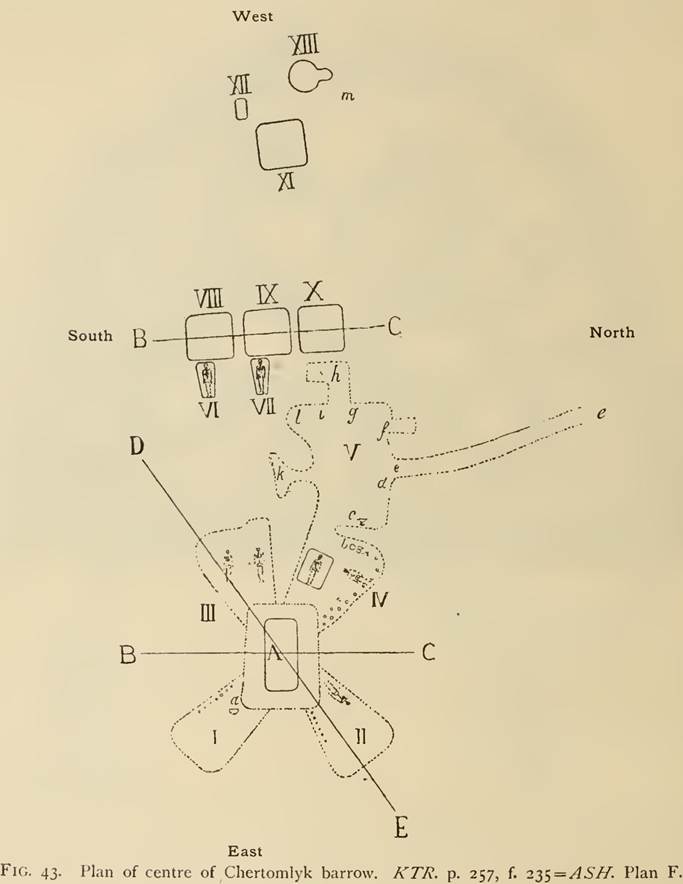
The barrow was 60 feet high and i too feet round, surrounded by a stone plinth, and a kind of stone alley led up to it across the steppe.
A is the central shaft descending 35 ft. 6 in. below the original surface of the ground, 15 ft. x 7 ft. at the top and widening downwards. At the bottom opened out four lateral chambers, 1, 11, m, iv, one from each corner. The N.w. chamber iv communicated with a large irregular chamber v which debouched a narrow passage ce, the mine of ancient plunderers. To the west of all this were three square pits in a line from s. to n., viii, ix, x, and to the E. of viii and ix two graves, vi and vn. Later graves, xi, xii, xiii, were sunk in the heap for persons who had nothing to do with its original possessors.
In A everything had been thrown into disorder by the plunderers. There were only found traces of a coffin or bier painted red and bright blue. In i to the s.e. were a small cauldron, at a the remains of a skeleton converted into lime, by it remains of a quiver with arrows and five iron knives with bone handles, not unlike p. 190, f. 82 below, against the wall in a corner 150 more arrows with remains of their shafts, 28 inches long, and what once was a carpet; about the floor many gold plates and strips which had adorned clothes hung from iron hooks in wall and ceiling.
In No. 11 to the n.e. were six amphorae along the wall, in the middle a bronze mirror with an iron handle, by the door a skeleton with a bronze torque and a gold earring and finger ring, on his left an ivory handled knife and a leather quiver with 67 bronze arrow-heads, near his head ivory and gold remains of a whip handle, also a silver spoon and the fragments of an ivory box, besides innumerable plates and strips of thin gold for sewing on to clothes. The enumeration of the plates found in one side chamber of a single tomb will shew the variety of these plates and the prodigal use made of them. Figures of many of them are in KTR., still more in ASH. In 11 were found 25 plates with flowers, 64 with a fantastic animal, 7 with a lion tearing a stag, one with a calf lying down, 10 with a barbarian combating a griffin, 31 with a griffin alone, 12 with a rosette, 130 with a bearded man’s head, 24 with a gorgon’s head and 5 pendants, 27 with a plain gorgon’s head, 6 with the heads of Athena and a lion back to back (p. 158, f. 45, xxx. 6), 33 of Heracles strangling a lion (ib. xxx. 10), one of a lion combating a sphinx, 24 triangles made up of grains (cf. p. 197, f. 90, ABC. xxn. 7). Besides these a great number of hollow pendants, tubes, beads, buttons, and other golden ornaments to be sewn on to clothes. These plates are very characteristic of Scythian dress, and occur in great numbers in all barrows ; less wide-spread was the use of strips of gold repousse or ajoure with plant patterns or combats of animals and monsters, sometimes as much as 14 inches long. All these thin gold objects have little holes near the edges for sewing on to textiles.
into
id="Picutre 58" class="lazyload" data-src="/files/uch_group78/uch_pgroup304/uch_uch7209/image/image058.jpg">
158
Scyt/iic 'Tombs. Dnepr Group
[ch.
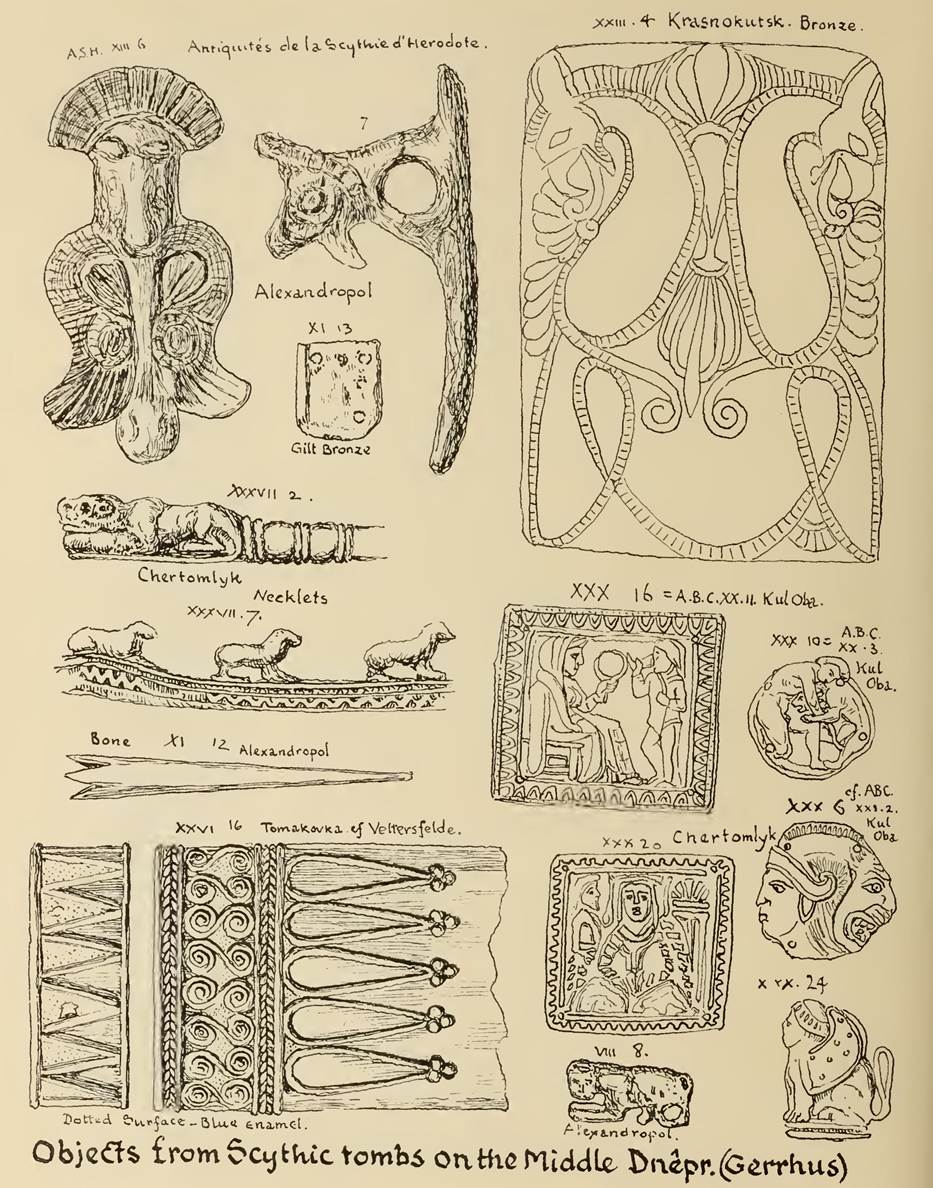
Fig. 45. Gold: Horse’s Frontlet (cf. Greek version of same type, p. 169, f. 61): Necklets (p. 63, 161): Plates (pp. 61, 155, 157, 161, 266): Dagger (p. 71, cf. 236). Bronze: Plate (p. 167, 282): Armour Scale (p. 74). Bone Arrow-head (p. 68).
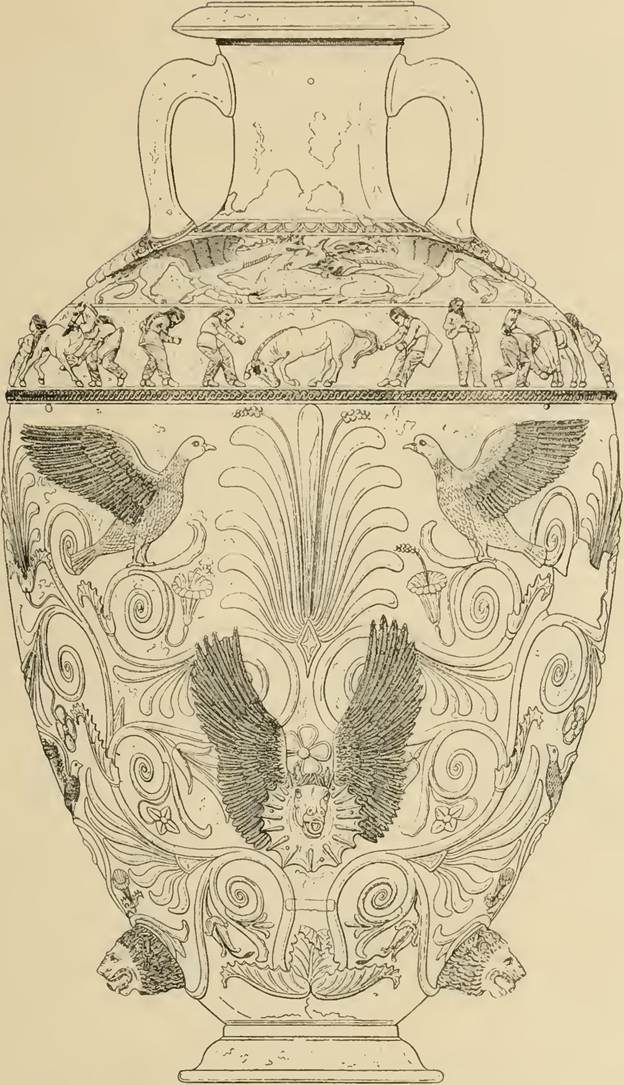
Fig. 46. (v. pp. 161, 288), Chertomlyk Vase, silver, parcel gilt. Front view, p. 297, f. 257 = 0?. 1864, pl. 1. 70 cm. (26? in.) high.
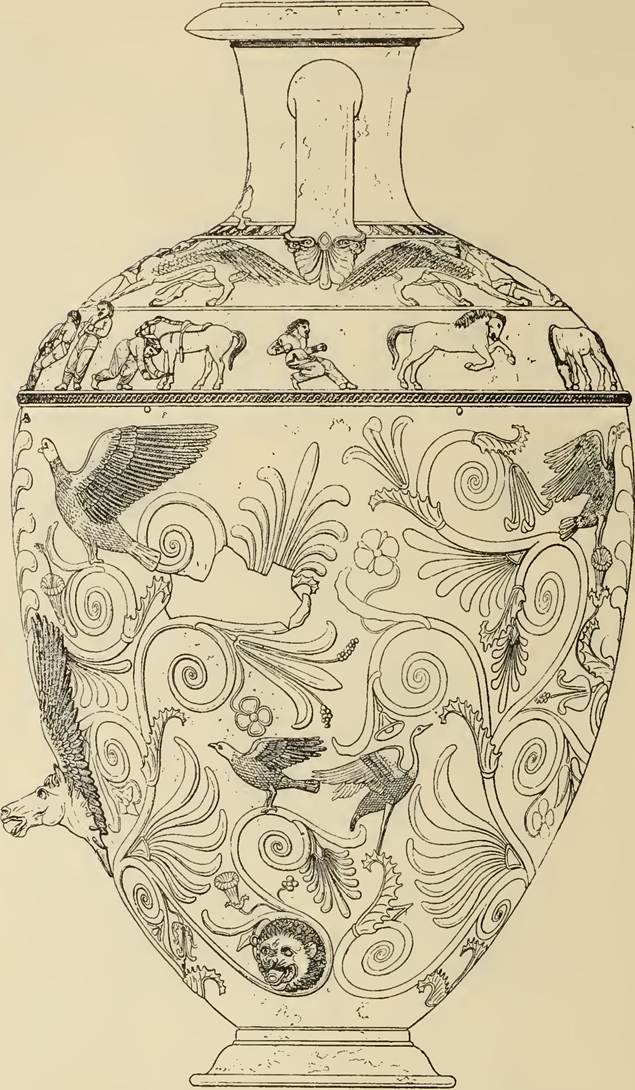
Fig. 47. Chertomlyk Vase. Side view. KTR. p. 296, f. i^6 = CR. 1864, pl. 11.
In in, the s.w. chamber, lay a skeleton wearing a golden torque with twelve lions upon it, shewing signs of long wear (AS//. x.xxvii. 7 on p. 158). About the head could be traced the form of a hood outlined by 25 gold plates with griffins and fastened at a couple of smaller ones, a dower and a gorgoneion. He wore the usual bracelets and rings, and a belt with brass plates, and greaves (which are not so general); by his head were two vessels, a bronze cup, and a silver ewer with a string to hang it up by, and lower down the quiver with arrows, and a whip. By him lay another skeleton with much the same equipment. In the n.w. chamber (iv) were found remains of a bier painted dark and light blue, green and yellow. Upon it lay a woman’s skeleton in rich attire. On each side of her head were heavy earrings, and upon it were 29 plates in the shape of flowers, twenty rosettes and seven buttons. The head and upper part of the body were covered by a purple veil with 57 square gold plates representing a seated woman with a mirror, and a Scyth standing before her (v. p. \^ = ASH. xxx. 16). The line of these plates made a kind
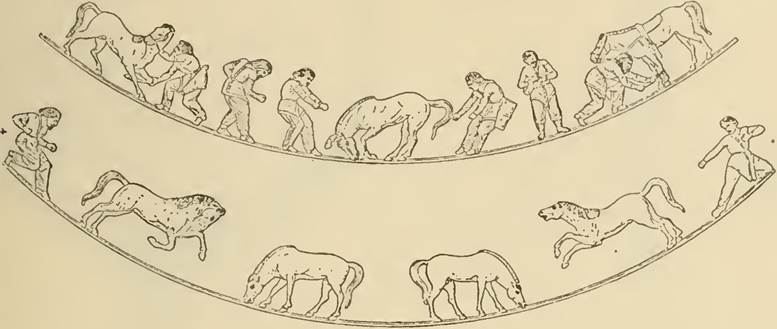
Fig. 48. Frieze of Chertomlyk vase. CR. 1864, pl. III. |.
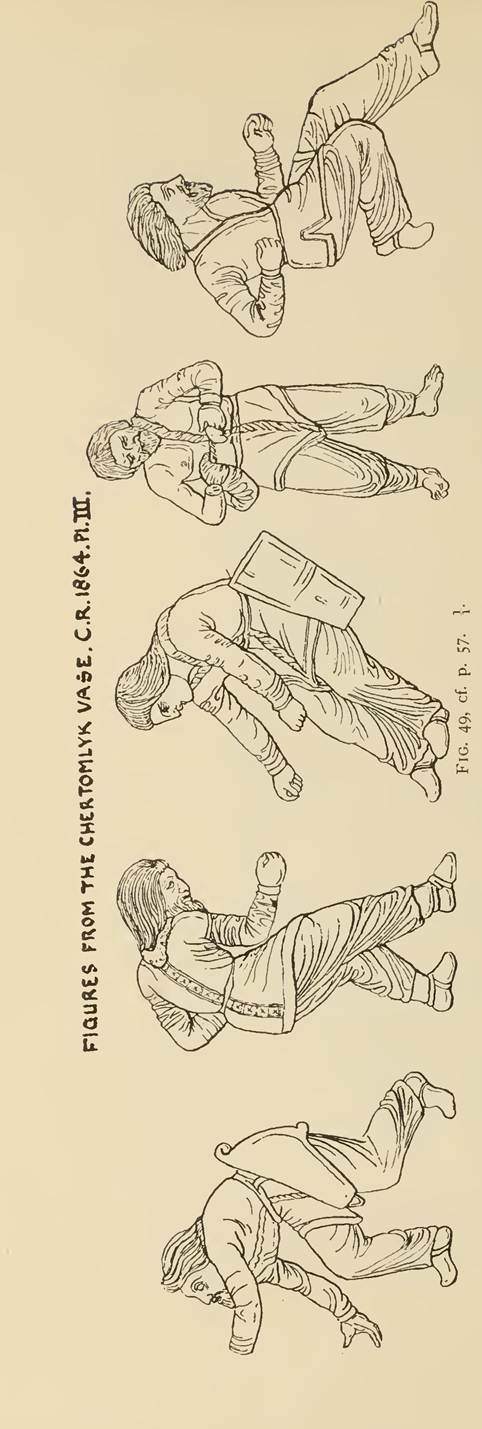
of triangle reaching a foot above her head and descending to her breast, outlining a hood or pointed headdress with lappets falling down on each side of the face ; such lappets seem shewn on a plaque of inferior execution figured on the same page (AS//, xxx. 20). Something of the same sort was worn by the queen at Kul Oba, and by that at Karagodeuashkh where the triangular gold plate which adorned it has a scene representing a queen wearing just such a one (p. 218, f. 120). The Chertomlyk lady also wore bracelets and a ring on each finger ; by her hand was a bronze mirror with an ivory handle, with traces of some blue material. By the woman’s skeleton was a man’s with iron and bronze bracelets and an ivory-handled knife (the knives are always on the left hand side), a little further were the usual arrow-heads. Along the wall were ranged thirteen amphorae. In the west part of this chamber ($) was made the most precious find of the tomb, the famous Chertomlyk or Nicopol vase (ff. 46—49, cf. p. 288 sqq.). By it was a great silver dish with an elaborate pattern engraved within, and two handles formed by a kind of palmetto of acanthus leaves with the figure of a woman wearing a
M.
21
162 Scyth ic 7"om bs
[ch.
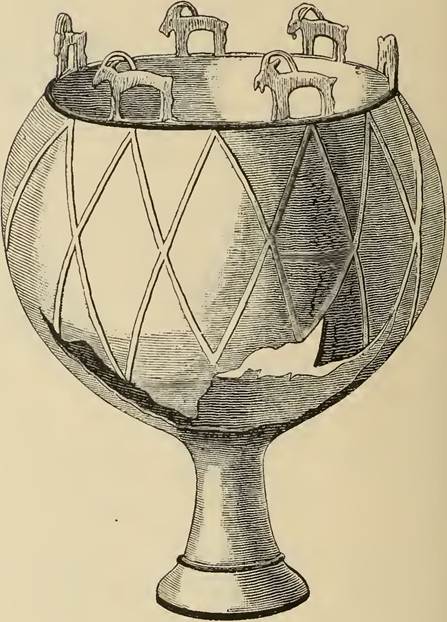
Fig. 50. Chertomlyk. Bronze cauldron. KTR. p. 262, f. 2$=ASH. Text, p. 112.
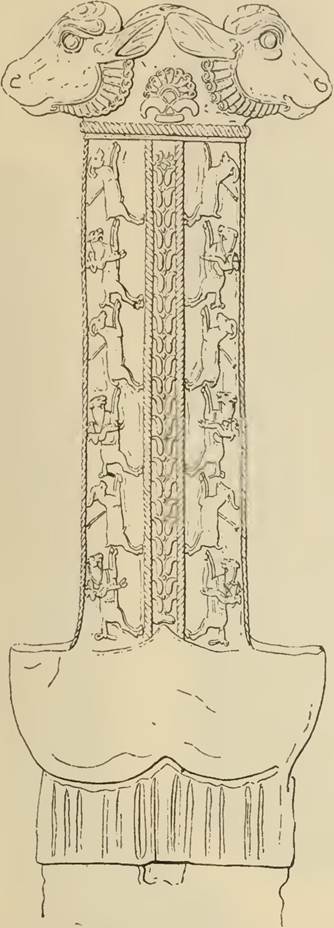
Fig. 51. Chcrtomlyk. Golden hilt of king’s sword. KTR. p. 304, f. 264 = CT?. 1864, v. 2, better Pridik, Melgunov, pl. v. 1, cf. p. 270.

Fig. 52. xm. p. 54, f. 30=J 57/.
XL. 12. Lesser sword from Chcr- tonilyk found at k on plan. '.
still more from the operations of the tomb-thieves, that it is impossible to say what may have been its original plan. It can hardly be entirely due to the thieves. The thieves’ mine (ff) opened into it and all round were
1 KTR. pp. 263-4, ff. 239-4° = yi-s7/· XX1X· 5- 7·
Scythic Tombs. Dnepr Group [ch.
niches (_/ Zz, Z, Z) apparently clue to them. If on their entrance they found the way into iv blocked up, they probably tried the walls in various directions and finally broke, into iv and obtained access to the central tomb.
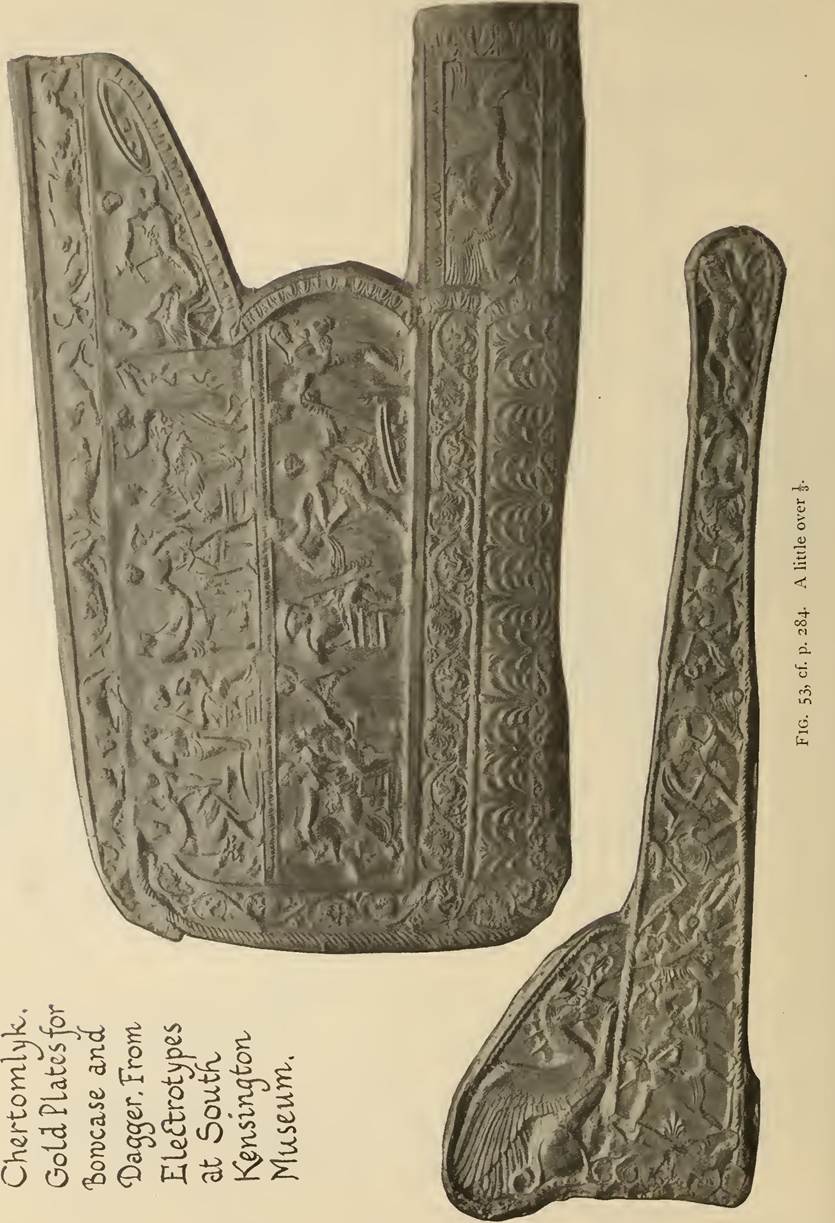
They seem to have begun to pile their booty in heaps in the corners of v ready to take it away, when the roof, disturbed by their operations, fell in and caught one of them, whose skeleton was found at e by the entrance of his mine; at c was a six-wicked lamp he may have been using: the plunderers at Alexandropol had only potsherds with rags in them. At d was a cauldron of the Scythic type 3 ft. high with goats as handles on the edge; the outside blackened with fire; within the head, ribs and leg-bones of a horse (f. 50). Near it was another, smaller, containing a foal’s bones. At f was a niche in the wall with a heap of gold ornaments, at /z another with a woman’s things, as far as may be judged, at g and i were remains of boards, at Z another heap of gold, at k the objects taken from the tomb of the king himself. Three swords had been stuck into the wall, where their blades remained while the handles had rusted off and fallen down (f. 52). Below were the great gold plate that adorned the king’s gorytus, a strip of gold that went along the side of it, and the plate of gold which covered his sword sheath (f. 53); two more swords with gold hafts (f. 51), a hone with a gold mounting, and many other gold plates and a heap of arrow-heads. About the floor were fragments of Greek pottery.
Of the. horse graves, in vm were three horses saddled and bridled, one with gold ornaments, the others with silver ; in ix were four horses, two saddled and bridled with gold, two only bridled and with silver. In x were three horses saddled and bridled with gold, one without a saddle and bridled in silver. The grooms in vi and vn had each his torque, one of silver gilt and one of gold, and each his quiver with arrows.
In the heap itself, early in the excavations, was found an immense number of objects pertaining to harness. At the top of the barrow was a mass of such ornaments rusted together, silver had almost perished, bronze was in bad condition, of gold there was little but 29 pair of horse’s cheek ornaments. In bronze there were animals upon sockets (the so-called standards), horse frontlets, buckles, buttons, bells, tubes, strips, crescentshaped pendants, and about 250 iron bits, also a curious open-work saucepan, as it would appear for fishing meat out of one of the big cauldrons’. This description of the finds in the Chertomlyk barrow, though far from detailed, gives some idea of the barbarous prodigality with which the steppe folk buried their kings.
• Krasnoknt.sk and Tsymbalka.
In the same neighbourhood as Chertomlyk is the Krasnokutsk barrow[444] [445]. In its mound Zabelin found the fragments of a funeral car broken up and piled in two heaps, and the usual remains of harness and trappings: in a special tomb were four horses with frontlets (ff. 56, 57 and p. 158, f. 45; ASH. xxiu. 4). These ornaments are interesting because of their remarkable resemblance to the northern beast-style usually associated with the early middle ages. Other two tombs had been completely stripped by plunderers who only left enough to let us judge that the contents were of the usual Scythic type. Fig. 56, cf. p. 267. Krasnokutsk. Horse’s cheek ornament. Silver. KTR. p. 256, f. 2^ = ASH. xxm. 5. On the S. side of the river, in the district of Melitopol, government of Taurida, is the barrow Tsymbalka1 near Belozerka. As usual the main tomb had been violated by a mine from the north, but in the side tomb were six horses, four with bronze trappings and silver frontlets, two with very interesting gold frontlets, one of fine late ivth century Greek work with a Schlangenwcib, the other barbaric with griffins (ff. 54, 55, cf. p. 269). 1 CR. 1867, p. xxi; 1868, p. xix; KTR. p. 268. Fig. 57. Krasnokutsk. Silver bridle ornament. KTR. p. 255, f. 2^ = ASH. xxm. 7. C/i my rev a Mogila. Chmyreva Mogila, two miles from Tsymbalka, was investigated in 1898 by Dr Th. G. Braun1. Here again the main tomb had been rifled, this time by Fig. 58. CR. 1898, p. 28, f. 28. Chmyreva Mogila. Gold plate from harness, cf. p. 269. Fig. 59. CR. 1898, p. 29, f. 32. Chmyreva Mogila. Gold plate from harness. means of a shaft sunk from the top of the mound, and a later burial for which the barrow had been used was also cleared, but the horse interment was the best met with. An inclined plane led to an oblong pit yiom. x 3 m. x 2*15 m. Ten horses had been led into the pit which was then shut up with boards and 1 CR. 1898, p. 26; BCA. xix. p. 96. heaped over. They had evidently struggled towards the outlet, and their skeletons lay one upon another. Their trappings were adorned with the usual metallic plates, but some were of the finest GreBk workmanship of about 300 b.c.1 (ff. 58—60): there were also specimens of native attempts to imitate them. Very strange is a frontlet of a type which has occurred in several of the Gerrhus tombs2, but this is the only one of skilful execution (f. 61). In the main tomb was picked up an interesting plate with two Scythians wrestling (f. 62). Ogiiz, Deev and J anchckrak. In the same district further to the south near Lower Serogozy, Ogiiz, a very large barrow, has been investigated by Professor Veselovskij3. A plan and section of the stone corbelled vault are given overleaf. The interior is 21 ft. square, surrounded and upheld by a solid mass of stone work 50 feet square. The stones of the corbelled vault itself were bound by iron clamps of a 1 1 shape. Unfortunately the tomb had been rifled three times. The first time the plunderers knew what they were doing, for they approached along the gallery from the s. instead of as usual from the x. The last plunderers came down from above and took off the top stone of the vault. Hence it all filled with earth. The plunderers could do their work much more effectually in the stone vault than in unlined earthen pits and left very little behind them, just a few gold plates, some from the same dies as at Chertomlyk, Kul Oba and Theodosia (e.g. ASH. xxx. 6 on p. 158 and ABC. xxii. 28), and other ornaments, also some horses’ bones coloured green with copper, but no bronze objects with them. At the sides of the great stone mass were small niches ; in the eastern one nothing was found, in the northern one was a woman’s skeleton with a mirror and one or two poor ornaments. In the niche to the west lay two 1 CR. 1898, figs. 28—34. 2 V. p. 158 = 245//. Xlll. 6 and 7. 3 CR. 1894. p. 77. skeletons with no objects but a bronze earring. At the entrance of the main vault lay a man’s skeleton with a long spear, an iron knife and bronze and bone arrow-heads. He seems to have been as it were a sentry outside the tomb moved to one side by the thieves. This would shew that they had penetrated very soon after the heaping of the tomb. Veselovskij points out thatsuch a work as the stone vault must have been built in the king’s lifetime though the heap may have been raised after his death. In 1902 further excavations by N. W. Roth led to considerable discoveries in this same barrow, but the objects found are of the same types, save for some new forms of arrow-heads1. Figs. 63, 64. CT?. 1894, p. 78, ff. 110, in. Plan and section of vault in Ogiiz barrow. Near by was Deev barrow'2, 500 ft. round but only 14 ft. high. The main tomb was empty, but a woman’s (?) still untouched contained mostly poor copies of Hellenistic work, e.g. two diadems, one with a rich leaf pattern, the other with Neo-Attic maenads, also a frontlet with pendants and Sphinx earrings, all to be closely paralleled at Ryzhanovka (p. 179). There was a very fine gold and enamel necklace with alternate ducks and flowers and an armlet like that from Kul Oba on p. 197 (ABC. xxvi. 3). 1 Arch. Anz. 1904, p. 106 ; CR. 1902, p. 63 sqq.; 2 BCA. xix. p. 168, pl. xiii. xv. K03, p. 166, f. 323; BCA. xix. p. 157. vi nJ Ogirz, Dccv, Jaiichekrak, & Mclgunov s Barrows 171 From Janchekrak in the n.e. of the district of Melitopol conic phalcrae of late Roman date, one with the type of winged figure which was adopted for the Christian angel : they were found with a hone and were probably from a late Scythic grave*. Mclguiiov's Barrozv. Of the barrows which have been excavated without proper account having been kept of the disposition of their contents we can regret none more than that called Eitdj Kurgan, opened in i 763 at Kucherovy Bueraki, about 20 miles from Elisavetgrad, by order of General A. P. Mclgundv, who sent the spoil up to Petersburg for Catherine II to view. Preserved with the Siberian antiquities in the Museum of the Academy of Science the objects have with them found their way to the Hermitage. Fig. 65. Mclgunov’s barrow. Golden sheath and fragment of sword hilt. I’ridik, pl. in. -J. They included a very interesting dagger and sheath of Scythic forms, but Assyrian style; here is a view of one side of the sheath and a fragment of the 1 Rep. Imp. Russ. Hist. Museum, Moscow,for 1907, p. 13, pl. 1. ; Arch. Anz. 1908, p. 190, if. 21, 22. much damaged dagger hilt (ff. 65—67’, cf. p. 71) with a restoration (f. 68), parcel gilt feet and fittings of a couch, and one of 17 golden birds displayed (f. 69). There were also a golden diadem or necklet in the form of a triple chain Figs. 66, 67· Details of Melgunov sheath. Natural size. From S. Kensington electrotype. Dalton, Oxus Treasure, p. 56, f. 38, p. 38, f. 26. Fig. 68. Fig. 69. Couch fittings, 2 ; Bird,*}. 1In Mat. xxxi. with Pharmacovskij’s “Keler- mes,” E. M. Pridik will publish a complete account of the find with excellent plates. He has had the extreme kindness to send me a preliminary copy of his part (St P. 1906), from which the annexed illustrations are taken. Cf. also Trans. Od. Soc. vi. p. 601 ; TRAS. XII. Pt 1. (1901), p. 270 sqq., A. A. Spitsyn. The sheath had previously only been published by Maskell, Russian Art, p. 112, from the S. Kensington electrotype, which lacks the side projection, a separate piece, by its style a Scythic addition ; for the use of Mr Dalton’s blocks I gladly thank him and the authorities of the British Museum. In order to try and obtain more light, V. N. Jastrebov undertook further explorations in 1894, but does not seem to have lit upon the right barrow. A copper belt with a pattern very like that on the sword hilt was found at Zakim (Prov. of Kars) CR. 1904, p. 131, f. 239. For the couch foot v. Perrot and Chipiez, Chaldaea &€., 11, p. 315, f. 193. Vili] Melgunov. Martqnosha. Eastern Governments J73 with rosettes set with onyx ; parts of silver disks with a pattern of roundels (they seem to have to do with the suspension of the dagger), 40 bronze arrow-heads of types more or less like Nos. 4, 29, 35, 36, on p. 190, f. 82, a golden strip with figures of an ape, two ostriches (?) and a goose in rather a naturalistic style, 23 gilt iron nails and a short gilt bronze bar ending in rude lions’ heads[446], apparently like a hussar button. The style of all these things seems to go back to early in the vith century b.c., perhaps the chain and the repousse strip are later, but this must have been a very early Scythic tomb. Martonosha. In 1870 at Martonosha in the district of Elisavetgrad on the borders of the governments of Kherson and Kiev some peasants excavated a barrow and found a man’s skeleton, by his thigh a hone, about him spears and arrows, and in the heap various pots crushed by the earth, four whole amphorae buried standing up, an enormous cauldron full of cow’s bones, and a bronze amphora with an archaic Greek running or flying Medusa in the pose of the Nike of Archermus. These particulars were collected in 1889 by Mr Jastrebov, who made a further exploration of the tumulus and found another grave plundered in antiquity. He gives the height of the barrow as 28 feet and the circumference of a high bank round it as more than 800 feet. It is clear that the interment was a Scythic one of the ordinary type though not very rich. The interesting point is the amphora handle which is Greek work of the vith cent, b.c., perhaps the most archaic piece found in the steppes[447]. Eastern Governments. The governments to the east of Ekaterinoslav have been very imperfectly investigated. Still chance finds in those of Kharkov and Voronezh and the land of the Don Cossacks[448], also beyond upon the Volga in the governments of Samara, Saratov[449] and Astrakhan[450], and further in Ekaterinenburg and Orenburg8, shew that there is no serious gap in the continuity of Scythic occupation stretching to within a measurable distance of the West Siberian area (v. p. 252). This region supplies interesting terms in the series of swords7 and cauldrons8. of late Scythic type at Salamatino near Kamyshin, Saratov. CR. 1902, p. 138 ff. 246—252. 6 Kishe, district of Chornyj Jar, CR. 1904, p. 133, ff 245, 246. ' 6 Krasnogorsk, CR. 1903, p. 126, ff. 256, 257. A special point was the absence of the dead man’s skull, suggesting Her. IV. 64 and p. 83 supra. ' Graf Eugen Zichy, Dritte Asiatische Forschungs-Reise, Bd in. Budapest, 1905; Archaeo- logische Studien auf Russischen Roden, by Bòia Posta, p. 102; CR. 1902, p. 142, f. 259. 8 Zichy, op. cit. Bd iv. p. 514. ТотЪъ ‘n the Southern Part of the Government of KitV. Fig. 70. viii] 'Tombs about Kiev. Serebrjanka, Guljaj Gorod 175 Much the same culture which we find in the tombs on the lower Dnepr is brought to light higher up the river in the governments of Kiev and Poltava. This country is no longer pure steppe, here we have the beginnings of the forest and the people are not so exclusively nomadic as further south. There is no longer such waste of horses at a funeral, no longer indeed such richness in gold and metal work, whereas the bone objects so characteristic of Finnish remains in N. Russia occur here also. Moreover, this is the country of earthworks (gorodtshche), and in these earthworks are found things of Scythian type, and great barrows are often near them. This all points to there having long existed here a nation having much in common with the steppe folk, but with some progress towards agriculture, a condition like that ascribed by Herodotus to the agricultural Scythians, whom however he seems to put further south. This country has been investigated by Count A. A. Bobrinskoj, whose volumes on excavations round about Smela, his estate on the Tjasmin in the s. of Kiev government, have supplied me with particulars of the Scythic tombs of the district[451]. Here also the greater part of the barrows has been plundered at some time or other. A typical simple grave unplundered is No. CCXLVI.[452], near the River Serebrjanka. Under a mound 2'4 m. high and 97 m. round was a rectangular pit 4’1 m. long by 3*35 m. broad and 25 cm. deep. The pit had been floored, lined and covered with wood ; at each end were as it were shelves. Upon one lay a horse’s skull, on the other an earthen pot. In the upper part of the tomb was a rusted bit, some bones and a broken pot, further down a horse’s lower jaw, fragments of an iron spear, a bone-handled knife, and an iron nail. Below all lay the skeleton and by it a bronze needle and sixty tiny yellow beads. The wooden floor was strewn with white sand and the hole filled in with black earth. Such was a typical poor grave not far to the west of Smela. The same type is rather more developed in another good example in this part of the country[453] near Guljaj Gorod. Sufficient description is an explanation of the plan. The mound was 7 ft. high : in the midst was a pit 9 ft. 6 in. x 7 ft. and 7 ft. deep with the remains of a wooden erection supported on four posts and.floored with wood. Along the e. wall lay a skeleton N. and s. ; w. of it were bits and other remains of harness in bronze, iron and bone, and in the middle an iron coat of mail. In the N. part of the pit lay a small bronze brooch in the form of a boar and the remains of a leathern quiver with over 150 bronze arrow-heads. Along the w. wall going s. were, a long iron spear-head, a bronze mirror with a handle, and a long oblong stone dish and by it pieces of red and yellow colour. At the south end were the remains of another skeleton and an extra skull. Essentially similar but more elaborate are the tombs near Zhurovka s. of Shpola. The example No. cd at Krivorukovo, two miles from Zhurovka, Anthrop. xix. (1891), p. no. B. Khanenko, Antiquities of the Region of the Dnepr Basin, Period before the great Migration, Vol. n. Pt II. and Pt in. Kiev, 1900. Bobrinskoj’s finds are at Smela, Khanenko’s in the town Museum, Kiev. 2 Sm. 11. p. 2, pl. I. 7 on f. 70. 3 Sm. I. p. 100, No. xxxviii. pl. xxiv. 22 on f. 70. was chosen because of the special interest of a Greek cylix with a vth century inscription AeXcpco ^vuy) ’Ir/Tpo. It was probably a little valued offering got rid of by an Olbian shrine of Apollo, just as is done at the present day ; it is not likely to have been lost. We may allow some time for its coming into the possession of its Scythic owner and finding its way into a grave, so that the interment may be put in the ivth century b.c. The annexed plan (f. 70) gives the general disposition, and the objects found are mostly figured by Count Bobrinskoj[454]. The barrow was 4'20 m. high and 164 m. round. Just above the natural surface of the ground were found the remains of a flat wooden roof reaching out far beyond the grave pit. The latter went down 2'22 metres. It was taken up by a wooden erection with nine posts supporting the roof. The sides of the pit were defined by ditches in which were fixed the lower boards of a wooden lining. The floor was of oak[455]. At the se. corner entered the approach in which were two horse skeletons with bits (i, 2) and other trappings. To the right of the entrance stood two big amphorae (3, 4) and a native vessel (5), beyond a gold plaque with a crouching deer (cf. p. 214, f. 115 = CR. 1876, p. 136) (6), and the cylix above mentioned (7). On the central post had hung two sets of horse trappings, including a gold plate (8) with interesting spirals and dots[456]. By the post was a piece of meat (9) of which the bone had survived, and from near it there pointed a pair of spears (10) northwards towards the principal skeleton (11), which lay surrounded with the trappings of man and beast, including a mirror (12) and a quiver with 463 arrows (13). A second skeleton of a young man lay along the sw. wall (14). Close to his head was a shirt of iron mail (15), and by him bits and ornaments. The objects found in this tomb recall in style those from the VII Brothers (inf. p. 206), as well as those across the Dnepr in Poltava (v. p. 180 sqq.). Fig. 71. CK. 1891, p. 169, f. 200. Scythic barrow near Kalnik, government of Kiev. Original height, 6 m. Circumference 193 paces. a. Top of barrow levelled for ploughing. b. Humus. c. Decayed turf. D. Black earth (Chernozem) making the main mass of the heap. e. Wooden tabernacle partly burnt, f. Wooden flooring under e. g. Mass of yellow green clay with burial. h. Pit full of black earth and decayed oaken of charcoal. w, m'. Human skeletons. n, area of barrow. 0. Patch of red clay. p. piles. Z’, k. Orange and black spots. I. Pocket n. Wooden floor extending over almost the whole Section of ditch, w. Subsoil of yellow clay. erection, but in this case the roof is slightly sloping. 3 Spirals are not common in Scythic ornament. BCA. xiv. p. 20, f. 51 ; xvii. p. 98, f. 37. Ci\. 1904, p. 89, ff. 142, 143. ' Vili] /Jiurovka, Kalnik, Griishevka, Darievka vyy The next two figures explain themselves. Kalnik was excavated by Professor Antonovich. The section gives a good idea of the elaborate wooden floors and tabernacles sometimes found in the midst of a Scythic barrow. The objects found were not of special interest. Fig. 72. BOA. iv. p. 42, f. 16. Grushevka, district of Chigirin, excavated by Ct. Bobrinskoj No. CCCLXXXIII. A, wooden posts ; />, ditches. In the older tomb, that to the SE., lay a crouching skeleton, behind his head a single pot and below a beef bone, but there was no red colouring. In the later Scythic tomb the skeleton, which shewed signs of fire, lay extended. Above, between two pots, a grindstone and some bronze clamps: by the head, mutton and horse bones and an earring like No. 455 on p. 191, f. 83: round the neck an electrum hoop and beads of gold, silver and crystal. The spears had iron heads and spikes. The iron sword was 64 cm. long, by it was a pierced hone. At the knees, two iron psalia and bronze ornaments ; at the feet, a clay pot and bronze clasp. Darievka. To the sw. of Smela towards Zvenigorodka at a place called Darievka1, near Shpola, Madame J. Th. Abaza excavated a large barrow and found a typical Scythic grave, with the usual gold plates to the number of 270, with griffins (f. 73), deer, lions, triangles with grains, palmettes, strips (ib.) etc.: the types are very similar to those found further south though the workmanship is not quite so fine: there was also found in bronze, a large mirror, 41 arrowheads (fewer than is,usual in the south); in iron, a long spear-head, a javelinhead and knives in bone hafts; 38 bone arrow-heads, some glass beads and two black-glazed Greek vases. The excavation does not seem to have been conducted very scientifically, and it is not apparent whether there was a woman buried as well as a man, moreover there is a strange absence of all horse gear. At Vasilkov near by were found a dagger of the Scytho- Siberian type with heart-shaped guard and a wonderful lion’s head in stained ivory apparently of Greek workmanship (p. 193, f. 95, cf. p. 266): also bone spoons and knobs with good specimens of the Scythic beast style. Ryzhanovka. Still richer were the results attained by the Polish archaeologist Godfryd Ossowski in 1884 and 1887, at Ryzhanovka, to the w. of Zvenigorodka - (f. 70, 1 Sm. 11. p. 128 sq. 2 “Zbidr wiadoinosci do antropologii krajowej” (Collection of information touching the anthropology of the country) of the Cracow Academy, Vol. Xil.; and “Wielki Kurhan Ryzanowski wedlug badan M. dokonanych w latach 1884 i 1887” in Polish, French Abstract, Cracow, 1888 (The Great Ryzhanovka Kurgan according to investigations made in 1884 and »887). Sm. if. p. 137 sqq., pl. XVI.—XIX. 23 Fig. 73. Mirror (p. 66), Model Axes (p. 72), Gold Plates (p. 177), Earring and Bronzes (p. 266 sqq.). vm] Ryzhanovka l79 below). His accounts have been summarised by Count Bobrinskoj, without the plan and section. I have adopted the dimensions given on Ossowski’s plan. The great kurgan (barrow) was explored in 1884 by a trench cut through the middle of it, but only horses’ bones and amphora sherds were found. But in 1887 the side of the trench fell in, exposing the top of a complete amphora, a bronze vessel, a mirror, and some gold plates. The peasant who found all this then caught sight of a human skull, was frightened, gave up digging and handed over his finds to the lord of the manor, Mr Grinccwicz. The latter gave them to Mr Ossowski for the Cracow Academy. Then happily a horse fell into the hole and died there, preventing any further attempts on the part of unauthorised plunderers. Ossowski proceeded to investigate the tomb systematically, and it proved one of the most perfect Scythic tombs known. A passage led down to a depth of 3'1 m. and then continued horizontally for 6 m., being 1'50 m. broad and rather more than a metre high. It led into a rectangular chamber 3'10111. long and 2'65111. broad, high enough to stand up in. The chamber was divided into two unequal parts by a step 40 cm. high. In the northern part into which the passage led lay a narrow board 2 m. long with a hole to hold the bottom of the amphora discovered by the peasant. Along it were ranged the bronze vessel, the mirror and a bronze pin. In the w. corner of the southern division was the skeleton of a young woman of weak build in a half-sitting position, one leg bent under the other. She lay upon some kind of woollen stuff under which was a layer of moss. She wore upon her head a golden tiara, with a thrice repeated scene of maenads, well-known Neo-Attic types1 going back to Scopas, a golden frontlet with pendants2, a long ribbon of gold with rude griffins and palmettos, three gold plates, a pair of gold earrings or temple ornaments shaped like griffins (f. 73) hung from the diadem, four little gold beads, and a big bead of carnelian. Round her neck she had an elaborate gold necklace, upon her belt 21 gold rosettes, on her arms two bracelets, one silver and one gold; she Fig. 74. Mat. XIII. p. 37, f. 7 = Sni. II. xvi. 9. Part of gold necklace. Ryzhanovka. wore eight rings, two seal rings, two set with gold staters of Panticapaeum (rather like Pl. v. 16), one set with an unworked piece of limestone, and three 1 Rather like Nos. 25 and 27 or 32 in F. Hauser, Die Neo-Atlischen Reliefs. 2 Cf. ARC. pl. VI. 2. quite plain. The seals are a winged quadruped and a dagger, and Hercules’ club and bow, both of them suggest coins of Panticapaeum. Across between the shoulders were three rows of the triangles of grains (called wolf’s teeth, as on p. 197, f. 90), points downwards. Upon the rest of her clothing space was found for three big flat rosettes, 44 big convex ones, 21 rayed ones, 47 small convex ones, two small flat ones, 230 large knots, three small ones, 20 silver tubes and two bronze rings. By the skeleton were found in bronze a pail and plate, in silver an object that fell to pieces, a saucer and a fluted cup with three gilt rings and a frieze of dogs round it, a clay saucer, bottle and spinning whorl, a black- glazed cantharos (mended) and two bone bodkins. We have already mentioned the amphora, mirror, cup and pin found on a shelf by the entrance of the chamber. I have enumerated all these things because there is no rich tomb whereof the disposition had remained untouched and was noted down with such exactness. It is not quite normal because it is the tomb of a woman only, but it gives a good idea of. how the innumerable gold plates beloved by the Scythians were applied. To judge by Count Bobrinskoj’s plates the greater part of the Ryzha- novka objects are imitations of Greek work made by native workmen or by inferior artizans in Panticapaeum ; there is little distinctively Scythic about them, but it is noticeable in other tombs that the Scythic work is best represented on horse trappings and weapons, both of which are naturally absent in a woman’s grave. In this and in detail, the earrings, the strips with leafwork and with griffins, and the frontlets with Maenads and with pendants, it agrees with the Deev barrow (p. 170). The parcel gilt silver cup recalls by its shape and decoration the series of similar vessels from Kul Oba1. The form seems native, though Greeks may have imitated it to order. The earrings have an archaic, almost oriental, touch about them ; the two coins are put between 350 and 320 b.c. (v. Ch. xix.) ; the bronze pail, though it has been rudely supplied with an iron handle, is a beautiful piece of Greek work, perhaps of the mrd century. The figures on the tiara, already degraded by repetition, and the cantharos (cf. Ch. xi. § 7, f. 254) might be later, so that the whole interment may be put in the und century. Government of Poltava. Axjutintsy. On the left side of the Dnepr near Romny (Poltava government) at Axjutintsy, S. A. Mazaraki dug up an interesting barrow about 1885. In this district the course of the Sula cuts off from the steppe a district rich in wood and water, and it seems as if any nomads that did cross the river tended to settle down to some degree, being protected by the river from other nomads, and henceforward finding no necessity to change their pastures at various seasons; hence the barrows thickly grouped along the river escaped speedy plunder and so their investigation promises well2. The spoils of the chief barrow (No. 2) at Axjutintsy (10 m. high, 156 m. 1 pp. 198, 200, if. 91, 93, cf. p. 287, ABC. xxxiv. xxxv. 2 Zavitnevich ap. Bobrinskoj, Sm. n. p. 101. Fig. 75· }· about)1, found in a central pit 8'5 m. x 4-2 m. and 1 m. deep, offer a great contrast to those at Ryzhanovka, inasmuch as the tomb being that of a warrior, almost all the objects are arms or trappings, and all are most purely Scythic. There was a wooden erection over the burial place, under it lay the skeleton much decayed with its head to the south. By its left shoulder were two leathern quivers with 400 bronze arrow-heads, by its head on the right five iron spear-heads and a javelin, in the se. corner of the grave three iron bits with bronze i//aXia (others were of bone, v. p. 189, f. 81), 18 bronze plates from horse trappings and some ornaments with fantastic beast heads. In the nw. corner was a bronze Scythic cauldron weighing 40 lbs., a perished bronze dish, a terra cotta cylix, an amphora with 15 gold faces in it, a small oblong gold plate with a deer on it, five stones for throwing and the remains of textile ; in the ne. corner was a small urn. The skeleton wore bronze armour and a plain gold open neck hoop, 1 lb. in weight; by the pelvis were an iron sword of Scytho-Siberian type and a large gold oblong plate with a crouching deer (f. 75), the cover of a quiver or bow case, for under it lay a heap of bronze arrow-heads. There was another grave in the barrow lower down, the skeleton much decayed and by it only animals’ bones, and 40 bronze arrow-heads. The only purely Greek object seems to be the cylix, which may be referred to the vth cent. b.c. The same date may be. given to the great plate with the deer, which recalls the Kul Oba deer (put by Furtwängler in the middle of that century2) and Minusinsk designs (p. 251, f. 172). P ig. 75, bis. Axjutintsy, Gold Plate from Belt. Rep. Hist. Mus. Moscow, 1906, 1. 3. A barrow3 opened in 1905 had been robbed, but not till the wooden chamber had rotted, so only the servants’ division suffered. The other held two skeletons and much the same set of grave goods as the chief barrow of Volkovtsy (v. inf.k Most noticeable were nine gold plates from a belt (f. 75 bis}, a diadem strip, bronze greaves and the bones of swine as well as sheep (v. p. 49). A Greek cylix had vth century letters scratched upon it, but as the pattern on the strip goes back to ivth century work, this smaller barrow cannot be older than the nird century. Volkovtsy. In 1897 and 1898 Mazaraki excavated at Volkovtsy, the next village to Axjutintsy, a rich tomb which Count Bobrinskoj has illustrated and described4. 1 he barrow was 13 m. high and some 150m. round; about it was a bank. In the midst was an oaken chamber 5 m. x 3*5 m. The plan (f. 76) gives a singularly complete view of the contents of a Scythic tomb in this part of the country. The skeleton lay with its head to the s. About its neck was a gold torque (p. 184, f. 77, No. 424), by its collar-bone a gold tube (No. 418), about its right arm a gold ribbon (No. 425), by its left forearm a quiver adorned with gold plates (Nos. 406, 410, 413, 417) and containing three hundred arrows. By its left 1 Sm. 11. p. 163. Moscow for 1906, pp. 14 — 17, ff. 1, 2, Pl. 1. 11. 2 p. 203, f. cp> = ABC. XXVI. 1, cf. p. 266. 4 Sm. III. p. 82 sqq. ff. 22—42. See also B. 3 For description, plan, section and illustrations Khanenko, op. cit., Vol. 11. Pt 11. p. 6. of chief objects v. Report of Imp. Russ. Hist. Mus. Fig. 76. Plan of tomb at Volkovtsy. N.B. The “ Mace Head” is the cup f. 79, No. 451. Fig. 77- Objects from Volkovtsy (pp. 182, 187), 413, 4i8, 425, b W, 4°6, 408, 410, 419, 420, 424, i; 315, i Big. 78. Horse’s frontlet, cheek and bridle ornaments (v. p. 187, 283). hand was a silver cup (f. 79, No. 451). 1 he ne. corner of the tomb was given up to the remains of armour, bronze and bone, and a great bronze helmet. In the nw. corner stood an amphora, a black-glazed vessel and three other pots between, at the dead man’s feet hung his clothes whose gold plates strewed the ground (f. 77, Nos. 408, 415, 419, 420). To his right were a dagger and a collection of horse trappings (No. 315), including six bits with bronze psalia, horses’ cheek ornaments and frontlets of gold (f. 78), a large gold fish (f. 77, No. 404) and other fragments. In the sw. corner were nine iron spear-heads, three javelin-heads, and an iron battle-axe, and by them along the s. wall four maces or standards[457] (f. 79, No. 224), and further a big Scythic cauldron and a saucer of gilt bronze. The manner in which the Greek motives have been degraded is well exemplified by the horse’s frontlet with a gorgoneion at the top end and two griffins which I did not distinguish until I came to draw them. Compare the pair of horse frontlets from Tsymbalka (p. 166, ff. 54, 55). Popdvka. Later Tombs. About Popovka, also on the Sula, Mazaraki likewise carried on excavations in a large group of barrows[458].· These belong to a later period as is shewn by the abundance of iron used for arrow-heads as well as for swords and spears, which themselves differ somewhat in type from those found in more ancient graves. An interesting find was one of bone scale armour made of pieces of various sizes, sewn on much as were the common bronze scales. That the Sarmatians used such armour we know from Pausanias (1. 21. 5) who says that a Sarmatian hauberk of scales made of horses’ hoofs was preserved as a curiosity in the Temple of Aesculapius at Athens. In one barrow there was also found a mirror with a loop in the middle of the back such as is common in tombs of the time of the great migrations. The figures of stone-bucks and birds of prey recall Siberian objects and the finds in ne. Russia. There seem no Greek objects but amphorae, and no objects of Roman manufacture. Still these graves may be probably assigned to the first two centuries a.d. just before the great apparent changes of population in these parts. Further Scythic finds from the Kiev and Poltava governments are published in the catalogue of B. I. Khanenko’s collection now in the town Museum at Kiev. The interest of these is that they lead on to the mediaeval and northern beast style, which owes much, may be even its origin, to influence exerted through the Scythians. The Scythic graves are succeeded in this region[459] and to the north of it by graves containing very similar objects, but occurring in cemeteries without barrows over the interments. The imported objects become Roman and even include coins (e.g. of Faustina and Gordian), dating these burials as of the nnd and mrd centuries. Cremation is practised and skeletons arc sometimes found in the early huddled position. The native pottery improves, but on the whole not much of value was buried with the dead; there is Fig. Si. Daggers (p. 70) and Bone Cheek pieces (pp. 77, 268). EH.M, Airow and Spear Heads (p. 68), Axe and Knife (p. 72), Mirrors (p. 66). vili] Objects from Governments of Kiev and Poltava 19 i HG. 83. Mirror (pp. 65, 266), ('.old Plates and Earrings (pp. 62, 177, 269), Pins (p. 57, n. 1), Harness qj. 76). Fig. 84. Sinjavka No. 100. Gold plates on Skull (v. p. 58). Sni. ill, p. 139, f. 71. a remarkable absence of weapons, and of horses, the bones found being exclusively those of food animals. Thus the cemeteries of Zarubintsy, Cherniakhovo, and Pomashki[460], excavated by Mr V. V. Chvojka, form a bridge connecting the Scythic type of these regions with the Slavonic type of later times. There is much to be said for the view well put forward by Chvojka that the basis of the population was the same always, that we have in fact the Slavonic Neuri for a time under strong Scythian influence, even lordship possibly, at other times under Roman or Gothic attraction, but always reverting to their own ways. Certainly the inland nw. Scythic graves which occur north of the forest line are by no means so typical as those about the Dnepr bend, and these are less characteristically nomadic than those on the Kuban; the number of horses sacrificed increases steadily as we go east. It seems rash to call the makers of the Neolithic “areas” Slavs, they might be yet undifferentiated from other kindred stocks, but there does not seem good evidence for any fundamental change of Later Cemeteries. Chance Finds «93 VIllJ Fig. 85. Looped Mirrors (p. 66), Lion’s Head (pp. 78, 266), Cylinder, Kholddnyj Jar No. XIX (p. 271). population. The agricultural folk remained on the land though they had to submit to aristocracies of warlike foreigners coming upon them alternately from the steppes to the SE. and from the forests and seas to the nw. EUfoMCC Birred. Fig. 86. Royal and Golden Barrows. Tombs of the Scythic type are also found where we should least expect them, in the immediate environs of Panticapaeum. But for the great finds of Kul Oba we should not ascribe the vaults of the Golden Barrow (Altyn Oba) or the Royal Barrow (Tsarskij Kurgan) to natives but they all belong to the same class and probably once hid similar contents, though the first alone preserved them to our day. The masonry of all is clearly Greek, though the plan rather suggests the Mycenaean period. Are we to see in it a survival of the old method of burial among the Milesian descendants of the ancient race ? Are we to ascribe this way of building tombs to the influence of Asia Minor, if this be not saying the same thing in other words, or should we not rather regard these as the translation into stone of the wooden roof and earthen pit with a gallery leading down to it which formed the typical Scythian grave ? The Tsarskij Kurgan may be said to be the only impressive architectural monument left by Greek builders on the north coast of the Euxine., with the possible exception of the town walls of Chersonese. The great barrow is three miles to the ne. of Kerch, a little inland of the Quarantine, the site of Myrmecium. It has a circumference of 250 m. (820 ft.) and a height of 17 m. (55 ft.). A curious feature in the heap is the layer of seaweed which occurs also in barrows near Taman1. Into one side of it leads a gallery 116 ft. long, 11 ft. broad and 23 ft. high, the walls being for Fig. 87. Kerch. Section of Royal barrow. ABC. Pl. Ab, D. six courses (10 ft.) perpendicular, and then for twelve corbelled out one above another until they meet at the top, all being of great stones hewn in the rustic manner. At the end of the gallery is a doorway 13 ft. high and 7 ft. broad, leading into a chamber 21 ft. square and 30 ft. high, roofed by a circular Egyptian vault ingeniously adapted to the square plan. But the whole has been plundered and has lain open from time immemorial. E. D. Clarke, Travels^, II. p. 73. Vili] Royal and Golden Barrows. Kul Ola i g 5 Altyn Oba, or the Golden Barrow to the w. of Kerch along the* line of Mount Mithridates, resembles the Tsarskij Kurgan, except that the gallery is much shorter and the vault is round on plan. It contained two subsidiary chambers and had a stone revetment. It also was plundered long ago and the masonry is in no way so well preserved as that of the former tomb1. Kul Oba. Fig. 88. «. This is also true of the famous Kul Oba from which much stone has been taken to build an adjacent village, so that the balance of its Egyptian vault was disturbed, and the ransacking that its riches brought upon it has reduced it to utter ruin. For the circumstances of the opening of the tomb in 1830 the reader is referred to the account of Dubrux2, but we here reproduce the plan and section on a larger scale. 1 ARC- plan Aa, B, i. 2 AßC. pp. 4 16 of Reinach’s reprint. Ek;. 89. 1 ABC. xliv. II. 2 ABC. xxxiv. 1, 2; 3, 4 [fig. 91], xxxv. 5, 6. 4 ABC. xxxvii. 4. 6 ABC. xxxiii. [figs. 93, 94]. 7 ABC. xx. xxi. xxii. [fig· 9°]· 3 ABC. xxxv. 4 [on fig. 90], 5. " ABC. xijv. 7, 12, 13. 8 ABC. xxvii. 1 [fig. 98]. Fig. oo. i except xxx. 7 and 10, i; and xxxvi. 4, 5. N.B. The figure in the middle with cup and quiver should be marked ABC. XXXII. 1, and the archers XX. 6. Fig. 91. Fig. 92. Bracelets from Kul Oba. ABC. XIII. 1, 3, King. 2, Queen. Kul Oba, the mound of ashes, is about 4 miles w. of Kerch beyond Altyn Oba and with it was incorporated in ancient defences of the peninsula. It is long shaped, contains traces of several minor interments and at the east end had twin peaks. In one the chamber almost vanished long ago, in the other was a vault in construction similar to that of Altyn Oba, except that its plan was square, and it preserved its square section up to the summit. The vault was 15 ft. x 14 ft. and 17 ft. high, the gallery only 7 ft. long. The section (p. 196, f. 89) shews the construction and the plan gives the distribution of the objects as they were found, and should be compared with that of Chertomlyk (p. 156) and Karagodeuashkh. The system of construction, sumptuous though it was, did not allow of the 1 These figures find new analogues in terra W. Flinders Petrie, Memphis, I. (1909), Pl. XL. cottas of Scythians from Egypt c. 300 B.C. and p. 17, v. supra p. 39 f. 3 bis. VIIIJ A it! Oba 201 Fig. 94. CR. 1864, p. 142. Kul Oba Vase. Two groups. Fig. 95. Kul Oba. Bronze mirror with gold handle = ABC. xxxi. 7. A. Upon the woman’s head was a diadem of electrum with a pattern of palmettes and hippocamps[461] [462] 2, and with enamelled rosettes. About her neck was a gold necklace finely braided, and a neck ring with lion ends[463]. Near the waist were two medallions of Athena with pendants and three smaller such decorated with flowers3. These are all earrings or temple ornaments hung from the ends of a diadem ; why they occurred in this position does not appear. By her side were two bracelets with a pattern of griffins seizing deer many times repeated[464]; between her knees the vase with Scythians[465] [466] 6. She was laid upon the floor and covered with five inches of black mould. Between her and the groom lay six knives with long handles of ivory, and a seventh with its haft plated with gold®. This is the only object near her of distinctly Scythic type. She had also a Greek mirror with a handle of Scythic work[467]. About her were fragments of turned wood and painted planks, probably part of her coffin[468]. The king and his belongings lay in a great box 9 ft. 4 in. square and _ 10^ in. high. The side towards the woman Fig. 96. ABC. n. 1. Kul Oba. Gold band round king’s hood. j. was open. The king wore on his head a pointed felt cap adorned with two strips of embossed gold (ABC. 11. 2 and f. 96). His neck ring ended in mounted Scythians (f. 97). On his right upper arm was a bracelet an inch broad with alternate scenes of Peleus and Thetis and Eos and Memnon, and blue forget-me-nots between9. On each fore-arm were two electrum armlets10, and on his wrists bracelets with sphinxes at the ends11. To the left of the king a narrow board cut off a compartment for his arms between him and the open side of the great box. There was his sword of Scythic style with a blade nearly 2 ft. 6 in. long Fig. 97. Kul Oba. Gold and enamel necklet=^4Z?C. vm. 1. p and 3^ in. broad12; his whip with gold thread plaited into the lash ; a gold plate from the sword sheath13; a greave, the other being on the king’s 9 ABC. xin. 3 on fig. 92. 10 ABC. xxvi. 3 on fig. 90, perhaps Dubrux means one on each: ten smaller ones (ib. 4) may have come down to the wrists. 11 ABC. xiii. 1 on fig. 92. 12 Haft ABC. xxvii. 10. 13 ABC. xxvi. 2, fig. 98. y8. Dee. (j>, inscribed PAI and Shea.h (ft inscribed HOPHAXO, ABC. XXV,.,. =; Group ib. XXXH. - right, a hone pierced and mounted in gold \ and a round drinking cup with a boss in the middle (f. 99). Under the king’s head were four gold statuettes of a Scythian with a bow case[469] [470], and one of two Scythians drinking out of the same horn[471]. In the engravings it is hard to distinguish these from the ordinary stamped gold plates, but they are in the round. As usual the whole floor was strewn with these stamped plates[472], shewing all the types we have already met; sometimes it seems from the same dies as those found at Chertomlyk, Ogiiz and VII Brothers5. Also many bronze arrow-heads were Fig. 99. Phiale Mesomphalos. Gold. Kul Oba=^42>C. xxv..[J. found, too hard for a file to bite on them. In sifting the earth in the vault there were found the remains of the ivory veneer from an inner coffin with fragments of perhaps the most beautiful Greek drawings extant, representing the judgment of Paris (ff. 100, 101), the rape of the daughters of Leucippus (f. 102), preparations for the race between Pelops and Oenomaus6, and other pieces in a more sketchy style with a Scythian dragged by the reins7, shewing that these bits at any rate were made for the Scythian market, if not in Pantica- paeum itself (inf. Ch. xi. § 5); also pieces with quasi-architectural decoration, 6 p. 158, f. 45, ASH. xxx. 6, 10, 16; p. 208, f. 106, No. 3. 8 ABC. lxxix. 13, 14 on f. 103. 7 ABC. lxxix. 9 on f. 103. fig. too. Kul Oba. Drawings upon ivory. Judgment of Paris. ARC. LXXJX. i 1'iG. 103. Seated figures, AUC. LXX1X. 7, 8; Hunting scenes, ib. 9, 10; Preparations for race of Pelops and Oenoinaus, ib. 13, 14: Candelabrum with Acanthus leaves, i.xxx. 14; llermes (,?; anil Archaistic Drapery, ib. 16. j. including a kind of Ionic capital (f. 104). Before the careful examination and registration of the contents of the vault had been completed, this latter began to fall about the head of Dubrux to whom we owe the account. Unhappily during the third night the guards set over the chamber left their post, and Greeks and peasants of the neighbourhood risked entering into the danger and began to collect the remaining gold plates. This led them to dig up the floor, and under it they found another tomb in the Eig. 104. earth itself and not lined in any way. The skeleton was almost decayed away. In this tomb there was much gold and electrum. The story goes that out of 120 lbs. of gold found the government only rescued 15 lbs., and that there was not a woman about Kerch but had ornaments of the spoil. Of the treasury in the undertomb there were recovered only the well-known deer1, and two gold lions’ heads[473] which formed the ends of a great neck ring of gilt copper. Next day the whole tomb was a wreck. In what relation 'the undertomb may have stood to the upper one no man can say. The dead man has been supposed to be an ancestor of the king that lay above, or conceivably it was a cache and the skeleton was a guard for it. The deer seems to have been the ornament of a shield ; a very similar one has been found at Kostromskaja near the Kuban with traces of a round shield about it (v. pp. 225, 226, ff. 128, 129). The cauldrons, the queen’s mirror handle, the sword hilt and some of the gold plates alone shew purely Scythic workmanship, but many of the things made by Greeks were clearly intended for the Scythian market, e.g. the deer, the sword-sheath (if indeed these be not of native work, v. p. 265 sqq.), the adornments of the king’s pointed cap, the hone, the cups and some of the neck-rings, for the forms of the objects are Scythic, even though the style be Greek. Therefore we need hardly hesitate to believe that the man buried in Kul Oba was just as much a native chief as that in Chertomlyk barrow. But he must have come within the attraction of Greek civilisation, just as Scyles did, or just as a Sultan of Johore or a Dhuleep Singh puts on the external trappings of another civilisation and buys its products. The house of Spartocus, the rulers of the Bosporus, though of barbarian origin, were if anything Thracian, and certainly far more truly Hellenized than the king of Kul Oba, with whom the veneer is very thin, as testify the slaughtered slave and wife and the very mutton bones in the cauldron. 1 ARC. xxvi. i on fig. 98. Kuban Group. Seven Brothers. To the east of the Bosporus the same culture prevailed and along the course of the Kuban many tombs have been opened. These tombs seem to have been less thoroughly ransacked in former times, so that they have now offered many interesting objects. The first group to be explored in this district was that called the Seven Brothers lying on the steep side of the Kuban io m. sse. of Temrjuk. These barrows were excavated by Baron B. G. von Tiesenhausen in 1875 and 18761. Of them No. 1 was almost a blank. No. n2 contained a stone chamber with one corner set apart for the man, in the remainder 13 horses. The bits, psalia and trappings of three horses offer most remarkable forms, e.g. the fore part of a horse at one end and a hoof at the other3, others are in the shape of axes or of beakheads (f. 109), some of the bits themselves have cruel e\?pot upon them with spikes to make them more effective4. The man’s skeleton was wearing a hauberk with scales, some of gilt iron, some of bronze5, and by him was a spare cuirass of iron, once adorned with a splendid pectoral in silver, a horned hind suckling a fawn with an eagle displayed beneath (f. 105). About his neck he wore a torque of gold and two necklaces®; upon his clothes innumerable various gold plates exemplifying the Scythic love of animal forms (f. 106). Some of these go back to the beginning of the vth cent, b.c., for there is the turn-up nose and the long eye of the archaic period (ib. No. 1). Some, e.g. No. 3, are identical with-those at Kul Oba, but most are earlier in style, compare the winged boar on f. 106 with that on f. 90. By his side were the remains of a very long and heavy sword and of a lance, a rhyton ending in a lion’s head7, a /zecro/zto the vth century. The fifth barrow had untouched only the horse tomb with the usual bridles8. The sixth tumulus had not been opened. The chamber was divided into four compartments by thin stone walls (f. 114). In No. 1 lay the dead man, in Nos. 2 and 3 his various gear, in No. 4 his seven horses. Over his coffin was stretched a woollen stuff roughly painted (not embroidered) after the fashion of black-figured vases9. It had been in long use, for it was patched and mended (f. 113). There was very little upon the dead man, scale armour, remains of furs, perhaps boots and cap, some good beads, a pair of gold “ twists ” (v. Ch. xi. § 12), the usual gold plates and, most interesting, a crystal intaglio of a sow10. In the small compartment (No. 2) was a bronze mirror, some gold buttons, the sherds of two amphorae, a silver gilt cylix with a genre scene3 and a red figured vase with ephebi; No. 3 held a chest with engraved ivory panels, some vases of bronze and pottery and pieces of a basket in No. 4 the horses wore bits adorned with bronze cheek-pieces and phalerae. The seventh tumulus had but a horse-tomb, in it was picked up an early earring11. In none were there any remains of women’s burial. The main interest in the Seven Brothers is in their undoubtedly early date (v. inf. p. 265) and in the beast style, which is applied to the adornment of the horse trappings. At Eltegen (Nymphaeum) about the same year Professor Kondakov found similar pieces in two tombs, which must be classed with the Seven Brothers owing to the surprising identity of both gold and bronze objects yielded by them. It looks, however, as if in this case we had rather Greeks with Scythic horse gear, than Scythians with Greek tastes (ff. 106, 114—116)12. The pattern on the coffin sunk for inlay (f. 115, 5 ib. II. 7, 8. 0 CR. 1878-9, pl. v. 1. 7 CR. 1877, 1. 9. 8 CR. 1876, pp. 136-7. 9 Or rather transitional red-figured of the class treated of by Six, Gaz. Arch. 1888, p. 193 ; H. B. Walters, Hist. Anc. Pottery, 1. p. 393 ; Rhomaios, A th. Mitt. 1906, p. 186; JHS. xxix. (1909), p. 333. 10 CR. 1876, in. 28—33 on f. 106. 11 ib. in. 42. 12 CR. 1876, pp. 220-40; KTR, p. 52. CH Fig. i 14. Fig. i 15. cf. Ch. xi. § 5), and the gold plates[479] [480] arc ( the engraved ring and the plate with and 30 be tow), shew Iranian affinities. A most remarkable mixture of Scythic and Greek grave-goods was that found by a peasant in 1900 at Akhtanizovka[481], ne. of Phanagoria. A brooch (f. 1 17) and still more a big intaglio shew that we have to do with the first centuries a.d. Quite Greek are a conical helmet with a gold wreath and cheek-pieces, phalerae and glass vessels. But the necklets, one of five turns, one of three, and one of nine (f. 118), arc quite Siberian in character, and the hone is perhaps the latest example of a Scythic hone. So in place and in contents this tomb came between the Bosporus and the Kuban. At Siverskaja[482], Kuban district, Cossacks found a similar mixture, glass vessels mounted.above and below in gold and garnets—from the upper rim carnelians and gold beads hung by chains—a roundel in technique like Fig. 117, one with a curled-up griffin, a large phalera with rude figures and coins of the last Paerisades. reck. The rayed silver dish (f. 1 14)3, a winged being on f. 106 (Nos. 8 Fig. i 16. CT?. 1877, p. 231. Cheekpiece Nymphaeum. Figs. 117, 118. Akhtanizovka. Brooch with stone (f), and Gold Necklet (A). CT?. 1900, p. 107, ff. 210, 211. 3 CT?. 1900, pp. 104—108, ff. 190—219, cf. Spitsyn, BCA. xxix. pp. 19—23, 30—36, ffi i—35. 4 ib. pp. 24—26, 37, 38, ff 36—41 ; A'77?. 448—451, f. 394, the phalera. Ka ragodeuashkh. Of late years excavations have been carried on with much success on the e. side of the Bosporus higher up the Kuban than the Seven Brothers. The most important find is perhaps that made in the barrow Karago- deuashkh, and it has been particularly well treated from the general point of view by Professor A. S. Lappo-Danilevskij, and from the point of view of art criticism by Professor W. Malmberg[483]. This is perhaps the most important contribution to the question of Scythian ethnology for the last fifteen years, and I am much indebted to it. v Karagodeuashkh barrow is near the post and railway station Kr^mskaja about 20 miles ne. of Novorossijsk, just at the point where the Adagum, a tributary of the Kuban, flows into the plain. The valley of the Adagum is the pass by which the railway to Novorossijsk crosses the ridge of the Caucasus, here not much more than 1500 feet high. The barrow was about 33 ft. high and 672 ft. round. In 1888 a hole appeared in one side of it disclosing stonework. E. D. Felitsyn, a local archaeologist, informed the Archaeological Commission and proceeded to excavate the barrow[484]. There appeared a row of four chambers leading one into the others, built of squared stones, of varying heights. The first was 11 ft. 6 in. by 9 ft· 9 in. and 6 ft. 6 in. high, the next 14 ft. long by 11 ft. broad. Both these chambers were plastered: the next room was 21 ft. long and 7 ft. broad, plastered and frescoed. The last chamber was about 10 ft. 6 in. square and 8 ft. high ; between the chambers were doorways with stone lintels. In the first room by the door were the remains of a funeral car, in the middle of the chamber were two or three horse skeletons, one with a bit in its mouth; the bones shewed signs of fire. In the right-hand half of the chamber were a heap of ashes and some bones of a domestic animal, and in the corner a big amphora, 46 cm. high; by it a silver vessel, a copper spoon and some pottery, also 150 various beads and three engraved pastes set in silver[485]. Along the left-hand wall lay the skeleton of a young woman in full array. By her head was a thin gold plate (f. 120) roughly cut into a triangle so as to mutilate the subjects on it, Tyche or Nike, a biga, and a queen surrounded by attendants and wearing just such a headdress. About it 16 ajoure plates in the shape of a dove (in. 5 on fig. 119) and 50 round Medusa heads, by her temples beautiful Greek earrings (ib. in. 6, 7), on her neck a golden hoop and a necklace (ib. iv. 1, 2). Upon her wrists were spiral bracelets ending in hippocamps (ib. in. 8), and on her right hand a ring with a woman playing the lyre engraved upon the bezel4., Beside her lay a golden chain ending in a lion’s head, a second plaited gold necklace (ib. iv. 3), and the silver roundel with Aphrodite’s head (ib. m. 12). About her were the remains of a coffin. The second chamber was absolutely empty. Fig. 120. Karagodeuashkh. Gold plate from headdress. Mat. XIII. iii. i. In the third long and narrow chamber were frescoes that crumbled away upon discovery. A pasturing deer was distinguishable. In the further corner were the bones of a horse with iron and bronze trappings. Fig. 121. Mat. xm. p. 150, f. 23. Karagodeuashkh. Silver Rhyton, restored. }. In the fourth or square chamber, also frescoed, were the fragments of several big amphorae and one whole one ; along the right wall various broken vessels, a great copper jug, a smaller one, two copper cauldrons, Fig. 124. Mat. xm. p. 125, f. 2. Karagodeuashkh. Part of bow-case. 9 10· VI II] 22 I and a clay lamp. Near it a great copper dish with two crossed rhyta upon it, and by them a silver cylix and scyphus1, and further on a great bronze plate (possibly a shield ; it fell to pieces in being brought out) with two more crossed rhyta upon it (f. 12 1), a silver colander and a silver ladle2. Along the left wall lay a man’s skeleton, by his head gold rosettes and faces and a strip from his hood (f. 122), about his neck a gold hoop with ends in the form of lions devouring boars (Fig. 119, 11. 8, 9). At his side an iron sword with a gold haft of the Scythic type and a cylindrical hone in a plain gold mount8. On the right of his head lay a bow-case adorned with a plate of silver covered with gold and ornamented with figures in relief of the same disposition as the Chertomlyk plate (ff. 124, 125). In the quiver part 50 copper (?) arrow-heads. On the left side was another quiver, adorned with little gold plates, and containing 100 arrow-heads (f. 123). Above the head by the wall lay twelve iron spear-heads. About were the remains of a coffin, but it cannot be said whether the arms lay within it or without. Fig. 125. Mat. xiii. p. 57, f. 34. Karagodeuashkh. Bow-case. The stone roof of all the chambers had fallen in and filled them up with earth and stones, severely damaging many objects. Also the objects found were not registered as carefully as might be, so that the details of their original disposition are no longer to be restored. For instance there is an interesting fragment of a phiale mesomphalos w’ith concentric patterns round the perished boss4. On comparing this with the other rich Scythic tombs we may notice the absence of armour scales and of a gold plated dagger-sheath. 1 Mat. xiii. v. 2 and p. 151, f. 24. 2 ib. vi. 2, 3. 3 ib. vii. 7. 4 ib. vi. 4. Kelermes. A little further to the east about Majkop are many barrows just where various tributaries of the Kuban enter the plain[486]. The oldest in date, near the Kelermes, was excavated by D. Schulz in 1903 : no details or illustrations are to hand, and the novel character of the objects makes it hard to picture them to oneself even by the careful description[487]. The horse grave in this case had been plundered, but the man’s body was untouched. He wore a bronze helmet, surrounded by a broad gold band as a diadem with rosettes, flowers and falcons soldered on to it; in the middle was a stone apparently amber ; above and below ajourd rosettes and falcons. There was a second diadem with repoussd flowers. At the skeleton’s right hand lay a short dagger of the usual Scythic type with a gold haft and a gold sheath with a row of monsters and genii, and on the usual side-projection a crouching stag, the whole much like Melgunov’s sheath (pp. 71, 172), but of a more purely Assyrian style. The haft had similar decoration. There was also found an iron axe, which is unique, enriched on haft and head with elaborate decoration of genii and beasts, x wrought in gold ; into this the Scythic elements seem to have entered more than into that of the sheath. About a yard to the left was a panther, of cast gold surrounded by iron scales, corresponding exactly to the shield ornaments of Kul Oba and Kostromskaja. The eyes and nostrils were filled with glass pastes which had themselves stones let into them ; the ears had 5 pastes of different colours, separated by gold cloisons, a very important instance of this interesting technique. Near the feet were arrow-heads of bronze. There were also gold buttons, bronze bridles and big iron lanceheads. The chief pieces are referred to Mesopotamian art of the vnth or vith century, fresh evidence of direct contact between Scyth and Assyrian. In 1904 Mr Schulz opened another barrow in which lay a man and a woman[488]. With the former were found a gorytus cover in gold, adorned with crouching stags in squares, and two rows of panthers, a silver rhyton with centaurs and Artemis, the Lady of the Beasts. The woman had a most remarkable belt with gold adornments set with amber, a diadem with a griffin head in front, recalling very closely the griffin from the Oxus treasure (v. p. 256)—from the diadem’s hoop hung by chains rams’ heads and flowers enamelled blue—and a silver gilt mirror bearing various groups of animals, monsters and centaurs, together with a similar Artemis. In neither tomb had there been a wooden tabernacle. The two silver pieces belong to Ionian art when it was chiefly occupied with beasts and still had much in common with non-Hellenic art in Asia, and the diadem belongs to the Perso-Greek style. The belt and gorytus are more like the Scythic work, and the former strangely anticipates some details of the so-called Gothic jewelry, although it must be several centuries older. In the names derived from rivers I have dropped the Russian adjectival ending -skaja. 2 Arch. Anz. 1904, p. too sqq. Pharmacovskij is to treat of these finds in Mat. XXXI. 3 Arch. Anz. 1905, p. 57 sqq. figs, i—4. vi ii] Kelermes. Kurdzhips 223 In two other barrows opened by Veselovskij1 standards and bone work recall W. Scythia. Phalerae with cold inlay and with spirals are also interesting3, but wooden tabernacles had made plunder easy and only horses were left, 24 in one, 16 in the other, arranged in I________________________________________ shape. Other barrows held coloured skeletons. At Voronezhskaja the 30 horses were set as a horseshoe and had trappings recalling the VII Brothers3. Kurdzhips. On the Kurdzhips, a tributary of the Belaja, another affluent of the Kuban, in the Majkop district, again just where the river reaches the plain, are many barrows. One was opened without authorization in 1895, but most of the objects found were secured for the Archaeological Commission4. They comprised the usual selection of gold plates, mostly of rather rude ^TANHVSA.. Fig. 126. Cap, Roundels, ]. work, but worthy of note are a gold nugget pierced for suspension as an amulet, some round carnelians slung round with gold wire, and especially a kind of cap with a rosette pierced with a hole above, and on each side a group of two men in Scythian dress, each holding one spear set up between them ; in the free hand of one is a sword, of the other a human head cut off (f. 126). It might almost illustrate what Herodotus (iv. 64) says of Scyths bringing scalps to their king to claim their share of the booty. Phis find moved the commission to send Mr V. M. Sysoev to investigate the barrows thoroughly5. This one proved to be 9 ft. 6 in. 1 CR. 1904, pp. 85—95. 4 CR. 1895, pp. 62,63, figs. 140 153. 2 ib. pp. 88, 89, ff. 138, 142. 5 CR. 1896, pp. 60 and 149. 3 CR. 1903, pp. 73, 75, ff. 139—153. high and about 84 ft. from e. to w. and 70 ft. from N. to s. A curious feature was that the heap was half and half of stone and earth. Nothing in the way of a definite burial was found, but many objects occurred in a thin layer going under the greater part of the area of the tumulus. The bronze and iron objects were in too bad a state to preserve, and the clay vessels were all broken. The Greek objects, e.g. a little glass amphora of variegated streaks, and bronze reliefs under the handles of a deep bronze dish, would make the date of the deposit about the last century b.c. No objects suggested Roman times. The most beautiful thing was an elaborate buckle in three parts, adorned with knots and enamelled rosettes (f. 127). There were more gold plates, and imitations of them in the shape of Medusa heads of gilt plaster. But the most interesting detail was the Fig. 127. Buckle from Kurdzhips. CR. 1896, p. 62, f. 295. { occurrence of two round repoussd gold plates, fixed to large bronze roundlets. On one was a lion curled up, on the other a tiger or lioness (f. 126). In the former were two turquoises set and holes for them in the latter. The workmanship, and especially the manner of treating turquoise, recalls the plates from Siberia, whose affinities with the.Scythic are undoubted but difficult to define. This was the first appearance of such work so far sw. but it has again been found at Zubov’s Barrow, and elsewhere in the district1. Kostromsktija. In the same country, at Kostromskaja, Veselovskij excavated a very. interesting barrow2, see plan and section (f. 128). In the centre of the barrow was erected a kind of tabernacle as follows. Four thickish posts were driven into the ground. Four great beams were laid about them so as to form a square of 3’2001. = 10 ft. 6 in.; within these, along each side, were put six vertical posts of less, thickness; and outside, opposite to the spaces between these last, five such sloping up so as to meet high above the Xmiddle. In the square thus formed were found the dead man’s belongings about 7 ft. from the original surface. In the s. part was an iron scale hauberk with copper scales on the shoulders and along the lower margin. v. p. 230, f. 132 and p. 232 n. 6. 2 CR. 1897, p. 11. To the w. lay four iron spear-heads ; N. of these a thin round iron shield, adorned in the centre with a cast deer, like the Kul Oba deer (f. 129). In Fig. 129. Golden deer from Kostromskaja. CR. 1897, p. 13, f. 46. |. the nw. corner two leather quivers, one worked with beads, and by them bronze arrow-heads. In the ne. corner lay a big sharpening stone broken into two pieces, all about pottery purposely broken, and in one place several copper and iron bits. Outside the square were 22 horse skeletons arranged in pairs, with the legs of one under the body of the next, except that at the two outside angles to the north there was only one horse each. Some of the horses had bits in their mouths.' The tabernacle seems to have been daubed over with clay and the whole structure set on fire and then the earth heaped upon it. The square space had been dug out to 7 ft. below the surface and then filled in with earth rolled hard. In this earth were found 13 skeletons, but nothing with them. The pit ended in two steps on each side going longways N. and s., so that the bottom of all was a ditch a couple of feet wide. On each step lay a skeleton. At the N. end of the ditch stood two small slabs of stone that closed the way into a small chamber going down with two steps again, this time e. and w. In the chamber there was just room for a skeleton lying at full length. Nothing was found with it. No doubt this burial is very unlike most of the Scythic type, but the deer is a distinct link and the ideas expressed by this ritual are very similar to those expressed by that we have found in Scythic graves. The principle of breaking objects or burning them so as to despatch them to the other world is more logically carried out than usual. The slaughter of men and horses is greater than any we have met, though we shall meet a worse horse sacrifice in the next tomb dealt with. The bareness of all the human remains and the ingenious arrangement of the dead man’s grave-chamber almost suggest that an attempt was made to secure a quiet resting place by withdrawing the body from the valuables which experience had found to tempt the sacrilegious. Ulskij Barrow. A barrow excavated by Professor Veselovskij in Majkop, where the U1 runs into the Laba, yielded a the same district of yet more astonishing Fig. 130. Diagram of Ulskij barrow. CR. 1898, p. 30. example of sacrificing horses1. The barrow was 1 5 m. high and had a long south slope, but its shape had been disfigured by a battery erected upon it 1 CR. 1898, p. 29. 29—2 during the Russian conquest. A trench 25 m. by 60 m. was cut through it (v. f. 130). This shewed that the barrow had been partly heaped up and then more than fifty horses laid upon its surface, and these had been covered with another mass of earth. The barrow had been plundered, but in the plunderers’ hole were found a gold plaque of Scythic style with griffins and deer[489], fragments of copper cauldrons, Greek vases and scale armour very similar to that found at Kostromskaja. But the plunderers had not destroyed the general disposition of the grave; first two thick stakes had been driven in 5'35 m. (17 ft. 6 in.) apart, making as it were an entrance gate, 15 m. (49 ft.) beyond were two rows of posts in one line, each row joined by bars across, leaving the 5’35 m. avenue in the middle. On each side of each of these fences lay 18 horses with their tails to the bars (72 in all); 4’25 m. (15 ft.) further on were three posts on each side of the central avenue, and about each post, radiating with their heads away from the posts, again 18 horses (108 in all) ; 4’25 m. beyond was an oblong, set crosswise (7’45 m. x 570 m. = 24 ft. 6 in. x 18 ft. 6 in.). As at Kostromskaja there were perpendicular posts at the corners and four horizontal beams, and along the sides holes (4 and 6 respectively) for smaller rods. Evidently here was such a tabernacle as in the former case. But this had been plundered. At each side of the oblong were the skeletons of two bulls and some horse bones lying in confusion. Beyond in the same order were the fences with horses and the posts with them radiating therefrom. The horses near the oblong had bits in their mouths. Thus we arrive at something over four hundred horses sacrificed at this one burial. The plundering of the grave prevents us knowing how many human beings shared the same fate. The distances given above appear to have been set out on a standard of 1'07 m., a little over 43 in. This was divided into three parts of about 1 ft. 2^ in. The measurements are all nearly divisible by these amounts. Another barrow close by had also been plundered, there too were horses’ skeletons arranged in rows 2'15 m. apart shewing the same unit. In this tomb were found fragments of a black figured vase giving a presumption of an early date, making it the more regrettable that the grave had been ransacked[490]. Vozdvizhenskaja. Among various other interesting barrows in this district should be mentioned that at Vozdvizhenskaja dug up by Veselovskij in 1899[491]. Here the original interment was that of a single skeleton doubled up and stained dark red ; he was buried without any objects. Above him lay four skeletons also stained and doubled up, one of them apart, the others on a space paved with cobbles. By these were an earthen pot and a spear, palstaff, axe, chisel and pin, all of copper. In the upper part of the barrow was another stained skeleton and not far from it a complete Scythic interment. Under a wooden tabernacle once supported by four posts at the corners, covered by a pall with stamped gold plates, lay a man’s skeleton. By his head was the usual iron and copper scale hauberk and iron arrow-heads, on his breast a golden brooch with a large carnelian and other adornments ; Fig. 131. Diagram of Vozdvizhenskaja barrow. CR. 1899, p. 44, 1*1. 2. under his heels two plaques with a six-headed snake attacking a wild goat, on his right two iron swords, a hone, a mirror, an alabastron, at his belt a dagger of the type suggesting the Siberian. By his knees were found tinsel threads, perhaps a fringe. On his left one or two vessels of silver and clay and glass, further down two pair of iron bits with wheel- and S- shaped psalia adorned with gold and an iron brooch with a gold plate in the form of a curled up animal with settings for turquoises. Along one side stood three copper vessels, a big cauldron upside down so that the handles had got bent in, another such, smaller and right way up, and a large copper basin. The glass shews their burial not to be very early. The whole barrow is interesting as an example of the same tumulus being used several times. Zubov s Barrows. The last find of this type in this district that need be described is that made in 1899 by the peasants of Zubov’s farm1 14 m. e. of Tenginskaja between the Kuban and the Zelenchuk. Two barrows were excavated. A large proportion of the booty was secured for the Hermitage. In Barrow No. 1 by the skeleton there lay seven roundels of gold with a large circle of many coloured glass in the centre in a border set with small coloured stones and pastes and adorned with gold wire soldered in patterns on the surface, rather like that from Akhtanizovka (p. 215, f. 117) but better. These were ornaments of a strap or belt as is shewn by a flat loop at the back. They were of Greek work and would seem to belong to the time about the Fig. 132. BCA. 1. p. 95, f. 2. Gold Roundel. Zubov’s Farm. Fig. 133. BCA. 1. p. 96, f. 10. Zubov’s Farm. Bronze cauldron. J. Christian era when such many coloured jewels had become fashionable. Five other roundels were of pure Siberian type with monsters and characteristic incrustations: they too adorned a strap (f. 132). There were also the end pieces of the strap and buttons belonging. On the arms were two open gold bracelets, on the breast a hemispherical cup of glass, by the 1 BCA. 1. pp. 94—103, ff. 1—31 and pl. 11. feet a Scythic cauldron (f. 133), by the head a copper jug (to look at it might be English xvuth century work), along the side an iron sword with a gold hilt, on the left a scale hauberk (f. 134), silver plaques, iron bits with curious psalia overlaid with gold (f. 135), a large stone hone, an earthen jug and iron arrow-heads. The most interesting object was a silver с/наХт? р.есг6р.фа\оч about 8 in. across (ff. 136, 137). Upon the boss is a coiled serpent, about it “stabornament” round the hollow thirteen deer heads facing in relief, about the edge the inscription Fig. 134. BCA. 1. p. 97, f. 15. Zubov’s Farm. Bronze armour. Fig. 135. BCA. 1. p. 98, f. 16. Zubov’s Farm. Iron bit with gold mounts. J. Fig. 136. Fig. 137. BCA. I. p. 99, f. 18. Phiale from Zubov’s Farm. J. АРОЛЛПМО£НГЕМОМО£Е1М1ТОМФА?1 ’АтгбХХсог'о? 'НуеДото? expX тор. Фаоч. “Apollo the Leaders am I who is at Phasis[492].” The work of the bowl is very similar to that found in the second of the Seven Brothers (p. 209, f. 107), and referred by Stephani to the early vth century. The inscription belongs to the end of the century or the beginning of the ivth. What was the temple of Apollo the Leader at Phasis we know not, but how a bowl belonging to it came into this tomb is no mystery, when we think that this Kuban district is the hinterland of that very coast whose piratical inhabitants are described by Strabo (xi. ii. 12). In the second barrow the tomb was covered with wood: the earrings, pendants, bracelets, beads, mirror and especially three small jugs, two adorned with a little animal crawling up the side by way of a handle, and containing rouge and white paint, make it appear that it was a woman’s though she had a miniature copper-headed spear. Besides there were glass and earthen vessels and gold plates for sewing on to dresses. It is a pity that the excavation was not made by an expert. For Kieseritzky[493] wishes to use the phiale to date the roundels as of the vith century b.c. and supposes that an early barrow and one of Roman date have had their contents mixed, but the phiale is a chance survival and nothing else in the find is contemporaneous with it. The cases of the archaic lamp, tripod and stand from Ust-Labinskaja[494] and perhaps of the black-figured vases (p. 228 n. 2) seem similar. In this Kuban district a more or less Scythic culture seems to have continued later than in the west of what is now South Russia. This is what we might expect if the Alans are indeed much the same as the Sarmatians of whom we hear in earlier times and the Ossetes of our own day. The tombs of the first three centuries A.D.[495] often introduced into the barrows of red skeletons (p. 143) are characterised by the substitution of Hellenistic or Roman industrial products[496] for the more artistic Greek work; at the same time communication with Central Asia was kept up and we find specimens of the Siberian style, with its beasts and turquoise or garnet incrustations[497] also a Parthian coin c. 43 a.d.[498], so that the mixture of things at Zubov’s barrows need not awake suspicion. CR. 1901, pp. 66—86; 1902, pp. 65—91; 1903, pp. 61—70; 1905, pp. 73—75: Arch. Anz. 1. c.; 1906, p. 109; 1907, p. 126. 5 e.g. silver cups, CR. 1902, pp. 70, 78, ff. 143, 165 ; white bronze basin with copper emblema, CR. 1905, p. 74, f. 95 ; Arch. Anz. 1906, p. in, f. 1; vessel in form of ram such as is common at Olbia, CR. 1902, p. 67, f. 136, of a duck (?), p. 72, f. 152; Arch. Anz. 1902, p. 83, f. 3. 6 e.g. roundels, CR. 1902, pp. 67, 77, 78, 82, ff. 139, 140, 161, 164, 177; figures of rams, p. 87, f. 196; 1903, p. 62, f. 96; v. inf. pp. 277, 279, f. 205. 7 BCA. xxxii. App. p. 99, Stavropol. Fig. 138. Diadem in gold set with a bust of a Roman empress in chalcedony and large amethysts and garnets. Novocherkassk. A'77C. p. 489, f. 441. vii11 Later Finds on Kuban. Novocherkassk Fig. 139. Collar in gold encrusted with coral and topaz from Novocherkassk. STS. p. 49b f· 44j· 7· Figs. 14i, 142. Gold bottle from Novocherkassk, side and top. AT77?. p. 493, ff 447, 448· I- FlG. 143. Gold strip encrusted with light and dark blue and green. Treasure of Novocherkassk. KTR. p. 494, f. 450. These objects were not merely imported as is shewn by the well-known Novocherkassk treasure. The main bulk of this find is in the Siberian style, but in the front of the principal piece, a crown (f. 138), is the bust of a Roman empress in chalcedony of the mid or mrd century a.d. and attached to its lower rim are pendants after the fashion of those found in Panticapaean work of about that time. Also the work cannot very well be much later because in the following centuries the so-called Gothic jewelry was dominant in these regions (v. pp. 280—282). This treasure was found in 1864 near Novocherkassk on the lower Don and included the crown mentioned above, a collar (or diadem, f. 139) even more Siberian in style, a spiral bracelet ending in animals, two little boxes (f. 140) and a scent bottle (ff. 141, 142, of the same shape as that found in a tomb of a Bosporan queen at Glinishche near Kerch[499]) adorned with beasts, another in the shape of a feline with a body of agate, a statuette of Eros (nnd cent, a.d.), some little gold plates recalling typical Scythic fashions, a slip of gold attached to a chain and encrusted with bright blue, turquoise and pink, recalling Central Asia in colouring and the “ Gothic ” style in make (f. 143), some gold vases, one with a handle formed of an animal (f. 144) and an object like a spectacle-case attached to a chain and adorned with animals’ heads[500]. The circumstances of this find render it Fig. 144. Golden cup from Novocherkassk. KTR. p. 495, f. 452. doubtful whether these objects were buried with a dead man or were a cache. Similar in shape and style to the cup here figured and found in the same neighbourhood is a cup in the Uvarov Collection inscribed HHBANOKOYTAPOYAACenOiei in dotted letters : Xebanocus is the name of the owner rather than that of 2 KTR. pp. 488—496, ff. 441—454 gives all these except the Eros and the vases. Maskell, Russian Art, p. 83 sqq. the maker’s father: MH is more probably 48 than a misspelling of /ze and so f would seem to stand for χρυσοΰ. It is all very obscure, but we learn from it that a thing of this style was made for a Sarmate or Alan (cf. some seventy Sarmatian names in -ακος in losPE^ by a man who wrote Greek. Vettersfelde. There is one find which belongs to the class of Scythic antiquities but was made in a region so far distant from the localities where Scythic remains are usually to be looked for, that it naturally comes in at the end of this survey although in date it may be almost the earliest of the rich Scythic equipments[501]. In October 1882 there were ploughed up near Vettersfelde in Lower Lusatia and acquired for the Antiquarium in Berlin the fragments of a great jar and the complete equipment of a Scythian chief. It included the centre ornament of his shield, a fish 41 cm. x 15 cm. made of pale gold repousse and covered with animals in relief (f. 146), a gold breastplate 17 cm. square formed of four roundels each with a boss in the middle and animals in relief all round it, set about a fifth smaller roundel or boss (f. 145. 1), a gold plate to cover the sheath of a dagger of the typical Scythic shape with a projection on one side (f. 147), the handle of the said dagger as usual covered with a gold plate and shewing the characteristic Scytho-Siberian heartshaped guard, a golden pendant, earring (f. 148), arm-ring, neck-ring, chain, knife sheath with remains of the iron blade, gold ring, small stone wedge set in gold, a hone bored through and set in gold (f. 145. 2), and some fragments. Professor Furtwängler has treated these things in a masterly fashion and they are all duly illustrated by him. All of them have their analogues in the South Russian finds except the breastplate, but such an object is quite in keeping with the tastes of people who covered themselves with gold plates of various sizes. The earring is declared by Hadaczek to be of an Ionian type and earlier than any found in South Russia and the knife sheath is identical with the one from Tomakovka figured on p. 158. The fish is the most remarkable of these things. It corresponds in style (v. p. 264) and destination to the Kul Oba deer, and Furtwangler’s decision that they are both shield ornaments has been satisfactorily borne out by the finding of the Kostromskaja deer still in place upon remains of the shield, only this was round instead of long shaped as had been supposed on the evidence of the Kul Oba vase[502]. The inventory of the find is typically that of the personal effects in the Scythic tombs of kings except that the horse trappings are absent, and of course the women’s things. The whole may be dated rather earlier than the older objects from Kul Oba and put in the first decades of the vth century. Dalton and the authorities of the British Museum. 2 supra pp. 203, 226 ; CR. 1897, p. 12. V. Gardt- hausen’s view that the fish was a Tessera Hospitalis is an extraordinary instance of the errors of even famous scholars, Rhein. Mus. xxxix. p. 317 How these things including the brittle whetstone found their way so far from home without loss is unexplained. Save for some little damage by Fig. 145. 1. Gold breastplate (?) from Vettersfelde. 2. Hone set in gold. Furtwängler, pl. 11. fire and rust they are as good as new. Furtwängler guesses that their coming may have to do with the Scythians’ northward retreat before Darius. Fig. 146. Gold fish from Vettersfelde. Furtwängler, pl. I. Rather less than half size. FiG. 147. Gold dagger sheath. Vettersfelde. Pl. in. 1. After Dalton, Oxus Treasure, p. 33, f. 22. |. V«ttirskl155" class="lazyload" data-src="/files/uch_group78/uch_pgroup304/uch_uch7209/image/image155.jpg"> Fig. 149. CR. 1895, P· 76, f. 199. Murza Bek, Crimea. Kamennaja Baba. 6 ft. 8 in. high. Bdby” in Bulletin of Xllth Russian Arch. Congr. (Kharkov), 1902, p. 222, and “ So-called Kdmennya Bdby ” in Messenger (Vestnik) of Archaeology ana History, Pt xvii. St P. 1905. Professor Lappo-Danilevskij[505] shews that they cluster most thickly just about the bend of the Dnepr, just in the land Gerrhus. This would all suggest that there was a real connection between the Scythic tomb and the statue upon its summit. It is not important that Herodotus does not mention the setting up of such figures ; the golden statue erected to Zarinaea their queen by the Sacae[506] might be a glorified “ baba ” but is not enough to prove others having really been set up by Sacae. However Rubruck says distinctly (v. supra p. 89) that the Polovtsy or Cumans set up figures holding cups before them3, and cases occur of “ baby" being found upon barrows of the mediaeval nomads, e.g. at Torskaja Sloboda, district of Kupjansk, government of Kharkov (Veselovskij, l.c.). Further in the Orkhon inscriptions very similar figures are designated as balbals, memorial statues. It seems then clear that kdmennya bdby were set up by a mediaeval Turkic tribe, presumably the Cumans as Rubruck says so, and this is the opinion of Tiesenhausen and Veselovskij the best authorities on the relations of Russia with the Orient. Anyone setting up such a statue would naturally choose a commanding position such as is afforded by a high barrow. The coincidence in area of their distribution with that of Scythic remains is due to the fact that, as has been already remarked, the range of the Cumans was limited by the same physical conditions as that of the Scyths when they were the dominant nomad power. We cannot however assert that the Scyths set up no such figures, since a priori they might be expected to agree in this as in other customs with the later nomads, but there is no specimen to which we can point as probably being Scythic. xxxiv. 5. 3 Spitsyn, TRAS. x. (Russo-Slav, section, 1898), p. 342, figures a male baba from Vernyj (Semi- rechensk) bearing a cup of well-known mediaeval (xillth cent.) Mongol type.
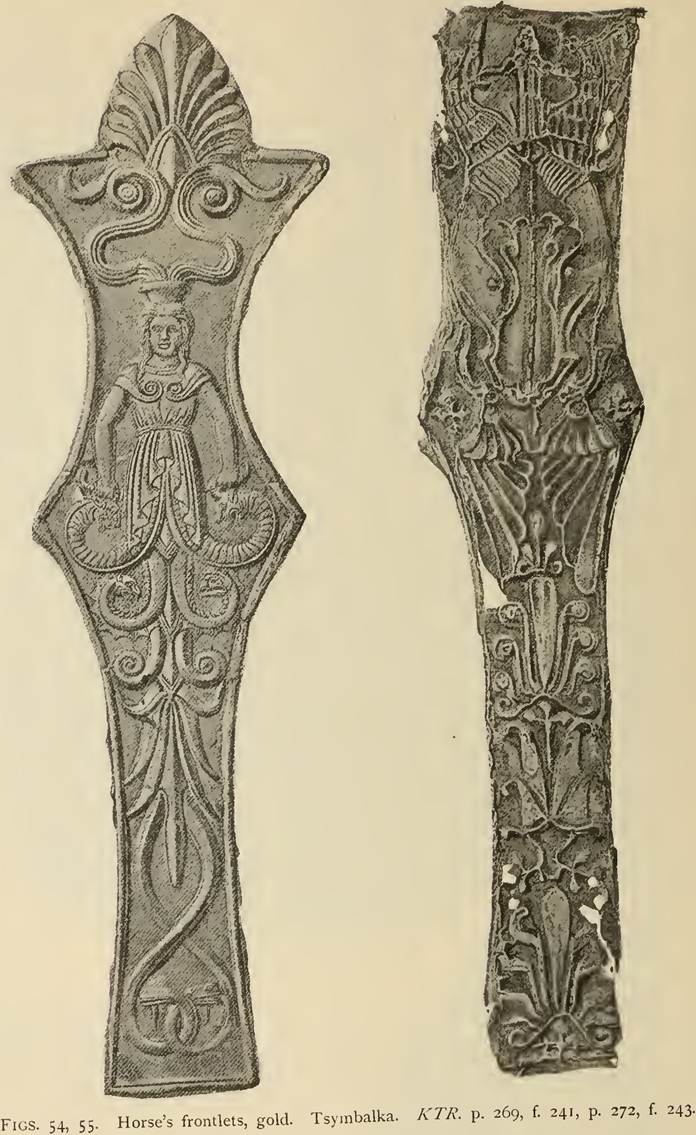
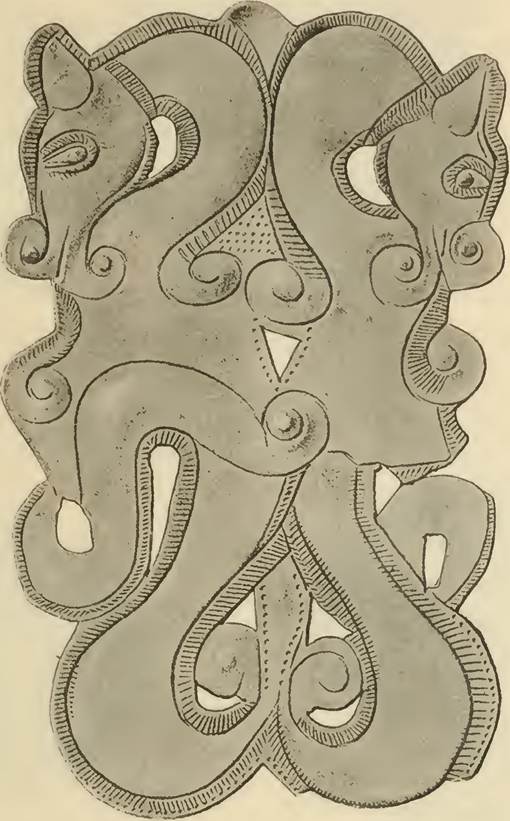
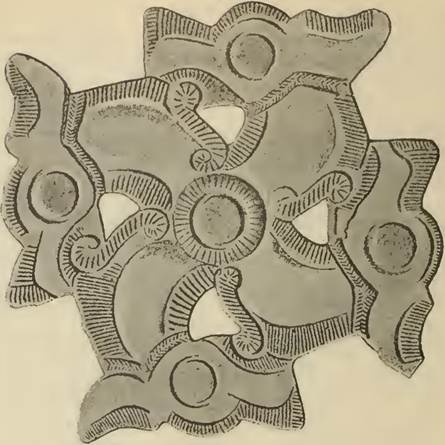
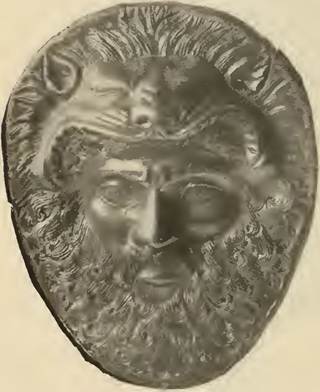
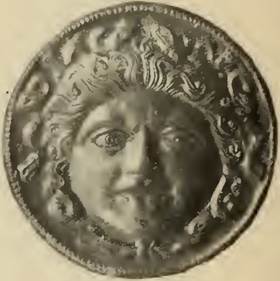
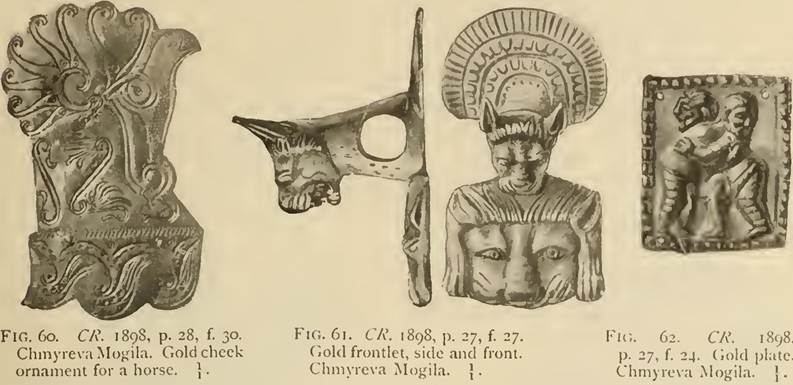
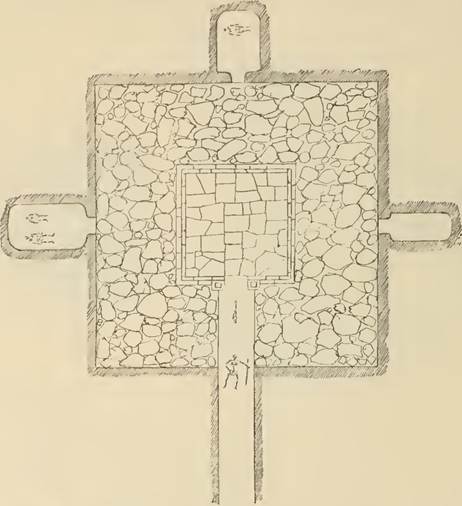
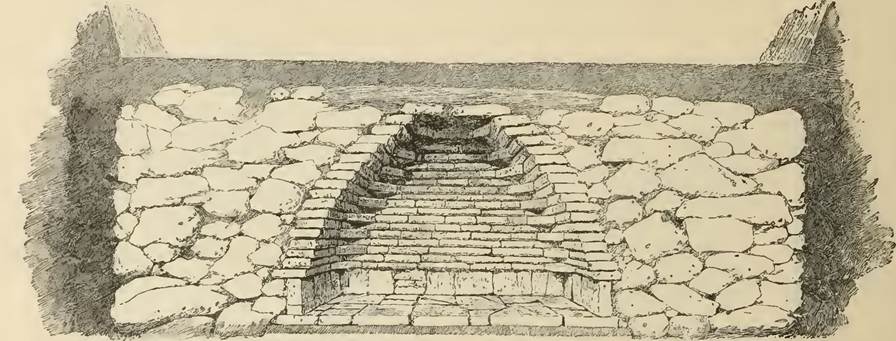
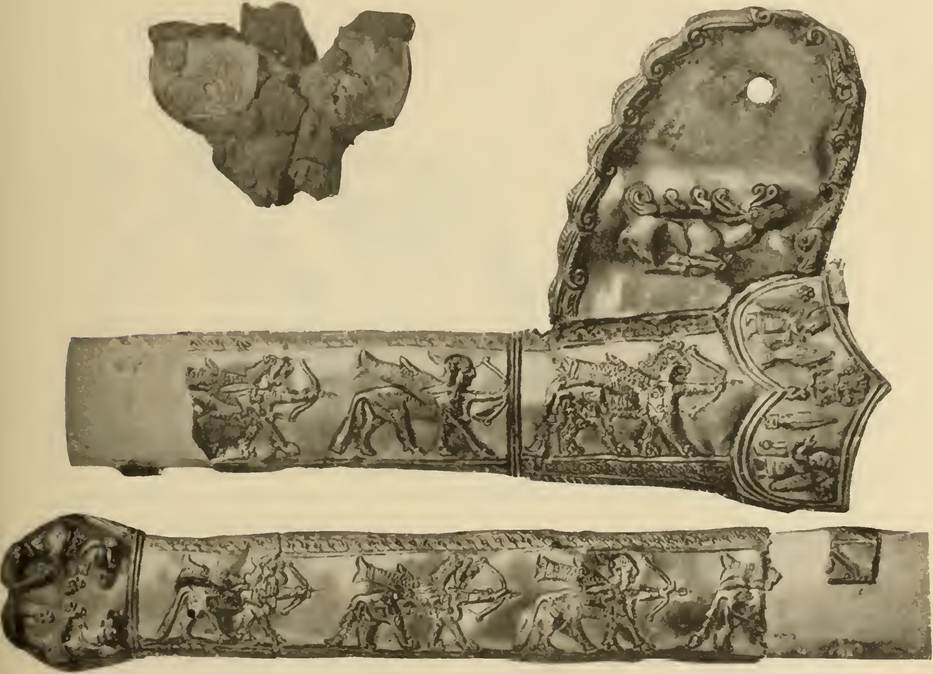
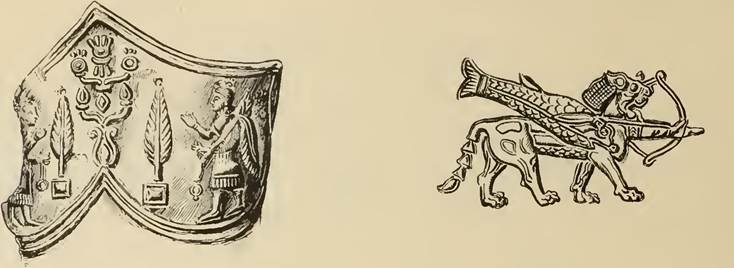
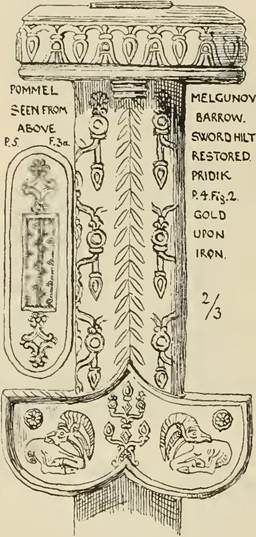
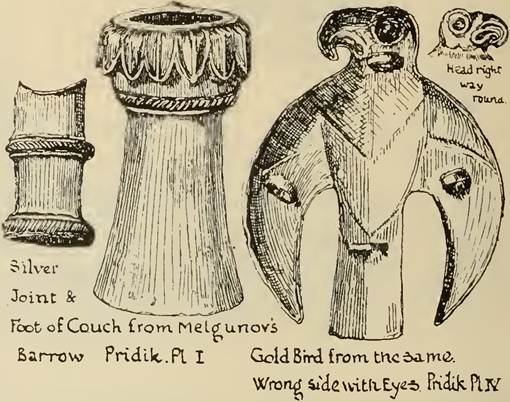
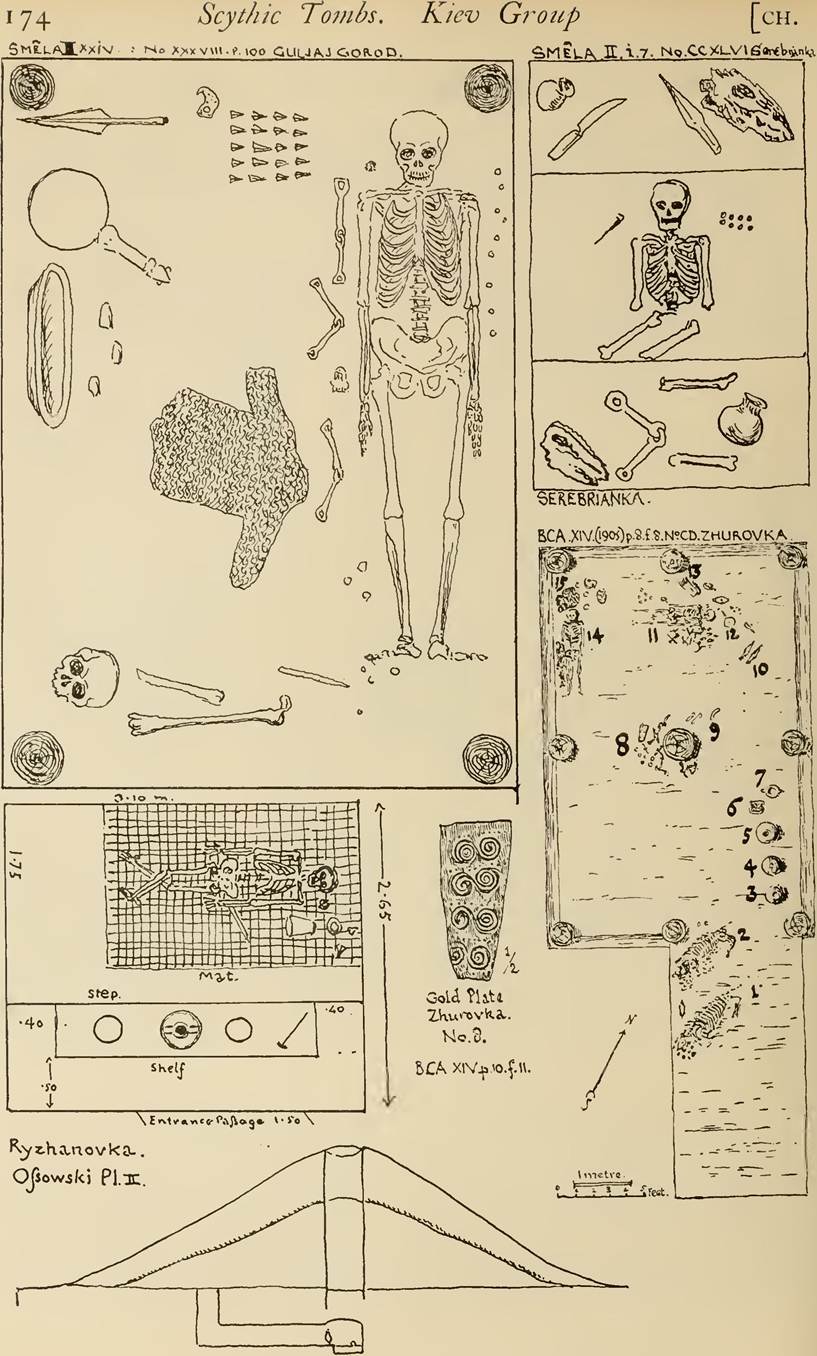
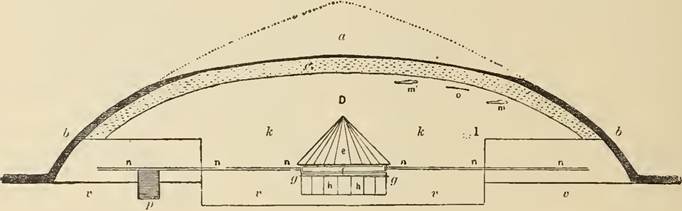
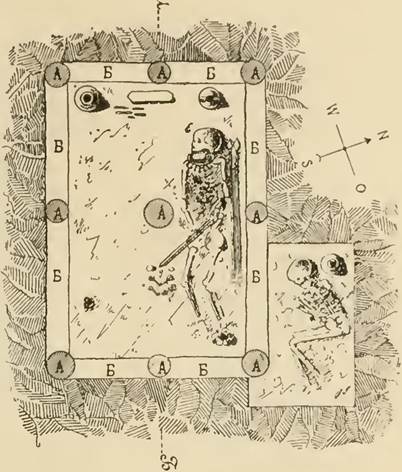
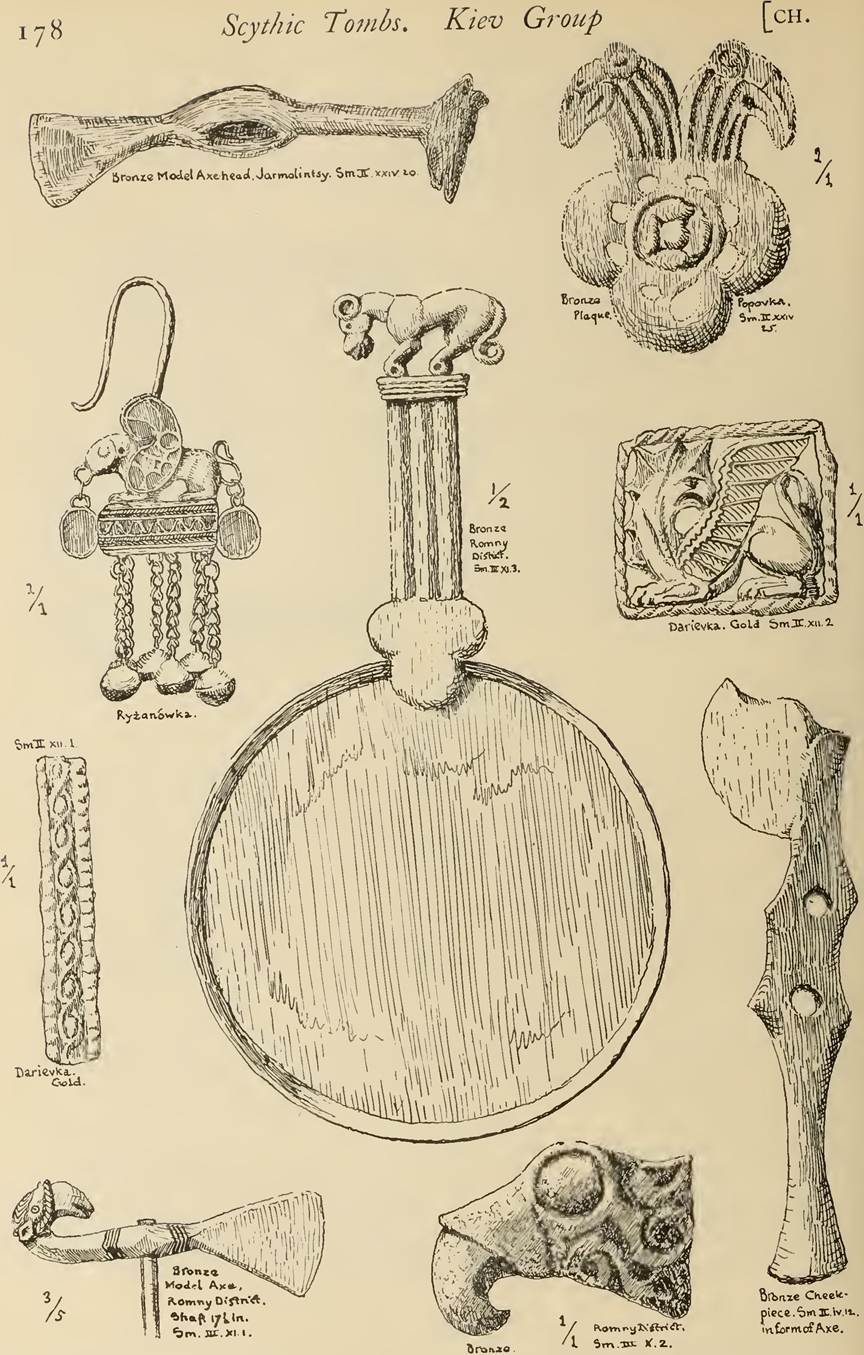
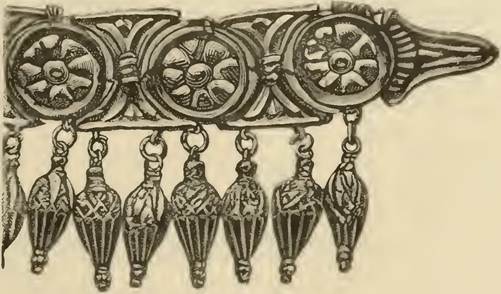
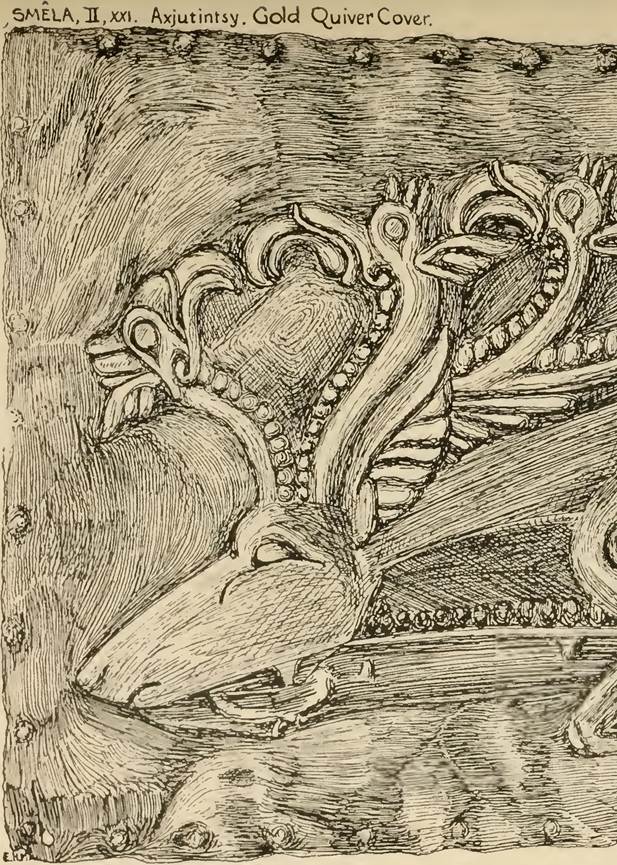
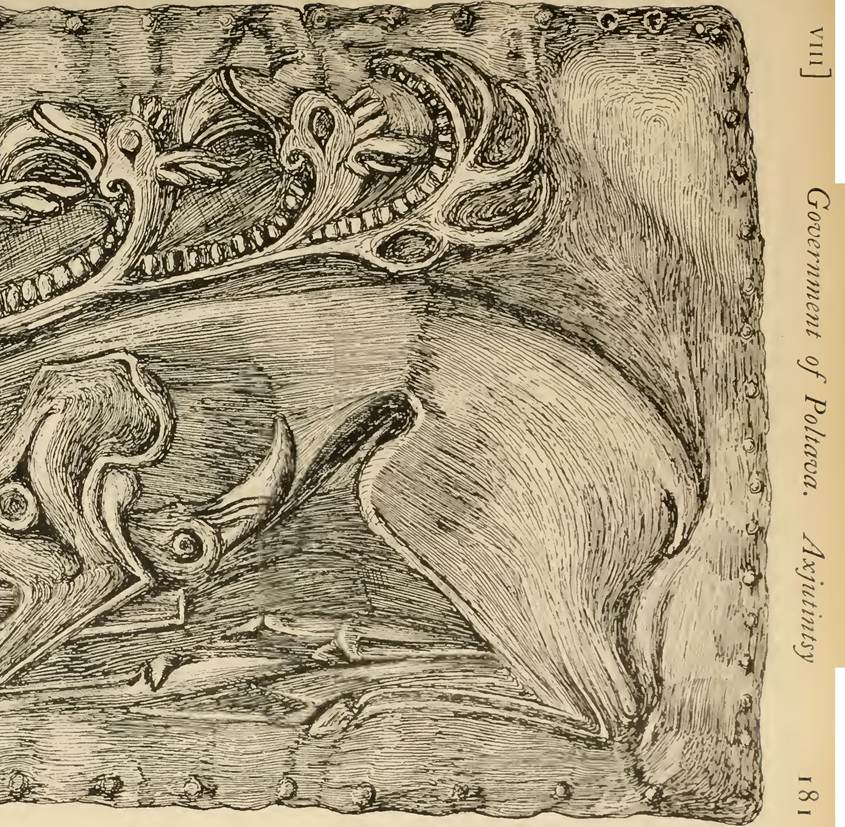
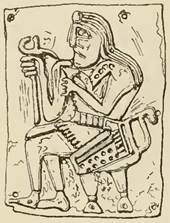
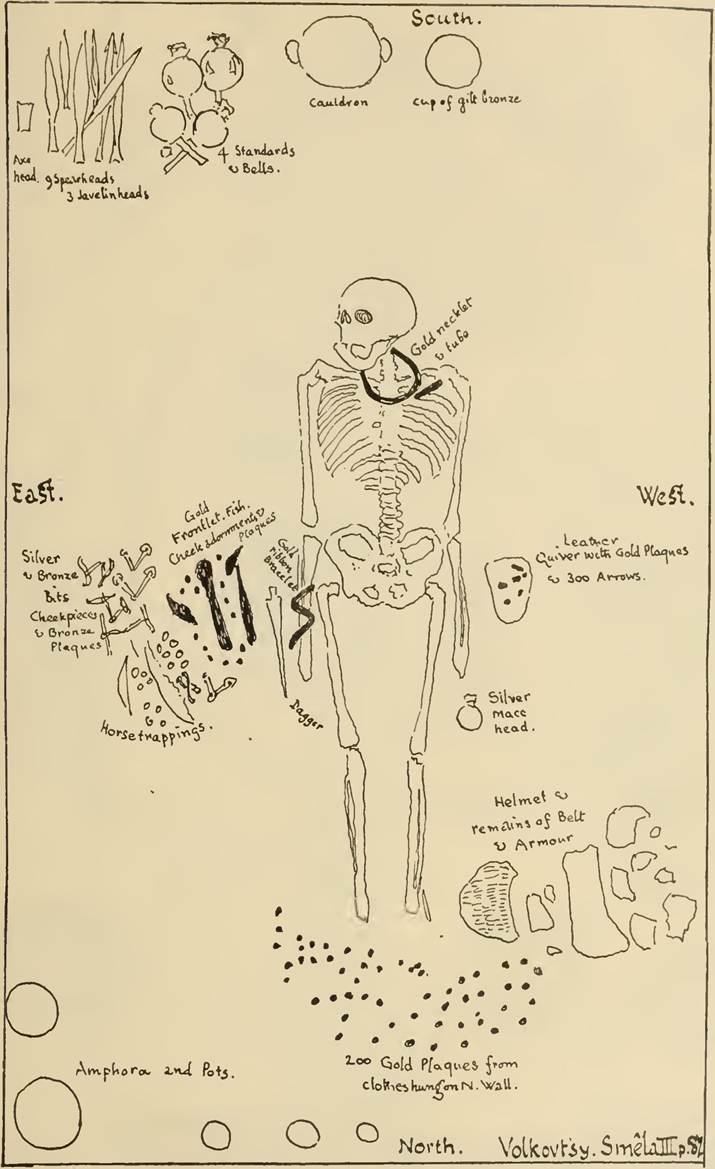
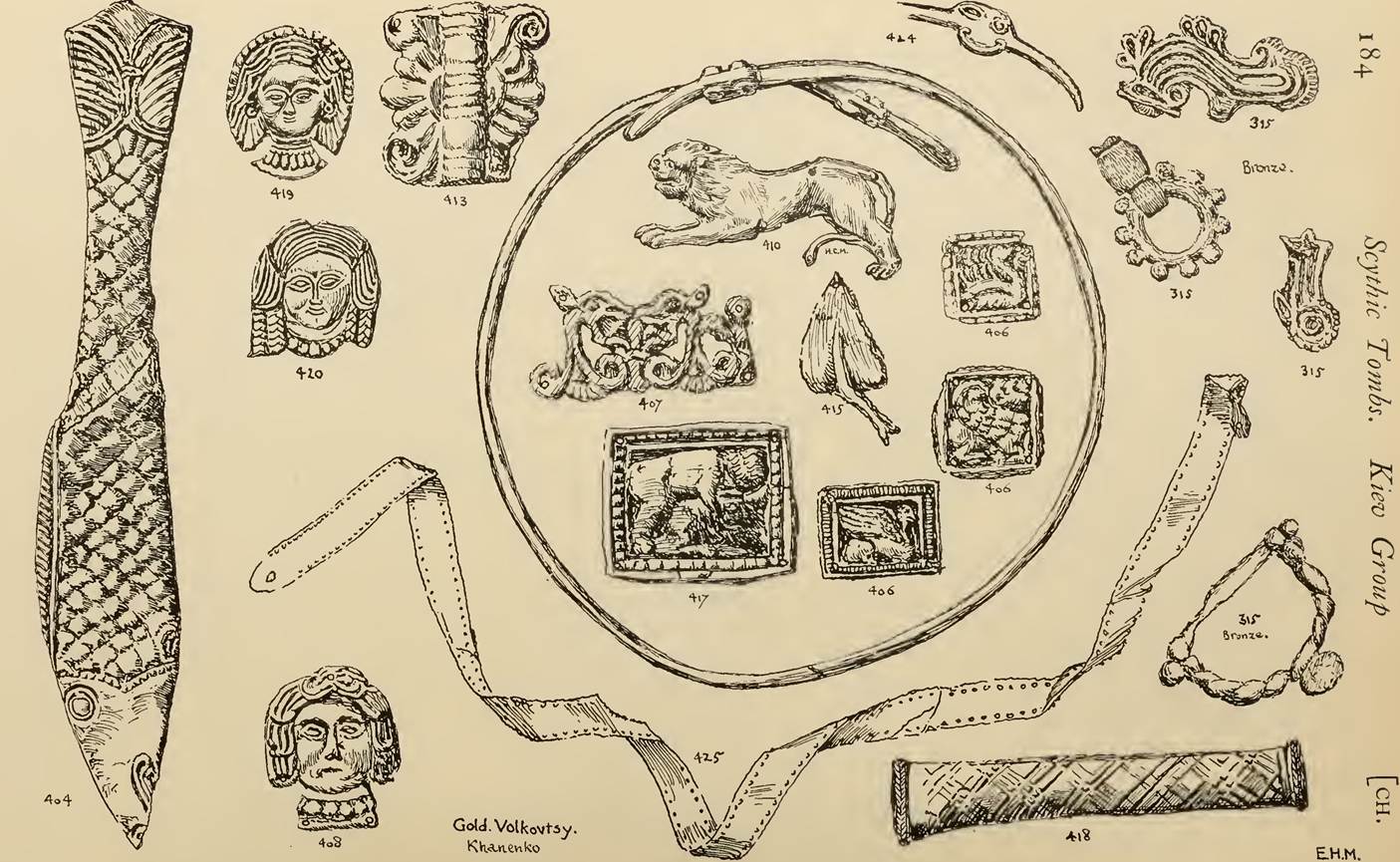
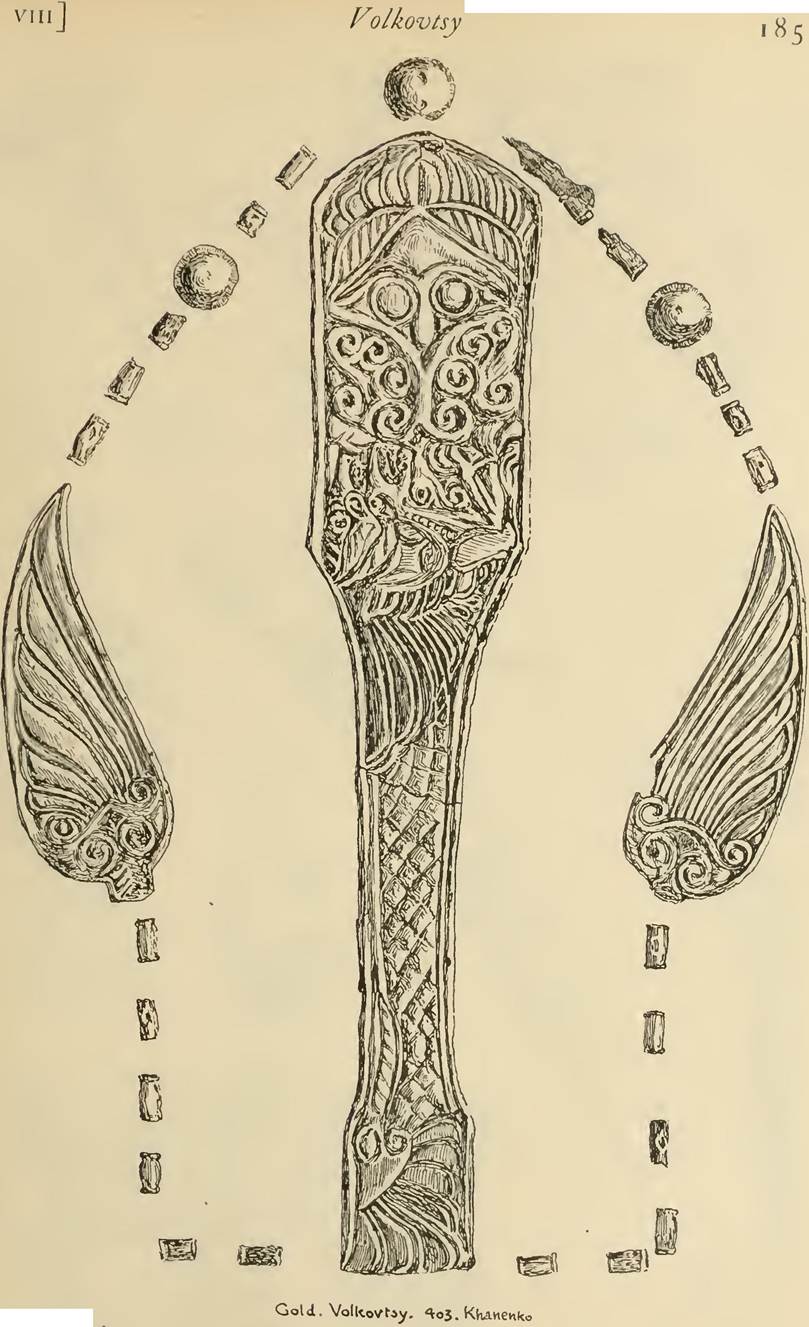
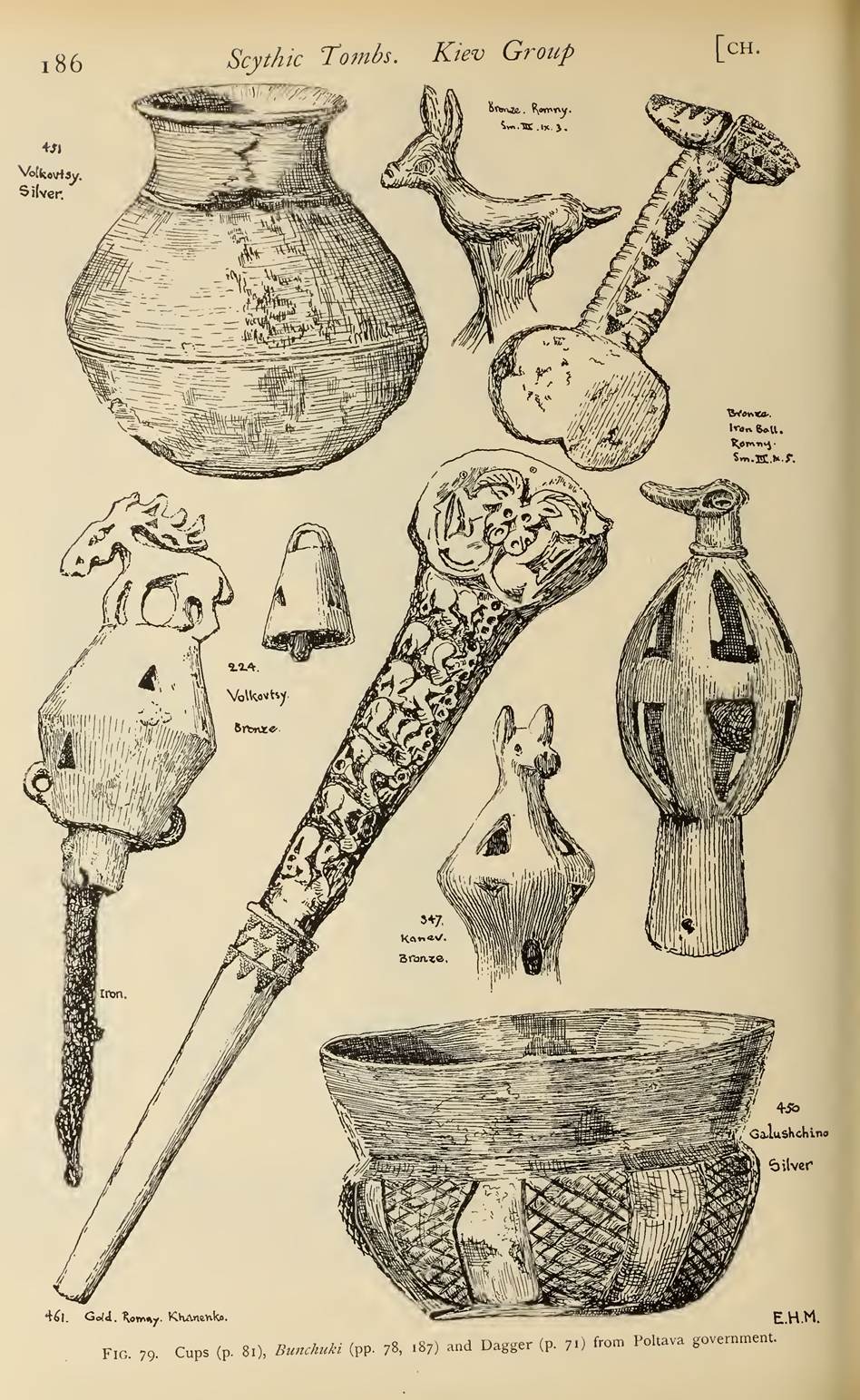
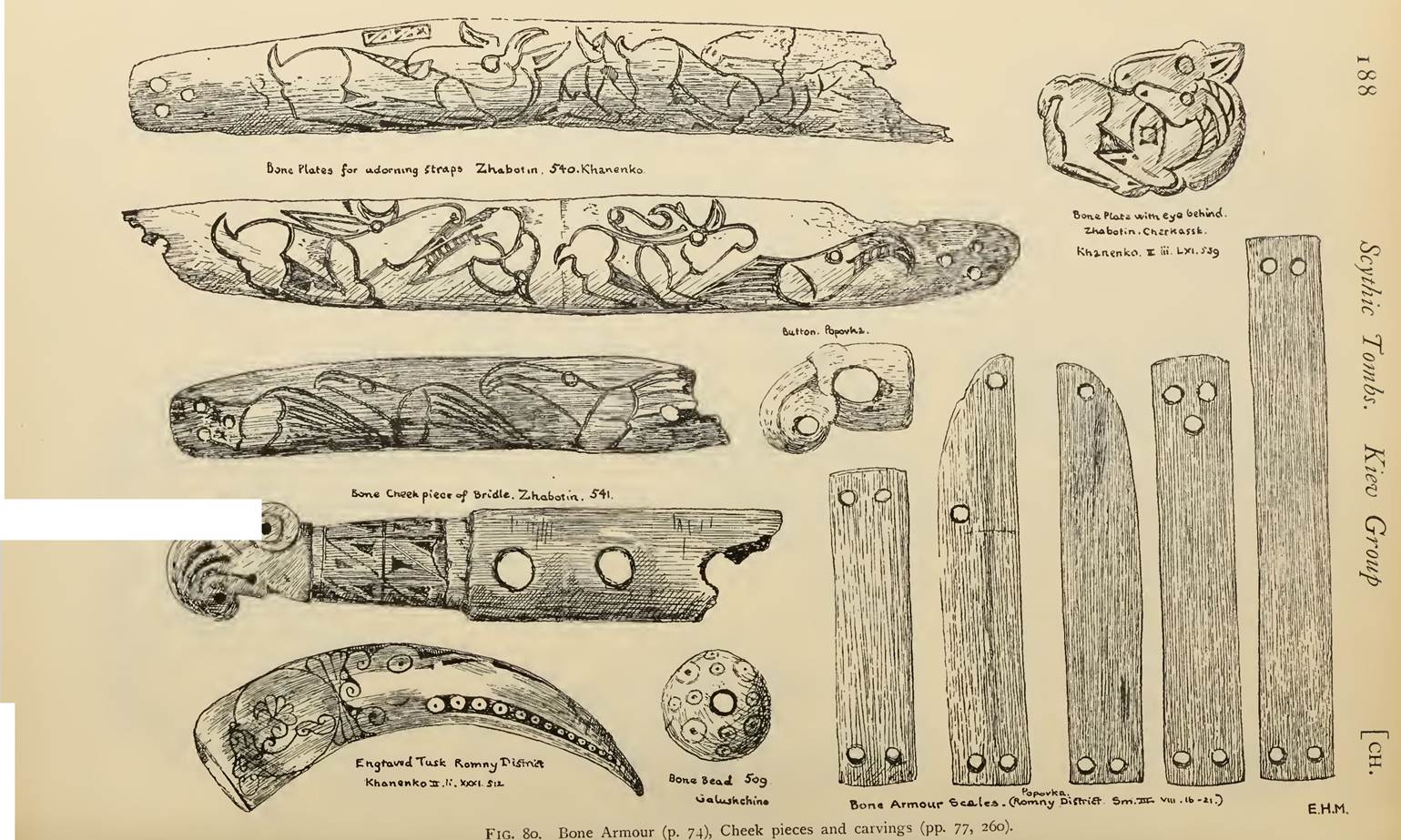
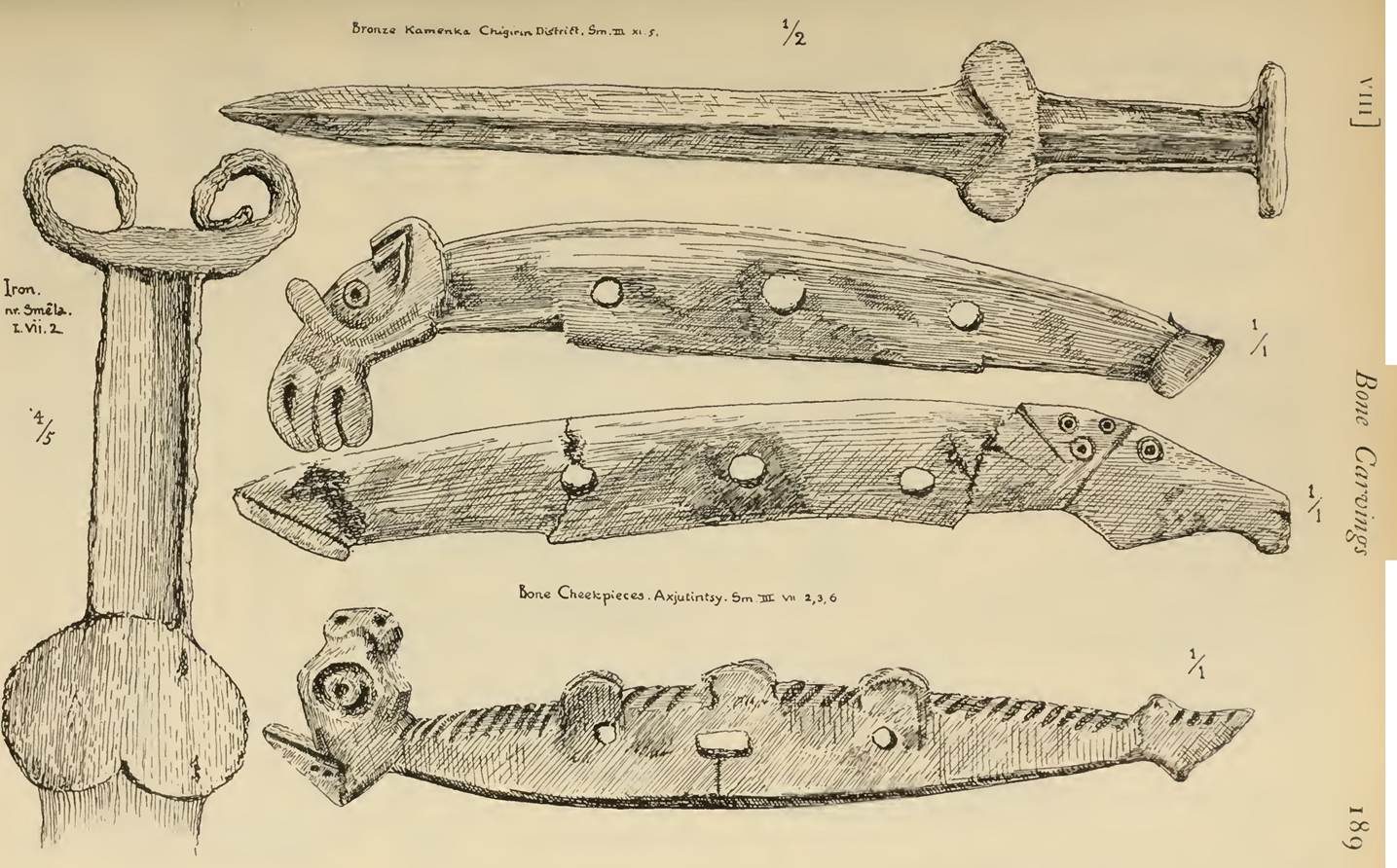
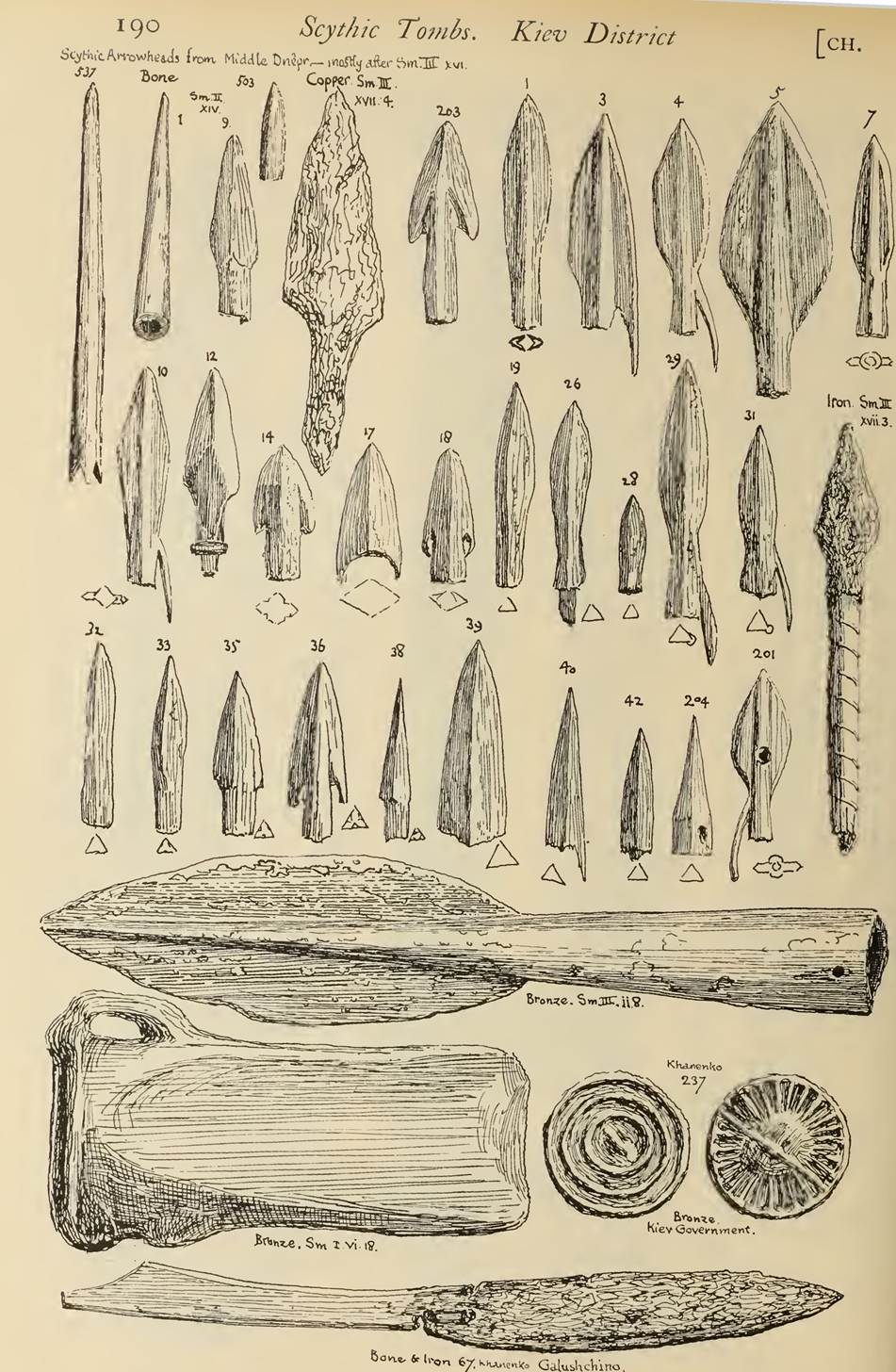
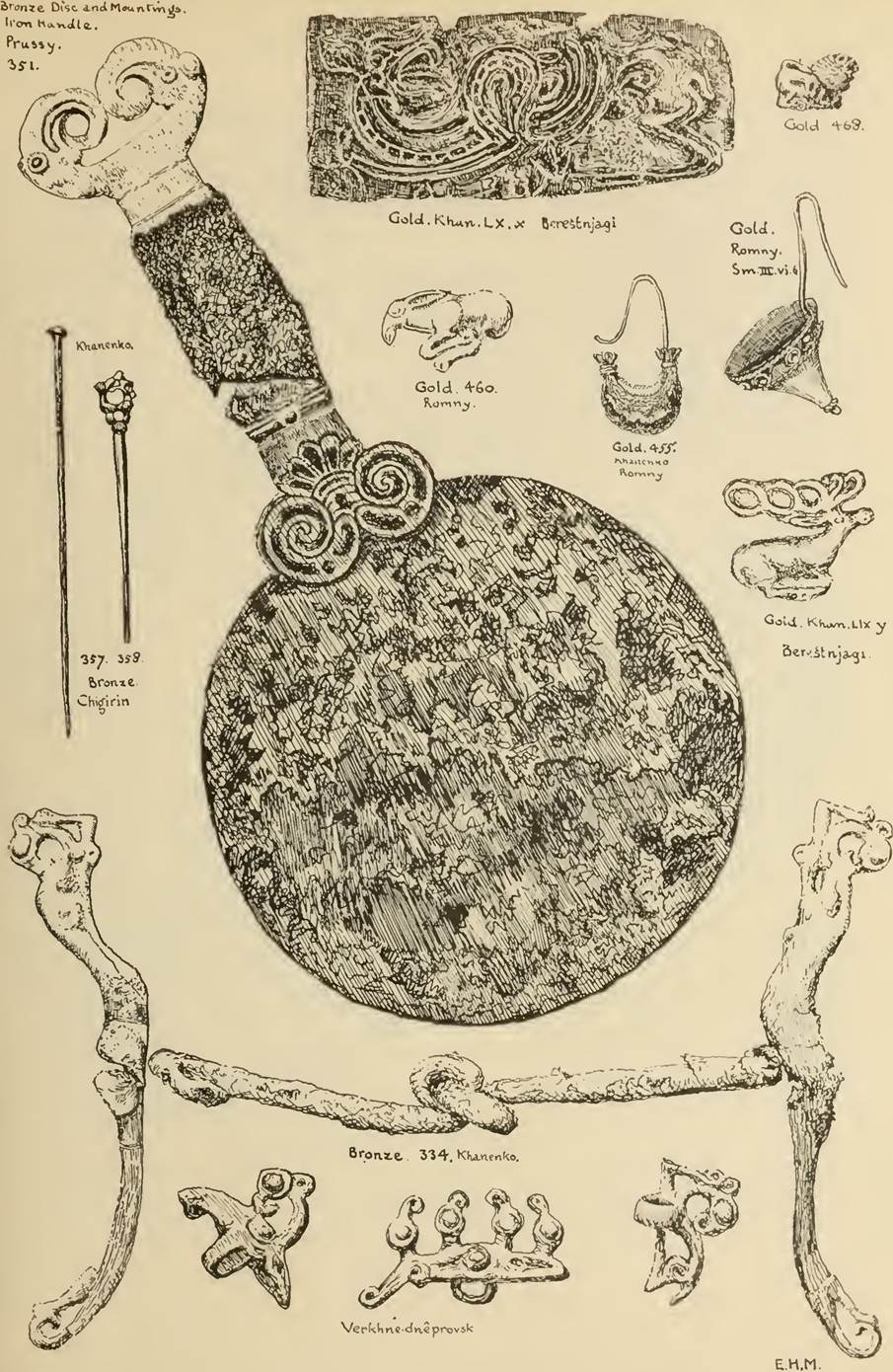
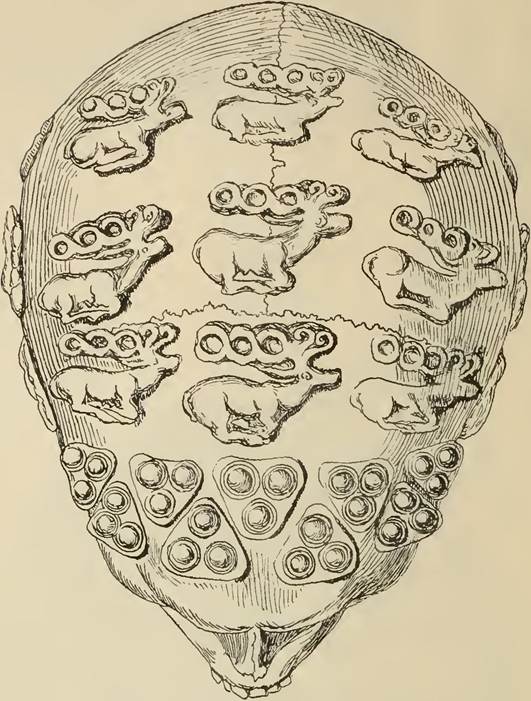
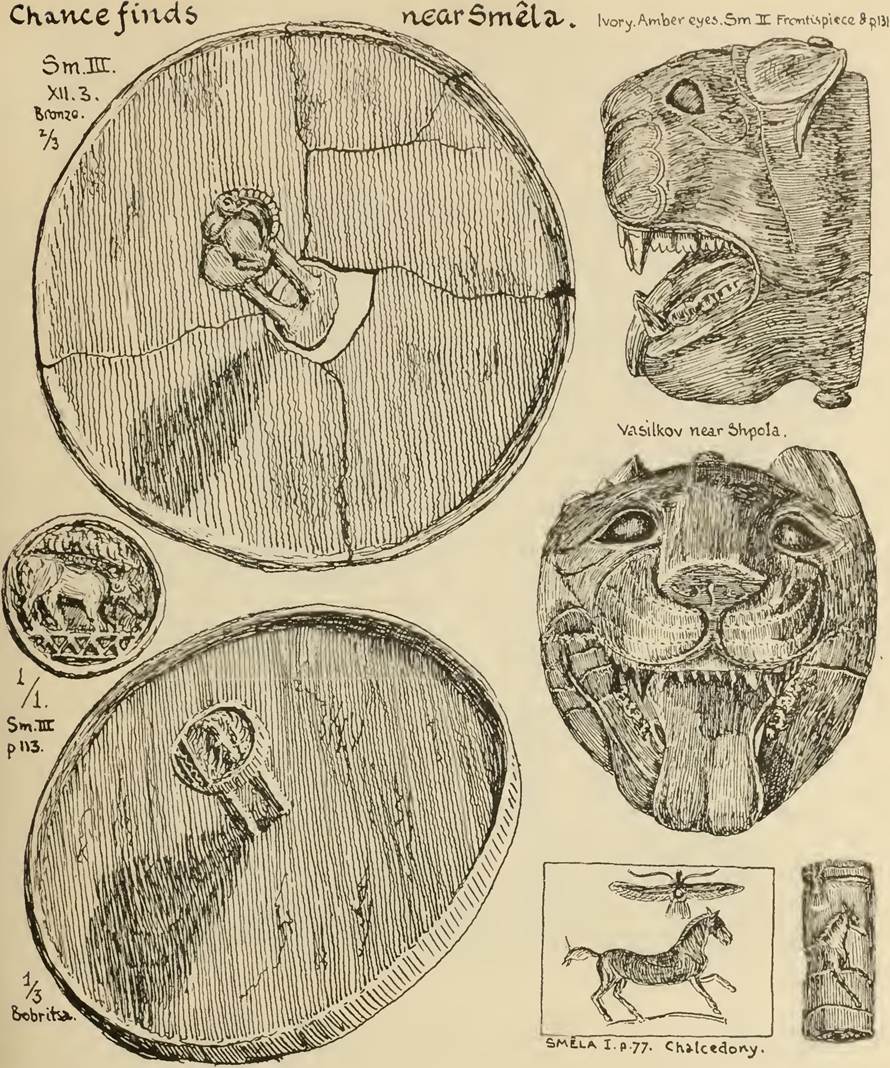
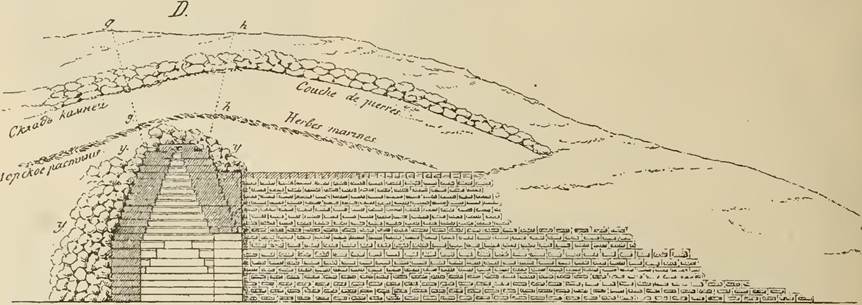
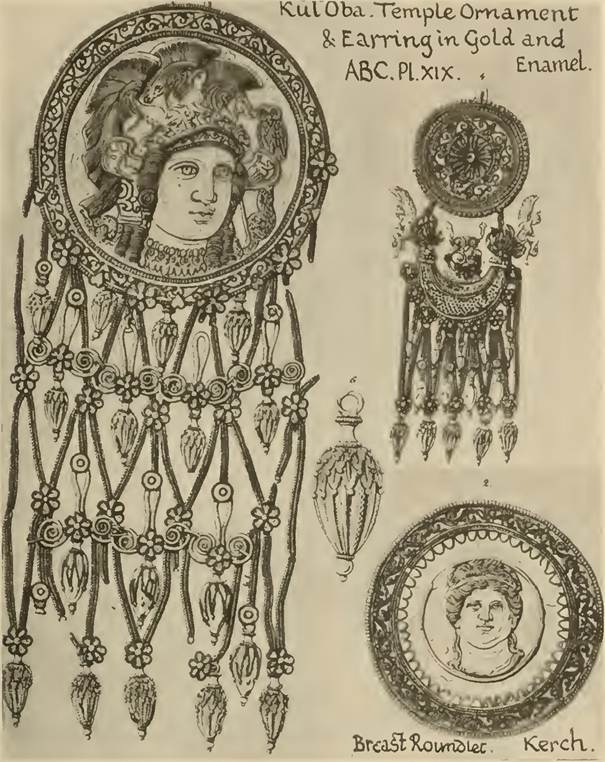
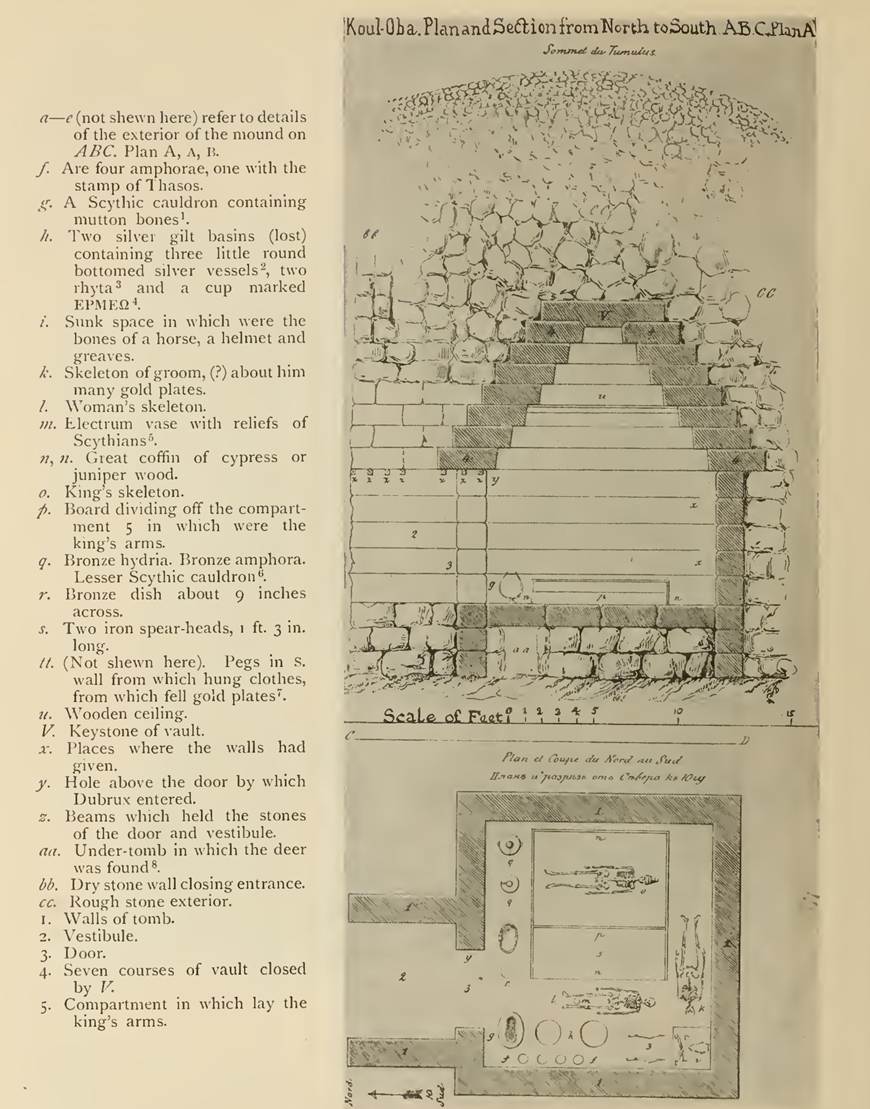
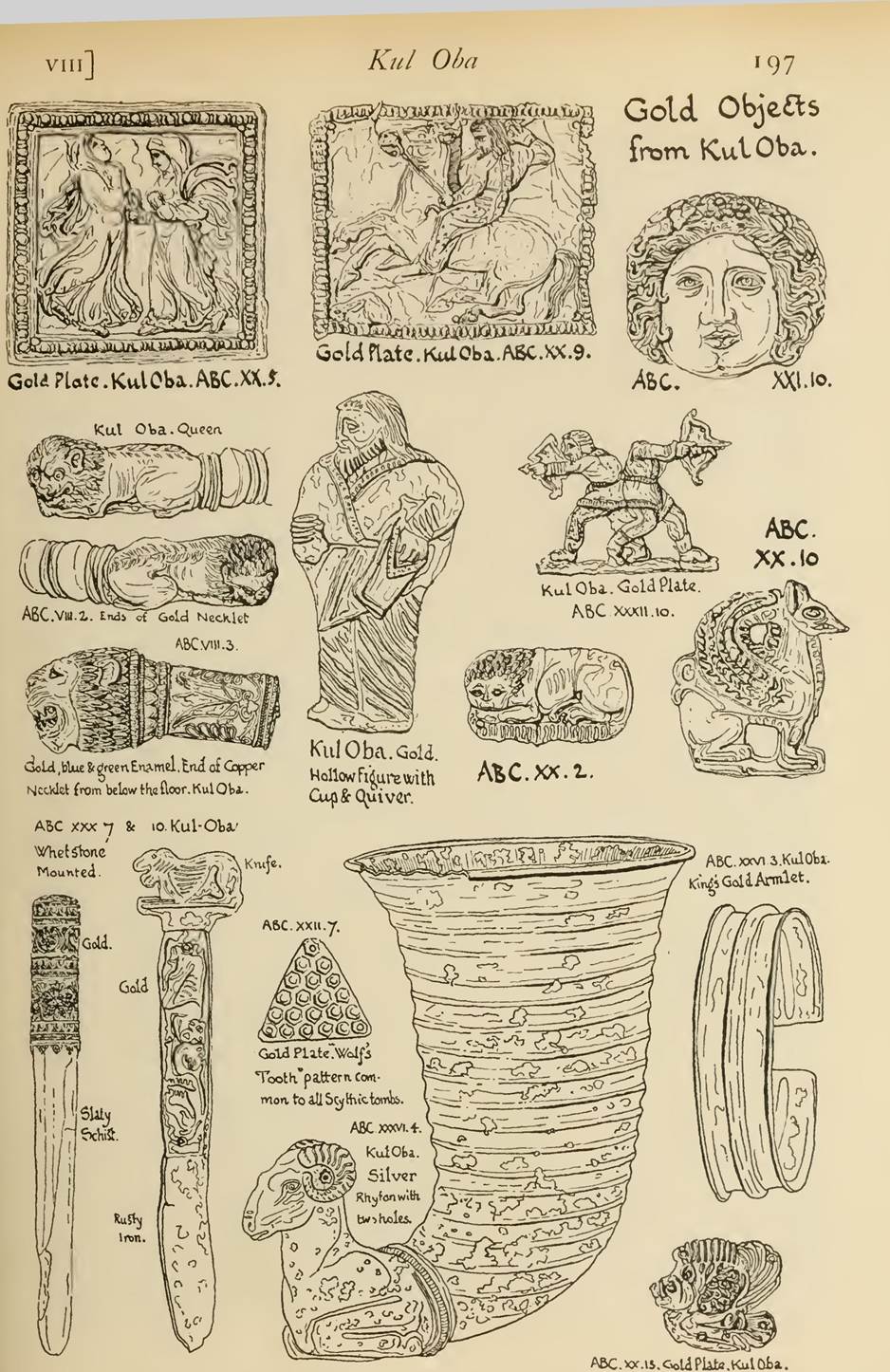
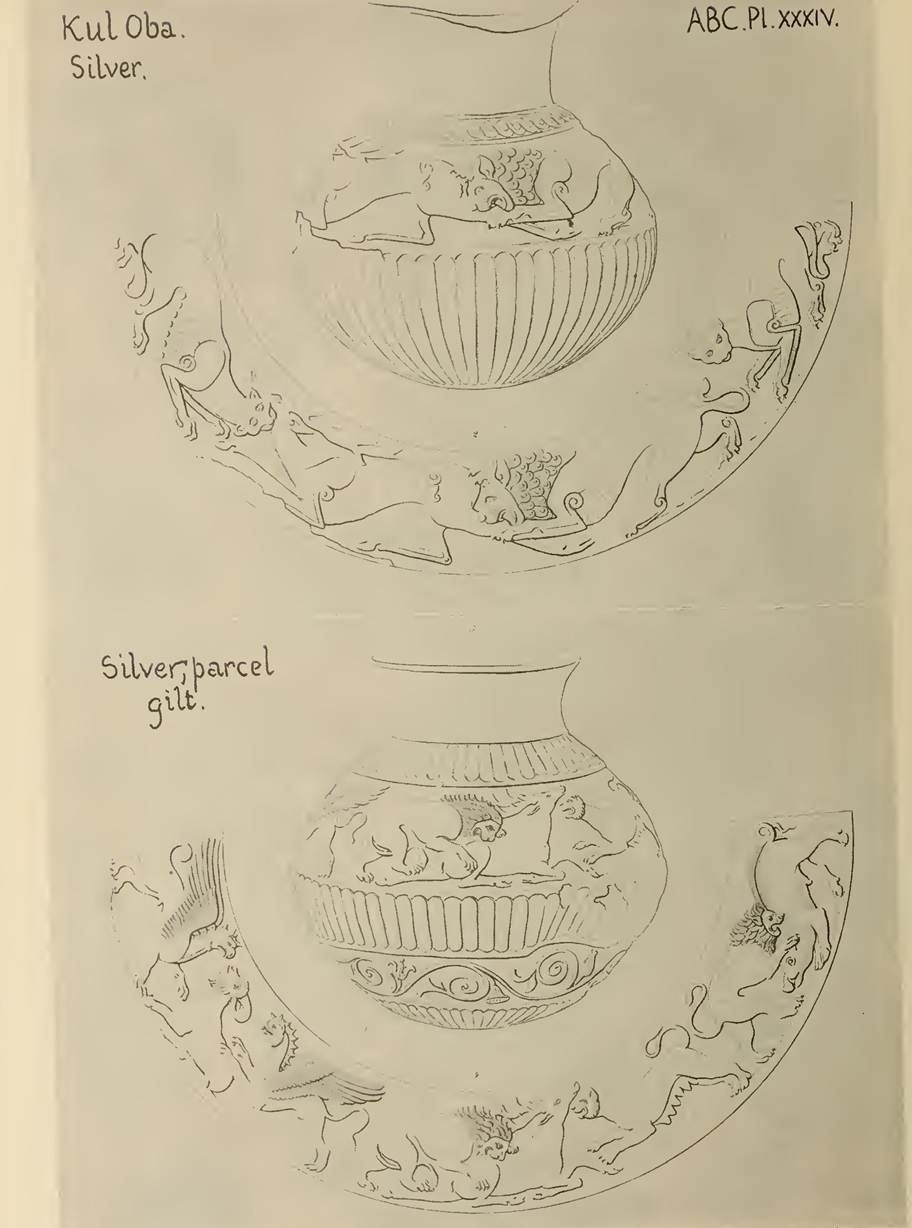
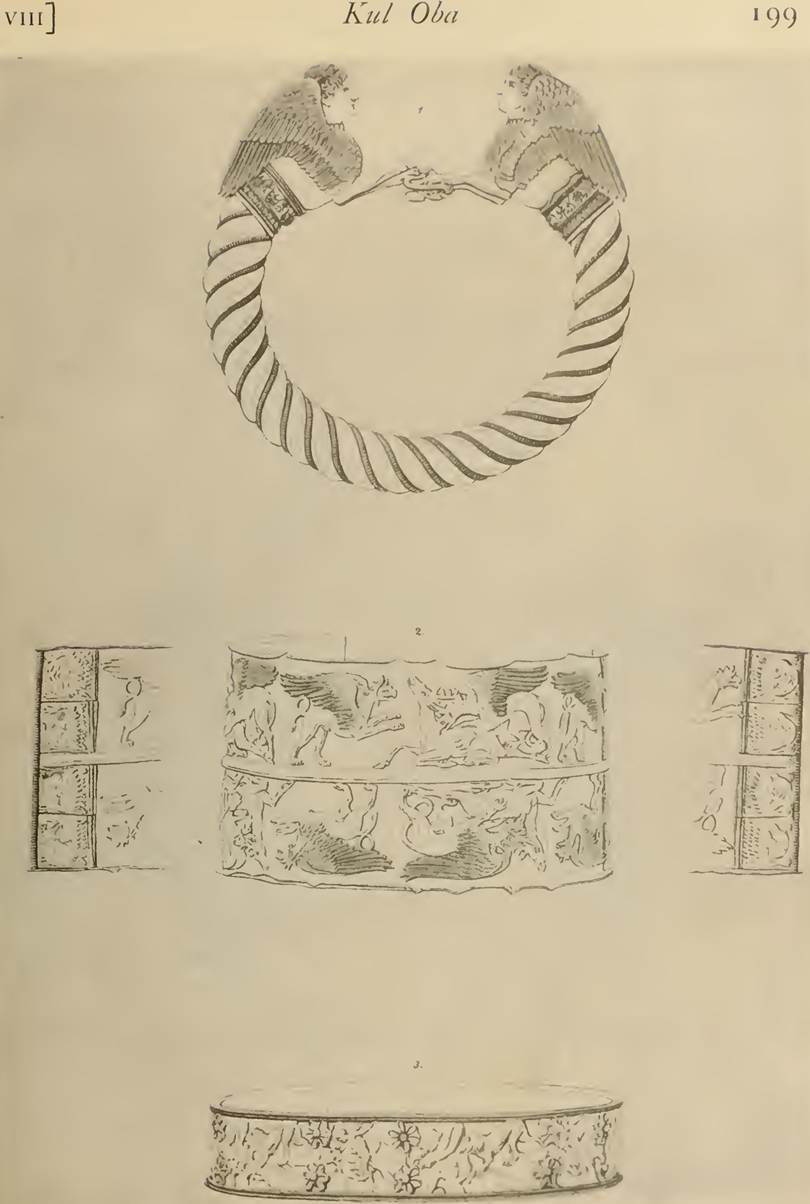
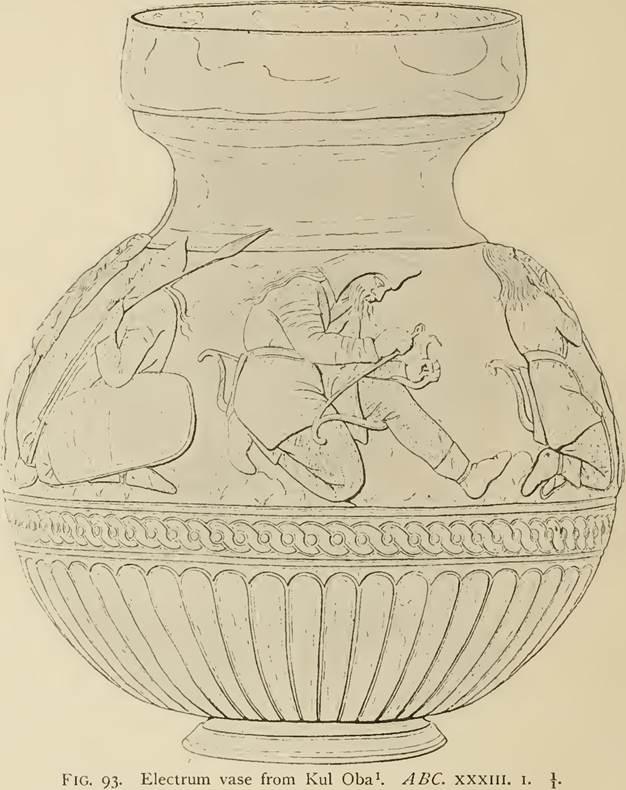
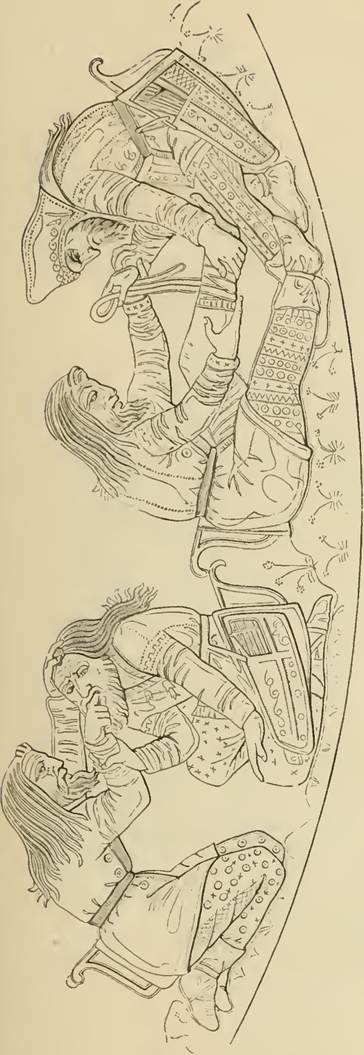
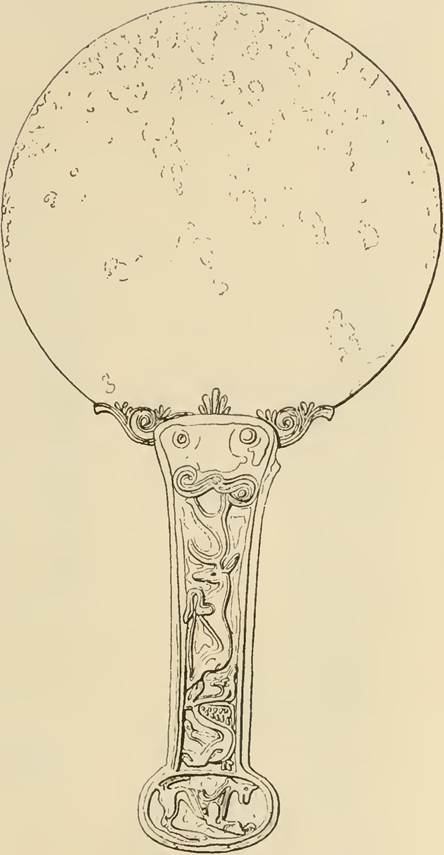
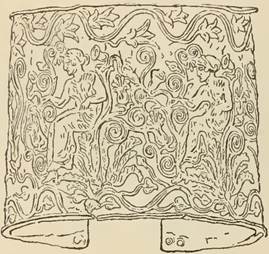
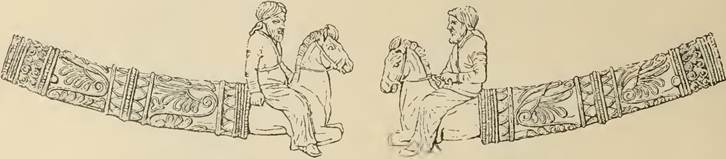
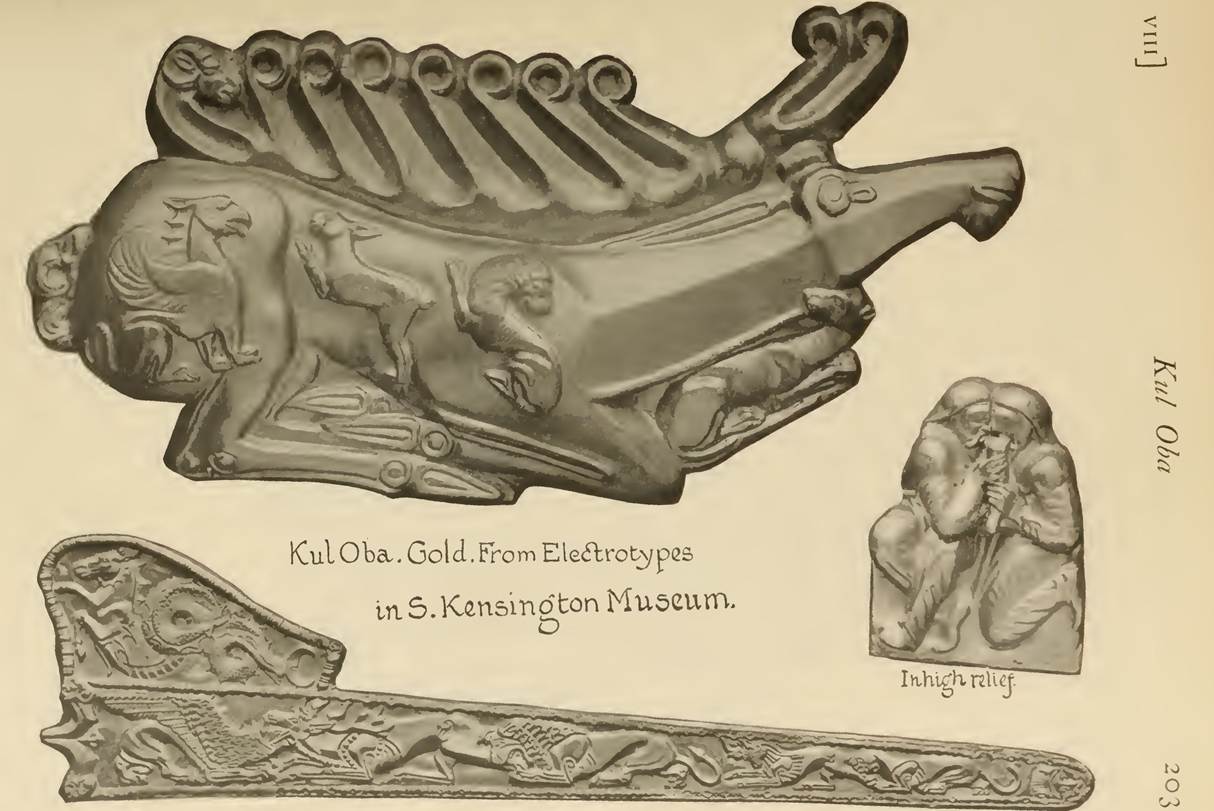
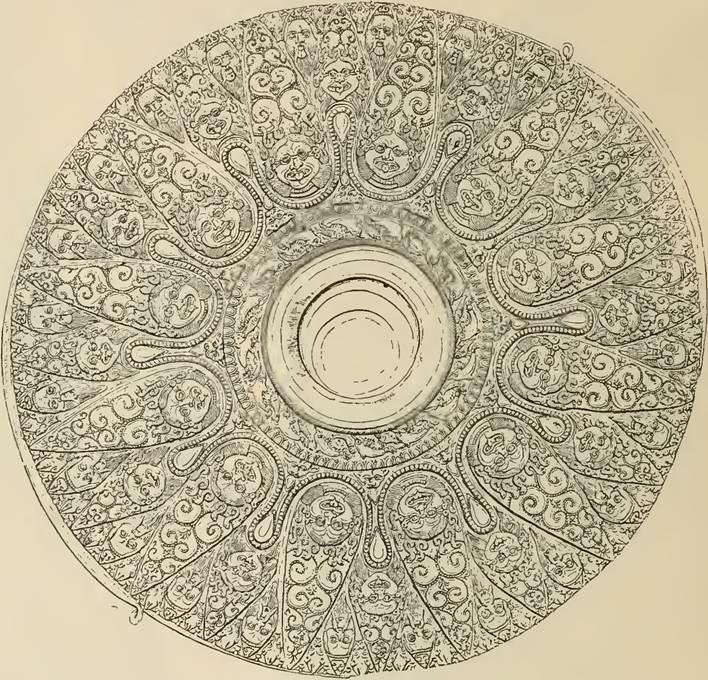
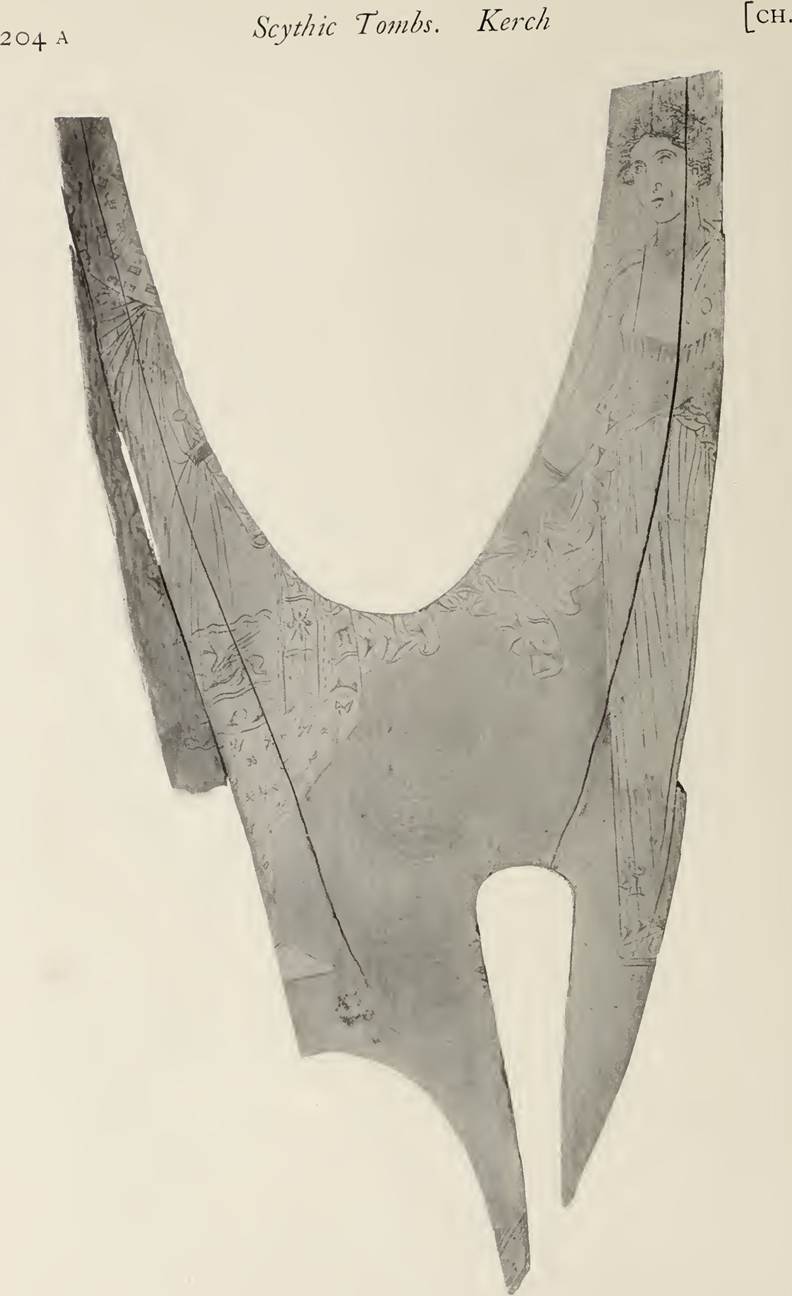
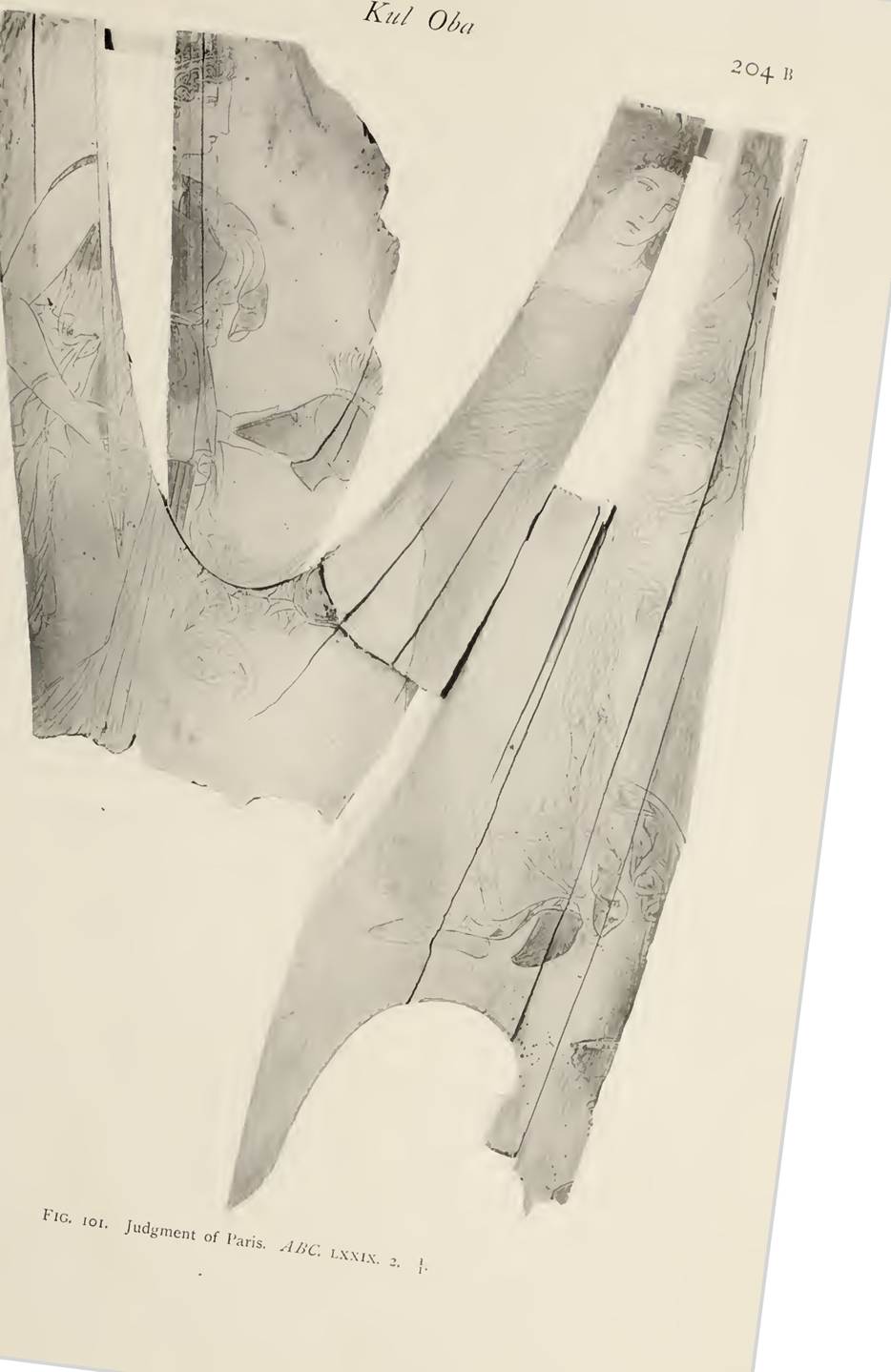
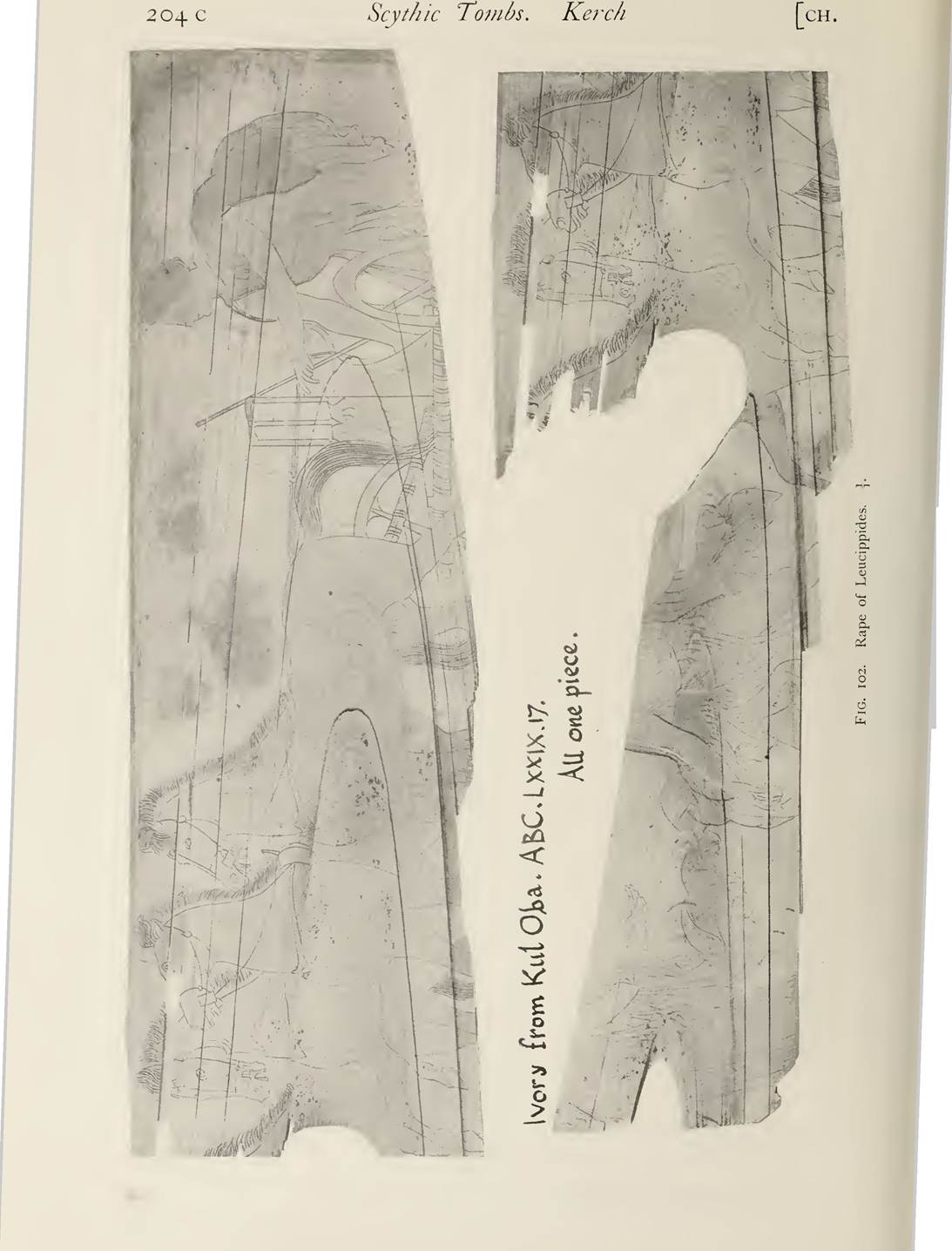
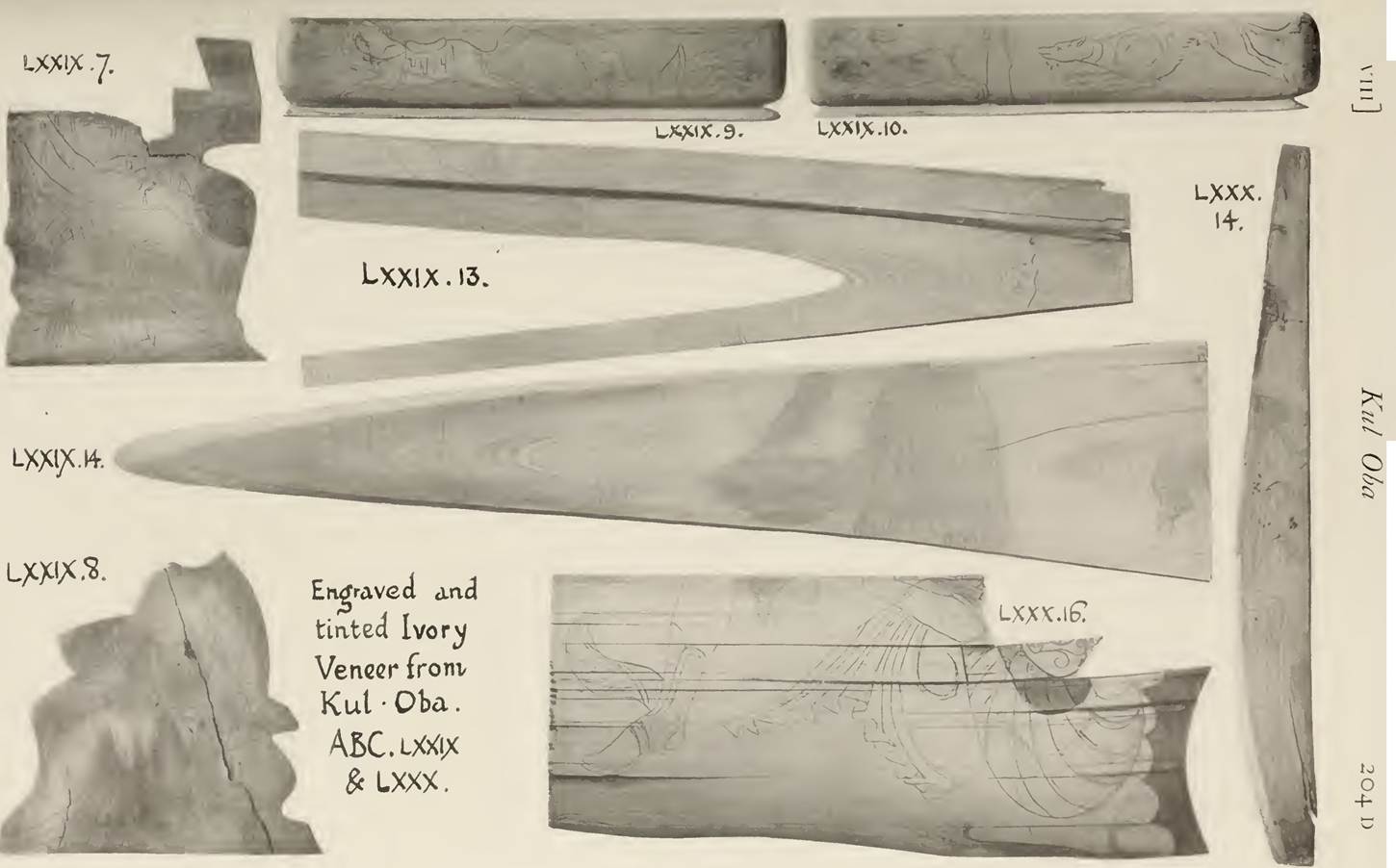
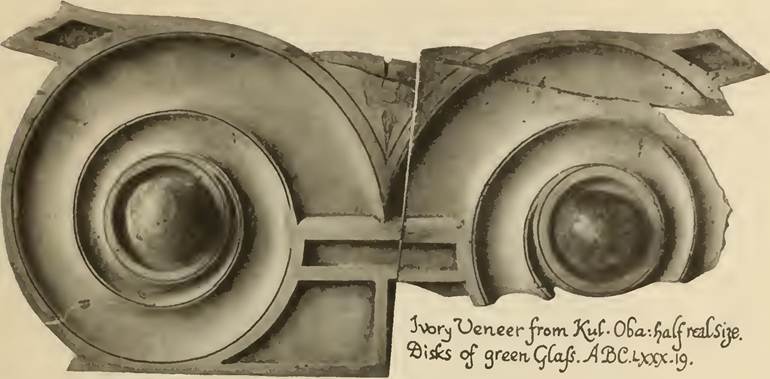
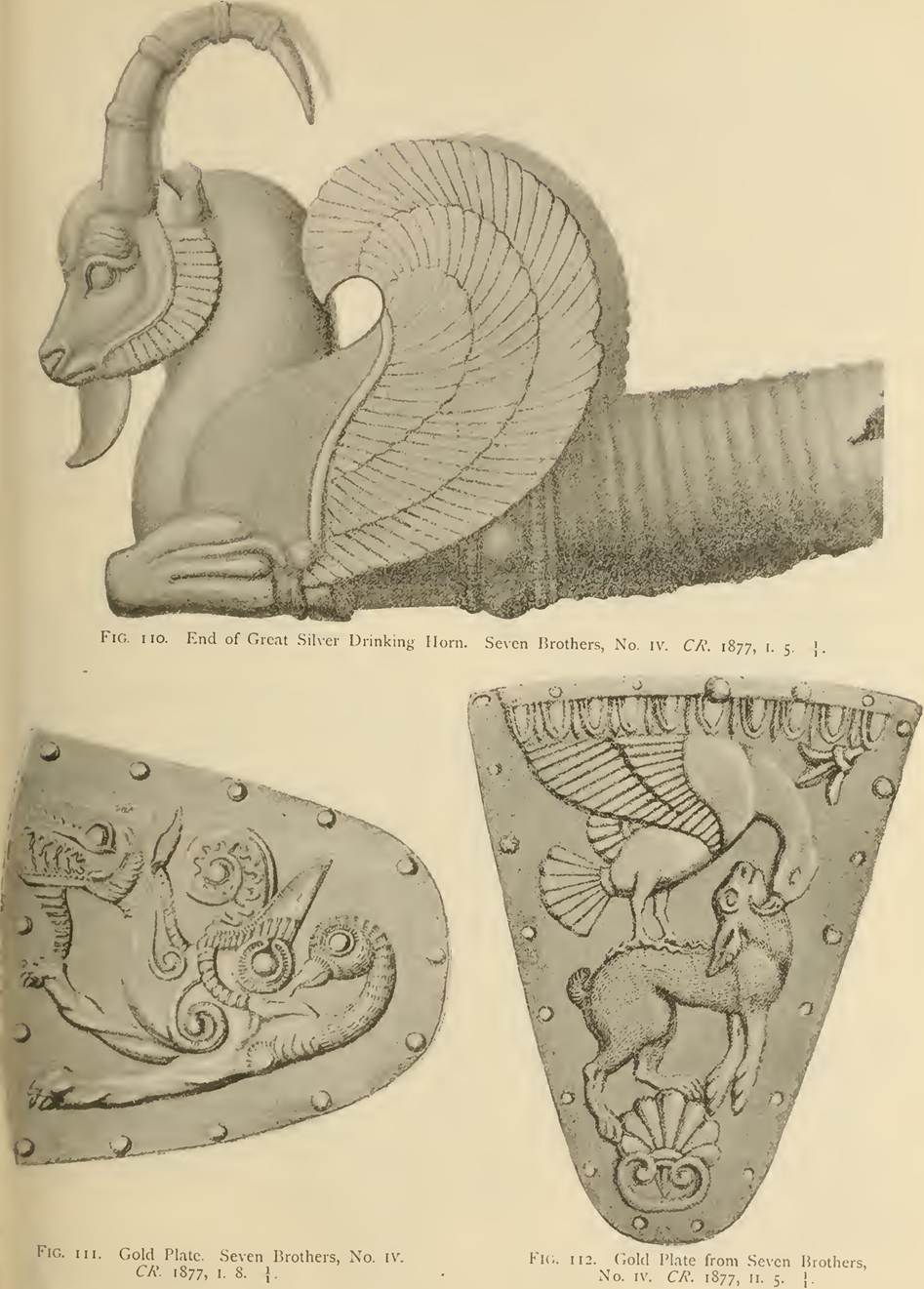
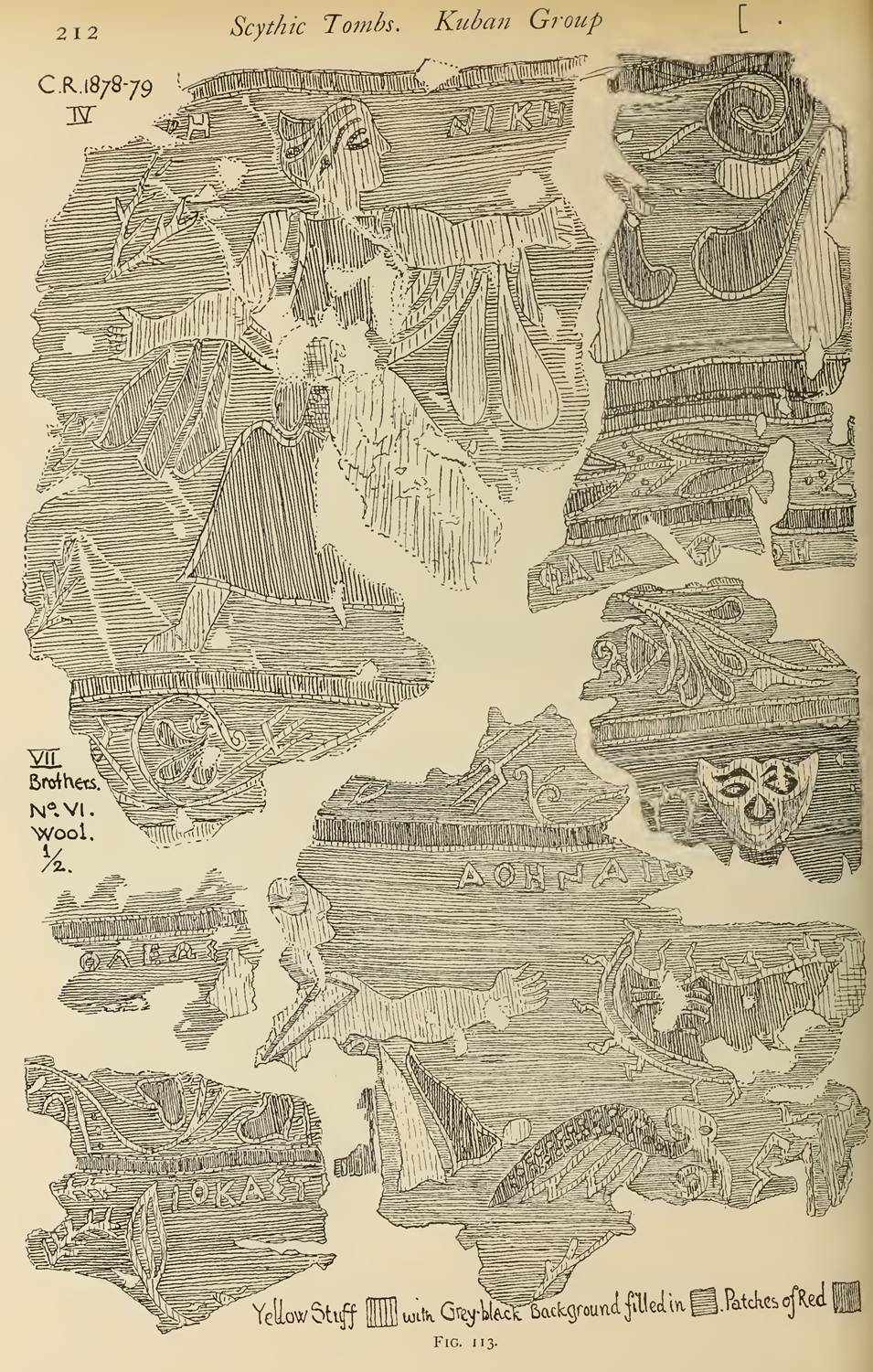
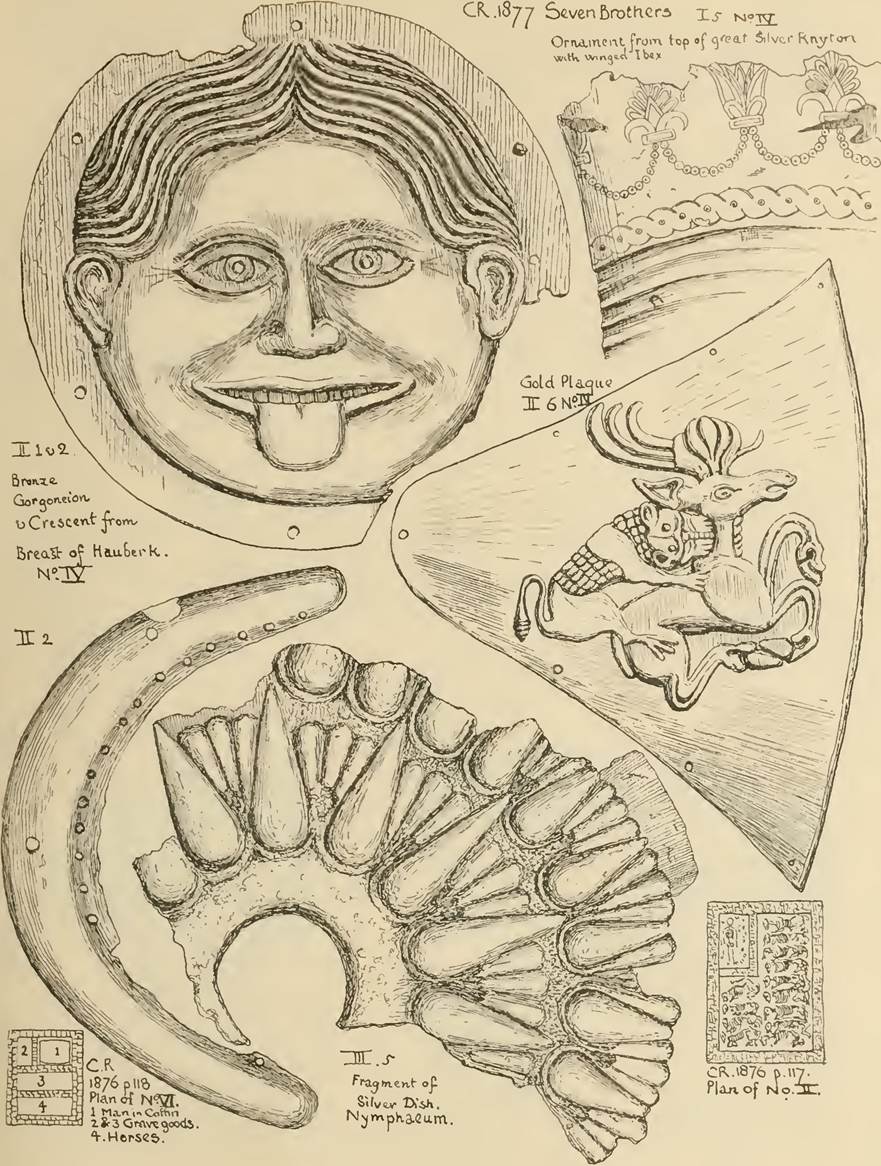
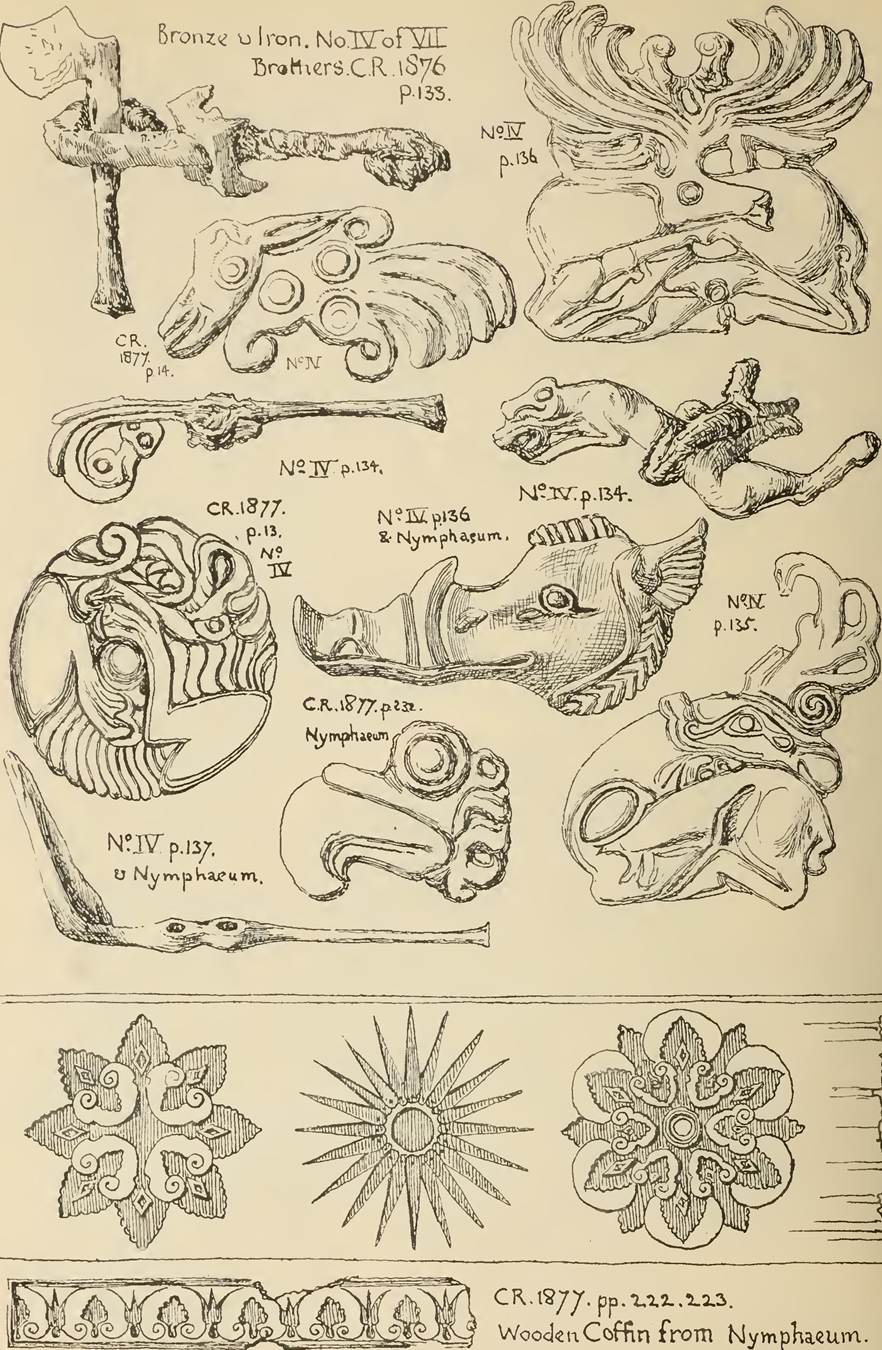
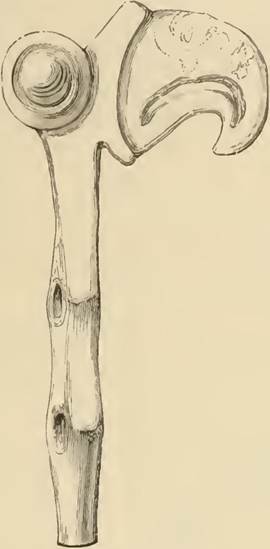
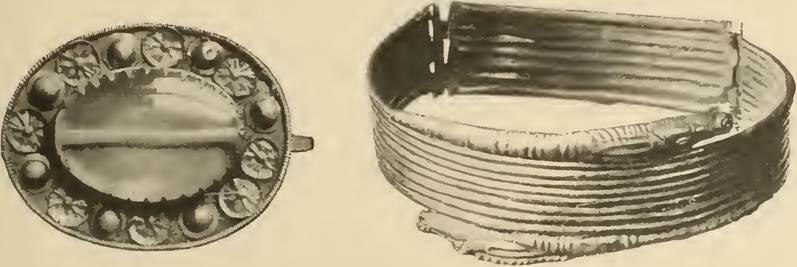
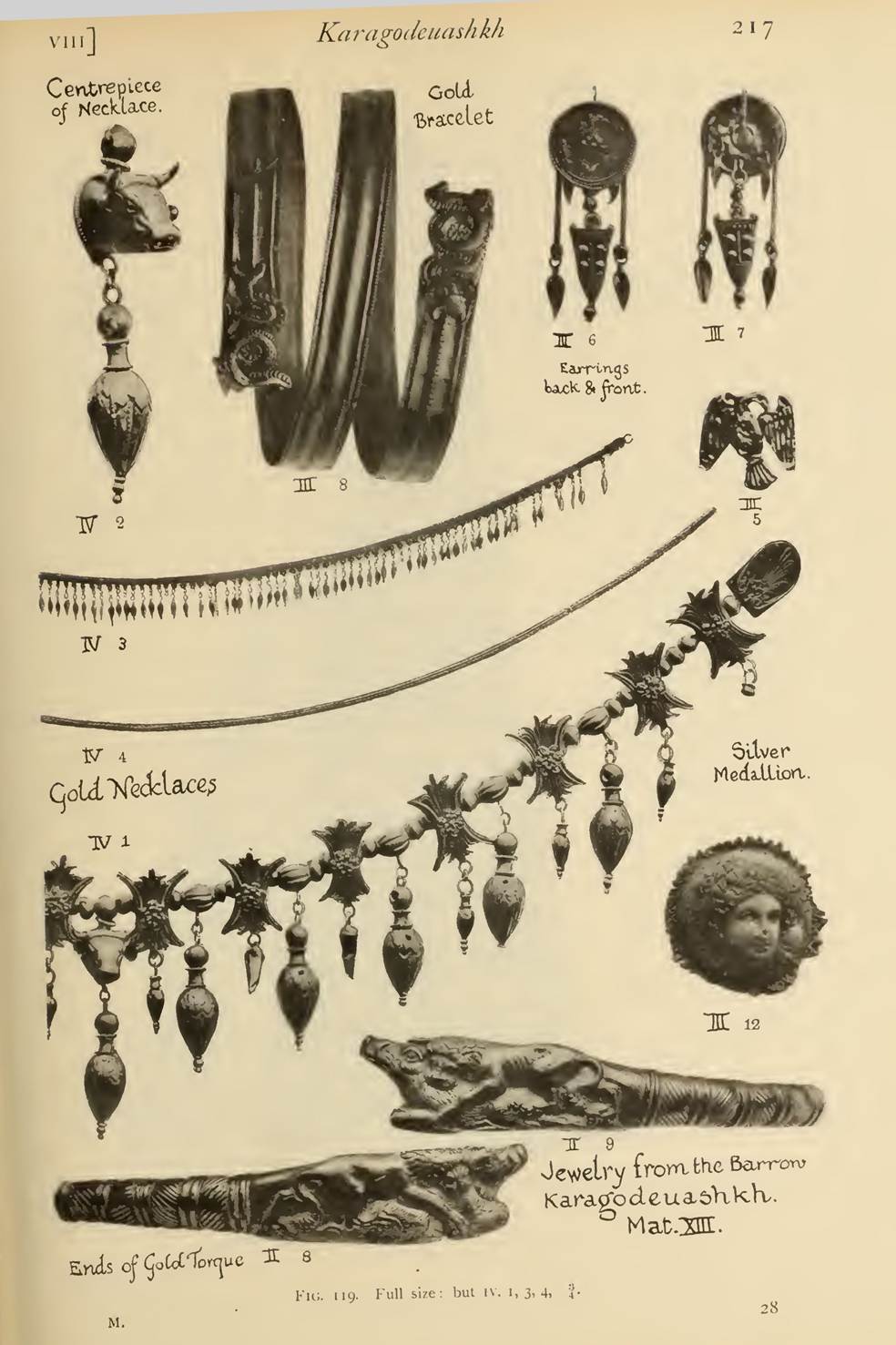
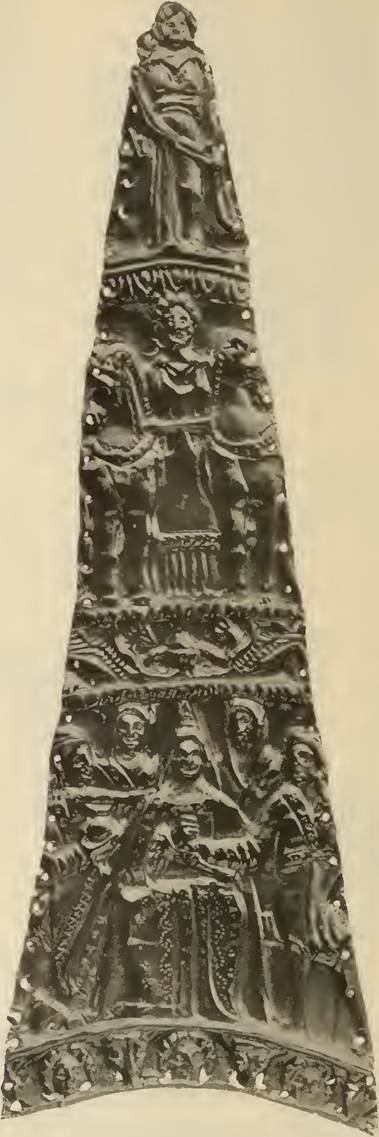
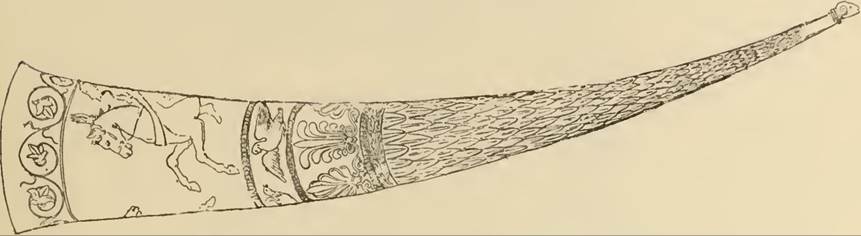
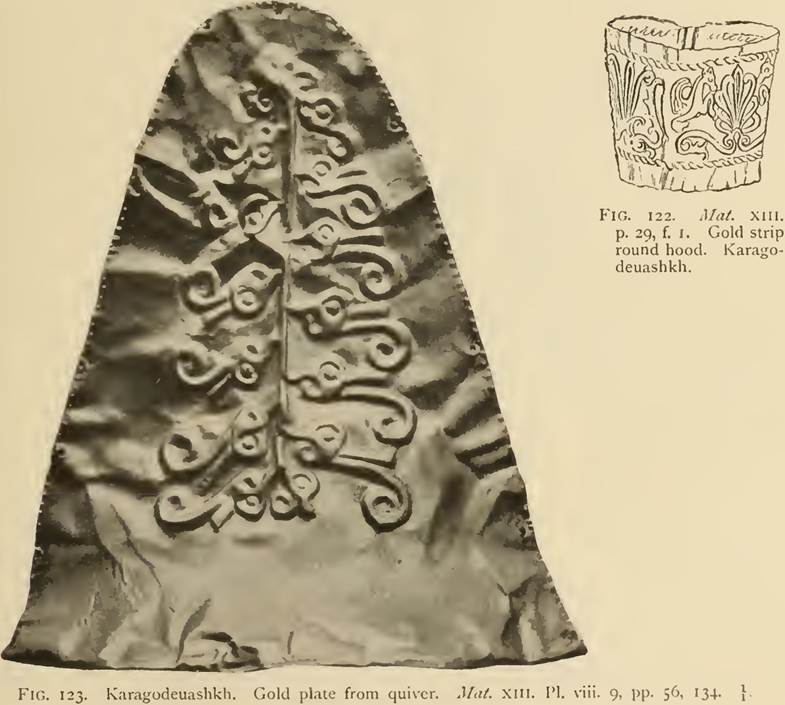

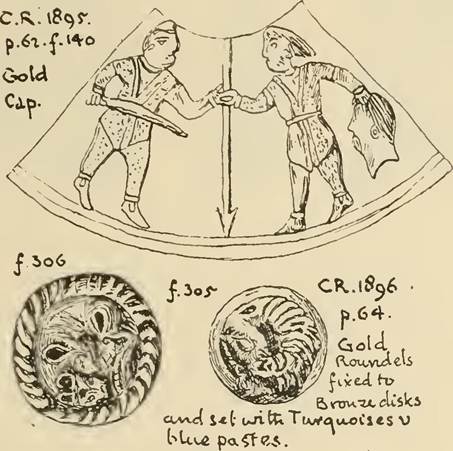
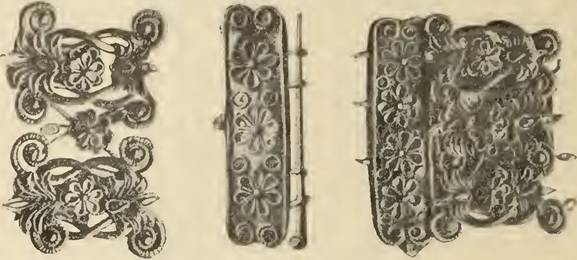
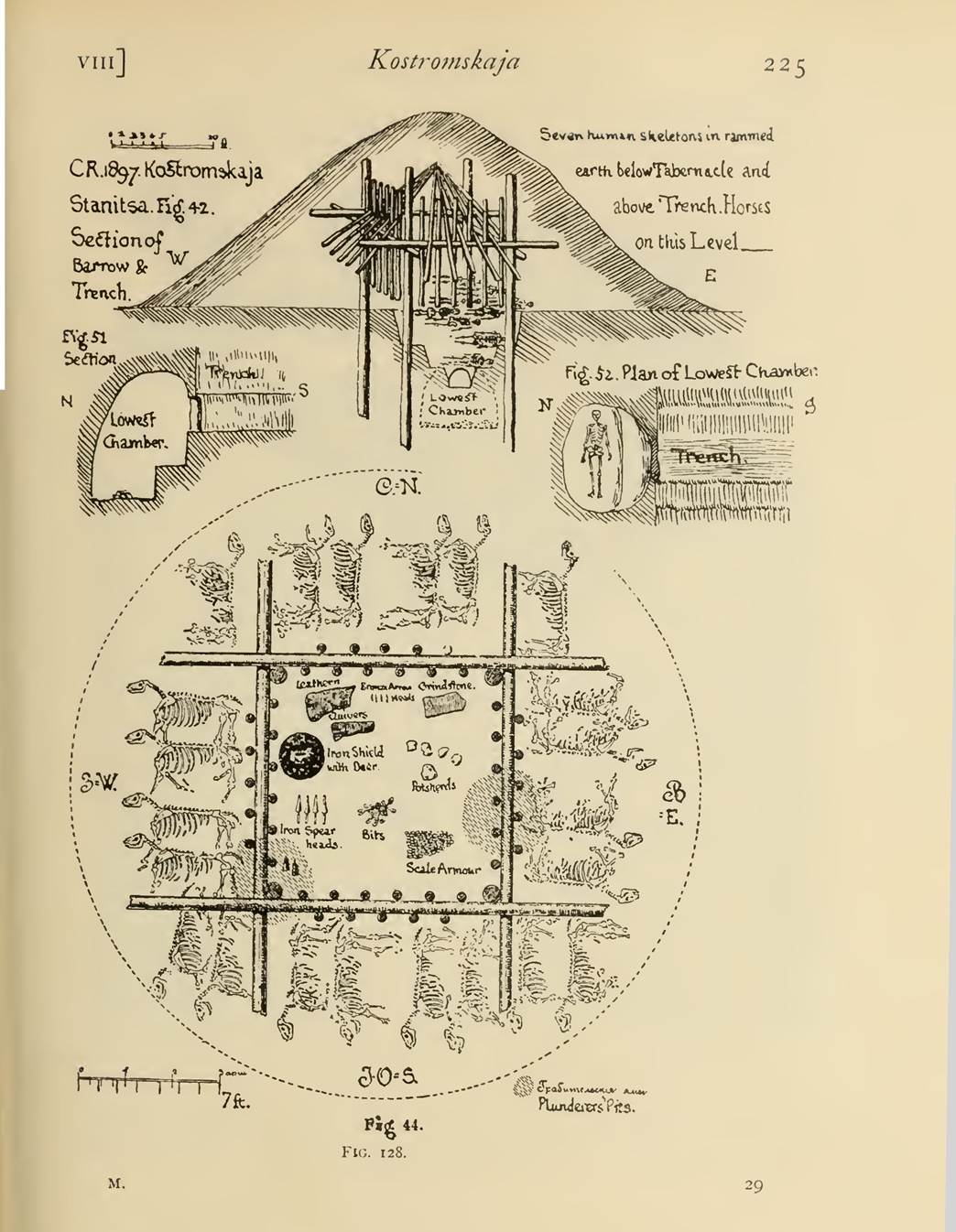
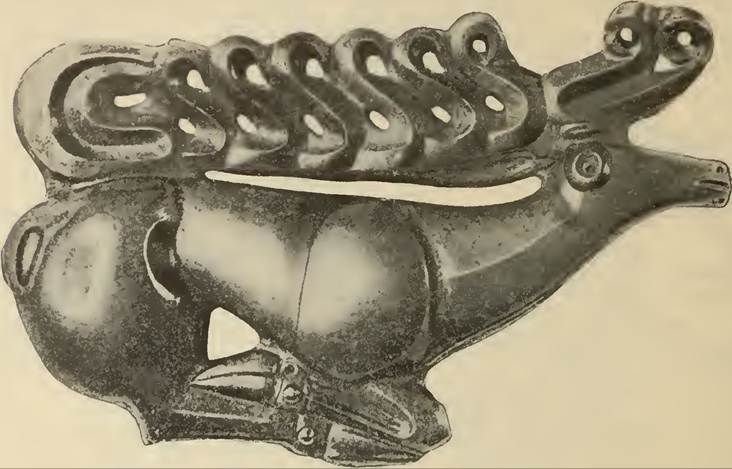
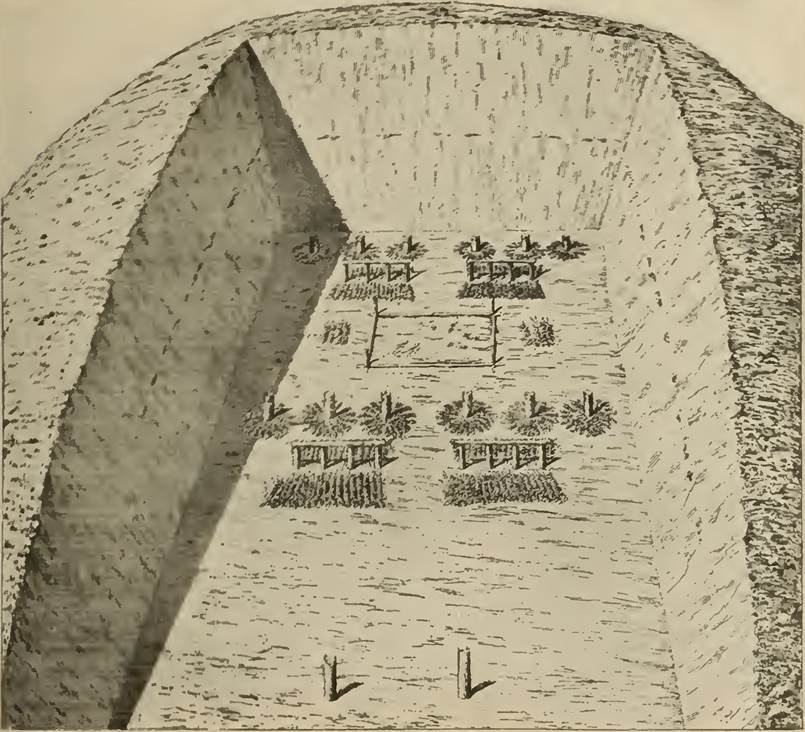
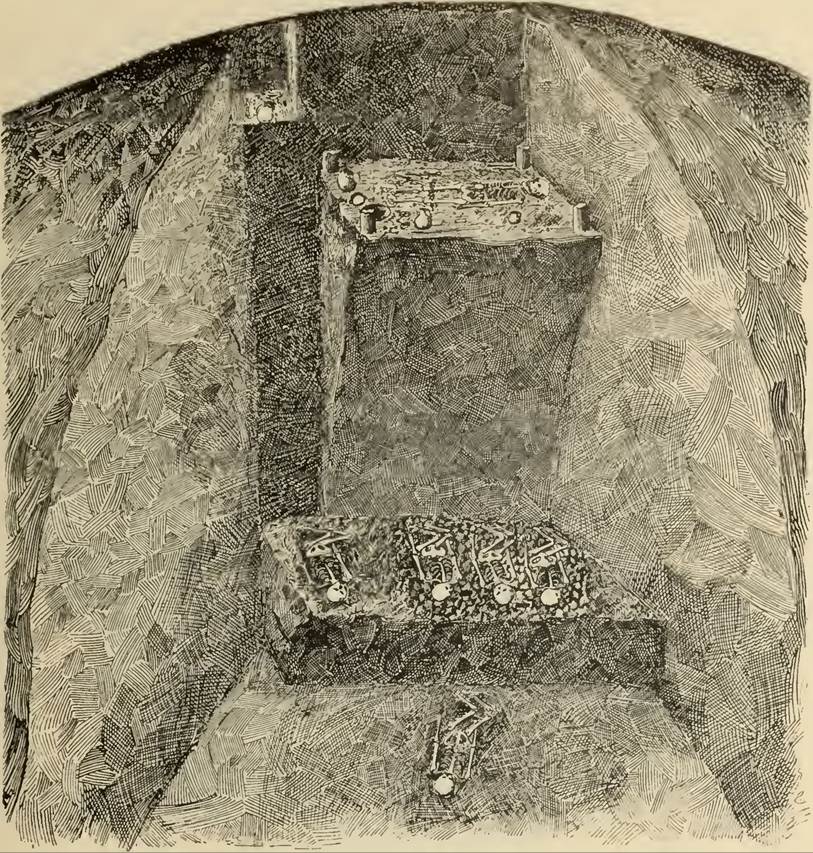
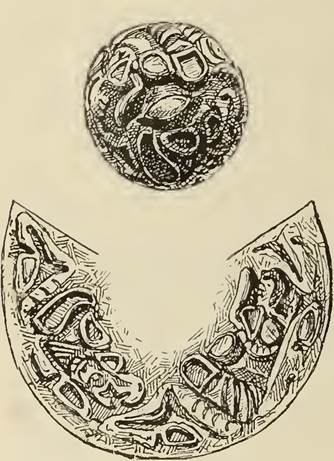
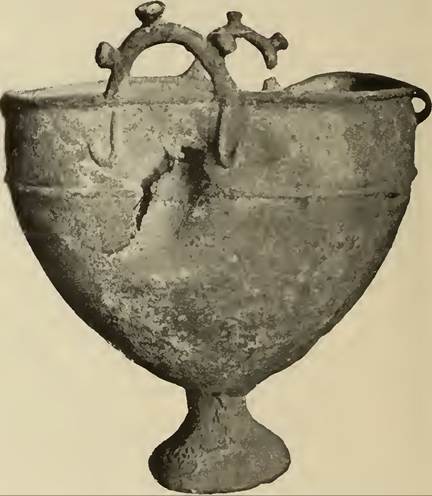
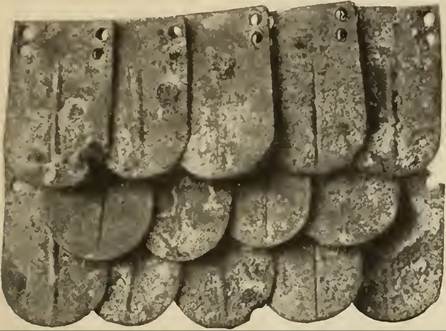
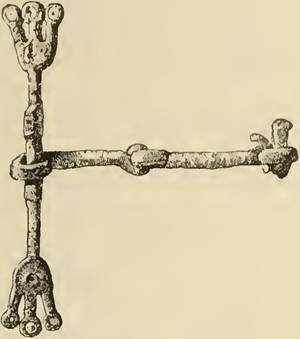
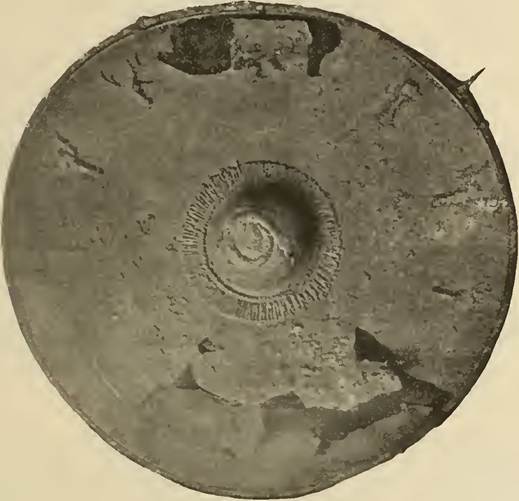

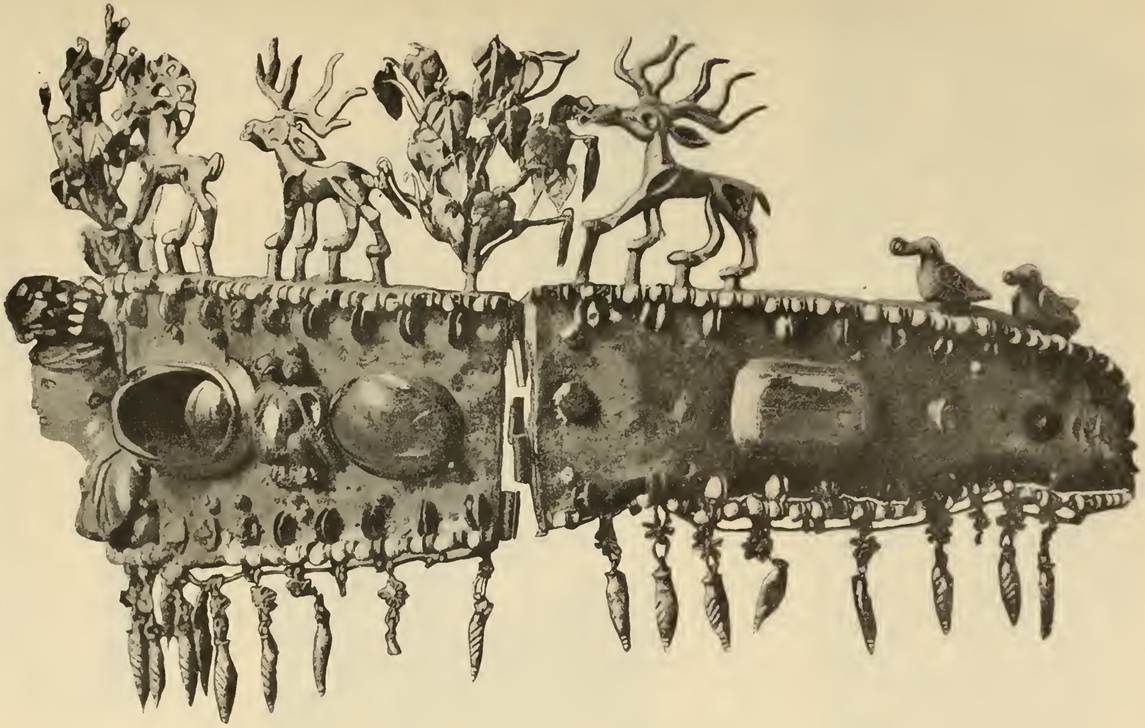
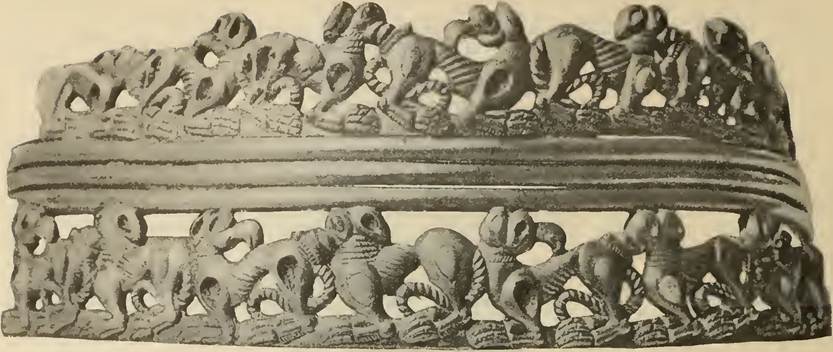
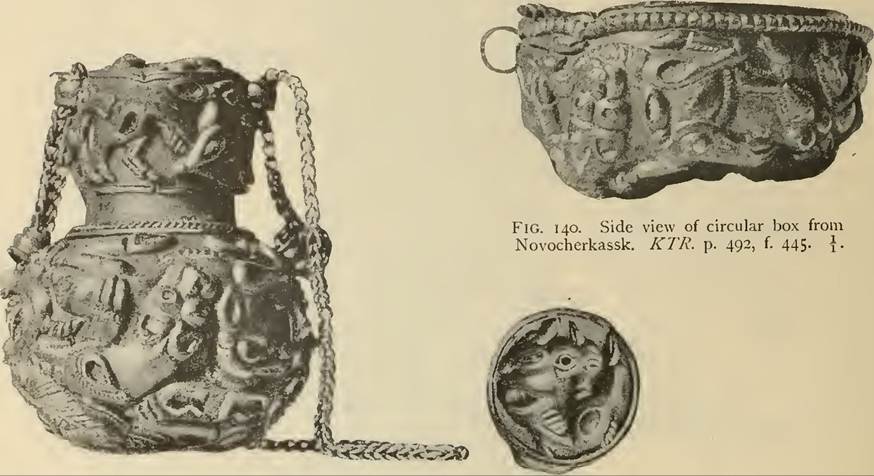
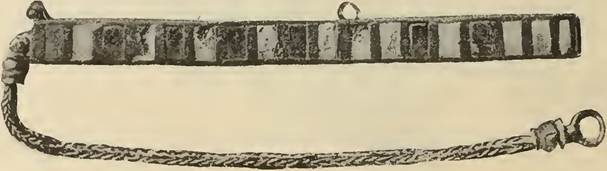
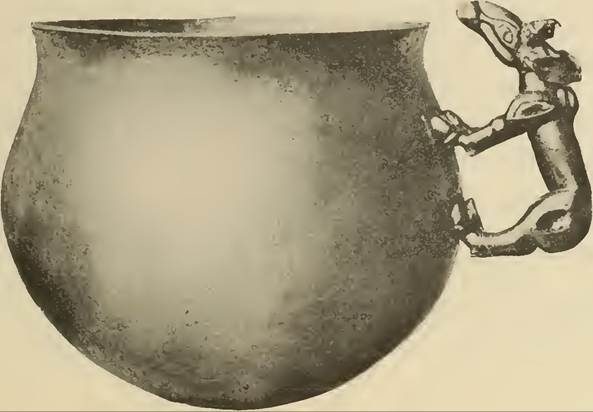
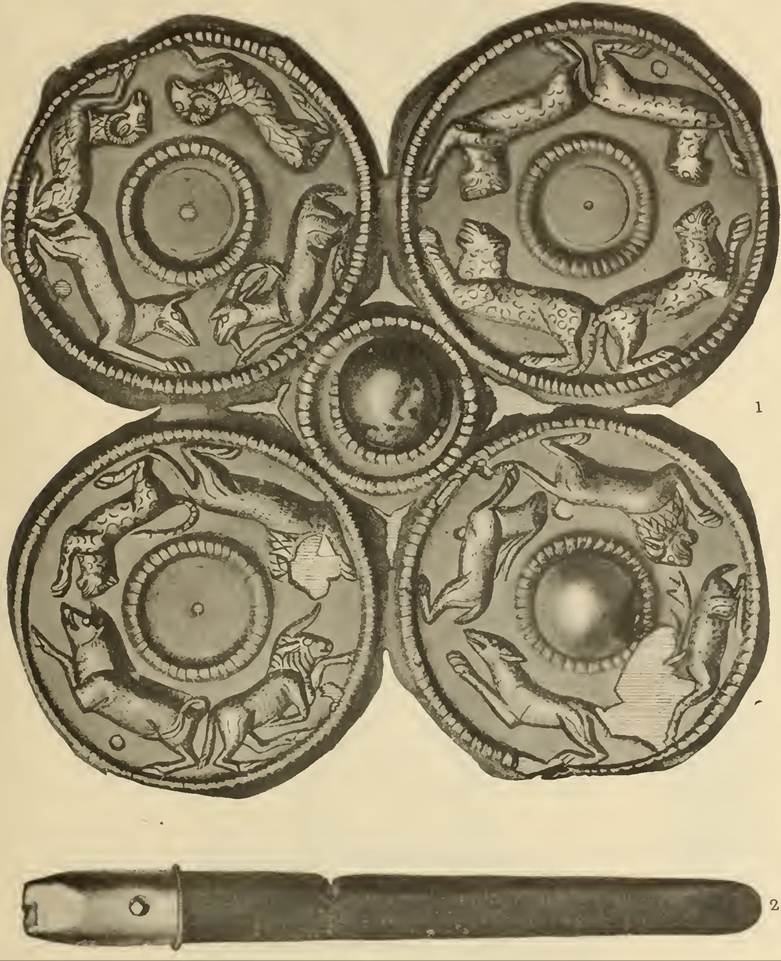
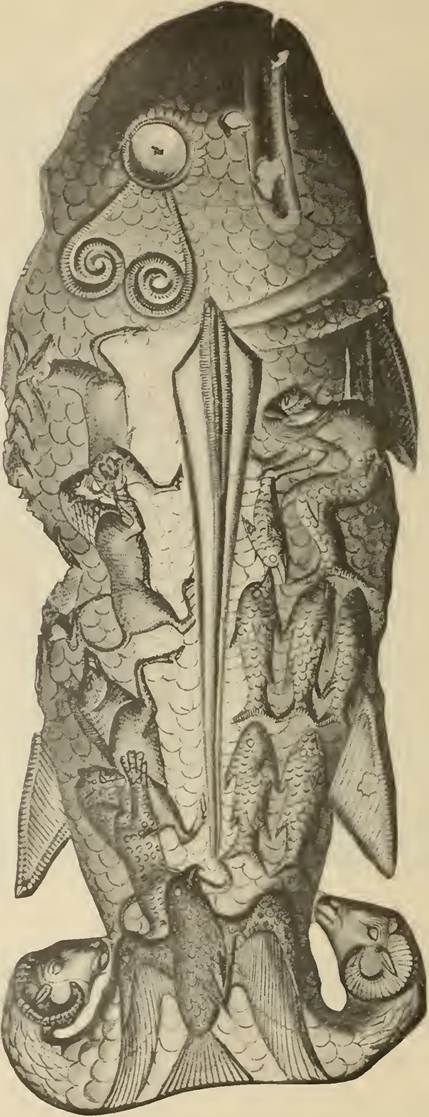
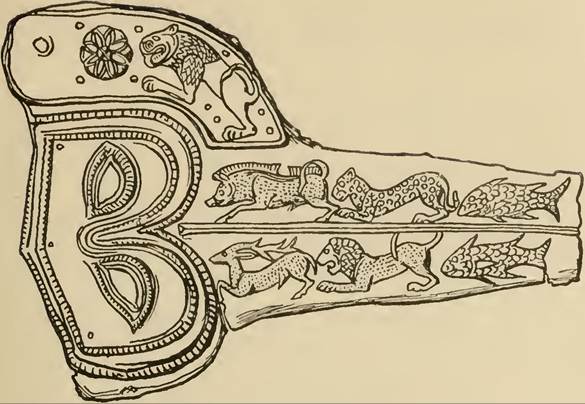
More on the topic CHAPTER VIII. SCYTHIC TOMBS.:
- Minns E.H.. Scythians and Greeks. A survey of ancient history and archaeology on the north coast of the Euxine from the Danube to the Caucasus. Cambridge: University Press,1913. — 720 p., 1913
- CHAPTER IX. SIBERIA AND SURROUNDING COUNTRIES.
- The Scythians
- CHAPTER THREE The Russian Sea: Donetsk and Odessa