CHAPTER VII. PRE-SCYTHIC REMAINS IN SOUTH RUSSIA.
I ought perhaps to ask forgiveness for mentioning remains that have no direct connection with Greeks or even with Scythians, but these paragraphs make accessible to English readers what it is difficult for them to read for themselves, and give a certain completeness to this hasty survey of Russian archaeology.
Also the interest of the Tripolje culture soon to be described is so general that exception can hardly be taken to some account of it being given.No satisfactory attempt can yet be made to sum up the prehistoric antiquities of Russia. The time has not come. As compared with Western Europe the series still has many gaps that will be filled up in due course: we cannot yet tell w’hether the absence of certain stages be due to their never having existed in Eastern Europe, or to the fact that it is only within the last thirty years that this vast area has been seriously investigated. Even now for the Stone Age we are chiefly dependent on chance finds, and very little has been done towards examining the remains of these early periods in situ[401].
Palaeolithic Remains.
The first finds of palaeolithic weapons were’made in 1873 near Gontsy (district of Lubny, government of Poltava). They were followed by others in the same part of the country. The remains were associated with the bones of mammoths[402]. Next Count Uvarov[403] found others near Murom (government of Vladimir) by the village of Karacharovo and along the course of the Oka. Further, a station has been discovered on the Don, near Kostenki (government of Voronezh), and another not far off at Borshev[404]. Bone implements of the same periods have occurred in caves near Kalisz in Poland.
published in German in the Internationales Centralblatt für Anthropologie u.s.iv. 1903, pp. 65 sqq., 129 sqq. For Western Russia and its connection with Western Europe see Niederle, Slavonic Antiquities, Part 1.
Prag, 1904, pp. 435 sqq.2 Count A. S. Uvarov, Archaeology of Russia, Stone Age, Moscow, 1881, Vol. I. p. 104. For similar finds made by Kan’shin at Umrikhino near Kursk v. RCA. xxi. suppL p. 10.
3 op. cit. Vol. 1. p. 112.
4 CR. 1905, p. 84.
But by far the most trustworthy information as to the Early Stone Age in Russia is clue to the careful investigation by Mr V. V. Chvojka of a station on the very site of Kiev, known as the Cyril Street Settlement*.
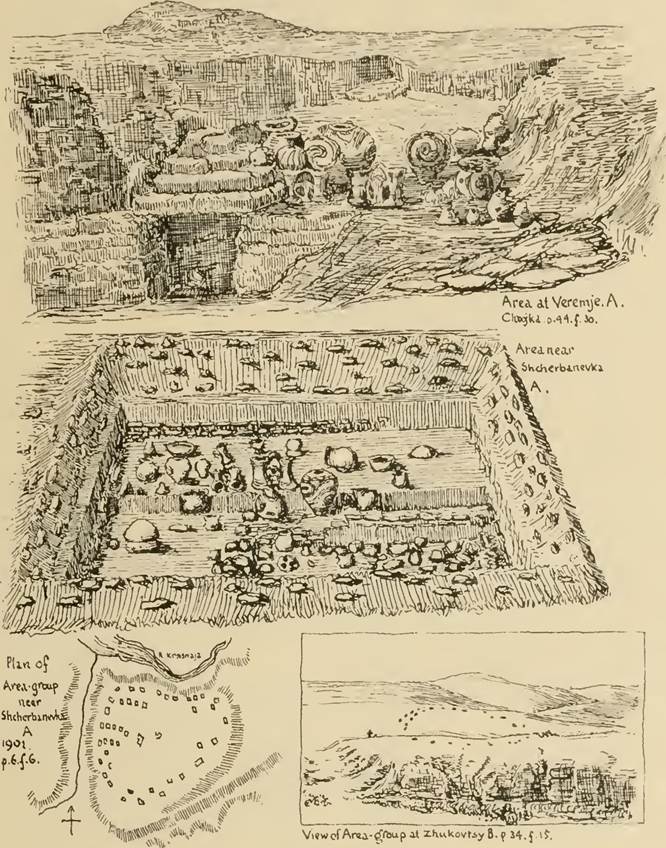
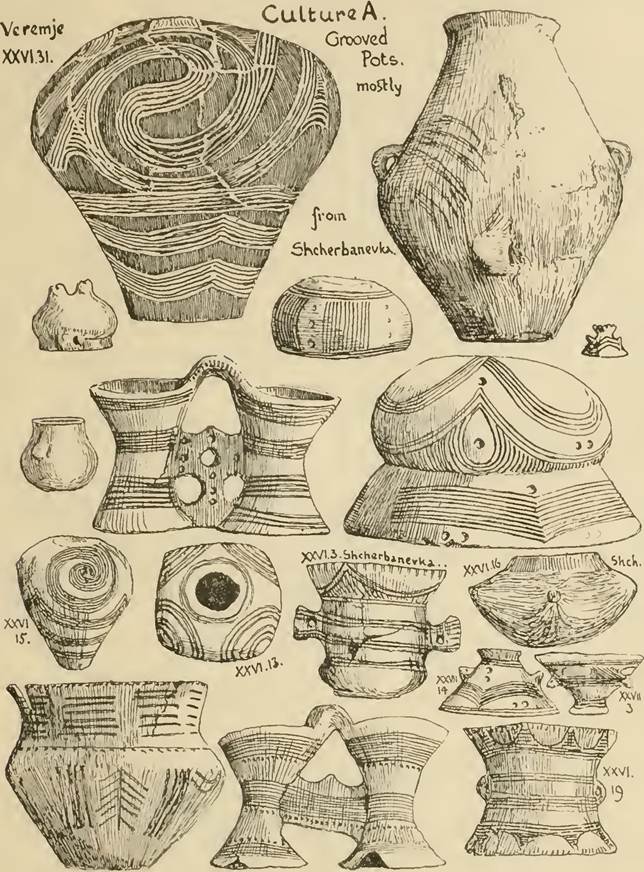
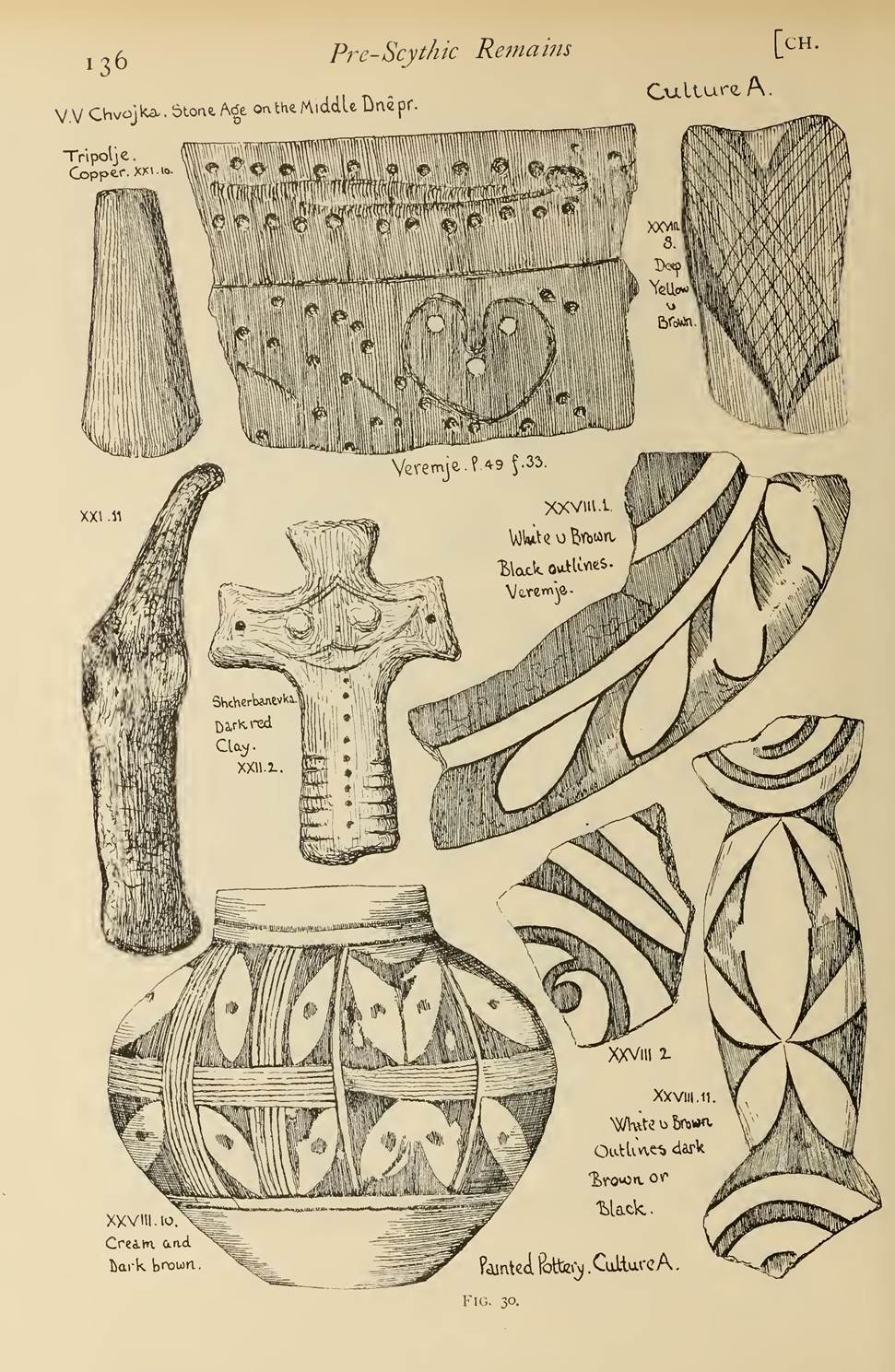
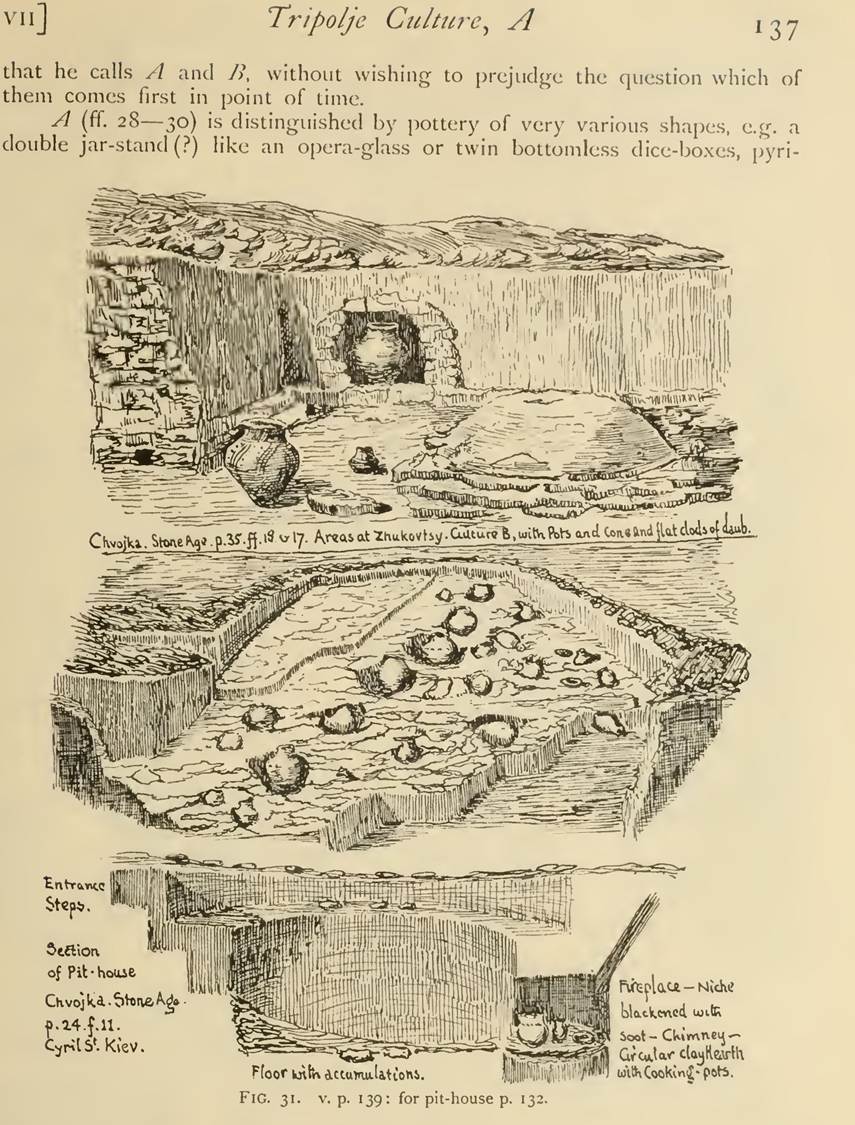
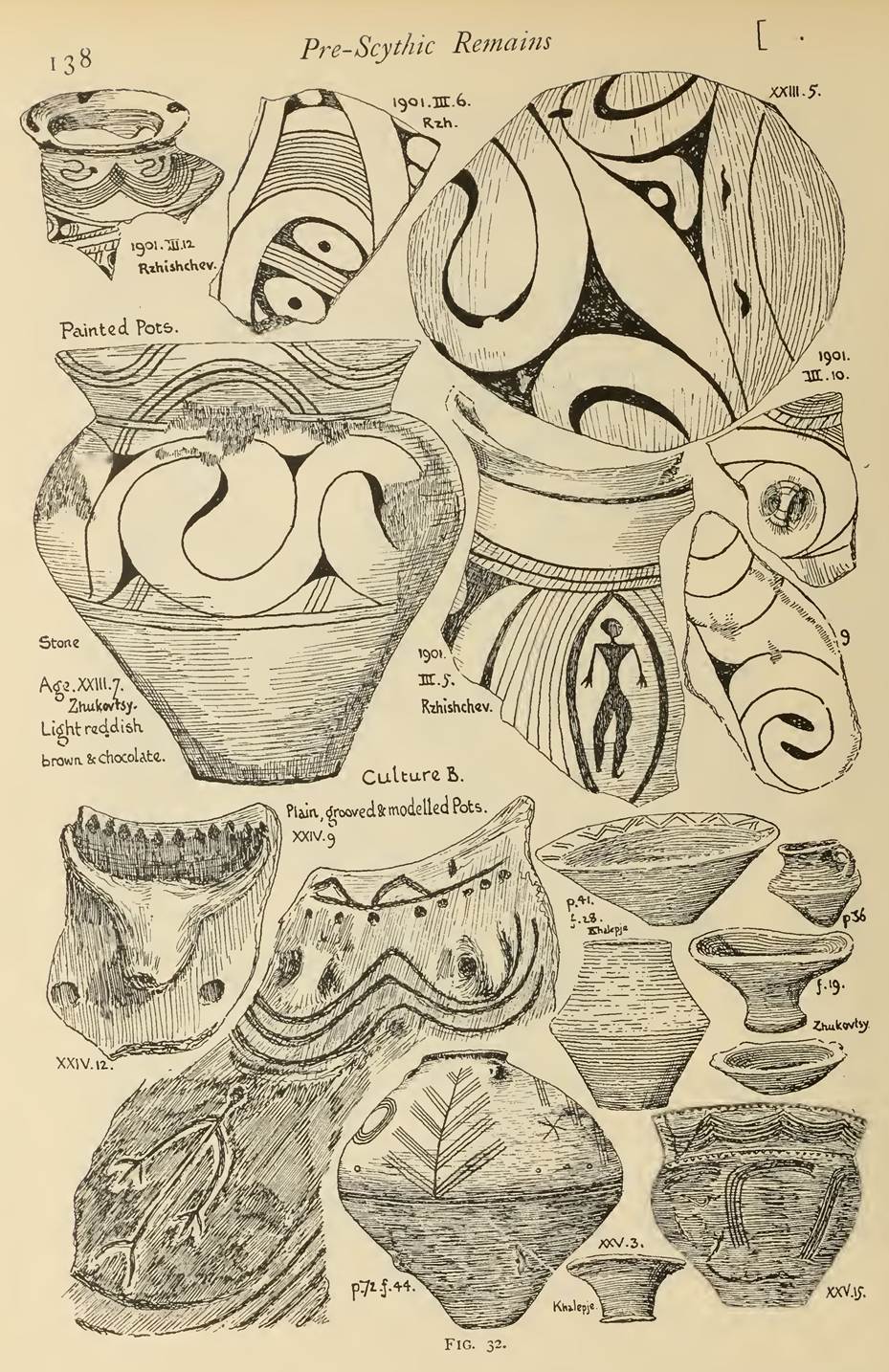
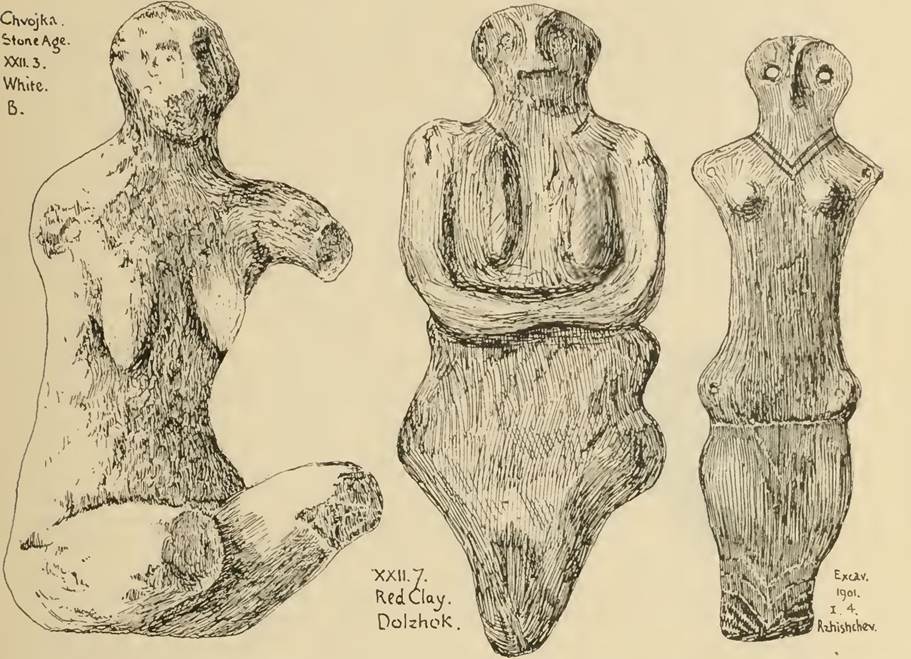
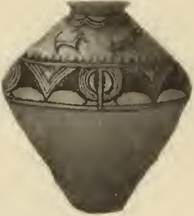
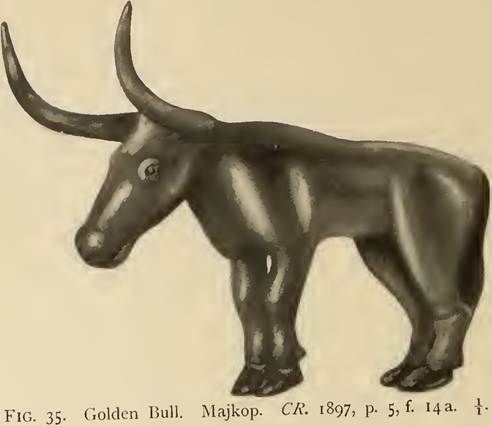
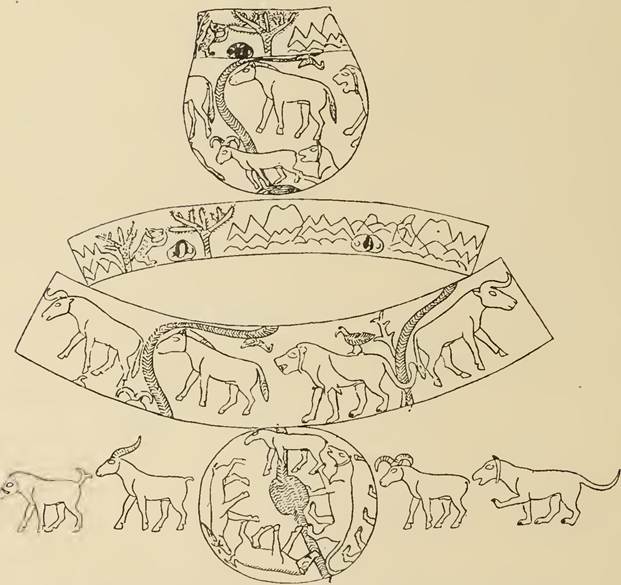
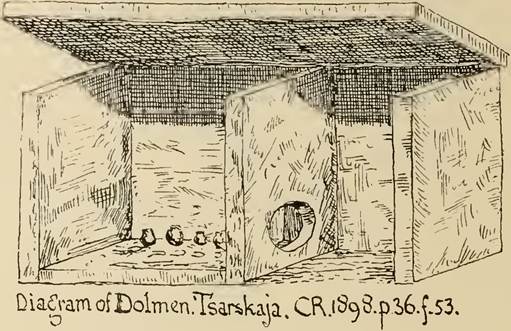
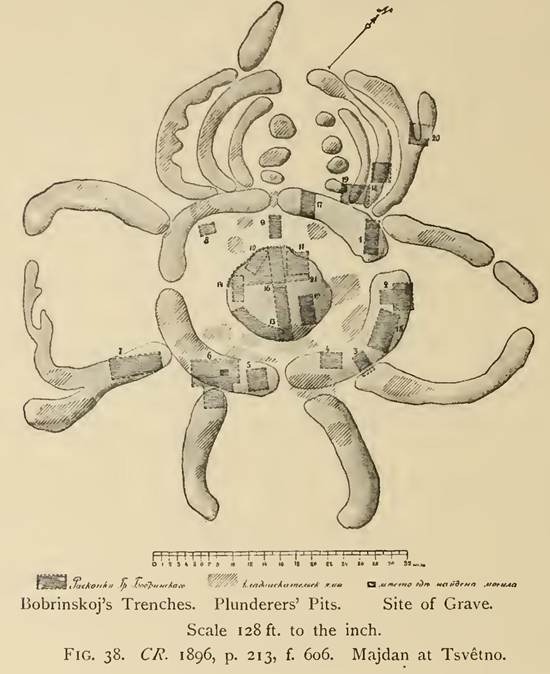
At a depth of 19 metres from the. top of a steep slope forming the S. side of the Dnepr valley, underneath layers of black mould, loss, clay, streaky sand and sand with boulders and above a tertiary stiff blue clay, were found very many mammoth tusks, bones of mammoths, and in a less quantity of other animals contemporary with them, mostly broken and shewing traces of fire, places where fires had been made, that is patches of mixed earth and charcoal often several yards each way and two or three feet thick, and finally mammoth tusks with traces of definite handiwork, even a rude attempt at a drawing[405] [406], together with flint implements of the earliest type. The conditions under which the finds were made are best satisfied by the supposition that here was a settlement of man living in the interglacial age a little to the south of the great glacier that covered all N. Russia: the original limits of steppe and forest seem to answer to the line reached by the said glacier. Man settled in the valley of the Dnepr and hunted the mammoth who furnished the chief means of his subsistence, The great amount of the remains shews that he must have lived on this spot for many years. It was probably sheltered from the cold winds and convenient for hunting purposes. Occasional floods marked by layers of sand drove him from his place, but he returned again and again. In the streaky sand above the main layer of remains we find a few patches of charcoal with bones of lesser animals, no longer the mammoth ; no doubt a change of climate or of physical conditions made this spot uninhabitable and drove away the earlier fauna, so that man could no longer occupy the site permanently. Finds of the very latest palaeolithic period, possibly indicating a transition to the neolithic, have been more frequent and extend much further north as the retreating ice-sheet allowed man to occupy more country. Such have been made on the banks of Lake Ladoga by Prof. Inostrantsev and about the Oka by Count Uvarov. Cave dwellings with chipped flints have been investigated along the Dnepr near Kiev by Prof. V. B. Antonovich and by K. S. Merczhkovskij in various parts of the Crimea[409]. 4 Transactions of VII I th Russian A rchaeological Congress, Moscow, Vol. HI. p. 88 sqq. Mr G. A. Skadovskij’s finds of palaeolithic implements in Kherson govt quoted by Bobrinskoj, Snt. in. p. iii. ■' Nicderle, Preh. Man, pp. 53—57. The scarcity of Palaeolithic finds in Russia is exemplified by the fact that V. A. Gorodtsov enumerating all the types of axes in the Moscow Hist. Mus. (Report for 1906, p. 97) gives none of this period. Early neolithic stations are also found in all parts of Russia from the so-called Winter Shore (Zimnij Bereg) on the White Sea and the borders of Lake Onega to Kazan on the Volga, and to Jurjeva Gora near Smela, with many other points in the basin of the Dnepr about Kiev. The pottery is very rude and shews no special points of contact with other cultures[410]. In the far west of Russia, between the Carpathians and Kiev, we find in the neolithic period distinct traces of connection with the coasts of the Baltic, pottery with string patterns (Schnurkera/mik'), northern types of axe and amber, but such finds are few and poor. Close by the palaeolithic station at Cyril Street, Kiev, Chvojka investigated the most important neolithic site in S. Russia. Whereas palaeolithic man preferred the lower slopes of the valley, neolithic man chose the plateaus above. Here were found the remains of a village which must have existed long. The more primitive dwellings were as it were caves cut in from the edge of the slope; the great majority was formed by digging out a shallow pit oblong or round from three to five and a half yards across and about a foot or eighteen inches deep[412]. In the middle of this they dug a hole from 2 ft. 6 in. to 5 ft. deep, 6 ft. 6 in. to 8 ft. across, with a way down into it made with steps, and at the other end a niche in the face of the inner pit with a hearth and a hole for smoke to escape. Round the outer shallow pit were walls of wattle and daub, and over all a roof. The inhabitants threw all the remains of their food into the central pit, shellfish, bones of deer of various kinds, wild boar and beaver, and to some extent horses and cows. But they were also acquainted with agriculture, for we find several examples of hand-mills and lumps, which Chvojka supposes to be cakes. Also they seem to have kept tortoises as pets. Spindle whorls shew that spinning, and probably weaving in some simple form, were known. Most weapons and tools are made of stone or horn of deer or elk. The latter are well made, but the flint implements are very slightly ground. There is a remarkable absence of arrow-heads. Most characteristic is the pottery, in which is to be traced progress from very ill-baked, formless, cracked vessels, made of the first earth that came to hand, such as are found in the cave dwellings, to fairly graceful pots of considerable size, adorned with dots and lines and made and pounded shells. Some few pieces on the “ areas ” next described. of a careful mixture of clayey sand approach to the finer kinds found the huts was found an early mould near it was a horn axe of exactly On this same site between two of for casting copper or bronze axes, and the same type, but inasmuch as no metal was found in the houses themselves we may be allowed to class them as neolithic4. 2 Niederle, Slav. Ant. 1. p. 452. 3 Inf. p. 137, f. 31= Chvojka, Stone Age, p. 24, f. 11. 4 Spitsyn gives a Map of the stations of the earliest copper age in Central and North Russia, TRAS. Russo-Slav. Section, vu. Pt 1, p. 73. 1 he next class of remains distinguished by the “areas” hereafter to be described with their remarkable pottery and figurines is of very special interest because of the wide range of its affinities, considering its rather special character. Fig. 28. Tripolje Culture. Areas. 1 he actual “areas ” are about Kiev but the culture occurs in Russia in the governments of Chernigov, Kiev, Poltava and Kherson, in Podolia and in Bessarabia. Pottery of the same type has been found long since in Galicia at Wygnanka and Z'fote Bitcze, in Bukovina, in Moravia, in Transylvania and in northern Moldavia near Cucuteni. Something similar occurs in Serbia and at Butmir in Herzegovina. A southern extension has been traced through Thrace to Thessaly and across the Dardanelles to Hissarlik and Yortan on the Caictis[413]. The first finds were made about the village of Tripolje on the Dnepr forty miles below Kiev, whence this is called the Tripolje culture. The remains consist of so-called “areas” {ploshchtidka\ These are arranged in groups of a circular form, sometimes the circle is double or triple for part of its circumference, in any case the areas are closer together on s. and se. than on the N. and w.; in the middle of the circles are usually two or three areas of larger size than the rest. The construction of an area seems to have been as follows. The space to be occupied was marked and dug out to the depth required from two feet to about four, then walls were built of wattle and covered with clay which was fired when dry. Sometimes we seem to have a lean-to with only one wall and a roof; others had walls on two, three or four sides. In some cases the walls were whitewashed or coloured red or bear layers of alternate colour, and there in Zt. f. Ethnologie, xxxv. (1903), pp. 438—469, “Tordos”; XXXVI. (1904), 608—656, “Troja, Mykene, Ungarn”; xxxvn. (1905), 91—113, “ Keramik der makedonischen Tumuli”; the Transylvanian (Priesterhügel) by J. Teutsch, Mitth. d. Anthrop. Ges. in Wien, 1900, pp. 193—202; the Rumanian by'M. Hoernes, Urgeschichte d. bild. Kunst, p. 210; the Serbian by Μ. Vasic, Starinar, I. ii. (1907) “Zuto Brdo,” and BSA. XIV. pp. 319—342 “The South-Eastern Elements in the Prehistoric Civilization of Servia.” The whole question is well set forth by R. Μ. Burrows, The Discoveries in Crete (London, 1907), pp. 184—202, and his r(sum( gives all that the English reader requires but wants illustrations; see too D. G. Hogarth, Ionia and the East (Oxford, 1909), p. 113 ; and Peet, Wace and Thompson in Classical Rev. 1908, pp. 232—238 for further literature. For Thrace (Tell Racheff near Jamboli, see Fr. Jdrome, “L’Epoque N^olithique dans la Valide du Tonsus” in Revue Archeologique 3, xxxix. (1901), pp. 328—349, and CR. du Congres International dArchcologie, 1905, Athens, p. 207), also Seure-Degrand, BCH. 1906, pp. 359 sqq. Tsountas and Stais have found neolithic stations near Volo, At тгрогсгторгкаї акротгоЛегу Aip.r]viov ка'і Sea-кЛои, Athens, 1908, esp. pl. xi; and Wace and Droop at Zerelia in Thessaly, Annals of Archaeology and Anthropology (Liverpool), 1908. p. 116 sqq.; BSA. XIV. p. 197 sqq.; for imported ware at Matera, S. Italy, see T. E. Peet, The Stone and Bronze Ages in Italy, (Oxford, 1909), p. 108, f. 36. is every trace of the structure existing a considerable period and being restored and beautified from time to time. Remains arc also found of a kind of cornice to the walls. Sometimes there had been a floor of hardened clay. The layers of clay lumps seem to be the remains of the walls and perhaps the roof, and Fig. 29. v. p. 137. where there are many layers it is probable that the structure has been destroyed and reedified. Occasionally there seem to have been interior walls. Amid the clay lumps, standing or lying or upside down on the original floor, arc the remarkable vessels which give chief interest to the discovery, as in them and the figures some have seen an analogy to the early Aegean culture. As many as eighty have been found together. Chvojka divides the areas into two classes form pots with small openings above, conical pots on little rims to support them, rude faces made by a pinch of the fingers and three dots on a round or heart-shaped projection of clay, stone axes bored through and even one or two copper ones, most of all by the adornment of the pots either with graceful and m. 18 CH Culture ZB iillllfl'l xxni VIIJ TripoljC Culture, B ’39 In />’ (ff. 31—34) on the other hand the shapes of the pots are more angular, the ornament especially when incised is less free and chiefly confined to the upper half of the pot, the rim of which is sometimes adorned with heads of animals and birds in relief. There are no axes with holes bored in them and no metal whatsoever, by so much />’ seems inferior, but the statues of women arc very much better than the cruciform idols of A. Also A’ has curious pedestals of clay which have been painted several times, or stands of clay supporting a stone basin. In I) also have been found remains of half-cooked corn hidden below the general level of the platform. Moreover in J3 have been found marks, some occurring singly upon vessels and perhaps denoting ownership as the Tanigi of the Caucasian tribes, in one case1 set in a row and presenting a remarkable resemblance to an inscription. It would seem as if A were superior to 13 and later than it, but the difference in the statuettes is most remarkable. Fig. 33. 1 Figured in the Trans. Od. Soc. Vol. xxni. p. 202. Chvojka thinks that the cultures A and B belonged to the same people but that A has mostly imported from the south the elements that distinguish it. Perhaps the occurrence of metal in A proves it to be the more modern. As to the object of the areas, they cannot be dwellings, because about them are none of the traces of habitation, no remains of food or pottery thrown away, hardly any implements or signs of a perpetual hearth. Though no urns of ashes or interments were found in the earlier diggings Chvojka came to the conclusion that they must be tombs or chapels of the dead. It is a remarkable conception that on the highest suitable hill near the village there should have been the circle of little chapels dedicated to the departed of each family. Except in one case we have not happened upon the village. The culture of the pit houses on M. Sventoslavskij’s ground near the site on Cyril Street, Kiev, of which we first spoke, seems to occupy a half-way position between the period of the earlier pit houses and that of the areas, having similar pottery and also arrow-heads which are not found in the earlier houses. The pottery rather resembles A than B. Later excavations about Rzhishchev and Kanev[414] have shewn that the same people lived in the more advanced pit dwellings and built the areas. Better preserved specimens of these unspoilt by the plough have yielded urns full of human ashes and thereby placed their purpose beyond a doubt: bodies some scorched and some untouched by fire shew that cremation was not the exclusive custom, but it is not clear whether it was going out or coming in[415]. Superior especially in range of colour to anything from Tripolje is a pot from Podolia of which Chvojka has recently sent me a photograph. This pot which he classes with B stands 2 ft. 6 in. high and its surface is covered with light brown slip. On the upper slope are two bands of ornament in dark red, the lower curvilinear, the upper having drawings of a he-goat, a nanny goat, a deer and a dog. It was full of scorched wheat grains. Other vases from Podolia have on a ground painted black, light brown, yellow or grey, spirals and curves in three colours, white, light or dark red, orange or brown according to the ground[416]. Fig. 34. Pot from Podolia from a drawing by Chvojka. Von Stern’s finds at Petreny likewise surpass Tripolje ware in range of colour. There is little incised work and the figurines are few and very rude, one of them is striped : most of the attempts at modelling in the round come from one single area. The shapes too of the vases are not so varied as further north. The painting however is very abundant and of a high order. In a few cases on the natural red or yellow surface of the clay the patterns have been painted directly in black or violet brown. More often the natural clay is covered by a slip, polished if it be red or brown, dull if it be white or yellowish : on this the painting is applied in black or violet brown (often with a greenish tinge to judge by the plates), rarely yellow or red. In a few cases I take this opportunity of thanking him most deeply for sending me reprints of his articles, unpublished photographs and very kind letters to enable me to keep abreast of his researches. both black and red are used together. The designs are mostly of much the same character as those here illustrated, especially those of culture B (p. 138, f. 32). They are founded on the spiral executed with wonderful skill, simpler curves also come in, arcs of circles and fairly straight lines. The attempts at the human figure scarcely come up to those illustrated above, and the animals including oxen, dogs and goats arc not equal to those on the Podolian pot. There are the same knobs and tiny handles. The potter’s wheel is strange to the whole culture. Chvojka, the first discoverer, thought that this was an autochthonous civilisation developed by the Indo-Europeans before they differentiated, perhaps more particularly by that section of the race which was to become the Slavs. Those who studied the Western regions, where somewhat similar spirals occur, did not at first dare to think that northerners could have been so artistic without external influence, and ascribed the highly developed decoration to the influence of the Aegean exercised through traders and the importation of wares. Independently M. Much, H. Schmidt and von Stern advanced the view that the movement was the other way, that the northern finds are earlier in date than the similar objects in the Aegean region—in fact von Stern even entitles the Russian version of his paper “ Pre-historic Greek Culture in the S. of Russia,” and thinks that the artistic people who made the Petreny pots moved south and conquered even as far as Crete. The difficulty here is that we can trace back continuous development on such sites as Cnossus to a neolithic stratum far inferior in artistic power to the pots at Petreny: that is, that the supposed northern immigrants must have gone back in their art on reaching new countries, and afterwards raised it again to the height of Kamares ware or ware from Phylakopi which according to von Stern recall Tripolje and Petreny. This is of course possible; the wars of conquest may have caused a setback in art. But the fact is that we do not know enough yet to talk of movements or affinities of races. Still, having regard to the artistic gifts of the Mediterranean as opposed to the Northern race, it may be that the basis of the Tripolje population was a geographically northern outlier of the former subjected to the strong influence of its neighbours, the varying strength of this influence accounting for the differences presented by similar cultures to the westward. The inconsistency of funeral customs argues the same mixture. Cremation would seem to have come in from the north, but not yet to have put an end‘to the vivid consciousness of the dead man’s continued presence and needs which goes with primitive interment. Hence the numerous offerings. Under their less favourable conditions pottery painting was the one art which the Tripolje folk brought to a high standard, that and the modelling of some B figurines1. Before they could advance further they seem to have come absolutely to an end. There is nothing in S. Russia which can claim to be in any sense a successor to the Tripolje-Petreny culture. They may have moved south or they may have been overwhelmed by newcomers. They were agriculturists long before the date of the agricultural Scythians, but the next people to dwell in their land were thorough 1 For a fuller statement of the various views of op. cit. pp. 189—196. He regards the art as due to Wosinsky, Schmidt, and Hoernes, see Burrows, an outlier of the Mediterranean race. Nomads. At Khalepje one area had been spoilt by its materials having been used to pile a barrow for a man of the nomad race buried doubled up according to custom with only one pot by him, but with his bones coloured with the characteristic red[417]. Niederle[418] reviewing the whole subject with very wide knowledge of the Central European finds comes to no very certain conclusions. He is disinclined to hold to the view at first current in Russia that the Tripolje culture evolved entirely on the spot. He takes it to be a special development of the South European band pottery (JBandkeramik') already approaching the Tripolje forms at Butmir and other sites across to Transylvania. This development may have been called forth by intercourse with the Aegean area and Asia Minor going by way of Rumania and Bessarabia, but the gap in our knowledge of these countries makes it so far impossible to trace its progress. A distant resemblance to forms from the Mediterranean region is undoubted, but investigators of Aegean styles seem to see it less clearly than those who have dealt with N. Europe[419] [420]. The statuettes also recall Southern forms. The 2? culture moreover shews analogies with the Northern style before mentioned, especially in the wide open flower-pot shaped vases'*. A consideration of these relationships inclines Niederle to put the whole culture at about 2000 b.c., which would give time for the period of coloured skeletons to follow. But it seems premature to attempt to assign dates, only we must allow a long period for the red skeletons. Colotired Skeletons. Right across South Russia from Podolia and Kiev to the slopes of the Crimean mountains and the Caucasus, the most primitive type of grave commonly met with is distinguished by the fact that the skeletons are coloured bright red, mostly with ochre or some other earth containing iron. The colour is found in a thick layer most abundant upon the upper part of the body and head, and even occurs in lumps lying to one side. The body usually lies with the legs doubled up in a position “ making our last bed like our first[421].” The interment is in the untouched earth, not in the mass of the barrow. The size of the barrows raised over them shews that these men were great chieftains in their day, though they took so little, with them into the tomb[422]. Often later peoples have used their barrows, putting their own dead into a shallower grave in the heap7. Also we find various interments of this type in one great mound, which suggests that within the limits of this period men had had time to forget the first owner of the barrow. Often, but not always,'above the body there are the remains of a kind of wooden shelter, more rarely a stone cist. Few objects are found in the tomb, at most one or two round-bottomed pots8, more rarely chips of flint, still more rarely copper or bronze arrow-heads. This gives their 5 Sir T. Browne, Hydriotaphia,chap. in.; shewn in side tomb, p. 177, f. 72, but no colour was found there. 0 e.g. Bezschastnaja Mogila 15 m. high and 230 round. KTR. p. 278, CR. 1883. p. xliv. 7 e.g. Geremes Barrow, KTR. p. 253. 8A good example, Mastjugino (Voronezh) CR. 1905, P· 97, f· 123. date as belonging to the latest stone age, and the first beginnings of metal. But much more metal is found with the colouring of the skeleton in the south at the foot of the mountains. There seems no doubt that the colouring matter was very thickly smeared on the body at burial, and that after the decay of the flesh it impregnated the bones when they had become porous with age. The colour is almost always red, sometimes whitey yellow. The circumstances of the finds preclude the idea that the flesh was taken off the bones and the latter stained on purpose, or that the colouring matter is the remains of paint on the coffin or dye in clothes or cere cloth. Probably these people painted themselves with ochre during life, and when they died they wished to enter the other world in full war paint, and even had a supply for future use put with them. Professor Kulakovskij[423] compares the painting red of the face of Jupiter Capitolinus and of the hero of a Roman triumph, suggesting that this is an instance of Roman conservatism going back to the most primitive times; the practice was common in Neolithic Italy[424]. In the Kuban district richer tombs with the characteristic colouring accompanied by pottery and axes and spear heads of copper were found by N. I. Veselovskij at Kostromskaja[425], Kelermes4, Kazanskaja, Tiflisskaja and Armavir’. Many have intruded Scythic interments as that at Vozdvizhen- skaja (inf. p. 229, f. 131). Of unexampled richness was a tomb at Majkop8, so much so that one might doubt whether it have any connection with that of the typical coloured skeletons. Here we have associated with the colouring, in this case by means of red lead, gold vessels and other objects testifying to remarkable artistic progress. The style in some cases, e.g. the plates with lions and bulls7, recalls the Scythic, in others rather the products of the Caucasus. Still the wooden covering and the characteristic doubled up position offer some resemblance to the simpler coloured burials. Archaic objects are a vessel made of stone, but mounted in gold and with a gold stopper, and implements of stone and copper, as well as bronze; also the pottery is not unlike that found in other graves. Quite unlike anything else, and so far unexplained, is a set of silver tubes about 40 in. long, four with golden end-pieces : upon these were threaded, through a hole in their backs, solid golden bulls (p. 144, f. 35). There were also fourteen silver vessels, of which two had engraved ornament, recalling faintly the compositions of Western Asia. One is shewn here (p. 144, f. 36), the other8 has a more conventional frieze and no landscape. It is probable that we have here relics of a people which formerly stretched all over S. Russia, and buried its dead after daubing them with red colour. We have seen that many tribes were pressed towards the Caucasus when enemies entered their land, and this may have been the case with this people. Here they would be in contact with the Caucasian tribes, and 4 CR. 1904, p. 96, ff. 163, 164, one axe double looped, the other of Koban type. 6 CR. 1900, p. 45, f. 105 ; 1901, pp. 66—86; 1902, pp. 66—75, 86—89, ff. 193, 198; 1903, pp. 61 71 ; 1905, p. 69; the ff. noted shew the three-legged clay incense-burners (?) peculiar to these tombs. 8 CR. 1897, pp. 2—11. 7 ib. p. 3, ff. 1—3. 8 ib. p. 8, ff. 27—29. Fig. 36. Silver Cup from Majkop. CR. 1897, p. 7, 26· i· through them with Western Asia, also sooner or later they would have to do with the “ Scythic ” culture, whether the Scyths were their immediate displacers, or whether other movements of population intervened. Hence an intelligible mixture of original customs, Scythic dress shewn by the many gold plates in the form of lions, and Caucasian metal work shewn in the gold and silver bulls and the engraved vessels. We must beware of trying to give this race any historic name. Professor D. J. Samokvasov wishes to call it Cimmerian and date it up to the vith century b.c., but this is going further than is safe1. Mr V. I. Goszkcwicz of the Kherson museum unhesitatingly applies the name Cimmerian to graves of this class, which he enumerates fully as far as they occur in the government of Kherson. He says2 that in particular cases the position of the bones makes it appear that the colour was applied after the flesh had been removed, and suggests that there existed some arrangement like the “ Towers of Silence.” But there are too many suppositions concerned for this to be an argument in favour of the Iranian affinities of the Cimmerians. I take it these are the people Professor J. L. Myres calls “ the Kurgan people,” and declares to have been blonde longheads. He gives a map shewing such burials right across from the upper waters of the Obj to the Elbe, and as far south as Thessaly and Anatolia. As kurgan is just the Russian for barrow, the name Kurgan people would suit any one between these early folk and the nomads of the xmth century3. In the neighbourhood of Kiev, according to Professor V. B. Antonovich[426], these people were dolichocephalic[427]. Pie mentions two other types of very early burials that occur at any rate in his district, small barrows with the bodies lying straight and often wrapped in elm bark, no objects therewith ; and graves without barrows but with stone cists, bodies burnt accompanied by rude pottery. Both these types are comparatively rare and do not seem to offer any data for putting them before or after the widely spread people with coloured skeletons. The early date of the latter is shewn by the invariably bad preservation of the bones. Megalithic Monuments. The Dolmens[428] of Russia have not yet been duly investigated, but it seems probable that they are to be referred to a very remote date. They offer close analogies to those in Western Europe, but any direct connection is hard to suppose, because there is a gap in their distribution. That similar forms may arise independently 1 History of Russian Law, Warsaw, 1888, p. 134 sqq., cf. Bobrinskoj, Sm. II. p. xiii. 2 Treasure TroveandAntiquities, Bk I. Kherson, 1902, p. 137. 3 Geographical Journal, XXVIII. (1906) p. 551, “ The Alpine Races in Europe.” The geological changes described in this ingenious paper come before anything with which this book can deal. is shewn by the occurrence of dolmens in India, the Sudan, Algeria and Syria. It is with these last that O. Mon- telius[429] would connect those in the Crimea and the Caucasus. At Tsarskaja in the latter the further detail is found of a hole in one of the side slabs agreeing with a disposition remarked in Western Europe and also in India. To those who see Kelts in the Cimmerians the dolmens are a welcome confirmation, but in both ends of Europe these monuments probably precede any population to which we can put a name. In a barrow at Verbovka (Kiev government) was found a circle of twenty-nine stones about four feet high, with engravings something like those of Gavr’inis, but no objects[430]. Fig. 37. Total length 3'11 metres = 10 ft. 2I in. Dolmens with similar holes near Tuapse, BCA. xxxiii. pp. 83—86, ff. 14—16. Earthworks. Sheer want of stone might prevent the erection of dolmens on the steppes, but no country could better suit earthworks. Besides the innumerable funeral barrows which generally reveal their date on excavation, are many works meant either for look-out stations or for defence. These are of all dates, from the earliest times to the works thrown up by Charles XII of Sweden or the Russian expeditions against the Crimea under Munnich or Suvorov. But merely defensive considerations will not explain the singular forms of some of these great works ; their extent suggests that they were the work rather of settled people than of nomads, moreover, they occur in the wooded country beyond the steppe. The first account of them was that by A. Podberezskij[431]. They occur about Kharkov, Poltava[432], and in the south of the government of Chernigov, but are specially common in that of Kiev[433] and so westwards into Podolia. Some seem to have been Dccupied in Scythian times from the pottery picked mostly near Romny. In BCA. v. pp. 1—95, A. Spitsyn gives short particulars of them in many governments. . 5 1. Funduklej’s Survey of Barrows, Banks and Camps in the Government of Kiev, Kiev, 1848, is not quite superseded. up upon them, but of those that seem built for defence the lie of the land makes it probable that they were designed by people who had very feeble missile weapons. Matronenskij Gorodishche, the greatest of them, goes down into a ravine in such a way that part of the bank would be entirely commanded by good bowmen*. At Belsk (Poltava) is a camp of another type, the largest in Russia; it has been specially well excavated by Mr V. A. Gorodtsov[434] [435]. It is six-sided, like a truncated octagon, one long side running N. and s. by the river Vorskla, which defended it from the E. whence attack was most to be feared. This side, which is seven miles long, is broken by a fort, a stronger fort is at the salient angle away from the river, the greatest breadth (four miles) being measured between them; there is a smaller fort to the n.e. The whole circumference is some 20 miles. The site had been inhabited in the Tripolje period and yielded the typical pottery and statuettes. With these came early Scythic things, pots with white incrustation (v. p. 82), bone and bronze psalia and a whole hoard of arrowheads, besides Ionian vases and beads of “ Egyptian paste”: from this we can distinguish a later Scythic period with black figured and later Greek vases and glass beads ; to this the earthworks belong, for the older remains are used up as material in the banks ; the whole comes under the special form of Scythic culture described on pp. 175 sqq. About were barrows of all sizes, most of them plundered. Some had the queerest resemblance to spiders or crabs, consisting of a small circle with one or more openings, on either side of which stretch out claw-shaped banks, sometimes two or three, one within the other. Such are found elsewhere and called Majdans, and were long unexplained. One of the first to be carefully excavated, that at Tsvetno (Kiev government), was quite of a spider shape (see plan, p. 148, f. 38). Within the enclosure was found a typical grave of a Scythian woman, and near by other Scythic remains of the iv.—11. centuries b.c., but in connection was a barrow with a red skeleton. The combination offered no clue to date or purpose. But Mr Gorodtsov[436], after examining a considerable number of such earthworks, came to the conclusion that they were merely barrows which had been plundered for their contents, the peculiar form assumed by the earth that had to be moved being due to the conditions of working with volo- kushi, wheelless carts or sledges used by the Russians in the xvuth century. A. A. Spitsyn has cleared up the whole mystery. In the with and xvuth centuries saltpetre was regularly extracted from the grave mounds : · the earth was boiled on the spot and the liquor again boiled. The banks are merely spoil-heaps trending away from the barrow, so as not to get in the way of the operators. Spitsyn shews how a certain amount of system producing fair symmetry was rendered necessary, and describes exactly how the process was carried on. He supports his case by many extracts from contemporary authors and documents referring to it as quite a common 3 I)revnosti,= Trans. Mose. Arch. Soc. XX. 2, pp. 29—39. L. V. Padalka, Archaeological Chronicle of S. Russia, 1904, pp. 128 sqq., dissents strongly, but by his article I have been made acquainted with Gorodtsov’s view. 148 Pre-Scythic Remains [ch. vii thing, and coins of the time are found in the banks, e.g. near Belsk. The centre of the mound was naturally the richest, and the flanks were left as not worth boiling. Hence the ring form. Most likely the application of the process to the Siberian barrows first shewed their richness in gold, of which the Siberian collection at the Hermitage is almost the sole relic[CDXXXVII].
More on the topic CHAPTER VII. PRE-SCYTHIC REMAINS IN SOUTH RUSSIA.:
- Minns E.H.. Scythians and Greeks. A survey of ancient history and archaeology on the north coast of the Euxine from the Danube to the Caucasus. Cambridge: University Press,1913. — 720 p., 1913
- Timeline of Chapter 5 South
- Relics and Remains
- CHAPTER FIFTEEN PROGRESS IN RUSSIA