CHAPTER VI. HISTORY OF SCYTHIA, LATER MIGRATIONS.
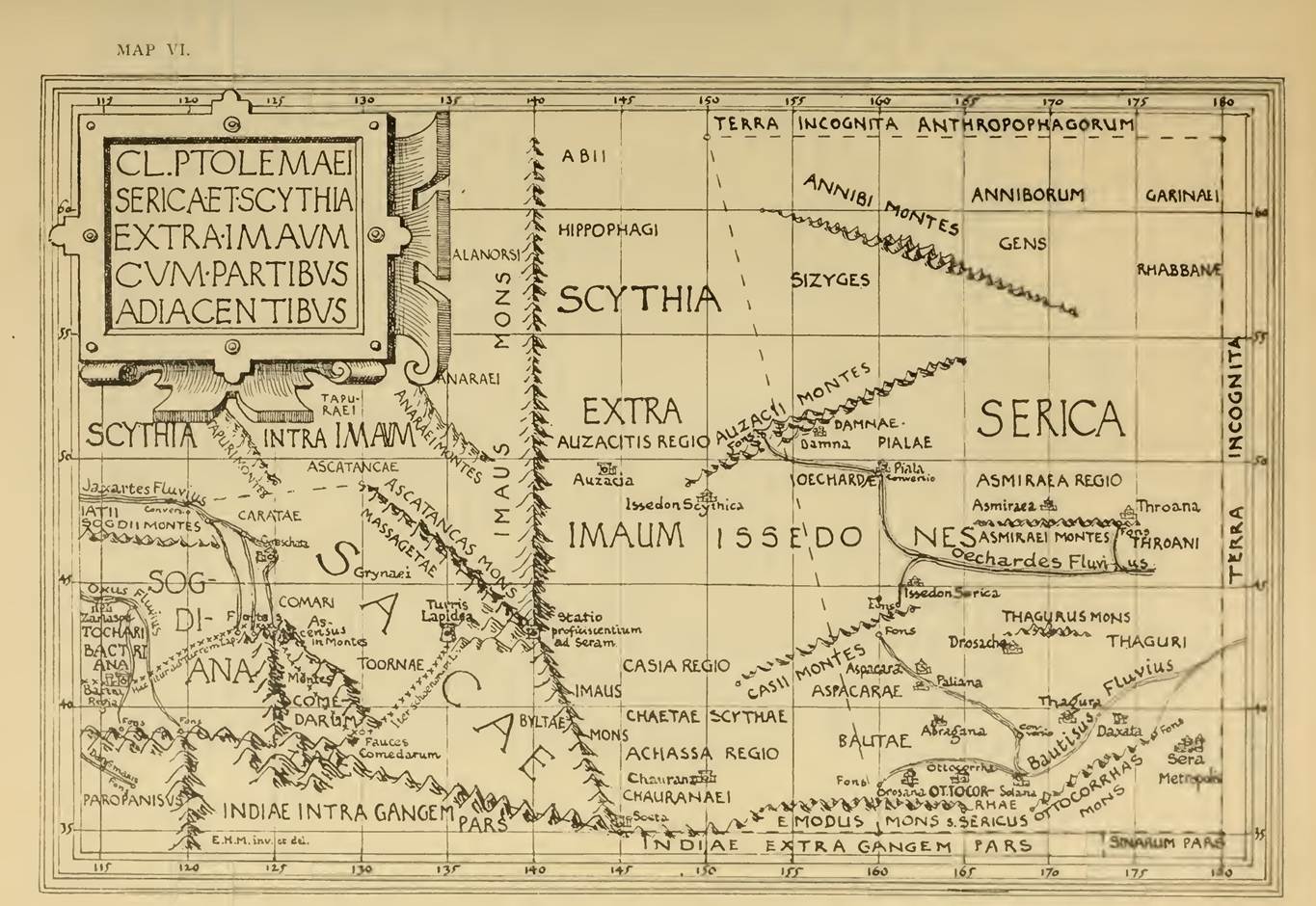
In the preceding pages has been given a sketch of the position, and as far as possible ethnology, of the inhabitants of the great steppes and their neighbours, according to Herodotus and his informants, especially Aristeas, who enables us to extend our knowledge as far as the borders of China.
Aristeas gives us the first recorded example of one of those movements which have altered the names on the map of Asia from that day to the day of Tamerlane. The fate of the Greek settlements on the north coast of the Euxine is so intimately bound up with these changes of population that a brief survey of them is indispensable.The Chinese chronicles of the Chou dynasty speak of the restlessness of the Hiung-nu interfering with communications with the west in the vin. century b.c. : and Aristeas says that the incursions of the same people whom he calls Arimaspi drove the Issedones to fall upon the Scyths and make them enter Europe. We have supposed this in conjunction with Herodotus (iv. 11) to mean that Issedones forced themselves into the country to the west of the Tarim basin and joined with the Massagetae or impelled them against the Scyths. These latter, crossing the Volga and Don, pressed the inhabitants of the land, probably Iranians, towards the west, where they joined Thracian tribes, Treres, and invaded Asia Minor, and towards the se. where they passed the Caucasus and attacked vassals of the Assyrians. These called them Gimirrai, in Greek Cimmerians. The eastern horde was followed by Scyths, Asguzai, who appeared as allies of the Assyrians, effected a diversion of the siege of Nineveh and made a raid over a great part of western Asia. It seems impossible to get a more detailed view of the movements of these various northern invaders from the accounts in Herodotus (i.
103-6), the Assyrian monuments, and the Hebrew Prophets (v. pp. 41, 42).In sw. Asia the Scyths, broken by the Median Vespers still commemorated in Strabo’s Sacaea (xi. viii. 4, 5), disappeared without leaving any traces, the Cimmerians finally vanished after having held their ground for many years at various points such as Sinope and Antandrus, but to the north of the Euxine the Scyths established themselves as the ruling caste of nomads in the eastern part of the plain, exacting tribute from various tribes in the western half. Above the steppe belt, the row of forest tribes, Slavonic Neuri, Finnish Androphagi, Melanchlaeni and Budini, Ugrian Thyssagetae and lyrcae, take no part in the changes which swept the open steppe. In the time of Herodotus and Hippocrates the Scyths seem on the down grade, on their eastern frontier appear the Sarmatae, nomads from the Caspian steppes, pressing the Maeotae and allied, probably Caucasian, tribes towards the mountains, and threatening their neighbours across the Tanais.
116 History of Scythia [ch.
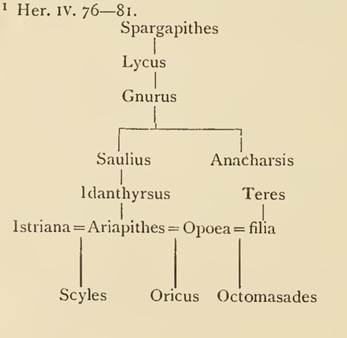
Though we have so full an account of the customs of the Pontic Scyths we know few events in their history ; still from Herodotus we can construct a kind of genealogy of their reigning house. We cannot tell whether this was in any way related to Madyes and his father Protothyes (Bartatua), whose exploits were in Asia. But we have the succession Spargapithes, Lycus, Gnurus, Saulius (with his brother Anacharsis), Idanthyrsus, who was probably father to Ariapithes. This latter had three wives, the Istrian woman by whom he had Scyles his immediate successor, the Scythian Opoea, who bore him Oricus, and the daughter of the Thracian Teres, mother to Octomasades, who eventually slew Scyles and reigned in his stead. We have no means of placing Ariantas, who made the cauldron out of arrow-heads, or Scopasis and Taxacis, who were kings under Idanthyrsus at the time of Darius1.
Invasion of Darius.
Except for one incident we know nothing of the reigns of these kings, save the stories of Anacharsis and Scyles, shewing the attraction exercised by Greek life on the more advanced Scyths and the tragic result.
But to that incident, the famous invasion of Scythia by Darius about 512 B.c.2, we are indebted for the introduction of the Scythian episode into the history of Herodotus.After what has been said of the geography of Scythia there is no need to insist on the impossibility of the story as related to us. Its whole basis is inconceivable and the tale is adorned with improbabilities of every kind. We may take it as true that Darius crossed the Danube and disappeared for a time into the steppes. It may well be that he was severely harassed by his mobile enemy ; but it cannot be believed that he went further than the Dnestr, the crossing of which would have involved a bridge and dangerous operations in face of an active foe. Strabo3 indeed says (vn. iii. 14) that the desert of the Getae was the scene of the expedition, but this may be only the outcome of his own reasoning, not independent historical evidence. However, he must be substantially right: Darius can hardly have done more than make a demonstration against the northern barbarians, with a view to securing his frontier on the Danube. It may well be that the ruling race gathered the western tribes to oppose him, so he may have come in contact with the western Budini (if as is suggested above there were two divisions of these), and this may have brought into the narrative a confusion which Herodotus turned to account to enforce several of his favourite notions, the condign punishment of the Great King’s overweening pride, the servility of the. lonians, and the solitary merit of Miltiades. In this latter Mr Macan, as Thirlwall before him, sees the chief motive of the whole tale. He thinks it an echo of the defence made when he was on his trial for tyranny in 493 u.c.
That Scyles took his father’s wife Opoea (c. 78) is in accordance with the almost universal custom of polygamous countries. Still we may remark that this custom shocked de Plano Carpini, Rubruck (c.
6) and Hayton (op. cit. c. xlviii.) among the Tartars, and is noticed by the Chinese.2 v. Macan, Herodotus, Books IV.—vi. Vol. n. App. 3.
3 Ctesias, Frag. 29, §§ 16, 17 (Muller) says Darius advanced 15 days’ march, and returned on finding the Scyth’s bow stronger than the Persian, cf. the tale of the Khazar and Russian swords in Ps.-Nestor.
Darius can never have meant to reduce all European Scythia. The device of keeping his communications open sixty days and no more, if it meant anything, would mean that Darius intended to return by the Caucasus, if he found the path open. But with his experience of nomads on his north Asiatic frontiers, to say nothing of the fate of Cyrus (the common story may well be unhistorical), he would never have trusted himself unsupported in an unknown country, even supposing that he was absolutely ignorant as to the extent and character of the countries he must traverse. He reduced Thrace, received the submission of Macedonia, and made a demonstration, perhaps not entirely successful, against the northern neighbours of his new territories ; that is sufficient justification for his European expedition, and we need not regard this as part of a scheme to gain profit from the gold of the griffins, and round off his empire by making the Euxine a Persian lake.
A most original view is that advanced by Professor Bury1. According to him the real objective was the gold of Transylvania, afterwards worked so profitably by the Romans. Had Darius meant to go east he would never have left his fleet at the Danube, but it could support him no further in a north-westerly direction. His idea then would seem to have been to build a line of forts along the Oarus = Ararus = Buzeo to keep his communications open, but upon realising the difficulty of permanently defending such a line, he abandoned his plan and returned. Confusion of the Ararus and the Oarus would then be the foundation of the story bringing Darius all across Scythia : also a more definite object for his expedition would be furnished, and an explanation of his attempted fort-building.
One only wonders if the Great King in Susa had heard of the gold mines in the land of the Agathyrsi.Duncker2 rationalises the story and suggests that the sixty days was merely an arbitrary· limit given out by the lonians to prevent daily discussion of the question whether Darius should not be abandoned. He does not think Darius went far. It is surprising what a good defence of the traditional account is made by Rawlinson (ad loc.) who strongly urges the independence of commissariat shewn by an Asiatic army, and its power of crossing rivers without difficulty. But in this case it is too much to believe.
Herodotus (vi. 40, 84) tells us that in revenge the Scyths made a raid which reached the Thracian Chersonese and drove out Miltiades, and even proposed to Cleomenes a joint invasion of Asia.
Decline of Scyths. Advance of Sarmatac.
After the time of Octomasades, who may be reckoned a contemporary of Herodotus, we can trace the Royal Scyths no farther with any certainty. The name Scyth seems to move westward giving place to those of eastern
1Classical Review, XL (1897), July, p. 277, 2 History of Afiliqieily, E.ng. ed., 1879, Vol. VI.
“The European Expedition of L)arius.” p. 272 sqq.
tribes, but then it spreads again over all the steppe countries, and embraces all the nomad peoples. These changes of connotation make it hazardous to make any statement as to the fate of the true owners of the name, save that they moved west and were absorbed between the Getae and Sarmatians.
When exactly these latter crossed the Don is not quite clear. As Niederle[354] says, it was probably a gradual process. In § 68 of the Peri plus ascribed to Scylax, dated by K. Muller[355] about 338 b.c.,a tribe ofSyrmatae is given in Europe close to the Tanais, but in § 70 Sauromatae are in Asia, just over the river. Stephanus Byzantius cites this rare form Syrmatae from Eudoxus of Cnidus, and gives it as the same as Sauromatae, Sarmatae.
Braun[356] wishes to make these Syrmatae Finns, and to distinguish them from the Iranian-speaking Sauromatae. But it seems more probable to suppose the mention of “Syrmatae” west of the river to be put in by a later hand than that of the compiler of the periplus. In the second half of the fourth century the Sarmatae are still east of the Don or just crossing, for the next century and a half we have very scanty knowledge of what was happening in the steppes. Probably an era of mutual strife had broken out which made impossible, not merely journeys into upper Asia such as Aristeas had accomplished, but even regular communication with the hinterland, of the Euxine. The Scyths had shewn readiness to trade and an appreciation of Hellenic culture, in spite of the statement of Herodotus (iv. 76) that they were hostile to foreign influences, for no nation ever thinks another sufficiently ready to adopt its customs. But now they were fighting a losing conflict with the ruder Sarmatae[357] [358], and the latter were not to be such good neighbours to the Pontic Greeks.The first definite mention of Sarmatae in Europe is in Polybius (xxv. ii. (xxvi. vi.) 12). Gatalus d Sap/zcbr??? is one of the rulers in Europe who joined a great league of states in Asia Minor and on the coast of the Euxine, b.c. 179. This is the first occurrence of the form Xap/zdr^s in place of the earlier Saupopar^? which continues to be used as a proper name[359].
The centre of gravity of the Scyths’ power, and it may well be the representatives of the Royal Scyths, shifted westward for a while under the pressure from the east. They even extended their borders in this direction, and crossed the Danube, so that the Dobrudzha gained the name of Little Scythia6, which was also applied to all West Scythia as far as the Borysthenes. Demetrius of Callatis early in the second century b.c. speaks of Scythians near Tomi7. They may have appeared here when their king Atheas8, after successful struggles with the Triballi and with Istrus, concentrated his power on this side, only to be defeated by Philip of Macedon, 339 b.c. (v. p. 123). We find Scythians also mentioned in the decree in honour of Protogenes at Olbia9, in such a fashion as to shew that their power was no longer what it was. There it is a case of their seeking protection from other invaders. The names of tribes mentioned with them,
vi] Sarmatae on Don, Scyths on Danube, Scilurus 119
Sail, Thisamatac and Saudaratac, recall the forms of Sarmatian names. From this time forward the word Scythian becomes a purely geographical designation for any northern nation, Sarmatae, Goths, Huns, Russians all have applied to them the name sanctioned by classical usage.
For instance, it is hard to define the Scythians ruled over by Scilurus and his son Palacus. Strabo (vn. iv. 3) and the Diophantus inscription[360] call them Scythians, and they are in close alliance with the Sarmatians and with the Tauri; they may perhaps be the people loosely termed Tauroscythae or Scythotauri ; they were scarcely a homogeneous tribe, but more likely a casual aggregation of the dwellers along the coast between the Dobrudzha and the Crimean mountains. Scilurus struck coins in Olbia, and the other barbarian kings, whose names we find on coins struck in that city, were probably lords of the same power, but whether before or after Scilurus we cannot say, the style is all we have to go by, and this is so barbarous that it can be no sure guide as to date. A reasonable view is that of A. V. Oreshnikov [361], according to which there were kings of the Scythians about the Danube- mouth Canites[362], Cau-, Sarias and Aelis[363] [364], who had not full control over Olbia. Later, about 110 B.C., Scilurus, who must have organised a considerable power sufficient to give much trouble to Chersonese and Mithridates, and appears to have had something of a capital at Kcrmenchik by Sympheropols, became suzerain of Olbia, and put his name upon its coins. Pharzoeus and Inismeus (Ininsimeus) also struck coins with the name Olbia, but style and lettering appear considerably later, and these kings seem to belong to the time when the city arose from the Getic devastation, and existed under the tutelage of the natives who had missed its commercial services. After a period of hostility towards the natives, as described by Dio Chrysostom, who calls them vaguely Scythians, this tutelage was exchanged for Roman protection. Latyshev is inclined to put Pharzoeus and Inismeus before Scilurus. If the coins are genuine which are figured by P. Vacquier[365], Scilurus and his dynasty ruled at Cercinitis also, as is in itself very probable. This disappearance of the true Herodotcan Scyths does not denote any great destruction of population, merely that the ruling caste lost its vitality and merged in the' mass of the people, and another tribe having defeated it assumed its place and spread its power over much the same group of tribes as had owned the sway of the Scyths. The difference cannot have been great. Objects found in tombs which must be referred to the Sarmatian period are often preeminently Scytho-Siberian. The leaders of the Sarmatae were again probably Uralo-Altaic, though it is just possible that they represent an Iranian reaction. We are unable to make any distinction between ΒΑΣΙΛΕΥΣ ΣΚΙ ΛΟΥΡΟΣ ΒΛΣ... Ε.... Δ. Σ | ........... ΛΕΛΥ........ / ΒΑΣΙΛΙΣ. Λ... N.. Ρ.... looks as if Scilurus were dedicating a statue of his queen, evidently we have only just missed the name of the king his father, iv. 191, Βασ]ιλίύί Χώδ[lying above the said interval between the Ister and the Borysthenes the first part is the desert of the Getae, next come the Tyregetae, after them the lazyges-Sarmatae, and those called Royal and Urgi, the greater part nomads, but some engaged in agriculture. They say these also live along the Ister, often on one side and on the other. In the back country are the Bastarnae marching with the Tyregetae and with the Germans, and indeed themselves having something of German race about them; they are divided into several tribes, some are called Atmoni and Sidones, and those that hold the island Peuce in the Ister, Peucini. But the Rhoxolani are furthest to the north and hold the plains between the Tanais and the Borysthenes....But we do not know if anyone lives above the Rhoxolani.” He goes on to give the stock description of nomad arms and mode of life, adding that the Rhoxolani winter in the marshes by the Maeotis and spend the summer on the plains. Still further e. beyond the Tanais, between it, the Caspian and the Caucasus, Strabo places the Aorsi and Siraci[366], the Sirachi of an inscription at Tanais (193 a.d.) in which Sauromates II. claims to have conquered them[367]. These people are also rich in horses and mostly nomadic though not quite without agriculture. They were just then specially prosperous owing to the overland trade with India. The Aorsi seem to be mentioned as Yen-ts‘ai by the Chinese historians and to have later been known as A-lan-na3. Whereby we may identify them with the Alans or Alanorsi in Ptolemy. Pliny4 is the first writer in the west to speak of Alans, and the Rhoxolani themselves are interpreted as Blond Alans. The personal names of Aorsi and Siraci preserved by Strabo bear an Iranian stamp. Strabo does not mention the name of the lazamatae, the first tribe of the Sarmatae, which we meet as their extreme western out-post towards the Tanais; the name occurs in various forms, Hecataeus calls them Ixibatae; Ephorus who distinctly refers them to the Sarmatae, lazabatae5; Polyaenus (vm. 55) makes them Ixomatae and by mistake Maeotian, he speaks of a time when they were living to the e. of the Maeotis. But Miillenhoff is probably right in regarding lazyges as a later form of the same word[368]. So the chain of Sarmatian tribes according to Strabo is lazyges, Royal Sarmatians, JJrgLof which we know nothing, more, and chief of all Rhoxolani[369] with the Aorsi and Siraci beyond the Tanais. These nations gradually pass westwards. Ovid still knows the lazyges in W, Sarmatia[370], but in Tacitus[371] [372] they appear as allies of the Sucvic king Vannius, that is they are already on the middle Danube in a.d. 50. Ptolemy has them in two places, along by the coast of the Maeotis and lazyges Metanastae, between the Theiss and the Danube, the result of combining information of different dates“. In Western Sarmatia the lazyges are succeeded by the Rhoxolani. Tacitus[373] tells how they made an unsuccessful raid into Moesia, a.d. 70, and clearly shews the inferiority of their long swords or spears and heavy coats of mail to the handy equipment of the legionaries’. Later they fought Hadrian on the Danube and their land extended to the borders of Dacia. East of the Rhoxolani came the Alans who crossed the Tanais and finally found themselves neighbours of the Goths and Vandals, with whom the name of their western division becomes so closely linked. Westward Movement of the Huns. All these movements from the East, like that which brought in the Scyths, seem to have had their origin in Mongolia. Towards the end of the Chou dynasty (c. 1155—255 b.c.) the Hiung-nu were pressing both upon China and south-westwards upon the Yiie-chih (Issedones? v. p. 110) and Wu-sun. The Ts'in dynasty (255—209) resisted the Nomads and secured China against them by building the Great Wall. Hence the Hiung-nu turned westwards and c. 176 b.c. drove the Wu-sun into the mountains about Hi and the Great Yiie-chih into the Tarim basin. Here the latter seem to have amalgamated with the earlier population, the T‘u-huo-lo (Tochari). After their defeat by Kayuk c. 160 b.c. we find the Yiie-chih probably including' the T‘u-huo-lo 2—3000 li w. of Ta-Yiian (Farghana), N. of the Kuei (Oxus); w. of them is ’An-si(k) (Arsaces, i.e. Parthia), N. the nomadic K‘ang-kii and again N. of these the Yen-ts‘ai (Aorsi). To the s. of the Kuei, 2000 li sw. of Ta-Yiian, is Ta-Hia, and se. of this again Yen-tu (Panjab)8, so Ta-Hia must be Bactria (v. inf. p. 129, n. 4). The appearance of the Yiie-chih in Trans-Oxiana displaced the Sai (Sek = Sacae) southwards, but may also have exercised pressure northwards, as in the following century we find the Aorsi on the borders of Europe. Next we hear in the Han Annals that the Yiie-chih have moved south of the Kuei and conquered B Hist. 1. 79. 7 For pictures of Sarmatians on the walls of the vaults of Anthesterius and others near Kerch, C/\. 1872; Kill. p. 203 sqq., v. inf. ch. XI. i; 4. 8 Chang K'ien, c. 126 B.C., ap. Shih-ki c. 123. The first character of Yen-tu ( = India) is commonly read Shen, body, hence the identification Sindhu, but here we are specially directed to pronounce it Yen or Yuan (H. A. Giles). M. l6 Ta-Hia. This would be soon after the unsuccessful attack of Artabanus on the Tochari (c. 124 b.c., Justin xli. 2), as it seems to be the movement Strabo (xi. viii. 2) records, whereby the Asii, Pasiani (in these names lie hid Yiie- chih and Wu-sun), Tochari and Sacarauli (v.l. Saracauli) from over the Jaxartes drove the Greeks out of Bactria1. Of the five Yiie-chih tribes the Kushanas eventually came to the front and their power also gravitated towards India, replacing the Greek dominion in Afghanistan. Hence in western usage they shared the name of Indo-Scyth with the Saka states on each side. Meanwhile we catch glimpses of the westward movement of the Hiung-nu2 due to pressure from the Sien-pi, their eastern neighbours, who finally absorbed part, penned part in the Altai to reappear as the Turks, and drove the main body to the far west. About 200 b.c. the Phauni are coupled with the Seres as the limits of Graeco-Bactrian ambition, that is the Huns were in their original position3. Amometus4 puts them to the N. of the Indians by the Tochari: Ptolemy or rather Marinus of Tyre places them as Chuni on the borders of Europe, and gives the Ural river its Turkish name Aat£5, now Jajyk. So from the other side the Hou-han-shu tells of the Huns spreading westward, c. 100 a.d., and subduing the A-lan-na, c. 250 a.d., and the Wei-shu of their taking the land of the Yen-ts‘ai6. Finally, in 375 a.d., the storm of the Huns’ invasion fell upon the Alans and afterwards on the Goths, and all the peoples of Eastern Europe were involved in confusion. It is beyond my purpose to follow their fate. Invasions of Scythia from the West. Getae. But not only from the east did peoples enter the steppe land. The force of the backwash of the Iranians and advance of Huns was not sufficient entirely to prevent the western peoples from moving down towards their end of the great plain. The Getae may almost count as original inhabitants. Certainly we have very early traces of their presence to the N..of the Danube. Whenever their nation was strong and united they seem to have extended their sway to the Dnestr, in times of decadence their borders would fall back to the Danube, and as we have seen, sometimes the Scythians crossed even this. To the Getae belonged very likely the Tyragetae, not from the simi- larity of name which seems to be but 1 Tr. Pomp. Prol. XLI. “ Saraucae et Asiani ” attack Diodotus of Bactria; xlii. “reges Thoga- rorum Asiani interitusque Saraucarum.” 2 All the Chinese forms, v. sup. p. 91, including Hua the older name for the Yi-ta or Ephthalites, the Yüe-chih’s successors, called in Sanskrit Hüna but generally regarded as no true Huns, go back to an original Hun. In western authors we have Chuni, Phuni, Xovvoi, ovvot and Ovvvot ; the interchange of///, kh, and h is found in Turkish dialects and Tomaschek (1. p. 759) may be right in identifying all these forms. 3 Strabo XI. xi. I, on authority of Apollodorus. Codd. avvä>v, Müller pvvS>v. H. Brunnhofer, Iran und Turan, p. 204, sees in Dribhika, Cumuri and Dhuni, beggar folk of the Veda, nomad tribes Sarmatian for men of the Tyras, but Derbiccae and Qoinoi, the form preferred (he says) by Eust. ad v. 730 of Dion. Perieg., but this is but to strengthen his view of the late invasion of the Panjhb by the Aryas, Eust. really rejects the O. 4 ap. Pliny, NH. vi. 55 ; Detlefsen reads “Thuni et Focari,” adding “al. Chuni, Phuni vel Phruri, et Tochari”; similar var. 11. in Dion. Perieg. v. 752 ; so much for arguments founded on the supposed etymology of tribal names. 5 Ptrix in Constant. Porph. de adm. imp. yj. 6 See F. Hirth, “ Ueber Wolga-Hunnen und Hiung-nu,” in Sitzungsber. d.phil.-hist. Classe der k. bayer. Akad. d. lldss. 1899, Bd II., Heft II., pp. 245— 278, Munich, 1900, and review of same by Prof. K. Inostrantsev in TRAS. Oriental Section, Vol. xm. p. 068, St Pb., 1900. from there being no other stock to whom the Tyragetae can be referred. They seem clearly distinguished from any variety of Scythian *. In the time of Philip of Macedon we read that Athens had spread the power of the Scythians to the south of the Danube, but this power was, it seems, destroyed by the defeat inflicted by Philip[374] [375] [376], b.c. 339. For in 336 Alexander2, having driven the Triballi to take refuge in the island of Pence, crossed the Ister, defeated the Getae on the north bank to the number of 10,000 foot and 4000 horse, and took their town. It seems hardly possible that in three years’ space the Scythians should have thus disappeared and left in their place another nation with a town and large forces, and that this nation should continue the war with Macedon. The question arises, was not Atheas a Getan, called a Scythian just because he lived N. of the Danube ? Alexander’s attack was merely a demonstration, and later the Getae gave much trouble to the rulers of Macedon. While Alexander was conquering the east his lieutenant in Thrace, Zopyrion, made an expedition against the Scythians[377] and was annihilated. This again suggests that the authorities did not clearly distinguish Scythians and Getans in this region. About 291 b.c. Lysimachus undertook an expedition against Dromichaetes, king of the Getae, was defeated and taken prisoner with his whole force in the sBace between the Ister and the Tyras in which, according to Strabo, Darius had suffered defeat (vn. iii. 8 and 14). Tacchella[378] refers to successors of Dromichaetes coins bearing the names of Acrosandrus, Canites, Adraspus and Sarias, also perhaps Scostoces. We hear little of the Getae for the next two hundred years, for the Galatian invasions weakened all the Thracian and neighbouring tribes. Then about the time of Sulla[379] there arose a vigorous king among the Getae, as Latyshev thinks, or according to others among the Daci. The fact is that these were two closely connected peoples, and the Romans were apt to apply the name Daci to both because they approached the pair of them from the west, whereas the Greeks called both Getae, having come in closest contact with these7. It is with this king Byrebista8 that Strabo (vn. iii. 11) begins his account of the Getae. He found his people oppressed and weakened by continuous wars but united them and trained them till he had subdued the greater part of their neighbours. He harried the Roman provinces and Thrace, destroyed the Keltic Boii and Taurisci, and took Olbia and the other Greek towns along the coast as far as Apollonia9. At least the time given by Dio for this destruction, 150 years before the delivery of his speech, between 67 b.c. and 50 b.c., agrees with the time of Byrebista’s power which ended with his death about 44 b.c. Caesar intended an expedition against him, but when Augustus sent one, the king p. 119, n. 3. 8 Jordanes, Gel. c. XI. " Cf. Dio Cassius,RH. i.xvii. 6. 8 This form livpeßiara indecl. is used in a contemporary inscr. from Dionysopolis, N. of Varna, Latyshev, Journ. Min. Publ. Inst. 1896; Ditt.2 I. 342. Strabo has Boipe^t'arar, VII. iii. I I ; Trogus Pomp. Prol. XXXII. 10 Burobustes, or something like it; Jordanes, Get. xi., Burvista. u Dio Chrysostom, Or. XXXVI. p. 49. He seems to have had a peaceful suzerainty over Dionysopolis, Ditt.2 I. 342. had been murdered and the country was divided into four or five warring states, so that the power of the Getae sank as quickly as it had risen. To the Getae belong the Carpi, Carpiani (Ptol. in. v. io), Harpii (ib. m. x. 7) between the Tyras and Ister, with the town Harpis on the coast. Niederle[380] puts them further inland and connects their name with Carpathian, and suggests that they were Slavs, the same as the enigmatical Khorvate or Croats. They are not mentioned by"Strabo, whereas they were known to Marinus of Tyre. They could hardly have come in after the annexation of Bessarabia to the Roman Empire under Nero (v. chap, xiv.), so that their appearance coincides in time with the migration of the lazyges into the basin of the Theiss, and there may well have been causal connection between the two events[381]. Geographus Ravennas (1. 12) speaks of Sarmatum Patria which may be either the Theiss valley or Sarmatia e. of the Carpathians, and adds, gens Carporum quae fuit ex praedicta in bello egressa est. That the Carpi were Dacians is shewn not so much by the form KapTroSaxat[382] as by the characteristic place-names in -daua given by Ptolemy in their country. The forms with PI came through the mouths of Germans, Bastarnae[383]. Bastarnae and Sciri. These Bastarnae[384] are the next invaders from the w. who came to join the mixed population of this part of Scythia. They were the easternmost outpost of the Germanic world, the first Germans to come in contact with the Greeks. These latter at first regarded them as a variety of Kelt and the earlier authors speak of them as FaXarai, but the clear statements of Strabo and others[385] who had learnt the difference between Kelt and German have given Miillenhoff and Braun good grounds for confidently affirming their German blood. They are also interesting as having stood between the Keltic and Slavonic worlds in the place afterwards occupied by the Goths. Whether or no they were the serpents who drove the Neuri from their country (p. 103), the first position in which we can clearly trace them is on the e. slopes of the Carpathians, which they must have reached before the first great sound-shift, for from them must have come the form Harfa'Sa in which the word Carpathians occurs in Norse epics[386]. At the beginning of the second century b.c. they moved down to the Danube and were employed by Philip of Macedon against the Thracians. Being defeated the greater part returned home, but a part settled in the island Peuce, near the mouth of the Danube (p. 12), and never rejoined their fellow tribesmen, though consciousness of their affinity continued for centuries, and geographers, mistakenly identifying Peucini and Bastarnae, placed the former in the interior in the places occupied by the latter. Strabo is the first to say where the main body of the Bastarnae lived after leaving the Carpathians. He locates them in the interior bordering on the Tyragetae and the Germans, 5 Braun, p. 99 sqq. Cf. Niederle, op. cit. I. p. 289 sqq. ; Miillenhoff, DA. 11. 104 sq. 6 Str. vii. iii. 17 ; Pliny iv. 100; Tac. Germ. 46. 7 Niederle takes the snakes literally, and will not allow the Bastarnae on the Carpathians before 250 B.c. Trogus Pomp, xxviii. mentions them about 240. N. will not grant any defined date to the sound-shifting. that is in Galicia and upper Bessarabia. In this position, though they retained their German speech, manner of life and houses, living a settled life and going afoot as opposed to the Sarmatians who spent their time in waggons or on horseback, still by mixed marriages they took on something of the dirty ways of the Sarmatians[387]. In spite of the words mixed marriages, we must beware of thinking of the Bastarnae as bastard Germans, as Braun has shewn that this use of the root bast is only mediaeval. Also they are- not to be identified with the Galatae of the Protogenes inscription[388]. If Γαλάτσι there meant Germans, we should not have Γαλάται και ^κίροι., as these latter would be included in the greater denomination[389]. These Sciri offer no great difficulty, although they are not mentioned again until the time of Pliny[390], who puts them on the Vistula to the s. of the Goths, between them and the Bastarnae: we may suppose that they, with their companion Kelts, were partakers in the movement which brought the Bastarnae into Thrace, but instead of continuing as far as that more distant objective they turned aside to plunder Olbia. Being foiled in their attempt the Sciri probably returned to the Vistula with the chief mass of the Bastarnae, whereas the Kelts who came from Northern Hungary remained on the Danube together with the Peucini. It seemed as if the Sciri remained among the most remote Germanic tribes, until these at last moved south in the wake of their more advanced countrymen. But some Sciri are found among the tribes subject to the Huns about 381 a.d., and again in 409, when they were caught in a flight and destroyed or sold as slaves[391]. The Huns could scarcely have reached the Sciri on the Vistula; perhaps some of them had settled further south. Ptolemy does not mention any Sciri®. Kelts and Goths. Finally, beside the Germanic Bastarnae and Sciri there were Kelts on the lower Danube. Ptolemy puts them above the Peucini, between them and the Harpii, calling them Britolagae, v.l. BpiToyaXXoi. Their towns were Nov iodunum and Aliobrix, names whose Keltic character is evident. Various views have been taken as to how Kelts came there, and whence and when, and with these questions is bound up that of the date of the Protogenes inscription2. The eastern movements of the Kelts had brought them to three positions from which a detachment might have moved down to the lower Danube. From the Eastern Alps, occupied about 400 b.c., they spread further, and in 281 attacked Thrace along the western border, and in 279 made their great descent upon Delphi. On their way back the remnants occupied se. Thrace, and founded a kingdom under Comontorius with a capital TvXtj or TuXis, near Mount Haemus. This kingdom continued till 213 b.c. when a rising of the Thracians utterly destroyed them7. These are the Kelts who are supposed by W. A. S. Schmidt8, and after him Latyshev“, 0 Braun, p. 117 sqq. ; Niederle, op. cit. I. p. 302 sqq. 7 Polybius iv. xlv. 10; xlvi. 1. 8 “ Das olbische Psephisma zu Ehren des Protogenes,” Rheinisches Museum für Philologie iv., Bonn, 1835-6, p. 357 sqq., 571 sqq. 9 Olbia, p. 66 sqq. to have extended their devastations as far as Olbia. Boeckh thought that the assailants were Scordisci from Pannonia. In each of these cases the incursion must have been pushed very far from the base of the people making it, and they must have returned to their own place again. Moreover it is hard to see how they should have come into combination with the Germanic Sciri. Whereas if we suppose that there was a general southward movement of Keltic tribes settled in northern Hungary, and Germanic tribes from over the mountains in Galicia, Britolagae, Bastarnae and Sciri, this combination could be well understood and the assailants would be found again in the Britolagae on the Danube. That would put the Protogenes inscription in the second century b.c., not in the third, and this agrees best with the general character of the lettering which still does not preclude its belonging to the third century according to Latyshev’s view[392]. To Keltic influence we may attribute the presence in S. Russia of fibulae derived from the La Tene type[393], but Spitsyn (l.c.) puts them down to the Bastarnae. Keltic too, if we may trust the engraving, is a coin from the Crimea figured by Waxel[394]. Yet one more nation entered Sarmatia from the west, the nation which brought about the fall if not the absolute annihilation of the Greek colonies on the mainland. The Goths appear in the steppes early in the third century a.d., and by 238 already receive a stipend from the empire[395]. This aroused the envy of the Carpi, who claimed to be as good as they, and on being treated by the Romans with contempt they crossed the Danube and destroyed Istropolis, a.d. 241. Under Philip the Arabian the stipend to the Goths was unpaid and they in their turn invaded the empire and laid siege to Marcianopolis. After defeating the Gepidae who had tried to follow them into the rich plain, but were forced to return to their seat in Galicia, the Goths under Cniva again invaded the empire in 249, took Philippopolis in 250, and the following year defeated and killed the emperor Decius. In the war which followed the Goths, whom the historians with characteristic pedantry call Scythians, used boats to harry the coasts not.merely of the Euxine from Pityus to Byzantium, as the Russians were to do after them, but also those of the Aegean, sacking even such towns as Ephesus and Athens, as well as “Trojam Iliumque vix a bello illo Agamemnoniaco quantulum se reparantes”[396]! But a great combined invasion, rather a migration by land and sea with women and children, was destroyed by Claudius, who well earned the title Gothicus. Aurelian ceded Dacia to the Goths and peace was made in 270, a peace which lasted with slight interruptions till the eve of the Hunnish invasion. But before crossing the Danube the Goths had worked their will upon Olbia and Tyras. Coining comes to an end with the first half of the reign of Alexander Severus, and the latest inscription (App. 14) is of the time of Philip the Arabian : Olbia was not quite deserted, for later coins, even Byzantine ones, have been found on the site, but it ceased to be a Hellenic xxi. p. 255 ; Sm. m. i. 1 —7. 3 Suite du Recueil d'Antiquites, f. 57. 4 Cf. Hodgkin, Italy and her Invaders'1, Vol. I. p. 46. 5 Jord. Get. XX., cf. Zosimus, 1. xxxv. sqq. city'. 'I'hc Goths probably obtained from it, as from Panticapaeum, some of the ships they used in their distant sea expeditions'[397] [398]. But from the time of the coming of the Goths the history of the Pontic Greek states is at an end, save only for Chersonese on its well-defended peninsula. For her these new tribes mostly meant new markets for her commerce. Crimea and Caucasus. At the other end of the region whose history we are considering, about the west end of the Caucasus, we find another group of tribes whose position it is again very hard to determine. Here the causes are just the opposite to those which produce difficulty in the great plain. The mountainous country has cut up the inhabitants into tribes so small that the number of names furnished by the ancient authors conveys no idea to our minds. Pliny, for instance (AV/. iv. 85), speaks of thirty tribes in the Crimea, and hardly any of his names occur in any other author, they seem to be the designations of the. inhabitants of particular valleys and villages. This region appears to have preserved some relics of the Scyths, possibly joined with the Tauri. Scythotauri may mean but the Scyths living in or near the Tauric Chersonese, or it may be just the Tauric natives, loosely called Scythians. It is hard to see how the Scyths could have really amalgamated with the mountain people. However, Scilurus as ruler of the western steppes in the time of Mithridates made his power felt against Chersonese, and had occupied Balaklava, so that he had penetrated to some extent into the Tauric territory. The Scythae Satarchae in the Crimean steppe may be either relics of Scyths or a Sarmatian tribe. Our written authorities draw no clear line of distinction between Sarmatae and Maeotae on the one hand, and on the other between the Sindi, who were almost certainly Maeotae, and their se. neighbours. But the barbarian names found in the inscriptions at Phanagoria and Gorgippia shew a much smaller proportion of Iranian derivatives than those of Tanais, and these few are either widely distributed Persian names or names of particularly common occurrence at Tanais that seem to have spread about the Bosporan kingdom. This would seem to point to the indigenes of the Euxine coast being of a different stock from the Sarmatian natives surrounding Tanais, and so presumably Caucasian. This is Müllenhoff’s view. On the other hand, Professor Lappo-Danilevskij[399] points out the substantial identity of customs and civilisation of the people who heaped up barrows along the Kuban and along the Dnepr and, assigning his Karagodeuashkh barrow to the Sindi, refers these to the same stock as the Sarmatians. Possibly a ruling tribe, nearly related to the Scyths, played the same part to the east of the Maeotis that their cousins played to the west, and dominated many tribes of various origin, some Iranian and some Caucasian. Phis would account for the similar customs used at the burial of kings in two regions so widely separated[400]. 3 Mat. хні. St P. 1894, pp- 96 —in, v. inf. p. 206 sqq. 4 Strabo, xi. ii. 16, says of the people above Dioscurias that the greater part are Sarmatae East of the Sea of Azov the tribes along the coast where the Caucasus comes close to the Black Sea were certainly the ancestors of the people that inhabited the district till the other day. The best account of these, and of the Maeotae too, is in the first chapter of Latyshev’s introduction to the Inscriptions of the Bosporus1. But he only takes notice of the tribes mentioned in his inscriptions. As we have seen, the Sarmatae really included the lazamatae, whom some authorities give as Maeotae : Iranian too were the Aorsi and Siraci, of whom Strabo says that they came down from the north (xi. v. 8). They seem to have encroached upon the Maeotae, who appear once to have reached as far as the Tanais along the Pal us that bore their name. Earlier (xi. ii. 11) Strabo gives a list of tribes among the Maeotae, Sindi, Dandarii, Toreatae, Agri, Arrhechi, Tarpetes, Obidiaceni, Sittaceni, Dosci, and the people called Aspurgiani. Of these the Sindi are much the most interesting. They first fell under Greek influence, their territory, the Taman peninsula and a little to the e. of it by the southern mouth of the Kuban, being full of Greek towns, hence they alone have left us coins (Pl. ix. 25—27) and they are first mentioned in the inscriptions of the Bosporan kings apart from the other “ Maitae2,” that is they became so Hellenized that they hardly counted as Maitae (losPE. 11. 6—8, 10, 11, 15, 36, 344—347, iv. 418)3. After the Sindi the Maeotae are taken together, e.g. καί Μαιτων πάντωτΛ Next are mentioned Toretae5, Dandarii”, Tarpetes7, Doschi8, Sirachi9. Strabo omits to mention the Thateis10, and the name is found in the text of no author, but Boeckh restored it for ®ρακων Diodorus xx. 22 and in Ptolemy for mss. Θερ/χαιώται, Θετμ.ώΐ'ται put Θατ(ε??) Μαιώται. The inscriptions give also the name Pses[s]in. Of these tribes the Toretae seem to have lived on the coast just e. of the Sindi, the Dandarii N. of them near the upper branch of the Kuban, the others cannot be well located except the Aspurgiani between Gorgippia and Phanagoria, and these appear to have been not a tribe but rather a political party or a military colony founded by Aspurgus12. ’ Along the coast next to the Toretae (at Bata) came the Cercetae, says Artemidorus, then the Achaei, Zygi and Heniochi; but the authors who treated of the wars of Mithridates put the Cercetae to the east of these latter, between them and the Moschi. Last of the coast series come the Colchi13. The Cercetae may well be the Circassians. There may have been a change of population here in spite of the natural difficulties, or Artemidorus may have confused the Cercetae and Toretae, whom Anon. Periplus (63 (22)) makes the same. Further up in the mountains Strabo (xi. ii. 1, 19; v. 7, 8) tells of Macropogones, Phthiro- phagi, Melanchlaeni, Soanes above Dioscurias, in what is now Svanetia, and barbarous Troglodytes (in the Caucasus there are great cave cities of unknown date1), Chamae-coetae, Polyphagi, Isadici, and to the north of the chain Nabiani and Panxani ; other authors add man)’ names in their lists, but they cannot be identified. The Melanchlaeni and Phthirophagi occurring here have been identified with the Melanchlaeni and Budini2 in the interior beyond Scythia, and have accordingly added to the confusion. The descendants of these tribes have not moved or have only been moved of late years by the Russian administration, which found the Circassians too little amenable to its rule. The survival of the names Cherkess, Svan, Abkhaz (the Abasgi)3 shews that there has been no great change of population, although most of the modern tribal names arc not to be identified with those mentioned by the ancients. and all Caucasian. So even in his time some Sarmatian tribes had taken to the mountains like their last representatives the Ossetes. Tirgatao, queen of the Maeotae, had an Iranian name, v. supra p. 39.. 1 losPE. Vol. II. p. ix, as usual amplifying the work of Boeckh, CIG. Ii. p. 100. 2 Her. IV. 123, yiairjrai. 3 Cf. App. 27, 29, 29“, 30, 31, 35, 42. 4 App. i(f- = IosPE. 11. 11. 5 App. T] = IosPE. 11. 6 ; App. ito write Tukhara, the form T‘u-huo-lo (in Hiian Tsang, a.d. 629—645, and Wei- and Sui-shu) belonging to a later date when they were rather more successful in expressing foreign sounds. The old equation Ta-hia = Dahae (A. Remusat and others) had been disproved by Gutschmid {Gesch. Irans, p. 62, n. 2), for the Dahae were far to the NW. near the Caspian (Str. xi. vii. 1 et al.) whereas the data (supra, p. 121) make it clear that geographically Ta-Hia=Bactria. Marquart explains his own identification by supposing that the Tochari left the Tarim basin in a migration earlier than that of the Yiie-chih, and that these caught them up and conquered them in Bactria ; but we have no Chinese account of such a separate movement of the Tochari, nor does Strabo or Justin support it (v. p. 122). 1 have supposed (mainly following Franke, op. cit. p. 30) that the Yiie-chih when driven w. by the Huns conquered the Tochari in the Tarim basin, and the two tribes, whatever the former differences between them, became politically one, then together they were forced through Farghana (rather than Dzungaria, v. Shih-ki l.c.) to Trans-Oxiana and later moved S. to Bactria. The Chinese went on using the name Yüe-chih for the combination, among the Westerners (and Southerners, Skt Tukhara) the word Tochari was the more familiar (cf. Getae and Daci, p. 123), so that it clung to their new country and so got into later Chinese. As to the name Ta-Hia, we have T‘u-huo-lo already as the Chinese transcription ofTukhära and 7« = great was, as 1 understand from Professor Giles, too familiar an ideogram often to be used as a mere phonogram (Ta-shih = Tadzhik used for Arabs being understood as Polyphagi), so that Hia is all we have to deal with, and by its tone there is no reason to suppose any lost final consonant. It would therefore do for the first syllable of Yavana (Gr. 'hlFoves, Pers. Yauna, cf. Ar. Ach. 104) the name by which the Bactrian Greeks were known in India. The Ta would distinguish these Hia from the Hia nearer home, cf. Ta-Ts‘in = the Roman empire and Ta- Yiian = Farghana. This latter might seem more like Yavana, but F. Hirth, Ueber fremde Einflüsse in der chinesischen Kunst, München, 1896, p. 24, gives good reasons against this interpretation.
More on the topic CHAPTER VI. HISTORY OF SCYTHIA, LATER MIGRATIONS.:
- CHAPTER III. GEOGRAPHY OF SCYTHIA ACCORDING TO HERODOTUS.
- CHAPTER V. TRIBES ADJOINING SCYTHIA ACCORDING TO HERODOTUS AND ARISTEAS.
- The Genetic Evidence for Population Migrations
- Evaluation of a child presenting in the health care involves four key components, often referred with acronym HELP, i.e. History, Examination, Logical deduction and Plan of investigation. Present chapter outlines broad guidelines regarding history-taking, the first step in evaluation process.
- We have had occasion to observe frequently in previous chapters how the Indian subcontinent and its religion have been influenced by migrations and cultural infusions from various parts of the world.
- Vaughn Marc M.. The History of Ukraine and Russia: The Tangled History That Led to Crisis. History Demystified,2022. — 164 p., 2022
- Chapter З The History of the Future
- Chapter 3 Early history to 1340
- CHAPTER 7 WRITING NEW HISTORY IN UKRAINE
- CHAPTER SEVEN MARY AND THE HISTORY OF SALVATION
- Chapter Five Writing a ‘Stalinist History of Ukraine’