§11. Silver.
Silver oxidizes with time so that comparatively little has been preserved in good condition. Small pieces have nearly always perished, with the exception of coins which the pressure of the die makes more resistant.
Special circumstances have rendered possible the great finds of ancient plate made in Western Europe, and nothing comparable has been discovered in South Russia. As in the case of bronzes, the earliest specimens come from barbarian or semi-barbarian graves. From Majkop come pieces which are apparently pre-Greek : the curious cup (p. 144, f. 36) and its fellows, and a “ Cypro- Phoenician ” vase with lotus pattern round the top and birds on the base’. Most of the older gold and silver plate in Kul Oba and the VII Brothers, rhyta, cups, phialae, torques, pectoral, plates for various weapons and clothes, having an Oriental or Scythic touch about it, as well as the later work from Chertomlyk, has been discussed in Chapter x. (pp. 262—269, 283—291). Perhaps the oldest Greek silver is the (fndXr) /jbcao/jbcliaXo^ found in Zubov’s barrow (p. 231, ff. 136, 137) and the similar one from No. 11 of the VII Brothers (p. 209, f. 107). These may be referred to the earlier part of the vth century, although the inscription on the former may be later. A vessel of the same type but of later style occurred at Deev barrow, but this is simply fluted“.Early cylices with the most beautiful engravings inside were found in the VII Brothers7: one from No. iv has Nike gilt; that from No. 11, Bellerophon, an early representation, for both cups belong to the vth century: a scene de famille on that from No. vi, put by Stephani early in the next century, is ranked by him as a drawing with the Kul Oba ivories, but he explains that the illustration in CR. does it scant justice: it is one of the cases that cry aloud to be reproduced by photography, excellent as may be the drawings in CR.; we see the objects in the earlier issues through the style of Piccard, the later drawings make us regret him.
Another ivth century cylix from a barrow nearKunst-Industrie, Pl. xii.
5 Arch. Anz. 1909, p. 151, f. ii : Smirnov, Argenterie Orientale, Pl. I. Nos. і — n ; Pl. СХХХ. Nos. 326—331 ; Pl. cxix. No. 303.
6 CR. 1897, p. 33, f. 103, v. sup. p. 170.
7 p. 206, n. 9, p. 210, n. 3 where please read “Dionysus”: CR. 1881, I. 1—5.
by bears Dionysus and Maenads. The whole series is very interesting as furnishing examples in Greek engraving of the best time, and with the Kul Oba ivories shews how the methods familiar to us on vases were also used in other branches of art. Rather later is the Kul Oba cylix with the Ionic dedication EPMEil: the cover (or bottom plate) is engraved with palmettos'.
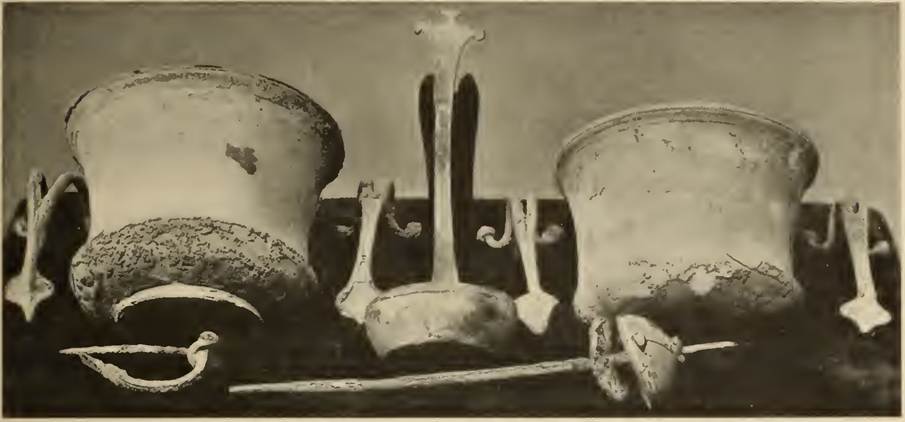
The classification of later Greek plate is difficult, because not only did the old simple shapes live on or from time to time return into favour, even in a rich tomb like the Great Bliznitsa[828] [829] [830] we find nothing more elaborate— but actual pieces can be shewn to have survived for hundreds of years, as indeed Pliny and Juvenal tell us’. Fig. 284. Silver Canthari, Colander and Hairpin, bronze Fibula. Olbia, v. p. 420. For instance, the cylix was always a popular shape, and the plain specimens from Olbia[831] [832] [833] and Ryzhanovka* are on much the same lines as the older pieces. That from Karagodeuashkh is distinguished by its high base: from the same tomb come late examples of rhyta, a р.еаор.фаХоa woman’s tomb on the way to the Quarantine6. She had a gold wreath, earrings (No. 12 on p. 396, f. 290), necklaces, finger-rings, the two best with busts of Athena in gold with the faces cut in garnet7, a ladle, a spoon and a strigil, a hairpin and toilet instruments, and a stater of Lysimachus important as giving a terminus post quern, but his coins went on being struck after his death and remained in circulation not much less than a century. Two pieces of the plate seem early Hellenistic, one, an elegant cylix with a gilt and engraved drawing of Helios and his four horses on a loose plate fitting in the bottom of it, is according to Watzinger the model for a class of Cales ware8: the other, a cantharos with a necklace below its rim, is just like the clay 5 ABC. 11. 5. 6 Ashik, Bosporan Kingdom, Pt in. p. 70, n. 2, ff xliv—xlix; ABC. Introd., p. Ixiii., Reinach, p. 20, xxxvn. 5, xxxviii. I, 3, 4, 5 ; Annali dell' Instituto, 1840, p. 13. Watzinger, Ath. Mitt. xxvi. (1901) p. 92, v. supra p. 351. 7 ABC. XV. 15 ; Ashik, ib. and f. 184, very like p. 365 supra, f. 265, I. 4. 8 Pagenstecher, Calen. Reliefkeramik (v. p. 349, n. 3), p. 130. ii] Hellenistic, Glinishche, Quarantines Konelsky, 385 cylix from Olbia (p. 350, f. 256) except that its base is adorned with a Lesbian cyma like the necklace gilt. Simple too is a saucer upon a square base and fluted stem ; it has a cover but no handles. But two of the pieces are quite baroque, one a jug with a twisted handle ending in a mask, an oak wreath round the neck and a vine pattern on the. shoulder ; the other, even more overloaded, has the vine pattern, fantastic handles in the shape of Satyrs, a spout made like a comic mask, and altogether suggests bad Renaissance work. Though found in the same grave these pieces must represent two different periods of silver ware. Between them come two porringers and a flask from Artjukhov’s barrow[839], in which the engraving technique has not entirely given way to the relief work: indeed some pieces from there are quite plain, the saucer on a stand just like that mentioned above, and a porringer with thumb-piece handles whose form is so common in glass. An Olbian find, containing a gold necklace with no special features, a ring and a silver-gilt emblcma, offers certain analogies to the Quarantine-road tomb. The cmblema, 12 cm. To a late period belongs a rhyton in the shape of a calf’s head which has upon its cylindrical cup extraordinarily bad figure subjects, whereas the animal’s head is rendered excellently well, so that it is difficult to understand how the whole could have been made at one time[841]. Really the figures almost equal the culminating horrors of Dorohoe[842]. Fragments of interesting work, remains of emblemata and other embellishments of Hellenistic silver vessels, have been mentioned in connection with the clay wares that copied them (p. 364), indeed, as there pointed out, the best of the moulds found at Chersonese have really more to do with silver work than with ceramics. Actual fragments of silver are two heart-shaped pieces with women’s heads and a round one with two heads kissing, all from Chersonese[843], and two reliefs of Tritons from Jaroslavskaja on the Kuban[844]. Fhe latest productions of antique silver work come from two curiously similar finds made in catacombs at Kerch in 1904: each included a silver dish inscribed DNCONSTANTIAVGVSTI * VOTIS * XX* (i.e. his Vicennalia a.d. 343), a gold wreath with an indication from a coin of Sauro- mates II (a.d. 174—210)—also in one case others of Gordian and Valentinian— a dagger hilt set with red glass and many other specimens of garnet jewelry scene. A still closer analogue is seen in another deer’s head from Tarentum now in Trieste shewing the same inferiority of figure-work, L. de Laigue, Rev. ArcMologique, Ser. 3C, xxxix. (1901), p. 153, Pl. XVI.—xvi 11.: such western analogues dispose of Reinecke’s Chinese comparison, v. 4 ABC. XXXIX. —XLIL 5 BCA. 11. p. 17, fif. 16, 17, p. 19, f. 1, v. p. 350. I! CR. 1896, p. 57, f. 280. xM. 49 and a silver-gilt shield boss: one tomb had two interesting silver spoons’, the other two good ewers and a gilt bronze statuette of a priestess[845] [846]. There should be mentioned also, although it occurred in the district of Baku far from the Hellenic colonies, a fine dish representing Amphitrite riding on a hippocamp attended by Tritons and Erotes ; its style suggests the beginning of the decline[847]. Similar dishes of late classical[848] and Byzantine work also form part of the strange collection of silver plate that has found its way from all directions to the depths of the Perm forests, although they are mostly Oriental (v. p. 257, n. 4): the Klimova find includes a round dish with a goatherd sitting in landscape recalling Theocritus and the “ Hellenistic relief[849] [850].”