§ 10. Bronzes.
On the whole, South Russia is not distinguished for Greek bronze work. No bronze statues have ever been found there, and but few statuettes: the reason seems to be that few bronze things have so close a personal relation to any individual that his relatives should wish to lay them with him in the grave, and it is from graves that the antiquities found in South Russia are taken.
Remains of towns have yielded comparatively little, for bronze is too valuable a material to find its way to the rubbish heap, and has always been melted down to suit new needs. There is no reason to suppose that there was any lack of beautiful bronzes in Olbia or Panticapaeum, only when those towns ceased to flourish the bronzes were carefully taken away. At Chersonese, which was less rich in classical times, bronzes may well have been comparatively rare, and the conditions of the soil make it unlikely that any finds of bronzes will be made on that site.The early Greek bronzes found in South Russia have all been found in Scythic graves, and have thus been mentioned already, but as products of pure Greek art, whose presence in barbarian hands was accidental, not designed by their makers, they must be treated here. We have, in fact, a specimen of the three most familiar types of Greek vith-century art[793]. There is, for instance, the six-winged Gorgon in the posture of the Nike of Archermus, whether running or flying it is impossible to tell: we have seen that the Medusa head was very popular among the Scythians, but the whole monster is of rare occurrence : the two chief examples are a gem from Juz Oba5 and the handle
4 The three bronzes here illustrated have been newly republished with excellent photogravures in Mat. XXXII. The Gorgon is treated by W. Malmberg, the Kore mirror by the same and S. A. Zhebelev, the other mirror by the latter alone.
5 v. p.427,f. 318, cf. CR. i860, iv. 6. Furtwängler, Die Antiken Gemmen, vm. 52.
of a crater from Martonosha (f. 278)[794]. The whole must have been a fine piece of work : the rim, neck and upper part of the body, adorned with spirals and Siabornaineni, are in the Odessa Museum, the handle in the Hermitage“. The latter is very massive; where it rested on the vase’s shoulder the junction is masked by the four-winged Gorgon in a characteristic vith-century chiton. She is running along a kind of abacus as of an Ionic capital, which in its turn
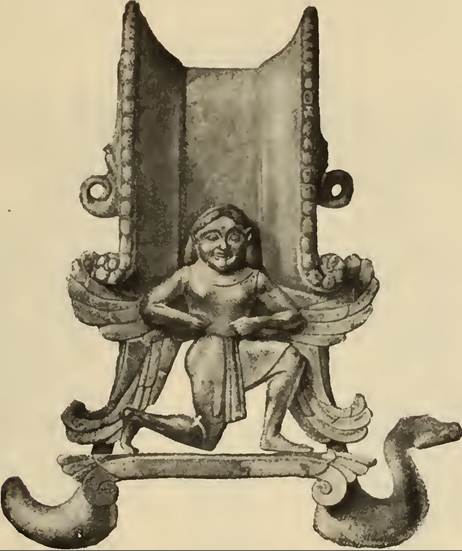
F1G. 278. CR. 1889, p. 30, f. 12. Martonosha. Handle of Bronze Crater, A.
is connected with the vase by serpents. The angle between the lower part of the handle and the vase, on a level with the Gorgon figure, is filled up by another wing on each side so that the monster should appear winged from every point of view. The whole style points to Ionian work of the vith century. It is very sad that this handsome piece should have been so broken at the time of its discovery, and that further the fragments should be separated by all the length of Russia.
Another familiar archaic type is that represented by a statuette found in secret diggings about two miles from the Government town, Kherson, in 1896 (Fig. 229)[795]. The fragment is 25 cm. high, and formed the handle of a mirror. We have a figure standing in the accustomed attitude of the Acropolis
Collection de Clercq, Tome III. “Les Bronzes,” p. 267 ; cf. H. B. Walters, B.M. Cat. Bromes, p. 85, No. 583, and one in the Louvre Gazette Arch/olo- gique, 1887, Pl. 33.
2 Mat. xxxii. pp. 1—24, Pl. 1: Goszkiewicz, Treasure Trove, p. 44, Pl. vm.: Derevitskij, Trans. Od. Soc. XIX. Minutes, p. 105 sqq., fT. 1, 2, 3.
Korai and agreeing with them in all details. Her left hand as usual holds a fold of her skirt, her right hand bears a human-headed bird.
The manner of attachment to the circumference of the mirror is elaborate. The artist did not see his way to breaking with his model and lifting her arms to hold the arc above her head, but managed the transition by interposing a whole system of animals. Two jackals (?) with their forefeet on each side of the lady’s head and their hind feet on her Shoulders support with their heads and the lady’s a strip of metal which is the ground for the familiar group of two lions tearing an ox as he lies on his back. These in turn support a strip of bronze adapted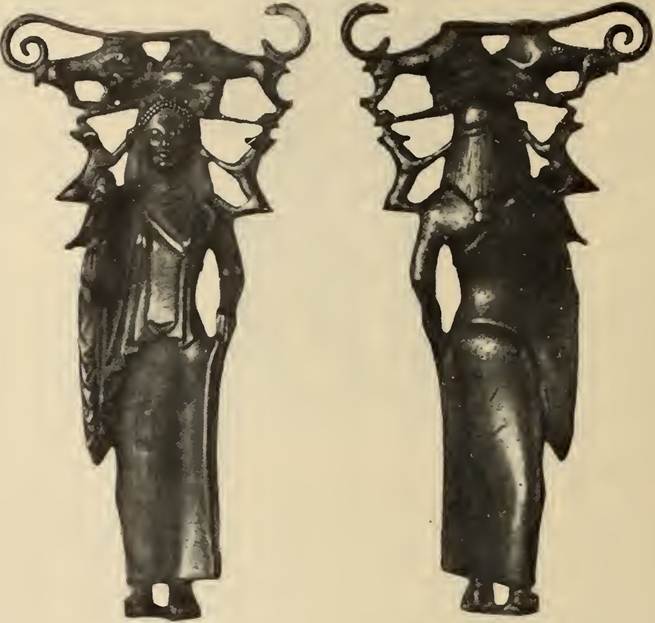
Figs. 279, 280. CR. 1896, p. 82, ff. 337“·'*. Kherson. Bronze Minor Handle. |.
to the arc of the mirror and curling round in volutes to touch the lions’ backs. In this strip are holes for rivets; the palmette which supported the disk from the back has become detached. The figure clearly stood on some sort of base now lost. There is also a small antelope which was probably fixed to the circumference of the disk as in other examples.
The general type of mirror is fairly common[796]. The treatment of the figure, the coiffttre, the beast group and the human-headed bird all point, according to Messrs Malmberg and Zhebelev, to Ionian art of the latter part
Arch. Am. 1904, p. 23, f. 2 ; Burlington Catalogue, 1904, xlv. a. 8, and one in the Hermitage, Mat. XXXII. Pl. 11.
of the vith century, being much earlier than a very similar piece occurring in Etruria, which has been ascribed to native artists* and dated by de Ridder as late as the middle of the vth century2. Our figure was at first called Cybele, then Aphrodite, but it is better not to give it a name.
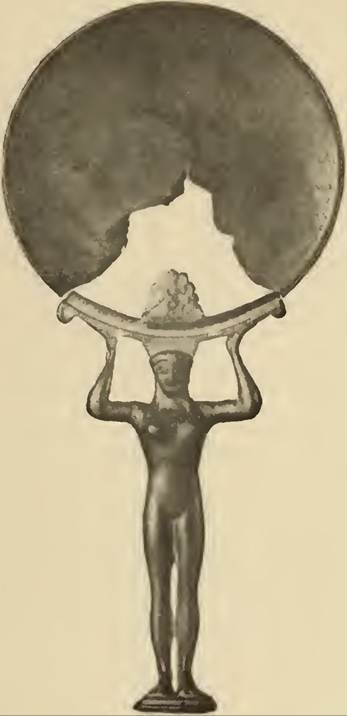
Much more simple in general disposition is a similar mirror found the following year at Annovka (Fig. 281)3. Here we have a nude female figure holding the disk with her hands raised on each side above her head, which
FlG.
281. Cl\. 1897, p. 78, f. 186:l. Bronze Mirror. Annovka near Odessa, g.itself bears the palmette that supported it behind. Unlike the Egyptian figurehandles this stands on a base, and so derives from a separate statuette. In spite of her sex, in type she resembles the so-called archaic Apollo. The proportions of the body and the whole treatment recall that type, made female because the object it adorned was designed for women’s use. Zhebelev shews that while nude female statuettes of a hieratic type are general, such very early artistic presentations are exclusively Peloponnesian. For the figure,
1 H. B. Walters, />’..!/. Bronzes, No. 493. 3 Mat. xxxu. Pl. III. pp. 25—35.
2 BCH. xxii. O898), Pl. m. p. 204.
M.
48 the closest analogy he quotes and illustrates (likewise a mirror handle) is at Munich ; for the general scheme, a mirror at Aegina[797].
An attempt at the same motive is found in a mirror from near Romny in the Government of Poltava. In this case we have a relief instead of a complete figure, and the arms seem clumsily put behind the head instead of being stretched outwards and upwards:—also the legs are much too long in proportion. The handle ends below in a medallion on which is a Sphinx. The mirror disk is perfect. This does not seem so old as the former mirrors, but it is hard to judge of its style because its surface is in an unsatisfactory state. It hardly seems quite barbarous work, yet it is a very poor reproduction of its prototypes[798]. For other more or less Greek mirrors, v. p. 266.
A similar case of a traditional plastic type (Apollo) being used as a mere handle is the Hermes who served to hold a saucepan from the VII Brothers[799]. The transition to the disk is made by two rams on each side of the god’s head, so he may be considered a kind of Criophoros.
Another early bronze is a candelabrum from Ust Labinskaja, found in a grave with plaques of the Siberian style such as it appears on the Kuban (e.g.
Zubov’s barrows, p. 230, f. 132). At the top of the shaft which was lost was a human-headed bird, with long archaic locks of hair, its waves indicated by nicks: above rose the convolvulus-shaped sconce for the lamp. The base was bell-shaped, with fluting and oves, and stood upon three bustard feet. The whole cannot be later than the vith century[800].These specimens of archaic bronzes have all occurred in native tombs. Those worthy of notice from Greek tombs are of much later, even Hellenistic, date. Most artistic are the examples of repousse work, especially the mirror boxes. One of these boxes bears Bacchus and Ariadne, accompanied by Eros and a panther: the inside is decorated with engraving, but is in poor preservation[801]. From each of the two women’s graves in the Great Bliznitsa came a mirror box with a group of Aphrodite and Eros[802]. Perhaps the most decorative is one from Artjukhov’s barrow with a magnificent figure of Scylla[803]. A later mirror with the familiar group of the three Graces was found on the slope of Mount Mithridates8. From Olbia we have one with Demeter’s head9.
In the first grave of the Great Bliznitsa were four sets of phalerae for horses, making up twenty roundels and four pointed ovals, all adorned with the battles of Amazons and Greeks10. This kind of work was heightened with gilding.
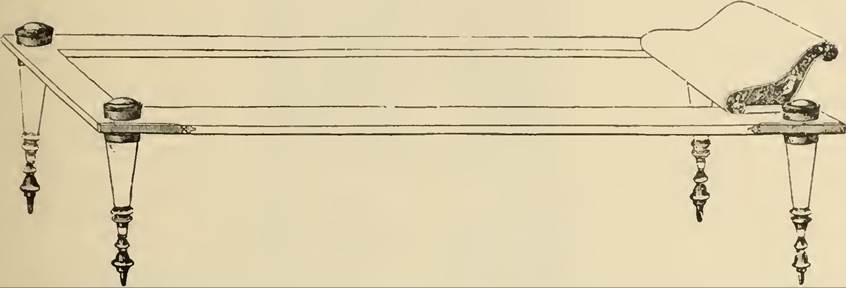
In the same technique were made the adornments of a couch discovered at Phanagoria. The chief piece11, in the shape of J, masked the end of the
7 CR. 1880, in. 13.
8 CR. 1894, p. 45, f. 68; another mirror from Kerch with Eros tying Aphrodite’s sandals, CR. 1901, p. 60, f. 124.
9 CR. 1902, p. 13, f. 20.
10 CR. 1865, V. 2—6, cf. those from Elis in the British Museum, JHS. xxix. (1909), p. 157, and supra p. 155, n. 1.
11 CR. 1880, iv. 10; C. Ransom, “Reste gr. Holzmobel in Berlin ” in Jahrb.
d. k. arch. Inst., 1902, p. 134, f.11; cf. a close analogy in the British Museum, JHS. XXIX. (1909), p. 162 : also Wiegand- Schrader, Priene, p. 380, f. 481.pillow-rest, and bore Aphrodite in the middle and little busts at each end; the other fragments were plain but sufficiently preserved to allow the wooden parts to be restored and the whole to stand in the Hermitage.
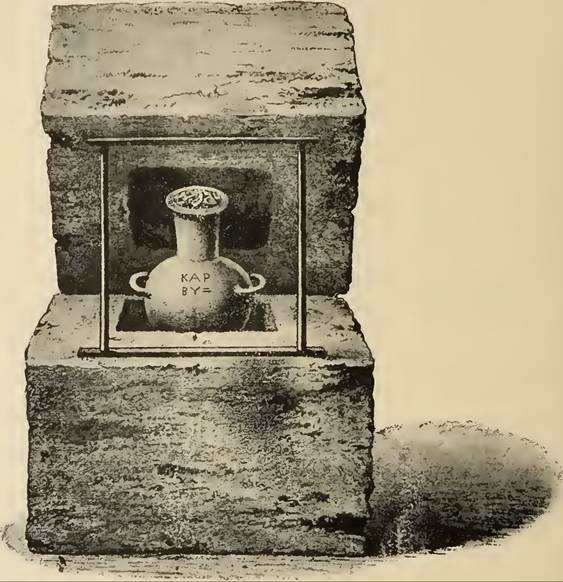
It is the repousse work also which gives artistic interest to a helmet from the Quarantine road[804], which bore a triangle upon the brow with a head of Athena, a gorgoneion of the later beautiful type on each side and a well- designed figure of Scylla with a torch and an oar filling the shape of the cheek pieces. The work is graceful, apparently of early Hellenistic time. Another fine helmet, a perfect specimen of its kind but quite plain, came from the Mirza Kekuvatskij barrow[805], together with a plain pair of greaves[806] and a Scythic sword, the one barbarian object[807] [808]. A similar helmet of pure Greek work was found up country at Galushchino near Kiev[809]. Very like is another helmet from Nymphaeum6. Of quite an original type is one found in the man’s tomb in the Great Bliznitsa and shaped as a Phrygian cap, making permanent the soft felt bashlyks of the country[810]. Fig. 282. Phanagoria. Couch. Restored woodwork: ancient bronze mountings. CR. 1880, p. 88. Besides the greaves mentioned above the Hermitage has a more ornamental pair adorned above with a gorgoneion8, not unlike a leg in the British Museum bronze room. The gorgoneion is of an archaic type, but as such appears rather to be a survival than a very early example. Mention has already been made of an elegant Greek cuirass and brassart of vth-century work found near Nicopol9. The scale armour and arrow-heads, most of which were certainly of Greek work, are treated on pp. 68, 74, for they have no artistic interest and were as it were naturalized among the Scythians. A certain number of bronze vessels has been found in various graves ; comparatively few are extracted whole, but the rim above and the handles, on which the decoration is concentrated, have generally been preserved. The commonest type is that of a hydria, which was a convenient vessel other interesting helmets, BCA. xxix. pp. 30, 31, ff- 1-3· 8 ABC. xxvm. 7. 9 v. p. 74, S. Pavlutskij, “ Objects of ancient armour from the district of Ekaterinoslav,” in Archaeological Chronicle of S. Russia, 1. (1903', p. 37, and Pl. v. 48-2 for receiving the ashes of the dead. For instance, in the passage under the wall of Chersonese by the gate[811] E stood six urns, Nos. i—3 of clay entire, Nos. 4—6 of bronze broken : No. 4 as a prize from the Attic festival Anacia bore on its rim AOAO^EIAN AklJPA7 in dotted letters very like those of the Timotheus papyrus; it held the best jewelry, No. 1 the next best. Sometimes these urns were secured most carefully against any sort of damage, for instance there is in the Kerch room at the Hermitage a kind of stone box arranged to receive such a hydria and protect it from injury, and it is Fig. 283. Stone box containing a clay urn. CR. 1891, p. 35, f. 16, from Hadzhi Mushkai near Kerch. still untouched (cf. f. 283). Fragments of a very artistic hydria, with decorated foot and side handles and a Siren at the base of the middle handle, were found in the Babjr barrow near Mikhailovo-Apostolovo[812]. A perfect specimen is well illustrated in MacPherson (Pl. 111.) ; this was gilt as many others were, for instance the hydria in Kul Oba; by it stood a great rarity, a bronze amphora of almost the same form as the earthen ones and also gilt[813]. Another form that often occurs in bronze is the ewer, oenochoe : a good specimen with a well-worked handle ending in an archaistic bearded head was found at the Khatazhukdevskij Aul on one of the tributaries of the Kuban4. Among other objects found with it was a polished stone axe, which points to a strange mingling of different cultures. In the same year was found at Chersonese a ewer of rather unusual form, having a very high handle embellished with a dog above and a woman’s face below[814]. Jugs like an oenochoe but with lids survived till the mrd century a.d., occurring in the queen’s tomb at Glinishche near Kerch ; in the same tomb was a handsome dish or shallow bowl with handle formed of snakes curling out of a winged head·1. A similar shallow bowl 47 cm. in.) across was found at Majkop ; it also had snakes about the handles and below them repousse plaques representing Pylades and Thoas (?)[815]. A basin of pale bronze 50 cm. across with a pretentious Hellenistic emblema, in copper representing a warrior, his mourning wife and a goddess of death, comes from a plundered tomb at Nekrdsovskaja Stanitsa on the Kuban[816] [817] [818]. In one of the VII Brothers an oenochoe was found with a Satyr above the handle and a crouching figure below. Another from the same group had a handle ending in an elegant Siren0. Of a similar type is a vessel from the Kuban district with Eros and a torch at the base of the handle0. From the VII Brothers also comes one of the few good statuettes found in South Russia, a young Apollo crowning a tall columnar stand like a candelabrum[819]. Quite isolated are some statuettes from the land of the Don Cossacks, a pair of wrestlers, a Satyr and a young Dionysus[820]. The latter is rendered rather curious by having a Byzantine inscription round his middle and Christian monograms engraved upon his chest. Very few of the common statuettes that fill museums in the West have been found even in the town excavations. We may mention Zeus with a thunderbolt[821] and a bust of a woman from Chersonese[822], statuettes of Athena and of Osiris from Eupatoria11, and a Hermes from Balaklava1'[823], but nothing of any merit. It is curious that perhaps the most graceful small bronzes found in all the extent of the North Euxine coast came long ago from Tanais (Nedvigovka), which has yielded no other works of art, the more so that the remains of the town then investigated date from the und century a.d. They include a pretty lamp, an imperfect candelabrum, and a kind of standing vase13. Another fragment from the same site is the fluted handle of some vessel: at the end is a ram’s head, and on the plate by which it was riveted to the body of the vessel are two figures affronted of Greek potters moulding pots : the style seems as early as the ivth century b.c.14 A good lamp was found in Artjukhov’s barrow10, another on a stand at Kerch10. Worthy of mention as an evidence of trade with Italy is a saucepan found near Kagarlyk (Kiev Govt) with a Latin inscription N GRAN IPLOCAS17. Of Roman date is an interesting vessel from Tyras cemetery in the form 10 CR. 1896, p. 169, f. 537. 11 CR. 1897, p. 74, f. 171 ; BCA. xxv. p. 179, f. 14. 12 CR. 1891, p. 131, f. 138. 13 KTR. pp. 91, 92, ff. 120, 123, 122 = Report of Archaeological explorations made in 1853, Nos. 40, 42, 39·.. 14 Archaeological Bulletin and Botes published by the 'Moscow Archaeological Soc. VII. 1900, p. 360, note by the Countess Uvarov. 15 KTR. p. 55, f. 69-CR. 1880, p. 19. 16 CR. 1904, p. 75, f. 116. 17 CR. 1891, p. 91, f. 70. of the head and bust of a negro girl; the handle above is a half circle with loops in the shape of chenisci. The whole shews Alexandrian influence[824]. The poorer classes used bronze for their adornment: very common are simple bracelets from Kerch, just bronze wire twisted round the wrist and then round itself, and of no artistic interest[825]. There is little more of this in the bronze rings with engraved bezels[826]. None in mere instruments such as strigils, ear-picks and what not. Buckles give some field for fancy in the various pierced patterns with which they were decorated ; one from Chersonese is a good example of the change of taste of which Riegl makes so much[827]; the taniga is sometimes ingeniously worked into the design (v. supra, p. 318, f. 228).
More on the topic § 10. Bronzes.:
- 10 The Rising and the Setting Sun
- THE THEORY OF KNOWLEDGE
- Ritual Instruments Used by the Vestal Virgins
- Bredholt Christensen Lisbeth, Hammer Olav, Warburton David. The Handbook of Religions in Ancient Europe. Acumen,2013. — 456 p., 2013
- CHAPTER IX. SIBERIA AND SURROUNDING COUNTRIES.
- CONCLUSION: ON SEEING AND BELIEVING
- SURVIVAL OF ETRUSCAN RELIGION
- Bibliography
- Conclusion
- CHAPTER FOUR Town and Country Urban devotions and rural rituals