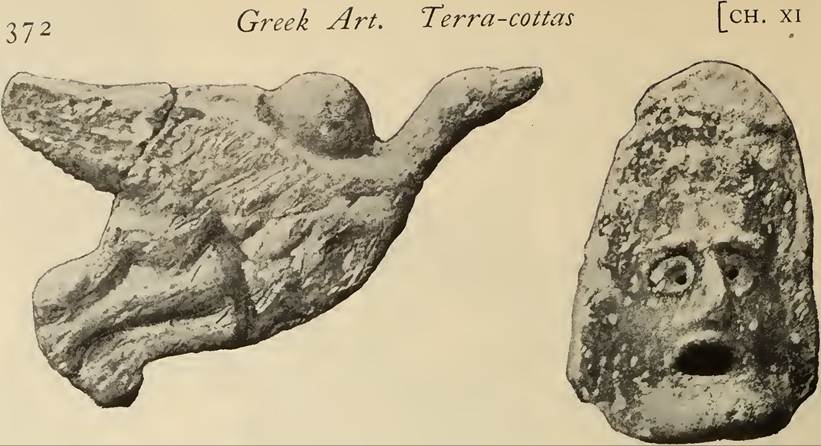
§ 9. Terra-cottas.
In spite of the spirited defences made by the Russian archaeologists it must be admitted that the terra-cottas[764] of the Northern Euxine, if not worthy of the wholesale condemnation meted out to them by Pottier[765], ami repeated by Mr Huish[766], do not come up to the level attained at Athens, Myrina or Tanagra.
The few exceptions are either actual imports or copies or even imitations made by taking casts of imported figures. That quite good figures were produced in these northern parts, that not all the tolerable specimens were imported, we know from the discovery of a coroplast’s workshop with moulds at Kerch close by the cemetery1 and at Chersonese. But the ease with which given types could be reproduced is shewn by the success of modern forgers. This being so, it is natural to find that by far the greater part of South Russian terra-cottas though of native manufacture can be paralleled in other Greek districts, particularly at Myrina, the necropolis of which corresponds in date to that in which the best class of Kerch statuettes occurs.In view of this agreement there is no need to consider the debated question of the reason why the Greeks put terra-cottas in their graves. The various views are well summed up by Derevitskij in his article, and again in his introduction to the Odessa Terra-cottas. This latter publication, with its text in German as well as Russian, makes a very representative collection accessible to Western archaeologists who wish illustrations on a larger scale than those in Kekule-Winter. In view of the existence of these w'orks and the generally second-rate character of Euxine terra-cottas, I have treated this section rather shortly.
As with other departments of Greek art, the early development of the art of moulding clay is not to be studied in the Euxine colonies.
We cannot point to many undoubtedly early specimens. We have in plenty types which by their disposition and rudeness go back to the first attempts at modelling, but these we must regard as survivals preserved under the influence of hieratic' tradition. Speaking broadly, we find but few instances of the severe style, and can merely witness a steady decline from the making of quite satisfactory imitations of the best products of Attica or Asia Minor to the rudest lumps in which any plastic intention can be traced.The different towns have distinctly their several characteristics in terracottas. The highest average belongs to Theodosia, because nearly all its specimens belong to one fairly early find, hence a superiority in material, a firm yellowish carefully washed clay, design, characteristic of the best period,
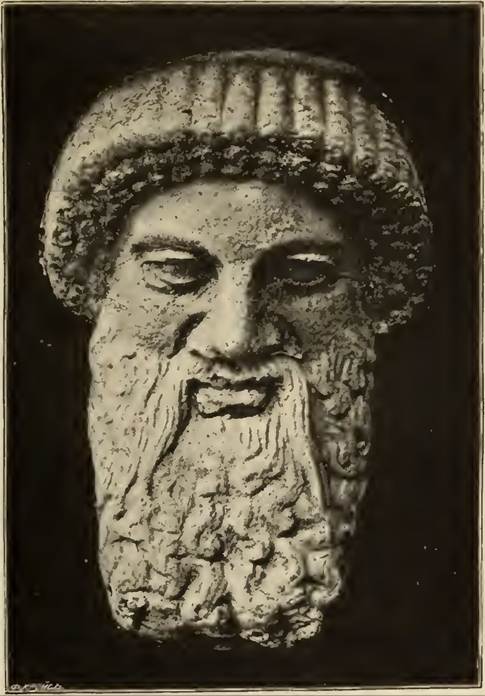
W K. Malmberg, Mat. VII. “Antiquities found in Chersonese in 1888 and 1889.” S. A. Zhebelev, Mat. xxiv.“The Kerch Niobids.” A. Vogell,Sammlung, Nos. 643—738, figs. 39—42, Pl. IX. KekulOther moulds have been taken from marble sculpture, especially a fragment of a Bacchic procession2 and a head of an archaic type of Hermes (Fig. 267) of which Kondakov and Malmberg believe that we possess the battered original in Fig. 210 on p. 297; they point especially to similar curls in the left moustache and beard and to the fact that, allowance being made for the double shrinking of the clay, the sizes of the two pieces tally exactly. Most of the moulds reproduce terra-cotta originals, not only the pretty but senti-
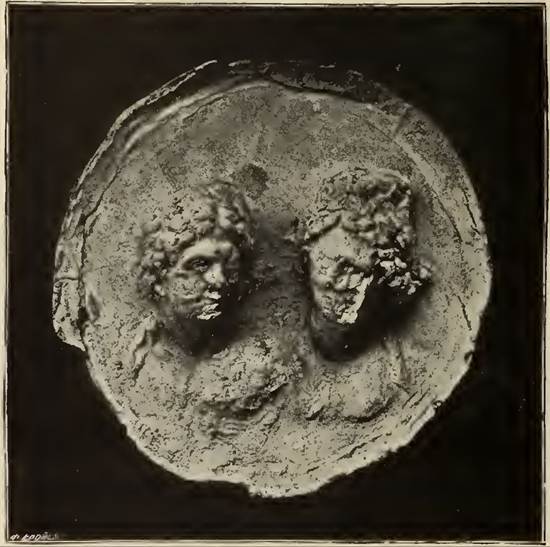
Fig. 266. Mat. vn. p. 12. Emblema from mould found at Chersonese.
mental heads on Fig. 265—in. 3 rather recalls the familiar Niobe—but various rough heads and figures3, and purely decorative pieces, attachments of handles and lips, borders and the like4. In view of such a method of working we can hardly credit this potter with a distinct style.
Other pieces of terra-cotta from Chersonese mostly have a bold free character, rough but not barbarous, just what we should expect in a town which, without any claims to artistic life, still kept itself much freer from barbarous admixture than any other on the north coast of the Euxine6.
1 BCA. II. p. 75, f. 2; p. 19, f. 19.
2 Mat. vn. її. i.
3 ib. пі. I, 4, 5, pp. 17, 18.
4 ib. pp. 22, 23.
6 CT?. 1896, p. 175, ff. 546—550; 1898, p. in, f. 10; 1899, p. 8, ff. 10, ii, p. 9, f. 14 ; 1900, p. 18 sqq., ff. 34—38, 42; 1905, p. 54, ff. 58, 60: Arch. Anz. 1906, p. 115, ff. 2, 3.
By far the greater part of the terra-cottas from South Russia are found in the environs of Kerch. Here they occur in the greatest numbers and in the greatest variety, but it is hard to characterize their style except when it becomes barbarous and produces some types unknown in purely Greek lands.
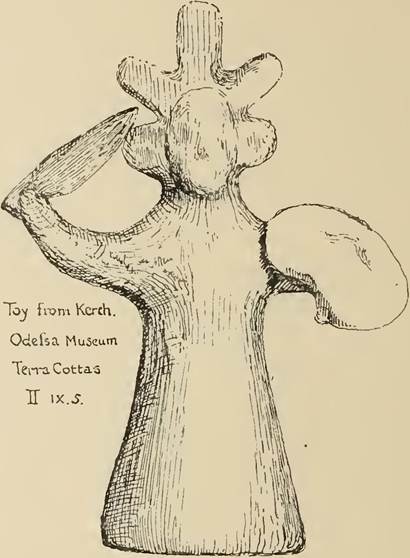
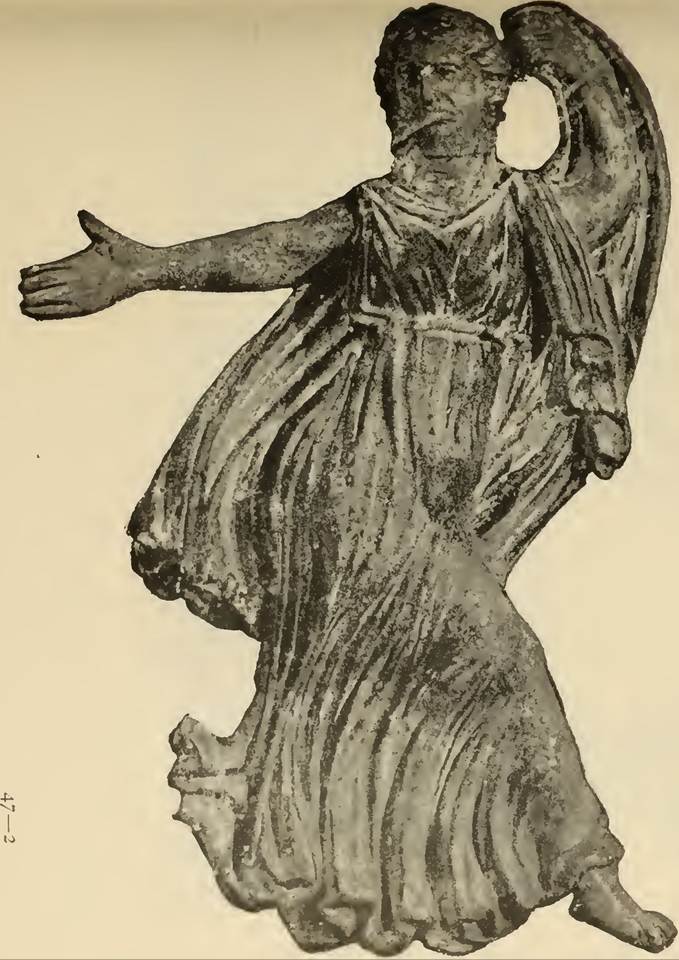
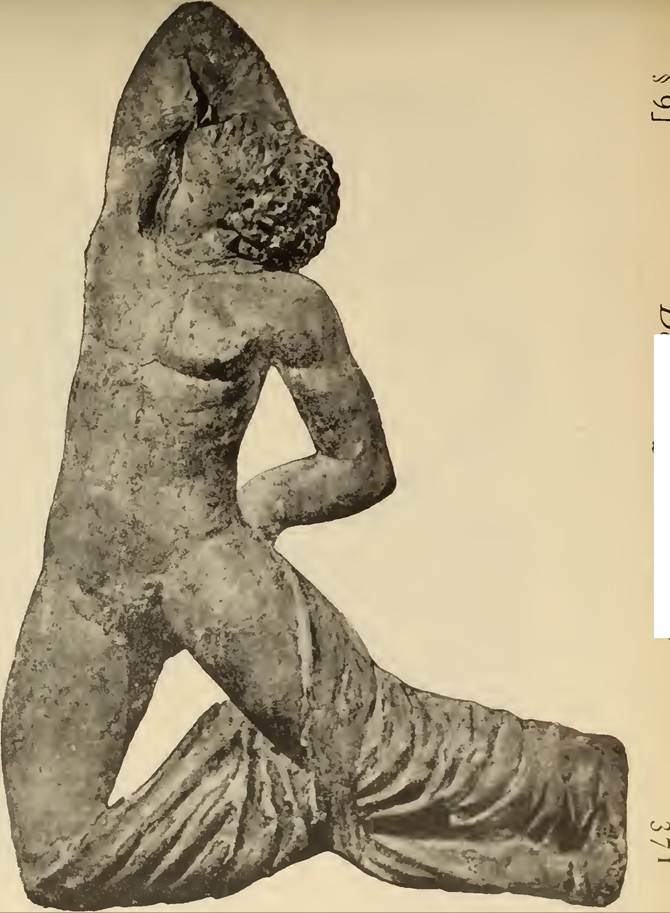
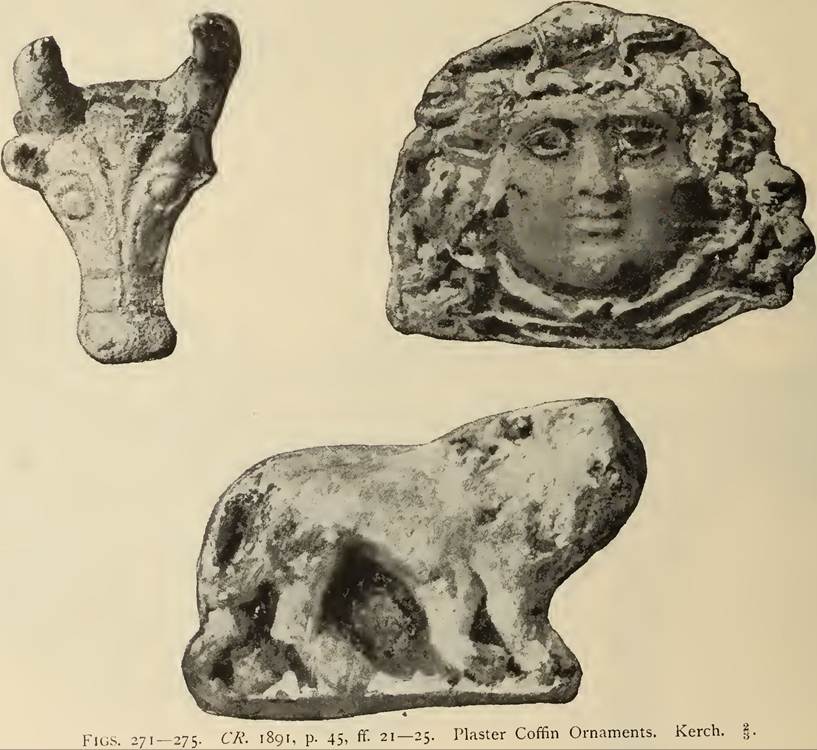
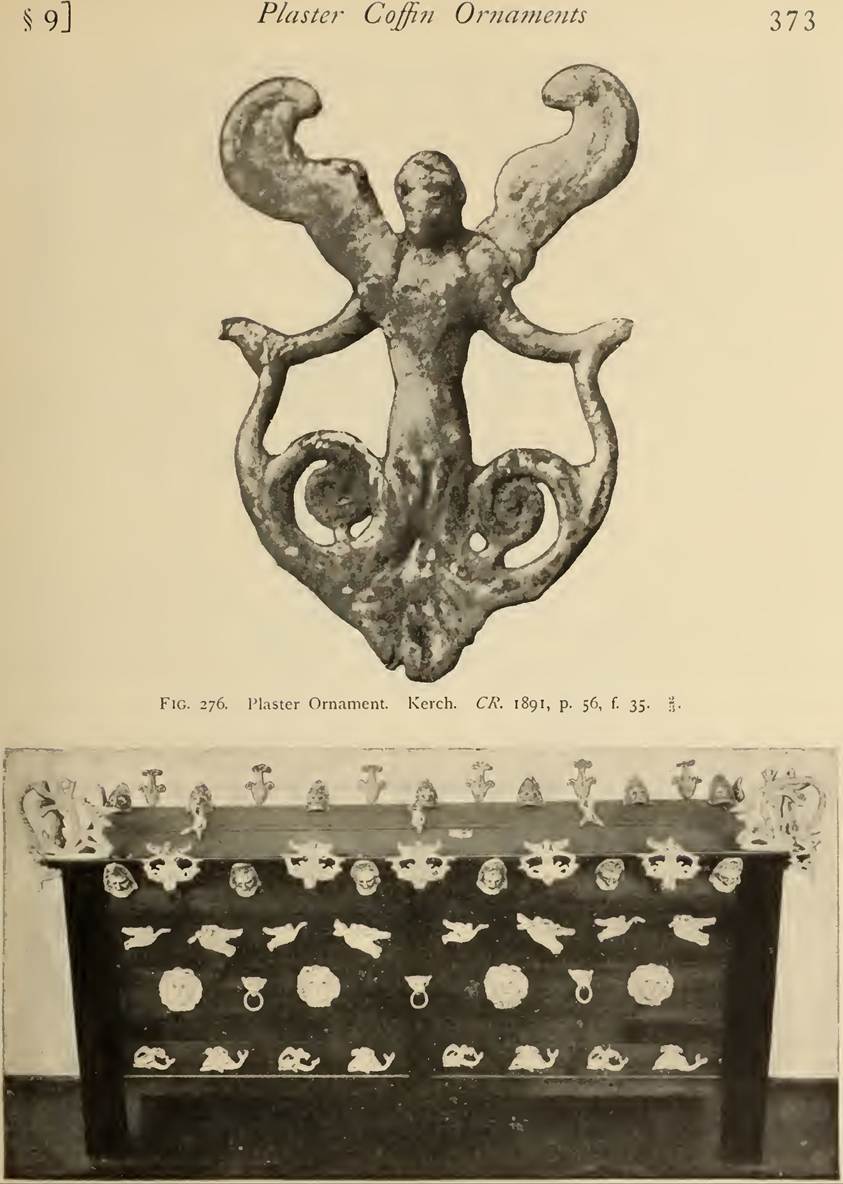
We have of course the usual Aphrodite Anadyomene[767] with or without a Herm, a dolphin or an Eros, she often wears a disk-shaped head-dress peculiar to Kerch[768]; Eros alone or with Psyche[769]; Dionysus and his crew[770] [771] or their masks’; Fig. 267. Mat. vii. p. 21. Head of Hermes from mould found at Chersonese, j. Demeter and Core[772]; Muses[773]; actors8; theatrical masks9; gorgoneia10; Nereids and Tritons11; Heracles12; Pan13; Bes14; of everyday types, mother and child”; 7 CR. 1873, 1. 4; 1880, vl 7; 1881, IV. 7. 8 Derevitskij, Trans. Od. Soc. xvm. Pl. 11.: with dancers, CR. 1906, p. 87, fif. 96 102. 9 ABC. lxxv. 3; CR. 1881, iv. 2, 3 ; 1882 8,vi.i. in ABC. i.xxv. 1, 2, 4—7. 11 Od. 12 ABC. LXiv. 8; LXXp. 304, f. 218) which occurs in stone, bronze and terra-cotta, and also on coins. The fact that a man with a Greek name put it on his dedication seems against its being barbarian. The terra-cotta versions are not clear enough to help[784]. When the horse stands on four separate legs the whole becomes rather a toy than a work of art[785] [786]. The barbarian can, however, be recognised without any doubt when he is caricatured. Such caricatures we have in the figures of slaves looking after children®. One, for instance, wears a moustache. These caricatures were carried to very great lengths among the Bosporans, even further than among other Greeks. From some of the tombs have been taken the most extraordinary figures, notably that of the second lady in the Great Bliznitsa near Taman, explored in 18696; the lady was apparently a close relation of the priestess of Demeter, whose grave was found in the same barrow in 1864, and was herself initiated; she possessed also the most beautiful jewelry, but with all this was found a whole collection of terra-cottas representing comic actors in all the obscene extravagance of their costume, athletes and slaves and women likewise, all with every indecent detail. Stephani explains that everything aTOTrov koc yeKoiov served to avert the evil eye, and that the object of these grotesques was to keep off evil influences: others think that this was just her taste, and she wished to have with her in the grave what she had found amusing in life, and that other caricatures were due to the same feeling in other people, though in no one was it so exaggerated7. In many tombs, especially in the later period, we find figures with movable limbs. Some are made like articulated dolls, that is, like an ordinary statuette with some of the limbs working on pieces of wire8. A more typical class is made so that the trunk, in the shape of a kind of hollow cone, ends about the hips, and the legs and phallus are hung separately 1870-71, v. 8 CR. 1869, 11. in., v. inf. p. 428. 7 Od. Mus. 1. xiv. 4, 5,6; KekulC-Winter. in. 1, p. 172, 1—6; CR. 1865, vi. 6, 7; 1868, 1. 15; 1874, 1. 8; 1882-8, vi. 1, 2. 8 ABC. lxxiv. 8 is quite rudely made but CR. 1868, 1. 18 is more artistic, cf. 1877, vi. 8, 12, 15, 16. on to wires and could be moved about by strings through a hole in the back. These almost certainly served as marionettes[787]. Mostly they are very rudely modelled, but there is an excellent caricature of a conjuror from Kerch, and from Olbia come models of Roman soldiers made on the same principle[788]. Some of the coarsely made ones have as it were rays coming from their heads, and hence they have been called idols, but there is no reason to suppose that they represent anything but some strange head-dress (f. 268). The model waggons were also toys (v. pp. 50, 51, ff. 5, 6[789]). It has been said that we have no clear idea what was the object of putting terra-cottas into graves, and we do not know of any definite arrangement according to which they were disposed. They were evidently thrown into a heap in no sort of order: sometimes broken on purpose and with the fragments Fig. 268. 1. at opposite ends of the grave: but in South Russia the object of a large class both of terra-cottas and of plaster figures is quite clear. They served to decorate coffins, and mention has been made of the traces left by them on the panels. The most usual series for this purpose was that of the N iobids, and in various Russian Museums several separate sets from Kerch are preserved in a more or less incomplete condition (ff. 269, 270, also pp. 332—334, ff. 241—2434). Similar figures have been found at Gnathia in Apulia, and published for comparison by Mr Zhebelev in his exhaustive treatment of the subject. Ulskaja, Arch. Am. 1910, p. 196, f. 1; BCA. XXXV. p. 3, associated with a red skeleton, copper pins and “ pre-Mj cenaean ” figurines, ib. Pl. I, u. 4 Cf. CR. 1861, in. iv.; 1868, 11 1—9; 1874, >· I· ic,. 269. Mat. xxiv. p. 10, f. 1 r. Kerch. Clay Niobid. um. vyujjttt \jrnumenis Fig. 270. Mat. xxiv. p. 7, f. 6. Kerch. Clay Xiobid. Fig. 277. CR. 1901, p. 59, f. 119. Model of Coffin from Kerch with plaster ornaments. different series vary considerably in their style, and these variations on a familiar type throw light on the methods which workmen practising a minor art applied in copying examples of fine statuary. Besides the Niobids there were used for the same purpose various masks, especially those of Medusa and models of theatrical masks; also flat figures of lions and griffins and conventional ornaments such as palmettes: these have often survived when all trace of the wooden coffin had long vanished or did vanish at the touch of fresh air (ff. 271—276; f. 277 shews what the whole looked like): but these modellings, whether in plaster or clay, though sometimes spirited and skilful, are too hasty to be of very great interest or beauty[790]. With these flat-backed figures may be mentioned flat lead castings from Olbia, the commonest are bucrania ; double axes and a biga also occur, and the British Museum has the figure of a Scythian[791]. The only other objects of clay that remain to be mentioned are the little pyramids with holes in them which are picked up on the beach near Greek sites, and apparently served as weights for nets and for the threads of the warp in weaving. Sometimes they have stamps with emblems like those on coins or on amphorae[792].