§ 7. Ceramics.
For the history of the Ceramics of the Greeks the finds in South Russia have no such superlative importance as for the study of their carpentry, textiles or goldwork. Yet they have yielded much material towards filling up outlines traced by investigators working in other regions, and they have no small historical interest as determining the relations between the coasts of Scythia and other parts of the Greek world at various periods[677].
In view of the endless number of specimens any attempt at an enumeration even of the most important is hopeless, and for finds made in Stephani’s lifetime the reader is referred to CR. from 1859 to 1881 and to his Catalogue of Vases in the Hermitage.
Early Vases.
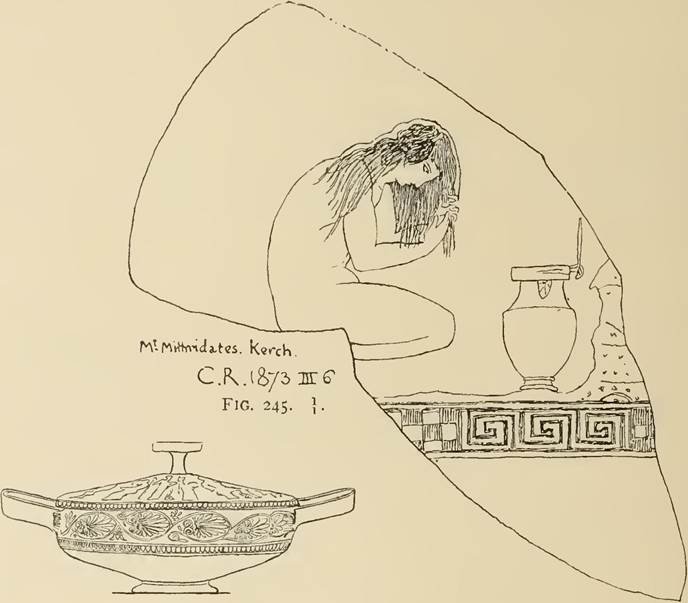
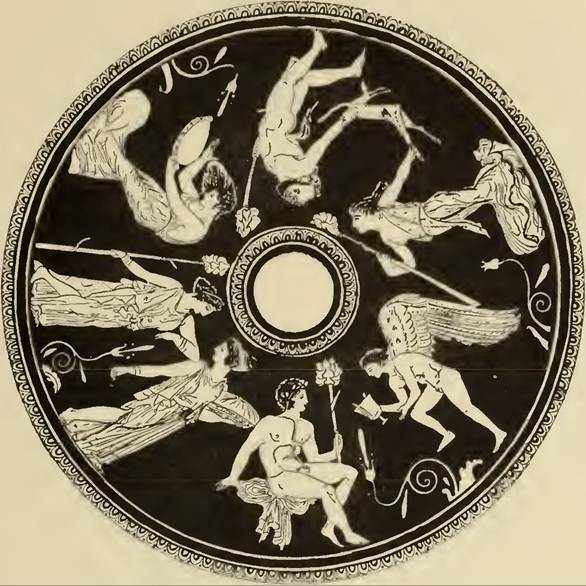
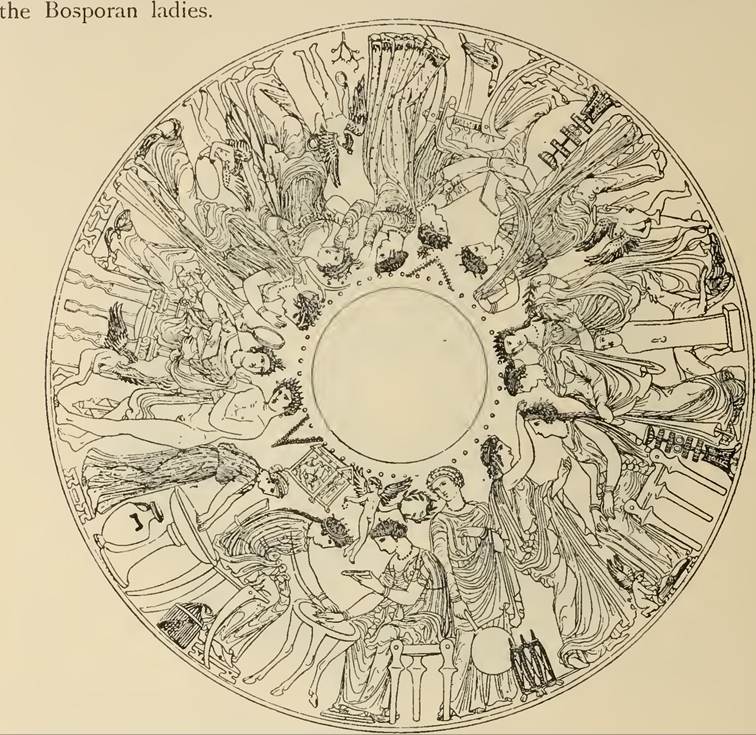
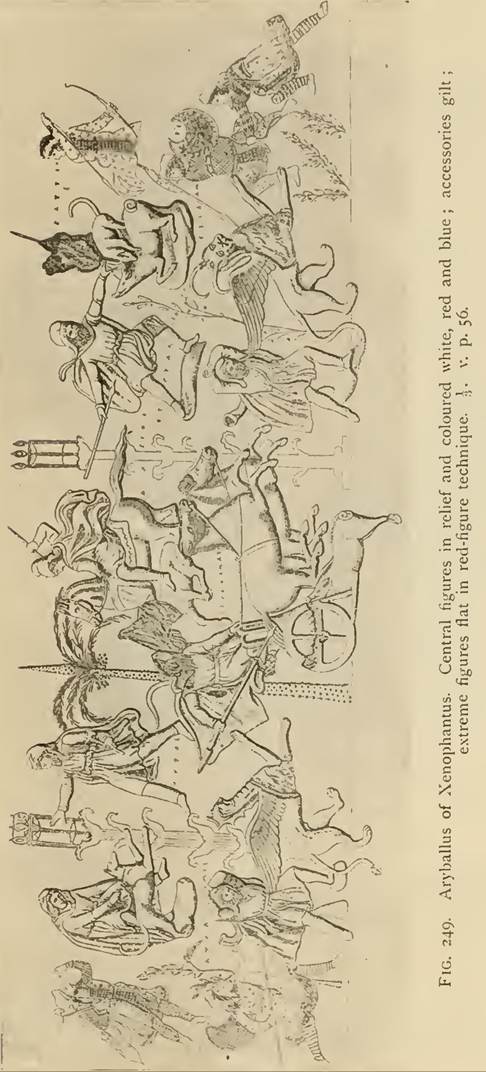
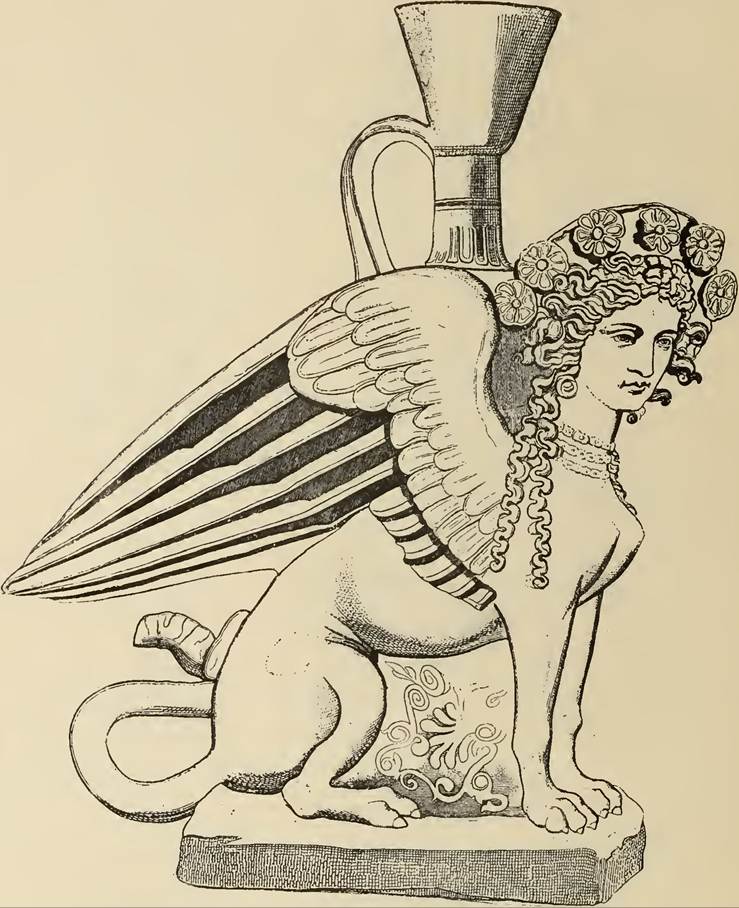
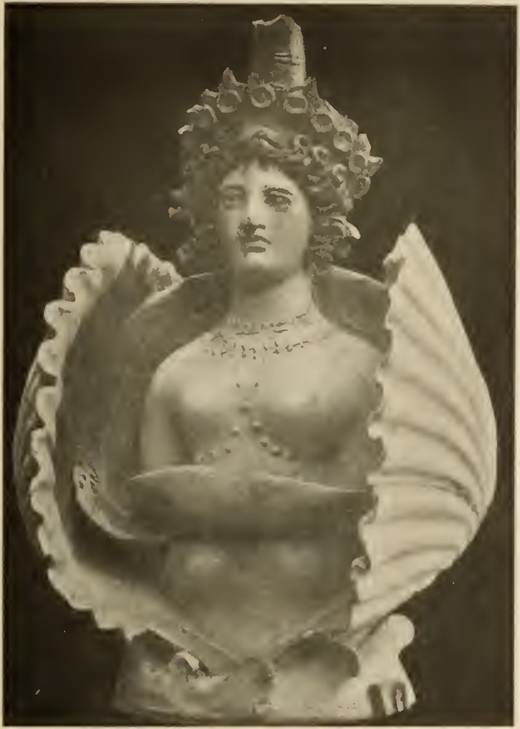
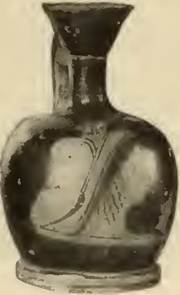
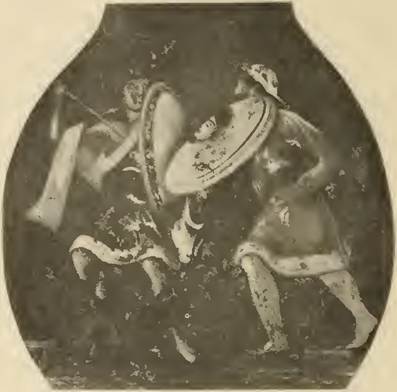
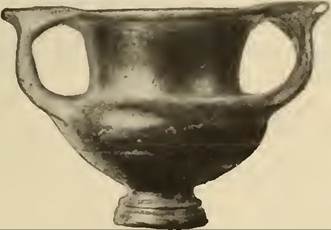
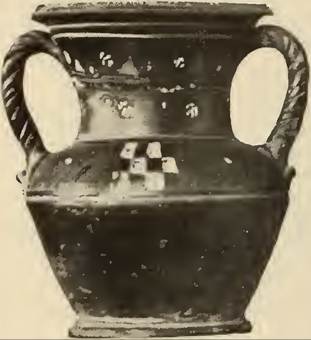
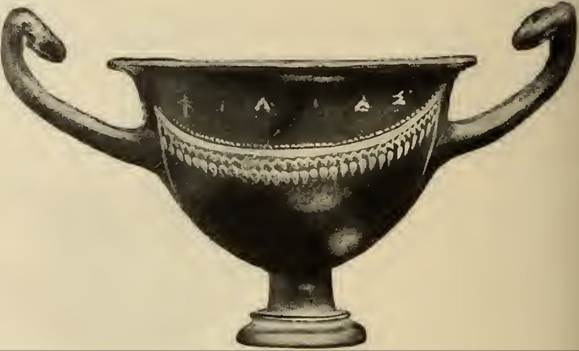
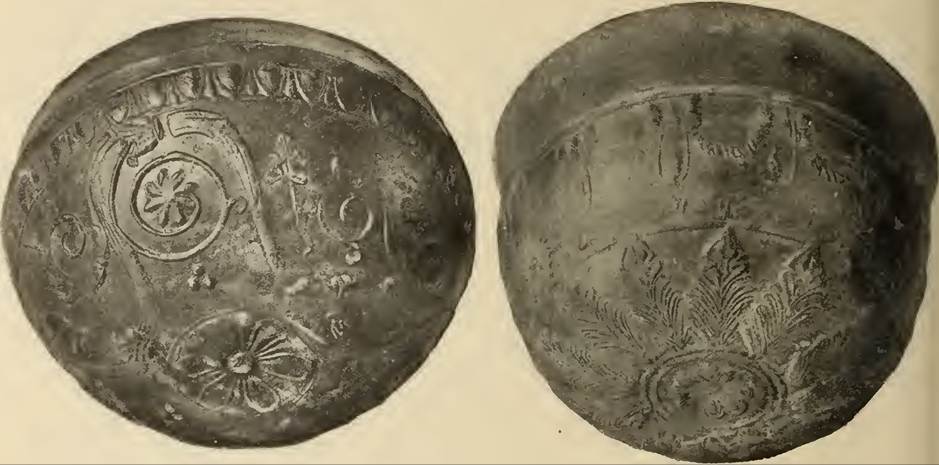
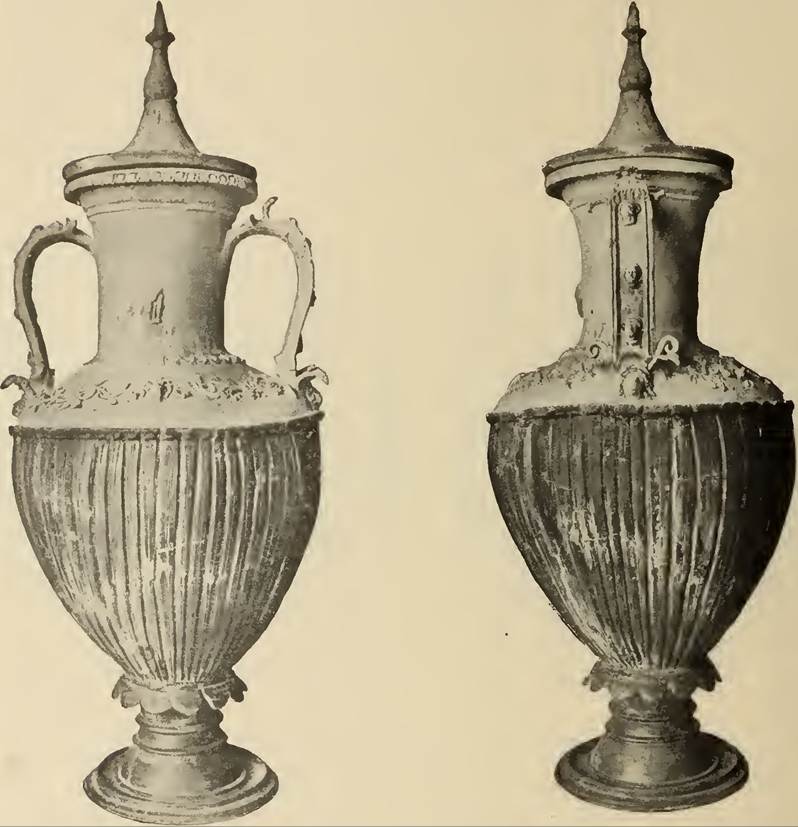
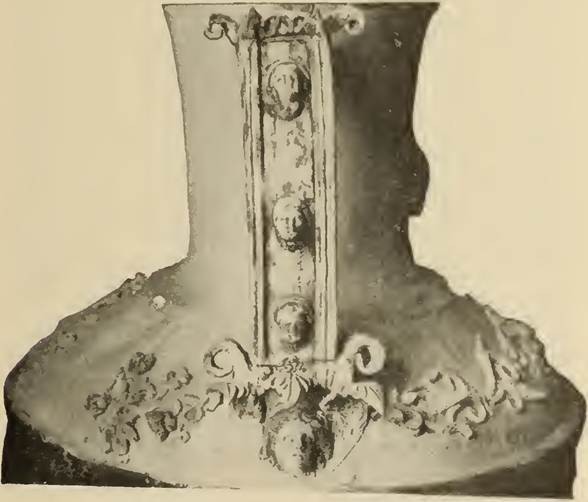
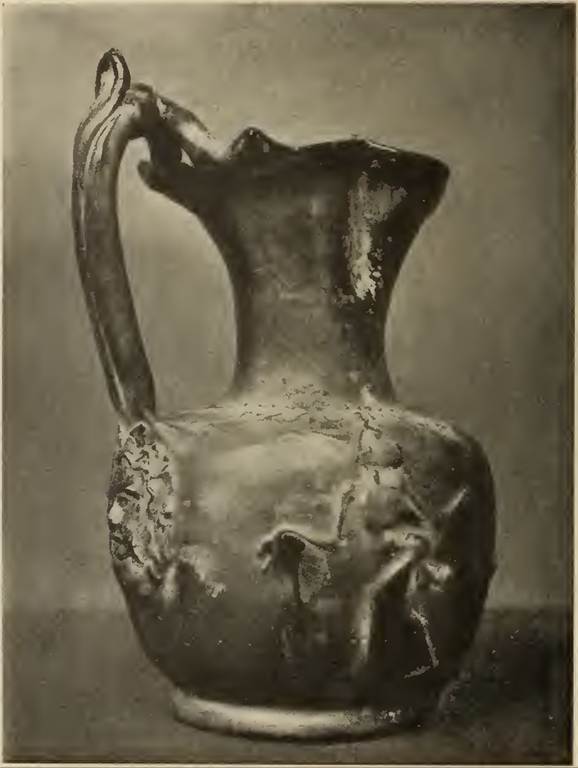
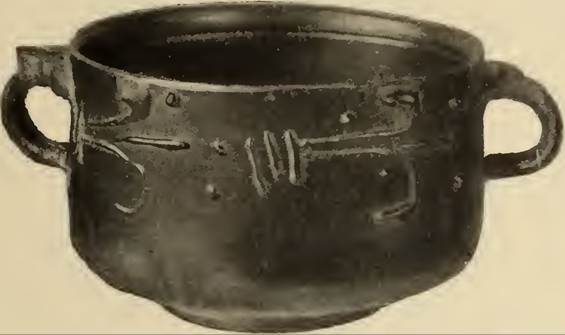
One Geometric vase is said to have come from Berezan[678]; with, as far as I know, this single exception the earliest kind of Greek vase that occurs in South Russia is that referred by Boehlau to Miletus. From the environs of Kerch such vases are very rare, first published was that from Temir Gora[679]. A Corinthian aryballus was found at Kerch in 1902, and with it one of “ Egyptian porcelain ” with a kind of cartouche upon it, not, it seems, Egyptian work but after the Saite type as Mr F. W. Green tells me[680] [681]; another Corinthian and a Milesian (?) aryballus were found there the next year[682] [683]. But these early finds are few on the Bosporus: the rather desultory excavations carried out in that region in spite of their long continuance do not seem to have happened upon the oldest cemeteries. Perhaps there was no considerable Greek population before the vith century, or it is just conceivable that the older diggers who were looking for productions of the “finest” periods took no notice of earlier and less elegant objects. Be that as it may, the careful diggings of the last few years have produced plenty of early fragments from the Olbia district. knowledge of S. Russian Ceramics has been due to von Stern and his pupil В. V. Phannacovskij. 2 Arch. Anz. 1910, p. 227, f. 27. 3 CR. 1870-1, Pl. IV; Prinz, A'lio, Beiheft VII., “Funde aus Naukratis,” p. 134. 4 CR. 1902, pp. 53, 58, ff. 89, 120. 5CR. 1903, p. 47, ff. 71, 72 ; cf. Arch. Anz. 1908, p. 170. 6 CR. 1901, p. 133: two late Milesian sherds, N. Radlov, BCA. xxxvn. p. 81, coloured Pl. in. IV. 7 CR. 1903, pp. 152, 153, ff. 303, 304. 8 So J. Boehlau, Aus Jonischen und Italischen Necropolen, Leipzig, 1898, p. 52 sqq., renames Rhodian and Fikellura. also a new ware most nearly allied to Naucratis and so probably Milesian, it consists of bowls, yellow or yellowish-grey outside, red, black, dark-brown or chocolate within : round the outside run three red or dark rings. Attic wares are confined to the top layers ; among these, were two signatures of Tlesus*. Olbia itself yields a not less abundant harvest of much the same sorts[685] [686]: the best specimens seem at first to have fallen into the hands of the predatory diggers, as von Stern laments[687], but now Pharmacovskij has found very numerous fragments and some whole vases. He has grouped them temporarily and published some of the best pieces, recording the occurrence of Samian[688] [689], Naucratis, Corinthian, Chalcidian and the unknown Ionian fabric with creamy ground and red decoration0: such already existed in Mr Vogell’s collection at Nicolaev[690]. More recently specimens of Milesian, Clazomenae and Daphnae wares have turned up, and lastly vases in the shape of a man with a hedgehog in “ Egyptian porcelain ” probably made at Naucratis or Miletus[691] [692]. Fragments of Milesian pots even penetrated into the interior as far as the government of Ekaterinoslav and the districts of Chigirin and Zvenigo- rodka in Kiev”. A very early black-figured vase of curious shape like the weight on a steel-yard was found in a barrow near Ulskaja (Kuban) in 1898. It would appear to be of some Asiatic make, but is not quite like the Milesian9. Black- and Red-figured Rases. Ordinary black-figured vases come from all the sites in South Russia, Kerch10, Theodosia11, Berezan and Olbia12, even Eupatoria (Cercinitis)13 and Chersonese14. These Attic vases shew that the Athenian potters had conquered this market in the latter part of the vith century. Von Stern correlates this with the foreign policy of the Pisistratids. With the expulsion of the tyrants this pre-eminence was apparently lost, for the severe red- figured vases of about the time of the Persian wars are very scarce. From ff· 33, 34, 39; I9IO> PP· 234, f· 33, 238, 239. 8 Von Stern, Trans. Od. Soc. Minutes, p. 13 ; Klio, IX. p. 141 ; Bobrinskoi, BCA. XX. p. 7, f. 9. 9 CR. 1898, p. 32, f. 47. 10 ABC. XLVIII. 6, 7 : LXilla. 1 ; MacPherson, Pl. IX. ; CR. 1898, p. 17, f. 16 ; 1899, p. 27, ff. 38— 40; 1902, pp. 53, 54, ff. 90—93 ; 1903, p. 162, f. 132 ; 1905, p. 64, f. 80. 11 Von Stern, Das Museum der kais. Odessaer Ges. d. Gesch. u. Altertumsk. III. “Theodosia und seine Keramik,” Odessa, 1906, Pl. II. 1—9. 12 CR. 1873, p. xxii; 1897, p. 79, ff. 187, 188; 1902, p. 7, f. 3: Trans. Od. Soc. XXII. Minutes, p. 119: BCA. xiii. p. 149, f. 95, pp. 155—159, ff. 103—108, p. 184, f. 136, p. 187, f. 12 BCA. xxv. p. 185, f. 26. 14 A fragment, Mat. VII. p. 24 : the Milesian sherds from Inkerman in the British Museum, A. 1675, Prinz, l.c. and letter from Mr H. B. Walters, were probably in native hands. 43 - Leuce we have part of a cantharos made by Nicosthenes and painted by Epictetus with a symposium[693] ; from Olbia a pelice with a flute-player and Nike[694], an amphora a colonnette with Dionysus and Maenads[695], and one or two bits[696]; from Kerch a shallow cup with Menelaus and Helen that von Stern5 puts down to Amasis 11°, an amphora a colonnette like that from Olbia7, and the fragments figured on CR. 1873, m., of which Fig. 245 is an example. A beautiful alabastron, made by Hilinus and painted by Psiax, with a warrior on one side and an Amazon on the other, though in the Odessa Museum was not certainly found in South Russia“. Among all the fragments of red-figured pottery found by General Bertier-de-La-Garde during the harbour works at Theodosia, not one belonged Fig. 246. Side view of Fig. 247. J. to the severe style. It seems likely that upon the interruption of the trade with Greece the colonies in Scythia were no longer in a position to indulge in such luxuries as the finest painted pottery. We have no hint as to their fate during this disturbed period which included the expedition of Darius, an event which must have excited anxiety among the men of Olbia. Athens did not regain the market at once, her attention was diverted to the West, 5 l.c. p. 73, Pl. in. 1. 0 J. D. Beazley, JHS. XXX. (1910), p. 38 would call him Kleophrades. 7 CR. 1903, p. 159, f. 318. 8 Von Stern, Trans. Od. Soc. to Italy and Sicily, and vases of the transitional style are also rare[697]. But with the introduction of the free style, South Russia becomes one of the richest sources. The ware destined for it was singularly like that exported to Cyrene. From this time forth we can study the changes in fashion of Greek pottery by innumerable examples drawn from Olbia[698], and still Fig. 247. Lecane from Kerch, fjp I have much pleasure in thanking Miss J. E. Harrison for the loan of the block made from a drawing by Mrs H. F. Stewart after Trans. Od. Soc. xvm. Pl. 1. more from Kerch and its environs3. From Theodosia we get fragments4; from Chersonese two or three late vases5 * and some fragments8, of importance in their way as the first proof that the site of the “ New” Chersonese dated from at least the ivth century b.c. Among the various classes of free are quite a speciality. Half of those style vases found at Kerch the lecanae extant come from the Bosporus, and &c. Pharmacovskij classifies all vases of these styles known down to 1901 in a wonderful appendix to his “Vase Painting and its relation to Monumental Art in the period directly after the GraecoPersian Wars,” TRAS. xn. (1901, 2): all found in Russia are indexed s.v. I’occifl. 4 Von Stern, 'Theodosia, Pl. in.—v. 8 CR. 1903, p. 32, f. 33, p. 39, f. 55. 8 CR. 1904, p. 68, f. 104; BCA. iv. p. 78, ff. 28, 29 ; Mat. vil. iv. 2, 3, 4. they are almost always marked by singular elegance1. Their use for washing face, hands and feet in perfumed water just suited the luxurious tastes ot Fig. 248. Jiiz Oba Lecane. KTR. p. 77, f. 106. J. In Panticapaeum as in South Italy the simple contrast of black and red at last ceased to satisfy customers, and vase-painters took to heightening the effect of their wares by adding white details and gilt accessories. 1 e.g. those published by Pharmacovskij, Trans. Od. Soc. xvi. p. 29, Pl. 11. 2, and von Stern, ib. xviii. pp. 19—63, Pl. 1. (Figs. 246, 247), also CR. i860, 1. { = KTR. pp. 76—78, ff. 105—107, v. Fig. 248) p. 5 sqq., 1861, 1.11. &c.: plain ones from Olbia, CR. 1900, p- 9, f. 18 ; RCA. xiii. p. 137, f. 79: list in Pharmacovskij’s “Vase Painting” App. p. 73. 2 Pharmacovskij, op. cit. App. p. 75, but Boehlau Samml. Vogell, No. 181, Pl. III. 4, calls them amphorae. The best was found at Kerch in 1906, Arch. Anz. 1907, pp. 131—136, fif. 3—7; another ARC. lii. Reinach, p. 104. 3 CR. 1872, Pl. 1. \—KTR. p. 78, f. 108 and many books since. §7] Lecanae. Vases'with colour and relief Xenophantus 34.3 The same kind of work adorns the equally well-known vase* signed round the neck just where it rises, below the palmettos which decorate it, The last word of the signature has been usually completed ’ AOtjvcuos not \\0-r)V7)at, and it is supposed that Xenophantus was an Athenian artist working at Panticapaeum, but it is quite conceivable that he worked at Athens and exported his wares. Round the shoulders comes a narrow frieze in gilt relief—a biga with attendant figures thrice repeated, a gigantomachy and a cen- tauromachy in between. The main subject (f. 249) belongs to the world of pure phantasy : the dress and the names of the figures are more or less Persian, the date-palm and silphium in thebackground are Libyan—even in Libya tripods do not grow on silphium stems—only the griffins suggest Scythia, and one of these is of quite a strange type2. The less elaborate colour effects of white lecythi did notfind muchfavour outside Attica, but we have one or two examples from Kerch3, and one apparently from Olbia4. 1 ABC. XLV. XLVI., Reinach, p. 98 =C/?. 1866, iv. Rayet ct Colli- gnon, Cframique Grecque, pp. 264, 265, ff. 100, 101, &c. 2 For another aryballus in much the same style, v. ABC. XLViu. 1, 2, 3: and one just slender enough to be called a lecythus, Arch. Anz. 1908, pp. 173, 174, ff. 10 a, b. 3 ib. p. 170; CR. 1902, p. 55, f. 97. 1 Vogell, Samml. No. 145, Pl. m. 13· Kases in the Shape of Statues, Animals and Heads. Something of the same taste which rejoiced in the many-coloured vases decorated with reliefs also approved of vases actually made in the form of Fig 250. Phanagoria. Tinted Vase. KTR. p. 81, f. no. human figures and beasts or monsters, and these, also beautifully coloured, are rather a speciality of South Russia, although they do occur elsewhere. Particularly beautiful specimens are a Sphinx and an Aphrodite Anadyomene, both found in a tomb near Phanagoria[699]. The former (f. 250) has preserved its colours specially well : the handle and mouth of the vessel are the ordinary black ; the Sphinx herself wears a red diadem with gilt Howers, gilt also are her hair and necklaces with touches on wings and tail : these last arc white with blue streaks : blue also are her eyes : her body is a warm white, shading up from her breast to the delicate (lush of her face : the base is red and blue, Fig. 251. Phanagoria. Tinted Vase=C/i. 1870-71, 1. 3. From a photograph kindly sent me by Mr J. I. Smirnov. and between the feet it is adorned with white palmcttcs on a red ground. It is a pity that this vase is not published in colours before it fades, as it must do in spite of the great care taken to shield it. The Aphrodite (Fig. 251) is in much the same style but not so well preserved. She is indebted to the late Mr Kieseritzky for shewing me these figures. For the types of this class of vase, v. Die Antiken Terrakotten, herausg. v. R. Kekuld von Stradonitz; Bd HI. 1, 2, “Die Typen der figürlichen Terrakotten,” bearb. v. F. Winter, Berlin 1903, 1, p. 228. 6 ; 2, p. 158. 2, p. 203. 3, 4. Μ. 44 coming out between two valves of a shell, white without and red within. The type is common in terra-cottas[700]. The same idea of a figure made into a vase is less well carried out in the Dancer Vase[701] from the Pavlovskij Barrow a little to the south of Kerch. Another such vase represents a Siren, but the mixture of woman, bird and fish is clumsily managed[702]. A whole series of vases somewhat similar in conception and in colouring was found in 1852, likewise by Phanagoria, but they differ in that they have the form of upright human figures. One presents a winged dancer with castanets standing by an altar: each of the next two, a girl without wings : the last, a young man, perhaps Dionysus. The back in each case has the black or brown of an ordinary vase, and the neck projects above the figure’s head. The colouring may have faded from these, the flesh tints have not the delicacy of the former vases[703] [704]. Still less delicate in colour is a group of a goddess riding upon a goat[705], and a charming vase from Kerch at Odessa6 relies entirely upon modelling for its effect. In quite a different style are vases made in the form of a Silenus reclining on a wineskin[706] or leaning against it[707]. Another vase from Olbia takes the shape of a female bust[708] and brings us to a whole class of vases in the form of heads[709] from the Quarantine road at Kerch[710], from Chersonese[711], and from Olbia heads of a Maenad, Silenus, Pan, a negro, a child and women13. Another form of head-cup furnished with handles comes from Kerch14. Cups shaped like a horse’s head occur at Kerch16 and Olbia16, also a boar’s head at Olbia17. Whole animals are specially common there—the earliest is a black- figured askos in the shape of a bird18—a bull19, many rams20, a dog21, a lion22 and a cock23, made in fine red clay. Mr Vogell24 had replicas of pretty well all these types and more, a crouching negro, swine, hedgehog, ape, etc. They mostly belong to about the nnd century b.c. Similar examples from Kerch are an eagle26, a wolf26, a nondescript animal with an old man’s head27, and an elephant28. Some also come in Scythic graves (v. supra p. 232, n. 5). Rhyta in the form of human or animal heads have in them something of the same idea, and besides the well-known silver examples clay specimens occur at Kerch29. 13 Arch. Ans. 1908, p. 186, f. 19; 1910, p'. 235, f. 36; CR. 1897, p. 80, f. 195; 1904, p. 40, ff. 60, 61 ; Od. Mus. 11. xii. 1, 3. For glass heads v. p. 362, n· 3·.... 14 ib. xiii. 2. 15 ib. x. 1. 10 op. cit. 1. xvii. 4. 17 CR. 1902, p. 27, f. 45. 18 Arch. Ans. 1909, p. 175, f. 40; Tritons, ib. 1910, p. 214, f. 14. 19 Od. Mus. 1. xvii. 2. 20 op. cit. 11. xvi. 3, 4; Arch. Ans. 1891, p. 19, f. 4; CR. 1902, p. 11, f. 14. 21 ibid. f. 13. 22 Drevnosti, xv. ii. p. 11, f. 10, v. p. 420. 23 BCA. viii. p. 54, f. 55. 24 Samml. early, Nos. 45, 46, Pl. I. 2, 6; later, Nos. 523—541, Pl. viii. 1 —18. 25 Od. Mus. 11. xvi. 2. 26 ABC. lxxi. 5, 5a. 27 CR. 1906, p. 86, f. 95 ; Arch. Ans. 1907, p. 130, ff. 1, 2. 28 Arch. Ans. 1910, p. 214, f. 13. 29 Od. Mus. 11. xiii. 1, 3. Late Painted and Distempered Vases. But the. plastic feeling did not suddenly destroy the taste for painting. The red-figured technique survived longest in little aryballi with women’s heads or palmcttes hastily touched in (e.g. f. 252)’, or else in various vases which seem to have been imported from South Italy. In one grave at Kerch* we have one of the ordinary plates with fishes and a squid for decoration and a lecane of the same style, and from Chersonese a fish plate3. Pieces of Italian ware have been sold as from Olbia, but their provenance is not certain ; there were, however, many specimens in the Vogell collection, an Apulian “ Prachtamphora,” pelicae, craters, jugs and fish plates4. To the latter part of the ivth century belong the Panathenaic vases that have been found at Kerch6: their technique is black-figured, but their style readily betrays their date: rather an earlier one was found at Nymphaeum and is in the possession of Mr A. V. Novikov. Another, from Olbia (?), was Fig. 252. Late Vase from Olbia. CR. 1901, p. 10, f. i2a. |. in the Vogell collection6. It is interesting to think that Greeks from these distant towns won prizes at the Panathenaea. Something similar is a prize vase with pictures of a horseman and of a quadriga in the old black-figured technique; it was found by Pharmacovskij at Olbia7, and there are other such in the Odessa Museum. There is nothing so far to shew at what contest they were awarded. The subsidiary decoration seems to be in the Hellenistic manner. When moulded ware took the place of painted in most parts of the Greek world, the Pontic Greeks seem to have wished to continue the custom of depositing painted vases with their dead. Accordingly, since the supply of Attic vases had ceased, they endeavoured to provide a substitute, and produced a kind of vase which has never been found south of the Euxine. Such vases are of a badly prepared clay and have thick sides so that they weigh three times as much as good Greek vases, and their surface could never be brought to the smoothness of the old ware. This clay was sometimes coloured black, 1 Cf. MacPherson, Pl. Vin. CR. 1862, II. 1—40. 5 CR. 1876, I. pp. 5 108; 1881. p. 127 sqq. 2 CR. 1902, p. 54, ff. 94, 95. 0 Samuil. No. 108, f. 6 and Pl. iv. 5. 3 CR. 1903, p. 32, f. 34. 7 CR. 1901, pp. 10, 11, f. 13. 4 Saninil. Nos. 546—574, Pl. IV. V. sometimes left its natural dirty yellow. To this ground they applied their painting in something of the nature of tempera, but they did not know how to fix the colours, which accordingly brush off very easily, and it is rare to find a well-preserved specimen. The best according to von Stern is at Berlin; the examples at Odessa, one of which comes from Olbia (hitherto these have been found at Kerch only), have but single figures left, yet the Hermitage is not without fair pieces, reproduced by Stephani[712]. Upon another (f. 253) we have a combat of a Greek with an Amazon. The Greek has reddish brown flesh with high lights, a red chiton, blue scarf, whites to his eyes and black pupils, a bluey white shield, a brown helmet and spear and a red plume: the Fig. 253. Distemper Vase. Kerch. CR. 1878-9, Pl. 1. 5. | Amazon is painted with a blue helmet, yellow flesh, brown chiton, red scarf and a bluey white shield with a gorgoneion in the centre. Another good vase of the kind is represented on the Frontispiece of CR. l863[713]. It is not the drawing or colouring that is so bad in this curious class of vase as the technical side, the knowledge how to prepare clay, make a pot and apply colours so that they shall stand properly. There can be no doubt that they were made on the north coast of the Euxine, probably at Kerch, in spite of one being found at Olbia, and this shews that the Panticapaeans had a fair share of skill in drawing, and raises the question whether we must really put down most of the artistic objects found in South Russia as foreign importations. We have seen (p. 339) that even Milesian vases found their way up into the interior of the country. The Attic vases are naturally of far more frequent occurrence (p. 82, n. 4). Early examples are a black-figured cylix from Gorobinets[714] and a white le'cythus with black patterns from near Shpola4: later a red-figured aryballus and crater from Bobritsa®, a fine crater with Europa and the Bull from Galushchino6, another crater from near Kanev in Kiev 4 Smela, 11. viii. i, p. 117. s Stn. III. xx. 5, 6. G Khanenko, Antiquitcs de la Region du Dniepre, II. 2. xxxvi. No. 809. University Museum, a careless cylix with a dedication from Zhurovka (pp. 176 and 361), and a number of pieces of mere black-glazed pottery ; the care with which they are mended shews how much they were valued. All these places are in the Government of Kiev, but there are plenty of Greek pots from Poltava, Ekaterinoslav and the Kuban[715]. Plastic Decoration. While, the belated distemper-vases were being put in graves by those who regarded old customs, plastic decoration became more and more usual for vases used by the living. After becoming hasty in order to be cheap, and gaudy in order to be attractive, vase painting gave up the struggle and yielded to various wares which could receive rich ornament from a mould without the labour involved in hand-painting. A last survival of painting was a practice of putting a wreath round a vessel’s neck or a kind of necklace in white paint, giving almost an effect of relief. This was often done in local work, which is betrayed by the poor quality of its glaze. There is a large amphora of such work in the Museum at Chersonese. Better work, probably imported, recalls the style associated with Gnathia in Apulia[716]. The main cause of the change of fashion was that the wealthy classes in the Hellenistic states had now Fig. 254. CR. 1901, p. 12, f. 17. Cantharos, Olbia. Such are found in Scythic tombs (v. p. 82), e.g. Chertomlyk. within their reach great masses of gold and silver, some of which they applied to the making of plate, and Toreutic became a far more important art than it had been. The common people who could not afford these precious materials could at least copy the metal forms in clay, an imitation which at its best produced some undeniably elegant pots, but when coarsened to suit common clay and poor workmanship led to a loss of that adaptation of form to material which makes quite rude work satisfactory. Vessels which shew this imitation of metal work specially clearly are similar to those which, when found in Italy, are called Cales ware[717]. They are characterized by the use of medallions (emblemata') as ornaments whether of a cup from Olbia adorned with a relief.” A perfect example from Olbia, BCA. Xin. p. 164, f. 114; Rayet et Collignon, p. 348. H. Dragendorff in Bonner Jahrbücher, xcvi. xcvn. (1895), “ Terra Sigillata,” pp. 23—26f.; Arch. Anz. 1910, p. 213, ff. 11, 12, p. 235, f. 35 ; R. Pagenstecher, Jahrb. d. k. d. Arch. lust. Erg. heft vin. (1909), “ Die calenische Reliefkeramite,” pp. 12, 120, 1’1. iv. let into the bottoms of cups or into the sides of larger vessels. Exactly similar medallions are used in the silver plate that has survived. In plate their use began in Hellenistic and went on into Roman times, so that the Bosco Reale and Hildesheim treasures offer perfect parallels. Such a medallion in silver has actually been found at Olbia[718], and at Chersonese was found a whole series of moulds apparently made from such metallic originals[719]. That these Olbian clay pots were not imported from Cales is shewn by the fact that they are closer to the metallic originals and finer in their workmanship than the Italian examples. The fashion probably spread from Asia Minor. A curious trace of the making of pottery at Chersonese is a kind of triangle with a pyramid on each point, itself made of clay, and used to keep apart the different shallow vessels in a pile while they were being baked in the kiln[720]. Fig. 255. CR. 1896, p. 208, f. 594. Felice. Olbia. Fig. 256. CR. 1901, p. 13, f. 20. Cylix. Olbia. |. The influence of metal work is further shewn in a growing tendency to flute vessels, to make the handles very thin, often to imitate in clay the methods of riveting a metal handle to its body, and in general to apply a style of ornament more suited to repousse work. At the same time the varnish gets less and less beautiful; instead of the hard black smooth varnish of former times, it is brownish or greyish with metallic lights and unevenly put on. This kind of stuff is well represented and fully illustrated in Pharmacovskij’s account of his excavations in Olbia in 1901[721] [722]. The question of Hellenistic pottery and the transition from the characteristic black varnish and painted style of classical Greek times to the red varnish and plastic style of typical Roman ware has received much illustration from excavations near the west end of the Athenian acropolis[723]. Evidently the Silbergefässe im Antiquarium,” Berlin, 1898, PI. 11. IV.; andC.Waldstein JHS. m. (1882), p. 96, PL xxn. 3 BCA. 1. p. 44, f. 41. 4 BCA. viii. pp. 33—40, ff. 16—38; Vogell, Samml. Nos. 296—388, PI. vi. Some at Munich, Jahrb. d. k. d. Arch. Inst. 1910, pp. 58, 59, f. 12. s Ath. Mitt. xxvi. (1901), pp. 50—102, C. Wat- zinger, “Vasenfunde aus Athen.” new-fashioned vases were made even in Athens, and they correspond fairly closely to the various types from South Russia[724], but the change of fashion seems to have come in from Asia Minor, which had led the way in the metallic originals. Watzinger points out very clearly how a set of silver vessels such as the cantharos, cylix, jug and standing saucer found in a tomb on the Quarantine Road at Kerch[725], or those in Artjukhov’s Barrow[726], can be paralleled in clay. Both these tombs contained a coin of Lysimachus, in the latter case one coined in Byzantium shortly after his death in b.c. 281, shewing that the burials belong to about the middle of the century. So Watzinger gets dates for the potsherds, comparing ABC. xxxvm. 5 with the Calenian style, xxxvm. 1 with the inscribed canthari, CR. 1880, p. 19 with the cups upon which raised decoration is just beginning, and ABC. xxxvn. 5 or xxxvm. 3 with those wares upon which the plastic principle has triumphed. To this transitional period, or some half century later, belong vases with a light surface and decoration in red or brown rather carefully put on. In this style are jugs with sketches of objects, e.g. one from Kerch with a jug like itself, an amphora, a basket, a lyre, a harp and pan-pipes[727]. The most extraordinary example of a metal shape in clay is a kind of stand from Olbia. It is like a candlestick with a disproportionately large sconce, from the underside of which hang loose rings: the whole is supported by high claw feet. A fragment of a similar one was found at Chersonese. It is wonderful that pottery should have been strong enough to hold together in such a shape5. Megarian Bowls. One class of ware with rather rich ornament in relief is that most commonly represented by the small hemispherical or shallow cups called Megarian bowls6. The Russian dealers call them Jennolki, skull-caps, which has the advantage of not begging the question of their origin. A cup of similar shape in silver occurred in Karagodeuashkh Barrow, but it may be of barbaric make and it lacks decoration7. These cups are dark grey, brown or almost black, and have a dull surface. They were formed in moulds, themselves covered with patterns by means of stamps in relief, and the makers shewed much ingenuity in adapting the same moulds to the production of various-shaped vessels by adding bases, necks and handles to the fundamental 3 CR. 1880, pp. 17, 22, Pl. 11. 19, 20, 21, iv. 8, 9; v. p. 431, f. 321. 4 CR. 1906, p. 90, f. io8 = >irr/z. Am. 1907, p. 138, ff. 8, 9; cf. one with wreaths and pots, Vogell, No. 389, Pl. V. 17, cf. p. 353 n. 6. 5 BCA. XX. p. 26, f. 9. 6 Dragendorff, op. cit. p. 28 sqq.: Bonner Jahrbücher, CI. (1897), p. 142 : R. Zahn, Jahrb. d. kais. deutschen Archäol. Inst. 1908, pp. 45—77, “Hellenistische Reliefgefässe aus Südrussland,” describes and illustrates some 35 examples from the Vogell Coll., cf. Vogell, Samntl. Nos. 245—295, mostly figured on p. 28 and Pl. vn. 1 —12 : others illustrated in ABC. xlvii. 1, 2, 7, 8, xlviii. 8—10; CR. 1876, p. 185 ; 1899, p. 124, f. 235. 7 Mat. XIII. p. 43, f. 8, cf. the gold Gracco- Bactrian (?) bowl from Transcaucasia, Smirnov, Argenterie Orientale, vii. 20 = KTR. p. 449, f. 393. bowl[728]. The conditions of extracting the moulded vessel determined the shapes that this process could produce. In any case, the manufacture seems to have been carried on somewhere in Central Greece, Dragendorff says Chaicis, whereas von Stern points out that the attribution to Megara, which is now universally discredited, rested for a while on much the same evidence as that which now points to Chaicis: nothing short of the discovery of an actual potter’s workshop with broken moulds and pots of this make can really settle the question. In any case, the same firm sent identical bowls to Vulci and Panticapaeum. But undoubtedly there were imitators on the spot. Zahn makes out that only his Nos. i and 2 were made in Greece, but no doubt the moulds for others came from abroad, as his Nos. 4 and 5 are of native clay but identical with examples from Montefiascone and Megara. Fig. 257. C/?. 1901, p. 15, f. 26, identical with Vogell, Fig. 258. CR. 1900, p. 12, f. 24. “Megarian No. 288, Zahn, 6. “Megarian bowl.” Olbia, g. bowl.” Olbia. g. Demetrius[729] and Menemachus[730] are well-known names in this trade, but they may have worked in Greece ; Menemachus ware occurs in Italy[731]. But the stamps for pots with the strange word KIP BEI must have been made on the Euxine, for only in this region do we find genitives in -et from nominatives in -cis according to some native declension[732], and in one of the Pontic colonies there must have been a potter with the barbarous name Kipfieis. These bowls and 403 and many others: v. BCA. iv. p. 141, B. B. Latyshev, “ On the question of ancient pottery with the inscription KIP BEI”: Zahn, p. 49, points out that the letters come round the head of a bust like that of Tyche (Demeter?) on Olbian coins (Pl. III. 3 and its degradation III. 27), but his pictures, on pp. 55, 56, 60, 61, 67 or Arch. Anz. 1910, p. 234, f. 34, do not establish an identity of type : for the grammatical form he compares Doric genitives in -a. their like are placed in the 1 urcl and early nnd century b.c. Von Stern (l.c.) suggests that they are the Vasa Sarnia, a name that has long been familiar and used to be applied to the bright red Arretine ware, lie argues that there was an important class of what we should term Hellenistic ware called after Samos, and that the affinities of the compositions reproduced on “ Megarian ” ware are rather with Asia than Europe, so that Samos would suit as the place of its manufacture. Closely connected in technique is this same Arretine ware. The chief difference is caused by the discovery that more intense baking produced a harder substance and a uniform bright red colour much more attractive than the dull surface of the “ Megarian” ware. This discovery was probably made in some Greek country[733]; but Arretium became a great centre of the industry, and imitations were made in Erance, Germany, and even Britain. That products of the Italian factories were exported as far as South Russia is proved by the stamps of Roman makers, both in Latin and Greek letters (e.g. CCELLVM and TAIOT[734]), from Olbia, and I have myself a broken lamp from Chersonese with Latin letters upon it[735]. This ware is the first witness of the intercourse with Italy and Rome, which ended in the Roman protectorate over Olbia[736] and Chersonese and suzerainty over the Bosporus. Alexandrian Vases, Painted and Glazed. Vases were imported not only from Greece and Italy, but also from Alexandria, whose artistic influence we have already seen in the frescoes of tombs. One class said to have come from there is that of vases on which the body has been covered all over with white to receive painting in red, pink, yellow and black[737]. Ornament consisted e.g. in a bay garland of alternate red and black leaves about the neck, on the shoulders another of various coloured leaves upon a black ground, and on the body a panther and a round medallion which has lost its decoration. These vases seem mostly amphorae, sometimes put upon most curious stands[738]. The same white ground and bright-coloured decoration distinguishes a unique amphora found at Olbia in 1901[739]. But in this case there is the addition of plastic decoration which marks the vase as belonging to the nnd century. Body and base were of the ordinary late varnish, only marked by fluting and by as it were a whorl of sepals above the base. Shoulders and handles were covered with white, and the latter adorned with masks with gilt diadems and brown hair, and the former with elaborate patterns of acanthus and vine in relief, coloured pink and blue and gold. Upon the neck were figure subjects. ABC. Inscr. LXVI. Reinach, p. 135. 4 Very good specimens from Olbia, CR. 1906, p. 35, ff. 27—29. 5 CR. 1900, pp. 11, 12, f. 22; Vogell, Nos. 395, 396, Pl. v. 8, 12. 6 Cf. Amer. Jottrn. of Archaeology, 1. (1885), p. 18, A. C. Merriam, “ Inscribed Sepulchral vases from Alexandria,” Pl. 1. No. 1: ib. 1909, R. Pagenstecher, p. 387. 7 ff. 259—261, BCA. vili. p. 31 and Pl. in. The vase is to be published in colours in Materials. From Alexandria too comes, at a still later date, a class of vases to which much attention has been drawn of late[740]. It is distinguished from all other ancient pottery by being covered with a metallic glaze somewhat similar in composition to modern lead glaze[741]. The best Russian specimen, published Figs. 259, 260. BCA. vm. Pl. in. Olbia. Dark glaze below, white ground, gilt and coloured' above, v. p. 353. £. by Schwartz[742], was found at Olbia in 1891. It is of red clay covered with green glaze, and is more or less the shape of an inverted bell or a brass mortar[743], furnished with a handle made up of two snakes intertwined. Round 144, ff. 5—13; further literature ap. Zahn, op. cit. p. 76 n. 33. 2 Cf. Rayet et Collignon, op. cit. p. 372, f. 139, Berenice vase. 3 See also von Stern, loc. cit., Pl. I. 1 and 1 a. 4 Cf. a silver original from Bosco Reale, Monuments Piot, V. Pl. vn. vm. the base go three tori and a pattern of oves and lotuses very hastily indicated. Above this is the figure subject, also roughly but cleverly modelled—a caricature of the Judgement of Paris, in which 1 lerines and Paris are in the usual attitude, but treated in the comic style, and the three goddesses are represented by sketches of three low-class Alexandrians who are not distinguished by any particular attributes. Hera is giving Athena a slap in the face, and preparing the insulting gesture dpacrup/xa ; Athena has started back from her and is making the usual sign to ward off the effect of bad language. Aphrodite is also giving way before Hera’s fury, and holds what seems to be a flower before her face. The whole is a good instance of the boldness with which the Greeks caricatured their gods. In the same tomb was found another example of the same technique, now in the possession Fig. 261. BCA. Vin. Pl. in. Upper part of the same vase. of Mr Pierpont Morgan (Fig. 262)[744], whom I heartily thank for allowing me to take the photograph. In form it is an oenochoe, about 7 inches high, with the usual trefoil lip ; round the neck is the same adaptation of oves as on the last vase ; at the setting on of the handle is a mask, with horns rather large for a Silenus and rather small for a Zeus Ammon. On the body of the jug are three skeletons wearing conical hats ; the middle one has also a necklace ; they seem to be dancing some obscene dance ; between them are ravens ; the whole is covered with a brownish green glaze. The skeletons recall the Bosco Reale cups, to which reference has been made. The imitation of metal originals is unusually clear in this ew’er. Everything joins to put Tomb-find made at Olbia in 1891”) have shewn that it is from the same tomb, for an account of which v. inf. p. 420. the date of the tomb at about too a.d. Mr Vogell sent me a fragment which must have come from a replica of this oenochoe. Its glaze is cream coloured. Another example of the same ware comes from Kerch, and is in I. K. Suruchan’s Museum at Kishinev. Its glaze is brown, but the heads of the figures are inserted in some white material. The subject is the flight of Iphigenia, twice repeated with slight variations[745]. It is argued from this that the Alexandrian maker consciously designed this and all from the same Fig. 262. Jug with Metallic Glaze. Olbia. v. pp. 355, 420. mould for the Pontic market, hence that the trade between these distant points was really worth special consideration. This may have been so, but it is quite possible that the maker of the vase had no such idea, and that its being found upon the Euxine is due to chance or to the choice of the exporter. In the Odessa Museum is another piece with figures ; it comes from Olbia[746]. On it, repeated more than once, we have the battle of Cranes and Pygmies. The groups were formed in plaster in a mould and applied to the vessel after baking, but befoiS it was covered with its yellow glaze. The vase is too much broken to judge of its exact form. A replica of it in the Vogell collection[747] shews it to have been like a teacup with two handles. A porringer from Olbia, also at Odessa, has a kind of cornice and a row of ovc's, from which droop four swags, two encircling the handles and two enclosing with their arcs pairs of Erotes. All this was made in a mould, save that the Erotes were added in plaster. The work is very rough indeed, but the design good[748] [749]. Other pots made after the same fashion (f. 263)1 have no figured adornment but simple patterns mostly made with dabs of slip of different colour applied before the glazing: they all have a curiously modern appearance and do not at all suggest ancient work, but their genuineness is universally acknowledged. Their technique seems to go back to some of the glazing processes of ancient Egypt, and such vases from Egypt are in S. Kensington Museum. Fig. 263. CR. 1901, p. 16, f. 32. Olbia. Decoration en barbotine, Metallic Glaze. 5. It leads on by such specimens as have been found in Chersonese and Theodosia[750] to the Byzantine glazed vessels and ceramic ornament, and so to all the faiences of the. nearer East and the Mediaeval West. A similar glaze applied to a different material is exemplified by the fragments of a vase of the so-called Egyptian porcelain, so far unique in South Russia, found by Pharmacovskij in the vault of Heuresibius at Olbia; it too comes from Alexandria[751]. 221 ; 1901, p. 49, f. 98; 1902, p. 38, ff. 59, 61 ; 1903, PP· 33, 34, ff· 37—39 5 "9°6, p. 79, f· 78; cf. N. P. Kondakov, Russian Hoards, St P. 1896, pp. 36—42, ff. 9—17, 23; W. de Bock, “ Poteries vernissof these bear stamps, f. 565; 1897, p. I 14, f. 226; p. I 17, if. 229—231; p. 119, f. 234, on a stand; p. 128, ff. 248-9; 1899, p. 7, f. 8 ; 1900, p. 6, if. 6—9 ; 1901, p. 135, f. 238 ; 1903, pp. 27, 42, if. 23, 57 ; BCA. IV. p. 85, f. 34 ; p. 102, f. 51 ; KTR. pp. 103, 104, ff. 138, 139. These are mostly from Chersonese, some from Kerch, as also Od. Mus. I. x. 5, 11. xviii. 12 ; from Olbia come those figured ib. 1. xvii. 1, 11. xvii. 1, CR. 1896, pp. 204, 206, 208, ff. 586—589, 596; 1904, p. 33, ff. 41—46, in BCA. vili. p. 41, ff. 39, 40; p. 47, f. 47; p. 55, f. 59; p. 57, ff 61, 62; Vogell, Nos. 575—642 with 21 illustrations and Arch. Ans. 1910, p. 236, f. 37. 7 JHS. xxix. (1909) p. 164, f. 17. 8 P. Becker, Melanges Greco-Romains, St P. (1855) i. pp. 416—521, “Ueber die in Südlichen symbols, monograms and inscriptions with proper names in full. The interpretation of these stamps has not been successfully attained. Mr E. M. Pridik, in the forthcoming Volume in. of /osP/d, is making a complete collection of them and of other inscriptions upon pottery, and we may expect that he will be able to offer some satisfactory explanation. Meanwhile it is not very hopeful to go into the subject at great length. At first sight it might be supposed that the stamps have to do with the wine contained in the vessels, that they take the place of our labels, and that the name of a magistrate appearing upon the vessel was a guarantee of the authenticity of the commodity or of the vessel’s containing full measure, and at the same time among those who knew would serve as a date mark. The amphorae without marks would cither have contained vin ordinaire or had their distinguishing signs applied on the clay with which the opening was stopped, or written on some part of their surface. But the fact that similar stamps with the same names both of magistrate and of private persons occur upon tiles makes it apparent that it was a matter for the potter and the authorities who supervised him; and at the same time deprives us of any intelligible explanation. Is it conceivable that the same potter making amphorae and tiles, and putting the stamps on the amphorae for certain wine producers, stamps accordingly associated with his factory, should have transferred them also to tiles’ ? Whatever may have been their use, the stamps do allow us to learn something of the wine trade among the Pontic colonies. Quite clear are those of Rhodes and Thasos, which occur in large quantities on all the Greek sites. Clear too are those of Cnidos and Paros, w'hich are very much less frequent2. Plain amphorae maybe referred to these cities by similarity of make or material. The difficulty arises in assigning those which bear two names or even three, the third the patronymic of one of the other people ; in agreement or apposition to one of the names is the word αστυνόμου or άστυνομοΰντος, very rarely άγορανόμου, with or without erri, and this comes either at the beginning or between the names, in such a way that it is hard to distinguish who is astynomus and who potter. One class of these with the inscription in a peculiar narrow; depression may be referred to Chersonese because of its being found in greater proportion in the neighbourhood of that city and because of the occurrence of Doric forms in the names. It is usually without any emblem1. On this class names appear which also mark some coins of Chersonese. A kiln for baking amphorae was found there by Tower B on p. 505, f. 338. Russland gefundenen Henkelinschriften auf Griechischen Thongefässen.” Trans. Od. Soc. v. p. 18 sqq. = (Fleckeisen’s) Jahrbuch für klassischen Philologie, Suppl. Bd iv. (Leipzig, 1862), pp. 451 sqq., “Ueber eine Sammlung unedierter Henkelinschriften aus Südlichen Russland.” Trans. Od. Soc. vii. p. 3 sqq. = J. f. kl. Phil. Sup. Bd V. (1869) p. 445; “Ueber eine zweite Sammlung u.s.w.” J. f. kl. Phil. Sup. Bd X. (1878), p. 1; “ Ueber eine dritte Sammlung u.s.w. ”; Trans. Od. Soc. xi. p. 12, “Inscriptions on handles of Greek amphorae in the collection of I. K. Suruchan.” L. Stephani, Mèi. Greco-Romains, St P. (1866), II. pp. 7—26 and 206—216, and CR. passim. D. AlacPherson, Kertch, Pl. X. xi. \V. N. Jurgie- wicz, Trans. Od. Soc. Xi. p. 51 sqq. : “Collections of 1.1. Kuris and Odessa Soc.”; ib. XV. p. 47, “ Handles from near Chersonese”; ib. xvm. p. 86, “Amphorae and Tiles from Theodosia.” E. von Stern, Trans. Od. Soc. xxii. Minutes, p. 84; xxm. p. 30. V. V. Skorpil, BCA. III. p. 122; Xi. p. 19 “Ceramic Inscriptions ” mostly from the north slope of Mount Mithridates at Kerch; with J. J. Marti, Ceramic Inscrr. preserved in the Melek Chesme Harrow, Kerch, Odessa, 1910. See also Latyshev, Olbia, P· 299·..,.. 1 For tile stamps v. Ch. Giel, Kleine Beiträge zur Antiken Numismatik Südrusslands, p. 41. 2 For the special points of the Rhodian, Thasian and Cnidian amphorae (the latter are common at /Athens though rare on the Euxine) v. A. Dumont, Inscriptions Ceramiques de Grice, Paris, 1872, pp. 13—15; Rayet et Collignon, p. 360, fif. 133, 134: for the wine trade from other cities, v. inf. p. 441. By far the greater part present no special peculiarities of dialect or have sporadic Ionic forms, but are further distinguished by an emblem of a bird of prey attacking a dolphin or fish. Emblems may often be the devices of particular magistrates or potters, and particular ones go with certain names; but those which accompany various names and are common throughout a whole class of stamps evidently have to do with the city. Such are the balaustium of Rhodes and this eagle and dolphin. Unfortunately this very mark is common to the coins of several cities round the Euxine coast: it seems to have belonged to Sinope first and to have been adopted thence by Istrus and Olbia, and the question arises, to which it is to be referred in this case. P. Becker wished to call amphorae with this mark Olbian and it is certain that some of them must have come from Olbia: Jurgiewicz the other chief authority of the last generation put them down to Sinope: Kosciuszko- Waluzynicz follows him when treating of certain amphorae with “astynomus” found at Chersonese2. Though we have tiles with the stamps of the Archons of Panticapaeum3 and it is tempting to connect with some Spartocid Satyrus a handle found at Chersonese4, whereon one stamp had EPIXATYPO, the other, a good example of the canting stamp, 2ATYPO2 and a Satyr’s head like Pan’s on the coins of Panticapaeum, yet there are no amphorae which we can certainly refer to that city. This makes it look as if it were a matter of wine-making rather than pottery. The districts devoted to vine culture in ancient times did not quite correspond to those now noted for it; some change of conditions has occurred. Strabo (11. i. 16) mentions the difficulty of cultivating the vine at Panticapaeum certainly as if it were not grown in sufficient quantities to make wine, though now there are considerable vineyards in the neighbourhood. On the other hand, we know from the Agasicles6 inscription and from actual remains that the territory of Chersonese was covered with vineyards, whereas now they grow only in one or two favourable spots, and it seems possible that wine was an important factor in the prosperity of the colony, as it had too small and too dry a territory to grow corn with success. Whether the Greeks ever made use of the southern slopes of the Crimea where are now the best vineyards is not quite clear ; it rather seems as if they never got firm possession till quite late times. Bessarabia produces good wine, and may have supplied the Olbian trade : the vine district may have extended further to the n.e. than it does now. In any case the wine of the country did not satisfy the inhabitants, and they did a large trade with Rhodes and Thasos. A curious use of amphorae, not uncommon in very early Greece, is that for roofing over grave-cists6. With the amphorae and tiles go the great store-jars found in all Greek towns ; from Olbia some have been extracted whole, or at any rate completely pieced together7. 1 BCA. II. p. 18. 4 Mat. VII. p. 26. 2 Ibid.: CR. 1896, p. 169. BCA. xvi. p. 57, 5 App. V] = IosPE. 1. 195. cf. XXV. p. 93, tile from Sinope. 6 Olbia, CR. 1905, p. 34, f. 31. 3 MacPherson, pp. 72, 75, Pl. vn. xi. ~ CR. 1902, p. 21, ff. 30, 31. G rapiti. In Pridik’s third volume of losPE. we shall find besides the stamps all the “graffiti" scratched on pottery: this kind of material is well dealt with by Professor von Stern in treating a collection of such scratches in the museums of Odessa and Chersonese. They result from the excavations on Leuce made in the forties, from the works in connection with the harbour at Theodosia, from the present diggings in Chersonese, and from various sources, so that they give a satisfactory sample of what is to be found1. Von Stern divides those which can be more or less deciphered into inscriptions dedicatory, inscriptions of owners, and marks of dealers. The first class offers most interest, including dedications to Achilles at Leuce2, e.g. ΓΛ AVKOi Μ E A N ΕΘΗ K E/^A X IA AHI Λ E Y K Η Μ E ΔΕΟΝ ΤΙ Γ AIE ί P Οί I ΔΗΟ explained as “ Glaucus has dedicated me to Achilles Lord of Leuce : O boy into the Temenos of Poseidon.” It is conceivable that the writer, who combines exalted style with some carelessness (e.g. Aeu/o? for Aeu/o?? after /ζεδε- oPTt, cf. App. 26 = losPE. 11. 343, iv. 418), put in an extra E, meaning by the final words merely “the son of Posideus3”: ΓΛΑΥΚΟίΕίΡΛΙΝΑΙΔΕΟ = “ Glaucus take care how you sail in ” is on the reverse. Other sherds had [yjepa ’Αχιλλόυς and AITOICYN NAYT = κ]αι τοις (σ)υρραυτ[αις : I had rather supply ό δεΐρα κ]αι rot συνναυτ^αι. Vases with dedications somehow fell into the possession of the natives. We have a cylix of the careless red- figured style with Δελφιρίο(υ) ξυνή Ίητρο(υ) from Zhurovka (v. p. 176), and the silver vase from Zubov’s farm (v. p. 232) once belonging to Apollo in Phasis. From Theodosia we have fragments with ΑΓ, AOH, API, HP, APT, ΑΣ, ΣΩ, ΗΔ, which may be taken as dedications and would then give us the names of gods worshipped in Theodosia, and ΗΡΑ, ΟΩΤΗ, ΔΙ. ΔΑΜΑ, ΔΙΑΙ, ΑΘΑ, API, APT, in Chersonese, but since there are proper names of men as well as gods beginning with these letters we have no right to assume this. These may all belong to the class of owners’ inscriptions, which is represented by less doubtful examples, but does not give any very interesting results. Then we have the marks of the dealers in pottery, denoting the price and what numbers they had of any particular sort. Two abecedaria from Theodosia are not of much account, one is AB ΓΔΕΗΐΟ I KAM N only, and the other ΑΓΒΕΔίΗΟΧΚΛΜΝΞοΓΡΣΤν+ΦΨΗ. Very early graffiti interesting for an alphabet agreeing with that of Miletus in the vith century b.c. come from Berezan, ΣΜΙΚΗΣ EIMI4, ΜΗΔΕΙΣΜΕΚΛΕΥΈΡ and on a lamp Π i AV+NONEIΜI K Al Φ AI ΝΠ®[ΕΟΙ ί l]N K A N Φί> D ΓΟΙ ί I №. Another verse ΗΔΥΠΟΤΟΣΚΥΛΙΞΕΙΜΙΦΙΛΗΠΙΝΟΝΤΙΤΟΝΟΙΝΟΝ is pleasing with a Homeric word as befits Olbia4. Lastly there are the suitable mottoes painted on by the maker such as ΦΙΛΙΑΣ etc. (v. p. 351 n. 1). Interesting palaeographically are the boldly dashed-in letters on two cups from Chersonese (11—111 cent, a.d.), eiAeocMOioBeoc and πεΐΝεε[γ]φρCR. 1880, p. t) = KTR. p. 90, f. 119, a plainer form of iv. 8 on p. 431, f. 321. 6 Other pieces ; Kerch, MacPherson, Pl. IV. vi.: CR. 1874, 1. 9, 10; 1896, p. 158, f. 528; 1900, p. 28, ff. 65—67; 1903, p. 49, ff 80, 82; 1905, p. 63, f. 74; Arch. Anz. 1907, p. 139, f. 10: Chersonese, CR. 1891, p. 138, ff. 142, 143, p. 140, f. 151, p. 154, f. 191 ; 1895, pp. in, 112, ff. 269—273; 1899, p. 9, ff. 12, 13: Olbia, CR. 1901, p. 18, ff. 36—38: 1902, p. 12, ff. 16, 17; Arch. Anz. 1908, p. 187, f. 20; 1910, p. 238, f. 38: but the best pieces seem never to have been figured. 7 CR. 1896, p. 152, f. 505. 8 CR. 1872, 11. \=KTR. p. 225, f. 201.

More on the topic § 7. Ceramics.:
- An Empirical Study Using Input-Output Tables
- 8 A Maritime Empire?
- The Heirs of Odysseus, 800 BC–550 BC
- Bibliography
- The Triumph of the Tyrrhenians, 800 BC–400 BC
- 26 Virgin Islands
- CHAPTER FOUR Town and Country Urban devotions and rural rituals
- Merchants, Mercenaries and Missionaries, 1220–1300