5. Woodwork. Coffins.
The solidity with which the tombs were built about the Bosporus has preserved for us a large number of coffins which rank as among the best specimens of Greek woodwork extant[652].
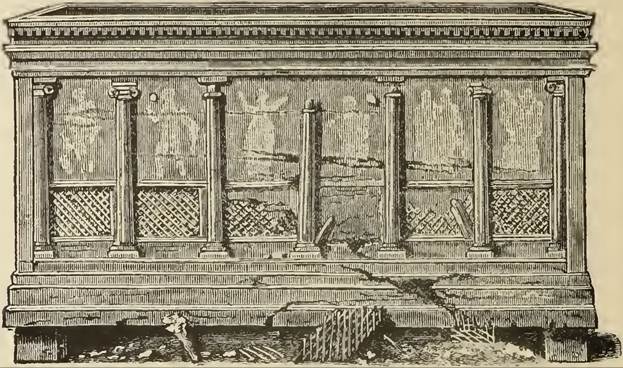
They are mostly constructed in a manner suited to the material, with framing and panelling : the enrichments are like those used in stone architecture, which had itself borrowed some from wooden construction, but are applied with due regard to the material. Only rarely do we find an instance of a wooden coffin clearly imitating a stone sarcophagus in its turn designed after the pattern of a small temple. The Niobid coffin (pp. 332—334, ff. 241—244) is evidently put together on the pattern of such a stone sarcophagus as the well-known one from Sidon[653] called Les Pleureuses, and both reproduce the columns round a temple or mausoleum,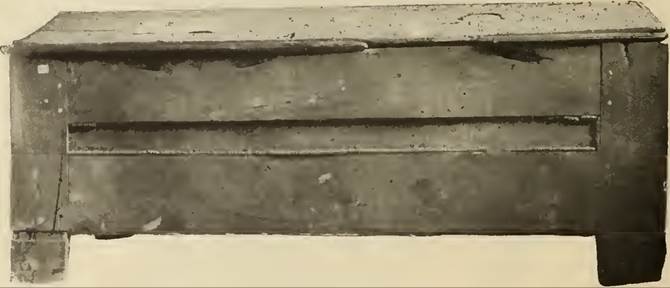
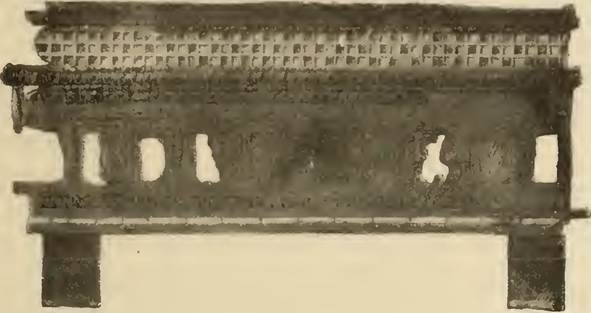
Fig. 232. CR. 1900, p. 103, f. 183. Wooden Coffin from Olbia in Odessa Museum.
the statues between them (e.g. the Nereid monument) and the railings put from column to column. Simple wooden treatment we have in that from Olbia, a little more elaborate in that from Juz Oba. In this already we have the application of colour which is such an interesting feature. Panels and frames were painted with figure subjects, enriched with elaborate marquetry, and even had applied to them wooden, plaster or terra-cotta figures and adornments coloured and gilt, until the more splendid coffins when fresh must have presented a magnificent combination of colour and form.
The plain chest from Olbia (f. 232), probably made to hold clothes, is very like an old English hutch, except that the front has such broad framing that the single panel bordered with beading that runs along the middle of the side is not half the breadth of the enclosing frame, being in fact not an inserted
sidcrable remains.
W. gives many illustrations and a most interesting analysis of technical and decorative development ; his work has rendered this section almost unnecessary, cf. Catalogue GOid- rale des Antiquites Egyptiennes du Mustle du Caire. C. C. Edgar, “ Graeco-Egyptian Coffins,” Cairo, 1905, pp. 1 —10, Nos. 33101—33123, Pl. 1.—v.2 O. Harndy Bey etTh. Reinach. UneNfrropole Roy ale a Sidon, Paris, 1892, Pl. iv.—xi. p. 238 sqq.
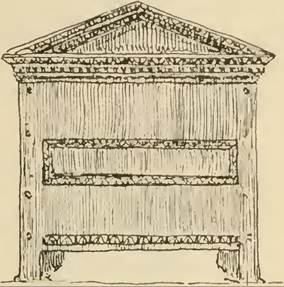
Fig. 233. CR. i860, vi. 2 and p. iv. Coffin from Juz Oba. Brown ; mouldings and pegs, white ; panel, red.
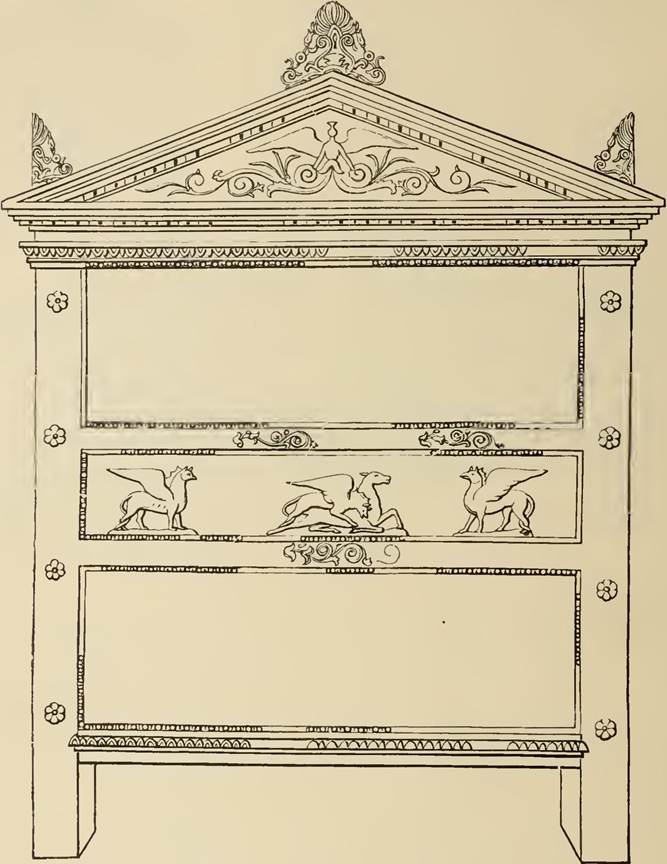
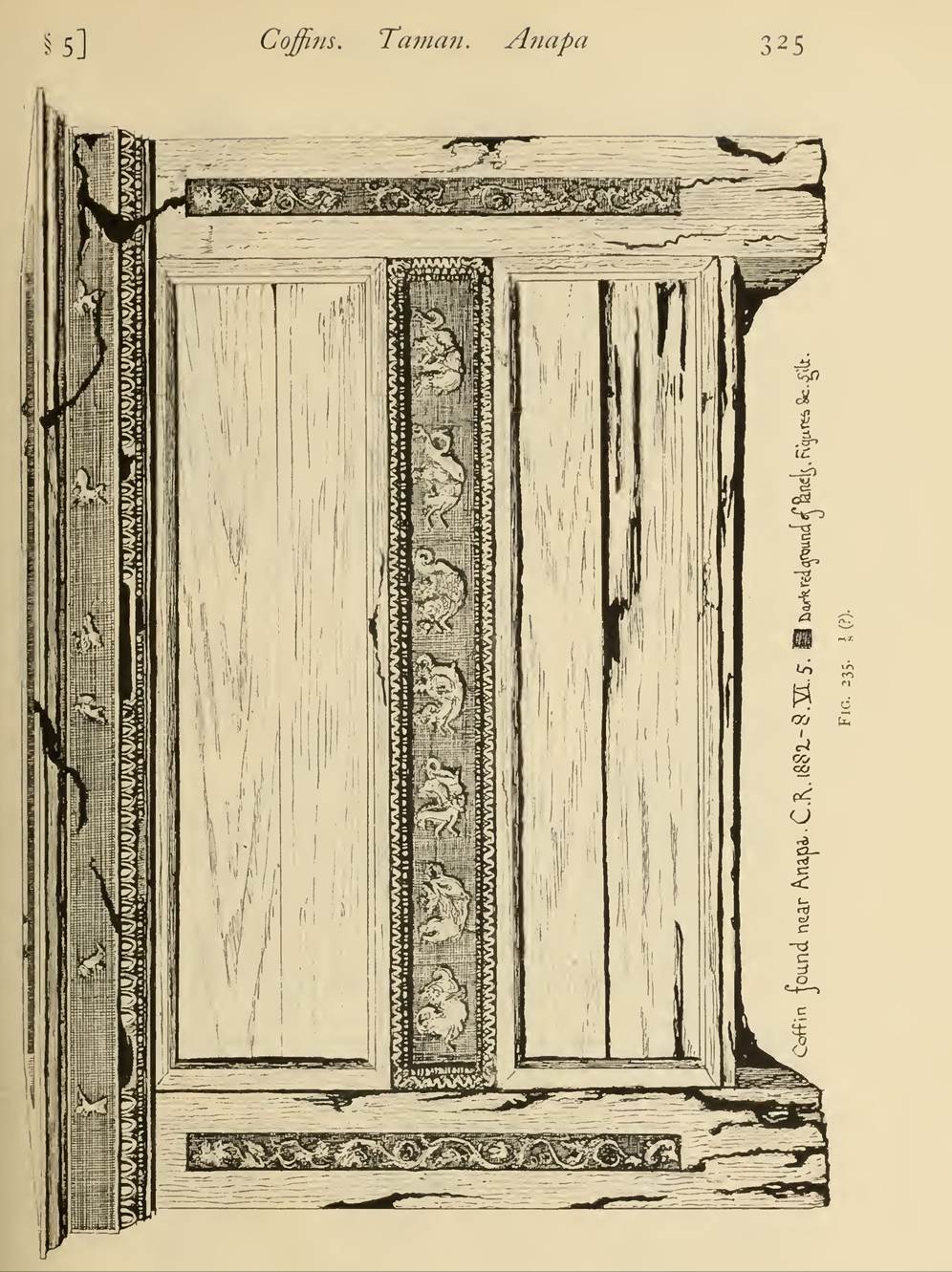
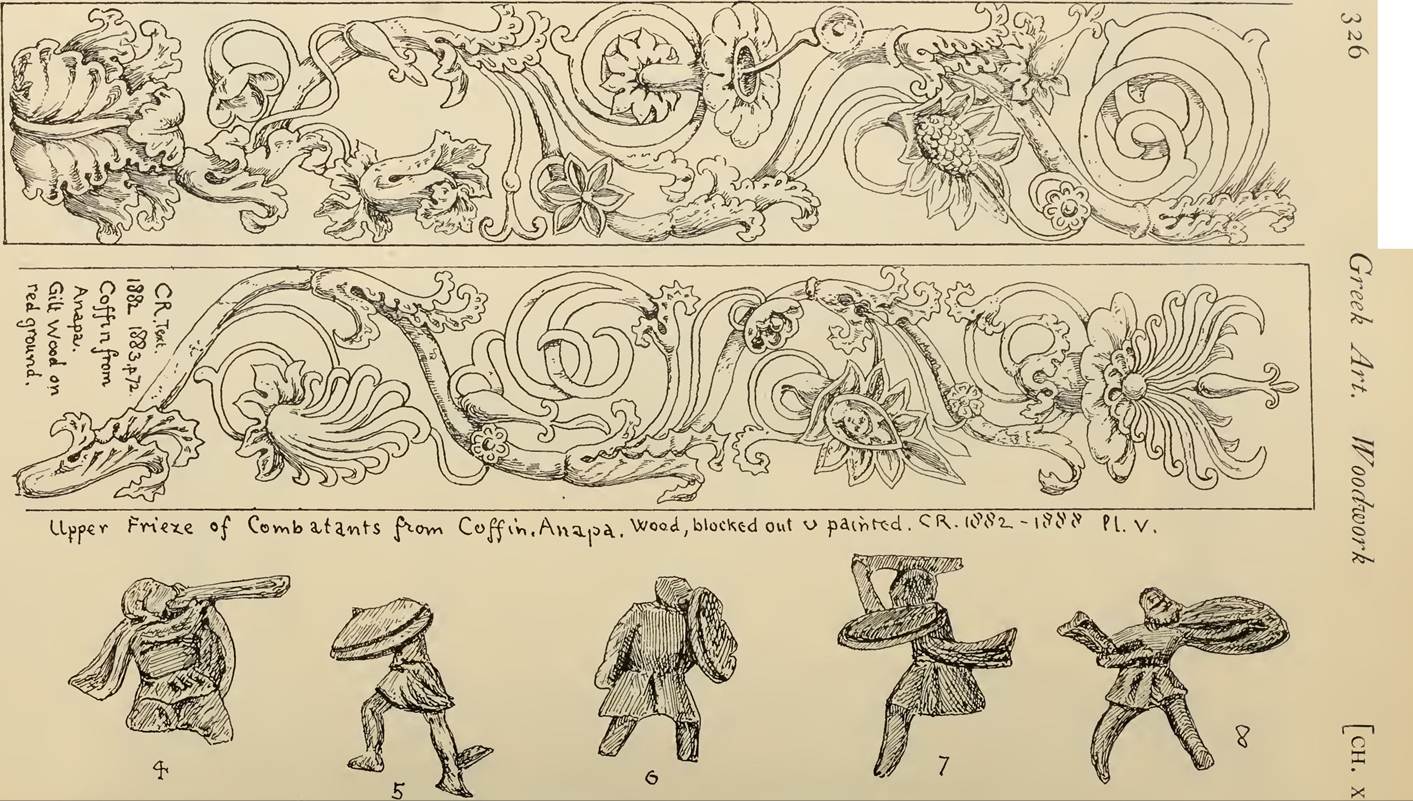
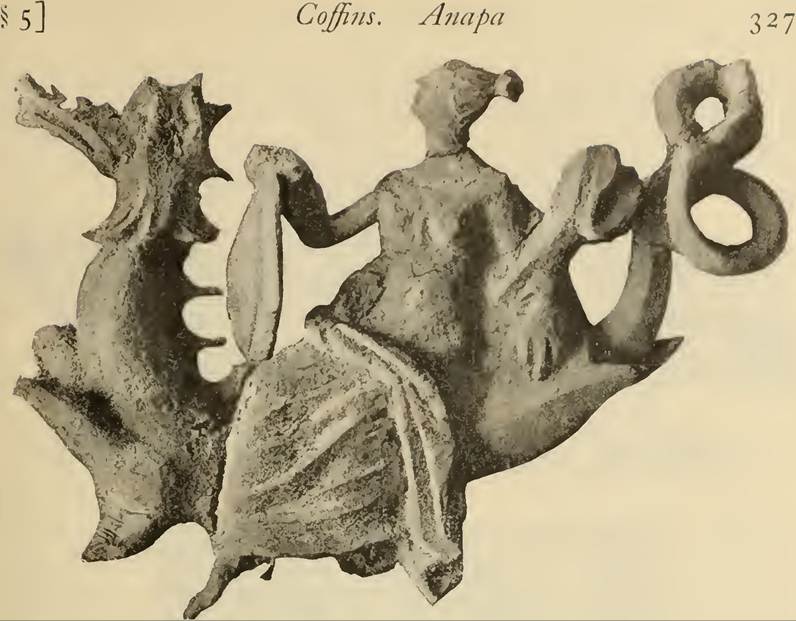
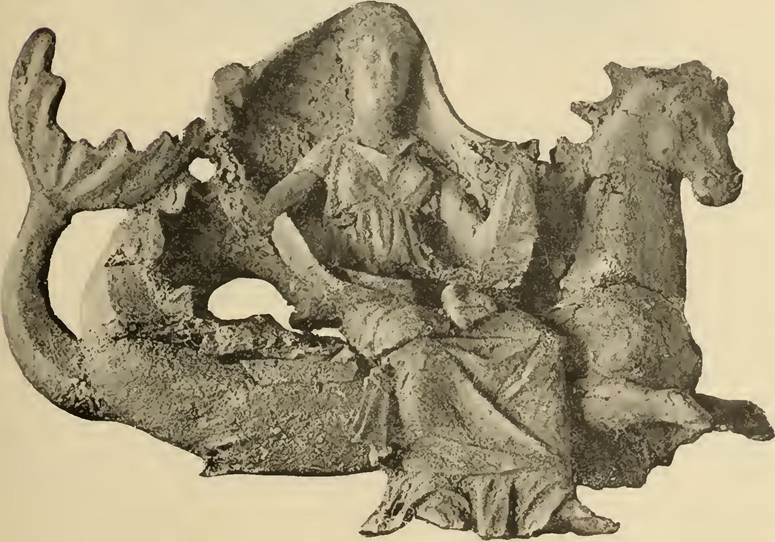
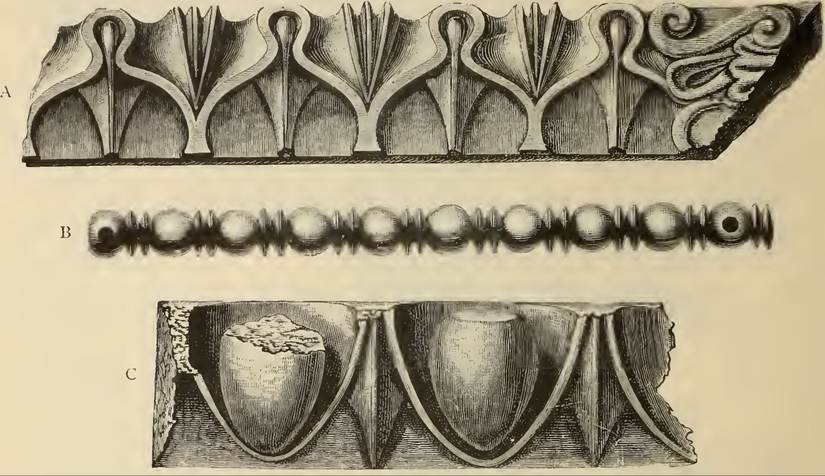
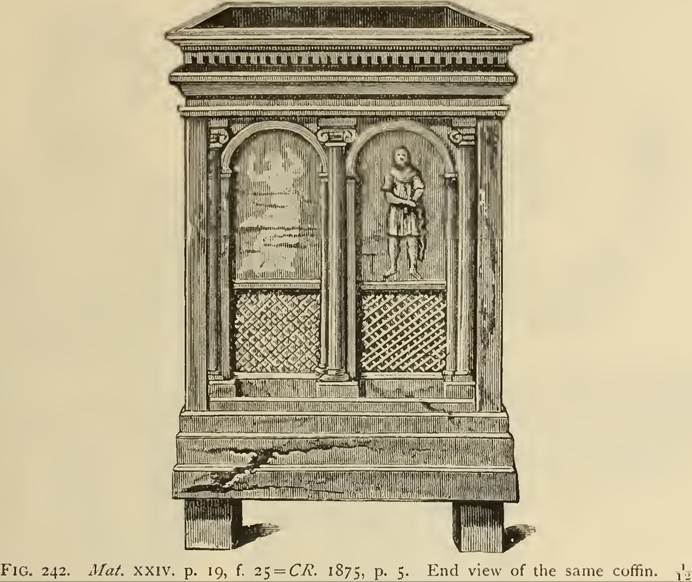
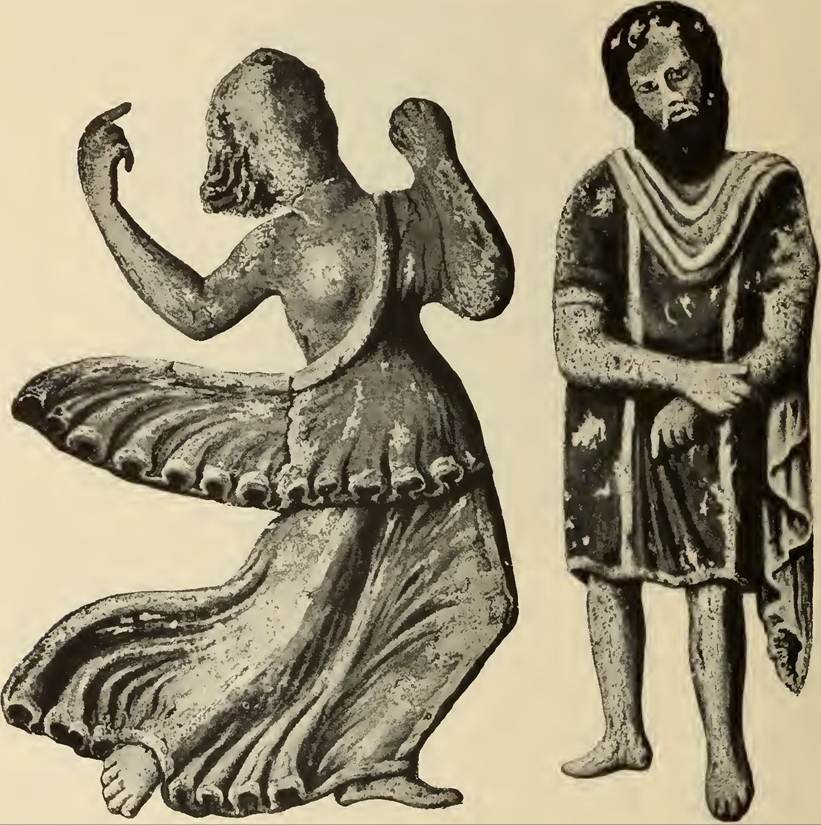
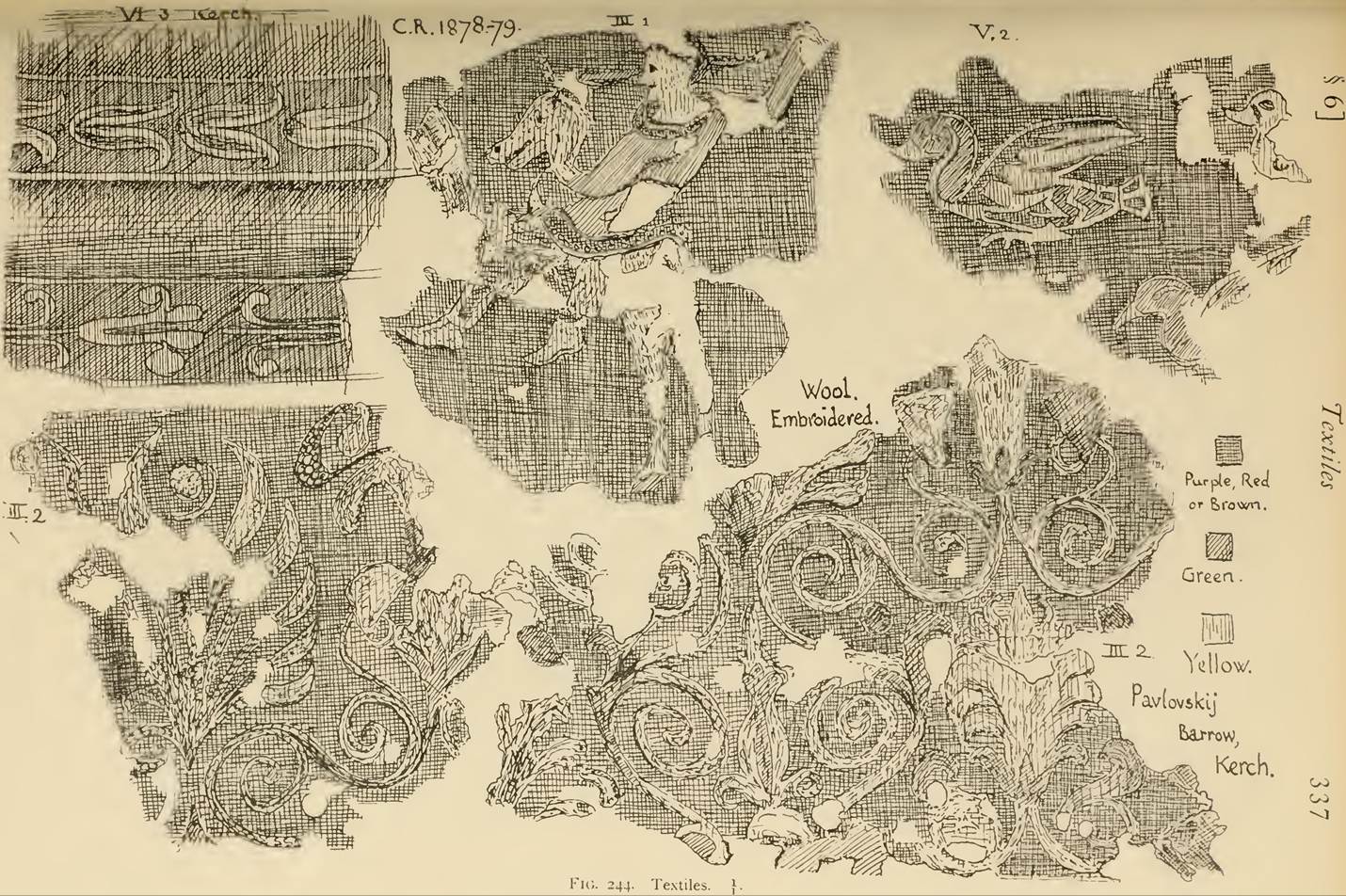
panel but one with the frame. The lid had two slopes and there were bronze handles on it[654] [655]: the end view was very like b ig. 233. Simple also, but very effective, is a coffin (f. 233^ found in a splendid stone chamber under one of the Jiiz Oba barrows to the south of Kerch. The sarcophagus took the form of an immense chest crowned by a roof of two slopes with a cornice along the sides and pediments at the ends. In each side and end of the chest was a panel of bright red set in the framework of dark brown and surrounded by a carved and gilded cymation : all the other mouldings were equally carved and gilded, and the whole produces an effect perhaps all the better for the loss of decorations stuck onto the panels. There was an inner coffin with simpler mouldings. Within this was found among other things the curious ring bearing on its bezel a serpent drawing a bow[656] and vase fragments of the end of the vth century[657]. Of similar general construction, with a long narrow panel down each side, was a coffin discovered by Ashik in the barrow of Mirza Kekuvatskij near Kerch in a chamber with an “ Egyptian ” vault. The framing of the panel was of cypress and the panel set in an egg-and-dart border of red and gold. On the ground of the red panel were gilt wooden figures of griffins attacking various animals. A more elaborate and better preserved example of somewhat the same design was found by Tiesenhausen in 1868 in the stone chamber of a barrow, about a mile and a'half from Taman on the way to Tuzla6. The coffin was built with three long panels in the sides one above the other, each surrounded with beading, but only the centre one, the narrowest, was decorated with wooden groups of griffins and panthers attacking deer. As usual the ground was red and the animals coloured and gilt. The framing was further adorned with inlaid arabesques and the corner posts with rosettes representing pegs. The cover was of two slopes with cornice and at each end a pediment; one of the latter is preserved ; it has a winged figure and arabesques in marquetry, and is surmounted by acroteria on the gable and at each angle. 5 ABC. LXXXIV. 2 shews the panel and griffins, 3, a part of the cornice ; cf. also p. 21 of Reinach’s reprint. Watzinger, p. 38, No. 14. For 1 perhaps we should read I- й f. 234, CR. 1868, p. x, and 1869, pp. 177 and 178 : Kl'R. pp. 40, 41, ff. 44, 45. Watzinger, p. 37, No. 13, ff. 65, 66. In 1882 the same explorer found the best specimen of this type near Anapa towards Vitjazevo and Blahoveshchenskaja1. The lid is lost and nothing is known of it. The framing and panels, of which there are two one above the other, have been left uncoloured, but the architrave, the cornerposts and the broad horizontal band between the panels have as it were Pig. subsidiary panels with a dark red ground sunk into them (Fig. 235). On the corner-posts these are filled with beautiful arabesques of acanthus leaves, tendrils and palmettos of carved and gilt wood. Under the cornice the red band forms a kind of frieze and bore small figures of barbarians in combat (Fig. 236). 1 CR. 1882—1888, pp. xxi—xxvi, Pl. vi. 5, p. 71 sqq. Watzinger, p. 36, No. 12, f. 64. Fig. 236. Figures, acanthus pattern, slightly reduced. Figs. 237, 238. CR. 1882-8, pp. 50 and 61. Wooden Nereids from Coffin found near Anapa. }. The broad band half way up each side has a row of Nereids bearing the arms of Achilles and riding upon sea monsters1. These were adjusted by letters of the alphabet. This band is enclosed by the usual cymatia and headings, made separately2. Among the lady’s belongings found within was a coin of Lysimachus, dating the find as of the mrd century b.c. which just agrees with the style of the Nereids ultimately derived from Scopas. Fig. 239 CR. 1882-8, pp. 74, 75, A, B, C. Mouldings from Anapa Coffin. ]. Of more complicated design, though scarcely more rich in execution, is a great coffin found by Ashik in the Serpent Barrow (Zmeinyj Kurgan) near Kerch in 18393 (Fig. 240): Stephani took the design to represent a house with a flat roof enclosed by a kind of railing and with many windows in the side walls. Accordingly the chief horizontal moulding, made up of a large bead moulding, then egg-and-dart, another bead and another smaller egg-and-dart, all enriched with red and gold, does not run along the extreme top, but some eight inches down ; a smaller top moulding has alternate squares of red and brown and a cymation with reversed palmettes in red and white on a black ground. 1 ff. 237, 238, CR. 1882—1888, Pl. in.—V. 15, 17, Reinach. Coloured in Sabatier, Souvenirs de 18, and Text pp. 48 sqq. Kertch, Pl. vm. 2 f. 239, l.c. pp. 74, 75, A, B, C, D. 4 op. cit. p. 40, No. 18. 3 f. 240. ABC. Pl. lxxxi. 6, 7 and p. 22 of right in thinking this to be an ordinary box-coffin which has lost its end-posts (the feet shewn are not original), has a kind of triglyph frieze instead of its main long panel and an extra board framed above it. The main body of the sarcophagus is of cypress-wood, the carved parts are of yew. Fig. 240. Mat. XXIV. p. 2O, f. 26. Wooden Coffin. Serpent Barrow, Kerch. Of perfectly plain construction was the outer coffin of the Kul Oba king, it was just a great box about nine feet square and eleven inches high (v. p. 202), with one side left open ; the elaborate inner coffin belongs to the next class. The queen’s coffin1, which Dubrux calls a catafalque, had turned pillars at the angles, but otherwise seems to have been quite simply made. Its paintings have been noticed already (sup. p. 305). Of unusual type was the ornament of a sarcophagus found in 1876 between Churubash and Eltegen (Nymphaeum)2. Instead of the architectural patterns derived from stone, the framing was ornamented with inlaid rosettes and stars at intervals in quite an original style. The coffins with more ambitious architecture being built up of a very large number of small pieces whose forms were not dictated by the simpler necessities of construction have on the whole suffered more than the artistically framed boxes. The application of strictly stone forms to the decoration of the coffins had to struggle against the important place that construction gave to the corner-posts, and this prominence was never quite got over. The simplest way to use stone forms was just to plaster them on to the frames and leave the wooden panels between. We have such an arrangement in the coffin found on Cape Pavlovskij as mentally reconstructed by Watzinger4. Here the ends were left much as on the box coffins, they had a panel with particularly rich marquetry work. The long sides had at each 1 Watzinger, p. 44, No. 24. 3 p. 39, No. 16, ff. 69, 70. 2 v. p. 214, f. 115, CR. 1876, pp. xvii—xix, 1877, 4 p. 45, No. 26, ff. 81 85. CR. 1859, p. 29 p. 221; Watzinger, p. 39, No. 17. Text: inside it a coin like Pl. V. 14. end and in the middle an elegant Ionic column with inlaid palmettes on the neck and glass centres to the curls of the capitals. These columns must have stood on some sort of base and had above them some sort of entablature to which belonged sundry pieces of moulding enriched with marquetry. In the wide intercolumniations were panels similar to those in the end walls. The roof has left very little but seems to have had acroteria and a sima-like ornament along the eaves.. Watzinger (p. 56, No. 41) has shewn with some ingenuity that the beautiful ivory veneers from Kul Oba would suit such a coffin very fairly well. The wood seems all to have perished and the ivories were not noticed until late in the process of collecting the finds. The unfortunate history of the exploration (v. p. 205) prevented the possibility of seeking any more fragments[658]. The discoverers thought that they had found parts of a box or of a musical instrument, but the size of the capitals with their glass eyes[659] shews that we have to do with a large composition, for corresponding pilasters must be more than a metre high. We may suppose that there were two pilasters at each corner. The subject of the Judgement of Paris (pp. 204 A, B, ff. too, 101) would take the main panel on one side, and the corresponding panel would have the meeting of Paris and Helen3. Or if there were a pilaster in the middle as on the Pavlovskij sarcophagus, the two incidents of the Paris story would be one on each side of it. The pieces with Herms4 would do for the end- or back-panels. The narrow strips with the rape of the daughters of Leucippus and the preparations for the race of Pelops and Oenomaus (pp. 204 C, D, ff. 102, 103, lxxix. 13, 14) may have run along the frame above a broader panel. The short thick pieces with a Scythian dragged by his horse and a hare pursued by a dog rather like a Russian borzoi would fit in across the breadth of the corner-posts (ib. lxxix. 9, 10). To the posts and frames rather than to panels would belong such decoratively treated pieces as the sitting women (ib. lxxix. 7, 8), Hermes or a Boread (lxxx. 16), the lion® and such mere decoration as the candelabrum (ibid. 14) with patterns like the egg-and-dart and the quatrefoil border®. The main pieces here regarded as panels are engraved with the point upon ivory hardly more than a millimetre thick. They are delicately tinted, the colouring, which is chiefly noticeable at the outlines, being in very subtle greys and browns. It must have been brighter once but was probably always restrained, as the drawing is before the time of a varied palette. The drawing is very like that of red-figured vases of the finest style save for one or two mannerisms (e.g. the treatment of the hands) which suggest the ivth century7. Still more like these ivories because of a similarity in technique are the engraved silver cylices from the VII Brothers8, but if we 3 [ABC. lxxix. 11, 12.] 4 [ABC. lxxx. 11, 12, 15.] 5 [ABC. lxxx. 17.] 6 [ibid. 8, 13.] 7 This was pointed out to me by Professor Waldstein, who referred me for an example of early archaistic treatment, such as we get in the Hermes, to a relief at Epidaurus (Defresse et Lechat, p. 87). 8 v. pp. 206, 210, 382, CR. 1881, I. 1—4. are to judge of these too, photographs are a necessity, for the drawings fall far short, as Stephani complains. There is considerable difference of style between the fragments, but perhaps it is not more than is to be explained by the more ambitious role that the panels would play in the original composition. The presence of the Scythian looks as if the work was done either at Kerch or definitely for the Scythian market, but he is so spirited that we cannot regard him, though different, as inferior to the more finished panels. Watzinger (p. 91) thinks the work Milesian because of the Asiatic look of the capitals, the fame of Milesian furniture and the resemblance to a sarcophagus found at Gordium : but in the ivth century Miletus had lost its commercial predominance and it is at least as likely that we have Attic work. In any case these fragments are unsurpassed as specimens of Greek drawing. The coffin of the Priestess of the Great Bliznitsa by Stebleevka has left but fragments including the capitals of two pilasters once curiously adorned with inlaid work, one with a palmette, the other with a group of two griffins and a deer[660] and also an Ionic fluted column, another shaft not fluted, thirteen greenish glass roundels from the eyes of Ionic capitals and a large number of pieces of ivory or bone for inlaying. Also various pieces of moulding, egg- and-dart, etc. with traces of red colour. These would make up into something not unlike the Pavlovskij coffin. Also from the same Bliznitsa come the fragments of a man’s coffin which was utterly destroyed by the falling in of the vault above it[661]. They include a very large number of pieces of ivory for inlaying, having the forms of human figures, male and female, parts of Fauns, Erotes, birds, horses, deer and three figures of Sirens playing the drum, the cymbals and the flute, also a butterfly, leaves, grape bunches and palmettes, and purely architectural pieces with traces of colour, egg-and-dart mouldings, cymatia and Ionic capitals duly garnished with glass eyes to the volutes (v. p. 424, f. 314). In spite of the large number of fragments no attempt can be made to restore the general design. Very similar fragments were discovered by MacPherson[662]. The next step towards a temple form is when there are large pilasters or piers at the corners and along the sides small pilasters, usually five, supporting a fully-developed entablature and resting on an imposing plinth. A good example of such a type is figured by Watzinger[663]. It was found by Kareisha in 1842 and a drawing has been preserved, but the original has perished entirely. The pilasters were Corinthian with Attic bases. Along the eaves were triangles representing antefixes and on the gables strange acroteria5. Under the projecting upper member of the plinth were turned balusters supporting the corners. Of the same type is a coffin from Kerch in the Antiquarium at Berlin6. The capitals, this time Ionic (?), were moulded in stucco which has fallen away, the lid is lost. 8 Compare the solid flat corner acroteria of a marble sarcophagus found at Kerch, CR. 1905, p. 58, f. 66. Probably these were painted, cf. those of grave reliefs, supra, p. 301, f. 214. 8 Watzinger, p. 48, No. 29, ff. 89—91. In these the corner-posts are still flat as natural construction demands, but the straining after stone effects led to the substitution of a round pillar at the corners. The simplest example had just a base moulding and a friezeless architrave and seven Ionic pillars along each side. In each of the panels between them hung a wreath of stucco, and two on each end-panel (compare the wreaths in the catacomb on p. 311, f. 222). The lid had two slopes’. To this class belongs a sarcophagus found near the Kerch Almshouse of Zolotarev in 1883. It was in rather bad condition but was remarkable for the great variety of applied figures that it once bore. At the angles there seem to have been turned pilasters on a flat carved base, the usual cornice and slender colonnettes along the sides. Along the frieze seem to have been 241. Mat. xxiv. p. 19, f. 24= CT?. 1875, Frontispiece. Niobid Coffin. Kerch, Fig. wooden figures of Centaurs, dolphins, hippocamps, pegasi, wolves attacking bulls, dogs, a horse, a lynx and a barbarian spearing a lion, and above at the corners wooden dolphins. In the panels were plaster appliques coloured white, blue and brown, including winged Naiads, Medusa-masks, bucrania and dolphins[664] [665]. The Hermitage exhibits a model coffin set up to shew off the plaster appliques ; the coffin and arrangement are not to be regarded, but the photograph gives a good idea of the variety of the appliques found together[666]. Somewhat similar was one found by Kulakovskij in 1890 at Glinishche near Kerch, but its preservation was not very good[667]. The same kind of thing comes from near Cape Zjuk to the north of Kerch5. The most elaborate wooden sarcophagus that we possess has been already referred to as that of the Niobids. It was found in 1874 on Mount Mithridates. Were it not that it lacks its cover it would be a regular little temple of the Ionic order. Along the -side (f. 241) are six intercolumniations with five complete columns and two half ones against the angle piers. At the ends description. 3 inf. pp. 371—373, ff· 269—277. Another with great variety is Watzinger’s p. 51, No. 33, ff. 108— in. 4 CR. 1882-8, p. 74, Note 1 and 1890, p. 25. 5 Trans. Od. Soc. xix. Pl. iv. Materials, p. 127. (f. 242) we have two half columns and a single whole one; these end columns stand in front of pilasters with imposts from which arches are turned across. Above the columns run a narrow frieze and a cornice with dentcis. From column to column, about a third of the way up, go rods holding trellis work in place below them, answering to the railings put in this position in actual temples. The statues usual on the stylobate are represented by figures of coloured plaster stuck on to the surface of the panel immediately above the trellis. They belong to the series of the N iobids, and the Pedagogue (f. 243) was found actually in place. Most were rather broken, but their places could be traced on the panels. Within were found glass vessels and a gold wreath with an indication of a coin of Vespasian. On the whole the sarcophagus is a fine piece of work, although perhaps its design goes beyond what is legitimate in wood1. Joinery and Ivory-work. It just happens that by far the greater part of Greek woodwork left to us consists of coffins. But the few fragments left of other pieces of furniture make us regret their rarity. In 1842 Kareisha discovered a three-legged table 1 CR. i875,p.5sqq. Watzinger, p. 54, No. 35. The example of the combination of arch under archiidentification of the indication made by Mr Markov trave : Stephani had put it down to a Diadochus has degraded the sarcophagus from being the first and dated it in the mrd century, B.c. in a tomb by the Kerch Public Garden. On being touched it fell to pieces, but one leg was saved, and the whole can easily be restored from this and from the pictures. For this is just the type of table commonly represented in the funeral feast scene[668]. The same technique as was applied to coffins was used in making boxes for daily use. To such a box belonged a piece of ivory inlay representing Eros and Aphrodite. The drawing is wonderfully free, especially considering the material (v. p. 424, f. 314). Fig. 243. Mat. xxiv. pp. 12, 16, ff. 14, 20. Plaster Niobid and Pedagogue from the same coffin. |. Some interesting ivories come from Olbia, archaic engravings of Eros and the “ Persian” Artemis[669], a statuette of a seated woman about 2 in. high[670], 2 Vogell, Sammlung (v. inf. p. 339 n. 6), Nos. 1145, 1146, ff. 54, 55. ‘ 3 BCA. xxxiii. p. 106, f. 4 = CT?. 1907, p. 57, f. 47 and a box the bits of which bear Erotes playing the double flute and juggling with balls[671]. Unexpected are the remains of another box made up of fourteen narrow panels apparently representing a Sassanian king and his court watching nautch girls and child acrobats dancing and tumbling to the music of winged boys. Pharmacovskij cites Alexandrian analogues for the work, but they are not convincing and it is as likely to have come from somewhere further cast, almost outside the classical tradition[672]. From Chersonese come some late bone fragments carved with animals, a barbarian soldier and a statuette[673]. We may also mention some sets of men for playing games, one with heads of nine gods, Augustus, L. Caesar, and a lady of their house, two wreaths and the Eleusinium, numbered on the reverse i—xv in Greek and Latin, all found at Kerch in a box complete, another at Odessa, most of a set of eighteen, also from Kerch[674], and one from Chersonese consisting of fifteen black and fifteen white draughtsmen in glass3. Very neat joinery is shewn in a toilet box found at Kerch with little compartments containing a round bronze mirror, a comb and spaces for putting jewelry®. Still higher skill went to making the comb with the words in open work ΑΔΕΛΦΗ ΔίΌΡΟΝ7. So much for the remains of Greek woodwork found in South Russia to which Bliimner8 rightly points as to perhaps the most important source for our knowledge of Greek carpentry. It is curious to notice how much the Greek interpretation of stone forms in wood forestalled the ways of the Renaissance artists. For instance, the table-leg might well have been the work of a xvith-century Italian, and the same may be said of details such as those of the N iobid sarcophagus. Only the Italians could not remain so long at the stage of satisfying simplicity and degenerated much sooner into rococo. In the wall paintings resemblances are not always mere coincidences, for discoveries of ancient frescoes in Rome had an important effect in guiding Italian decoration: but the case of woodwork shews that without them the development would have been very similar. ' § 6. Textiles. The special conditions that have preserved wooden objects for us in Bosporan graves have also allowed the survival of a few specimens of textiles : for the older time before our era little has been found elsewhere, later on Grecian Egypt has furnished us with some examples. Stephani has reproduced and discussed the best pieces9. He prefaces his description with an account of the representation of textiles in art, especially vase-paintings. The oldest piece (p. 212, f. 113, l.c. Pl. iv.) covered the sarcophagus in No. vi of the VII Brothers, which dates from the ivth century. The stuff 4 Μ. I. Rostovtsev, BCA. x. pp. 109—124, Pl. in. iv., cf. Rm. Archtol. 1905, V. pp. 110—124: Arch. Ahz. 1910, p. 238, f. 41. 5 BCA. iv. p. 109. 8 CR. 1899, p. 129, f. 251. 7 ABC. Reinach, p. 136. 8 Technologic, 11. p. 329. 9 CR. 1878-9, Pl. in.—vi., Text, pp. 111 114. must be much older as it has been darned in places. It is made of several strips sewn together and then covered with the design by means of some stain. There was a broad border of large palmettes, and six or more strips across filled with complicated figure-subjects separated by narrow patterned bands. The names ΝΙΚΗ, EPI[C AOHNAIH, IOKASTH, l]OAEiU, ΜΟΨΟΙ, Ι]ΠΠΟΜΕΔΠΝ, EVAIMENH, AKTAIH and ΦΑΙΔ[Ρ]Η shew both that many various tales were represented and that the dialect of the maker was Ionic. The stuff was yellow, but the ground of the design is black, and red is used also. The whole suggests some Ionian form of red-figured vase whereon the traditions of black-figured technique had survived more than they did at Athens (v. p. 210, n. 9). From the same tomb comes a piece (Fig. 244, v. 2) with a pleasing pattern of ducks on a purple ground and a border of stags’ heads ; something of the same black-figured spirit survives in the manner in which the ducks are rendered. They are yellow with streaks of black and green, and green was used for the stags’ eyes : the trimming was of fur. The finest piece left, from the Pavlovskij Fort Barrow, has a dark purple ground embroidered mostly with a pattern of spirals and palmettes, but also bearing the figure of an Amazon and edged with a green border of the texture of rep. The tendrils and stalks are pinkish-yellow, leaves are green, the Amazon has a green chiton with a red and yellow border. The drawing of it all is very free, considering that the design was to be carried out in satin stitch (Fig. 244, in. i, 2). On the same plate, in. in CR., we have specimens of golden leaves sewn on to a bark foundation covered with stuff to make a crown, a cheaper form than the all-gold crowns illustrated on pp. 388, 389, ff. 285, 286. In one case the gold was itself covered with fine woollen crepe : one bore an indication of a coin marked bXe common also on the gold crowns. Thus I would date them about the middle of the 1st century a.d., assigning them to Mithridates VIII, but they are more usually put down to Mithridates Eupator (v. coin-plate vii. 14—18 and Ch. xix.). · Other interesting pieces not reproduced on Fig. 244 may be mentioned ; v. 3 is silk found with the three-legged table (v. p. 333) ; v. 4 is embroidery in gold on slate colour, making an ivy pattern. Other pieces on this and the following plate are mostly stripes and mat-like patterns : vi. 2 is a conical cap with a tassel at one end and stripes round the other : vi. 3 (Fig. 244) has its stripes enriched with simple arabesques which look thoroughly in the Empire style. In several of these pieces remarkable skill is shewn in making the red shade into the green by delicate gradations. The texture is mostly similar to what we call rep[675]. Byzantine textiles, some inwoven with figures of men and animals interesting when compared with Coptic work, have been found at Chersonese[676]. p. 11, No. 16. Wooden soles of Roman date are figured, CR. 1878-9, p. 143. All are very like our shoes ; cf. Watzinger, op. cit. p. 14, ff. 25, 26. 2 CR. 1891, p. 5, f. 2; 1904, p. 51, ff. 63, 64: RCA. XVI. p. 38, ff. 1, 2.
More on the topic 5. Woodwork. Coffins.:
- 5. Woodwork. Coffins.
- Minns E.H.. Scythians and Greeks. A survey of ancient history and archaeology on the north coast of the Euxine from the Danube to the Caucasus. Cambridge: University Press,1913. — 720 p., 1913
- § 2. Architecture.
- Descriptions of the Specimens