§ 4. Painting.
Of painting we have more remains than of sculpture. It is to this rather than to its carpentry that the coffin of the Kul Oba queen[624], the most elaborate early example, owes its interest.
The top plank (Pl. lxxxiii. it?) is much the most important for colour and composition ; the ground colour is not clear, but beginning from the left we have a mass of green for the chariot, whiteygreen horses with red straps, a man’s figure with reddish-brown flesh in a red chiton, pursuing a girl in a green dress; a second girl (on 1 has a yellow dress, then comes a man in a blue and white chiton with a red border running after a yellow and brown swan ; the next figure, green and brown, is rather being attacked by a swan ; there follow a figure in green and brown, and one in a red chiton with a blue border; finally, on the last division (if) a grey female figure, pursued by a brown-fleshed man in a white and blue chiton, and beyond him another chariot, brown, with whitish horses. The hunting scene on the plank below (lxxxiv. \b and le) has a primrose ground, the chariot is neutral tint, the driver green, the two horses grey ; in front a red-fleshed man runs after a bird with a neck outlined in red and wings of white and green. The lowest plank (i c, 1 f) has a red ground ; upon it are yellow griffins with white wings, yellow lions and other yellow beasts. Below is a plain yellow band. The end fragment (11/, ig) is brown, with a kind of red panel; upon it are a griffin and a lion, both yellow. I have given this colouring at length as the original ABC. is very rare and Reinach’s reprint accessible, so his plates are worth supplementing; for this is a richer and more subtle range of colour than we find elsewhere in ivth century work[625].to be taken in three pieces, on the same plate 1 a, lb, 1 ; it represents the rape of the daughters of Leucippus.
The other two long planks (with a hunting scene, 1 b and 1 c of Pl. lxxxiv.) are repeated on a fairly large scale on Pl. lxxxiv. as le and if. The end piece id of Pl. lxxxiv. is enlarged alongside as 1 g; cf. Dubois de Mont- pdreux, IV. xxv. xxvi.6 For a discussion of the drawings on ivory, pp. 204, A—D, ff. 100—103, and the polychrome decorations of other sarcophagi, v. p. 330 sqq.
Simpler in every respect and therefore presumably earlier in date is the stele of Apphe, wife to Athenaeus (Fig. 219), found in January 1887 on the way from Kerch to the Quarantine. The lines are lightly incised on the stone, and the spaces were filled in with colour, since vanished. According to Gross’s drawing, here reproduced, we have a life-sized picture of a woman looking down at an infant that she holds in her arms. Her cloak which covers her head is brown with a red border : the child wears a red cap and a white-sleeved shirt. In front of her stands a Herm with a wreath painted on it, but Kieseritzky saw therein a woman with a pine-cone and a box. Above is the inscription traced in red upon a brown band: the whole was surmounted by a wreath of bay leaves in white, now mostly broken away. The work cannot be later than the first half of the ivth century: even as interpreted by Gross it is a charming drawing: nothing else like it has survived on Scythian soil.
The architectural patterns on the stele of Apaturis, wife of Thynus[626], are painted, a cymation in green and blue upon red, and a bay wreath blue and green with a red stalk and dark berries ; both go round to the sides of the stele. The inscription is in red. The stele of Xeno and Xeno- peithes[627] has at the top a red cymation (?), under it the inscription, incised but filled in with red, and below this a red fillet tied in a knot with its ends hanging right down. Both stelae are of the ivth century.
We have no good wall painting from houses: the Hellenistic house[628] at Olbia, which had an interesting design in the pebble-mosaic of its peristyle[629], and the baths at Panticapaeum[630] only yielded architectural patterns and marbled plaster.
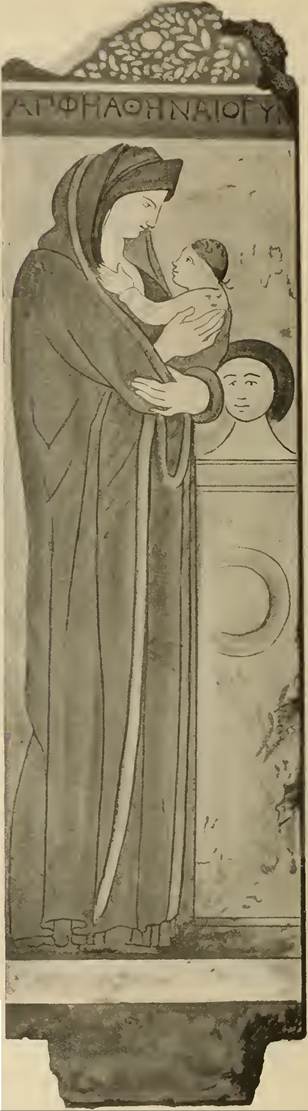
Fig. 219. Painted Stele of Apphe. Kerch. CR. 1882-8, p. 20; KW. 284, f. 6; losPE. II. 217. Height 1 m. 98 cm.
But it was on the walls and roofs of grave chambers that the greater part of ancient paintings—hence loosely called frescoes—in South Russia have survived. The earliest seem to be in the Taman Peninsula. In the second chamber of the Great Bliznitsa there were elegantly painted cornices (v. p. 423, ff. 312, 313), and in the middle of the roof a woman’s head on a dark blue ground. About her neck was a string of gold beads, and behind fell a light and dark red veil. Her hair, eyes and brows were dark brown, and about her head and in her right hand were leaves and Howers, red, yellow and white. This is one of the very few examples of late ivth-century painting. The head is probably that of Persephone[631].
In the same district, about a mile and a half to the west, Tiesenhausen found in Vasjurin hill the next term in the series of S. Russian wall paintings. In the outer corridor (for the tomb was in two parts) a pattern representing blocks of masonry went almost to the top of the wall, and was crowned with a very realistic cornice shewing a row of oves and dentels, with lions’ heads for gargoyles, and above them the line was broken alternately by swallows and ornaments representing meagre conventionalized antefixes. Within the chamber the masonry courses only went up to a dado, above which there was a broad brown band below the cornice. Other colours used were red, grey, black, blue and green[632].
To this early class the traces of fresco at Karagodeuashkh (v. sup. p. 216) seem to have belonged.
o
“ Catacombs" at Kerch.
The sepulchral chambers of Kerch itself offer curious specimens of the later stage of wall painting as practised far from the centres of Hellenistic art, but yet in accordance with its traditions. Something of the same kind was universal in the Graeco-Roman world and is most familiar to us from the wall paintings of Pompeii.
Other well-known examples have been found in Rome, the discovery of some of them being of importance in the history of the Renaissance. The fashion has long been supposed to originate in Alexandria, and the earliest examples of the fully developed architectural style are two graves lately found there[633], in which the architectural motives being logically worked out produce a much more satisfactory decoration than the rather mechanical architectural style and later baroque extravagances of the Pompeian examples. It is, however, just as likely that the real birthplace of the style was one of the magnificent cities of Asia Minor. There is no doubt that in each case the tomb reflected as faithfully as convenient the local style of house decoration and even arrangement. We must, however, never forget that these paintings were hurriedly executed by artificial light under unfavourable conditions and that it is hardly fair to judge them as if they were the highest of which their makers were capable.
The closest parallel to the Kerch tombs is a great sepulchral cave at Palmyra[634], where the mixture of Greek and Oriental races offered some analogies to Bosporan conditions, but the whole being on a much larger scale than anything in Kerch gave much greater scope for the artist who distinctly foreshadows some of the typical effects of the Byzantine style. Another very close parallel is offered by the decoration of a tomb in the northern necropolis of Cyrene ; here the flat pattern on the walls resembled very much the carpet-like pattern of the later Kerch examples[635].
At Kerch the sepulchral chambers, generally called “ catacombs[636],” occur on the north side of the ridge running west from Mount Mithridates where a bed of calcareous rock overlies one of stiff clay. A perpendicular shaft was sunk through the rock and the chamber dug out in the clay. From the shaft a passage usually leads into a main room from the sides of which open out recesses with couches on which the dead were placed.
In the walls there were generally one or two niches to hold lamps or vases. In most cases there was no attempt at decoration and the contents of the catacombs are not often very interesting, since all date from after the Christian era. Moreover nearly always they have been plundered, because it was so easy to violate a whole series of them by breaking through the partition walls. How they stand to one another may be well seen by the section given as MacPherson’s frontispiece. In one or two examples of sepulchral vaults the walls which are adorned with paintings are of real masonry ; the usual practice was to cover the natural clay with plaster to afford a satisfactory ground, only in a few late cases very simple decorations or crosses and inscriptions were traced directly upon the clay.The decoration of the chambers may be classified into three styles according as the walls are treated mostly to represent masonry or marble lining or embroidered hangings respectively[637]. The styles succeeded apparently in this order, though Rostovtsev in his last article asserts that the textile style came between the masonry and the marble lining and overlapped both. In all there persists a low band of plain colour or uniform marbling running along the base of the wall and representing a plinth.
capaean Catacomb adorned with Frescoes, Odessa, 1845, was the first to publish a Kerch catacomb; Stephani, as occasion offered, described or illustrated in CR. those found from year to year, but V. V. Stasov was the first to go into the subject in CR. 1872, pp. 235—328, his xvin plates are in the Text not the Atlas of CR.; J. A. Kulakovskij after publishing “A Christian Catacomb of 491 A.D. at Kerch,” in Mat. vi. (1891), made a fresh survey of the question in Mat. XIX. (1896), “Two Kerch Catacombs with Frescoes ; also a Christian Catacomb opened in 1895,” upon this my account has been mainly based. M. I. Rostovtsev reviewed Kulakovskij in ERAS. IX. (1896), Pt Ii.
p. 291, and added much of his own ; he has made a new classification and given fresh details in fount. Min. Pub. Instr., St P. 1906, May, pp. 211—231,“ Decorative Painting at Kerch,” and it is this article that I have in mind when I refer to him. He is preparing a comprehensive work on the subject.Among the very earliest vaults are the two with a masonry lining. Of one we did know only by MacPherson’s very untrustworthy sketch1, but Rostovtsev describes a drawing preserved in the Hermitage. The stones below the dado were jointed in black with red rustication, one course was sham marble, another had birds on sprays, above were horsemen with red and blue cloaks : the figures outside the door, shewn by MacPherson as lionheaded, were probably Hermes and Calypso, typical of parting. The other frescoed masonry tomb was opened by Kareisha in 1832. The description is very vague and it is hard to trust the published pictures2; the date seems to be the 1st century z\.d. ; the chief subject was the contest of Pygmies and Cranes.
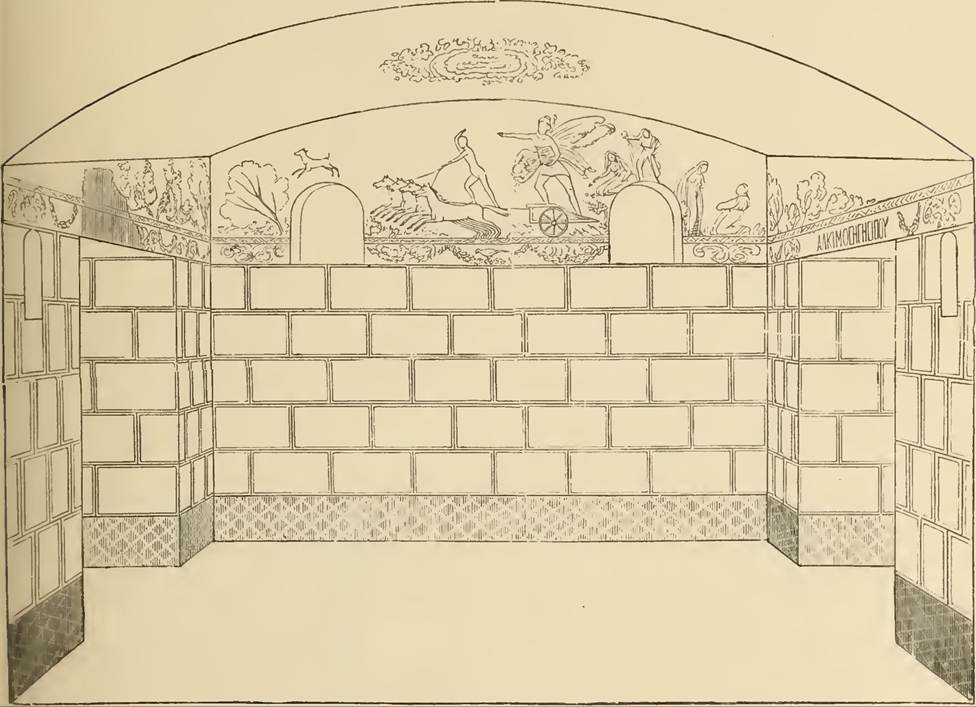
Fig. 220. Cr. 1868, p. 114. View of the Catacomb of Alcimus. Kerch.
In an ordinary plastered tomb of the first class, which corresponds in some degree to Mau’s first style at Pompeii, we have above the dark plinth an imitation of four or five unequal courses of big blocks of stone treated a little decoratively. This reaches almost to the height of the lowest spring of the irregular roof and is finished off by a broad band representing a cornice and
1 Kertch, p. 76. 2 Dubois de Montpereux, Sdr. iv. Pl. xviii. 2.
leaves but little space above itself where the roof is low, but considerable lunettes or spandrels where the roof rises. This space above the cornice is at the free disposal of the artist. To this class belongs the tomb of Alcimus, son of Hegesippus, found in 18671. The free wall space opposite the entrance was adorned with the rape of Core. Four brown horses draw a red chariot with blue wheels : the driver above may be either Eros, who should have wings, or Hermes, who usually leads the horses. On the car stands Pluto in a short red chiton and flying chlamys holding the blue-draped figure of Persephone whom he has seized from among four women. Of these one with a blue veil falling back is probably Demeter, the others, Persephone’s usual companions. The cornice is adorned with swags of foliage and birds. In the
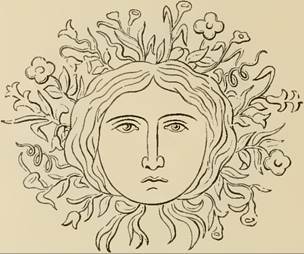
Fig. 221. CR. 1868, p. 116. Ceiling of Catacomb of Alcimus. Kerch, middle of the roof was a woman’s head surrounded by green leaves and red, white and blue flowers (f. 221), recalling the head in the Great Bliznitsa (p. 307). Another catacomb (Zaitsev’s) with the rape of Core was opened in 1895. Its frescoes have stood well and one can still see a head in the middle of the ceiling labelled A]H MHTHP, and a side scene of Hermes and Calypso2.
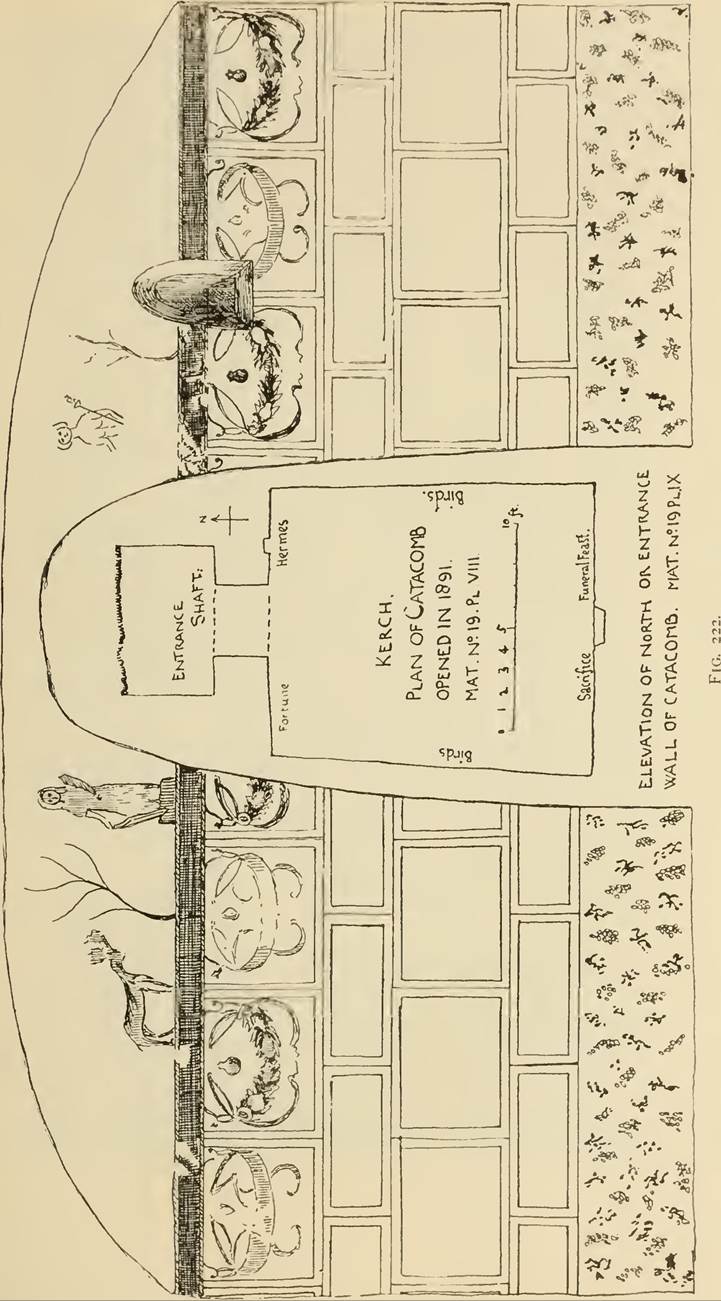
Of much the same date as the catacomb of Alcimus is the vault opened in 18913; above a plinth treated as a perfunctory imitation of marble are four courses of large stones, the joints marked with blue lines and the outline followed in brown. The top course has the thickest stones and each of them is treated as a panel filled with a garland hanging from two hooks. The garlands are alternately simple brown fillets and swags of fruit with flowers, the remainder of the oblong being filled with fluttering ribbons, the whole having a very graceful effect. Above the broad brown cornice band, we have peacocks and other birds on the long walls, on the entrance wall Hermes and Fortune and a deer under a tree. The principal wall opposite the entrance is divided into two by a niche, above which is the familiar motive of two peacocks drinking from a standing cup. On the right of this, but not well preserved, are the frequent scenes of a horseman and his companions and a sacrifice with a man and woman (Rostovtsev calls them Serapis and Isis) wearing calathi. On the left we have the familiar “funeral feast” with the unusual addition of a cradle with children, and beyond a picture of a tent. The whole is flanked by decorative trees and beasts. Something similar must
1f. 220, CR. 1868, pp. 114 and 116. 3 Fig. 222 ; Kulakovskij, Mat. xix. pp. 34—43,
2 Trans. Od. Soc. xix. Minutes, p. 56. Pl. vin.—XL
have been a catacomb opened in 1852, of which the only account is in an article by P. Becker on “ Kerch and Taman in July 1852[638].” He mentions two horsemen and birds above, and birds painted on the stones of the wall-pattern. Here seems to belong one opened in 1908 ; the walls were covered with broad stripes, yellow, dark red and yellow again with a narrow white band between and a white cornice : all round were painted alabastra, round vessels, garlands, olive crowns, Hercules clubs, and embroidered cloths represented as hanging from nails[639].
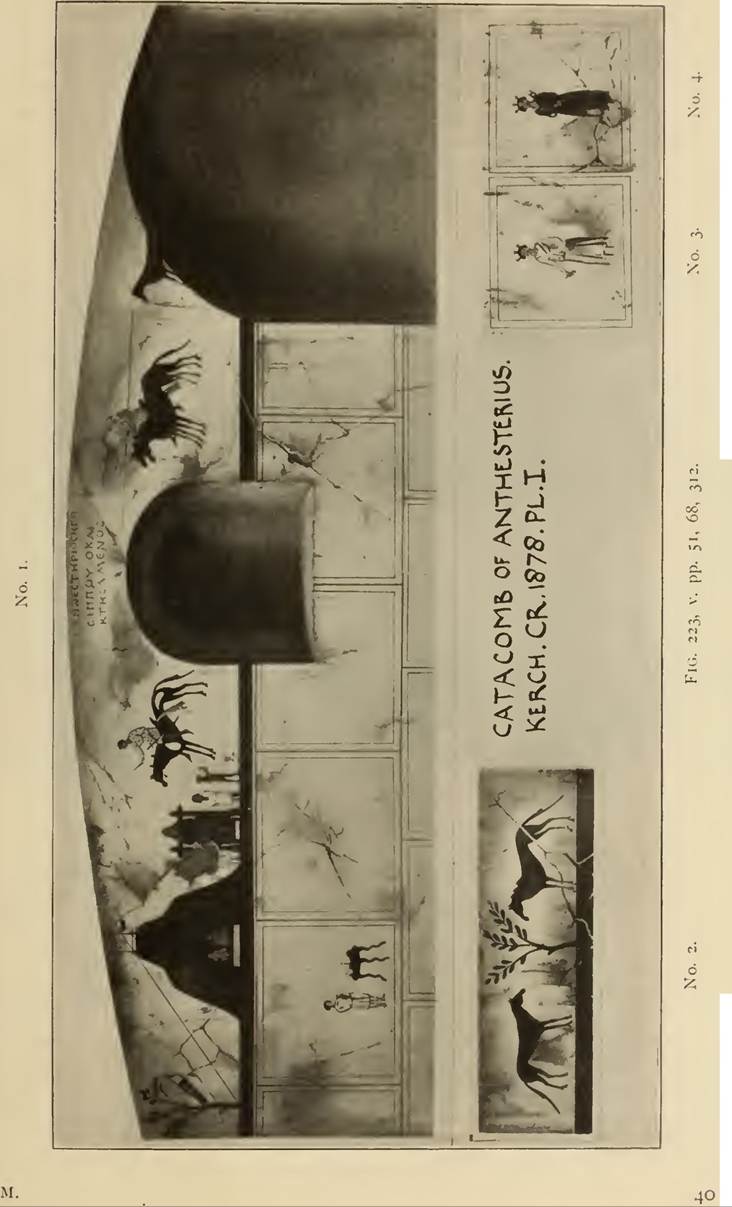
But much the most interesting of this class, though perhaps the latest, is that of Anthesterius, the son of Hegesippus, discovered in 1877[640]. Whether this Hegesippus was the same as the father of Alcimus cannot be decided, but there is sufficient resemblance in style between the tombs to make it not unlikely. Rostovtsev makes this vault earlier than that of Alcimus. Above the plinth we have four courses of stones separated by black lines and outlined in brown, the whole suggesting rustication. The stones of the top course, which are far the largest, are treated as panels, two of them bear figures with leaves in their hair and caducei in their hands, one (Fig. 223, No. 3) wears brown, the other (No. 4) green and red. Above the black and brown cornice is the chief scene (No. 1): Anthesterius in a blue and white shirt (conceivably steel mail) and brown trousers on a black horse with white patches is shewn receiving a blue cup from a boy in a brown shirt and red hose. Behind this latter is a woman shrouded in red sitting upon a high wooden chair with a blue cushion at her back : on each side stands a girl, one with a long blue dress and white shirt over, the other with these colours reversed. Next we have the tent, brown with reddish people within and apparently a blue floor: against it leans an inordinately long spear, brown with a blue head. Beyond stands a conventional tree with a gorytus hanging on it, and round the corner on a side wall are a brown and a green horse flanking a similar tree (No. 2). With the exception of the green horse the objects seem coloured according to nature. Here we evidently have a contamination of the funeral feast and the scene of the horseman’s departure, so the slave and the three-legged table with vessels on it have been supplied on one of the top stones beneath the cornice band. On the right-hand side of a niche we have a man clothed like Anthesterius, but with a blue (steel) cap and a long spear riding a light-brown horse and leading a black one. Behind follows another lightish-brown horse.
In the shaft of the catacomb found in 1891 was found a coin of Mithridates VIII ; this goes towards dating this class any time in the second half of the first century a.d.
A transitional stage in which we miss the imitation of a wall built with solid stone blocks, but still have the high cornice, is exemplified by a fine specimen discovered in 1841 and published by Ashik[641]. Unfortunately the drawings then made were anything but exact, and it is hard to see what we may take as authentic in them. Attempts to reopen the chamber have hitherto
3 f. 223, coloured in CR. 1878-9, Pl. I. f. 1 and Frontispiece.
4 op. cit., his most important drawings have been reproduced in KTR., pp. 211, 212, if. 193, 194 and in Stasov xvill. 35.
failed. In this case the wall surface below the cornice was divided up by Ionic pillars, between which were various scenes, while there were more scenes above the cornice. Accordingly more space was taken up with figure-work than in any catacomb known. There were also purely decorative panels with sprigs, peacocks, masks, and architectural adornments. The scenes represented included a specially full version of the funeral feast and a cavalry engagement wherein some combatants wear short scale-coats, sometimes partly hidden by a surcoat, others coats of mail so long that they have to ride sidesaddle. The surface of these latter is not indicated with typical scale pattern, but with oblongs just like masonry, perhaps they were quilted and
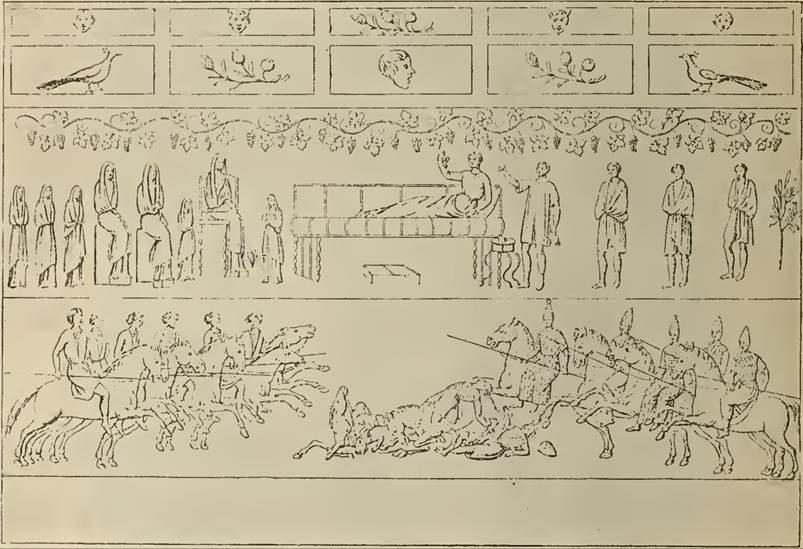
Fig. 224. Wall Painting from catacomb at Kerch (1841) after Ashik. KTR. p. 211, f. 193.
not covered with scales at all. Which are Bosporans and which barbarians is not clear. Other scenes shew the funeral, the dead man carried high in a covered litter, also various scenes from daily life and even gladiatorial combats. All with a Roman touch which may be genuine or may be due to the training of the copyist.
Typical specimens of the second class were those discovered in 1872 and 1875. They are characterized by the disappearance of the plain wall of apparently solid blocks : in its place we find an imitation of as it were high wainscoting made with panels of many-coloured marbles rendered architectural with pilasters. A similar change of taste is observed at Pompeii. The favourite pattern for the wainscot panels seems to be a rayed circle within a larger circle inscribed in a lozenge in its turn inscribed in the oblong of the §4-] “ Catacombs” Ashik's, 1872, 1875, Sarcophagi 315 panel[642]. The wainscoting is not as high as the former wall pattern and leaves more space for free decoration above.
Judging from the description a good early example of this style was a tomb excavated in 1902 on the way to Katerles[643]. It is interesting for the painting of Medusa’s head on the inner side of the door slab, and for a very pretty and natural design of a vine with grapes that adorned the long front of one sarcophagus. These give an idea much higher than usual of the skill of Bosporan painters. It is a pity that the decoration of the other original sarcophagus and of the vault itself has only left very small traces.
Another sarcophagus[644] had interesting painting on its inside: upon one end was depicted a garland, upon the other a table with vessels and two comic dancers; each side was divided by Composite pilasters into three panels, bearing (1) a man with a horse and arms hanging behind him, (2) a painter at work in his studio, (3) the funeral feast, (4) a lady seated and two servants,
(5) two horsemen opposed to each other, (6) musicians ; the lower face of the cover was adorned with roses. Thus the interior of this coffin presented all that a catacomb could do ; it is referred to the 1st century a.d.
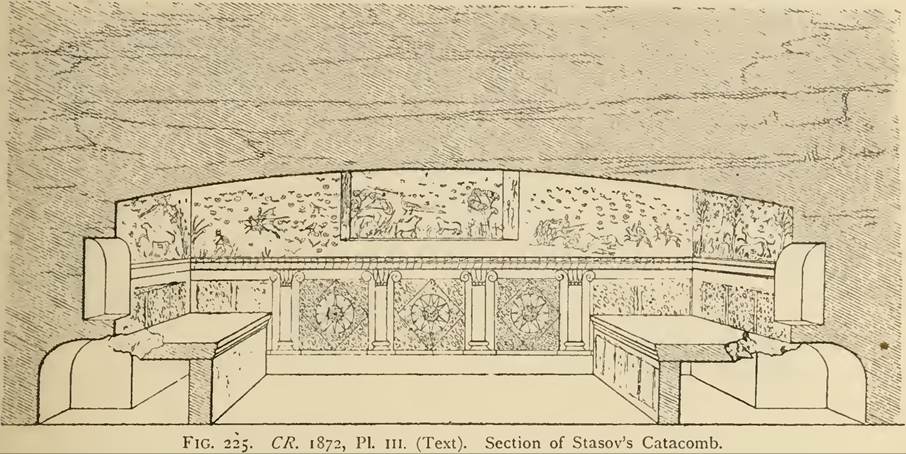
The richest specimen of a catacomb and the best illustrated was found in 1872 and published with very full treatment by V. V. Stasov. This author is too much inclined to see Oriental influence in every detail : the fact is that there is nothing but what can be paralleled from Hellenic sources, save the actual portraits of barbarians and the barbarous costume of the Bosporans themselves.
The greater part of the surface of the tomb above the panelling is taken up with trees, birds and beasts, among which the peacock, boar, dog, deer, lion and leopard can be distinguished, also two winged Genii or Erotes, one of whom has an orthodox Greek chlamys, but the other is arrayed in a brown coat and knickerbockers[645]. The background of walls and ceiling (op. cit. Pl. xm.) is sem6 of an ornament in the shape of a light and dark pink heart associated with pairs of green leaves (apparently a conventionalized rose), and has besides long yellow things like centipedes with ribbons at each end and sometimes leaves sticking out of them : these appear to be garlands of a kind or rather bags stuffed with flowers worn as garlands. These two motives occur in all the late Kerch catacombs and can be paralleled from Sicily and from textiles made in Egypt under Greek influence. For this habit of strewing a background is certainly derived from textiles, and the whole scheme of decoration was influenced by the custom of hanging tapestries on the walls of rich rooms[646].
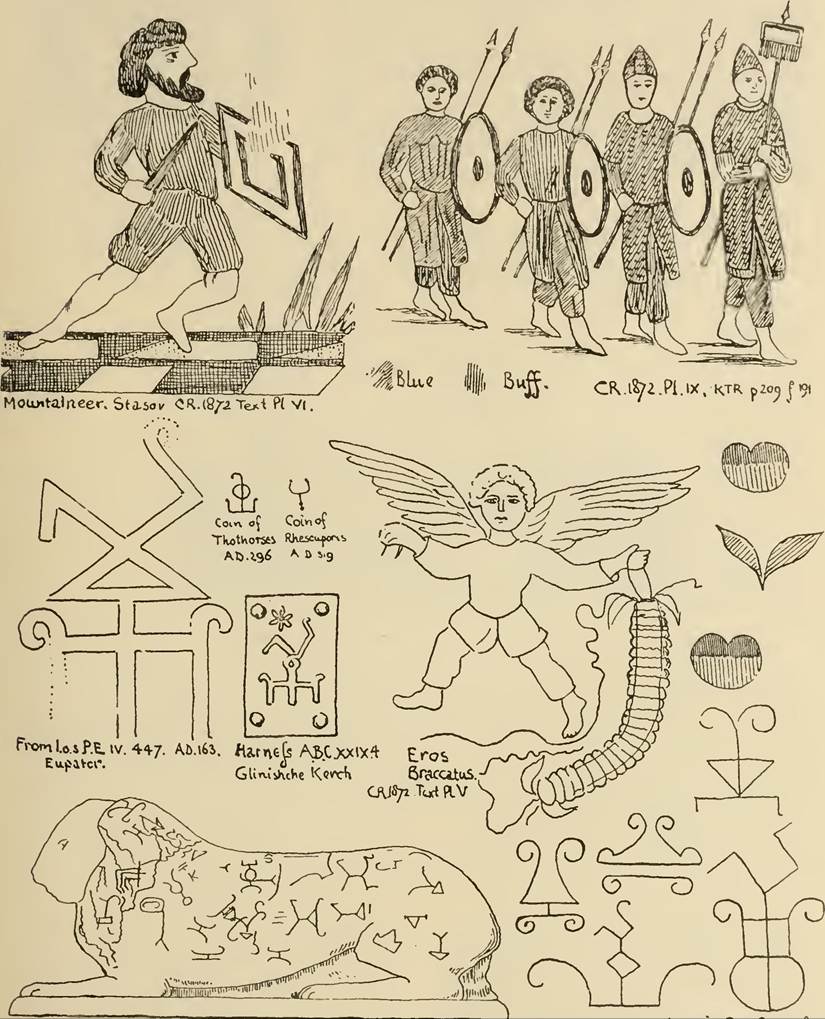
To us the chief interest of Stasov’s catacomb consists in the pictures of combats between what we may take to be Bosporans and natives. In these the difficulty again arises that the Bosporans had so far adopted barbarian arms that it is hard to say which side is which. First we have people with long coats of steel mail and buff jerkins under them, with loose brown trousers and conical caps on their heads[647]. When on horseback these ride astride, have long spears and saddles with a kind of tail sweeping back on each side, and resemble Anthesterius. Their footmen (f. 227) bear round shields and two spears apiece, but not all have the coats of mail. In front of them goes a standard-bearer with a standard which recalls both the labarum and the standard on Parthian coins[648]. The principal personage, probably the owner of the vault, always has a red chlamys flying behind him. These people have round faces and no beards. Against them fight folk on horseback who do not wear the clumsy mail but coats and trousers. They use short nomad bows, but so did the Bosporans to judge by Anthesterius and the grave reliefs. Finally, we find the principal figure in all his glory fighting a bearded fellow in coat, knickerbockers and stockings, with a short sword and a lozenge-shaped shield; he would seem to be a rude mountaineer. That there was not much difference in armament between Bosporans and Sarmatians or whoever their enemies may have been is evident; probably they found that the best way to combat nomads was to adopt their ways, and so they suffered the same outer assimilation that has made the Terek Cossacks so like their hereditary enemies among the mountaineers5.
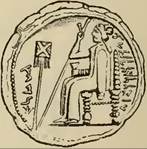
Fig. 226. Mat. xni. P- 30, f- 3·
Coin with Standard and Candys^.
In one place the surface layer of plaster with its painting had cracked off and disclosed signs scratched on the wall just like those on the Olbia lions6 and (occasionally upside-down) on certain gravestones7, all idle scribbles, but thus proved to be ancient. Similar separate signs or modifications of these, occurring one or two at a time on coins, slabs, buckles and strap-ends,
“ Beiträge zur Aramäischen Münzkunde Erans.”
6 Baddeley, J. F., The Russian Conquest of the Caucasus, London, 1908, p. 11.
6 f. 227, cf. p. 298, Trans. Od. Soo. III. p. 247, Pl. vi.; IX. p. 191, Pl. xiv.; XV. pp. 504, 505.
7 losPE. 11. 219, 232.
must have had some real meaning analogous to that of the tumga. or brand of possession among Caucasian tribes1. One particular device ft, that to the left
CJk.(?72..Tert.Pl. xvu. 13. Ertone Uησου and ctti βασιλείας (v. Ch. XIX.) about A.D. 107.
ff. 2, 3 shew ft and another mark, the same two as f. 228 ; gravestones : losPE. 11. 84 ft /cf. KIV. 626, f. 16), 219 (ft ?), 232 (ft?), iv. 237, 283,'359, BCA.k. p. 36, No. 28 (ft?); buckles etc.: f. 228, ib. xxv. p. 14, f. 5 ft, xxxvii. pp. 31, 32, ff. 4—12 ft, ABC. xxix. 4 ft (f. 227), xxxii. 19 (ft ?), 20 ft ; the four strap-ends have the same tip, it may be a mark: cf. ERAS. Slav. Sect. iv. (1887) p. 519, Orient. Sect. 1. (1886) p. 304: KIV. l.c. calls these marks “Gothic.”
2 Stephani in CR. 1875, pp. xxiv—xxvi, 1876 pp. 218—222; KTR. p. 37, ff. 37—39.
3 CR. i860, p. vi.
In the 1902 catacomb were coins of Cotys II (123—131 a.d.), and in that of 1875 coins of Rhoemetalces and Eupator (131 —153—170 a.d.), so as far as our evidence goes this class of tomb went right through the iind century a.d.
The third class is represented by the tomb found in 1873 and that of Soracus. In these the architecture is reduced to a mere plinth and all the wall space given up to fancy patterns. In the former (Eig. 230)1 the style of these patterns differs little from that of those in the second class. We have the same roses and peacocks and garlands as in Stasov’s ; new are figures of four women dancing and three people under a tree. There is the usual combat, but less well drawn than in Stasov’s. The enemy is represented as
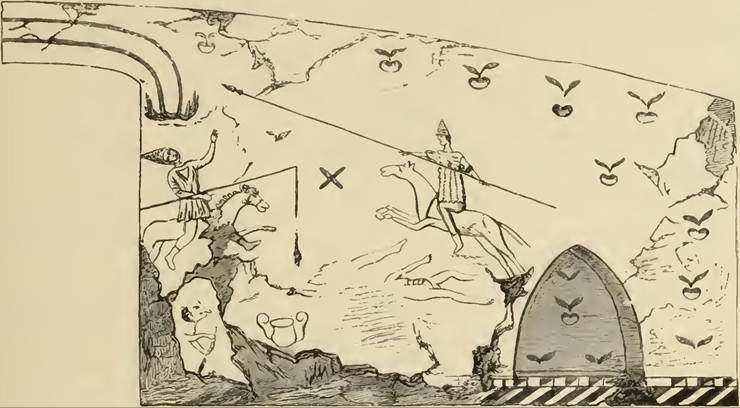
Fig. 230. CR. 1874, p. 115. Combat from Catacomb found in 1873. Kerch.
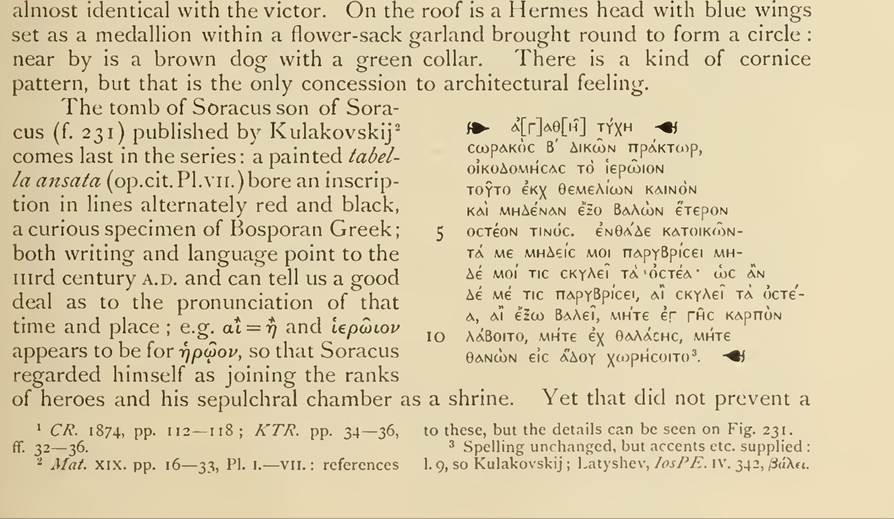
justifiable fear that the shrine might be plundered and his heroic bones cast out, and the inscription contains the usual comprehensive curses to guard against this. He seems to have amassed some wealth as an exactor of legal fines.
As regards the decoration, except for the brown plinth which goes right round there is no architecture left (Pl. n.). The whole wall is covered irregularly with the heart-shaped rose, whose leaves are not quite so much conventionalized as usual : we also have the brown garlands sometimes pecked at by a pair of birds; a fresh pattern is one of crossed palms (Pl. iv.). On the left of the entrance stood Hermes (Pl. in.) on a pedestal with money-bag and caduceus painted on a kind of buttress or pier supporting the roof. To this corresponds on the right an actual square pier which bears on one side the inscription and below it two Erotes (Pl. vi. z5)’, on another a dancing Satyr with flutes (Pl. v.). At the back of the Hermes buttress, looking towards the couch on which no doubt was placed the body of Soracus, we have the inevitable funeral feast with some apparent attempt at portraiture of the principal figure (Pl. vi. /z).
This is the latest catacomb with frescoes, but that method of burial went on for another two hundred years. To this interval belong such as have rude drawings or patterns executed directly upon the clay3. In unadorned catacombs have been found coins of a whole series of sovereigns from Sauromates I (92—124 a.d.) to Valentinian III (424—455) and later still a silver shield with a splendid figure of Justinian on horseback3.
Sometimes in Christian tombs crosses and extracts from the Psalms and hymns covered the walls. Such a case was published by Kulakovskij in his first monograph {Mat. vi.) and was important for the definite date 788 a.b. = 491 a.d. The names of the dead pair Sauagas and Phaeisparta are clearly of the same Iranian or Ossetian type that we have said to be characteristic of the earlier Bosporan citizens4. This and the continued use of the Bosporan era proves that there had not been such a break-up as had been hitherto supposed. The greater part of the walls is covered with Psalm xc., but the writing is so inaccurate that it is of no importance for the Greek text; the presence of m is so much against that form being Egyptian.
In another Christian catacomb, discovered near by in 1895, we have the same Psalm xc. (but written much more correctly), the Trisagion and various crosses but no names; the writing again points to the vth century a.d.6
At Chersonese, with the exception of three Christian vaults6, only one chamber with frescoes has been discovered, and that in such bad condition that it is hard to judge of date, style or subject. It was only possible to distinguish the figure of a woman, half nude, turned away from the spectator, and a group that suggests the winged figures bearing away a dead man, so common upon white lecythi7. At Olbia practically no remains of painting have survived8.
amulet, Trans. Od. Soc. XXI. Minutes, p. 8.
5 Kulakovskij in an appendix to Mat. xix. p. 61.
Mr N. McLean kindly informs me that the text offers no points of interest.
G BCA. xvi. p. 98, No. 1494, xxv. pp. 166—169, Nos. 2086, 2114.
7 CR. 1894, pp. 71, 72, ff. 103, 104.
8 Two rude figures BCA. xm. p. 26, f. 16.
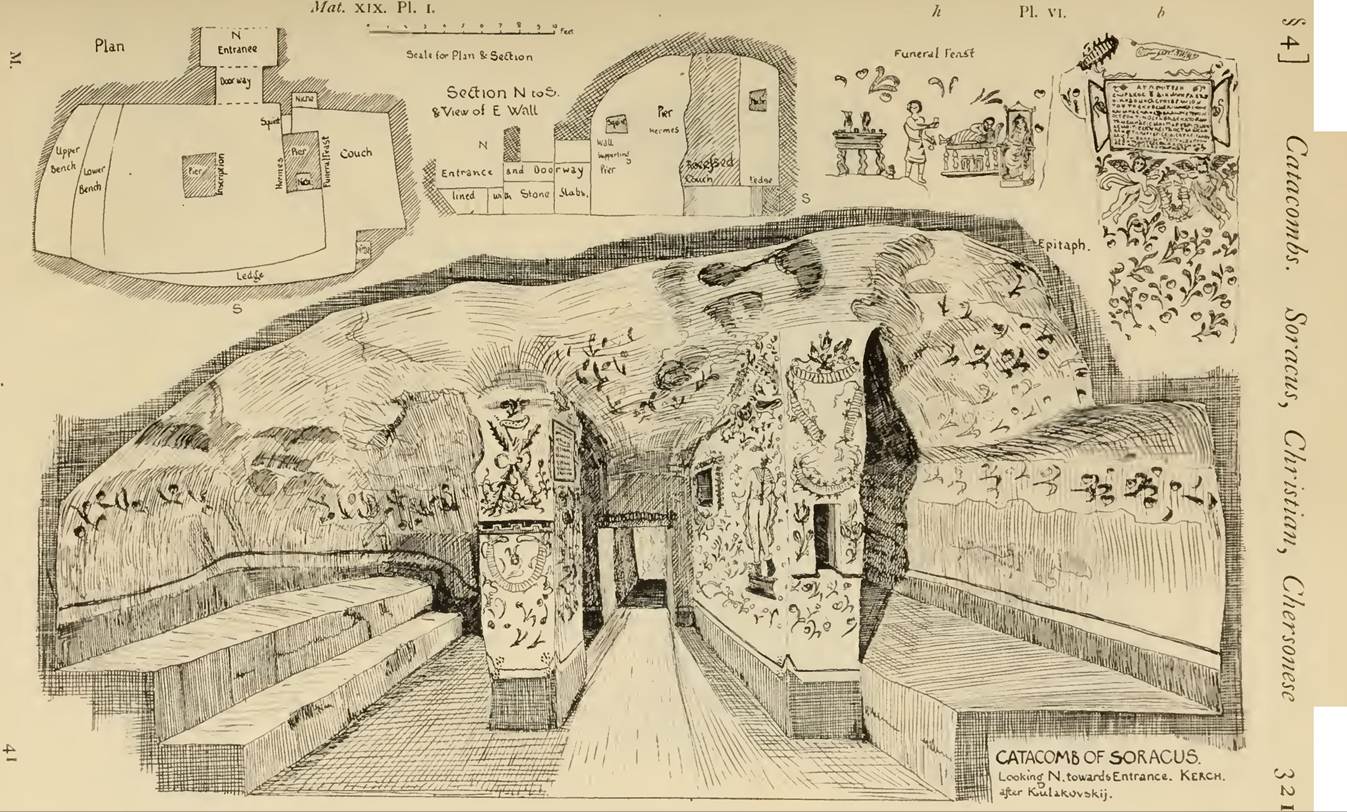
Fig. 231, г. pp. 304, 319.
Pl. π.
More on the topic § 4. Painting.:
- Models for the Painting
- Painting People and Places
- Jean-Leon Gerome’s The Snake Charmer (Figure 24.1) is a painting about mystery and latent danger in the exotic East.
- REMBRANDT HARMENSZOON VAN RIJN (l6θ6-l669) was the foremost artist of the Golden Age of Dutch painting and one of the most brilliant of all European artists.
- (Overleaf) Fort Batavia (Java), administrative headquarters of the Verenigde Oost- Indische Compagnie in Asia. Painting by A. Beeckman, 1656. Tropenmuseum, Amsterdam
- The politics of beautiful Indies landscapes
- The Child Soldier in Literature
- A NOTE ON THE COVER ART
- VII The World of Poetry and Art
- Repin's Tour of Ukraine (1880)