Jean-Leon Gerome’s The Snake Charmer (Figure 24.1) is a painting about mystery and latent danger in the exotic East.
All eyes are drawn to a pre-pubescent boy who is encompassed by a massive snake held in thrall to the charmer’s music. Wrapped twice around his young torso, the thick body of the boa constrictor forms a sinuous arabesque, its patterned flesh glistens with the play of light.
The child’s delicate musculature is no match for the latent strength of this serpent. How long can the strains of the charmer’s flute hold this threatening reptile in this acquiescent state? This risky but intriguing entertainment elicits a range of responses from its audience; there are some furrowed brows, a few heads strain forward mesmerised by the scene, one reacts with an amused and knowing smile, while others impotently grip their weapons in an unconscious visceral reaction to the imminent threat. The nakedness of the snake charmer’s assistant underscores his vulnerability and lends an erotic charge to this scene. For Gerome’s nineteenthcentury Western European audience, the mise-en-scene of this painting—its traditional costumes and carpet from the Near East and the exquisitely rendered turquoise Ottoman Iznik tiled wall—located the scene in an enchanting East, distant in time and place from Western industrial modernity.The Snake Charmer has attained a level of notoriety matched by few Orientalist paintings. Since it was published on the cover of Edward Said’s seminal book Orientalism, the work has been imbued with a synoptic function to become a visual shorthand for the Orientalism debate, a distillation of Western Europe’s enchantment with a notion of the exotic East in the age of Western European imperial ascendancy.1 Over the last three decades Said’s writings on Orientalism have provided a crucial framework for interpreting European visual representation of Middle Eastern cultures and their patterns of exclusion. Said did not write about art.
However, he provided a model for thinking about the place of Western visual culture within the discursive field of Orientalism, because art replicated binary structures of thought through which the West defined itself by positioning the Orient as its other. Like other disciplines within the humanities engaged in the analysis of European representations of the Middle East region, the study of nineteenth-century European Orientalist art was transformed as a result of this cultural critique.Linda Nochlin’s 1983 essay ‘The Imaginary Orient’,2 the first transposition of Said’s Orientalism into art history, exemplifies its impact within the discipline. Nochlin challenged the cultural politics of the field of study by investigating various ways in which the visual
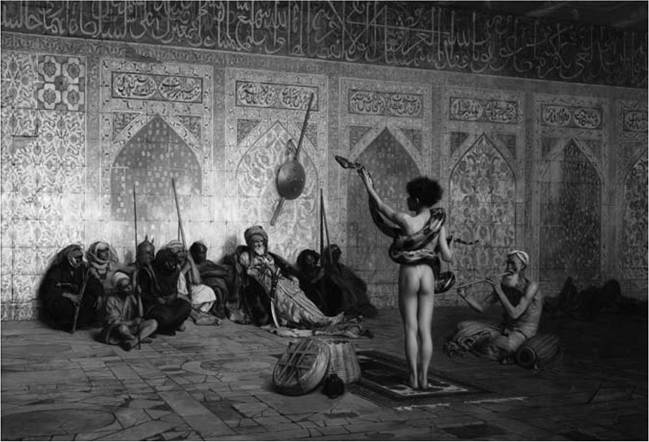
Figure 24.1 Jean-Leon Gerome, The Snake Charmer, c. 1879, oil on canvas, 82.2 x 121 cm. Collection: The Sterling and Francine Clark Art Institute. Image © Sterling and Francine Clark Art Institute, Williamstown, Massachusetts, USA
arts participated in colonial processes by inscribing boundaries between ‘Europe’ and its imaginary ‘Orient’. She highlighted the prevalence of European stereotypes of Oriental exoticism, despotism and cruelty, where Islam was represented as an irrational religion and the East rendered as a fantasy site of erotic excess. She revealed the way the ‘reality effect’ of nineteenth-century academic art presented these Western stereotypes as the reality of Oriental life. The meticulously detailed realism of Gerome’s The Snake Charmer exemplified this impulse. According to Nochlin the painting was ‘a clear allusion... clothed in the language of objective reportage, not merely to the mystery of the East, but to the barbaric insouciance of Moslem peoples, who quite literally charm snakes while Constantinople falls into ruins’.3 For Nochlin, one of the tasks of the art historian was to unmask the aesthetic languages that naturalised Orientalist values as an ideological buttress for Western Europe’s political and economic domination of the region.
Over the last decade, an approach to nineteenth-century visual culture that emphasises cross-cultural contact and exchange between Europe and cultures of the Near East has begun to augment the insights provided by the earlier Saidean critique. The terms of the debate within art history have profoundly shifted through recognition that European images of the East were not produced in a cultural vacuum; rather there were many and varied forms of engagement from cultures of the region. Taking on board the lessons of Said’s Orientalism, but recognising the limitations of his model (especially with regard to questions of indigenous agency), scholars have been transforming this art historical narrative by analysing visual culture from both sides of the Mediterranean. Heralding this new direction, in 1996 Zeynep Qelik framed this issue in terms of ‘speaking back’ to Orientalist discourse, emphasising the ways indigenous art contested Western stereotypes.4 She later acknowledged lacunae in cross-cultural dialogue, analysing revisionary indigenous forms that were met with failures to listen and to hear.5 Since then other studies have addressed varied hybrid aesthetic forms created by indigenous artists in both colonial and non-colonial contexts.6
This essay explores art in Ottoman Istanbul as a case study of the role of the visual arts within the political and cultural geography of the region. As the capital of the only Muslim empire on the world stage in the nineteenth century, Istanbul is a unique and important site from which to investigate the role of the visual arts in the cultural politics of empire. I focus on three themes: the role of art in Ottoman diplomacy, the creation of Ottoman visual histories and the representation of elite Ottoman women.
More on the topic Jean-Leon Gerome’s The Snake Charmer (Figure 24.1) is a painting about mystery and latent danger in the exotic East.:
- SNAKE BITE
- Exotic Newcastle disease
- exotic Morbillivirus INFECTIONS
- § 4. Painting.
- LATENT INFECTIONS (APPARENTLY HEALTHY CARRIERS)
- The danger sofknifefights
- Designating danger
- Models for the Painting
- Although a century has passed since its outbreak, the First World War retains much of its mystery.
- The Mystery of Mohenjo-Daro
- East and South East Asian Piracy
- CHAPTER EIGHT Candles in the Dark and Spice from the Orient: Mystery cults
- LATENT INFECTIONS (APPARENTLY HEALTHY CARRIERS)
- TREATMENT OF RESIDUAL HIV-1 DISEASE: PURGING LATENT
- Painting People and Places
- When Leon Leconte beat, blinded and threatened to kill Chief Tieou he had little reason to fear recrimination.
- Jean Μ. Turfa
- Jean-Jacques Aubert