Designating danger
Arriving from a continent largely expunged of harmful fauna, Europeans adopted divergent responses to threatening indigenous animals. Larger carnivores such as lions, bears and crocodiles were subdued or negated via the tools of empire: firearms, mechanisation and the built environment.
Paddle-steamers and locomotives enabled settlers and their stock to penetrate interior waterways and railways, isolated from roaming predators. Industrialised building materials—uniform wooden planking, corrugated iron and barbed wire—permitted construction of robust compounds and fences to protect colonists and their vulnerable flocks. Muskets, shotguns and above all the magazine-fed repeating rifles of the century’s final decades dramatically, if not entirely, eroded advantages once accorded to the superior senses, muscles, fangs, claws and sheer bulk of ‘wild beasts’.Animals were also both victims and accomplices in a near-ubiquitous hunting culture. From ducks and mutton-birds to ostriches and penguins, birds filled bellies. Imitating indigenous peoples, meals might likewise be made of opossums, elands and kangaroos. Hunters killed thousands of such quadrupeds each year for the lucrative fur trade, yet colonial hunting was frequently encoded as ‘sport’. Mounted on horseback, or camel, or
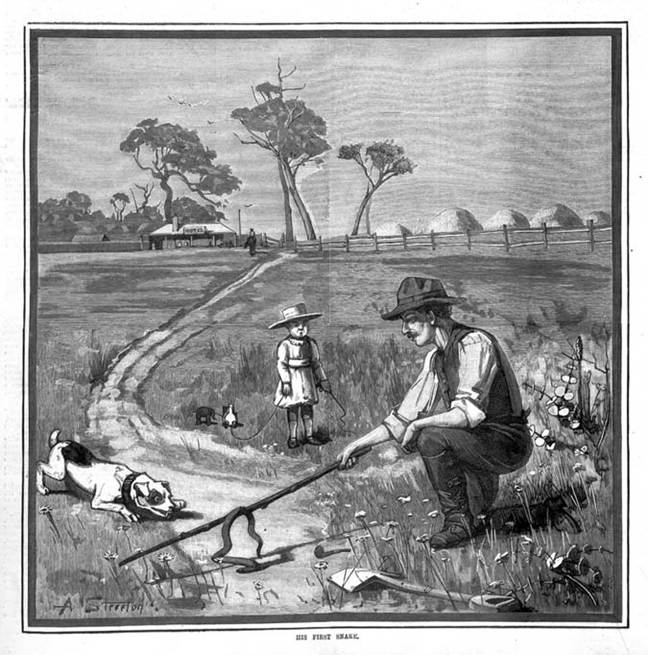
Figure 19.1 Engraved by noted colonial artist Arthur Ernest Streeton, His First Snake depicts not merely a rite of passage, but a layering of animal relationships. Equally at risk from the serpent’s bite, man, child and domesticated dog—note the docked tail and sturdy collar—a.K similarly spared by the father’s rod. Such a pioneering spirit, the child’s toys imply, belitded the mightiest beasts. First appearing in the Australasian Sketcher with Pen and PmfZ on 24 January 1889, this illustration is reproduced, with permission, from the Pictures Collection, State Library of Victoria, Accession No.
A/S24/01/89/1.elephant, supplied by pack-mule or ox-cart, and above all abetted by dogs, colonists ventured into the wilds to pursue quarry.18 In the Antipodes, deer, foxes, rabbits, quail and pheasant were introduced for this purpose, while a visitor to the brand-new settlement of South Australia declared in 1839 that ‘Hunting the kangaroo is one of the chief sports of the colonist’. Breathless chase accounts inevitably interwove animal narratives: intrinsic to this exhilaration, settlers’ horses and hounds were prized for their skill and pluck.19
Such tales also foregrounded danger, largely reflecting the proliferating hunting literature grounded in Indian, African and South American experience.20 Especially after 1850, the imperial hunting genre sustained an enormous popular market. Its delights were threefold: the exoticism of remote locations; the embrace of a pursuit that in Europe was preserved largely for the landed classes; and the titillation of mortal combat between the lone white hunter and his animal adversary, whether tiger or boa constrictor. The allure proved powerful for many: by the 1880s burgeoning empire-trotting hunting parties and their ‘bags’ prompted the imposition of gentlemanly codes, quotas and finally mandated reserves. These measures were intended to preserve a modicum of game for monied whites dreaming of displaying their fieldcraft, marksmanship and valour.21
Some ‘dangerous’ animals, however, provided neither sport, sustenance nor commerce. While St Patrick was revered for banishing snakes from Ireland, the rest of Britain and Europe remained uncomfortably familiar with serpents. Adders, asps, vipers and slow-worms slithered through local vernaculars, their bites proving bothersome—and occasionally fatal—well into the twentieth century. Yet in 1800 snakes were as much detested for their underworldly connections as their venom, loathed like all ‘reptiles’ as the unclean ‘creeping things that creep along the earth’ of Leviticus 11:29.
Snails, mice, weasels and tortoises were similarly disparaged, but none starred so soon in the Old Testament as Genesis 3:14, whence God cursed the serpent ‘above all cattle, and above every beast of the field’.22Furthermore, snakes were not alone in being deemed ‘venomous’: creatures believed to generate a harmful substance which they transferred into another animal through bites, stings or spines. Universally bemoaned in warmer climes were mosquitoes; only in the final years of the nineteenth century was irritation at their ‘venom’ superseded by apprehension that they might transmit infectious diseases such as yellow fever. More commonly feared were scorpions, yet only in the 1860s was it determined that their poison was not identical to that possessed by snakes. ‘Venom’, it appeared, was not a unitary substance. Moreover, ‘venomous’ was neither an inherent nor a stable property of species, or even individual creatures. Accepting that rabies was transferred through the saliva of affected animals, until the 1880s it remained unclear whether it constituted a contagion—like syphilis—or a venom. Provoking periodic panics over animal bites, from Travancore to Tasmania, the origin of the rabies ‘virus’ remained obscure. Did wild animals harbour and then transmit it to ‘innocent’ domesticates? Did it prosper in poorly controlled, low-class ‘mongrels’? Were certain types of dogs prone to spontaneously developing rabies, thereafter becoming infectious? For most of the century experts debated whether rabies arrived inside colonists’ animals or had more proximal environmental causes. Many authors on venomous beasts asserted that hotter climates both ‘enraged’ the biting animal and increased the potency of its poison.23 Thus the places creatures inhabited—both geographically and within the animal matrix—mattered in determining how ‘dangerous’ they were.
The American rattlesnake commenced the nineteenth century with a widespread reputation as the world’s deadliest serpent.
This enduring narrative was perpetuated by a highly influential eighteenth-century treatise on poisons, constantly re-published, by Richard Mead—physician to King George II. After a London man was ‘bit on one of his fingers by a Rattle-snake, just then brought over from Virginia’, a 1720 experiment in South Carolina— whereby a rattlesnake bite killed a dog in ‘a quarter of a minute’—convinced Mead that ‘the poison of this Snake is more quick and deadly than any other’.24 The interrelation of such living proofs—connecting the potency of venom in humans and ‘lower animals’— proved as important to discerning ‘dangerous’ snakes as their physical transfer around the British Empire. By 1775 American separatists were challenging that imperium: Benjamin Franklin argued that the rattlesnake—a potent indigenous species striking only when pro- voked—provided an apt symbol for America’s united but disgruntled colonies. Combining a rattlesnake with the epithet ‘don’t tread on me’, the so-called Gadsden Flag hoisted by the rebellious Continental Navy hardly endeared this serpent further in British opinion.25Perhaps this was why subsequent reports of fatal rattlesnake encounters in the imperial capital were leavened by snakebite experiments on rats in the West Indies and human casualties from India. Even as Scottish-born surgeon Patrick Russell commenced experiments to determine the most fearful of Indian serpents—by encouraging them to bite dogs, rabbits, chickens and pigeons—Britons began landing on other shores. At the new settlement of Port Jackson (now Sydney), Royal Marine Lieutenant Watkin Tench remarked in 1793 that ‘A dog was reported to be bitten by a snake, and the animal swelled and died in great agony’. Yet he remained unconvinced that local serpents were truly venomous. Six years later, while circumnavigating Van Diemen’s Land, naval surgeon George Bass encountered a ‘black snake with venomous fangs’ and ‘determined on taking him alive, in order to try the effect of his bite upon a hawk which was at that time in the sloop’.26 In short, surrounded by novel fauna, European colonisers did not immediately presume these snakes deadly.
Rather, they ascertained whether indigenous serpents were dangerous through active experiment and observation in non-human animals. By the 1810s, Australian colonists remarked a common and often fatal syndrome following snakebites in their cattle, sheep, horses and dogs. As human cases slowly accumulated, settlers extended this syndrome to themselves. Defined against ‘dangerous’ local snakes, the biological identification between Europeans and their imported animals crafted an enduring metonymic relationship.Certainly, observations in familiar animals frequently superseded the testimony of indigenous peoples. Australian colonists derived little knowledge of snakes and snakebite from local Aborigines. The diversity of clans, language groups, cosmologies and medical schemas precluded any unifying indigenous system which might outcompete European medicine. Some Aboriginal practices for snakebite—cutting and sucking the wound, or tying a tourniquet—coincided with Western traditions and were simply universalised. Traditional knowledge and totems regarding dangerous serpents, however, remained at arm’s length. While in 1866 Gerard Krefft, the Brunswick-born Director of the Australian Museum, remarked of local tiger snakes that Aborigines appeared ‘to be in great dread of this reptile, and assured me that its bite was certain death’, within a few years such observations were largely relegated to ethnography. Concurrently, on the subcontinent, where up to 20,000 locals died each year from snakebite, Indian Medical Service surgeon Edward Nicholson sniffed that the ‘statement of Indians is rarely worth anything’, proposing that Europeans might ‘live for ten years in Indian stations without seeing ten live snakes otherwise than in the hands of the juggler’. Dog bites, he claimed, killed more British soldiers than serpents.27
A striking exception was New Zealand. Lauded, like Ireland, for being bereft of snakes, settlers’ animals were rarely troubled by spider bites. Here, Ma- ori testimony carried greater weight: in the first known British report of this spider, missionary Richard Davis wrote in 1834 of suffering at the fangs of ‘noxious vermin, called by the natives KATIPO’, whose ‘bite produces inflammation and sometimes death’. Sustained both by tradition and ongoing bite reports from Ma- ori, settlers added their own painful experiences—and occasional fatal cases—to countermand Northern Hemisphere naturalists. Until 1890, these experts, many of whom had allowed themselves to be bitten by similar Latrodectus spiders from as far afield as Corsica, the Canary Islands and New York, remained sceptical that any spider could kill a human. Yet even as the credence accorded Maori testimony faded, their traditional convictions saw the katipo feared as perhaps the world’s most poisonous spider into the 1910s.28
More on the topic Designating danger:
- The danger sofknifefights
- Jean-Leon Gerome’s The Snake Charmer (Figure 24.1) is a painting about mystery and latent danger in the exotic East.
- ... when renouncing house and shelter a reckless individual arose...he became used to look the unfriendly neighbor straight in the eye, forgetting if such a thing as danger existed in the world.—Gogol, Taras Bulb
- Two theories of humility
- Taqiyya: Precautionary Secrecy
- Emergency of technogenic character
- Dangers, their classification
- 29.1 OUTPATIENT MANAGEMENT OF CHILDREN FROM 2 MONTHS UP TO 5 YEARS
- HMGB1 AS A MAJOR “ALARMIN”
- Getting real: a view from below
- THE DOMINATE
- The 950 manuscripts found in eleven caves around the site of Khirbet Qumran, located at the North-West of the Dead Sea shore, constitute one of the most amazing discoveries of the twentieth century
- Chapter Notes
- 11 Prohibition on Buying and Proselyting Non-Jewish Slaves
- THE PANTHEON