A Republic of Poison Letters
Through the early 1800s, colonial doctors facing venomous animals relied as much on personal experience as the polyglot traditions of Western science. They might equally invoke Pliny or Patrick Russell, Richard Mead or Felix Fontana, a Florentine natural philosopher who over 1764—1781 slayed literally thousands of animals to study viper venom.
Helping regularise their treatments in the face of proliferating folk remedies, most clinicians contended that, even if symptoms following snakebite differed, venoms were fundamentally alike regardless of snake species or locale.29 Indeed, authoring the century’s first major monograph on the topic, Philadelphia physician Silas Weir Mitchell concluded in 1860 that there was little variation between snake venoms ‘whether the bite be inflicted by the Viper, the Copperhead, the Rattlesnake, or the dreaded, but not more deadly, Cobra’.30In engaging with predecessors like Russell, Fontana and Mead, Mitchell perpetuated the ‘Republic of Letters’, a fading Enlightenment concept of courteous international correspondence between scholars. Furthermore, by using familiar animals as test subjects— rabbits, dogs, pigeons and frogs—he suggested that his results could be replicated anywhere that these ‘standard’ species had travelled. Such universality was, after all, one of the central tenets of vivisection—experiments conducted in living animals for nominally heuristic purposes. Yet this commonplace negated any acknowledgment that despite their enormous variations in ancestry and environments, colonial animal populations—like ‘Australian horses’—might no longer be synonymous with their European forebears.31 By 1860 the cultivation of stable breeds of animals—especially dogs—had only just begun to take root in Europe. Yet in natural history, this very concept of discrete species fixed in time and space was being undone by Charles Darwin’s On the Origin of Species, published only a year earlier.
Darwin is often credited with dramatically revising the ways in which Europeans drew direct correlations between ‘man’ and ‘beast’. Yet therapeutic analogies between humans and animals had long informed the demonstrations of a group of practitioners operating beyond orthodox science or medicine. Prevalent across the United States, India and the Australian colonies were itinerant antidote sellers and snake charmers. In India, demonstrations primarily involved ‘jugglers’ charming their snakes to dance, sometimes receiving an apparent bite to ‘prove’ a touted curative. Across Australia, the standard patter required a snake to bite a pair of fowls, dogs or pigs—and often the showman himself. The second animal and the spruiker would receive his nostrum; the first would not. If all went to plan, only the untreated animal would sicken and die before the crowds assembled in main streets, public houses and music halls. Not all performances followed the script, but the wider point was that well before the dissemination of Darwinism, such vivisections were predicated upon biological homologies between beasts and ‘men’. Settlers, indeed, bought such antidotes both for themselves and their valued animals, whether working horses or household pets.32
While snake charmers profited from demonising local species, international circumstances reshuffled the hierarchy of dangerous serpents. The Indian cobra’s challenge to the American rattlesnake as the world’s most feared snake can be traced precisely to 19 October 1852. On that date, an inebriated keeper at the London Zoological Gardens, Edward Girling, died after being bitten by a manhandled cobra. Captivating the British metropole only a year after the Great Exhibition of 1851, Girling’s demise dramatically raised estimations of the cobra across the empire. By the mid-1860s, writers from Mitchell to the enormously popular natural history author John Wood acknowledged cobras as
‘some of the most deadly of the serpent tribe’.33 Neither Wood nor Mitchell, however, mentioned Australian snakes.
This lacuna was unsurprising. Through the 1860s and 1870s, concern over serpents varied widely between the Australian colonies. It peaked in Victoria, especially after 1863, when the colony welcomed George Halford, the first teaching professor of medicine in the Antipodes. Having treated a rare case of adder bite in London—also in 1852—Halford was intrigued by the death in Melbourne of John Burstall, a recent arrival from Ceylon, on 14 April 1867. Burstall had imported his pet cobra, which he believed he had rendered harmless by wrenching out its fangs. This fatal error provided Halford with a clinical demonstration of cobra bite, plus sufficient quantities of venom to test it in ‘a full sized dog... [which] died after the usual symptoms’. The professor then compared these ‘usual symptoms’ with those produced by an Australian black snake in a dog, kitten, pigeon and rat. Microscopically examining these animals’ blood, he proposed that snake venoms might act like the germs of disease recently propounded by the French chemist Louis Pasteur. Halford then ventured that because ‘the home of cholera and of the cobra and other venomous reptiles is India’, the epidemic of cholera then affecting India, Europe and Britain might be the result of the dried venom of innumerable dead cobras being wafted around the globe in air currents.34
This remarkable hypothesis instigated a prolonged and acrimonious exchange between Victoria and India. By 1868, Mitchell in Philadelphia read Halford’s theories, sending him a package of dried rattlesnake venom to experiment with. Mitchell’s courteous request for a return sample was never granted. This incivility ensured that Professor Halford of Melbourne became the first investigator capable—via experiments in stray dogs—of directly comparing Australian snake venoms with those of the world’s two most dreaded serpents. His results in a handful of victims permitted Halford to venture that science had ‘arrived at a point where a difference seems to exist between the effects of the poison of the tiger snake and that of both the cobra and the rattlesnake’, declaring the Australian serpent at least as deadly as its American counterpart.35 Further studies with rattlesnake and tiger snake venom led Halford to propose a new treatment for snakebite—the intravenous injection of ammonia.
These gambits provoked British doctors in India, especially Joseph Fayrer, Professor of Surgery at the Medical College of Bengal. By mid-1869 Fayrer and senior colleagues were experimenting almost weekly, enlisting over 100 domestic dogs, ‘pariah dogs', fowls and pigeons to test a welter of local snake venoms, especially those of the cobra and Russell's viper. Concluding in 1871, Fayrer's vast catalogue of vivisections saw him reiterate that the Indian cobra remained the world's deadliest serpent, and that Halford’s ‘remedy’ was no such thing.36Medical opinion in Victoria and Britain initially fell towards Professor Halford and his fellow colonists, who cited a growing number of successful treatments with ammonia injection in humans and their dogs. Vindicating Halford’s research, in 1870 the British Medical Journal concurred that ‘the tiger-snake, the brown and black snake of Australia’ were not only ‘as deadly as the cobra and rattle-snakes of India [sic]’, but almost as venomous ‘as some of his London critics'.37 Like Mitchell, however, Indian experimentalists could not obtain Australian snakes or their venoms until 1873. That July, the Government of India appointed a Commission to investigate ‘the effects of artificial respiration, intravenous injection of ammonia, and administration of various drugs, &c. in Indian and Australian snake-poisoning'. They overrode Halford, negotiating directly with the Victorian government to ship two dozen Australian tiger and black snakes to
Calcutta, via the vessels that regularly exported Victorian horses to Bengal.38 Spearheaded by Halford’s fiercest critic, Balasore civil surgeon Vincent Richards, the Indian Snakebite Commission conducted an exhaustive series of vivisections. Dismissing ammonia injection for actually hastening death, in 1874 the Indian investigators furthermore concluded that cobras were ‘six to thirteen times more poisonous than the snakes of Australia’—at least in dogs.39
As these vivisections came to sway British opinion, the elite Medical Society of Victoria felt impelled to conduct its own trial of the remedy propounded by their former president: George Halford.
Although employing only local tiger snakes, this 1876 study replicated the results of the Indian Snakebite Commission. After demonstrating the complete inefficacy of ammonia injection in saving canine lives, the Victorian investigators became increasingly sensitive to signs that their dogs were suffering dreadfully from this supposed remedy.40 Although they expressed no moral qualms over their subjects’ struggles and howls, these experiments coincided with a British Royal Commission on Vivisection which led, in August 1876, to the United Kingdom becoming the world’s first nation to formally regulate experimentation upon living animals. During its deliberations, the Commission’s chairman voiced concern that legislation over-regulating vivisection might preclude researchers in British India from performing an ‘inestimable service to humanity’—curing snakebite.41 As it happened, passage of the 1876 British Cruelty to Animals Act saw imperial vivisectors travelling to India precisely for its freer regulatory environment, especially to investigate venoms. This exceptionalism regarding snakebite studies was not unique; it also featured in Parliamentary debates that in 1881 saw the colony of Victoria become just the second legislature worldwide to systematically restrict vivisection.42Yet despite the decade-long animus between Victorian and Indian practitioners, the British Royal Commission’s numerous witnesses made no mention of Australian serpents. Furthermore, one commissioner foresaw ‘no possibility of arriving at any knowledge of an antidote for snake bite... except by submitting animals to be bitten by snakes’.43 The Medical Society of Victoria demurred. After fierce internal discord, they voted against the results of their own committee’s finding in dogs and, deferring to clinical testimony, adopted Professor Halford’s ammonia therapy as their approved treatment for snakebite on 5 July 18 7 6.44 It proved a pyrrhic victory; few bites were recorded over the ensuing decade and the ammonia remedy increasingly fell into disuse.
In the 1890s, a new series of vivisections pitted European, African, American, West Indian and Australian snakes against cobras from British India and French Indo-China. Designed to test the novel antivenene produced by the Pasteur Institutes in Saigon and Lille, the ensuing exchanges at the height of fin de siecle nationalism saw scientists asserting that there was no universal cure: each local snake species required a novel antivenene—generated in the blood of horses.45One element remained constant, however: the dogs. After 1876, no venom could be studied, nor any putative antidote evaluated, without recourse to animal surrogates for their colonial masters. Although other standardised laboratory animals—rats, mice, guinea pigs—came gradually to predominate, dogs typified the conflicted animal matrices at each imperial site. At once the expendable detritus of settler societies, boon companions and comrades in arms, dogs suffering in Victorian and Indian laboratories served concurrently as avatars for human responses to snakebite. Thus, as occurred at Malcolm Fraser’s inquest in 1891, negotiating which indigenous animals were ‘dangerous’ stretched across and beyond empires, but was always firmly rooted in local circumstance. The requisite layers of
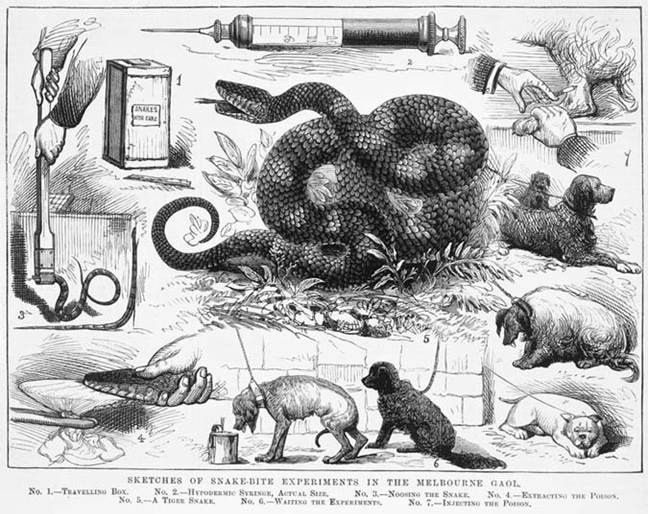
Figure 19.2 Encapsulating the medicalisation of snakebite studies between 1860 and 1875, this illustration provides a stark contrast to the enduring lay practice of simply encouraging a snake to bite its unfortunate canine victim. Often conducted in authoritative institutions such as gaols, scientific studies required apparatus to capture, store and milk snakes of their venom, employing the hypodermic syringe as a surrogate fang to envenom test subjects. From the Australasian Sketcher with Pen and Pencil, 17 February 1877; reproduced with permission from the Pictures Collection, State Library of Victoria, Accession No. A/S17/02/77/184.
proof similarly escaped the loosely woven net of ‘science’, ranging from the traditions of colonised peoples to the howling testimony of individual animals themselves.
Notes
1 ‘Inquest on the Body of Malcolm Fraser’, Wellington: Archives Office of New Zealand, Coroners’ Inquest Reports/files 1888-1938,J46 Box 54 112, 7 February 1891.
2 Ibid.
3 Ibid.; Anonymous, ‘Is the Katipo Bite Poisonous? An Interesting Investigation’, Evening Post, 7 February 1891, p. 2; R. Allan Wight, ‘The New Zealand Katipo’, Insect Life, Vol. II, No. 5 (1889), p. 136. I thank Derek Dow for biographical details of these practitioners.
4 Eric Rolls, They All Ran Wild: The Story of Pests on the Land in Australia (London, 1977). See also Alfred W. Crosby, Ecological Imperialism: The Biological Expansion of Europe, 900-1900 (Cambridge,
1986) ; Thomas R. Dunlap, Nature and the English Diaspora: Environment and History in the United States, Canada, Australia, and New Zealand (Cambridge, 1999).
5 Adrian Franklin, Nature and Social Theory (London, 2002), pp. 9-12; Tim Low, The New Nature: Winners and Losers in Wild Australia (Camberwell, 2001), pp. 1-3.
6 George Orwell, ‘Shooting an Elephant’, in Sonia Orwell and Ian Angus (eds), An Age Like This, 1920-1940 (New Hampshire, 2000), pp. 235-242; Liv Emma Thorsen, ‘A Fatal Visit to Venice: The Transformation of an Indian Elephant', in Tora Holmberg (ed.), Investigating Human/Animal Relations in Science, Culture and Work (Uppsala, 2009), p. 89.
7 Albert C.L.G. Günther, The Reptiles of British India (London, 1864), p. 340; Kay Anderson, ‘Animals, Science, and Spectacle in the City', in Jennifer Wolch and Jody Emel (eds), Animal Geographies: Place, Politics, and Identity in the Nature-Culture Borderlands (London, 1998), p. 37; John Simons, Rossetti's Wombat: Pre-Raphaelites and Australian Animals in Victorian London (Middlesex, 2008), p. 23.
8 Michael A. Osborne, ‘Acclimatizing the World: A History of the Paradigmatic Colonial Science', Osiris, Vol. 15 (2000), pp. 135-151. Italics in original.
9 Victoria. Parliamentary Debates. Session 1881. Legislative Council and Legislative Assembly Volumes XXXVII & XXXVIII (Melbourne, 1882), p. 345.
10 Ian M. Parsonson, Vets at War: A History of the Australian Army Veterinary Corps 1909--1946 (Loftus,
2005), p. 23; Michael Tyquin, Forgotten Men: The Australian Army Veterinary Corps 1909--1946 (Newport, 2011), p. 25.
11 Harriet Ritvo, ‘Beasts in the Jungle (or Wherever)', Daedalus, Vol. 137, No. 2 (2008), pp. 22-30.
12 Tim Ingold, ‘From Trust to Domination: An Alternative History of Human-Animal Relations', in Aubrey Manning and James Serpell (eds), Animals and Human Society: Changing Perspectives (London, 1994), pp. 1-22; William S. Lynn, ‘Animals, Ethics, and Geography', in Wolch and Emel (eds), Animal Geographies, pp. 288-290; Sandra Swart, Riding High: Horses, Humans and History in South Africa (Johannesburg, 2010), pp. 13-17.
13 Steve Baker, Picturing the Beast: Animals, Identity and Representation (Manchester, 1993); Lynda Birke, Feminism, Animals and Science: The Naming of the Shrew (Buckingham, 1994); Pratik Chakrabarti, ‘Beasts of Burden: Animals and Laboratory Research in Colonial India', History of Science, Vol. 48, No. 2 (2010), pp. 127-131.
14 Joseph Conrad, ‘Heart of Darkness', in Franklin Walker (ed.), Heart of Darkness and the Secret Sharer (New York, 1969), pp. 59, 84; Aaron Herald Skabelund, Empire of Dogs: Canines, Japan, and the Making of the Modern World (Ithaca, 2011), pp. 12-13.
15 Virginia DeJohn Anderson, Creatures of Empire: How Domestic Animals Transformed Early America (Oxford, 2004), pp. 160-171, 211-216; Leigh Dale, ‘Empire's Proxy: Sheep and the Colonial Environment', in Helen Tiffin (ed.), Five Emus to the King of Siam: Environment and Empire (Amsterdam, 2007), pp. 9-12.
16 Robert Kenny, The Lamb Enters the Dreaming: Nathanael Pepper and the Ruptured World (Melbourne, 2007), p. 168; James Boyce, ‘Canine Revolution: The Social and Environmental Impact of the Introduction of the Dog to Tasmania', Environmental History, Vol. 11, No. 1 (2006), pp. 102-129.
17 Donna Haraway, Primate Visions: Gender, Race, and Nature in the World of Modern Science (New York,
1989), pp. 1-55; Harriet Ritvo, The Platypus and the Mermaid and Other Figments of the Classifying Imagination (Cambridge, MA, 1998), pp. 1-50; Sherie Lynne Lyons, Species, Serpents, Spirits, and Skulls: Science at the Margins in the Victorian Age (Albany, 2009), pp. 2-50.
18 TimJetson, ‘Hunting and Snaring: From Furs to Fashions', Tasmanian Historical Research Association Papers and Proceedings, Vol. 45, No. 2 (1998), p. 119; Robert E. Kohler, All Creatures: Naturalists, Collectors and Biodiversity, 1850--1950 (Princeton, 2006), pp. 69-73.
19 W.H. Leigh, Reconnoitering Voyages and Travels, with Adventures in the New Colonies of South Australia (Milson's Point, 1982 [1839]), p. 84.
20 Claire Brennan, ‘Imperial Game: A History of Hunting, Society, Exotic Species and the Environment in New Zealand and Victoria 1840-1901', PhD dissertation, University of Melbourne, 2004, pp. 90-116; Kate Hunter, Hunting: A New Zealand History (Auckland, 2009), pp. 31-66, 77-93.
21 John M. MacKenzie, The Empire of Nature: Hunting, Conservation and British Imperialism (Manchester,
1988), pp. 25-51; Heather Schell, ‘Tiger Tales', in Deborah Denenholz Morse and Martin A. Danahay (eds), Victorian Animal Dreams: Representations of Animals in Victorian Literature and Culture (Aldershot, 2007), pp. 230-248.
22 King James version.
23 Harriet Ritvo, The Animal Estate: The English and Other Creatures in the Victorian Age (Cambridge, MA,
1987), pp. 167-202; Neil Pemberton and Michael Worboys, Mad Dogs and Englishmen: Rabies in Britain, 1830-2000 (Houndmills, 2007), pp. 9-16, 60-69.
24 Captain Hall and Hans Sloane, ‘An Account of Some Experiments on the Effects of the Poison of the Rattle-Snake', Philosophical Transactions, Vol. 35, No. 399-406 (1727), p. 309; Richard Mead, A Mechanical Account of Poisons, in Several Essays (5th [corrected] edn) (London, 1756), pp. xl-xli, 40-41. Italics in original.
25 J.A. Leo Lemay, The Life of Benjamin Franklin, Vol. III: Soldier, Scientist, and Politician, 1748--1757 (Philadelphia, 2009), pp. 367-368.
26 David Collins, An Account of the English Colony in New South Wales, from its First Settlement, in January 1788 to August 1801, Vol. II (London, 1802), p. 189; Everard Home, ‘The Case of a Man, Who Died in Consequence of the Bite of a Rattlesnake; with an Account of the Effects Produced by the Poison', in Abstracts of the Papers Printed in the Philosophical Transactions of the Royal Society of London from 1800 to 1830 Inclusive (London, 1832), pp. 354-355; Watkin Tench, 1788: Comprising a Narrative of the Expedition to Botany Bay and a Complete Account of the Settlement at Port Jackson, Tim Flannery (ed.) (Melbourne, 1996 [1789/1793]), pp. 242-243. Italics in original.
27 Gerard Krefft, ‘On the Vertebrated Animals of the Lower Murray and Darling, Their Habits, Economy, and Geographical Distribution', Transactions of the Philosophical Society of New South Wales, 1862--1865 (1866), p. 32; Edward Nicholson, Indian Snakes. An Elementary Treatise on Ophiology with a Descriptive Catalogue of the Snakes Found in India and the Adjoining Countries (2nd edn) (Madras, 1874), pp. 126, 156, 159.
28 John Noble Coleman, A Memoir of the Rev. Richard Davis, for Thirty-Nine Years a Missionary in New Zealand (London, 1865), p. 174; C.V. Riley and L.O. Howard, ‘A Contribution to the Literature of Fatal Spider Bites', Insect Life, Vol. I, No. 7 (1889), p. 204; Stanley Hirst, Species of Arachnida and Myriopoda (Scorpions, Spiders, Mites, Ticks and Centipedes) Injurious to Man (London, 1917), pp. 10-11.
29 Barbara J. Hawgood, ‘Abbe Felice Fontana (1730-1805): Founder of Modern Toxinology', Toxicon, Vol. 33, No. 5 (1995), pp. 593-596.
30 S. Weir Mitchell, Researches Upon the Venom of the Rattlesnake: With an Investigation of the Anatomy and Physiology of the Organs Concerned (Philadelphia, 1860), p. 98.
31 Nancy Cervetti, ‘S. Weir Mitchell and His Snakes: Unraveling the “United Web and Woof of Popular and Scientific Beliefs”', Journal of Medical Humanities, Vol. 28, No. 3 (2007), pp. 122-131; Jutta Schickore, ‘Scientists' Methods Accounts: S. Weir Mitchell's Research on the Venom of Poisonous Snakes', in Seymour Mauskopf and Tad Schmaltz (eds), Integrating History and Philosophy of Science: Problems and Prospects (Dordrecht, 2011), pp. 144-158.
32 John Cann, Snakes Alive! Snake Experts & Antidote Sellers of Australia (Kenthurst, 1986), pp. 16-30, 57-69; Nicholson, Indian Snakes (2nd edn), pp. 137-138.
33 C. Ball, ‘Joseph Clover and the Cobra: A Tale of Snake Envenomation and Attempted Resuscitation with Bellows in London, 1852', Anaesthesia and Intensive Care, Vol. 38, Suppl. 1 (2010), pp. 5-7;J.G. Wood, The Illustrated Natural History, Vol. III:Reptiles, Fishes, Molluscs (London, 1863), p. 140.
34 C.H. Campbell, ‘Professor Halford's Germ Theory of Snake Poisoning', Medical Journal of Australia, Vol. 1 (1966), pp. 552-555; George B. Halford, ‘On the Condition of the Blood after Death from Snake-Bite, as a Probable Clue to the Further Study of Zymotic Diseases, and of Cholera Especially', Transactions and Proceedings of the Royal Society of Victoria, Vol. VIII (1868), pp. 75, 92; Peter Hobbins, ‘Snake Germs and Professor Halford's Webs', University of Melbourne Archives Bulletin, No. 29 (2011), pp. 3-5.
35 George B. Halford, ‘On Snake-Poisoning', The Australasian, (1868), n.p. Italics in original.
36 C.H. Campbell, ‘Professor Halford's New Treatment of Snake Bite with the Injection of Ammonia into the Veins', Medical Journal of Australia, Vol. 1 (1966), pp. 1,008-1,015; J. Fayrer, ‘Snake-Poison', Australian Medical Gazette, Vol. I (1869), pp. 240-241.
37 Anonymous, ‘The Ammonia Cure for Snake-Bite', British Medical Journal, Vol. 2, No. 504 (1870), p. 224.
38 Joseph Ewart, Vincent Richards, and S. Coull Mackenzie, Report on the Effects of Artificial Respiration, Intravenous Injection of Ammonia and Administration of Various Drugs, &c., in Indian and Australian SnakePoisoning; and the Physiological, Chemical, and Microscopical Nature of Snake Poisons. By the Commission Appointed to Investigate the Subject (Calcutta, 1874), pp. 17, Appendix III, lxxi; J. Fayrer, ‘SnakePoisoning in India', Medical Times and Gazette, Vol. II (new series XLVII) (1873), p. 249.
39 Anonymous, ‘Snake Poisoning', Indian Medical Gazette, Vol. IX, No. 11 (1874), p. 303; Ewart, Report on the Effects of Artificial Respiration, p. 64.
40 W. McCrea et al., ‘Report of the Special Committee on the Subject of Snake-Poisoning', Australian Medical Journal, Vol. XXI (1876), pp. 120, 125; Sharon Louise Wallace, ‘Treatment of Snakebite from Halford to Sutherland', Bachelor of Medical Science dissertation, University of Melbourne, 1983, pp. 32-34.
41 Edward Cardwell et al., Report of the Royal Commission on the Practice of Subjecting Live Animals to Experiments for Scientific Purposes; with Minutes of Evidence and Appendix, vol. C.1397 and C.1397-I (London, 1876), p. 87.
42 Victoria. An Act for the Protection of Animals, DCXXII, 24 December 1881, Sections 12-13; K.D. Baker, ‘Vivisection Debate in Nineteenth Century Great Britain: A Muted Echo in Colonial and Early Post-Colonial Australia', Australian Veterinary Journal, Vol. 76, No. 10 (1998), pp. 687-689; Chakrabarti, ‘Beasts of Burden', pp. 129, 136-139.
43 Cardwell et al., Report of the Royal Commission, p. 87.
44 Anonymous, ‘Ammonia in Snake-Bite', Australian Medical Journal, Vol. XXI (1876), p. 241.
45 Frank Tidswell, Researches on Australian Venoms. Snake-Bite, Snake-Venom and Antivenine. The Poison of the Platypus. The Poison of the Red-Spotted Spider (Sydney, 1906), pp. 29-37; Annick Guenel, ‘The Creation of the First Overseas Pasteur Institute, or the Beginning of Albert Calmette's Pastorian Career', Medical History, Vol. 43, No. 1 (1999), pp. 16-18; Murray Johnson, ‘Fangs and Faith: The Search for an Effective Antidote against Snake Envenomation in Australia', Journal of the Royal Australian Historical Society, Vol. 95, No. 2 (2009), pp. 126-130.
Further reading
Anderson, Virginia DeJohn, Creatures of Empire: How Domestic Animals Transformed Early America (Oxford,
2004).
Burnett, D. Graham, Trying Leviathan: The Nineteenth-Century New York Court Case That Put the Whale on Trial and Challenged the Order of Nature (Princeton, 2007).
Creager, Angela N.H., and William Chester Jordan (eds), The Animal/Human Boundary: Historical Perspectives (Rochester, 2002).
Diamond, Jared, Guns, Germs and Steel: A Short History of Everybody for the Last 13,000 Years (London,
1998).
Fudge, Erica, Animal (London, 2002).
Harre, Rom, Pavlov's Dog and Schrodinger's Cat: Scenes from the Living Laboratory (Oxford, 2009).
Manning, Aubrey, and James Serpell (eds), Animals and Human Society: Changing Perspectives (London,
1994).
Ritvo, Harriet, The Animal Estate: The English and Other Creatures in the Victorian Age (Cambridge, MA, 1987).
Ritvo, Harriet, The Platypus and the Mermaid and Other Figments of the Classifying Imagination (Cambridge, MA, 1998).
Rupke, Nicolaas (ed.), Vivisection in Historical Perspective (London, 1987).
Skabelund, Aaron Herald, Empire of Dogs: Canines, Japan, and the Making of the Modern World (Ithaca,
2011).
Thomas, Keith, Man and the Natural World: Changing Attitudes in England 1500--1800 (London, 1983).