§ 3. Sculpture.
As with architecture so with sculpture. Not a single good life-size statue has ever been found in South Russia. No large bronzes are known at all, and the few marble statues are of very little value, so I have felt it my duty to enumerate fragments that would scarcely claim attention elsewhere.
On the other hand, we have any quantity of funeral bas-reliefs varying in quality from bad to a badness such that there might be some doubt whether they represent the human form at all9. Yet it is but just to say that comparatively few gravestones have survived from before the 1st century b.c., and hardly any of these bear figures.We have evidence in a signature of Praxiteles10 that at any rate the Olbiopolites tried to secure good work, but of the work itself we have not a fragment. We know from Pliny that an Eros by the same hand existed as near as Parium on the Propontis11. We have in an inscription from Chersonese the name of another well-known artist, Polycrates, who may well be the Athenian famous for representing athletes12. We can better spare the various statues of whose former existence we know by the whole series of inscriptions from Panticapaeum and Phanagoria, though portraits of the
9 G. von Kieseritzky und Carl \Vatzinger(A'IK.) Griechische Grabreliefs aus Südrussland, Berlin, 1909, v. inf. p. 299.
10 losPE. 1. 145.
11 NH. xxxvi. 22 (4); Latyshev, TEAS. iv. p. 146; Loewy, Inschr. Gr. Bildhauer, p. 383, No. 76 a.
12 losPE. iv. 82, Pliny NH. xxxiv. 91 (19)· Cephisodotus who made the statue of Ariston, App. \q = IosPE. I. 199, is thought by Loewy, op. cit. p. 237, No. 337, to have been an Athenian but only of the Roman period.
Spartocid kings would have been interesting, especially as the heads are gone from the bas-relief above the Athenian decree in honour of the sons of Leucon \
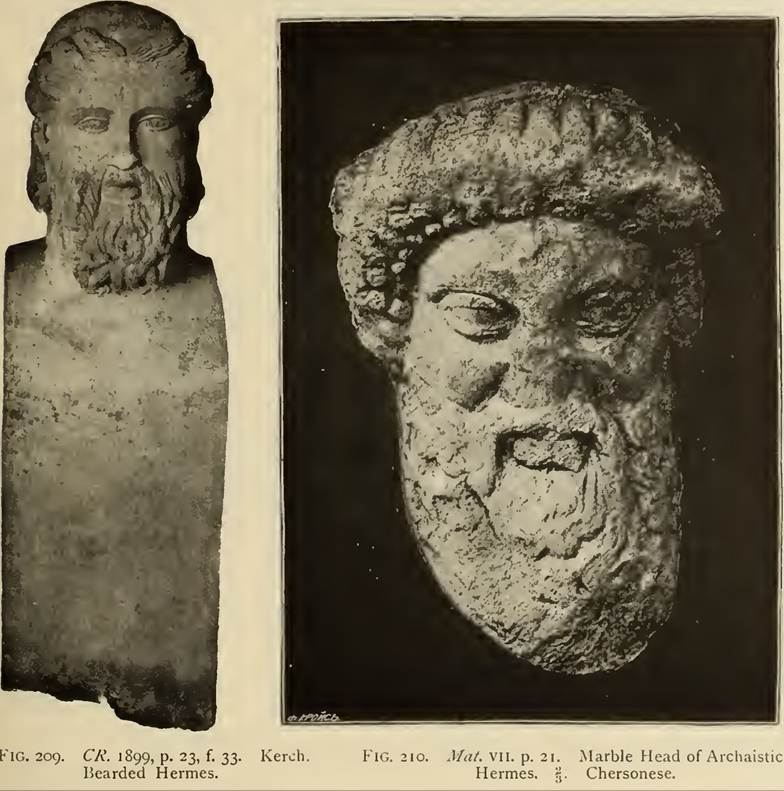
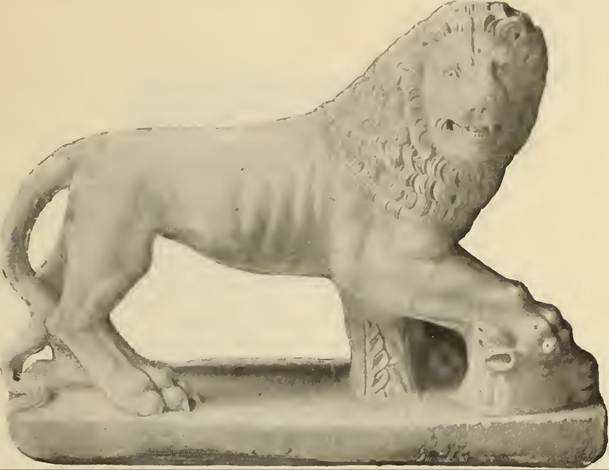
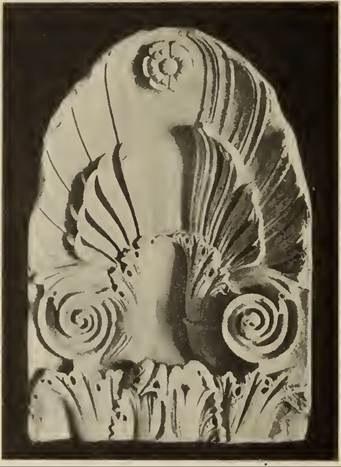
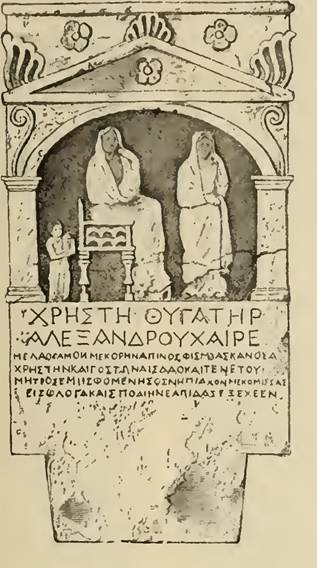
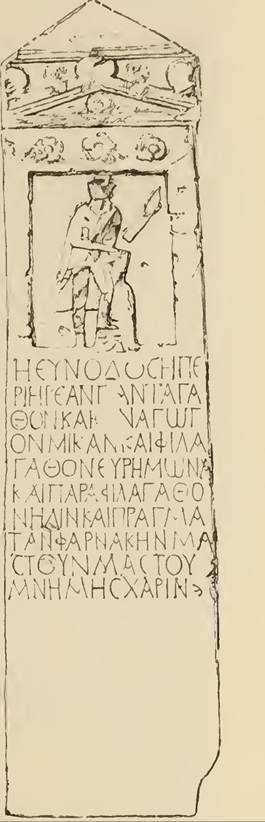
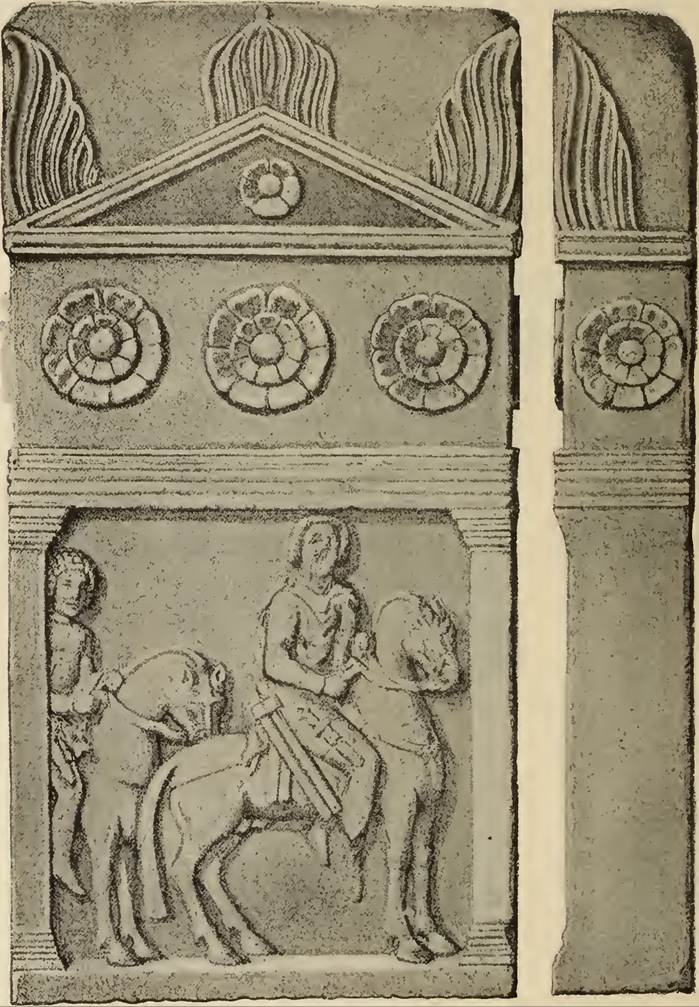
Of the figure subjects actually preserved, the oldest is a little bit of back hair from Olbia, Milesian work like the CroesuS columns at Ephesus[593] [594]; second seems to rank a piece of a sepulchral relief from Kerch with a youth’s head and shoulders, Attic work of the early vth century[595]. Next come more fragments from Olbia, a bit of hair and brow in the style of the Parthenon[596], a mutilated head of the end of the century[597], and a larger piece now in the Historical Museum at Moscow[598], part of a ivth century grave-relief in Pentelic marble with a mistress like the seated figure of Demetria and Pamphile[599] and a maid behind her chair, but the heads are gone and the stone split, after which the back was used for losPE. 1. 64, a dedication to Apollo Prostates, with a figure of extraordinary barbarity ; so that of the good work hardly anything is left. Something similar happened to the stone of losPE. iv. 36, also from Olbia, and bearing reliefs of young men. To the ivth century belonged the monument of Comosarye[600], with its statue of Astara, which is figured by Ashik[601], but has since been lost. We still have from Chersonese a girl’s torso at Odessa[602], of which Zhebelev says that after the manner in which the zone and diploidion are arranged and the folds treated, it would seem to go back to a good ivth century original: he suggests as its nearest analogue a statue at Corfu[603], which recalls the middle period of Praxiteles. O. Waldhauer publishes a torso of a draped woman from Theodosia, which he dates between 470 and 460 b.c. (he means 370—360)[604]. In the same collection we have a female head from Olbia in very poor preservation, but also of ivth century date[605]; and to the same period seems to go back a sleeping Eros with a torch, similar but inferior to one at Vienna14. A bearded male head from Olbia in the Historical Museum at Moscow, in type not unlike Asclepius, is referred by O. Waldhauer15 to Scopas himself, but it looks later in his picture, and is in any case very fragmentary. To the end of the ivth century belongs the most interesting statue from South Russia, the replica of the Phidiac Athena Parthenos in Pentelic marble dug up at Olbia in 1903. From Olbia, from the Hellenistic house at ix on the plan (p. 450, f. 331), come the most attractive of sculptures from these parts, the three heads, of Philologische Wochenschrift, 1888, p. 1516. 11 Arndt-Amelung, Photogr. Einzelaufn. Ant. Sculpt. 11. 603. 12 Trans. Od. Soc. xxvi. p. 203, f. 1. 13 Zhebelev, op. cit. p. 70, f. 4. 14 ib. p. 69, f. 3, cf. Sacken u. Kenner, Die antiken Sculpt, d. kk. Münz- u. Antiken-Cabinets in Wien, 1866, Pl. V. 15 BCA. xxiii. pp. 76—102, Pl. 1. 16 BCA. xiv. pp. 69—93, 1*1· L—IIL 17 O. Waldhauer in BCA. xvii. p. 99 wishes to refer it to the school of Philiscus c. 250 B.c., but Pharmacovskij, ib. p. 109, successfully defends his own view. 18 Arch. Anz. 1910, p. 210, f. 8. about half life-size, dug up by Pharmacovskij in 1902[DCVI]. He has no difficulty in shewing the first to be that of Asclepius, and finally comes to the conclusion that it is Alexandrian work of the middle of the mrd century, recalling as it does the style of Bryaxis, c.g. his Scrapis, but shewing some- influence of Lysippus. The expression is mild and compassionate, without the exaggerated passion of Pergamum or Rhodes. The wonderfully beautiful female head (p. 292, f. 208) has less defined characteristics, but agrees with the first. The only reason for its being named Hygiea is that it was found with the Asclepius. The third head is that of a child, but shews only the beginning of that accurate study of infant forms which reached its perfection in Boethus : one hesitates to give it a name, but it may be an Eros. To the nnd century belongs a pair of Herms from Kerch, one headless, representing Heracles, another with the Bearded Hermes (f. 209). Another such Hermes (f. 210) in marble, of a more archaistic character, was found at M. Chersonese in 1890, and is very closely related to the original from which the artificer whose moulds were found there that same year had taken his cast[607]. It distinctly recalls the Hermes of Alcamenes from Pergamum[608]. To the class of the late Hellenistic genre subjects belongs a statuette from Akkerman, now at Odessa. It represents a hunter in a chlamys[609]. The execution is rough, belonging to the last century b.c. To a model originating in the same sort of taste goes back a statue dedicated by the Olbian strategi to Apollo Prostates in the nnd century a.d.—a boy with a wine-skin, from which the water of a fountain is to gush[610] [611]. Of the Odessa collection perhaps the most pleasing specimen is a bas-relief from Kerch, with Artemis, Apollo Daphnephoros, Hermes and Peitho or Aphrodite[612]. Reinach sees in it Attico-Ionian sculpture of about 470 b.c. But the figure of Peitho in its transparent dress seems to betray the taste of a later time, and the relief would more likely belong to the archaistic class ; its poor preservation makes it hard to be quite sure. It recalls the lost Corinth puteal6, which was almost certainly Neo-Attic. So Hauser says, and Kondakov would seem to agree. Of whole statues perhaps the best are those of a man and a woman of the 1st century a.d. discovered at Glinishche, near Kerch7. They are rather over life-size and of regular Roman work. The woman generally resembles the well-known woman from Herculaneum ; the type also occurs in terra-cotta. At Odessa is a female head from Theodosia bearing some relation to this group, but earlier in execution’. From Kerch comes an elaborate sarcophagus on which recline the mutilated figures of a man and a woman9; the position is that so common on Etruscan sarcophagi; on the sides are interesting reliefs with scenes from the life of Achilles. Animals have not fared better than men. There is a very stiff lifeless lion from Kerch in the Hermitage (f. 211), rather a better one from Chersonese13, and a pair of rather worse ones from Olbia, chiefly interesting for the mysterious marks scratched upon them14. A griffin’s body at Odessa might have once adorned the palace of Scyles15. In the little museum at Theodosia is an elegant bas-relief of a griffin, but it came from Kerch ; a marble table-leg in the form of a lion from Chersonese is good as mere decoration16. The British Museum has some specimens from Kerch, sent home by Colonel Westmacott in 1856; they include figures of a lion and lioness, a relief of Tritons and some typical grave stelae17. 7 ABC. Frontispiece 7, 8, Reinach, p. 39. 8 O. Waldhauer, Trans. Od. Soc. XXVI. p. 191: Reinach, Rep. de la Statuaire, n. p. 613. 4, 666. 8. 9 ABC. Frontispiece 9, Reinach, p. 38. 10 ib. 12. 11 Bosp. Kingdom ill. ff. cxviii. xcix. c.—cviii. 13 op. cit. p. 71, f. 5. 13 CR. 1905, p. 46, f. 43. 14 v. p. 317, f. 227: CR. 1872, Text, Pl. xvii. 19. 15 Museum Guide, p. 17, No. 9, cf. Her. IV. 79. 16 CR. 1890, p. 31, f. 16. 17 MacPherson, Kertch, pp. 48—51. These stelae have been comprehensively studied by Watzinger'. 11 is first class[613] [614] consists of those without figures. Besides the plain stelae or those with a simple horizontal moulding along the top, referred to any century between vi b.c. and 1 a.d.,—these may have the further adornment of two rosettes or weapons,—we have in the ivth century b.c. a simplification of a cornice with eaves, and at all periods a pedimental top. A more interesting termination is the palmette in its varieties. Here belongs the oldest piece of carving from Kerch, not later than the vith century b.c., an arrangement Fig. 211. CR. 1894, p. 5, f. 1. Marble Lion from Kerch. of palmettes and volutes, recalling early Ionian pottery or even Cypro- Phoenician work3. More ordinary forms were at first probably painted : the favourite variety is. a palmetto rising from a pair of co volutes commonly not lying horizontally as in most Attic work, but set vertically back to back, an East-Greek form4. Between the volutes there gradually grow up acanthus leaves and flowers until the palmettes arc disintegrated into sprays of volutes0. About the middle of the ivth century Attic fashions come in again ; e.g. an anthemion from Chersonese in Pentelic marble (f. 212), and imitations from Kerch. All these types are copied unintelligently in the 1st century a.d. and caricatured in the next6. The figured stelae Watzinger7 first classifies by their architecture : they offer curious examples of degradation. The actual relief is usually in a 3 A'IK 87, Pl. iv., cf. O. Montelius, Die alteren Kulturperioden, I. Nos. 319, 323, 371, 381. ‘ KW. Pl. v. 5 KW. Pl. vi. vii. 6 A'IK Pl. ix. 7 A IK. pp. 22—28. rectangular panel frequently flanked by pilasters ; above is a kind of entablature, often with three rosettes on the frieze. Above this, again, the composition is in a few cases, in the ist and und centuries a.d., finished off with an anthemion ; more usually by a pediment with acroteria, occasionally giving the top a gabled outline. Far more commonly above the pediment is another horizontal moulding. The acroteria are sometimes left flat as it were for painted palmettes (Figs. 214, 216), later they degenerate into shapeless lumps : more often an attempt at a palmette is carved upon them, usually without the base volutes (Fig. 215). Between the acroteria and in the pediment we generally have rosettes. The most elaborate composition (11 century b.c.)1 has to flank the relief Ionic columns supporting an architrave Fig. 212. Anthemion from Chersonese. KW. 128, pl. vill. (cf. ib. 129 from Olbia). with circles incised upon it; above this is an Ionic portico, with rails and large shields between the five columns, a bust of Demeter in the pediment and large rosettes above. Instead of the rectangular field we very often find a niche with an arched top, and the treatment of this arch in conjunction with the pilasters and architrave shews how early the Eastern Greeks began to try and reconcile the two principles, for these rude imitations follow more accomplished Hellenistic models ; but we have all the combinations which elsewhere play a greater part, the arch rising from the pilasters themselves as on Fig. 213, or from an inner order or else from brackets ; in the spandrels we have long-stemmed volutes or rosettes. Above the arch come the same upper members as above the rectangular fields. The reliefs themselves—sometimes there are two on one stone—offer the ordinary types. The feminine figures, which occur singly or in all possible combinations, are all represented on Fig. 213, the lady sitting or standing 1 KW. 407, Pl. xxviii. in an attitude of dejection and the basket-bearing maid often on a smaller scale. The man appears as taking leave of the woman, at other times he is standing alone, and then is usually armed. In Fig. 214 he is resting his elbow on a pillar against which his shiedd leans while his gorytus hangs behind him. At other times we see him riding out to war with his groom Fig. 213. losPE. iv. 391 = CR. 1890, p. 29, f. 15; Λ'/Γ. 201, Pl. XIV. Stele of Chreste. Kerch. NeXXoyapov pe κόρην άπίνόσφισί βάσκανο!”Α(ι)δη! Χρήστην και γ[νω]των δΐ! δύο και yeve'rou, μητρο! ΐμήί φθιμύνη! ο! νηπίαχόν μί κόμισσα! en φλόγα κα'ι σποδίην ιλπίδα! ιζίχιιν. (1. 2 = four brothers and a father.) Fig. 214. CR- 1876, p. 214 = losPE. 11. 62, A'll'. 454. Pl. xxxni. Stele of Mastus. 7s· Kerch. 'Η σύνοδοί ή πιρι ήρίαν Παντάγαθον και συναγωγον Μίκαν και φιλιιγαθον ΐ,ύρήμωνα καϊ παραφίλάγαθον Ήλιρ καί πραγματαν Φαρνάκην λίαστούν Μαστού μνήμη! χάριν. (τ)ρίαν = if pea.) following on foot or on horseback (Fig. 215). Both these stelae have been set up by the society to whom the deceased belonged (v. Ch. xix.). The galloping type like Fig. 218 is rare; usually the horse is walking. When there are two reliefs they may represent two different aspects of the dead man’s life, e.g. on the stele of Gazurius (p. 507, f. 339), above the relief of arms typifying his warlike side, is a group shewing him with his wife, a boy Fig. 215. Kerch. Stele of Daphnus in coarse local stone, KTR. p. 217, f. 197: CR. 1872 (Text), XVII. 3: A'lT. 627, Pl. XLII. = II. 65. ^dTryphon’s dedication from Tanais (Fig. 218). The type recalls the coins of Cotys II (Pl. vm. 4), terra-cottas from Kerch7, and a clasp in the form of a horseman from Sympheropol8. From this latter site come reliefs of Tauri (?), one a trousered rider, early ivth century, the other with two fields, in one a horseman, in the other a spearman in a doublet with a small targe9. The ordinary stelae with reliefs date from the nnd century b.c. to the imd century a.d. Two, clearly among the latest in style10, bear the actual date 426 of the Bithynian, Pontic or Bosporan era (a.b.) = 130 a.d. Hardly one of them has any artistic merit; the great majority come from Panticapaeum, 5 losPE. iv. 238; KIV. 550, Pl. xxxvn. 6 ABC. 1 p. 279, Reinach, p. 96, not in KIV. 7 ABC. lxiv. 2, v. p. 369, n. 3. 8 CR. 1889, p. 26, f. 11. 9 KIV. 557, Pl. xxxviii. 442, Pl. xxxn. 10 KW.z-j'i, Pl. xviii.; 614, Pl. xlu. = 2?C\4. x. p. 81, No. 94; losPE. 11. 301. 3> +] G> 'aue Stelae. Coffin of Ku I Oba ^ueen 305 a few from Olbia ami Chersonese. I cannot detect any local distinction of style. The very last stage of degradation would seem to be reached in the stones set up by Roman soldiers at Chersonese, e.g. to Aurelius Victor and the son of Aurelius Viator[620], if it were not for rude plates in the shape of head and shoulders[621] something like Muhammadan tombstones but flat. There are a few attempts at sepulchral effigies[622], but they are very poor. The stelae from Kerch not only crowd the Hermitage and the Kerch, Moscow and Odessa Museums, but are preserved, many of them, in the Royal and Melek Chesme Barrows; some twenty-five are in the British Museum. MacPherson[623] tells us how two statues, one of an orator, the other of a woman, both double life size and of marble and so presumably imported work, were lost in the Volga on the way to Petersburg, and we may regret their loss, as that of Astara mentioned above, but they were probably of late date.