Descriptions of the Specimens
Object 3076 is a corner fragment of a rectangular incense altar recovered from Locus I5004, a destruction debris layer (Stratum VIB in Area I5) on top of a cobbled floor (Loci I5006, I5013, and I5014).
The stratigraphic context of this locus is similar to Locus E7004, the one that yielded Obj. 3139. This locus might have come down from the inner room on the second floor of the building. TheTable 1. Tell Halif upper stratigraphy
| Stratum | Period | Date |
| IV | Hellenistic | 300-100 BCE |
| V | Persian | 500-300 BCE |
| Gap | Late Iron II/Babylonian | 650-500 BCE |
| VIA | Iron II | 700-650 BCE |
| VIB | Iron II | Destruction 800-700 BCE |
| VIC | Iron II | 850-800 BCE |
| VID | Iron II | 900-850 BCE |
| VII | Iron I | 1200-900 BCE |
| Table 2. Tell Halif incense altars' locus and stratum | |||
| Incense Altar | Area | Locus | Stratum |
| Obj. 3076 | I5 | I5004 | VIB |
| Obj. 3139 | E7 | E7004 | VIB |
| Obj. 3191 | H6 | H6010.P | VIB |
| Obj. 3619 | C7 | C7017 | VIB |
fragment’s dimensions are approximately 7.1 cm x 5 cm with a height of 5.1 cm. Like the other intact limestone incense altar (Obj. 3191), it also has a traceable depressed basin. Since the surface of the basin has chiseling marks similar to the finished incense altar (fig. 3), we presume that the fragment went through the same process that produced the other altar. Although the fragment indicates some degree of similarity to the finished one that has incised drawings (Obj. 3191), it has some different profiles. This altar had a shallow depressed basin. Its total size might have been a little smaller (fig. 4) than that of Obj. 3191. Morphologically similar ones to this profile, with and without legs, can be found in the Tell Jemmeh collection (Hassell 2005, figs. 8, 22). This fragment could be either a broken part of a completed incense altar or a fragment discarded during production. Because carving out a depressed basin on top of the altar is relatively easier than that of carving out legs, the smoothly finished surface of the basin may imply that the altar was completed or might have been nearing completion.
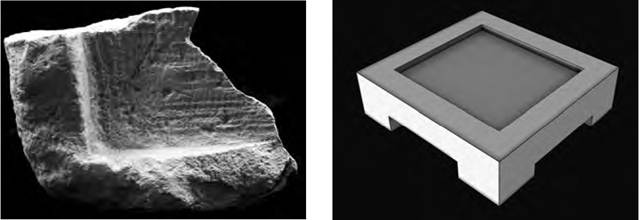
Figure 3. Obj. 3076 showing chiseling marks; Figure 4. An artist's reconstruction of Obj. 3076; il-
photo by Seung Ho Bang and Oded Borowski; lustration by Seung Ho Bang; LRP.
LRP.
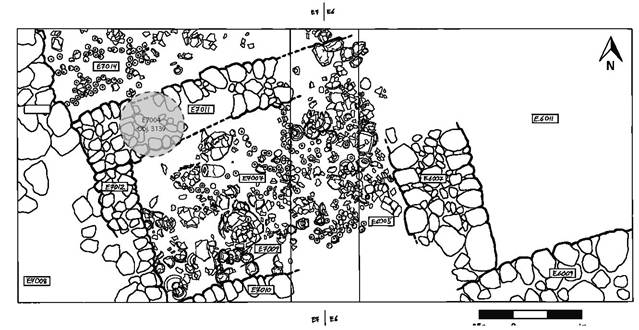
Figure 5. Tell Halif Weaving Workshop in Field V; Areas E7 and E6 top plan; drawing by Dylan Karges; LRP.
Object 3139 is another small four-legged rectangular limestone incense altar found in Locus E7004, a destruction layer in a domestic textile workshop (Areas E6 and E7, see fig.
5). The altar’s dimensions are approximately 7.9 cm x 8.3 cm with an average height of 6.5 cm. Compared to Obj. 3191, the state of craftsmanship of this incense altar is crude. Judging from the attempt to form a depressed basin, the crude state could be due to the altar’s unfinished state. Long incised lines parallel to the rim on the upper part of three sides (fig. 6) are another indication that this incense altar might have been in the middle of its production. These three lines are relatively parallel to each other though one end of these lines is a bit off the track. These three lines are not intended for decoration purposes. The complete incense altar, Obj. 3191, does not have thick and deep incised lines for decoration. Rather, the incision marks probably indicate where the artisan intended to shave off the top. In fact, this incense altar is approximately 3 mm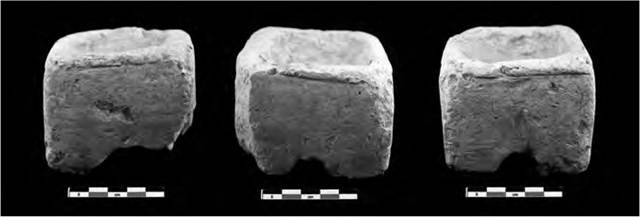
Figure 6. Incisions on three sides of the incense altar, Obj. 3139; photo by Seung Ho Bang and Oded Borowski; LRP.
higher than the other finished altar (Obj. 3191). Furthermore, since the altar was missing one of its four legs, the breakage might have been the cause for the incompletion. In other words, its production was abandoned when the artisan broke the leg.
Object 3191 is an intact small four-legged rectangular limestone incense altar with incised drawings. The altar's dimensions are approximately 8.7 cm x 8.7 cm with a height of 6.2 cm. It was recovered from an occupational accumulation (Locus H6010.P) in Area H6 (fig. 7). The ceramic assemblage of Imlk-type jars from the extension of the room into the adjacent Area (H7) suggests that the space was used for domestic storage. This incense altar has a large soot mark in the middle of a square depressed basin on top. The altar has decorations depicting a frame of geometric designs with human and animal figures inside (fig. 8; for a more detailed discussion on the iconographies of Obj.
3191, see Bang and Borowski 2017). Noticing the quality of the carving and incised drawing, it appears that the altar was made with experienced craftsmanship and presents what looks to be an ideally finished incense altar. Decorations similar to the ones on this altar are found on incense altars from Tell Jemmeh (Hassell 2005, tab. 2 cat. no. 20, 22; fig. 11, 20; Keel and Uehlinger 1998, 382, illus. 371; Petrie 1928, 18-19; pl. xl, 1-6; Zwickel 1990, 78, 99) and Tell el-Far‘ah (South) (Keel and Uehlinger 1998, 382, illus. 373) though they are attributed to a later time period. Comparing these incense altars with the one from Tell Halif, we see relatively homogeneous stylistic features; though, it is not conclusive whether they were crafted by the same social group (for a discussion on the technological tradition for production and the social group responsible for it, see Roux and Rosen 2010, 13).Object 3619 is a stone fragment (6.7 cm x 5.9 cm with an average height of 4.7 cm) from a possible incense altar that was found in Locus C7017, a mud brick detritus layer, which is above Locus C7018, a destruction layer. The locus contains materials that might indicate the existence of a ceiling or a second floor. The fragment could be one of the four corners of a rectangular incense altar.
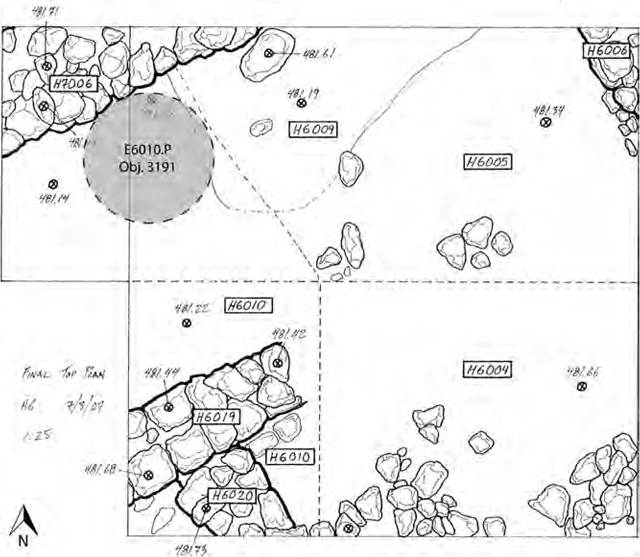
Figure 7. Area H6 final top plan; drawing by Dylan Karges; LRP.
Although it is not clear, this fragment has a trace of carved depression on top. In general, the shape and the material (stone) are very different from those of the other altars. The current state of this fragment may suggest that either the fragment was discarded during the early stage of its production or underwent severe abrasion after it was completed.
In sum, Field V in Tell Halif yielded two identifiable fragments, one unfinished altar, and one finished and actually used rectangular incense altar from domestic contexts of the destruction layer (Stratum VIB). Despite their relatively close spatial proximity, their appearance, quality of craftsmanship, and phase in the production process are different from each other.
More on the topic Descriptions of the Specimens:
- Dead Sea exploration and the compilation of a canon of expertise
- 16 EXPANDING FLORA’S EMPIRE
- Techniques of hysteroscopic endometrial ablation
- Chapter 36 Sexual Assault and Domestic Violence
- appendix Occupational Safety and Health Administration Regulations on Occupational Exposure to Bloodborne Pathogens
- BIBLIOGRAPHY FOR BACTERIAL AND FUNGAL INFECTIONS
- Management of Twin-Reversed Arterial Perfusion (TRAP) Sequence
- Emergency Evaluation and Treatment of the Sexual Assault Victim
- The Problem of Theoretical Terms
- Chapter 1 The Woman’s Health Examination and Women’s Health Care Management