The Problem of Theoretical Terms
“The Problem of Theoretical Terms” is reprinted by permission from American Philosophical Quarterly 2 (1965), 1-11. Although this chapter appeared earlier than the others, I include it because it was among the first group of articles published by philosophers skeptical of the sort of noncontextualized observable-unobservable distinction central to antirealism.
There is an addendum showing how problems raised in my article are present in van Fraassen's version of antirealism and how my own defense of realism avoids these problems.Philosophers with quite different viewpoints have considered it important to distinguish two sorts of terms employed by scientists. While various labels have been suggested I shall use the expressions theoretical and nontheoretical to represent the intended distinction. Those who propose it provide examples of terms which fall into these respective categories, and, although there is by no means general agreement on all classifications, there is substantial accord on many examples. What follows is a list of some of the illustrations cited:
theoretical terms
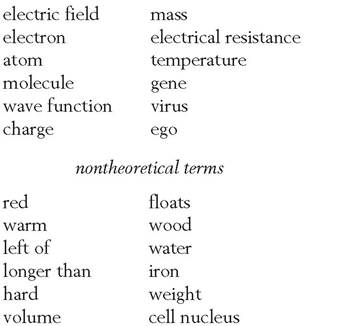
The author is indebted to the National Science Foundation for support of research.
Some philosophers base this distinction on a concept of “observability.” Others appeal to a notion of “conceptual organization” or “theory dependence.” My purpose here is to examine this distinction and suggest reasons for doubting the claim that there is some unique criterion or set of criteria which underlies it. Rather, I shall argue, the notions of “observability,” “conceptual organization,” and “theory dependence” introduced by these authors generate many distinctions which result in a number of different ways of classifying terms on these lists. Since the alleged distinction between theoretical and nontheoretical terms has played an important role in the philosophy of science, as well as epistemology, an examination of its basis may show the need for reformulating some rather persistent issues and indicate the sort of steps which might profitably be taken.
1
The proposal first to be considered is that the classification rests upon a distinction between entities or properties which are observable and those which are not. Thus, according to Carnap, we have on the one hand “terms designating observable properties and relations,” and on the other, “terms which may refer to unobservable events, unobservable aspects or features of events.”1 Carnap does not go on to explain what he means by “observable” and “unobservable” and presumably believes that his readers will understand in at least a general way the distinction intended. Unfortunately the situation is more complex than he seems willing to admit, since the terms “observable” and “unobservable” can be employed for the purpose of making a substantial number of different points.
Consider the case of visual observation. Just what it is that I can appropriately claim to have observed depends very importantly on the particular context in which the claim is made.[171] [172] Suppose that while sitting by the roadside at night I am asked what I observe on the road ahead. I might, in one and the same situation, reply in a number of different ways; for example: a car, the front of a car, a pair of automobile headlights, two yellowish lights, and so on. Or, when driving on a dirt road in the daytime I might, in one and the same situation, claim to be observing a car, a trail produced by a car, or just a cloud of dust. Two points deserve emphasis here. First, in each case what I will actually say that I have observed depends upon a number of factors, such as the extent of my knowledge and training, how much I am prepared to maintain about the object under the circumstances, and the type of answer I suppose my questioner to be interested in. Second, in both examples I might claim to have observed a car ahead, though in the first the only visible parts of the car are its headlights, and in the second I see none of its parts at all, not even a speck in the distance which is the car. Nor must such claims necessarily be deemed imprecise, inaccurate, ambiguous, or in any way untoward. In the particular circumstances it may be perfectly clear just what I am claiming, though someone ignorant of the context might misconstrue my claim and expect me to know more than I do, such as the color, the shape, or even the make of the car. Both of these points can be illustrated by reference to scientific contexts. Suppose that an experimental physicist, acquainted with the sorts of tracks left by various subatomic particles in cloud chambers, is asked what he is now observing in the chamber. He might reply in a number of ways, e.g., electrons passing through the chamber, tracks produced by electrons, strings of tiny water droplets which have condensed on gas ions, or just long thin lines. Similarly, to the question “What does one observe in a cathode-ray experiment?” the physicist might answer: Electrons striking the fluorescent zinc sulfide screen, light produced when molecules of zinc sulfide are bombarded, bright spots, and so forth. In each case what the physicist actually claims to have observed will depend upon how much he knows and is prepared to maintain, the knowledge and training of the questioner, and the sort of answer he thinks appropriate under the circumstances. Furthermore, just as in the previous automobile examples, there are situations in which the physicist, concerned mainly with indicating the occurrence of certain events and with proper identification, will report observing various particles pass through the chamber—electrons if the tracks are long and thin, alpha particles if they are shorter and heavier. Whether he chooses to describe the situation in this way will depend upon the sort of factors just noted. Analogous considerations hold for other terms on the “theoretical” list. Thus the physicist may report having observed the electric field in the vicinity of a certain charge, or he may describe what he did as having observed the separation of leaves in an electroscope; he may report to be observing the rise in temperature of a given substance, or simply the increase in length of the column of mercury in the thermometer, and so on. Suppose then, Carnap were to acknowledge that scientists often describe what they have observed in different ways, and that physicists do speak of observing such things as subatomic particles in cloud chambers and electric fields in the vicinity of charges, when the main concern is to report the occurrence of a certain event or the presence of a certain type of entity. Still, he might urge, contextual considerations of the sort mentioned will be irrelevant when we consider, strictly speaking, what is really observed in such cases. For what the physicist (really) observes is not the electron itself (but only its track, or a flash of light), just as in the automobile examples, what is (really) observed is not the car itself (but only its headlights, or a dust trail). And when the physicist detects the presence of an electric field, what he observes is not the field itself, but (say), only the separation of leaves in the electroscope. In general, it might be said, the distinction desired can be drawn on the basis of the claim that items on the “theoretical” list are not themselves (really) observable.[173] I do not want to deny that electrons, fields, temperature, and so on can be described in this way. Indeed, such a description may be invoked when the physicist begins to explain just what claims he is making when he speaks of observation in each of these cases. However, as will presently be indicated, when an expression such as “not itself (really) observable” is employed it makes sense only with reference to a specific context of observation and some particular contrast. Suppose that in the second automobile example I report that I cannot (really) observe the car itself. What claim am I making? I might be saying that all I can observe is a dust trail and no speck in the distance which I can identify as the car; or that I can observe only a speck, but not the body of the car; or again, that I can see the car in the mirror but not with the naked eye. And obviously other contrasts could be cited which would make the point of my assertion clear. Consider now the case of a virus examined by means of an electron microscope. Suppose I say that the microbiologist does not (really) observe the virus itself. What am I claiming? I might be saying that since (let us suppose) he employs a staining technique, he sees not the virus but only the staining material known to be present in certain parts of the specimen. Or I might simply be saying that what he observes is the image of the object as presented by the microscope, and not the object itself. On the other hand, comparing electron microscopy with X-ray diffraction, I might claim that in the former case he is able to observe the virus itself, whereas in the latter case he observes only the effect of X rays on the virus. On different occasions any one of these contrasts, and others, could underlie the claim that the virus itself cannot (or can) really be observed. Similar considerations are relevant in understanding a corresponding claim regarding electrons. In the context of a cloud chamber experiment, if I assert that electrons themselves cannot (really) be observed I might be saying that though a track is visible there is no speck which can be identified as the electron, in the way that if a jet airplane is close enough, one can see not only its trail but identify a certain speck in the distance as the airplane itself. On the other hand, I might wish to contrast the case of the electron with that of the neutron and claim that whereas electrons themselves can be observed in a cloud chamber, neutrons cannot. In general, then, it is not sufficient simply to refer to the previous list of so-called theoretical terms and claim that the distinguishing feature of the items designated by these terms is that they are not themselves (really) observable. What must be done is to indicate for each item the point of such a classification, and this is most readily accomplished by contrasting the sense in which it is said to be (really) unobservable itself with the sense in which something else is claimed to be observable. Now I do not deny that one could supply a context for each item on the list in which it would be appropriate to speak of that item in the manner proposed. The important point is simply that these contexts, and the sorts of contrasts they may involve, will in general be quite different and will yield different classifications. Here are a few contrasts, some of which have already been noted, namely, those between: (a) objects such as electrons and alpha particles which are detected by means of their tracks, and objects such as cars and airplanes which can be seen together with or apart from their tracks. (b) objects such as neutrons and neutrinos which do not leave tracks in a cloud chamber, and those such as electrons and alpha particles which do. (c) objects such as smaller molecules which it is necessary to stain in order to observe with the electron microscope, and larger objects for which staining is unnecessary. (d) objects such as individual atoms which are too small to scatter electrons appreciably and hence cannot be seen with the electron microscope, and larger objects such as certain molecules which have significant scattering power and hence can be observed. (e) objects requiring illumination by electron beams which then must be transformed into light via impact with a suitable screen, and objects visible with ordinary light. (f) objects which can only be observed by the production of images in microscopes, and those which can be seen with the naked eye. (g) properties such as electrical resistance whose magnitudes must be (or are generally) calculated on the basis of measuring a number of other quantities, and those properties for which this is usually not necessary. (h) properties such as temperature for which some instrumentation is usually required (for determining differences), and those such as color for which it is not. (i) objects such as electric fields which are not the sorts of things to which mass and volume are ascribed, and objects such as solids to which they are. Each of these contrasts, as well as others which could readily be cited, might be used to generate some sort of observational distinction. Yet the same item would be classified differently depending upon the particular distinction invoked. Electrons would be unobservable under (a) and (d) but observable under (b); heavy molecules would be unobservable under (e) and (f) but observable under (c) and (d); temperature would be unobservable under (h) but observable under (g). Also, under certain contrasts some items cannot be classified at all—electrons under (c), (e), and (f); heavy molecules under (a) and (b); temperature under (a)-(f). Accordingly, if contrasts of the type cited must be invoked to provide significance for the claim that a certain entity or property is itself (really) unobservable, then the sort of distinction required by Carnap seems difficult if not impossible to draw. 2 I want now to consider two qualifications which some authors place on the notion of observation. The first is that one should not speak simply of observability, but of direct observability. Hempel, e.g., writes: In regard to an observational term it is possible, under suitable circumstances, to decide by means of direct observation whether the term does or does not apply to a given situation Theoretical terms, on the other hand, usually purport to refer to not directly observable entities and their characteristics.[175] In offering this criterion, Hempel, like Carnap, mentions no special or technical sense which he attaches to the phrase “direct observation.” Nor does he elaborate upon its meaning, except to cite a few examples.[176] He admits that his characterization does not offer a precise criterion and that there will be borderline cases. Yet the problem involved is more complex than Hempel seems willing to allow and, contrary to his suggestion, does not just turn on the question of drawing a more precise “dividing line.” For the expression “(not) directly observable,” like “(un)observable itself,” is one whose use must be tied to a particular context and to some intended contrast. Thus, if the physicist claims that electrons cannot be observed directly, he may simply mean that instruments such as cloud chambers, cathode-ray tubes, or scintillation counters are necessary. Here direct observability has to do with observation by the unaided senses. Or he might mean that when one observes an electron in a cloud chamber one sees only its track but not, e.g., a speck which one would identify as the electron itself. Again the nuclear physicist might claim that particles such as neutrons and neutrinos are not directly observable, meaning that such particles cannot themselves produce tracks in a cloud chamber, unlike electrons and alpha particles, which, under this contrast, would be deemed directly observable. Another type of situation in which the expression “direct observation” might be invoked involves a contrast between properties, such as electrical resistance, whose magnitudes must be calculated by first measuring other quantities, and those, such as length or temperature, for which this is often not necessary.[177] In short, many contrasts can be invoked by the notion of direct observation,[178] and a given item will be classified in different ways depending upon the particular one intended. An appeal to direct observation by itself does little to advance the cause of generating a unique distinction, and when such an appeal is spelled out in individual cases various distinctions emerge. The second qualification sometimes placed on observability concerns the number of observations necessary to correctly apply a term or expression. Thus, in “Testability and Meaning,” Carnap writes: A predicate ‘P’ of a language L is called observable for an organism (e.g., a person) N, if, for suitable argument, e.g., ‘b’, N is able under suitable circumstances to come to a decision with the help of a few observations about the full sentence, say ‘P(b)’, i.e., to a confirmation of either ‘P(b)’ or ‘-P(b)’ of such high degree that he will either accept or reject ‘P(b)’.[179] Carnap does not, however, explain his qualification in sufficient detail and leaves some important questions unanswered. Is the number of observations to mean the number of times the object must be observed (or, if an experiment is in question, the number of times the experiment needs to be repeated) before a property can definitely be ascribed to the object? Or does Carnap perhaps mean the number of different characteristics of the object which need to be observed? Again, he may be thinking of the amount of preliminary investigation necessary before a final observation can be made.[180] Or perhaps all of these considerations are relevant. Yet whether an observation or experiment will need to be repeated, or many different characteristics of the item in question examined, or considerable preliminary investigation undertaken, depends not only on the nature of the object or property under examination but also on the particular circumstances of the investigator and his investigation. One relevant factor will be the type of instrument employed and how easily the scientist has learned to manipulate it. The physicist familiar with electroscopes need make few, if any, repetitions of an experiment with this instrument to determine the presence of an electric charge and hence of an electric field. Nor need he observe many characteristics of the field (e.g., its intensity and direction at a certain point) in order to determine its presence. And he will not always need to make extensive preliminary observations on the instrument but only a few. Yet, charges and electric fields are alleged to be unobservable. Another factor determining the facility with which an observer will identify an object or property is the extent of his knowledge regarding the particular circumstances of the observation. If the physicist knows that a certain radioactive substance has been placed in a cloud chamber he may readily be able to identify the particles whose tracks are visible in the chamber. Whereas, if he knows nothing about the circumstances of the experiment, and he is simply shown a photograph of its results, successful identification may be a more complicated task. Rapid classification, then, depends in considerable measure upon particular features of the context of observation and the knowledge of the investigator. Under certain “suitable circumstances” (to use Carnap's phrase), quite a number of terms classified by him as nonobservational can be correctly applied “with the help of [just] a few observations.” Furthermore, if nonobservability in Carnap's sense is held to be sufficient for a theoretical classification additional difficulties emerge. For many fairly ordinary expressions are such that in numerous circumstances more than a “few observations” might well be required before correct application is possible; for example, “is chopped sirloin,” “is a bridge which will collapse,” “was composed by Corelli.” Yet these do not really seem to be the sorts of expressions the authors in question wish to call theoretical. On the other hand, if, following Scheffler,11 Carnap's criterion for “nonobservability” is to be construed simply as a necessary but not a sufficient condition for being classified as theoretical, then unless further criteria are proposed (which they are not either by Carnap or Scheffler) we will have no general basis for separating theoretical from nontheoret- ical terms.[181] [182] And if this criterion concerning the number of observations is to be construed as a sufficient one for a nontheoretical classification (as Carnap and Scheffler suggest), then, as we have seen, many terms classified by these authors as theoretical will, in numerous situations, require reclassification. 3 I have considered attempts to base a theoretical-nontheoretical distinction upon some notion of observation. Generally speaking, the thesis that a list of “observational” terms can be compiled is defended by those envisaging the possibility of an “empiricist language.” One of the underlying assumptions of this program appears to be that there exists a unique (or at least a most suitable) way of describing what is, or can be (really, directly) observed—a special “physical object” or “sense datum” vocabulary eminently fit for this task. Yet, as emphasized earlier, there are numerous ways to describe what one (really, directly) observes in a given situation, some more infused with concepts employed in various theories than others. This does not, of course, preclude the possibility of classifying certain reports as observational in a given case. The point is simply that there is no special class of terms which must be used in describing what is observed. Words from the previous “theoretical” list, such as “electron,” “field,” and “temperature,” are frequently employed for this purpose. Still, it might be urged, even though terms on both lists can be used in descriptions of what is (really, directly) observed, those on the first list are more “theory-dependent” than those on the second. And while it may not be possible to draw the intended large-scale distinction on the basis of observation, it is nevertheless feasible and important to separate terms on the basis of their “theoretical” character. It is to the latter position, which has been defended by Hanson and Ryle, that I now wish to turn. According to Hanson a distinction should be drawn between terms which “carry a conceptual pattern with them” and terms which “are less rich in theory and hence less able to serve in explanations of causes,”[183] or, in Ryle's words, between expressions which are “more or less heavy with the burthen of [a particular] theory... [and those which] carry none [of the luggage] from that theory.”[184] As an example of a term which carries with it a conceptual pattern Hanson cites the word “crater”: Galileo often studied the Moon. It is pitted with holes and discontinuities; but to say of these that they are craters—to say that the lunar surface is craterous—is to infuse theoretical astronomy into one’s observations.... To speak of a concavity as a crater is to commit oneself as to its origin, to say that its creation was quick, violent, explosive....[185] “Crater,” then, carries with it a conceptual pattern not borne by (non- theoretical) terms such as “hole,” “discontinuity,” or “concavity.” Two notions underlie these suggestions, one stressed more by Hanson, the other by Ryle. The first is that a theoretical term is one whose application in a given situation can organize diffuse and seemingly unrelated aspects of that situation into a coherent, intelligible pattern; terms which carry no such organizing pattern Hanson sometimes calls “phenomenal.” The second notion is that theoretical terms are such that “knowing their meanings requires some grasp of the theory” in which they occur.[186] “The special terms of a science,” Ryle asserts, “are more or less heavy with the burthen of the theory of that science. The technical terms of genetics are theory-laden, laden, that is, not just with theoretical luggage of some sort or other but with the luggage of genetic theory.”[187] Despite the fine examples Hanson cites, and the use he makes of the notion of “organizing patterns” in supplying trenchant criticisms of various philosophical positions, surely the first proposal fails to provide a sufficient characterization of those terms Hanson calls “theory-laden” (or “theory-loaded”). For almost any term can be employed in certain situations to produce the type of pattern envisaged. Indeed, Hanson himself offers many examples of this; quite early in his book, for instance, he presents a drawing whose meaning is incomprehensible until it is explained that it represents a bear climbing a tree. In this context, the expression “bear climbing a tree” is one which organizes the lines into an intelligible pattern. Moreover, one could describe contexts in which Hanson's “phenomenal” terms such as “hole,” “concavity,” and “solaroid disc” might be employed to organize certain initially puzzling data. Conversely, there are situations in which terms such as “crater,” “wound,” “volume,”“charge,” and “wave-length,” which Hanson calls “theory-loaded,” are used to describe data which are initially puzzling and require “conceptual organization.” Hanson, at one point, grants that terms can have this dual function: It is not that certain words are absolutely theory-loaded, whilst others are absolutely sense-datum words. Which are the data words and which are the theory-words is a contextual question. Galileo's scar may at some times be a datum requiring explanation, but at other times it may be part of the explanation of his retirement.[188] Yet this admission is a large one. For it means that the rendering of “conceptual organization” is not a special feature of terms on the “theoretical” list which sets them apart from those on the “nontheoretical” list. Whether a term provides an organizing pattern for the data depends on the particular situation in which it is employed. In some contexts, the use of the term “electron” will serve to organize the data (e.g., tracks in a cloud chamber); in others the term “electron” will be employed to describe certain data requiring organization (e.g., the discontinuous radiation produced by electrons in the atom). But even a presumably nontheoretical expression such as “(X is) writing a letter” can be used in certain contexts to organize data thereby explaining a piece of behavior, and in others to describe something which itself demands explanation. Hanson does make reference to the “width” of terms, claiming that some expressions are “wider” theoretically than others and hence presumably “carry a [greater] conceptual pattern with them.”[189] So despite the fact that most terms are capable of serving explanatory functions, distinctions might still be drawn on the basis of “width.” Yet it is not altogether clear how this metaphor should be unpacked. Sometimes the suggestion appears to be that one term will be “wider” than another if it can be used to explain situations whose descriptions contain the latter term. Thus, referring to the Galileo example quoted earlier, the term “scar” would be wider than the term “retirement” because it can be used to explain something designated by the latter. Yet this is not altogether satisfactory since we might imagine a case in which a man's retirement constituted part of an explanation of a scar he incurred. Again, the term “electron” can be employed in explanations of magnetic fields, yet the presence of a magnetic field can explain motions of electrons. Perhaps, however, the reference to “width” should be understood in connection with the thesis, proposed by Ryle (and shared by Hanson), that certain terms depend for their meaning upon a particular theory, whereas others do not, or at least are much less dependent. By way of explanation Ryle cites as an analogy the situation in games of cards. To understand the expression “straight flush” one must know at least the rudiments of poker, whereas this is not so with the expression “queen of hearts,” which is common to all card games and carries with it none of the special “luggage” of any of them. In a similar manner certain terms used by scientists are such that to understand them one must have at least some knowledge of the particular theory in which they appear. These are the “theory-laden” terms.[190] Other expressions utilized by scientists can be understood without recourse to any specific theoretical system. Before examining this proposal some preliminary points should be noted. First, Ryle often seems to be suggesting that a theory-laden term is one which “carries the luggage” of one particular theory. Yet quite a few of the terms which he and Hanson classify as “theoryladen”—terms such as “temperature,” “wave-length,” “electron”—appear in, and might be thought to be infused with the concepts of, many scientific theories. Such terms are not restricted to just one theory, as with respect to games, “straight flush” is to poker. Second, it is certainly not a feature characteristic only of terms Ryle calls “theory- laden”—or only of such terms and those from card games—that they must be understood by reference to some scheme, system of beliefs, or set of facts. Following Ryle's lead one might draw up many different sorts of classifications, such as “university-laden” terms (“hour examination,” “credit,” and “tutorial”) which cannot be understood without some knowledge of universities and their procedures; or, referring to scientific contexts, “instrument-laden” terms, such as “dial,” “on,” “off,” which presumably would not appear on the “theoretical” list, yet require at least some knowledge of instruments and their uses. Thus Ryle's proposal must not be construed simply as a criterion for distinguishing terms which must be understood in the context of a set of beliefs from those which can be understood independently of any such set, though Hanson's “theory-laden” versus “sense-datum” labels might misleadingly suggest this. Third, one must always specify the theory with respect to which a given term is or is not “theory-laden.” And, it would appear, a term might receive this classification with reference to one theory but not another, though it occurs in both. For in one theory its meaning might not be understood unless the principles of the theory are known, whereas this would not necessarily be so in the case of the other theory (or at least there could be significant differences of degree). For example, “mass” might be considered “theoryladen” with respect to Newtonian mechanics but not with respect to the Bohr theory of the atom in which it also appears, since it can be understood independently of the latter. Thus, presumably, not every term occurring in a given theory will be “theory-laden,” just as not every term found in standard formulations of the rules and principles of poker—such as “sequence” and “card”—will be “poker-laden,” to use Ryle's expression. But if a theory must always be specified with respect to which a given term is deemed “theory-laden,” and if a term can be classified in this way with reference to one theory and not to another in which it appears, then lists of the sort compiled at the beginning of this chapter cannot be legitimately constructed. The most that could be done would be to cite particular theories and for each one compose such lists indicating which terms are to be considered theoretical and which not for that theory.[191] Yet even this task may be deemed incapable of fulfillment once we examine Ryle's claim that expressions are theory-laden if they are such that “knowing their meanings requires some grasp of the theory.” For there are many different ways in which terms might be said to be dependent upon principles of a given theory, and it is not altogether clear whether any or all of these should be classified as cases of “meaning-dependence.” Since, we have already seen, the issue of whether a term is “theory-laden” must be considered always with reference to a specific theory, let us suppose that we are given such a theory. Within it we could expect to encounter the following sorts of terms or expressions which might be considered theory-dependent in some sense: (1) A term or expression whose definition cannot be stated without formulating some law or principle of the theory in question. For example, “Newton's gravitational constant” could only be defined by invoking the law of universal gravitation. The expression “Bohr atom,” frequently employed in atomic physics, is defined as one satisfying the postulates of the Bohr theory. “Electrical resistance” is defined by reference to Ohm's law, and so forth. (2) A term or expression whose definition can be stated without formulating laws of the theory, but whose use must be justified by invoking some of these laws. In electrostatics an “electrostatic unit charge” (esu) is defined as one which when placed in a vacuum one centimeter away from a like equal charge will repel it with a force of one dyne. Such a definition proves useful provided that the force with which like charges repel each other in a vacuum depends upon their distance, which it does according to Coulomb's law. (3) A term whose definition can be stated without formulating laws of the theory, yet which denotes some more or less complex expression which appears in a formula whose derivation in the theory will not be understood unless certain laws of that theory are known. Quite often various expressions utilized in the theory will not be considered thoroughly understood unless one knows “where they come from,” i.e., how certain formulas containing these expressions are derived from more fundamental principles of the theory. This is true, for example, of the term “enthalpy” in thermodynamics, which is defined as “U + pV" where U is the internal energy of a system, p its pressure, and V its volume. One standard method for introducing this term is by considering a process of constant pressure and applying the first law of thermodynamics, arriving at an expression containing “U + pV.” (4) A term or expression referring to something x which the theory is designed to describe and explain in certain ways, and for which the question “What is (an) x?” could be answered, at least in part, by considering principles of that theory. Very often this question, rather than “What does the term ‘x mean?” will be asked, and an answer given not by reference to some formal definition of ‘x (if indeed one exists) but to principles of the theory which characterize features of x. For example, suppose one were to ask, “What are electrons?” Many sorts of replies could of course be given depending upon the knowledge and interests of the inquirer. Part of the answer might involve references to the Bohr or quantum theories which describe the various energy states of electrons within the atom; to the band theory of solids which uses quantum mechanical results in describing properties which electrons manifest in conductors; to the theory of the chemical bond which describes the sharing of electrons by atoms, and so forth. By characterizing various properties of electrons, theories such as these provide answers to the question “What are electrons?” and in this sense the term “electron” might be considered theory-dependent with respect to each. (5) A term or expression whose role in the theory can only (or best) be appreciated by considering laws or principles in which it appears.[192] In most theories the roles of constituent terms can be examined from several points of view. One might simply consider whether and how a given term is needed for the purpose of formulating some of the principles of the theory (for example, how ‘h’ (Planck's constant) is used in the formulation of two fundamental postulates of the Bohr theory). Once a theory has been stated one might ask whether and how a certain term affords a simplification or concise expression of other principles (as how the term ‘s’ (entropy) facilitates the formulation of an equation combining the first and second laws of thermodynamics); or how it is used in proofs of important theorems. From a wider viewpoint, the role of a term might also be studied by considering how principles in which it functions serve to explain various phenomena (as how “resonance potential” in the Bohr theory is used in the explanation of electron transitions to different energy levels). Conversely, one might consider the manner in which principles of the theory are used to explain various phenomena which the term itself designates.[193] Thus, the role played by the expression “discrete spectral lines” in the Bohr theory might be specified by showing how the postulates of that theory serve to explain the sort of phenomenon referred to by this expression. The five sorts of theory-dependence mentioned reflect various factors which may be relevant in understanding a given term and represent at least some of the ways in which expressions employed by a theory might be deemed “theory-laden” in Ryle's sense, i.e., dependent (at least in part) on the theory for their meaning. No doubt others could be listed and within those already mentioned further distinctions drawn. Yet each type of dependence cited, if employed to generate a classification of terms, might well yield different results. On the basis of the first sort of dependence noted we could distinguish (a) terms whose definitions are usually given by reference to laws of the theory in question, from (b) terms usually defined independently of such laws. (With respect to thermodynamics, “entropy” might be considered an expression of the former sort, whereas “enthalpy” would be placed in the latter category.) On the basis of the second dependence we could distinguish (a) terms (such as “electrostatic unit charge”) whose definitions require justification by appeal to some of the principles of the theory, from (b) terms (such as “electrostatic force”) which are not specifically defined in that theory, or whose definitions require no special defense by reference to principles of the theory. And so forth For these reasons a criterion of theory-dependence of the sort proposed by Ryle and Hanson not only precludes the construction of theoryindependent lists of the type given at the beginning of this paper, but, even with respect to a specific theory, can give rise to various distinctions under which terms may be classified differently. On the other hand if all the various senses in which a term might be dependent upon a given theory are lumped together and a term classified as “theory-laden” if it conforms to any of these, then such a label would become useless for distinguishing between terms in a given theory since it would be applicable to almost all of them. Our conclusions here are relevant also for those seeking to draw the broader distinction between terms laden with the concepts and principles of some theory or other and terms dependent upon no theory whatever. Since there are many sorts of theory-dependence, various distinctions become possible. And should any one of the criteria outlined earlier be considered sufficient to render a term “theoretical,” few if any terms will escape this classification.[194] 4 We have been considering the doctrine that expressions employed by scientists can be divided into two sets. On one view the principle of division rests upon observation; on the other, upon conceptual organization or theory-dependence. What has been shown is not that divisions are impossible to make, but rather that the proposed criteria are capable of generating distinctions of many different sorts, each tied, in most cases rather specifically, to a particular context of observation or to a particular theory. Questions such as “Does the term refer to something which can be observed?” and “Does its meaning depend upon some theory?” are too nebulous to provide illuminating classifications. This means that certain problems raised by philosophers need serious rethinking. For example, authors of logical empiricist persuasion introduce the following issue: If theoretical terms in science do not refer to what is observable, how can they be said to have meaning? The type of answer given consists in treating such terms as uninterpreted symbols which gain meaning in the context of a theory by being related via “correspondence rules” to observational terms. The problem is then to make this idea precise by providing a “criterion of meaningfulness” for theoretical terms.[195] Yet in the absence of some definite basis for drawing the intended large-scale distinction between theoretical and observational terms such problems cannot legitimately be raised, at least not in this form. Again Ryle, beginning with the question, “How is the World of Physics related to the Everyday World?” suggests the need to restate it in a clearer way as, in effect, “How are the ‘theory-laden’ concepts of physics related to others?”Yet unless his notion of theory-dependence is made precise and is shown to generate some rather definite distinction one will be in doubt about which terms he is referring to and what special characteristic he is attributing to them. This by no means precludes questions concerning the manner in which terms employed by scientists are tied to observation and to theories. Such questions, however, should not be raised about observation in general, or theories in general, but about particular sorts of observations and about terms in specific theories. The concept electron, for instance, is tied to observation in a manner different from that of temperature, field, or molecule. And while there are some similarities there are also important differences, so that epithets such as “not directly observable” are bound to prove unhelpful. The philosopher of science genuinely concerned with the relation between theory and observation must begin by examining individual cases. Taking a clue from earlier discussion, one illuminating procedure consists in invoking a series of contrasts. How, for example, is the observation of electrons similar to and also unlike the observation of high-flying jets, large molecules, neutrons, chairs and tables? Each such contrast can be invoked to bring out some quite definite point concerning the relation between electrons and observation. This constitutes one important way of dealing with certain questions raised by logical empiricists, though obviously in a much more specific form than they envisage. Employing a series of contrasts we can also proceed to discover how given concepts are theory-dependent, thus turning our attention, though again in a specific way, to issues raised by Ryle and Hanson. It is important to consider the manner in which entities studied by the physicist are tied to observation and to theory. Yet the philosopher of science must not at the outset assume that items on the “theoretical” list constructed earlier are related to observation (or theory) in the same way, or even in the same general way. Some items can be grouped together as similar in certain observational respects (for instance, electrons and neutrons as being too small to observe with electron microscopes), though in other such respects there will be important differences (e.g., ionizing effects). If categories are invoked to mark the similarities which do exist they will need to be a good deal more specific than the “theoretical” and “nontheoretical” classifications too often presupposed by epistemologists and philosophers of science. ADDENDUM Philosophy of science in the 1950s and early 1960s was dominated by philosophers who believed that to make sense of science an important distinction needs to be drawn between two sorts of terms that appear in scientific theories: “theoretical” and “observational.” Various questions became important, including these: How can one confirm or provide evidence of theoretical claims in science (ones expressed using “theoretical terms”) on the basis of observational results (ones described using “observational terms”)? Indeed, if theories make claims about a realm of unobservables, then if one is to be an empiricist in the sciences, how can one even make sense of such claims? One prominent answer to both questions was to say that for a theory to be genuinely empirical, the theory must explicitly formulate relationships between its theoretical and its observational terms using sentences called “correspondence rules” or “bridge principles.” These confer empirical meaning on the theory and also allow a theory to be tested by permitting purely observational claims to be derived from the theory, which can then be confirmed experimentally. This chapter offers a range of criticisms of the distinction drawn between theoretical and observational terms. In 1980 Bas van Fraassen published The Scientific Image, which became very influential because it offered a new defense of an antirealist position in science that he called “constructive empiricism.” His idea is that it is not the aim of science to give theories that provide true descriptions of what the unobservable world is like. Rather it is to provide theories that are “empirically adequate,” that is, that make true claims about the observable parts of the world. Accordingly, van Fraassen's view depends on a fundamental distinction between what is observable and what is not observable. He emphasized that this is not the earlier distinction between terms in a theory but between objects, events, and processes in the world. Some are observable; some are not. Despite van Fraassen's claims to the contrary, I believe that some of the problems with the earlier distinction between observational and theoretical terms are present also with the distinction between observable and unobservable things in the world. This is particularly evident in the first part, in which I discuss the distinction between entities or properties in the world that are observable and those that are not. My claim still holds that there are many different distinctions and contrasts that can be made by saying that electrons are (or are not) observable—depending on features of the context of assertion. (Electrons seem to be van Fraassen's favorite example of unobservables.) How, if at all, is my own defense of scientific realism in chapter 11 affected by the conclusions of this chapter? There I defend the idea that, despite antirealist claims to the contrary, Perrin offered a valid experimental argument for the existence of molecules. (Similarly, in chapter 15 I argue, among other things, that J. J. Thomson offered a valid experimental argument for the existence of electrons.) Now, on my view, there are different claims one might be making in calling molecules or electrons “unobservable.” Pick any of these you like. The realism of my view is that scientists can and do present valid empirical arguments for entities they (or philosophers) call “unobservable” (in whatever sense or contrast they have in mind); that the arguments being used to establish their existence are not at all impugned or affected by the fact that such entities are called “unobservable”; and that (as van Fraassen’s realist says) it is one of the aims of science to provide true theories of what the world is like, no matter whether, or in what sense, or with what contrast, the objects being referred to are classified as observable or unobservable. Accordingly, the scientific realist does not have to pick out some preferred sense of, or contrast to be made with, the terms “observable” and “unobservable.” His view applies to all entities, events, or processes postulated by theories. He wants his theories to make true claims about all of them. By contrast, the antirealist does have to select some preferred sense or contrast to be made with these terms. This is because the antirealist wants theories to “save the phenomena,” that is, the observable parts of the universe. But on my view, what parts are selected as “observable” vary contextually with the contrast intended, and no one contrast has pride of place. The antirealist offers no general epistemic or ontological principle for deciding whether electrons, for example, are or are not the sorts of things that theories are supposed to “save.”
More on the topic The Problem of Theoretical Terms:
- Legal Analysis in Relation to State and Society: Theoretical Departure from Liberal Legal Analysis
- FIVE COMPONENTS OF LEGAL COMPETENCIES
- Conclusion
- CONCLUSIONS
- Of Bootstraps and Bohm
- A Makeshift Idea of Compensated Demand and Income
- Background Context
- �To treat with any commissioners, named by the colonies or plantations’
- THE THEORY AND PRACTICE OF EMPIRE-BUILDING
- Towards the domestication of Rwandan genocide trials