Petrographic Analysis
Method of Analysis
Three rectangular limestone incense altars from Tell Halif have been examined for a provenience study of their raw material through petrographic analysis.
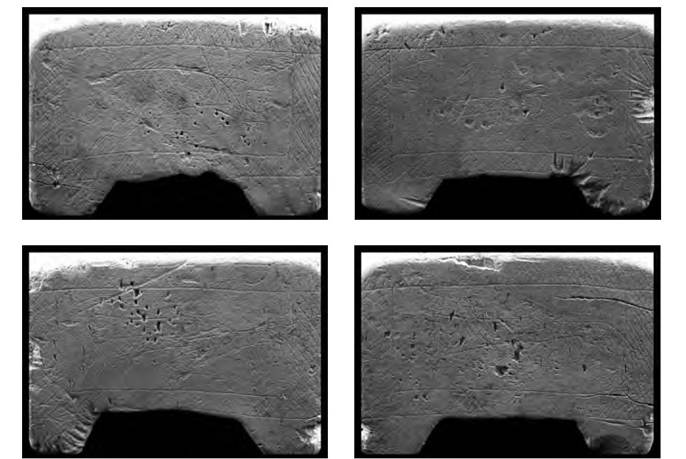
Figure 8.
Incised drawings on Obj. 3191; photos by Seung Ho Bang and Oded Borowski; Lahav Research Project.Three samples were taken from the bottom part of each altar and analyzed in the Laboratory for Comparative Microarchaeology (LCM) at Tel Aviv University (the samples' number in the following study indicate the specimens from which the samples were taken). For petrographic analysis, the samples were glued to micro-slides (76 mm x 26 mm x 1 mm) by thin epoxy resin. Thin sections from the samples were prepared by polishing the glued samples to a thickness of 30 microns (0.03 mm) with Buehler PetroThin® Thin Sectioning system and examined with polarizing petrographic microscope (Motic BA 300 Pol.) at magnification of 40X, 100X, or 400X in plain and cross polarized light.
Result
The microscopic examination of the two thin sections of Samples no. 3076 and no. 3139 reveals that they are made of chalk. Foraminifers, a frequently found type of calcareous marine microfossils, are observed in both samples. Sample no. 3076, however, has a larger quantity offoraminifers than that of no. 3191. In no. 3191, a certain amount of small quartz grains are also observed. Their brownish calcareous Microcrystalline matrix attests that these stones are typical of the local Eocene chalk of the Adulam Formation (figs. 9-10).
Chalk outcrops of the Adulam Formation often with chert layers can be found at Tell Halif and its immediate surroundings (Sneh and Avni 2008a). If
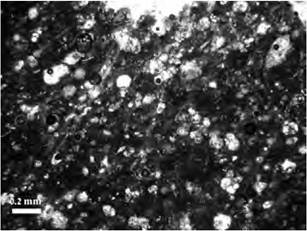
Figure 9.
No. 3191; plain polarization, X 40; photo by Kook Young Yoon and Yuval Goren; reprinted by permission of the LCM.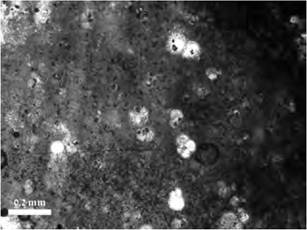
Figure 10. No. 3076; plain polarization, X 40; photo by Kook Young Yoon and Yuval Goren; reprinted by permission of the LCM.
we broaden the boundary to a ten-kilometer radius from the site, many different rocks outcrop, such as sedimentary rocks (Cretaceous, Tertiary, and Quaternary periods), Eocene and Senonian chalks (mostly to the north and south of the site), and Cretaceous limestone and dolomite (to the east of it) can be found (Sneh et al. 1997c; Sneh and Avni 2008a, 2008b). Besides, small quantities of Miocene limestone and Pliocene Sandstone are also found within this boundary.
The Adulam Formation, from which the incense altars of Objs. 3076 and 3191 were probably made, is distributed mostly in the Shephelah and the northwestern part of the Negev, and the formation is also intermittently found in northern Israel (fig. 11; Sneh et al. 1997a, 1997b, 1997c). Given the wide extent of the distribution of this formation, it is difficult to specify an area for a possible provenience of the raw material. Nevertheless, unless evidenced otherwise, it might be tentatively inferred that the provenience of raw materials for Samples no. 3076 and no. 3191 is from the close vicinity of Tell Halif.
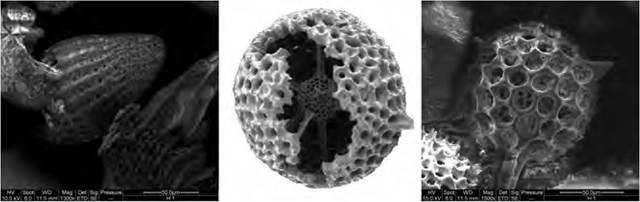
Sample no. 3139 is also made of chalk. But the stone is harder than the other samples and contains a high amount of well-preserved radiolarian (fig. 12a). In Israel, these siliceous microfossils occur only in a few localities: in nanno-ooze of the Middle Eocene Maresha Formation of the Shephelah (fig. 12b-d) or in scanty locations in northern Israel (Sneh et al. 1997a, 1997b, 1997c; Goren 2007, 210).
Radiolaria are distinct from other calcareous microfossils like foraminifers by their isotropism in microscopic observation. Their shape in thin section is normally characterized by a spherical or bell-shaped contour, a radially symmetrical structure of the skeleton, and a saw-toothed peripheral zone of the shell.
The degree of radiolarian fossils' preservation is controlled by different factors, such as accumulation rate, the degree of silica undersaturation of pore waters, and the intensity of bioturbation (Flügel 2004, 487). Both the Maresha FormationFigure 11. Geological map of Judea and northern Negev showing the location of the Adulam Formation in gray color (ea) and the Maresha Formation in light gray color (emr); from the top, Beth- Guvrin (circle), Tell Halif (triangle), and Beersheba (square); after Sneh et al. 1988; reprinted by permission of the Geological Survey of Israel.
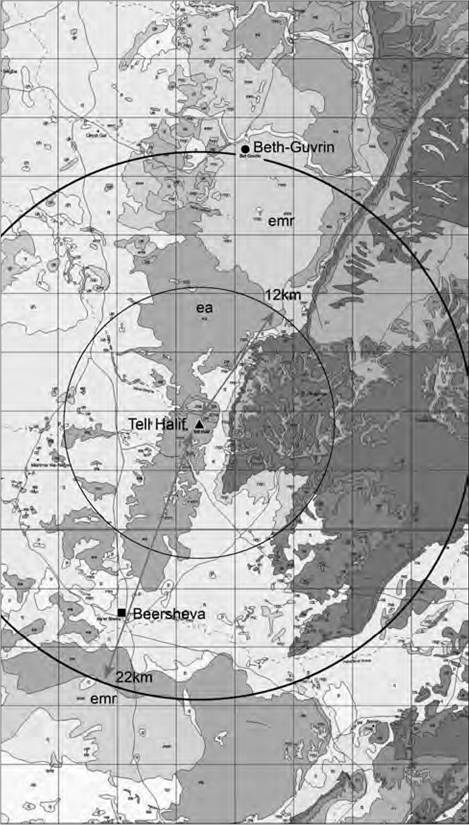
and Adulam Formation belong to the same superordinate lithostratigraphic unit of the Zor'a Formation of Eocene Series characterized by chalk and limestone accompanied by chert layers in between. In the Adulam Formation, however, radiolaria are rare or diagenetically altered (Buchbinder, Minran, and Gvirtzman 1988, 268-69; Goren 2007, 210).
Radiolaria in the thin section of Sample no. 3139 is not the same as it is shown in the Adulam Formation or in the vicinity of Beersheba. This formation outcrops intermittently in the Shephelah, from Zor'a near Beth Shemesh in the north to the south and southwest of Beersheba in the south (Sneh et al. 1997b;
Figure 12. a. No. 3139 with Radiolar- ian; plain polarization, X 400; photo by Kook Young Yoon and Yuval Goren; reprinted by permission of the LCM.
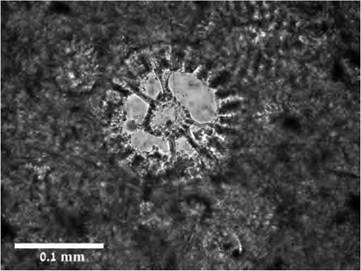
Figure 12. b, c, d. Scanning electron microscopic photos of Radiolaria from the Maresha Formation of a Seleucid stele found in Maresha; photos courtesy of Yuval Goren, the LCM.
1997c). Under the influence of varied ecological and sedimentary environments (Flügel 2004, 487), radiolaria in the vicinity of Beersheba do not occur at such a high extent as they do in the vicinity of Maresha-Beth-Guvrin (Goren 2007, 210). Therefore, taking into account only the petrographic point of view, the raw material of Sample no. 3139 is more likely to have derived from the Maresha Formation in the Shephelah. Its closest outcrop is found in approximately twelve kilometers to the north of Tell Halif (fig. 11). This interpretation gains more support since the closest southern outcrop of this formation is approximately twenty-two kilometers to the southwest of Tell Halif, almost two times farther from the outcrop in the Shephelah.[213]