Local Production of Small Incense Altars
Transportation of Raw Material
The maker of Obj. 3139 most likely used limestone from the vicinity of Maresha, a relatively distant source, rather than locally available ones.
Since Obj. 3139 is an unfinished altar, it is hard to imagine that the altar was purchased or imported from a distant location. Rather, it is logical to assume that raw stone was imported from the distant source. In the Levant, transporting exotic raw materials from distant sources began as early as the Neolithic period and established regular local and long distance exchange throughout times (Moore 1982, 14-15). Traditionally, obsidian was considered an exemplary exotic raw material that has been transported from a distance (Bar-Yosef 1980, 130; Bar-Yosef and Belfer-Cohen 1989, 470, 482, 488-89; Healey 2007, 171, 176; Wright and Gordus 1969, 82-84; Yellin, Levy, and Rowan 1996, 366-67). Exotic raw materials, however, included bitumen (Gilead 1991, 142; Kuijt and Goring-Morris2002, 380), basalt (Bar-Yosef and Belfer-Cohen 1989, 489; Cline 2003, 360), flint (Bar-Yosef and Belfer-Cohen 1989, 480, 489), gypsum (Kingery, Vandiver, and Prickett 1988, 238, 241), turquoise, copper, ivory tusk (Cline 2003, 360), and colored limestone (Bar-Yosef and Belfer-Cohen 1989, 489; Moore 1982, 7) as well.
Ivory procurement and crafting during the first millennium may demonstrate that transportation of these exotic raw materials was continued in the Levant (Feldman 2014, 26-27). Among the exotic raw materials, basalt, due to its limited distribution in northern Israel, such as around the Sea of Galilee and in the Golan Heights (Singer 2007, 186), presents prolonged raw material procurement from distant sources, its transportation, and local manufacturing (Rutter
2003, 129-31; Squitieri 2015, 209-12) for both daily and ritual contexts (Squitieri 2015, 209-12). Owing to abundance of limestone throughout the southern Levant, the evidence of using imported limestone is hard to find.
Nevertheless, here we have a possible case that the ancient Israelites used imported limestone. Tell Dover yielded a vessel made of imported limestone from an Iron Age II context (Wolff 2007, 306-8). The raw material is brecciated limestone procured from the Nile Valley. This limestone has reddish color with grayish-white veins. If the raw material came from Egypt, these colors would have made the limestone attractive and worthy of import from there.The raw material for Obj. 3139 came from a relatively distant location. Since limestone is available around Tell Halif and two incense altars were made of local material, there must have been a specific reason for using imported limestone. In fact, the limestone of Obj. 3139 has a darker color and harder texture compared to the local limestone of Objs. 3076 and 3191. Just as brecciated limestone from the Nile Valley, we may presume that because of its color and texture, the limestone of Obj. 3139 might have been considered exotic or at least made it worthy enough to be imported. The raw limestone for the altar could have arrived at Tell Halif as a result of commercial activities. If there were interactions between the distant source in the vicinity of Maresha and Tell Halif, it is not surprising that the limestone came through an established trade network.
Local Production of Incense Altars
The petrographic analysis and the examination of the finished state of the Tell Halif incense altars provide new perspectives on identifying the group of people responsible for the production of these incense altars. Although it is hard to determine the exact conditions and production stages of Objs. 3139 (and possibly Obj. 3619) before it was buried, the unfinished state of the altar strongly suggests that it was discarded in the middle of its production process for some reason, such as the breakage of one leg.
Another piece of evidence for local production of incense altars can be seen in the different finished state and levels of craftsmanship as well.
For example, Objs. 3076 and 3191 have resemblances, such as a similar rectangular profile, formation of a depressed square basin, and possible four legs. Similar comparisons can be made between the two unfinished altars. These technological and morphological attributes imply that the limestone incense altars were crafted based on a somewhat standardized convention and manufacturing process. The two different sources of raw materials for the incense altars and the presence of the finished and unfinished incense altars during the same time period in close proximity to each other at the site may indicate that Tell Halif was the locus of production of the incense altars with shared conventional techniques and styles.Particularly, Obj. 3191 demonstrates that a local artisan at Tell Halif had the ability of producing a top quality limestone incense altar similar to other southern Levantine incense altars (e.g. Tell Jemmeh incense altar [catalog no. 22], see Bang and Borowski 2017). It is possible to assume that the artisan responsible for the production of Obj. 3191 was at another site, such as Tell Jemmeh or Beersheba, where larger collections of small incense altars were discovered, and the completed altar was brought to Tell Halif. This supposition, however, is less convincing since the altar was made of local material. If we attribute the production of Obj. 3191 to an artisan from another location, he must have been an itinerant artisan specializing in making incense altars. The artisan probably came to Tell Halif and crafted Obj. 3191 using local material. The date of the incense altar, however, may undermine this possibility as well. Including Obj. 3191, the Tell Halif altars, which were found in a late eighth-century BCE context, are the earliest ones among the southern Levantine incense altar collection. In terms of their stratigraphic context, they might be precursors of similar incense altars found in southern Levantine sites. In other words, Tell Halif might have been among the few earliest sites that adopted the idea of making this kind of incense altars and transmitted it to other nearby sites along the trade network.
Craftsmanship of the Tell Halif Incense Altars
The presence of different finished states, different levels of craftsmanship, and different proveniences of the incense altars with their close proximity to each other in Field V at Tell Halif suggest two possible interpretations of local incense altar production. Since the four incense altars exhibit different levels of craftsmanship, we may assume that more than one artisan produced them. We have finished fine quality of Objs. 3076 and 3191 and unfinished poor state of Obj. 3139 (and possibly Obj. 3619 as well). These two groups also represent different choices of raw materials for crafting incense altars. The first group chose locally available soft limestone while the second group selected dark and hard imported stone. In other words, the presence of different phases of altar production and quality of finishing in multiple altars found at the same site suggest the existence of multiple artisans with different levels and styles of craftsmanship at Tell Halif. The distribution of the four altars in Field V also supports the presence of multiple artisans. Similarly to Fields III and IV, architectural remains reveal that Field V consists of several pillared buildings abutting the city wall (fig. 13). These conjoined architectural remains lead one to consider the possibility of multiple households. Therefore, the four altars would have belonged to different persons or different households.
The observations made above of similarities and differences can be explained by the existence of apprenticeship (for a general discussion on a tribal and family setting of industrial training, see Roux and Rosen 2010, 12-13, 16; Swift 1919, 21-23, 60-61). If this was the case, a master with a high level of skill and much more experience might have been responsible for Obj. 3191, and an apprentice with a lower level of skill and less experience might have been responsible for Objs. 3139 and 3619.
Location of Incense Altar Production at Tell Halif
The different finished state of the Tell Halif incense altars may also reveal the location of the incense altar workshop in Field V at Tell Halif.
While both Objs. 3076 and 3191 were completed and the latter was actually used in a domestic context, the loci yielding them do not exhibit clear evidence for their production, such as prepared raw materials, discarded or chipped parts, and tools. Since making incense altars might not have required a dedicated work place, special tools, and storage of raw materials, it would be natural to find no such evidence. Nevertheless, considering the high artistic skill exhibited in Obj. 3191, the artisan must have had much practice and prior experience before he crafted the finished one with decorations (Obj. 3191). The artisan might not have crafted such high quality incense altar by chance.In fact, while the completed incense altar does not necessarily point out where it was made, the incomplete one most likely points out where it was produced. Although we do not have clear direct evidence for altar production, Area E7 exhibits conceivable evidence of incense altar production. The area yielded an unfinished altar (Obj. 3139), and roughly 10 m to the north, in Area C7, we
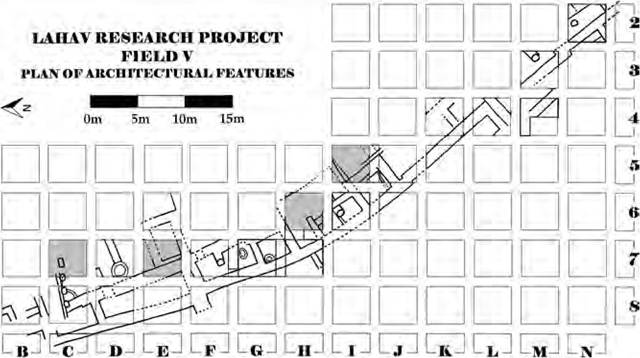
Figure 13. Plan of architectural features in Field V; drawing by Dylan Karges; LRP.
have another incomplete or discarded fragment (Obj. 3619). Therefore, the most probable place where an artisan was active would have been somewhere in between Areas C7 and E7. Despite lack of other direct supporting evidence, such as tools, it is, however, quite plausible that part of the textile workshop in Area E7, where a domestic production activity took place, would also have been a place where incense altars were crafted. There could have been synergy if two different production activities shared resources, such as tools, space, and labor. For example, if there was a connection between the textile workshop and incense altar production so that the artisan could have taken advantage of the textile trade, then the artisan could easily get raw material for incense altars from other locations through a pre-existing textile trade network.
The same network could have served the transmission of ideas on incense altar production. In other words, the textile workshop could have been a point of access to certain circulating technological practice and stylistic features of small incense altars. The presence of the imported limestone, of which Obj. 3139 was made, substantiates this point.Incense Altars in Rituals
Since all four Tell Halif incense altars were found in domestic contexts, they most likely were made for domestic use.[214] The incense altar has no known utilitarian function except producing aroma, whether it is for making pleasant odor or expelling insects. Even signs of burning are not found in every incense altar. Therefore, we should expand our scope and try to relate the incense altars' nonutilitarian function with other non-utilitarian objects found together in the areas and the functions of the areas. First, Obj. 3139 was found in a part of a domestic textile workshop (Areas E6 and E7). These areas yielded a total of six cult objects from the same stratigraphic phase. In particular, Locus E7004, where the altar was found, yielded four cult objects, such as a Judean horse and rider figurine fragment, a kernos oil lamp fragment, a zoomorphic vessel fragment, and a possible standing stone (masseba). An intended function of Obj. 3139, if it were completed and used in the area, could have been closely related to the primary function of the textile workshop, in which it was discovered, and the adjacent kitchen (in Area D7) next to the workshop. The internal stratigraphy of the locus that yielded the incense altar suggests two possibilities of its function. If the locus belongs to the ground level, the incense altar could have been an integral part of the weaving and/or food preparation processes. The altar might have been used along with other cult objects in ritual related to textile production or food preparation activities. Recent studies reveal a high rate of occurrences of cult objects in association with work places in the Iron Age (Bang 2015, 152-257; Albertz and Schmitt 2012, 175).
Since Locus E7004 is found approximately 40 cm above the occupation accumulation in Area E7, it might not have been part of the ground floor but that the incense altar and other cult objects came from the second floor directly above the textile workshop. Although it is not sure whether the locus was covered space in the second floor, it could have served as space for dwelling, sleeping (Albertz and Schmitt 2012, 28; Holladay 1992, 316), and other personal activities. A probable ritual in this context would be personal piety rather than communal or nuclear family based rituals. We have a similar case in Area I5, where the incense altar fragment (Obj. 3076) was found in Locus I5004. As we discussed early, this locus consists of collapsed materials, which covered the floor to a height of approximately 20 cm. This altar was most likely to be used in the second floor. Using incense altars in a second floor gains support by the case of Tall Jawa, where many cuboid altars found in the second floor contexts (Daviau 2014, 120).
Considering an easy movement through the kitchen, textile workshop, and the second floor, the intended user of the incense altar (Obj. 3139, if it was completed) could be identified with the one who was crafting the altar, the one who occupied the room in the second floor, the weaver in the textile workshop in the first floor, and/or the cook who prepared food for the household in the kitchen (Area D7) next to the textile workshop. This interconnection among the domestic spaces suggests that a female household member would have planned to use the incense altar together with the other four cult objects.
Object 3191 was found in a domestic storeroom. Having no apparent utilitarian function in relation to storage activities, we may also assume that this incense altar would have had nonutilitarian functions. The storeroom might have provided a unique place for nonutilitarian activities, such as a small communal gathering accompanied with a small-scale feast. An Ugaritic marzihu (KTU 3.9) offers an example of a domestic storeroom used for a religious drinking feast for nonhousehold members (Segert 1984, 141; Dawson 2009, 28; Bordreuil and Pardee 2009, 261, text 40). Not only a small communal religious gathering, but also private or small family-based religious activities could be performed in the place. The storeroom in Area H6 would have provided a remote and isolated space, an ideal place for performing personal and/or small group piety. The contemporary shrine room found in Field IV at Tell Halif demonstrates this possibility. The room yielded an assemblage of cult objects, such as a fenestrated stand, a pillar figurine head, and two finely dressed standing stones (massebot) (Hardin 2010, 133-43), that most likely were used in performing domestic rituals.