16 EXPANDING FLORA’S EMPIRE
Linnaean science and the Swedish East India Company
Christina Skott
During the course of the seventeenth century, Sweden had expanded beyond its national borders, acquiring both economic and territorial ground on the southern shores of the Baltic Sea.
This expansion was halted at the end of the century, when King Charles XII led the country to war against Russia in what became known as the Great Nordic War. Twenty years of political and economic turmoil ended with the Treaty of Nystad in 1721, whereby Sweden lost most of the territories gained around the Baltic. This signalled the beginning of a period referred to as ‘Frihetstiden’ (the ‘Age of Liberty’), a time of growing stability and economic prosperity and characterised by a weak monarchy.1 The political power lay with the estates of the ‘Riksdag’, where two factions emerged in the 1730s, commonly referred to as the ‘Hat party’ and the ‘Cap party’, so called because the more assertive ‘Hats’ accused the rival party of being asleep, that is, of wearing ‘nightcaps’. Made up mainly of merchants and manufacturers, the Hats came to dominate Swedish political life of the mid-eighteenth century. The party forcefully promoted a utilitarian and mercantilist programme which was strongly patriotic: the goal was for Sweden to become economically independent, by developing manufacturing and accumulating wealth from exports. One of the first signs of the new economic upswing was the founding of the Swedish East India Company in 1731.The general atmosphere of optimism and the promise of new prosperity were mirrored in the intellectual climate and the sciences. The Royal Swedish Academy of Sciences was founded in 1739 by leading Hats and academics. There was also a sense of a renewed prestige for institutions such as the Universities of Uppsala and Lund, but much of the scientific upswing centred around individual scientists.
Foremost among them was Carl Linnaeus, Professor of Medicine at Uppsala, whose rising fame in Europe in the decades around mid-century did much to establish Sweden’s position as one of Europe’s great scientific nations.Linnaeus’ road to fame had begun in 1735, when he published a slim volume entitled Systema naturae, in which he proposed an entirely new system of classifying the natural world, a taxonomy based on a binominal nomenclature whereby every plant and animal could be classified and slotted into a grid of genera and species. The system would be developed and extended by Linnaeus himself until his death in 1778, by which time his system would be recognised and used across Europe. The genius of Linnaean taxonomy had been obvious from the start, but its usefulness became more obvious still as the Linnaean project of mapping the natural world went global. This project was heavily imbued with the political thinking of the time. Linnaeus envisaged science in all its forms, and botany in particular, as a deeply patriotic enterprise, with a strong emphasis on the useful. He therefore preferred to rely on his own countrymen, especially his own students trained in the new method, to provide him with new specimens, while reporting on the traditional medicinal properties of plants as well as their commercial value. But Linnaeus was not alone in promoting this uniquely Swedish form of science: the ‘Age of Liberty’ saw the emergence of a multitude of amateur naturalists engaged in the collection and dissemination of botanical and zoological material. It became a patriotic duty to collect plants to be brought back to Sweden: the expansion of Flora’s empire developed into a national obsession.
Linnaeus’ productive years coincided with the most prosperous period of the Swedish East India Company, which provided Linnaeus and other scientists with direct and unmediated contact with Asia. Despite the optimism and relative prosperity of the time, the Swedes had no ambitions to establish themselves as a colonial power, or compete with the English and French in acquiring territory on the Indian subcontinent.
Instead, they preferred to make as much profit as possible from the low-risk enterprise of a flexible trading company. This chapter examines how the activities of the Swedish East India Company informed and enabled the Linnaean project of mapping the global natural world. It sets out to highlight a unique case in the history of European science, where scientific discovery became closely intertwined with a domestically propagated form of political economy and the relentless pursuit of information about the world. In the past decades, the study of the relationship between science and European expansion has emerged as a vibrant field of historical research. Whereas this scholarship has focussed heavily on Europe’s leading colonial powers, Sweden in the time of Linnaeus provides a unique and little-known example of the ways in which engagement with the world propelled European science.Born in the central province of Smaland in 1707, Carl Linnaeus (in 1761 ennobled as von Linne, a name used in Sweden itself) had taken a keen interest in the natural world while still a schoolboy.2 After studying at the Universities of Lund and Uppsala, he embarked on a study trip to Holland in 1733, where he was to remain until 1737, working and studying, while also befriending leading Dutch botanists of the time. Many of these scientists had close links to the Dutch East India Company (VOC), whose officials in Asia had long collected and brought back botanical and zoological material. It was here that Linnaeus first saw and was able to examine tropical plants, and it was in Holland that he published the then modest Systema naturae (1735), which would gradually attract the attention of Europe’s scientists.
In 1738 Linnaeus returned to Sweden. After practising medicine in Stockholm for a few years, he took up a Chair in Medicine and Botany at the University of Uppsala in 1741. After his appointment he rarely left Uppsala, and was never to travel outside Sweden again. Around mid-century a stream of publications, most notably Species plantarum (1753), which described more than 7,000 plants using the binominal nomenclature, cemented Linnaeus’ position as one of Europe’s leading scientists.
The rapid expansion of Linnaeus’ ambitious project of mapping the entire natural world is well illustrated by the ever- enlarged editions of Systema naturae and its appendices, Mantissa plantarum (1767) and Mantissa altera plantarum (1771). Budding naturalists and colleagues alike travelled from all over Europe to Uppsala to meet and be taught by the great man himself, while a multitude of plants and other naturalia arrived in the little university town, sent to Linnaeus from Sweden, Europe and beyond.In Holland Linnaeus had already established a position for himself within an international network of leading scientists. Later, working from Uppsala, he was heavily reliant on a large number of correspondents, informants and collectors. He exchanged letters as well as plants, became passionately involved in heated scientific debates and quarrelled with colleagues until the very last days of his active life. Linnaeus’ vast correspondence reveals a restless personality, always busy, eagerly waiting for news from travelling students, for the arrival of boxes of seeds, dried and live plants, animals preserved in bottles or insects pierced on needles. His greatest excitement was in receiving parcels from far-flung places: his was the privilege to be the first scientist to describe, determine and name plants never before seen in Europe.3
Linnaeus’ fascination for exploration and travel had its origins in his own experiences as a young student travelling in Lapland, and his published journals from his early travels had helped to establish his scientific reputation. For his inaugural address at Uppsala in 1741 he chose to speak on the necessity for a scientist to travel, to see for himself, first in his own country before embarking on overseas journeys. Although these ideas were deeply rooted in early modern European apodemic travel writing, Linnaeus came to see travel itself as a unique form of scientific knowledge.4 This was at least partly a product of the utilitarian cameralist thinking which then dominated the political climate in Sweden, and it has been suggested that the rise of the sciences in Sweden during the time of Linnaeus was driven by economic rather than scientific ambitions.5 These ideas would colour Linnaeus’ ideas about the usefulness of travel, and of the necessity to record everything observed.
This is amply illustrated in his journal Oland and Gotland Journey (1745), where descriptions of manufacturing, farming implements, buildings and artefacts, but also customs and local folklore feature alongside purely botanical information. Linnaeus was convinced that economic progress and the advancement of science were intrinsically linked, and this was the spirit in which he instructed his students to explore the world. His student Pehr Kalm wrote from North America: ‘I do know that Historia Naturalis is the base for all things concerning Economics, Commerce, Manufacturing... Aiming for Economic progress without mature or sufficient insight into Natural History is to behave like a dancing master with only one leg’.6 It followed that a scientist should not only collect plants and animals, but also observe and record manufacturing techniques, and methods of agriculture, as well as geographical information, history and languages. Linnaeus’ first commandment was for his students to ‘ask about everything’ (Det frägas om allt).During the 1740s and 1750s Linnaeus was to send out more than twenty of his students, often as one-man expeditions, on long and hazardous journeys to North and South America, the Middle East and other parts of Asia, in the name of science and the advancement of knowledge of the world. He liked to refer to these men as his ‘Apostles’, sent out into the world with a mission to return to the Master in Uppsala, laden with naturalia and reports from faraway places. It has often been said that the results of these journeys were a disappointment to Linnaeus.7 Several of the Apostles were beset by mishaps and unfortunate circumstances, some fell ill and died, one went mad and slit his own throat, and collections were lost or eaten by insects. Others, however, returned, bringing back collections, journals and reports, and new specimens of plants and animals which Linnaeus examined, classified and published. But expanding Flora’s empire was a costly exercise, and the extent of Linnaean travel would not have been possible without financial help.
This often came in the form of bursaries from the university and sponsorship from wealthy amateur scientists, who expected to augment their own collections as a result. Another important source of funding for scientific travel was the Royal Swedish Academy of Sciences.The founding of the Academy was a result of a meeting of six leading scientist and politicians, Carl Linnaeus among them, in Stockholm in 1739.8 Although modelled on equivalent institutions in Paris and London, the new Swedish Academy from the start adopted a unique and ambitious programme which aimed to promote ‘useful’ sciences, placing a strong emphasis on legitimising the Hat party’s economic policies. This meant that papers presented at the meetings of the Academy intentionally focussed on the practical usefulness and economic gains of the scientific findings and discovery. The hallmark of the early activities of the Academy was the creation of networks of communication among its members and informants. The Academy officially supported local collectors, and actively encouraged excursions of enquiry within Sweden. But, by the mid-1740s a new interest began to emerge: China. This was enabled by the direct access to the ‘East Indies’ which had opened up with the activities of the Swedish East India Company.
Swedes had made several attempts to engage in formal overseas trading from the early seventeenth century, but there were also long-established indirect contacts between Sweden and the East Indies.9 Due to Sweden’s intimate commercial links with Holland at this time, thousands of Swedes had taken employment with the VOC, many as surgeons. Some of these VOC employees published travel journals in Swedish. The most widely read of these was compiled by Nils Matson Kioping, who in Een kort beskriffning uppa trenne resor och peregrinationer (1667) provided Swedish readers with extensive descriptions of Asian flora and fauna.10 To the patriotic Linnaeus, these publications were important as they presented eyewitness information by ‘our men’ and so were seen as more trustworthy than European publications.
The Swedish East India Company was given a Royal Charter and monopoly on Swedish trade to the east of the Cape of Good Hope in 1731. Although this enterprise was very much a reflection of the economic climate that signalled the beginnings of Sweden’s ‘Age of Liberty’, the Company was initially dominated by foreign expertise and experience. Several of the founding members, such as the Scotsman Colin Campbell, had been active within the failed Ostende Company, and historians of the Swedish East India Company have debated to what extent this actually was a Swedish enterprise, or just a flag of convenience for European businessmen who had fallen out with other European trading companies.11 In any case, the new company was viewed with suspicion by their English, Dutch and French competitors in Asia. The directors initially nourished extensive plans to get a foothold in the increasingly lucrative trade with India and made several expeditions to Surat and ports around the Bay of Bengal. However, British hostility soon forced the Swedes to abandon trade on the Indian subcontinent, and during the latter half of the eighteenth century Swedish ships sailed almost exclusively to Canton (modern day Guangzhou), the only Chinese port open to European trade.
Between 1731 and 1813, when the Company was officially dissolved, the Swedish East India Company sent out 132 expeditions to Asia, using thirty-seven different ships. The ships set out from the Company’s headquarters in Gothenburg early in the new year in order to catch the south-easterly monsoon in the China Sea in July and August. The Swedish ships normally took a route north of the British Isles, down to Cadiz in Spain, where Swedish iron ore was exchanged for silver, the only commodity wanted by the Chinese. The ships usually stopped for a few weeks at the Cape (as was allowed by the VOC), then continued across the Indian Ocean, through the Sunda straits between Java and Sumatra, towards the Pearl River and the port city of Canton.
In Canton, the Swedes had their own factory alongside those of other European nations. The Swedish supercargoes seem to have got on better than other Europeans with the Cohong, the group of Chinese merchants who had a monopoly on trade with the Europeans. The Swedish ships typically stayed in Canton for five to six months, during which time the ships were loaded with tea, porcelain and commodities such as silk and rhubarb, while the crew had an opportunity to botanise, and wander in the environs of the city, as long as they did not enter the old walled city. The Swedish ships arrived back in Gothenburg in the middle of the Swedish summer, two-and-a-half years after leaving the home port. The goods were sold at auction a few weeks later. The main buyers were European merchants, with most of the tea sold to England at enormous profits. Exactly how big these profits were remains unknown. The Company had been permitted to conceal the identity of its shareholders, which included Englishmen who were barred from trading in the East Indies in competition with the English East India Company. This meant that accounts generally were destroyed after each expedition. It is, however, clear that the Company was the most profitable Swedish commercial enterprise ever.
Linneaus had at an early stage realised the potential opportunity for the Swedish East India ships to bring back not only tea and porcelain, but also plants and other naturalia. His fascination with the natural world of the East-Indies originated from his time in Holland, where he had been able to himself observe and examine live specimens of tropical plants. He assisted Johannes Burmann the Elder in the publication of Thesaurus Zeylanicus (1737), a Flora of Ceylon. In 1735 Linnaeus was employed to work on the herbarium owned by Georg Clifford, Director of the VOC and a keen amateur scientist, who had established hothouses and extensive gardens in Hartekamp near Haarlem, resulting in the splendidly illustrated Hortus Cliffortianus (1737). During his time in Holland Linnaeus also published Musa Cliffortiana (1736), a treatise on the banana plant based on observations in Clifford’s hothouse. This was the first banana plant to flower in Europe, and Linnaeus would always be especially facinated by the banana (then known under its Malay name pisang), which was thought to be the fruit of the Garden of Eden.12
After his return to Sweden, Linnaeus enthusiastically wrote that new knowledge of the hitherto unknown ‘life between the tropics’ was crucial for the advancement of the great project of mapping the natural world. It was generally acknowledged that the flora of the East Indies was not very well known. This was at least partly a result of Dutch unwillingness to allow publications on its Eastern possessions. The few existing publications on the flora and fauna of the East Indies were well-known to scientists, and Linnaeus did make references to earlier writers such as Jacobus Bontius and Engelbert Kaempfer.13 But he complained bitterly in a letter to the Academy that the most extensive botanical work on Asia, Hendrik Adriaan van Rheede tot Drakenstein’s Hortus indicus malabaricus (1678—1703), published in twelve richly illustrated and expensive folio volumes, was simply not available in Sweden in the mid-eighteenth century.14 Whereas Linnaeus acknowledged Georg Everard Rumpfs (Rumphius) Herbarium amboinense (6 vols, 1741—1750), it has been argued that he made curiously little use of this main publication on the natural history of the region now known as the Indonesian archipelago.15 The explanation, however, has to be seen in the light of Linnaeus’ own work: Rumphius did not provide enough information to enable Linnaeus to incorporate these plants into his own system of classification. In the Linnaean method the visual examination of the smallest parts of every plant was crucial for determining the genus and species; consequently it was necessary to have access to the actual specimens in order to situate them within the new taxonomy. This was the essence
of Linnaean thinking: the scientist had to travel, see for himself and examine in order to determine and classify.
The prospects of being presented with actual specimens of plants, animals and minerals from the East Indies excited Linnaeus throughout his life; he wrote to a student,
when I think about all the wonderful things to be found in the Indies, it hurts to think that so little is known, which easily could be known, if only travellers collected all kinds of insects, mosses and plants or trees together with their flowers and fruits.16
After returning from Holland he actively sought to acquire not only botanical and zoological material from the East Indies, but also to further knowledge about the East Indies more generally. In the 1740s he pleaded with the Academy of Sciences in Stockholm for naturalists to be given financial help to undertake East Indian journeys, especially to Bengal, where, he wrote, ‘no one has collected plants with open eyes, still less done anything for Zoology. A few blind men have picked up around fifteen plants there’. He added that ‘I had never thought that the Swedish nation would have the honour of describing the rare plants of India’.17
Sending out Swedes to Bengal was, however, not easily done.18 On the Subcontinent the British were keen to prevent the Swedes from gaining trading access. In 1752 a Swedish ship had sailed to Surat leaving behind the supercargo Christian Henrik Braad, who disguised himself as a naturalist, with a secret commission to report on trading conditions and European competition in India. His reports from India to the Company in Gothenburg and the Academy in Stockholm were composed in the Linnaean spirit of ‘asking about everything’, and so provided a wealth of knowledge of peoples and histories as well as botanical information. Nevertheless it was becoming clear that British assertiveness made it too difficult and unprofitable for the Swedes to trade in India.
Linnaeus therefore had to rely on the yearly expeditions to Canton. The mechanisms of reporting from China were put in place at an early stage. At the recommendation of Linnaeus, Hans Teurloen, one of the supercargoes of a Swedish East India ship, was elected to the Academy of Science on the condition that he present the Academy with two Chinese books, one on the growing of silk worms, the other on rice cultivation. In addition, Teurloen was given a list of things to study and report on for his next journey.19 This was the starting point of a unique arrangement which would involve Linnaeus, the Academy, the Swedish East India Company and a multitude of individuals travelling on Swedish ships.
The second charter (octroi) of the Swedish East India Company, covering 1746—1766, would become the most successful period in the Company’s history. During these years Swedish interest in Chinese culture and arts peaked, symbolised by the building of a ‘China Pavilion’ in the gardens of the royal castle of Drottningholm, inaugurated by the Crown Prince himself dressed as a Chinese mandarin. The nobility commissioned personalised porcelain, households filled with China-inspired decorations and furniture, and the wives of wealthy merchants appeared in dresses made of Chinese silk. This was also the time when more formalised links between the Academy and the Company were established, prompted by Linnaeus himself.
On Linnaeus’ initiative the Academy began negotiations with the Swedish East India Company for a trained naturalist to be sent to Canton on a yearly basis. One of its most prominent members, Count Tessin, persuaded the Company’s directors to give free passage to the East Indies for naturalists appointed by the Academy. The exact terms of this arrangement are somewhat unclear, but during the 1740s and 1750s the directors and administrators of the East India Company were often reminded by Linnaeus and other members of the Academy of the need to appoint men familiar with the Linnaean system as ships’ surgeons.
Magnus Lagerstrom, an amateur scholar who had risen to become one of the leading figures in the Company as well as a member of the Academy, was a long-time organiser in collecting and distributing East Indian material. In 1747, Lagerstrom drew up instructions for the Company to only appoint men trained in natural history to serve as chaplains on board the Swedish ships. These men would preferably have been students of Linnaeus, and should be able to show references from the great man himself. The chaplains, as well as surgeons, supercargoes and captains were instructed to collect naturalia and deliver them to the board of directors. The supercargoes, who carried out transactions with the Chinese merchants, were asked to produce reports on the China trade for submission to the Academy. In addition, captains of the Swedish ships were asked to urge their entire crews to take notes and collect specimens of natural history, and keep journals of cartographic, magnetic and astronomical observations. The goal was to ‘metamorphise peasants into naturalists’.20
It was within these arrangements that streams of seeds, living and dried plants, and animals were brought back to Sweden to be divided up between Linnaeus in Uppsala, the Academy in Stockholm, the collections of the Royal Household and other private collectors. Much of what was sent on to the Academy was only anonymously recorded in the minutes, where Lagerstrom spoke warmly about what he called his yearly ‘East Indian harvest’. This consisted of Chinese plants and animals, a variety of marine produce, as well as models and drawings of Chinese buildings and machinery and tools associated with agriculture and manufactures such as a silk looms, bellows, threshing machines and tools.21 Lagerstrom himself is said to have owned a collection of a thousand Chinese drugs, and a selection of his zoological collection was published in 1754 under the title Chinensia Lagerstromiana. He also acquired a collection of Chinese books, among them a ‘Botanicon Chinense’, recently acknowledged as the well-known materia medica ‘Pen ts’aso kang mu’.22
Another individual who did more than anyone else to promote knowledge of Asia in Sweden was Carl Gustaf Ekeberg, who during a long career as a captain made a total of twelve voyages to Canton. Although not a professional scientist, Ekeberg was a relentless reporter to the Academy, and he supplied Linnaeus and other collectors with Asian plants for many years. Ekeberg had a special interest in hydrography, and his observations on magnetic inclination were published in the Academy’s proceedings. In 1757 he published Kort Berättelse om den Chinesiska Landthushallningen (A Short Treatise on Chinese Husbandry). He was also a deeply engaged cartographer and published several sea charts and maps of the waters along the route to China.23
The large cabinets of naturalia kept by Swedish travellers and amateur naturalists have received relatively little attention in the study of the emergence of Linnaean science. Several of the directors of the Swedish East India Company kept private museums. Most famous of these were Claes Alstromer and Professor Jonas Petter Bergius, a student of Linnaeus who did not travel himself but built up one of Sweden’s largest plant collections. Another important collection was that of the Royal Household, as both King Adolf Fredrik
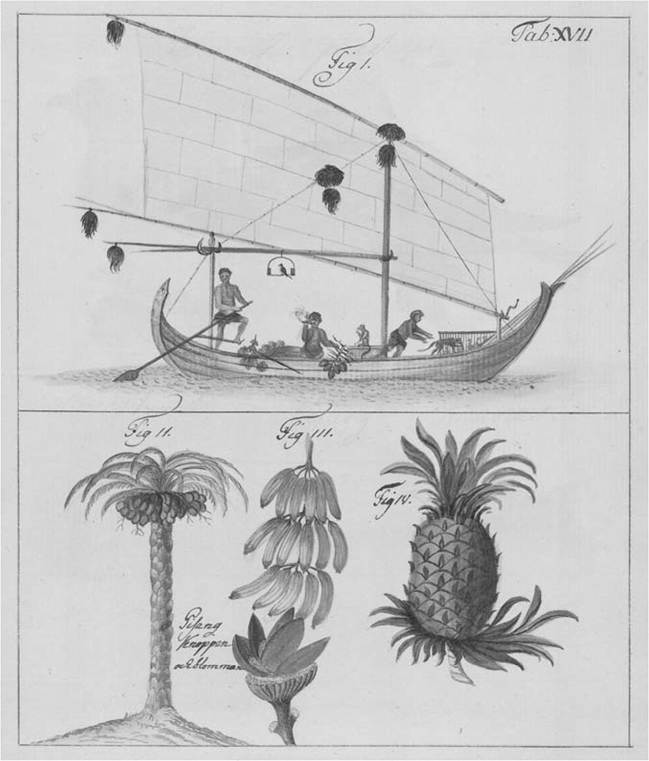
Figure 16.1 Scenes from the Sunda Straits, from report submitted by Carl Johan Gethe to the Royal Swedish Academy of Sciences, 1740s. Royal Library, Stockholm. Photo: Jessica Lund.
and Queen Lovisa Ulrika took a very active interest in natural history. The Queen appointed Linnaeus to be curator of the royal collections, and the magnificently illustrated catalogue which he published in 1754, Museum S.R.M. Adolphi Friderici, was the first publication where the binominal nomenclature was used in zoology. The royals also kept a zoo of living exotic animals, many of which had been brought back from the East Indies.
The result of this frantic activity of collecting and recording made possible by the Swedish East India Company was that Sweden’s institutional and private collections expanded rapidly, and it could be argued that China was better known in Sweden than anywhere else in Europe at the time. This was acknowledged by the men involved: in the 1750s a proposal was made in the Academy to compile all the material on China accumulated by Swedish travellers. This would be the Swedish alternative to the standard
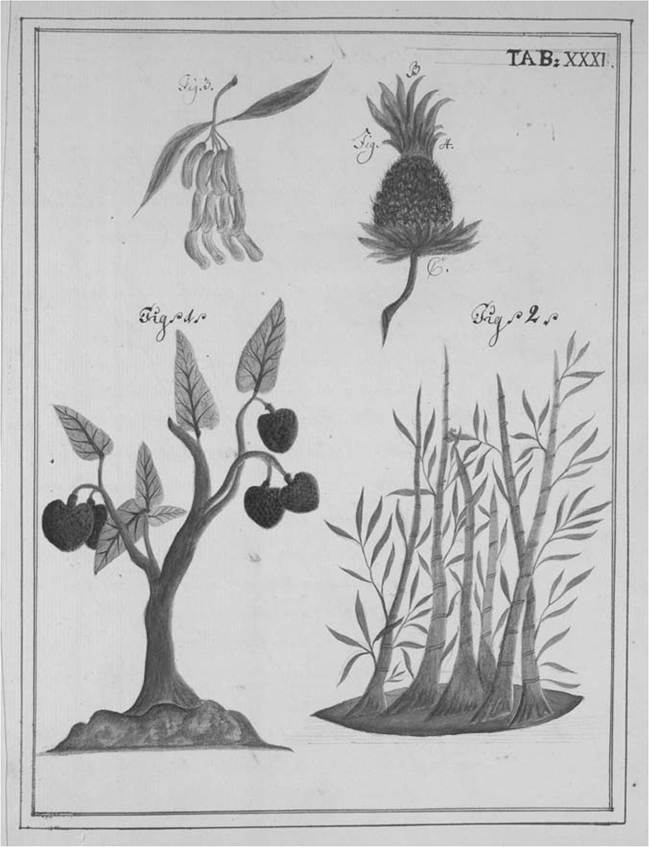
Figure 16.2 Illustration from Gustaf Fredrik Hjortberg's journal ‘Ost-Indisk Resa 1748 och 1749'. Royal Library, Stockholm. Photo: Jessica Lund.
source of information on China at the time, Description de la Chine, compiled by the Jesuit Jean-Baptiste Du Halde,24 but, in the event, this never materialised.
Back in Uppsala, Linnaeus eagerly awaited his own helping of the annual East Indian harvest. Although Lagerstrom’s plan for all the ships’ chaplains to be Linnaean ‘Apostles’ proved overly ambitious, Linnaeus managed to send out a number of his own students to China. The first was Christopher Tarnstrom, who before his departure to China in early 1746 was issued with the following instructions:
1. Acquire a Tea bush in a pot, or at least seeds of it, preserved in a manner that
I have instructed you earlier.
2. Seeds and leaves of the Chinese Mulberry Tree.
3. All the undescribed Fishes of the East Indies: to be preserved in spiritu vini, and to be published, since this part of the natural history of the Indies is left to our time and Academy.
4. As many plants as possible to be collected. Preferably with flowers and fruits.
5. Seeds are to be collected from as many plants as possible.
6. Bulbi and tubera of roots of Lilies to be kept in dry sand or moss, as will all succulent plants.
7. Insects to be kept on needles, but Zoophyta in spiritu vini.
8. All snakes are to be collected, but in particular Naja or Cobras de capelo.
9. A piece of unworked clay for porcelain.
10. Unknown drugs: Anisum stellatum, Gummi Ammoniacum, Catechu, Lignum Aloes and Myrobalani. The trees from which these originate are to be carefully observed and described.
11. Of Mace, a correct description is to be obtained.
12. The ripe fruits of as many Palm trees as can be had.
13. Living Goldfish for her Majesty the Queen.
14. Thermometrical observations day and night below the Line and in Canton. More I have asked for in conversation.
Farewell
Upsala 22 Nov. 1745
Your servant
C. Linnaeus.25
Christopher Tarnstrom never made it to Canton; he died off the coast of Vietnam during the outward journey. His meagre collections never reached Linnaeus.26 Nevertheless, the list illustrates well the diversity of the Linnaean project: it was necessary to ‘ask about everything’ and bring everything back to the Master. In order to carry out his mission the scientist had to be trained not only in the Linnaean nomenclature and method, but he also had to have intimate knowledge of the preservation of plants and animals. Most importantly, the list demonstrates with clarity the ways in which Linnaean enquiry was seamlessly intertwined with utility, and that concerns for the usefulness of specimens often were to overshadow purely scientific goals.
The argument that science in Sweden and the Linnaean project in particular were ultimately driven by economic interests and patriotic fervour through cameralist ideas is supported by Swedish publications on China. Within the Academy of Sciences, essays on China would be dominated by economic subjects, not zoology or botany. Swedes could and should, it was claimed, learn from Chinese agricultural methods and manufactures: there were publications on Chinese egg-hatching, porcelain kilns and silk preparation, and Linnaeus himself wrote a treatise on the cultivation of pearls. Exclusive trading information was given equal importance, and the Swedish East India Company could rely on the Linnaean voyager for intelligence on local trading practices as well as Chinese customs, music and architecture. Swedish visitors to Asia therefore, by default, continued the tradition established by Linnaeus himself—during his travels in Scandinavia—of incorporating ethnographic observations in scientific reporting.
The intimate links between utility and science can be observed especially in Linnaeus’ engagement with Chinese plants. His first contribution to the proceedings of the Academy was a description of a new species of Chinese peas and their nutritional value.27 His interest in plants such as the tea bush and mulberry tree was purely driven by the idea of import substitution: once acclimatised to Swedish conditions and cultivated there on a larger scale, expensive imports of tea and silk could be replaced by home-grown produce. It was therefore crucial to bring these plants back from China alive.
In China, Europeans were not allowed to venture into the ‘tea-woods’ to acquire seeds. Several attempts were made by Swedes to transport tea plants in pots, but they had all ‘withered about the Cape of Good Hope’. In 1752, Linnaeus’ student Pehr Osbeck nourished high hopes of bringing his professor an eagerly awaited tea bush, but his hopes were swiftly dashed already at the departure from Canton, as his pot ‘fell upon the deck during the firing of the canon and was thrown overboard’.28 Ten years later, in 1763, Ekeberg was able to bring back live tea seedlings, which Ekeberg’s wife is said to have transported on her lap from Gothenburg to Uppsala to avoid any shaking of the pot. To Linnaeus’ great excitement the tea bush survived almost one whole winter in Uppsala, but in 1765, when he wrote a dissertation on tea, Potus theae, only two leaves remained on the Swedish tea plant. He was delighted, however, to report that his barren plant was the first live specimen in Europe. He was convinced that the tea plant could one day prosper in Sweden, as he had been told that the Chinese grew tea near Peking, where winters were as cold as Sweden’s.29
Apart from a preoccupation with useful plants, Linnaeus’ purely scientific publications show a steady increase in the number of Chinese and East Indian species described. In 1753, Species plantarum named and determined nearly one hundred Chinese plants.30 The 1759 edition of the Species presented nine new Asian species and in 1762 nineteen more were added, the Mantissa plantarum listing twenty new ‘Indian’ species.31 But Linnaeus also made wider use of reports and observations made by fellow Swedes travelling with the Company in the classification of man himself.
The tenth edition of Linnaeus’ Systema naturae (1758) stands out as a radical and, in many ways, new work. It was here that the binominal nomenclature was for the first time systematically applied to the animal kingdom, in which Linnaeus now, controversially, included man, under the scientific name Homo sapiens. More controversial still was his suggestion that the genus Homo consisted of three different species. What Linnaeus named Homo troglodytes (also called Homo nocturnus, ‘night man’) and Homo caudatus, ‘tailed man’ were only ‘cousins of man’. These strange beings differed from man in physiology as well as behaviour, and could be found in the East Indies. A closer examination of his sources, listed in an academic dissertation published a few years later, reveals that he relied heavily on eyewitness accounts from Southeast Asia provided by his own countrymen. He quotes at length the travel journal of Nils Matson Koping mentioned earlier, describing half-humans in Ambon and the Andaman Islands. However, Linnaeus’ ultimate confirmation of the existence of curious beings came from the above mentioned Christian Henrick Braad, newly arrived back from India. Braad had travelled on a Swedish ship along the east coast of the Malay peninsula, and in conversation with Linnaeus had been able to describe the ‘troglodytes’, as he had seen them for himself in Malacca.32 The explanation as to why it could be assumed that the peoples of the interior of the Malay Peninsula were of a different species can probably be explained through the complex relationship between local ethnic groups, but the ‘cousins of man’ caused considerable controversy and Linnaeus soon had to abandon the idea that humanity was divided into several species. The case nevertheless highlights the hallmarks of Linnaean reporting: the need to record ‘everything’ and the importance of personal relationships—most of the actors had links to Linnaeus, the Academy and the East India Company.
Although the East Indian reporting involved a considerable number of men, few of Linnaeus’ own students in the service of the Company would achieve scientific prominence in their own right. One exception was Pehr Osbeck, one of Linnaeus’ most promising students, who was appointed chaplain on the ship Prins Carl in 1750. As a collector of naturalia, Osbeck was perhaps the most zealous and passionate of Linnaeus’ students. Approaching the coast of Java, he wrote that he was ‘forced to languish like a hungry person who views his food from a distance’.33As his ship anchored for refreshments in the Sunda Strait, Osbeck was quick to go ashore, eagerly penetrating forests so dense and dangerous that only a man ‘with a screw loose in his head’ dared follow him.34 During his stay in Canton, Osbeck produced a systematic and detailed description of this city and its environs. His travel journal provides vivid glimpses of the toils and troubles of a botanist’s life in Canton, but he also dwells on the relationship between Europeans and the local population, claiming that in comparison to other European traders, the Swedes generally got on better with the Chinese, enabling them to acquire more precise knowledge of China, something which is confirmed by other Swedes in Canton.35 Throughout his journey, Osbeck corresponded with Linnaeus and sent his teacher a large East Indian herbarium. He also brought back a rich collection of plants for himself and private collectors. Osbeck’s travel journal Dagbok ofwer en ostindisk resa (Diary of an East Indian Journey) was published in 1757. In this work he lists, among his other observations, 150 Chinese animals and a total of 244 Chinese plants, identified by their Chinese and Linnaean names.36
Due to the scarcity of information on China in Europe at this time, Osbeck’s Dagbok was soon translated, into German in 1765, and from that language into English in 1771 as A Voyage to China and the East Indies.31 Appended to the volume was the account of another Swedish East India Company man, Olof Toren, as well as Ekeberg’s treatise on Chinese husbandry. An additional appendix was entitled Faunula and Florula Sinensis. This work, the most comprehensive account of Chinese plants of the time, would be read all over Europe, and remained one of the most referenced sources on China throughout the eighteenth century.
In Sweden, scientific reporting from China slowed down after the 1750s, as it became increasingly difficult to recruit willing naturalists to go on board the Swedish ships. However, several of the pioneering travellers were elected members of the Academy, and publications relating to China and East Indian natural history were still published. Swedish interest in China during the following decades also took a more theoretical turn, as the ideas of the French physiocrats were reflected in several treatises on Chinese agriculture published by the Academy of Sciences.
Linnaeus’ final years were marked by depression and low spirits. A series of mild strokes left him bedridden for several years, and eventually led to his death in 1778. His chair at Uppsala was passed on to his son, Carl Linnaeus the Younger (Linnaeus Filius), who did not have the genius of his father, and was disliked by many. It has been said that Linnaean science in Sweden died with the Master himself, and historians have acknowledged that science in Sweden declined in the final years of the eighteenth century. This can be seen both in the prestige of universities and the lack of an audience for the type of publications
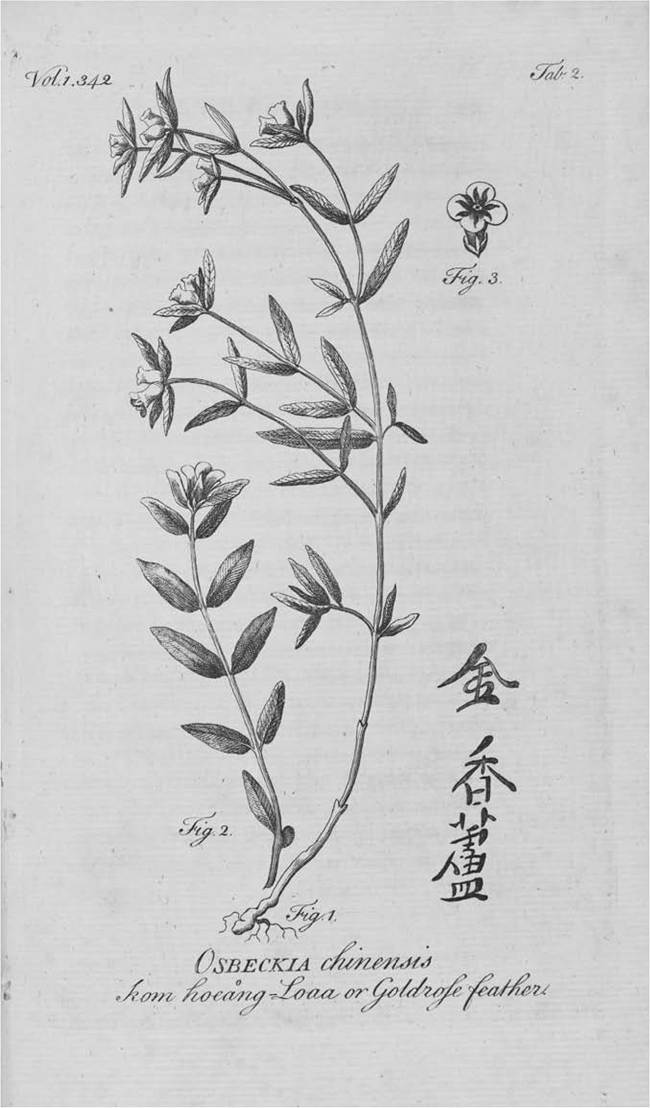
Figure 16.3 Illustration from A Voyage to China and the East Indies, by Peter Osbeck. (London, 1771). Reproduced by the permission of the Syndics of Cambridge University Library.
that had characterised the Linnaean era. Travel journals with endless lists and detailed descriptions of individual objects and specimens gradually had to give way to new ways of seeing the natural world with the arrival of plant geography.38 The Swedish East India Company became unprofitable in the final years of the century, mainly because of further British maritime expansion and changes in British taxation on tea imports, and the Company was dissolved in 1813.
It could also be argued that Linnaean science was a victim of its own success. Due to Linnaeus’ fame in Europe, several of his best students were offered employment outside Sweden. One of the most promising Apostles, Carl Peter Thunberg, was for years engaged by the Dutch East India Company, working in the Cape, Java and Japan. When he eventually returned to Sweden in 1779, Linnaeus was already dead.39 Similarly, around 1770 Captain Ekeberg managed to acquire permission from the Dutch authorities to post a Swedish botanist in the Cape Colony. Linnaeus was delighted, and sent out his student Anders Sparrman, who had already sailed to Canton and published an account of China. Before long, Sparrman received an offer he could not refuse: the Englishman James Cook who stopped over at the Cape on his way to the Pacific, quickly invited the associate of the famed Linnaeus to join his expedition.40
This was not the first time Cook had employed a student of Linnaeus. Daniel Solander had initially been sent to London to work on the natural history collections of the British Museum when he was recruited to accompany Cook and his naturalist, Joseph Banks, on the Endeavour, the first of the Cook expeditions. Solander would remain in Britain, working closely with Banks, one of the instigators of Britain’s ascendancy as Europe’s leading scientific nation towards the end of the century. The life and work of Banks have been studied to show how the natural sciences and political economy became intertwined at this time, as botany became a tool in the hardening rivalry between Europe’s colonial powers.41 Here, Banks as a central figure organising, collecting and reporting held a position which much resembled that of Linnaeus in Uppsala fifty years earlier, with the difference that plants and botanical knowledge were now not only collected but also disseminated across the British Empire. As British interest in China accelerated, the Swedes could still act as important intermediaries. One such example is Johan Petter Bladh, a keen naturalist and supercargo in the declining Swedish East India Company, who during the first years of the new century sent plants from Canton home to the Swedish Academy and private collectors in Sweden to but also to Banks in London.42 By now, a common scientific language was used and understood by scientists all over Europe. Linnaean nomenclature and taxonomy had made these global botanical exchanges possible, only now they were carried out in a much bigger arena, propelled by new goals of colonial expansion.
Notes
1 Michael Roberts, The Age of Liberty: Sweden 1719--1772 (Cambridge, 1986).
2 Biographies of Linnaeus in English are Frans A. Stafleu, Linnaeus and the Linnaeans: The Spreading of their Ideas in Systematic Botany, 1735--1789 (Utrecht, 1971); Tore Frangsmyr, with contributions by Sten Lindroth, Gunnar Eriksson, Gunnar Broberg, Linnaeus: The Man and his Work (Berkeley, 1983); Wilfred Blunt, Linnaeus: The Compleat Naturalist (London, 2004).
3 Linnaeus’ correspondence has been published in the series Bref och Skrifvelser af och till Carl von Linne (Stockholm, 1907-1943). See also the ongoing online Linnaeus Correspondence Project, http:// linnaeus.c18.net/.
4 Sverker Sorlin, ‘Scientific travel—the Linnean tradition', in Tore Frängsmyr (ed.), Science in Sweden: The Royal Swedish Academy of Sciences, 1739--1989 (Canton, MA, 1989), pp. 96-123.
5 Lisbet Koerner, Linnaeus:Nature and.Nation (Cambridge, MA, 1999).
6 Pehr Kalm to Linnaeus, 3.6.1748, translated from Sverker Sorlin and Otto Fagerstedt, Linne och hans apostlar (Orebro, 2004), p. 65.
7 Sverker Sorlin, ‘Apostlarnas gärning. Vetenskap och offervilja i Linne-tidevarvet', Svenska Linne- sällskapets ärsskrift (Uppsala, 1990-1991), pp. 75-89; Sorlin and Fagerstedt, Linne och hans apostlar.
8 Sten Lindroth, Kungliga Svenska Vetenskapsakademiens historia 1739--1818, Vol. 1,2: Tiden intill Wargentins dod (1783) (Stockholm, 1967); Tore Frängsmyr (ed.), Science in Sweden.
9 A company founded in the 1620s had not taken off primarily due to Sweden's heavy involvement in the Thirty Years' War on the continent. Histories of the Swedish East India Company in Swedish include Sven T. Kjellberg, Svenska ostindiska compagnierna, 2 vols (Stockholm, 1973 and 1975); Tore Frängsmyr, Ostindiska kompaniet. Människorna, äventyret och den ekonomiska drommen (Hoganäs, 1976); Kristina Soderpalm (ed.), Ostindiska Compagniet: Affärer och foremäl (Gothenburg, 2000); Christian Koninckx, The First and Second Charters of the Swedish East India Company (1731--1766): A Contribution to the Maritime, Economic and Social History of North-Western Europe in its Relationships with the Far East (Kortrijk, 1980).
10 Nils Matson Kioping, Een kort beskriffning uppä trenne resor och peregrinationer, sampt konungarijket Japan (Wisingsborgh, 1667).
11 Kristina Soderpalm, ‘SOIC—ett skotskt foretag?' in Soderpalm (ed.), Ostindiska Compagniet, pp. 36-61. See also Leos Müller, ‘The Swedish East India Company: Strategies and Functions of an Interloper', in Markus A. Denzel, Jan de Vries and Philipp Robinson Rossner (eds), Small is Beautiful? Interlopers and Smaller Trading Nations in the Pre-industrial Period (Stuttgart, 2011), pp. 73-93.
12 Arvid Hjalmar Uggla, ‘Linne och bananen', Svenska Linnesällskapets ärsskrift (Uppsala, 1959), pp. 79-88.
13 Jacobus Bontius, ‘Histori® naturalis & medic® Indi® Orientalis', in Gulielmi Pisonis, De India utriusque re naturali et medica, libri quatuordecim: quorum contenta pagina sequens exhibit (Amsterdam, 1658).
14 Linnaeus to the Academy of Sciences, in Bref och skrifvelser, I:2 (1908), pp. 187f.
15 E.M. Beekman (trans. and ed.), The Ambonese Curiosity Cabinet: Georgius Everhardus Rumphius (New Haven, 1999), Introduction.
16 Linnaeus to Johan Fredrik Dahlman, in Bref och Skrifvelser, I:5 (1911), p. 329.
17 Linnaeus to Elvius, Bref och Skrifvelser, I:2 (1908), pp. 72-73.
18 Linnaeus himself published a Flora of Ceylon, Flora Jeylanica, in 1747, but this was for the most part based on a herbarium to which he had had access in Holland, collected by a Dutch VOC official.
19 Lindroth, Kungliga svenska, p. 632.
20 Johan Leche to Linnaeus 1746, quoted in Lindroth, Kungliga svenska, p. 638.
21 Minutes of the Royal Swedish Academy of Sciences (KVA) 3.3.1750.
22 Bjorn Lindeke and Qun-Ying Yue, ‘Ett kinesiskt apotek', in Soderpalm (ed.), Ostindiska Compagniet, pp. 211-220.
23 Carl Forsstrand, ‘Carl Gustaf Ekeberg, hans färder till Ostindien och Kina. Naturvetenskapliga intressen och forbindelser med Linne', Svenska Linnesällskapets ärsbok (Uppsala, 1928), pp. 147-161.
24 Lindroth, Kungliga svenska, p. 640. See also Minutes of the Royal Swedish Academy of Sciences (KVA) 15.6. 1754.
25 ‘Instruction for Magister Tärnstrom', Bref och skrifvelser, I:2 (1908), pp. 53-54.
26 See Christopher Tärnstroms Journal: en resa mellan Europa och Sydostasien, Ar 1746/Christopher Tärnstrom's Journal: A Passage between Europe and East Asia in the year 1746, Kristina Soderpalm (ed.) (London,
2005).
27 ‘Beskrifning pa et slag ostindiska ärter... beskrefne af Carol Linnaeus', Svenska Vetenskaps Akade- miens Handlingar, Vol. 3 (1742).
28 Peter Osbeck, A Voyage to China and the East Indies... Together with a Voyage to Suratte by Olof Toreen... and Account of the Chinese Husbandry by Captain Charles Gustavus Eckeberg, Vol. II (London, 1771), p. 39.
29 Gustaf Drake, ‘Linnes avhandling potus Theae 1765', Svenska Linnesällskapets arsskrift (1939), pp. 27-43.
30 Kenneth Nyberg and Mariette Manktelow, ‘Linnes apostlar och tillkomsten av Species plantarum’, Svenska Linnesällskapets arsskrift (Uppsala, 2002-2003), pp. 9-30.
31 This referred to the whole of the East Indies, i.e., including China.
32 Carl von Linne, Menniskans cousiner (Anthropomorpha). Afterword and notes by Telemak Fredbärj (Ekenäs, 1955).
33 Osbeck, A Voyage to China, Vol. I, p. 131.
34 Pehr Osbeck, Dagbok Ofwer en Ostindisk Resa Ären 1750. 1751. 1752 (Stockholm, 1757).
35 See, for example, Osbeck, A Voyage to China, Vol. I, p. 389.
36 See also Anne Fox Maule and Carlo Hansen, ‘Linnes korrespondance med Pehr Osbeck 1750-1753’, Svenska Linnesällskapets arsskrift (Uppsala, 1972-1974), pp. 75-145.
37 The English translation was done by Johann Georg Forster, an associate of Linneaus, who later was to accompany James Cook to the Pacific.
38 Karin Johannisson, ‘Naturvetenskap pa reträtt. En diskussion om naturvetenskapens status under svenskt 1700-tal’, Lychnos (1979-1980); Per Eliasson, Platsens Blick. Vetenskapsakademien och den naturalhistoriska resan 1790--1840 (Umea, 1998).
39 Thunberg’s travel account Resa uti Europa, Africa, Asia was published in four parts in 1788-1793 and soon translated into German and English.
40 L.C. Rookmaaker, The Zoological Exploration of Southern Africa 1650--1790 (Rotterdam, 1989).
41 Richard Drayton, Nature's Government: Science, Imperial Britain, and the ‘Improvement' of the World (New Haven, 2000).
42 E. Bretschneider, History of European Botanical Discoveries in China, Vol. I (London, 1898), p. 111.
Further reading
Blunt, Wilfred, Linnaeus: The Compleat Naturalist (numerous editions).
Brorson, Hedvig, The Influence of East India Trade on Swedish Culture and Social Thought: Chinoiserie, Utility and Theory (Stockholm, 1993).
Frangsmyr, Tore, with contributions by Sten Lindroth, Gunnar Eriksson, Gunnar Broberg, Linnaeus: The Man and His Work (Berkeley, 1983).
Frangsmyr, Tore (ed.), Science in Sweden: The Royal Swedish Academy of Sciences, 1739--1989 (Canton, MA,
1989).
Johansson, Bengt (ed.), The Golden Age of China Trade: Essays on the East India Companies' Trade with China in the 18th Century and the Swedish East Indiaman Giitheborg (Hong Kong, 1992).
Koerner, Lisbet, ‘Carl Linnaeus in his Time and Place', in N. Jardine, J.A. Secord and E.C. Spary (eds), Cultures of Natural History (Cambridge, 1996), pp. 145-162.
Koerner, Lisbet, Linnaeus: Nature and Nation (Cambridge, MA, 1999).
Koninckx, Christian, The First and Second Charters of the Swedish East India Company (1731--1766): A Contribution to the Maritime, Economic and Social History of North-Western Europe in its Relationships with the Far East (Kortrijk, 1980).
Roberts, Michael, The Age of Liberty: Sweden 1719 1772 (Cambridge, 1986).
Schiebinger, Londa, and Claudia Swan (eds), Colonial Botany: Science, Commerce, and Politics in the Early Modern World (Philadelphia, 2007).
Skott, Christina, ‘The VOC and Swedish Natural History: The Transmission of Scientific Knowledge in the Eighteenth Century', in Siegfried Huigen et al. (eds), Dutch Trading Companies as Knowledge.Networks, Intersections: Yearbook for Early Modern Studies, Vol. XIII (Brill, 2010), pp. 361-392.
Sorlin, Sverker, ‘Ordering the World for Europe: Science as Intelligence and Information as seen from the Northern Periphery, Osiris, Vol. 15 (2000), pp. 51-69.
Wallenberg J., My Son on the Galley, Peter Graves (ed. and trans.) (Norwich, 1994).