CHAPTER XVII. CHERSONESE.
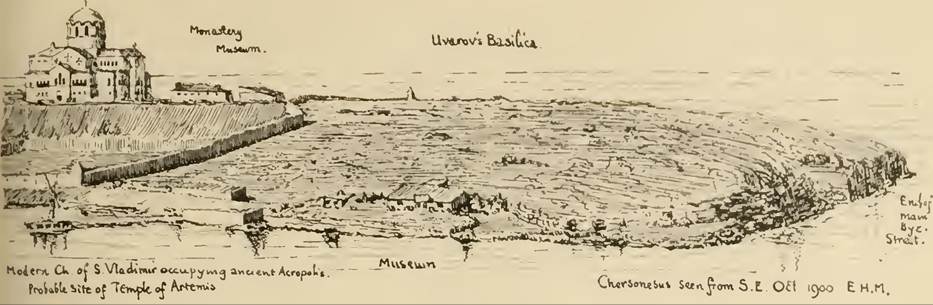
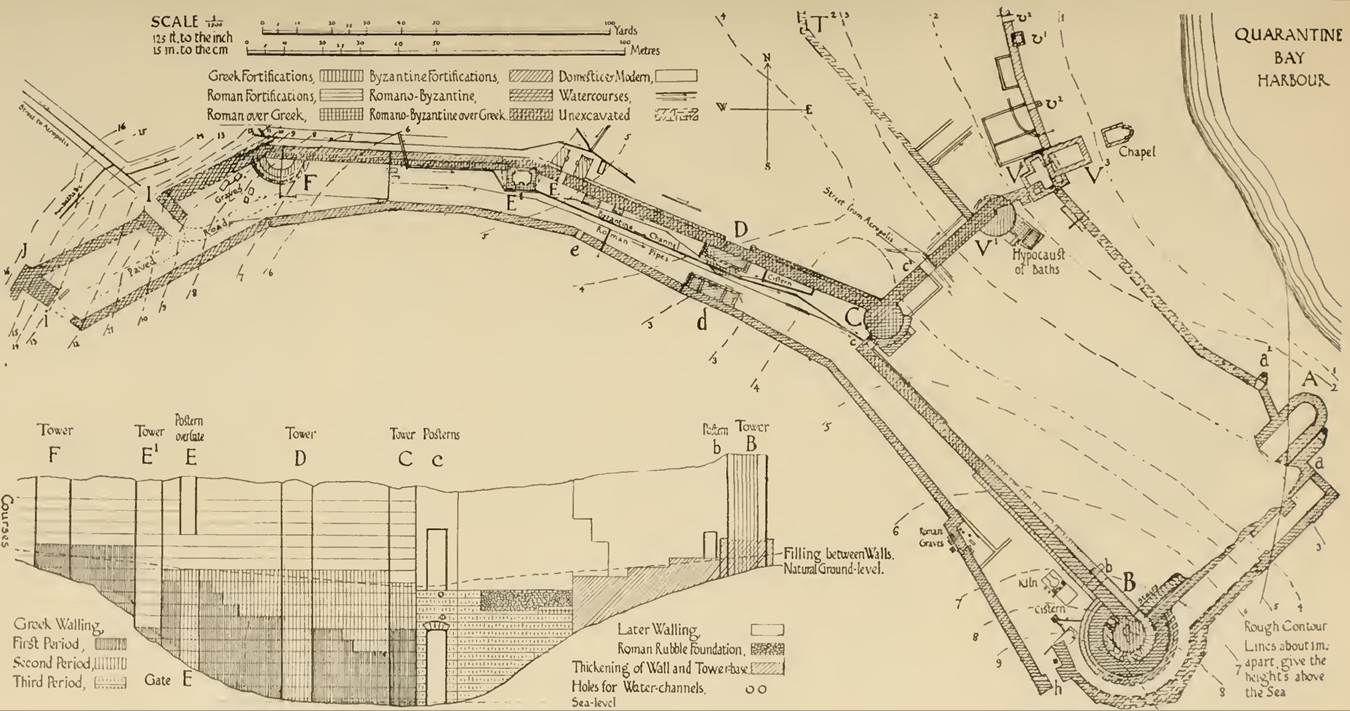
Fig. 333 b.
Chersonese[MCXXIV] differs from all the other Greek colonies on the north shore of the Euxine except Cercinitis in being Dorian.
It can hardly be a coincidence that like the other Dorian colonies it was founded on a site which however accessible from the sea did not offer special advantages for trade with the interior. Just as Heraclea Pontica, its mother city, had its own territory from which it drew supplies, so for the greater part of its existence Chersonese had mainly to rely on the produce of the Lesser Peninsula which soon became its very own, and in flourishing periods on possessions in the west part of the Crimea. But when the other colonies because of their intimate connexion' with the natives whose hostility might bring ruin fell into decay through the change of population, then rose to importance thement of Phlegon of Tralles in the time of Hadrian, but the quotation occurs in late authors who may have substituted the more modern form (e.g. Const. Porph. de Them. 11. 12, p. 63). Dionysius Exiguus (ap. Mansi, Condi. III. p. 366, but cf. p. 383) translates the signature of Bp Aetherius 11 at the second council of Constantinople A.D. 381 as ersoni- tanus, whereas his successor at the council of 448 was Styled етгісгкотгог Xeppovtjaov (ib. VIII. p. 239, cf. p. 243): that is the long form did not at once give way to the short. The latter appears in Latin as Chersona in Jordanes (Get. V. 32, 37). The Russian chronicle makes it Корсунь, Koisun. The Tartar name was Sary Kerrnen, the yellow fortress, cf. Selivanov, p. 10, n. 3: Brandes, s.v. Chersonesos (20), P.-ll'. III. p. 2261. 1 shall call it Chersonese as the anglicized form of the word is familiar though not in its application to this city.
modest commerce of the Chersonesites, safe in their remote corner of a secondary peninsula.
So the time when Chersonese was of moment in the world was when it was handing on to the untouched tribes of Russia the religion and culture of Eastern Rome. That is my excuse for continuing my sketch of its history to the time when cut off from the interior by the Mongols it died at the coming of the Turk.Since then it has lain desolate. In 1578 Martinus Broniovius de Biezdz- fedea[1125], ambassador from Bathory to the Crim Tartars, visited the site of which he left a high-flown account more indebted to Strabo than to his own eyes. So it remained until the coming of the Russians in 1783, and the speedy foundation of Sevastopol. Chersonese then became accessible to travellers and the first learned folk to see it were Pallas[1126], Mrs Guthrie[1127], and Dr E. D. Clarke[1128]. All these had preconceived ideas of what ought to be found on a classical site, and when nothing of the sort was to be seen, they ascribed the desolation to a Russian passion for destruction. General A. L. Bertier-de-La-Gardes has shewn that Pallas and Clarke much exaggerated the damage done. Clarke, more especially after the treatment he had suffered at the hands of the insane Emperor Paul, was no doubt excessively prejudiced against the Russians, and everywhere speaks of the antiquities that he saw as doomed to destruction. As a matter of fact everything he mentions has been preserved unto this day; but the explanation is probably that he visited the country just as real order was being established, and the pioneers of conquest were giving place to a more settled administration which could see to the preservation of antiquities. But during the first twenty years it was small blame to the Russians if they used Chersonese as a quarry for Sevastopol and stripped the town of the ready squared stone that lay on the surface. General Bertier-de-La-Garde argues that during its long decay the city’s fine buildings had been dilapidated by its own inhabitants, and that there was nothing but small rough stone left by the time the Russians appeared, but the amount of squared stone walling discovered in recent excavations offers a presumption that much had remained aboveground and was greedily carried off to Sevastopol.
It can hardly be held that it was more trouble to cart stone a couple of miles than to quarry it at Inkerman five miles off. Some destruction had already been done by the Turks who are said to have shipped columns across to Constantinople, by the Genoese, and by the Tartars; but at the time of the Russian occupation the remains of the poor Byzantine town stood almost intact surrounded by its walls, and with its gates in sitif: much in the same way Chufut Kale stands on its hill deserted by all but a Rabbi in charge of the Karaite synagogue, the people having gradually moved to Baghchi Saraj. To charges of reckless destructiveness Russians can reply that the Allies did their share of damage during the siege of Sevastopol.4 Travels, Vol. II. pp.206,273, London, 1817,8vo.
5 Mat. XII. p. i sqq.
0 A view shewing it like this is reproduced in Ainalov, Monuments of Christian Chersonese, I. p. i, f. 2 after Sumarokov, Leisure of a Crimean fudge, St Petersburg, 1803, but it is mostly fancy.
The Lesser Peninsula.
The home domain of Chersonese consisted of what Strabo calls the Lesser Peninsula, a triangle of which the base is the line from Inkerman to Balaklava (7^miles=i2 km.) and the south side the inhospitable coast from the latter to Cape Chersonese about 14 miles (23 km.) following the slight curves. The general line of the north side is fairly straight and extends some 12 miles (20 km.) from the Cape to the head of the North Bay at Inkerman, but the coast is deeply indented and presents a wonderful series of harbours.
This triangle is a plateau which has a general slope towards the north and especially the west (on Map vm. the heights arc marked in feet), from the cliffs at the extreme south, where they reach 1000 feet (304 m.) to the lower cliffs opposite Inkerman, and to the Hat Cape Chersonese. The edge of the plateau forms an escarpment overlooking a depression which coincides with the base of the triangle.
Further to the cast were the mountains of the Tauri, a region that the Chersonesites never seem to have subdued until after the Christian era. This triangle is precisely the limit of the ground occupied by the Allies besieging Sevastopol; they could hold the Sapun and Karagach escarpment against the Russian armies that attempted to relieve the town. It is drained by many ravines which make the inlets of the northern coast. General Bcrtier-de-La-Garde[1129] still further reduces the space owned by the citizens saying that traces of their occupation scarcely extend east of the South Bay of Sevastopol.This exposed limestone plateau is now mostly barren: it lacks moisture and the soil is very thin : only in the ravines are there attempts at gardening and a few vineyards on the south-eastern slopes above Kadikoj. Yet in ancient times its whole surface was undoubtedly cultivated. Dubois de Mont- p6reux traced all over it the lines of regular boundary walls and in many places the foundations of the ancient homesteads[1130]. Inscriptions give us fragments of a decree concerning the apportionment of land[1131] and Agasicles is praised for his services in a redistribution of the vineyards[1132] [1133] [1134] [1135]. The produce of the vineyards was exported in amphorae referred to Chersonese on account of Doric names which coincide with those of known Chersoncsan magistrates’. I have no explanation of the enigma to offer unless it were a great diminution of rainfall ; perhaps if sufficient labour and intelligence were applied to the peninsula it could support a considerable population. Nowadays this is not worth while as the valleys along the south coast of the great peninsula are far more attractive; debarred from these by the Tauri the Chersonesites did their best with difficult soil. In later times when decay set in Chersonese had to rely on imported wine and grain paid for with hides and wax from the Pecheneg country8. Let us now apply Strabo’s description to this country. 3 I os PE. iv. 80. 4 losPE. I. i95=App. 17. This may refer to land in the west of the Crimea, v. p. 518. 5 Collected and well annotated by I. I. Makhov, Bull. Taur. Rec. Comm, xi.vm. 1912. 6 Const. Porph. de Adm. Imp. c. 53, v. inf. p. 538. “As you sail out (of the Gulf of Carcinites) you have on your left[1136].............. a townlet and another harbour of the Chersonesites. For as you continue your sail there stretches out towards the south a great promontory being part of the main Chersonese and upon it is built the city of the Heracleotes, itself called Chersonese. In this is the Sanctuary of the Maiden (a deity after which also is named the cape that runs out in front of the city at a distance of too stades and is called Parthenium[1137]) with a temple of the deity and an image. But between the city and the cape are three harbours. Then comes Old Chersonese all pulled down and after it a harbour with a narrow mouth, at which point the Tauri did most of their piracies attacking those that took refuge in it: it is called the harbour Symbolon. And this harbour makes with another called Ctenus an isthmus forty stades broad, this is that which shuts in the lesser Chersonese which we said was a part of the great Chersonese and has in it the town with the same name of Chersonese.” In the next section Strabo remarks that Ctenus is the same distance from the town Chersonese as from the harbour Symbolon. Again (l.c. § 7) he speaks of “a place called Eupatorium founded by Diophantus general of Mithridates. It is a cape distant about 15 stades from the wall (τείχους) of the Chersonesites making a fine large bay turned towards the city. Above it is a sea-mere with salt-works. This was where Ctenus was.” He next describes how Diophantus fortified the cape and made a mole across to the city (και το στόμα τον κόλπον το μέχρι, τής πόλεως διεχωσαυ, surely this must be a mistake, a bridge or boom would give the easy communication sought) and how when the Scythians tried to pass the ditch across the isthmus towards Ctenus, by filling it up each day with reeds, the king’s men burnt them each night and so repelled their attacks (v. With New Chersonese fixed the promontory Parthenium must be that now called Cape Chersonese, the distance of too stades agrees fairly well with the actual 85, by land it would agree almost exactly. The three harbours would be Strelets, Reedy and Cossack Bays. The narrow-mouthed harbour Symbolon is clearly Balaklava. Old Chersonese should be somewhere east of Cape Parthenium. Clarke and Pallas say that the isthmus between Cossack Bay and the south-western sea was covered with the remains of a town, and on this the only conceivable site, Kosciuszko-Waluzynicz’s excavations exposed two cross-walls with towers and gates, also remains of houses and small antiquities going back to the Greek period of Chersonese. The end of one of the text in some such form as this— eKnAeoNTiAeN&piCTe PAicctikaAocAimhn K'TeiXHXeppONHClTCO- eiTAAeKApKINITIC ttoAixnhk'aAAocAimhn XeppONHClTCON The lines are hardly shorter than usual, e.g. Kenyon, Palaeography of Greek Papyri, pp. 21, 66, Pl. XI. or Schubart, Pap. Gr. Berol. 31, Theaetetus. 2 Latyshev, l.c. first proposed taking this as a parenthesis and so doing away with the idea of two sanctuaries, one in the town, another on the cape. Hence the buildings identified as this temple by Pallas and later travellers are probably but homesteads with well-built refuge towers. xviiJ Old and New Chersonese. Ctenus. Eupatorium 497 the walls projected into Cossack Bay and formed an island upon which the Byzantines built a monastery answering to the account of the first resting place of S. Clement of Rome. If this fortress was not Old Chersonese it may have been a place of refuge to which cattle might be driven away from inroads of the Tauri, perhaps one of the referred to in the citizens’ oath (v. p. 516)'. In 1910 N. M. Pechonkin8 found pots and other objects beginning like the oldest things from New Chersonese with the end of the ivth century b.c. and going down to the early Roman period, when Strabo speaks of the place as ruined. They do not tell us whether this was the original settlement made in a corner remote from the natives because the Heracleotes were not yet sure of their ground, nor, if so, when the bulk of the population migrated, leaving a mere remnant behind. Pliny (l.c.), who does not seem dependent on Strabo, implies the existence of Old Chersonese by speaking of Cherronesus Nea. Ctenus is clearly the great bay now called North Bay, the subsidiary Quarantine, Artillery, South, Dock and Careening Bays make it not unlike a comb. Balaklava to Inkerman is nearer sixty than forty stades3 but this distance just answers to the five miles from Chersonese to Inkerman. Eupa- torium fifteen stades from Chersonese must have been a fort made by walling off the end of the North Cape and this is the isthmus towards Ctenus of which Strabo speaks in § 7 ; not the isthmus Balaklava-Inkerman. Pallas and Clarke misunderstanding this passage saw remains of a wall along the latter line ; but General Bertier-de-La-Garde declares that there are no traces of it now and well shews that the population of Chersonese could not have manned so long a wall. No doubt they had observation-posts along the Sapun ridge and relied on the lie of the land for protection. Even so the massive foundations of the scattered homesteads suggest that they were built to offer refuge against sudden raids ; there were no open villages. The value of a tete-de-pont like Eupatorium to Diophantus who carried war into the country of the Scyths is evident, saving him from the long march round the North Bay and the dangerous passage of the Chernaja. The batteries on North Cape remained in Russian possession and the defenders of Sevastopol retired to them by a bridge thrown across from the city and so withdrew. ' No attempt has been made to state the many conflicting views as to these various localities, c.g. Burachkov put Eupatorium at Eupatoria regardless of distances. Eupatoria is another instance of singularly unfortunate application of ancient names. Bertier-de-La-Garde4 denies that Eupatorium was the name of the fortress built by the besieged across the bay ; yet this is the natural deduction from Strabo’s words ; so the Allies had their Fort Victoria. He maintains that the whole story about Scythian siege applies exactly to Cossack Bay and the site of Old Chersonese : the points deciding him are the sea-mere with salterns and the shallowness of the bay which allowed of throwing the mole across it. Von Stern5 will have none of Old Chersonese but allows the scene of this siege to have been in Cossack Bay, saying that it is a 1CR. 1890, p. 37, and Clarke’s plan, 11. p. 273. 4 BCA. XXI. p. 177 sqq. ■Arch. Anz. 1911, p. 206; BCA. XLll. pp. 6 Brans. Orf. Sac. XIX. Minutes, p. 99 ; Hettier’s 108—126. Zt.f. Alte Gesch. 1. 2. pp. 63—71, and again Trans. 3 Pallas says that the distance does not look Orf. Sac. xxvin. Minutes, p. 89. more than 40, op. cit. 11. p. 62. M. 63 matter of the τείχη or forts of the Chersonesites (v. p. 516) not of the city wall, but this again is straining Strabo’s words as he mostly speaks of πόλις. The view in the text has to give up διόχωσαρ : 15 stades of mole is too much to ask, however shallow the bay: a bridge is no mean feat. The saltern cannot be reckoned a permanent geographical feature, but there is a lake just inside North Cape[1138]. Site and Remains. The final settlement of the Heracleotes was on a low peninsula between the lesser Round Bay and the Quarantine Bay[1139]. Among all the harbours offering this seems to have been chosen because it was well commanded by an easily fortified site yet itself had gently sloping shores suitable for the Greek method of beaching ships. The western harbours provided no kind of acropolis, the eastern such as South Bay were enclosed by steep cliffs, and North Bay was on too large a scale and too much exposed to enemies. The space finally enclosed by the walls of New Chersonese is some five eighths of a mile (about 1 km.) long from west to east and 600 yards (550 m.) from north to south occupying the whole of the blunt headland between the two bays. This gives a circumference of two English miles (3 km.) which can in no way tally with Pliny’s five Roman miles[1140]. This considerable extent was naturally not built with one effort, but the capricious progress of the work shews less perseverance than might have been expected. The explanation is 1 other. I took as my main basis that given in Brockhaus-Jefron’s Russian Encyclopaedia, s.v. Chersonese, and on it endeavoured to combine the sectional plans drawn to various scales which have accompanied the yearly reports of the excavations published in CR. from 1888—1906 and in BCA. (v. Bibliography p. 551). Finally 1 corrected the fortifications by Bertier-de-La-Garde’s Pl. H.&c.,and the churches and earlier excavations by Ainalov, Monuments of Christian Chersonese, 1. “ Ruins of Churches,”f. 1, and Mr M. I. Skubetov, draughtsman to the excavations, made some important additions on theroughcopy. Thedeath of Mr K. K. Kosciuszko- Waluzynicz in December 1907 made it impossible to bring out the full results of his last two years’ work. To him we owe almost all our knowledge of what has been actually found at Chersonese and I am specially indebted to him for his courtesy in giving me information on the spot and in supplying me with the latest results of his researches. The present Director of the excavations, Dr R. Loper, has continued his predecessor’s kindness to me. A great hindrance to the work is the presence of the monastery, which takes up the best part of the site. Its great church, the chief landmark of Chersonese, is built over the remains of a basilica hastily assumed to be the scene of Vladimir’s baptism. Further the operations of military engineers are destructive but unavoidable as the site is of such strategic importance to Sevastopol. 3 NH. IV. 85. This distance must refer to the isthmus of Perekop, cf. Pomp. Mela 11. 3, 4, whom Pliny seems to have misunderstood. that until the ist century b.c. a wall of crude brick or a palisade was in places defence enough. During the ivth century when danger was to be feared from the aggressive policy ol the Spartocids, Greek poliorcclics were rather elementary, later on it was only a question of barbarian raids almost powerless against any sort of fortification *. One exposed point of the position was clearly the lowest part of the site towards its se. corner (Fig. 338) commanded as it is by a considerable hill to the sw. of it: moreover it was vital to protect the port. Here accordingly was made the first attempt at fortification, or probably, as von Stern points out2, the beginning was made here for physical rather than tactical reasons. Between E and />’ the wall goes down into a deep valley the middle of which about DC is nothing but the old bed of an arm of the harbour. The foundations actually stand in water and for that reason have not been exposed. In this water crude brick would simply have melted3; so from the tower E to the tower C were built the lower courses of a wall, and towers and gates were laid out: the towers had rather shallow projection and the gates were not well commanded by cross fire, but it was early for these improvements. This whole piece of work is admirable, even extravagant in execution. The stones are large and “rusticated,” i.e. carefully smoothed round the edges, the face being left rough ; they are laid as headers and stretchers alternately, without mortar but held by swallow-tailed wooden clamps. The facing is backed with rubble and stones set in clay, total thickness 12 ft. 8 in. (3'85 m.). Upon some stones are masons’ marks, notably an N with the archaic slope, later forms point to the ivth century4. Deep in the heart of the wall5 by the gate and dating from its construction is a sepulchral passage, a kind of T-shaped tunnel containing urns within which were ashes and jewelry, the earliest of which is of the ivth century, the latest about a hundred years more recent (v. pp. 380, 397—399, 402, 410 n. 1, 422): members of a distinguished family were successively buried here : having regard to the singular position, may it not be supposed that we have here the family tomb of the builder of the wall? He may have deserved the honour by his munificent intentions, but he did not execute them. The curtain walls were nowhere carried up more than nine courses6; some of the towers were left even lower (v. elevation on Fig. 338): also the gate E by its position involved a most inconveniently steep approach. Perhaps because these weak points were observed the work was left incomplete as is shewn by the regularly stepped line of its top courses, quite unlike the look of a wall which has been partly knocked down after having once been finished; further no similar stones have been found used as material in any later building. A second attempt was made after a short interval which did not give the projecting corners time to weather : the work was more cheaply executed, the stones smaller and far less regular, though still rusticated; there are no masons’ marks. In this style the stepped upper line of the first attempt was brought to a level, but in other respects the former plans were departed from. The unfinished gate E was walled up and the towers were rebuilt with more projection, thus the depth of this stratum varies from eleven courses at the tower D which had not been intended by the first building, and seven in the curtain wall by C to one course on the wall about the gate E (v. elevation on Fig. 338). 1 How elementary they were in the vth century is well shewn by Grundy, Thucydides and the History of his Age, Ch. XIII. p. 282 sqq. Bertier- de-La-Garde thinks that Old Chersonese remained as a refuge until the ist century v.D. and so the Cheisonesites were in no hurry to complete their defence on the new site. - 'Trans. Od. Sac. xxvin. Minutes, p. 113. 3 Cf. Xenophon, Hellen, v. ii. 1—8. 4 BCA. XXI. p. 93, f 14; similar marks along L-N-0 and on the house-walls G-G. 5 v. inset Plan vii; BCA. I. pp. 3—5, ff. 2—4. й Mr Wace suggests a mud brick top to the wall. FlG. 334. Gates (A on Plan vn. v. inset) in the Greek Wall of Chersonese. Eight courses of 1st period, one of 2nd; above, Roman with threshold of postern. The gate was 3'87 m. broad, the passage way 839 m. long. Just within the entrance are portcullis-grooves and 5’33 m. from the face of the wall are projections reducing the opening to 2’12 m. To the east of the gate inside was a stair to go up on the wall. Three water runnels meeting give the directions of streets, two “back of the walls,” one towards the Acropolis and one towards the harbour (Fig. 338). At a lower level than all this was a sepulchral monument 2'40111. square as it were a pyramid with three steps (CR. 1900, p. 21, f. 43). The jambs of the gate shewed no signs of any traffic having passed through it. From a photograph furnished by Mr Kosciuszko-Waluzynicz, who stands in the gateway. The plans were changed even during the execution of this small piece of work. In the second style the foundations were laid of a wall running east of tower C to a round tower of the same size (f71 on Fig. 338)[1141]. Then they seem to have decided to include a greater space for the harbour district and the towers y/1 and B were built, but nothing remains to connect B up with a curtain wall. So far they had got by the mrd century b.c. Towards the end of the iincl century they began to join up towers C and B by means of a wall jutting out to the west of C and having in it a postern c with a skilfully turned arch : this wall only reached half-way to A[1142]. After the middle of the last century b.c., perhaps as a result of experiences in the wars with Scilurus, they tried to make Chersonese more defensible on this side and also more convenient. With the latter intention the existing masonry wall was sacrificed. We have seen that between and B the wall Fig. 335. BCA. 1. p. 39, f. 23. Greek walls at Chersonese looking se. from near e towards Dd. Seven courses of first period, four of second with round tower D. Upper work and square towers Dd, Roman. descended into a deep valley. The road to the main part of the city followed it down into this marshy depression and then climbed a very steep slope to the gate at about I. To remedy this the beginnings of the defensive walls were used as a retaining wall and earth to the depth of about 20 ft. was piled against their outer face to make a causeway., Another weak point was at the sw. corner L-N, where an enemy might come along a hog’s back leading gently down to the town : here again we have ivth century work forming a foundation for the walling of irregularly squared but not rusticated stones characteristic of the Roman period, when the circuit was finally completed in masonry. From the successive towers A\ A2 on the shore of the harbour1 a wall five times rebuilt runs sw. to B, the most exposed point in the circuit. Hence the original narrow tower of the second Greek period was treated as a mere nucleus thickened at three successive rebuildings. Just by it was a postern b. The piece of wall from B to C rested for its northern half on the Greek wall of the second period, but the latter had been completely earthed over, for there are courses of rough foundation masonry between it and the lowest course of Roman finished walling2. A new postern c was built just above the former one. Its object was to allow sallies from b to return to the town without exposing their right flank to an enemy. In the straight piece from C to E (Fig. 335) the three periods of masonry are best seen. At D the second period had designed a weak semicircular tower. The gate at E had long been walled up. It had no proper cross fire to defend it, and was altogether badly placed. The round Greek tower Ex to the west of it was not a powerful work, in Roman times it was rebuilt in rectangular form3. F a stronger circular tower4. No Greek work remains along the slope from F almost to L. At I was the main town gate for traffic approaching from the east and a street led up from it to the Acropolis5. J was a tower whose importance came later6—between it and the se. corner tower L1 there were only three ordinary towers as here the ground falls steeply from the foot of the wall. Some way along this space were the main Thermae8 from which successive lines of water-courses ran between the walls to c, here re-entered the town over the postern and so gained the harbour9. The next section L-N ran across a ridge giving easy access to the great gates M, the chief entrance to the town from the plateau, Balaklava and Old Chersonese : the gates were renewed in Byzantine times, and the actual doors stood until the xvmth century. The aqueduct from Jukharin’s Ravine entered the town at this point: but the levels were equally favourable for bringing siege engines up to this piece of wall, therefore it was built as early as the ivth century b.c. and in Roman times rebuilt, doubled and strengthened by four towers: in 1894-5 was mostly cleared away by the War Office10. The same applies to the stretch N-O. From O the foundations of the Greek wall go straight on nnw. to A*1, the remains of a round tower ; there must have been three towers in between. The Romans turned the wall westwards at a small gate and a tower: their wall makes two more projecting bends with towers, a re-entrant angle by 0 where a retaining arch carries it over a burial chamber11, and finally at A2 reaches the sea at a tower half of which has fallen12. This tower commanded the postern p (v. Fig. 336). This western section of the wall is remarkably well designed to secure cross-fire and is further strengthened with an outer wall. The system of an outer wall was applied also to the other part of the walls resting on Greek foundations. The reports in BCA. give it as early Byzantine but one stretch seems according to the graves it disturbs to be rather of the Antonine age13. It reaches 1 CR. 1897, pp. 91, 92, ff. 203, 204. 2 BCA. xxi. Pl. vii. 3 CR. 1904, pp. 64—67, ff. 96—102. 4 CR. 1903, Pl. in. i., p. 30, f. 28. 8 CR. 1905, Pl. 11. 6 BCA. xvi. Pl. in. 7 CR. 1893, p. 57, f. 35. 8 Plan CR. 1898, p. 113, f. 13. from the tower J past the gates I to the 9 ib. p. 107, f. 7 ; 1899, p. 4, Pl. 1; 1900, Pl. 1. 10 My plan follows Garaburda as very kindly amended for me by M. I. Skubetov, Bull. Taur. Rec. Comm, xliii. Pl. 1., cf. Bertier-de-La-Garde, RCA. xxi. Pl. 11. pp. 133, 134, ff. 22, 23. 11 CR. 1901, p. 23, f. 46. 12 CR. 1895, P· IO2> ff 253, 254. 13 losPE. iv. 94, of the time of Commodus. Fig. 336. CR. 1895, p. 103, f. 254. Chersonese, xw, postern p with foundation of tower P-. tower D which was rebuilt on a square plan without regard to the round foundations of the second period; opposite was built the tower d to make the Fig. 337. Chersonese. View between walls looking nw. On left Roman tower d·. on right late Greek round tower about which has been built Roman square tower /7; beyond, ('.reek wall with two Roman columbaria butting against it: these hide the Gate E and the Tower Ex is in the bank beyond. other side of a gateway. The foundations of D rested on an arrangement of beams now rotted away : that is the ground was marshy but not permanently submerged. Attention was next turned to the Southern Extension and this was made into a military quarter by building a tower at F[1143] [1144] and joining it to A[1145] and to C with a small gate A half way. The curtain CB was elaborately strengthened and the tower B once more reinforced. Control of access into the town was secured to the garrison by extending the double wall as far as B where gates h were made just under the great tower ; the wall B—A‘3 was also doubled. As long as the Black Sea was duly policed, there was no great need for sea walls, though some fragments of such are assigned to the Greek period, e.g. Ax-Vx-T2 (probably Roman) and at “1894” west of R\ but after the middle of the nird century pirates’ raids had to be taken into account; hence the coast-line of the city was then guarded with walls, pieces are still found at qq. at H, at Q Q\ where we have the inner side of a tower, and near Z. From a point where a line drawn ne. from R cuts the coast, past a square tower and then a convex bend at R, they can be traced fairly continuously round the harbour2, with big towers at S, V- and A\ perhaps another about T1 between T and VR and the wall running north from it with small towers like v1 and several little gates z'2 z>2 is of still later date. Nearer to the present water’s edge is the line of a quay wall, the flat space between being insufficient for an enemy to form on, and thoroughly well commanded by the defenders. The parapet and battlements of the walls are nowhere preserved: but a view of a fortified town on the wall of a tomb south of the city shewed battlements, simple on the curtain-walls and overhanging on the towers3. The builders of the walls have not left themselves without witnesses. The possible founder has his tomb ; the second attempt agrees in date with Agasicles[1146], whose wall building is not put down as his highest achievement. Somewhere in the nnd century a.d. we have the Namuchus[1147] [1148] directing such work ; of another inscription on some tower but the date 270 = a.d. 245/6 is left". The names of Theodosius and Arcadius may be attached to the building of the military quarter[1149], as also that of Domitius Modestus under Valens, Valentinian and Gratian (a.d. 370—375)[1150]. Zeno’s inscription (a.d. 488) seems to have come from the tower B[1151], and to commemorate the last strengthening of it. That of Isaac Comnenus[1152] came from near the quay and records the rebuilding of the gates of the Praetorium, L-N-0 discovered in 1907—9 shew that the western was quite small only including the space beyond OP^. As shewn on the plans the walls G, G, and H never seemed suitable for town-walls either in thickness or direction : walls of rusticated ashlar at j are just as solid and certainly belonged to Greek houses, BCA. XLii. pp. 102—107, ff. 5—7.. 4 App. \7 = IosPE. i. 195. 5 losPE. 1. 202. 6 ib. 1. 211. 7 App. 11 = losP E. iv. 464. 8 BCA. xxiii. p. 5, No. 2, where Rostovtsev suggests that it was called ra Qecova, v. inf. p. 531. 9 App. 23 = Iuser. Christ. 7. 10 a.d. 1059, App. 2S, = Inscr. Christ. 8. Fig. 338. Supplementary Plan of SE. part of Town-walls (v. explanation to Plan vn.) and Diagrammatic Elevation of Greek Wall from F to B, after Bertier-de-La-Garde, BCA. pp. 98, 109, ff. 15, 16. Mr Skubetov tells me of a Greek Tower (.4* on Plan vn.) inland of A and a wall joining it to J71, both discovered in 1907 and not yet published. 5°5 perhaps the military quarter. Justinian I also is said by Procopius to have rebuilt the walls of Cherson[1153], but the expressions are vague. The greatest recorded trial the wall had to face was the attack ordered by Justinian II (v. inf. p. 532). Bertier-de-La-Garde points out that the topography agrees with the account of the siege given by Theophanes (6203, 581 Bonn), if we take A to have been Centenaresius, the tower on the water’s edge first taken, B Syagrus, and the inner wall which foiled the attack, that from C to V. The siege which Vladimir laid to the town was not such a test of its fortifications, being ended by treachery. The destruction of the walls was due to the Genoese, especially along the sea-front: all along the land side they could until quite recently be traced, and in some places stood up as much as thirty feet, but of course the ashlar facing of the above-ground walls had gone[1154]. Civil Buildings and Necropolis. Of the buildings of the city there is not much to be said here. From Greek times we have nothing but fragments mostly mutilated by being used in later erections. We can point to worked stones from an Ionic temple about 35 feet high built into Uvarov’s basilica (1), but this cannot go back before the nnd or nird century a.d. (v. p. 525) : other fragments are still later. Of some interest are the potter’s kilns, in one near Z were found the clay moulds (v. p. 364), another near B seems mainly to have produced amphorae, two are very well preserved west of 7?[1155] [1156]. From Roman times we have the Thermae (A") mentioned above, in connexion with them seems to have been a curious building with elaborate drainage just north of J*, other baths near some ordinary dwelling houses, one Y with a hypocaust such as is found so commonly in Britain[1157], and a large building X in a commanding situation in the western part of the town, possibly the residence of the governors—the palace of which Broniovius speaks[1158] [1159]—unless the governor lived in the military extension to the se. Perhaps some interesting building is concealed by the monastery, but it is not very likely. Excavations on this central site might with more probability give us fresh inscriptions. A deep cellar, found -in 1904, contained 43 blanks of bronze; it has been supposed that it was the mint’. Near by was found a Greek altar with a sculptured snake curled round it, suggesting Asclepius[1160]. To the north at U, rather towards the sea, there seems in ancient times to have been an open space, later covered with Byzantine houses. Besides the city of the living the city of the dead yields much to the excavator. At Chersonese it has given up many interesting objects, of which the most important have been noticed in their place in Chapter xi.[1161] The p. 541), for the arms, the looped javelin, the shield (cf. p. 56, f. 10), the typical sword, the mediaeval looking helmet (cf. Boeheim, Waffenkunde, p. 39; Ant. Pergamon, 11. Pl. 45. 2, 47. 2, Text p. 102; Baumeister, p. 2037, f. 2215), the greaves and the gorytus. Kieseritzky-Watzinger (No. 409, Pl. xxviii.) say there was an upper field with figures of a boy, woman, man and child. For the cups v. p. 361 ; the earring, p. 409; the leaves for eyes and mouth, p. 422. The fibula indicates connexions with the barbarians and the buckles exemplify just that view of pattern and background on which Riegl laid such stress (v. p. 273). Fig. 339. Miscellaneous objects from Chersonese Necropolis, v. p. 506, n. 9. different methods of burial have also been discussed in connexion with the usages of the other cities along the same shores (v. p. 421). But the actual position of the tombs gives us information. Mention has already been made of the vth century Greek tomb found just inside the Greek gateway E. The idea of the western extension of the city in Roman times, since confirmed by the excavation of the actual town walls, was first arrived at on the discovery of Greek tombs within the present walls. So too the secondary walls are dated by the fact that they destroy in their course typical tombs of the earlier Roman time. It is a little hard to make out where each type of tomb prevails, chiefly owing to the somewhat desultory character of the excavations of the necropolis due to the necessity of anticipating the destructive activity of the military engineers. In general we find, as might be expected, the earlier and richer tombs near the city, the later or poorer ones at some distance, just the opposite to Olbia: the “catacombs1” are naturally restricted to places where knolls of rock cropped out. Most of the necropolis is to the south of the city, for on all other sides it was surrounded by sea. It extended almost half a mile in this direction well beyond the cross-church. Whether there were buildings or tombs to the east of the Quarantine Bay is not clear. Clarke on his map and Koehne2 actually put the city there, but that may be mere carelessness. In any case Sevastopol has destroyed all traces. Byzantine Cherson. Churches. It is for its Byzantine remains that Chersonese is of interest in the history of Architecture. These belong to two main periods. There was an earlier one in which most of the streets follow the old lines, so that the houses are rather irregularly placed, but they are fairly well built, and the churches adorned with marble (mere trade-work from the Proconnesian quarries), some mosaic floors and a little wall-mosaic. This city seems to have perished by fire and the whole site was laid out afresh. If there is any truth in the story of the revenge of Justinian -II (v. inf. p. 532), his may be the destruction indicated. The new streets were regular, cutting at right angles the old main street, which went from sw. to ne., but they were narrow and the houses mean and badly built of rough stone with clay for mortar. Byzantine houses are marked JT". The churches were in some cases allowed to go to decay, in others restored with the old materials, often on a smaller scale and within the old foundations (Fig. 340, Plans 4, 13). In everything is seen the increasing poverty of the city. This rebuilding and the partial reconstructions that preceded it changed the level of the city and caused constant modifications in the various arrangements for water-supply and drainage. Not much is left of the oldest system of which we can only trace the gutters down the middle of each street, in Roman times earthen pipes were more in use, but the late Byzantines reverted to open channels at least for the drains of the Thermae. Though the aqueduct from Jukharin’s ravine was no doubt the chief source of supply, rain-water was collected from roofs, for instance that from tower B was stored in a cistern to the west of it3. As the surface rose, 1 A large one very well described by Skubetov, 2 p. 8; his map, Pl. IX., is correct. Bull. Taur. Rec. Comm. xlv. 3 CR. 1900, p. 20, f. 40. the later inhabitants constantly adapted the lower parts of earlier buildings for the storage of food, fish has left most traces, and for middens or cess-pools. I have been tempted to add a bare enumeration of the chief churches, which, with the subjoined page of ground plans, may be of value to students of Byzantine architecture. The subject was excellently treated by General Bertier-de-La-Garde in 1893[1162], but several interesting buildings have been found since he wrote, and perhaps his verdict that Chersonian architecture was extremely poor stands in need of some revision. I received Ainalov’s work too late to do more than add references to it. I cannot deal with the innumerable chapels (by 1891 twenty-seven churches and chapels had been found and since then another twenty at least), but will add a list of illustrations shewing the best among the icons and objects of ritual use. The churches of Cherson were mostly basilicas roofed in wood ; only six have a plan founded upon the Greek cross, and even of these all do not seem to have had domes ; apparently the skill of the local builder was not equal to such difficult construction. All point about ne. towards the summer sunrise. Of the basilicas the finest, probably the cathedral, was that discovered by Count Uvarov (1, the numbers refer both to Plan vn. and to Fig. 340) in i853[1163] [1164]. It measured about 158 ft. long by about 88 broad (48 x27 m.), including a side chapel. It seems, both on the evidence of coins and of style, to have been built in the vnth century and restored in the xth. From the older church survived many remains of pagan buildings : it was paved with excellent mosaic, part of which, much rearranged, is now in the Hermitage. Its walls were also covered with mosaic, at any rate in the apse, for many cubes of coloured glass, especially of the blue ground, have been picked up on the site and on the shore below, as the sea has washed away the ne. corner of the building. Remains of frescoes also occurred, shewing in places three separate layers. To the south of this is a building in the form of an ace of clubs (2)’. A basin in the middle, a system of water-pipes and a big cistern to the se. shew it to have been a baptistery. The three apses seem to have been vaulted and adorned with mosaic, in which again blue predominated ; even the central space was very likely domed. The lower part of the walls was lined with marble. The walls themselves are carefully constructed of stone, with binding layers of brick so as to sustain a vault. The evidence of coins points to about 600 a.d., which would fit both basilica and baptistery. If Vladimir was christened at Cherson (inf. p. 535) it was most probably in this building. Latyshev, discussing the life of S. Capito (inf. p. 531, n. 4), suggests that this represented the baptistery and church of S. Peter that he built. Almost under the baptistery are the remains of a small apse ; this might go back to S. Capito’s time. East of the baptistery was another early church in plan very like No. io[1165]. There were two smaller basilicas[1166] sw. of Uvarov’s. Ainalov, pp. 1 —14, ff. 3—16. 3 First excavated by the Odessa Society in 1876—7, and finished in 1901, v. RCA. IV. p. 89, cf. Bertier-de-La-Garde in BCA. XXI. p. 70, Pl. 1. Ainalov, pp. 15—24, ff. 17a—21. 1 CR. 1904, p. 59, 60, f. 86: not in Ainalov. 4 Ainalov, pp. 24—29 ; ff. 22—24. A building near the sw. gate M being a quatrefoil on plan with a central dome and four apses resembles the baptistery but shewed no trace of a basin in its mosaic floor[1167] [1168]: it may have been secular, but the way it seems to occupy the site of an older kiln recalls the story of S. Capito (p. 531). Of the same date as Uvarov’s basilica and identical with it in plan was one which was found just inside the postern at the nw. corner of the city (3)=. It was 122 ft. long and 70 broad (37x21 m.): the aisles were paved with mosaic, but the nave with plain marble blocks ; the sanctuary also was paved with marble, but in it a darker variety made the pattern of a cross within a circle, the altar being at the centre and below it a cross-shaped excavation for relics. This basilica seems to have been deserted in the xth century and its marbles used up in other buildings[1169] [1170]. In the western part of the town not far from the monks’ garden was discovered in 1889 the best instance of a large church being destroyed and another built on its site, so much smaller that nave and aisles came within the old nave (4)·*. The older church had marble work identical in style with that of the churches at Ravenna, the presumption being that all was made at Proconnesus. The floor was of rather good mosaic, and the whole has been preserved by the erection of sheds to cover it. The newer church is put together in the rudest way out of fragments of the former, unnecessary columns being built into the walls and the capitals used to pave the sanctuary. There was no pavement in the nave and clay was used for mortar, but the miserable building is interesting as a very late example of an aisled basilica built in the Eastern Church and for its altar being against the wall of the apse instead of on the chord (so too No. 13). It may be assigned to the xmth century. The very last of these belated Chersonian basilicas was the church of S. George’s Monastery, near Cape Fiolente, built after the abandonment of the city about the xvth century[1171]. In the centre of the town, about where we should put the Acropolis, stood a considerable group of churches and chapels, including a crosschurch (5), a basilica (6) and a church of intermediate type (7). The first (5) being, according to the knowledge of the middle of the last century, the church nearest to the centre of the town was taken as the scene of Vladimir’s baptism, and over it has been built the great new church of the Monastery. The remains of the old churches have been quite spoilt[1172]. Small-scale plans of eleven churches are given by Bertier-de-La-Garde, but I have mostly used plans on a larger scale than his. Basilicas 10 and 11 are remarkable for their proportionate breadth : 12 is given as an example of the heaping together of sepulchral chapels[1173]. 5 Bertier-de-La-Garde, Trans. Od. Soc. xxvm. “On the History of Christianity in the Crimea: a false Millenary” (a history of the Monastery), p.60, cf. Museum IVorsleyanum, London, 1794, Pl. Cxi., for a view of the church now destroyed. 6 Tolstoi and Kondakov, op. cit. IV. p. 16, f. 9; Trans. Od. Soc. V. Pl. vi.; Ainalov, pp. 46—66, fif. 38-47. 7 On these Ainalov, pp. 92—98, fif. 69—71, mostly repeats Bertier-de-La-Garde. Fig. 340. The figures 1 —12 correspond to those on Plan vn., 13 and 14 are outside its scope. Of the cross-churches beside the baptistery- (2) and a small one (8) attached to the nw. basilica (3)[1174] there may be mentioned one (9) found in 1897, north of the Greek tower F\ round it ran a complete peribolos wall[1175]. This church was 24’65 m. (80 ft. 9 in.) long, 19’50 m. (63 ft. 8 in.) broad. Between the arms were various subsidiary chambers, and that to the ne. had a kind of little apse in which was a basin, generally taken to be a font, but it is probably nothing more than a large piscina. In the main apse under the site of the altar was found in situ a silver coffer (13’4 x 8’5 x 11’5 cm. = 5I x з| x 4^ in.) much the same in form as the two pitched shrines of our mediaeval times[1176], adorned with three nimbed heads on each side and one at each end, and crosses on the slopes of the roof. Within was still the relic of an unknown martyr wrapped up in a cloth. Professor Pokrovskij refers the reliquary to the vith century a.d. In later times the church was divided into separate ossuaries and finally destroyed by fire. The roof was of timber, the walls not being of a character to support vaults. Remains of a still more remarkable cross-church (14) were explored in 1902[1177]. The earlier observers had noticed ruins on a little mound about 450 yards (410 m.) due south of the great south tower B. On excavation they proved to consist of a massive wall, including a space 44 x 36 m. (144 x 118 ft.). In the midst was a cruciform church 20 x 21 m. (65 ft. 8 in. x 69 ft.), and to the ne. two chambers filling up the space between it and a hall later turned into a chapel whose apse projected beyond the peribolos. Between the east and north arms of the cross was a chamber early pulled down, and corresponding to it on the south another better preserved; this was used as the diaconicum and had a basin like that described in the ne. addition of the last church (9) set in similar fashion in a kind of apse, but the eastern arm of the main church is rectangular. At one stage this was lined with seats like a round apse, but originally there was a door at the end of each arm. Finally the whole was walled up and made into an ossuary. The chief feature of the building besides its remarkable plan is a splendid mosaic floor, better than that removed from Uvirov’s basilica. In the square central panel is a high vase flanked by peacocks, and something similar is in the south transept. In the north transept is a design of intersecting squares. The border of the whole is vine-pattern and the greater part of the area is taken up with intertwined straps enclosing medallions with various fruits and vases®. The eastern arm had a brick floor. The walls of the church were decorated with frescoes ; on them were painted or scratched inscriptions in Greek and Armenian6. Only the se. addition, the diaconicum, was vaulted; the rest of the roof was of timber : this arrangement agrees with No. 5. The date seems to be c. 525—550. The whole building is constructed over six large sepulchral chambers. Below these is a passage hewn out of the rock roughly in the shape of a у stretching from the ne. corner of the enclosure, where it is reached by a square shaft, to the nw., where it ends by a drain-hole through the outer wall, the whole distance being 45’36 m. (148 ft. 6 in.). At two points are dry wells made to help in the excavation or to supply air, and at the end of the short arm just south of the nave of the church is a well with water. This has been regarded as a catacomb in the Roman sense. But Bertier-de-La-Garde shews that it is merely a passage giving protected access to water from a refuge-tower built in the SE. corner of the enclosure, and continued beyond the actual well in hopes of securing a more abundant supply. His other idea that the continuation was the beginning of an underground way to the city cannot vanquish a certain prejudice against admitting the existence of such long secret passages. By an analysis of the coins found in the graves about the church he gives strong reason to suppose that this was never a pagan burying place, but the original Christian cemetery, dating from times before the triumph of the faith, and therefore rich in martyrs’ tombs and a suitable place for a fine church though the exposed site needed massive defences. The church of most complex plan, discovered in 1906 too late for Ainalov or my Fig. 340, stood just to the west of K. In essence it was a cross church, but between each of the four arms of the cross was a chapel with an apse, those east of the transepts serving as prothesis and diaconicum. The end of each transept formed the side of another apsidal chapel, so that the east elevation of the church presented five apses ; these apses were covered with half domes and the crossing was domed; the rest of the church was roofed in wood. A square baptistery was added on the north side, and at the west end was an inner and an outer narthex, the latter afterwards turned into chambers: the total length was 25 metres and the breadth 19 (81 x 62 ft.). Most of the coins were of Romanus I, so the church may date from the xth century1. One more ecclesiastical antiquity of Chcrson the probable site of the tomb of S. Clement of Rome deserves mention because a reasonable hypothesis has endowed it with such an association (v. inf., p. 530). Mention has been made of the islet in Cossack Bay formed about the extreme wall-tower of Old Chersonese2. On it we now find the remains of a little monastery. Placed amid the water and connected with the land by a causeway which may have been submerged from time to time it occupies just such a position as might give rise to the tradition of a church built by angels in the sea and approachable but once a year. In fact the earlier legends have nothing miraculous about them, but may be taken to mean that once a year priests and people went by boat six miles (precisely the distance) to celebrate the saint’s day. This agrees with the account of how in 862 a.d. Constantine the Philosopher better known as Cyril the apostle of the Slavs found the Saint’s relics neglected and carried them off to Rome. He seems to have brought the site into notice again as the buildings, restored shortly after his time, were still seen by Rubruck (c. 1). 1 CR. 1906, pp. 66—78, ff. 73—75, Plan iv. 2 v. Bertier-de-La-Garde Mat. xu. Pl. in. fig. 10 and p. 57 sqq.; Ainalov, pp. 137—143, f. 103. Here 1 should like to give some account of the remarkable Cave-Churches of Inkerman but that would be making too much of a digression, v. Trans. Od. Soc. XIV. pp. 166—279, Arkas, Pl. vm ; D. Strukov, Ancient Monuments of Christianity in Taurida, Moscow, 1876; Arsenij I. Markevich, M. “ Monuments of Christianity near Baghchi Sarai and Karasubazar,” Bulletin of the Tauric Record Comm. Sympheropol, 1899: there are considerable remains of a basilica, vn— xvi centuries, at Partenit on Aju Dagh, Repnikov, BCA. xxxn. pp. 91 —140, ff. 1—64: and a fairly complete church at Senty, Kuban district, with frescoes, BCA. iv. pp. 1 14, ff. 1—9, Pl. 1—9: another on the R. Amhata near by, BCA. I. p. 104, and at Demerdzhi near Alushta. 65 Lesser Byzantine Antiquities. Students of Byzantine art may be glad to have indicated to them the chief illustrations of smaller objects found at Cherson in that they shew a style as distinct from that of Byzance as that of the architectural monuments[1178]. Moreover objects of this style were exported to Russia and served as models at Kiev. Closely connected in material with the architecture are certain fragments of carved marble used in the adornment of churches[1179] referred by Bertier-de-La- Garde to the Proconnesian marble works. Of painting we cannot judge by the fragments of frescoes and wall-mosaics, but small icons in low relief in various materials shew characteristic Byzantine drawing. Perhaps the earliest is an incised marble plate with the subject of Our Lord and S. Peter walking on the Sea of Galilee[1180]. True reliefs in gilt slate are one of SS. George and Demetrius and a fragment with Our Lord in glory[1181] [1182]. Certain marble reliefs are excessively rude[1183], one of a saint inscribed o]v 6 (tJco? to ovop.[a olSei']6. In bone after much the same style we have S. Luke[1184]: in cast bronze an Evangelist[1185] and an icon of Our Lady Hodegetria[1186]. In clay there is a dish with a very archaic presentment of the Saviour (?)[1187] and a roundel or pilgrim’s badge with S. Phocas who was a great patron of sailors on the Euxine and had a hospital at Cherson". A mould for producing such a roundel with an inscription in honour of S. George was found in 189812, also moulds for crosses and other sacred objects13. Crosses themselves are common: one14 has a Slavonic inscription shewing that it was made for the Russian market, and examples of precisely similar style are found at Kiev15. An enamel crucifixion of the xith century is set in the mitre of the Hegumen of the monastery. Interesting for its dumpy archaic style is a bronze censer with several scenes from Gospel history16. Of other sacred objects in metal we have many candlesticks both small standing ones17, and large ones cither to hang in church18 or to stand, such the Russians call panikadilo—one of these was made out of a marble club of Heracles set on a base19, others of old capitals of columns20—a bronze discos21 10 CR. 1904, p. 53, f. 74. 11 CR. 1896, p. 166, f. 531. He is fully discussed in Mat. xxiii. p. 30, No. 42. 12 CR. 1898, p. 116, f. 16 ; cf. Mat. xxiii. p. 35, No. 43. Another, CR. 1905, p. 47, f. 46. 13 CR. 1898, p. 117, f. 17: AAzZ.xxm.p. 27, No. 41. 14 CR. 1902, p. 40, f. 166. 15 For a discussion of their peculiarities v. Tolstoi and Kondakov, Russian Antiquities, V. p. 32, fif. 21, 22 ; Kondakov, Russian Hoards, I. p. 43—45, fif. 24 —27. More specimens are figured in CR. 1897^.99, f. 210, p. 101, fif. 211, 212; 1899, p. 13, f. 20; 1900, p. 24, f. ?8 ; 1903, p. 2 5, fif. 18—20 ; 1905, p. 46, f. 45; BCA. xvi. p. 57, f. 14, p. 79, f. 36. 10 Tolstoi and Kondakov, IV. pp. 34, 35, fif. 27, 28, cf. Dalton, p. 620, f. 393 ; Kondakov l.c. describes the enamel; better, Samml. Sivenigorodski, p. 180. 17 CR. 1896, p. 167, f. 535 ; 1897, p. in, f. 224 ; 1900, p. 24, f. 59; 1904, p. 68, f. 103. 18 BCA. xvi.p. 80, f. 37; Bull. Taur.Rec.C.YUAN. 18 CR. 1902, p. 34, f. 54. 20 ib. p. 30, f. 47. 21 BCA. I. p. 46, f. 43. XVIl] Svia lier' Antiqu ities. or paten, a hand-censer[1188] [1189], the end of a crozicr’ and the silver reliquary (p. 512): of secular use were many locks (of a type still made at Tula) and keys[1190], weights inlaid with silver[1191] [1192] [1193], a decorated bronze mortar and a cymbal0. Rather a different interest attaches to a series of carvings of beasts in bone or ivory (v. p. 335, n. 3). Even better examples of the beast-style, forming a transition between the Oriental and the Mediaeval beast-styles and not without Scythic influence, are to be found in the remains of shallow bowls or dishes of glazed pottery (v. p. 357, n. 5). Very good specimens of the same pottery have occurred at Theodosia. The same kind of monster appears on a gilt bronze buckle from Chersonese". One piece of mediaeval glass is interesting as it bears a shield with a pale and above the date C0°cccxxu[1194]. History. Chersonese was a colony of Heraclea Pontica upon the coast of Bithynia. The mother city was founded by the Megarians (with the help of the men of Tanagra)[1195] at the rime. rh;it Cyms conquered Media (c. 559 b.c.)[1196]. At first a democracy it soon fell under the power of its aristocrats'^ The foundation of Chersonese itself may possibly have been due to the expelled democrats who here found the freedom they had sought in vain in the former colony. Conceivably, if we do not press the word “soon” too far, the democrats sought refuge in a Heraclean factory already in existence and this accession of strength allowed the transfer of the settlement to a new site11. As to the date of the foundation of Chersonese we have no information. Ps.-Scymnus (1. 824) says that in obedience to an oracle the Heracleotes joined with the Delians to colonize a Chersonese. Here Delians is probably a mistake for Delphians and there may well be a confusion with the tradition as to the foundation of Heraclea Pontica recorded by Justin. There is no trace of any Ionic influence in the language or institutions of Chersonese. Pliny12 says that the towns at this end of the Crimea were called Megarian. No doubt this was in opposition to the Milesian colonics along the rest of the Scythian coast. Friendly relations between mother and daughter city were always kept up so that even in the time of Hadrian the Heracleotes supported the Chersonesites in their petition for liberty13. These relations helped the Chersonesites to remain purely Greek. Herodotus makes no mention of Chersonese, not much can be deduced from his silence but it was probably later than his time. The first attempt at wall building on the new site belongs to the succeeding century. Bcrtier-de- La-Garde14 thinks the most natural point of time for the Heracleotes to found 9 Ps.-Scymnus, 1. 975. 18 Aristotle, Pol. vin. (v.) vi. 2. 11Ps.-Scylax, § 68, the first author (v. supr. p. 25) to mention Chersonese, calls it e’/xrrdpiov. But Herodotus applies the same term to Olbia. 12 NR. iv. 85, reading Megaricae...vocabantur according to good MSS.; cf. Brandis, s.v. Chersonesus, P.-ll·'. III. p. 2265. The ordinary text gives Megarice...vocabatur 13 App. 20=losPE. iv. 71. 11 RCA. xxi. p. 196, n. 1. 6S-2 [сн. a colony in the Crimea would be just after the fall of Theodosia which they had helped against the dynasts of the Bosporus: but von Stern[1197] argues that this help was probably rendered because of the Heracleotes already having a colony to protect in the Western Crimea and that the wall is older than the date mentioned. The fact is that we know too little of the history of any of the states concerned. The only hope lies in a complete excavation of the site of Old Chersonese and a determination of the time when it was first inhabited. Evidence of communication with Athens we have in the vase found in the wall marked as a prize from the Anacia (v. supra, p. 380). Later in the century we have the dedication to Athena Soteira made by a citizen whose name is lost. The statue above was the work of a Polycrates who has been identified with the one mentioned by Pliny[1198]. But Chersonese never seems to have been so closely connected with Athens as were the Bosporus and Olbia. Perhaps its Doric sympathies drew it aside and through Heraclea Pontica it had with Asia Minor special ties which strengthened as Athens sank. In the mrd century we have evidence of such ties in a decree granting proxeny to Timagoras of Rhodes[1199] and in many coins of states such as Heraclea, Amisus, Sinope, Galatia, Amastris, Magnesia, Teos, and Byzantium and amphorae of Thasos and Rhodes as well as their coins[1200]. To the mrd century belongs the well-known citizens’ oath[1201], certainly one of the three or four most interesting epigraphic finds of South Russia. It is the formula which every Chersonesite had to rehearse before becoming a full citizen and accordingly it enumerates at length the duties of a citizen[1202]. But the full detail into which it enters suggests that special dangers had injured or threatened the state and were still to be guarded against. We may compare the party oaths mentioned by Aristotle[1203]. The citizen swears by Zeus, the Earth, the Sun, the Maiden, the gods and goddesses of Olympus and the heroes of the land to defend Chersonese, its land, Cercinitis, the Fair Haven and the other Forts (rety?}) against Greek and barbarian alike, to be faithful to the democracy and protect the “saster[1204]” and reveal to the damiorgi any plots against it; in case of election to the offices of damiorgus or senator to exercise them faithfully and not to divulge any state secrets; to deal fairly by every other citizen except a renegade: to take no part in any plots[1205] internal or external, private or public, but to give information of such, any oaths to the κοΰντι Se εζώλεια καϊ αύτω καϊ -γίνει τώ εζ εμού.” Ditt. Inscrr. Or. 229, cf. Syll.2 837: the oath of Pharnaces I, App. \f = BCA. xlv. p. 23, No. 1, cf. p. 518 η. 2, is almost identical in its terms. 7 Pol. їх. (v.) 7 (9), 1310 a, and Thue. VIII. 75. 8 The word σαστήρ is new. It seems most probably derived from the root of σώζω. Th. Sokolov (fount. of Ministry of Pub. Instruction, St P. Nov. 1902) compares the form άρητήρ: and suggests that it means a kind of civil dictator appointed to compose the differences which the document presupposes. He cites Ditt. Sy ll.2 108, a promise of the Athenians to support τον Άρχοντα ον εϊλοντο θετταλοί. Latyshev seems to think it means the established constitution. 9 E. Ziebarth, Das gr. Vereinsivesen, p. 94, regards these συνωμοσίαι as more or less permanent political clubs. xvi i] Foundation. Oath. Land-laws 517 contrary notwithstanding, and to give his vote according to justice: finally not to export corn from the plain tout to bring it to Chersonese. If he keep the oath may it be well with him and his, if he break it may neither sea nor land bear him fruit nor his women have offspring. This document shews us the city governed by a democracy with damiorgi and a senate for which every citizen was apparently eligible. The administration of justice was also in the hands of the citizens. The city was predominant ally or mistress of Cercinitis, the Fair Haven and other Forts, and to it belonged a “plain” on which corn was grown. This plain must have been in the western part of the Crimea because legislation was required to ensure that its produce of wheat should be brought to Chersonese. If the plain were merely the plateau of the Lesser Peninsula Chersonese would have been the only conceivable port. This legislation recalls the Athenian regulation of the corn trade. About the end of the mrd century we have several documents that point to the prosperity of the Chersonesites, probably the highest point that the city reached in its earlier history. To it belong the works of Syriscus narrating Ta? CTrit/iapeia? ra? HapOevov...kcll tol ttotl tov$ BocT7ropou /SacriXet?...ra 0' virdp- ^avra LXdv0poiira ttotl tos ttoXcli;1. In the list of Proxenies conferred by the Delphians we find under the year 195/4 b.c. the name Hymnus, son of Scythas of Chersonese, and under 192/1 those of Phormion son of Pythion and Heraclidas son of Rhisthas, and in another inscription the occasion upon which this privilege was granted to these latter2. The Delphians had sent envoys to announce the approaching Pythian games and these envoys reported that the Chersonesites had entertained them sumptuously at the public expense and had passed a decree expressing their general and several regard for the Delphians and sent envoys, Phormion and Heraclidas, to make sacrifices of a hundred beasts to Apollo and twelve to Athena Pronaos (each sacrifice being headed by an ox) and to distribute the meat among the Delphians. Other gifts are recorded as well. Accordingly a decree of thanks was passed in honour of the Chersonesites and they were granted promantia, while their envoys were given the proxeny and suitable presents. That they were in a position to make such handsome sacrifices argues a certain prosperity. This prosperity was probably due to their having gained dominion over the plain and divided it among the citizens. We have a fragmentary list of citizens who bought plots of land and among them the name of Hymnus son of Scythas3. The lettering points to a date a few years earlier than the occurrence of his name at Delphi. The same name also occurs upon an amphora, but the lettering seems later4. The area of a plot was 100 fathoms square6, the prices given varied according to the quality or position of the land. The apportionment was carried out by cTrijueX^rai elected for the purpose. An iTTLpiXxiTf)^ in such an operation, very likely this one, was Agasicles son of Ctesias6, who besides holding the regular offices is praised for having made a proposal about a garrison and organized it, set out the boundaries of the vineyards upon the plain, and made walls. 1 losPE. 1. 184, cf. BCA. XLV. p. 44, inf. p. 544. 6 40,000 sq. yds., 8} acres, 3-35 hectares : tK.aru>- • Dittenberger, Syll? 268, 281. pvyor, sc. xXijpor, Keil, Hermes, 1903, pp. 140-144. 3 losPE. IV. 80, cf. I. 226. 0 App. \y = IosPE. I. 195 : the name also occurs 4 BCA. 11. p. 23, with C for S. A grandson’s on coins, Giel, Kl.B. p. 2 : Bertier-de-La-Garde, name perhaps. Trans. Od. Soc. xxvi. p. 220, n. 3, pp. 248, 249. Although we cannot declare that the plateau of the Lesser Peninsula was not called the “ Plain,” the expression in the oath makes it probable that this word was reserved for the territory in the west part of the Crimea, and this is rendered almost certain by the small area on the plateau suitable for vineyards. It looks then as if the activity of Agasicles was devoted to organizing and defending new possessions on the mainland (he may have built the refy?? so often referred to) and the decree regulated the allotment of them among the citizens. The rectangular division of the plateau probably dates back earlier and formed a model for the allotment of new acquisitions, though the transfer of properties in succeeding ages has introduced certain irregularities now noticeable. Probably most of the wine exported in Chersonesan amphorae was raised on the mainland. To this prosperous period belong the pieces of frieze from a temple dedicated by Pasiadas son of Artemidorus to Dionysus, to judge by the bucrania and swags of ivy leaves with which they are adorned[1206]. The city was of sufficient power to be included in an alliance made in 179 b.c. between the kings Pharnaces I of Pontus, Eumenes II of Pergamum, Prusias of Bithynia, Ariarathes V of Cappadocia, Artaxias of Armenia and Acusilochus, and Gatalus the Sarmatian, and the cities Mesembria, Cyzicus and Heraclea Pontica[1207]: but each ally was under express obligations to Rome. As the second century wore on the position of Chersonese changed for the worse. For one thing Greece was declining, for another she was receiving raw products from Syria and Egypt, now thoroughly opened up ; moreover the oath of Pharnaces hints at attempts to destroy the democracy and finally we now hear of Scythians making attacks upon the city or at any rate its possessions : no doubt the coast tribes were being pressed on by Sarmatians behind them. With these Sarmatians accordingly the Chersonesites established friendly relations, so foreshadowing the Byzantine expedient of using distant tribes to make diversions against nearer ones (p. 539); this seems the foundation of the story of Amage queen of the Sarmatians, said with a force of 120 horsemen to have defeated and slain a Scythian king hostile to Chersonese[1208]. But this policy was not permanently successful. Our one clear view of Chersonesan history, the story of the campaigns of Diophantus in the last decade of the second century, shews us the Scythians and Tauri united under King Scilurus, and the Rhoxolans, a tribe of Sarmatians, ready to assist them. Scilurus, who has taken the Fair Haven, Cercinitis and the Forts, has built Neapolis, Chabum and Palacium and is at any rate suzerain of Olbia, about this time leaves to his son Palacus a united sovranty and the prospect of adding Chersonese to his dominions[1209]. Heraklea, ii. p. 17. App. ir~BCA. xlv. p. 23, No. 1 gives the oaths interchanged by Pharnaces and the city: I am specially grateful to Professor Latyshev and Dr Loper for sending me this new find before publication. 3 Polyaenus, viii. 56, it seems to fit in here. 4 See the inscr. of Diophantus, Appendix 18 = losPE. 1. 185, cf. iv. p. 278, Ditt. Syll.2· 326, also losPE. IV. 67, further Strabo VII. iii. 17, 18, iv. 3, 7 ; Justin xxxvii. iii. 1, xxxviii. vii. 3: the clearest account is in Th. Reinach, Mithridate, p. 61 sqq. xvu J Barbarian Pressure. The Bosporan kingdom was in equal danger. Help was to be had only from beyond the sea. The Chersonesitcs called in Mithridates VI, who had lately assumed the government of Northern Cappadocia (I’ontus). On their entreaty he sent Diophantus of Sinope the- son of Asclepiodorus, giving just the help his ancestor Pharnaces I had promised in his oath. This commander, who seems to have urged the expedition, appears to have spent four years almost continuously in the Crimea, probably from iio to 106 b.c. We know that the conquest of some Scythians was the first exploit performed by or rather for Mithridates, and Diophantus is understood to have written an account of the country and of his campaigns (IIoptikci) which is quoted in a work on the Red Sea by Agatharchides used by Artemidorus, who wrote in 104 b.c.[1210] Now Mithridates only returned from his wild life and succeeded to power in 11 1 b.c.[1211], so he could scarcely send help before the following year[1212]. Diophantus then crossed the Euxine with a fleet in the summer of 1 10. His first measure was to make a passage with his whole army over to the other side (Iuser. 1. 6). This I take to be the making of the mole across the harbour[1213]—that is rather a bridge across to the North Cape—and the building of a fort (which he called Eupatorium) to secure the harbour against the pirates of Palacium and to gain free access to the main peninsula so as to turn the enemy’s position. When he got into the enemy’s country he was attacked by Palacus before he was ready (Inscr. 1. 7), but that merely gave him the occasion to set up in honour of Mithridates the first trophy celebrating a victory over the Scythians. This put the neighbouring Tauri into his power and he founded them a city on the spot and settled them together in it. As it was filled with Tauri and naturally in their country, probably it occupied the same site as Palacium on the harbour Symbolon and had nothing to do with Eupatorium : by giving it into the possession of the Chersonesites he could secure to them command of the harbour and people that had so long plagued them, and indeed the Tauri seem to have given them little more trouble, though they were still hostile 150 years later (v. p. 523, n. 2). No accurate writer speaks of Tauri north of the North Bay5. Diophantus would naturally leave a garrison in his tete-du-pont, and it seems as if it was imhis absence that an attack was made on it by the Scythians, who filled the ditch up with reeds which the defenders burnt every night, until they were relieved by the success of the general campaign ; the incident may have occurred at any moment in the war6. Diophantus, after settling the Tauric question, went off to the Bosporus and reduced it (v. p. 582). Next (probably the following year 109) he returned to Chersonese, took the pick of the citizens and marched into the midst of Scythia (i.e. the Central Crimea) and received the surrender of the royal towns of Chabum and Neapolis and the submission of all the tribes to Mithridates. Eor this success he received the thanks of the city and afterwards went back to Sinope (Inscr. 11. 9—15). The pacification, however, was not permanent. The Scythians rebelled non de regendo, sed de augendo regno cogitavit. 4 v. supra, pp. 496, 497. Strabo, VII. iv. 7. 5 This is Selivanov’s view, op. cit. p. 22, note 3. G Strabo, l.c., for other views v. supra, p. 497. and in the latter part of the following year (108) Mithridates sent Diophantus back to restore his authority. Diophantus with his own force and the best of the Chersonesites, undeterred by the approach of winter, set out to recapture the same royal towns of the Scythians, but the season made the valleys impassable and he turned aside to the plains along the coast of the Western Crimea, took Cercinitis and the Forts, and laid siege to the Fair Haven. But Palacus, believing the season to be in his favour, had collected all his own forces and further brought up the “ Rheuxinali ” (Inscr. 11. 15—23). So Diophantus was obliged to leave to the citizens of Chersonese the capture of the town commemorated in another inscription1. In the battle which followed Strabo (vn. iii. 17) pits fifty thousand Rhoxolans under their king Tasius against six thousand hoplites : either Diophantus prevented the junction of the barbarians or the forces of Palacus were reckoned in with the Rhoxolans. The event of the battle had been foreshewn by the Maiden of Chersonese and rendered certain by the superiority of the Greek arms and tactics. According to the accounts none of the barbarian infantry escaped and but few of the cavalry (Inscr. 11. 23—28). Diophantus lost no time in following up his victory. Early in the following spring (107) he marched to Chabum and Neapolis and compelled the Scythians to flee or to make terms (Inscr. 11. 28—32). His next task was to restore the authority of Mithridates on the Bosporus. This he seemed at first to have done without apparently any display of force : but the Scythian party of Saumacus the foster-son of Paerisades rose in insurrection, slew the old king and nearly caught Diophantus, who escaped upon a ship sent by Chersonese. However Mithridates seems to have sent help to his general, and Chersonese, exhorted by him, contributed three ships full of chosen citizens, so that in the early spring (106 ?) he set out thence and captured Theodosia and Panticapaeum, punished the ringleaders, sent Saumacus off to Mithridates, and reduced the country to obedience (Inscr. 11. 32—44). The net result was that Chersonese became tributary to Mithridates in return for effective protection against the Scythians. So far as we know the city was never again in such danger from the surrounding tribes, but its fate was now intimately linked with that of the Bosporan kingdom. At first the terms granted it seem to have been easy. Diophantus is thanked for supporting the envoys of the city, and it is natural that he should do all he could for a city which had furnished him with such a valuable pied-a-terre and contributed men to the reduction of the Bosporus. In return for these services the senate and people decreed that Diophantus should be crowned with a gold wreath at the festival of the Maiden, and that the symmnamones (v. inf. p. 542) should call aloud this honour ; that a bronze statue of him in full armour should be set up in the Acropolis between the altars of the Maiden and of Chersonese, and most effectual of all that the decree should be cut upon the base of the statue. Still indebted as they might be to Diophantus, the Chersonesites probably had to contribute their share of the 180,000 medimni of wheat and the 200 talents of silver yearly sent across the Euxine to Mithridates, and according to 1losPE. IV. 67, very fragmentary, but mention- inscription set up in the year when Agelas son of ing the Fair Haven and like the Diophantus Lagorinus was king. Strabo Chersonese remained “from that time until now” under the rulers of the Bosporus. It was perhaps rather as a subject of Mithridates than as a daughter state and ancient ally that Chersonese sent help to Heraclea Pontica when it was being besieged by Cotta in 72 b.c.[1214] : though in the disorganization of the Pontic empire which the wars with Rome had brought about, it would have been possible to escape complying with the commands of the king. What part Chersonese played in the final break up it is impossible to say. The darkness settles down again and all efforts to reconstruct the history of the succeeding period have failed. It is however difficult to believe that Chersonese had an uneventful history at this time, or that its submission to foreign kings was continuous. We cannot tell exactly what Strabo or his sources meant by “until now,” we are certainly not obliged to take it to mean the last year of his life, c. a.d. 19. Pliny (d. 79), whose information as to these parts mostly goes back to the time of Augustus, says of Chersonese libertate a Romanis donatum (sc. oppidttm), but this may refer to Flavian times[1215]. That something remarkable happened at Chersonese in 25/24 b.c. we can deduce from the fact that the Era of the city is reckoned from that date. This we may calculate from an inscription relating the restoring of the town walls by the command of the Emperor Zeno. It is dated “in the year 512 in the 11 th of the Indiction.” Zeno reigned from a.d. 474 to 491, and the only 11 th year of an indiction is 488 A.D.[1216] Considering the disturbed state of these regions and the various uprisings and revolutions which even our scanty knowledge of Bosporan history shews (v. inf. p. 589) it is very probable that some fresh start was made by Chersonese in 25 b.c. and even if it were not politically successful, and the Bosporans maintained their hold until after the date of Strabo’s death, the new reckoning may have become customary to supplement the clumsy method of eponymous kings or archons[1217]. disposes of Cousindry by the following arguments. 1. Pallas saw the stone in Hablitz’s possession at Sympheropol probably in 1794, and Waxel certainly in 1797, so Cousinery cannot have seen it at Thessalonica less than forty years before he wrote his book. Hablitz said it came from Chersonese. 2. There is no way by which it could have been brought from Thessalonica to the Crimea- 3. Cousinery is trying to prove an absurd theory. 4. He says it was kept in Esky Dzhuma in Thessalonica in the cellars : there are no cellars in that mosque and never have been. 5. Cousindry made corrections of the Byzantine spelling: if allowance be made for these, his errors can be traced to his having used Clarke and Waxel. The evidence of a man of 84 writing about what he could not have seen for 40 years cannot be set against that of intelligent observers like Pallas, Waxel and Clarke. 4 It is just to this period that Dr Richard Garnett {Eng. Hist. Rev. Jan. 1897, Essays of an Ex-Librarian, p. 129) would refer the story of Gycia, v. inf. p. 528, assigned by Const. Porph. to the reign of some successor of Constantine I, late in the ivth century A.D. 66 Roman Period. At least from the time of their rendering assistance to Heraclea Pontica the Chersonesites had to reckon seriously with the power of Rome. Their policy, whenever they were sufficiently free to have a policy, was to use Rome to free them from Bosporan sovranty or protect them from Bosporan ambition, but to snatch any opportunity when Rome was occupied to recover independence, sometimes by the risky method of alliance with Bosporus. Even if we had the history of Chersonese we should scarcely follow all the turns of such delicate steering, and it is hopeless to reconstruct the course of events from two or three fragmentary inscriptions and some enigmatic coins. One stone[1218] bears part of the name of King Aspurgus of the Bosporus (8 b.c.— 38 a.d.), but we do not know in what connexion he was mentioned. So a citizen is praised for having headed a successful embassy to King Polemo, but whether the first (14 b.c.-—- ) or the second (38—41 a.d.) we cannot tell[1219]. Nor can we say what services Cornelius Pudens rendered to the city to earn him proxeny[1220]. Most tantalizing of all is an inscription about a kind of Chersonesan Protogenes[1221]. The hero of it comes back from abroad, encourages the citizens, drives out a tyrant without loss of life, is elected director of the finances, restores the fortifications, collects supplies through his own correspondents, goes on a mission to the Emperor and Senate, and it would seem recovers the city’s hereditary liberty ; finally, on his return wards off an attack threatened by the tyrant and his picked men, apparently by catching his children and working on his paternal feelings. His reward is like that of Diophantus. The lettering shews that the Emperor mentioned is one of the earliest. It does not seem as if the word tyrant could be applied to one of the Bosporans, so that quite a new element appears on the scene. It certainly looks as if the Romans gave help against the tyrant. Nor do the coins give us enough to construct any definite history, although a series bearing dates offers more to gQ upon than usual. Hitherto the coins had mostly borne the names of magistrates. All the dates have been collected by Bertier-de-La-Garde5, the result is they fall into two divisions, in the former every year from 70 to 78, i.e. a.d. 46 to 54, is represented. Then there is a gap, and the next division has the numbers 103, 104, 109, in, 120, 131 and 158, so stretching from a.d. 79 to 134. One of the former division and four of the latter are of gold, including the last (Pl. iv. 25). The coins have most of them a monogram (TiapOevov, v. p. 549), and further, there occur upon some the legends BACIAEYOYCAC and EIPHNHC CEBACTHC6. Finally, we have a last series with the word EAEY0EPAC, evidently later than the date-marks. Bertier-de-La-Garde argues that the first division from a.d. 46 to 54 runs from the accession of Cotys I to the death of Claudius, and represents a time during which Chersonese was practically independent. This free position was probably gained during the struggles of Mithridates VIII and Cotys for the throne of the Bosporus. It may have been convenient to the Romans to acknowledge it, and if Pliny was up to date this may be the freedom he means[1222] [1223]. The interruption in the series of dated coins goes from a.d. 54 to 78, beginning with the accession of Nero, whose vigorous foreign policy finally insisted on his head appearing on the coins of Cotys, and ending with Vespasian’s reign. In the early part of this period we know that Rome, through Ti. Plautius Silvanus, helped Chersonese against the Scythians’. In 66 a.d. the Jewish King Agrippa speaks of the Crimea as being held by a Roman garrison[1224] [1225], and Chersonese was no doubt one of its stations : the detachment there being under a centurion according to a tile from Aj Todor*. In the latter part of this time the Chersonesites set up a statue to S. Vettulenus Cerialis, legate of Moesia[1226] [1227]. But we cannot say that Chersonese was quite free of Rome during the second period of dated coins : though some relaxation may tally with the Dacian wars and the preoccupation of the central government therewith during the reigns of Domitian and Trajan, it was still advisable for the city to honour the legate of Moesia with an inscription": also the heads of Apollo on the coins have a curiously imperial look, and the phrase EIPHNHC CEBACTHC (Pl. iv. 23) seems the Roman PAX AVGVSTA : finally, we have the evidence of the coins and bricks found at Aj Todor, the ancient Charax, a station on the south coast of the Crimea west of Jalta[1228]. Here everything points to a vexillatio of the Ravenna fleet, some 500 men, as in occupation through the reigns of Vespasian and Domitian, and later the establishment of a vexillatio of the Moesian fleet from Trajan’s time to Gordian’s. We may suppose that when the Dacian trouble was over the Romans in due course again turned their attention to Chersonese, just as it . whole history of the Roman occupation and this he has corrected and supplemented in RCA. xxin. p. 1, xxvil. p. 55, xxxiii. p. 20. I have been content to reproduce his account. Newer excavations published by him, RCA. XL. pp. 1—42, with a good plan have revealed a gate in the outer wall flanked by towers, a cistern or “ Nymphaeum ” with a mosaic bottom, baths and halls, also outside a temple with votive reliefs to various gods (v. p. 546) and inscriptions set up by beneficiarii at their post commanding important cross-roads ; cf. Arch. Ans. 1911, pp. 234—238 ; Vinogradov, Hermes (Russian), VI. (1910), pp. 248 sqq., 278 sqq. A find made in 1904 two miles inland of Jalta consisting of many hundred coins and a few other things offered to the goddess of some barbarous tribe in the hills, shews that a little east of Aj Todor Bosporan influences as measured by the predominance of Bosporan coins over Chersonesan, were in the ascendant, and Bertier-de-La-Garde in treating of it {Trans. Oil. Soc. XXVII. Minutes, pp. 19—27) suggests that Aj Todor, placed at the point where a transverse ridge reached the sea, was a natural Chersonesan frontier post and occupied as such by Roman troops; they would hardly have chosen it of themselves as a post from which to command the sea, since for this it offered no advantages. Rostovtsev thinks it a Tauric oppidum. 66—2 was about this time that Arrian was sent on his reconnoitring expedition round the east coast of the Euxine. They were very likely dissatisfied with the use the city had made of its liberty[1229] There probably followed a period of complete subjection, during which the Chersonesites made every effort to obtain a tolerable position, and finally they were given their liberty, that is liberty in the Roman sense, and renewed their issue of coins, this time with the inscription EAEY0EPAC (Pl. iv. 26—29). The late date of these coins is shewn by their style, and this is confirmed by their occurrence at Aj Todor associated with Roman coins of the late und and early mrd centuries[1230]. Nor are we left quite in the dark as to what the Chersonesites may have been doing when the Roman vigilance was relaxed. Whatever their actual freedom they were no doubt allies of Rome, and Rome allowed none of her allies to treat with other states; whereas we have two inscriptions in honour of men who have had to do with the Bosporus : on one the hero besides having held the usual offices is praised for something done, κατά Βόσπορον. His last duty seems to have been an embassy to the legate of Moesia[1231]. Better preserved and more explicit is an inscription in honour of Ariston, son of Attinas[1232] [1233]. Besides filling the ordinary offices with singular merit and rendering special services in putting the finances in order, Ariston twice went as ambassador to Rhoemetalces[1234] (131 —154 a.d.), each time with success, and finally spent six years petitioning the Emperor about the city’s freedom. On this service he died apparently without being successful. The petition was afterwards backed up by the mother state, Heraclea Pontica, and Roman resentment was appeased. The Chersonesites duly express their gratitude in more severe Doric than usual6. Meanwhile their relations with other towns are shewn by various fragments of proxenies granted among others to Dia... of Heraclea, Pharnaces of Amastris, a ship-master Satyrus probably a Bosporan, and another ship-master, C. Caius Eutychianus of Sinope’. division under Domitian, the nearer province would be understood without “ Lower,” and the inscription can quite well be put later. 4 App. \g = /osPE. 1. 199. 6 The name occurs among the Thracian kings of the time of Augustus. Loewy {Inschr. Gr. Bildh. p. 237, No. 337) assigns the inscr. to this date because of the title of Augustus, ποτι τον θεόν Σεβαστόν, but Latyshev {/osPE. IV. 280) rightly quotes App. 2θ = ιν. 71» tsot'i τον άμών και. δεσπόταν used of Antonine: cf. Deiss- mann, p. 264, n. 8. 6 App. 20 = 1osPE. iv. 71. There are mistakes in it and it is obviously a dead dialect, cf. Mommsen, Provinces, 1. p. 282 note. 7 App. 18a = Ποντικά, p. 314; losPE. iv. 70; BCA. xiv. p. 104, No. 12; losPE. iv. 72. The fate of this last inscription is a real curiosity of Epigraphy : its right half has been known since 1822, it was found in the ruins of Saraj on the Volga, the capital of the Golden Horde, and copied by the Pastor of the German colony Sarepta. So it found its way into CIG. (2134^), and Boeckh thought it might come from Exopolis, a town mentioned by In the latter half of the second century we have plentiful evidence of the presence of a Roman garrison at Chersonese. Besides the Greek tombstones with Roman names which always mark date we have many epitaphs of Roman soldiers and auxiliaries belonging to regiments known to have been stationed in Moesia during this period1. In an African inscription3 we have the epitaph of a pracpositus vexillationibus Ponticis apud Scylhia^itl Tauricam, and in one from Vaison3 perhaps another is mentioned. The head of the detachment at Chersonese appears to have been a centurion (p. 523 n. 4). Two important documents, both belonging to 185 a.d., throw much light on the Roman forces at Chersonese and their relations with the townsfolk. One is a dedication made in honour of Commodus and of Flavius Ser^ianus Sosibius trib. mil. leg. I. Italicac, no doubt commander of thè whole garrison, naval and military, by T.Aur. Secundus Ravenna, trierarch of the. Moesian fleet4. In the other, the well-known inscription dealing with the reXos TropuLKOP, we have mentioned the tribune Atilius Primianus in chief command, a predecessor of his Arrius Alcibiades and a centurion Valerius Maximus, who seems to have exacted the tax and taken too great a proportion of the proceeds for the benefit of the garrison, leaving the town less than the share which had been defined by the Emperors. Hence a correspondence between the central government, the legate of Moesia, the town of Chersonese and the commanders of the Roman soldiers stationed there6. Interference with the private concerns of Chersonese could hardly go further. However, the city must have prospered, as the remains of a fair sized temple, dedicated to Aphrodite and used up in Uvarov’s basilica, seem to belong to the beginning of the third century7, so far as we can judge from the type of name written on the columns. The usual contribution to the cost of a column was five hundred denarii. On the architrave is chronicled a gift of three thousand, the balance left in the hands of [Aur.] Hermocrates after a year of office as agoranomus. Ptolemy on the Don. The left half was found at Chersonese and published in Mat. XVII. No. 2. Latyshev had not recognised its relation to the other fragment, but his restoration has been well borne out upon the whole., On noticing the name in CIG. he put the parts together in Journ. Min. Pub. Instr. St P. Nov. 1895. The story is of some importance for the causes of the destruction of Chersonese. It is wonderful that a stone should have been carried 800 miles and more. 1 e.g. losPE. iv. 120, Aur. Victor, leg. I. Italicae (in Moesia from 69 a.d., B. Filow, “Die Legionen der Provinz Moesien,” Klio, Beih. VI. (1906), р. 27, and united with XI. Claudia before 211); losPE. 1. 222, Aur. Saluianus, tubicen leg. XI. Claudiae (v. Filow, p. 66); the names of these legions occur at Aj Todor ; we have no clue to the date of lulius Valens, losPE. iv. 121, as his leg. V. Macedonica was in Moesia from 71 to 200 A.D. and again under Aurelian (Filow, p. 64); losPE. IV. 119, Aur. Valens and Ael. lulius, coh. I. Cilicum in Moesia from 134 a.d. ; BCA. xxvn. p. 58, No. 2, M. Antonius Valens, coh. II. Lucensium, in Moesia с. 105 a.d. ; ib. xxxiii. p. 20, No. 2, M Maecilius, cho. I. Bracaraugustanorum in Moesia A.D. 99 to 134, both these cohorts were from Spain. Greeks bearing names such as, BCA. X. p. 22, No. 16, Aur. Tyche or losPE. IV. 108, M. Aur. Jason must belong to the same period; Aur. Viator(ib. IV. 122) seems of the Hird century. 2 C1L. vni. 619, cf. Suppl. 11780 from Makter quoted by Rostovstev, Klio, 11. p. 83. 3 CIL. xii. 1358, Rostovtsev BCA. xxxiii. p. 21. 4 losPE. iv. 94, and ap. Rostovtsev, Klio, 11. p. 85.. 5 App. 21= losPE. iv. 81, and Domaszewski, CIL. III. Suppl. p. 2243-5, N°. 13750 cf. Rostovtsev, l.c. p. 86, and Latyshev, Mat. IX. p. 39. For the precise impost see Journal Asiatique, vm. ii. (1883), p. 170, inscr. of the octroi exacted at Palmyra A.D. 137, Hermes XIX., H. Dessau, “Der Steuertarif von Palmyra,” p. 517, Suetonius, Gaius, 40. On the collection of this impost by soldiers in Rome v. Rostovtsev, History of State-contracts in the Roman Empire, St P. 1899, p. 73; at Palmyra, p. 96 ; in Egypt, pp. 210, 212 (there is a German Ed.). d Cf. a similar correspondence in the case of Tyras, App. 4 = losPE. I. 3, supra p. 446. ' losPE. 1. 203—210; Tolstoi and Kondakov, Russ. Ant. iv. p. 20, f. 16. BCA. in. p. 27, No. 9. [ch. The privileges of the city though boasted upon the series of coins issued at this time did not satisfy the inhabitants and Democrates, the son of Aris- togenes, earned praise by paying his own expenses at Rome when going as an envoy for the benefit of the city[1235]. At this period the Doric dialect is no longer kept up. Now also comes in the title Protarchonteuon, forming a transition to the Trpcorevcop used by Constantine Porphyrogenitus[1236]. About the middle of the century Chersonese ceases to coin money[1237]. Legendary Wars with Bosporus. We hear no more of Chersonese, henceforth called Cherson, until the time of Diocletian. In the last chapter (53) of his work on the government of the Empire, Constantine Porphyrogenitus[1238] [1239] losing sight of any practical purpose goes off into a digression on the history of Cherson[1240]. He says that in the time of Diocletian (284 to 303 a.d.) Sauromatus {sic} of the Bosporans, son of Crisconorus (Rhescuporis ?), marched through Lazice as far as the Halys, where he was met by a force under Constans (this must be for Constantius Chlorus, and gives a date before 292), who being in a weak position urged the Chersonites to make a diversion. Accordingly the President Chrestus, son of Papias, collected a large force of men and artillery in waggons, defeated the Bosporans by a pretended flight, captured their city with their wives and families and compelled the latter to send to Sauromatus to make peace. Sauromatus, who had meanwhile won more advantages over the Romans, was after some negotiations forced to forgo an indemnity, give up his prisoners and retire to Bosporus, whereupon the womenfolk were duly handed back to him unhurt, and the victorious Chersonites returned home. For this the city received true freedom and immunity and rich gifts. Constantine the Great when troubled by an invasion of the Scythians (Goths) upon the Danube, remembering the help given to his father, called in the Chersonites6, who under their President Diogenes, son of Diogenes, went with their artillery {yeLpo^oXiarpan} and waggons and defeated the enemy. who have repeated it, but it is probably drawn from some Chersonian chronicle (each incident is dated by the name of an annual president, e.g. στεφανη- φοροΰντος καί πρωτεύοντος θεμιστοϋ του θεμιστου), and represents what the Chersonites believed about their past. Also the story of Gycia is very pleasing, quite worthy of Herodotus. The genesis of the whole is very likely an attempt to explain certain statues existing in Cherson, certain privileges and perhaps the existence of the remains of a great house, ruined and made into a rubbish heap, left in the west part of the town near a postern—this is Mommsen’s view, Provinces, II. p. 316, note—the whole being combined with traditions of ancient wars against the rulers of the Bosporus and stock stories like David and Goliath and Ali Baba. 6 Koehne, Chersonese, p. 108, puts this at A.D. 318; Stritter, Mem. Populorum, IV. p. 537, at 327 ; Gibbon, l.c. at 332. Accordingly the Emperor summoned the leaders to Byzance, confirmed the former privileges, and presented them with a golden statue (of himself) in royal crown and robes, a charter of liberties for them and their ships, and a ring with his portrait with which petitions to the Emperor were to be sealed. Also he granted them a yearly allowance of cord, hemp, iron and oil for the artillery and a thousand rations to those who served it, “ paid until this day ” to their descendants who make up a fixed number in the corps. Years passed and Sauromatus, grandson of the former Sauromatus son of Crisconorus, sought to avenge his grandfather but was defeated at Capha (Theodosia ; this is the first occurrence of the mediaeval name) by the president of Cherson, Byscus1, son of Supolichus, and the boundary fixed at Capha at the old frontier of the Spartocids (v. inf. p. 557). After a time another Sauromatus arose and crossed the boundary with a great force collected from the tribes about the Maeotis. The president of Cherson at this time was Pharnacus, son of Pharnacus, who led his army out to meet the enemy and proposed a single combat with the Bosporan king, although he himself was a small man. Sauromatus readily agreed, trusting like Goliath in his height and heavy armour, but Pharnacus had arranged that when he should have manoeuvred his opponent round so that each had his back to his enemy’s host, the Chersonites should cry out, “aha.” Sauromatus turned his head round at the cry and the scales of his armour opened so that Pharnacus could pierce him with his spear. On seeing their leader slain the host of Sauromatus fled, but the victorious Pharnacus contented himself with drawing the boundary at a line forty miles from Bosporus town, doing no harm to the citizens. In memory of this clemency the Bosporans set up his statue in their city. This was an end to the kingship of the Sauromati in Bosporus. So far the story is not such as to make it impossible that it should have some foundation. Of course we must make allowance for the patriotism of the Chersonites, who glorify the prowess, cunning and mercy of their leaders, and extend the boundaries of the city’s dominion. We can understand too that a confusion should arise between the ethnic name Sauromates and the proper name derived from it2. Some of the expressions suggest that the enemy of Cherson was not exactly the rightful ruler of Bosporus, he appears rather as the chief of the barbarians about the Maeotis. The state of things may correspond to a time of confusion in Bosporan affairs, when at once there were two kings, one as it seems the representative of the old reigning house, the other of more recent barbarian origin. At the time indicated for the beginning of these events Thothorses, and after him Rhadampsadius, seem to have been rivals of the last Rhescuporis, and after this we know nothing of the Bosporus. The barbarian element seems to have got out of hand because the Romans were busy with internal affairs and the Danubian difficulties. In earlier times they would not have allowed real wars between their vassals ; we may compare the state of things under Pharsanzes, another extra king of Bosporus, who put its fleet at the disposal of the barbarians (v. inf. p. 608). 1 Cf. Boia-KOi, losPE. iv. 103; BCA. xvui. p. 2 The forms in -os are presumably to be referred 118, No. 29. to the later date of Constantine or his authority. Gycia. Next, Constantine goes on to tell the story of the plot made by a Bosporan king Asander to avenge his kingdom upon Cherson. Hearing that Lamachus the president of Cherson had a fair daughter named Gycia, the king proposed that his eldest son should marry her and so put an end to the hostility between the two states. The Chersonites agreed but only on condition that the prince should come and live at Cherson and never go back to see his father at Bosporus, and the condition was accepted. Now at Cherson, Lamachus, who was very rich in gold and silver, menservants and maidservants, flocks and herds and goods, had a house taking up four wards (regiones) of the city in length and breadth : it had its own postern in the city wall and four towered gates with fair wickets through which each kind of beast went in and out to its own stable. Lamachus gave his consent to the marriage and after a space of two years died, and Gycia was left alone with Asander’s son, for her mother had died long before. A year after the death of Lamachus, in the presidency of Zethus son of Zethon \ Gycia, not desirous of making a display but wishing to keep bright the memory of her father, asked grace of the elders of the city that she might yearly all her life long on the anniversary of his death make a great feast to all the townsmen, their wives, children and households, so that abstaining from work for that day they should dance and make merry in public each in his own ward. In this proposal she was encouraged by her husband who saw in it an opportunity of carrying out his treasonable designs against the liberties of Cherson. After the feast he sent a trusty slave to Bosporus saying “ From time to time upon the pretext of bringing me presents send me ships and ten or twelve stout young men over and above the rowers. Let them wait at Symbolon and I will send and bring the young men and the presents into the city. Then in the daytime in the sight of all I will send away the young men and they shall hide till dark in the meadow (perhaps the marshes of the Chernaja by Inkerman) and then I will bring them by sea round to the harbour Susa and let them in by my own postern.” So they did and in time there were assembled in the cellar of the house two hundred Bosporans, only waiting for the annual feast to burn and slay, the lady knowing nothing of the matter. Now a slave-girl, trusted by Gycia, had committed some fault and chanced to have been shut up in a chamber just above the Bosporans ; in spinning she dropped her spindle-whorl and it rolled into a hole in the pavement. To reach it she pulled up a brick and through the hole she saw armed men in the cellar beneath, so she put the brick back carefully and sent for her mistress and shewed her the sight. Then Gycia, saying that her offence was foreordained of Heaven (6 ®eos) that this treachery might be revealed, took her back into yet closer confidence and commanded her to keep silence : but she herself opened the matter to two trusty kinsmen and bade them summon the chiefs of the city in a secret place and let them choose out three men furnished with ability, able to keep a secret, who should promise under oath to do what Gycia should ask them, for she must trust them with a matter 1 Cf. losPE. iv. 86, 96. most weighty and of great moment to the state. When the three men came she made them swear that when she died she should be buried in the midst of the city. Then she told them of the two hundred Bosporans hidden in her house. Further she said that they were not to forgo the approaching feast but to celebrate it with moderation. So she would first seem tired of it and they likewise would go early as though to bed : but really as soon as the prince was put off his guard they should all join and pile wood about the house of Lamachus and prepare covered torches and then stand ready to slay all that should break out thence ; last of all that she herself should lock the doors and come out to them, whereupon they should put fire to the whole. To this they agreed, and on the appointed day the feast was celebrated with the utmost eagerness, so that they tired early of the dancing and went home. In her own house Gycia vied with her husband in pressing wine upon all, only she bade her chambermaids be sober and herself drank watered wine from a purple goblet but plied her husband withal. So when the citizens appeared weary she made her husband go to rest before the former time : this he did gladly but had not dared say so of himself. So all the doors were locked and the keys brought to Gycia who commanded her maids to take her jewels and any precious things they could hide in the folds of their garments. Then she stole from her husband as he slept overcome with wine, locked the bedroom door, went quietly out with her maids from the great gate and gave the citizens the sign to compass the house with fire. So it was burnt with all and everything within it. When the citizens wished to rebuild it for her, Gycia would not allow it but bade them rather make a dunghill of the place where such treachery had been plotted. And the place is called the look out place of Lamachus until this day. When the citizens saw the infinite mercy of heaven towards their city wrought through Gycia, and that she had spared nothing of her own, in the street of the city they set up two images of brass pourtraying her in her youth and beauty as she was at the time when she saved the city: one shewed her modestly adorned, revealing to the citizens her own husband’s plot; the other in warlike array attacking the plotters. Below these the tale was written and whoever among the citizens wished for the fame of loving fair things would clean the letters and make clear the writing. Now when a certain season had passed and Stratophilus son of Philo- musus was chief ruler of Cherson, Gycia in her great wisdom wished to make trial of the Chersonites whether they would keep their oath and bury her in the midst of the city. So she took counsel with her maids and feigned to be dead ; and her maids mourned her and gave word to the citizens that she was dead and asked in what place she should be buried. \\ hereupon the Chersonites took no account of their oath, but carried her without the city to bury her. And when the bier was set down at the tomb, Gycia sat up and looked round on the citizens : “ Is this,” said she, “ your promise under oath ? Is this how you keep your word ?” Then the Chersonites, shamed by the issue of their own ill faith, prayed her to pardon their fault and to cease from reproaching them. So they swore a second oath to bury her in the midst of the city and this indeed they kept; for during her lifetime they set up her m. 67 altar-tomb and raised to her yet another brazen statue and overlaid it with gold setting it by her tomb for a yet more sure memorial. This pleasing piece of Chersonian legend does not inspire confidence in its truth. Sir Lewis Morris was not violating history when he turned it into a tragedy and made a few changes to suit his purpose[1241]; only he need not have made the period 970 a.d. after the death of the author who relates it. As we have seen, Dr Richard Garnett (op. cit.) is dissatisfied with the date to which Constantine refers it and rightly points out that neither the names nor the customs still less the general atmosphere suit a presumably Christian town in the latter part of the ivth century. But when he comes to putting it in the 1st century b.c. because at that time there was a real Asander reigning in Bosporus he is doing more than is possible. As well fix the date of Arthur or Vladimir from the contents of the ballads without the help of external history. It looks, as I have said, as if the legend had gathered about some dismantled house (perhaps the Monte Testaccio in the west part of the city is Λα/χάχου σκοπ?/) and several statues of women, perhaps a Π,αρθόνος πρόμαχος and a Victory. As to religion the tone is vaguely monotheistic unlike the century in which the Maiden gave definite promises of victory to Diophantus[1242]. Christianity. Byzantine Period. As to the introduction of Christianity into Chersonese, legend has it that J5. Andrew first preached the gospel here[1243]. At the end of the first century we find it already a place of banishment for Christians, Flavia Domitilla in 92*, S. Clement of Rome in 94? Whatever its foundation, in its final form the story of S. Clement is full of absurdities, he arrives with many companions and finds two thousand Christians working in marble quarries and forced to go 45 stades for a drink of water, the Saint at once reveals a clear spring, and next his preaching daily gains many converts- among the townsmen up to five hundred, and seventy-five churches are built. This rouses a persecution ; as nothing touches the Saint he is tied to an iron anchor and thrown into the sea. His disciples pray for the sight of his relics and the waters stand up to leave a path to where the Saint lies in a shrine and the anchor by him within a church (v. supra, p. 513). It is revealed to the disciples not to remove the body, and each year on the day of the martyrdom the miracle is repeated and this keeps the Chersonites constant in the faith. But the greatest wonder is that once the only son of pious parents who had taken him to the shrine was (for the shewing forth of the Saint’s glory) left behind in it, and when the at Cherson,” was contributed to Serta Borysthenica in honour of Professor Kulakovskij, Kiev, 1911. 3 Ps.-Nestor, p. 7; cf. S. V. Petrovskij, “Apocryphal Tales of Apostolic Teaching on the Black Sea Shore,” Trans. Od. Soc. xx. p. 29, xxi. p. 1; Golubinskij, Hist. Russian Chui ch2, I. i. p. 23. 4 Bruttius, Fr. 3 ap. Hieron. Citron. Schoene, p. 163, says in insulam Pontianam·, H. Peter, Hist. Rom. Rell. 11. p. 160. parents returned next year to recover his body they found him alive and leaping, the Saint having fed and guarded him the while[1244]. In the time of Diocletian, about 300 a.d., was made a real effort to evangelize Cherson, apparcm]y_jnitiated by Hermon, Bishop of Jerusalem, whoand Duke of Cherson[1255],—a few years previously the Turkish danger had been serious[1256],—and finally by Leo Aliatus Patrician and Praetor (στρατηγός) of Cherson and Sugdaea under Isaac Comnenus in 1059[1257]. In return the city made contributions in kind to the upkeep of the Imperial navy[1258]. There was a special coinage for Cherson under Justinian I, under Maurice and from Michael III and Basil I to Basil II and Constantine IX (XI), i.e. 866—1025 ; in all these periods we have other evidence of close dependence, but the types and monetary system are peculiar to Cherson[1259]. An interesting exile was Pope Martin (c. 653) ; he gives a most dismal account of things, complaining that the town was dependent upon what ships brought for the very necessaries of life, but there is probably a good deal of exaggeration in what he says[1260] [1261]. But much the most important exile was Justinian II, banished in 695, on whom after his mutilation by the usurper Leontius, as Gibbon puts it, “the happy flexibility of the Greek language could impose the name Rhinotmetus.” The story goes that Justinian hearing that some of the townsmen had hostile designs upon him escaped by the help of others to the Khan of the Khazars, married his sister and settled at Phanagoria. However, the Khan was finally bribed by Tiberius III to give him up but Justinian broke loose and took refuge with the Bulgars and by their help regained his throne (705). So he was in a position to avenge upon the citizens the insults and hostility they had directed against him. The accounts of his vengeance are just a string of legends which leave us quite in the dark as to his real motives. When he was an exile the governors seem to have been sent out from Constantinople, but at the time of his vengeance the Khazars had a representative (tuduii) in the city and the expeditions seem to have been as much against the Khazars as against the Chersonites though the citizens are exterminated once or twice in the course of events. Finally it is Bardanes a nominee of Cherson that wins over the soldiers and returns to Byzance to murder Justinian (711)” The whole story is severely criticized by Bertier-de-La-Garde12, he admits however that it agrees remarkably well with the disposition of the fortifications, and Cherson seems rather more scription Generale des Monnaies Byzantines, 1. p. 71. Mr Wroth, Imperial Byz. Coins in the Brit. Mus. I. p. xviii, hardly seems to recognize the Justinian coinage; no specimens are in the B.M., cf. pp. ciii and 43 n. He correlates the end of coinage with the capture by Vladimir, p. liii. 10 Mansi, Coll. Concil. xv. pp. 64, 65, Ep. xvi., xvii. Shestakov, p. 31, takes him literally. 11 Gibbon, ed. Bury, v. p. 180; Bury, Later Roman Empire, ii. p. 362. 12 Trans. Od. Soc. xvi. p. 78. independent than he will allow. Shestakov (pp. 31—35) is less sceptical. The fullest accounts are in Theophanes[1262], and Niccphorus Constantinopolitanus (p. 44 sqq.), who used the same source less accurately[1263]. The later writers (v. bibliography) merely abbreviate except Constantine Manasscs (11. 3988— 4100) whose poetical treatment is quite in place. During the reigns of the I saurian dynasty Cherson was a refuge for the Orthodox banished by the Iconoclasts ; as such it appears to have made itself more or less independent of the Empire. Several of the letters of Theodore of Studium are addressed to, or speak of, such refugees[1264]. At the same time it cultivated friendly relations with the Khazars, perhaps it had only changed a distant overlord for a near one. Certainly it is represented as a new idea when Pctronas Camaterus, a spatharocandidate, who was sent to help the Khan of the Khazars to build himself a capital at Sarkel on the lower Don, and on his way had occasion to call at Cherson, suggests to Theophilus (c. 834) that he should make himself direct master of the city instead of leaving its government to the president (πρωτεύων) with the so-called Fathers of the city. So Theophilus sent this very Petronas as praetor (στρατηγός) and from that day the praetors were sent from Byzance[1265] [1266]. This is probably the time when Cherson was made a Theme, the xiith®. About this time the late life of S. Stephen of Surozh (Sudak) tells of a Russian Bravlin making a successful raid on Cherson : how he got there is a mystery[1267], perhaps he is a reflection of Vladimir’s attack. Towards 861 there came to Cherson, Cyril (Constantine) and Methodius, afterwards the apostles of the Slavs, at this time sent by the Patriarch Photius on a mission to the Khazars, or perhaps to the Slavs under the Khazar rule; they also preached to the Goths in the region called Phulla[1268]. In Cherson Cyril is said to have learned many languages eastern and northern and some have supposed that it was from their alphabets that he supplied the signs for Slavonic sounds which are wanting in Greek, but Taylor[1269] and Jagic[1270] have made it probable that these signs are ligatures from the Greek cursive and that their alphabet was already invented[1271]. Cyril visited the tomb of Clement and took his relics away to Rome, and “Cersona” appears which mention the visit to Cherson are “ Ein Brief des Anastasius Bibliothecarius an den Bischof Gaudericus” published by J. Friederich in SB. d. k. Bai. Ah. Phil.-Hist. Cl. 1892, p. 393; “Translatio S. Clementis,” AA. SS. Mart. II. p. *19; “Vita Constantini” (O. Slav.), ed.Miklosich and Dummler, Denkschr. d. k. Ah. d. W. zu Wien, Phi I.-Hist. Cl. XIX. 1870; the “Vita Methodii” (O. Slav.), Arch, f. Kunde Oesterr. Geschichtsquellen, XIII. 1854, passes this episode over ; P. Lavrov intends an edition of them all: cf. Hilferding, Works, St P. 1868, I. p. 306, “Cyril and Methodius”; L. K. Goetz, Gesch. der Slavenapostel, Gotha, 1897, reprinting Latin translations; V. Jagic, “Zur Enste- hungsgeschichte d. kirchenslav. Spr.” in Denkschr. d. k. Akad. zu Wien, Phil.-Hist. Cl. XLVil. (1902) and Arch.f. Slav. Phil. xxv. p. 544, xxvm. pp. 161, 186, 229; “ Cyrillo-Methodiana” by V. Lamanskij, A. Brückner, I. Franko; also as touching Cherson, Shestakov, op. cit. p. 48: v. Encycl. Brit. [1272] s.v. “Slavs”; Bury, op. c. pp. 392—401, 485—488, 500. in the frescoes of San Clemente[1273]. The state of Cherson is described as pitiable, surrounded on all sides by new hordes of barbarians, its immediate environs desert, its own population much mixed and decadent. In 891, under Leo VI the Chersonites rebelled and killed the governor Symeon, but they do not seem to have established their independence[1274]. The importance of Cherson in dealing with the Bulgars and the Khazars and for missionary effort is brought out in this reign by the letters of the Patriarch Nicolaus Mysticus to Symeon of Bulgaria, to an unknown, perhaps Bogas, governor of Cherson, mentioned in them, and to the Archbishop of Cherson[1275] [1276]. Intercourse with Russians. Vladimir. In the following century the power of the Khazars had declined through the attacks of the Pechenegs, and the Eastern Slavs had been united under their Russian (Varangian) leaders, so that they could throw off the Khazar yoke. The Russians descended to the mouth of the Dnepr in spite of the attacks of the nomads on their flanks and even made expeditions for trade and war across the Euxine. Of all the Greeks the Chersonites came into closest contact with them and their city became a main channel of Greek influence flowing into Russia. Accordingly their interests are carefully guarded in the treaties made by Byzance with Igor (944) and Svjatoslav _ (972)*, providing that the Chersonites should be allowed to fish unmolested at the mouth of the Dnepr (near which they had salt-works), and that their land should be left in peace and even protected from the raids of the Black Bolgars: however the Russians were to support the Emperor in case of Cherson’s revolting. It was through the help of Svjatoslav that a Chersonite Calocyrus hoped to become Emperor but failed’. The “Notes of the Gothic Toparch” have been fixed astronomically at 961 a.d. in the reign of Svjatoslav by Fr. Westberg who puts the scene of action to the north of the Crimea, but the author’s avoidance of all non- classical names makes identification of what he is trying to say hopeless6. The conversion of the Russian people to Orthodox Christianity is one of the most important events in European history, and though it was coming about by the direct intercourse of Byzantines and Russians,—Christian tombs dating back a hundred years before Vladimir have been found at Kiev7,— Longinov, “Treaties of Peace between Russians and Greeks,” Trans. Od. Soc. XXV. p. 395. 6 Stritter, Mem. Pop. II. p. 988 from Zonaras xvi. 27, cf. G. Schlumberger, Un Empereur Byzantin au Xй siecle, p. 560 sqq. 6 Publ. by Hase, Leo Diaconus, p. 496 sqq.; the whole question is summed up by Westberg, Mem. de I Acad. Imp. des Sc. de St P. Cl. Phil.-Hist. S6r. viii. T. v. 2 (1901), “Die Fragmente des Toparcha Goticus.” I have not seen Kunik, ib. xxiv. (1874), p. 61, Vasilievskij, Journ. Min. Publ. Instr. No. 185, who spoke of Moesia, nor P. Miljukov, Trans. VIII. Russ. Arch. Cong. (Moscow), 1897, who suggests of Akkerman, Shestakov, op. cit. p. 79. 7 BCA. xxxiv. Suppl. p. 169. Cherson certainly played its part in the process, being generally regarded as the scene of its most dramatic incident, the baptism of Vladimir, hence the building of the great church shewn in the view (Fig. 333) and the necessity of discussing the question[1277]. In the Russian Chronicle the story goes that in 986 a.d. missionaries from the Muhammadan Bolgars on the Volga, the Germans, the Jews (Khazars) and the Greeks came to Vladimir one after another to set forth their faiths, and that next year he in turn sent envoys to see how the faiths were practised in the various countries[1278]. I n 988 as though to take Christianity by force he suddenly descended upon Cherson, encamped upon the further side of the town in the harbour, and set about starving it into submission, declaring that he could wait three years : as he did not succeed he threw up a bank against the wall (to bring his men on a level with the defenders) but these stole away the earth by a hole in the wall and carried it into the town. Finally a Chersonite named Anastasius sent Vladimir a message upon an arrow to say that pipes brought water into the town from wells to the east of him and bade him cut them off. Vladimir cried out, “ If this prove true, I will be baptized.” So the defenders were reduced by thirst. Then Vladimir sent to the Emperors Basil and Constantine demanding their sister Anne in marriage and threatening to do the like to Constantinople. They agreed on condition of his accepting Christianity, and upon this it is clear that he had already resolved. Thus Anne set out with much weeping as into slavery, and with her officers and priests, and the Chersonites met her with reverence. Then Anne’s priests baptized Vladimir, naming him Basil in the church of S. Basil (v.l. Our Lady, in the “Life,” S. James), in the midst of the town where the Chersonites buy and sell ; many of his warriors were also baptized. So Vladimir took Anne to wife and by the church his palace and hers are to be seen unto this day. After building a church on the heap of earth stolen from his bank, Vladimir went back to Kiev with his bride, “ Basil Bolgaroctonus,” p. 23, Miscellany {Sbornik} of the Imp. Acad, of Sc. St P. Vol. XI.iv. 1883. The discovery of this last has rendered earlier treatment of the questions concerned out of date, cf. Rosen, op. cit. pp. 194, 198, 215; G. Schlumberger, L'Epopee Byzantine, Paris, 1896,1900, Vol. I. 702—end, Vol. II. 1 sqq. ; Golubinskij, op. cit. pp. 105—164; S. Srkulj, “ Drei Eragen aus der Taufe des heiligen Vladimir,” in Arch.f. Slav. Phil. xxix. (1907), pp. 246—281 ; Shakhmatov, op. cit. and in “ Investigations into the most ancient Compilations of the Russian Chronicle,” pp. 133—161 ; Chronicle of the Progress of the Archaeographic Commission, XX. St P. 1908 ; S. P. Shestakov, op. c. pp. 82—93, 125—137; A. L. Bertier-de-La-Garde, “How Vladimir besieged Korsun,” Bulletin {Izvestia} of the Imp. Acad, of Sc. St P., Russian Language Section, Vol. XIv. 1909. I have not seen Sobolevskij, fourn. Min. Pub. Instr. 1888, June, “ In what year was S. Vladimir Christened?” 2 Stories of such disputations were in the air, e.g. the conversion of the Bulgarian Boris in 864, the preaching of Cyril among the Khazars and the accounts of how they were Judaized, but the stories are hard to date, v. J. Marquart, Ost-Eur. u. Ost.· As. Streifziige, pp. 5—27. carrying off thither Anastasias and other priests of Cherson, the relics of S. Clement, holy vessels and icons, also two brazen statues and four brazen horses afterwards set up in Kiev, but the town he gave back to the Emperors as a marriage-gift (veno). The Chronicle adds that some said mistakenly that Vladimir was baptized at Kiev, Vasiliev or elsewhere. Shakhmatov’s “Special” Life agrees with this tale in making the fall of Cherson due to treachery and in putting Vladimir’s baptism there, but in other respects it differs entirely. Vladimir sends to demand the daughter of the prince of Cherson in marriage, on his being refused with scorn he collects his forces, takes up his position and makes his threat as before ; but “Vladimir waited six months and the men of Korsun were not starved out: now in the town was a Variag named Zhidibern (Norse Sigbjorn): he shot an arrow into the company of Variags and said ‘take the arrow to Vladimir.’” He had written on the arrow that he was friendly to Vladimir and that in two or three years he could not starve Korsun out, “for shipmen come with drink and food into the town and their road is to the east of thine array.” So Vladimir cut this road and in three months the men in the town surrendered through hunger and thirst. Thereupon Vladimir violates the daughter of the prince and princess before their very eyes, slays them and gives her in marriage to Zhidibern whom he sends to Constantinople to demand for him the hand of Anne ; and the end is as in the former version. Bertier-de-La-Garde shews that both these stories are fairly consistent with the strategical topography of the place, supposing Vladimir had boldly penetrated to the head of the harbour, and the shipmen landing somewhere in North Bay brought provisions to the point opposite the town and across the mouth of the harbour out of sight of Vladimir who could not keep the sea in winter, the water pipes are of course well known (v. supra, p. 502): he also shews that both the episodes with arrows are reasonable and supposes a separate cutting off of the provisions and of the water, as is implied by either story separately, e.g. shipmen could not bring water for a beleagured town : in fact that the authors of these two accounts knew a common source in which appeared all and more than all the incidents that now fill up two stories, the source being a tale or ballad made up in Vladimir’s camp, incorporating the motive of the vengeance of the rejected suitor. The Chronicle certainly implies that the siege took a long time and the “ Special ” life gives it at not less than nine months, this would enable us to reconcile the date given by the Chronicle, 988, which we may take as that of the beginning of the siege with the date of the capture deducible from Leo Diaconus and defined as between April and June 989. A difficulty has arisen because Yahya of Antioch confirms the vaguer accounts of Cedrenus and Zonaras telling of a force of Russians, the origin of the Varangian guard, who were lent to Basil and Constantine and enabled them to defeat Bardas Phocas at Chrysopolis in the summer of 988 and at Abydos, April 13, 989. Yahyd says that (apparently in 987) the Emperors had to apply for help to an enemy, the prince of the Russians, and he demanded their sister in marriage, to which they consented on condition of his being baptized : and afterwards (giving time for the affair of Cherson), Basil sent bishops who baptized the prince...and they sent him their sister:...and when the matter of the marriage was decided (not necessarily after the promised bride had been received), the host of the Russians came and joined the host of the Greeks who were on the side of Basil: the Russians must have arrived between April 4, 988, when Basil published a very despairing preamble to a Novel, and the battle of Chrysopolis in the summer. Bertier-de-La-Garde argues that Vladimir would not have let his men go without getting a hostage for them in the shape of Anne, this being the main object of his marriage, and that Cherson must have been captured before then, in fact the hostilities against Cherson were the hostilities of which Yahya speaks: besides it would be inconceivable that Vladimir should be besieging the Emperors’ town just when he was helping them with picked forces. Srkulj (p. 269) has hit on the explanation without making very much of it, when he suggests that perhaps at the moment the town did not belong to the Emperors. There is no direct evidence for this, but its dependence on Asia Minor is the most constant Get in its history and all Asia was under Bardas Phocas. Hence it appears to me an excellent stroke of policy for Vladimir, when the Emperors delayed his imperial bride, to do them a service, and yet remind them of his power by taking a Greek town belonging to the rebel side : this would palliate the treachery of Anastasius but would not much lessen the disaster in the eyes of Leo Diaconus. The hostility of which Yahya speaks was the longstanding hostility of the Russians dating from Askold and Dir, now turned to permanent friendship. The Emperors were then constrained by the pressure of the Bulgarian war and the revolt of Bardas Phocas, to promise a Porphyrogenita in marriage to a barbarian, and brought up to execute their promise by the alarming service of the reduction of Cherson1. Vladimir had no need of a hostage for his Variags, who as a matter of fact, never came home as a body, but were quite able to take care of themselves, being for the next hundred years the main support of the Empire, always recruited from fresh Norsemen and later on from Englishmen. He was anxious for the matrimonial project because, though he knew the political weakness of the Empire, its prestige attracted him, and he really thought the time had come to adopt the faith and civilization of the Greeks. The latest authorities have come to believe that however much truth there may be in the details of the siege the legend of Vladimir’s baptism at Cherson was inserted in the chronicle at one of its early remodellings. Shakhmatov supposes that an account of his baptism at Kiev came immediately after the triumph of the Greek missionary which ought to lead up to it (the sending of his own envoys being part of the Cherson story), and it is suggested that the mission was also political to ask for his help against Bardas or the Bulgarians. This would be in 986 and could be brought into agreement with the statement of the Panegyric that he took Korsun in the third year after his baptism ; with it independent sources assert that he survived his baptism 28 years in all, and his death in 1015 is well known. It looks therefore as if Vladimir had been baptized at home, at Kiev or Vasiliev in 986, but like Meczisiaw of Poland, and Stephen of Hungary2 1 For their unwillingness v. Luitprandi Leg. de adm. Imp. c. 13, p. 86 sqq. p. 350 of the Bonn Leo Diac., and Const. I’orph. 2 Golubinskij, 1. p- 132 n. M. 68 in similar circumstances, he kept it quiet for a while until the taking of Cherson and the marriage with an imperial princess gave him a grand opportunity to make the announcement: foundation for the story that he was christened at Cherson may be sought in the baptism of part of his host or in a misunderstanding of the marriage ceremony : the object of it was a desire to exaggerate the part played by Cherson in the Christianization of Russia. For it was the priests of Cherson that baptized the Russian people in the Dnepr: Joachim first bishop of Novgorod was from Cherson ; the holy and other objects made at Cherson for the Russian market went far and wide, so that many of the oldest pieces are still traditionally called Korsunian, but this attribution does not rest on a very sound basis except as regards crosses of a certain type which do occur at Chersonese, even with Slavonic inscriptions. At Novgorod are two pairs of bronze gates, one pair made at Magdeburg in the xnth century and called Korsunian, the other of Byzantine design said to have been brought from Sigtuna in Sweden. It is possible that the names have been exchanged, but even so we cannot be sure that the Byzantine gates came from Cherson[1279]. The Icon called Our Lady of Korsun belongs to a type which derives from Italian painting of the xivth century[1280]. Commerce and Diplomacy. Decay. A certain amount of prosperity seems to have come to the Chersonites from this commerce with the Russians, for whom were destined a hoard of Novgorod grivnas (bars of silver) found at Cherson[1281], and with the Pechenegs to whom they exported silk and other stuffs and ribbons dyed to various shades of purple[1282]. In return they received hides and wax which they sold at Constantinople. Their ships then went along the coast of Asia Minor and brought cargoes of corn and wine and other such products. Without these the Chersonites could not live. Accordingly if the Chersonites were insubordinate, as perhaps in the reign of Leo, all that need be done was to seize any of their ships and cargoes that might be at Byzance, and shut up the crews and passengers in workhouses, to send and do the same by their ships along the coasts of the themes of the Bucellarii (Bithynia), Paphlagonia and the Armeniac theme (Pontus), meanwhile preventing the native ships from sailing across, and for the praetor to stop the allowance of ten pounds sent to Cherson from the treasury and the other two pounds allowed by treaty and retire to another town. For the Chersonites were equally dependent on selling the produce of the Pechenegs and buying the provisions of Asia®. 2 Kondakov, Iconography of the B. V.M.: the connexion of Greek and Russian Icon-painting with Italian painting of the early Renaissance, St P. IQI I, pp. 163 —165, ff. 112 — I 14. 3 CR. 1889, p. 14. 4 Const. Porph. de adm. Imp. c. 6. 5 ib. c. 53 fin.; cf. for earlier times the commerce of the Altziagiri Huns with Chersona, quo Asiae bona auidus mercator iniportat, Jordanes Get. V. 37. Besides the commerce there passed through Cherson most of the diplomatic communications between Byzancc and the Pechenegs': and these latter were most important as by keeping on friendly terms with them the Empire could have the advantage of the Russians, Magyars (Τούρκοι) and Kh azars, and dearly too did they make the Greeks pay for their services. However the Uzi could be employed against the Pechenegs and also against the Khazars, and these latter could be kept from interfering with Cherson by the help of the chief of the Alans or the Black Bolgars. So the system of playing off barbarian against barbarian is expounded by Constantine[1283] [1284]. In 1066 we have a curious story shewing how the barbarians regarded the Greeks. A captain from Cherson made friends with Rostislav Vladimirovich, who was making the Russian principality of Tmutorokan on the east side of the Bosporus too strong, and gave him at a banquet slow poison from under his nail, then he returned and prophesied the prince’s death. But the Chersonites stoned him for his pains[1285]. With the arrival of fresh hordes of Turkish tribes and the weakening of the Russian power the profitable connexion of the latter with Cherson became difficult and from the time of the Tartar invasion ceased completely. At the same time the declining authority of the Empire (during the Latin usurpation Cherson was Trapezuntine) could no longer afford assistance, indeed, with the growth of Genoese influence in the xivth century, it became hostile to the interests of Cherson. The Italians while feeling their way, dwelt at Cherson and had a consul and even an archbishop there[1286], but after establishing themselves firmly at Sudak, Caffa and Cembalo (Balaklava) they boycotted the city and even forbade the Greeks to trade there[1287]. It is generally said6 that the final blow was struck in 1363 by Olgerd the Lithuanian, who having defeated the Tartars and pursued them into their country, took the opportunity of plundering the poorly defended city7, but I cannot help thinking that the Korsun meant is the Russian town of that name not very far from Kiev, and I find that Bertier-de-La-Garde regards this incursion as mythical. Be that as it may, the inhabitants gradually withdrew to Cembalo and Inkerman, but the episcopal see still bore its old name being even raised to the rank of a metropolis, perhaps to resist the pretensions of the Latin archbishop, and the only events recorded are petty quarrels with other sees as to small border villages : finally it was united with that of Gothia still called after the few Ostrogoths who had remained behind in the Crimea. Some few people must have remained in 1449 as the Genoese then had a consul at Cherson, but in 1470 there was no one to prevent the Bank of S. George pulling down the walls. We may take 1475 the year of the Turkish conquest to be the end of Cherson as a habitation of men. 0 Bobrinskoj, p. 162. 7 Karamzin, Hist, of the Russian Empire, Vol. V. c. i., quoting in note 12 Stryjkowski, Chron. Lith. XII. ii., but the former dates Olgerd’s raid in 1332, and Kojalowicz, Hist. Lituana, Danzig, i6;o, p. 287, who claims to put Stryjkowski (whom I have not seen) into classical dress, says nothing of Cherson ; Solovjev, History oj Russia, says nothing either. Institutions. The political constitution of Chersonese can only be divined by putting together the scanty hints afforded by the inscriptions and eking them out with analogies drawn from Megara and its other colonies. The authors tell us nothing. Yet even so we can see that the names and duties of the magistrates and most likely the whole spirit of the constitution underwent a complete change in the latter part of the ist century b.c., perhaps under Roman influence. Hence we must be very chary of applying to one period data derived from another[1288]. Chersonese was essentially a democracy, and it preserved the forms and something of the spirit of a democracy to a very late period. Indeed it has been claimed for it that it was the only ancient city state which kept essential autonomy well into the Middle Ages. Yet no doubt it became rather oligarchical after its final submission to Rome under the Antonines. Sovranty resided in the People (6 Sa/xos): but measures brought before it had first been considered by the Senate (a /3ov\a). Every citizen[1289] might aspire to the senate. Proposals might be made either by private individuals3 or by officials, occasionally vopocfniXaKes4, more often the TtpoeBpoL5, who seem to have presided over the senate in Roman times. In earlier times wTe find the date of the decree in honour of Diophantus6 expressed by the name of the king, which gave the year, of the TrpoaLavpvdv and of the ypa/x/zarevs. It would appear that the TrpoaLavpvojv was the chief of a college of alavp-varcu corresponding to the prytaneis at Athens with their eTTicrrctr-ij?, and probably holding office for a month. The exact relations of atcrv/xrarat and TtpoeBpoL are not clear. The latter may have taken the place of the former whose name was part of the Megarian heritage : or they may have co-existed, it being mere chance that the words occur in distinct periods : at Athens the irpotBpoi. in some degree superseded the prytaneis. Further in connexion with the senate and people there was a Secretary, ypapparevs7. Magistrates. Until quite a late period the heads of the executive seem to have been the BapLopyoi. It is to them that the citizens are to reveal all plots against the city. Every citizen was eligible, probably there was some limit of age. How many there may have been we do not know. The chief of them appears to have been said Bapiopyeiv rdv [7rpd>r]av dpyav\ The word seems 3 losPE. I. 184, cf. BCA. xlv. p. 44; iv. 64, 65. 4 BCA. III. p. 21, No. 1; xiv. p. 101, No. 9. 5 App. i8a, losPE. 1. 188; iv. 71, 72; BCA. xiv. p. 103, Nos. (11), 12; also losPE. I. 200. 6 App. \0> = IosPE. 1. 185, cf. App. \r~BCA. XLV. p. 23, No. 1. 7 App. i7a, 18, i8a, losPE. 1. (190), iv. (97). 8 losPE. I. 196 ; the word occurs in another inscription which gives the cursus honorum, losPE. I. 199 ( = App. 19); and I have ventured to suggest it for the damaged wreath of App. 17 instead of Latyshev’s στραταγήσαντι. to have gone out about the middle of the und century a.d. as it last appears in App. 19 dated by the mention of Rhoemetalces (131—154). whereas in χλρρ. i8a dated a.d. 129—130 we find the first mention of Archons[1290] a πρώτος αργών and four common ones. About this time came the abandonment of the Doric forms in decrees. No doubt they had perished in common speech long before, as even the legal speech was impure. In decrees of the later period, e.g. App. i8a, the best preserved, we find the chief archon sealing next after the Maiden Queen, the rest of the first two columns (στίχοι) are taken up with thirteen names of prominent citizens, perhaps ex-magistrates, several of them belonging to the same families ; in the last column we have four other archons, three nomophylaces, prodicus and secretary. The chief archonship could be held more than once[1291] [1292] [1293]. Gazurius (p. 507, f. 339) is described as πρωταργοντεύων, and from that, as I have said, it is but a step to the πρωτεύων καί στεφανηφορών of Constantine Porphyrogenitus. The Byzantine Governors were called στρατηγοί, Praetors (v. p. 543), and πρωτεύων has the wider meaning of “being a leading citizen2.” On a seal (p. 543), it seems a real title. There must have been Strategi in ancient times, but the sixth wreath of Agasicles (App. 17) is doubtful. The administration of justice was in the hands of the citizens who swore to judge according to the laws. There were magistrates called προδικοι who must have had to do with the course of justice, perhaps as at Corcyra they were representatives of the senate in legal affairs·1. The νορ,οφύλακες, five or six in number, were police magistrates[1294]. They occasionally proposed measures as a college. The άγορανόμοί looked after the markets. Perhaps it was while he filled this office that Agasicles laid one out. Hermocrates spent the proceeds of his tenure, three thousand pence, on the temple of Aphrodite[1295]. We can deduce the existence of αστυνόμοι. from the amphora-handles with Doric names found at Chersonese; we find the same names upon coins, their bearers having ascended to be δαρ,ιοργοί[1296] (v. supra, p. 359). The office of Gymnasiarch, also filled by Agasicles, was rather a liturgy than a magistracy8; so too with that of Thiasarch which is coupled with other liturgies, although most probably it was semi-private1'. The Priesthood was a post of honour and expense: it was not unusual for statues to be put up to those who had held one, to women as well as men. A priest, no doubt that of the Maiden, is named in dating decrees1". There were also ταμ. ία ι των ίερων who were to defray the expenses of erecting a statue to Diophantus and the inscription to Syriscus”. With the priests are coupled in several inscriptions the Kings whose office was no doubt purely religious12. That they were eponymous we know poses that the astynomi were responsible for the coinage as well as the amphorae. 8 cf. also Поктіка, p. 311. 9 losPE. i. 200, Democrates, son of Aristo- genes; Ziebarth, p. 170, and Poland, p. 28, (v. inf. p. 620, n. 5) think him a public overseer of societies. 10App. 18а, losPE. i. 190, iv. 70; cf. also App. 15, !7, r9> losPE. iv. 86, 87, 92. 11 losPE. I. 184, cf. BCA. xi.v. p. 44. 12 App. 15, losPE. iv. 87, 88. from two inscriptions of the same year[1297]. After a reorganization in the last half-century b.c., the fruits of which we can trace in the coinage also, human kings no longer appear and we find the Maiden named as Queen in decrees (e.g. App. i8a) and on coins. This change it is hard not to bring into connexion with the establishment of the Chersonesan Era 24 b.c. both on coins and decrees, as the date according to that era is associated with the words ^acriXeuoucras TTapflepov, or the monogram {Jf. As Queen the goddess was the first to seal decrees[1298]. The avp.p.vdp.oveChcrsonian, but appear to come from there, upon one of them we have a spatharocandidate ε’πι των οίκειακών, on the other a protospatharius as a γενικός λογοθέτης or treasurergeneral. These seals belong to the x-xnth centuries. The different hierarchical ranks are some measure of the relative importance of the offices. Cults. In Chersonese one cult predominated almost to the exclusion of every other—the cult of the Maiden. She was no doubt in the first place a local deity—the same to whom the Tauri offered their human sacrifices[1309]. Further she was identified with Artemis, apparently by a series of false etymologies and analogies[1310]. The name Taurica suggested ravpoTToXos and Tavpci>: her dwelling in the mountainous belt may have brought to mind, Oriloche[1311]: the bloody rites of her sacrifice recalled those of Artemis Orthia at Sparta. Herodotus (iv. 103) identified the Tauric goddess with Iphigenia, who was and was not Artemis Brauronia. Hence a confusion in which mythologists 0 cf. Const. Porph. op. cit. c. 53, p. 251, Bonn, τού? oe τούτων π ρωτ^ύονταί. 7 The native goddess referred to on p. 523, n. 7 was milder, seeming only to have received the jawbones of domestic animals as meat-offerings. 8 For Artemis and the Tauric Maiden v. Roscher, s.v. Artemis^ 15, 1. p. 585, and Parthenos, III. p. 1661 ; also Wernicke in P.-W. s.v. Artemis, Βραυρωνία, 'ΐφιγίνεια, Ορθια, Ορσιλόχη, llapülvos, ΤουροπόλοΓ, pp. 1375—14°9< Harrison and Verrail, Myths and Monuments of Ancient Athens.op. 394— 404 ; Farnell, Cults, il. p. 452. Oreshnikov, op. cit., p. 9, vehemently objects to the Maiden being called Artemis; I should have done better to avoid the name. 9 v.l. Orsiloche in Amm. Marc. xxii. viii. 34; cf. Ant. Lib. 27, citing Nicander, who gives Iphigenia the name ’Ορσιλοχηα. rejoice. The whole story was brought into artistic shape and popularized by Euripides. But in Chersonese, without troubling about origins, they acquiesced in their Maiden being Artemis : on coins she is the huntress with bow and spear, short chiton and hunting boots. Three attitudes may go back to artistic statues—though the coins are early for such dependence—standing over a deer and driving a spear into its neck from behind (Pl. iv. 16, 27), sitting and looking at the point of an arrow, perhaps with her deer beside her (Pl. iv. 8, 9), and kneeling on one knee with her spear laid down by her and holding a bow in her left hand (Pl. iv. 14) ; lastly we have what appears to be her cult image, perhaps the ξόανον of which Strabo speaks (vn. iv. 2); she stands as though casting her spear with her right hand, while the left is outstretched with the bow[1312]. On her head can be distinguished a mural crown which re-appears on coins bearing her head alone (Pl. iv. 17): that is she also did duty as city-goddess, as Demeter may have done at Olbia[1313]: it is in this aspect that she encouraged Diophantus and his army (App. 18, 1. 23). Mela (11. i. 3) calls Diana the foundress of the city and the chief festival in the religious year was that of the flap^e^eta. Her altar was on the acropolis and no doubt her temple too with its πρόναον in which decrees of honour could be set up[1314]. Near it was an altar τας Χξρσονάσου, who must have been rather the local nymph than the Tyche of the city ; the gender seems to rule out a Hero Chersonesus whom Oreshnikov[1315] sees on certain coins and a bas-relief: perhaps the Nymphs’ cave mentioned by Mela (1. c.) belonged to a nymph Chersonesus. A cave called Parthenon is mentioned as the refuge of S. Basileus[1316] [1317]. On coins besides the heads with mural crowns we have other heads that may be considered to exhibit Artemis (e.g. Pl. iv. 1—5, perhaps 2 and 4 might just conceivably be Apollo). Also the figure of a deer must be referred to her“. Lastly the Victory which appears driving a quadriga (Pl. iv. 6) or a biga[1318], perhaps even that standing with a wreath[1319], must be thought of as an emanation of the Maiden. Even without these nearly two thirds of the coins figured by Burachkov bear the Maiden’s image. A very curious case of the citizens’ devotion is furnished by an inscription which thanks Syriscus son of Heraclidas for having laboriously written an account (inter alia) of the manifestations of the Maiden and read it aloud9. There can be no doubt that if any priesthood was eponymous it was that of the Maiden. A dedication gives the name of a priest who had also been king10, and another, probably that of the same Gazurius who was chief archon11. Upon the coins Apollo occurs most frequently after the Maiden. Sometimes it is hard to tell which is meant, but in the later series upon restoration from Arch. Epigr. Mitth. aus Oesterreich, xx. p. 87, mostly upheld by new pieces, BCA. xlv. p. 44, v. supra p. 517. 10 App. 15 = losPE. iv. 83, also probably 87, 88. 11 losPE. iv. 86. Other interesting dedications: ib. iv. 84, ivth cent.; 85, nnd cent., Agios' ’ArroXXa Tlap6eva>i Kar’ evvirviov, the nomenclature suggests Apollo. 0eas Ilapdevov, BCA. XXVII. p. 16, No. 2, may have been a priest or perhaps a iepoSovXoy. which his bust appears distinguished by the lyre there can, pace Bertier- de-La-Garde (v. inf. p. 549), be little doubt[1320]. No inscription mentions him. Athena Sotira receives one dedication, made by a man for his wife (both names are lost). The statue above was the work of Polycrates'[1321]. In date this was as early as any dedication to the Maiden and in itself one which we should value specially highly for the name of the artist. Athena’s helmeted head, in type like that used by Alexander, occurs on a few coins (Pl. iv. 11, 12). In the Oath of the Citizens the Maiden comes just where the patron of the city should come (cf. inscription cited on p. 516, n. 6). Zeus, Earth, and Sun are invoked without our deducing thence that they had any special cult at Chersonese, their very natures and offices made them the guardians of all oaths, still less has the mention of all the gods and goddesses of Olympus any definite significance, even the heroes of the land need not have had direct worship paid to them. The only other inscription mentioning Zeus is a dedication of a piece of wall to Zeus Soter not earlier than the nnd century a.d.[1322] Zeus is represented on one coin which bears his head on the obverse and a thunderbolt on the reverse[1323] [1324]. Coins like Pl. iv. 24 are thought by Koehne and Burachkov to bear Zeus but the head is more probably that of Asclepius®. I(oui) O(ptimo) M(aximo) which instead of D.M. heads the gravestone of M. Antonius Valens, Rostovtsev explains by a combination of the Roman worship of Jove and the Spanish habit of dedicating gravestones to upper deities[1325]. To Aphrodite was dedicated the temple which dating from the end of the nnd century a.d. furnished many fragments to Uvarov’s basilica[1326]. One coin (Pl. iv. 10) bears a type which resembles rather her head than the Maiden’s, but it does not seem to have been repeated. In the same basilica that yielded the fragments of Aphrodite’s temple were found pieces of frieze with skulls of oxen and goats (?), and swags of ivy[1327], suggesting that it was to Dionysus that Pasiadas son of Artemi[dorus] king and priest dedicated it9. One type of coin (Pl. iv. 7) with its Janiform head suggests the Indian Dionysus and Ariadne or some one else of Dionysus’ train, but it is not less like a bearded Hermes. To Hermes Demoteles son of Theophilus (nnd century a.d.) dedicates as gymnasiarch epinicia which take the form of five elegiac couplets inscribed upon a base and containing several new epithets applied to the god, who is prayed to be gracious to all, ocrot kXvtov aerrv rd Awpov vatovertv, an interesting example of the Chersonesites’ long-lived pride in their Doric descent10. He has but few coins which honour his deity: his head appears on some (Pl. iv. 19, B. xv. 67, 82, 83, 86, xvi. 119) and on others the caduceus, this is scarcely evidence of an actual cult. Asclepius with or without Hygiea also appears but rarely upon coins 8 BCA. xxvii. p. 58, No. 2. 7 losPE. 1. 203, v. supra pp. 295 and 525. 8 Von Stern, Od. Aftis. Guide, p. 79, No. 1; Mat. XII. Pl. iv. 2, p. 19 ; losPE. iv. 87. u Dionysfus restored in BCA. xvi 11. p. 114, No. 23, and on an altar (?) at Old Cher., Mat. XII. p. 57, and Diony]sia, losPE. 1. 184, are very risky : AIONYCOY scratched on a cup, BCA. 11. p. 24. 10 Latyshev, Journ. Min. Publ. Instr. St P. 1907. Class. Section, pp. 261—265 = IIovtiku, p. 311. 69 (Pl. iv. 29, probably 24; B. xvi. 115—1 18). According to Latyshev’s restoration of one inscription[1328], he had a temple in which complimentary decrees were set up perhaps in return for physicians’ services. But there is a bare possibility that we have to do with a name like Asclapiodorus. Many coins exhibit Heracles or his symbols, the lion’s head or the club. Inasmuch as the mother city was Heraclea, and Chersonese may itself have been a Heraclea, it is no wonder if there was a cult of Heracles. But his appearance on coins does not go for much. It may have but suggested the name of the city or it may have been mere reproduction of types specially common about the Pontus. The most usual head is Alexandroid[1329]. The Dioscuri appear on a bas-relief and on coins[1330]. The altar Ta? Xepa-o- vaaov (App. 18,1. 52) and Mela’s Nymphs’ Cave have already been mentioned. I cannot admit as evidence of any cult at Chersonese the sherds with two or three letters or a monogram scratched upon them such as HP or HPA, Al, AAMA, Al Al, A0A, API, APT, for these are the first letters of men’s names as well as gods’: even CGOTH begins some human names. It may be no mere chance that ten in von Stern’s collection bear HP or HPA but these are common enough initial combinations (v. p. 361). At Aj Todor (v. p. 523, n. 7) were inscriptions and reliefs dedicated to Jove, the “Thracian Riders,” Dionysus, Mithras, Hermes, triple Hecate and (on another site) Artemis, also a cistern inscribed N]ymph[aeum ; the temple being outside the wall was accessible to others beside the Roman garrison[1331]. Kalendar, Literattire and Athletics. We know four months of the Chersonesan Kalendar, Dionysius, Heracleius, Lyceius and Eu[cleius]. Save for Heracleius, perhaps derived from Heraclea Pontica, they bear out Latyshev’s guess that Chersonese used a Kalendar like that of Megara and its colonies, Byzantium and Chalcedon[1332]. Of literary activity in Chersonese our only specimens are one or two metrical epitaphs of which perhaps the less said the better[1333], and the hymn to Hermes. We do just know the name of one Chersonesite writer Syriscus crowned for celebrating the Maiden’s wonders but it seems they had to go to a stranger for any statue which should be an ornament to the city. Still their Doric traditions saved them from falling into the inflated style of the Olbian decrees[1334]. The tale of Gycia must reproduce Chersonian tradition, and a good deal of the hagiographical literature to which reference has been made was doubtless written in the city. As at Olbia, so here we have evidence of the survival of athletic contests[1335], in lists of victors in running both long and short distances, throwing the 5 App. 18, I7a and i8a, losPE. iv. 70, 95 cf. BCA. XXIII. p. 61 : Trans. Vlth Russ. Arch. Congress, Odessa, 1886, Vol. 11. p. yo=HovriKa, PP· 40, 3’9· 6 losPE. iv. 108, 110, 136, 149 ; BCA. xiv. p. 107, No. 17 ; p. in, No. 25 ; XXXIJI. p. 48. 7 losPE. I. 200 alone approaches them. 8 losPE. 1. 228, better iv. p. 282,· BCA. x. p. 20, No. 14; Journ. Min. Pubi. Instr. 1907, Cl. Sect. p. 261 = Ilovi-ik d, p. 311. xvnj Kalendar. Literature. Games. Coins 54.7 javelin, boxing, wrestling and d'yKvXop.a^ia which one would like to translate ju-jitsu. In honour of the victors we have the beginning words of each line of an elegiac epigram which we need not regret. More interesting is a fragment* which seems to tell of contests of trumpeters and heralds and of an epigram written by one Marcus. All these inscriptions are shewn by the names and the grammatical forms (axoi/ro/) to belong to late Roman times, at least the third century. They justify Pliny’s praise when he says that in the whole region the Chersonesites kept their Greek civilization specially bright2. Coins. Plate IV. Koehne in his book on Chersonese and later in MK. and recenti) General A. L. Bertier-de-La-Garde have done most to bring the coinage of Chersonese into order. The latter divides its numismatic history into three periods, which he has tabulated as follows3: I. Independence, from middle of ivth century to middle of 1st century B.C. zR and zE. Nos. i—22. Types: chief, Artemis, Heracles; rarer, Pallas, Hermes, Aphrodite, and Zeus : many secondary, bull, griffin, lion, deer, Nike, etc. XEP ; once at beginning XEPX ; once at end XEPCONHCOY. ■ Names of magistrates except upon the earliest. ' Types: Apollo, Artemis; rarer, Zeus, Heracles, Pallas and Nike: secondary, deer, eagle, caduceus. XEP.. II. Autonomy, from middle of 1st century B.C. to latter part of imd century a.d. No magistrates. Oates. or its varieties. Artemis (Apollo not allowed by Bertier-de-La-Garde), Asclepius and Hygiea; bull. XEPCONHCOY EAEY0EPAC : no dates, no names, no JJT\ N and zE. Nos. 23—25. III. Roman Liberty, to middle of mrd century a.d. zE only. Nos. 26—29. One or two transitional pieces do not come into this grouping. The silver coins in the first group are rare. Up to the Mithridatic period Bertier-de-La-Garde4 makes of them two main divisions according as Heracles appears upon them or not. Upon the greater part the Maiden is unrivalled and these are coined on a standard of about 55 grn. or 3*55 grm. to the drachma, this he identifies with the Phoenician standard. So No. 1 would be half a drachma, No. 3 a lightish drachma, No. 4 a didrachm, No. 5 a tridrachm, No. 13 a tetradrachm: we seem to have the obol of this series in zR. 8’5 grn. = '55 grm. Artemis head 1. | Fish over club, below X E P. Oreshnikov, Mat. vii. p. 38, No. 35: weight corrected by B.-de-La-G. The bull upon club seems to be derived from the coins of Heraclea Pontica’, but it is such a common type as not to go for much. It is hard to think that it was not regarded as the armesparlantes of the Tauric Peninsula. But No. 9 (141’6 grn. = 9’17 grm.) does not fit in with such a system nor its congeners of half (reverse as Nos. 9 or 8) and quarter (reverse as No. 8) weight. This Heracles class has didrachm, drachma and hemidrachm of the Persian standard, lightened from its 86 grn. drachma, as used in Asia Minor and especially in the mother city Heraclea Pontica with whose types it agrees. The first attempt to issue coins on this standard approached more nearly to the original weight and the series comes out:— 1 BCA. xiv. p. in, No. 24. 2 Praecipui nitoris in toto eo tractu custoditis Graecis moribus, A7H. iv. 85. ___ 3 “ Signification of Monograms lAr etc.,” IRAS. Num. Sect. 1. (1900), p· 56: Oreshnikov, op. c., generally agrees but separates a group from c. 110 to 24 B.C. which he calls“ Bosporan Influence,” and the next he terms “ Reign of the Maiden.” 4Trans. Od. Soc. XXVI. pp. 236—248. 6 cf. BMC. Pontas, Pl. XXIX., XXX. Didrachm, 16473 gm. = 10’56 grm. Heracles as No. 9. | Artemis as No. 9. Drachma, 80-34 grn.= 5-15 grm. do. | Artemis slaying deer as No. 16. Hemidrachma, 39’156 grn.= 2’51 grm. Peculiar hd of Artemis r. | Bull as No. 8 (B. XIV. 18, 19). but these are all very rare and of specially good workmanship. Evidently Chersonese struck silver upon one standard, the Persian, for external, on another, the Phoenician, for internal circulation. The two series run parallel as we see both from their style and from the magistrates’ names common to both: to make a bridge between the systems was the object of the tridrachm No. 5 equivalent to a Persian didrachm. Oreshnikov[1336] does not accept this. The coins in the top row on the plate belong in style to the second half of the ivth century. The coppers Nos. 6 and 7 are as good in execution as the silver. The spearman on No. 6 would appear to be a local hero, on the defensive like Chabrias[1337]; both the types of No. 7 are interesting, the Janiform head on the obverse is quite unexplained, Oreshnikov supposes it to be the bearded Dionysus and a Maenad ; Head makes the beardless head Dionysus and the other Zeus[1338]: the reverse is a favourite motive among the Scythians. The second row represents the following two hundred years : the tetradrachm No. 13 is the largest of a series with a similar head on the obverse, didrachm (B. xiv. 3—5), drachma (B. 1—2) have reverse like No. 16, the half drachma has bow and quiver as on Pl. vi. 5 (B. 22—24). The first trial of Heracles-coin came early in the mrd century, the main issue such as No. 9, later, even half-way down the imd. That coins like Nos. 9 or 13 were circulating at the end of that century is shewn by the countermarks, e.g. the dolphin is Mithridatic, and just traceable on No. 13 under the thunderbolt is the first form of which marks all the next period at Chersonese. At the very beginning of the ist century there was a rough and ready reform of the currency. Under four magistrates, Demetrius, Moeris, Apollonius and Diotimus, any coins of anything like the right weight, e.g. drachmae both of the Artemis and the Heracles series, like Nos. 9 and 13 but smaller, were re-struck to bring them into relation with the tetradrachms of Mithridates and the Roman denarii now the chief currency of the Levant. No. 1 7 comes from a hoard found in 1853 near Sevastopol and now spread all over Europe, No. 18 (there are coppers very like it, B. xv. 54) is the chief constituent of a hoard found in 19034 near Karan, between S. George’s Monastery and Balaklava, just north of 979 on Map viir., apparently in a house or small fort burnt in the Scythian wars. In this hoard were found copper as well as silver coins and not merely new-struck ones as in the former hoard, but coins that had been in circulation previous to the reform, so we may put magistrates’ names such as Choreius, Menestratus, Pythion, Promathion, Diagoras, Istron, &c., fairly late. The earliest in style found in the hoard was No. 11, but examples of it occur with ist century stamps, so its good execution must be due to exact copying of the Alexander type. The head on occur, also the same magistrates as on No. 7. 3 Cai. Uvarov, p. 42, No. 287: HN? p. 279. 4 Trans. Od. Sac. XXVI. p. 250. xvn] Monograms. Dates 549 No. 17 recalls the type of Sinope* and the deer is perhaps Mithridatic (cf. Pl. vi. 7). On the smaller denomination, No. 18, the memory of the Heracles series was preserved. No. 19 was found in the Karan hoard and belongs to this date. No. 20 also bears the head of Heracles in a lionskin which has hitherto been restricted to silver but the whole type is very similar to Panticapaean coins (Pl. vi. 12, 14, 16, 24). The 1st century b.c. was the time of chief naval activity on the Euxine, and during it prows commonly occur on coins. This one may have to do with the exploits of Diophantus. The coin has been re-struck, the die seems hardly big enough for the blank, but what it may have been originally cannot be distinguished. Thoroughly Panticapaean is No. 21 with its lion’s head (cf. Pl. v. 9) and the star which appears to be Mithridatic (cf. Pl. vi. 3). Certainly the grazing deer on No. 22 is Mithridatic (cf. his later tetradrachms and Pl. vi. 7) : so too B. xvi. 97, The third period is marked by the word EAEY0EPAC. Probably in between had been a time of direct subjection to Rome. There is no more question of gold or silver, only of copper. With the archaism of decadence the coins, like No. 27, bear reproductions of types of the first period, Artemis slaying a deer like No. 16 and the bull which appeared already on No. 4, but mostly we have Apollo with the lyre and Artemis standing. It has been suggested that this is a reproduction of a group set up in the city—Artemis in a mural crown, with dart and bow, a stag by her side, not so very unlike Diane de la Biche—but shewing late date by the accumulation of attributes. Asclepius and Hygiea are purely Roman. The tolerable style of Nos. 28 and 29 is due to a raising of craftsmanship accounted for by close communication with more civilized centres. The lettering with clumsy serifs is enough to shew the late date. BIBLIOGRAPHY. Sources. The earlier collected in Latyshev’s Scythica et Caucasica (TRAS. 1890—1906), the Byzantine mostly in Stritter, I. G., Memoriae Populorum olim ad Danubium, Pontum Euxinum, &-c., incolentium. St P., 1771—1779. Herodotus, iv. 103. Ps.-Scylax, 68. Polybius, xxv. ii. (xxvi. vi.), 12. Ps.-Scymnus, 1. 822 sqq. Strabo (308), vii. iii. 17, iv. 2—7. Pomponius Mela, II. i. 3. Trogus Pompeius ap. Justinum, xxxvii. iii. 1 ; xxxviii. vii. 3. Pliny, NH., iv. 85 (26). Fl. Josephus, Bell. Jud. 11. xvi. 4. Phlegon Trallianus, Olymp. Lib. xv. fr. 20 (xxn.), FHG. in. p. 607. Memnon, c. XLIX. 4, FHG. III. p. 551. Polyaenus, Strategemata, vili. 56. Ptolemy, Geographia, III. vi. 2. Ps.-Arrian, Periplus Ponti Euxini, 30 (19).. Anonymi Periplus P.E. 80 (54). Ammianus Marcellinus, xxn. viii. Jordanes, Getica, v. 32, 37. Zosimus, Historia Nova, iv. 5. Procopius, De Aedijiciis, ill. 7. De Bello Persico, I. 12. ----- De Bello Gothico, iv. 5. Menander Protector, “Excerpta de Legationibus,” c. 43, FHG. iv. p. 245. Theophanes Confessor, Bonn, pp. 173, 510, 537, 566, 570—585, 691= de Boor, 112, 332, 351, 369, 372—380, 451. Theophanes Continuatus, VI. c. 10, p. 360. Nicephorus C-politanus, Bonn, pp. 44, 46 sqq. Constantinus Porphyrogenitus, De Thematibus, II. c. 12 (p. 62, Bonn). De Administrando Imperio, cc. 1 —13, 37, 42, 53. ----------- De Cerimoniis, 11. c. 54 (p. 794 Bonn). Leo Diaconus, vi. 9 ; X. 10. Toparcha Goticus, ad fin. Leonis Diac., Hase, p. 496 sqq., cf. supra, p. 534, n. 6. Cedrenus, 1. pp. 775—784 ; 11. pp. 372, 383. Zonaras. III. pp. 233, 236, 240—242, 513—519. Anna Comnena, Alexias, x. 2. Constantinus Manasses, 11. 3890, 3988—4100. Michael Glycas, iv. p. 517 sqq. Nicephorus Gregoras, xvm. 2. Ps.-Nestor, Chronicle according to the Laurentian Version. Ed. III. St I’., 1897. (The best translation by L. Leger, Paris, 1884.) Introd. p. 7 and under a.i>. 944, 945, 971, 988, 989, 1066. For Hagiographical Literature, most fully collected by P. Lavrov in Monuments of Christian Chersonese, II. Moscow, 1911, v. p. 531, nn. i, 3. General Histories of Chersonese. Fuller Bibliographies Al. I. Markevich, “ Bibliography of the Crimea,” in Bulletin of the Tauric Record Commission, Vol. xx. and in Bobrinskoj’s Chersonese, pp. 188—194. 1 have not included small articles whose contents have been summarized in general works, especially the first publications of inscriptions, or such as touching on single points are referred to in the footnotes. Guthrie, Maria, A Tour performed in the years 1795-6, through the Taurida or Crimea, &-*c., ed. by Matthew Guthrie. London, 1802. Siestrzencewicz de Bohusz, Mgr S. Histoire du Royaume (\) de la Chersonlse Taurique. St I’., 1824. Polsberw, L. De Rebus Chersonesitarum et Callatianorum. Berlin, 1838. Koehne, B. de, Investigations into the History and Antiquities of the city of Chersonesus Taurica. St P., 1848. This also appeared in the form of “Beiträge zur Geschichte und Archäologie von Cherronesos in Taurien,” in Mint, de la Soc. d'Archäologie et de Numismatique de St P. (the earlier series of TRAS.) Vol. 11. pp. 161—241, 301—353 (1848). Pl. x.—xn. xvi.—xx. Vol. in. pp. I —102. PI. I. II. (1849). “Herr Stephani und seine Kritik” and “Nachträge.” Supplement to Vol. IV. and Pl. I. 3, 4 (1850). Neumann, K. Die Hellenen im Skythenlande, pp. 379—446. Berlin, 1855. Koehne, B. de, Description du Musie Kotschoubey (MN.), I. pp. 119—267, Pl. 11. Selivanov, S. A. Chersonesus Taurica. Odessa, 1898. Brandis, C. G. in P.-IV. Encycl. pp. 2261—2269, s.v. Chersonesos (20). Stuttgart, 1899. Rostovtsev, Μ. I. in Brockhaus-Jefron Encycl. xxxvn. pp. 162—165, s.v. Chersonese. St P., 1904. Bobrinskoj, Count A. A. Chersonesus Taurica. An historical Sketch. St P., 1905. Kulakovskij, J. A. The Past of Taurida. Kiev, 1906. (Ivanov, Dr E. E. “Chersonesus Taurica, an historico-archaeological Sketch,” Bull. Taur. Record Comm, xi.vi. Sympheropol, 1912.) Site and Remains. Martinus Broniovius de Biezdzfedea, Tartariae Descriptio. Col. Agrip. 1595· Reprinted in Elzevir Russia seu Moscouia. Lugd. Bat. 1630; also Trans. Od. Soc. Vol. VI. (1867), p. 341. Pallas, P. S. Travels through the Southern Provinces of the Russian Empire made in the years 1793 — 1794. Eng. Trans. London, 1802. Ciarke, Dr E. D, Travels in various Countries. Pt I. Vol. 11. 8vo Ed. London, 1817. Dubois de Montpdreux, F. Voyage autour du Caucase, vi. pp. 130—202, I. Pl. 1, 20, 21, II. Pl. 59. Paris-Neuchätel, 1839-43. Arkas, Zacharias, Description of the Heraclean Peninsula and its Antiquities. (Trans. Od. Soc. Vol. ii. (1845). Reprinted,) Nicolaev, 1879. Extracts from the most humble Report of Archaeological Explorations made in 1853. St P., 1855. (Becker, P. Die Herakleotische Halbinsel. Leipzig, 1856.) Murzakewicz, N. “The Chersonesan Church of S. Vladimir.” Trans. Od. Soc. V. (1863), p. 996, Pl. vi. (Mansvetov, D. I. Historical Description of ancient Chersonese and the Monuments discovered in it. Moscow, 1872.) Strukov, D. Ancient Monuments of Christianity in Taurida. Moscow, 1876. CR. 1882-88, p. ccvi., to 1907, contains short Reports of K. K. Kosciuszko-Waluzynicz’s excavations, and to these were added from 1890 to 1898, fuller statements in an Appendix; from 1899 these fuller statements were transferred to BCA. I. pp. 1—55 ; II. pp. 1—39; iv. pp. 51 —119; IX. pp. 1 — 62 ; xvi. pp. 37—113; xx. pp. 17—100; xxv. pp. 67—171 ; xxxiii. pp. 50—70; xlii. pp. 1—91 (part of the report for 1907 is by Μ. I. Skubetov, the draughtsman of the excavations), pp. 92—107 by Dr R. Loper (v. supra, p. 498, n. 2). Arch. Anz. 1900 sqq. contains very short notices of Chersonese. Tolstoi, Ct I. I. and N. P. Kondakov, Russian Antiquities in Monuments of Art. Pts 1. pp. 17, 18 ( = KTR. pp. 18—20), iv. pp. 1—24, v. pp. 27—38. St P., 1889-97. Bertier-de-La-Garde, General A. L. “Remains of Ancient Constructions in the Neighbourhood of Sevastopol and the Cave-towns of the Crimea.” Trans. Od. Sac. XIV. (1886), pp. 166—279. “Excavations of Chersonese,” Mat. xn. St P., 1893. ----- “Chersonese,” BCA. xxi. St P., 1907. Malmberg, W. K. “Description of Classical Antiquities found at Chersonese in 1888-9.” Mat. vn. St P., 1892. von Stern, E. R. “Report on the position of Old Chersonese.” Trans. Od. Soc. xix. (1896), Minutes, p. 99. ----- “On the Results of the last excavations at Chersonese.” Ib. xxn. (1900), Minutes, p. 62. ----- “Bemerkungen zur Topographie und Geschichte des Taurischen Chersonesos” in Hettler’s Zt für Alte Gesek. I. 2, p. 63—71. Bern, 1900. ----- “On the position of Old Chersonese.” Trans. Od. Sac. xxvin. (1907), Minutes, pp. 89—131. Engel, Μ. Archaeological Excavations at Chersonese, 1897—1899. Sevastopol, 1900. Ainalov, D. V. Monuments of Christian Chersonese, I. “ Ruins of Churches,” Moscow, 1905. Garaburda, Μ. I., and Μ. I. Skubetov, “The defensive Wall of Chersonese,” Bull. Taur. Record Com. хни. Sympheropol, 1909. Pechonkin, N. Μ. “Archaeological Excavations on the site of Strabo’s Old Chersonese,” BCA. xlii. pp. 108—126, cf. Arch. Anz. 1911, p. 206. (Vinogradov, Th. A. “ Excavations at Aj Todor,” Hermes (Russian) Vi. pp. 248 sqq., 278 sqq., St P. 1910.) Inscriptions and Historical Details. Gibbon, E. Decline and Fall. Ed. J. B. Bury. London, 1902. Waxel, L. de, Recueil de quelques Antiquitds trouvees sur les bords de la Mer Noire...en 1797 et 1798. Berlin, 1803. Karamzin, History of the Russian State. Vol. V. с. I. Boeckh, A. CIG. Vol. II. pp. 80—170. Berlin, 1843. CIL. in. Suppl. xiv. p. 392, No. 3608 ; cf. supra p. 525. Finlay, G. History of Greece under the Romans. Ed. H. F. Tozer. Vol. 11. p. 350. Oxford, 1877. Jurgiewicz, W. “ Psephisma of Chersonese rewarding Diophantus.” Trans. Od. Soc. xn. (1881), pp. 1—48. Burachkov, P. O. “An Attempt to make the Diophantus Inscription agree with the Localities and the Testimonies of Ancient Authors.” ib. pp. 222—248. Schneiderwirth, G. Das Politische Heraklea. Heiligenstadt, 1881-5. ----- {Zur Geschichte von Cherson in Taurien, Berlin, 1897.) Latyshev, V. V. losPE. 1. 184—240, iv. 64—190, 464—467. St P., 1885—1901. ----- Mat. ix. pp. 1—45 ; xvn. pp. 1—25 ; xxin. pp. 2—51. St P., 1892-99. ----- BCA. i. pp. 56—59; ii. pp. 61—68, Nos. 1—14; 111. p. 21, Nos. 1—14; x. p. 20, Nos. 14—19, p. 96; xiv. p. 100, Nos. 8—37 ; xvin. p. 114, Nos. 23—39 ; xxin. p. 35, Nos. 13—21, pp. 49—51, 57—62 ; xxvii. p. 15, Nos. i—31 ; xxxiii. pp. 43—49, Nos. 3—11. ----- Inscr. Christianae (Russian), pp. 7—36, Nos. 7—30. ----- “Epigraphic Data for the Constitution of Chersonesus Taurica.” fourn. Min. Publ. Instr. St P. 1884, p. 135. Reprinted as “La Constitution de Cherson£sos en Tauride d’apres des documents Epigraphiques.” BCH. ix. (1885), pp. 265—300, 524, 525. ----- “On the Kalendar of Ch. Taur.” Trans. VI. Russian Arch. Congr. II. p. 70. Odessa, 1888. = Ποντικά, p. 40. ----- “Bürgereid der Chersonesiten” { = Mat. ix. No. 1). SB. d. k. pr. Ak. d. W. zu Berlin, 1892, p. 479. Improved as a separate publication (St P. ΐ9θθ) = Ποντικά, (St P. 1909) pp. 142—167. ----- “Inschriften aus der Taurischen Chersonesos” { = Mat. xvn. 1—17). SB. Berlin, 1895, p. 505. “Decree in honour of Dia...the Heracleote.” fourn. Min. Publ. Instr. St P., 1907, p. 140 sqq. = Ποντικά, p. 314. Ποντικά contains some other minor articles touching Chersonese. Gilbert, G. Handbuch der Gr. Staatsalterthümer, Bd 11. p. 188. Leipzig, 1885. Mommsen, Th. The Provinces of the Roman Empire { = R.G.W]. London, 1886. Niese, B. “Straboniana, VI. Die Erwerbung der Küsten des Pontos durch Mithridates VI.” Rheinisches Museum, xli. (1887), p. 559. Bury, J. B. A History of the Later Roman Empire. London, 1889. ----- A History of the Eastern Roman Empire (a.D. 802—867). London, 1912. Reinach, Th. Mithridate Eupator, Roi de Pont. Paris, 1890. von Domaszewski, A. “Die Dislocation des romischen 1 lucres ini Jalire 66 n. Chr. Rhein. Mns. XLVI. (1892), p. 207. Bertier-de-La-Garde, A. L. ‘‘An Inscription of the Time of the Emperor Zeno in connexion with Fragments from the History of Chersonese.” Trans. Od. Soc. x\ 1. 1893), p. 44. ----- “ How Vladimir besieged Cherson,” Bulletin (Izvestia) of the Second Section of the Imp. Acad. 0/ Sciences, St P. vol. XIV. 1909. (v. tinder coins.) von Stern, E. R. “ Graffiti on ancient Pots from S. Russia.” ib. XX. (1897), pp. 163 199. Rostovtsev, M. 1. “Roman Garrisons on the Tattric Peninsula.” fount. Min. Puhi. Instr. 1900, p. 140. Repeated in Klio (Beitr. z. Alien Gesch.) II. (1902), pp. 80 95. ----- “New Latin Inscriptions from Chersonese.” RCA. xxm. p. 1, Nos. 1 4; xxvii. p. 55, Nos. 1—3; xxxiii. pp. 20—22. ----- “The Sanctuary of the Thracian Gods and the Beneficiarii of Aj Todor.” RCA. XL. p. 1, Pl. 1 \ 1. Garnett, Dr Richard. “The Story of Gycia.” Eng. Hist. Rev. Jan. 1897 = Essays of an Ex- Librarian, p. 129. London, 1901. Golubinskij, E. E. Ihistory of the Russian Church'1, I. i, ii. Moscow, 1901, 1904. Keil, B. EKATOPYrOS. Hermes, XXXVIII. pp. 140 144. Berlin, 1903. Shestakov, S. P. “The Beginning of Christianity in Cherson.” S'erta Borysthenica (in honour of Professor Kulakovskij), p. 183. Kiev, 1906-11. ----- “Sketches of the History of Chersonese in the VI ixth centuries a.D.” In Monuments of Christian Chersonese, III. Moscow, 1908. Makhov, I. I. “Amphora Handles of Ch. T. with names of Astynomi.” Bull. Taur. Rec. Com. xi.vm. 1912. ----- “Thasian Amphora Handles from Ch. with emblems and names of Astynomi,” ib. xi.ix. 1912. Loper, R. “Chersonesan Inscriptions.” RCA. XLV. pp. 23—70; cf. Latyshev, ib. pp. 132 —136. Coins. Besides the two works of Koehne whose importance is chiefly numismatic and has made earlier works negligible, and Bertier-de-La-Garde’s article on the Zeno Inscription in Trans. Od. Soc. XVI. von Sallet, A. Zeitschrift für Nuinismatik, Berlin. I. (1874), pp. 17 31. “Die Münzen von Ch. in der Krim.” IV (1877), p. 273—277. “Ein Goldstater der Taurischen Ch. mit dem Beinamen BACIAEYOYCA und einer Jahreszahl der Chersonesischen /Era.” X. (1883), p. 143 and XL (1884), p. 47, Pl. I. 7. “Jahreszahlen auf Münzen der T. Ch.” Beschr. d. An/. Münzen d. k. Museen zu Berlin, I. (1888), pp. 2—7. Gardner, P. Brit. Mus. Cat. Thrace, lauric Chersonese, Sa rinntia, Gvc., p. 1—3. London, 1877. Burachkov, P. О. (B.). General Catalogue of Coins of Greek Colonies on A’. Shore of Euxine, pp. lol —126, Pl. Xtv—xvii. Odessa, 1884. ^Corrections by Bertier-de-La-Garde. Moscow, 1907.) Giel, Ch. (G.). Kl. R., p. 2, Pl. 1. TEAS. v. (1892), p. 346, Pl. iv. 6—12 ; vii. (1895), P· 22°, I’1· xvni. xix. 15-38. Oreshnikov, A. V. Catalogue of the Collection of Antiquities of Ct A. S. Uvarov, Pt vn. pp. 41—48, Pl. I. Moscow, 1887. ----- Description of Ancient Greek Coins in Moscow University, pp. 26-30. Moscow, 1891. ----- Materials touching the Ancient Numismatics of the Black Sea Coast. Moscow, 1892, pp. 25—28. “ Certain Coins of Ch. T.” (i.e. dated coins). Pl. II. ----- Mat. VII. p. 33 sqq. “ Descr. of Coins found in the Ch. Excavations in 1888-9.” St P., 1892. “Chersono-Byzantine Coins.” Moscow, 1905, extract from Trans. Moscow Numismatic Soc. Vol. ill. Supplements in Numismatic Miscellany, I. Moscow, 1911. ----- “Coins of Chersonesus Taurica, Kings of the Cimmerian Bosporus and Polemo II of Pontus,” extract from Aiimismatic Miscellany, II. Moscow, 1912. Antonovich, V. B. Description of Coins in Kiev University. Pt 1. “Ancient Coins,” p. 112. Kiev, 1896. Bertier-de-La-Garde, A. L. “Some new or little-known Coins of Chersonese.” Trans. Od. Soc.'KXXl. (1906), pp. 215-276. p-p.Vp ----- “On the meaning of the Monograms Ifni and on the Coins of Chersonese.' TEAS. Numismatic Sect. Vol. I. (1906), pp. 51—79. ----- “A chance find of Antiquities near Jalta.” Trans. Od. Soc. XXVII. (1907), Minutes, pp. 19—27. “Monetary Novelties from the ancient cities of Tauris,” ib. XXX. (1912). ----- “Materials for Stathmological Investigations into the Coinages of the ancient Greek cities and kings of Tauris and Sarmatia,” pp. 21—25. Numismatic Miscellany, II. Moscow, 1912. Wroth, W. Imperial Byzantine Coins in the British Museum, esp. p. ciii. London, 1908. Head, В. V. UN.2, p. 279. Oxford, 191 1. Μ. /О