CHAPTER XVIII.THEODOSIA AND NYMPHAEUM.
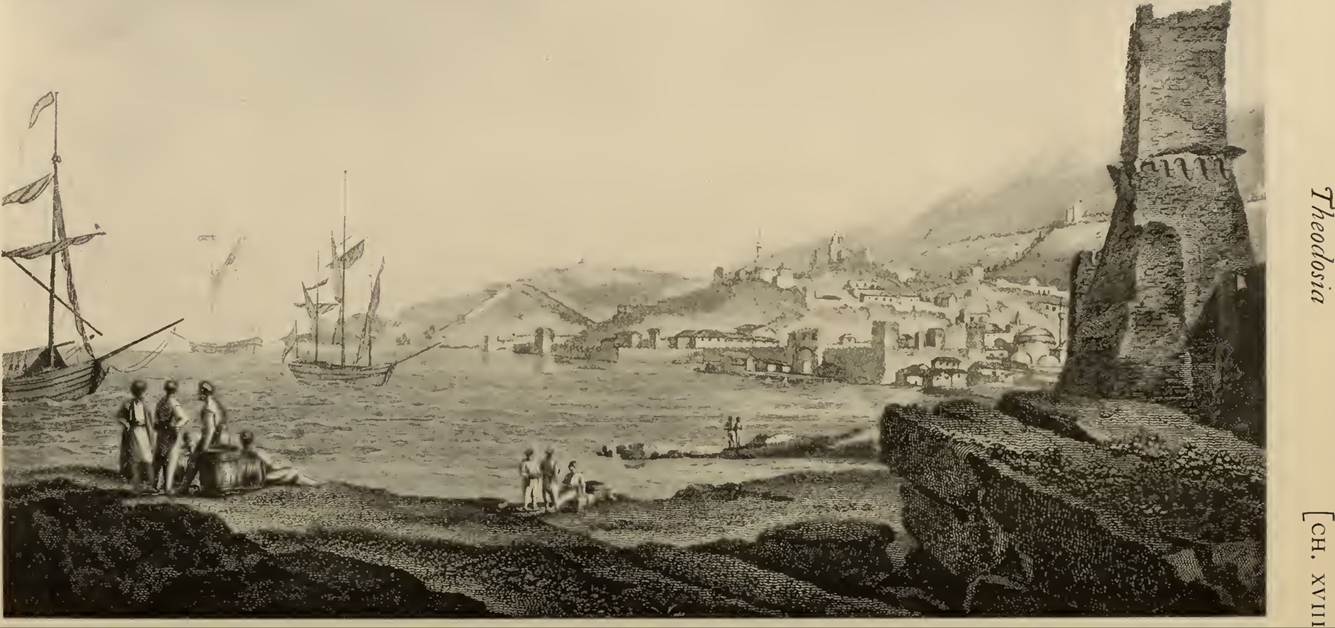
Fig. 341. View of Theodosia c. 1786 looking S.E. Museum Worsleyanum, London, 1794? n? Pl· ll7-
Theodosia.
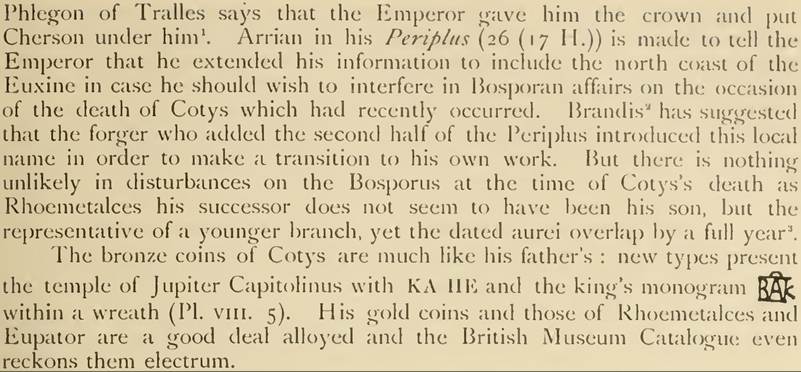
Although Theodosia and Nymphaeum were soon to become part of the Bosporan kingdom they have not left themselves without witness to their free existence, and the former at any rate always remained a separate title in the rulers’ style and a special division of the kingdom. The anonymous Periplus P. E. (pj (51)) says that Theudosia, a deserted city with a harbour, lay 280 stades, 37^ miles, from Cazeca, that it was an ancient Greek city, a colony of the Milesians and often mentioned in literature. So far he agrees with Ps.-Arrian (30 (19 H.)), but he adds from some unknown source, “now Theudosia is called in the Alan or Tauric tongue *ApSa/33a, = en-Tadeos : it is said that exiles from the Bosporus once inhabited it.” As an inscription proves it not deserted till after Arrian’s time, this is so much against the authenticity of the second half of the Periplus ascribed to him (v. p. 24, n. 3). Ulpian, the scholiast to Demosthenes in Leptinem, says that Satyrus died while besieging it and that it had its name from the sister, or according to other authority wife, of Leucon who on capturing the city made it more of a port than before and renamed it[1339].
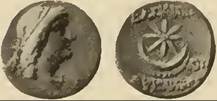
This question of its name is interesting; some authors (v. p. 560) and inscriptions give it as ©euSocrta which in itself is a Doric form[1340], others and even inscriptions of the same ruler, ©eoSocria. On the later coins we have OEY (Pl. ix. 7), OEYAo[1341], on most early ones probably autonomous, OEoAE-r1 (Pl. ix. 4 and Jakunchikov’s, v. p. 559), OEoAEo4, but OEoAo (Pl. ix. 6) is almost as early. Koehne’.has suggested with great probability that these are IdvcKa from some ungreek name *8E0AEIA and that Leucon made a kind of pun in changing this to the name of his sister which somewhat resembled it and was also a good augury for the newly won city.
As to Ardavda Miillenhoff gets the right meaning out of it (v. p. 39) but it has been suggested“ that this was a mistaken interpretation and that the second half is cognate with dare making an equivalent for the Greek name. It is almost certainly Iranian, but we cannot take this as throwing light on the Tauri for it is more probably Alan.The site has never been systematically excavated, but in the harbourworks carried out in 1894 by that distinguished engineer and archaeologist General Bertier-de-La-Garde there were found inscriptions7, sculpture
Trans. Od. Soc. xxx. No. 10.
4 Giel, TRAS. v. Pl. iv. 14.
5 MK. 1. p. 276.
G Jurgiewicz, Trans. Od. Soc. viii. p. 9.
7 losPE. iv. 195, 196 (ivth cent. H.c., cf. v. Stern, Theodosia, Pl. x. 2, 1), 197 (nird cent, a.d.), 198.
70—2
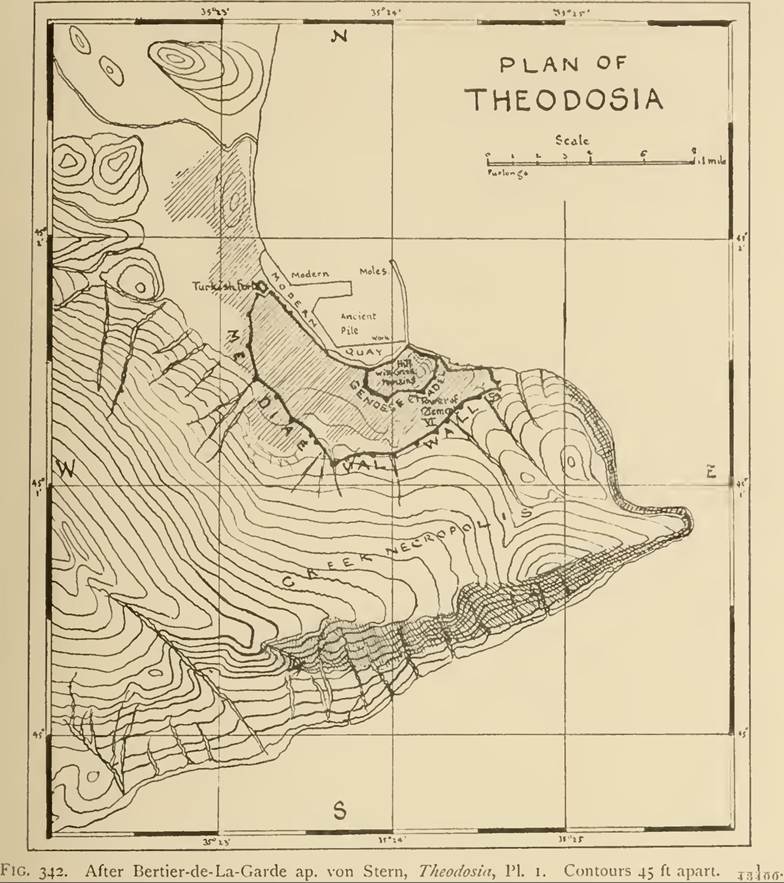
(v. pp. 296, 298), terra-cottas[1342], sherds of pottery[1343], some with graffiti, e.g. BO^nOPH-OEIMlTOTI LIP I KVA I EE with its early lettering and curious names[1344] and the two abecedaria (v. p. 361), also amphora-handles (v. p. 358, n. 8), all proving that the hill whereon stand the remains of the Genoese citadel at the east end of the circuit of mediaeval walls was the site also of the Greek city. Other excavations made in 1852 by Prince Sibirskij and in 1853 by the great sea-painter Aivazovskij on the initiative of Count Perovskij[1345] produced most beautiful gold work which may be referred to the ivth century and terra-cottas decidedly above the average of the Pontic coasts. But the terra-cottas found in the harbour-works are of quite a distinct class shewing a genuine archaic style of which one or two specimens (v. p. 364) must go back to the vith century recalling the /copat of the Athenian Acropolis, and black-figured vases tell of Athenian commerce5. That makes the history of Theodosia begin over a century before the first event recorded, the siege laid to it by Satyrus c.
389 b.c. (v. inf. p. 574). We have an incident of this siege preserved by Polyaenus who says that the Heracleotes supported the Theodosians and sent across Tynnichus with the few soldiers they could raise and several buglers to be put into separate boats distant from one another. So when they sounded the besiegers thought in the darkness that they were so many full complements, and retired before the superior force. Certain it is that Satyrus died without having taken the city, but Leucon was more successful, although it is probable that he too had to contend with the Heracleotes6. It looks as if there was a prolonged struggle on the part of Heraclea Pontica, helped no doubt by her colony Chersonese, to extend her power over Theodosia or at any rate to prevent its falling under that of the Bosporan rulers. Memnon of Rhodes may have taken the side of Heraclea in this struggle, at least we do not know in what other war he should have opposed Leucon7: if so the Heracleotes remained hostile through all Leucon’s reign, as Memnon’s career only just overlapped his.However, when at length successful, Leucon took no vengeance on Theodosia but made good use of its natural advantages. Strabo (vn. iv. 4) says that the harbour was sufficient for as many as a hundred ships, whereas the harbour and docks of Panticapaeum could only accommodate thirty : as a matter of fact the natural harbour has never been very good and the roads though spacious are absolutely open to the se. ; however, that is not a dangerous quarter and the gently shelving beach would allow Greeks to draw their ships ashore. The piles found in the recent harbour-works may be the remains of a Greek mole or may only go back to Genoese times, they shew that the need of a real harbour had been met before the present final solution of the difficulty. For Leucon Theodosia had two great advantages over Panticapaeum, it was always free from ice, and it was close to the rich cornlands instead of being upon the “rugged peninsula.” Accordingly it was here that he made the staple of his corn-trade as we find in the speech of
1.
p. 274; ABC. Pl. xu«, = supra p. 401, f. 294, Reinach, pp. 52—54; LXX«. 1, 4, 6, 10, p. 117 (Terra-cottas); KTR. p. 13 sqq.5 Von Stern, Theodosia, Pl. 11.
6 Polyaenus, V. xxiii.: vi. ix. 3.
7 ib. v. xliv. i, v. inf. pp. 576, 626.
Leucon and his successors without denying themselves supreme authority were considerate enough to call themselves archons merely and let the name of the city be part of their official style (v. p. 576).
It is likely that Theodosia suffered in the wars between Paerisades I and the Scythians1, certainly compared with the many ivth century things objects
1 Demosthenes in Phormionem, § 8.
of the Hellenistic period are decidedly few : it probably fell into the same straits as Chersonese in the mid century b.c. It was taken by Diophantus[1346] and probably regained some prosperity under Mithridates : yet, perhaps under pressure of his taxation, it was one of the cities which followed the example of Phanagoria and revolted against him[1347] [1348]. This is the last historical notice of it—the mentions in Mela, Pliny, Ptolemy and later Ammianus are merely geographical—and we might believe the Peripli that it lay desert in Roman times but for pieces of terra sigillata\ the fairly complete series of Bosporan coins found on the site[1349] [1350], and one or two inscriptions ; the most important, referred by von Stern8 to the mrd century a.d., shewed that there existed at Theodosia just such a religious society as at Tanais and elsewhere in the Bosporan kingdom. A presumption that it continued to have some importance as a frontier port is offered by the existence of a dignitary of the kingdom called the prefect of Theodosia[1351]’. Von Stern[1352] expands two- or three-letter monograms upon sherds into the names of Apollo, Athena, Ares, Hera or Heracles, Artemis, Asclepius and perhaps Demeter : he wishes to regard them as 0eol avvvaoL, but men write the name of a god to whom they are making a dedication, even when there is only one in the temple, besides we have no right to make them names of deities at all. In the very unhistorical wars between Chersonese and Bosporus recounted by Constantine Porphyrogenitus8, Capha is named as the spot where the Chersonites defeat their enemies and set the frontier against them. That it was inhabited in the succeeding centuries is shewn by Byzantine pottery9 and by a pillar with epitaphs dated a.m. 6327= a.d. 81910. This name of Caffa is that under which the site of Theodosia became famous. As the chief Genoese mart on the Black Sea it destroyed by its competition the trade of Cherson and ruined its Venetian rival Soldaia (Sudak) which finally came under its authority together with Cembalo (Balaklava). It was far more important than Vospro (Kerch) and even Tana (Azov) in which were quarters for the merchants of each rival city. The Genoese appear to have established themselves at Caffa shortly after 1266 and the settlement, being the objective of a trade-route reaching to China, flourished exceedingly in spite of the occasional hostility of the Tartar Khans, until the Turks gained control of the Thracian Bosporus. Then the tenure of the Italians became very precarious, it is wonderful that they could hold it at all at such a distance from their base, and the Turks had no difficulty in seizing it in 1475. At that time it seems to have contained a population of about a hundred thousand made up of many creeds and races. When the Genoese were turned out the rest remained and it was quite prosperous under the rule of the Turks who called it Little Stambul. The Sultan kept it directly under himself and did not give it to the Crim Tartars. p. 26, No. 21. 7 Trans. Od. Soc. xx. p. 173, PI. 1. 4—21, cf. supra p. 361. 8 v. supra p. 526, de Adm. Imp. c. 53, pp. 252, 255 Bonn. 0 Von Stern, Theodosia, Pl. vi—vm. lu CIG. iv. 9286 ; Latyshev, Inscr. Christ. 75. At the time of the Russian conquest in 1783 it had some 80,000 inhabitants but most of these deserted it, wishing to remain under the Sultan’s rule. Coins. Plate IX. Nos. 4—-7. The coins go back to the vth century, e.g. No. 4 inscribed OE oA E·^ and /R. 3’9 gm. = ’25 grm. Head of Pallas, r. as No. 4. B. xvm. 2 /R. 16’2 gm.= 1’05 grm. Female head in ampyx r. Ox-head in profile r. (cf. No. 29) ->EOAE() all as it seems in incuse square. Giel, TRAS. x. Pl. iv. 14. Almost as early is a coin in the Jakunchikov collection at St Petersburg[1355] [1356]: zE. Ox-head, three quarters r. | Star, between the six short thick rays · EOAE-H.. The star has been compared to that on coins of Chersonese (Pl. iv. 21) and Panticapaeum (Pl. vi. 3) and the general similarity of design regarded as evidence for a monetary league, but the Theodosian coin seems very much earlier than the other two. Pound at Theodosia all these coins no doubt belong there in spite of the unexpected form of the inscriptions. The charging ox upon the reverse of Nos. 5 and 6 appears on coins of Heraclea Pontica and Chersonese (Pl. iv. 4, 5, 8, 16) and would seem to point to an alliance. The largest silver coin, recently acquired by Bertier-dc-La-Garde1, zR. 72’8 grn. = 472 grm. Head of Heracles I Club, beneath 9EYAO bearded r. also recalls Heraclea, but almost certainly belongs to a time when autonomy had been lost, as does No. 7 with a similar inscription, though the resemblance between the latter and the commonplace types of Leucon II (Pl. vi. 16, 17) does not amount to very much, and cannot be adduced as proof that it belongs to a time of subjection. Burachkov’s xvm. 4—7 belong to other cities. The standard seems to be Aeginetic as the coins fit into the Panticapaean scries[1357]. witnesses to its prosperity under Turkish rule and E. D. Clarke, Travels, 11. p. 144 sqq. and Pallas, Travels, II. p. 265, to its subsequent ruin. Vinogradov, Lagorio and lx. Neumann criticize the methods of the government. 3 TRAS. Num. Sect. 1. iii. (1909), p. 171 : 1 am very grateful to the owner for sending me a cast. 1 “ Monetary novelties,” Pl. I. 10, Trans. Od. Soc. XXX. 5 v. p. 631 : B. xvm. 2 would be 4 obol, Terlecki’s coin just similar but '5 grm. i obol, Giel’s, ii, 1X 4 three and Bertiei-de- La-Garde’s, 5 or 6 obols, sec his “ Materials for Stathmological Investigations,” Num. Misc. 11. p. 26, Nos. 49—53. Sources and Inscriptions t)eo8oa-ia(t]\ App. 18, 26, 27, 42, 61, 63 {=IosPE. 1. 185, 11. 343, 6, 36, 29; BCA. X. p. 26, No. 21) and losPE. 11. 345. Strabo, VII. iv. 4, 6. Mela, 11. 1. 3. Pliny, NH. iv. 86 (26). Ptolemy, Geogr. in. vi. 2 ; VIII. x. 4. Ammianus Marcellinus, xxn. viii. 36. mentioning Theodosia. 0euooa-i. 16, cf. also Brandis, s. v. Bosporos (2) in P.-IM. in. p. 769. 2 CR. 1876, pp. x—xxv; 1878, p. xxxvii; 1879, pp. Ixii—Ixvii; 1880, pp. xiv—xvi. 3 losPE. 11. 288, iv. 287, 325, 361, BCA. m. p. 44, No. 10 of the ivth cent. B.c., losPE. iv. 274 of the mrd, 11. 102, 204, iv. 226, 276, 375, BCA. xiv. p. 121, No. 43 of Roman date. 4 Collitz-Bechtel, in. i. 3083. 6 BCA. x. p. 25, No. 20. 6 losPE. iv. 205, cf. ib. 432. We cannot tell whether Nymphaeum was originally founded by the Athenians in order to secure a share of the Bosporan corn-trade or acquired by them subsequently. It is generally thought to have been one of the gains of the Euxine expedition which Pericles made in 444 b.c. shortly before the Spartocids seized the power at Panticapaeum which was probably not strong enough at the moment to raise any objection. The archaic writing of the dedication to Harmodius suggests that the Athenians were honouring their hero at an earlier date than this. We know from Craterus (ap. Harpocrat.) that Nymphaeum was a member of the Delian league and paid a talent, hence Kohler has been able to restore its name from NY. He has also restored Kip' to Ki/z/xepixop, Opuk, and DAT to Ilarpaeus the village near the monument of Satyrus (v. pp. 20, 23, 573) but this is all very doubtful[1364] [1365]. If right it tends to shew that Athens made a serious attempt to establish herself on the Bosporus. In any case these possessions became untenable when she lost command of the sea after Aegospotami b.c. 405. The Athenian commander Gylon handed the place over to Satyrus and received Cepi in exchange. No doubt he was fined for this by the Athenians and Aeschines calls it treachery, some have thought that the fine was merely the formal disapproval of an act which must not be allowed to set a precedent. Aeschines discredits his statement by calling the Bosporan rulers enemies whereas we know that very shortly after they were on excellent terms with Athens. Probably Gylon was in a difficult position and contrived to extract from an inevitable loss to his country a personal advantage to himself. SkorpiP has published an inscription found in the sea off Eltegen : in it the praise of As]ander’s wife Glycaria is put into the mouth of a wayfarer who has drunk his wine with water from a fountain by her tomb: the stone is in shape suitable for the keystone of a rustic arch and has a hole for a water pipe. There is quite a good case for the restoration of the husband’s name and for identifying him with King Asander who married his known wife Dynamis rather late in life : the lettering is very like their inscriptions (v. pp. 591, 592 n. 7, 593 nn. 4-6). Skorpil goes on to suggest that Nymphaeum was Asander’s home or appanage and would thereby explain the next fact about it recorded in history, its rebellion against Mithridates (Appian, l.c., v. p. 588). Pliny speaks of the town as a thing of the past (l.c. fuere oppida... Nymphaeum Dia); it may have suffered in the troublous times about the beginning of our era, but there are three or four gravestones of Roman date and the name survives in Periphis Anonymi and the Peutinger Tables. However, the harbour probably began to silt up in the early centuries of our era and there seems no evidence of the town’s existence in Christian times. The coins of Nymphaeum (Pl. ix. 8, 9 Aeginetic 2 and 5 obols[1366]) are of silver and go back to the vth century : all bear on one side the head of a Nymph, on the other NYM, NYN or NY, a vine-leaf and grape-duster. [’Λσ]the baths were supplied by a well, and there was a fountain at the foot of Mount Mithridates near the sea, water was probably a difficulty with the men of Panticapaeum : hence the numerous large cisterns that have been found on the slopes of the hill. At this day there is no water in Kerch fit to make tea with, except what is fetched from Taman on the other side of the strait. Phanagoria and Gorgippia. Phanagoria was certainly near Senndja, but the topography of the town has never been explored. It seems to have covered a considerable area, but the sea has encroached upon the northern part of it. The actual site of the town was what is now a more or less level space about three quarters of a mile long and half a mile broad between the farms of Borovik and Semenjaka. From the middle of the sea-board a mole ran out about 350 yards (320 metres). The town-site is surrounded by mounds of rubbish containing tombs ; and barrows line for a mile and a half in every direction the roads leading to the other towns of the Taman peninsula. To the south ran the old branch of the Kuban now filled up. No Greek buildings have been excavated but architectural fragments, bases of statues and inscriptions have been found built into the ruins of Byzantine date. The site of the acropolis cannot be pointed out[1367]. Dubois de Montpereux as usual saw walls and gates and streets, but the oldest inhabitant knew nothing of them. The ruins seen by De La Motraye[1368] were probably mediaeval. In Tartar times the peninsula of Taman was more thickly inhabited than now[1369]. Inscriptions mention several buildings which are likely to have had some architectural importance, a gymnasium[1370], a Caesareum[1371] [1372], colonnades round the temple of Aphrodite Apaturias[1373] and outside the town the temple of Artemis Agrotera[1374]. At Gorgippia (Anapa) nothing seems visible, but inscriptions are continually being discovered ; these mention temples of Aphrodite Nauarchis8 and of Poseidon[1375] [1376], a πρό^ναον™, a τέμενος του μεγάλου θεού and an εργαστηρίου[1377]. Tanais. It is generally thought that there were two settlements called Tanais, a later, of which we have the remains at Nedvigovka, and an earlier, which is that mentioned by the ancient authors[1378]. It is curious that it is not noticed by 4 losPE. 11. 360, cf. BCA. in. p. 50, No. 17. 6 App. &> = losPE. 11. 362. G oroai TrepLvdioi losPE. II. 352. 7 App. ic) = IosPE. 11. 344. 8 App. tg] = BCA. xxiii. p. 46, No. 32. 9 App. 51= BCA. xxxvii. p. 38, No. 2. 10 losPE. iv. 430. 11 BCA. xxxvii. pp. 61, 63, Nos. 43, 46. 12 Strabo, XI. ii. 3; Alexander Polyhistor ap. St. Byz. s. v. calls it ’Eptropiov a term used of it by Strabo and occurring in inscriptions on the new site; Eustath. in Dion. Per. 1. 663; Ptolemy, in. v. 12, perhaps means the new town : see also Pliny, XH. VI. 20 (7). Ps.-Scymnus who speaks at length of the river and mentions the small settlements on the Taman peninsula. Pliny says that this region was held first by Carians, then by Clazomenians and Maconians, lastly by men of Panticapaeum, while Strabo directly states that it was a colony of Bosporans : it seems to have enjoyed a certain amount of independence as he speaks of some Maeotae obeying the Bosporan rulers and some the holders of the trading station on the Tanais. Polemo I found this freedom not to his liking and utterly destroyed the settlement (c. 15—7 b.c.). It had a great trade with both European and Asiatic nomads taking their slaves and hides and other nomadic products and giving in exchange clothing and wine and articles of civilized life. In front of it at a distance of a hundred stades lay the island of Alopecia w’ith a mixed population. Leontiev, who has done more than anyone else for Tanais[1379], was inclined to seek the older Tanais at Elisavetovskaja in the delta: P. Butkov[1380] wished to put it, as well as the mediaeval Venetian colony Tana, at Azov, explaining the lack of remains by the wholesale blowing up of the Turkish fortress after the Treaty of Belgrade in 1739. Mr A. A. Miller’s excavations at Elisavetovskaja, 1908—1910, have not been sufficient to settle the question[1381]. He shews by a map of the mouths of the Don (l.c. p. 86) that the upper section of the delta (v. Map ix.) was once divided by a considerable channel into two halves, to the north a marsh, to the south a long stretch of sandy ground even now mostly raised above the spring floods: this stretch is covered with barrows for four miles, and half way along the old channel which bounded it to the north, is the site of a town with an outer bank, an inner enclosure and a “hard” or jetty (Plan l.c. p. 120). The barrows are Scythic in type save for an absence of horse-gear, but are full of Greek amphorae and other pots : the town-site yields similar ware giving the date as the Hird century b.c., but some things from the barrows are much older, the sheath (p. 270, f. 186) came from here and another almost as early3. But so far there are no inscriptions or other evidences of a real Greek settlement[1382] and I am much more inclined to think that we have here Alopecia and the κατοικία μ,ιγάδωρ ανθρώπων. It happens that coming up the east coast, along which the traffic went, you would get to it just a hundred stades before reaching the spot where the town seems to have started anew about 100 a.d. That this place has a right to the name Tanais the inscriptions prove ; but as nothing on the site goes back b.c. the presumption is that the old town was elsewhere. Probably some change in the river channels made it advisable to re-establish the settlement between the villages of Nedvigovka and Sinjavka upon the north side of the northernmost arm of the Don now called the Dead Donets. Above a high cliff sloping steeply down to the river, a space about 700 feet square was surrounded by a bank ; outside this was a ditch omitted on the side next the river. To the east and west were ravines which helped to isolate the site. At the corners of the square and in 3 BCA. xxxv. pp. 86 — 130, Pl. v. fif. 23, 24 late Sc. sheath and rhyton = /7rcA. Anz. 1910, pp. 202— 206,ff. 5,6 ; alsoib. 1911, p. 197, f. 5, vith cent, sheath. 4 A Panathenaic Amphora, Arch. Anz. 1912, p. 374, ff. 66, 67, late Vth cent. В.С. looks more like it, cf. BCA. xlv. p. 83, Pl. vi. the middle of the north and west sides were towers. There was a gate at the ne. angle and another in the middle of the south side from which a way led down to the river. By the sw. angle below the cliff was a Monte Testaccio. The barrows of the necropolis had mostly been rifled in ancient times but Professor Veselovskij had some success in 19081, finding evidence of both Fig. 346. Nedvigovka. Scale about 5^55 or 150 yards to the inch. interment and cremation with interesting cinerary urns of slip ware and und century jewelry of some pretensions, especially an earring with a large Nike pendant2. In the middle of the town was the market-place as shewn 1 Hermes (Russian), 1909, p. 246 sqq.; Arch. 2 l.c. p. 150, f. 10. Anz. 1909, pp. 140—145, ff. 1—6. χιχ] 'Tanais. History, Foundation of Cities 569 by remains of its paving ; there were also two wells. All the masonry was exceedingly poor except one wall which may have belonged to a temple. The town was destroyed suddenly so that stores of wheat in the cellars were not removed : in cellars, too, we.re found candelabra and a lamp of bronze, the most elegant bronzes found in South Russia (v. p. 381, n. 13). The; earliest inscriptions belong to the time of Sauromates I about the beginning of the und century a.d.,[1383] [1384] [1385] the latest to that of Ininthimeus in a.d. 237’. Beside those set up by the religious societies and one or two private dedications, one of which seems to mention the docks (v. p. 619), no doubt to be placed on the sandy belt of beach where coins are still found, we have a whole series commemorating the erection of various buildings: walls’, towers[1386], gates[1387] [1388] [1389] [1390], a market-plac4, cf. Pliny, NH. vi. 20 (7). Panticapaeum. “ Clazomenian” pots from Taman are probably only 8 Diod. Sic. xn. xxxi. 1. late Milesian, Pharmacovskij, A rch.Anz. 1912, p. 337. 9 v. S. A. Zhebelev, “The Bosporan Archaean- 3 Ps.-Scymn. 1. 898. actids,” Journal Min. Pub. Instr. St P. 1902, 4 Pliny, NH. vi. 18 (6): Stratocles in App. 27= March, p. 130. before in 480 b.c. If they were a clan with a hereditary claim to government they must have gone much further back ; Zhebelev remarks that Diodorus does not generally go back before that date, so his first year for their power seems quite meaningless. If they had held power only for forty years they must have been parvenu tyrants. How Spartacus or rather Spartocus (so his descendants always wrote the name on their inscriptions) took over the power we know not: the usual idea that he was a Thracian mercenary leader who made a coup d'dtat has everything in its favour[1391]. Spartocus reigned for seven years. So Diodorus says in two places (xn. xxxi. 1 and xn. xxxvi. 1), but he is made to die in b.c. 433/2, which gives him only five years of reign. In the latter passage his successor is called Seleucus and reigns forty years (so the best ms. P[atmius], vulg. four). In the next passage touching Bosporus (xiv. xciii. 1) we hear nothing of Seleucus, but are told that in b.c. 393, 2 died Satyrus son of Spartocus king of Bosporus having ruled forty-four years (so P., vulg. SeKaTeo-crapa, edd. rerrapaKovTa to make it agree with the archon-date and xn. xxxvi. 1). Before P. was discovered it was usually assumed that between Seleucus with his four years and Satyrus with his fourteen a *Spartocus II had dropped out. Now it is generally thought that Latyshev[1392] [1393] is right in supposing that Seleucus—a name neither Greek nor Thracian and never heard of before the time of Seleucus Nicator though so familiar afterwards—is a mistake for Satyrus whose single reign took up the time formerly assigned to Seleucus, * Spartocus II and Satyrus. Diodorus goes on to say that Satyrus dying in 393/2 b.c. was succeeded by Leucon his son who reigned for forty years and in the next passage (xvi. xxxi. 6) that Leucon having ruled forty years died in 354/3 b.c., and was succeeded by his son “ Spartacus” (11), who reigned five years till his death in 349/8 when “ Parysades” his brother began his reign of thirty-eight years (xvi. lii. 10), and after his death a civil war followed in 310/9 b.c.:! There was no reason to doubt this series until an inscription found in the Piraeus in 1877 shewed that in 347/6 b.c.[1394] the Athenians had received from the joint rulers of the Bosporus, Spartocus and Paerisades (so always in inscriptions) envoys to announce the death of their father Leucon and were setting up a decree complimentary to them and their brother Apollonius who remained in a private station. This means that Leucon did not die till about the preceding year or perhaps the one before that’, just the date given by Diodorus for the death of Spartocus 11 himself. Schaefer’s explanation is no doubt right that Diodorus, calculating back from 310/9 when he had definite information about the Bosporus, knew that Paerisades had reigned thirty-eight years but did not know that five of 4 App. 28= Kumanudis,’Athji'aioi', vi. p. ij2sqq.; A. Schaefer, Rhein. Mus. XXXin. p. 418 sqq., cf. XXXVIII. p. 310 ; CIAtt. IV. ii. 109 b ; 1 )itt.2 1. 129; RCH. V. pl. 5 ; Hicks2 Hill, 140. ·’’ In App. ^ — CIAtt. 11. i. 311; Ditt.2 1. 194, a year and a half had passed after the liberation of Athens from Demetrius Poliorcetes before the Athenians set up a decree to Spartocus 111, who had sent corn and congratulations upon that event, v. infra p. 580. these ran concurrently with the reign of Spartocus II whom he regards as reigning before Paerisades from 354/3 to 349/8. Hence, instead of letting Leucon’s forty years begin in 388/7, Diodorus had to push back his accession to 393/2. But I believe that he left the discrepant forty-four years to Satyrus and that the readings of the mss. in both places where the latter was mentioned (xn. xxxvi. 1 (mss. ScXcuko?), P. τεσσαράκοντα vulg. τεσσαρα and XIV. xciii. I, P. τετταράκοντα τετταρα vulg. δεκατέσσαρα) go back to this number. Diodorus is almost as much out about Spartocus I to whom he gives seven years although the dates are but five years apart. The whole confusion shews that Diodorus took some fixed date and calculated back from it adjusting the result to the tables of Athenian archonships. Paerisades was succeeded in 310/9 by Satyrus II who only reigned nine months being slain in battle with a younger brother Eumelus who also slew another brother Prytanis[1395]. Eumelus reigned five years and five months (b.c. 309—304/3) and was killed in a carriage accident leaving the throne to his son Spartocus who reigned for twenty years (303—283 b.c.)[1396]. So far, thanks to Diodorus, we can establish the chronology more or less (see table inf. p. 583) and it remains to fill in this outline by the testimony of other authors and of inscriptions. Of Spartocus I we know nothing more. His short reign must have been fully taken up with establishing the authority of the new dynasty. How far that authority stretched we cannot tell. Satyrus I devoted himself to rounding off the kingdom. We find him holding Cepi before the collapse of the Athenian sea power (405 b.c.) when Gylon the Athenian governor handed him over Nymphaeum and received Cepi in exchange (v. supra p. 561). This acquisition of Nymphaeum was the first enlargement of the kingdom of which we hear. Henceforward there was no more need for the dyke just to the west of Kerch on the boundary of strictly Panticapaean territory. It was probably Satyrus that secured the whole eastern end of the “rugged” peninsula by the dyke which runs across from Opuk-Cimmericum to the Maeotis. Nymphaeum gave Satyrus a harbour less liable to be ice-bound than Panticapaeum, but in pursuance of the same policy he set before himself the task of adding the port of Theodosia to his dominions. The harbouring of Bosporan exiles[1397] was probably a mere pretext. In this he was not successful but he left things so far advanced that his son Leucon could fulfil his desires. It is extremely improbable that a ruler who held Cepi and went as far afield as Theodosia should have allowed Phanagoria to continue perfectly free ; we may assume that if he did not receive it from Spartocus, it was his first objective[1398]. That Satyrus had yet extended his power over barbarians to the east and like his successors called himself king of certain native tribes is unlikely, but we cannot be sure, inasmuch as from his time we have no inscriptions, but he is mentioned by Lysias and by Isocrates', who represents him as well disposed to Athens and allowing Athenian grain vessels special facilities for which he received the thanks of the city. On the other hand he seems liable to suspicion and capriciously condemns to confiscation and death the speaker and his father Sopaeus or Sinopeus one of his chief ministers, though afterwards repenting and marrying his son to the speaker’s sister. We hear of exiles and plots, so all Bosporans were not satisfied with his rule. Strabo (xi. ii. 7) mentions on the Asiatic shore near Patraeus[1399] [1400], a tumulus raised to the memory of King Satyrus. It is likely to have been the first of the name who best deserved such a monument after his long reign and great services. The tale of Tirgatao[1401] does not fit any known Satyrus, but Latyshev is inclined to refer it to Satyrus I. The story goes that Hecataeus king of the Sindi, having been driven from his kingdom, was reinstated by Satyrus who gave him his daughter in marriage and bade him slay his former wife Tirgatao, a Maeotian princess of the tribe of the Ixomatae; Hecataeus out of love to her spared her life, but put her in prison. She, however, escaped to her own people, married her father’s successor, roused her tribe against the Sindi, overran the kingdom of Hecataeus and did harm to that of Satyrus. The two kings sued for peace and handed over Metrodorus son of Satyrus as a hostage: but meanwhile tried to get Tirgatao assassinated. She foiled the plot, slew the hostage and renewed the war with such success that Satyrus died of chagrin and his son and successor Gorgippus had to buy peace with rich gifts. The main reason for supposing that the story applies to Satyrus I, is that all the rulers of Bosporus subsequent to his time claimed to be kings of the Sindi: a good reason against is that Satyrus died at the siege of Theodosia and was succeeded by Leucon : also that we do not hear again of the Ixomatae until much later and that Metrodorus is a late type of name[1402]. However, in the same generation as Leucon I there was a Gorgippus, the father of Comosarye wife of Paerisades I[1403] [1404], and Latyshev suggests that he at first divided the kingdom with Leucon ruling the Asiatic side and founding Gorgippia. The inscription" on which Leucon is called Archon of Bosporus and Theodosia does not help to prove that his authority was limited to the part west of the strait inasmuch as it was found near Lake Tsukur. But that sometime in the ivth century a Gorgippus had quasi- sovran rights in Gorgippia we know from tile-stamps with ГОР|ГІП ПО Y7. But these would suit another Gorgippus mentioned with another Satyrus by Dinarchus8 about fifty years later, and the repetition of the same names in the family makes identification impossible. It is quite likely that in the for ’AttoXXcoviou, KPATIPC, TIAAOC, &c. : v. CA’. 1861, p. 176; Giel, KI. !>., p. 41 ; UCA. xi. p. 155 ; III. p. 162 ; Skorpil in llobrinskoj Miscellany, p. 33, nn. 4, 8, 9. 6 App. y>=IosPE. 11. 346. c App. 26 = losPE. 11. 343., 7 Mat. XVII. p. 71, No. 7; Skorpil l.c. n. 5; cf. ib. n. 11 and A EC. Reinach, p. 135, No. Lxvm. a gold cylinder inscribed 'Op^dpo rov ropyiirno. 8 In Demosthenem, 43. unknown times after b.c. 250 the decadent Bosporan kingdom may have acquiesced in the independence of the Sindi and been incapable of resisting the spirited Tirgatao. That Strabo (xi. ii. 10) seems to call Gorgippia βασιλέων των ^.ιν3ών points to their somewhat recent independence. Satyrus died while besieging Theodosia[1405]. His operations had been rendered null by the aid of the Heracleotes who sent across the ingenious Tynnichus[1406]. Leucon I, his son, is always regarded as one of the most enlightened of Greek rulers. He was successful in reducing Theodosia and made it the great port for the shipment of corn. He is said to have named the town anew after his sister or wife—what may have been its precise state previously we do not know. Master of Theodosia he developed the agriculture of the flat district between that town and the Bosporus. The open country had been subject to the steppe Scyths who even pushed their raids across the strait on the ice to the country of the Sindi[1407]. No doubt fear of such inroads led the minor cities more readily to acquiesce in the spread of a strong central power. The agricultural inhabitants of the plain were reduced to serfdom and the Bosporan kingdom was ready to become the granary of Greece. Naturally the closest ties sprang up between such a country and the chief commercial and manufacturing state of Hellas, Athens, and it is in this connexion that we hear most of Leucon and his successors. In this, too, he completed the policy of Satyrus[1408]. Of these friendly relations we hear in Demosthenes. In order to equalize the burdens of the Social War, b.c. 356, Leptines proposed that all immunities decreed to individual citizens, except descendants of Harmodius and Aristo- geiton, should be revoked. This was bad policy in the case of foreigners who had merely complimentary citizenship and Demosthenes opposed it; the case of Leucon and his sons was a very good one for his purpose. Moreover Demosthenes had family relations with the Bosporan rulers, for Gylon his maternal uncle had been under their protection since he had handed Nymphaeum over to them, and either now or subsequently the orator received from them a yearly allowance of a thousand medimni of corn[1409]. So Demosthenes sets forth at length the advantages reaped by Athens from the good will of Leucon0. Ina normal year Athens imported 800,000 medimni of corn of which half came from Bosporus. On these 400,000 medimni Leucon remitted the export duty of 3^ per cent amounting to 13,000 medimni and further, both at Panticapaeum and at his new staple of Theodosia, gave the ships bound for Athens facilities to load first. Moreover, three years before, in time of famine, he sent enough corn (presumably p. 443 n. i, see G. Perrot, “Le Commerce des Cereales en Attique au ive Siècle avant notre Ère.” Revue Historique, IV. (1877), pp. 1—73; Th. G. Mishchenko “Commercial Relations of the Athenian Republic with the Kings of Bosporus,” Kiev University Bulletin, No. 7 (1878), p. 477: H. Francotte, “Le pain à bon marche et le pain gratuit dans les cites grecques,” Melanges Nicole, p. 135 ; A. E. Zimmern, The Greek Commonivealth, Oxford, 1911, p. 356. 5 Dinarchus in Dem. § 43. c Dem. in Lept. 29—40. at the normal rate) to let the Athenians make: fifteen talents profit on the surplus. Strabo (vii. iv. 6) may mean this same consignment when he speaks of 2,100,000 meclimni sent by Leucon from Theodosia. Such an amount would about represent the Attic wheat deficit in a thoroughly bad year : or it may be the total of several consignments. There is no reason to suppose that there was any question of a gift in either case. The 15,000' medimni sent by Spartocus HI (v. infra) is quite a different thing if only for the small amount of corn involved. The ordinary price for corn was 5 drachmae a medimnus. No doubt the Bosporan rulers were themselves large sellers : no doubt, too, they did a profitable business with other states and the fisheries provided another source of revenue. No wonder that Bosporus could afford the wine and oil, the pottery and manufactures of Greece, even if money had to be spent on tribute to threatening Scythian tribes, on the support of Greek, Thracian and native mercenaries and on a Beet to keep down the neighbouring pirates. Perhaps it was for this purpose that later Spartocus 11 and Paerisades wanted the crews granted them in the inscription[1410] [1411] set up to them in the Piraeus. But from Athens the Spartocids received also less material recognition. From the same inscription we know that Satyrus had been honoured in some way, from Demosthenes and the same source we know that Leucon was publicly praised by the Athenian state, granted the citizenship and immunity from civil burdens and crowned at the Panathanaea with a golden wreath worth 1000 drachmae : which wreath according to custom was duly inscribed and dedicated to Athena Polias : further that the decree conferring these honours was set up, as Demosthenes tells us, in triplicate, in the Piraeus, at Bosporus and in the temple of Zeus Urius at the entrance of the Euxine. The decree of immunity was necessary because there was always money belonging to the Spartocids lying at Athens and some ingenious citizen might have proposed an antidosis. That is why the proposal of Leptines had a material importance. But it was the insult of withdrawing a privilege granted as a courtesy which would have done the harm. No doubt thq Spartocids’ vanity was flattered by these compliments. As Perrot remarks they never seem to have sought the glory of success at the great Hellenic games, at which Sicilian princes loved to display their magnificence. Probably the descendants of a Thracian condottiere could not gain admittance. But it was some consolation that the “eye of Hellas” enrolled them among her citizens and allowed the distant Bosporans to enter for the Panathenaic games and bring home prize amphorae (v. pp. 347, 626). In later times the compliments paid went even farther. Dinarchus (l.c.) accuses Demosthenes of corrupt motives in proposing that Birisades [i/r] and Satyrus and Gorgippus should have bronze statues in the Agora. The inscription from the Acropolis in honour of Spartocus HI (b.c. 287/6)3, speaks of such statues set up to his ancestors in the Agora and in the Emporium and of an offensive and defensive alliance concluded with them, and proposes to set up to him two statues, one in the Agora by his ancestors and one upon the Acropolis, as well as the usual inscriptions and wreaths. Leucon had to do not merely with Athens. We have the first few words of a decree in his honour passed by the common assembly of the Arcadians soon after 369 b.c.[1412] Perhaps he employed Arcadian mercenaries or granted them such a favour as the Mytilenians a few years later. These he let off with ii per cent export duty on 100,000 medimni of corn a year : above that figure they had to pay the usual if per cent[1413] [1414]. He left behind him as good a reputation as was possible for a man who was regarded as a τύραννοί. To have looked after his soldiers’ morals by stopping their pay when they got into debt through vice or gambling[1415], is counted to him for righteousness by Latyshev, who reckons among minus latidabilia his saying that a tyranny has need of bad men5 and the devices for foiling conspiracies of which Polyaenus (vi. ix. 2, 3) tells us, though one of these, enlisting the support of the trading class by borrowing its money, is not indefensible and the other not more treacherous than necessary : both shew that the Bosporan Greeks had the spirit not to submit quite tamely : the financial operation (ibid. § 1) of calling in all the coinage and reissuing it at double its face value seems to have been regarded as doing no harm to anyone : it may have begun a practice which disfigured Bosporan coin with countermarks but the style of extant coins subjected to the process points to a later ruler of the name. Polyaenus (v. xliv. 1, see inf. p. 626) also relates the trick played upon Leucon towards the end of his life by Memnon of Rhodes who was in the employ of the Heracleotes, the consistent foes of the Bosporan kings. Besides the decree of the Arcadians three other inscriptions on the Bosporus record his name. In one from the Taman peninsula6 he is only styled archon of Bosporus and Theodosia. In another from Kerch he bears the titles of archon of Bosporus and Theodosia and king of the Sindi, Toretae, Dandarii and Psessi7. The natural inference is that the former inscription belongs to a time when he had not yet conquered the native peoples. Latyshev argues from this and from the story of Tirgatao (v. supra p. 573) that at first he was not ruler of the Asiatic side of the strait, but the stone comes from there and the document would not have been dated in his archonship had he not at the time borne rule in that district. Hence we may infer that Satyrus set the reduction of the neighbouring Greek communities as the limit of his policy and that Leucon raised the dynasty from being archons of a few coast towns to being also kings of wide stretches of country and populous if barbarian tribes in the interior—and he it was who left the greatest name to posterity. Towards the end of his reign he seems to have admitted his sons to power, as they are thanked with him by the Mytilenians. Regia Pot. 11. 77. 4 Aeneas, Com. Poliorc. v. 2. 5 Athenaeus, vi. 71 (p. 257 c). G App. ■z6=IosPE. 11. 343. 7 App. 27 =IosPE. 11. 6; in App. ig = IosPE. II. 344 he only appears as the father of Paerisades. For the tribes see supra pp. 24, 127, 128. From the joint reign of Spartocus II and Paerisades 1 (349/8—344/3) the only monument is the Piraeus inscription from which we learn the true chronology of these rulers, the precise honours paid them by Athens and the existence of a third brother Apollonius, who though a private person received compliments by way of afterthought'. The inscription is headed with a basrelief shewing three figures, but unfortunately the heads have been mutilated so we cannot judge whether any barbarous traces were left in the family type[1416] [1417]. Paerisades when reigning alone (344/3—310/9) continued the policy of Leucon[1418] and is classed with him as a mild and capable ruler. He may even claim to surpass him ; Strabo (vn. iv 4) says he was reckoned a god, whether before or after death we cannot tell : here again we find the Bosporus anticipating Hellenistic custom. However, he had his difficulties as about 330 b.c. commerce in Bosporus was utterly disorganized by a war with the Scythian king[1419] [1420] [1421]. Probably the nomads had macle a raid into the country about Theodosia, but war with the eastern tribes may be referred to. In this direction Paerisades enlarged his authority or at any rate his pretensions. It is hard to believe that we can trace the fluctuations of his power in the changes of his title ; kings do not give up titles when they no longer represent facts, George HI called himself king of France : the leaving out of tribes may be due to mere questions of space8, but the addition of new tribes no doubt indicated fresh conquests. Paerisades at first adopted Leucon’s style as in App. 29 which is just like App. 27 except that there was no room for Psessi or their name has perished". Next instead of enumerating the last tribes separately, he summed them up as Μαϊτων πάντων[1422], further he added Θατεων8 and dropped the πάντων", and made the final addition of Δόσχων10. No doubt these' last two tribes stood apart from the Maeotae. The Sindi also are counted separately being the first Maeotian tribe to form part of the Bosporan state and being apparently less barbarous than the others. One inscription9 is abnormal in that Bosporus is left out, also its whole form is unusual: still it falls into place as coming before Paerisades conquered the eastern tribes, a more satisfactory criterion than the absence of Bosporus, which must surely be a slip. Schaefer" has based upon this the view that it belongs to a time when Spartocus ruled Bosporus and Paerisades Theodosia and the Maeotian tribes—a most unnatural combination. The stone was found at Kerch so in such a case it must have been dated by Spartocus. The whole dominion of Paerisades is well summed up in the epigram : Έάκόνα Φοίβωί στήσε, 'Αντίσστασί, Φανόμαχός σο[υ], αθάνατον θνητωι. πατρϊ γέρας τελεσας, Παιρισάδεος άρχοντος δσην γθόνα τερμονες ακρ[οι] Ταύρων Καυκάσιος τε εντός εχουσιν opotvl. 8 App. 30 = I os PE. 11. 346. 9 App. w=IosPE. 11. 8. 10 losPE. 11. 347, v. p. 128, n. 8. 11 op. c. also Latyshev losPE. II. p. xxiii. 12 losPE. 11.9: the genitive in -eos is most used by Paerisades I, losPE. 11. 9, 10, 345, 347, IV. 418: -ov? comes in 11. 11, 344, 346=App. 29“, 29, 30. Later kings of the name use -ov. M. 73 These were the natural boundaries which could only be easily passed towards the ne. where the frontier was no doubt very variable. Polyaenus (vn. xxxvii.) has his anecdote about a Paerisades, probably the first of the name, how that he had one change of raiment for setting the battle in array, another for the fighting and a third for purposes of flight. The device seems to have stood him in better stead than it did Ahab. Paerisades married Comosarye daughter of Gorgippus1. This Gorgippus may have been Leucon’s brother if the story of Tirgatao applies to Satyrus I: in any case he was probably a member of the ruling family as his daughter’s name is, like Spartocus and Paerisades, Thracian, and his own name recurs in the history and geography of Bosporus. Paerisades had three sons at least, Satyrus II, who succeeded him, Eumelus and Prytanis2. Most probably he had another, Gorgippus, and towards the latter part of his reign had associated Satyrus and Gorgippus with him in the power. That would account for Demosthenes having carried the proposal to set up the statues of all three Pontic tyrants as Dinarchus (l.c.) puts it, and would agree with the phrasing of inscriptions3 which begin naipicrd8?7s Kat 7rat3es give proxeny to so and so. These inscriptions testify that they treated not merely Athenians but also Piraeans (i.e. Athenian colonists at Amisus) and Chalcedonians well. Probably the reign of Paerisades represents the highest prosperity of the Bosporus kingdom under its own ruling house. The native tribes were weak or well kept in check by its vigorous ruler. As the granary of Greece it was sure of a constant income flowing in from a certain market. Athens its best customer was indeed declining but was not yet utterly fallen. But with the opening up of Asia to Greek enterprise new corn supplies were made accessible and new competitors appeared in markets whose purchasing power was lessened owing to the draining of Greece by wars and emigration. The country was made the less ready to bear this adverse change by the exhaustion produced by a year’s civil war, 309/8 b.c. When Paerisades died Satyrus his eldest son was his natural successor. We hear nothing of Gorgippus. However, Eumelus a younger son disputed his claim and Diodorus (xx. xxii.—xxvi.) gives us a detailed account of the struggle. Eumelus allied himself with Aripharnes king of the Thateis who lived beyond a river Thates. Satyrus invaded their country with two thousand Greek and two thousand Thracian mercenaries and Scythian allies numbering twenty thousand and more foot and ten thousand horse. He made a laager with his provision waggons and joined battle against the enemy who had twenty thousand horse and twenty-two thousand foot. Neither side seems to have used any Bosporan Greeks. After a doubtful struggle Satyrus was victorious and Eumelus and Aripharnes retired to the latter’s royal fastness, obscurely described as a kind of pile village surrounded by the river and rendered unapproachable by great cliffs and a thick forest. Two ways only led to it, one well guarded by the high towers of the royal castle, the other leading through marshes and only secured by wooden fortifications. Satyrus, after preliminary plundering of 'the open country, made his 1 App. y>—IosPE. II. 346. lettering, his daughter. - Acis, v. p. 585, n. 4, was, to judge by the 3 losPE. II. 1 ( = App. 32) and 2. approaches in form, took the wooden fortifications and began to cut a way through the forest, though his men were much harassed by the enemy’s sharpshooters. Ultimately when by the fourth day the attack was approaching the castle, Meniscus the captain of the mercenaries had to give way to the defenders and Satyrus coming to his support was wounded and died that same evening. Meniscus raised the siege retiring to Gargaza and brought the king’s body back across the strait (τού ποταμού regarded as mouth of the Tanais) to Prytanis at Panticapaeum. Prytanis laid Satyrus in the royal tomb and hasted to Gargaza where he assumed the power. Eumelus proposed a partition, but Prytanis refused it and hurried back to Panticapaeum to establish his authority. Thereupon Eumelus and his barbarian allies advanced and took Gargaza and other places, forced Prytanis to a combat, defeated him and shut him in a headland by the Maeotis : Prytanis capitulated and promised to leave the country, but when he came to the capital Panticapaeum, made a last attempt to seize the power, failed, tied to Cepi and there was slain. This last attempt seems to have exasperated Eumelus who proceeded to exterminate the house of Spartocus and the adherents of Satyrus, and only Paerisades the young son of Satyrus escaped. He took refuge with Agarus king of the Scythians. These massacres roused the indignation of the citizens : but Eumelus called a mass-meeting, defended his actions, restored the ancestral government (την πάτριον πολιτείαν άποκατεστησε), conceded again the immunity which the dwellers in Panticapaeum had enjoyed in the time of their forbears and promised to exempt everyone from the direct taxation, doing all this to gain the affection of the masses. So he ruled his subjects according to law and aroused much admiration by his merits : moreover he was a benefactor to the other Greeks about the Pontus, to the men of Byzantium and Sinope and especially to the citizens of Callatis. For when Lysimachus besieged them and there was lack of corn in the city, he received a thousand of them and granted them lands upon the Psoas. Further, he earned universal praise by restraining the piracies of the Heniochi, Tauri and Achaei and conquered for his kingdom much land of barbarous tribes. Indeed he formed the project of uniting all the tribes about the Pontus and might have succeeded but for 'his strange death. Jumping from a runaway waggon (it had four horses, four wheels and a tilt (v. p. 51, f. 6)) he got his sword caught in a wheel and was whirled round and round and killed after a reign of five years and five months (309/8—304/3). I have given rather a full summary of the story of Eumelus found in Diodorus because it seems evidently to go back to an extract from some history of, or panegyric written for Bosporus. It gives us an insight into the relations between the Bosporan state and the surrounding tribes indicating what a part they played in its internal affairs. The river Thates with the fastness of Aripharnes and the town of Gargaza are quite unknown[1423], but everything points to the country between the lower Kuban and the outliers of the Caucasus. What may have been the rights and immunities restored by Eumelus to the citizens of Panticapaeum we cannot tell. They were probably rather shadowy. At least the citizens take singularly little part in their rulers’ struggle. Eumelus may represent a reaction of the barbarian element against the Hellenic. In other things besides his scheme of general conquest he appears as a forerunner of Mithridates the Great. There are no lapidary inscriptions in honour of Satyrus II, Prytanis or Eumelus, but the names occur upon tiles[1424]. Spartocus III, son of Eumelus, reigned from 304/3 to 284/3 B-c· He is the last king of whom Diodorus (xx. c. 7) speaks. As we have seen the Athenian inscription[1425] tells us that in 287/6 b.c., a year and a half after expelling the garrison of Demetrius Poliorcetes, in return for a present of 15,000 medimni of wheat Athens decreed Spartocus the usual honours: she could offer no other reward. In his own country several inscriptions date from his reign, but do not tell us much about him[1426]: the first calls him archon alone, the next (and 11. 35) king alone, the last two give him both titles (e.g. 348 αρχοντος και βασιλεύοντος). His son Paerisades II reigned from 284/3 till after 252 b.c., for in the latter year he presented a vase to Apollo at Delphi[1427]. In one inscription he is spoken of as archon of Bosporus and Theodosia and king of the Sindi, Maeotae and Thateis[1428]. In the others he is only king0. The tiles7 with the names Spartocus and Paerisades seem to belong to these kings to judge by the lettering (Π, Ο, Σ) and grammatical forms (genitive Παιρισάδου) but there is very little to go upon as also in the question of the coins (v. inf. p. 584 sqq.). As Boeckh and after him Latyshev have well explained, the Spartocids at any rate from the time of Leucon when they had extended their power over neighbouring barbarian tribes, had borne a double title. In the Greek cities of the Bosporus and in Theodosia they professed to fill the more or less constitutional office of Archon, though their authority was such that other Greeks thought of them as τύραννοι and called them as much when they did not wish to be polite8. Otherwise they spoke of them as δυνάσται or ήγερ,όνες. Demosthenes speaks of Leucon as archon, the official decrees of the Athenian people give no title at all : no one could tell but that Paerisades and Spartocus II and Spartocus HI were private individuals. So thanks are given for acts which were obviously political without any mention of the state which performed them. That the Spartocids were really the whole state we see from decrees of proxeny being made out in their name9. Naturally there was no need of such careful regard for the feelings of barbarous tribes and the Spartocids could proclaim their power for what it 0 losPE. 11. 16, 17 ( = App. 36), 35, [350]. 7 CR. 1861, p. 176; Giel, Kl. B. p. 41 ; BCA. ni. p. 162 (ΠΑΙΡΙΣΑ ΠΡΥΤΑΝΗ, ib. p. 163, cannot be fitted in); XI. p. 156; Skorpil, Bobrinskoj Misc., P· 33, nn. 6, 7. 8 e.g. Dinarchus in Dem. 43. 9 losPE. 11. 1 ( = App. 32), 2. was and call themselves kings. Whatever may have been the concessions made by Eumelus to gain the acquiescence of the mob they probably did not amount to much more than words. The constitution of their fathers and their forbears’ immunity were sounding phrases, and if the ruler could remit the taxes paid by the citizens of the chief town it shews that he was entirely independent of them. So his successor Spartocus becomes rather careless of a distinction which was becoming an anachronism in the world of the Diadochi—and Paerisades II after the last regular appearance of the ancient formula called himself simply king. Later historians not unnaturally tended to call all members of the house kings in whatever connexion they may have been mentioning them. We have an inscription[1429] which mentions a king Spartocus (IV), son of Paerisades. The lettering suggests the middle of the mrd century. Latyshev makes him son to Paerisades II. Another son of his was Leucon’·’ who during his father’s lifetime made a dedication to Apollo Hietros. The combination of names recalls to Latyshev the story referred to by Ovid in the lb is (1. 309): Aut pia te caeso dicatur adultera, sicut Qua cecidit Leucon vindice dicta piast[1430]. Neither king would seem to have reigned long: hence we have but one coin and one inscription from the time of Spartocus and only coins from that of Leucon II, if indeed all the coins are not still later. The tile with the name of Leucon is still unpublished. Skorpil seems to refer it to Leucon I[1431]. Then follows a break of about seventy years into the earlier part of which there probably come the King Aces and the Archon Hygiaenon, but as we know their names from tiles and coins only, they arc better discussed in connexion with the coins of the Spartocids (p. 583). The friendly relations with Chersonese chronicled by Syriscus (p. 517) came just at this time. We next have a glimpse of the Bosporan kings in the middle of the nnd century in an inscription honouring as King and Archon Paerisades Philometor, son of King Paerisades and of Queen Camasarye Philotecnos, daughter of Spartocus, and now married to Argotes son of I...thus[1432]. Latyshev[1433] has identified these persons with pious donors recorded in inscriptions in the temples of Branchidae and Delphi. At the former place under the year 156/5 we have the name of Queen Camasarye[1434] and under the following year Haussoullier restores that of Paerisjades[1435]. Further Homolle[1436] has published a decree of the Delphians in honour of 4 Bobrinskoj Misc. p. 33. 5 App. 38 = losPE. II. 19. Tomaschek, “Alten Thraker,” p. 49 suggests ,l[employed as his agent in the Crimea Diophantus, whose exploits are related in the great Chersonesan inscription[1438]. After defeating Palacus, Diophantus went to the Bosporus and there was most successful (presumably in the winter of b.c. iio, inscr. 1. 10), apparently relieving Paerisades from his enemies, but leaving him the semblance of authority. So things remained for about three years, during which Diophantus was breaking the power of the western Scythians. However, in the autumn of 107, when Diophantus was actually at Bosporus seeing after the interests of Mithridates, the Scythians under Saumacus[1439], who had been brought up by Paerisades, rose and killed the old king and nearly caught Diophantus, who escaped on a ship sent by Chersonese. Diophantus raised a force among the men of that city, received support from Mithridates, and in the following spring crushed the revolt and took Saumacus prisoner. It is quite possible that Saumacus was the legitimate representative of the Spartocids naturally opposed to the intervention of Mithridates and like Eumelus relying on native support, but after his failure Diophantus could establish his master’s unlimited authority over the kingdom. Neither among the Spartocids nor still less among the later kings can we find a place for Leucanor and Eubiotus of whom Lucian3 speaks, though the older investigators even assigned coins to the latter. Numismatists[1440] have macle so much history out of the Bosporan coins that it is impossible to treat the coins and the histor) apart, but as regards the Spartocid period they have thrown on it very little real light. Even did we know the names and dates of all the kings we could scarcely assign them their coins, for in dealing with remote cities, using imitative types, style becomes a most untrustworthy criterion, we cannot even be sure that there was steady decadence, at any time a good engraver might come across from Asia and raise the level. them all into the Ilnd century B.C.), Latyshev from the historical side, losPE. 11. p. xxix.), Giel, Skorpil (Hygiaenon) and Bertier-de-La-Garde, Num. Wise. 11. “Mat. for Stathinological Investigations,” p. 58, who alone gives all the weights, see Bibliography. One thing is clear, that we have no coins of the older Spartocids who refrained from the title of king except in connexion with the barbarous tribes. There is no coin older than Spartocus IV, or at most Paerisades II. Coinage was the only sovran act that we can attribute to the cities of Panticapaeum and Phanagoria. Spartocus only coined silver, Leucon only copper, and Aces only gold ; Hygiaenon certainly coined gold and silver, perhaps copper as well. Electrum and gold staters and a silver tetradrachm bear the name Paerisades. The gold coins go together being all modelled on the staters of Lysimachus and shewing on the reverse his Pallas Nicephoros (cf. p. 448, f. 329 bis). The eleven surviving staters with the name Paerisades all come under the description applied to Pl. vi. 20, 21, but they seem to fall into four groups as they differ among themselves in execution and the cast of features upon the obverse and also in the monograms upon the reverse and in weight. These particulars, the history and the chief publications of each coin, may be tabulated as follows: I cannot feel that there is much essential difference between the first three groups, 'ihe head in all is decidedly idealized though the Amnion horn of the Alexander model is not reproduced, it is a kind of compromise ; the work on Sibirskij’s example is finer than on the others, and the hair is rather stiff in group hi, none come near a good Lysimachus ; so too the average weight is decidedly inferior to the general run of the Lysimachi in the Anadol hoard buried somewhere circa b.c. 270[1441] [1442]. The time of Paerisades 11 is possible, and the style of the things in Artjukhov’s barrow (v. p. 430) agrees, unless our judgment of it is founded on this very coin, but if we knew of a Paerisades about 200 b.c.—perhaps the father of Philometor might do—he would suit the coins better. The head on the tetradrachm is certainly a portrait, for it has a slight beard not unlike those worn by Prusias I and II (b.c. 220—149)'·; and this makes for about the same date ; the features to my eye resemble those on Sibirskij’s stater. Group iv shews the light weight and rude workmanship of the Pseudo-Lysimachian staters issued in the western Euxine towards the end of the nnd century b.c. and first half of the 1st: on such appear the features of Mithridates and Pharnaces, and no doubt we have here those of Paerisades, probably Philometor or a later king if such there were : they shew a decided resemblance to Spartocus. The monogram under the seat is no doubt 11A for Panticapaeum, cf. the BY of Byzantium and the TY of Tyras (v. supra p. 4'48). The trident and dolphins in the exergue also appear in the western Euxine. There is therefore no proof that the unique stater at Paris inscribed ΒΑΣΙΛΕΊΣ AKoY (13 r 17 grn. = 8'5 grin.; the head has the horn of Ammon, and so is not a portrait[1443]) belongs to a king of Bosporus; accordingly Chabouillet (p. 3) assigns it to a Thracian or Scythian dynast: Imhoof-Blumer (op. c. p. 35) was first to prefer Bosporus on account of the general likeness: judging by weight and style it ought to come rather earlier than the better Paerisades coins though the A (also found on the tetradrachm) and the absence of Athena’s spear suggest lateness ; the name would be the masculine counterpart of’Ακίς which has occurred in the Spartocid house[1444]. As to Hygiaenon the tiles with ΑΡΧ0ΝΤ0Σ / ΥΠΑΙΝ0ΝΤ0Σ[1445] settle the matter, and so Aces is probably Bosporan also: Hygiaenon’s silver coin" ' Horseman charging r. with raised spear, chlamys /R. 55-6 grn. = 3’6 grm. Head of Archon r. much flying behind. In front, ; below, ; as on Pl. vi. 19., betweenj ΑρχοΝΤο£ / ΥΓΙΑΙΝοΝΤοΞ. was first found and next the gold stater (Pl. vi. 19)7, lastly Skorpil has announced a copper (l.c. Pl. 1. 3), I Starry caps of Dioscuri, between them cornucopiae, /E. Head r. with long back hair. below ΥΓΙΑ. but he tells me that Bertier-de-La-Garde doubts its belonging to Hygiaenon. p. 125 : full list Skorpil, “The date of the Archon Hygiaenon’s rule,” Bobriuskoj A/isc. pp. 34, 35, ff. 1, 2., 6 E. Muret, BCH. VI. p. 211 ; Skorpil, l.c. p. 37, Pl. I. 2, figures a better specimen. 7Oreshnikov, Trans. Moscow Num. Soc. II. 1899; Num. Misc. II. Pl. 1. 1 ; Skorpil, l.c. Pl. 1. 1. M. 74 The silver coin looks of the nnd century, the lettering of the tiles nird, the stater in weight 129'32 grn. comes between the better and the worse Paeri- sades, but the style is better than any, the hair rather recalls the Panticapaean “macaroni” (v. inf. p. 628). The head is certainly a portrait though slightly idealized, it is without the divine horn or the regal diadem. The sum of all this points to Aces in the latter part of the nird century followed by Hygiaenon and a Paerisades early in the nnd[1446]. Leucon’s coins, being copper, are naturally much the commonest. They are rough in style and rather worn. The lettering on all three varieties (Pl. vi. 16, 17, 18) is very similar, and there is no reason to give them to more than one king. The heads of Heracles (Pl. vi. 16, occasionally the reverse has the bow the other way up and above the club[1447]) and of Athena are derived from types of Alexander, but that is the only guide to the date. Against putting them down to Leucon II, of whom Ovid speaks, is the presumption that he had a short reign, but we are hardly justified in inventing for them a Leucon III in the nnd century b.c. Spartocus has only left one single coin (Pl. vi. 15, in the Rumjantsev Museum at Moscow) in poor preservation ; von Sallet thought the E was 6, and put it accordingly into the nnd century, assigning it to Spartocus, the father of Camasarye. On the whole the general style points that way rather than to the nird, and further the head bears a distinct resemblance to the Paerisades on the worst variety (Pl. vi. 21), i.e. probably to his grandson Philometor. Mithridates and Pharnaces. Mithridates, by defending Chersonese and driving the Scythians out of the Bosporus, gained throughout the Greek world the reputation of a champion of Hellenism. Also he added to his ancestral dominions a district from which in the future he could draw men, money and supplies. The Crimea and Sindica paid him a tribute of 180,000 medimni of wheat and 200 talents of silver[1448], and we find troops from these parts enumerated among his forces[1449] [1450]. Not less valuable was the access he thereby gained to recruiting grounds which supplied levies more martial if not more trustworthy than the commercial Greeks. It was because he had profited by continuous relations with the barbarians of the interior and had long been used to enrol under his banners Scythians, Tauri and Sarmatae, as well as Bastarnae, Thracians and Kelts further west, that he formed his great scheme of marching on Italy from the north and rolling up all these nations to overwhelm it6. It is probably at this time that Mithridates received the allegiance of Olbia formerly subject to Scilurus (v. p. 463). Neoptolemus was his most likely agent, as we find his name attached to a tower at the mouth of the Tyras, and probably Tyras town also joined him. 2 Burachkov, xxiv. 1. 3 Strabo, vii. iv. 6. 4 Appian, XII. 15,41; Bosporans even captured Roman standards, Orosius, vi. xxi. 28. 5 Appian, xii. 15, 41, 57, 69, 109. At first Mithridates seems to have ruled by deputy the provinces that his deputy had won for him[1451]. The first war with Rome forced him to subject them to a heavy tribute and probably interfered with their trade, also the Scythian danger may have appeared less serious now that it had been diverted ; similar causes acted in Colchis and both dependencies revolted[1452]. Colchis was quickly reduced and Mithridates put in as viceroy his son of the same name. Against Bosporus a large expedition was being prepared when M urena, wishing for a cheap triumph, alleged that the Roman power was the real objective of so powerful a force and claimed to be merely anticipating Mithridates in declaring war. So for two years the attention of the king was occupied by the “second” war with Rome. After the defeat of Murena and the conclusion of peace (81 b.c.) Mithridates was free to deal with Bosporus, which he speedily reconquered. About this period come the exploits of Neoptolemus, who defeated the natives both on the ice and on the water of the Bosporus[1453], but an expedition against the wild tribes of the Caucasus coast was destroyed. Meanwhile Machares was installed as viceroy of Bosporus (b.c. 79)4. What his title may have been we do not know, as no coins bearing his name have come down to us. At first during the course of the ensuing war with Rome he continued faithful and forwarded to his father reinforcements and provisions, so that he was allowed to add to his dominions the satrapy of Colchis5. Accordingly he refused supplies to Cotta during the siege of Heraclea (72 b.c.)“. But when Fortune had definitely declared herself upon the side of Rome and Mithridates in great straits after the disastrous retreat from Cyzicus sent across for help, Diodes, his envoy to the Scythians, deserted to Lucullus, taking with him the money entrusted to him, and Machares withheld his support. During the flight of Mithridates into Armenia, Machares was practically independent, still he had the grace to send grain to besieged Sinope. Finally he gave in to Lucullus and made a treaty with him, offering him a gold wreath and supplying with corn the besiegers of Sinope instead of the beleaguered city7. At this juncture Olbia appears to have sent help to the besieged8. After his final defeat in 67 b.c. and the desertion of Tigranes, when the West, the South and the East were closed to him, Mithridates put his hopes in the North. Colchis had not followed its ruler Machares in his desertion, but seems to have reverted to a kind of neutral independence. He found there no opposition to his flight, and wintered in Dioscurias (66/5 b.c.)9. From here he stirred up the Iberians and Albanians and gave Pompey some trouble in his pursuit. When the latter arriyed in the basin of the Phasis Mithridates had fled ; his last hope was to win back the kingdom of Machares. He could not go by sea, for a Roman squadron was watching the coast. He had to make his way along the steep southern slope of the Caucasus, through tribes whose reputation for savagery was unsurpassed in the ancient world. The Heniochi were friendly, but the Zygi were so hostile that he had to take to boats and so get round to the Achaei, who were also well disposed[1454]. 4 Appian, xii. 67. 6 Memnon, f. 53. ° Memnon, f. 49. 7 B.C. 70, Appian, XII. 83 ; Memnon, f. 54. i RCA. XXIII. p. 21 sqq., v. supra, p. 464. 9 Appian, XII. 101 sqq. When Machares learned that his father had comethrough this unexampled journey he did not dare to measure his strength against even such a small force as he had brought, but sent envoys to try and turn away his wrath, and knowing him too well to have faith in their efficacy, burned all the ships he could and put the strait between his father and himself. When other ships were found and sent after him, he slew himself after having been ruler of Bosporus fourteen years and almost independent for the last seven (71—65 b.c.)[1455] [1456]. Although the last acts of Mithridates and his death are the most dramatic events in the history of Bosporus (well is the hill of Kerch called Mount Mithridates), they are too familiar to make it necessary that I should describe them in detail·’. Filled with his great scheme of invading Italy from the north, Mithridates relaxed no efforts to collect and equip an army ; for this he disdained neither bond nor free, spared no wood, not even the oxen for the plough, laid the heaviest taxes upon even the smallest property and allowed his agents to make these exactions insolently, being unable to look after them himself because of some disfiguring disease which kept him in his castle. Further, the Roman fleet was blockading the whole peninsula[1457] [1458] and an earthquake (64 b.c.) added to the economic ruin[1459]. Moreover, in spite of his energy and the fact that the aged king had created a new army and a new fleet, all felt that the star of Rome was in the ascendant and had lost their former confidence and loyalty. Finally the Roman deserters who formed a corps whose very position made them trustworthy, were disturbed at the prospect of attacking their motherland of Italy. The spark to make the explosion came from Phanagoria. Castor the governor, illtreated by one of the king’s eunuchs, slew him and roused the people. The acropolis held out. In it were five children of Mithridates, who gave themselves up. One, Cleopatra, would not yield and was rescued by her father. Following Phanagoria’s example, Chersonese, Theodosia, Nymphaeum, and the other places of which Mithridates had lately got possession, revolted. Then he began to have doubts of his own troops. In a last hope of strengthening himself he sent two of his daughters as brides to Scythian kings asking for speedy help ; but their military escort slew the eunuchs in charge and handed the girls over to Pompey. Yet even so Mithridates did not despair of his Italian campaign. Then his favourite son Pharnaces, whom he had designated as his heir, fearing that on the failure of this great emprise the forces of the kingdom would be utterly exhausted and the Romans embittered beyond hope of appeasement, determined to seize the kingdom while there was yet a kingdom to seize. His plot was discovered and his confederates tortured, but he was spared. The very next night he went and tampered with the Roman deserters and easily won them over and 2 Appian, XII. 102 ; Dio Cassius, XXXVI. 1. 2, says he was slain by his own friends. 3 Reinach, pp. 402 sqq.; cf. Appian, XII. 107 ; Dio Cassius, XXXVII. x. 4sqq.; Orosius, VI. iv., v. 4 Plutarch, Powipey, xxxix. 5 Dio Cassius, XXXVII. xi. 4 ; Orosius, VI. v. 1. the fleet too. In the confusion many corps came over because they thought the matter already decided. Mithridates went out to speak to the rebels, but it was too late, he barely escaped from them alive. Returning to the castle he watched from the terrace while Pharnaces was crowned king with a strip of papyrus from a temple near. When there came again none of his messengers whom he sent asking to be allowed to depart safely, he thanked his faithful friends and guards and sent them over to the new king. So he prepared to die. The poison which he carried with him failed to act, though it sufficed for his two daughters Mithridatis and Nyssa. Too weak to slay himself, he had to ask this last service of Bituitus, a Gaulish chieftain who had long followed him faithfully[1460]. So he died at the age of sixty-nine, having been overlord of the Bosporus for more than forty years. Pharnaces sent the body over to Sinope, where it was buried by Pompey in the royal tomb. Pharnaces asked either for all his ancestral dominions, or at least for the Bosporus as ruled over by Machares. Pompey, while admitting him as a friend and ally of the Roman People in return for the service he had done in ridding it of its great enemy, granted him the Bosporus only, and exempted from his rule the city of Phanagoria, because it gave the signal for revolt[1461]. With this arrangement Pharnaces had to be content, and he occupied himself in extending his power over the tribes to the east of the Maeotis, so that his frontiers reached to the Tanais. One of these tribes, the Dandarii, he conquered by flooding their country from an arm of the Hypanis, so they must have dwelt in its northern delta[1462]. About 48 b.c. he thought that the Romans being preoccupied with the civil war, he had an opportunity of regaining his father’s kingdom. First he seems to have retaken Phanagoria (if indeed he could keep his hands off it so long), but treated it with clemency[1463]. Next he overran Colchis and the former kingdom of Pontus, defeating Cn. Domitius Calvinus and fancying himself as great as his father. However, he received the news that Asander, whom he had left as governor of Bosporus, had revolted, so he turned back and on his way encountered Caesar at Zela, to be utterly defeated (b.c. 47)’. He made his peace with Rome as best he could, and fled back to Bosporus, for he did not despair of regaining his authority there. So he raised a force of natives and recovered Theodosia and Panticapaeum, but was hemmed in and slain by Asander. Now Asander had risen in the hope that the Romans would be favourable and give him the dominion of the country : but Caesar, disgusted by his treachery, named as king one Mithridates, said to be son of the great Mithridates by a Gaulish mistress, Adobogionis, wife of Menodotus of Pergamum. However, this Mithridates of Pergamum was defeated and slain by the native claimant, and for the next few years the Romans were much too taken up with their own affairs to disturb Asanderb. Mithridates Eupator, besides being the most picturesque figure in Bosporan history, did it a very definite service, being held responsible for the introduction into it of the era by which subsequent kings dated their coins and inscriptions[1464]. This Bosporan era, as we shall call it, inasmuch as it was used on the Bosporus much longer than anywhere else, originated in Bithynia, his successors Mithr. II, Ariobarzanes, Mithr. Ill, Pharnaces I, Mithr. IV Philopator Philadelphus, Mithr. V Euergetes and Mithr. Eupator, to whom as against E. Meyer and Reinach he restores the traditional VI. where it probably commemoratild the year in which Zipoetes raised that principality to the rank of a kingdom, d'be point from which it is reckoned is the autumnal equinox of b.c. 297=a.u.c. 457’. The months are those of the Macedonian ICalendar; we have no names of Bosporan months before its introduction, probably they were after the Milesian pattern as at Olbia and Tyras (p. 472). The era first appears upon the coins of Nicomedes II in b.c. 148/7 and continues till the death of Nicomedes III in b.c. 74/3. Mithridates, during a close political and commercial alliance with Bitbynia, issued his famous tetradrachms bearing date a.b. (Anno Bithyniae sen Bospori) 202 = b.c. 96/5 and subsequent years, and staters from a.b. 205 = b.c. 93/2. They probably circulated in Bosporus, and were in themselves sufficient to familiarize his subjects with the era. Pharnaces II also put these dates on his coins, which were no doubt issued in Bosporus. The first coin distinctively Bosporan on which the era is used bears date a.b. 281 =b.c. 17/6 (Fig. 347) and belongs to Dynamis, wife of Asander, ruling alone after her husband’s death. The first dated inscription bears the name of Aspurgus and the year — gjT usually read Tl T, but quite possibly EkT, giving the dates a.b. 313 or 325 = a.d. 17 or 29s; the last date known is a.b. 794 = a.d. 497/8’. Asander and Dynamis. The first mention of Asander seems to be in the Nymphaean inscription quoted on p. 561, according to which he had a first wife Glycaria. It would also be a witness to his importance at Nymphaeum, and this may have been the reason why that city revolted before any other. The literary references do not tell us who he was, but speak of his personal antagonism to Pharnaces : this makes it hard to understand why the latter, during his time of power, did not make away with him and how his daughter Dynamis came to be Asander’s wife. The most natural explanation is that he had his own following in the country, due, it is suggested, to his representing the Spartocid tradition, and was too strong to be attacked ; so Pharnaces early in his reign, when Asander would be about fifty, thought that he would attach him to himself by giving him his daughter to wife, and afterwards trusted him to the extent of leaving him in charge of the kingdom during his expedition to Asia. The common idea that Asander at the age of 63 married Dynamis just after he had killed her father is almost too much even for the 1st century b.c.4; it is founded on the gratuitous assumption that Pharnaces only had one daughter, the one whom he offered in marriage to Caesar before Zela5. The account of Asander in Dio Cassius (liv. xxiv.) is that he married Dynamis, daughter to Pharnaces and so granddaughter to Mithridates[1465], and that by 14 b.c. he was dead and his wife, after taking over the power, had married first an adventurer Scribonius and afterwards the Roman nominee Polemo. Lucian[1466] says that Asander was raised by Augustus from 40vdp^r)Scribonius[1467]. This would place his birth about 108 b.c. Strabo adds (vn. iv. 6) that he defended the isthmus across to the Maeotis with a wall 360 stades long with ten towers to the stade, trusting thereby to keep off the Scythians without paying them tribute[1468] [1469] *. 1 Cary, Histoire des Rois de Thrace et de ceux du Bosphore Cimmerien eclair eie par les nn’dailles, Paris, 1752, and Froelich, Regunt Veterum numismata anecdota aut perrara notis illustrata, Vienna, 1752, as summarized by Eckhel, D.N.V. Pars I. vol. II. p. 381, ap. Latyshev, losPE. II. Introd, p. xxxiii, fixed the first year of the era at 297 B.C. All have agreed, and Th. Reinach, Trois Royaumes, p. 130, has traced it to its Bithynian source. Loper (loc. cit. and Bull. Russ. Arch. Inst, at Constantinople, vm. p. 160) thinks an inscription of Mithridates Euergetes at Ineboli is dated by a.i;., cf. Num. Chron. Ser. iv. Vol. v. (1905), p. 113. 3 BCA. x. p. 90, No. 107. 2 losPE. 11. 364. 4 Skorpil, BCA. xxxvii. p. 21 ; Prince Sibirskij, Trans. Od. Soc. X. p. 56; Bertier-de-La-Garde, ib. XXIX. (1911), “Coins of Rulers of the Cimmerian Bosporus determined by Monograms,” p. 181. To this last article, though I have not been able to accept all its positions, I have been most indebted throughout the next fifteen pages. 5 Appian, XIII. 91. On the east side of the Maeotis he established his rule as far as the Tanais[1470], and probably repressed the pirates unlike the Bosporan rulers who gave them a refuge and market for their spoils[1471]: sea-power is suggested by his coins and his admiral’s dedication[1472]. This inscription proves that his royalty was recognized by Rome (in it first occurs the epithet (/»tXopw/aato?) and mentions his wife Dynamis. The evidence of coins bears out the other information, but just fails to tell us anything fresh. We have his gold coins for 29 years. For the first ten or so they weigh the same as those of Pharnaces, I25’6grn. =8’14 grm., afterwards coming down to the weight of a Roman aureus, 123'9 grn. = 8'03 grm.8 For the first three years he bore the title of archon and put on his coins the heads of Octavian (1 and 2) and Antonius (3[1473]). In the fourth he also figures as king and lets his own head appear, and so henceforth, e.g. Pl. vi. 26 with date KH = 28 : unluckily he did not use the Bosporan era, and we do not know from what date to reckon. Fig. 347· Gold Stater of Dynamis, 123’9 gm. = 8 03 grm. Ans = A.B. 28i=a.d. 17/16. Oreshnikov, Cat. Uvarov Coll. Pl. 11. 471. His wife Dynamis represented the Mithridatic tradition and put the date a.b. 281 ( = b.c. 17/16, a.u.c. 737/8) on her solitary stater, which shews us that in that year she was reigning alone as queen and had not yet married Scribonius. Reckoning back 28 complete years we have b.c. 44 = a.u.c. 709/10 as the latest date when Asander can have begun to coin as archon. That would just allow us to suppose that as long as Caesar, the friend of Mithridates Pergamenus, was alive he kept quiet, but on the news of his death took the title of archon, received the acquiescence of Octavian, then fully occupied in avenging his uncle’s murder, and put his effigy upon his coins. For this he substituted that of Antony upon the latter’s coming east in a.u.c. 712, and next year was allowed by the concurrence of Octavian right across from the bay of Carcinites to the open Maeotis at Genichesk, then it is not far out. A wall 360 stades long, with ten towers to the stade, would take up a most enormous force to defend it; one of 40 stades would naturally be very closely fortified. The mention of the number of the towers suggests that Strabo meant the isthmus of Perekop and merely adopted the wrong reckoning of the distance across, v. supra, p. 16, n. 6. 5 Strabo, xi. ii. 11. 6 ib. xi. ii. 12. 7 App. yi = IosPE. 11. 25. 8 Bertier-de-La-Garde, Trans. Od. Soc. xxix. p. 207. BMC. Pontus etc. Pl. x. 10 shews 0K = 29- y (1) Giel, KI. B. Pl. 11. 22; (2) B. xxv. 41 after Sibirskij; (3) Oreshnikov, Cat. Uvarov, p. 62. and Antony to assume the style of king, a licence attributed by Lucian to Augustus. This is essentially Oreshnikov’s explanation and does account for the facts—only it requires us to assume that Asander died early in his year 29 and that Dynamis issued her coin very soon after. As archon, Asander hastily coined a great deal of bronze bearing a ship’s prow all restruck on already existing coins either of Panticapaeuin and Phanagoria or of Sinope and Amisus (v. inf. p. 630 and Pl. vi, 24, 25), but as king he seems to have confined himself to gold. Perhaps he had supplied the demand by his hasty reminting. Apparently he feared that to assume the title of archon, strike coins and reckon his rule from the date of his rebellion against Pharnaces, a rebellion so definitely disapproved by Caesar, would have been to llotit the suzerain claims of the Romans and might lead to their sending fresh nominees like Mithridates of Pergamum, or at any rate make them unready to allow him the full title of king, the unauthorized assumption of which they could not have overlooked. In any case we may reckon the extreme years of his rule b.c. 47/46 = a.u.c 7O7/8=a.b. 251 and b.c. 17/16, a.u.c. 737/8=a.b. 28 i Dynamis then was queen in this latter year, but on the appearance of an adventurer Scribonius'2, who claimed to be a grandson of Mithridates named by Augustus to succeed upon Asander's death, she took him for her husband. Upon this Agrippa, who was at Sinope settling the affairs of Asia, sent across Polemo, king of Asiatic Pontus, to slay Scribonius and take possession of the kingdom. He found that the Bosporans had already unmasked and slain the impostor, but were by no means ready to accept as king the member of an upstart dynasty, and they did not yield to Agrippa’s decision until he came himself to support it. This is all put down to the year a.u.c. 740 = 11.0. 14 = a.b. 2833..... Dynamis professed special gratitude to Augustus. Accordingly she set up statues to him at Panticapaeum4 and Phanagoria5. At the latter town she also set up one to Livin'5. In these, no more than upon her stater or the complimentary inscription of the Agrippeans7, is there any mention of her husband. It has been supposed that they were the expression of her gratitude for the alliance with Polemo, but rather she was still hoping for the favour of being left alone as queen-regent to bring up her son, or more probably grandson, Aspurgus. But the success of Scribonius shewed that this could not be allowed by Rome, though it was probably for this that the Bosporans fought against Polemo. Dynamis, as a daughter of Pharnaces, must have been an elderly bride and probably did not long trouble Polemo, as within a few years we find him married to Pythodoris[1474]. 1 For Asander, v. p. 591 n. 4 and the following: von Sallet, whose Doctor’s dissertation was De Asandro et Polemone.-.quaestiones chronologicae et numismaticae, Berlin, 1865, amplified into Beitr.z. Gesch. u. Num. d. Kon. d. Cim. Bosp. u. d. Pontus, ib. 1866, thinks Julius Caesar recognized A. so that his coins begin in A.U.C. 708/9= B.C. 46'5 : Waddington, Rev. Num. n.s. XI. (1866) p. 417, dates his archonship from the death of Pharnaces, B.C. 47 : Burachkov, General Catalogue, pp. 190, 230, Pl. xxv. 41—50, begins with 45 B.C., and Giel, KI. B. pp. 10—12, Pl. 11. 22, agrees with von Sallet : these are all well summarized by Latyshev, losPE. 11. pp. xxxv—xxxvii, but he comes to no conclusion. Giel, ERAS. vn. p. 225, Pl. xix. 60 goes over to Oreshnikov’s view as put forth in Catal. of Ct Uvarov's Coins, Pt VII. pp. 62—68, v. esp. No. 471, the stater of Dynamis, supra Fig. 347. Brandis, s.v. Bosporus, P.-IU. in. PP· Til—779, makes Asander date from his first M. rising against Pharnaces in 48/7, and so gives Dynamis some years of solitary reign. But he sees the head of Asander on all his coins alike, which is absurd : Asander certainly did not put his own head upon the coins of years 1 and 2, though Wroth, BMC. Pontus, p. xxxi, and Reghng with Hennig {Berliner Munzbldtter, xxix. 1908, p. 86) think that he did in year 3. These latter take the head on years 1 and 2 to be Antony ; I am very much inclined to find Antony on all three years. 1 regret not having seen V. Voigtius, De Asandro Bospori Rege, Kiev, 1894. 2Dio Cassius, LIV. xxiv. 4—6. 3 Eutropius, vii. 9, (Augustus) omnes Ponti maritimas ciuitates R. adjecit imperio; Dio Cassius, l.c.; Eusebius, 01. 191. 3. 4 App. ^o-=JosPE. iv. 201. 5 ib. ii. 354. 0 ib. iv. 420. 7 App. 41 = losPE. 11. 356. 7.5 Polemo I and Pythodoris. Polemo had no possible right to the Bosporus. The princes, vassals of the Empire, formed at this time a special class whose members from Mauretania to Bosporus and from Judaea to Thrace intermarried and were regarded as interchangeable[1475]. Polemo was raised into this class by Antony. His father Zeno, a rhetor of Laodicea, had bravely defended his native city against the Parthians, the son was made king, first of Lycaonia, next of Pontus and finally of Little Armenia. Although he supported Antony at Actium he did not lose the favour of Augustus, and Agrippa thought him a suitable instrument for securing the obedience of the Bosporus[1476]. His second wife Pythodoris belonged to a similar family. Her father Pythodorus was a great man at Tralles, as rich as a king and a close friend of Pompey’s. This brought upon him confiscations, but his wealth carried him through[1477]. He married Antonia, eldest daughter of the triumvir by his second wife Antonia[1478]. So Polemo and his wife belonged to the Antonians, but this did not prevent their being highly favoured by Augustus. Towards the end of his life he reigned over most of the countries that formed the kingdom of Mithridates. He subdued Colchis[1479], continued the conquest of the eastern coast of the Maeotis, and on a lack of obedience on the part of the colony of Tanais utterly ravaged it7. Polemo met his death while making a treacherous attack upon the Aspurgians, whom Strabo (xi. ii. 11 ; xn. iii. 29) regards as a tribe of barbarians living in a space of five hundred stades between Phanagoria and Gorgippia. This is the first we hear of the Aspurgians, and it can hardly be a coincidence that Aspurgus is the name of the next king of whom we know, the rightful heir of Asunder. It would be natural to suppose them to be a political party of his adherents having its chief strength in that part of the country but that the name occurs in inscriptions8, ό επί των ’Ασπονργιανων being one of the officers of the Bosporan monarchy in the latter part of the nird century a.d. : Rostovtsev9 suggests that Aspurgus founded a military 7 Strabo (XL ii. 3) speaks of this having taken place pewori: and from this it has been argued that Polemo lived to within a few years of 19 A.D., when Strabo was still writing: but as we do not know his method of composition or to how much revision he subjected his notes, this is no criterion. The sack of Tanais may have happened thirty years before. 8 losPE. 11. 29 (=App. 61), 431, 431 bis. 9 BCA. x. p. 15. xix] Polemo I. Pythodoris. Monograms 595 settlement, perhaps made up of mercenaries whom he had used against Polemo and established on the land side of the Taman Peninsula. '1'his region would, as Brandis (p. 7^0) says, be called ra ’Ahe seems to shew his own mistake, Mithridates disregarding his mother’s advice really made preparations for war against the Romans and when their suspicions were aroused sent his brother Cotys to Rome to allay them. He however revealed the whole scheme and received the kingdom for himself, being conducted back by a force under Didius Gallus. Tacitus gave an account of all this in a lost book of the Annals ; the end of the story which is preserved" recalls that of Satyrus and Eumelus. Didius Gallus withdrew with the main part of his army and left Cotys, quite a young man, under the protection of Julius Aquila and a few cohorts. Mithridates was regarded as crushed, but he began to win over deserters and rouse the native tribes till he had sufficient force to drive the king of the Dandaridae (or Dandarii) out of his kingdom, also he made Zorsines, king of the Siraci, resume hostilities. So Cotys and Aquila made friends with Eunones, king of the Aorsi, who supplied them with cavalry. Aquila and his allies routed their enemy who could not make a stand at Soza in the country of the Dandaridae, because that tribe was not well disposed, but Zorsines attempted to defend Uspe in the country of the Siraci, a place set in a strong position beyond the river Panda and defended by wooden walls and earthworks. This was stormed and quarter was refused. The fate of Uspe struck terror into the Siraci and Zorsines made his peace with Rome, prostrating suggests on the strength of it that I’olemo ruled on the Asiatic side and Mithridates on the European, but there is no real evidence for this; however the epithet (friXytj>p.dviKs would suit I’olemo better. 3 Burachkov, XXVI. 93. 4 App. $$ = iosPE. 11. 41. 5 FUG. iv. p. 184, fr. 3. B Ann. xii. 15—21. Ancient authors tell us no more about Cotys, but we have several inscriptions with his name. Two are servorum missiones (cf. App. 43) and merely give us the dates 57 and 59 a.d. and tell us that like all his successors he bore the names Tiberius Julius4. On the base of a statue of his preserver Nero he is the first Bosporan king to proclaim himself “ pious and high priest of the Augusti5 *,” while an inscription on a fountain8 claims that he has raised again the glory of his land and house, and holds all the sceptres of the Inachii (=Achaei). In two mutilated inscriptions of Rhescuporis I (I I), Latyshev has been able to restore the name of Cotys (which alone can fit) with all but absolute certainty, so shewing that his wife’s name was Eun[ice] and that Rhescuporis was his son7. · We do not know in what year Rhescuporis came to the throne and no author mentions him. All we hear of the Bosporus at this time is that in a.d. 66 Herod Agrippa says that the Heniochi, Colchi, Tauri, Bosporans and peoples round the Maeotis are now kept in order by 3000 hoplites and forty 1Ann. xii. 18 : Mithridates terra marique Romanis per tot annos quaesitus sponte adsum : utere, ut voles, prole magni Achaemenis, quod mihi solum hostes non abstulerunt. 2 c. 20 : sed disserebatur contra suscipi bellum avio itinere, inportuoso mari: ad hoc reges feroces, vagos populos, solum frugum egenum, taedium ex mora, pericula ex properantia, rpodicam victoribus laudem ac multum infamiae si pellerentur. A good summary of the disadvantage of punitive expeditions. 3 Plutarch, Galba, 13, 15. 4 losPE. iv. 204, Kerch : BCA. xxvn. p. 38, No. 34 from Duzu Kale near Novo-Mikhailovka on the coast E. of Anapa, from which the stone was probably brought. It contains the first mention of Jews in these parts, no doubt from the διασπορα in Asia Minor bearing out Kulakovskij in his review of losPE. II. in Jonrn. Min. Publ. Instr. St P., May, 1891, p. 180 n. ; v. inf. p. 622, n. 1. s App. 44 = losPE. 11. 32. 8 App. ^=IosPE. 11. 37. 7 losPE. II. 355, Phanagoria, dated A.D. 71, on the base of a statue of Vespasian, κ[ύριο]ι> τοΰ σΰμπαντος Βοοσττόρου; BCA. XXXVII. p. 70, No. 7 : [τό]ι> ε’κ π ρογόνων βα[σιλε'ωι» βασιλέα μίγαν] ΎιβΊριον ’Ιούλιοι» ‘Ρησ\κοΰποριν, βασιλίως Κότν-1 os και βασιλίσσης Evi/piKijs· (?) υιόν, φιλοκαίσα-] ρα και φιλορώμαιον, ε[νσεβ)}, άρχίίρία των Σε-] βαστών διά βίυο και ([ΰεργίτην της πατρίδος] ό δήμος Γοργιππίω[ν....... ] ρον τον Ίδιον εύεργε'[τ>;>']. In a.b. 377 = a.d. 80/1 the Bosporan rulers in the person of Rhescuporis obtained what they had been striving after for three generations, the right to put their names and portraits upon their coins. But we cannot exactly fix the year of his death, for a.b. 388= a.d. 91/2 is the last year in which he coined, whereas we have no aureus of his successor Sauromates until a.b. 390 = a.d. 93/4· Coins with monograms. [1] General Bertier-de-La-Garde tells me Turkish ships cross from Constantinople in three days. [1] Burachkov, xxvn. 121 —131 ; BMC. Pontus, XII. 5 —11. [1] Trans. Od. Soo. xxix. p. 164, Pl. 11. 32, 33. [1] BMC. Pontus, xu. 4. 5 A stranger thing is a coin with BAE on the reverse and the same monogram countermarked on the obverse. Giel, TRAS. v. Pl. vi. 60. 6 This disposes of an interpretation of the monogram on Pl. vn. 25 as rov ’Athe Bosporan house and the royal house of Thrace. The Thracian names of Spartocus and Paerisades indicate too remote a link to account for the appearance on the Bosporus of the names Cotys, Rhescuporis and a century later Rhoemetalceswhich go back generations in the Thracian dynasty. We do know of a link in that Pythodoris, second wife of Polemo I, married her daughter Antonia Tryphaena to Cotys V Sapaeus of Thrace and became regent of the country, but the Zenonids were only interlopers on the Bosporus and Antonia’s son, Polemo II, never established his claim to it, so it would scarcely be through them that the Bosporan dynasty {pace Bertier-de-La-Garde l.c.) adopted Thracian names. If Gepaepyris was Thracian[1484] [1485] she would be a more likely person. The descent claimed from Eumolpus (App. 54) shews pride in the Thracian connexion. I have referred to the probability that Aspurgus took the names Tiberius Julius on being granted the kingly title at the accession of the Emperor Tiberius. Sauromates I and Cotys II. Ti. Julius Sauromates I, son of Rhescuporis, reigned according to his coins (Pl. viii. 1) from a.b. 390 to 420 = a.d. 93/4 to 123/4. His coppers are similar to his father’s (v. p. 600 and Pl. vn. 19, 20, 25) only that upon some appears the head of the Emperor[1486] or that of an Empress or goddess (cf. vn. 7 reverse). The superscriptions are sometimes extraordinarily ill written testifying to Bosporan ignorance of Greek[1487]. A new variety of the gateway coin shews two towers, a kneeling captive and a tree or flames behind the arch (Pl. viii. 2). The portraits of the king upon his large bronzes are very characteristic with his mild expression, long hair and prominent nose[1488]. His inscriptions[1489] give us his full title—he revives the style ySacriXcu? /fturiXeW used by Pharnaces and perhaps by Asander—tell us of buildings undertaken for or by him, and shew that in his time Tanais was already re-established, but on the new site. The Latin inscription is a compliment from the colony of Sinope. He is the first to express upon inscriptions the claims to descent from Poseidon and Heracles that his father indicated upon his coins and Rhescuporis II[1490] stated most elaborately. To this king’s reign we must refer a revolt quelled by Trajan of which Jordanes speaks[1491], if we are to believe in it at all. Pliny the Younger[1492] tells us of envoys sent by Sauromates to Trajan. Ti. Julius Cotys II, son of Sauromates, reigned from a.b. 420 to 429 = a.d. 123/4 to 132/3. In his first year his admiral defeated the Scythians10. 0 losPE. 11. [26, 38], 39, 40 (Latin), 352, 358, 401, iv. 202 (?), 446, BCA. xxiii. p. 46, No. 32 ( = App. 47), XXVil. p. 37, No. 33 (?) from Partenit, probably brought there as building material. 7 losPE. n. 4i( = App. 54) and 358. 8 Romana, 267, Traianus...Bosforanos Colchos edomuit postquam ad feritatem prorupissent; perhaps a mere exaggeration of Eutropius VIII. 3, regem...Bosporanorum...in fidem accepit. 9 Epp. LXIII, LXIV, LXVII. 10 losPE. 11. 27, his only other inscription is IV. 421 = App. 48. Rhoemetalces and Eupator. Ti. Julius Rhoemetalces, as his coins shew, reigned from a.b. 428 to 45O = A.n. 131/2 to 153/4; they are fairly continuous, but there is a curious gap between a.b. 434 and 439 (Pl. vm. 6). In his second year he set up an inscription to Hadrian as top tStop κτίστην*. Later on he may have had some idea of making himself more independent, for twice the Chcrsonesans sent Ariston to him to discuss an alliance5 * * and some cause of trouble arose between him and the Roman provincial authorities. However the Emperor Antoninus Pius sent him back to his kingdom". His coppers present much the same types as those of his predecessors, without the new ones added by Cotys II'. O. Rossbach8 supposes that a bust in the National Museum at Athens is a portrait of Rhoemetalces, but there arc other possibilities. The name of Ti. Julius Eupator shews that in spite of their Thracian names the Bosporan kings had not forgotten the Mithridatic tradition. His coins extend from a.b. 451 to 467 = a.d. 154/5 to 170/1 (cf. Pl. viii. 7). Then follow three years without any issue ; these may be assigned cither to Eupator or to his successor Sauromates or to an interregnum or struggle. Lucian makes one of his characters in “Alexander or the False Prophet’’ meet at Aegiali the envoys of Eupator journeying into Bithynia to fetch the yearly subsidy9 and fare in their ship to Amastris. His inscriptions are all from Tanais10 where there was much building activity in his time. 1 KaOvirira^tv, ap. Const. Porph. de Them. n. 12 ; Steph. Byz. s.v. ttoairopos; v. sup. p. 524 n. 1. [1] P.- IV. m. p. 783, more at length, A7z. Alus. 1.1. p. 1. C. Patsch defends its genuineness in Klio, IV. pp. 68—75 : v. supra p. 24. [1] BA1C. Pontus, p. 61, Cotys, OKY = 429 a.h. [1] losPE. 11. 33, other inscriptions n. 353 ( = App. 49), 437. BCA. xlv. p. 9, No. 1 is a private dedication to Hadrian (’). 4 App. 19 = losPE. 11. 199, v. sup. p. 524. G lulius Capitolinus in Script. Hist. Aug. “Vita Antonini,” c. 9, Rhoemetalcen in regnum Bospo ranum audito inter ipsum et curatorem negotio remisit. Brandis, P.-IV. in. p. 784, translates curator by Vormund suggesting that Rhoemetalces was a minor under a guardian. 7 B. xxix. 179 -190. 8 Svoronos, Journal Internat, d'Archäologie Numismatique, IV. (1901), pp. 77—82, Pl. IV. a C. 57, airanTas eiri KopiSp rijs tTrereiov avi’Tti- £fo>r, so Brandis translates, P.-IV. in. p. 787, not paying tribute as P. C. Sands, op. cit. p. 135, says. Cf. infr. p. 608 n. 2. losPE. n. 422 ( = App. 50), 438, 439 ; IV. 447; the latter has a fine example of the Bosporan state mark, v. p. 317, f. 227, p. 318, n. 1. Sauromates II, Rhescuporis II. Cotys III, Sauromates III. After the three years’ gap mentioned above the coins of Sauromates II run without any decided break from a.b. 471 to 507 = a.d. 174/5 to 210/11 (cf. Pl. viii. 9). He is not mentioned by any author but appears in a good many inscriptions4. In the first he thanks Caracalla as a benefactor of himself and his kingdom : another (App. 52) speaks of him as having gained victories over Scythians and Siraci, received the submission of the Tauric land and made the sea safe for ships to go to Bithynia. Indeed the reign of Sauromates marks the end of a peaceful stretch in Bosporan history and the beginning of long wars with the natives; to this corresponds the way the quiet scenes depicted in the earlier catacombs (e.g. p. 313, f. 223) give place to combats in the later (pp. 314—319, ff. 224—2305). His coinage is interesting: besides continuing the types of Rhoemetalces6 he issued a series of large coppers7 of unusually good workmanship with the labours of his ancestor Heracles (e.g. Pl. vm. 11). Other new types are those of the captive and trophy8, the eagle displayed holding a wreath9 and a figure of a goddess (Aphrodite Urania ?) sitting on a throne crowned with a mural crown, holding the apple in one hand and a long sceptre in the other (Pl. vm. 12, 14). Before her sometimes stands Eros10. This type survived in utter degradation upon the coins of later kings. A more important innovation was the substitution in some of his staters of very decided electrum for gold, an important step in a degradation which ended in the miserable coins of the later kings11. Ti. Julius Rhescuporis II son of Sauromates, king from a.b. 507 to 525 = a.d. 210/1 to 228/9, is usually considered to be the husband of the queen with the gold mask (v. p. 433). From his time we have many inscriptions mostly [1] Koehne, MK, 11. p. 313, cf. v. Sallet, Zt. f. Num., iv. p. 309. 2 Pl. vm. 8; B. xxix. 191—202. 3 BCA. X. p. 29, No. 22 mentions a son of Rhoemetalces, Tib. Julius...Eupator or Sauromates we cannot say. 4 losPE. 11. 34, 57, 357, 427, 428, 445 (=App. 53), BCA. xxxvii. p. 38, No. 2 (=App. 51), on the analogy of the last his name is probably to be supplied in losPE. II. 402 ( = App. £9) and certainly in II. 423 ( = App. 52): 11. 47 is doubtful, much more so BCA. X. p. 29, No. 22. In losPE. II. 41, 43, 430—431 bis, iv. 194 he appears only as father to Rhescuporis II. His tamga (cf. p. 318, n. 1) adorns App. 52 and BCA. XL. p. 113, No. 112, v. p. 614, n. 2. BCA. XLV. p. 51, No. 5 at Chersonese seems to mention this king’s warlike operations. r> Rostovtsev, Bobrinskoj Miscellany “Painting of the 1891 Catacomb,” p. 127, n. 2. e B. xxx. 218—227, xxxi. 250, 251. 7 B. xxx. 230—238, marking a real reform of the copper currency, v. p. 633. 8 B. XXXI. 252—254. 9 Pl. vm. 13: B. xxxi. 246—249. 10 Rostovtsev, op. c. p. 150, n. 1, arguing that the figures, formerly described as Sarapis and Isis (v. supra p. 310), are really chthonian deities into whom the deceased is to be merged, suggests that on these coins we have the queen merged in a similar goddess and on those (B. xxx. 228, 229) which shew Heracles with club and trident crowned by Nike, the king merged in his divine ancestors: he compares the stele described on p. 304, n. 4. 11 Taraktash hoard, A. Ch. Steven, Bulletin of Tauric Record Comm, xliii. 1909, p. 99, as quoted by Latyshev, Hovtiku, p. 123, n. 1. from Tanais where much was doing in his reign'. Two stones'·' witness to the gratitude of the citizens of Prusias ad Hypium : another 'set up by the city of Amastris calls the king Philhellcne, proof positive that he was a barbarian. His “aurei ’’are some of gold and some of electrum (Pl. vm. 15, 16); the coppers mostly shew the king on horseback with a spear (type of Pl. vm. 10) and the seated Aphrodite: a new and elaborate type4 shews a trophy with supporters and a crouching captive below. The abundant coinage of Rhes- cuporis gives place in a.b. 524 to an issue of his son Ti. Julius Cotys Ill : in 525 both coined aurei reduced by 5 grn. probably thus raising funds for a civil war". Cotys Ill’s coins go on till a.b. 530 = a.d. 233/4 (e.g. Pl. vm. 17). After his father’s death Cotys did not reign alone for we have coins (e.g. Pl. vm. 18) bearing the name Sauromates (HI) and dates from a.b. 526 to 529 = a.d. 229/30 to 232/3. Their names appeared together in an inscription of a society at Gorgippia6, so presumably their relations were friendly. To Sauromates HI is referred a hopelessly corrupt manumission7, otherwise he is unknown ; Cotys is mentioned in several inscriptions from Tanais’*. The degradation of the coinage now proceeded rapidly. Cotys III has “aurei” of gold, electrum and silver, Sauromates HI of electrum and silver and perhaps even potin. Their coppers shew few types and poor design. Later Kings. However, worse was speedily to come. The coinage shews that the kingdom was fast declining and that divided rule produced its natural effect. Whether the division was effected peacefully we cannot tell ; but it is probable that, as in the Empire itself, mutually hostile claimants to the crown held different parts and tried to dethrone each other. Further the execution of the portraits is so poor that it is impossible to be sure to how many persons belong the various heads marked Rhescuporis. The regnal years arc as follows. Coins with the name Rhescuporis appeared during the year a.b. 530 = a.d. 233/4 (Pl. vm. 19), the last year of Cotys, and a.b. 531 =a.d. 234/5 the first of Ininthimeus whose coins (Pl. vm. 20) go on till a.b. 536 = a.d. 239/40". Then begin other coins marked Rhescuporis which go on without any considerable break until a.b. 572= a.d. 275/6. There is a good deal of variety among the portraits on these coins but different writers put the change at different times : Mionnet and Sabatier take a.b. 550 = a.d. 253/4, for which year there seem no Rhescuporis coins, and just at that moment Pharsanzes strikes coins with the dates a.b. 550 (Pl. vm. 21), 55i=a.d. 253/4, 254/5'°: Oreshnikov" finds at a.b. 560 = a.d. 263/4 a new head and a better style (v. Pl. vm. 22 and 23), leading off with a real gold aureus: whereas Koehne (he.) refuses to make any 1losPE. 11. 41 ( = App. 54), 42, 43, 48, 429, 430 (=App. 55), 431, 431 bis. 446—451, iv. 194, BCA. xxxvn. p. i, No. 1 : not all of them, e.g. 11. 447 (=App. 56), mention him, the year number being sufficient dating: in n. 432, 453, iv. 433 he is given as the father of Cotys. 2 losPE. 11. 43 and iv. 194 (from Esky-Krym, a new place for Bosporan inscriptions). 3 ib. 11. 42. 4 B. xxxn. 284. 5 Bertier-de-La-Garde, “Materials for...Stath- mological Investigations,” p. 87, n. 46. 6 App. yj = IosPE. iv. 433. 7 I os PE. 11. 54. 8 losPE. 11. 432, 452 (=App. 58),453, [455]· 9 B. xxxn. 316: Giel, TEAS. v. p. 360, says 535. 10 Koehne, J/A'. 11. p. 332. 11 Cat. Uvarov, p. 113. [сн. distinction ; certainly the variation in style of Eupator or Sauromates 11 is just as great. This evidence may be interpreted according to taste. One and the same king may have been enthroned in a.b. 233, deposed the following year in favour of Ininthimeus, restored in 239, again driven out by Pharsanzes during the year 254, and re-established under more favourable conditions so that in a few years he could make improvements in the coinage and rule undisturbed till his death in a.b. 572 = a.d. 275/6[1493] [1494], or again there may have been a whole series of shortlived princes bearing or adopting the same royal name and struggling with various rivals or rebellious subjects. This is what we usually find towards the end of an oriental dynasty. Certainly the appearance of Pharsanzes, as has been already remarked, coincides with the time when on the extinction (or rather effacement) of the old loyal dynasty, the Borani and Goths were allowed by upstart kings to use against Roman Asia the harbour and ships of Bosporus[1495]. It is clearly useless to number these later Rhescuporids. Ininthimeus (a.d. 234—239) apparently belonged to the old house, at least he used the names Tiberius Julius, but a different tamga (v. p. 318, n. 1), on inscriptions at Tanais3, the latest found on the site. Shortly after the town must have succumbed probably to the very movement of the barbarians that brought the Borani to the Bosporus. A Ті. Julius Rhescuporis has left us inscriptions from Panticapaeum itself[1496], dated a.b. 546, 547 = a.d. 249, 250, and these tell us that he claimed the kingdom by hereditary right. Evidently a.b. 572 = a.d. 275/6 must have been a critical year on the Bosporus. The date is borne by the last coin of the Rhescuporis series, by the whole issue of Sauromates IV (Pl. vni. 24) of whom we know no more, and by the first coin struck by Tiberius Julius Teiranes whose series (Pl. vni. 25) breaks off at a.b. 576 = a.d. 279/80, the latest from Taraktash (v. p. 606, n. 11). In his honour and that of his queen Aelia all the great men of the kingdom from Theodosia to rd 'Kvnovpyiava. joined to set up a dedication to Zeus and Hera the Saviours[1497], so he must have ruled on both sides of the strait. Thothorses succeeded to Teiranes and we find his coins for most years from a.b. 575 to 6o5=a.d. 278/9 to 308/9 (e.g. Pl. vni. 2б)[1498]. In time he corresponds to the legendary Sauromatus son of Crisconorus in Constantine Porphyrogenitus. No inscription names Thothorses, but one dated a.b. 603 = a.d. 306 throws an interesting light on the career of a Bosporan in his reign[1499]. One Sogus son of Olympus after spending sixteen years in Roman territory where he bore the name of Aurelius Valerius Olympianus and rose to be πάροδον, πλοίοις αυτούς οικΑοις διαβιβάσαντ(ς, ά πάλιν άναλαβόντίς άνιχώρησαν έπ' οίκου. 3 losPE. π. 433, 434 ( = Αρρ. 59), [435]· 4 losPE. π. 44, 45, 46 ( = Αρρ. 6ο). 5 Αρρ. 6ι = losPE. 11. 29, ν. ρ. 6ΐ2: Αρρ. 62 — losPE. IV'. 211 probably belongs to this reign. 0 Giel, TRAS. v. p. 360, makes him begin at a.b. 583 = a.d. 286/7 but there seems no reason to doubt the earlier years quoted by Koehne MK. 11. p. 357: Oreshnikov, Cat. Uvarov, p. 118 raises no objection: Giel is sole authority for the year 605. Note the special tamga on his coin. 7 App. 63 = PCA. X. p. 26, No. 21 : cf. the σ(βασ- τόγνωστος Roman knight in App. 60. personally honoured by Diocletian and Maximum, and after passing through much tribulation returns to be governor of Theodosia and builds a Trpoo-cu^r) in fulfilment of a vow. Rhadamsadius (Rhadamsades, Rhadampsadius) coined from a.b. 605 to 619 = a.d. 308/9 to 322/3 (e.g. Pl. viii. 27)[1500] [1501] thus overlapping with Rhescuporis the Last. Rhadamsadius is mentioned in two inscriptions'-, hut both are imperfect beyond satisfactory restoration. One mentions Rhescuporis as well and Latyshev restores it as if it belonged to the time when the two kings reigned together, but the stone is lost and the reading unintelligible. Koehne gives coins of Rhescuporis the Last for most years between a.b. 608 = a.d. 3112 and a.b. 631 =a.d. 334/5: Podshivalov[1502] instances some with the date a.b. 600 = a.d. 303/4 at the beginning and a.b. 638 = a.d. 341/2 at the end and Imhoof- Blumer follows him in this4, but the coins (e.g. Pl. vm. 28) arc so miserably executed that Oreshnikov5 is quite right in doubting these figures. Giel (l.c.) after a new examination declares that his earliest coin is a.b. 615 = a.d. 318/9. The name is written in either nominative or genitive in endless ways; Giel8 gives thirteen varieties. One of these misunderstood gave birth to a mythical king CVrrHC who has been finally disposed of by Giel7. Koehne has been followed by many other investigators in his endeavour to make out two dynasties during the latter part of the Bosporan kingdom. He makes Rhescuporis, Sauromates IV and Rhescuporis the Last the representatives of the old line and Pharsanzes, Teiranes, Thothorses and Rhadamsadius members of a foreign dynasty. But we cannot establish two lines of kings ; each set is fairly complementary to the other and the overlappings, about a.d. 253/4, 272 and 318—321, arc quite intelligible without such a supposition : the words of Zosimus do not necessarily imply it. The series of coins which gives us each king’s name and date fails us in 342 a.d. and the general idea used to be that the Bosporan kingdom soon came to an end and Panticapacum was destroyed by the Huns8. In a.d. 362 envoys from the Bosporans approached Julian asking leave to pay tribute (annua complentes sollemnia) and live peaceably in their own territories’. Perhaps what they really wanted was help against the barbarians. Certain it is that there were movements of Goths and Huns passing from the Crimea to the Caucasian mainland in close neighbourhood to the Greek cities, but what destruction they wreaked was not fatal, for it is certain that the old population went on digging catacombs and using the Bosporan era and bearing Iranian names until the end of the vth century (v. p. 320), and probable that kings bearing the names of Tiberius Julius and more or less representative of the ancient line may have survived in the town until the centralizing policy of Justinian undertook their duties of government and defence. 4 Portratkopfe, Pl. V. i6and p. 38. 5 Cat. Uvarov, p. 119, but in “Coinsof Cher. T., Kings of Hosp. Cimm. &c.,” Num. Miso. 11. Pl. 1. 1 3, p. 47, he publishes with reservations one dated 0AX = a.d. 342/3. « TRAS. vii. p. 228. 7 TRAS. v. p. 359. s Mommsen, Provinces, I. p. 315. 9 Amm. Marc. XXII. vii. io. M. 77 The main evidence for this is the inscription of Ti. Julius Doeptunes1 in which the old Bosporan formulae are preserved untouched, except that the old invocation ’Αγαθή Τύχη is flanked with a cross, the epithet ευσεβής comes before the rest, and the titles έπαρχος and κόρης applied to two officials concerned shew the influence of Christian Constantinople. Of the date only the unit Θ remains, but the ten looks like O and as in its general disposition the inscription is so like those of the earlier kings that in a time of change it cannot be separated from them by a very great interval, I should be inclined to supply X for the hundred and make the whole ΘΟΧ, a.b. 679 = a.d. 383. The earliest dated Christian inscription has the year a.b. 601 =a.d. 3Ο4/52. In 325 Cadmus Bishop of Bosporus signed the decisions of the council of Nicaea; later in the century no doubt Christianity became dominant. We have a cross3 set up to a Deacon in the year a.b. 733 =a.d. 436/7 and there is the whole catacomb with its walls covered with psalms, prayers and responses dated a.b. 788 = a.d. 491 and others similar but undated4. Christian burials are concentrated in two regions, one spot in the Glinishche and one on the north slope of Mount Mithridates near the catacombs. At the same time we must admit the presence of Goths even in the towns ; for as Skorpil points out5, we find them buried with their characteristic jewelry in these same Christian cemeteries and in catacombs hard by6. In the time of Justin (a.d. 518—527) says Procopius7 the Bosporites who had been independent found it necessary to add themselves to the Empire. The Huns had lately utterly destroyed Cepi and Phanagoria8 and they feared the same fate for Bosporus. Justinian tried to assure the peace of the Bosporus by supporting Grod or Gordas, a converted Hun, as prince of the neighbouring barbarians, but he infuriated his compatriots by melting down their idols and selling the metal in the city. Under his brother Mugel or Moagerius they rose up against him, slew him and attacked Bosporus where they slew the imperial officers. So Justinian had to send considerable forces and re-establish the imperial authority9. Presumably it was at this time that he rebuilt the fortifications that had fallen into decay10. From henceforward Bosporus has no independent existence. Sometimes it is subject to the Empire, sometimes to the Huns, later to the Khazars, but it does not keep the same individuality that Chersonese kept and there is not the same temptation to follow its history through the dark ages11. 1 App. 66 = losPE. II. 491, p. 292. 2 Trans. Od. Soc. xxii., Minutes, p. 59; -t-cV&iSc Karanifi Eirpoiris \a 3 Latyshev, Inscr. Christ. 86. 4 Kulakovskij in Mat. VI.; Rom. Quartalschrift, viii. pp. 49—87,309—327, Pl. 11, ni;cf. supra, p. 320. s BCA. xxiii. p. 31. " e.g. MacPherson, Pl. v : von Stern Trans. Od. Soc. xx. p. i; Phai macovskij Arch. Anz. 1905,p. 60= CR. 1904, pp. 71,78, v.suprap. 385,wheredishes with figures of Constantius afford some idea of the date. 7 de Bello Persico, 1. 12. 8 Procopius, de B. Goth. iv. 5 : yet we find Phanagoria mentioned in the time of Justinian 11 ; Theophanes (de Boor), p. 373 ; Niceph. C-politanus (Bonn), p. 46. 9 Malalas (Bonn), p. 431 : Theophanes (de Boor), p. 175, v. supra, p. 532. 10 Procopius de Aedif. III. 7, cf. Latyshev, Inscr. Christ. No. 98. This obligation fell on later emperors, e.g. Maurice App. 70 = Inscr. Cllrist. No. 99, and was carried out through imperial officials—no doubt the Bosporan dynasty was extinct. 11 The history of Bosporus between the last Rhescuporis and Justinian is gradually brought out by a controversy between Latyshev and Kulakovskij: cf. Latyshev, losPE. II. 491, p. 292; CR. 1882-8, p. 22 ; Kulakovskij, “ Review of los PE. II.,” Journ. Min. Pub. Instr. May 1891, p. 181 ; Mat. vi. p. 24: Rom. Quartalschrift, viii. pp. 49, 309 sqq. Latyshev, TRAS. v. p. 373; Mat. xvn. p. 59; Inscr. Christ. No. 98; Kulakovskij, Vizan- tijskij Vremennik, 11. (1895), p. 198, in. (1896) p. 1 ; The Past of Taurida (Kiev, 1906), p. 55 sqq. See also Bertier-de-La-Garde, Trans. Od. Soc. XVI. p. 82. Brandis, P.-IV. II. p. 786. Every known gold or silver coin of these Bosporan rulers from Pharnaces to Ininthinieus is noted with its weight in Bertier-de-La-Garde’s “Materials for Stathmological Investigations,” Aunt. Misc. II., and this table is in-close agreement with his: he adds one to the numbers of the Rhes- cuporids (v. p. 600). Officials of the Bosporan Kingdom. We have already seen how the Spartocids at first ruled as archons in the Greek cities, then assumed the title of kings over various barbarian tribes and finally imitated the other rulers of their time and called themselves, at any rate in ordinary usage, kings of the whole Bosporus. Considering their preponderance as evidenced by the absence of all mention of senate or people they can hardly be said to have had a constitutional position. Mithridates introduced the purest orientalism and this probably characterized all his successors. The growth of the king’s title has been followed as it developed into the sonorous formula used by Rhescuporis IP. Even this did notexpress enough for subjects who address Sauromates II as ό ίδιος [#εδς] καί δεσπότης or σωτηρ[1503] [1504], and Teiranes and his queen as οί ίδιοι θξ,οϊ καί εύεργεζται[1505]. The king was surrounded by his court and some of the administrators of the government bore titles derived from his household, having as usual developed out of his personal attendants. After the time of Mithridates VIII the Bosporans seem to have dropped out of the social class of client kings, we hear no more of the ruling queens who are characteristic of the period of transition and probably a harem system was established[1506] [1507]. Others of the official hierarchy bore territorial titles. Latyshev® has given the general outlines of this organization pieced together from indications centuries apart in date. But there is every reason to believe that the Bosporan kingdom was thoroughly conservative and the picture is probably right, it remains but to fill in the details which have come to light since Latyshev wrote. The chief interest in the matter is that the Bosporan kingdom as a survival of Hellenistic states throws light on the manner in which such personal officers of the ruler, always the main officials of an Eastern state, passed into the organization of the later Roman Empire. We have a list of the chief grandees in an inscription at Panticapaeum set up by them in honour of Teiranes and his queen Aelia3. They call themselves άριστοπυλείται “officers of the Sublime Porte ”, and include Menestratusprefect of the Kingdom (ό επί της βασιλείας)[1508] and of Theodosia[1509], Phannes commander of the Thousand[1510] and prefect of the Aspurgiana9, Phanes the chief secretary of state (άρχιγρα/χ/χατεύς), Chariton the captain (λοχαγός)10, Phidanfis formerly governor of the city (πρίρ πολειτάρχης), Leimanus actual governor of the city, Euius and Eros former finance ministers (ε’πί των λόγων), Psycharion actual finance minister, Alexander formerly private secretary (ε’πί της πιρακίδος), Menestratus under secretary of state (γρα/χ/χατευς), and perhaps Bardanes ε’πί τ(ών ?) ΓΙαιρισάδου n. These state officials 12 with many private persons seem ( = App. 54, 60), 357. 9 Cf. losPE. 11. 431 (c. A.D. 220), 431 bis. 10 Cf. at Phanagoria, losPE. II. 363 and at Gor- gippia, 402 ( = App. 69), IV. 436«, BCA. xxxvn. p. 44, N0. 3.,,, 11 Reading 1. 35, ’loas· [/S'J · Bap8äv(j]s') Ov- ...7T...6 ctti UaipiadSov 2[rjoo·- d(p)[aKoy] k.t.X. : for Latyshev’s text, v. p. 657. 12 The eiriprjviaavTes may have served as officers of the society, SO too the ypapparevs. to have formed a religious society with Julius Chopharnes as priest. Other inscriptions mention ό ε’πί της υη'σου[1511], ύ ε’πί της Γοργιππίας[1512], ύ ε’πί των Ιερών'. Clearly the country was divided into districts and their rulers were apparently little satraps. 'Die west side of the strait was called the kingdom />As to the time when these offices came into being, ό ε’πί τής νήσου is mentioned in the time of Aspurgus and the others probably go back to the same period. The court officers (οί βασιλικοί ?)“ were as follows: ό ε’πί τής αυλής[1516] [1517], the άρχικοιτωυείτης“, the κραβάτριος[1518] [1519], maybe the same or his underling, ό επί τής πιυακίδος1’’ apparently the king’s private secretary, and ό περί αυλήν γα\_ζοφύλαξJ, if rightly restored, the court treasurer". The πολείταρχαι of Panticapaeum were presumably presidents of the municipality nominated by the crown like the gradonachalnik of certain Russian towns. Phanagoria or rather Agrippias Caesarea may have preserved special privileges even after its reduction by Pharnaces, it seems to have treated directly with Rome in a surprising manner'[1520]. Its magistrates arc called Archons in 307 a.d. 13: its Demosis mentioned in the time of Dynamis14 and in the nnd century a.d. a Demos and perhaps a Boule too15: we also meet with the titles of λοχαγός1“ and ό ε’πί των Ιερών[1521]. So too we learn that the Demos survived at Gorgippia in the time of Cotys I17; here besides the governor, who was no doubt nominated by the king, were ενκυκλίων οικονόμοι and Ιερών οικονόμοι[1522]'. 1 he δρφανοφύλαξ™ was also probably in the service of the state rather than an officer in a society (v. pp. 624, 625) and the same applies to the Gymnasiarch20, who may have been fulfilling a liturgy rather than practising a profession. However ό επί τοΰ παιδαγωγίου at Panticapaeum was surely head of a state school21. Minor officials were Soracus who collected fines (δικώυ πρακτωρ)22, XXVIII. Minutes, p. 24. 12 C1L. vi. 5207 found at Rome:’Нйоког Εύόδου/ πρίσβιυτής Φανα/γορίίτών των κα/τα ΰοόιτπορον. 'Α,σποΰργος Ιίιομ/άσον vios ίρμηνί. vs Σαρματών Βω, anopavos. 13 losPE. її. 363· 11 App. 41= losPE. її. 356. 15 losPE. 11. 359, 360. 19 losPE. 11. 363. 1T BCA. xxxvii. p. 70, No. 7; v. p. 598, n. 7. ,s Both in App. 51 =BCA. xxxvn. p. 38, No. 2 ; cf. losPE. IV. 434, for the latter and ό ttri τών ί. 19 losPE. iv. 434; cf. BCA. xxxvn. p. 46, No. 7. 20 losPE. 11. 403. 21 BCA. xiv. p. 117, No. 39. 22 v. p. 319; losPE. iv. 342. and the interpreters ερ/Λ-^ρείς[1523] under a chief mentioned on a building at Taman[1524]. The ε’πιρελ-^ταί[1525] often mentioned as carrying out particular tasks were chosen ad hoc and were not as such regular magistrates: έπαρχος and κόμης (App. 66) were probably Roman titles not Bosporan offices. Army and Fleet. The military forces of the kingdom had always to be kept efficient. Many are the epitaphs of Bosporans who fell in the continuous struggle against the surrounding tribes. Their ordinary equipment is shewn on frescoes and grave reliefs (v. pp. 301—304, 313—319, ff. 214—216, 218, 223—225, 227, 230) but there was a body of Bosporans armed in Roman fashion[1526]. We cannot discern their organization: there were chiliarchs[1527], λοχαγοί[1528], occurring in all three towns, they may be commanders of local forces. At Gorgippia there was also a ταγρα]τάρχτ}ς, if that is right7, and στρατηγοί8. At Panticapaeum a special part of the cemetery was set apart and marked στρατηγών9, and near by was buried a στρατηγός Τυκαρδειτώρ10. The native army was stiffened with Roman troops at any rate during the imd century a.d. 11 Apparently they consisted not of legionaries but of auxiliaries. We have the gravestones of privates in the Cyprian cohort12 and the princeps and centurion of the Thracian cohort13. There was also a σπείρη Βοσπορι,ανη πρώτη™. The fleet was almost as important as the army. We hear of Spartocus II and Paerisades asking for Athenian crews (supra, p. 575), the services rendered by Eumelus in putting down piracy have been duly chronicled and the later kings boast of similar exploits. The northern dominion of Mithridates was founded on sea-power and his admiral Neoptolemus won a battle in the strait itself. Asander’s success would seem to have been due to a naval victory, at least a ship’s prow occurs on all his coins (Pl. vi. 24—26), and we find his ναύαργος setting up a monument to Poseidon Sosineos and Aphrodite Nauarchis, deities singularly nautical15. So in the time of Cotys II the admiral Tryphon celebrates a victory over the Scythians16. Magistrates of Tanais. We do not know what may have been the exact relations between Tanais and the Bosporan kingdom or its internal constitution before its destruction by « Panticapaeum, losPE. 11. 29, Phanagoria, 363 ; Gorgippia, 11. 402 ( = App. 69), iv. 436 a; BCA. xxxvii. p. 44, No. 3. 7 losPE. iv. 431, perhaps 7roXet]r« losPE. 11. 27. I’olemo[1529], but the town was rising again under Sauromates[1530], and from the time of Eupator and his successors we have several inscriptions recording how' various officials made restorations of towers, walls, a gate, a fountain and an agora. The settlement consisted of two communities distinguished as’Ελλιπές και ΤαίΌΈΐται3, each with its head, the Hellenarch[1531] [1532] [1533] and the Archon of Tanais (App. 52) or Ταΐ'αατώΐ'[1534]. This last office appears in commission in App. 55 which mentions four or five men. This double character is also indicated by the custom of speaking of benefits conferred τρ πο'λει και τοΐς e/χπόροις (e.g. App. 55), but it is not clear which corresponds to which, nor whether as places ή πόλις and το Ιμπόρι,ον were distinct or no. Supreme over both communities and their magistrates was the royal Legate": he was often one of the great officers of the kingdom, the grand chamberlain (App. 52), the prefect of the Aspurgiana[1535], the prefect of the kingdom8, but sometimes he was chosen from the Tanaites, e.g. Chophrasmus son of Phorgabacus, Legate in a.d. 236 (App. 59), appears in several lists of private citizens. In App. 52 w'e have apparently four στρατηγοί των πολιτών as W'cll as the archon of Tanais and the Hellenarch. Minor officers were the διάδοχος (App. 59) and the revenue officer, but he may have been employed in the kingdom rather than in the town as he is called Hellenarch late revenue officer”. The architects and έπι/ζεληταί10 hardly count as public officials. They were probably chosen for each separate job, though the architect Aurelius Antoninus11 evidently got most of the towm’s w’ork. Cults. The religious history of the Bosporan kingdom is especially interesting in its later stages. A Graeco-Iranian population in the presence of a Jewish ferment developed a syncretistic popular religion organized in private societies which seem more completely than in the Empire to have superseded the hierarchies of the old Hellenic gods. The names of these survive in official documents of the latest period but their personalities seem faded and the combinations of deities which occur and the epithets applied to them shew a pantheistic tendency. Somehow it seems quite natural that the Hellenic religion should not have flourished in a country in which the bay and myrtle, so interwoven w’ith their cult, could not be made to grow in spite of efforts made by Mithridates and others definitely for the sake of ritual needs'[1536]. Of the old Hellenic gods Zeus did not apparently attract the worship of the Bosporans. There is a dedication to Zeus y£vdpxv)CA. xxxvii. p. 38, No. 2; perhaps App. 69 = losPE. 11. 402. 8 losPE. 11. 41 ( = App. 54), 358, 361. 9 В. XXX. 228, 229, v. p. 606: his trident appears on many royal coins, e.g. Pl. vii. 11, vin. 6. 10 App. 39 = losPE. ii. 25; the combination of god and goddess finds a close parallel at Mylasa, П. 'ЛафаХею« and ’А. ЕитгХош, P.-IV. s.v. Aphrodite, I· P· 2755· 11 losPE. 11. 6 ( = App. 27), 10, 15 ( = App. 35), supra, p. 477 and p. 581; Ct I. I. Tolstoi, Journ. Min. Publ. Instr. St P., Jan. 1904, Class. Sect. pp. 1 —15, “The Cult of Apollo on the Bosporus and at Olbia” ; Roscher, I. p. 433; Farnell, Cults., iv. pp. 233, 409. 12 B. xix. 25 and 48. 13 In verse, v. supra, p. 577 ; ’ArroXXozzz KvXidvi.os, las PE. iv. 407, v is probably a man’s name and patronymic, so Skorpil, BCA. XL. p. 115 quoting an amphora-stamp with the same genitive. 11 losPE. 11.345. 15 losPE. 11. 348. 19 losPE. 11. 351. 17 App. 50 = los PE. 11. 422. ls Panticapaeum, Pl. v. 24—27, vi. 2—6, 9, 11 ; B. xx. 98—100, xxi. 101 —143, xxii. 144—151; Phanagoria, Pl. IX. 16—18; B. XXin. 12—18 = losPE. 11. 346. 13 1 offer him my best thanks. 14 The loss of the t in Greek may be paralleled by its loss in Hamilcar, cf. nipSo: and there does M. occur a later Babylonian form NnnDX Estra with an Aramaic termination, as used by Syrians and Man- daites, Noldeke, Encycl. Bibl. 11. p. 1404 s.v. Esther. 15 Strabo, XI. ii. ΙΟ: ’Ετυρολογοϋσι δί το ιπίθιτον rrjf θιον μύθον τινα προστησάμινοι, ώτ, Ιπιθίμίνων ίνταύθα τϊ) θιώ των Γιγάντων, ιπικαλίσαμϊνη τον Ήρακλί'ο κρνψίΐίν tv κινθμωνί τινι. ιιτα των Γιγάντων ΐκ,αστον διχομίνη καθ ινα τώ Ηρακλίΐ παραδιδοϊη δολοφονιΐν ιξ απάτηΐ. 18 The combination of the two names Sanerges and Astara is curiously like the names of two otherwise unknown deities NPiJC’I in an Aramaic in scription at Teima in N. Arabia, C. I. Remit., Pt. 11. Tom. 1. No. 113, 1. 16 kindly pointed out to me by Professor Bevan. We have learnt nothing certain since Koehler published his Dissertation in 1805. 17 HX1 p. 281 he is called Mithras. 18Pl. vi. 10, B. xxii. 179, Giel, A7. />. Pl. iv. 6, B. XXIII. 6 c. 78 [1] In HN.2 p. 281 it is called a bearded Satyr. [1] ABC. xvm. 7. 3 Arch. Anz. 1912, p. 347: for Sarapis and Isis at Olbia, v. ib. p. 366 and supra Addenda to p. 478. [1] losPE. 11. 347. 6 Strabo, xi. ii. 10; Pliny, NH. vi. 18 (6): oppi- dumpaene desertum Apaturos: Hecataeus ap.Steph. Byz. s.v. seems to call the lake ’Airarovpos. [1] losPE. 11. 352., 7 losPE. II. 343 ( = App. 26), IV. 418 Phana goria: 11. 19 ( = App. 38), 28 Kerch. This last (243 A.D.) has Aby F. Poland, “ Gesch. des gr. Vereinswesens,” No. xxxvm. ib. 1909, and the character of their religion by E. Schürer, Sitzber. d. k. Pr. Akad. d. IViss. zu Berlin, 1897,1—xxxii. pp. 200—225, “Die Juden im bosporanischen Reiche und die Genossenschaften der 1898, April. No doubt these Crimean Jews converted the Khazars. For the whole question of the Jews in the Crimea and the Karaim besides the authorities referred to by Schürer, V.’ “Alt-Jüdische Denkmäler aus der Krim mitgetheilt von Abr. Firkowitsch, geprüft von A. Harkavy,” Mim. de VAcad. Imp. des Sc. de St P., vne sdrie, T. xxiv. N0. 1, 1876. 2 e.g. inscription from Athribis BCH. XIII. (1889) p. 178. 3 So Josephus Antt. Jud. XX. viii. 11 calls Poppaea θεοσεβής. 4 Orat. xviii. 5 : Migne P.G. XXXV. p. 989599. EKetros· τοίνυν...ρίζης έγένετο βλάστημα οΰκ επαινετής...εκ δυοίρ τοίν έναντιωτάτοιν συγκεκραμένης, Ελληνικής τε πλάνης και νομικής τερατείας' ων άμφοτέρων τά μέρη φυγών έκ μερών συνετέθη. Ti/s· μεν τά είδωλα και τάς θυσίας άποπεμπόμενοι τιμώσι το πυρ καϊ τά λυχνα' της δί το σάββατον αϊδοΰμενοι καϊ την περϊ τά βρώματα εστιν ά μικρολογίαν την περιτομήν άτιμάζουσιν. Ύφιστάριοι τοΐς ταπεινοις όνομα καϊ ό ίΐαντοκράτωρ δη μόνος αυτοϊς σεβάσμιος. 6 Latyshev, losPE. II. ρ. 246, quoting Doma- szewski, Arch.-epigr. Mitth. aus Oest. X. (1886) p. 238, No. 2, also Ziebarth,p. 57 ; Schürer, p. 212; von Stern, Trans. Od. Soc. XXIV. Minutes, p. 35 ; Poland, p. 216.. xix J Jewish Influence. Tanais, Gorgippia 623 Serbia, a dedication made θεω έπηκόω υφίστω by a #ία["σος] Σββαζιανος. Perhaps the personality of Sabazius, in whose honour the thiasus had been named, had faded with time. Certainly there is no reason to call the Bosporan deity Sabazius, though they both had come to be much the same kind of divinity. 1 he lists of Θεασείταε or συνοδεΐται at Tanais arc arranged according to three formulae. The most usual1 after the invocations to the deity and to good luck and aftl&r naming the reigning king begins η σύνοδος η περί ιερεα τον 8εΐνα and gives the list of officers and then that of the members. T he next2 begins the enumeration thus η σύνοδος περί θεόν υφι,στον καί Ιερεα κ.τ.λ. Finally we have lists which appear to contain names of new members or mere associates ; they run είσποιητοί (ζδβΧ^ίοι σεβόμενοι. θεόν υφι,στον εγγραφαντες εαυτών τα ονόματα περί πρεσβυτέραν τον 8εΐνα3. In the second variety the deity is reckoned as if he were the chief officer of the society ; in the development of mystic doctrine either the deity has descended among his worshippers or they have raised themselves almost to his level. This then would seem an innovation appearing in a.d. 220—228, but two inscriptions which do not shew it are assigned to the reign of Cotys a.d. 227—233 \ so perhaps not all societies adopted it. The examples of affiliated associations seem to belong to the same decade. As to numbers, Poland (pp. 284, 285) remarks that societies in the earlier days were rather small, ranging from some 15 to 30 ; inscriptions of the second variety, with which 11. 445 and 454 must be included, shew 40 as the norm plus additions which can be seen to be such ; the affiliated associations are naturally quite small, about 20, 11. 452 enumerates only eleven members. The officers of a society at Tanais usually appear more or less in this order (iepeii?), (πατήρ συνό8ου), συναγωγός, φιλάγαθος, παραφιλάγαθος, γυμνασιάρχης, νεανισκάρχης, and (γραμματέας): 1 have bracketed those which are not always present. The presence of a ίερεύς3 argues that there was a sacrificial ritual, the πατήρ συνό8ου seems rather to have held the position of a patron or an honorary senior than a real office6, while the συναγωγός was the working president7; the γυμνασιάρχης and νεανεσκάρχης shew that the society concerned itself with the education of the young ; perhaps if we had complete lists we should find that the πρεσβυτέρας of an affiliated association was the νεανεσκάρχης of the parent society. The γραμματευς only appears in one or two of the earlier societies. What were the duties of the φιλάγαθος and παραφιλάγαθος we cannot divine8. Ziebarth (p. 146) is inclined to believe in a kind of cursus honorum, a regular promotion from office to office, but Poland (p. 338) does not concur. The heading of the Theodosian list has unfortunately perished. At Gorgippia we learn most from the inscription set up to Poseidon” by the gild of ship-owners (Merchant Venturers) in the time of Sauromates II. It looks as if the gild was open to others besides ship-owners, seeing that all the chief men of the state were members (v. p. 625), even the king, who had paid an entrance-fee towards restoring the temple[1564]. Probably too the deity had, like his worshippers, lost touch with the sea and become very like the tfeo? ύψι,στος. The gild is called a Macros, feminine on the analogy of σύνοδος used in losPE. iv. 434. The officers besides the usual Priest[1565] and συναγωγδς[1566] included φροντίσταί[1567], elsewhere unknown, but the Ιερών οικονόμος, like the obviously secular officials and probably even the γυμνασίαρχος[1568] [1569] and δρφανο- φύλαξ* of other inscriptions (to judge by their places in the list), were not, as such, officers of the society (v. p. 613). The number of members at Gorgippia was particularly large : one list[1570] has not less than 150 names. losPE. 11. 437—445 (=App. 53)> 454 ■ 453 and 455 cannot be restored to tit into any regular formula: 453 seems to call full members d3eXoi. 2 losPE. 11. 446, 447 ( = App. 56), 448, 451; the first two name the same priest and are taken to belong to the same society, although there is but five years between them, and yet only two names are common to the two lists. 3 losPE. 11. 449, 450, 452 ( = App. 58), 456, [459]· 4 losPE. 11. 454, 455. 5 Poland, p. 339. 6 So Poland, p. 371, against Ziebarth, p. 154. 7 Ziebarth, p. 149. 8 In Chalcedon societies the 0. had ritual functions, Ziebarth, p. 155; in Egypt the word seems a mere honorific title, Poland, p. 413. 9 App. 51 =ECA. xxxvii. p. 38, No. 2 : App. 69 ( = losPE. II. 402) had, I think, the same dedication. At Panticapaeum there is direct evidence mostly of the burial-club side of the societies ; we have no lists of members but epitaphs beginning ή σύνοδος η περί Ιερέα or συναγωγόν (the absence of the priest may indicate a society of less distinctively religious character), followed by the names of the officers given more or less fully and that of the dead man. We have two inscriptions of one society with the same officers[1571]; in one the members call the dead man τον ίδιον αδελφόν, an expression Poland (p. 54) had sought in vain to exemplify. Unusual is the case in which a society honours its παραφιλάγαθον διά βίου with an engraved gold wreath-strip9. Failing full lists an epitaph10 giving all the identical officers that we had at Tanais proves the existence of a precisely similar organization with the same purposes including the care of the young. Only the γραμματεύς is absent, and he occurs in some cases11, and in others we find a πραγματάς occupying the same place12. In view of this terminological identity and of the fact that the θεός ύφι,στος έπήκοος was worshipped at Panticapaeum we may take it that the burial societies at the latter place worshipped him, and that had we yet any gravestones from Tanais we should find that the religious societies there were also burial-clubs. It may be by chance that the two or three inscriptions from Phanagoria bear a character of their own, but it might be urged that though the Jews were in special force there, still paganism made of the great shrine a stronghold. There is a hieratic stamp about the σύνοδος whose officers are a νακόρος, a ίερεύς and a ίερομάστωρ as well as the γραμματεύς and φι,λάγαθος™; the Ιερομάστωρ comes again in an inscription from Akhtanizovka14. He seems to correspond to the Ιεροποίός15, an assistant to the priest in other societies. No doubt the spirit of their worship changed, but it looks as if the Phanagorites remained in a sense faithful to Aphrodite Apature10. A very late list from Taman17 9 losPE. iv. p. 125, n. 2; BCA. xxvn. p. 43. 10 App. 02=IosPE. iv. 211, cf. ib. 209, 210, 212. 11 losPE. iv. 209, 212 ; perhaps App. 61 = 11. 29. 12 losPE. 11. 61, 62 (v. supra p. 301, f. 214), 63 ; Poland, p. 378, thinks him a finance officer. 13 App. 4$=losPE. iv. 421. 14 BCA. xiv. p. 116, No. 38. 15 Ziebarth, p. 151 ; Poland, p. 390. 16 Poland, p. 191, remarks that the worship of A. Urania flourished just in the same regions as that of v\l/iseveral ενκυκλίων οίκονόμοί and στρατηγοί'[1583], and other lists shew λοχαγοί'3. The δρφανοφύλαζ11 was also a state-official, and Ιερείς when they stand low on the list are probably not the society’s priests15. Membership was confined to men and apparently to soldiers, at least at Panticapaeum, where the reliefs set up by the συνοδοί, always represent the deceased as such : either he is leaning on a pillar with his bow-case hung up behind him (p. 301, f. 214) or he is riding out in full equipment with or without an attendant (p. 302, f. 215). 1 cannot agree with Poland (p. 72) that they were no true societies but rather lists of the chance participants in an annual celebration, who had their names cut on a stone just as nowadays they might be photographed in a group. It is quite possible that this organization may have helped the Greeks in their resistance to barbarization, though the names in the lists shew that by the mrd century a.d. the members were mostly of native blood, and the grammar makes one feel that Greek was hardly a living tongue, or rather was not being treated with due respect as a dead language. The use of the cases and the construction of the sentences are so bad that it is sometimes hard to establish the exact sense16, while other mistakes seem due to phonetic decay17. In any case the religious societies in the Bosporan kingdom offer an interesting example of that trend towards monotheism which prepared the triumph of Christianity. 12 Cf. losPE. u. 404; in 402 ( = App. 69) 1. 32 1 cannot allow myself to see the word. 13 App. 69, losPE. iv. 436^ ; BCA. xxxvii. p. 44, No. 3. 14 ib. p. 46, No. 7 '?); losPE. IV. 434 ; Poland, p. 405. 15 losPE. u. 402 ( = App. 69), 404, 410; Poland, P· 340. 16 e.g. in App. 58 = losPE. 11. 452, the doubt whether there were one ттріаритерої or four, and the confusion of cases in App. 51. 17 e.g. for ou, App. 52, 1. 17, cf. App. 47, 1. 11. M. 79 The Bosporans kept up the gymnastic exercises of Hellas, but we have not so much evidence of it as in Chersonese and Olbia. Only at Gorgippia have we a considerable inscription[1584], which tells us that early in the mrd century b.c. that city held a festival of the Hermaea at which was a long race (SoXt^o?). There was also a kind of all-round contest in e[ve]fta, into which, strength, beauty, agility and skill in arms all probably entered. Other early lists of citizens from Panticapaeum[1585] and Nymphaeum[1586] were also probably agonistic. Phanagoria can shew its Agonothetes in the time of Paerisades I[1587]. The Panathenaic vases which I have mentioned several times (p. 347) are also a proof that the Bosporans were not unsuccessful in their cultivation of athletics, though we do not know of their having distinguished themselves in the great games of the mother country. The occurrence of the title gymnasiarch among the officers of religious societies proves that to the end bodily exercises were practised. Professors of gymnastics were imported from Sinope[1588]. The Bosporans’ taste and practice in art has been sufficiently treated (p. 294). Memnon made use of their taste in music by sending with his envoy to Leucon the famous citharoedus Aristonicus of Olynthus. The latter was instructed to begin his performance as he approached the shore, so that to hear him the whole population should assemble in the theatre, and accordingly its full numbers might be ascertained[1589]. We have the stele of an avXrjrp'is from Myrmecium[1590]. A vith century “ Pseudo-Panathenaic ” vase from Kerch with a contest of flute players matched by a genuine inscribed one of the vith century from Elizavetovskaja (Tanais, v. p. 567) with lyrists argues some success in music[1591]. In literature they have nothing to boast of. Sphaerus, a rather obscure philosopher, a pupil of Zeno and Cleanthes, lived at the court of Ptolemy Philopator[1592]. He also helped Cleomenes in his schemes for regenerating Sparta. Yet the Bosporan kings tried to patronize letters. One of them who had received a full Greek education came to Smyrna while seeing the sights of Ionia. Polemo of Smyrna, the chief sophist of the town, so far from politely waiting upon him, would not even go to see him when invited, and made the king come to him with a present of ten talents[1593]. The king must have been Sauromates I, Cotys 11 or Rhoemetalces, during whose reigns Polemo flourished. The long extract in Diodorus (v. p. 578) presumably comes from the works of some native author: but the historians of Mithridates and his deeds seem to have been from Asia Minor. We can only judge of Bosporan literature by one or two metrical inscriptions[1594] and epitaphs, of which there are about thirty. The earliest of these, one of the very earliest inscriptions from the north of the Euxine, being written boustrophedon, is a failure12. 10 Philostrat., Vitae Sophistarum, I. iv. 25, p. 229. ' 11 losPE. II. 9, v. p. 577, and 37 = App. 45. 12 App. 25 (s. slope of Mt Mithridates) = BCA. X. p. 63, No. 66, cf. xxm. p. 63 ; Melanges Nicole, p. 301, No. i ; Cronert, Wochenschr. f. KI. Phil. Oct. 24, 1906; A. Τυχ|ωι/|θ£. B. 'Σηματι τωιδ’ | ΰπόκίΐ|ται άνήρ | [ττ]ολλοΓΐ]σι Trotfeilvoy. C. Tai pois elvV?) Τυχών | | | | Tc2hoffer further evidence of the close communication between the opposite coasts of the Euxine, which found its full expression in the Empire of Mithridates. Bosporus Coinage, Citv Issues. Plates V, VI. 1—14, IX. 10—29. To the exceptional constitution of the Bosporan kingdom correspond its monetary issues, so much can be discerned, but the want of data forbids us from tracing this correspondence into any great detail. Just as the rulers of the country long refrained from assuming any higher title than king with respect to the cities, so they refrained from the royal prerogative of coining. It is clear that they kept to this rule until the latter half of the mrd century at least, and the comparative rarity of Spartocid coins in the precious metals as compared with the abundant city issues argues that their interference in the matter was exceptional. The common coins with Leucon’s name may have been called out by some emergency and do not represent a great addition to 7 losPE. iv. 330. Not so bad as Zeilas of Tarsus, BCA. XLV. p. 16, No. 7, set up in his lifetime to his wife “one of the Pierian Muses”: above is a funeral feast. 3 losPE. iv. 409 = //. x. 242. 9 losPE. 11. 201, cf. supra p. 560, n. 1 ; iv. 400, 334, BCA. xxin. p. 43, No. 26. 10 losPE. 11. 302, 3021, 303, iv. 402. 11 losPE. 11. 295. 12 losPE. 11. 285, 286, 286', 287. 13 losPE. 11. 289, cf. supra p. 560. 14 v. n. 5 and BCA. X. p. 67, No. 71 ; xvm. p. 132, No. 49; xxvii. p. 50, No. 8. 15 losPE. 11. 301, 296. 16 BCA. in. p. 51, No. 17; losPE. 11. 294, 11. 468 and iv. 403, 401, 11. 292, 300. 17 e.g. ABC. Reinach, p. 130. the currency. There are points of resemblance between certain royal coins and others issued by the cities, but in the uncertainty of historical and stylistic criteria we do not gain from these much help in dating either. With the entrance of Mithridates the coinage becomes quite different and types which ultimately go back to his inspiration become dominant : but he did not deprive the cities of the right of coining, not even of the right of coining silver. He allowed them to issue the small silver change and copper required to supplement the splendid tetradrachms which he made the chief currency of his dominions. To his time belong Dionysiac types. During the unsettled half-century that succeeded, naval power was all-important on the Euxine, and naval types are very general upon the coins, especially during the time of Asander. From this time the mints become royal mints, only, as it seems, Phanagoria, which had been granted exceptional privileges and had taken the name of Agrippias Caesarea, continued to issue copper after the other cities had given up coining. The coinages of Nymphaeum and Theodosia, even the latter’s last (ix. 7) so-called Leuconian type, have no affinity but their Aeginetic weight with that of the Bosporan towns and have been treated separately. The first group of coins is common to Panticapaeum, Apollonia and Phanagoria. The metal is silver and the reverse has almost always an incuse square. The type is a lion-scalp (v. 3—6. ix. 10, 11) treated in some cases in quite an archaic manner. The smaller coins of the class are very small indeed, some of these have an ant instead (v. 1, 2). The incuse square is sometimes plain, quadripartite or with pellets, sometimes of the swastika or mill-sail pattern: a few members of the group have a ram’s head with a fish below it; it is remarkable that an example at Berlin[1601] has this more developed type overstruck with a quadripartite square inscribed PANT. The legends are AP or PA (reading either way), APoA, PANT, PANTI and A. The ant has been supposed to refer to Myrmecium, the little town to the ne. of Kerch: and Apollonia has been thought to be the true Greek name of Panticapaeum. These coins have been referred to Apollonia in Thrace[1602], but they are found on the Bosporus. Their issue must have continued for most of the vth century[1603]. This name of Apollonia may account for a severe head of Apollo on the obverse of a late coin of this early series[1604] and upon the reverse of one6 of the next group, which belongs to the time of greatest prosperity under the established Spartocids. This group is marked at Panticapaeum by heads of Pan, whose presence merely expresses the first three letters of the city’s name. His head appears in wonderful variety, bearded and beardless, at first with straight fine hair (v. 7, 9—13), then it becomes more bold and curly (v. 8, 15), and finally is conventionalized in a way which recalls Mucha’s posters of fifteen years ago with their decorative “macaroni” (v. 16—23). The later straight and rough treatments which shade into one another correspond to the time when full, or nearly full faces were in vogue on coins; the last style returns to profile. In this style the use of the drill has been allowed to produce round blobs (there is no other word) in the features and a monotonous quality of PANTI in square, 157 gm. = ro2grm., i|obols(?). 6 B. xix. itZ = MK. 1. p. 345; obverse, Pan bearded 1., 195’4 gm. = I2’66grm., stater. treatment (see the folds in the neck of the ox on v. 17). Often the presence of the ivy wreath goes with the later style. This Pan class of coin seems to have gone right through the i\ th century and survived into the mrd. In the nnd and perhaps even in the 1st it appears to have been occasionally revived in inferior specimens (vi. 1, ix. 15). The finest examples are furnished by the magnificent gold staters which ar 9 the glory of the Panticapaean mint; these are in three varieties, according as the head of Pan, or, as some call him, a bearded Satyr, is in full face (v. 8), or turned to the left (v. 7) or in profile, but wreathed with ivy (v. 16). The reverse always bears a horned griffin. The types of the silver are more varied. Mostly we find lions (e.g. v. 1 1—13, the latter has been taken to be a complete allegory of Bosporus conquering Chersonese!), demi-lions (v. 10) or lionfaces (v. 9, 14); further, we have ox-heads (v. 15, 1 7), supposed by Oreshnikov to be in allusion to Bosporus. On copper the types of this period include demi-griffins (v. 18), lion-heads (v. 20), each with the sturgeon below, ox-heads similar to v. 15, and, most important of all, the bow and arrow (v. 19, ix. 15) which connects on with Leucon’s reverse (vi. 16). To the ivth century belong some good coins of Phanagoria with quite distinctive types, Phanagoras, ox or demi-ox and wheatear (ix. 12 and B. xxm. 2, 4/>)· The issues of the late mrd and nnd centuries are marked by a predominance of Apolline types. The earliest of these (v. 25) still has macaroni treatment of the hair. The change seems to be about the time of Spartocus, on whose coin we have the bow in case, which we also find on some of the later Pan coins (v. 23), on a great countermark over a Pan coin (v. 21) and on the Theodosian coins which recall those of Leucon by their obverse (ix. 7 ; cf. vi. 17). But one copper issue (v. 24) almost exactly reproduces the coin of Spartocus (vi. 15) and the monogram might read in. Similar coins occur in silver (B. xxi. 107, 1 1 2), and v. 26 is a degenerate variety. With Apollo go such types as the dolphin (vi. 2), the eagle (B. xxi. 102), and the horse (v. 25, 27), also Poseidon (v. 28). We now find fuller legends such as nANTI and nANTIKAHAlTQN. It is hard to know whether degraded Pans such as vi. 1 or ix. 15 should be classed with these or referred to a later assertion of coining rights ; vi..i has Mithridatic affinities. To the nnd century would seem to belong the first issue of Gorgippia, which may beeven earlier to judge by the lettering (ix. 22). During the Mithridatic period Dionysus (who was incarnate in the great king) appears on most of the coins, the three cities of Panticapaeum, Phanagoria and Gorgippia striking identical types1 on blanks of a new fabric. To shew their identity in type and monogram 1 have given vi. 9, ix. 17 and ix. 24, so vi. 8, 10 recur at the other two towns, and ix. 16, 18, 23 have analogues at Panticapaeum. The balaustion is peculiar to Phanagoria, but the head of Artemis on ix. 13 is like that on vi. 7, which is clearly shewn to be Mithridatic by the characteristic pasturing deer, the mark of Mithridates’ later tetradrachms (cf. Pl. iv. 22 at Chersonese)2, and the star and crescent of ix. 14 is the well-known sign of the Achaemenid house. The last coin has no legend; ix. 21 is also distinguished by no legend to shew its minting place, but its Giel, Kl.B. Pl. iv., shews them well. 2 Rather than the goddess’s attribute. monogram is Mithridatic, and it is commonly found on the Bosporus and undoubtedly belongs there[1605]. No one has unravelled the confusion of issues which reigned on the Bosporus in the time following Mithridates. There was such a restriking and countermarking of coins as has hardly ever been known. The various shortlived governments seem to have wished to make political capital by making their emblems appear on the coinage as soon as possible; but to determine the order of these restrikings is difficult. Such a coining contest seems to have gone on between Asander and his opponents. The copper coins that are certainly his are marked by prows, emblems apparently of a naval victory, and we have an inscription dedicated by his admiral to naval deities[1606]. On the other side we have the Mithridatic tradition of which Pharnaces was the embodiment. To this belong the deer, eagle, tripod, stars, cornucopia and pilei, Apolline and Dionysiac emblems[1607]; this side, too, made a bid for naval victory with a prow. Further, there is an occasional reversion to autonomous types, such as we see in the Pan of vi. 1, the griffin wing of vi. 4 or the balaustion of ix. 14[1608]. A very clear case of the Mithridatic tradition is seen in vi. 5 and 6, where Apollo’s head recalls the king’s features, and the types on the other side come from him, and yet vi. 6 is struck upon a coin of Asander as archon. So vi. 11, a city coin, is struck over the unassigned coin ix. 21. The eagle does not seem to be the Roman type, as it occurs on Mithridatic coins, e.g. of Sinope[1609] [1610], and Asander has struck vi. 25 on vi. 11, itself already restruck. All Asander’s large bronzes are struck upon coins of Panticapaeum or Phanagoria. The smaller ones, as Pl. vi. 24, are struck upon those of Amisus and Sinope"’. So the big countermark put upon the Poseidon-prow coins (vi. 12) as on vi. 13 is exceedingly like the Pallas on vi. 14, which has a prow on its reverse. To which side these stamps belonged we cannot distinguish. With this interchange of monetary courtesies the city issues of the Bosporus come to an end. Save only Phanagoria, granted an exceptional position by Agrippa and accordingly renamed Agrippias Caesarea, issued ix. 19 and 20; the head on the obverse seems decidedly like that of Livia, whether she were represented as a mortal or a goddess. A similar head appears on coins of Gepaepyris (vii. 7), Cotys I, Rhescuporis I and Sauromates I, but local coining can hardly have survived into these latter reigns; the reverse types are quite common-place. As to the standards upon which the minting of the precious metals in Panticapaeum and Phanagoria proceeded, it is, as usual, an article of Bertier- de-La-Garde’s which gives most help[1611]. With the archaic vth century silver coins he does not deal directly, but though remarking on their likeness to the Samian[1612], many specimens of which have been found on the Bosporus, thinks 6 BMC. Pontus, Introduction, p. xv, No. 1, Pl. XXiii. 2; Oreshnikov, Cat. Uvarov, p. 62. - 6 Asander’s vi. 24 and BMC. Pontus, x. 8 on ib. in. 6 (Amisus) and xxm. 2 (Sinope). 7 Numismatic Miscellany, 1. Moscow, 1909, “The Comparative Value of Monetary Metals on the Bosporus and Borysthenes in the middle of the IVth century B.C.” 8 BMC. Ionia, p. 350, Pl. xxxiv. 4—7. that the Aeginetic system suits them best*. Head’2 refers them to the Phoenician or Asiatic. No electrum was coined at Panticapaeum at any time. In tlie ivth century Panticapaeum coined in gold and copper, but no doubt the silver, still Aeginetic, was the real basis3. We have the stater (v. 17), the tetrobol (v. 15), the triobol (v. 9, 11, 12, 13, 14, and other varieties with Pan and lion), the diobol with a ram on the reverse, perhaps to be referred to the older series4, the obol (v. 10, other varieties with young Pan and demi-lion or griffin)8, similar types served for the half- and quarter-obol'[1613]. Stirred by the succfess of Philip’s gold staters Panticapaeum attempted its issue of gold ; of the two earlier varieties (v. 7, 8) 14 and 16 specimens are known, all extremely close to 1404 grn. = 9· 1 grm., and 46 of the later rather broader sort (v. 16) are nearly as exact. This unique weight has been generally supposed to be an Attic stater raised because gold was cheap at Panticapaeum owing to the produce of the Ural or Altai mines. But Bertier-de-La-Garde shews that this abundance of gold was mythical (v. supra p. 441), and that electrum was there a little dearer than elsewhere, 741 times silver, citing Demosthenes’, who says that there a Cyzicene = 28 Attic drachmae. Assuming therefore that the unusual weight is due to a desire to make the gold coin commensurate in value with the silver unit he finds that to take the gold coin as equal to nine silver staters (v. 17) brings out the monetary ratio of gold to silver as 11 '6 : 1, and the commercial as 12:1, again a little more than in Greece, but much the same as he had reached at Olbia, allowance being made for more alloy in the Olbian silver, and he thinks that we have in the gold piece, which weighs exactly an Egyptian Kat, 1^ drachmae or 9 obols Aeginetic, the very rare hects8 (young Pan: demi-griffin 1., 22'8 grn. = 1’5 grm.) being halfdrachmae : so a silver stater would be exactly worth a gold obol. U nfortunately for Panticapaeum this ingenious adjustment was spoilt by the drop in gold down to ten times silver after Philip’s coining and Alexander’s conquests: also the 6°/o extra was just enough to make its gold sought after but not enough to give it an independent position in the market, and it suffered the fate of good coin, going straight out of the country, to the great loss of the town which had bought its gold rather dear. This last consideration brought ill success to a final attempt to coin gold, this time Attic staters; five are known just like v. 16 but, though perfectly preserved, weighing only i32grn. = 8'55 grm. (one is 844), and a solitary half-stater, 664 grn. = 44 grm." The = 5'89 grm.), a drachma; Brussels (131'8 grn. = 8'54 grm.), 9 obols. 1 had put down V. 5, 6 as obols but they are clearly very light terms of series averaging 1'39 and 1'44 grm. He allows several issues of J obols (e.g. B. X1X. 9, like my V. 5, 4'6 grn. = '3 grm.) and more doubtfully of 1, lA and 4 obols. 2 //A’.2 p. 280; cf. B.MC. Thrace, p. 87. 3 Bertier-de-La-Garde, op. cit. pp. 36—40, enumerates 24 sorts and 213 coins, cf. Comp. Values, p. 34, n. 2. 4 B. XIX. 26 (27 grn. = 174 grm.). 6 B. XX. 65, 66, 87. 6 Giel, TUAS. v. Pl. v. 29 (5-55 grn. = '36 grm.), 30 (3-24 grn. = '2i grm.). 7 hi Phorinioneut, § 23. s B. xx. 61, B.MC. Thrace, p. 4. No. 4. 9 Bertier-de-La-Garde, Conip. Values, p. 51. example of Philip and Alexander had been irresistible, but subservience to it was also useless and the city issued no more gold : for the mrd century Panticapaeum, like most cities, left coining to foreign kings. A fresh start with silver was made early in the imd century by Panticapaeum, Phanagoria, and now also Gorgippia : it was on the reduced Attic standard, not the cistophoric[1614] [1615]. There is nothing to guide us in classifying the denominations of the copper token currency. The coinage of the Sindi belongs to the vth century before they came under the power of the Spartocids. Hecataeus, the name of their king at this period, if genuine, shews that the Greeks had already established a footing among them, and the coins are quite Greek imitated from familiar types: ix. 25 points to Heraclea Pontica, 26 to Teos, from which Phanagoria was colonized, and the owl suggests Athens or Sinope; the standard is Aeginetic[1616]. The one coin of Dioscurias (ix. 28) appears to be Mithridatic. The Colchian coins (ix. 29)3 are quite archaic, but no definite meaning can be attached to their types, which rather recall Samos. One thing is clear throughout the Bosporus, that the coin types had not the slightest religious significance. The types of the main series were either canting heraldry or commercial, the imported types were purely political. Bosporus Royal Issues. Plates VI. 15—28, VII, VIII. The royal issues have been discussed in the course of the history so far as they bore upon it, and the chief types of each king have been passed in review. As to their weights and denominations, the solitary silver coin of Spartocus appears to be a didrachm, that of Hygiaenon a drachma, and that of Paerisades a tetradrachm, all of the lightish Attic standard current in their day, and the gold staters correspond (v. p. 584). Later on those of Mithridates weigh about 128'86 grn. ( = 8'35 grm.), those of Pharnaces and of Asander down to about b.c. 33, 125'6 grn. ( = 8'14 grm.), the later issues of Asander and Dynamis (v. p. 592, f. 347), 123'9 grn. ( = 8'03 grm.), just a trifle more than the Roman aureus with which they competed. The earlier gold coins with monograms average 122 grn. ( = 7-91 grm.); Mithridates VIII 121'1 grn. ( = 7'85grm.), Cotys I and Rhescuporis 121'6 grn. (=7'88 grm.), thus declining much less quickly than the Roman gold. When Rhescuporis was allowed to put his full name on coins he came down to 120'8 grn. ( = 7'83 grm.), Sauromates I to 120'2 grn. ( = 779 grm.) and Cotys II to 11975 grn. ( = 776 grm.)4. At this weight the coins remained fairly constant, but under this king the gold begins to be much alloyed, so that it passes into electrum, which is almost white under Sauromates II, after whose time the weight also becomes very uncertain. Under Cotys III the electrum was debased to mere silver, Sauromates III was satisfied with potin ; Ininthimeus returned to electrum, but the following Rhescuporis and Pharsanzes mostly 3, J and | obols. 3P. A. Pakhomov, “ Coins of Georgia,” Pt 1. TRAS. Num. Sect. I. iv. (1909), p. 6. 4 Bertier-de-La-Garde, Trans. Od. Soc. xxix. pp. 207—213, cf. BMC Pontus, p. xxxiii. M. So