Evolution of the Ukrainian Literary Language*
The question “When did the Ukrainian language arise?” is often asked and often answered with great assurance. It is, however, both unanswerable and unscholarly, for it ignores the difficulty of defining historically the term “Ukrainian language.” The further back we trace the Ukrainian language, the fewer of its present-day characteristics are found until, sometime around the seventh or eighth century, it dissolves in Common Slavic.
In the interval the gradual accumulation of specific characteristics which we now label Ukrainian occurred. But at what point a sufficient number of these characteristics is accumulated so that the language may be called Ukrainian remains open to question. The decision can only be arbitrary and, more often than not, it is politically motivated. What is undeniable is that a continuum has existed from the earliest local changes within Common Slavic to the present.The emergence of a literary language in Ukraine (and by the same token, of the literary language of Ukraine) can, however, be dated with a considerable degree of precision. It coincides with the date of the Christianization of that area, or, more precisely, of its official Christianization, which occurred around 988 as indicated by the Primary Chronicle. This literary language was Church Slavonic, the vehicle of the new religion promoted as such by the church and by the state authority.1
Old Church Slavic, later Church Slavonic, was intended for all Christian Slavs. Although initially based on Macedonian, it was designed for and adapted to the idioms first of the Moravians, later of the Bulgarians and Serbs. Local variations of Church Slavonic inevitably appeared; admissible in principle, in practice they were due either to the
*At the behest of the author, the soft sign, transliterated by an apostrophe (’), is retained in this paper.
excessive zeal of local preachers who wanted to influence their flock as much as possible, or to the ignorance of users.
No one, however, wanted to break the unity of the literary supralanguage and to cultivate the local tradition alone.The Church Slavonic language came to Ukraine primarily in its Bulgarian adaptation. It is gratuitous to speak in terms of “ifs,” but there certainly existed the necessary prerequisites for the creation of a single eastern version of Church Slavonic in the area from Lake Ladoga to the Byzantine frontier. The loss of political independence by Bulgaria in 972 and the demise of the Macedonian state after 1018 severed the contacts of..Rus’ with the areas south of the Danube. The newly introduced literary language found itself in the hands of the local clergy and scribes of rather recent vintage. It is no wonder that they were at first perplexed by the treasure to which they had become heirs. They could not cope with the great range of possibilities that Church Slavonic offered them in spelling, syntactic constructions and vocabulary. The copyist felt bewildered by the apparently excessive subtleties and either mixed them, helplessly losing control of the text he copied, or loyally and slavishly followed the original and betrayed his mother tongue only in occasional slips. The former attitude is represented, for example, by the text known under the Russian title Trinadtsat' slov Grigoriia Bogoslova, the latter largely by the Izbornik of 1073.
Yet, the Izbornik also attempts here and there to regulate the unwieldy imported language, at least in the inflection (instr, sg. of masc. subst. in -m' vs. Church Slavonic -onΓ, 3 pers sg. and pl. in -t’ vs. Church Slavonic -t). This trend can be seen in a series of manuscripts, until in such texts as the Vygoleksinskii sbornik (late twelfth century), the Hankenstein Manuscript (thirteenth century) and others, a relative systematization was achieved.
In evaluating this evolution it should be kept in mind that it was not a result of any nationalistic attitude or desire to break with tradition and build the literary language on local foundations.
The entire development proceeded inside the tradition and indeed strove to keep it alive and vigorous, while eliminating only those features which may have seemed “unnatural.” What exactly was deemed unnatural depended on the social status and cultural level of the writer and, in the choice of vocabulary, on the thematic key of the passage in question (not on the genre of the work). The importance of thematic keys (which often influenced the language of the segments immediately following) can best be seen in various secular texts from the Chronicles or Vladimir Monomakh s Testament to the charters.Thus the evolution of the literary language of Ukraine from its inception until the end of the fourteenth century was, broadly speaking, the result of its adaptation to local speech habits. This was achieved, however, not so much through the elimination of some Church Slavonic peculiarities as through a broadening of the range of variations within the literary language. Every knizhnik tried to use as much Church Slavonic in his language as his education, ability and the thematic key of the text permitted; but the extent of fulfillment of this goal varied widely. By the end of the fourteenth century, the unity of Church Slavonic lay more in the idea behind it than in actual usage, since it consisted of innumerable personal and local variations.
The evolution of the literary language in Ukraine was impeded by the political and demographic events of the thirteenth and fourteenth centuries. The Tatar invasion which resulted in the fall and destruction of Kiev in 1240, caused a mass flight of population from the Left-Bank and middle-Dnieper regions. The majority fled to the west and northwest, i.e., to Galicia and Polissia, but many intellectuals chose to move to the Russian lands. For several decades Galicia and Volhynia maintained the literature and literary language of Ukraine. In 1387, however, Ukraine was partitioned between Lithuania (which absorbed the greater part of the Ukrainain lands), Poland (Galicia, Kholm, now Chelrn), Moldavia (Bukovyna) and Hungary (Transcarpathia).
These powers had no interest in upholding the literary language of Ukraine. Further, the church, which might have been concerned with this task, was in a deplorable situation. After Metropolitan Peter left for the Russian lands in 1299, the metropolitan see of Kiev remained vacant until 1411. In the conditions of general instability, the decline of towns and of church authority, and the lack of educational institutions, it became impossible to preserve the standards of the literary language. Features of spoken, outright dialectal speech made inroads into Church Slavonic writings (e.g. in the Kamianka-Buz’ka Gospel, 1411, the second part of the Chetia of 1489, etc.).From 1390 to 1550 a new type of Church Slavonic, the so-called Euthymian recension, was brought to Kiev from where it slowly expanded northward. The new trend tried to purify Church Slavonic and was hostile to any Vernacularization of the church language. Without trying to restore the original Old Church Slavonic, the new trend fostered artificiality (at least in some features) as a device for keeping the written language above the everyday idiom. This trend emanated from the circle of clergymen and scholars centred around Euthymius, the patriarch of Trnovo in Bulgaria, and reached Ukraine via Mount Athos, Constantinople, the Moldavian monasteries and the Bulgarian refugees from the Turkish conquest of the Balkans.
Euthymian Church Slavonic was characterized by striking mannerisms in spelling, syntax and vocabulary. In Ukraine the most significant feature of the Euthymian language reforms was the reversal of the centuries-long evolution toward a synthesis of Church Slavonic with the vernacular. Such a synthesis was precluded now by the philosophical precepts of the trend: the literary language was considered the system of symbols reflecting the ultimate religious truth. Consequently, this “new” Church Slavonic could not admit elements of the vernacular, which could not absorb the former’s esoteric rules.
The literary language reached a fork between ecclesiastic and secular usage. The separation of the two led to diglossia.This course of development was reinforced by the events which shaped the chancery language of the time. The Polish rule in Galicia put an end to the use of the local speech in court and administration records: in 1433 Wladysiaw Jagieilo decreed the unification of the judiciary system (the Privilege of Cracow) which discontinued the use of ius ruthenicale and, by the same token, made Latin obligatory in court records. In the Lithuanian-occupied part of Ukraine, a new administrative language was introduced from the political centre of the country, Vilna (now Vilnius). This language which was called rus’kyi (not to be confused with modern Russian which was called Muscovite) will here be labelled Ruthenian. If one disregards the very few early records which had a Ukrainian tinge, the language was Belorussian based on the spoken language of the Vilna region.
When used by Ukrainians, Ruthenian, like Church Slavonic of the earlier period, occasionally manifested some Ukrainian features. However, in addition to these inadvertent Ukrainianisms, there arose a small set of almost obligatory substitutions reminiscent of the contemporary relationships between various branches of English like, for instance, British versus American. As an example one can take the treatment of e. In the Belorussian version of Ruthenian, it freely alternated with e∖ in the Ukrainian recension this was not permitted and in the intermediary Polissia region this was allowed only in unstressed syllables. Many other substitutions were hidden behind the facade of conventional spelling. Such striking features of Belorussian pronunciation as akanie, tsekanie and dzekanie were in principle avoided, as were such Ukrainian features as the change of о into и (kun, “horse,” traditionally spelled kon, now kin ), but no doubt they were applied in reading the texts. Such substitutions, however, did not split the Ruthenian language into two or more branches, nor were they capable of changing its fundamentally Belorussian character.
In sum, the Ukrainians had to deal with two literary languages: a rather esoteric Church Slavonic, and Ruthenian, which was Belorussian-based although it tolerated a few Ukrainian features. The expansion and the prestige of Ruthenian as the language of administration can be measured by its use in some charters issued in Moldavia (which in the fourteenth and fifteenth centuries were predominantly Ukrainian with some admixture of Bulgarian and Romanian), in the diplomatic acts of the Cossacks, etc.
The philosophical premises of the Euthymian recension of Church Slavonic, if ever properly realized, did not have a lasting effect in Ukraine. Partly due to the Reformation, a desire arose to make the ecclesiastic language intelligible to the common reader. While preserving the orthographic attire of Euthymian Church Slavonic, attempts were made to synthesize the two literary languages, the most advanced being the Vernacularized Peresopnytsia Gospel of 1556-61 and the numerous manuscripts of the Didactic Gospels of the following decades. But the Union of Lublin in 1569 eliminated the frontiers between Poland and Lithuania, and “Lithuanian” Ukraine, with the exception of the Berestia (now Brest) region, became part of Poland. The severance of ties with Lithuania made the fostering of Belorussian-based Ruthenian in Ukraine pointless and it simply withered away.
Further, after the partition, the social prerequisites for such a synthesis were no longer present. Within the Polish state there did not and could not exist any Ukrainian court. The Polish tax and legal system impeded the development and prosperity of the Ukrainian town dwellers and transformed the Ukrainian sections in towns into little more than ghettos. Other laws impeded the cultural development of the Ukrainian clergy. The majority of the nobility, the clergy and the townspeople either renounced their Ukrainian nationality or became second-class citizens. With the exception of the church, Ukrainian national institutions ceased to exist, and there were no social organizations capable of nurturing the literary language.
As the possibility of a synthesis of Ruthenian and Church Slavonic faded away, Polish and Latin began to spread into the country as the languages of the administration. The government started using it immediately after the Union of Lublin. The Ukrainian gentry protested in 1569, in 1571, in 1577 and several times more up to 1675, and the Polish government issued guarantees for the use of Ruthenian (privileges of 1569, 1591, 1638, 1681) but these were rarely enforced. As an example, of 172 Zhytomyr books of municipal and court records written between 1582 and 1776, 130 were in Polish, 25 in mixed Latin and Polish, 13 in mixed Ruthenian and Polish, 3 in Ruthenian and 1 in Latin. The basic law of the country, the Lithuanian Statute, was published for the last time in Ruthenian in 1588; the editions which followed, in 1614 and 1619, were in Polish. This trend was formally legalized by the resolution of the Warsaw Diet of 1696, which proscribed the use of Ruthenian in court records.
The depth of penetration of Polish into the literary language outside of the administration is shown by its use in the religious polemics which preceded and followed the Church Union of Berestia (1596). Although the Greek Orthodox writers used Church Slavonic and Ruthenian widely at the beginning of the conflict, the first Orthodox treatise in Polish appeared as early as 1597, and after 1628 Polish was the only language used.
The expansion of Polish outside of the administration proceeded primarily at the expense of Church Slavonic, which was gradually relegated to the status of a dead language of the liturgy. In turn, Ruthenian gradually lost its Belorussian components and adapted to the local dialects. Under the new name of prostaia mova (literally, the language of commoners), with a small Church Slavonic and substantial Polish admixture, it was used in private letters, secular songs, memoirs, fictional tales, some chronicles and also in the so-called Didactic Gospels. But its social status was low and its resistance to Polish intrusions feeble. The diglossia of former years was being replaced by the triglossia, with Polish playing the dominant role.
Under these conditions, the only viable intellectual force was the clergy. To oppose the Latin tradition championed by the Polish religious polemicists, the Orthodox clergy began turning to Church Slavonic and proclaimed it the legitimate heir to the glorious Greek tradition. An unprecedented revival of Church Slavonic began in the 1580s, initiated by the circle of Prince Konstantyn of Ostrih. It was taken up by the Lviv Fraternity after 1586, and brought to its acme in Kiev, first by the intellectuals of the Cave Monastery and later also by the Kiev Academy. The new trend appealed to the Greek and to the Orthodox Slav tradition without showing interest in a national Ukrainian foundation for the revived Church Slavonic. It is not fortuitous that the principal achievement of the Ostrih circle, the publication in 1581 of a Church Slavonic translation of the Bible, was based on a manuscript solicited from Russia in which very few adjustments were made. In turn, the grammars and dictionaries subsequently compiled by the Ukrainian students of Church Slavonic were based on this same book. These were virtually the first grammars and dictionaries of Church Slavonic: Lavrentii Zizanii (1596), Meletii Smotrytsky (1619), Pamva Berynda (1627), Iepyfanii Slavynetsky (1642), and Slavynetsky and Arsenii Koretsky (1649), to mention the most important.
Despite their “common Slavic” (excluding the Poles!) aspirations, the creators of the new version of Church Slavonic had no ambition or desire to restore Old Church Slavonic or Euthymian Church Slavonic to its original purity. Their Church Slavonic had no developed philological, philosophical or even theological orientation. It was first and foremost a practical tool in the struggle for the preservation of national and religious identity. The chief goal of their activity was to eliminate disorder in the church language by a rigid codification of language based chiefly on the patterns available in Ukraine, Belorussia and Russia, with some adaptation to the intricacies of Greek grammar and to the rules of Latin grammars current in Poland at the time.
The Meletian (from the name of Meletii Smotrytsky, one of the codifiers of the language) version of Church Slavonic was generally accepted in Ukraine, but adherence to it varied according to the training and zeal of the authors. Writers such as Tarasii Zemka rigidly limited Ukrainianisms in their works to the few accepted by Smotrytsky. Others allowed more licence so that in practice we find the whole gamut of shades and transitions between the Meletian Church Slavonic and the prostaia mova in the writings of the time, in perfect agreement with the requirements of the then predominant Baroque style.
The revived Church Slavonic superseded Polish as the literary language of those Ukrainians who did not undergo complete Polonization. The new diglossia was accepted by the society: Church Slavonic (iazyk slavenorosskyi) versus the vernacular (prostaia mova). In addition to liturgical books, the former was used in learned poetry, drama and theology; the latter in private documents, tales, etc., with a plethora of transitions.
The national revolution of 1648 produced an autonomous Cossack state east of the Dnieper as a Russian protectorate, whereas Right-Bank Ukraine remained under Poland after the second partition in 1667. This development enhanced the possibilities of the prostaia mova in the new hetmanshchyna, or Hetmanate, as the Cossack state was often called. It was widely used in the records of the central and local governments and became a strong contender for the status of the national literary language. Although it was not cut off from dialectal elements, it displayed a relatively high degree of standardization: essentially the same type of language appears in the documents compiled in Ukraine as well as in the non-Ukrainian parts of the country, e.g. in the records of Starodub. Clearly it was a kind of administrative koine in the making.
The disintegration of the Cossack state after Mazepa’s defeat at Poltava in 1709, and the ensuing transformation of that part of the country into a Russian colony affected the two literary languages of Ukraine in different ways. The high language, Church Slavonic, supranational by its character and intent, was replaced by Russian, an easy transition because of the important role Church Slavonic played in the structure of literary Russian. It was, in a sense, a switch from one type of Church Slavonic to another. This explains why, in the eighteenth and at the beginning of the nineteenth century, Russian was used by Ukrainian writers even in anti-Russian works, such as Oda na rabstvo by Vasilii Kapnist and Istoriia Rusov. The prostaia mova was in use as the language of administration in the provinces until the introduction of the Russian administrative system by Catherine II in 1780-4, after which it was restricted to private use, in songs, satires and other works not designed for printing. The linguistic dichotomy of the preceding period, Church Slavonic versus prostaia mova, continued in the contrast between Russian and prostaia mova, but the latter shrank substantially in the area of its usage. This is the situation which prevailed until the upsurge of Romanticism at the beginning of the nineteenth century.
Meriting special attention is the progressive replacement, in the literary usage, of the dialects of the north and west of Ukraine by those of the southeast. This development, though insignificant in itself because the vulgar style was not part of the literary language, is important in the evolution of modern Ukrainian. In the writings from the seventeenth century, and even in the greater part of those from the eighteenth, the dialects of the north and the west predominate, to the extent that dialect features are admitted at all. The dialects of the southeast assume importance only in the Romantic era in the works of Ivan Kotliarevsky (1769-1838), Petro Hulak-Artemovsky (1790-1865) and others, based on the dialects of Poltava, Kharkiv and the southern part of the province of Kiev. This change was probably due to the political dismemberment of Ukraine upon its third partition between Russia and Austro-Hungary (1793-5) and to the economic and cultural decline of its northern and western regions which turned Kiev, Poltava and, in particular, Kharkiv, after the founding of its university, into the principal cultural centres.
Romanticism began to penetrate Ukraine around 1820, superimposing its precepts on the old traditions and causing a modification of linguistic concepts. This movement was crowned by the works of Taras Shevchenko and Panteleimon Kulish, whose work eventually transcended the boundaries of Romanticism. The spirit of Romanticism, which is held responsible for the creation of the modern literary language of Ukraine and which, indeed, determined its nature, presented a striking contrast to the spirit of Classicism. The central concept of Classicism was a hierarchy or differentiation of what were called styles, actually genres; language was merely a t∞l in this programme. Romanticism, on the other hand, stressed what could be called the symbolic function of language: language became the banner, the platform, the slogan, and the measure of all things (see Appendix 1). Language was considered the expression of the nation’s aspirations and soul and the sum of its historical experience. From this view sprang the search for the synthesis of national styles which was founded on the language spoken by the people and the language employed in its folklore. This synthesis is demonstrated in the works of Shevchenko and Kulish.
To turn the spoken language into a subtle expression of the “people’s spirit” and of the nation’s history, these writers had first of all to purge from it the “low” and vulgar elements which entered it during the whole of the preceding period (see Appendix 2). On the other hand, they had to impart to this language the heritage of former epochs. This led to a new injection of Slavonic elements, especially those used in the church. Shevchenko is closer than Kulish to the traditions of the former literary language of Kievan Rus’ which tended to synthesize the popular language and Church Slavonic (but, of course, in quite different proportions). Kulish, on the other hand, is closer to the Baroque tradition of the seemingly chaotic mixture of heterogeneous elements although, in his theoretical manifestoes, he tended to neglect the usages of seventeenth-century Ukrainian.2
Briefly, the modern Ukrainian literary language, shaped above all by Shevchenko and Kulish, stems from the popular language (called “vulgar style” in the period of Classicism) which is based, in turn, on the dialect of the southeast (although Kulish himself was born and spent most of his life in northern Ukraine). This dialect was raised to the status of a language by the adoption of elements from folklore and of styles bequeathed by tradition. Despite all the differences between this language and the prostaia mova of the seventeenth century, the genetic ties between the two cannot be denied.
During the course of its development this literary language lost a considerable number of artificially introduced historical elements. Due to government restrictions and the influence of populism, the literary language began to lose its non-vernacular elements and even moved somewhat closer to the pre-romantic “vulgar style” (see Appendix 3). This development, however, was checked by the influences emanating from Western Ukraine, which had been incorporated into Austria, where there were no administrative (legal) obstacles to the development of the literary language.
Between 1860 and 1880 Western Ukraine adopted the literary language that the Romantics had elaborated. The regulations imposed by the Russian government in 1863, and in particular the 1876 prohibition of public use of written and spoken Ukrainian, led to the transfer of the majority of Ukrainian publications to Galicia. There many local elements penetrated the written language, especially those avenues of life which were closed off to Ukrainian in the Russian part of Ukraine: law, government, administration, technology, science, etc. The West Ukrainian influence involved not only the vocabulary but even, in a limited way, the phonology and morphology of Ukrainian.3
This “invasion” of “Galicianisms” provoked discontent and brought about two “linguistic discussions” (1891—3 and 1907-12) between the defenders of the original or “pure” language and those of the new, partly “westernized” idiom. The second of these discussions took place after the revolution of 1905, when Ukrainian publications were authorized again in the Russian part of Ukraine (see Appendix 4).
The reciprocal influence of the two variants of modern Ukrainian continued after the revolution of 1917 and the fourth partition of Ukraine among Russia, Poland, Czechoslovakia and Romania in 1919. The influence of the Galician characteristics increased in various ways especially during the twenties, the period of so-called Ukrainianization. Even at present, when Western Ukraine belongs to the same polity as the rest of the country and plays in it but a secondary role, a West Ukrainian linguistic influence is evident in books and periodicals published in Soviet Ukraine. The government, however, has been unfavourably disposed toward this influence since the early thirties.
The principal stages in the development of the literary languages of Ukraine may be presented in the (grossly simplified) table (page 226).
In the general typology of literary languages, the contemporary standard Ukrainian is not a literary language based on historical synthesis; it shows continuity only in part of its stages, it is not monodialectal in its foundation, and its geographical centres shifted. Contrary to Russian, Polish and Czech, but like Serbo-Croatian, Slovenian and Slovak, modern standard Ukrainian is essentially a product of Romanticism and bears an imprint of that period in the people’s attitude toward their literary language.
The veneration of Ukrainian, rooted in a Romantic complex of ideas but continued during the post-Romantic era, placed the question of the Ukrainian language at the centre of the political conflicts of the late nineteenth and early twentieth centuries. Contrary to the opinion that literary languages, to assert themselves, require cultural centres created by
TABLE 1. PRINCIPAL STAGES IN THE DEVELOPMENT OF LITERARY LANGUAGES OF UKRAINE
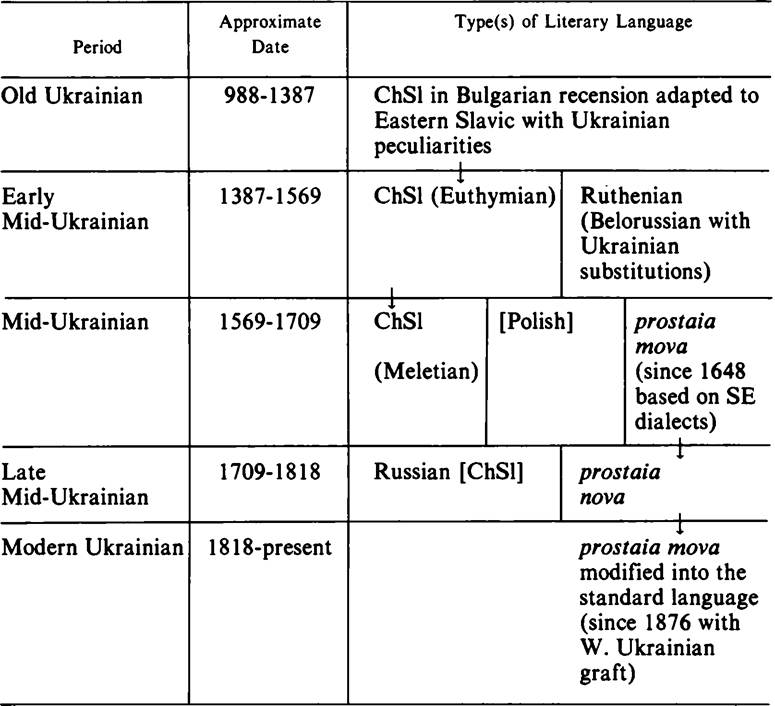
note: Periods in the history of the literary language are very roughly marked off by the dates of important historical events. Arrows show continuity, the absence of arrows indicates lack of clear continuity. Brackets indicate that a given language played a secondary role in the development.
economic and political development, modern literary Ukrainian has been the work of a group of men of letters (primarily Shevchenko and Kulish) as a manifestation of the poetic spirit. There were practically no large towns in Ukraine; in those which did exist, the upper classes spoke and wrote in Russian. There were few intellectuals and the middle class was small. Generally, the use of Ukrainian was confined to the peasants and the lower clergy.
Once created, the literary language became a slogan, a banner, a goal. At the end of the nineteenth century, the Ukrainian national movement was concerned above all with questions of culture, education and literature viewed as political problems. In the twentieth century the linguistic controversy gradually lost its central position and purely political issues came to the fore (see Appendix 5).
Contrary to the conventional theories that a literary language develops as a result of political movements, the Ukrainian literary language offers the “miracle” of a linguistic development that has given birth to a political movement. The linguistic work of Shevchenko and Kulish prepared the way for the rise of political parties, states, armies, for wars, struggles and conflicts. Lovers of paradoxes may say that a poet created a language and that the language created a nation. Of course, the nation had its long historical tradition, but by the beginning of the nineteenth century this tradition had visibly reached the point of disintegration and extinction.
Appendix 1
In the works of Amvrosii Metlynsky the Ukrainian language is already considered a crystallization of the nation’s history and the incarnation of the people’s spirit:
Bulo shchastia, buly chvary,
Vse te het’ sobi pishlo,
I, iak sontse iz-za khmary, Ridne slovo iziishlo.
Pryinialo kozachi richi,
Rehit, zharty, plach, pechaΓ: Ozovet’sia iak iz Sichi, Stane smikh і stane zhaΓ.
(“Ridna mova,” published for the first time in Metlynsky’s Dumky і pisni ta shche deshcho, Kharkiv, 1839. Quoted from Amvrosii Metlynsky and Mykola Kostomarov, Tvory, Rus’ka pys’mennist’, Lviv, 1914, 42.)
During the period of Osnova (1861-2) Kulish defined the role of the Ukrainian language in the following way: “The mother tongue alone is the strength of our people, the glory of our people, and it alone allows us to claim a place among other nations.... The mother tongue, and nothing else, has given us the respect of other nations and has laid the new foundations of our historic life. ( Choho stoit Shevchenko iako poet narodnii,” Osnova, 1861, 3, quoted from Kulish, Tvory, Rus’ka pys’mennist’, 6, Lviv, 1910, 486, 492.) The same theme appears in numerous poems by Kulish, especially in his collection Dzvin (Geneva, 1893). Take, for example, the poem “Do Marusi V”:
Otechestvo sobi gruntuimo v ridnim slovi,
Vono, vono odno vid pahuby vteche,
Pidderzhyt' natsiiu na batkivs’kii osnovi...
or the poem “Sum і rozvaha”:
Slovo nam verne і sylu davneznu і voliu,
I ne odyn nam Iavrovyi vinets’ obivie kruh chola.
In Shevchenko’s poetry the motif of the language (slovo) is especially important. With the help of a series of appositions and substitutions, Shevchenko identifies slovo with other concepts, such as soul, justice and vengeance. The poet views his historical mission as the resurrection of Ukraine by the slovo:
... Vozvelychu
Malykh otykh rabiv nimykh!
Ia na Storozhi kolo ikh
Postavliu slovo...
(uPodrazhanyie XI psalmu,” 1859).
The original psalm does not speak of the protection of oppressed peoples by their mother tongue. Psalm XI (XII) speaks only of preserving honourable men from wickedness: “Because the poor are despoiled, because the needy groan, I will now arise,” says the Lord; “I will place them in the safety for which they long.”
Shevchenko bases his faith in the future of Ukraine on the irrepressible power of the slovo:
I nesytyi ne vyore
Na dni moria pole,
Ne skuie dushi zhyvoi
I slova zhyvoho.
(“Kavkaz,” 1845).
For an analysis of Shevchenko’s widely extended semantics of the slovo, see V. Samonenko, “Obraz Shevchenkovoi muzy,” Shevchenkivs’kyi zbirnyk (Kiev: Sorabkop, 1924); B. Iakubsky, “Do Sotsiolohii Shevchenkovoho epitetu,” Shevchenko, richnyk 1 (Kharkiv, 1928); D. Chyzhevsky, Istoriia ukrainskoi Hteratury (New York, 1956), 441 ff. (In English: A History of Ukrainian Literature, Littleton, Colorado, 1975, 521 ff.)
In the appeal of the Fraternity of Cyril and Methodius to the Ukrainians (1846), which represents one of the first platforms of the Ukrainian national movement in the nineteenth century, the blossoming of the mother tongue has priority over social questions: “We declare that all the Slavs should unite.... But in such a way that each nation build its own republic and be governed separately so that each nation have its own language, literature and social order.” (M. Kostomarov, Knyhy bytiia ukrains’koho narodu, Augsburg: Ukrains’kyi muzei-arkhiv pry UVAN, 1947, 25.)
Appendix 2
Shevchenko’s struggle with the elements of the “low” genres of Classicism makes its appearance in his earliest works. The “vulgarisms” below destroy the style of the romantic poem. They disappear from this genre of Shevchenko’s poetry after 1842, and are only retained in his satires.
Zarehotalys' nekhryshcheni...
Hai obizvavsia, halas, zyk’
Orda mov rizhe. Mov skazheni,
Letiat' do duba... Ni chychyrk!
(“Prychynna,” 1838),
Vychuniala [Kateryna], ta v zapichku Dytynu kolyshe...
(“Kateryna,” 1838),
Slipyi vshkvaryv. Navprysiadky
Pishly po bazaru.
(“Haidamaky,” 1841),
Appendix 3
The orientation toward a more “popular” style finds its expression in uSiohochasne Iiteraturne priamuvannia” by Ivan Nechui-Levytsky: “The model of the literary language should be none other than the language of the peasant and its syntax,” and, as far as vocabulary is concerned, “the Ukrainian literary language should develop on the basis of the living language of the peasantry by drawing on its terminology and suffixes: new words should not be sought in other Slavic languages, nor in Church Slavonic, but the vocabulary should be developed on the basis of popular Ukrainian variants.” {Pravda, 1878, 26.) The language of Nechui-Levytsky’s novels and novellas corresponds to a great extent to this programme.
Appendix 4
The first discussion opened with the article by Borys Hrinchenko (Chaichenko, “Halyts’ki virshi,” Pravda, 1891, 9), which sharply attacked the Galician influence, and the reply by Ivan Franko (“Hovorymo na vovka, skazhimo і za vovka,” Zoria, 1891, 18). Much less aggressive were the voices of M. Shkolychenko (uChaichenko і Franko,” Zoria, 1891, 23), I. Kokorudz (uPrychynok do sporu iazykovoho,” Zoria, 1891, 24) and A. Krymsky (Khvanko, uNasha iazykova skruta ta sposib zaradyty Iykhovi,” Zoria, 1891, 24). Hrinchenko entered the stage twice more in a conciliatory tone. The discussion ended in a compromise, with a tacit agreement to follow, to some extent, a via media. This is reflected in the subsequent works of Hrinchenko (his pamphlet Tiazhkym shliakhom, Kharkiv, 1907) and Franko (uLiteraturna mova і diialekty,” Literaturno-naukovyi visnyk, 1907, 2).
A new round of discussion was provoked by Nechui-Levytsky1S pamphlets uSiohochasna Chasopysna mova na Ukraini,” Ukraina, 1907, 1-3, and Kryve dzerkalo ukrains,koi movy (Kiev, 1912). The distinctly anti-Galician position of Nechui-Levytsky, however, found no support. The responses it provoked (I. Steshenko, M. Zhuchenko, M. Levytsky, I. Verkhratsky et al.) championed the idea of compromise.
Appendix 5
The first appeal of the Central Rada of Ukraine, published on 22 March 1917, was vague in its formulations. Its only concrete demand concerned Ukrainian language rights. This document is typical and worth quoting at length.
People of Ukraine! The chains that you have been wearing for centuries have fallen. Liberty has come to all the oppressed, to all the nations of Russia who were reduced to slavery. The time is ripe for your liberty and your awakening to a new, free and creative life. For the first time, you, the thirty million people of Ukraine, shall have the opportunity to express how you wish to live as a separate nation. Henceforth you shall forge with your own mighty hand a better destiny for yourselves in the friendly family of free nations. The government of the tsars has collapsed, and the provisional government has proclaimed that a constituent assembly will soon be convened, based on universal, equal and direct suffrage. It is there that your true voice, your real will shall be heard in the world for the first time. As we wait for this moment, we ask you to demand from the new government calmly, but resolutely, all the rights that belong to you by nature, and that you, the Great People, master of the land of Ukraine, should have; and for the immediate future you should demand the right to introduce your mother tongue in all the schools, from the most elementary to the most advanced, in the courts and in the administration of the country.
(Quoted from D. Doroshenko, Istoriia Ukrainy 1917-1923 rr., 1, Uzhhorod, 1932, 43, where the text is reproduced in its entirety.)
Aside from a rather indefinite view on national autonomy, the First Universal (manifesto) of the Central Rada on 23 June 1917 demanded “that a certain proportion of the taxes levied on our people for the central treasury (in Petrograd) should be given to us, the representatives of this people, for the cultural needs of our nation.” (The complete text is quoted by Doroshenko, Istoriia, 1, 88-92).
It was only in the Third Universal of 20 November 1917 that the democratic republic of Ukraine was proclaimed and that other demands were explicitly formulated over and above those relative to equality and the use of the Ukrainian language. For the complete text, see Doroshenko, 179-81. On the attitudes of the different political parties in Ukraine in 1917, see also J. S. Reshetar, The Ukrainian Revolution, 1917-1920 (Princeton, 1952), 48 ff.
Notes
1. The Soviet claims of the 1930s and 1940s that an older or simultaneous literary language of purely native drevnerusskii character existed now appear politically motivated and do not deserve serious discussion. See Viktor Vinogradov, “Voprosy Obrazovaniia russkogo natsionalnogo Iiteraturnogo iazyka,” Voprosy Iazykoznaniia 1, (1956): 7-10, and Boris Unbegaun, “Some Recent Studies on the History of the Russian Language,” Oxford Slavonic Papers 5 (1954): 119 ff.
2. See, e.g., Kulish’s poem “Hryts’ko Skovoroda” in P. Kulish, Sochineniia і pisma, ed. I. M. Kamanin 3 (Kiev, 1909).
Liakhy zh pys’menstvom popsuvaly
Nam netiamni manastyri.
Nauky nide bulo vziaty, Pryishlos' ii V Liakhiv shukaty, I my poΓshchyznoiu zhyly Todi, iak z neiu priu vely. (1, 15)
3. In phonology it was the matter of several characteristics in the pronunciation of loanwords. In morphology it was the exclusion of participles of the type roblianyi, kladianyi', the exclusion of the first person singular of the type khodiu, nosiu and of the third person singular of the type khode, nose-, the predominance of the dative singular in -ovi for masculine nouns.