Farmers and Pastoralists
The division of labor in a family clan system was based on age and gender, with hunting generally reserved for males who were taught to make and use hunting-fishing implements at an early age, while gathering plant-based foodstuffs such as fruit, berries, roots, and herbs was reserved for females.
As planting and farming began to replace gathering, we see the beginnings of matriarchal agricultural settlements in southeastern Europe, which gradually spread to the fertile soil of the east European prairie. However, the tall grasses and abundant wild herds of horses of the steppe favored an alternative development from hunting and gathering—the herding and domestication of wild horses and cattle which roamed the vast expanse of the European plain following the Ice Age. The sedentary life of an agricultural Communityproduced food surpluses, which could not only tide the farmers over poor harvests but also provide feed for livestock which was not native to the cold winters of the east European steppe. Over time the mainly peaceful and matrilinear farming societies could support skilled artisans, builders, and miners who learned how to smelt gold and copper, and produce the first monetary-type wealth and copper tools.15,16Although more limited in their food production nomadic pastoralism had its own advantages, which led to a radically different lifestyle and culture. Supplemented by hunting and gathering, pastoralists enjoyed a healthy diet, and in terms of time spent on the production of food and other necessities pastoral
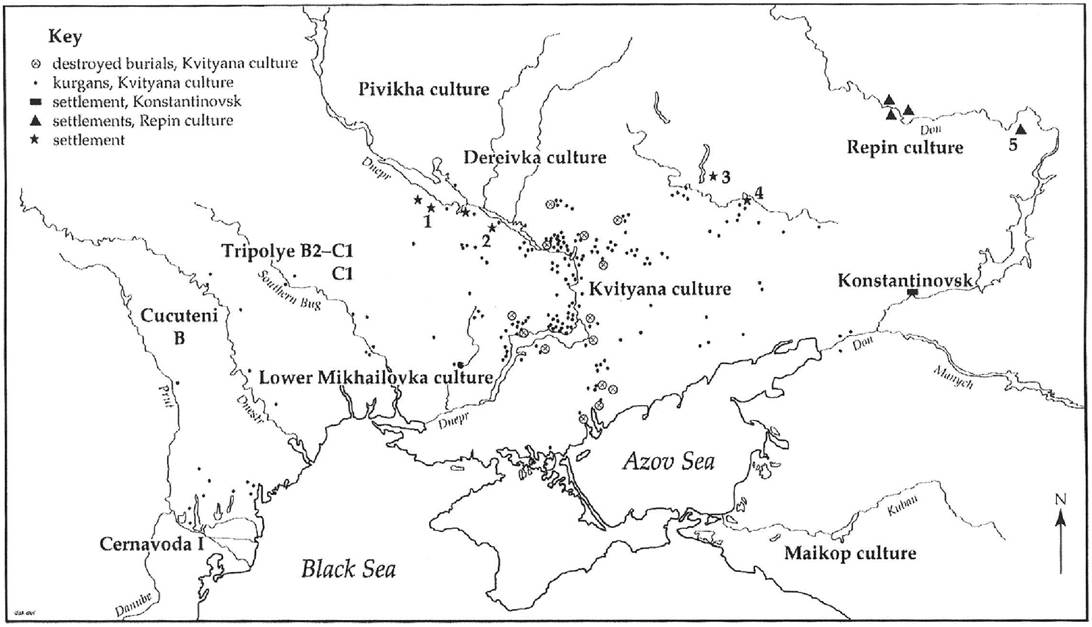
The distribution of early pastoral and farming cultures of eastern Europe, 4,000 вс-2,000 вс.
herding was more efficient than farming; it did not require a Iengthypreparation and maintenance of the soil, and the timeconsuming planting and harvesting for both man and beast, since the imported sheep and cattle did not graze in the wintertime.
This allowed herders to spend more time, at an early age, in war-like activities such as practicing the maneuvering of chariots at high speeds. All herds needed protection from rival neighboring tribes, and every able-bodied male was both a skilled herder and a warrior able to cover great distances.The agricultural settlements were first discovered in Ukraine at Trypillia (Tripolye in Russian) in 1899 just to the west of the Dnipro River and ten years later at Cucuteni in Moldavia, so to date some 2,700 sites of the Cucuteni-Trypillia culture are known. The Trypillia settlements were the most easterly of the matriarchal societies of Old Europe as referred to by M. Gimbutas.17 Beginning with 12-house hamlets which occupied about one hectare of land, during 4200-4000 вс we have 100- 200 house villages, and by 3800-3300 вс we see veritable cities emerge such as at Tallyansky to the west of the Dnipro in Ukraine with some 2,000 houses which occupy an area of 3.5 ? 1.5 km. The settlements are situated near rivers and enclosed by two concentric earthen mounds, with an open gap in the outer wall perhaps for herding sheep and cattle. The reconstructed houses appear surprisingly modern with sloping roofs to withstand heavy snowfalls and contained ovens, clay tables, and sacrificial altars.18 The Cucuteni-Trypillia farmers were also highly skilled in the manufacturing of flint knives, polished stone implements, and ceramic pottery but it was the involved process of smelting copper and pouring moulds to cast tools and make ornaments that made them the bearers of the copper age. Several hoards have been found in Moldavia and Ukraine consisting of some 500 copper hammers, axes, chisels, awls, and fishing hooks but very few weapons. On the other hand there is a marked preponderance of ornaments, and hundreds of copper beads which could have served as currency in trade with the neighboring Buh-Dnisterpeople.19 Kiln-fired, elaborate multicolored ceramic pottery also indicates specialized artisan manufacturing.20
The rich soil of the Ukrainian steppe was highly conducive to agriculture and as the Cucuteni-Trypillia culture expanded it began to have an influence on the local hunter-gatherers.
By 4900-4800 вс most of the traditional Buh-Dnister activities disappear and are replaced by farming and herding, although hunting and fishing still provided a part of the diets of both the Buh-Dnister and Cucuteni-Trypillia settlements. There is no evidence for a conquest and the Buh-Dnister people were not replaced but simply assimilated into an agrarian way of life. Recent genetic analysis of the male Y chromosome indicates that about 80 percent of European men have inherited the chromosome from Paleolithic ancestors that lived in Europe 40,000- 25,000 years ago, and only 20 percent from Middle East migrants.21 Given population movements during the Roman Empire, the proportion of early aboriginal descendents was probably higher.Another major culture of the Pontic-Caspian steppe was the Dnipro-Donets culture, which arose about 6500 вс at the same time as the related Buh-Dnister settlements, and spread throughout eastern Ukraine. Its main settlement was at Seredny Stih I (Sredny Stog I) on the Dnipro River, and the culture is known from 200 excavations of permanent settlements and 30 cemeteries with a total of 800 burials, mainly males. Bodies were buried in communal trenches, a distinctive practice, and sites were strewn with red ochre. Their physical type was late Cro-Magnon, with more massive and robust bodies than the Cucuteni-Trypillia, the Balkan, OrMediterranean people. They were a tall people with average male height of 172 cm (5'10"). The male dead were buried with shell ornaments, flint tools, and some copper ornaments such as beads, rings (including one of gold), and a copper pot indicating trade with the Buh- Donets people. A mace carved from porphyry found at Mariupol in southern Ukraine also implied contact with the Caucasian region. The distinctive features of the Dnipro- Donets culture are the plaques which were cut from boars’ tusks, polished, and sown onto clothing. At Mariupol 429 plaques were found, with 310 for ten of the 124 bodies (11 children) in the cemetery.
The “richest” individual had 40 plaques sewn to his clothing that covered his thighs, and the porphyry mace indicated a chieftain. Perhaps the boar tusk plaques were means of exchange and a sign of personal wealth since an immature child’s skeleton at Nykolskwas covered with 41 plaques, with 11 whole boars’ tusks sewn on the cap.22 Cutting and polishing the tusks was a labor-intensive task and they may have had a social significance and served as currency in trade.A great disaster such as a major flood could also have forced the southern migration along the Dnipro River, for about the same time inhabitants of the more easterly wooded region began to move out into the south-eastern Russian steppe, towards the middle Volga River. Once on the open plain they would have encountered rich game such as wild cattle, deer, and above all herds of wild horses. Traces of early Stone Age man dating to 8290-7960 вс have been found in the middle Volga region and later at Elshanka, Seroglazovo, and elsewhere between the southern Volga and Ural rivers dating from about the middle of the 7th millennium.
Ofparticular interest is the Samara culture which was discovered on the tributary of the Volga by the same name. They practiced internment of the dead, sprinkled red ochre, wore boar tusk plaques, and were probably related to the Dnipro- Donets people from whom they acquired domesticated goats and sheep. Much of the Samara culture was different in some important respects. Excavations reveal the importance which the horse had assumed, where it was probably first domesticated in the 7th millennium вс to be used for both food and to pull the early chariots used to hunt the wild stock and to manage domesticated herds. We observe the first horse cult, remains of sacrificed horses and horse figures carved from bone, and particularly weapons which are not known further to the west; flint and bone daggers, some with flint blades inserted in both sides measuring 56 cm. A child’s grave in a deep pit also contained a long adult’s flint dagger and it is here that we find the beginnings of the first warlike society in Europe. Interestingly, the Samara culture is also where we first find fired clay pottery, tempered with shells and dating to the mid-7th millennium вс.23