The Chariots Are Coming: TheBronzeAge
Related cultures continued to develop in the Volga-Iower Ural River and by the mid-5th millennium вс we see the rise of the prominent Khvalynsk culture, discovered only in 1977 with the excavation of 158 graves which dated to 4700-4600 вс.
The sites reveal major horse herding with some stock-raising of sheep and cattle, but some 70 percent of meat consumption still appears to have been fish. Animal sacrifices, probably at funeral feasts are common with horses playing a symbolic role in a widespread horse cult, as witnessed by horse carvings from bone and the polished perforated maces in the shape of horse heads. Dogs were also domesticated by this time and after death were buried under thresholds of dwellings, indicating their purpose was to guard settlements. Graves are colored with red ochre, and we find a large number of copper objects with 286 beads, rings and other “jewelry” found in 43 graves. These are later-day graves, and analysis indicates direct trade contacts with their western neighbors, as the copper was mined in the Balkan Peninsula. Tools and weapons are still made from stone and flint, but now we find long daggers which could be wielded from a chariot. Potteryis also typical with cord-impressed decorations showing a solar motif. It is the people from the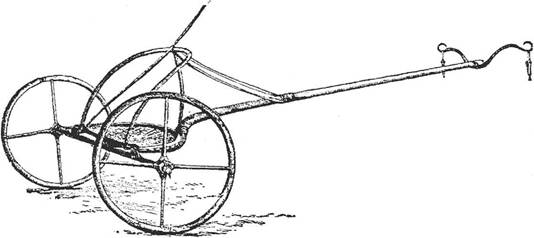
An early chariot made by Bronze Age mechanics of eastern Burope, late 3rd millennium вс, as preserved in a dry Bgyptian cliff-tomb. Made of elm and ash with bindings of birch fiber. Birch does not grow south of the Mediterranean, and the chariot was imported.
northern and eastern regions of the Caspian Sea that would begin to transform the Pontic-Caspian steppe. Warfare and pas- toralism would become a way of life, lead to the bronze and iron ages with a large-scale manufacture of metal weapons, and with the revolutionary horse-drawn war chariot the Aryan Indo- Europeans would become virtually unbeatable in war.
Mobility and the speed of travel increased greatly and communications became more extensive. As pointed out by E.N. Chernykh: “The steppe tribes of horse breeders and mobile pastoralists had already begun in the copper age, to play the role which they were to continue for the next 5,000-5,500 years of human history.”24What led to the birth of a technologically adept and warlike pastoral society on the Pontic-Caspian plain, far removed from the civilizations that were being born in the Middle East and Egypt? As the Buh-Dnister and Dnipro-Donets steppe dwellers were coming under the influence of the Trypillia agriculturalists, their east Samara-Khvalynsk relatives were adapting to the more arid conditions of the south Russian steppe surrounding the northern shores of the Caspian Sea. They depended on fishing and hunting, raising horses that roamed the open steppe and domesticated by about 4800 вс.25 While other domesticated herds of cattle and sheep could be fed by grown produce and fodder, they were not well suited to the weather conditions of the steppe. By early winter, the dry prairie vegetation would be covered by snow and ice, making it inaccessible to the southern species. Unlike native horses and cattle which could paw the snow and ice to expose dried forage, the introduced species relied on their muzzles to clear snow and ice, resulting in injury. Even when vegetation was covered by light snow, most cattle would not attempt to uncover the forage. The indigenous species, on the other hand, were not only a reliable source of food—such as reindeer in the north and horses on the southern steppe—but could also provide swift transportation and increase the effective hunting range of the wild stocks. Some authors have placed the domestication of the horse in Central Asia at a later date, but this is incorrect and is not supported by archaeological evidence.26
Mistaken claims are also made for the origin of the war chariot to be in the Near East, about 1900-1800 вс.
As with other implements of war, the origin of the light two-wheeled chariot lay in hunting, particularly for species which had to be pursued at some speed, such as the horse. The range of the bow was still limited and the most effective method would have been to drive a stallion and his mares, with their young colts, into a fenced gulch or gully, both common in the steppe. Once corralled, the animals could be kept for some time, with colts born in captivity. To match the speed of the wild horse a rudimentary but light vehicle would prove to be essential even when rounding up the domesticated herds. A two-wheeled chariot is known to have existed by 3000 вс and probably earlier since traces of spoked wheels were found in graves at the recently excavated sites of Abashevo and Sintashta to the east of the Caspian Sea.27 Given the complexity of the chariot it was in the process of development for some time, and was probably preceded by four-wheeled wagons and carts such as those found in a wagon grave at Balka Mohyla (Balka Kurgan) in southern Ukraine. An intact four-spoked wheel made of solid bronze and dating to about 3100 вс has also been found at Klady Kurgan in southern Russia. No chariot has survived intact on the Pontic-Caspian steppe, but a bronze-age war chariot was discovered in near perfect condition in a cave in the Middle East, made from north European wood which does not grow in the Mediterranean climate. Made by skilled craftsmen the entire construction was of elm and ash with bindings of birch fiber, light yet strong enough to support a grown man.Two lifestyles had emerged and become dominant on the expanses of the east European prairies; settled agriculture and nomadic pastoralism, with mutually exclusive land-use and a contrastive divide. By about 4200 вс we see the emergence of warlike male dominated pastoralist societies, as populations increased and clans began to merge into tribal units. Hunting implements developed initially to hunt and kill game were now turned against Otherhumans as conflict developed over territory and land use.
With the mobility of ox-drawn wagons and the swift striking power of the chariot the pastoralists were becoming dominant in warfare as the Khvalynsk clans expanded to the Dnipro River, southern Ukraine, and the northern foothills of the Caucasus Mountains.The first major conflict came about 4200-4000 вс and was marked by the disappearance of the Dnipro-Donets culture, overcome by Khvalynsk invaders from the Volga region. The attack was probably set off by the cooling period of the so- called Piora Oscillation, which we Icnowbegan during 4200- 4100 вс and caused a bitterly cold period for 140 years. It was the coldest period until then, and is known from tree-ring data of oaks found in German bogs as well as ice-core drillings of Greenland glaciers.28 Unlike the semi-agricultural Dnipro- Donets societythe Khvalynskpeople depended on herding and hunting-gathering and were more at the mercy of the climate. We now see the rise of a new Seredny Stih (Sredny Stog) culture along the Dnipro River with 200 sites excavated at two main settlements, Dereivka and “Strilcha Skela” (“Shooter s Cliff”). The collective burials of the Dnipro-Donets culture are replaced by individual graves topped with earthen mounds, and in place of the thick-boned broad facial body types of the Dnipro-Donets people we find a more gracile bone structure, with medium-width skulls statistically similar to the Khvalynsk population. The mound burials contain spear points, arrowheads, and long flint daggers which could be used from a war chariot, and point to a more war-like population.
The best known Seredny Stih type settlement which was established by the invaders is at Dereivka on the Dnipro River, by the now submerged great cataracts and surrounded by a palisade enclosing an area over 2,000 square meters. The rectangular houses seem to have served as workshops for making tools, weapons, pottery, and to repair fishing gear. Domesticated horses begin to play a major role as indicated by the unearthed horse bones, 63 percent at Dereivka and 80 percent at Khutir Repin on the Don River.29 At this stage the horse was probably semi-domesticated and not yet subject to selective breeding.
Given the small size of the animals with an average estimated withers height of 136 cm (4'5") it is Unlikelytheywere ridden by adult males in battle or for herding since chariots could be used for both activities.30 There is in fact little evidence for wide-spread horseback riding before the first millennium вс and it is now known that the antler cheek piece found at Dereivka, thought to date to 4200-3700 вс, was from a much later Scythian period.31 Dogs were also domesticated early on, such as the sleek “khort” wolfhound used for hunting and guard duty.To the west, by the 5th millennium вс much of Europe had evolved a developed system of agriculture and in some regions—ParticularlytheAgean coastline and todays Bulgaria— were beginning to reach a sophisticated level of craftsmanship in ceramics, metallurgy, and architecture. Theyhad introduced the copper age, and by 4500 вс Old Europe had spread from Greece and the Balkan Peninsulawith thousands Ofsettlements springing up in central and western Europe.32 Hundreds of settlements were also established in Eastern Europe between the Danube delta, the Carpathian mountains, and the Dnipro River which formed the boundary with the Khvalynsk pastoralists. By the middle of the 4th millennium вс some of the Trypillia settlements would attain the size of small cities such as at Maid- anetske with 1,575 unearthed structures built on some 250 hectares of land.
The appearance of the Khvalynskwagons/chariots on the banks of the Dnipro River by 4200 вс was the beginning of major conflicts and warfare in Europe, the first westward invasion of the (Proto) Indo European people who would establish what M. Gimbutas has called the aKurgan tradition”:
The “Kurgan tradition” is characterized by an economy, essentially pastoral with subsidiary agriculture; by a patriarchal and hi- erarchal society with prominent hill-semi-subterranean houses; by horsemanship; by distinctive burial rites including hutlike structures built of stone or wood, covered either by a cairn or an earthen mound; and by horse and weapon cults and sun- oriented symbolism.33
And, of course, the revolutionary two-wheeled war chariot.
Family traditions were often polygamous and personal hereditary rights did not prevail. There was also no obvious caste or social class stratification associated with religious practice, and temples of worship were unknown. Privileges of military chiefs, who were chosen by common consent, was limited and the practice ofburying personal valuables such as weapons worked against the accumulation of personal wealth. Thus a sarcophagus was discovered in 1969 in southern Kazakhstan constructed from fir logs, which contained a skeleton of a male (or female) chieftain covered with 4,000 pieces of gold. To the pastoral nomads the most valuable property lay in their herds of horses, cattle, and sheep which were owned by the entire clan, and the usually-elected chiefs had neither the personal interest nor the power to deprive tribe members of their herds without cause. Nomadic pastoralism embodied a military-warrior society and what prevailed was a high degree of individual meritocracy as can be seen from the practice of choosing judges and chiefs from the bravest, and the acceptance of women as warriors. There was also no state or a formal government and inequality was never very great, at least not approaching the extent described by Adam Smith in his Wealth of Nations: “Til there be property there can be no government, the very end of which is to secure wealth, and to defend the rich from the poor. d4In fact a nomadic societyled a dual life—herding cattle, sheep, and horses, and maintaining a military unit, so that every steppe herder was also a warrior. Nomads refused to take up farming since it was too labor intensive and provided little time for warrior training such as the difficult task of being able to maneuver a war chariot at full gallop. Settled city life also led to social Inequalitywhich led to low fighting morale.
Following the penetration and conquest of the Dnipro- Donets region by the Volga-Ural pastoralists, the newly established Seredny Stih II inhabitants headed west towards the Danube delta which was rich in vegetation and could feed the herds of horses and cattle on which their survival depended. The pastoralists seem to have been on good terms with the Trypillia inhabitants or perhaps the worsening climate was forcing them to head south towards the Balkan Peninsula, which by 4300-4200 вс had reached a level of wealth and development that even surpassed that of the Middle East, including Egypt. Part of the wealth of the agricultural society lay in mining, and the cemetery at Varna in today s Bulgaria still has the richest burials (at the time) in the whole world. To date 281 graves have been found, of which 61 contain more than a total of 3,000 gold objects weighing 6.0 kilograms, 2,000 of which were in just four graves.35 Copper was also a valuable commodity which has been mined in the Balkan Mountains for centuries, and at the north end of the Isker gorge at Eliseina where copper occurs not only as an ore but can still be found in metallic form.36
By about 4100 вс the chariots had reached the northern edge of the Danube delta and now launched an attack on the farming matriarchal communities of Old Europe, leaving behind destruction and burned out settlements. Continuing south and west the steppe pastoralists destroyed all in their path, and those who could not get away were killed, as witnessed by the human bones in excavated, burned out houses. Between the estimated dates 4100 and 3900 вс more than 600 settlements were destroyed and not resettled in eastern Bulgaria, Romania and eastern Hungary. Virtually all of the Balkan copper mines ceased production and quality pottery was no longer made and in its place we see the emergence of typical east European prairie ware. The excavated “kurgan” burial mounds reveal stone maces shaped like horse heads dating to 4300-4100 вс, stone axes, flint or obsidian spear points and daggers, similar to those found in Khvalynsk and Seredny Stih II. A few copper artifacts were found such as axes, rings and bracelets and a burial revealed a horse sacrifice. The economy also begins to rely heavily on stockbreeding as sections of forest disappeared, with pollen samples indicating they did not regenerate. Horses made their first appearance in the Balkans, together with the burial mounds. The sudden destruction of the Balkan-Carpathian agrarian culture could not have been due to an internal conflict since it was replaced by a completely different society—nomadic, pastoral, and warlike.
Most of the Indo-European tribes dispersed on the Pontic- Caspian steppe practiced their own customs but by 4000-3700 вс they appear to become more similar as is indicated by common burial practices which appear at this time. By 3300 вс we have the emergence of the Pit Grave or aYamnayaw cultural and political system, extending over a vast territory and with the appearance of a unified entity.37 The mostly male bodies were placed in deep pits or “yammas” with pottery impressions resembling solar motifs, polished perforated stone axes, maces, flint or obsidian knives and spear points, with red ochre powder sprinkled on the floor or on the bodies. The walls were lined with timber and the bodies placed on wooden planks or rushes, giving the appearance of a log cabin. The most striking feature of the burials are the mounds or “kurgans” which were erected to cover the graves, some of which reached the height of a 3- story building. In Ukraine they are known as “mohylas”—literally “graves”—which indicates their purpose was preserved by the steppe inhabitants for thousands of years. The territory of the Yamnaya cultural system covered some 3,000 kilometers, indicating rapid mobility and communication. To date many Yamnaya kurgan burials have been excavated in Ukraine and southern Russia, which portray an unambiguous profile of their society: war-like, male dominated, and an economy based on nomadic pastoralism.
The most spectacular site to be uncovered was also the first burial mound to be excavated in 1897 at Maikop, in the northwestern foothills of the Caucasus Mountains by the Kuban River, dated to 3700-3400 вс. The burial of a renowned chieftain, the Maikop mound was almost 11 meters high, 100 meters in diameter, and revealed a chamber 4 meters wide and 1.5 meters deep, divided into three “rooms” lined with larger timbers.38 Two southern “rooms” each contained an adult female skeleton, while the northern partition revealed a male skeleton, with 68 miniature statues of lions, 19 of bulls, and a large number of rings and beads—some of gold. Next to the skeleton lay six decorated silver rods 103 cm in length which probably supported a tent-like canopy. Ofparticular interest are two small gold and fourteen silver cups, two of which were engraved with realistic likenesses of a Caucasian spotted panther, a lion, a bull, and the earliest known image of a steppe horse. The most interesting find, however, were two cauldrons, buckets, tools, and remarkable weapons such as axes and daggers, all made from a new revolutionary new metal—bronze. The Bronze Age had begun, and more bronze weapons would be found in the Maikop culture, such as the “Klady” (“Hoard”) kurgan cemetery at Novos- vodna excavated during 1979-80 and dating to about 3100 вс. Just a single grave contained 15 heavy bronze daggers, 5 bronze axes, and a remarkable 61 cm bronze double-edged straight sword suitable to be wielded from a chariot. All the bronze was of high quality and consisted of between 1 percent and 5 percent arsenic.39 Although bronze was beginning to be known, most weapons such as spearheads and swords were still being made of copper, and were mainly used for thrusting.40 Bronze weapons, when they appeared, must certainly have been highly prized, and a question remains as to why they were placed in the burial mounds to be lost to the living members of the clan. Since a religious practice is not evident there could have been two reasons for the burials: a warrior was expected to earn his own weapons or, perhaps more likely, it was believed passing on of weapons of warriors killed in battle would bring misfortune.
The first bronze tools and weapons were found in a prairie region deep within the Caucasus Mountains, dated to the early 4th millennium, more than 1500 years before their appearance in the Aegean eastern Mediterranean region or in central Europe.41 The Caucasian steppe had been inhabited by early agricultural settlers beginning at about 5000 вс, who a millennium later were overcome by new arrivals practicing pastoral stock rearing and grazing. It is in the kurgan burials of the Indo- European Yamna type, in the flat steppe surrounded mainly by mountains in what is today Georgia and Azerbaijan that we find the early bronze tools and weapons. The most impressive kurgan is from Uch-Tepe in the Milska steppe, measuring 17 meters high and 25 meters in diameter. The tomb had been looted and was empty, but charcoal remains give the kurgan a ClyfCalibrated date of3700-3400 вс. Otherburial mounds are even older and contain rich funeral assemblages of gold and silver objects, pottery, and bronze tools and weapons.42 The bronze alloys found in the Caucasus region usually contain up to 6 percent arsenic, but 1 percent-2.5 percent zinc and 1 percent nickel bronzes are also found. Laterperiod bronzes contain 8 percent-14 percent tin and 1 percent-15 percent arsenic, with the higher percentages found in ornaments such as beads, perhaps to improve the flow of the molten alloy.43
By the middle of the 4th millennium the Yamna Kurgan cultural system had spread throughout the Pontic-Caspian steppe and Undoubtedlywas experiencing population increases in both human and the grazing stock populations. Then during 3500-3100 вс the climate of the northern hemisphere entered a significantly cooler, drier period for reason still unknown.44 The change had an irreversible effect in some parts of the planet, such as North Africa, where the Sahara desert formed during this time. The Indo-European pastoral tribes were particularly hard hit, since unlike the Cucuteni-Trypillia agriculturalists they could not store sufficient fodder for their herds, nor could they irrigate the great expanse of the steppe. Nomad herding was a family (or clan) affair and did not depend on hired labor, which would have been necessary to store a sufficient amount of hay for the winter.45 Even if help was available the nomads did not possess sufficient storage facilities such as barns or stables. Their only control over their wealth and food supply lay in mobility which enabled the pastoral warriors to find or conquer new pastures. The dried grasses Couldprovide forage only for so long before fighting broke out for possession of grazing territory, with weaker tribes facing annihilation or being expelled from their traditional lands. There is no direct archaeological record of the steppe warfare that undoubtedly broke out amongst the pastoralists, but societies do not generally embark on major migrations unless compelled to do so.
Some pastoralists headed east towards the Altai Mountains to establish the so-called Afanasievo Culture during 3300-3000 вс but the main thrust was to the west where the war chariots first struck the Cucuteni-Trypillia towns and villages, leaving behind charred remains as hundreds of Cucuteni settlements were abandoned in Moldavia, with only pockets of small Tryp- illia settlements surviving in the more forested regions in the upper reaches of the Buh and Dnister river valleys. The matriarchal and relativelypeaceful agriculturalists stood little chance against the Aryan warriors armed with bronze weapons and fighting from swift chariots. The invaders continued west and south into the Danube valley and regions of the Balkan Peninsula with the beginnings of the Usatovo culture by the Black Sea delta of the Dnister River. The penetration of the pastoral nomads into what were mainly agricultural lands continued as tribes emerged from the Pontic-Caspian steppe in search of pastures which were clearly not compatible with sown fields and gardens.
A third invasion of Old Europe took place during 3100- 2900 вс, with major incursions into the Balkans and central Europe. All traces of the last Trypillia settlements vanished and kurgan burial mounds begin to appear on the Danubian plain at Vucedol and Ezero in Bulgaria, the Globular Amphorae and Corded Ware cultures in western Ukraine, eastern Poland, and the Late Baden culture in Hungary.46 We can trace the path of the third Yamna invasion from the artifacts they left as they advanced into Europe and Asia Minor. Besides the unique kurgan mounds erected over burial pits of their chiefs or heroes, another characteristic marker of the Yamna cultural system were the forts or strongholds erected on high ground or other locations protected by rivers or marshland. The hill forts served as tribal centers where pottery and bronze tools and weapons were manufactured and stored, together with the tribal gold, silver, and precious stones. A chain of hill forts appeared in central Europe, the Balkan Peninsula, Greece, and Asia Minor which are related to the Yamna forts excavated in the lower Dnipro region in Ukraine.47 With time the wooden forts would grow into walled cities such as the Acropolises in Greece.
The progress of the war chariots was blocked by the Carpathian Mountains, with only two passes for wagons and chariots to get through. The mountains could be bypassed along the Danube Valley through the so-called Iron Gates which lead to the Balkan Peninsula and the Hungarian plan; or they could proceed along the northeastern foothills into Poland and central Europe. The progress of the pastoralists and the herds would also be blocked by the vast forests which covered much of central and western Europe. Gradually, by 2700 вс all Copper Age cultures disappeared from a large area of Europe, to be replaced by a totally different culture and people, the Aryan ancestors of most of today s Europeans. The conquest took place over a period of time and represented what is the first known large-scale genocide in Europe.
Other Indo-European tribes headed south and east. First the copper-age cultures of Asia Minor were annihilated or pushed to the southern regions with the first known destruction of Troy about 2800-2600 вс, by a people wielding typical Aryan weapons such as battle axes and maces uncovered at the site. By 2300 вс the Aegean Sea region was invaded, Troy destroyed for a second time, war chariots attacked in what is today Iran, and the Acadian culture in Syria went into demise at about 2200 вс. Actually, excavations by Claude Schaeffer in the 1940s reveal as many as four layers of burnt ruins on the southern Turkish coast and northern Syria, indicating a sustained struggle which lasted for some time. In all it is estimated that a territory of about 5,000 kilometers in diameter was destroyed in eastern and southern Europe, Asia Minor, and the Middle East, by invaders evidently enjoying great mobility. The invasions are correlated with unusual weather conditions as the Eurasian steppes became cooler and more arid after about 2500 вс, reaching peak aridity around 2000 вс.48 Troywas destroyed for the first time during the 1500-year North Atlantic Cycle, while the invasion of Syria occurred at the beginning of a very dry period. Iceland’s Hecla volcano is also a likely suspect, and excavated acidic tephra layers reveal a major explosion at about 2354 вс.
The identity of the invaders is witnessed by the appearance of domesticated horses, kurgan burial mounds, perforated stone battle maces, and above all the first appearance of bronze weapons. The burial mounds also increased in size over time, alater-day “mohyla” mound at Chortomlykin southern Ukraine rising 60 feet in the air, and 1,100 feet in circumference with five separate chambers in the pit. Also, pottery is decorated with the usual cord impressions and sun oriented symbolism such as the swastika. The skeletal measurements also differ from those of the previous inhabitants, and represent a taller more robust body type with skull shapes originating from the populations of the Pontic-Caspian steppe.49
What were the personal and cultural values of the pastoral herders, who had become the most feared warriors of the known world? The earliest Indo-European written records go back to no later than 2000-1500 вс to ancient Greece and the Punjab Valley of northern India. It is the literature of the Indian Aryans, the RigVeda (“Chieftain’s Knowledge”) that clearly reflects the traditions and values of the pastoral warriors before the beginning of agriculture and a settled lifestyle. The 1,028 hymns were written by about 1500-1000 вс from earlier oral memory and indicate an Indo-European society that was male dominated, with animal herds passed on from father to son. Bravery in battle earned personal glory and fame, and great chiefs were buried under enormous mounds, paradoxically to deny death. As recorded in the RigVeda: “...let them... bury death on this hill... the fathers hold up this pillar for you,” such that “I shore up the earth all around you. Let me not injure you as I lay down this clod of earth,”50 a clear reference to the body being laid in a chamber. The burial was accompanied by a ritual sacrifice of a horse and a feast accompanied by poetic recitations honoring great deeds.
Keep the limbs (of the horse) undamaged and place them in the proper pattern. Cut them apart, calling out piece by piece.... Those who see that the race horse is cooked... and who wait for the doling out of the flesh of the charger—let their approval encourage us.... Let this racehorse (sacrifice) bring us good cattle and good horses, male children and all-nourishing wealth.51
Individual relations amongst warriors, such as close comradeship so important in battle, played a predominant role:
That man is no friend who does not give of his own nourishment to his friend (comrade) the companion at his side. Let the friend turn away from him—this is not his dwelling place. Let him find another man who gives freely even if he be a stranger.
Let the stronger man give to the man whose need is greater— let him gaze upon the lengthening path. For riches roll like the wheels of a chariot, turning from one to another.52
Pastoral herding also gave the nomads free time to observe and wonder at the mysteries of life and the universe. In an early hymn of the Rig Veda, the “Nasadiya” or the Creation Hymn, the author(s) raise deep metaphysical questions, realizing there is no simple answer, and perhaps no answer at all:
There was neither non-existence nor existence then; there was neither the realm of space nor the sky which is beyond. What stirred? Where?... Therewasneitherdeathnorimmortality then. There was no distinguishing sign of night nor of day.... Darkness was hidden by darkness in the beginning with no distinguishing sign, all this was water. The life force that was covered with emptiness, that one arose through the power of heat. Desire came upon that one in the beginning; that was the first seed of mind. Poets seeking in their heart with wisdom found the bond of existence in non-existence.
Who really knows? Who will here proclaim it? Whence was it (the bond) produced? Whence is this creation? The gods came afterwards, with the creation of this universe. Who then knows whence it has arisen?53
By the time the Rig Veda was written the Aryans (at least in India) were monotheistic. Since it is not “the gods” who created the universe there must have been a “god” of creation who also created “the gods.”
“Once he was born, he was the one lord of creation. He held in place the earth and the sky.... He who gives life, who gives strength, whose command all the gods, his own, obey.”54
A number of views have been proposed in the past which deny that east Europe was the original home of the Indo- European people. The discovery of weapons and other artifacts has led some historians to place Indo-European origins somewhere to the east of the Caspian Sea but the evidence does not support the hypothesis. The dating of the finds indicates that Indo-European artifacts found in central Asia are later than those unearthed in Eastern Europe. The horse is not native to CentralAsia nor is Indo-European speech. There is also no evidence of Aryan migrations from Asia into Europe, although the reverse is known. Most telling is the absence of two animal species, one in Asia and the other in Europe. The camel which was domesticated at an early time would have been known to Indo Europeans if they had migrated from Asia, while the honeybee which was common in Eastern Europe was unknown in Asia. There is also no Indo-European word for “lion” which was common in many parts of Asia.
A central European origin for the Indo-European speaking people, in the area bounded by the Carpathian, Balkan, and the Alp mountains has also been suggested, the so-called Danubian culture. The excavated settlements, however, lack the usual Aryan weapons, and there is no trace of corded ware pottery or of horses. On the contrary, there is a widespread cult of the Mother Goddess, a totally alien deity to the Indo-Europeans but was common to the early agricultural communities.
Another contender for Indo-European origins is the Nordic Theoryput forward in the second half of the 19th century by German, Austrian, and Scandinavian authors, which equates “Aryan” with “Germanic,” and places Indo-European origins somewhere in northern Europe.55 The Aryanization of the Danube Valley, the argument goes, came from northern conquerors and not from Eastern Europe. Imprecise dating techniques kept the argument alive for several decades preceding World War II but today it is accepted by few archaeologists. While there were Aryan invasions of central and northern Europe, the latest archaeological evidence indicates unambiguously that the invading chariots originated on the east European steppe and not in the dense forests of northern Europe. Also, analysis of pollen trapped in north European bogs shows that the earliest clearing of land was for pastures and not for sowing crops. The Nordic Theory lay at the heart of the “master race” mythology of Hitler s Nazi movement leading up to World War II, and even to this day the term “Aryan” and the Indo-European pagan swastika sun symbol suffer from negative associations.
By no later than 2900 вс all northern settlements of Old Europe came to an end, to be replaced by sparse dwellings of flimsy and non-permanent construction. The invaders were kurgan-building pastoralists whose eastern steppe origins are unmistakable. The single grave burials contain trademark corded ware pottery, stone maces, and bronze weapons. The burial mounds cover territory extending to Jutland and the Netherlands and by 2200 вс the Corded Ware people are dominant in Scandinavia. With the newcomers we have the introduction of the horse and battle axes found in Swedish tombs which have been traced to the Pontic-Caspian steppe.56 The east European origin of the northern Aryans is still denied by some members of the German School who argue that the Funnel Beaker people were a local development and it is they who are at the origins of the Indo-Europeans.
Immaterial of the origin of the Funnel Beaker culture, it was replaced by the Corded Ware cultural system which was virtually identical to the older Yamna culture of Eastern Europe. Both were engaged in cattle and horse breeding, and both erected the typical kurgan burial mounds with pits powdered with red ochre. The Corded Ware people were also warlike, with burials exhibiting typical steppe polished and perforated stone battle axes, maces, bronze weapons, and arrowheads.57 By 2200 вс their system stretched from Belgium and the Netherlands to the Dnipro River in Ukraine, which was the contact zone between the CordedWare and the Yamna cultural systems, with the latter continuing east and past the southern foothills of the Ural Mountains. It is on the territory of the Corded Ware system that we find the early beginnings of the Germanic, Baltic, and Slavic languages of northern Europe.58
The Yamna and Corded Ware expansions required a sustained military effort with a steady supply of equipment such as wagons, war chariots, and bronze weapons. Chariots could be built almost anywhere but the making of bronze required a particular location, one with access not only to copper, and (mainly) arsenic ore but charcoal required a steady supply of hardwood, and the pastoralists’ animal herds needed a steppemarsh environment. One such location to the south of the Ural Mountains soon outstripped the Caucasus region for mining where two to three percent quartzite copper and arsenic ores of the Ural-Tobolsk region had been worked for some time but beginning about 2100 вс we have more than 20 heavily fortified settlements being built on the Ural-Tobol steppe. The main town was on the Sintashta River, with about 50-60 structures spread over an area of 140 meters in diameter. Each building showed evidence of ore smelting, and by 1992 following two decades of excavations, it became clear that the Sintashta-type fortified settlements were a center for metallurgical manufacturing, the first known to archaeology. As interesting was the fact that bronze weapons were being exported to the west, and much of the smelted Copperwas shipped to the southern cities of Mesopotamia.59