Independent Ukraine
In January 1992 Ukraine embarked on an entirely new stage in its long history. For the first time it was able to function as an independent state accepted enthusiastically or grudgingly by all its neighbors, and therefore without any threat to its sovereignty.
Ukraine was one of several states that were able to begin a new life following the Revolution of 1989 and the collapse of the Soviet Union two years later, resulting in the end of Communist rule throughout entire Soviet realm that had stretched from central Europe though central Asia to the shores of the Pacific Ocean. Almost all the countries within this vast geographic space proclaimed as their goal freedom and democracy for their citizens and the desirability of replacing centralized command economies with ones based on free-market forces.Declarations of goals was one thing, their actual implementation was quite another. Ukraine, like all other countries in the former Soviet sphere, entered into what came to be known as a period of post-Communist transition. For several central European countries the transition period could be said to have ended on the eve of their entry to the European Union between 2004 and 2007. Other countries, including Ukraine, have made substantial changes in their political and economic life but they are still in a transitional phase.
Political restructuring
For Ukraine, the most significant break with the past coincided with the end of the domination by a single-party “dictatorship of proletariat” and the creation of a multi-party political system in which the president and parliament would be elected through freely contested elections. In fact, the confirmation and ultimate imprimatur for Ukraine’s independence came from the citizens themselves during the December 1991 referendum which coincided with an election for president of the new country.
The 1991 election, considered to be free and fair according to international observers, brought the former Communist party ideologue-turned- national Communist, Leonid Kravchuk, to the post of president by a margin of 62 percent of the vote.In pre-term elections held in 1994, Kravchuk ran again but was defeated in another freely contested election by Leonid Kuchma, who was reelected to a second term in 1999. After two-terms in office - the maximum allowed according to the constitution - a fourth presidential election was held in late 2004. This time the electoral process was accompanied by widespread fraud and corruption, to such a degree that the results were declared invalid by the country’s supreme court. The 2004 election became a crucial test of Ukraine’s commitment to free elections, a test that it passed in large part due to extensive nation-wide citizen protests that came to be known as the Orange Revolution. As a result of a repeat election, the “orange” choice was victorious in person of Viktor lushchenko, who was inaugurated as the country’s third president in January 2005.
During the early stage of the transitional period, Ukraine set as its goal the creation of a state structure that was similar to those found in Europe - the proverbial West. This meant a balance of responsibility between three branches of government: the executive, as represented by the office of president; the legislative, as represented by the national parliament; and the judicial, as represented by the court system. Of course, existing democratic European states offer a wide variety of models from which to choose. Some are highly unitary (centrist), like France; others are federal in structure, like Germany; still others combine both unitary and federal principles. Moreover, the relationship between the executive, legislative, and judicial branches varies from country to country. Ukraine’s state builders were faced with the challenge of which European model, or variant thereof, would best suit their country.
Ukraine’s legislative branch inherited the structure that existed in Communist times, that is the Supreme Soviet, or Council (Verkhovna Rada). There was some debate about creating a second legislative chamber, but in the end the national parliament comprises one chamber that is still called the Supreme Council. The council has 450 deputies elected to a four-year term. Initially, the deputies were chosen according to a two-tier system; that is, half from party lists and the other half from each of the 225 electoral districts into which Ukraine was divided. Beginning with the 2006 parliamentary elections, only the party list, or proportional system is in effect. This means that the electorate votes for a particular party, not an individual. Each party prepares in advance of an election a list of its deputy candidates in order of preference (with the party leader in the first position). The number of candidates who become deputies (following the order of preference set by the party) depends on the percentage of votes a given party receives in a parliamentary election.
Considering their experience in previous governmental structures, it is perhaps not surprising that it was the Communists who initially held the highest number of seats in Ukraine’s “post-Communist” national parliament: 86 seats at the outset of the 1994-1998 session and 121 seats in the 1998-2002 session. Since the beginning of the twenty-first century the strength of the Communists has progressively waned, however, so that in the most recent parliament session (2006-2010) that party has only 21 deputies.
Actually, the transitional stage in Ukraine has made parliamentary politics quite complex and unstable. During the past decade, there have existed at any time over one hundred registered political parties. The vast majority of parties have been unable to obtain the minimal percentage of votes (four percent until 2002, three percent thereafter) required to qualify for at least one seat in parliament.
Therefore, most “parties” who make it into parliament do so as part of a bloc usually consisting of one relatively large party together with several smaller ones. At the outset of the twenty-first century the most important parties and blocs were Our Ukraine, headed by Viktor lushchenko, the Party of Regions headed by Viktor lanukovych, and the Tymoshenko Bloc (BIUT) headed by luliia Tymoshenko. These parties and blocs have alternatively cooperated or opposed each other depending on particular political circumstances. While all favor the existence of a sovereign Ukrainian state, each has different views on issues of political structure (a stronger presidential office or a stronger parliament), economic reform (its pace and extent), and foreign relations (joining the Western institutions like NATO and the European Union or closer relations with Russia).The greatest political challenge facing Ukraine after independence was to adopt a constitution. Despite discussions about the possibility of a federal state along the lines of Germany, this option was rejected. The constitution that was finally adopted in 1996 provided for a unitary state in which the president (elected for a five-year term) has extensive powers, including the possibility to form and dismiss the government, as well as the control of foreign and defensive policy, the security service, and the prosecutor general’s office.
The one exception to Ukraine as a unitary state was the Crimea. Already during the waning months of Soviet rule, the local Communist leadership arranged for a referendum (January 1991) in which an overwhelming majority of the peninsula’s voters (93 percent) approved the reestablishment of the Crimea as an autonomous republic, a status it had had within Soviet Russia before 1945. The Crimean A.S.S.R was formally reconstituted one month later, although this time within the framework of Soviet Ukraine. After Ukraine itself became independent, its relationship to the Crimea remained unclear as long as leaders in Kiev did not adopt a constitution for the country.
What followed was a struggle between Simferopol’ (Crimea’s capital) and Kiev over the status of the Crimea. The region’s parliament in Simferopol’ acted more quickly and adopted its own constitution in May 1992, which declared Crimea’s “state independence.” A few months later a revised constitution was adopted (September 1992) describing the Republic of Crimea as a state within Ukraine. The peak of estrangement between Kiev and Simferopol’ came in January 1994, when Crimean voters elected as their president Iurii Meshkov. Together with his Russian bloc political allies in the republic’s parliament, he called for the “reunification” of the Crimea with Russia.This clear threat to Ukraine’s territorial integrity was dealt with decisively by president Leonid Kuchma soon after coming to office. Under his instigation, in March 1995 the Crimean presidency was abolished and its constitution cancelled. It took three years before a reformulated Crimean constitution was accepted by Ukraine. It provides for only a limited amount of self-government for the Crimean Autonomous Republic which remains firmly within Ukraine. Not even all the peninsula’s territory is included within the Crimean republic, since the city of Sev-
MAP 46
INDEPENDENT UKRAINE
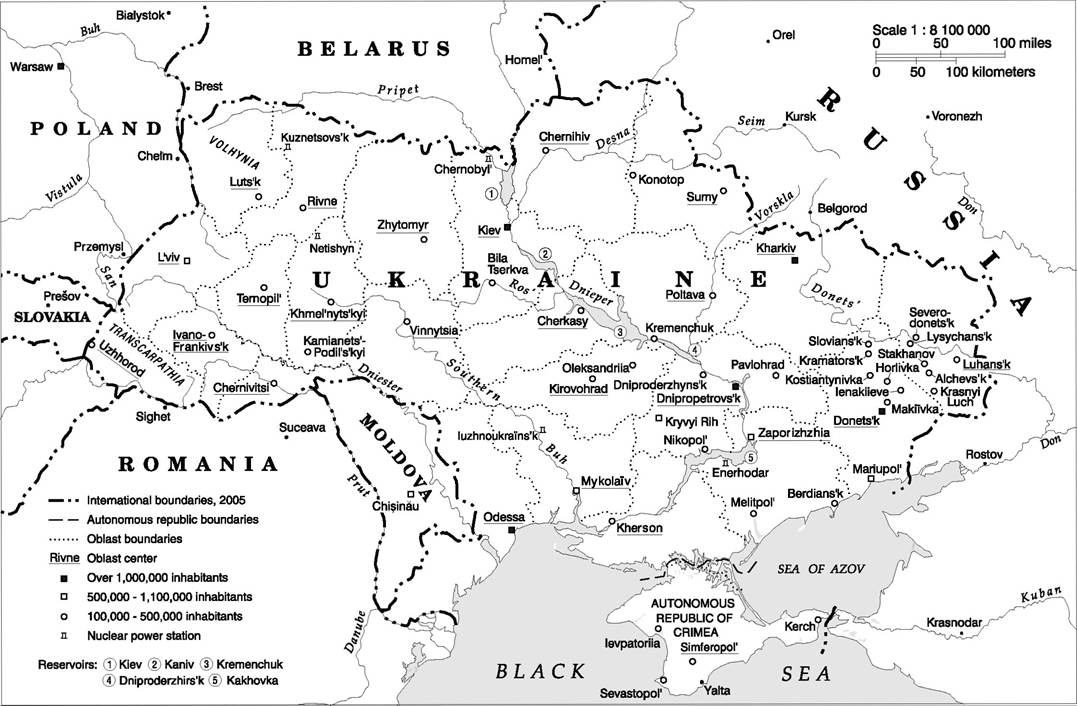
Copyright © by Paul Robert Magocsi
astopol’ (home of the Black Sea Fleet) and neighboring suburbs are administered directly by Ukraine’s central authorities in Kiev.
Two other regions of Ukraine have also expressed desires for autonomy. In the far western Transcarpathian oblast located along the borders of Slovakia, Hungary, and Romania, the inhabitants approved (by a 71 percent margin) a referendum in December 1991, calling for territorial self-rule (samouprava). Although the question was formulated by future President Leonid Kravchuk himself, self-rule has never been implemented by any of the governments in power in Kiev.
Farther east, civic activists meeting in the city of Sieverodonets’k called for autonomy for eastern and southern Ukraine, although nothing ever came of this “separatist” movement.The only significant change in Ukraine’s governing structure came as a result of constitutional reform (adopted in December 2004 and implemented in early 2006), whereby the power of the presidency was reduced. In this new parliamentary-presidential system, the Supreme Council selects the prime minister who, in turn, chooses all other governmental ministers that form the cabinet. As head of the government, the prime minister has the primary policy-making role, while the president’s powers are mainly in the area of foreign and military policy. While the president can veto legislation adopted by the Supreme Council, the latter, by a two-thirds vote, can override the presidential veto as well as amend the constitution. In effect, the functioning of Ukraine’s government is determined by the party or coalition that forms the majority in the Supreme Council (parliament). Such power-sharing between the parliament and president may sound reasonable, but in practice it can and does lead to friction between the president and prime minister, resulting in governmental paralysis. Moreover, Ukraine functions neither as a centrist nor federal state but, to quote one political commentator, as a “decentralized unitary state.”1 The ideal here is, on the one hand, national integration based on shared values and common institutions while on the other, acceptance of the reality of a state comprised of several distinct regions.
Foreign relations
Since Ukraine was until 1991 part of the Soviet Union, it is not surprising that relations with that country’s proclaimed successor, Russia, would be the most complex. Russia’s governing and civic elite, not mention its public-at-large, have found it difficult to accept the fact that “their” vast Soviet space no longer includes the fifteen “fraternal” republics, all of which by 1991 had become independent states. Ukraine, in particular, had - and still has - a special place in the Russian cultural and geo-political mindset. For many Russians it is simply inconceivable that Little Russia - Ukraine - is no longer a part of the Russian body.
Aside from such powerful, if somewhat intangible beliefs, there remained a whole host of concrete social, economic, and familial ties that had developed between Russia and Ukraine over the centuries and that were deepened even further by seventy-five years of highly centralized Soviet rule directed from Russia’s capital in Moscow. The command economy had fully integrated Ukraine with the rest of the Soviet Union, and the political and managerial elites of both countries were closely interwoven. After all, the Soviet Union was for long periods of time headed by Communist party leaders that were from, or closely connected with, Ukraine (Nikita Khrushchev, Leonid Brezhnev, Konstantin Chernenko, among others). In an attempt to maintain these complex interrelations after independence, the leaders of Russia, Belarus, and Ukraine - already in December 1991 on the eve of the formal passing of the Soviet Union - agreed to form the Commonwealth of Independent states (CIS). Most Central Asian and Caucasian republics also joined the CIS; the three Baltic states (Estonia, Latvia, Lithuania) demonstratively refused to do so.
Ukraine’s relationship to the CIS was to remain ambiguous. For example, during his second term in office President Kuchma seemed to reorient Ukraine closer to Russia. In 2001, he became the head of the CIS Council of Heads of State and agreed that Ukraine should become part of a single economic space to be created in three stages together with Russia, Belarus, and Kazakhstan. Whereas Ukraine agreed to the first stage, a free-trade zone among the four countries, Kuchma made clear his opposition to being part of the next two stages, which were to result in a currency union and customs union. In effect, not even stage one has been implemented, so that the CIS has never fulfilled the cooperative federative function intended by its Soviet-minded creators back in 1991.
The trend toward separation rather than integration has characterized relations with Russia since Ukraine’s independence. Of particular concern was Russia’s recognition of Ukraine’s borders, which did not occur fully until 1999. The question of the Soviet Black Sea Fleet based in the Crimean port of Sevastopol’ proved to be a particularly sensitive issue. The very existence of the fleet symbolized Russia’s naval power and its access to the Black Sea and the Mediterranean. Now independent Ukraine was a territorial hindrance to such access. Aside from symbolic and strategic considerations, the Black Sea Fleet was part of the larger question of property assets. In other words, who was to inherit the assets - and debts - of the defunct Soviet state? In general, it is the successor state on whose territory the assets are located. Consequently, Ukraine inherited - among other things - a large amount of conventional military hardware and approximately 5,000 nuclear weapons, making it the world’s third power after the United States and Russia. As for the Black Sea Fleet based in the Crimea, which is part of Ukraine, long negotiations finally led in 1997 to an agreement with Russia, whereby the two countries divided the fleet (Ukraine receiving about 18 percent of the ships) and the Russian navy was given a twenty-year lease on Sevastopol’s port. By the year 2017, what remains of the Russian fleet is to withdraw from Ukraine.
The other ongoing area of disagreement with Russia has been energy resources. As part of Soviet policy, Ukraine’s industries - and domestic sector - had become virtually dependent on gas piped from fields beyond the Ural Mountains in western Siberia. By the same token the Soviet Union gained valuable western currency by supplying “capitalist” western Europe with natural gas that flowed through pipelines across Ukrainian territory. Ukraine is still dependent on energy resources from Russia but would prefer to receive them for much less than what countries in the European Union pay. Quite logically, Russia’s argument is that if Ukraine is not part of Russia or willing to be part of a fully functioning Commonwealth of Independent States, then it should pay the same price as any other independent state. On the other hand, Ukraine has the right to expect appropriate transit fees, since it controls the pipelines through which 80 percent of Russia’s energy exports reach western and central Europe. Disputes over natural gas prices and over what mechanism this commodity reaches world markets are topics that have continued to dominate Russian-Ukrainian relations throughout the entire post-Soviet transition era. In an effort to free itself from excessive dependency on Russian energy resources, in 1997 Ukraine entered into an agreement with neighbors to its south and southeast. The resultant consortium, named GUAM after the first letters of the participating member states (Georgia, Ukraine, Azerbaijan, Moldova), has as its goal the creation of new transport facilities for Azerbaijani oil crossing through the Caucasus region and the Black Sea to Odessa, and from there across Ukraine to the European Union.
Ukraine’s relationship with Russia has also influenced the attitude and policies of its neighbors in Europe and the United States. Ironically, among the first countries to recognize Ukraine’s independence was its historic “enemy” Poland. Since the early 1990s, post-Communist Poland has consistently promoted the idea of Ukraine’s further integration into Euro-Atlantic structures and would hope that it become a candidate for membership in NATO and the European Union. Such an eventuality is not likely in the short-term, although the European Union does recognize the importance of Ukraine and has singled it out as a key component of its European Neighborhood Policy.
The United States, on the other had, has adopted an entirely new attitude toward Ukraine. Traditionally, American foreign policy makers have throughout the twentieth century ignored or dismissed the idea of Ukrainian independence. As late as 1991, U.S. President George H. W. Bush, on a visit to what was still Soviet Ukraine, warned in his so-called chicken-Kiev speech against nationalist extremists and the danger of their fantasy-like dreams of separating from the Soviet Union. But with the collapse of the Soviet Union, Ukraine for the first time was taken seriously by American’s foreign policy-makers. As the largest and economically most powerful former Soviet republic after Russia, Ukraine was now seen as a strategic partner of the United States. After all, without Ukraine it would be difficult if not impossible for Russia to attain the status of its Soviet predecessor as the world’s second superpower.
American-Ukrainian relations were particularly favorable during the first term (1994-1999) of President Leonid Kuchma, which coincided with the second term of U.S. President Bill Clinton. As part of its share in Soviet property assets, independent Ukraine became a major nuclear military power. But at the urging of Washington, Ukraine signed in 1994 a tri-lateral nuclear disarmament agreement with the United States and Russia. According to its provisions, within the next two years the last nuclear warheads were removed from Ukrainian territory. The United States, in turn, provided Ukraine with security assurances, paid for the de-nuclearization process, and started pouring in funds to assist the country in its transition to democracy and a market-driven economy. During the presidency of Bill Clinton in the 1990s, Ukraine, after Israel and Egypt, was the third largest recipient of U.S. foreign aid.
As a strategic partner of the United States, Ukraine was considered a buffer between Russia and Europe. And to enhance Ukraine’s security, the United States helped it to become part of NATO’s partnership for peace program in early 1994. Since that time Ukraine has participated with its troops in America-led military campaigns (Iraq) and in numerous NATO and United Nations peacekeeping missions in the former Yugoslav republics, Lebanon, and several African states. The United States remains a strong supporter of future NATO membership for Ukraine, whose candidacy to this day is still opposed by certain influential western European members of the alliance.
Ukrainian-American relations began to cool during President Kuchma’s second term (1999-2004). There were several reasons for the change. From the American perspective, Kuchma’s efforts at economic reform were half-hearted and ineffective, and his administration was tainted with charges of corruption, human rights violations, and restrictions on the media (including suspected collusion in the murder of a journalist critical of the government). Moreover, in the wake of the Al- Qaeda attacks against the United States on 11 September 2001, President George Bush, Jr. was keen on seeking accommodation with Russia’s president, Vladimir Putin, both of whom had common interests in the “war on terrorism.”
Whereas during the closing years of the twentieth century Ukraine’s foreign minister Borys Tarasiuk was calling for the country’s “return to Europe,” by the outset of the twenty-first century President Kuchma was strengthening relations with the CIS and cooperating fully with Ukraine’s business leaders (oligarchs) who favored greater integration with Russia. Ukraine’s policies, which at different times or simultaneously could be both pro-Western (Europe and the United States) and pro-Eastern (Russia) were referred to by its defenders as “multi-vectorism.” For some, the multi-vector approach was the most natural policy for a “buffer state” like Ukraine; for others, including Western policy makers, it seemed like a mark of the country’s instability and the confused or opportunistic attitudes of its leaders. The pro-Western (liberal, democratic) and pro-Eastern (authoritarian) conundrum was transformed into a stark choice for citizens to decide during what came to be known as the Orange Revolution.
The Orange Revolution
In retrospect it is now clear that the stage was set for the Orange Revolution two years earlier, when, in the 2002 parliamentary elections, Viktor Iushchenko’s Our Ukraine bloc, campaigning on a platform of reform, won a plurality of votes. The victory proved to be short-lived, since political manipulation by deputies loyal to President Kuchma reduced the Our Ukraine bloc (in alliance with the Tymoshenko bloc and the Socialist party) to the role of parliamentary opposition. Iush- chenko was determined, however, to be the candidate of reform in the 2004 presidential elections. He was opposed by then Prime Minister Viktor Ianukovych, the chosen favorite of Kuchma and the business interests represented by powerful oligarchs from the industrial region of eastern Ukraine. Not wanting their business privileges and their often corruptly earned income to be threatened by the reform-minded lushchenko, the oligarchs joined with President Kuchma (himself fearful of possible prosecution for the various scandals associated with his second term in office) in an attempt to assure that their candidate Viktor lanukovych would be next president.
Not surprisingly, lushchenko and lanukovych were the two leading candidates in the first round of the elections (after which the other contenders were eliminated). lushchenko actually polled the most votes in the first round, but he allegedly lost to lanukovych in the second round. Despite widespread accusations of electoral fraud, President Kuchma recognized lanukovych as his successor. More ominous was the fact that soon after the second round, President Putin of Russia was the first foreign leader to congratulate as winner Viktor lanukovych. It seemed that the “multi-vector” foreign policy of Ukraine, which of late was leading more in the direction of Russia, would now be the course the country would adopt under a lanukovych presidency. After all, while still governor of his native Donets’k region, Ianukovych had unabashedly called for making Russian the second state language of Ukraine, for allowing the populace to hold Russian and Ukrainian dual citizenship, and for making positive relations with Russia a national priority. Throughout the electoral campaign, the Ianukovych forces branded their rival Iushchenko (who, incidentally, was nearly fatally poisoned under suspicious circumstances) as an anti-Russian extremist and a puppet of America. The lushchenko camp was not about to concede defeat, however, and together with an even more radical reformer, luliia Tymoshenko, launched what came to be called the Orange coalition.
The Orange forces led by lushchenko presented themselves as the vanguard of revolutionary change that would allegedly cleanse Ukraine of corruption, government inefficiency, and dependence on Russia, and would adopt wide-ranging economic reforms, implement a Ukrainian cultural revival, and seek the country’s early entry into NATO and the European Union. The Orange leaders called on their supporters to take to the streets and conduct massive protests until the fraudulent second-round election results were overturned. No one, least of all the Orange coalition leadership, anticipated the response. Whereas previous political rallies had attracted at most 150,000 people, in December 2004 no less than 20 percent of the entire population of Ukraine - an estimated 7 million people - took to the streets and squares of countless towns and cities throughout the country. Kiev and its large central Independence Square (Ukrainian: Maidan Nezalezhnosti, popularly known as simply the Maidan), became the focal point of the nation-wide protests, where for seventeen consecutive days in the midst of freezing temperatures and snowfall approximately 2.3 million people (over a half of whom arrived in the capital from all parts of the country) held vigil until their demand to annul the second-round presidential elections was fulfilled.
The enormity of the lengthy protests required concerted logistical support, which came from government and non-governmental agencies in the United States and the European Union, from the office of the sympathetic mayor of Kiev, and from thousands of the capital’s ordinary citizens who provided free food for
Was There Anything Revolutionary about the Orange Revolution?
In the euphoric years immediately following the collapse in 1989 of Communist rule in central Europe, the region’s most respected leader worldwide, the former dissident and subsequently president of Czechoslovakia, Vaclav Havel, warned that the greatest challenge facing his countrymen and women was not the former political system but the “enemy within.” In other words, citizens in the post-Communist sphere must learn to overcome their internal fears and the civic mistrust that had been embedded in their souls by decades of totalitarian rule. Perhaps only an outside observer - in this case, a professor from St Louis in the mid-western heartland of the United States and an eyewitness to the Orange Revolution - would be able to decipher the profound transformation that took place in the national psyche of Ukraine’s citizens as a result of the events of late 2004.
A million Ukrainians flocked to Kyiv’s Independence Square [the Maidan] to demand that a new and fair election be held to overturn the results of an earlier one, which a corrupt and thuggish government had fixed. Although facing constant danger, tens of thousands of peaceful protesters camped out on the freezing Maidan for weeks at a time, until, after a new vote on December 26, justice was finally done. Once a man for whom they voted was finally installed in office they went home, leaving neither gum wrapper nor cigarette butt behind. Ordinary people had accomplished an extraordinary thing. It is called the Orange Revolution.
A year later, corruption in Ukraine was as bad as ever, the economy had taken a nosedive, political murders and assassinations... remained unsolved and, worst of all, the coalition swept into office by the event on the Maidan had collapsed amidst bitterness, recrimination, and accusations. An upset public complained that the Orange Revolution had changed nothing.
Many Ukrainians have sadly, though understandably, misunderstood the meaning of the Maiden: a fantastic event at a precious moment in history, it must not be forgotten.
The Maidan is, of course, a place, but [it is] also a living entity: a symbol, a message to the world, a source of hope, a warning, and the birth act of a modern democracy.
The events of the Maidan put on the map a corner of Europe the rest of the world would prefer to forget. It is, after all, the ground zero of human suffering in the twentieth century - the scenes of the greatest battles in both world wars, the killing grounds of the Bolshevik Revolution, the bone fields of the Holodomor [the 1933 Great Famine], and the bone heaps of the Holocaust. Ukraine has also been divided, oppressed, disrupted, and systematically stripped of identity....
The quiet dignity of those on the Maidan - men and women prepared to die for political principles too often taken for granted elsewhere - opened a window of light into a nation whose history is one of darkness. Their example shames those who would turn their backs to Ukraine, which now has for the first time in its history a lifeline to the rest of the world. A path has opened into a realm of light. The Maiden is therefore a source of hope in a land which has known little of it....
The example of the Maidan, in other words, delivers the universal message that even in a quasi-dictatorship, sovereign power resides in the people. It is a statement of honor and dignity, for which the West should be grateful.
The Maidan is also, as put eloquently by Tatiana Korobova, ‘about a people, who have discovered humanity in themselves’.... The extraordinary event on Independence Square... can also mark the birth of a new modern democracy. Its memory and legacies must be defended. That is the ultimate meaning of the Maidan. and the Orange Revolution.
source: John Gillingham, “The Meaning of Maidan,” Harvard Ukrainian Research Institute News, Spring Issue (Cambridge, Mass. 2006), pp. 1 and 7.
the millions of unexpected guests. Eventually, lanukovych supporters from eastern Ukraine also arrived in Kiev, but they made up only about 5 percent of the total. In the end, the overwhelming majority of the protestors, who were pro-Orange supporters primarily (77 percent) from central and western (Galicia) Ukraine, achieved their goal. Ukraine’s Supreme Court declared invalid the election that had given Ianukovych a majority and called for another run-off election to take place. Its results brought a 52 percent victory for Viktor lushchenko, who was inaugurated the third president of Ukraine in January 2005. Most important for the functioning of a democratic society was the peaceful transition of political power, in which President Kuchma stepped down and his hand-picked successor lanuko- vych remained active in the parliamentary opposition.
The hopes and expectations of the Orange Revolution were not, however, to be realized. Not only were the electoral campaign promises overly optimist, but the coalition’s main leaders - lushchenko and the increasingly popular Tymoshenko - proved themselves unable to work together. While it is true that the populace soon became disillusioned with the political process, it is equally true that a profound and longer-lasting change had occurred among Ukraine’s citizenry. For the first time in human memory it was possible for Ukraine’s people to take a stand and, through their collective but spontaneous actions in the form of peaceful protests, to reverse the political path that in 2004 the country’s authoritarian leaders had tried to impose on them. In the end, Ukraine experienced no radical change as a result of the Orange Revolution, and its future political course is likely to vary between three approaches to governing the state as symbolized by the moderate reformer Viktor Iushchenko, the radical reformer Iuliia Tymoshenko, and the conservative Viktor lanukovych. Hence, it might be best to remember the year 2004 not as one that witnessed a revolution, but rather another - albeit dramatic - phase in Ukraine’s ongoing evolution from Soviet-style authoritarian rule to a parliamentary and free-market European-style democracy that with regard to political practice reminds one more of Italy than of post-Communist Russia.
Economic developments
The biggest challenge facing Ukraine, like all countries in the post- Communist world, was how to adopt its economy from the centralized command system to market-driven capitalism. An integral aspect of that change was to adopt and integrate Ukraine’s economy with rules and patterns of the global economy, still determined largely by the policies of the European Union and the United States. Since independence, Ukraine’s economic development has gone through two basic phases. For nearly a decade, until the end of 1999, the country was on the verge of economic collapse; by contrast, since the year 2000, the Ukrainian economy has not only recovered but has made some remarkable advances.
The decade of decline, which coincided with the presidencies of Leonid Kravchuk and the first term of Leonid Kuchma, was most dramatically revealed in Ukraine’s Gross National Product (GNP), which between 1990 and 1997 recorded a decrease of 12.6 percent, placing Ukraine nearly at the bottom (158 out of 162) of all countries worldwide. As for Ukraine’s Gross Domestic Product (GDP), in 1999 it stood at only half of what it was in 1989, the last relatively stable year during Soviet times. Small businesses in particular faced stagnation because of excessive taxes that at times reached 90 percent. The decline in productivity was accompanied by hyper-inflation which was on average over 2,600 percent between the years 1991 and 1995, reaching a staggering 10,156 percent in 1993.2
Inflation had a devastating impact on persons with fixed income and retirees, whose monthly salaries or pensions in the post-Communist transitional period were hardly enough to survive for one week. Even a week’s survival assumed, at very the least, that the government would pay its employees and pensioners. In fact, it was quite common in the 1990s for teachers and other government sector employees not to receive any salary at all for several months until the authorities found enough funds to pay them. Desperate to survive, pensioners in particular were reduced to a form of begging by taking to the streets to sell their possessions or whatever other goods they could find in an effort to make some money. Middle-aged and younger people sought another solution - seasonal or permanent emigration. By the outset of the twenty-first century, an estimated 4.5 million Ukrainians had sought survival by going abroad to work for several months of each year or even longer. Nearly 2 million work at various jobs (mostly physical labor) in Russia, with the remainder in Italy, the United States, Poland, Spain, and other countries of the European Union.
In 1994, Leonid Kuchma came to the presidency on a platform promising reform. In the economic sphere this meant dismantling government-owned factories and cooperative farms and turning them over to private ownership. In theory, privatization could have improved the economic lot of large segments of the population; in practice, it turned out to be prykhvatyzatsiia, that is, privatization by seizure, which enriched only a few. Former Communist factory managers and other officials were quick to take advantage of the privatization laws and to acquire control over much of the large-scale industrial sector based in south-central and eastern Ukraine. The country’s most wealthy capitalists came to be known as oligarchs, many of whom amassed incredible wealth based especially on metallurgy, energy resources, and finance. By 2008, Ukraine had no less than twenty-three billionaires, ten of whom were billionaires several times over. In many ways, postCommunist Ukraine at the end of the twentieth century came to resemble the United States a century before, when laissez-faire capitalism allowed “robber barons” to dominate the American economy.
Whereas Kuchma himself may not have directly benefited from privatization, others around him certainly did; these included his friends, some family members, and in particular his former Soviet managerial colleagues interconnected with oligarchic “clans” based in Kiev, Dnipropetrovs’k, and Donets’k. Ukraine’s capitalists depended on a president like Kuchma, who would provide a favorable political environment for their economic ventures. In turn, the president depended on financial and electoral support from the oligarchs in order to be reelected and stay in power. This cozy relationship between Kuchma and the oligarchs created a situation which one North American analyst has dubbed the “blackmail state.”3 In other words, should any oligarch waver in his or her loyalty to the president, the likehood of charges and arrest for economic crimes would follow.
Actually, “oligarchic capitalism” under Kuchma and his successors did pay off. Since the year 2000 Ukraine’s economy has grown at a very fast rate. Inflation has dropped remarkably and, while high, is relatively stable, between 10 and 16 percent annually. By way of comparison, between 2000 and 2004 Ukraine’s Gross Domestic Product (GDP) rose on average 8.4 percent, while the GDP of the United States rose only 2.7 percent and those of the four largest economies in the European Union (France, Germany, Italy, the United Kingdom) only 1.7 percent.4 The costs of Ukraine’s economic growth have been high, however. In effect, the economic status of the vast majority of the populace has improved only marginally, while the continuing close ties between the government and oligarchs has fostered widespread corruption. Moreover, such conditions, together with the reality of complicated government regulations and problems with property law have tended to discourage foreign investment. It was discontent with “oligarchic capitalism” and political corruption that galvanized supporters of the Orange Revolution in late 2004. Nevertheless, despite the promises of the reformers, the positive and negative aspects of Ukraine’s socioeconomic life had not yet changed very much.
Civic and cultural developments
A sovereign independent state has traditionally been the goal of most, if not all, national movements. With the achievement of Ukrainian independence in 1991, the question inevitably arose as to whether this new political entity should encompass a population whose common national identity is based on civic or on ethnic principles. A civic national identity is one based on association with the state, which is understood to represent a community of people who are linked by common citizenship, who live in a specific territory, and who are aware of being subject to a common body of laws and political institutions. An ethnic national identity is one in which the state is assumed to be characterized primarily by its association with a particular ethnicity or nationality defined by its language, historical traditions, and cultural values. What therefore, is a Ukrainian: someone who is of that particular ethnicity; or someone who is a citizen of Ukraine regardless of ethnic background or nationality?
It was during the first-term presidency of Leonid Kuchma that these questions were addressed. The constitution adopted in 1996 basically supports the concept of a civic national identity, since it defines “the Ukrainian people” as “citizens of Ukraine of all nationalities.”5 In this sense the titular and numerically dominant nationality, ethnic Ukrainians, are not given any special privileges with regard to their legal status among Ukraine’s citizenry. On the other hand, in a multinational state, in which in 2001 ethnic Ukrainians formed 78 percent of the population - followed by Russians at 17 percent, with the remaining 5 percent divided among nearly 100 nationalities - some decision had to be made about issues such as the language of the state and its cultural values and aspirations. Here, the constitution clearly came out on the side of the titular and numerically dominant nationality. Ukrainian was declared the state’s sole official language, whose “comprehensive development” was to be promoted “in all spheres of social life”; meanwhile, “the languages of national minorities,” the most important of which was Russian (the mother tongue of 38 percent of Ukraine’s inhabitants in 2001), were to be guaranteed “free development.”6 The classification of Russian as a minority language and the enhanced status given to Ukrainian was not accepted easily by Russian speakers, whether of Russian or Ukrainian ethnicity, and there have been and continue to be calls by political forces in eastern and southern Ukraine (in particular the Party of Regions) to make Russian the country’s second state language.
Aside from language, the constitution calls on “the state to promote the consolidation and development of the Ukrainian nation, and of its historical consciousness, traditions, and culture.”7 The constitutional phrase, “Ukrainian nation” (ukrains’kyi narod), effectively refers to ethnic Ukrainians. For example, the educational curriculum for teaching history continues, as in the Soviet Union, to be standardized throughout Ukraine. Now, however, the Soviet-Marxist version has been replaced by the Ukrainian national schema formulated by Mykhailo Hrushevs’kyi at the very beginning of the twentieth century (see chapter 2). Kievan Rus’ is presented as a medieval proto-Ukrainian state and great emphasis is given to the Cossack state from Khmel’nyts’kyi to Mazepa, which is understood to have struggled for independence from - and not unification with - Muscovy/Russia. As for the Soviet era, it is no longer depicted as a period of unending progress and socioeconomic success, but rather as one of widespread human suffering, artificial famine, and repression of the ethnic Ukrainian national idea.
In order to underscore the Ukrainian national historiographic viewpoint among the public-at-large, the government has introduced several measures of long-lasting impact. In 1996, it adopted the hryvnia (the name used in Kievan Rus’ and the post-World War I Ukrainian National Republic) as the state’s currency on which it placed the portraits of the most famous ethnic Ukrainian national cultural figures (I. Franko, M. Hrushevs’kyi, B. Khmel’nyts’kyi, I. Mazepa, T. Shevchenko, Lesia Ukrainka, H. Skovoroda) as well as grand princes of Kievan Rus’ (Volodymyr “the Great,” laroslav “the Wise”). In 2003, the government adopted as the national anthem the lyrics, in slightly modified form, of the nineteenth-century “nationalist anthem” by Pavlo Chubyns’kyi, whose verses recall a Ukraine stretching from the San to the Don Rivers. Whereas in Soviet times it was obligatory to have at least one statue of Lenin in every town and city (many of which still remain, especially in eastern and southern Ukraine), the trend in independent Ukraine is to make the nineteenth-century Ukrainian bard, Taras Shevchenko, the obligatory icon in Ukraine’s public spaces. Of particular symbolic importance are the monuments raised in the late 1990s in Kiev to the Ukrainian republic’s first president Mykhai- lo Hrushevs’kyi and to the medieval Kievan ruler laroslav the Wise, and in L’viv to Galicia’s medieval King Danylo. Enhancing historical memory through public statuary has not occurred without controversy, such as that which surrounded the statue in L’viv to the World War II Ukrainian underground leader Stepan Bandera (opposed by latent Soviet patriots, especially from the east of Ukraine), or the monuments in Odessa and Sevastopol’ to Empress Catherine II (opposed by Ukrainian patriots who adamantly reject the epithet commonly given to her - “the Great”).
The constitutional call for affirmative action on behalf of the Ukrainian language has been most evident in the educational system. During the Soviet era, especially since the 1930s, the Russian language enjoyed a privileged position in schools as either the dominant language of instruction throughout the country, or the exclusive language of instruction in eastern and southern Ukraine. Since 1991, government policy has attempted to reverse the Russian/Ukrainian language-of- instruction ratio. As the following table reveals, there has been a marked increase in the percentage of Ukrainian-language schools, in particular at the preschool and university levels. Over all, the Ukrainian-Russian ratio in 1991 was 1 to 1; by 2005 it stood at 3 to 1 in favor of Ukrainian.
Aggregate statistics for the country as a whole do not, however, reveal the disparities in language use among the country’s regions and the status of the language outside the classroom. Whereas Ukrainian as a language of instruction has made remarkable progress, there are still parts of the country where it remains a “minority” language in the school system, in particular in the southern and eastern oblasts of Odessa (47 percent), Zaporizhzhia (45 percent), Luhans’k (17 percent),
TABLE 53.1
Language of instruction in Ukraine’s schools, 1991-20088
School year Pre-schools Primary and secondary Higher
| Ukrainian | Russian | Ukrainian | Russian | Ukrainian | Russian | |
| 1991-1992 | 51% | 47% | 49% | 50% | 37% | 63% |
| 1998-1999 | 76% | 22% | 70% | 29% | 69% | 31% |
| 2006-2007 | 85% | 15% | 79% | 20% | 85% | 15% |
Donets’k (14 percent), and the Autonomous Republic of Crimea (°.8 percent). Outside the classroom there has occurred what may be characterized as a psychological sea-change in public attitudes and perceptions. Still, in late Soviet times, the Ukrainian language was considered basically a peasant or even uncouth form of speech, which was inappropriate for serious discourse. Consequently, Russian (which often took the form of a bastardized mixture of Russian and Ukrainian known as surzhyk) was expected to be used as the “normal,” “civilized” mode of communication, in particular in urbanized areas throughout Ukraine. Since independence, however, Ukrainian has gradually achieved a level of respect as the language of state, parliamentary discourse, and education, and in general it is no longer frowned upon in the public space, even by those cannot speak it properly or not at all.
Nonetheless, the government’s promotion of Ukrainian still faces enormous challenges. The mass media, in particular, is dominated by Russian, whether it be the cinema (including DVDs), pop music (radio and CDs), or the Internet. The authorities have been somewhat more successful in promoting Ukrainian- language programming on state-owned television, although they can do little counteract easy access to Russian-language channels from neighboring Russia. The situation in the print media - still popular in Ukraine - also remains problematic. In fact, the proportion of newspapers printed in the Ukrainian language actually decreased between 199° and 2°°°, from 68 percent to 35 percent, while the proportion of Ukrainian-language magazines declined even more so, from 9° to 12 percent during the same decade. The slack is taken up by a flood of Russian- language magazines on newsstands. Despite government efforts to assist Ukraine’s publishing industry, by the outset of the twenty-first century a mere 1° percent of books available in Ukraine’s stores were in the Ukrainian language. Ukrainian- language publishers simply cannot compete with Russia’s vast publishing industry which, thanks to that to country’s liberal tax laws on book production and export, continues to flood and dominate Ukraine’s book market. All of these factors both reflect and contribute to the reality that a decade after Ukraine’s independence (2001) more than half of country’s inhabitants either use Russian (37 percent), or Russian and Ukrainian (26 percent) as their main “language of communication.”9 In other words, Russian remains the medium in which the majority of Ukraine’s inhabitants most easily converse or speak most often, what some analysts have called their “language of convenience.”
Religion
Despite its best efforts, the Soviet regime was unable to remove religion from Ukrainian society. In independent Ukraine religion has experienced a marked revival, in part because of a genuine spiritual transformation, and in part because religion acquired “prestige” for having been restricted or banned by the Communists. The Ukrainian government, moreover, has given its imprimatur and has welcomed the participation of religious institutions, especially the country’s traditional Eastern-rite Christian churches, in the process of reawakening and restoration of
TABLE 53.2
Religions in Ukraine, ca. 200010
| Religious body | Parishes/ Communities | Churches/ Synagogues/ Mosques | Clerics |
| Ukrainian Orthodox - | 7,996 | 6,590 | 6,568 |
| Moscow Patriarchate | |||
| Protestant* | 4,030 | - | - |
| Ukrainian Greek Catholic | 3,212 | 2,877 | 2,161 |
| Ukrainian Orthodox - | 2,187 | 1,491 | 1,743 |
| Kiev Patriarchate | |||
| Ukrainian Autocephalous | 1,024 | 744 | 543 |
| Orthodox | |||
| Roman Catholic | 751 | 677 | 401 |
| Islamic | 281 | 112 | 273 |
| Jewish | 102 | 53 | 54 |
| Other Christians** | 1,237 | — | - |
| Other*** | 74 | - | - |
*The Protestants are divided into several distinct orientations for which we only have data on the number of their communities: Union of Baptists (1,781); other Baptists (207); Pentecostals (1,313); Church of Full Gospel (191); other charismatics (137); Reformed Calvinists (100); Lutherans (45); other Protestants (256).
**These include communities of Seventh-Day Adventists (676); Jehovah Witnesses (514); and Mormons (47).
***These include communities of the neo-pagan runvira movement (42) and Krishnaites (32).
Ukrainian cultural values. Whereas Roman Catholicism (largely among Ukraine’s Poles), Judaism (among Jews), Islam (among Crimean Tatars), and various Protestant sects (especially among ethnic Ukrainians and Russians) have all prospered under independent Ukraine’s constitutional guarantees protecting freedom of religion, it is the various Eastern-rite Christian churches that remain the dominant religions of the country.
The biggest changes have perhaps occurred in the status of the Ukrainian Greek Catholic Church. Banned by the Soviet Union for close to four decades (see chapters 49 and 50), this church has once again became the dominant religion in its traditional territorial base, historic eastern Galicia, that is, western Ukraine’s oblasts of L’viv, Ternopil’, and Ivano-Frankivs’k. Of great symbolic importance has been the return to Ukraine in the early 1990s of the Greek Catholic hierarchy headed by then Metropolitan-Archbishop Myroslav Liubachivs’kyi, who since the late 1940s had been based in “temporary” exile in Rome. L’viv in western Ukraine again became the seat of the Greek Catholic Church in Ukraine, although for various reasons the Eparchy of Mukachevo (which coincides with the Transcarpathian oblast) remained apart and to this day is under the directjurisdiction of the Holy See in Rome.
The restored Greek Catholic Church witnessed enormous growth in the 1990s, as a majority of parishes that had been forcibly made Orthodox during the Soviet
period returned to the fold of Greek Catholicism. Monastic life was restored and religious instruction was again possible in public schools. In order to train a new generation of priests, the L’viv Theological Academy was reopened. Headed by distinguished church scholars from the ethnic Ukrainian diaspora in North America, in 2006 the academy was transformed into the Ukrainian Catholic University. Throughout the twentieth century the Greek Catholic Church had been closely associated with the Ukrainian national movement and, therefore, the restored institution remains an avid supporter of Ukrainian language use in its liturgies, sermons, publications, and educational institutions.
The restoration of the Greek Catholic Church that began in the very last years of Soviet rule has since then been fraught with challenges. Foremost among them is the question of church property, all of which technically was owned (expropriated) by the former Soviet state, but “on loan” to the Russian Orthodox Church. The Greek Catholics claimed their right to property restitution based on ownership in pre-Soviet times, and they expected the independent and democratic Ukrainian state to back their demands. In most cases the Greek Catholics have succeeded in securing the return of their former churches and monasteries, but not without opposition form the local Orthodox hierarchy and faithful, regardless ofjurisdictional affiliation.
The restored and reinvigorated status of the Greek Catholic Church in Ukraine has also caused problems for Catholic-Orthodox ecumenical relations. The Moscow Patriarchate of the Russian Orthodox Church continues its historical rejection of the Greek Catholic Church as an uncanonical body, and therefore its leaders refuse to meet with the Roman Catholic representatives of the Vatican at any gathering in which the Greek Catholics may be present. Greek Catholic-Orthodox relations in Ukraine remained tense, especially after the decision in 2006 to move the metropolitan’s seat from L’viv to Kiev. The Greek Catholic argument is that, as a “national church,” its seat should be in the state’s capital city; the Russian Orthodox Church - Moscow Patriarchate views the move as yet another example of the aggressive eastward proselytization of the Roman Catholic Church through its Greek Catholic minions.
Orthodoxy remains the largest religious orientation in Ukraine in terms of the number of adherents. The Orthodox are divided, however, among at least three jurisdictions, each with its own hierarchy and institutional structure. The divisions often have as much do with personality conflicts among ambitious leaders as they do with ideological matters, in particular the question of the church’s attitude toward Ukraine as a state entity and distinct culture. At the same time, theological and liturgical differences between the various Orthodox jurisdictions are nonexistent. Consequently, the ordinary church-goer has no difficulty attending liturgy in any of the Orthodox churches, since from his or her perspective all of them are “ours” (nashi pravoslavni).
The largest and still the most influential of all religious bodies in Ukraine is the Ukrainian Orthodox Church jurisdictionally linked to the Moscow Patriarchate. In Soviet times the Moscow Patriarchal parishes in Ukraine were under the authority of an exarch, in the person of the metropolitan of Kiev. In an effort to adjust to changing political conditions, the Moscow Patriarchate enhanced the status of its Ukrainian Exarchate by renaming it in 1990 the Ukrainian Orthodox Church. The renamed body, which continued to be headed by the incumbent of what was now called the Metropolitan of Kiev and All Ukraine, at the time Filaret (Denysenko), was expected to obtain a greater degree of autonomy (ecclesiastic self-governance) or even autocephaly (jurisdictional independence). In fact, the nomenclature change proved to be largely cosmetic.
A very prominent feature of the Ukrainian Orthodox Church - Moscow Patriarchate remains its Russianness. Although Church Slavonic is the language of the liturgy, the sermons are usually in Russian and the entire religious culture of the Moscow Patriarchal parishes is Russian. Church publications are primarily in Russian; the saints who are venerated - including all those from the days of Kievan Rus’ - are hailed as “Russians”; St Vladimir (Volodymyr the Great) is continually depicted as the grand prince who brought Christianity to Russia; and in recent years a veritable cult has grown up around the last tsar of Russia Nicholas II and his family, murdered by the Bolsheviks in 1918. The “Russian” orientation of the Moscow Patriarchal Ukrainian Orthodox Church is associated with the territorial sphere of the Commonwealth of Independent States (the putative successor of the Soviet Union and ultimately the imperial Russian Empire), and it is often accompanied by a dismissive attitude toward Ukraine and the Ukrainian language as inappropriate for serious and sacred church matters.
Opposition to the continued subordination of the Ukrainian Orthodox Church to the Moscow Patriarchate led to friction and the dismissal (and eventually to excommunication and an anathema) of its head Metropolitan, Filaret. In response, he helped spearhead the establishment in June 1992 of a new body called the Ukrainian Orthodox Church - Kiev Patriarchate. In an effort to distinguish itself from Ukraine’s Moscow Patriarchal jurisdiction, the Kiev Patriarchate has prided itself on being a Ukrainian religious body. It uses the Ukrainian language alongside Church Slavonic in services and publications, and its head carries the title “Patriarch of Kiev and All Rus’-Ukraine,” thereby claiming the inheritance of Orthodoxy in Ukraine since medieval Kievan Rus’. The two Orthodox jurisdictions, the Moscow Patriarchate and Kiev Patriarchate, immediately began a bitter struggle for control of individual parish churches, cathedrals, and monasteries throughout Ukraine, in particular the most venerated Orthodox holy places such as the Caves Monastery and St Sophia Cathedral in Kiev.
Yet a third jurisdiction is that of the Ukrainian Autocephalous Orthodox Church, the institution which was banned by the Soviet regime in 1930 but that survived in exile in the United States. In July 1992, the church’s long-time head and self-styled patriarch, Mstyslav (Skrypnyk), returned to Ukraine. Initially, his parishes and hierarchy were part of the recently established Ukrainian Orthodox Church - Kiev Patriarchate. The unity between those two jurisdictions quickly broke down, however, and after the death of Mstyslav in 1993 the Ukrainian Autocephalous Orthodox Church elected a successor as patriarch.
Both before and after the return to Kiev of its exiled hierarchy, the Autocephalous Orthodox Church found its greatest strength (nearly 80 percent of its parishes) not in traditionally Orthodox central and eastern Ukraine, but rather in Galicia, the historic stronghold of Greek Catholicism. It is the deeply Ukrainian cultural nature of the Autocephalous Orthodox Church that has more likely attracted those Galician Ukrainians who, after four decades of being Orthodox under Soviet rule, were reluctant to become Greek Catholic but still wanted to be in a church that was Ukrainian in language and culture. Like the Ukrainian Orthodox Church - Kiev Patriarchate, the Ukrainian Autocephalous Orthodox Church remains uncanonical; that is, it is not yet recognized as part of the universal Orthodox community headed by the “first among equals,” the ecumenical patriarch of Constantinople.
Like the governments of most other states that came into being since the early nineteenth century in the Balkan region and eastern Europe, Ukraine’s political leaders have favored the idea of having for the country its own national Orthodox church. Initially, preference to one or another of the rival jurisdictions varied: President Kravchuk favored the Kiev Patriarchate, President Kuchma initially the Moscow Patriarchate. But since the adoption of Ukraine’s constitution in 1996, which guarantees the separation of church and state, the government has supported the idea to create a single jurisdictionally independent church that would unite all the Orthodox faithful. Nevertheless, the country’s three Orthodox churches - Moscow Patriarchate, Kiev Patriarchate, and Autocephalous - continue to remain divided over questions ofjurisdictional authority, property, and canonical status.
All three Orthodox jurisdictions, and to a lesser degree the Greek Catholics, do seem to be in agreement, however, about one thing - what they consider the threat of Protestant “sects.” Protestantism has existed in Ukraine since the sixteenthcentury Reformation, although it soon died out. It was revived in the nineteenth century, whether in the form of the Baptist Church beginning in the 1860s, or even earlier in the form of various Protestant orientations associated with specific nationalities; for example, Lutheranism among ethnic Germans, Anabaptism among the Mennonites, or Reformed Calvinism among the Magyars in Transcarpathia. Since independence several other Christian bodies have expanded their influence in Ukraine, in particular Protestant Evangelicals (Pentecostals), Sev- enth-Day Adventists, and Jehovah Witnesses. Most of these groups are supported by evangelical activists in western Europe and, in particular, the United States. One aspect of such intervention proved to be particularly attractive during the economically difficult decade of the 1990s. These churches, or more precisely church communities, provided desperately needed social services (in particular soup kitchens, clothing, etc.) which clearly were a motivating factor in attracting adherents. It is interesting to note that virtually all the literature and services of these proselytizing evangelical groups is published and conducted in Russian.
National and ethnic diversity
Ukraine remains a multinational land, although the status and numerical size of its various peoples has changed since the country attained its independence in 1991. The overall size of the population has changed as well. As in many other
TABLE 53.3
Demographic change among the largest nationalities in Ukraine, 1989 and 200111
| Number | Percentage of the total population | Percentage of absolute gain/loss | |||
| Nationality | 1989 | 2001 | 1989 | 2001 | |
| Ukrainians | 37,419,000 | 37,542,000 | 72.7 | 77.8 | +0.3 |
| Russians | 11,356,000 | 8,334,000 | 22.1 | 17.3 | -26.6 |
| Belarusans | 440,000 | 276,000 | 0.8 | 0.6 | -37.3 |
| Moldovans | 324,000 | 259,000 | 0.6 | 0.5 | -20.1 |
| Crimean Tatars | 44,000 | 248,000 | 0.0 | 0.5 | + 463.6 |
| Bulgarians | 234,000 | 205,000 | 0.5 | 0.4 | -12.4 |
| Magyars/Hungarians | 163,000 | 157,000 | 0.3 | 0.3 | -3.7 |
| Romanians | 135,000 | 151,000 | 0.2 | 0.3 | +11.9 |
| Poles | 219,000 | 144,000 | 0.4 | 0.3 | -34.2 |
| Jews | 486,000 | 104,000 | 0.9 | 0.2 | -78.7 |
| Armenians | 54,000 | 100,000 | 0.1 | 0.2 | +85.1 |
former Communist-ruled states in central and eastern Europe, a declining birth rate has led to the stagnation or even decline in population. In the case of Ukraine the decline has been as high as 3 million, from 51.4 million inhabitants in 1989 to 48.4 million in 2001, and down even further to 46.2 million in 2008. Aside from a low birth rate, the other factor contributing to population decline is emigration. There could be as many as 7 million people who since independence have left Ukraine on a temporary or permanent basis in search of employment and a better life in Russia, the European Union, and North America.
With regard to the multinational composition of Ukraine’s population, during the first decades of independence the general trend has been toward a decrease in the size of the country’s numerically largest nationalities (see table 53.3).
The most dramatic decreases have occurred among Russians and Jews. The 26.6 percent decrease in Russians between the 1989 and 2001 censuses can be attributed to various factors, the most important of which are: (1) a change in identity of many citizens - often Russian-language speakers whose parents might be of mixed national background - from a Russian to a Ukrainian national identity; and (2) emigration, whether to neighboring Russia or to the European Union and North America. The decline in the number of Jews is due primarily to emigration largely to Israel and North America. At the same time the number of ethnic Ukrainians remained static, with losses because of birth rate and emigration being counterbalanced with the addition of a large number of former “Russians” who now declared themselves to be ethnic Ukrainians.
There are a few exceptions to the general trend of numerical decline, as among Armenians and Romanians. The increase among the latter is in part the result of a number of Moldovans now claiming Romanian national identity. But the most dramatic demographic change has occurred among the Crimean Tatars, who between 1989 and 2001 experienced a stunning 463 percent increase from 44,000 to 248,000. This is the result of the return of Crimean Tatars (forcibly expelled in May 1944), mostly from Uzbekistan, to their ancestral Crimean homeland, where they now comprise about 12 percent of population. Whereas return migration has reached its peak, the relatively higher-than-national birth rate among Crimean Tatars assures that their numbers are likely to increase in the future.
Ukraine’s treatment of its various nationalities has been one of the more positive aspects of social development since independence. There have been incidents of violence against Russians, Jews, and ethnic Ukrainians, but these have, for the most part, been a few in number and isolated. The only exception is the Crimea, where clashes have occurred frequently between returning Crimean Tatars and East Slavic (especially Russian) inhabitants who fear they may lose their property and social status because of the demands of the returnees. Protests and at times harsh rhetoric, however, not physical clashes or death, have characterized interethnic relations in the Crimean Autonomous Republic.
If anything, the policies of Ukraine’s various governments have worked in favor of Crimean Tatar interests. Kiev has made clear its opposition to those elements in Crimea’s Autonomous Republic who have favored independence or unity with Russia. In any case, the Crimean Tatars were opposed to any kind of autonomous political entity that did not recognize Crimean Tatars as the peninsula’s titular nationality. In order to pursue their own political agenda, they have created their own assembly, the Milli Meclis (People’s Parliament), headed by the legendary Soviet dissident and long-time proponent of the Crimean Tatar return to the homeland, Mustafa Dzhemilev, who since 1998 has also been a deputy in the national parliament (Verkhovna Rada) in Kiev. Crimean Tatar discontent continues to be directed against Russians in the autonomous republic’s administration, who are blamed for the lack of schools teaching the Crimean Tatar language, for the absence of guaranteed representation in the autonomous government and parliament, and for the ongoing difficulties in acquiring land lost during the 1944 deportation.
Whereas the central Ukrainian government is unable to provide any serious political or financial solutions to these problems, it does not hinder assistance that may come from local, private, or external sources. Crimean Tatars have received assistance from NGOs based in Europe and North America. In particular, the government of Turkey (where there is still a large Crimean Tatar diaspora) has been generous in supplying funds to build schools with Crimean Tatar as the language of instruction and to restore architectural monuments of historical significance. Among the latter are several mosques which have been reopened as part of a revival of the Islamic faith. Whereas the majority of Crimean Tatars maintain a distinction between their religion (a private matter) and their functioning in a secular society, there is a small percentage of the group - especially among young people - who have became enamored with Islamic fundamentalism. Their presence, made visible by wearing traditional dress, has prompted many local Russians to believe that the aim of all Crimean Tatars is to take back their land (that is, dispossess Russians) and to create an independent Islamic state. For the moment, the extremists on either side do not represent the norm in the Autonomous Republic of Crimea.
Table 53.4
Language of instruction in elementary and secondary schools, 2002-200313
| Language | Number of schools | Number of students | Percentage of students |
| Ukrainian | 16,937 | 3,945,000 | 60.1 |
| Russian | 1,732 | 804,000 | 12.6 |
| Romanian | 94 | 25,000 | 0.3 |
| Hungarian | 69 | 16,500 | 0.2 |
| Crimean Tatar | 13 | 4,000 | 0.0 |
| Moldovan | 9 | 4,000 | 0.0 |
| Polish | 4 | 1,000 | 0.0 |
| Bilingual | 2,242 | 1,760,000 | 26.8 |
Ukraine’s constitutional provisions to promote “the development of the ethnic, linguistic, and religious identity of all indigenous peoples and national minorities”12 has indeed had a positive impact on most groups. The state allows for instruction at the elementary and secondary levels in various languages where a given group predominates, with Russians, Romanians, and Magyars/Hungarians having the largest number of “national minority” schools.
There are also bilingual schools in which one or more languages other than Ukrainian is taught as a subject. The largest number of students enrolled in schools where another language is available are: Russian (1.7 million), Crimean Tatar (32,500), and Bulgarian (13,400). All of the above mentioned groups as well as nineteen others - ranging from Azerbaijanis and Koreans to Uzbeks - each has its own cultural institutions and publications.
Despite their dramatic numerical decline, from 486,000 to 104,000 between 1989 and 2001, Jews in Ukraine have undergone a renaissance. Many urban centers where Jews once lived in high concentrations again have operating synagogues, even if their congregations are small. Like other national minorities, Jews receive financial assistance from abroad, from NGOs like the Joint organization or from wealthy Jewish philanthropists (some of whom are wealthy oligarchs currently living abroad), who are moved by the desire to contribute toward the preservation of the Jewish heritage in the land of their ancestors.
One group that has not fully benefitted from Ukraine’s positive policies toward its various peoples are the Carpatho-Rusyns of the far western oblast of Transcarpathia. They officially number 10,000 (census of 2001), but group leaders claim their numbers could be as high as 800,000. The statistical discrepancies are in part the result of the Ukrainian government’s refusal to recognize Carpatho-Rusyns as a distinct nationality. Nevertheless, organizations which promote the idea of Car- patho-Rusyn national distinctiveness are allowed to operate legally, and in March 2007 the locally elected regional assembly (Oblasna rada) virtually unanimously adopted a resolution declaring Carpatho-Rusyns to be a distinct nationality.
The identity question in Transcarpathia is complicated by the fact that some Carpatho-Rusyn activists have at various times formed parallel “governments” proclaiming the existence of an autonomous “republic” (1993) and subsequently a “sovereign” (2008) state of Subcarpathian Rus’, arguing as precedent the status that the region had within Czechoslovakia before World War II. For their part, the Ukrainian authorities in Kiev may not oppose the existence of a Rusyn identity; they have remained adamant, however, in arguing that the ethnonym Rusyn is an older designation for Ukrainian and that the indigenous East Slavs living in Transcarpathia - whether Rusyns, Hutsuls, Boikos, and Lemkos - are only ethnic groups belonging to the Ukrainian nationality. Ukraine’s position in this matter is in stark contrast to its European Union neighbors - Slovakia, Poland, Romania, Hungary - all of whom recognize Carpatho-Rusyns as a distinct fourth East Slavic nationality. While the “Rusyn question” has never gained national prominence, it does remain an unresolved issue that periodically is raised in domestic affairs, in Ukraine’s foreign relations with its immediate neighbors to the west and with Russia, and by international human rights observers.
Much more problematic is the status and role in Ukrainian society of Russians. With the collapse of the Soviet Union, ethnic Russians outside the borders of the Russian Federation found themselves in an entirely new, and from their standpoint unenviable, position. As a former privileged people - the “most outstanding nation” and “leading force in the Soviet Union,” to quote Stalin’s 1945 war victory toast - Russians living in post-Soviet successor states such as Ukraine were transformed overnight. They continued to live in what they thought was their own homeland, but in fact they became members of a national minority, or at best part of a “diaspora” in Russia’s “near abroad.” Particularly galling for many Russians in former Soviet republics, including Ukraine, was that they were expected to learn the local, former “minority” language in order to function fully in the post-Soviet world.
The very concept Russian is complex and eludes easy definition in Ukraine. There are, according to the 2001 census, 8.3 million people who identify their nationality as Russian, as well as another 6.2 million persons of other nationalities (mostly ethnic Ukrainians) who indicate that their mother tongue is Russian. The vast majority of persons of Russian nationality reside in eastern and southern Ukraine, with particularly heavy concentrations in the urban heartland of the Dnieper-Donbas industrial triangle (cities like Dnipropetrovs’k, Donets’k, Luhans’k, Kharkiv, and Zaporizhzhia); in the southern Black Sea region cities of Odessa, Kherson, and Mykolaiv; and throughout the Crimea. In these same regions, as well as elsewhere in Ukraine, live over 5 million persons who identify their nationality as Ukrainian but whose native language, or language of convenience, is Russian.
Both ethnic Russians and many Russian-speaking self-identified ethnic Ukrainians embrace the Russian language and culture, and both groups have tended to act in the political sphere in similar ways. They form the background of constituents for the Ianukovych-led Party of Regions and they seem to welcome that leader’s statement at a 2004 party congress that “Russia was, is, and will be for us a country tied to us by blood, history, religion, and spiritual values.”14 It is also they who sometimes listen with approval to local politicians who from time to time demand that Ukraine be transformed into a federal state, that an autonomous or an independent republic be formed in the southeast, or that that entire region be annexed to Russia.
Voting patterns and political pronouncements reflecting the above attitudes have prompted commentators within and outside Ukraine to speak of a deep division within the country between the European-oriented, Ukrainian nationalist, and Orange-supporting coalition forces in the western and central part of the country, versus the Eurasian-oriented, Russian-speaking eastern and southern regions. In other words, they emphasize the divide that was most evident in the 2004 presidential election that pitted Viktor lushchenko and Viktor lanukovych (ironically both “easterners”) against each other. Perhaps too much, however, has been made of this alleged west-east divide. Regional differentiation, after all, is characteristic of many states, and in those that are democratic in orientation it is not uncommon to encounter extremist statements, especially during closely contested elections. Flanders in Belgium, Quebec in Canada, and Lombardy in Italy are only a few of the many places like southern and eastern Ukraine in which feelings of alienation from a central government are sometimes expressed by regional activists in terms that seem, on the surface, to call into question the very existence of the larger state in which they live.
Moreover, Ukraine is no newcomer to internal differentiation. Historically, it was divided between a Polish and Habsburg-ruled west versus a Muscovite and Russian-ruled east. If anything, the idea of a unified Ukraine as the political norm has only really taken hold among an increasing percentage of the country’s population - and most importantly among young generations - since the dawn of independence in 1991. Even the proverbial west-east divide has shifted, so that the center of the country (formerly part of “the east”) is beginning to act politically more like “the west.” As time progresses, the children of Russian-speaking Ukrainians are more and more likely to become culturally Ukrainian at the same time that Ukrainian becomes their language of convenience. While such a trend is likely to continue, there are other factors that will contribute to Ukraine’s consolidation. Among these are Ukraine’s very existence as a state, its integration into the global economy as a distinct national entity, and the recognition and respect accorded it by neighbors in the rest of Europe. Such external realities, together with the conviction of the majority of citizens that they deserve to have their own state, are the firmest guarantees for the future of Ukraine.
This page intentionally left blank