Khmel’nyts’kyi and the Uprising of 1648
Bohdan Khmel’nyts’kyi is the central figure in Ukrainian history during the seventeenth century. Some have also considered him the most important leader in modern Ukrainian history.
First of all, it was during his tenure of less than a decade as hetman (1648-1657) that the Cossacks, and with them half of Ukraine’s territory, changed their allegiance from Poland to Muscovy. This proved to be the beginning of a process that was to result in the further acquisition by Muscovy of Ukrainian territory from Poland until the final disappearance of the Commonwealth from the map of Europe at the end of the eighteenth century. Even more important for Ukrainian history was the fact that Khmel’nyts’kyi succeeded in bringing most of central Ukraine under his control and in ruling the territory as if it were an independent state. His Cossack state consequently provided an inexhaustible source of inspiration for future generations of Ukrainians, many of whom strove to restore what they considered to have been an independent Ukraine under Khmel’nyts’kyi.A pivotal figure in the history of eastern Europe during the seventeenth century, Bohdan Khmel’nyts’kyi has been viewed in radically different ways. Not surprisingly, traditional Polish historiography considered Khmel’nyts’kyi the leader of a destructive uprising that seriously undermined and eventually destroyed the Polish state, while Russian historiography has viewed him as a leader who successfully led the Orthodox “Little Russians” into the fold of a united Russian state. Ukrainian writers see Khmel’nyts’kyi as an outstanding leader who successfully restored the idea of national independence that had lain dormant since Kievan times. Although some Ukrainians may criticize him for his sociopolitical and diplomatic failures, especially his decision to submit to Muscovy, all agree that his rule was a crucial turning point in Ukrainian historical development.
Jewish historians view Khmel’nyts’kyi as the instigator of the first genocidal catastrophe in the modern history of the Jews. They point out that not only was the vibrant Jewish community in Ukraine largely decimated, but this early “holocaust” brought about the inner-directed and mystic emphasis which marked the subsequent development of eastern Europe’s Ashkenazi Jews. Finally, Soviet Marxist writers, both Russian and Ukrainian, tended to stress the popular revolutionary aspect of the Khmel’nyts’kyi years. Beginning in the 1930s, they placed the Cossack leader into that small but politically significant pantheon of acceptable pre-Soviet national heroes, especially because he was so instrumental in setting out along a course which led to the “reunification” of the brotherly Ukrainian and Russian peoples. Thus, for some, Bohdan Khmel’nyts’kyi has been a hero, either qualified or of the highest order, while by others he is seen as a villain or even the devil incarnate. Who was this man, whose career is still the subject of historical debate and contemporary political polemics?KhmeVnyts’kyi’s early career
Bohdan Zinovii Khmel’nyts’kyi was born about 1595. His actual birthplace has not been determined with certainty, although many believe it was his father’s estate at Subotiv, near Chyhyryn, not far from the Dnieper River and about forty-three miles (seventy kilometers) south of the frontier town and Cossack center at Cher- kasy. The boy’s father, Mykhailo, was a registered Cossack of gentry origin, probably from Belarus, who had served in Galicia (in the town of Zhovkvajust north of L’viv) on the staff of the renowned early seventeenth-century Polish general Hetman StanislawZolkiewski. Subsequently, Mykhailo Khmel’nyts’kyi was invited by the district starosta at Chyhyryn to serve in that town, where he soon became vice-starosta and settled on an estate in nearby Subotiv, where his son Bohdan was later born.
In the absence of an Orthodox school in the relatively nearby city of Kiev (one was not opened there until 1615), Bohdan was sent to aJesuit school in Galicia (at Jaroslaw).
After completing his education, he served with his father and the Cossacks who fought with Hetman Zolkiewski in the latter’s abortive campaign against the Turks in 1620. Both Zolkiewski and Mykhailo Khmel’nyts’kyi were killed at the Battle of Tutora/Cecora, near Iasi in Moldavia, while the young Bohdan was captured and sent to Constantinople. For the next two years, until his mother forwarded enough money to redeem him, Bohdan studied Turkish and learned much about Ottoman and Crimean politics, as well as about the difficulties faced by the Greek Orthodox Church in the sultan’s capital. After his return home in 1622, Khmel’nyts’kyi served with the registered Cossacks in his native region of Chyhyryn.At this time, during the 1620s and 1630s, Khmel’nyts’kyi was known to favor an increase in the number of registered Cossacks and an extension of their privileges. Some Poles suspected that he participated in the Cossack rebellions of 1637 and 1638, although there is no proof that this was the case. He was, therefore, allowed to hold the post of captain (sotnyk) of the Chyhyryn Cossacks. During the relatively peaceful years after 1638, Khmel’nyts’kyi turned his attention to the family estate near Chyhyryn, where he seemed destined to spend the rest of his life as a typical registered Cossack whose primary object was to enhance the status of his group so that it might eventually be accepted as on a par with the nobility (gentry) in the rest of Polish-Lithuanian society. But the steppe zone in which Khmel’nyts’kyi, like his father before him, lived was undergoing rapid colonization and change, and without the appropriate documents the Khmel’nyts’kyi family’s claims to noble status meant little to aggressive magnates who had a tradition of appropriating lands from the gentry, whether or not they were of proven noble status. Accordingly, Khmel’nyts’kyi’s social status remained uncertain, and he was forced to seek a modicum of security by rendering military service to the king or by engaging in economic activity in an effort to increase at least his material wealth.
The uncertainty of his own position was responsible for Khmel’nyts’kyi’s favoring changes on behalf of the registered Cossacks, whose status had declined after the abortive revolts of 1637-1638. He was particularly encouraged by King Wladyslaw IV’s plans in 1646 to organize a new crusade against the Ottomans. Courted for their military potential, the Cossacks saw the king’s plans as offering a way of improving their own situation. In fact, Khmel’nyts’kyi was one of a four- member Cossack delegation summoned to Warsaw in 1646 to negotiate with the king. So much the greater, then, was his disappointment when the Polish nobility succeeded in thwarting Wladyslaw’s effort. Nonetheless, the Cossack delegation supposedly received a secret charter from the king, which promised to restore those privileges the Cossacks had enjoyed before 1638.
The first few months of 1647 witnessed a series of events that was to mark a turning point in Khmel’nyts’kyi’s life. Because of his importance as a historical figure, it is not surprising that many legends have grown up around him, in particular about this crucial period. The more colorful of these legends, drawn from several later sources, make up what the historian Mykhailo Hrushevs’kyi has dubbed the “Khmel’nyts’kyi affair.” The so-called affair refers to a “struggle over a woman” named Matrona/Helena, in whom Khmel’nyts’kyi - himself married with a family - supposedly had an amorous interest. Eventually, Helena married Khmel’nyts’kyi’s local rival, the Polish vice-starosta of Chyhyryn, Daniel Czaplinski. Just before Czaplinski won the hand of Helena, he raided Khmel’nyts’kyi’s estate at Subotiv, appropriated its movable property, and at some point flogged the Cossack leader’s son, who as a result of his injuries died soon after. The violence and terror undoubtedly contributed to the untimely death of Khmel’nyts’kyi’s wife sometime in 1647.
Khmel’nyts’kyi was a business rival of Czaplihski’s superior, the Chyhyryn starosta, Alexander Koniecpolski, who for his part felt that the Cossack leader was encroaching on his liquor monopoly.
In response to the raid on his estate, Khmel’nyts’kyi sought justice in the local court, but was unsuccessful. He then journeyed to Warsaw and put his case before the Polish Senate. There, too, he received no satisfaction. While in the capital, he even turned to King Wladyslaw, who, though he sympathized with Khmel’nyts’kyi, admitted that he was powerless to intervene in Poland’s szZac^ta-controlled legal and administrative system.Khmel’nyts’kyi’s appeals to the royal court and Senate in Warsaw served to alienate his enemies further, and after returning home in late 1647 he was promptly arrested on Koniecpolski’s orders. Helped by friends, Khmel’nyts’kyi managed to escape and, with nowhere else to turn, decided to follow in the footsteps of hundreds of discontented registered Cossacks and lower gentry before him. In January 1648, he fled to the Zaporozhian Sich and its Cossack host, who lived in relative safety beyond the reach of the Polish authorities.
These basic facts were later embellished by several authors in such a way that the long-standing political, social, and economic friction between Poles and Cos-
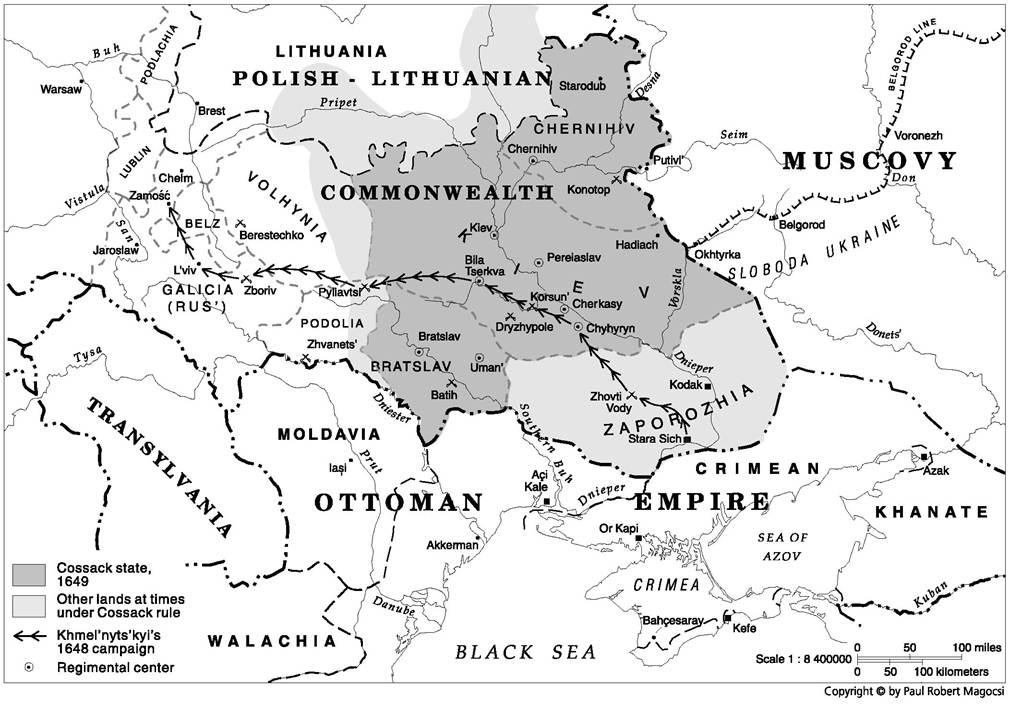
MAP 18
THE KHMEL’NYTS’KYI ERA
sacks was made to seem less important as motivating Khmel’nyts’kyi’s actions than his supposed rivalry with a minor local Polish official over the love of a woman. In the end, however, it was not a personal quarrel over “Helena of the steppes,” but the ever-present social, religious, and national tensions in seventeenth-century Ukraine that set the stage for a series of events which would result in profound changes in both Ukrainian and Polish society.
The uprising of 1648
While the Zaporozhians may have been subdued after the failure of the revolts in 1637 and 1638, they were not eliminated. Now it seemed that the right leader
- one who they heard was even trusted by the king - had arrived in Zaporozhia in the person of Bohdan Khmel’nyts’kyi.
Khmel’nyts’kyi immediately set out to allay the traditional attitude of suspicion on the part of the Zaporozhians toward the “gentrified” registered Cossacks, and before the end of January 1648 he was elected hetman. The new hetman anticipated conflict with the Poles and, drawing on his experience with the Ottoman world, concluded an alliance with the Crimean Tatars. Crimea’s khan, Islam III Giray (reigned 1644-1654), was receptive to an alliance for at least two reasons: he could punish the Poles for attacks on his khanate, and he might be able to placate rising discontent among his own Tatar nobles by giving them the opportunity to plunder Ukrainian lands, where war booty could be obtained with the ostensible approval and protection of the Cossacks themselves. In fulfillment of their side of the alliance, the khan called on Tugay-Bey, the administrator of the powerful Crimean fortress at Perekop/Or Kapi, who together with 4,000 Nogay and other Tatar cavalry joined in common cause with Khmel’nyts’kyi’s Cossacks.Although Poland’s governing and military circles were divided on how to handle this new Cossack-Tatar threat, they were convinced of their own superiority in military skills if not number of troops. A Polish land army together with Polish cavalry and registered Cossacks in Polish service - a force about 9,200 under the supreme command of Crown Hetman Mikolaj Potocki and including his son Stefan Potocki
- set out toward Zaporozhia, where Khmel’nyts’kyi had from 4,000 to 5,000 Cossacks under his banner together with 3,000 to 4,000 Tatar cavalry under Tugay- Bey. To their surprise, the Polish forces were intercepted en route and defeated by the Zaporozhians and their Crimean allies at the Battle of Zhovti Vody on 5-6 May. In the course of the battle, Stefan Potocki was captured by the Tatars (he later died of his wounds), and the registered Cossacks on the Polish side deserted to Khmel’nyts’kyi. With this expanded Cossack-Tatar force, Khmel’nyts’kyi was able to pursue the Poles and defeat them in a second battle, at Korsun’, on 15-16 May, in which both Polish commanders were captured. To make matters worse for the Poles, King Wladyslaw died on 16 May, the day of their defeat at Korsun’.
Upon hearing the news of the Cossack victories, discontented elements throughout much of the Kiev palatinate were inspired to revolt. Peasants drove out or killed their Polish landlords and Jewish estate managers; Orthodox clergy called for vengeance against Roman Catholic and Uniate priests; and townspeople plotted against the wealthy urban elements. Added to the turmoil was the arrival after the victory at Korsun’ of the Crimean khan himself with an enormous army upward of eleven thousand troops. Like the Tatar forces already in Ukraine, all were authorized to plunder and collect booty. Such restrictive “guidelines” were almost immediately forgotten, however, as the Tatar troops began to attack indiscriminately towns and villages and either kill or capture the local inhabitants to send to the Crimean slave markets.
Thus, by the outset of the summer of 1648, two of Poland’s leading commanders had been captured, its eastern army had been defeated, its Ukrainian peasant population was in revolt, its Tatar enemies were ravaging the countryside at will, and its king was dead. Moreover, Poland’s traditional enemies - the Zaporozhian Cossacks and Crimean Tatars - were flushed with victory and there seemed to be no defense against them. Undoubtedly, the Ukrainian peasant masses and the vast majority of the unregistered Zaporozhian Cossacks were ready to rid themselves of Polish rule once and for all. But was Bohdan Khmel’nyts’kyi ready?
Khmel’nyts’kyi’s way of life, like that of other relatively comfortable registered Cossacks, was that of an aspiring country gentryman. While he had been personally wronged by local rivals, his initial goal was simply to obtain justice. If justice could not be obtained through legal channels, then a military victory against the Polish army might force the authorities to act favorably on his behalf. Even after Khmel’nys’kyi had defeated Poland’s eastern army twice, it is likely that he would have welcomed the possibility of remaining a subject of the king of Poland if he had been assured of personal legal redress and the restoration to his fellow registered Cossacks of the privileges they had enjoyed before the abortive revolt of 1637-1638. It was too late to go back, however, whether he wanted to do so or not. Khmel’nyts’kyi’s actions, motivated by personal resentment, set in motion a sequence of events over which he did not have complete control. He had to ride the waves or be submerged.
At first, Khmel’nyts’kyi tried to resist the Cossack-peasant uprising, which after doing away with the local Polish nobility would, he surmised, probably turn on the Rus’ gentry and registered Cossacks as well. He hoped to find support among Poles for his desire to control what he considered the excesses of the revolution. In June 1648, pretending not to know of the king’s death, Khmel’nyts’kyi stopped his army at Bila Tserkva, just southwest of Kiev, and sent an emissary to Warsaw demanding that the traditional Cossack privileges be restored; that the number of registered Cossacks be increased to 12,000; that the Cossacks be paid for their services of the last five years; and that the Orthodox be treated justly, in particular by having the churches and monasteries still held by the Uniates restored to it. In return, the hetman pledged his loyalty to the king.
The Polish Diet was overjoyed with Khmel’nyts’kyi’s modest demands and agreed to have them considered by the new king, whom they were still in the process of choosing. Khmel’nyts’kyi then returned to his estate near Chyhyryn and in early 1649 even managed to marry Matrona/Helena, after her short-lived marriage to Czaplinski was annulled. It seemed that Khmel’nyts’kyi was on the verge of obtaining all he had wanted.
Events were not to leave him in peace, however. Other Cossack leaders, like the popular Maksym Kryvonis and Danylo Nechai, led the peasant masses and
Khmel’nyts’kyi and the Jews
Jewish chroniclers of the seventeenth century provide vastly different and invariably inflated figures with respect to the loss of life among the Jewish population of Ukraine during the Khmel’nyts’kyi uprising. The numbers range from 60,000-80,000 (Nathan Hannover) to 100,000 (Sabbatai Cohen) killed and from 300 communities to 670,000 households destroyed. Almost without exception, today’s specialists on the period reject what they describe as the grossly exaggerated figures in the chronicles. The Israeli scholars Shmuel Ettinger and Bernard D. Weinryb speak instead of the “annihilation of tens of thousands of Jewish lives,” and the Ukrainian-American historian Jaroslaw Pel- enski narrows the number of Jewish deaths to between 6,000 and 14,000. The most recent calculations by the Israeli Shaul Stampfer place the figure between 18,000 and 20,000, which represents about half of the Jewish population living in the Ukrainian lands of Poland-Lithuania at the time.
Despite the correctives provided by recent scholarship, the old chronicles manage to retain a strong hold on the modern reader’s imagination. Perhaps the best known and most often published chronicle is the Yeven Metzulah, by the rabbi of Ostroh, in Volhynia, Nathan Hannover. A Hebrew version was first published in Venice in 1653, and has since then appeared in many translations, including several in English under the title The Deep Mire or The Abyss of Despair. In the introduction to the 1983 edition of the Hannover chronicle, an American specialist in Judaic studies, William B. Helmreich, still refers to the events of the Khmel’nyts’kyi era as “one of the worst catastrophes ever to befall the Jewish people.” In the following excerpts from The Abyss of Despair, Hannover tells us why he chose his title and, how the attitudes of the Cossack hetman Khmel’nyts’kyi are supposedly characteristic of all Ukrainians.
I named my book YEVEN METZULAH (THE DEEP MIRE), because the words of the Psalmist [Psalms 69:3] allude to these terrible events, and speak of the oppressors, the Tatars and the Ukrainians [Hannover’s actual term is “Greeks,” i.e., Orthodox Christians] as well as of the arch-enemy, Chmiel [Khmel’nyts’kyi], may his name be blotted out, may God send a curse upon him. This book may thus be a chronicle to serve future generations.
For while he [Khmel’nyts’kyi] was soft spoken, he had seven abominations in his heart; a man plotting iniquity, in the manner of all the Ukrainians, who at first appear to the Jews as friends, and speak to them pleasant and comforting words, beguiling them with soft and kind speech, while they lie with their tongues and are deceitful and untrustworthy.*
The Khmel’nyts’kyi era is known in Jewish circles as the gzeyres takh vetat, an acronym referring to the evil Decrees of 1648-1649. At least until the second half of the twentieth century, a fast day (20th of Sivan in the Jewish calendar) was each year observed by eastern European Jews in memory of the victims of Khmel’nyts’kyi. Moreover, the account of Hannover, with its vivid and often sensationalist descriptions of brutality, has continued to influence the popular image of Khmel’nyts’kyi’s uprising among Jews to this day. Recent Jewish scholarship has pointed out, however, that Hannover’s goal was “not to provide an objective history, but to preserve the memory of the holy communities that had been destroyed”; in short, “his descriptions are often inaccurate” and for the most part not those of an eyewitness but those of someone who “used the works of others creatively to build up his narrative.”** Of Ukraine’s Jews who were not killed during the Khmel’nyts’kyi era (that is, more than half the original population), many survived either by fleeing to protected fortress-cities, or they fled abroad. Within a few years, most of the refugees, unwilling to live abroad, returned to their homes. This explains why before the end of the seventeenth century Jewish communities were once again flourishing in Ukraine.
*Nathan Hanover, Abyss of Despair: The Famous 17th-Century Chronicle Depicting Jewish Life in Russia and Poland during the Chmielnicki Massacres of 1648—1649, translated by Abraham J. Mesch, 2nd ed. (New Brunswick, N.J. and London 1983), pp. 25 and 34.
**Shaul Stampfer, “Gzeyres takh vetat,” in Gershon David Hundert, ed., The YIVO Encyclopedia of Jews in Eastern Europe, Vol. I (New Haven and London, 2008), pp. 646-647.
unregistered Cossacks in new revolts which heaped further destruction on Roman Catholic Poles, Uniate Ukrainians, and Jews throughout the Kiev palatinate. These revolts had a particularly devastating impact, in both the short and the long term, on the Jews (see Chapter 28). The number of Jewish victims during the period from 1648 to 1652 has been estimated from the tens to the hundreds of thousands, although the results of recent more systematic research give the more likely figure of 18,000 to 20,000.1 Whatever the exact number, or whoever was responsible - the peasants, the Zaporozhian Cossacks and their independent-minded leaders like Kryvonis and Nechai, or the Crimean Tatars, who sold captured Jews in the Ottoman slave markets - it is Khmel’nyts’kyi who is held to blame in Jewish sources to the present day. The widely used Encyclopedia Judaica describes him with borrowings from Jewish chroniclers: “‘Chmiel the Wicked,’ one of the most sinister oppressors of the Jews of all generations,... and the figure principally responsible for the holocaust of the Polish Jewry in the period.” His reputation among Jews remains unchanged, “even though in reality,” the same source admits, “his control of events was rather limited.”2 Whatever the validity of Jewish opinion about Khmel’nyts’kyi, the fact remains that in the socioeconomic system of the Polish- Lithuanian Commonwealth the Jews, alongside the Poles, had come to represent the oppressor. In the great social upheaval which began in 1648, the Jews found themselves caught between the proverbial hammer and anvil, and the result was the destruction of many of their communities.
By the end of the summer of 1648, the Cossack-peasant revolts had spread farther westward, engulfing the rest of the Kiev palatinate, as well as the Bratslav, Podolia, and (partially) Volhynia palatinates. At this point, Jeremi WiSniowiecki, an influential Polish magnate from the Left Bank and a descendant of the Rus’ Vyshnevets’kyi family who had become a fervent Roman Catholic and patriotic defender of Poland, decided to take matters into his own hands. Impatient with the seemingly inconclusive discussions of the Cossack question on the part of the Polish government in Warsaw, WiSniowiecki decided to attack the rebels. He was repulsed, however, by Cossack cavalry forces led by Maksym Kryvonis. This development prompted Khmel’nyts’kyi to come out of his short-lived seclusion. He marched westward toward Volhynia, where in September 1648, together with Kryvonis, he routed a large Polish army of 80,000 soldiers near the village of Pyliav- tsi. The Cossack forces together with their Crimean Tatar allies then moved on to L’viv, where after successfully cutting off the city from outside aid, they accepted a ransom from the urban authorities.
Now the way to Warsaw was open, and Khmel’nyts’kyi was urged by his Cossacks to strike there, at the heart of Poland. He set out in the direction of Warsaw but in November stopped at ZamoSc, about a third of the way between L’viv and Warsaw. Once again, in the hope of gaining greater concessions from the Polish government, Khmel’nyts’kyi preferred negotiation. The hetman’s conditions were the following: (1) that traditional privileges be restored to the Cossacks; (2) that free access to the Black Sea, without Polish forts like Kodak to block their way, be granted them; (3) that the right to be dependent on the king alone, not on local Polish officials, be given the hetman; (4) that amnesty be extended to all participants in the rebellion; and (5) that the Union of Brest and thus the Uniate Church be abolished. The new king, Jan Kazimierz (reigned 1648-1668), promised to do his best to fulfill these conditions. In the meantime he asked Khmel’nyts’kyi to cease hostilities and to return home.
Considering broken Polish promises in the past - whether because of an absence of goodwill on the part of the king or, more likely, the interference of the Polish nobility - one might well wonder how it was possible for Khmel’nyts’kyi to believe things would be different this time. But whether or not he believed the Poles, Khmel’nyts’kyi still hoped to function within the Polish-Lithuanian Commonwealth. As a result, he agreed to put a stop to unruly Cossack and peasant rebellions and to return home.
Khmel’nyts’kyi as a national leader
The hetman’s attitude began to change, however, after his arrival in Kiev. At the head of a victorious Cossack army, which had within the space of less than a year defeated Poland’s leading military forces, Khmel’nyts’kyi entered Kiev on Christmas Day (according to the Julian calendar) in January 1649. There he was greeted by the Orthodox metropolitan of Kiev, Syl’vestr Kosiv, and by the patriarch of Jerusalem, Paisios, who was in Kiev at the time. As they had done with Hetman Sahaidachnyi in 1620, the Orthodox hierarchy provided a religious and national ideological context for Khmel’nyts’kyi’s actions. The hetman was called a modern- day Moses who had succeeded in leading his Rus’ people out of Polish bondage. In the opinion of the Orthodox leadership, the events of the past year had a bearing on the religious and cultural survival of the whole Rus’ people (Ukrainians and Belarusans), and not just the particular interests of a single group, whether Khmel’nyts’kyi himself, or the registered Cossacks, or the Zaporozhian Host as a whole. Patriarch Paisios was particularly concerned with the international implications of the events in Ukraine. With the long-term goal of mobilizing the whole Orthodox world to free the church from the Ottoman yoke, the patriarch urged Khmel’nyts’kyi to work in close harmony with the neighboring Danubian principalities of Moldavia and Walachia and to recognize the authority of the tsar of Muscovy.
Khmel’nyts’kyi was undoubtedly affected by the new role conferred upon him. He is reported to have said to the commissioners of the Polish king: “I have hitherto undertaken tasks which I had not thought through; henceforth, I shall pursue aims which I have considered with care. I shall free the entire people of Rus’ from the Poles. At first I fought because of the wrongs done to me personally; now I shall fight for our Orthodox faith.... I am a small and insignificant man, but by the will of God I have become the independent ruler of Rus’.”3
Whether or not Khmel’nyts’kyi fully grasped the leadership role in which fate had cast him, in practical terms it was impossible for him to control the peasant uprisings (which by the end of 1648 had spread farther westward to Galicia and almost as far as the Vistula River), or to expect that the masses, having had a taste of freedom, would calmly return home to their duties within the Polish socioeconomic system. Moreover, the hetman must have been impressed by the Orthodox hierarchy’s expectations of him, expressed by no less than a patriarch from the Holy Land itself. Khmel’nyts’kyi proceeded to undertake diplomatic negotiations with Moldavia, Walachia, Muscovy, and its allies the Don Cossacks, as well as with Protestant Transylvania and the Lithuanian Prince Radziwill, who because of their own anti-Catholic interests might help him in his anti-Polish efforts.
It was the alliance with the Crimean Khanate, however, that remained the centerpiece of the hetman’s foreign policy. Since the beginning of the Khmel’nyts’kyi uprising, Crimean forces had fought alongside the Cossacks and celebrated in all their joint victories over the Poles. The Tatar military commander Tughay-Bey even negotiated with the Poles on behalf of the hetman and Zaporozhian interests. Cossack-Tatar ties were enhanced further by Khmel’nyts’kyi’s close personal relationship with Tughay-Bey, who the hetman referred to as “my brother, my soul, the only falcon in the world!”4 Fully confident in the “eternal” Cossack friendship with the Crimean Tatars, Khmel’nyts’kyi now took an entirely different approach to Poland. By the spring of 1649, when the king’s negotiator Adam Kysil’ - himself an Orthodox Rus’ nobleman loyal to Poland - met with Khmel’nyts’kyi again, the change in the Cossack hetman was evident. Khmel’nyts’kyi now styled himself “Autocrat of Rus’ by the Grace of God” and talked of liberation for all the Rus’ people living in the Polish-Lithuanian Commonwealth.
It seemed inevitable that hostilities would break out again. By the summer of 1649, Khmel’nyts’kyi, together with his Crimean Tatar allies, had surrounded the Polish army led by King Jan Kazimierz at Zboriv. A peace, or, more precisely, a truce, was signed in August whereby (1) the number of registered Cossacks was raised to 40,000; (2) the Kiev, Chernihiv, and Bratslav palatinates (collectively known as Ukraine) were declared Cossack territory, to be rid of the Polish military, Jews, and Jesuits; (3) the Orthodox metropolitan was to be given a seat in the Polish Senate; and (4) an amnesty was declared for nobles who had participated in the uprising. Apart from the 40,000 on the register, those others who called themselves Cossacks as well as the rebellious peasants were expected to return as serfs to their landlords. While the clergy and Cossack officers were satisfied with the Zboriv agreement, the peasants and peasants-turned-Cossacks clearly were not.
Khmel’nyts’kyi once again seemed to be wavering in his role as leader of the whole Rus’ (Ukrainian and Belarusan) society. After all, he was imbued with gentry values and concerned with social stability; he was not a revolutionary who favored the overthrow of the social order. In any case, the Zboriv peace gave him a convenient respite in which to begin organizing a structure for the rapidly expanding Cossack state. He made Chyhyryn the hetman’s capital and from there conducted extensive diplomatic negotiations in an effort to find allies who would share his vision of eastern Europe.
Khmel’nyts’kyi’s vision departed from the traditional approach of the Christian powers, whether that of Catholic Poland and the Habsburgs or that of Orthodox Muscovy backed by the Eastern patriarchs. The traditional alliances had instinctively been directed against the Ottoman “infidels.” Khmel’nyts’kyi, however, hoped to form a great coalition of Orthodox, Islamic, and Protestant powers - Moldavia, the Ottoman Empire, the Crimean Tatars, Transylvania, and Lithuania’s powerful Protestant figure Prince Radziwill - to force Poland’s rulers to make structural changes in their society. The Cossack hetman also hoped to entice Poland’s rival in the west, Brandenburg, and even Cromwell’s Protestant England into helping him force the restructuring of the Polish-Lithuanian Commonwealth into a federation of three equal states - Poland, Lithuania, and Ukraine - to be headed by a new king, Gyorgy Rakoczi of Transylvania.
The key to this grandiose scheme was initially the Danubian principality of Moldavia, where Khmel’nyts’kyi and the Tatars led a campaign in 1650 to force the Moldavian ruler (Vasile Lupu) to give his daughter in marriage to the hetman’s son, Tymish. The marriage finally took place in 1652, but only after further Cossack military intervention, which alarmed neighboring Walachia and Transylvania and led to war with those two states and the death of Tymish in 1653.
Khmel’nyts’kyi’s war with the Poles continued while he was being drawn into Danubian politics. The attempted alliance with Lithuania’s Prince Radziwill failed (the prince instead sided with the Poles and captured Kiev during the Polish- Cossack conflict of 1651); the Cossacks were defeated in June 1651 at the Battle of Berestechko, in Volhynia; and Khmel’nyts’kyi agreed to abide by conditions set in the peace treaty signed at Bila Tserkva (September 1651). The Bila Tserkva agreement reduced the number of registered Cossacks to 20,000 and restricted their residence to the royal lands of the Kiev palatinate. The Bratslav and Chernihiv palatinates were returned to Polish governmental administrators, and nobles were allowed to return to their estates. Although the Bila Tserkva treaty was never ratified by the Polish Diet (it was blocked by the application of one member using the privilege of the liberum veto), Khmel’nyts’kyi upheld its provisions, even sending Cossack detachments to put down peasant uprisings against returning Polish noblemen in the Kiev palatinate. Not surprisingly, the hetman’s actions caused great discontent among the peasants and unregistered Cossacks, who in desperation moved farther east to lands along the upper Donets’ and Don Rivers that were under Muscovite control. There they were allowed to form tax-exempt settlements, known as slobody, from which the whole region got its name - the Sloboda lands, or Sloboda Ukraine. Khmel’nyts’kyi was able to defeat Polish armies in 1652 (at Batih, in Bratslav) and in 1653 (at Zhvanets’, in Podolia), and in the treaty signed at Zhvanets’ (December 1653) the favorable conditions established by the
1649 Zboriv treaty were restored.
It was becoming increasingly clear to Khmel’nyts’kyi, however, that his efforts against the Poles could at best end in a stalemate, with no real improvement for the Cossack lands within the Polish-Lithuanian Commonwealth. Also, with the death of his son, Tymish, in August 1653, it was equally evident that the hetman’s diplomatic effort to create a grand coalition against Poland had become entangled in the uncertainties of Danubian politics and in the end had produced nothing positive. Even his military alliances with the Crimean Tatars had proved uncertain at best - the khans having chosen to negotiate independently with the Poles during the battles at Zboriv (1649) and Zhvanets’ (1653) and having retreated at a critical moment during the battle at Berestechko (1651). Finally, Khmel’nyts’kyi’s intention to submit as a vassal to the Ottomans (his submission was proposed in
1650 and confirmed by Istanbul in 1652) resulted in little more than the sultan’s urging the Crimean khans to help the Cossacks. With failure evident in all corners, there seemed only one course of action left whereby Khmel’nyts’kyi might break the military and political stalemate with Poland. That alternative was the tsardom of Muscovy, and it is there that Khmel’nyts’kyi turned next.