The Cossacks and Ukraine
The rise of the Cossacks, whose origins go back to the period of Lithuanian rule in Ukraine, ushered in a new era in Ukrainian history. Because of its importance, the Cossack era has received extensive treatment in Ukrainian historiography.
Most Ukrainian historians (M. Kostomarov, M. Hrushevs’kyi, V. Lypyns’kyi, D. Doroshenko), and for that matter nineteenth-century literary figures and nurturers of the national psyche (T. Shevchenko, I. Franko), consider that the phenomenon of Cossackdom embodied the best characteristics of Ukrainians, which are supposedly reflected in the Cossack desire for freedom, independence, and a democratic way of life. Others, while admitting that the Cossacks played an important historical role, criticize their tendencies toward destructive rebellion and the rejection of state formations (P. Kulish) or their inability to create a high standard of civilization and express an all-national purpose (V. Antonovych), so that Ukrainians were unable to create their own state. Whatever judgments have subsequently been passed, all Ukrainian historians agree that the Cossack phenomenon occupies a central position in the Ukrainian historical process.The steppe
The Cossack phenomenon is part of the history of the steppe. During the period of Kievan Rus’, large portions of southern Ukraine, in particular the steppe zone, remained only sparsely settled. This was because that region kept its age-old reputation as a stamping ground for nomadic peoples, the most recent of whom during Kievan times were the Pechenegs and Polovtsians. Following the Mongol invasion of the mid-thirteenth century, the line where towns, villages, and farming communities ended receded even farther north. The result was a marked decrease in the number of inhabitants in the former principalities of Kiev and Pereiaslav, which in the second half of the fourteenth century had been annexed by Lithuania but were still subject to destructive raids from Mongolo-Tatar-held territory farther south.
Although the Kiev and Pereiaslav regions were never entirely depopulated, by the fifteenth century they had an average of a mere 8 inhabitants per square mile (3 inhabitants per square kilometer), whereas in western Ukrainian lands such as parts of Galicia, Volhynia, and Podolia the average density at timesThe Name Ukraine
The name Ukraine (Ukrainian: Ukraina) as a designation for a territory is both very old and relatively new. Etymologically, the term is of Slavic origin and is derived from the Indo-European root *krei “to cut,” with the secondary meaning of an edge (krai) or borderland (ukraina). Some linguists, among them Jaroslav Rudnyckyj, have surmised that the name Ukraine is connected with the pre-Slavic past, and that the name Antae (the group which inhabited Ukrainian lands until about the seventh century ce) is the Iranian translation of the Slavic words for borderland and border people. While such views assist those who support the idea of continuity between the Antae, the Rus’, and modern Ukrainians, they remain linguistic hypotheses unsupported by concrete evidence in written sources.
The name Ukraine is first attested in written documents which date from a much later period but which describe events in the twelfth and thirteenth centuries. The oldest reference is 1187, the year Prince Volodymyr of Pereiaslav died and at which time, according to the Hypatian text of the Primary Chronicle (copied in the fifteenth century): “The ukra'ina groaned with grief for him.”* But neither in this instance of the term nor in others in the Primary Chronicle (Hypatian text), describing events in 1189, 1213, 1280, and 1282 in various Ukrainian lands (Halych, the Buh region, etc.), is the term ukraina ever used in reference to a specific territory. Rather, when it is used, ukraina simply means an undefined borderland. The term ukra'ina appears as well in other Rus’ chronicles, describing non-specific borderland areas in the Pskov, the Polatsk, and other northern principalities.
It is not until the sixteenth century that the name Ukraine is used for the first time to refer to a clearly defined territory. At that time, Polish sources began to use the name in its Polish form, Ukrajina, to describe the large eastern palatinate of Kiev, together with Bratslav (after 1569) and Chernihiv (after 1619). With the rise of the Cossacks as a political force in the seventeenth century, the name Ukraine was still used, but once again in a less territorially specific manner. The Cossacks referred to Ukraine as their “fatherland” or their “mother,” and western European cartographers (G. Beauplan, J.B. Homman) often drew maps indicating that “Ukraine is the land of the Cossacks.” In actual practice, however, the Cossacks used the name Ukraine in a poetic sense, to describe their generic homeland, but officially they called their state the Zaporozhian Host, or Lands of the Army of Zaporozhia.
With the demise of Polish rule, the name Ukraine fell into disuse as a term for a specific territory, and it was not revived until the early nineteenth century. At that time, writers who promoted the national movement began to speak of Ukraine as the appropriate name for all territory in which Ukrainians lived. The term was once again non-specific, however, because in the context of Russian and Austrian imperial rule there was no possibility of a distinct administrative entity called Ukraine.
Not until the revolutionary period beginning in 1917 did the name Ukraine come again to specify a specific territory. It was used by the Ukrainian National Republic, by the Hetmanate, and by the Bolshevik party. The Hetmanate was formally called the Ukrainian State (Ukrains’ka Derzhava). The Bolsheviks called the entity they created the Ukrainian Soviet Socialist Republic, which after 1920 had specific boundaries largely encompassing the lands inhabited by ethnic Ukrainians.
Thus, as a term referring to a non-specific and even ethnically nonUkrainian territory, the name Ukraine dates from the twelfth and thirteenth centuries; as a name for a specific territory, it dates from the late sixteenth century; as a name for lands inhabited by ethnic Ukrainians, it dates from the nineteenth century; and as name referring to a state it dates from the twentieth century.
Cited in Henryk Paszkiewicz, The Making of the Russian Nation (London 1963), p. 305 n.293.
reached 36 inhabitants per square mile (14 inhabitants per square kilometer). Such demographic discrepancy did not begin to change until the second half of the sixteenth century, notably after 1569, when Poland annexed the Ukrainian- inhabited palatinates of Volhynia, Kiev, and Bratslav from Lithuania, and then in 1618, when it annexed Chernihiv from Muscovy.
By the end of the sixteenth century, Poland had become the granary of Europe. Its continuing economic well-being depended on the development of new sources of agricultural exploitation. Ukrainian lands became especially attractive, prompting local Rus’ nobles, joined by their Polish counterparts farther west, to stake out claims to large tracts of land and settle them with peasants from the more populated palatinates of Galicia, Belz, and western Volhynia. The settlement eastward was gradual, beginning in eastern Volhynia and Podolia and then continuing into the palatinates of Kiev, Chernihiv, and Bratslav - three regions which in Polish sources came to be referred to collectively as Ukraine (Ukrajina). Nonetheless, along the southern fringes of these three palatinates, and beyond that along both sides of the lower Dnieper River, lay the open steppe - the Wild Fields (Polish: Dzikie Pole) in contemporary writings - which remained untouched by any sedentary agricultural population. Actually, the steppe was a kind of no-man’s-land separating the settlements within Poland-Lithuania farther north from another civilization based along the southern fringes of Ukrainian territory, that of the Crimean Tatars.
The seemingly unbounded natural wealth of the Ukrainian steppe land outweighed the danger of living there, so that as early as in the fifteenth century a few individuals from more settled areas in the northwest began to venture down the Dnieper and its tributaries in search of fish, wild buffalo and horses, and the eggs of wildfowl.
In 1590, a Polish writer described Ukraine as: “the richest part of the Polish state. Its fields are as blissful as the Elysian... There are so many cattle, wild animals, and various birds in Ukraine that one could think her the birthplace of Diana and Ceres. In the Ukrainian apiaries so much honey is produced that one forgets the Sicilian Gela and the Attic Hymettus.... It is hard to count the Ukrainian lakes teeming with fish. In short, Ukraine is like that land which God promised to the Hebrews, flowing with milk and honey.”1At first, these expeditions in search of food lasted only a few weeks; soon, however, they lasted whole summers, long enough to plant a crop and harvest it from the rich soil. Among the earliest seekers of wealth were members of the lesser gentry and townspeople, groups whose status in Polish-Lithuanian society was steadily being eroded by the power of the great landowning magnates in Ukraine. Tales of the steppes’s natural wealth spread rapidly, and before long the gentry and townspeople were joined by even larger numbers of peasants, some of whom came from as far west as Podolia and Galicia. The landlords in the north were not about to miss an opportunity to increase their own wealth, and they demanded a portion of the foodstuffs and natural wealth their peasants brought back from the Ukrainian wilderness. Not surprisingly, the more daring decided not to return for the winter at all, but to make permanent homes in this no-man’s-land.
The rise of the Cossacks
This new mode of existence - traveling to the wilderness in order to fish, hunt, perhaps do some farming, and then returning home in the winter or, eventually, remaining in the wilderness permanently - came to be known as the Cossack way of life. Indeed, the danger from Nogay slave-raiding parties was ever present, and to cope with the threat the Ukrainian peasants- and townspeople-turned-frontier dwellers were forced to protect themselves and become skilled in the art of selfdefense.
Before long, self-defense was transformed by some into offensive attacks against Nogay slave-raiding parties and Crimean Tatar trade caravans. By the early sixteenth century, the Cossacks had already grouped into small bands of armed men engaged in trade (especially livestock, furs, slaves) and banditry. Their favorite source of booty was the Islamic world, both the rich commercial centers on the Crimean Peninsula and the towns of Walachia and Dobruja, near the mouth of the Danube River, which had come under Ottoman control.Besides these individuals, drawn to the Ukrainian steppe by its natural wealth and the prospect of booty from raids against Tatar caravans, there was another kind of Cossack. This was the freebooting warrior of various social and ethnic origin who entered the service of Lithuanian and Polish frontier officials or of the powerful magnates, who usually maintained their own armies. In fact, the very first group to be systematically described as Cossacks were Tatar renegades from the Crimean khan’s armies who had been hired by Lithuanian and Muscovite rulers. This helps to explain why the very term Cossack - later associated exclusively with anti-Tatar Slavic groups - probably derives from the Turkish term qazaq, meaning a freebooting warrior or raider.
By the fifteenth century, it was common practice for Lithuanian frontier officials
(voievody and district starosty) to hire Cossacks to help defend the grand duchy’s frontier fortresses against Tatar raiding parties, especially in the Kiev and Brat- slav palatinates. Because of their residence in frontier towns, these military forces were referred to as “town Cossacks” (horodovi kozaky), and in some contemporary documents (especially Muscovite), all Cossacks came to be called cherkasy, after the name of one of the fortified towns (Cherkasy) where many were concentrated. At least until the end of the sixteenth century, the town Cossacks were led by appointees of the king, usually local district starosty, who were called hetmans by their followers. Nor did these Cossacks serve only in a defensive capacity. Beginning in 1489, Cossacks led by crown-appointed hetmans attacked Tatar caravans and Turkish bases not only in the Crimea, but as far south as the Balkans and Anatolia. By the end of the sixteenth century, Cossack attacks against the Tatars and Turks were taking place virtually every year.
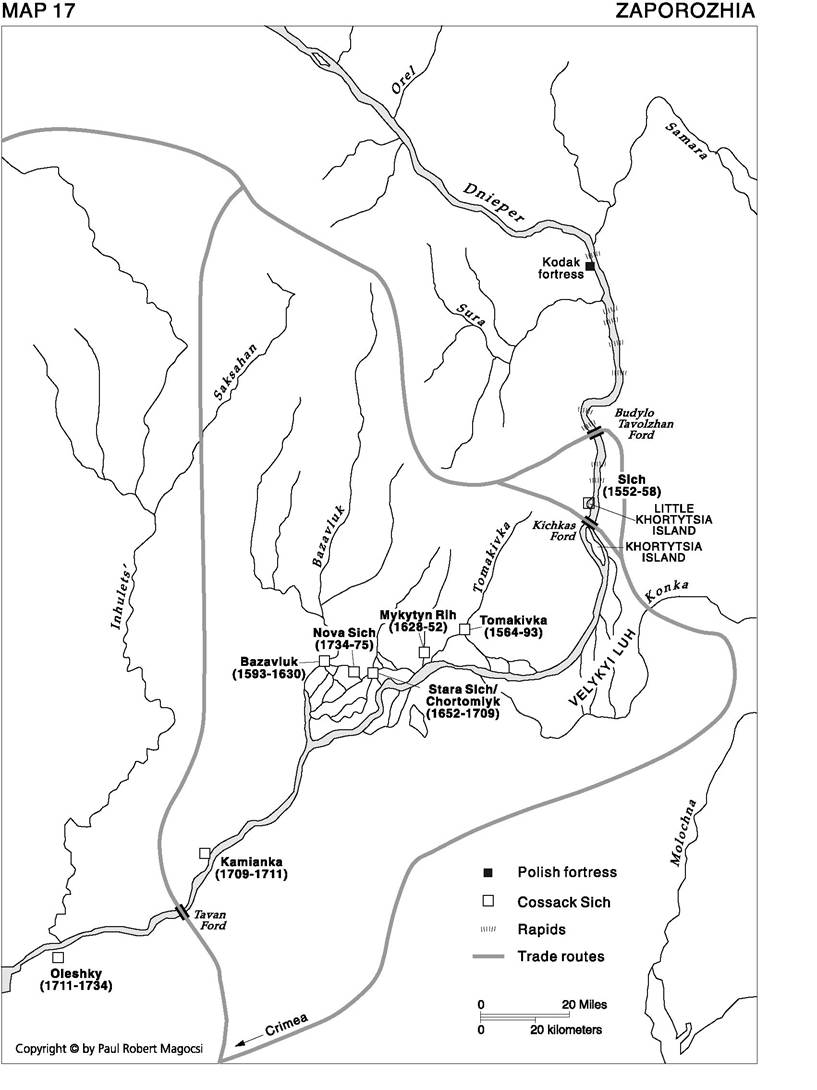
The Cossacks living farther south, away from the towns, built their own fortified centers, which, while frequently changing location, generally carried the name sich. The first sich was built in 1552 on the island of Little Khortytsia (Mala Khortytsia) in the Dnieper River, south of the rapids below the waterway’s first major bend. Because the first sich and the several subsequent ones were set up beyond the rapids (in Ukrainian: za porohamy), the Cossacks living there soon came to be known as the Zaporozhian Cossacks or the Zaporozhian Host. This name was applied in order to distinguish them from other Cossacks who at the same time had begun to develop in similar circumstances farther east along the southern Muscovite frontier and who were known as Don Cossacks. The land on both sides of the Dnieper River where the Zaporozhian Cossacks established their sich military fortresses was called Zaporozhia.
It is to Zaporozhia that townspeople and an increasing number of peasants from Ukrainian and Belarusan lands farther north and west (Galicia, Volhynia, western Podolia) came in an attempt to escape the increasing burdens of Poland’s manorial system. They were joined by other adventurers of various social backgrounds and origin (Romanians/Moldavians, Tatars, Turks, Jews) who desired to live within the government-less environment of the Cossack steppe. The newcomers settled in the sich itself as well as in the nearby wilderness of Zaporozhia on both banks of the Dnieper River. It should be noted that during these early decades, at least until the end of the sixteenth century, the differentiation between town Cossacks farther north and those based in the sich in Zaporozhia was not pronounced, since both recognized the same hetman as their leader and often joined together in expeditions against the Tatars.
The sich itself was a fortified center surrounded in part by high walls of wood as well as by lowland swamps or tributaries of the Dnieper River. Behind the walls were living quarters for resident Cossacks - only men were permitted inside - whose number in later years sometimes reached as high as 10,000. The central square (maidan) contained a church, a school, and the residence of the community’s leaders. Beyond the walls was a marketplace (bazar) where goods from cities and fortified centers farther north (Kiev, Kaniv, Cherkasy) and from the Crimea and the Ottoman lands in the south were traded.
The Cossacks of Zaporozhia
An excellent insight into the way of life of the Zaporozhian Cossacks comes from the pen of Guillaume le Vasseur de Beauplan, a French military engineer who spent seventeen years (1630-1647) in Poland in the service of its army. He published several detailed maps of Ukraine as well as a descriptive narrative (1651), from which the following excerpt is taken:
The valor of these Cossacks having been mentioned, it will not be out of place to speak [here] of their customs and activities. Among these people are found individuals expert in all the trades necessary for human life: house and ship carpenters, cartwrights, blacksmiths, armorers, tanners, harness makers, shoemakers, coopers, tailors, and so forth. They are very skillful at preparing saltpeter, which is found in abundance in these regions, and make from it excellent gunpowder. The women are employed at spinning flax and wool, from which they make cloth and fabrics for their everyday use. All are well able to till the soil, sow, harvest, make bread, prepare foods of all sorts, brew beer, make mead, braha, spirits, etc. As well, there is not one of them, of any age, sex or rank whatever, who does not try to drink more than his companion, and to outdo him in revelry. What is more, there are not Christians [anywhere else] who are their equals in not caring for the morrow.
It is quite true that in general they are all proficient in the whole range of crafts.... In short, they are all quite clever, but they limit themselves only to useful and necessary matters, and especially to those relating to country living.
The fertile land produces grain in such abundance that often they do not know what to do with it, the more so because they have no navigable rivers that empty into the sea, except the Borysthenes [Dnieper], which is blocked fifty leagues below Kiev by [a series of] thirteen rapids.... That is what prevents them from transporting their grain to Constantinople, and hence engenders their laziness and unwillingness to work, except when pressed by necessity or when they are unable to buy what they need. They prefer to borrow goods that are necessary to their comfort, from their good neighbors the Turks, rather than take the trouble to work for them. They are content if they have enough to eat and drink.
There is nothing about them coarser than their clothing. They are sly, crafty, clever, [and yet] sincerely generous, without ulterior motives or ambitions to become very rich. They greatly value their liberty, and would not want to live without it. That is why the Cossacks, when they consider themselves to be kept under too tight a rein, are so inclined to revolt and rebel against the lords of their country. Thus, seven or eight years rarely pass without a mutiny or uprising.
Beyond that, they are a faithless people, treacherous, perfidious, and to be trusted only with circumspection. They are a very robust people, easily enduring heat and cold, hunger and thirst. They are tireless in war, daring, courageous, or rather reckless, placing no value on their own lives.
source: Guillaume Le Vasseur, Sieur de Beauplan, A Description of Ukraine (1660), translated by Andrew B. Pernal and Dennis F. Essar (Cambridge, Mass. 1993), pp. 11-13.
The Zaporozhian Sich was governed by the principle of equality. Accordingly, all major decisions, especially those pertaining to military policy and foreign alliances, were made during a general meeting called the rada. In practice, there were “class” distinctions even within the sich, so that by the end of the sixteenth century it was common practice for two separate rady to meet: one for the officers (star- shyna) and one for the rank and file (chern’). Neither rada dominated the other, and officers always felt that their policy decisions could be overturned - even brutally - by the rank and file. Departing from subsequent romanticized images of the supposedly egalitarian existence in Zaporozhia, one historian, Linda Gordon, has perhaps more aptly suggested that “the system of Cossack self-government was not democracy but dictatorship tempered by mob intervention.”2
The head of the Zaporozhian Cossacks, elected by all members present at the rada, at first was called simply the elder (starshyi), and later the sich otaman or koshovyi otaman. Until the end of the sixteenth century, the Zaporozhians also recognized as their leaders those hetmans appointed by the Polish king, most often from among the ranks of district starosty, who commanded registered Cossack troops stationed in the fortress towns. The first of these recorded in contemporary documents is Prince Dmytro Vyshnevets’kyi, the starosta of Cherkasy and Kaniv, who as hetman built the first sich on Little Khortytsia island as a defensive measure against the Tatars. By the last decade of the sixteenth century, the Zaporozhians meeting at the rada would at times elect their own hetmans.
The Cossacks in Polish society
When, as a result of the Union of Lublin in 1569, Zaporozhia and the Ukrainian steppe came under the nominal authority of Poland, the Cossacks - whether at the sich or in the towns farther north - considered themselves subjects of the Polish king. The rugged life on the steppe, however, and their evolution into a valued military force imbued the Cossacks with a sense of independence that inevitably clashed with the efforts of the magnates to extend further their control over what previously had been uninhabited and uncultivated territory. Nor was the struggle simply one between peasants seeking freedom and nobles trying to enserf them. Instead, the Cossacks, whether in the fortress towns or in Zaporozhia, became one of the many rival interest groups in a Ukrainian society that was increasingly coming under the influence of Polish social norms.
For instance, town Cossacks in the service of the large Rus’ magnates (the Ostroz’kyis, Vyshnevets’kyis, etc.) tended to increase the influence of that social group in Polish society. In response, Poland’s kings would themselves try to entice the Cossacks into the service of the crown by granting them privileges. Also, those gentry who lost lands or became indebted to the magnates found an outlet for their discontent in flight to the sich. Even among magnates, there were different views of the Cossacks. While the Orthodox Rus’ magnates essentially appreciated the defensive role of the town Cossacks and accommodated their demands, Polish nobles farther removed from the frontier had little tolerance for what they considered the “pro-Cossack policies” of the king and magnates in Ukraine. For their part, the Cossacks not only maneuvred among these various interest groups in Polish- Lithuanian society, but also increased their own political leverage by entering into agreements - often short-term military alliances - with foreign powers. In effect, by the second half of the sixteenth century, the Zaporozhian Cossacks had become a political as well as a military force in their own right, a player in eastern Europe’s complex diplomatic game of chess involving frequent wars and rapidly changing alliances among the Polish-Lithuanian Commonwealth, the Habsburg Empire, Muscovy, the Crimean Khanate, Walachia, Moldavia, and the Ottoman Empire.
With the growth of Cossack military potential, it was inevitable that conflict, whether motivated by personal discontent or by discontent with policy, would arise between the independent-minded steppe frontier dwellers and the local authorities. In fact, beginning in the final decade of the sixteenth century and lasting for nearly the next half century, there occurred no less than seven uprisings, led by Kryshtof Kosyns’kyi (1591-1593), Severyn Nalyvaiko and Hryhorii Loboda (1594-1596), Marko Zhmailo (1625), Taras Fedorovych (1630), Ivan Sulyma (1635), Pavlo Pavliuk-But (1637), and lakiv Ostrianyn (1638). All these figures were subsequently immortalized as defenders of the traditional Cossack liberties and of Ukraine’s struggle for freedom.
Whereas the causes of these uprisings varied, there were a few general trends. Throughout this whole period, the Cossacks never questioned the premise that they were subjects of the Polish king. In fact, what they wanted was to become recognized as a distinct estate with its own “traditional liberties” within Polish- Lithuanian society. While it is true that by the early seventeenth century sharp distinctions had evolved among the Cossacks, some kind of special status within Poland for the group as a whole was still the goal.
The legal distinctions within Cossack society were actually the result of Polish governmental policy, in particular that of the king. In an attempt to impose some kind of control over the ever-growing number of Cossacks and to ensure their military service to the crown instead of to local magnates or foreign powers, Polish kings introduced a policy of registration. The first registration occurred in 1572, and several others took place during the following years, the most ambitious perhaps being that of King Stefan Batory (reigned 1576-1586) in 1578. According to his program, the so-called registered Cossacks were (1) recognized as being in the Polish military service; (2) no longer to be subject to the control of the local gentry, or szZachta-dominated administration (at least during their time of service); and (3) to be paid for their services. The registered Cossacks were drawn from the town Cossacks, since the Polish government did not recognize the legal existence of the sich. The number of registered Cossacks generally remained small, ranging from 300 in the first register of 1572, to 6,000 under King Stefan Batory in 1578, to 8,000 in 1630. But the crown’s effort to maintain control over a manageably sized Cossack force was undermined during periods of international conflict, especially in the first half of the seventeenth century, when kings encouraged large numbers of Cossacks (frequently peasants who had only recently fled to Zaporozhia) to enlist in the crown’s service. For instance, by 1620 the Cossack registers had swelled to 20,000.
The existence of the register contributed to sharp distinctions between, on the one hand, the Cossacks in and near the frontier towns and, on the other, the Cossacks in Zaporozhia. Among the “traditional liberties” promised by King
Social Estates in Sixteenth- and Early Seventeenth-Century Ukraine
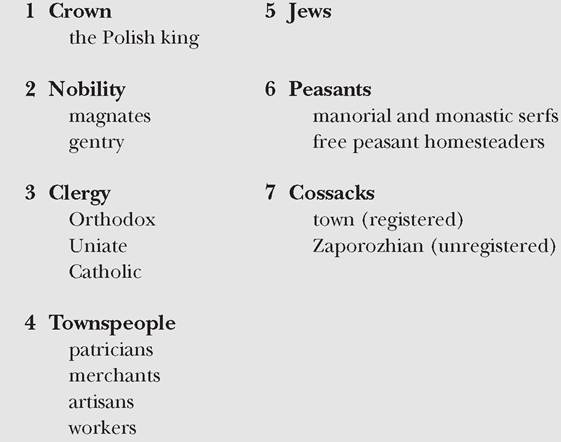
Stefan Batory to those on the register was the right of Cossacks to elect their own leaders and to be judged by their own peers, and perhaps most important of all was the royal confirmation of their right to the lands they held. This meant that the Cossacks of lesser-gentry status might regain lands they had lost to the great magnates or gain new lands. At the same time, the right meant landed-gentry status for registered Cossacks who were of peasant or town origin but had managed to get hold of a piece of land. In effect, it was not long before the registered Cossacks became wealthy property owners in their own right.
Living a more stable existence with their families in the middle regions of the Kiev and Bratslav palatinates, these landowning Cossacks were anxious to obtain even more privileges within the Polish administrative structure. In particular, they hoped to be recognized as on a par with the Polish szlarhta. For their part, however, the Polish and local Orthodox Rus’ magnates could never accept as equals those whom they considered Cossack upstarts and freebooting rabble. Conversely, the vast majority of Cossacks, who lived in Zaporozhia and who, not being on the register, were known as unregistered Cossacks, scorned their registered comrades- in-name who were in Polish service. The Zaporozhians wanted nothing to do with the Polish or any system of governmental control and preferred to live the traditional Cossack way of life: hunting, fishing, trading, farming a little, and raiding the Crimea and the Ottoman Empire in the south.
A Male-Dominated Society?
The stereotypical image of the Zaporozhian Cossacks passed down through generations of writers is of a brotherhood of brave male warriors whose ideals were to fight hard and drink hard. This image of the Cossacks often became the image of Ukrainian society as a whole. As for women, there seemed to be no place for them. They were forbidden to enter Zaporozhia’s military and administrative headquarters (the sich), lest male privacy be violated or “the brothers” be disturbed during their macho rituals and pursuits. In short, women in Cossack lore either were not mentioned or were relegated to a subordinate role. But was this really the case?
The following is another excerpt from the pen of Guillaume le Vasseur de Beauplan, the insightful contemporary observer of seventeenth-century Ukraine.
Fulfilling the promise I made above, let us relate something of the customs they [the Cossacks] observe in some of their marriages, and in what way they sometimes go courting one another. These practices will no doubt seem new and unbelievable to many [readers]. In that country, contrary, to the practice current in every [other] land, it is the girls who are seen courting the young men who please them.
One of their special practices, which is very carefully observed, almost always assures the young ladies success in their efforts. Indeed, they are more certain to succeed than the young men would be, if occasionally they tried to take the initiative. Here is how these girls proceed. An amorous young lady goes to the house of the father of the young man (whom she loves), at a time when she believes that the father, the mother, and her beloved will be together at home. Upon entering the house, she says PomahaiBih, meaning, ‘May God bless you,’ which is the usual form of greeting when one enters one of their homes. When she has sat down, she pays compliments to the one who has wounded her heart.... [She continues:] ‘I recognize in your face something of an easy-going nature. You will know how to love your wife and govern her well, and your virtues make me hope that you will be a good husband. Your fine qualities lead me to beg you very humbly to accept me as your wife.’
Having spoken thus, she addresses the father and mother in like terms, humbly requesting their consent to the marriage. However, if she receives a refusal or some excuse [or other], [perhaps] that he is too young and not yet ready for marriage, she answers them [saying] that she will not leave until she becomes his wife, as long as they are both yet alive. When these words have been pronounced, and the girl has shown herself tenacious and determined never to leave the room without obtaining what she seeks, the father and mother are obliged, after a number of weeks, not only to give their consent, but also to persuade their son to look favorably on the girl, as one who must be his wife. Similarly the young man, seeing the young lady persevere in wishing him well, begins then to consider her as one who will someday be the mistress of his will. He therefore earnestly begs his father and mother to permit him to direct his affections toward that girl.
In such a manner, amorous young ladies of this country cannot fail to be provided with husbands at a young age, since by their stubbornness they force the father, the mother, and their beloved to accede to their wishes, for fear, as I have said above, of incurring God’s wrath, and suffering some dreadful misfortune.
source: Guillaume Le Vasseur, Sieur de Beauplan, A Description of Ukraine (1660), translated by Andrew B. Pernal and Dennis F. Essar (Cambridge, Mass. 1993), pp. 70-71.
The political interaction among the king, the Polish and Rus’ magnates and gentry, the gentrified registered Cossacks, and the Cossacks of Zaporozhia began to play itself out with increasing complexity after 1572, when the last Jagiellonian ruler died and the monarch was henceforth elected by the Diet. Polish kings were becoming more and more dependent on the whims of the magnates and gentry. Only those two factions of the nobility could, through the Diet, authorize the necessary funds or supply military forces to sustain Poland’s foreign ventures. But most often they were reluctant to do so, especially when it seemed to them that a particular king, whether for dynastic or for economic reasons, was too eager to enter into war with Muscovy, or Sweden, or Moldavia. Faced with such internal political opposition, Poland’s elected kings saw in the Cossacks a ready-made force that could be used to further their own foreign policy and military goals without their having to depend on the cooperation of the noble estates. This intent is what gave rise to the policy of registration, whereby Poland’s kings would grant or restore Cossack privileges in return for military service. For their part, the Polish and polonized Rus’ magnates and gentry opposed these direct relations between king and Cossacks, not to mention the continuing existence of a group that remained outside their control. The Rus’ magnates in Ukraine, however, favored the existence of the registered Cossacks as long as they remained in their service and not that of the king.
The international role of the Cossacks
The vast majority of the unregistered Cossacks in Zaporozhia continued their policy of providing short-term service to Poland’s kings and seeking alliances with foreign powers. During the last decade of the sixteenth century, they accepted an invitation from the Habsburg emperor of the Holy Roman Empire to join in a crusade against the infidel Ottomans. They took this occasion to raid and loot at will the Ottoman provinces of Walachia and Moldavia. Then, in the second decade of the seventeenth century, they fought on the side of Poland’s king Zygmunt III during his frequent invasions of Muscovy. It was also during these decades that they built a large naval fleet, which, under the leadership of their daring hetman, Petro Sahaidachnyi, raided Ottoman cities along the northern as well as southern shores of the Black Sea. In the tradition of the Varangian Rus’ almost 800 years before, Sahaidachnyi’s Cossacks even plundered the outskirts of the impregnable Ottoman capital of Istanbul.
The Ottomans held the Poles to blame for the exploits of their unruly Cossack subjects, and not surprisingly, Polish-Ottoman relations deteriorated as a result. In the spring of 1620, a combined Turkish-Tatar army defeated a Polish force at the Battle of T utora/Tsetsora Fields, near the Moldavian town of Ia§i. The way to Poland was now open. The Ottomans made further military preparations, and the following spring, in 1621, they advanced with an army of over 100,000. In desperation, the Poles called on the services of Hetman Sahaidachnyi, and it was his force of 40,000 Cossacks (drawn from Zaporozhia as well as from the ranks of the registered) that made possible a Polish victory over the Turks at the Battle of Khotyn in northern Moldavia, near the border with Podolia.
Thus, during the first half of the seventeenth century, a seemingly unbreakable cycle arose within the Crimean-Ottoman-Polish triangle that surrounded Cossack Ukraine. The Zaporozhian Cossacks would raid the Crimea and the Ottoman Empire. In response, the Ottoman Empire would threaten and sometimes carry out military invasions against Poland. The Polish government would demand that the Zaporozhians cease their anti-Ottoman and anti-Crimean raids, and to back up its demands would periodically send punitive expeditions to intervene in Zapo- rozhian affairs. The Zaporozhians would rebel against this interference, and wars against Poland would result, with sometimes one side, sometimes the other winning. In the end, nothing decisive ever occurred, and the cycle was repeated.
The Polish-Cossack conflicts before 1648, however limited in scope to the border regions near Zaporozhia, witnessed much of the brutality that accompanies any civil conflict. Polish frontier aristocrats like the hetmans Stanislaw Zolkiewski, Stanislaw Koniecpolski, and Stanislaw and Mikolaj Potocki seemed to take special delight in trying to put down what they considered the Cossack rabble, and their victories at the battles of Lubny (1596), Pereiaslav (1630), and Kumeiky (1637) left a heritage of bitter hatred. For their part, the Zaporozhian Cossacks had no illusions about the Polish szlachta, and they felt betrayed by their own registered Cossacks, who often sided with the Poles. They felt especially betrayed by the king, who seemed ever ready to call upon their services for campaigns in Moldavia, or Muscovy, or Sweden, or against the Ottomans, but careless of living up to his promises of greater privileges or payments. Because of the Polish system of government, however, even if the kings were desirous of fulfilling their promises, they could almost never effectively do so over the heads of the szlachta opposition. Thus, the pre-1648 period left the Zaporozhian Cossacks with a deep-seated hatred and distrust of the Poles, combined with an ingrained historical memory of their own courageous hetmans such as Dmytro Vyshnevets’kyi and Petro Sahaidachnyi, their successful campaigns against the Crimean Tatars and Ottoman Turks, and their ability to circumvent Polish aristocratic control over their lives. It was on this era (the 1630s) that Nikolai Gogol’, a nineteenth-century Ukrainian author who wrote in Russian, based his famous novel of Cossack revolt against Polish rule, Taras Bul’ba (1835).
The role of the Cossacks in Ukrainian life was not limited, however, to military raids and protection of the frontier. Before long, they combined their desire for freedom and self-rule with a deep commitment to defend the Orthodox faith. The ideological link between the Cossack struggle for self-rule and its defense of Orthodoxy was in large part forged during the first two decades of the seventeenth century by lezekiil Kurtsevych, the archimandrite of the Trakhtemyriv Monastery (halfway between Kiev and Cherkasy) and Hetman Petro Sahaidachnyi. A native of Galicia and probably of noble descent, Sahaidachnyi was educated at the Ostroh Academy, where he was imbued with an Orthodox spirit. He then went to the sich, where the Zaporozhians elected him hetman. He not only increased the commitment of the Zaporozhian Cossacks to the Orthodox faith, but also led them in numerous victories against the Tatars and the Turks, and - in the service of Poland - against the Muscovites. In return for his loyalty to Poland, so crucial to the king on the eve of the 1621 Battle of Khotyn against the Ottoman Turks, Sahaidachnyi included in his demands the full restoration of the Orthodox Church, most of whose eparchial sees had been left vacant after the Union of Brest in 1596.
Meanwhile, during the first two decades of the seventeenth century Kiev itself was undergoing a revival which was to make it once again the center of Rus’- Ukrainian culture. The Monastery of the Caves (Pechers’ka Lavra), founded under laroslav the Wise during the mid-eleventh century, was headed from 1599 to 1624 by another native of Galicia, lelysei Pletenets’kyi. While Sahaidachnyi was raising the military and political prestige of the Cossacks, Pletenets’kyi was busily engaged in creating a new basis for Orthodox cultural activity in Kiev. In 1615, he brought to the monastery a printing press from Striatyn, in Galicia, and during its first fifteen years of operation (1616-1630) it produced forty titles, more than any other press in the rest of Ukraine or Belarus. Among the titles were works of literature, history, and religious polemic, liturgical books, and texts for the growing number of schools. The last category included Pamvo Berynda’s Leksykon slaveno- rosskii (Slaveno-Rusyn Lexicon, 1627), the first dictionary in the East Slavic world, which, together with another contemporary work, published elsewhere, Meletii Smotryts’kyi’s Grammatika slavenskaia (Slavonic Grammar, 1619), established a standard for the Church Slavonic language that was to be used among all East Slavs for the next two centuries.
Pletenets’kyi also brought to Kiev’s Monastery of the Caves a group of Galician intellectuals (lov Borets’kyi, Zakhariia Kopystens’kyi, Lavrentii Zyzanii) who had been trained or taught at L’viv’s Stauropegial Brotherhood school. Following the L’viv tradition, Kiev received its own brotherhood and school in 1615, where a Greco-Slavonic curriculum was established according to the L’viv model. Moreover, in the midst of this cultural revival, Hetman Sahaidachnyi moved his administration to Kiev, making it once again the seat of political and military power as well as the cultural center of Ukrainian lands. And to show his further support of the Orthodox revival, the hetman enrolled all his Zaporozhian Cossacks in the recently established Kiev Brotherhood.
Buoyed by the support of the Cossacks and their dynamic leader Sahai- dachnyi, the Orthodox clergy and lay leaders felt that the time had come to restore the organizational framework of their church. By the second decade of the seventeenth century, the metropolitan’s office and all the Eastern-rite eparchies on Belarusan and Ukrainian lands in Poland-Lithuania with the exception of L’viv were in the hands of the Uniates. The Cossacks, however, had refused to allow the Uniate metropolitans - Ipatii Potii and his successor, Veliamyn Ruts’kyi (reigned 1614-1637) - to take up their seat of Kiev. Now, in 1620, the Orthodox group took advantage of a visit by the patriarch of Jerusalem, Theophanes, who in October of that year stopped in Kiev on his way to Muscovy. They persuaded the patriarch to ordain an Orthodox metropolitan for Kiev as well as four bishops for the sees of PrzemySl, Polatsk, Volodymyr-Volyns’kyi, and Luts’k. Early the following year, two more Orthodox bishops were ordained, for Chelm and Pinsk. The ordinations were performed in secret and without the approval of the Polish government. When the government found out, it accused Patriarch Theophanes of being a Turkish spy and outlawed the newly appointed metropolitan and bishops.
In response, in 1621 the new Orthodox metropolitan, Iov Borets’kyi (reigned 1620-1631), and the six bishops published their first manifesto. Of particular interest is their characterization of the Cossacks:
We all know about the Cossacks, that these chivalrous men are of our race, are of our kin, and are true Orthodox Christians.... They are the descendants of the glorious Rus’, of the seed of Japheth who fought [Byzantine] Greece on land and on sea. They are the descendants of that warlike race which under Oleh, the Rus’ monarch, attacked Constantinople. They are the same as those who with Volodymyr, the sainted king of [Kievan] Rus’, conquered Greece, Macedonia, and Illyria. Their ancestors, together with Volodymyr, were baptized and accepted Christianity from the church at Constantinople, and even to this day they are born, are baptized, and live in this faith.3
Referring to more recent times, the Orthodox bishops stated: “[The Cossacks’] second purpose is to set the prisoner free.... It is truly said that no one in the whole world does so much for the benefit of the persecuted and oppressed Christians... as the Army of Zaporozhia with their daring and their victories. What other peoples achieve by words and discourses, the Cossacks achieve by their actions.”4 The Cossacks were now armed with a historical ideology and viewed by the highest Orthodox authorities as latter-day descendants of the biblical Japheth and the Kievan Rus’ princes.
The registered Cossacks, in particular, took advantage of the situation and put forth a new demand in all their negotiations with the Poles: recognition of the already-appointed bishops and thereby the full reconstitution of the Orthodox Church in Poland-Lithuania. During the next decade, the Polish king Zygmunt III often made promises regarding Orthodoxy, but he refused to recognize the consecration of its seven hierarchs. Finally, following the death of the king in 1632, a period of interregnum ensued during which the Polish Diet prepared for the election of a new monarch. Several Orthodox Rus’ noblemen seized the opportunity to introduce the Cossack question into the royal electoral debates. For the first time they demanded that the Cossacks be recognized as a noble estate within the Polish social structure, and they renewed their call for the legalization of the Orthodox hierarchy. Not surprisingly, there was great opposition from the Polish szlachta. The newly elected king, Wladyslaw IV (reigned 1632-1648), needed troops for a campaign against Muscovy, however, and was therefore predisposed to favoring the Cossack requests. Although the question of noble status was decided against the Cossacks, the new king, through personal persuasion, was able in 1632 to push through a compromise agreement known as the “Pacification of the Greek Faith.”
The compromise of 1632 finally regulated Orthodox church life in Poland- Lithuania. The metropolitan and bishops were to be elected by the Orthodox clergy and nobility, confirmed by the Polish king, and blessed by the ecumenical patriarch of Constantinople. The secretly elected Orthodox hierarchy of 1620 was not recognized, however. With regard to Orthodox-Uniate relations, the eparchies of the Metropolitanate of Kiev were divided between the two churches (see map 15). The archeparchy of Kiev, the eparchies of L’viv-Halych, PrzemySl-Sambir, Luts’k-Ostroh, and the newly created eparchy of Mstsislau went to the Orthodox; the eparchies of Polatsk, Chelm, Volodymyr, Pinsk-Turau, and Smolensk (then under Polish rule) went to the Uniates. Moreover, each church was to have its own metropolitan of Kiev. The Orthodox metropolitan was to reside in Kiev itself, the Uniate metropolitan in Vilnius or Navahrudak in Lithuania. As well, Orthodox schools, printing presses, brotherhoods, and new churches were permitted; several churches and monasteries held by the Uniates (including all but one in Kiev) were returned to the Orthodox Church; and Orthodox adherents were once again permitted to hold office in municipal government. Despite protests from the Uniate metropolitan and Polish Catholic bishops, the king upheld the agreement of 1632 and reconfirmed it three years later.
Taking advantage of the favorable political situation, Orthodox nobles in the Polish Diet nominated in November 1632 a fellow deputy, Archimandrite Petro Mohyla (Petru Movila), as metropolitan of Kiev (reigned 1632-1647). Within days, the nomination was approved by the king and a blessing requested from the ecumenical patriarch. This meant that the recently elected Metropolitan Isaia Kopyns’kyi (reigned 1631-1632) the successor to Metropolitan Borets’kyi who was secretly elected in 1620 - was removed from office.
The new and dynamic Metropolitan Mohyla/Movila was the son of the Romanian Orthodox ruler of Walachia and Moldavia. In 1627, just two years after his arrival in Kiev, he was made archimandrite of the city’s influential Monastery of the Caves. The ambitious and talented Mohyla was convinced that the survival of Orthodoxy depended on the creation of a well-educated group of clerics trained in the best traditions of their religious antagonists, the Jesuits. Accordingly, he sent monks to Poland to be educated, and he opened a new school on the Jesuit Latin model at the Kiev monastery.
Mohyla’s policies were by no means universally accepted within Poland-
Orthodox versus Uniate
Despite the compromise of 1632, hailed in Polish governmental circles as the “Pacification of the Greek Faith,” the struggle among the Rus’ people between adherents of Orthodoxy and of Uniatism continued unabated through the whole first half of the seventeenth century. The struggle took many forms: court cases, debates in the Diet, and the publication of polemical pamphlets in defense either of the Orthodox faith and Ruthenian language or of the rightness of union with Rome.
Meanwhile, Orthodox defections to the Uniates continued among all strata of society, and included that of the once-staunch defender of Orthodoxy, Archbishop Meletii Smotryts’kyi, who in 1628 became a Uniate. Even more pronounced were conversions to Roman Catholicism among members of the powerful Rus’ magnate families (the Ostroz’kyis, Vyshnevets’kyis, Sangush- kos, Chartoryis’kyis, Zbaraz’kyis, and Zaslavs’kyis) and the further spread eastward of Roman Catholic influence through the establishment of several new Jesuit schools between 1608 and 1646 (in L’viv, Luts’k, Kam’ianets’- Podil’s’kyi, Ostroh, Brest, Ovruch and as far east as Novhorod-Sivers’kyi and Kiev). It was the advance of Roman Catholicism that prompted discussion of the possibility of a “new union,” including a proposal put forth in 1645 by none other than the Orthodox metropolitan of Kiev, Petro Mohyla/Movila.
The passions and zeal of the Orthodox-Uniate struggle produced intellectual debates and legal battles as well as physical violence against individuals and the destruction or forcible acquisition of rival churches. Among the more brutal and memorable instances of violence was the assassination of the Uniate archbishop of Polatsk in Belarus, losafat Kuntsevych (reigned 16171623), by the angered Orthodox citizens of Vitsebsk, where the prelate’s residence was located. Following his death in 1623, Kuntsevych was hailed by the Uniates of Poland-Lithuania as a martyr for their faith, and in 1867 he was canonized by the Roman Catholic Church. The intensity of the Orthodox-Uniate antagonism in the early seventeenth century is conveyed in the following contemporary description, from Bishop lakiv Susha’s biography of Kuntsevych (1665):
The ringing of cathedral bells and the bells of other churches spread. This was the signal and call to insurrection. From all sides of town masses of people - men, women, and children - gathered with stones and attacked the archbishop’s residence. The masses attacked and injured the servants and assistants of the archbishop, and broke into the room where he was alone. One hit him on the head with a stick, another split it with an axe, and when Kuntsevych fell, they started beating him. They looted his house, dragged his body to the plaza, cursed him - even women and children.... They dragged him naked through the streets of the city all the way to the hill overlooking the river Dvina. Finally, after tying stones to the dead body, they threw him into the Dvina at its deepest.*
Osyp Zinkewych and Andrew Sorokowski, comps., A Thousand Years of Christianity in Ukraine (New York, Baltimore, and Toronto 1988), p. 121.
Lithuania’s Orthodox milieu. Actually, the metropolitan’s election at the end of 1632 represented a victory for the Orthodox Rus’ nobles over the Cossacks, who had supported the deposed and still-smarting Metropolitan Kopyns’kyi and the other hierarchs secretly ordained in 1620. Kopyns’kyi, together with those proMuscovite sympathizers, looked to the tsar and hoped for reconciliation with the patriarch in Moscow. Consequently, they worked against what they considered Mohyla’s pro-Western (i.e., Roman Catholic) orientation. Hearing the complaints of such traditionalist clerics, the Cossacks even threatened to do away with Mohyla and his “Latin-oriented” intellectual circle, whom they considered infiltrators poisoning the minds of Orthodox youth.
Despite his critics, Mohyla moved ahead in trying to implement his vision for the revival of Orthodoxy within Poland-Lithuania. While he was still archimandrite of Kiev’s Monastery of the Caves, the school he founded there in 1631 was merged the following year with the city’s brotherhood school into one institution, the Kievan, or Mohyla, Collegium. The collegium maintained the traditions of scholastic education then prevailing in Catholic Jesuit schools, and great emphasis was placed on the study of Latin. Mohyla believed that the future of Orthodoxy in Belarus and Ukraine lay in an accommodation with Poland - albeit on an equal basis - and for this reason he tried to undermine the traditional attitude of the Ukrainian Orthodox clergy, who until then had looked eastward to Muscovy as their only salvation. During the first half of the seventeenth century, discontented Orthodox clergy and monks had continued to seek refuge in Muscovy. Now, under the leadership of the capable and intellectually astute Mohyla, the Orthodox Church and its centers of learning in Ukraine could hold their own as a source of cultural attraction against the Catholic West.
The calm before the storm
By the 1630s, Cossack pressure had succeeded in restoring the legal status of the Orthodox Church in Poland-Lithuania. Its own demands, however, remained unmet. The registered Cossacks were not recognized as a distinct social estate, and the Zaporozhians continued to clash with Poland’s governmental authorities, either because of their disagreements with frontier officials in Ukraine or because of their unauthorized attacks on the Crimea and the Ottoman Empire. As a result, the cycle of Polish-Cossack friction continued: Cossack service in Poland’s foreign military ventures was followed by their discontent with unfulfilled promises and then by Polish military efforts to subdue them. The latter included the construction in 1635 of a fortress at Kodak to secure the frontier and stop the flight of runaway peasant serfs to Zaporozhia (see map 16).
The reaction of the Cossacks was to raze the fortress at Kodak within a few months of its construction and then to mount two major rebellions - 1637 (led by Pavlo Pavliuk-But) and 1638 (led by lakiv Ostrianyn and Dmytro Hunia) - in which the registered Cossacks as well as the unregistered Zaporozhians participated. The first ended with the beheading of the Cossack leader by victorious Polish forces following their victory at the Battle of Kumeiky (December 1637). The second ended after the Polish victory at Zhovnyne (June 1638) and the departure of Ostrianyn with 1,000 of his followers to the Muscovite-controlled Sloboda Ukraine. After the 1638 defeat, the number of registered Cossacks, which had continued to fluctuate during the seventeenth century, was reduced to 6,000; they were allowed to live only in the districts of Cherkasy, Chyhyryn, and Korsun’; their election of the hetman and offices above the rank of colonel were abolished; and a large military garrison was stationed at the rebuilt Kodak fortress. Finally, all the unregistered Cossacks farther down the Dnieper in Zaporozhia were declared outlaws.
For the next ten years, the situation remained relatively quiet, and some Poles felt that perhaps the Cossack problem was at last under control. Yet nothing had really changed. The magnate-dominated manorial system continued to increase its hold over the agricultural sector; discontented peasants, townspeople, and lesser gentry continued to flee to Zaporozhia; and the Orthodox Church, while restored to legal status, was forced to compete with the government-favored Uniate church for the control and maintenance of individual parishes. Meanwhile, the Cossacks were drawn into the vagaries of Polish politics, which had traditionally set the king in opposition to the nobility.
The latest instance of Cossack involvement came during the reign of Wladyslaw IV, a king who was particularly fond of foreign ventures, whether against Sweden (as a member of the Vasa dynasty, he had claims to the Swedish crown), against Muscovy (Poland still interfered in the yet-unstable Muscovite state), or against the Ottoman Turks (the traditional enemy). In 1646, Wladyslaw made plans for a crusade against the Turks, but when the Polish Diet refused to grant him funds, he naturally turned to the registered Cossacks. The latter received a secret charter and banner from the king, and an army was assembled, but the Diet got wind of the agreement and before the end of 1646 demanded the demobilization of the army. The following year, Wladyslaw capitulated to the Diet’s wishes, and the potential advantages accruable to the Cossacks from the venture were lost.
All these factors - socioeconomic, religious, and political - contributed to an increase in the heritage of hatred between the Cossacks and the Polish nobility, who, because of their political power, came to represent the whole Polish-Lithuanian Commonwealth. Continual tension could erupt into conflagration at any time. In 1647, the spark was finally lit by the personal misfortune experienced by one Cossack official, Bohdan Khmel’nyts’kyi.
More on the topic The Cossacks and Ukraine:
- Chapter 8 The Cossacks
- Who were the Cossacks?
- Cossack Tatar Fighters
- Hetmans and Metropolitans
- The Turning Point
- Notes
- Letting Mazepa Speak
- Bibliography
- Chapter 14 The Books of the Genesis
- Writers’ Licence