The Tatars and the Crimean Khanate
Traditional historiography about Ukraine has considered the mid-fourteenth to mid-seventeenth centuries as the Lithuanian and Polish, or the Polish-Lithuanian era. Certainly, the Grand Duchy of Lithuania and the Kingdom of Poland ruled significant parts of Ukrainian territory and had a profound impact on the political, socioeconomic, and cultural development of Ukraine and its peoples.
But there is a third entity, the Crimean Khanate, which during the same period ruled about a quarter of Ukraine (according to its present-day borders), and which also had a long-standing impact on developments in other Ukrainian territories beyond its direct control. It is for that reason we refer in this book to these centuries as the Lithuanian-Polish-Crimean period in the history of Ukraine.Chapters 8 and 10 discussed developments in the Crimean peninsula and the steppe zone north of the Black Sea in the course of the fourteenth century. By that time the Golden Horde or Kipyak Khanate, of which Crimea was a part, had allowed a large degree of independence to the Genoese merchants, who as a result came to dominate the trade and commerce flowing through Caffa and several other Crimean Black Sea ports. During the second half of the fourteenth century, however, the Golden Horde entered an extended period of internal political crisis and foreign invasions (by Lithuanians from the north and Timur/Tamerlane from the east), with the result that by the fifteenth century the once-powerful Mongolo-Tatar state was disintegrating. In its stead, Tatar tribesmen established three new states, known as khanates. Two of these came into existence during the 1440s in peripheral regions of the Golden Horde: the Kazan’ Khanate along the upper Volga River, and the Crimean Khanate in the Crimean Peninsula and areas north of the Sea of Azov. The third state, the Astrakhan’ Khanate, took over the remaining territories of the Golden Horde along the lower Volga River in 1502, when that entity finally ceased to exist.
Each of the successor khanates continued the Mongol practice and exacted tribute from those states that held lands formerly part of Kievan Rus’: the Kazan’ and Astrakhan’ khanates received payments from Muscovy; the Crimean Khanate from Muscovy and also from Lithuania and Poland. The three Tatar successor states were formidable powers in their own right. Hence, much of the early history of both Lithuania and Muscovy wasMAP 16
THECRIMEAN KHANATE AND SOUTHERN UKRAINE, circa 1625
s
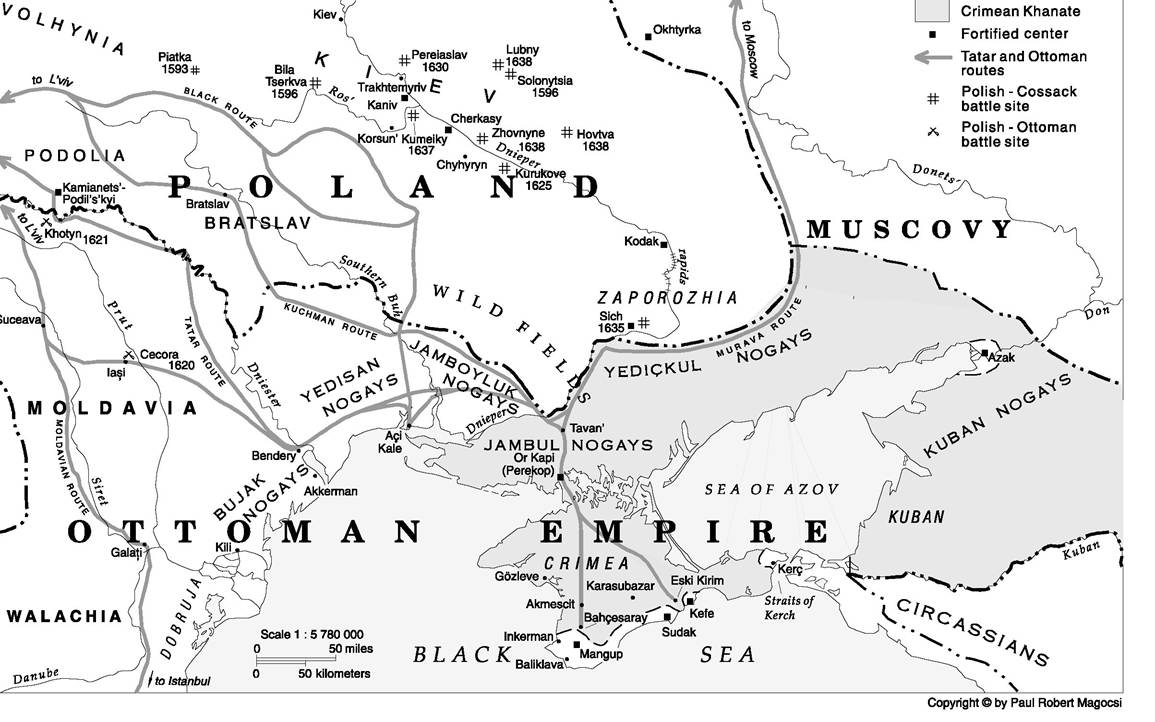
marked by efforts to rid themselves of what was considered the odious and humiliating heritage of the Golden Horde’s “Tatar yoke” as maintained by the Kazan’, Astrakhan’, and Crimean khanates.
The Crimean Khanate
It was the Crimean Khanate that had the most direct bearing on Ukrainian lands, and well before the final disintegration of the Golden Horde at the outset of the sixteenth century, it had evolved into a distinct political entity. Ever since 1260s, the Crimean peninsula and steppe lands north of the Sea of Azov formed a part of the Golden Horde. An official from the Horde administered the region from the town of Eski Kirim/Krym/Solkhat (today Staryi Krym), located north of the port of Kefe/Caffa beyond the Crimean mountain crests. The Crimea soon became a refuge for princes of the ruling dynasty of the Golden Horde, some of whom tried but failed to became its supreme leader (khan). One of these exiled leaders was Haci Devlet Giray. He was a Chinggisid prince, that is, a descendent of Chinggis Khan, the creator of the Mongol Empire. Haci Devlet was invited by local Tatar clan leaders (themselves from the Golden Horde) to rule in the Crimea. He arrived sometime in the late 1430s, proclaimed the independence of the Crimea from the Golden Horde, and after a complicated struggle against various competing political forces in the peninsula, managed to became the first khan of the Crimean Khanate, ruling from ca.
1441 to 1466 and thereby establishing the state’s Giray dynasty.In the course of their rise to power, it was inevitable that the Crimean khans of the Giray family would clash with the rulers of the Golden Horde (who still claimed authority over the Crimea), as well as with other forces in the peninsula itself: the Theodoro-Mangup Principality in the mountainous back country in the southwest; and the Genoese, whose control of trade and the coastal cities posed a particular challenge. In the midst of this three-way struggle for control of the Crimea between Girays, the Theodoro princes, and the Genoese, a new contender entered the field. These were the Ottoman Turks.
Following the fall of Constantinople in 1453, the Ottoman conqueror of the city, Sultan Mehmed II (reigned 1451-1481), was determined to extend his realm north of the Black Sea, which he set out to transform into an “Ottoman lake.” In 1475, Ottoman forces arrived in the Crimea and captured Caffa, other Black Sea ports, and the mountain-top fortress of Mangup, thereby destroying the Principality of Theodoro. At the same time, the sultan rejected the Crimean khan’s claim for Caffa and other Black Sea coastal towns which were placed directly under Ottoman administration. Place-name changes symbolized the ascendancy of Ottomans, as Italian Moncastro (later captured from Moldavia) became Turkish Aq Kerman/Akkerman (today’s Bilhorod-Dnistrovs’kyi), Cerchio became Kery (today’s Kerch), and Tana became Azak (today’s Azov). On the Crimean peninsula itself, the ports of Kalamita became Turkish Inkerman, Cembalo became Baliklava (later Balaklava), the fortress of Soldaia became Sudak, and the most important Genoese center, Caffa, became Kefe (today’s Feodosiia). Under Ottoman rule, Kefe’s port was expanded and its population increased to the point that by the early seventeenth century it was one of the largest cities in all of eastern Europe.
The arrival of the Ottomans prompted a new realignment of political power in the Crimea.
The sultan claimed he was a political heir of the Golden Horde, and backed by overwhelming military force he was able to dictate terms to the Giray rulers of the Crimean Khanate. In return for pledging vassalage to the sultan, in 1478 Khan Mengli I Giray (reigned 1468—1473, 1478—1515), with Ottoman military support, was able to regain his throne and to impose his authority vis-à-vis rivals within the region. The Crimean peninsula itself was divided. A narrow strip of noncontiguous territory along the Black Sea littoral from Inkerman to Kery (Kerch) eventually became part of an Ottoman province (sancak), which was named Kefe after its administrative center. Aside from the Crimean littoral, Kefe province included the eastern shore of the Straits of Kerch and the fortress of Azak. The rest of the peninsula was under the authority of the Crimean khan and clan leaders loyal to him.From the very beginning the Ottomans maintained a special relationship with the Crimean Khanate and its Giray ruling dynasty. The Ottoman sultan claimed authority over all Turkic peoples that inhabited the steppe region stretching far eastward into Central Asia. Since the Girays were direct descendents of Chinggis Khan, the Ottomans used their connection with the Crimean Khanate to legitimize their claims over the Central Asiatic Turkic world. Therefore, in contrast to other Ottoman vassal states which were required to pay tribute and supply troops to the sultan, it was the sultan who provided the Crimean khans with an annual pension and with landholdings in the Turkish provinces of Rumelia and Anatolia. And whenever the Ottomans needed troops from the Crimea, they sent an “invitation” - not an order - to the khan accompanied by campaign expenses.
While it is true that Ottoman interference in Crimean politics progressively increased from the end of the sixteenth century, the Crimean Khanate was nonetheless able to maintain a privileged position within the Ottoman Empire and to follow a basically independent foreign policy vis-à-vis its neighbors.
For example, the khanate’s first rulers were allied at times with Muscovy, and at other times with Lithuania and Poland, as part of their ongoing efforts to undermine their rivals in the Golden Horde. In fact, it was Hayi Devlet’s son and successor, Mengli I Giray, who in 1502 successfully attacked the Golden Horde’s capital of New Saray on the lower Volga River, drove out its ruler, and adopted for himself and his Crimean successors the title, “Great Khan of the Golden Horde and the Kipyak Steppe.” Mengli I and those Crimean khans who followed him also proclaimed inheritance to the Golden Horde’s right to collect tribute from Poland and Muscovy. Claims such as these brought the Crimean Khanate into conflict with its two neighbors to the north. This was particularly the case with Muscovy, with whom the Crimean Khanate remained in conflict throughout the first half of the sixteenth century for control of former Golden Horde territory, which by then was divided among the Nogay Horde (east of the Volga River) and the Khanates of Kazan’ and Astrakhan.Crimean socioeconomic life
The Crimean Khanate was a state governed by Islamic law, whose rulers and majority Tatar and Turkic population were Sunni Muslims. The head of the state was the khan, always of the Giray dynasty, who derived his preeminent status within the Tatar political leadership because he was a descendent of Chinggis Khan. The Giray khans were not absolute rulers, but instead governed with the active participation of Crimean Tatar clan leaders (beys), the most important of which represented the girin, Mansur, Barin, and Sicuvut clans, the so-called karnei beys. These four and other Crimean clans (including the Kipyak and Argin) derived their social and economic influence from two sources: ownership of large tracts of land, mostly in the steppe portion of the peninsula north of the mountain crests and foothills; and their ability to supply or deny, at their discretion, troops to the khan. The Crimean clan leaders met periodically in assemblies (the kurultay), which formally elected a new khan before submitting his candidacy to the Ottoman sultan for approval.
Aside from the kurultay, clan leaders together with clerics and elders of the khan’s court also sat on the khan’s council of the state (divan), which effectively determined Crimean governmental policy.The Tatar inhabitants of the Crimean Khanate, who numbered about 500,000 in the mid-sixteenth century, comprised a heterogeneous population which differed quite radically depending on its origins, linguistic characteristics, and geographic location. In terms of geography, the Crimean Khanate included the territory in the Crimean peninsula as well as an even larger expanse of land beyond the isthmus of Perekop that encompassed the steppes of Ukraine north of the Black Sea and Sea of Azov. The Crimean peninsula itself was geographically diverse; its northern two-thirds consisted of a steppe-like plain that was a continuation of the Ukrainian steppe north of Perekop. The southern third of the peninsula included the foothills and a mountain chain running in an east-west direction parallel to the sea coast. Finally, below the mountain cliffs along the coastal littoral was a narrow strip of land which was the site of several port towns, including the largest of them all, Caffa/Kefe (today Feodosiia).
In the broadest terms, the population living in the Crimean Khanate belonged to two groups: nomadic and sedentary. The nomadic elements lived in the steppelike plains, which covered the northern two-thirds of the peninsula as well as southern Ukraine. The sedentary population inhabited the peninsula’s foothills and mountain valleys as well as the coastal towns and villages.
The Crimean Tatar ruling elite, which included the extended Giray ruling family and the various clan leaders who administered large tracts of land in both the peninsula’s steppelands and mountainous regions, were descendants of the Turkic Kipyak nomads and warriors who lived in the heartland of the Mongolo-Tatar Golden Horde. The Crimean elite spoke and developed for administrative purposes a written language that was a mixture of Kipyak Turkic (from the Inner Asian steppe) and Oghuz Turkic (related to the Turkish language of Anatolia, the heart of the Ottoman Empire).
The Crimean peninsula had for millennia become home to numerous other peoples - Scythians, Goths, Alans, Huns, Greeks, Genoese, and Armenians - some of whom were originally nomadic while others were sedentary agriculturalists and town-dwellers. In the course of the fifteenth and sixteenth centuries, most of these groups became linguistically turkcized and they adopted the Islamic faith. This heterogeneous mix of peoples came to be known as Tats, which was initially a derogatory term used by Turkic peoples to describe their neighbors (and converts to Islam), who may have spoken Turkic but were not of “pure” Turkic descent. The Tats referred not only to the peasant farmers of the mountainous foothills and valleys (who spoke the Kipyak-Oghuz Turkic mixed language), but also to the coastal town dwellers who lived under direct Ottoman administration (and who spoke Oghuz Turkic as in Anatolia). It was the Tats who were to become the dominant demographic element in the peninsula, and it was they who provided the Crimean Tatars with characteristics that made them distinct from other Tatars in Central Asia. In other words, the Tats - whether peasant farmers, artisans, tradespeople, or bureaucrats - formed the very core of the Crimean polity.
Crimea’s peasant farmers were organized in villages, the land was worked in common, and taxes were assigned by the landlord (usually tribal and clan leaders) to the village as a whole. Peasants were not proprietary serfs, however, and were free to leave the land if they wished. Among the most important and lucrative export products of Crimean agriculture were fruits, tobacco, and honey.
Whereas most of Crimea’s diverse peoples assimilated to the peninsula’s Turkicspeaking Islamic majority, in that process they left a distinct cultural and linguistic imprint on the Tats, who eventually formed the basis of a Crimean Tatar ethnos. For example, the Turkic language of the coastal Tats contains several loanwords from Italian and Greek, reflecting the former presence of those peoples in the Crimea’s ports. There were also a few peoples, who, while adopting Turkic speech, did not become Muslims. These included the Christian Armenians and Greeks (the urum, or Greek Tatars) and the Jewish Krymchaks and Karaites. The Krymchaks and Karaites lived primarily in the khanate’s largest towns: Akmescid (today Simferopol’), the port of Gozleve (today Ievpatoriia), the girin clan “capital” of Kara- subazar (today Bilohirs’k), and the khanate’s capital Bahyesaray (today Bakhchysarai). The Armenians and Greeks were concentrated in Kefe (today Feodosiia).
The first capital of the Crimean Khanate was the eastern town of Eski Kirim/ Solkhat (today Staryi Krym), but already under Khan Haci Devlet Giray in the midfifteenth century it was moved closer to the center of the peninsula. He chose the mountaintop town of Kirk Yer, located a few kilometers north of Bahyesaray. Kirk Yer functioned as a formidable fortress, while in the valley below at Salayik (today Starosillia) the khan had his residential palace. It was Devlet Giray’s son, Mengli I Giray, who expanded the palace complex at Salayik, which included the Zindcirli Medrese, or college (est. 1500) to train Muslim clerics. When Salayik proved to be too constrained for the growing Crimean state, one of Mengli’s sons Khan Sahib I Giray (reigned 1532-1551) moved just a couple kilometers down the valley to Bahyesaray, where in 1532 he founded a new palace that was to become the permanent residence of the Crimean Khans. With its khan’s palace, extended gardens, mosques, schools, and other public buildings, Bahyesaray was transformed into an impressive center of Islamic culture as well as the political seat of the Crimean Khanate. It is interesting to note that, while losing its status as the Crimean capital, the mountaintop town of Kerk Yer, later known as Qufut-Kale (which in Crimean Tatar means the Jews’ Fortress), retained its importance as the center for the community of Karaites (Hebrew: Karaim), that is Jews who adhere to a form of a non- Talmudic Judaism.
The Karaites
The Karaites, also known as Karaim, are a Jewish sect whose origins are unclear and disputed. It is generally assumed that the sect was founded in the eighth century in Baghdad, the capital of the Islamic Abbasid Empire, and that from there it spread throughout the Middle East. In the twelfth century some Karaites settled in the Byzantine Empire (primarily in Constantinople and western Anatolia) and from there migrated to the Crimea beginning in the mid-thirteenth century. It was then that they adopted Turkic speech and eventually developed a distinct literary language (written in Hebrew script) that was rather similar to Crimean Tatar. There are also some scholars (A. Firkovich, S. Szapszal) who argue that the Turkic origin of the Crimean Karaites goes back even earlier to the Khazars who were also present in the peninsula both during and after the existence of their state. Toward the end of the fourteenth century, Lithuania’s grand duke resettled several hundred Karaites in his capital of Trakai/Troki, and from there some migrated south to the Rus’ towns of Luts’k in Volhynia and Halych in Galicia.
The Karaites in the Crimea were similar in language to the Turkic-speaking Crimean Jews, or Krymchaks (originally centered in Karasubazar, today Bilohirs’k). They differ from the Orthodox Jewish Krymchaks, however, in that they reject the religious commentaries and additions contained in the Talmud and instead believe only in the word of God as expressed in the Old Testament as the sole and direct source of religious law. Much later, and in an entirely different cultural context, some Protestants came to believe that the Karaites, as People of the Scriptures, were precursors of the Christian Reformation. Such beliefs led some Gentiles (especially German Protestants) to assume that the Karaites were different enough from Jews to be exempted from general European anti-Semitism.
The Karaites originally settled in the port of Caffa/Kefe and in Solkhat/Eski Kirim, but after the fall of the Principality of Theodoro-Mangup to the Ottoman Turks in 1475, they became concentrated in the mountaintop towns of Mangup Kale and Qufut Kale. There they lived in isolation from their immediate neighbors, but all the while maintaining contacts with their coreligionists in Lithuania (Trakai) and western Ukraine (Luts’k and Halych). In the eighteenth century Qufut Kale became a major Karaite cultural center, where several books were printed in Hebrew and efforts made to create a Karaite Turkic literary language using the Hebrew and later Russian and Latin (Polish) alphabets. In the second half of the nineteenth century, Qufut Kale was abandoned and the coastal city of Gozleve (by then renamed levpatoriia) became a major center of Karaites in the Crimea.
From the outset of Russian rule in the 1780s, the imperial authorities made a legal distinction between Karaites and other Jews, distinctions which the Karaites themselves welcomed, arguing that they were an especially honest and industrious people loyal to the tsar. Consequently, the Karaites became a privileged and often wealthy group (numbering 5,400 in the Crimea in 1897) who were exempt from military service and granted religious autonomy. The most eminent Karaite scholar, writer, and active champion for equal rights was Abraham Firkovich from Luts’k in Volhynia, who from 1832 until his death in 1874 served the community in Qufut Kale and coastal levpatoriia.
Karaite distinctiveness took a strange turn during the World War II Holocaust period, when Nazi Germany occupied the Crimea. After extensive study, the Nazi authorities in Berlin declared that from the standpoint of their racial ideology the Karaites were non-Jewish. In contrast to the Jewish Krymchaks, who were virtually all killed by Nazis, the Karaites were left alone. Karaite behavior during the Holocaust ranged from indifference to the fate of the Krymchak Jews to actual collaboration with the Nazi administrators in the Crimea.
The Nogay Tatars and slavery
Whereas the Crimean Khanate quickly took on the characteristics of a stable sedentary society associated with the agricultural, artisan, and commercial pursuits of the majority of the population living in the southern third of the peninsula, there was yet another important element within the khanate’s political sphere. These were the Nogay Tatars, that is, Kipqak-speaking nomadic peoples of Turkic origin who pastured their flocks on Ukraine’s steppe lands north of the Sea of Azov and the Black Sea stretching from the Kuban River in the east to the Danube River in the west. The Nogay were originally one of the many tribal groupings within the Golden Horde. In 1556, when Muscovy finally subdued the Astrakhan Khanate and the Nogay heartland east of Volga River and north of the Caspian Sea, a portion of the Nogays migrated westward to the steppe zone north of the Sea of Azov and Black Sea. In this region the Nogays themselves were split into several tribal confederations: the Kuban Nogay (east of the Sea of Azov), the Yediqkul Nogay (north of the Sea of Azov), the Camboyluk Nogay (north of the Crimea), the Yedisan Nogay (between the Southern Buh and Dniester Rivers), and the Bujak Nogay (between the Dniester and Danube Rivers).
These Nogay tribes, generally referred to as “Tatars,” are the subject of much attention in Ukrainian history. Theoretically, the various Nogay tribes were expected to recognize the authority of the Crimean khan, usually in the form of a representative (serasker) sent from Bahqesaray. In practice, however, they usually followed their own whims and often rebelled against the Crimean Khanate. “Yet,” as the historian Alan Fisher has remarked, “the Nogays served a useful purpose for the Crimean Khanate: They prevented the establishment of solid Slavic settlements in the steppe and provided the Crimean slave markets with a never ending supply of captives.”1
By the early sixteenth century, the Crimean economy had come to be based largely on the slave trade. Slavery was legal according to Islamic law, but only persons from outside the Muslim world could be enslaved. Therefore captives taken in wars against non-Muslim powers were prime candidates for slavery. While slaves formed an integral part of the Ottoman Empire’s socioeconomic system, that society allowed for various forms of manumission, both for slaves and their offspring, leading in part to a situation in which the empire was in constant need of replenishing this human commodity. Before long the Ottoman’s new vassal state, the Crimean Khanate, became the primary source of slaves. From the standpoint of the Crimean authorities, whenever there was a downturn in agricultural productivity, the state could supplement its income with profits earned from selling slaves. Just to the north of the Nogay steppe were the non-Muslim lands of Ukraine and southern Russia, which at the time were nominally under the control of Poland, Lithuania, and Muscovy. It was there that Tatars from the Crimea turned to seek out Christian Slavs to enslave.
The Tatars, whether the khan’s armies or Nogay slave-raiders, entered the Ukrainian lands of Poland-Lithuania via several invasion routes that began at Perekop, the site of a major defensive fortress (called in Turkic: Or Kapi or Ferahker- man) that was located on a narrow sliver of land where the Crimean peninsula joins the steppe to the north. The khanate’s military forces, almost exclusively cavalry, ranged in size from 10,000 to 30,000 in the sixteenth century. While the Nogay slave-raiding parties were much smaller, their incursions were more frequent, with the result that the number of captives they managed to acquire were quite astonishing. Some scholars have estimated on average 20,000 captives from Poland-Lithuania each year, with total losses from the period 1500-1664 reaching about one million people. A certain number of captives were allotted to the Crimean khan and the remainder to all those who participated in a given campaign. Most, however, went to the Ottoman Empire: perhaps a fifth to the sultan as tribute, and the rest sold to Ottoman buyers at the Crimean Tatar slave markets in Bah^esaray, Karasubazar, the port of Gozleve, but most importantly at the Ottoman-ruled port of Kefe.
And what happened to the captives from Ukraine when they reached the heart of the Ottoman Empire? The slaves functioned at all levels of Ottoman society with the result that their fates differed widely. At the lowest end of the social scale were galley slaves conscripted into the imperial naval fleet and field hands who labored on Ottoman landed estates. House servants fared somewhat better. But there was yet another segment of captives, both male and female, who clearly improved their social and economic status while living in the Ottoman world. These people included converts to Islam, who served in various positions of the Ottoman military administrative system. Females, meanwhile, were conscripted into the harems of the Ottoman elite. The most renowned of these was a captive from Galicia, Nastia Lisovs’ka. Known as Roksolana, or Hurrem (her Turkish name), she became the favorite wife of Sultan Süleyman I (“the Magnificent”) and a personage of political influence in her own right during the apogee of Ottoman power in the mid-sixteenth century.
After the mid-sixteenth century, it was the Nogay tribes, especially the Yedi^kul, who were increasingly responsible for the slave raids. The Tatars in the Crimean peninsula were more interested in the role of middlemen between their Nogay suppliers in the north and Ottoman purchasers in the south. It is also from this period, the sixteenth and early seventeenth centuries, that the anonymous lyrical epic tales known as dumy arose among the Rus’ of Ukrainian society. Not surprisingly, the earliest dumy stressed only the negative aspect of captivity, as in laments on the fate of young men coerced to serve in the armies of the Ottoman Turkish “infidel” (Duma about the Lament of the Captives), or of young women forced to enter harems and serve the personal needs of the Ottoman rulers (Duma about Marusia from Bohuslav).
Was Ottoman and Crimean Slavery
All That Bad?
The tradition of alleged suffering at the hands of the Ottoman Turks was embedded in the Ukrainian-Rus’ psyche through the recitative chanting of epic tales known as dumy. The following is an excerpt from the Duma About the Lament of the Captives, one of the most famous examples of this genre of oral literature sung for generations until today by minstrels (Ukrainian: kobzari) usually playing a hand-plucked string instrument, the bandura or kobza.
On the holy day of Sunday, it wasn’t the grey eagles screaming,
But the poor captives weeping in bitter slavery,
Raising their arms, shaking their chains, Begging and imploring the merciful Lord: ‘Send us, O Lord, a fine rain from the sky And a wild wind from the Dnieper steppe!
Maybe a swift wave will rise on the Black Sea,
Maybe it will break the Turkish galley loose from its anchor!
Oh, we have had enough of this accursed Turkish slavery;
The iron chains have dug into our legs,
They have cut our white young Cossack flesh to the yellow bone.’
They spilled innocent Christian blood.
The poor captives began to see Christian blood on their bodies,
They began to curse the Turkish land, and the infidel faith:
O Turkish land, O infidel faith,
O separation from fellow Christians,
You have parted many from their fathers and mothers,
Brothers from their sisters,
Husbands from their faithful wives!
Liberate, O Lord, all the poor captives
From bitter Turkish slavery,
From infidel captivity!
Let them reach the quiet waters,
The bright stars
The merry homeland,
The Christian people,
The Christian cities!*
The dumy and other laments that have come down to us, whether in written form or in oral folklore, reflect the view of those inhabitants who managed to avoid abduction and remain in their homeland. But what about the views of those who were captured? Clearly, not all felt Ottoman and Crimean slavery was a fate worse than that they would likely endure if they never left home. Documentary evidence about the attitudes of Christian Rus’ captives living in the Crimea and Ottoman world is rare, but there is one example by a contemporary chronicler which suggests that for the Rus’ people of Ukraine “life in slavery” in a foreign land had its advantages. In the Tale of the Cossack War Against the Poles (1720), the author Samiilo Velychko relates what happened during the raid into the Crimea in 1675 by the Zaporozhian leader Ivan Sirko. On his way back to Zaporozhia carrying extensive booty, including 13,000 Muslim and Christian captives in tow, Sirko stopped somewhere in the steppe at a safe distance from the Crimean border.
Turning to the Christians who numbered 7,000 males and females, Sirko said: ‘Whoever wants can come with us to Rus’; for those who do not want to come, then return to Crimea.’ When the Christians [originally from Rus’], as well as the Christians who were already born in Crimea and the tumy [persons of mixed Turkic-Rus’ origin] heard this, a certain number, namely 3,000 of them, preferred to return to the Crimea rather than go live in a Christian land... He [Sirko] allowed those to depart for the Crimea. As they were leaving, he asked why they were so eager [to return] to Crimea? They responded that they already had in Crimea their own houses and property and therefore it was a better life for them there than in Rus’ where they have nothing.**
This story does not end on the happy note, however. When the disbelieving Sirko was finally convinced that these (for him ungrateful) Rus’ Christians really wanted to return to the Crimea, he ordered the Cossacks to massacre the entire group.
sources:
* Ukrainian Dumy, translated by George Tarnawsky and Patricia Kilina (Toronto and Cambridge, Mass. 1979), p. 23.
** Samiilo Velychko, Litopys, Vol. II (Kiev 1991), p. 191.
Thus, the Crimean Tatars and their Nogay allies represented the most recent in a long line of nomadic or sedentary civilizations (the Scythian, the Sarmatian, the Khazar, the Golden Horde) that came to dominate the southern steppes of Ukraine and that continued the symbiotic economic relationship between the coastal cities and the hinterland. Because captured slaves represented the most important resource in the Crimean economy, much of the area south of the Brat- slav and Kiev palatinates from the Southern Buh to the Dnieper Rivers and beyond became a sparsely settled or entirely uninhabited no-man’s-land, known as the Wild Fields. In effect, this part of the country became what the name Ukraine suggested: a borderland or frontier, not in the sense of the end of a civilized area, as is often assumed, but rather in the sense of a buffer zone between Poland-Lithuania to the northwest, Muscovy to the northeast, and the Crimean Khanate and Ottoman Empire to the south.