7 Kievan Rus’: Its Formation and Consolidation
As with all great and long-lasting political entities, the origins of Kievan Rus’ are shrouded in uncertainty and controversy. The debates about its origins have taken on an often shrill tone, especially since Kievan Rus’ has been claimed as the predecessor to three modern East Slavic states, Russia, Belarus, and Ukraine.
In fact, the territory of Kievan Rus’ did not coincide with any one of these states; therefore, its political and cultural heritage can legitimately be claimed by all three. It is certainly true that Kiev, present-day Ukraine’s capital, was the political, cultural, and for a long time the economic center of the medieval Rus’ polity. On the other hand, Kievan Rus’, even at the time of its greatest territorial extent, included at most only half of Ukraine’s territory while extending much farther north and encompassing all of Belarus and much of European Russia.The basic controversy surrounding the origin of Kievan Rus’ has to do with what might be called national pride. The vast majority of the inhabitants of Kievan Rus’ were East Slavs. Did they, however, create their own state, or did they need outsiders, Varangians from Scandinavia, to do it for them? And who were the Rus’? Were they Germanic Scandinavians or a multiethnic Baltic Sea trading company (called Varangians/Variagi by the Slavs and Rus’/Ruotsi by the Finns), which Slavic and Finnic tribes in the area of Novgorod near Lake Ilmen invited to rule over them sometime in the ninth century? Or were they an East Slavic tribe (the Rosy) dwelling along the middle Dnieper and Ros’ rivers that centuries earlier had formed a tribal union with its center in Kiev?
Although debates over these questions continue to engage (and at times enrage) historians, archeologists, and linguists, what might be considered the closest approach to a consensus on this matter is the following.
By the ninth century, the East Slavs had established several tribal unions, each with its own political and economic stronghold (see Map 4). Sometime in the 860s, the Varangians, who were already well established as traders in the far north among primarily Baltic and Finnic tribes, undertook to unite those as well as East Slavic tribes under their hegemony as part of a political entity based on the Baltic-Black Sea waterway and focused on the Dnieper River as the main connecting link to Byzantium.The first stage in the formation of Kievan Rus’ lasted from 878 to 972, when four rulers of Scandinavian origin—Helgi (Ukrainian: Oleh), Ingvar (Ihor), Helga (Ol’ha), and Sveinald (Sviatoslav)—succeeded in bringing the East Slavic and Finnic tribes under their control. At the same time, their external policies were directed at restraining the advances of nomadic steppe peoples from the south and east (Pechenegs, Karakalpaks, Torks, Polovtsians) and with creating a favorable military and economic position vis-a-vis the two strongest powers in the region, Byzantium and Khazaria. Actually, toward the end of this first stage in Kievan Rus’ history, the ruler Sviatoslav destroyed the Khazar Kaganate, leaving a political vacuum which after the 960s was filled by aggressive nomads, in particular the Pechenegs.

7.1 Drawing of the construction site of the Church of the Dormition, or Tithe Church (989-996) in Kiev, commissioned by grand prince Volodymyr the Great upon the Christianization of Rus’.
The second stage in Kievan Rus’ history lasted from 972 to 1132. During what could be called the era of consolidation, Kiev’s rulers, by then known as grand princes, set out to create an administrative structure to control the vast and expanding Rus’ territory and to assure that its military forces were strong enough to withstand external threats, the most dangerous of which remained the steppe nomads.
Success in these goals was achieved in particular during the reigns of three grand princes: Volodymyr I (“the Great,” r. 980-1015), Iaroslav I (“the Wise,” r. 1036-1054), and Volodymyr II Monomakh (r. 1113-1125).It was during the reign of Volodymyr the Great that the political structure of Kievan Rus’ was given clearer form. The homelands of the various East Slavic tribal unions were replaced by lands or principalities whose names derived from each territory’s leading commercial and political center. Aside from Kiev, there were initially seven principalities: Pereiaslav, Chernihiv, Galicia-Volhynia, Polatsk, Smolensk, Rostov-Suzdal’, and Novgorod. Like his Varangian predecessors, Volodymyr as grand prince resident in Kiev considered the entire realm his personal property, and to each of the seven lands he assigned one of his offspring to rule. Thus, Kievan Rus’ was typical of most polities in medieval Europe. In other words, it was not a centralized state but a conglomerate of various lands, or principalities, based on a common familial relationship to the grand prince ruling in Kiev.
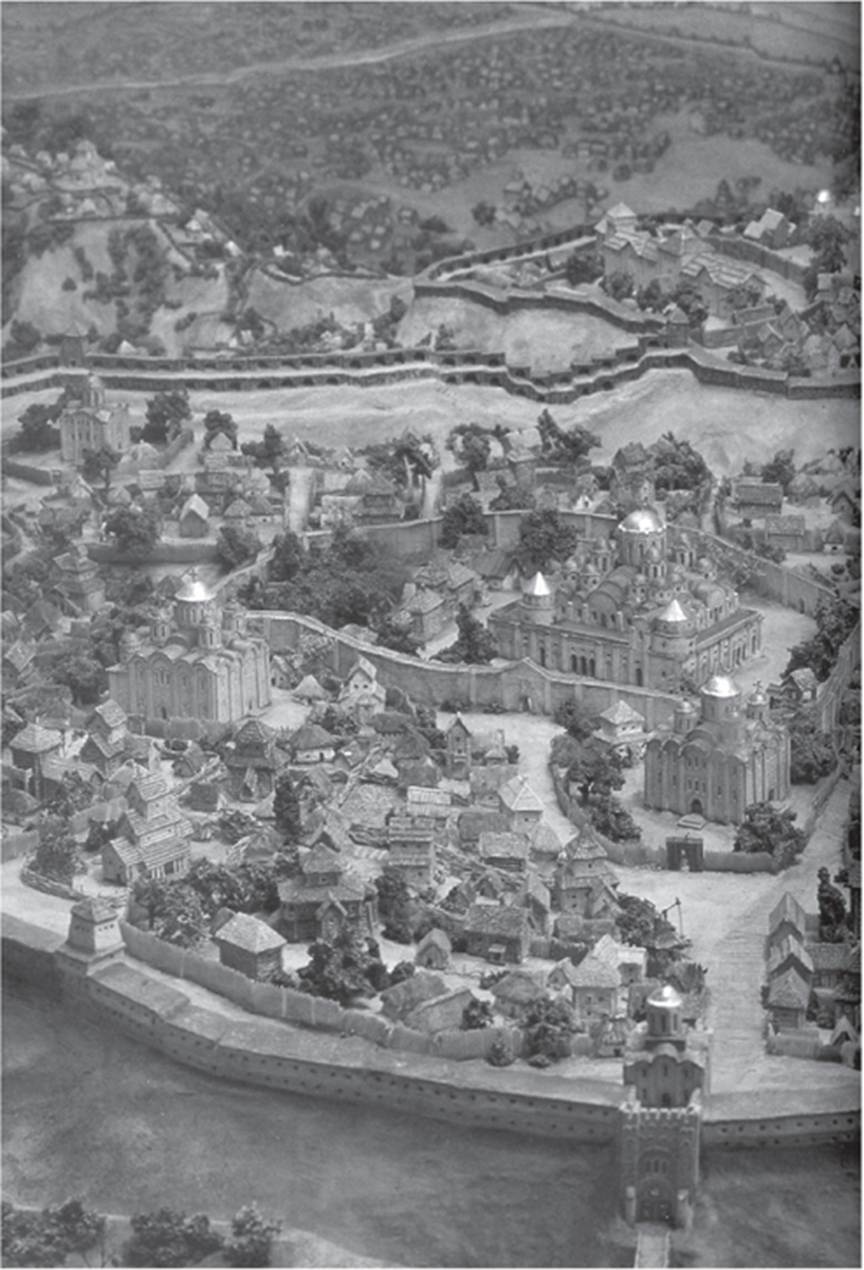
7.2 Model of 11th-century Kiev constructed largely during the reign of Iaroslav the Wise.
Volodymyr I was also concerned about ideological unity. Initially, the term Rus’ was associated simply with the ruling elite of Varangian origin. Gradually, however, Rus’ came to mean the territories and their inhabitants living under the rule of Volodymyr I and his filial representatives. At first this meant the land surrounding Kiev, Pereiaslav, and Chernihiv, but eventually it included all seven principalities of the realm.
Ideological unity was enhanced further with the adoption of a state religion. After considering several options (including an attempt to enhance Varangian beliefs in paganism), sometime around 988 Volodymyr I adopted Christianity according to the Eastern rite practised by the strongest political and economic power of the time, the East Roman or Byzantine Empire.
By this act Kievan Rus’ was drawn into the Byzantine cultural orbit and basically was to remain its political ally and economic partner. Byzantine Greek churchmen arrived in Kievan Rus’, where by the eleventh century they created an ecclesiastical structure. During the reign of Iaroslav I, Kiev became the seat of the head, or metropolitan, of the Rus’ church, and eparchies (the eastern term for dioceses) were set up throughout the realm at Bilhorod, Iur’iev, Pereiaslav, Chernihiv, Volodymyr-Volyns’kyi, Turaü, Polatsk, Rostov, and Novgorod. The new Christian Church promoted literacy in the form of the Old Slavonic language, using the Cyrillic alphabet created for the Slavs by the Byzantine missionaries, Cyril and Methodius. Although the process of Christianization throughout Kievan Rus’ took centuries to complete, it proved to be an excellent catalyst in promoting a sense of unity throughout the otherwise diverse and decentralized Kievan realm. At the same time that the concept of Rus’ was being associated with the territory and inhabitants of the realm, it also took on a religious connotation. In other words, being Rus’ in the territorial sense and being Rus’ in the sense of an adherent of the Eastern rite (later Orthodox) Christian faith were one and the same.
7.3 The seat of Rus’ Christianity, the Saint Sophia Cathedral Church, commissioned by Iaroslav the Wise; model of its assumed appearance when constructed between 1037 and 1044.
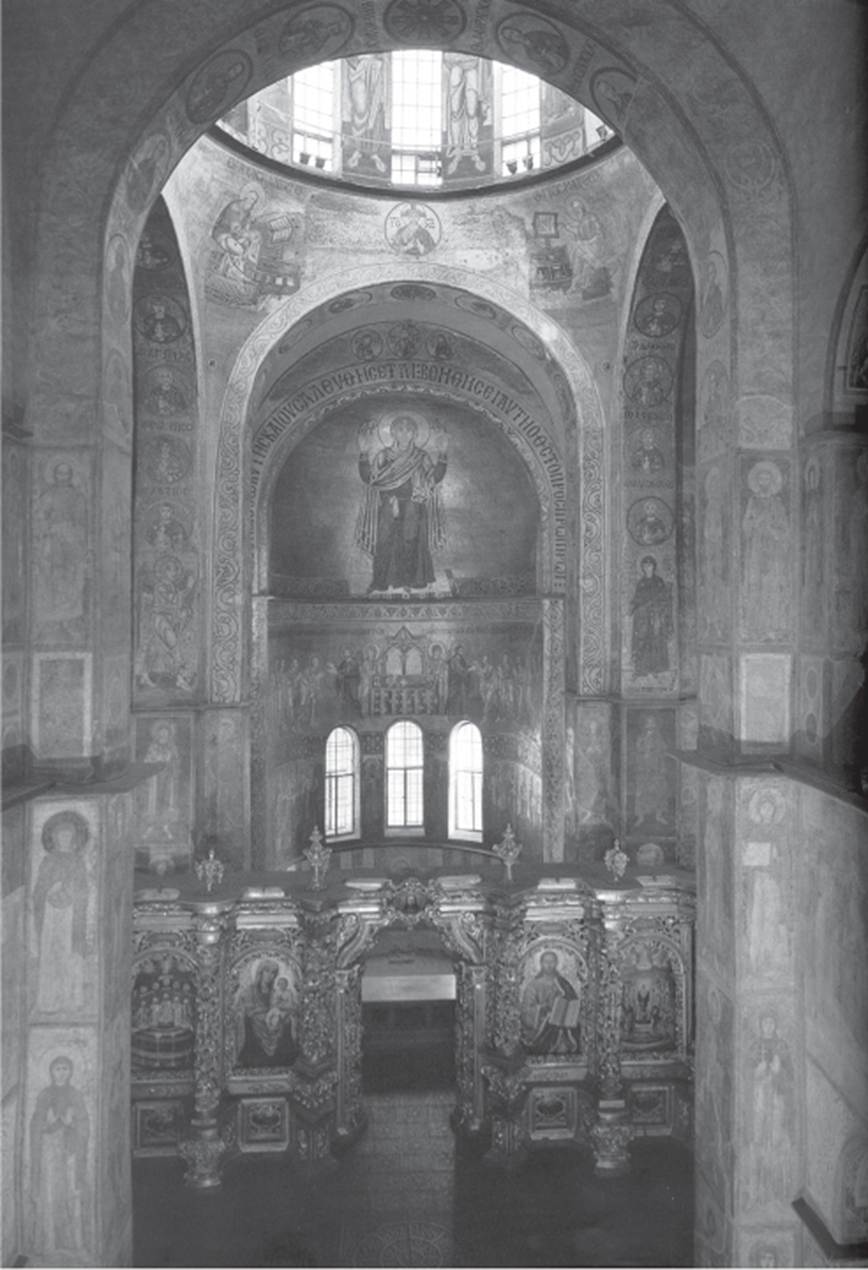
7.4 Mosaics and frescoes of the 11th century in the nave and apse of the Saint Sophia Cathedral, Kiev.
Iaroslav I “the Wise” contributed even further to the ideological consolidation and sense of common identity within Kievan Rus’. He commissioned the writing of historical chronicles, the most famous of which, the Povest vremennych let (Tale of Bygone Years), or Primary Chronicle, provided a common “foundation myth” and eventually a common historical consciousness for all the lands of Kievan Rus’.
Iaroslav also called for the preparation of a law code, the Ruskaia Pravda/Pravda Russkaia, or Rus’Law. This body of mostly common law was used throughout Kievan Rus’, thereby instilling in its inhabitants the consciousness that they lived in a single polity governed by common legal and social norms.
7.5 Iaroslav I Volodymyrovych (978-1054), known by the epithet “the Wise,” grand prince of Kiev from 1019 to 1054.

7.6 Nestor (ca. 1056-1114), sainted monk who continued and completed the Rus’ Primary Chronicle.
It was also during the reign of grand prince Iaroslav I that Kievan Rus’ became firmly integrated with the rest of medieval Europe. Iaroslav achieved this primarily through marriage alliances: his second wife was the daughter of the king of Sweden, while from among his children Anastasia became queen of Hungary, Elizabeth queen of Norway, Anna queen of France, and Vsevolod husband to the daughter of the Byzantine emperor.
Iaroslav I tried to resolve a problem that had plagued the first two stages in the development of Kievan Rus’—its system of political succession. The practice of seniority, whereby the grand prince of Kiev assigned his male offspring to rule over the other “subordinate” principalities, was terribly complex and led to frequent and often long drawn out interprincely warfare following the death of virtually each grand prince. On the eve of his death in 1054, Iaroslav I proposed a succession order, but in the end it was not followed by his immediate successors. Somewhat later Volodymyr II Monomakh, at the time ruler of Pereiaslav, called on his fellow princes to meet at the town of Liubech (1097) to discuss the succession problem. The participants at Liubech agreed to replace seniority with the principle of patrimony, whereby each prince would retain the land ruled by his father. This would have transformed Kievan Rus’ into a federation of self-governing and loosely linked principalities each with its own dynasty. It was not long, however, before rival princes crossed the newly established dynastic lines, with the result that the problem of succession continued to plague and to weaken Kievan Rus’ throughout the rest of its existence.

7.7 Anna (ca. 1020s-1070s), the daughter of Iaroslav the Wise and queen of France, sculpture at the Church of St. Vincent in Senlis, north of Paris.

7.8 Reconstruction of the Rus’ city of Liubech, site of the 1097 diet of princes summoned by Volodymyr II Monomakh.
MAP 8 KIEVAN RUS’, circa 1240
