Letter from the Collective Farmer Mykola Reva to Joseph Stalin about the Famine of 1933 in Ukraine
1 May 1940
Dear Joseph Vissarionovich,
You are, it would seem, our friend, teacher, and father, so the bold idea occurred to me of writing to you with the whole truth....
The dark reaction of the hungry year of 1933, when people ate tree bark, grass, and even their own children, when hundreds of thousands of people died of starvation, and all this before the eyes of the communists, who drove their cars across our bodies and impudently praised life....
...[T]he people were dying of hunger not because there was a poor harvest but because the state took their grain, and that grain lay in the Zahotzerno [Grain Procurement] warehouses in elevators and was being distilled into alcohol for intoxication, while people were dying of hunger.... [I]n 1933, when hungry people gathered grains of corn by the Zahotzerno warehouse at the KhoroI station, they were shot like dogs; a detachment of mounted police was dispatched from the town of KhoroI, and Iike Iions, with sabers drawn, they pursued us hungry ones, and there was grain in the warehouses, there was flour, but people were dying of hunger, which means that aII this was carried out deIiberateIy by the state, and the state knew about this....
The viIIage counciI does not issue death certificates for 1933 because mor- taIity in that year was so great that in more than fifty years so many peopIe did not die as in that year. Whoever was Ieft aIive, having endured such difficuIties - that person is aIready ruined because, as I know from my own experience, we coIIective farmers were swoIIen from hunger, we feII on our feet, we Iost our abiIity to think, we Iost a certain percentage of our eyesight, there is no heaIth, no strength, a generaI weakness of the bodiIy organism, and a great incidence of hospital visits and many sick people in those areas where the year 1933 made itself felt. All this took place before the eyes of the communists - how can they not be sorrowful and ashamed that they could not besiege the higher authorities and sound the alarm about this misfortune, so that it would not exist....
[T]he communists cared more for their own skins, for if anyone endeavored to stand up for the people with a mere word, his fate would be settled along with ours. That is how we are valued, Joseph Vissarionovich....
N. Reva
Originally Published in Rozsekrechena pam’iat’ (2007). Excerpts, pp. 573-75, 576. Translated by Bohdan Klid.
Reprintedfrom Bohdan Klid and Alexander J. Motyl (eds.) Holodomor Reader: A Sourcebook on the Famine of 1932-1933 in Ukraine (Toronto: CIUS Press, 2012). Reproduced with permission from the Canadian Institute ofUkrainian Studies.
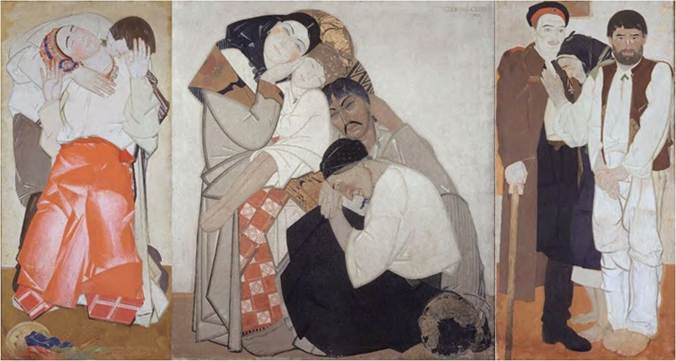
Fedir Krychevsky, Life Triptych (1925)
Fedir Krychevsky, LifeiTriptych (Love, Family, and Return) (1925-7). National Art Museum of Ukraine, Kyiv. Public Domain.