Postwar Soviet Ukraine under Stalin
Although World War II did not end in Europe until the capitulation of the German Army in May 1945, the Germans and their allies were driven out of Ukrainian territory between February 1943 and October 1944.
The first task of the Soviet authorities in the areas they recaptured was to reestablish their governmental and administrative authority. The challenge was enormous, since the war had wrought widespread human and material devastation.Wartime destruction and territorial expansion
World War II, which lasted close to six years, from September 1939 to May 1945, dwarfed even World War I in terms of its geographic scope and human and material destruction. Estimates of human loss range anywhere from 35 to 60 million lives. In this catalog of gruesome statistics, the Soviet Union led all countries, having lost an estimated 11 million combatants and 7 million civilians. Because Ukraine was one of the major war zones of the Soviet Union, it alone accounted for an estimated 4.1 million civilian deaths and 1.4 million military personnel killed in action or taken as prisoners of war. Aside from war-related losses, an estimated 3.9 million Ukrainians were evacuated eastward by the Soviet government during the rapid German advance in 1941-1942, and another 2.2 million were deported to Germany as forced laborers (Ostarbeiter).
Material losses were no less devastating as the front moved back and forth across Ukraine. The Soviet scorched-earth policy during its retreat of 1941 was followed by Hitler’s orders of 1943 to retreating German troops to create a “zone of destruction” in an attempt to delay the advancing Red Army. Consequently, those cities (Dnipropetrovs’k, Poltava, Kremenchuk) and villages that had not been severely damaged by previous attacks were deliberately destroyed in 1943 and 1944. The results of planned and combat-related destruction meant 28,000 villages and 714 cities and towns in Ukraine were left in total or partial ruin.
The center of Kiev, for instance, was 85 percent demolished, and the second-largest city, Kharkiv, was 70 percent in ruins. More than 19 million people were left homeless.The country’s industrial base, which in human terms had cost so much to build, was shattered. Initially, between July and November 1941, the Soviets had dismantled and evacuated 544 complete industrial enterprises. But the rapid German advance combined with subsequent scorched-earth policies implemented by the Soviets and, later, the Germans resulted in 16,150 enterprises being damaged or completely destroyed, 833 coal mines being blown up, and the destruction of electric power stations, dams, railroad lines, bridges, and roads. In the agricultural sector, 872 state farms, 1,300 Machine Tractor Stations, and 27,910 collective farms were destroyed.
But although World War II brought enormous physical destruction to Soviet Ukraine, it also resulted in the territorial expansion of the country. This expansion was a direct result of the enhanced international status of the Soviet Union, which together with China, France, Great Britain, and the United States made up the victorious Allied Powers. It was the Americans, British, and Soviets, however, who inflicted the decisive defeat upon Germany and Japan. Consequently, it was the leaders of these countries, the so-called Big Three - President Franklin D. Roosevelt, Prime Minister Winston Churchill, and General Secretary Iosif Stalin - who were to play the most decisive role in postwar European politics. In fact, even before the war had ended, the Big Three began discussions about their respective spheres of interest in Europe.
Stalin was adamant that Soviet borders should at the very least be extended westward to include those territories taken during the German-Soviet invasion of Poland in September 1939 as well as other lands acquired later. These included, from north to south, the Karelian region of Finland; the former independent states of Estonia, Latvia, and Lithuania; the Belarusan and Ukrainian lands that had been part of interwar Poland; and northern Bukovina and Bessarabia, which had been in Romania.
At their first joint wartime meeting held at Teheran in November 1943, Churchill and Roosevelt agreed in principle to Stalin’s demands. An immediate problem was Poland. Since Poland had fought on the side of the Allies, its territorial losses in the east had to be compensated. The solution was to detach from Germany territories east of the Oder and Neisse Rivers (Pomerania, Silesia, and the southern half of East Prussia) and to award them to the revived Polish state.As for Ukraine, the new Soviet-Polish border agreed to by Churchill, Roosevelt, and Stalin at their second conference in Yalta (February 1945) followed quite closely the Curzon Line, which in 1920 Great Britain had proposed as an armistice line and temporary boundary between warring Poland and Soviet Russia (see map 35). This meant that Ukrainian-inhabited eastern Galicia almost as far as the San River, and Volhynia and Polissa as far west as the Buh River, became part of Soviet Ukraine. Farther south, Soviet Ukraine’s border with Romania was restored to what it had been from the summer of 1940 until the German invasion of the Soviet Union one year later. Namely, the historic province of Bessarabia located between the Dniester and Prut Rivers was reapportioned: a small chunk of the southern coastal area near Izmail was given to Soviet Ukraine; the large central portion of the province, together with a strip of land east of the Dniester River, was reconstituted as the Moldavian Soviet Socialist Republic.
MAP 45
SOVIET UKRAINE, 1945
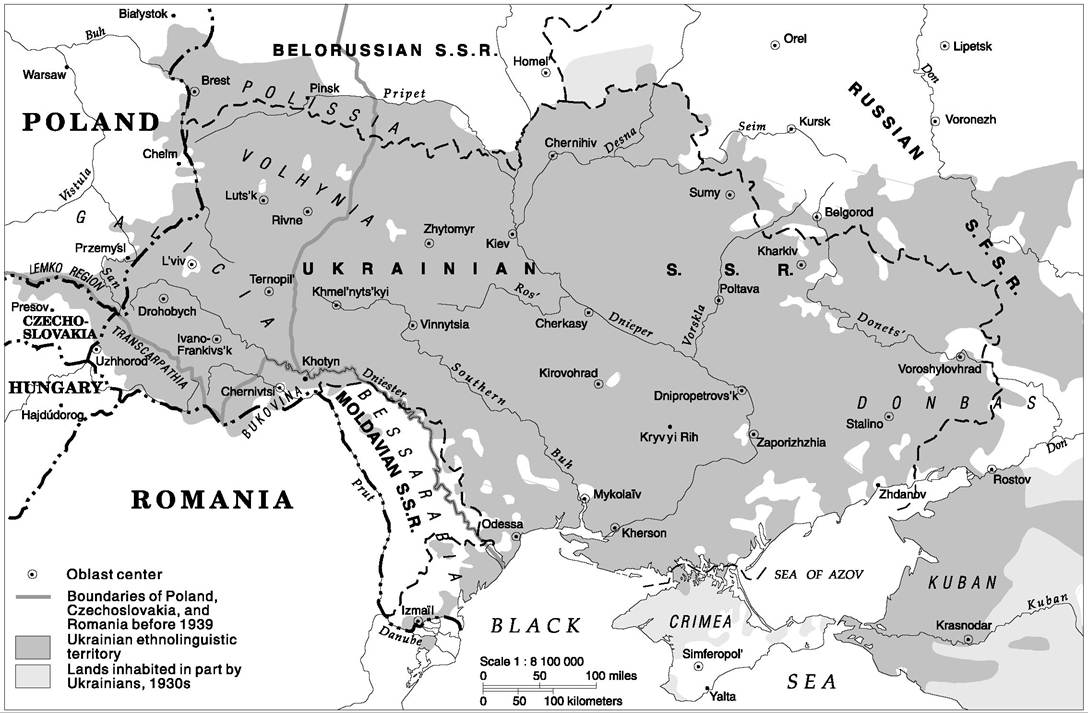
Copyright © by Paul Robert Magocsi
Voluntary Reunification, Soviet Style
On 25-26 November 1944, 663 delegates from people’s committees representing about 80 percent of the towns and villages in Transcarpathia gathered in the city of Mukachevo at the first National Congress of People’s Committees to determine the fate of their homeland. The manifesto unanimously approved by the delegates, which called for “the reunification of Transcarpathian Ukraine with its great motherland, Soviet Ukraine,” has been described by one historian and participant (Vasyl Markus) as “a kind of [interim] constitutional act for Transcarpathian Ukraine until its reunification with Ukraine.”* Ever since that time, the Soviet and the post-1991 Ukrainian governments have argued that the November 1944 manifesto was an expression of the will of the people that justified annexation of the province from Czechoslovakia.
It is interesting to view the events through the eyes of two other eyewitnesses, who co-signed the following recollection.At the time we were students at the Commerce Academy in Mukachevo. That fall we went back to school late. The city had to be put back in order [after the front had passed through], courtyards and sidewalks had to be cleaned, and the airport restored. At the same time Stalin’s KGB was already preparing for political work among the masses. They brought us in long lines to the Victory movie house (it was called Scala at the time) to look at films.
We arrived. The hall was quite full, because they had brought in people from other organizations. First the mayor of Mukachevo, comrade Dragula, greeted us. He opened the so-called meeting with the words: ‘Comrades, we have gathered here together for a very important purpose; we want to break away from bourgeois Czechoslovakia and unite Subcarpathian Rus’ in the framework of a great country, the Soviet Union, with its peaceloving capital Moscow. Whoever is for this, raise your hand.’
The hall was stunned. And since it was so quiet, the mayor said: ‘Comrades, silence means approval. We have unanimously adopted the manifesto for the union of Transcarpachia with the Soviet Union. We will address a telegram to that effect to comrade Stalin.’^
*Vasyl Markus, ^incorporation de t’Ukraine subcarpathique a t’Ukraine sovietique, 1944—1945 (Louvain 1956), p. 47.
Podkarpats’ka Rus’ (Uzhhorod), June 29, 1993.
An entirely new acquisition for the Soviet Union was the province of Transcarpathia. Following the Munich Pact of September 1938, Hungary reannexed the region from Czechoslovakia in two stages (November 1938 and March 1939). The Hungarians ruled the area for over five years until driven out by the Red Army in the early fall of 1944. For its part, the Czechoslovak government-in-exile, which had become a member of the Allied coalition, pushed for the restoration of Czechoslovakia according to its 1938, pre-Munich boundaries.
This meant that all of Transcarpathia (Subcarpathian Rus’) would once again become Czechoslovak territory. The Allies, including the Soviets, agreed in principle, and when the Red Army entered the region in October 1944, it permitted a Czechoslovak governmental delegation to function there for a few weeks. Before long, however, the Czechoslovak delegation was severely restricted in its activity. Local Communists under the protection of the Red Army - and with the encouragement of Soviet political officers - organized peoples’ councils, which by 25-26 November 1944 had called for union of the region with its “Soviet Ukrainian motherland.” As for the rest of Czechoslovakia, it was restored as a sovereign state, and although it was influenced but not yet fully controlled by the Communists, it nonetheless felt a sense of loyalty to its Soviet ally and “liberator.” In such circumstances, the restored government in Prague was certainly not going to jeopardize Czechoslovak-Soviet relations. Hence, on 29 June 1945, Czechoslovakia’s provisional parliament formally ceded Subcarpathian Rus’ (Transcarpathia) to Soviet Ukraine.Owing to postwar Soviet military and political prestige, Soviet Ukraine increased its territory by one-quarter (64,500 square miles [165,300 square kilometers]) and its population by an estimated 11 million. As elsewhere in the country, the new territorial acquisitions were divided into oblasts, which for the most part had no relationship to historical regions. By 1946, Soviet Ukraine had a total of twenty- four oblasts. The new territories also included a significant number of inhabitants other than ethnic Ukrainians, the largest group being the Poles, who numbered about 1.5 million.
The minority question
National minorities were of particular concern to the leaders of many post-1945 European countries, who were convinced that the very existence of minority populations had been one of the main causes of World War II. If future conflicts over national minorities were to be avoided, it seemed, more decisive action was needed.
As a result, many countries embarked on a policy of population transfers. These were either voluntary or, more often, involuntary - forced deportations. The largest and most publicized deportation in Europe during this period was the expulsion of 6.3 million Germans from Poland and Czechoslovakia.The Soviet government also participated in population transfers following agreements with Poland (1 October 1944) and Czechoslovakia (10 July 1946) on the exchange of populations. Between 1945 and 1948, several exchanges - some voluntary, others involuntary - took place. The largest departure from Ukraine was that of nearly 1.3 million Poles from Volhynia and eastern Galicia. There were also 53,000 Czechs who left Volhynia and Transcarpathia. Conversely, nearly 500,000 Ukrainians arrived from Poland (including two-thirds of the Lemko population), and another 12,000 from Czechoslovakia. Finally, there was the question of the Ostarbeiter (Eastern workers), POWs, and survivors of concentration camps who at the close of the war found themselves as refugees on German and Austrian territory controlled by four of the Allied Powers (the United States, the Soviet Union, Great Britain, and France). The Allies agreed on the principle of repatriation,
TABLE 50.1
Nationality composition of Soviet Ukraine, 19591
| Population | Percentage | |
| Ukrainians | 32,158,000 | 76.8 |
| Russians | 7,091,000 | 16.9 |
| Jews | 840,000 | 2.0 |
| Poles | 363,000 | 0.9 |
| Belarusans | 291,000 | 0.7 |
| Moldovans | 242,000 | 0.6 |
| Bulgarians | 219,000 | 0.5 |
| Magyars | 149,000 | 0.4 |
| Greeks | 104,000 | 0.2 |
| Romanians | 101,000 | 0.2 |
| Tatars | 62,000 | 0.1 |
| Czechs and Slovaks | 28,000 | 0.1 |
| Armenians | 28,000 | 0.1 |
| Germans | 23,000 | 0.1 |
| Gagauz | 23,000 | 0.1 |
| Roma/Gypsies | 22,000 | 0.0 |
| Others | 123,000 | 0.3 |
| TOTAL | 41,869,000 | 100.0 |
TABLE 50.2
Ukrainians beyond Soviet Ukraine (on contiguous ethnolinguistic territory), 1959
| Russian S.F.S.R. | 900,000 |
| Moldavian S.S.R. | 421,000 |
| Poland | 250,000 |
| Belorussian S.S.R. | 133,000 |
| Czechoslovakia | 90,000 |
| Romania | 62,000 |
| TOTAL | 1,856,000 |
and by mid-1945 nearly 2 million Ukrainians had been returned, in many cases forcibly.
The worst fears of the repatriates were often realized. Upon their return, tens of thousands were summarily executed, and an estimated 350,000, considered politically unreliable, were sent to labor camps in the Soviet Far East or resettled in Central Asia. In late 1947, when the other Allied Powers learned of and were sufficiently embarrassed by what the Soviets were doing to the repatriates, the process was stopped. By that time, however, only about 250,000 Ukrainian refugees were left in Germany, Austria, and other western European countries. Most emigrated as displaced persons (DPs) to Canada and the United States within a few years.
Yet one other “national” minority experienced a variant of repratiation. These were the Jews who survived the Holocaust. Tens of thousands returned to their homes in various parts of postwar Soviet Ukraine, whether from the Ural region of the Soviet Union (to where they were evacuated with other Soviet citizens as Nazi Germany was invading the country), or from various parts of Europe, including survivors from German concentration and death camps. Those who returned to western Ukraine did not stay long, but were part of the nearly 200,000 Jews who, between 1944 and 1948, were allowed to leave the Soviet Union for postwar Poland and Czechoslovakia, and who from there continued on to Israel and North America. Those who returned to central and eastern Ukraine were primarily wartime evacuees from the Soviet east, who remained in the country and formed the bulk of the 840,000 Jews recorded in Soviet Ukraine’s census of 1959.
Special circumstances prevailed in the Crimea. At the close of World War II it was returned to the Russian S.F.S.R., although administratively demoted from an autonomous republic to an oblast (region). Within one week of having driven the Germans out of the Crimea, on 18 May 1944 Soviet security forces (NKVD) carried out Stalin’s order to deport the entire Crimean Tatar population. The Tatars were accused en masse of having “betrayed the [Soviet] Motherland during the Great Patriotic War” and of having “actively collaborated with the German occupying powers”; as collective punishment they were “to be exiled from the territory of the Crimea and settled permanently... in the Uzbek S.S.R.”2 Deportation began on what Crimean Tatars still remember as the Qara Kun (The Black Day) - May 18 - when the inhabitants were given one hour to leave their homes at gunpoint. Remarkably, the process was completed in less than three days, by which time 183,000 Crimean Tatars were deported. In a fashion brutally characteristic of the Soviet regime under Stalin, the deportees were forced onto railway box cars for a trek of several weeks with little food or water. Hundreds died along the way, while tens of thousands more perished within a few months of arriving at their destinations, where in many cases they were simply dumped without any shelter against the blistering summer heat of the Central Asian desert. By far the majority of deported Crimean Tatars (151,000) were resettled in the Uzbek S.S.R., while most of the rest were sent to the Udmurt and Mari oblasts of the Russian S.F.S.R.
Soviet Communist party authorities in Moscow made clear their goal “to create a new Crimea according to Russian order.”3 All Crimean Tatar towns and villages were given new Russian names, Muslim cemeteries and religious buildings were destroyed or transformed for secular use. Then, within less than a year of the massive 18 May 1944 Crimean Tatar deportation, several of the peninsula’s smaller ethnic groups (Germans, Bulgarians, Greeks) were also forcibly resettled to the depth of the Soviet East. In effect, the Crimea was ethnically cleansed, so that by 1959, most of the peninsula’s entire population of 1.2 million was comprised of Russians (71 percent), Ukrainians (22 percent), and smaller numbers of Belaru- sans and Jews.
Despite all the efforts - often made at great human cost - to have political boundaries coincide with ethnolinguistic boundaries through the exchange and repatriation of populations, Soviet Ukraine was far from an ethnically homogeneous country. According to the first postwar census, conducted in 1959, over 9.7 million people, or nearly one-quarter of the country’s inhabitants, were nonUkrainian (see table 50.1). In comparison with the interwar years (see table 45.1), two peoples were added to the mix, both of which lived in the newly acquired
Ethnic Cleansing Soviet Style
Well before the end of the twentieth century, when the term ethnic cleansing began to be used to describe the forced resettlement or annihilation of specific peoples, the Soviet Union already had much experience in such policies. It was Stalin himself who once quipped, net naroda, net problemy - if there’s no people, there’s no problem. At the close of World War II, Stalin’s convictions were once again put into practice as Volga Germans, Meskhetian Turks, Crimean Tatars, and many smaller minorities were forcibly removed from their historic homelands.
The Soviet State Defense Committee Decree No. 5859ss, dated 11 May 1944 regarding the Crimean Tatars, listed various procedures related to the deportation and resettlement process. The government was to provide compensation for the immovable property taken from deportees. This never happened. Each family could bring 500 kilograms (1,000 pounds) of personal property. Considering the speed of the deportation, this happened in only rare cases. Doctors, nurses, food, and water were assigned to each transport, but they were woefully inadequate. One Russian eyewitness reported what he remembers of the deportation:
It was a journey of lingering death in cattle trucks, crammed with people, like mobile gas chambers. The journey lasted three to four weeks and took them across the scorching summer steppes of Kazakhstan. They took the Red partisans of the Crimea, the fighters of the Bolshevik underground, and Soviet and [Communist] party activists. Also invalids and old men. The remaining men were fighting at the front, but deportation awaited them at the end of the war. And in the meantime they crammed their women and children into trucks, where they constituted the vast majority. Death mowed down the old, the young, and the weak. They died of thirst, suffocation, and the stench.
On the long stages the corpses decomposed in the huddle of the trucks, and at the short halts, where water and food were handed out, the people were not allowed to bury their dead and had to leave them beside the railway track.[*]
After the trains stopped, the Crimean Tatar ordeal only got only worse as the deportees were transported by truck to their special settlements in the Uzbek desert. As a result of unhygienic conditions, lack of clean water, and overcrowding, a massive outbreak of typhus broke out. Consequently, between May 1944 and January 1946, nearly 27,000 Crimean Tatars (15 percent of the total) died on the way to, or after they were in, the special settlements to which they were assigned.
western Ukrainian lands. In the southwestern lowland area of the Transcarpathian oblast lived a compact community of Magyars/Hungarians (149,000), who were geographically contiguous with the same people living on the other side of the border in Hungary. The other “new” addition were the Romanians, who were linguistically and culturally the same as the Moldovans who had already been living within the boundaries of the Soviet Ukraine (in Transnistria and the Moldavian A.S.S.R.) before World War II. As a result of the Soviet classification system, which considered Moldovans and Romanians to be distinct nationalities, Soviet Ukraine now had both national minorities within its borders. In the Transcarpathian oblast there was a small Romanian minority, while in the neighboring Chernivtsi oblast there were both Romanians (in territory belonging to former Bukovina) and Moldovans (in territory belonging to former Bessarabia). Finally, not all ethnic Ukrainians living on contiguous ethnolinguistic territory were within the boundaries of Soviet Ukraine. An estimated 1.8 million lived just beyond Ukraine’s borders, in six surrounding neighboring states and Soviet republics (see table 50.2)
Industrial and agricultural reconstruction
Because of the extent of the destruction inflicted by the war, Ukrainian industry and agriculture had in many ways to be built up again from scratch. In 1945, industrial production was only 26 percent of its 1940 prewar level. Similarly, agricultural productivity was only 40 percent of its 1940 level, even though the new territorial acquisitions had increased the amount of arable land. The first challenge for Ukraine was reconstruction, and this time, unlike in the years following the revolution and World War I, the Soviet planners had a model - their experience after 1928. Stalin remained convinced that since centralized planning under a command economy had worked before, it would work again. As a result, in 1946 the Fourth Five-Year Plan was inaugurated, and in a real sense the recovery plan was remarkably successful. General histories of the post-World War II era often speak of the wonders of West German and Japanese reconstruction, both of which were made possible by western capital (mostly American) and a relatively freeenterprise system. No less impressive during these same years - and without western aid - was the recovery in Soviet industry, including that of Soviet Ukraine. Soviet Ukraine’s industrial base was reconstructed, and by 1950 its gross output had already exceeded that of 1940, the last full year of peace before World War II struck the country.
As before the war, the greatest emphasis was placed on heavy industry, and although the areas of consumer goods manufacturing, light industry, and the food industry increased over prewar levels, their expansion was on average only one-quarter the growth in the heavy industrial sector. The Ukrainian industrial recovery was also helped by capital investment and the expansion of the labor force. During the Fourth Five-Year Plan (1946-1950), 19.3 percent of the total Soviet budget was invested in Soviet Ukraine, a percentage which compares favorably with that invested during the last prewar plans (15.9 percent in 1929-1941). Moreover, the work force almost tripled, from 1.2 million in 1945 to 2.9 million in 1955. The latter figure reflects a 33.2 percent increase over the 1940 level. The result was that by the end of the Fifth Five-Year Plan in 1955, Soviet Ukrainian industry was producing 2.2 times more than it had produced in 1940, and the country was already one of the leaders in Europe in the output of certain key commodities. To measure its performance against that of the United Kingdom, France, West Germany, and Italy, for instance, Soviet Ukraine had the highest per capita production of pig iron and sugar, was second per capita in the smelting of steel and the mining of iron ore, and was third per capita in the mining of coal.
Whereas heavy industry continued to make significant advances after 1945, agriculture remained the Achilles’ heel of the Soviet Ukrainian economy. There was never any question in the minds of Soviet central planners that, despite the enormous human cost of the 1930s, collectivized farming was still the ideal approach to agricultural organization. Accordingly, the collective and state farms, as well as the supporting Machine Tractor Stations that had been destroyed during World War II, were rebuilt, and collectivization in general was introduced fully between 1947 and 1950 in the recently acquired western Ukrainian territories. Thus, the total number of collective farms in Soviet Ukraine increased from 28,000 in 1940 to 33,000 in 1949. The number of state farms remained practically unchanged, however, standing at 935 in 1950. This meant that collective farms, with their nearly 11.1 million acres (45 million hectares) of land in 1955, continued to exceed by far the amount of land in state farms (12.1 million acres [4.9 million hectares]). Actually, the state farms were more specialized concerns, with the vast majority producing dairy products, poultry, or truck produce. Beginning in 1950, collective farms began to be amalgamated in an effort to make better use of farm machinery and other resources. Hence, while the total amount of land owned by the collectives continued to increase, by 1955 the number of farms had decreased to fewer than half (15,400) their number five years before.
Notwithstanding the best efforts of the central planners, agriculture remained subject to climatic conditions. In 1946, a drought resulted in very low crop yields and subsequent hunger, especially in eastern Ukraine. For the next twenty years, a bad harvest occurred on average every three years. The inefficiency of centralized planning and the generally low productivity of farmers who did not own their own land only made a bad situation worse. Consequently, by the end of the Fourth and Fifth Five-Year Plans (1950 and 1955), the total harvests from Soviet Ukrainian agriculture were still far below their 1940 prewar level.
In addition to problems of productivity was the question of crop selection. As during the interwar years, the land under cultivation for industrial crops (including sugar beets) and fodder continued to increase, while both the cultivation and the output of grains for human consumption decreased. For instance, the human food grain harvest (wheat and rye) in 1950 was only 16.7 million tons compared to 18.1 million tons in 1940. The decrease in food grain harvests came, moreover, at a time when Soviet Ukraine’s population was increasing, from 31.7 million inhabitants in 1939 to 41.8 million in 1959. The result of these demographic and agricultural trends was frequently severe food shortages during the first decade after World War II.
The nationality question
The experience of the war years and the expansion of Ukrainian territory contributed to a revival of the nationality question in Soviet Ukraine. Although by 1938 the last vestiges of the Ukrainianization program had been eliminated, with the end of World War II, it seemed that the various national cultures of the Soviet Union would be allowed somewhat freer control over their own development. There was a new spirit of optimism, related to events that had taken place during the war. Faced with the German occupation of large parts of the country, Stalin and his governing entourage had decided to make certain symbolic concessions to the nationalities in the hope that such actions would help to mobilize patriotic feelings that could in turn be directed toward the overall war effort. In October 1943, the Soviet government decided to pay tribute to a prerevolutionary national hero by using his name in the newly instituted Order of Bohdan Khmel’nyts’kyi decoration for valor in military action. This use of pre-Soviet national heroes actually had begun in the very first years of the war, when a series of Russian defenders of the homeland, beginning with the thirteenth-century prince Aleksander Nevskii (and including Dmitrii Donskoi, Dmitrii Pozharskii, Aleksander Suvorov, and Mikhail Kutuzov), were invoked as examples of patriotism and sacrifice to the Soviet homeland. The Soviet government had even begun to court the Russian Orthodox Church, which after 1941 was spared extreme atheistic propaganda and, in September 1943, was allowed to elect a new patriarch, Sergei (Ivan Staro- gorodskii, reigned 1943-1944).
As for Ukrainian sensitivities, the Soviets initiated some cosmetic changes. The national name, Ukrainian, was used to designate four Red Army fronts in the counteroffensive against the Germans. In a sense, this was to have negative results, since “Ukrainian” armies subsequently were responsible for the sectors that covered most central European countries, with the result that the name Ukrainian became associated in minds of central Europeans with Soviet-style “liberation.” Another cosmetic change was introduced in February 1944, when the constituent Soviet republics were given back the old pre-1923 right to enter into direct relations with foreign states. Soviet Belorussia and Soviet Ukraine were permitted to form foreign ministries, and in early 1945 Roosevelt and Churchill agreed to Stalin’s request that the two “sovereign” Soviet countries be admitted as full members of the soon-to-be-created United Nations. As a result, Soviet Ukraine became, in April 1945, one of the original forty-seven founding members of the United Nations.
Soviet Ukraine also received separate missions of the United Nations Relief and Rehabilitation Administration (UNRRA), which assisted in overcoming the country’s food shortages in 1946, and it obtained some industrial investment from international sources. No foreign state, however - Great Britain tried in 1947 - was ever permitted to establish direct relations with Kiev. After all, Stalin had only “enhanced” Soviet Ukraine’s international status in an attempt to gain more votes for the Soviet bloc in the new international body. Nonetheless, despite the fact that in foreign affairs it remained entirely subordinate to the Soviet central government, as a founding member of the United Nations and a participant in that body’s other international organizations (UNICEF, etc.), Ukraine became a recognizable entity, at least in name, in the world community.
On the home front, any hopes for a lessening of the Soviet Russian chauvinism that characterized the end of the interwar period proved illusory. If anything, russification increased. Stalin himself set the tone as early as 24 May 1945 with a well-publicized toast to the health of the Russian people, that “most outstanding nation,” whose “clear minds, firm character, and patience” made them the “leading force in the Soviet Union.”4 In the words of one perceptive observer of this period, Yaroslav Bilinsky, “Soviet nationality policy from 1944 until Stalin’s death [in 1953] can be described as a continued and outspoken effort to impress the notion of Russian predominance upon the minds of the non-Russian peoples of the Soviet Union.”5
These same years also came to be known as the period of the “cult of personality” during which Stalin was glorified as the savior of the Soviet Union. Despite or perhaps because of the Soviet Union’s recognized position as the world’s second leading power, after the United States, Stalin became increasingly paranoid and instilled in Soviet society a sense of fear and suspicion. Purges of some (and plans for purges of many more) high-ranking party leaders indeed took place. But the bizarre show trials and sweeping attacks against Ukrainian intellectuals of the 1930s were for the most part not repeated between the end of the war and Stalin’s death in 1953. Nevertheless, while the methods may have been different, the ultimate aim was the same: to foster the elimination of national distinctions within Soviet society and to create a new Soviet man (homo Sovieticus), whose primary concern would be loyalty to the world’s first communist society, loyalty expressed through the medium of the world’s only “true revolutionary” language, Russian.
The achievement of this goal required the mobilization of the educational system and of historical ideology. As part of the postwar reconstruction, Soviet Ukraine witnessed the construction of nearly 3,400 new schools between 1945 and 1950. Children were taught that they were first and foremost part of a Soviet homeland. To encourage unity among the country’s many peoples, the trend toward more instruction in the Russian language that began in the 1930s was continued. As a result, the total number of students in Soviet Ukraine enrolled in Russian schools rose from 14 percent in 1938-1939, to 17.6 percent in 1950-1951, and to approximately 25 percent in 1955-1956.
With regard to historical ideology, Ukrainians were expected to accept the proposition that the past achievements in their country’s development were in large measure due to Ukraine’s relationship with Russia. To this end, the Soviet version of Marxist history took on the characteristics of religious dogma. All Soviet Ukrainian historians as well as writers and publicists in general were required to present works that were in conformity with the following four basic theses elaborated in 1954 and approved by the Central Committee of the Communist party of Ukraine in conjunction with the 300th anniversary of “the reunification of Ukraine and Russia.”
1 The Russian, Ukrainian, and Belarusan peoples trace their origin to a single root - the ancient Russian people (drevnerusskii narod) who founded the early Russian state - Kievan Rus’;
2 Throughout its history, the Ukrainian people - and, for that matter, the Belarusan people as well - desired reunification with the Russian people;
3 Reunification was a progressive act;
4 Throughout its entire history, the Russian people was the senior brother in the family of East Slavic peoples. Russia’s main virtue consisted in its giving rise to a strong working class, which in turn produced its vanguard, the Communist
. 6
party.
Western Ukraine
The western Ukrainian lands, especially Galicia, posed a special problem for the Soviet government in its attempt to impose socioeconomic and ideological uniformity. With the exception of wartime occupation during the Napoleonic era and World War I, and the less than two years of Soviet rule in eastern Galicia and northern Bukovina before the German invasion of 1941, western Ukrainian lands had never been part of the Russian or the Soviet empire. The result was that the Galicians, the Bukovinians, and especially the Transcarpathians had acquired a central European mentality forged by decades of Austro-Hungarian, Polish, or Czechoslovak rule. Quite simply, their worldview or political culture was European-oriented and often at odds with that of eastern Ukrainians, who had lived for centuries under tsarist Russian rule and then for nearly three decades under the Soviets. What did link western Ukrainians, especially the Galicians, to the East was their understanding of Ukrainian nationalism. Hence, at the close of World War II, the Soviet government was faced with two serious challenges: (1) to rebuild the economy of western Ukraine according to the centralized command model, and (2) to integrate the nationally fervent Galicians with the rest of the Ukrainian population. All this had to be done, moreover, while there still existed a military movement fighting openly against Soviet troops.
The military movement had begun during the German occupation with the establishment in 1942 of the Ukrainian Insurgent Army (UPA). By 1944, the UPA had between 25,000 and 40,000 soldiers, under the command of General Taras Chuprynka (pseudonym of Roman Shukhevych). Aside from engaging in battles against German and Soviet troops in Volhynia, Podolia, and Galicia, the UPA established, in July 1944, a provisional government that was embodied in the Ukrainian Supreme Liberation Council. With the departure of the Germans in the fall of 1944, troops of the Soviet secret police (NKVD) focused their attention on the UPA. The result was that during the winter of 1944-1945 Soviet security forces (NKVD) conducted a major offensive against the UPA. Although the insurgents were able to hold their own, their ranks were being depleted by combat losses and, especially, by defections among those who accepted amnesties offered by the Soviet authorities. Nonetheless, a small core of an estimated 6,000 dedicated fighters remained, who against overwhelming odds continued an armed struggle in the hope of creating a non-Soviet independent Ukrainian state.
From late 1945 to 1947, the UPA’s main field of operation was along the new Polish-Soviet border. It was particularly anxious to halt the population exchanges whereby Ukrainians west of the border were being “voluntarily” resettled in Soviet Ukraine. In its attempt to block the exodus, the UPA clashed with the army of the newly restored and by then Communist-dominated government of Poland. The fighting continued throughout 1946 and culminated in a UPA ambush in May 1947 that resulted in the death of the Polish vice-minister of defense (General Karol Swierczewski). This event persuaded the Polish authorities, in cooperation with Soviet and, later, Czechoslovak armed forces, to step up their campaign against the UPA and to deal with the remaining Ukrainian population that had not already gone eastward.
In the spring and summer of 1947, the so-called Vistula Operation (Akcja Wisla) was carried out, whereby 140,000 Ukrainians, including Lemkos living in the Carpathian region, were forcibly deported to the western (Silesia) and northern (Baltic seacoast) regions of Poland that had only recently been acquired from Germany. The surviving units of the UPA either crossed into Soviet territory or fled across Czechoslovak territory to the American zone of Germany. The UPA members who remained behind kept up guerrilla-type activity in the westernmost regions of Soviet Ukraine, including assassinations of pro-Soviet activists (among them the writer laroslav Halan) and sabotage of collectivization efforts, until the early 1950s. Nevertheless, by 1948 the UPA threat to Soviet rule in western Ukraine was effectively spent. Veterans who made it to the West, however, helped to create and sustain in the Ukrainian diaspora tales of the sorely outnumbered UPA freedom fighters who had resisted both the German and the Soviet armies in an ultimately futile attempt to liberate their homeland from foreign rule.
While Poland was doing battle with the UPA, the Soviets were engaged in a struggle on the ideological front. For them to be successful, all the old pre-Sovi- et institutions in western Ukraine had to be abolished, including the non-Soviet cooperatives, cultural societies, and schools, which only a few years before had been reestablished under the German-ruled Generalgouvernement. Their very existence during the war years made it easy for all of them to be depicted as having been in the “service of the fascists.”
The foremost institution associated with the western Ukrainian past was the Greek Catholic Church. At first, when the Soviet forces arrived in the summer of 1944, nothing changed substantially. But in November, the grand old man of the Greek Catholic Church and of Galician-Ukrainian national life in general, Metropolitan Andrei Sheptyts’kyi, died. Sheptyts’kyi’s death conveniently opened the way for the Soviets’ final struggle against what they considered the ultimate symbol of “reactionary feudalism” and “Ukrainian bourgeois nationalism,” the Greek Catholic Church. During the early nineteenth century, Tsar Nicholas I had abolished Greek Catholicism in the Russian Empire, arguing that it was an artificial, Vatican-inspired, anti-Russian creation of Poland set up to undermine the “true” Orthodox faith of the Rus’ people. The Soviets simply upheld the tsarist and Russian attitude that Orthodoxy was the only acceptable religious orientation for all East Slavs.
Nor was the question simply one of Orthodoxy. At issue was the expectation that all believers would belong to the government-recognized Russian Orthodox Church under the jurisdiction of the patriarch of Moscow. Any other Ukrainian Orthodox church was therefore unacceptable. During the course of 1944, the two Ukrainian Orthodox churches that had existed under wartime German rule ceased to exist. The entire Ukrainian Autocephalous Church hierarchy and many of its priests fled to the West, where the church was to survive for the next forty-five years in the United States under Metropolitan, later Patriarch, Mstyslav (Stepan Skrypnyk, reigned 1969-1994). As for the Ukrainian Autonomous Church, most of its hierarchs also fled to the West; those clergy who remained at home came under the jurisdiction of the Patriarchate of Moscow, which in theory they had always recognized. Thus, for the second time in the twentieth century, specifically Ukrainian Orthodox churches were abolished and outlawed in Ukraine, and also in those neighboring countries (Poland, Czechoslovakia) that came under Soviet domination after World War II.
In their struggle against Ukrainian churches, the Soviets did not always have to act alone, since the Russian Orthodox Church had its own agenda for rival Eastern Christian churches that were within what the Moscow patriarchate considered its own sphere of influence. By early March 1945, Stalin had agreed to the abolition of the Greek Catholic Church and to the Russian Orthodox Church’s being expected to play a supportive role in the process. During April, the entire Greek Catholic hierarchy headed by Metropolitan Slipyi was arrested, and a message over the signature of the newly elected Russian Orthodox patriarch of Moscow, Aleksei (Sergei Simanskii, reigned 1945-1970), was circulated to the Greek Catholic clergy and faithful of western Ukraine. The message accused the Vatican and the late Metropolitan Sheptyts’kyi of having called upon Greek Catholics “to accept Hitler’s yoke” during the war years, and maintained that the only reasonable course now would be to “hasten to return to the embraces of our own mother - the Russian Orthodox Church.”7
None of the arrested hierarchs, however, accepted the offer to abjure the Catholic faith and join the Orthodox Church. Therefore, to carry out Soviet government plans, the Initiative Group for the Reunification of the Greek (Eastern-rite) Catholic Church was established under the leadership of an Eastern-oriented priest and former close confidant of Metropolitan Sheptyts’kyi, Havriil Kostel’nyk. In March 1946, the Initiative Committee convened in L’viv a “synod” (although with no Greek Catholic bishop present), which voided the 1596 Union of Brest and subordinated the Greek Catholic Church to the Russian Orthodox Church - Moscow Patriarchate. Of the approximately 3,000 Greek Catholic priests, over 1,100 submitted to the Russian Orthodox Church; about 1,600 were imprisoned; and the rest went underground. In neighboring Transcarpathia, Soviet plans took longer to succeed, because the efforts to organize a synod to end the 1646 Union of Uzhhorod failed. Instead, the assassination of the local bishop (Teodor Romzha) was carried out in late 1947, and in August 1949 a few local Greek Catholic priests simply declared the Union of Uzhhorod void and proclaimed their eparchy’s “reunification” with the Russian Orthodox Church.
The Soviet pattern was more or less followed in neighboring countries within the Soviet sphere that still contained Greek Catholic minorities. A politically staged church union was held in Czechoslovakia (Presov, 28 April 1950), whereas in Romania the Greek Catholic Church was simply abolished by governmental decree (December 1948). In Poland, the Ukrainian population was dispersed, and the hierarchy of the Greek Catholic eparchy of Przemysl was arrested and turned over to the Soviets. Greek Catholic church property fell into the hands of the Polish Roman Catholic Church. Ironically, among the Soviet bloc countries, only Hungary, with its largely magyarized Greek Catholic eparchy of Hajdudo- rog (until 1913 part of Transcarpathia’s Mukachevo eparchy), allowed the Greek Catholic Church to function legally.
With the Greek Catholic Church and the Ukrainian Insurgent Army out of the way, the Soviet government was able to proceed more easily with other changes in western Ukraine. These included forced collectivization of the agricultural sector between 1948 and 1951 (during which time 95.2 percent of the land was collectivized) and the introduction of heavy industry and the exploitation of natural resources in a region that until then had been primarily agricultural. By 1955, industrial output in the area was four times greater than it had been during the interwar period. Among the new industries were automobile manufacturing, natural gas extraction, and coal mining.
Along with socioeconomic change came demographic change. In particular, there was a marked increase in the size of the Russian population in western Ukraine. Since the western Ukrainian lands had never been part of the Russian Empire, the number of Russians in the area before World War II had gone from negligible to non-existent. By 1959, however, Russians made up 5.2 percent of the population. Their increase was a result of (1) the influx of over 327,000 Russians (247,000 in Galicia, 51,000 in northern Bukovina, and 29,000 in Transcarpathia) to urban areas, where they took up positions in the party apparatus and new industries (both as managers and workers); and (2) the exodus of Ukrainians. There were three categories of departing Ukrainians: exiles to the West who fled the advance of the Red Army in 1944; nearly half a million persons deported to Siberia and Central Asia because they were politically suspect or because they had relatives who had served in the German Generalgouvernement or with the UPA; and peasants sent to eastern Ukraine and the Donbas area.
By the time of Stalin’s death in 1953, Soviet Ukraine had undergone several changes. Its economic infrastructure had been rebuilt to the point where its output, especially in the heavy industrial sector, far exceeded prewar levels, and its newly acquired western Ukrainian lands had been more or less integrated with the rest of the country. The nationality question and the question of Ukrainian identity had been subjected to the same policies adopted by the central Soviet authorities elsewhere in governing their vast multinational empire. Individual national expression was permitted but under certain conditions: only if it recognized Marxist-Leninist theory (as interpreted by Stalin) as the basis for a Communist socioeconomic system, and only if it took place within the framework of a political mind-set that explicitly accepted the superiority of Russian culture and language as a model for and means of expression. How did Stalin’s legacy of centralized control over all aspects of Soviet life survive in Ukraine after his death?