World War II and Nazi German Rule
The Ribbentrop-Molotov Pact of August 1939 was intended to fulfill the immediate needs of Nazi Germany and the Soviet Union. For Hitler, the pact served to neutralize the Soviets while his armies annihilated Poland; for Stalin, it provided a necessary breathing space in which to expand control over a buffer zone along his country’s western borders and to reinforce his military forces for what was expected to be the inevitable conflict with the West.
In the interim, during the brief era of German-Soviet “friendship” that lasted for just under two years between the summers of 1939 and 1941, each power carved out its respective sphere of influence over various parts of central and eastern Europe and the Near East. It was not long, however, before the interests of both powers clashed. In 1940, when the Soviets took over parts of Romania (northern Bukovina and Bessarabia), the Germans objected, since their own plans included control of Romania’s rich oil fields (at Ploerti). In the end, the disagreement over Romania proved a moot issue, because in the spring of 1941 Hitler abandoned the facade of cooperation with the Bolsheviks. In May, Germany completed plans for a military campaign known as Operation Barbarossa, the invasion of the Soviet Union.The German and Romanian invasions of Ukraine
On 22 June 1941, Nazi Germany launched an all-out attack on Soviet territory. Operation Barbarossa - as the invasion was known - had three short-term objectives: (1) the destruction of the Soviet armed forces; (2) the capture of the political and industrial centers of Russia (Leningrad and Moscow); and (3) the occupation of Ukraine and the sub-Caucasus region, with its mineral and agricultural wealth. The technique was the same as that used against Poland, a Blitzkrieg of combined ground and air attacks along a front running from the Baltic to the Black Sea.
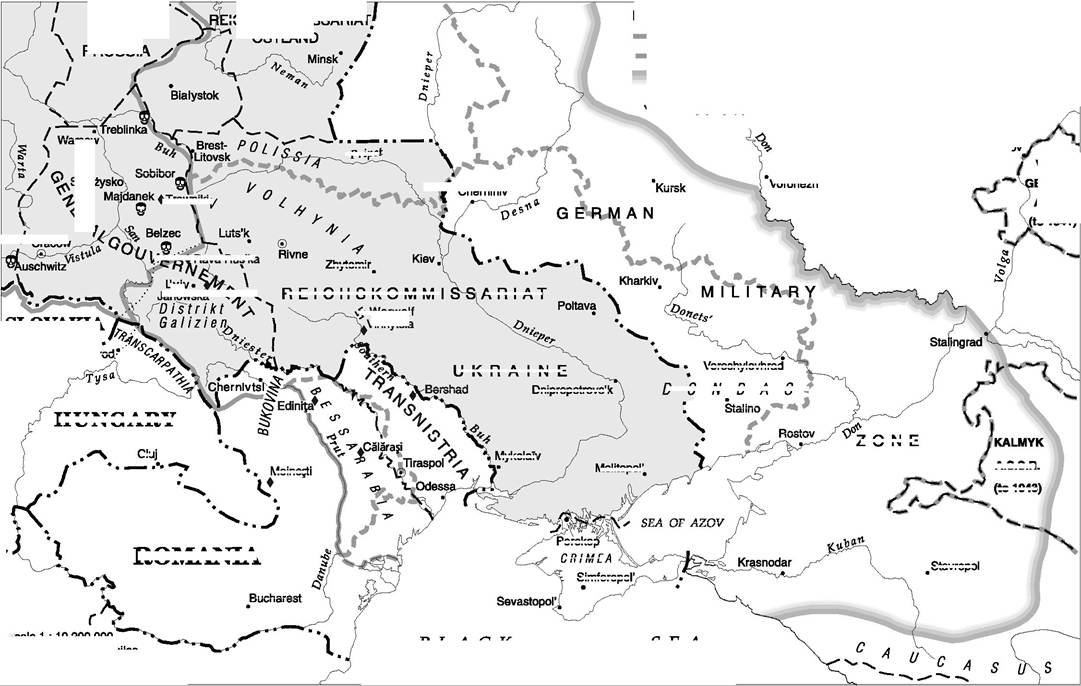
Of the three goals set by the German military planners, only the third was achieved. Although the German forces did come close, they failed to capture either Leningrad or Moscow; and although the Soviet forces suffered extensive defeats, they were not destroyed. The German Army, however, pushed as far as Lake Onega in the north (thus encircling Leningrad); they took Novgorod and reached the outskirts of Moscow in the center; and they overran Ukraine and beyond as far as the outskirts of Stalingrad, at the bend of the Volga River, and the foothills of the Caucasus in the south. This farthest German advance was attained in the summer of 1942.So rapid was the German Army’s advance that by November 1941, just four months after the start of the invasion, virtually all Soviet Ukraine was under German control. In response to Germany’s offensive, Stalin and the Soviet government called on the people of Ukraine (14 July 1941) to defend the fatherland. Whether or not they heeded the call - and many, remembering the forced collectivization, famine, and purges of the 1930s, did not - seemed irrelevant. Because the German military advance was so successful and quick, large numbers of Soviet forces were captured in battle or surrendered voluntarily. In desperation, Stalin adressed the Soviet people on radio as early as 3 July 1941, calling on the remaining forces to “make life in the rear of the enemy unbearable.” His “strategic plan” was to “destroy all that cannot be evacuated”1 - a scorched-earth policy which saw the retreating Soviet authorities demolish industrial plants, railroads, food supplies, water resources, cultivated fields, and other resources. Most of the mines in the Donbas were flooded, and the Dnieper Hydroelectric Works, with its dam and generators, was blown up. In their hasty and often panic-stricken retreat, the Soviet authorities were not about to evacuate the thousands of prisoners they had arrested, mostly during their last months of rule in western Ukraine.
Their solution, implemented at the end of June and in early July 1941, was to kill all inmates regardless of whether they had committed minor or major crimes or were being held for political reasons. According to estimates, from 15,000 to 40,000 prisoners were killed during the Soviet retreat from eastern Galicia and western Volhynia.The brutal scorched-earth policy would have been even more destructive had the Soviets not been forced to retreat so rapidly. Despite the haste, some planned evacuation was possible, especially in eastern Ukraine. It included the removal of 3.8 million people and about 850 large industrial plants to the Soviet East. Among the inhabitants who participated in the eastward exodus were about 200,000 Germans living in the Left Bank and the Crimea. According to a Soviet decree of 28 August 1941, they were forcibly deported because of their potential threat as “diversionists and spies” against the Soviet war effort. At the same time, Germans from the neighboring Volga German A.S.S.R. were also deported and their autonomous republic was abolished. In Ukraine’s Right Bank and the Black Sea littoral west of the Southern Buh River, however, the local German inhabitants were untouched by the Soviet retreat.
Not all Soviet Ukrainian territory came under German rule. Romania, which joined Nazi Germany’s invasion of the Soviet Union, immediately reacquired northern Bukovina and all of Bessarabia, which the country had ruled during the interwar years but lost to the Soviets in 1940. By an agreement signed with Germany at Tighina on 30 August 1941, Romania also acquired the region known as Transnistria, located between the Dniester and Southern Buh Rivers. This included the large Black Sea port of Odessa, which fell to Romanian forces in mid-October, but only after a military operation in which the invaders suffered losses of up to 70,000
MAP 43
UKRAINE, 1941-1944
EAST
Saratov
Voronezh
Concentration or slave labor camp
Boundaries before June 1941
— International
■ « Soviet republic
Farthest German advance, November 1942
Hillier’s command post
Privet
Sobibor
Kursk
Luts k
Rivne
Zhytomir
use h wit?
Kharkiv
AR AT
HUNGARY
Rostov
ZONE
KALMYK
Clu
Mykolaiv
Melitopol
Momesti
SEA OF AZOV
ROMANIA
Stavropol
Bucharest
BLACK
SEA
EICHSKOMMISSARIAT OSTLAND
Perekop
CR MEA
Simferopol
( A.S.S.R.
(to 1943)
U K R A N E
Bershad
Dmpropetrovs k
Voroshylovhrad
DONBAS
Sta mo
reb hnka
Warsaw
♦Trawnikii/
3
RE CHSKOMM
^Werwolf Vinnytsia
IZß* Rava Rus’ka
0 50 100 kilometers
Scale 1 : 10 200 000 0 50 100 miles
Copyright © by Paul Robert Magocsi

German civilian rule
Admininstrative center of subject territories Death camps
Chernihiv
Cracow
VOLGA
ERMAN A.S.S.R to 1941)
SLOVAKIA
Uzhhorod?
Janowska K
dead and wounded. Transnistria was not formally annexed to Romania, but functioned as a self-governing province under the authority of the country’s wartime head of state, Marshal Ion Antonescu. Transnistria’s administration was headed by a civil governor, Gheorghe Alexianu, whose headquarters were in the town of Tiraspol.
The new administration viewed the local Romanian inhabitants, who represented only about 10 percent of the 2.3 million inhabitants of Transnistria, as the vanguard of a Greater Romania that would extend eastward beyond the Dniester River. In an effort to enhance the Romanian character of the region, new Romani- an-language elementary and secondary schools were opened, a Romanian Scientific Institute was created to coordinate all forms of cultural activity, and a Romanian Orthodox Mission was established to coordinate the work of 250 missionary priests from other parts of Romania, who together with a nearly equal number of local priests tried to serve the 700 churches and chapels that used Romanian in their liturgies. These romanianization efforts continued throughout the war, until the arrival of the Red Army in 1944.
Nazi rule in Ukraine
The vast majority of Ukrainian territory came under the rule of Nazi Germany. And this did not bode well for Ukraine and its inhabitants. In the perceptive words of one scholar describing the mid-twentieth century: “If Europe was...
a dark continent, Ukraine and Belarus were the heart of darkness.”2The Nazi regime divided its conquests into three distinct administrative regions: (1) the Generalgouvernement Polen, (2) the Reichskommissariat Ukraine, and (3) the military zone. Galicia east of the San River, only recently incorporated into Soviet Ukraine in the fall of 1939, was made part of the Generalgouvernement on 1 August 1941. Most remaining Ukrainian territory was reorganized into the so-called Reichskommissariat Ukraine (formed 20 August 1941), essentially run as a German foreign colony ruled by a German civil administrator (Reichskommissar) resident in the Volhynian town of Rivne. Beyond the Reichskommissariat was the military zone, which stretched as far east as the German Army advanced.
The Crimea, although technically a part of the Reichskommissariat Ukraine, remained de facto in the German military zone. This is because of the difficulty the German Army encountered after it broke through the narrow isthmus of Perekop on 21 October 1941. The Soviet armed forces retreated to the port city of Sevastopol’, where they held out for eight months until surrendering in July 1942. During the military struggle for control of the peninsula, an estimated 20,000 Crimean Tatars fought in Soviet ranks. Many were captured or surrendered to the Germans.
The Crimea was of particular interest to Nazi Germany. Not only did it have strategic military value (the southern flank guaranteed control of Ukraine), it was also an important component of Nazi ideology. Hitler decided that the Crimea, after resettlement by ethnic Germans from southern Tyrol and Romania, would be transformed into a pure German colony called Gotenland (the Land of Goths), whose main cities, Simferopol’ and Sevastopol’, would henceforth be known respectively as Gotenberg and Theodorichhafen. As part of these plans, the Crimean Tatars, who like the Slavs were considered subhumans (Untermenschen) in the Nazi racial hierarchy, would have to be removed from the peninsula.
In practice, however, Nazi rule in the Crimea, which was to last a little over two years, followed a different pattern. The German military, in particular, was sympathetic to some kind of accommodation with the Crimean Tatars, who they expected would be more reliable than the local Russian and Ukrainian inhabitants. In fact, many Crimean Tatars greeted the arrival of the Germans as “liberators” from Soviet rule. Putting aside Nazi radical ideology, the German military in the Crimea, in cooperation with Crimean Tatar leaders from the exile community in Turkey (Cafer Seydahmet and Edige Kirimal) and in Romania (Mustecip Ulkusal), organized among captured Soviet soldiers several self-defense battalions. These included nearly 20,000 Crimean Tatars who assisted Germans in hunting down Soviet partisans and other real or suspected anti-Nazi elements.
The German civil authority, through the representative of the Reichskommissariat in the Crimea (Alfred Frauenfeld), already permitted in November 1941 the formation of Muslim Committees in various towns and cities, whose function was to promote Crimean Tatar religious and cultural activity. The former exile from Turkey, Edige Kirimal, who was recognized by the German authorities as the leading spokesperson for Crimean Tatar interests, even expected that some form of autonomy would be accorded his people. It would be incorrect, however, to assume that the German regime favored only Crimea’s Tatars. The official languages in use were actually German and Russian, and several Russians held posts in local town and city administrations. As elsewhere in the Nazi German realm, a much worse fate awaited the Jews. Within a year beginning in November 1941, all the remaining Jews in the Crimea (the indigenous Krymchaks as well as the Ashkenazi) - an estimated 30,000 to 40,000 - were killed by German SS units.
Certainly not all Crimean Tatars supported the German presence in their homeland. Aside from the nearly 20,000 fighting on various fronts in the Soviet Army, by 1944 Crimean Tatars made up nearly 17 percent (roughly their proportion of the population) of the Soviet partisans fighting against the German military in the Crimea. Nevertheless, a large percentage of Crimean Tatars did cooperate actively or passively with the occupying regime. Such cooperation provoked antagonism and deep hatred on the part of the local Slavic inhabitants (Russians and Ukrainians) toward whom they considered to be their “collaborationist” Crimean Tatar neighbors. The collaborationist label was to remain and have dire consequences once the Soviet regime returned to power.
The situation in the greater part of German-ruled Ukraine was even more complex than in Crimea. Initially, some Ukrainians welcomed the German invasion, because they hoped that with the end of Soviet rule their country would enjoy a better life and perhaps some form of national sovereignty. The attitude of the Organization of Ukrainian Nationalists (OUN) to the Germans was more complex and, depending on circumstances as they evolved, differed between that body’s two factions, the Banderites and the Melnykites. In their turn, Ukrainian nationalist aspirations found different responses among Germany’s Nazi leadership and its military. The military felt that some kind of cooperation with the OUN would be useful on territories that were about to be invaded by the German Army. The Nazi leadership, on the other hand, invariably rejected on racially motivated ideological grounds (see below) any serious cooperation with the local ethnic Ukrainian population, which it believed should be conquered and remain totally subordinate within Nazi Germany’s new world order. Such views resulted in what seemed contradictory policies toward ethnic Ukrainians, especially during the early weeks of Germany’s invasion of the Soviet Union.
As early as 1940, at various camps in Austria and Silesia, the German Army was training instructors for the future recruitment of Ukrainians into police units in the Eastern Territories (Ostpolizei). At first Melnykite but later Banderite activists were prominent in this program. On the eve of the invasion, in April 1941 the German Army allowed the formation under the direction of the Bandera faction of the OUN two military units of about 600 men, known by their code names, Nachtigall and Roland. These units consisted of former members of the Carpathian Sich, who after their release by Hungary had been in Austria and, later, Silesia, hoping to see military action that would allow them to participate in the liberation of their homeland from Soviet rule. At the time, these various military groups were popularly known as the Legions of Ukrainian Nationalists (Legiony/ Druzhyny Ukrains’kykh Natsionalistiv). During the June 1941 invasion of the Soviet Union, Nachtigall marched with the German Army into Galicia and eventually reached Podolia; Roland was sent southwest into Bessarabia.
In addition to the Nachtigall military unit, other OUN-Banderite activists led by laroslav Stets’ko returned to Galicia. Acting independently of the German military, the Banderites brought together a group of sympathizers who on 30 June 1941 proclaimed in L’viv the existence of a sovereign Ukrainian state. Stets’ko managed to obtain support for the “new state” from a Council of Seniors that included the most respected figures in Galician-Ukrainian society, Metropolitan Andrei Sheptyts’kyi and the former Austrian parliamentarian Kost’ Levyts’kyi (recently released from prison in Moscow, where he had been held since 1939). The Banderites also organized in the Generalgouvernement a large number of propagandists, the so-called expeditionary groups (pokhidni krupy). Traveling clandestinely by horse-drawn wagons and bicycles, about 1,500 young men (and some women) activists, organized in three expeditionary groups, followed the German military advance into eastern Ukraine, where they hoped to extend their vision for independent statehood.
The Akt of 30 June 1941, as the proclamation of the Ukrainian state came to be known, did not sit well with the German military, who knew quite well that Nazi policy makers were on principle opposed to any but the most superficial concessions to the Ukrainians. Consequently, the leading Banderites were arrested and sent to Berlin, including Stepan Bandera (who had never returned to Galicia himself) and Stets’ko, both of whom spent most of the war years (July 1941 to September 1944) in German prisons and concentration camps. The Banderite faction of the OUN was thus eliminated from Galicia, and the Nachtigall and Roland military units, which by then were serving in eastern and southern Ukraine, were demobilized in August 1941 and sent back to bases in Austria and Silesia. Both units were eventually fused into the Guard Battalion 201 and in March 1942 sent to fight against Soviet partisans in Belarus. Before the end of the year, however, the Guard Battalion was permanently disbanded and its officers sent to German prisons.
Following the rather quick alienation between the OUN-Banderites and the Germans, the Melnykite faction of the OUN thought it might be able to fare somewhat better with Ukraine’s new rulers. The faction’s leader, Andrii Mel’nyk, was joined by former officers from the army of the Ukrainian National Republic who on 6 July 1941 appealed to Hitler to allow them to take part in the “crusade against Bolshevik barbarism.”3 The appeal fell on deaf ears, however. At best, during the invasion the Melnykites were able to send interpreters and other advisers into eastern Ukraine with the German Army, as well as - without any authorization - expeditionary groups similar to those sent by the Bandera faction of the OUN. The center of Melnykite activity during the summer of 1941 was Zhytomyr.
Aside from attempting to raise Ukrainian national and political consciousness among the citizens of German-occupied Soviet Ukraine, the two factions of the OUN fought bitterly against each other. The internecine struggle led to assassinations and mutual accusations of responsibility for these acts and of complicity with the Germans. Following the assassination of two prominent Melnykite leaders (Omelian Senyk and Mykola Stsibors’kyi), the German security forces cracked down on the Banderites (who were blamed for the attacks), executing many of their activists and forcing all their expeditionary groups to disband. Any hopes for future reconciliation between the two factions of the OUN ended after the decimation of the Banderite organization in German-controlled Ukraine.
Having eliminated the more radical nationalist elements in Ukrainian society, the German civilian authorities seemed willing to work with relatively moderate leaders. In western Ukraine, the recently established Council of Seniors in L’viv on 30 July 1941 was transformed into the Ukrainian National Council, headed by Metropolitan Sheptyts’kyi and Kost’ Levyts’kyi. The new council, expanded to include members of the prewar UNDO political party and several Greek Catholic prelates, expected to represent the interests of Ukrainians in former Poland (Galicia, Volhynia, the Chelm region) before the German authorities. In practice, it was responsible only for Ukrainians in the Distrikt Galizien, whose annexation to the Generalgouvernement it opposed. Finally, in March 1942, following Metropolitan Sheptyts’kyi’s protest to the German government against genocide, the Ukrainian National Council was forced to disband. Henceforth, Ukrainian interests in the entire Generalgouvernement were represented only by the previously established Ukrainian Central Committee, headed by Volodymyr Kubiiovych in Cracow.
Under the auspices of the Cracow-based Central Committee, several Ukrainian cooperatives dismantled in eastern Galicia by the short-lived Soviet regime were revived; elementary, technical, and secondary schools were allowed to function; and Prosvita cultural societies were reopened. Ukrainians were also permitted to enter the lower ranks of the civil and judicial administrative apparatus of the Gen- eralgouvernement. Finally, in April 1943 a volunteer Ukrainian military unit known as the SS Galicia Division (German: Waffen SS Division Galizien) was formed. The Dyviziia, as it was known in Ukrainian, was one of the many non-German units within the military branch (Waffen) of the Nazi elite SS paramilitary organization. It proved attractive to large segments of nationally minded Galician-Ukrainian youth, who were committed to the Galicia Division’s declared object of fighting alongside the German Army against the Soviets on the eastern front.
In many ways, the Ukrainian Central Committee and the Galicia Division were a facade for German rule, upholding the pretense that Ukrainians had control of their community life. In reality, the Generalgouvernement was a protectorate within Greater Germany and was subject to the exigencies of direct Nazi rule. All decisions and ultimate power rested in the hands of a German governor-general resident in Cracow, Hans Frank, who in turn was responsible directly to the Führer in Berlin. But the extremes of the wartime Nazi regime, at least in the Generalgouvernements district of Galicia, were mitigated by the attitude of the local district governor, Otto Wächter. Although a committed Nazi, Wächter was from an Austrian Habsburg aristocratic family and realized the value of counteracting Polish interests by cultivating Galicia’s Ukrainians. Throughout the war, the district governor Wächter maintained cordial relations with a fellow Habsburg aristocrat, Metropolitan Sheptyts’kyi. The result was that Ukrainians and their traditional organizational structures in Galicia were allowed to function with less interference from the Nazi authorities than was the case in other German- and Romanian-ruled Ukrainian territories.
The situation within the German Reichskommissariat, carved out of former Soviet Ukrainian territory, was quite different. As part of his declaration of war against the Soviet Union, on 22 June 1941 Hitler proclaimed the liberation of peoples from Bolshevik rule and the recognition of freedom of religion and labor. Under these rather vague proclamations, there occurred a rebirth of Ukrainian national life during the first months of Nazi German rule. During the first few months of the German occupation, over 100 non-Communist newspapers began to appear, new publishing companies and theaters were formed, a society of Ukrainian writers was established, and teachers began to formulate a revised school curriculum that stressed a Ukrainian national message for classes in language, history, and culture. In the countryside, some peasants began to divide among their families land that had belonged to the Soviet collective farms, and others joined to establish voluntary agricultural cooperatives and rural financial institutions.
The churches were able to renew their pastoral work, not to mention their jurisdictional rivalries. The autocephalous Orthodox movement, which had been banned since the early 1930s in Soviet Ukraine, reestablished its organizational structure. The Ukrainian Autocephalous Orthodox Church, recently revived in the German-ruled Generalgouvernement (see chapter 48), was extended to the Reichskommissariat Ukraine under the leadership of Metropolitan Polikarp Sikors’kyi (reigned 1942-1944). In the first half of 1942, six new autocephalous bishops were consecrated, including Mstyslav Skrypnyk of Pereiaslav (reigned 1942-1944). The Autocephalous Orthodox Church was not alone, however; it had a rival in what came to be known as the Ukrainian Autonomous Orthodox Church. Founded at the Pochaiv Monastery in Volhynia in August 1941, the autonomists had their own hierarchy under Metropolitan Oleksii Hromads’kyi (reigned 1941-1943). The autonomists were able to attract to their ranks clergy from the Russian Orthodox Church, because they accepted jurisdictional subordination to the Moscow patriarch, even though they considered themselves free to act independently as long as the patriarchate was under Soviet control. Aside from the Autocephalous and Autonomous Orthodox jurisdictions, the Galicianbased Greek Catholic Church also set up for the first time a hierarchical structure in central and eastern (former Soviet) Ukraine. This was part of Metropolitan Sheptyts’kyi’s larger plan of realizing Christian unity through the mediation of the Greek Catholic Church. It was the possibility of missionary activity in “the East” and the overthrow of Bolshevism that prompted Sheptyts’kyi initially to look with favor on the German presence in Ukraine.
Finally, on the political front, in early October 1941 the Melnykite faction of the OUN initiated the creation of the Ukrainian National Council in Kiev (headed by Professor Mykola Velychkivs’kyi), which was intended to become the basis for a future Ukrainian government. All these developments during the summer and fall of 1941 led many Ukrainians to believe that the Germans had come as true liberators who would help them reestablish a non-Soviet national life. As it turned out, however, the Nazis, like the Soviet Communists before them, were prisoners of their own ideology. In short, the Nazis had their own plans for Ukraine.
Nazi racial policies and the Holocaust
It was during World War II that Ukraine came to considered one of the most important components of Germany’s Lebensraum - a territory where racially pure German citizens could find solace from an “unhealthy urban society” and build instead a predominantly agricultural - and supposedly pristine - environment. For such a racially pure setting to be achieved, local populations would have to be integrated into the new German society. If that were not possible, they would have to be deported elsewhere or, simply, killed. Because Nazi Germany was engaged in war, the building of its Lebensraum depended on the fate of its military campaigns. Accordingly, after the destruction of Poland in 1939, the Generalgouvernement was first intended to be a dumping ground for Poles and Jews from other parts of what had been Poland. Two years later, when Germany’s territorial advances catapulted eastward and nearly reached the Caucasus, the Generalgouvernement was reclassified as a German-settled territory known as the Vandalengau (the province of the Vandals), and the territory just to the east annexed from Soviet Ukraine was also slated to become a German-inhabited land known as the Gothengau (the province of the Goths).
The ideological justification for such a profound demographic reconstruction of eastern Europe is found in the writings of Hitler and other Nazis during the interwar years. At that time, they developed an elaborate theoretical framework that classified all peoples and civilizations worldwide. Their theories were based on racial distinctions. Certain “master” races, the so-called Herrenvolker, whose foremost representatives were the Germanic Aryans, were to be served by “inferior” races, the so-called Untermenschen (subhumans). Like all Slavs, the Ukrainians were classified among the inferior races, whose sole use was, at best, to serve the master races. The lowest elements in the Nazi racial hierarchy were the Jews and the Gypsies. Both groups were persecuted during the 1930s in Germany, but their ultimate fate was not decided until early 1942, when Hitler approved implementation of a policy known as the Final Solution. As it turned out, the Final Solution meant physical extermination. Since the Reichskommissariat Ukraine was treated as a German foreign colony, Nazi theories about superior and inferior races were put into practice there. This was especially the case after the appointment in the fall of 1941 of the notorious administrator from East Prussia, Erich Koch, as Reichskommissar of Ukraine.
According to Nazi racial theory, there was really only one people living on Ukrainian territory who could be considered superior - the Germans. Even before Nazi Germany’s invasion of the Soviet Union, tens of thousands of ethnic Germans living in Ukraine had taken advantage of the clauses on population transfers in the Ribbentrop-Molotov Pact and had begun moving westward at the encouragement of Berlin. Hitler had dreamed of creating in central Europe a Greater Germany to which all the scattered Germans of the Continent could be “repatriated” and in which the whole “master race,” living together, could build the “glorious thousand-year Third Reich.” To make room for the new repatriates, German boundaries were moved eastward, especially into former Polish territory. It was actually in a region in western Poland along the Warta River known as the Wartheland (German: Warthegau) that Germans from the east were settled. The first to arrive, between 1939 and 1940, were Germans from the newly occupied Soviet territories of western Volhynia (60,000), southern Bessarabia (93,000), northern Bukovina (42,000), and eastern Galicia (60,000)
After the German Army invaded the Soviet Union in June 1941 and set up administrations like the Reichskommissariat Ukraine, ethnic Germans in the Right Bank, as well as the Black Sea Germans farther south who had not been deported during the Soviet evacuation, were given a privileged position in Hitler’s “new order.” Ukraine’s Germans were in a sense in the vanguard, since they already lived on territory that was considered part of the future German Lebensraum. But now that many were serving a Nazi regime that generally treated non-Germans harshly, a serious hatred developed for the first time between ethnic Ukrainians and their German neighbors, whose families had lived in their midst for well over a century. It is not surprising, then, that in 1943, when the German Army was forced to retreat before the rapidly advancing Soviet troops, close to 350,000 ethnic Germans fled westward, settling first in the Wartheland and then in Germany proper. (Perhaps as many as 250,000 of these Ukrainian Germans were repatriated once again after 1945, this time by the Soviet forces in the eastern zone of Germany, who sent them for resettlement to the Komi A.S.S.R. and Siberia.) Thus, as a result of World War II, the German settlements on Ukrainian territory, some going back to the late eighteenth century, ceased to exist. But notwithstanding their ultimate fate, the German minority in Ukraine had a favored position at least for a few years.
At the other end of the Nazi racial spectrum were the Jews. During the German invasion of the Soviet Union, many Jews, especially in the eastern part of Soviet Ukraine, succeeded in fleeing eastward as part of the Soviet evacuation program of civilians, among them many Communist party functionaries, governmental employees, institutional functionaries, and factory workers. In western Ukrainian territories, however, Jews were prevented from fleeing eastward either because of the rapid advance of the German troops or because of the refusal of Soviet security forces to let them cross the pre-1939 borders of the Soviet Union. Those left behind found themselves under Nazi German rule and were subjected to that regime’s genocidal policies known as the Holocaust (Hebrew: sho’ah, “catastrophe”; Yiddish: Khurbn, “destruction”). The Holocaust reached its highest stage after 1941 with the implementation of a program of systematic mass killings - the Final Solution.
To achieve the Final Solution, the Nazis created special extermination task forces (Einsatzgruppen) recruited from the SS and the German secret police (the Gestapo). These units were assigned the task of following the German Army and ridding the occupied areas of all undesirable groups, which in Ukrainian lands meant Communists, the Polish intelligentsia, eventually Ukrainian nationalists, and, especially, Jews. During the very first days of the German invasion, the methods of killing were often random, reflecting the anarchic conditions that raged during the initial weeks of the invasion. The Germans helped to circulate rumors that “Jewish Bolsheviks” had been involved in the murders of thousands of Ukrainian political prisoners killed by the Soviet authorities before their hasty retreat. In L’viv, for instance, after the prisons were opened, about 4,000 Jews were massacred between 2 and 7 July 1941 by German extermination task forces with the assistance of what some sources describe as “Ukrainian auxiliary police” (Ukrainische Hilfspolizei). Among the victims that week was L’viv’s respected rabbi, Ezekiel Lewin, whose two sons were among the first of 165 Jews (mostly children) whom Metropolitan Andrei Sheptyts’kyi managed to hide in a network of safe places in several of Galicia’s Greek Catholic monasteries and convents. These lives saved were the exception, however; more typical was the fate of an estimated 24,000 Jews, who perished in pogroms perpetrated in other towns and villages throughout eastern Galicia and western Volhynia during July and August.
As soon as the days of invasion were over and a German administration was established, a more systematic approach was adopted for the elimination of the so- called undesirable elements. Jews were first rounded up in specified areas or ghettos, then either (1) shipped off in cattle cars to death camps (Auschwitz, Belzec, Majdanek, Sobibor, Treblinka) in order to be gassed and burned, the method of extermination favored in western Ukrainian lands; or (2) herded to the outskirts of the city, often near a pit, and shot, the method used in central and eastern Ukraine. Mass deportations of Jews from western Ukraine began in March 1942 and were essentially completed within the next year. The most infamous example of the second method of extermination took place in Kiev. In the valley of Babyn lar (Babi Yar), on 29-30 September 1941, just one week after the Germans
Thou Shalt Not Kill
The respected metropolitan of the Greek Catholic Church in Galicia, Andrei Sheptyts’kyi, was outraged by the “diabolical” immorality of the German authorities and some of his own Ukrainian people in their murderous activity against Jews. As well as hiding, at great risk, individual Jews, in early 1942 he wrote to the head of the Nazi SS, Heinrich Himmler, protesting the fact that “Ukrainian auxiliary police are being forced to shoot Jews.” Then, when the mass deportations of Jews began in the summer of 1942, the metropolitan decried the situation in a letter to the pope, dated 29-31 August 1942:
Liberated by the German army from the Bolshevik yoke, we felt a certain relief.... Gradually, the [German] government instituted a regime of truly unbelievable terror and corruption... [so that] now everybody agrees that the German regime is perhaps even more evil and diabolic than the Bolshevik [regime]. For more than a year not a day has passed without the most horrible crimes being committed.... Jews are the primary victims. The number of Jews killed in our region has certainly surpassed 200,000.... Almost 130,000 men, women, and children were executed in Kiev within a few days.
Finally, on 21 November 1942 Sheptyts’kyi issued a pastoral letter under the title of the fifth commandment, “Thou shalt not kill,” which was read in all churches and published in the official publication of the L’viv Greek Catholic archeparchy. Although referring to political murder, the entire text makes it clear that Sheptyts’kyi condemned all kinds of murder, including that of Jews.
Those who do not look upon political murder as a sin entertain a peculiar kind of self-delusion - as if politics freed men from the obligation to observe divine law and justified a crime that is contrary to human nature. This is not the case.... A person who sheds the innocent blood of his enemy, of his political opponent, is just as much a murderer as one who does it for robbery and is just as deserving of God’s punishment and the condemnation of the church.
source: Paul Robert Magocsi, ed., Morality and Reality: The Life and Times of Andrei Sheptys’kyi (Edmonton 1989), pp. 154-155 and 135.
took the city, an estimated 34,000 Jews who had not managed to flee the city were shot.
The Nazi extermination task forces often strove to employ local ethnic Ukrainians, Russians, Poles, Germans, and even Jews (through the so-called Jewish Councils: Judenräte) in the organization and implementation of their murderous missions. Some of the local population participated, either willingly or under various forms of coercion. It is interesting to note that in contrast to the solicitous actions
toward Jews undertaken by the Greek Catholic Metropolitan Sheptyts’kyi in western Ukraine, the metropolitans of both Orthodox jurisdictions (Autocephalous and Autonomous) helped to incite anti-Semitic attitudes in the local population. They did this through public remarks that associated Communist rule with Jews, thereby implying that as a group they should expect to be punished for their previous “collaboration” with the Soviet regime.
According to an agreement between Germany and Romania, 147,000 Jews were deported between 1941 and 1943 from Bukovina and Bessarabia to Transnistria, where they were held in concentration camps for use as forced labor. An estimated 90,000 died as a result of the deplorable conditions in the camps or other scattered atrocities. As for the Jews native to Transnistria itself, an estimated 130,000 to 170,000 were murdered or died from disease during the first two years of the Romanian occupation (September 1941 to November 1943). A particularly horrible incident took place in October 1941, when the Romanian forces executed 15,000 to 20,000 Jews in Odessa in reprisal for blowing up the Romanian army headquarters in the city.
During the Holocaust, the Nazis were able to kill an estimated 850,000 to 900,000 Ukrainian Jews. This meant the virtual elimination of the Jewish population in western Ukraine and an end to the centuries-old Yiddish and Hebrew culture that had flourished throughout the country. The Holocaust also had another detrimental effect. Even though the murders were systematically carried out under the direction of Nazi special extermination units, Jewish survivors of that time have stressed in memoirs and other testimonies that Ukrainian auxiliary police and militia, or simply “Ukrainians” (a generic term that in fact included persons of nonUkrainian as well as Ukrainian national background), participated in the overall process as policemen and camp guards and in other supporting jobs. The result is that recollections of the Holocaust, a phenomenon which has dominated Israeli and worldwide Jewish civic culture since World War II, often portray Ukrainians as anti-Semitic by nature. This stereotype has been perpetuated in the popular media and even in scholarly studies, particularly in Israel and North America.
Nazi policies toward ethnic Ukrainians
For the ethnic Ukrainian inhabitants in the Reichskommissariat Ukraine, the promising developments for their national life proved to be short-lived. In September 1941, the expeditionary groups sent by the Banderite faction of the OUN as well as their local supporters were being arrested or executed by the special extermination task forces at the same time that the Jews were being exterminated. The process of destroying Ukrainian nationalists and their organizational life was stepped up after the arrival in November 1941 of Erich Koch as head of the Reichskommissariat Ukraine. Before the end of the year, the recently founded Ukrainian National Council had been banned, and thousands of its OUN-Melnykite supporters had been arrested or killed. The Prosvita societies and cooperatives were abolished, and beginning in January 1942 all schools above the fourth grade were closed. None of these acts is surprising, since according to Nazi racial theory
Ukrainians were an inferior race. As Untermenschen (subhumans), Ukrainians did not need their own organizations, they needed only to work for the master German race. Reichskommissar Koch best summed up the Nazi attitude when he quipped, “If I find a Ukrainian who is worthy of sitting at the same table with me, I must have him shot.”4
The brutal policies of the Nazis provoked various forms of resistance. The Germans generally responded by assigning collective responsibility and annihilating entire villages, notably in the Chernihiv region, Volhynia, and the area immediately north of Kiev. Symbolically, the ravine at Babyn Iar, first used in September 1941 to annihilate those Jews who were still in Kiev, was for two more years used as a site for executions and mass burials, which were to claim an estimated 100,000 to 150,000 more lives (Soviet prisoners of war, partisans, Ukrainian nationalists, and Gypsies as well as Jews). The total number of non-Jews in Ukraine who were victims of Nazi extermination policies reached an estimated 3,000,000 people.
Besides the arrests and systematic killings, there were several other German policies which alienated most inhabitants of Nazi-ruled Soviet territory, even those who initially may have welcomed Germany’s armies as liberators from Bolshevism. These policies concerned (1) prisoners of war, (2) the collective farms, and (3) the forced deportation of civilians. Since the Soviet Union had not signed and did not recognize previous international conventions on warfare, the Germans had a convenient excuse to hold Soviet prisoners of war (POWs) under conditions that were effectively designed to bring about their death. Of the 5.8 million Soviet POWs who fell into German hands between 1941 and 1944, 1.9 million died and another 1.3 million disappeared.
As for the peasants, all hopes of getting back land following the fall of Soviet rule were quickly dashed. At first, some German policy makers argued that from the standpoint of supplying foodstuffs to the Third Reich it would be more efficient to allot land to individual peasants. These suggestions were effectively blocked, however, by Reichskommissar Koch, who simply renamed the former Soviet collectives “communal farms.” The “new” farms functioned as before, and were expected to fulfill German-imposed grain quotas that in many regions were double the last Soviet norm.
Finally, the so-called Ostarbeiter (Eastern workers) program was initiated in the Reichskommissariat Ukraine and other former Soviet territories. This program consisted of the forced deportation between 1942 and 1945 of 2.8 million civilians to work in Germany. The vast majority - nearly 2.3 million - were from Ukraine. In addition to being forced into their work, the Ostarbeiter were subjected to draconian labor discipline. Moreover, unlike other foreign workers in Germany, including Ukrainians from Galicia, the Ostarbeiter from the Reichskommissariat Ukraine were forced to wear badges at all times indicating that they were workers from the east.
Resistance to Nazi rule
The population of Ukraine began to resist Nazi rule as early as in the summer of
1941. That resistance took three different forms: (1) spontaneous efforts at self-
MAP 44
THE ADVANCE OF THE RED ARMY
Copyright © by Paul Robert Magocsi
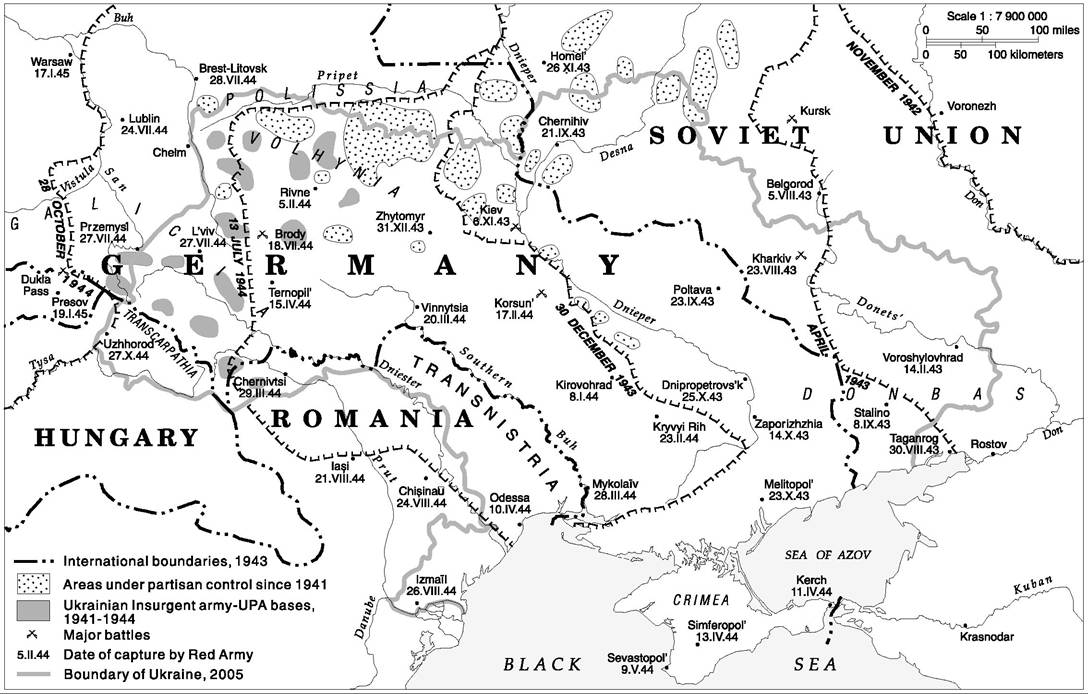
defense, (2) the organized nationalist (and anti-Soviet) movement, and (3) the Soviet partisan movement. The spontaneous efforts were undertaken in reaction to the more brutal aspects of Nazi rule, especially the practice of imposing collective responsibility, as a result of which entire villages and their inhabitants were destroyed. Local inhabitants who had no particular political orientation formed guerrilla units that often attacked German supply lines. In the course of 1942 and 1943, several such units were formed in eastern Ukraine (the Chernihiv region and the Donbas) and around Vinnytsia in Podolia.
Organized resistance by Ukrainian nationalists was initiated in Volhynia and Polissia, where a guerrilla force led by Taras Bul’ba-Borovets’ operated beginning in the summer of 1941 under the aegis of the Ukrainian National Republic in exile. First directed at the retreating Red Army, in March 1942 the unit redirected its attention against the German forces and was renamed the Ukrainian Insurgent Army (Ukrains’ka Povstans’ka Armiia - UPA). Within the next year, first the Banderite faction and then the Melnykite faction of the OUN formed their own units of the UPA. The various units drew their members from among OUN activists who had escaped arrest by the Germans and from among former Red Army soldiers who had served as German auxiliary police and guards. The latter group included not only ethnic Ukrainians, but also Azerbaijanis, Uzbeks, Georgians, and Tatars, who eventually had their own national units in the UPA. In November 1943, the diverse units of the UPA came under the direction of a supreme command directed by the Banderite faction of the OUN. Throughout 1943, the UPA, whose total forces were approaching 40,000 soldiers, fought in skirmishes against the German Army as well as against Soviet partisans. Initially, Volhynia was the center of operations, but by the summer of 1944 the focus had turned to eastern Galicia, where for nearly a year the UPA - whose numbers by then may have been close to 100,000 - fought several pitched battles against both the retreating Germans and the advancing Soviets for control of the Carpathian mountain passes.
Another aspect of UPA activity was its relationship to Poles. That relationship concerned the civilian population, that is, Poles living in scattered villages throughout the territories of western Volhynia, the Chelm region, and eastern Galicia, as well as the armed Polish resistance movement, in particular the Home Army (Armia Krajowa). The political tensions between ethnic Poles and Ukrainians that stemmed from the interwar years had never gone away. The Nazi German occupation and the military struggle connected with the war only made the situation worse by creating unstable conditions that could and did lead to a renewal of open conflict between the two peoples. This took the form of attacks by the UPA on Polish villages and reprisals by Polish self-defense units and later the Home Army on Ukrainian villages. The underground movement on both sides was concerned with the postwar status of these territories which, each side argued, should belong to either a restored Poland or to an independent Ukraine. Hence, the attacks on innocent civilians were designed to eliminate the presence of Poles and Ukrainians to the advantage of the future state that would rule these territories.
The question of who started this cycle of violence and retribution remains a subject of often emotional debate among historians and eye-witness survivors, but it is certain that several hundreds of thousands were driven from their homes (especially Poles from Volhynia) and that there was considerable loss of life on both sides (50,000 Poles and 20,000 Ukrainians killed are among the more reasonable estimates). In 1942, Ukrainians in the Chelm region were attacked by the Polish underground, allegedly in retaliation for Ukrainian support of the Nazi German regime. By the fall of that that year and continuing until the end of 1943, UPA units were attacking an increasing number of Polish villages in Volhynia. As the Soviet front moved steadily westward, forcing the German Army to retreat, Ukrainian and the Polish underground forces continued to fight against the advancing Soviets as well as against each other, resulting in further loss of life among the Polish and Ukrainian civilian populations in the Chelm region and Galicia throughout much of 1944.
The third form of resistance to Nazi rule was the Soviet partisan movement, which formally began on orders from the Central Committee of the All-Union Communist party within the first week of the German invasion at the end of June
1941. In actual fact, however, Soviet partisans in Ukraine did not attain any significant activity until mid-1943. In order to encourage the movement, the Central Committee of the CP(b)U, following instructions from Moscow, set up on 20 June 1942 the Ukrainian Staff of the Partisan Movement, with headquarters in Voroshy- lovhrad (Luhans’k), in far eastern Ukraine. By the end of 1943, there were reportedly over 43,000 Soviet partisans active in Ukraine, whose attacks were directed against the German Army and, later, the UPA. Among the more prominent of the Soviet partisan leaders were Sydir Kovpak, best known for his May 1943 raid deep behind German lines as far as the Carpathians, and Petro Vershyhora, who headed the First Ukrainian Partisan Division, which carried out raids deep into western Ukraine during the first half of 1944.
It was the Red Army, however, not the various partisan movements, that determined the future of Ukraine. By the end of 1941 the Soviet Union had reached a rapprochement with Great Britain and the United States which resulted in the Allied wartime alliance and the receipt of desperately needed military supplies, especially from the United States. Armed with such support and a fierce determination to drive out the Nazi invader, the Soviets began an offensive in November
1942. The decisive turning point came at Stalingrad, near the last bend in the Volga River, about 185 miles (300 kilometers) east of Ukraine. After nearly three months of fierce fighting in frigid temperatures, the Red Army defeated the heretofore invincible Germans and forced the surrender of the German Sixth Army after the incredibly costly Battle of Stalingrad. When the battle finally ended on 30 January 1943, more Soviet lives had been lost at Stalingrad alone than by the United States Army on all fronts throughout the entire war.
From Stalingrad, the Red Army pushed westward against fierce resistance from the Germans and their allies. During the early spring of 1943, the German forces were driven out of much of the Donbas, with Voroshylovhrad the first city in Ukraine to be recaptured (14 February). The rest of 1943 was dominated by the Battle for the Dnieper between August and December, during which the Red Army took the entire Left Bank as well as parts of the Right Bank, culminating in the capture of Kiev on 6 November.
The year 1944 began with a Soviet victory at a major battle around Korsun’ (24 January to 17 February). This was followed by the rapid retreat of German forces from the entire Right Bank. Farther south during April, the Germans and their Romanian allies were driven out of Transnistria, and all of the Crimea was retaken by the Red Army after Sevastopol’ fell to them on 9 May. The capture of Sevastopol’, with its militarily invaluable port took on especially evocative connotations for the Crimea’s local Russian inhabitants as well as for the Soviet Union as a whole. As the City of Glory (Russian: Gorod Slavye), Sevastopol’ - alongside Moscow and Leningrad - became the ultimate symbol of the defense of the Russian/Soviet homeland (rodina) against foreign invaders.
By mid-July, the Red Army was poised to enter western Ukraine, with L’viv and all of eastern Galicia falling before the end of the month. It was during the campaign for Galicia that the German unit, the Galicia Division, was virtually decimated by the Red Army - 8,000 out of 11,000 were killed or taken prisoner - at the Battle of Brody (18 July 1944). Finally, in September-October 1944 the Red Army crossed the Carpathian Mountains and took Transcarpathia as part of its operations against German and Hungarian forces defending the road to Budapest. When this campaign was completed in the fall of 1944, virtually all Ukrainian ethnographic territory for the first time had come under Soviet control.