Revolutions in the Russian Empire
The seemingly unending carnage of World War I placed an enormous burden on the societies and economies of those European countries directly involved in the conflict. The strain was felt particularly by states that had weak socioeconomic structures prior to 1914.
Among the weakest of these was the Russian Empire, and it is not surprising that the realm of the tsar became the first major casualty of the war.By 1917, the Russian Empire had sustained the greatest losses of all the combatants. Of the 15 million men tsarist Russia mobilized, more than half became casualties - 1.6 million killed, 3.8 million wounded, 2.4 million made prisoner. Nor do these staggering figures take into account the equally great or even greater losses among the civilian population, or the losses of property, transportational facilities, and livestock, especially in the western provinces of the empire. Added to the war losses was the fact that the fragile Russian economic structure had virtually broken down, with severe food shortages, especially in the cities, the result.
Russia’s first revolution of 1917
By the beginning of 1917, the economic situation had worsened considerably. In the imperial capital of Petrograd (the former name, St Petersburg, had been changed in 1914, because in an era of mounting hysteria it sounded too Germanic), food riots, strikes, and other demonstrations became a common occurrence. Criticism of the government by politicians was unrelenting, especially among the leftist opposition in Russia’s parliament, the Duma. The crisis came to a head on 8 March 1917, with a massive protest led by women against food shortages in Petrograd. The imperial troops were called out, but they refused to fire on the crowds. Instead, they joined the workers, and on 12 March they established together a council, the Soviet of Workers’ and Soldiers’ Deputies.
The example of the Petrograd Soviet was soon copied in towns and cities throughout the empire. The soviets demanded an immediate end to the war, the breakup of the imperial army, and the replacement of the monarchy with a governmental structure based on elected councils (soviets). With the establishment of the workers’ and soldiers’ councils, the first revolution of 1917 in Russia had begun. (Although the events began in March, the literature frequently speaks of the ‘February Revolution,’ since it occurred in February according to the Julian calendar - two weeks ‘behind’ the western Gregorian calendar - still in use in tsarist Russia.)Despite their precipitous formation and rapid proliferation in the major towns and cities of the empire, the soviets (workers’ and soldiers’ councils) did not take the initial lead in the February Revolution. Instead, they deferred to several deputies in the Duma, who, under the leadership of Prince Georgii L'vov, took it upon themselves to negotiate with the emperor about the increasingly critical political and social situation. Together with the Russian Army’s high command, the Duma representatives convinced Tsar Nicholas II that he should abdicate. After some discussion, the tsar agreed, and on 15 March 1917, without a single shot having been fired, the Russian monarchy came to an end.
With the monarchy defunct, liberal-minded deputies in the Duma hoped that Russia would be transformed into a parliamentary democracy of the western European variety. A final decision as to the actual form of a new government would have to wait, however, until the convocation of an elected constituent assembly. In the meantime, the Duma representatives, led by Prince L'vov, formed the self-appointed Provisional Government to direct the affairs of state. This transitional government, which had no electoral mandate, derived its authority from the now-defunct Duma, the Army High Command, and informal agreements with civic organizations like the Zemstvo League and the War Industries Committee.
The Provisional Government was immediately recognized by the Entente, and it used the old tsarist bureaucracy to carry out its directives. During this transitional period, the Provisional Government’s primary goal was to prepare for elections to a constituent assembly which would decide on Russia’s governmental future. Most immediately, it lifted tsarist censorship and other restrictions on civil liberties; it democratized local government; and it instituted a broad political amnesty.
Nonetheless, the two main problems that had faced the tsarist regime remained - the war and food shortages. Moreover, the Provisional Government had great difficulty in imposing its authority throughout the vast Russian Empire. One major stumbling block was the problem of ‘dual power.’ In effect, at least two centers of authority claimed to rule the entire post-tsarist Russian Empire: (1) the Provisional Government, and (2) the soviets (or councils) of workers’ and soldiers’ deputies. Aside from these two were the several nationalist governments that sprang up in individual borderland regions. Initially, the relationship among these various entities was characterized by cautious tolerance. Some individuals even served in more than one body; for instance, the Petrograd Soviet’s vicechairman, Aleksander Kerenskii, became a member and, later, the head of the Provisional Government. But by the summer of 1917 the cautious tolerance between the soviets and the Provisional Government had been replaced by suspicion and opposition. And when the actual authority in most cities, including the capital of Petrograd, fell to the local soviets of workers’ and soldiers’ deputies, as it did before long, they more often than not blocked whatever directives were issued by the Provisional Government. The most contentious issue between the two bodies was the Provisional Government’s decision to remain a loyal ally of the Entente and to continue its war effort against Germany and Austria-Hungary. This policy from the outset was opposed and subsequently was undermined by the soviets.
Despite its precarious situation, the Provisional Government, led after 24 July by its minister of war, Aleksander Kerenskii, continued in power for most of 1917. Throughout its brief existence, it managed to survive a left-wing Bolshevik (July) and a right-wing military (September) attempt to overthrow it. But the Provisional Government was never able to overcome the problems that had toppled the monarchy - the economy and the war. Nor did it succeed in convening a constituent assembly, which it had proclaimed as its primary goal. As the year 1917 wore on, the masses, faced by what seemed like government inertia, became ever more impatient, and their political mood more radical. They intensified their demands - the peasants for land, the workers for food and control of the factories, the soldiers for an end to the war, and the national minorities for autonomy or independence.
Revolution in Dnieper Ukraine
In a sense, it is more accurate to refer to revolutions in the plural when talking about the Russian Empire in 1917. Not only were there two Russian revolutions - in March and again in November - there were also several revolutions on territories inhabited by members of the empire’s many nationalities. Thus, in the wake of the first Russian revolution, the Ukrainian revolutionary era began as well.
The Ukrainian revolution began in March 1917, when the first political changes took place in the Russian Empire. It was to last until October 1920, when the international situation in eastern Europe finally stabilized. By that time, Ukrainians found themselves living within the boundaries of four states - Soviet Ukraine, Poland, Czechoslovakia, and Romania. The revolutionary era of March 1917 to October 1920 proved a decisive period in modern Ukrainian history. The era witnessed several attempts to establish an independent Ukrainian state. Although these efforts were ultimately unsuccessful, the goal was not forgotten, and further attempts would be made during subsequent decades.
The revolutionary era also saw the creation of the Soviet Ukrainian state, which, in close alliance with Soviet Russia, was to survive the revolutionary era and, by the second half of the twentieth century, unite most Ukrainian lands under its rule. Finally, all developments during the Ukrainian revolutionary era of 1917 to 1920 unfolded in an extremely complex environment marked by struggles between competing Ukrainian governments, peasant uprisings, foreign invasion, and civil war. Because of the importance of the Ukrainian revolutionary era, it will be treated at some length. So that its complexity can be explained in an understandable manner, the era will be divided into three phases: (1) March 1917 to April 1918 - the Central Rada; (2) April to December 1918 - the Hetmanate; and (3) January 1919 to October 1920 - the Directory, civil war, and the Bolsheviks.
The Central Rada
Phase one of the Ukrainian revolutionary era began on 13 March 1917, when news of the events in the imperial capital of Petrograd reached Kiev. Local leaders immediately reacted by setting up new organizations, in order to be prepared for anticipated governmental changes or to maintain order in the absence of other authority. Three such organizations came into existence, representing the Provisional Government, the local soviets, and the Ukrainian nationalists.
Kiev’s city officials first took the initiative by forming the Executive Committee of the Council of Combined Social Organizations (Ispolnitel'nyi Komitet Soveta Ob'edinennykh Obshchestvennykh Organizatsii, or IKSOOO). Besides former tsarist functionaries, IKSOOO included some political parties and national associations, each of which was concerned with maintaining public order. All the elements in IKSOOO supported the Provisional Government. The second organization included the various soviets of workers’ and soldiers’ deputies, which, as in Petrograd and the rest of the empire, were set up in several Dnieper-Ukrainian cities.
The first soviets were formed in Kharkiv on 15 March and in Kiev the following day. The third organization represented Ukrainian nationalist leaders, who, on 17 March, established in Kiev their own council, the Central Rada. The Central Rada was made up of Ukrainian leaders from the prewar Society of Ukrainian Progressivists (TUP) as well as representatives of Ukrainian-oriented professional groups, civic organizations, and political parties, especially the revived Ukrainian Social-Democratic Labor party and the newly founded Ukrainian SocialistRevolutionary party. On 27 March, the Rada elected in absentia Mykhailo S. Hrushevs'kyi, the former professor at L'viv University in Austrian Galicia, as its president. Owing to the lifting of restrictions following the February Revolution, Hrushevs'kyi was permitted to leave Moscow, where he had spent the war years under tsarist police surveillance after his arrest in 1914.If in Petrograd and other Russian cities two centers of authority vied for power, in Dnieper Ukraine the lines of authority were blurred among three forces: IKSOOO, the Kiev Soviet of Workers’ and Soldiers’ Deputies, and the Central Rada. For instance, the Kiev Soviet joined IKSOOO in March, and the Rada also contemplated joining. The membership of the Kiev Soviet and the Central Rada often overlapped, since many people believed both organizations were councils of workers and peasants. Also, all three bodies - IKSOOO, the Soviet, and the Rada - initially recognized the authority of the Provisional Government in Petrograd. The Central Rada even congratulated the Provisional Government on its formation, only expressing the hope that it would allow local autonomy for Ukraine.
For its part, the Provisional Government was so absorbed by problems in Petrograd that it initially ignored the Rada and Dnieper Ukraine in general. Consequently, the Central Rada and the various soviets took steps to establish their own authority not only in Kiev but throughout the Ukrainian countryside. It was not long before three bodies each claimed to represent Ukrainian (in the territorial sense) interests: (1) the Provisional Government, consisting of the former imperial bureaucracy and armed forces and supported at the local level by IKSOOO; (2) the soviets of workers’ and soldiers’ councils throughout Dnieper Ukraine’s urban areas, representing for the most part the Russian and russified industrial proletariat; and (3) the Central Rada, supported by nationally conscious Ukrainian leaders and organizations. In theory, the Rada was recognized as an organ of the Provisional Government whose authority was also accepted by the soviets. In practice, especially as 1917 wore on, the Rada, the soviets, and the Provisional Government drew farther apart and began competing with one another for the allegiance of the masses and control of Dnieper-Ukrainian territory.
Left alone by the Provisional Government, the Central Rada under Hrushev- s'kyi’s urging strove to become the supreme representative body for Ukrainian lands. It was rapidly transformed from a kind of clearinghouse for the diverse activity of Ukrainian national organizations into a political body that aimed to represent all inhabitants of Dnieper-Ukrainian territory regardless of their nationality. The Rada’s goals were in theory achievable, since the revolutionary environment encouraged a rebirth of Ukrainian political life, which had basically lain dormant since 1908. Because it wished to reflect the regional, social, and national diversity of Dnieper Ukraine, the Central Rada became an exceptionally large general assembly with at times upwards of 900 members. The Central Rada met only infrequently, and to make the body more operative, a Little (Mala) Rada of about 60 members was created to function as a kind of executive committee which would meet more often and decide on legislative and policy matters. In June 1917, the Central Rada chose the General Secretariat, which functioned as a governmental cabinet with a membership of between eight and fourteen ministers.
The membership of the Central Rada was dominated by leftist political groupings. The largest bloc of members were representatives from the soviets of workers, soldiers, and peasants (57 percent); they were followed by representatives of socialist political parties (13 percent), whether of Russian, Jewish, Polish, or Ukrainian national orientation. The leading Ukrainian parties were the revived Ukrainian Social-Democratic Labor party (headed by Volodymyr Vynnychenko, Mykola Porsh, and Symon Petliura); the newly formed Ukrainian SocialistRevolutionary party (headed by Mykhailo Hrushevs'kyi, Pavlo Khrystiuk, and Mykola Kovalevs'kyi); and the Ukrainian Socialist-Federalist party (headed by Ser- hii lefremov, Dmytro Doroshenko, and Oleksander Shul'hyn), which evolved from the Society of Ukrainian Progressivists (TUP), the group most instrumental in establishing the Central Rada. The general aim of these leading parties and therefore the Central Rada as a whole was to implement far-reaching social reforms and to raise the prestige of Ukrainian culture and language.
Among the first steps taken by the Central Rada in its efforts to represent Ukrainian interests was to convene, on 19-21 April 1917, the All-Ukrainian National Congress, made up of 900 delegates from all parts of Dnieper Ukraine as well as 600 other participants. The Rada also reorganized itself to be more representative of the country as a whole, and it passed resolutions calling for autonomy for Ukraine within Russia. Specifically, this meant the separation of nine ‘Ukrainian’ provinces into a special administrative area, the ukrainianization of the
First Universal of the Ukrainian Central Rada to All Ukrainian People Whether Residing in Ukraine or beyond Its Borders
Ukrainian people! A People of peasants, workers, toilers!
By your will you have entrusted us, the Ukrainian Central Rada, to guard the rights and freedoms of the Ukrainian land.
Your finest sons, who represent villages, factories, military barracks, Ukrainian communities, and associations, have elected us, the Ukrainian Central Rada, and ordered us to stand firm and defend these rights and freedoms.
Your elected representatives have, therefore, expressed their will.
Let Ukraine be free! Without separating from Russia, without breaking with the Russian state, let the Ukrainian people have the right to manage its own life on its owm soil. Let a National Ukrainian Assembly elected by universal, equal, direct, and secret balloting, establish order and harmony in Ukraine. Only our Ukrainian Assembly has the right to establish laws to provide order here in Ukraine.
Those laws which would govern the entire Russian state should be promulgated in an All-Russian Parliament.
No one can know better than we what we need and which laws are best for us.
No one can know better than our peasants how to manage their own land. Therefore, we wish that after all the lands throughout Russia held by the nobility, the state, the monasteries, and the tsar have been confiscated and have become the property of the people, and after a law concerning this has been enacted by the All-Russian Constituent Assembly, the right to administer Ukrainian lands shall belong to us, to our Ukrainian Assembly (.Sow/]....
They elected us, the Ukrainian Central Rada, from among their midst and directed us... to create a new order in a free autonomous Ukraine....
We thought the Central Russian Government would support us in this task, and that in cooperation with it, we, the Ukrainian Central Rada, would be able to provide order in our land.
But the Provisional Russian Government rejected all our demands and pushed aside the outstretched hand of the Ukrainian people. We have sent our delegates (envoys) to Petrograd so that they might present the following demands to the Russian Provisional Government:
That the Russian government by a special act publicly declare that it does not oppose the national will of Ukraine, the right of our people to autonomy.
'1'hat the Centra) Russian Government accredit our Commissar on Ukrainian Affairs for all matters concerning Ukraine.
That local power in Ukraine be united under one representative from the Central Russian Government, that is, by a Commissar in Ukraine chosen by us.
That a definite portion of funds collected from our people, for the Central Treasury be turned over to us, the representatives of this people, for its own national-cultural needs.
The Central Russian Government rejected all of these demands.
It was not willing to say whether or not it recognizes the right of our people to autonomy and the right to manage its own life. It avoided giving an answer, and referred us to a future All-Russian Constituent Assembly.
The Russian Central Government did not wish to accredit our Commissar and did not want to join us in the establishment of a new order. Likewise, it did not wish to recognize a Commissar for all Ukraine with whom we might bring our land to order and accord.
It also refused to return funds collected from our own land for the needs of our schools, education, and organizations.
Hence, the Ukrainian people is forced to determine its own destiny. We cannot permit our land to fall into lawlessness and decline. Since the Russian Provisional Government cannot provide order for us, since it does not want to join us in this great task, then we must do it ourselves. This is our duty....
That is why we, the Ukrainian Central Rada, issue this Universal to our entire people and proclaim: from this day forth we shall build our life.
Let every member of our nation, each citizen of a village or city know that the time has come for a great undertaking.
Hereafter, each village, rural district, city, or zemstvo governing board which upholds the interests of the LTkrainian people should have the closest of organizational ties with the Central Rada.
In places where for some reason administrative authority remains in the hands of people hostile to the Ukrainian cause, we propose that our citizens carry out a broad, vigorous organizational effort to enlighten the people and then elect an administration.
In cities and areas where the Ukrainian population is intermixed with other nationalities, we propose that our citizens immediately come to an agreement and understandingwith the democratic elements of these nationalities, and jointly begin preparations for a new order.
The Central Rada hopes that non-Ukrainian peoples living on our territory will also be concerned to maintain order and peace, and that in this difficult time of disorder in the entire state, they will join us in a united and friendly fashion to work for the organization of an autonomous Ukraine.
When we complete this preparatory organizational work, we will call together representatives of all the peoples of Ukraine and will establish laws for the country. The All-Russian Constituent Assembly must ratify all the law's and the new order we will prepare....
Strong and courageous hands are needed [for this task]. The people’s hard work is needed. But above all, for the success of this work, extensive funds are needed. Until now, the Ukrainian people turned over all funds to the All-Russian Treasury, but in turn it has not, nor does it now receive that which is its due.
Consequently, we, the Ukrainian Central Rada, order all the organized citizenry of our villages and towns and all Ukrainian community executive boards and organizations to institute a special tax on the population for the national cause, effective the first day of the month of July, to be transmitted accurately, immediately, and regularly to the treasury of the Ukrainian Central Rada.
Ukrainian people! Your fate lies in your own hands. In this difficult time of universal anarchy and ruin, prove by your unity and your statesmanship that you, a nation of workers and tillers of the soil, can proudly take your place beside any organized nation-state, as an equal among equals.
Kiev
10/23 June ’9’7
source: Taras Hunczak and Roman Sol'chanyk, eds., Utrains’ia suspil'no-politydina dumka v 20 stolitti: dokummty i materiialy, Vol. 1 (New York 1983), pp. 295-298.
school system, and the creation of a Ukrainian army. When in early June the Rada sent a delegation to inform the Provisional Government of its actions, it received an evasive reply. Ostensibly, Petrograd could not recognize the Rada because such matters fell under the jurisdiction of the future all-Russian constituent assembly. The Rada was not deterred. It simply continued its efforts to extend its influence throughout Dnieper Ukraine.
At the same time, nationalist enthusiasm began to spread among Ukrainian soldiers in the Russian Army. Some units employed Ukrainian as a language of command and looked to the Central Rada in Kiev, not to the Provisional Government in Petrograd, for leadership. Finally, in mid-May the First Ukrainian Military Congress recognized the Rada as the legitimate representative body of Dnieper Ukraine and welcomed the continued formation of Ukrainian national units in the former Imperial Russian Army.
Encouraged by the deliberations at the First Ukrainian Military Congress, at the end of May the Central Rada sent a delegation to Petrograd to urge the Provisional Government to approve the idea of Ukrainian autonomy within a federated Russian state. The Provisional Government once again replied that no decisions could be made until after the establishment of an all-Russian constituent assembly. At the same time, the Provisional Government refused to grant permission for the convening of a second Ukrainian military congress.
The Ukrainians were dismayed by the Provisional Government’s seeming lack of concern. A second military congress met anyway, and when it concluded on 23 June the Central Rada issued its First Universal. Reminiscent of the historic proclamations of past Cossack hetmans (the term universaly had been used by Khmel'nyts'kyi and Mazepa for their official decrees), the Central Rada’s First Universal proclaimed Ukraine an autonomous land within a federated Russia and called on the population to pay a special tax to aid the national cause. The declaration of autonomy was enthusiastically supported by the First All-Ukrainian Peasant Congress, which began its meeting in Kiev the same day (23-29 June). In an effort to direct the destiny of the country, on 28 June the Central Rada created a
governing council, the General Secretariat, made up of nine members under the direction of the writer and socialist politician Volodymyr Vynnychenko.
Russians in both Kiev and Petrograd were stunned by the Rada’s declaration of autonomy and its creation of the governing General Secretariat. Almost immediately, the Russian press characterized the Rada’s action as a ‘betrayal’ and a ‘stab in the back of the revolution.’1 In an attempt to avoid further tension, in mid-July the Provisional Government sent a delegation to Kiev headed by its soon-to-be chairman, Aleksander Kerenskii. A compromise was reached whereby the Rada would make no further demands for autonomy until the convocation of an allRussian constituent assembly. In the interim, however, the Rada’s newly formed General Secretariat could rule in Dnieper Ukraine, although according to ‘Instructions’ to be received from the Provisional Government. The compromise with the Provisional Government was outlined in the Second Universal, issued by the Central Rada on 16 July. The Rada’s authority was limited, however, to only five provinces: Volhynia, Podolia, Kiev, Poltava, and Chernihiv south of the present-day Russian-Ukrainian border.
In reality, the agreement had little practical effect on relations between Petrograd and Kiev, as friction continued to mount between the Provisional Government and the Central Rada’s General Secretariat. But the Provisional Government’s public recognition of the Rada and General Secretariat enhanced their image in the eyes of other peoples in Dnieper Ukraine who had previously been invited to join the Central Rada, but only now did so. At the end of July 1917, when the Rada numbered 822 members, 15 percent of the places were allotted to Russians, Jews, and Poles, who also had 18 out of 54 members in the Little Rada. To enhance its image further, in late September the Rada convened in Kiev the Congress of Minority Peoples, at which the presence of delegates of nationalities from many parts of the former empire created the semblance of a united front. The congress hoped to persuade the Provisional Government to give in to its demands for more minority rights. By the early autumn, however, the Provisional Government was facing problems more serious than the problem of minorities.
The Bolshevik Revolution
The greatest challenge to the Provisional Government remained the war. In June 1917, Kerenskii, the minister of war, ordered a new military offensive. The Russian Army was successful at first, but by July the Germans had counterattacked. The Russian Army was routed, discipline broke down, and desertions mounted. The final disintegration of the military had begun.
Another threat to the Provisional Government came from left-wing Russian socialist parties. One of these was the Russian Social-Democratic Workers’ party, which was divided between two factions: the Mensheviks, who represented the majority (despite their Russian name, which means minority), and the Bolsheviks. Both the Mensheviks and the Bolsheviks were committed to the overthrow of tsarist society and the establishment of an industrialized socialist state, one in which the means of production and the land would be in the hands of the working proletariat (whether industrial or agrarian) led by a government controlled by the proletariat’s leaders, the party. The two factions differed, however, on tactics. The Bolsheviks argued that a dominant role should be given to ‘professional revolutionaries’ who would use the party to lead the proletarian masses to victory. In contrast, the Mensheviks adopted a gradualist approach, anticipating that revolutionary change in the Russian Empire was not likely to come at least for another decade. In the end, neither group seemed destined to put its vision of social change into practice, since during the decade before World War I repressive tsarist policy had sent most of the leading revolutionaries into internal exile or prison or had forced them into exile abroad. With the fall of the monarchy, however, the Russian revolutionaries were released, and they streamed back to Petrograd and Moscow from Siberia and abroad.
The leader of the Bolshevik branch of the Social-Democratic Workers’ party, Vladimir Ulianov, known as Lenin, had been in exile in Switzerland and therefore was blocked by the eastern front from returning to Russia. Lenin’s disruptive potential as an opponent of the new Provisional Government was recognized by the Germans. Accordingly, they gave him passage across their territory in a ‘sealed train,’ actually a passenger car that was locked and guarded, ostensibly to prevent the Bolshevik ‘contamination’ of Germany. Upon his arrival on 16 April 1917 at the Finland Station in Petrograd, Lenin immediately called for the overthrow of the Provisional Government. He was soon joined by several of his former Menshevik rivals, including the talented Ukrainian-born Jew Leon Trotskii.
The Bolsheviks’ basic tactic was to increase the party’s ranks and to place as many of its members as possible in the Petrograd Soviet and every other soviet of workers’ and soldiers’ councils throughout the empire. Through the soviets, each of which had its own military self-defense unit known as the Red Guards, the Bolsheviks hoped to gain control of the country. Their tactic proved successful, and by early autumn the Petrograd and Moscow soviets had a Bolshevik majority. A symbol and a reflection of the Bolsheviks’ success was their manipulative use of what became the two most popular slogans of 1917: ‘Peace, Land, and Bread’ attracted supporters to the extent that between February and October alone the Bolshevik party grew from 24,000 to 350,000 members; and ‘All Power to the Soviets’ encapsulated the party’s goal of attaining political dominance.
In contrast, the Bolsheviks in Dnieper Ukraine remained relatively small in number, with only about 22,000 members by August 1917. Moreover, the party was divided into three separate and, often, competing groups: the Kharkiv- Katerynoslav group, the Kiev group, and the tiny Odessa group.
In Russia, meanwhile, Bolshevik tactics seemed to be working, and flushed with success they attempted to overthrow the Provisional Government in July. They were defeated, however, and Lenin was forced into exile again. This time he retreated only to nearby Finland, which the Provisional Government had recognized in March as an independent state within a future Russian federation.
Despite Lenin’s departure, the Provisional Government was challenged once again, in early September, this time by an attempted right-wing military coup, led by General Lavr Kornilov. The Provisional Government survived this threat too, but clearly its days were numbered. The army was disintegrating further, the food situation had worsened, and the nationalities were increasing their demands. Simply put, the country was on the verge of chaos.
Chaos was exactly what the Bolsheviks wanted, and on 20 October Lenin secretly returned to Petrograd. Again, he called for a general insurrection. With the support of the Red Guards from the Bolshevik-dominated Petrograd Soviet, on the night of 6 November 1917, following some skirmishing, the Bolsheviks overthrew the Provisional Government. The following day, 7 November, the Bolsheviks took over the reins of government, and from that moment the course of Russian and European history changed. As a way of legitimizing their actions, the Bolsheviks used the Second Congress of Soviets, meeting in Petrograd, to set the stage for the new order in Russia. That order was to be headed by the Council of People’s Commissars, whose leading members were Lenin as chairman, Trotskii as commissar for foreign affairs, and Iosif Stalin (the pseudonym of the Georgian- born Iosif Dzhugashvili) as commissar for the nationalities.
The Bolshevik coup in Petrograd immediately influenced developments in Dnieper Ukraine. A serious power struggle developed among supporters of the three local factions: the Provisional Government; the Kiev Soviet of Workers’ and Soldiers’ Deputies; and the Central Rada. The Bolshevik tactic was to gain control of the soviets and through them legitimize their party’s authority. The immediate serious challenge to Bolshevik plans seemed to be the lingering presence of local representatives of the Provisional Government. Not yet ready to act on their own, the Bolsheviks decided to cooperate with and even join the Central Rada, which on 12 November was able easily to take over power from the departing military and local administration of the Provisional Government. In other towns and cities throughout Dnieper Ukraine, power was already in the hands of local soviets of workers’, soldiers’, and peasants’ deputies, many of which included both Ukrainian nationalist and Bolshevik groups.
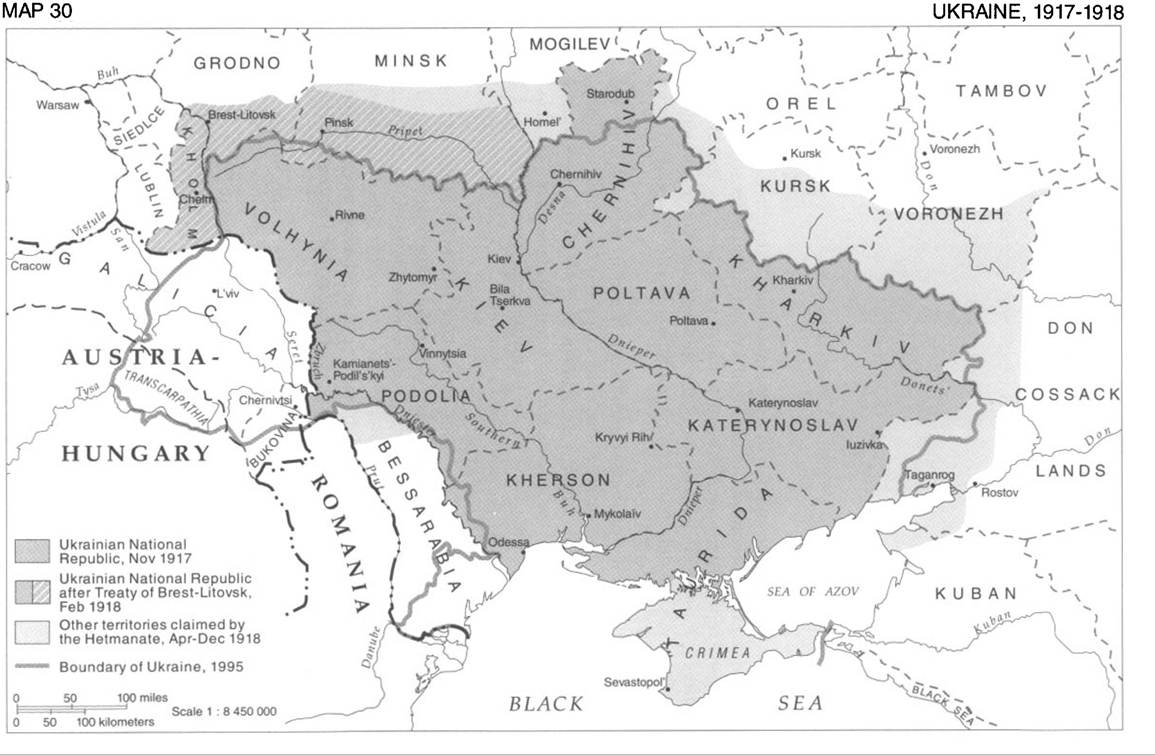
The seemingly cooperative relations between nationalist and Bolshevik supporters could not last long, however, because the Central Rada had already, on 8 November, condemned the coup in Petrograd and announced its intention to resist any similar attempts in Dnieper Ukraine. In this momentary political power vacuum, on 20 November 1917 the Central Rada issued its Third Universal. The document proclaimed for the first time the existence of the Ukrainian National Republic (Ukrains'ka Narodnia Respublyka), although instead of independence it favored federation with Russia. The territory of the new Ukrainian National Republic was to consist of nine former imperial provinces: Kiev, Podolia, Volhynia, Chernihiv, Poltava, Kharkiv, Katerynoslav, Kherson, and Taurida (excluding the Crimea). While not opting for complete independence, the Rada was nonetheless sensitive to the heady revolutionary fervor of the moment. The Third Universal therefore called for (1) the seizure of noble- and church-owned large landholdings and their distribution among the peasants, (2) the introduction of an eight- hour work day for the urban proletariat, (3) the nationalization of industries, (4)
Third Universal of the Ukrainian Central Rada (Preamble)
Ukrainian people and all peoples of Ukraine!
A heavy and difficult hour has fallen upon the land of the Russian Republic. In the capitals to the north a bloody civil struggle is raging. The Centra) Government has collapsed, and anarchy, lawlessness, and ruin are spreading throughout the state.
Our land is also in danger. Without a single, strong national authority, Ukraine may also fall into the abyss of civil war, destruction, and ruin.
Ukrainian people! You, together with the other fraternal peoples of Ukraine, have entrusted to us to guard the rights acquired through your struggles, and to create order and build a new life on our land. Therefore, we, the Ukrainian Central Rada, by your will and in the name of establishing order in our country’ and of saving all of Russia proclaim:
From this day forth, Ukraine becomes the Ukrainian National Republic.
Although not separating from the Russian Republic and therefore maintaining its unity, we nonetheless shall stand firmly on our own land, so that our strength may help all of Russia, and so that the entire Russian Republic will become a federation of equal and free peoples.
Until [the convocation of] a Constituent Assembly of Ukraine, all power to establish order in our country, to promulgate laws, and to govern belongs to us, the Ukrainian Central Rada, and to our government - the General Secretariat of Ukraine.
We shall use our power and authority to stand guard over freedom and revolution not only in our land, but also throughout all of Russia.
Kiev
7/20 November 1917
source: Taras Hunczak and Roman SoTchanyk, cds., Utmins'ia suspi!'no-polirydina duniku v20 atolitti:dokunieny i materiialy, Vol. I (New York 1983), pp. 340-341.
the granting of constitutional (non-territorial) autonomy to national minorities, (5) the abolition of the death penalty, (6) the strengthening of local self-government, and (7) the adoption of concrete measures to end the war. Finally, the Third Universal set 9 January 1918 as the date for elections to a Ukrainian constituent assembly, which would meet on 22 January. During the rest of November and December 1917, the Central Rada tried to consolidate its authority. It received support from the soviets in Kiev and from soviets in several of the country’s largest cities, including Katerynoslav, Odessa, and Mykolaiv. Only the Kharkiv Soviet refused to recognize the Rada, pledging itself directly to Petrograd instead.
The Ukrainian National Republic
The tenuous cooperation between Dnieper Ukraine’s Central Rada and local Bolsheviks loyal to the Soviet Council of People’s Commissars in Petrograd was not destined to last long. Petrograd’s Bolshevik government was displeased with the Rada’s claim to authority over the Ukrainian units in the Russian Army as well as its recognition of the neighboring Don Cossack Republic, which had declared its independence on 10 December 1917 and was fast becoming the center of a counterrevolutionary movement. Accordingly, Petrograd issued an ultimatum (received in Kiev on 17 December) stating that unless the Central Rada suspended its activity within forty-eight hours, the ‘Council of People’s Commissars [would] consider the Central Rada in a state of open war against the Soviet government in Russia and Ukraine.’2 Dnieper Ukraine’s Bolsheviks planned to convene the All-Ukrainian Congress of Workers’, Soldiers’, and Peasants’ Soviets on 17 December, which they expected to dominate and through which they hoped to take power throughout the countryside. Aware of this projected Bolshevik tactic, which was the one previously used so effectively in Petrograd, the Central Rada initially opposed the idea of a congress of soviets. Eventually, however, the Rada decided to prepare for a congress, and it called on its supporters throughout Dnieper Ukraine to join in its efforts.
When the Congress of Soviets met in Kiev as planned, on 17 December 1917, the Bolsheviks, who had at most 100 of 2,500 delegates, quickly discovered that they were far outnumbered by supporters of the Rada. Then, when the congress rejected the ultimatum of the Soviet government in Petrograd, the Bolsheviks, joined by a few other delegates, departed for Kharkiv. In Kharkiv, delegates from local soviets in the industrialized regions of the Donbas and Kryvyi Rih were already holding their own congress, which the returning representatives from Kiev renamed the First All-Ukrainian Congress of Soviets of Workers’, Soldiers’, and Peasants’ Deputies. Despite friction between the ‘Kievans’ and other delegations, on 25 December 1917 the central executive committee of the Kharkiv congress was able to form the first Soviet government in Dnieper Ukraine (Respublyka Rad Ukrainy). The new government was headed by the People’s Secretariat (Narodnyi Sekretariat), consisting of twelve ministers. With one exception, all the ministers were Bolsheviks, the most influential being Mykola Skrypnyk, who later served as the chairman. Hence, by the end of 1917 the almost year-long struggle for political power in Dnieper Ukraine had come down to two competing forces: (1) the Ukrainian National Republic, called into being by the Central Rada, which came to dominate the Kiev Soviet; and (2) the Soviet Ukrainian government, called into being by the All-Ukrainian Congress of Soviets of Workers’, Soldiers’, and Peasants’ Deputies, which was based in Kharkiv and made up mainly of Bolshevik-led workers from eastern Ukraine.
The Soviet Ukrainian government in Kharkiv was subordinate to the Bolsheviks in Petrograd, and with their help it began a campaign to undermine politically and then to remove from Kiev by military force the Central Rada and its Ukrainian National Republic. The Ukrainian entities in Kiev were described by the Bolsheviks as the ‘enemies of the people.’ Particularly helpful to the Kharkiv Soviet government was the arrival, on 25 December, of a Soviet Russian army led by Vladimir Antonov-Ovseenko. Together with the local Red Guards in Kharkiv and other eastern Ukrainian cities, Antonov-Ovseenko marched on Kiev. For its part, the Central Rada depended for defense on a modey array of forces: some Free Cossack units, workers’ battalions, and other groups such as the Haidamak Kish (under Symon Petliura) and the Galician-Bukovinian Battalion of Sich Riflemen (under levhen Konovalets'), made up of former Austrian prisoners of war. The Bolshevik invasion led by Antonov-Ovseenko at the beginning of 1918 marked the beginning of the military struggle for control of Dnieper Ukraine.
Faced with the loss of most of the Left Bank and the Donbas to Antonov- Ovseenko’s Red Army and the impossibility of further negotiation with the Bolshevik government in Russia, the Rada met in Kiev on 22 January 1918 - the day on which the Third Universal had called for the convening of a Ukrainian constituent assembly. The Rada’s response to the continued Bolshevik invasion was to issue, on 25 January, its Fourth Universal, which proclaimed the existence of an independent Ukrainian National Republic. (The document was actually dated 22 January, so that date was subsequently celebrated as independence day by Ukrainians in interwar Galicia and, until 1991, by Ukrainians living abroad). The Fourth Universal meant nothing to the Bolsheviks, who continued their drive toward Kiev. In the city itself, Bolshevik elements staged a coup on 29 January, but it was another ten days before Antonov-Ovseenko’s Red Army took the city. In the interim, the Rada of the recently proclaimed independent Ukrainian National Republic was forced to flee and take up residence farther west, in Zhytomyr. On 9 February, the Bolsheviks ruled in Kiev.
Meanwhile, the Soviet government in Petrograd made good its promise to end Russia’s participation in the war. In December 1918, it entered into peace negotiations with Germany and Austria-Hungary, as delegates from both sides met in the town of Brest-Litovsk. The Soviets desperately needed peace in order to consolidate their authority over the country. The Central Powers also wanted to eliminate the eastern front so that Germany could concentrate its forces against France and Italy in the west. Moreover, Germany and, especially, Austria-Hungary were in desperate need of foodstuffs and raw materials, which they hoped to obtain from Dnieper Ukraine. For these reasons, the Central Powers welcomed the presence of delegates from the Ukrainian National Republic’s Central Rada as well as from Finland, Poland, and the Baltic states, each of which had recently declared or was about to declare its independence from Russia. German, Austro- Hungarian, and Ukrainian interests thus coincided, and on 9 February 1918 the Central Powers signed with the Ukrainian National Republic a treaty at Brest- Litovsk. The Soviet Russian delegate, Trotskii, bitterly opposed the idea of any dismembering of the former tsarist empire, as did the Ukrainian Bolsheviks, who against Moscow’s orders continued to wage a guerrilla campaign against the Germans. Ultimately, it was Lenin who had the last word. Desperately in need of peace, the Soviet government accepted the provisions of the Treaty of Brest- Litovsk less than a month (3 March) after it was originally signed.
The Treaty of Brest-Litovsk
Whereas the Ukrainian people has, in the course of the present world war, declared its independence, and has expressed the desire to establish peace between the Ukrainian People’s Republic and the powers at present at war with Russia, the Governments of Germany, Austria-Hungary, Bulgaria, and Turkey have resolved to conclude a Treaty of Peace with the Government of the Ukrainian People’s Republic; they wish in this way to take the first step towards a lasting world peace, honorable for all parties, which shall not only put an end to the horrors of the war, but shall also contribute to the restoration of friendly relations between the peoples in the political, legal, economic, and intellectual spheres....
Article I.
Germany, Austria-Hungary, Bulgaria, and Turkey on the one hand, and the Ukrainian People’s Republic on the other hand, declare that the state of war between them is at an end. The contracting parties are resolved henceforth to live in peace and amity with one another.
Article II.
1. As between Austria-Hungary on the one hand, and the Ukrainian People’s Republic on the other hand, in so far as these two powers border upon one another, the frontiers which existed between the Austro-Hungarian monarchy and Russia prior to the outbreak of the present war will be preserved.
2. Further north, the frontier of the Ukrainian People’s Republic... will be delimited in detail by a mixed commission, according to the ethnographical conditions and after taking the wishes of the inhabitants into consideration....
Article 111.
The evacuation of the occupied territories shall begin immediately after the ratification of the present Treaty of Peace....
Article IV.
Diplomatic and consular relations between the contracting parties shall commence immediately after the ratification of the Treaty of Peace.
With respect to the admission of consuls on the widest scale possible on both sides special agreements are reserved.
Article V.
The contracting parties mutually renounce repayment of their war costs, that is to say, their state expenditure for the prosecution of the war, as well as payment for war damages, in other words, damages sustained by them and their nationals in the war areas through military measures, including all requisitions made in enemy territory.
Article VI.
Prisoners of war of both parties shall be released to their homeland in so far as they do not desire, with the approval of the state in whose territory they shall be, to remain within its territories or to proceed to another country....
Article VII.
The contracting parties mutually undertake to enter into economic relations without delay and to organise the exchange of goods on the basis of the following stipulations:
Until 31 July of the current year a reciprocal exchange of the surplus of their more important agricultural and industrial products, for the purpose of meeting current requirements, is to be effected according to provisions... settled on both sides by a commission composed of an equal number of representatives of both parties, which shall sit immediately after the Treaty of Peace has been signed....
The exchange of such products as are not determined by the above-mentioned commissions shall be effected on a basis of free trading....
In regard to the economic relations between Bulgaria and the Ukrainian People’s Republic, these shall, until such time as a definitive commercial Treaty shall have been concluded, be regulated on the basis of most-favored-nation treatment....
In regard to the economic relations between the Ottoman Empire and the Ukrainian People’s Republic, these shall, until such time as a definite commercial treaty shall have been concluded, be regulated on the basis of most-favored-nation treatment....
The Ukrainian People’s Republic shall make no claim to the preferential treatment which Germany grants to Austria-Hungary or to any other country bound to her by a customs union and directly bordering on Germany, or bordering indirectly through another country bound to her or to Austria-Hungary by a customs union, or to the preferential treatment which Germany grants to her own colonies, foreign possessions, and protectorates, or to countries bound to her by a customs union.
Germany shall make no claim to the preferential treatment which the Ukrainian People’s Republic grants to any other country....
Article VIII.
The establishment of public and private legal relations, the exchange of prisoners of war and interned civilians, the amnesty question, as well as the question of the treatment of merchant shipping in the enemy's hands shall be settled by means of separate treaties with the Ukrainian People’s Republic, which shall form an essential part of the present Treaty of Peace, and, as far as [is) practicable, come into force simultaneously therewith....
Final Provision.
The present Treaty of Peace shall be ratified. The ratifications shall be exchanged in Vienna at the earliest possible moment.
The Treaty of Peace shall come into force on its ratification, in so far as no stipulation to the contrary is contained therein.
Brest-Litovsk
February 9, 1918
Alleged Secret Clauses United States Department of State Report, June 20, 1918
A report from Stockholm states that the following secret clauses were included in the treaty which the Central Powers signed with the Rada of the Ukraine on 9 February, 1918. The object was stated to be the simplification of future relations along racial lines.
(a) All claims to districts to the west of the Dniester River are given up by Ukraine as well as all Ukrainian territory in eastern Galicia.
(b) An adjustment is to be made in Austria in regard to her frontier to the east of Galicia and the district of Lemberg [L'viv] is to be made the western limit of eastern Galicia, the division to be made on language lines.
Alleged Secret Agreement as Published in the Vienna Newspaper, Nene Freie Presse, July 7, 1918
In view of the fact that the Ukrainians have granted to the minorities living in Ukraine, and among the Poles, a far-reaching autonomy and the possibility of cultural development, therefore, we [the Austro-Hungarian government] also declare, in order to insure the national-cultural development of that part of the Ukrainian people who live within Austrian territory, and for the purpose of a closer connection between our states, that at the latest by 31 July, a bill will be introduced into Parliament dealing with the creation of a special crown-land from the Bukovina and that part of eastern Galicia which is preponderatingly [nr] inhabited by Ukrainians. The Austrian government will use all constitutional means at its disposal to the end that this hill may be given legal force through parliamentary action.
source: Texts of the Ukraine 'Peace' (Washington, D.C. 1918), pp. 9-25, 141.
According to the provisions of Brest-Litovsk and supplementary treaties and agreements signed between February and September 1918, both Soviet Russia and the Central Powers recognized Ukraine as a sovereign state. Soviet Russia agreed specifically ‘to conclude a peace at once with the Ukrainian National Republic’ and to clear that territory of pro-Soviet troops. The Central Powers agreed to return Ukrainian prisoners of war (especially numerous in German and Austrian camps) and to equip them for self-defense and for any struggle which might take place with the Bolsheviks.
The territory of the Ukrainian state recognized at Brest-Litovsk included not only the nine former imperial provinces previously claimed by the Central Rada (Volhynia, Podolia, Kiev, Chernihiv, Poltava, Kharkiv, Kherson, Katerynoslav, and northern Taurida), but also the former province of Kholm and the southern third of Minsk and Grodno provinces, including the city of Brest-Litovsk itself. The Ukrainian delegates at Brest-Litovsk also laid claim to the Ukrainian-inhabited territories in Austria-Hungary, but the best they could obtain was a secret protocol according to which the Austrian government agreed to introduce, by 31 July 1918, a parliamentary bill proposing the creation of a separate crownland consisting of ‘Bukovina and that part of eastern Galicia which is preponderatingly [sic] inhabited by Ukrainians.’3 The implementation of this protocol depended, however, on Ukraine’s ability to fulfill its treaty obligations, which included supplying 1 million tons (63,000,000 poods) of grain to the Central Powers by 31 July 1918.
The initial signing of the Treaty of Brest-Litovsk took place the very day (9 February) the Central Rada was driven out of Kiev by the Bolsheviks. By that time, all major centers on the Left Bank (Kharkiv, Chernihiv, Poltava, Katerynoslav) were also in the hands of the Soviet Red Guards. Faced with this situation, the Central Rada called for aid from the Central Powers. German and Austrian troops promptly entered Ukrainian territory, and backed by their support, the forces of the Ukrainian National Republic were able to drive the Bolsheviks out of Kiev on 1 March. The first Bolshevik occupation of Kiev thus lasted a mere twenty days. In the face of the German advance, the Soviet Ukrainian government, still bitterly divided into a Kiev faction and a Kharkiv faction (the latter having established in February its own Donets'-Kryvyi Rih Soviet Republic), fled to Soviet Russia.
The fledgling Ukrainian National Republic was now faced with a dilemma. With its very existence threatened by the Bolsheviks (the fighting continued in eastern Ukraine until late April), the Central Rada could survive only with German aid. In return, Ukraine was expected to supply huge quantities of grain and other foodstuffs, which would be difficult to obtain from a reluctant Ukrainian peasantry. After living more than a year in a revolutionary environment with little effective governmental authority anywhere, the peasantry was not about to give up its grain simply in response to a request by a far-off government in Kiev that claimed to represent Ukrainian national interests.
The result was tension between the peasant countryside and the government of the Ukrainian National Republic, and especially between the Central Rada and the German military authorities. It was not long before the Germans were convinced that the existing Ukrainian government would be ineffective in any effort to acquire raw materials and foodstuffs. Accordingly, the Germans laid plans to install their ‘own’ Ukrainian government. On 28 April 1918, the German Army deposed the Central Rada of the Ukrainian National Republic.
Thus, fourteen months after the first revolution in the Russian Empire had begun in February 1917, the first phase of the Ukrainian revolutionary era came to a close. During these fourteen months, and in the midst of competing political and, later, military factions on Ukrainian territory, the Central Rada, led by Mykhailo Hrushevs'kyi, emerged in Kiev as a force demanding first autonomy and then independence for a Ukrainain National Republic. After the second Russian, or Bolshevik, Revolution in November 1917, the Central Rada initially cooperated
Revolutions in the Russian Empire 487 with the local Bolsheviks. Their relationship soon dissolved, however, and the Rada was forced to abandon Kiev in the face of a Bolshevik attack that ostensibly represented a Soviet Ukrainian government based in Kharkiv. Like the Soviet Ukrainian government, which depended on the military support of Soviet Russia, the Central Rada of the Ukrainian National Republic was able to sustain itself only with the help of outside military support - the German Army. And when the German Army became displeased with the policies of the Central Rada, it was overthrown.