World War I and Western Ukraine
August 1914 is a landmark in modern history. Although people did not realize it at the time, that fateful month witnessed a series of events that were to lead to the outbreak of war - the first world war.
That war was to change the face of Europe and set the stage for another conflict that two decades later would change the face of the world. Ironically, by 1914 most Europeans anticipated, and some even hoped, that war would break out. Few, if any, could have foreseen its consequences. During the next four years, most European countries, as well as the United States, Canada, Japan, and the Middle East, were drawn into a conflict that in the end mobilized an incredible 65 million men, of whom 8.4 million were killed and 21 million were wounded. The statistics boggle the mind. No war until that time had cost so much in human lives.The outbreak of World War I
In the narrowest sense, the war began in Austria-Hungary after the heir to the throne, Franz Ferdinand, was assassinated in June 1914 by a Serbian nationalist. In a larger sense, the war was a result of power politics, a game that European states had played throughout history. By the end of the nineteenth century, Europe’s great powers included Great Britain, France, Germany, Italy, Russia, and Austria- Hungary. Another power was the Ottoman Empire, but despite its territorial extent it was weak vis-à-vis Europe’s other, more modern states. Each of the great powers was afraid that its rivals would take advantage of the weakened Ottoman state, and therefore all were willing to come to the aid, at least diplomatically, of the proverbial ‘sick man of Europe.’
At the beginning of the twentieth century, the existing international alliances saw Great Britain, France, and Russia pitted against Germany, Austria-Hungary, and Italy. As in previous decades, each side was anxious to block any attempted advance by the rival side with regard to the Ottoman Empire.
There was, of course, nothing sacred in the composition of the two great power alliances, and given sufficient reason each member could easily have realigned itself.The goals of each member within these alliances were different. Great Britain hoped to contain the growing military strength of Germany, while Germany saw Britain as a rival to be equaled or overtaken, especially on the sea. France’s chief object was territorial: to recover the provinces of Alsace and Lorraine on its eastern borders that had been lost to Germany in the Franco-Prussian war of 18701871. Italy, which ever since its own struggle for unity and independence had been opposed to the Habsburgs, hoped to acquire southern Tyrol and lands along the northern Adriatic Sea still ruled by Austria-Hungary. For the moment, however, Italy’s attention was turned toward establishing colonies in northern and eastern Africa. Since Italian interests in Africa clashed with French interests, France’s rivals, Germany and Austria-Hungary, became Italy’s allies.
Russia’s primary hope was to weaken the Ottoman Empire further and thereby achieve its centuries-old foreign policy goals. As a complement to the warm water ports on the Black Sea, which it had acquired in the late eighteenth century, Russia felt it needed unhindered access to if not outright control of the narrow straits held by the Ottomans between the Black and Aegean Seas (the Bosporus and the Dardanelles). Such access or control would allow Russia an easy passage to the trade routes of the Mediterranean. But because Russia was deterred by its own allies, especially Great Britain, from any direct assault on the Ottoman Empire, it directed its attention instead to stirring up national and irredentist feelings in the Balkans, among the Slavs and Romanians who either were still struggling to gain independence from the Ottoman Empire or had gained independence but still had further territorial claims to Ottoman-held lands. Russia’s activity in the Balkans reflected, in part, the spirit of the Pan-Slavism that had become integral to Russian intellectual and political thought during the nineteenth century.
In fact, it was as a result of direct and indirect aid from St Petersburg that Serbia (1817), Greece (1829-1830), Romania (1858-1862), Montenegro (1878), and Bulgaria (1878) became autonomous and, later, independent states. Russia and its smaller Balkan allies also had their sights set on liberating the supposedly oppressed Slavs in the Austro-Hungarian Empire. Not surprisingly, Austria-Hungary was wary of the increasing Russian influence in the Balkans as well as of the effects of that influence on the Slavic peoples living within its own borders.The Balkans became the area of greatest political tension, because alongside the great power rivalries in the region were conflicts among the Balkan states themselves. Two wars, in 1912 and 1913, reflected the bitter local rivalries among Bulgaria, Serbia, and Greece for territorial expansion, especially over Ottoman- controlled Macedonia. These tensions and conflicts prompted commentators to refer to the Balkans as the ‘powder keg of Europe.’ In 1914, the powder keg’s fuse was lit.
In June 1914, Austria-Hungary’s heir to the Habsburg throne, Franz Ferdinand, was on a state visit to Bosnia-Hercegovina. This formerly Ottoman-ruled Balkan land had been occupied by the Habsburg Empire in 1878 and finally annexed and placed under the joint authority of Austria and Hungary in 1908. While riding in an open car along the streets of Sarajevo, Bosnia’s administrative center, Franz Ferdinand and his wife were assassinated by a young terrorist who was a member of a nationalist organization based in neighboring independent Serbia.
Certain ruling circles in Habsburg Vienna, especially among the military, were convinced that now was the time to teach ‘little Serbia’ a lesson once and for all. Like their counterparts in many other European countries, the Austro-Hungarian military believed in the idea of a so-called preventive war; that is, strike at one’s enemy as soon as possible in order to weaken him before he develops into a greater threat.
Convinced of the feasibility of a short preventive war, the Habsburg government received assurances of support from its German ally and then issued an ultimatum to Serbia. In response, Serbia’s Slavic ‘brother’ in the east, tsarist Russia, pledged to support its threatened Balkan ally. All last-minute attempts at reconciliation (including Serbia’s acceptance of most of Austria’s demands) failed, and on 28 July 1914 Austria-Hungary declared war on Serbia. Russia mobilized along its borders with Germany and Austria-Hungary. Germany responded by declaring war on Russia on 1 August. By 12 August, each of the great powers had declared war on one of the others, and the two prewar coalitions evolved into the Entente (Great Britain, France, and Russia) and the Central Powers (Germany and Austria-Hungary). Subsequently, the Ottoman Empire and Bulgaria joined the Central Powers, and Italy, which initially had decided to remain neutral, joined the Entente in 1915. Finally, in 1917 the United States entered the war on the side of the Entente.The results of the war are well known. When an armistice was finally signed on ‘the eleventh hour of the eleventh day of the eleventh month’ (November) in 1918, the Central Powers had surrendered. At the time of the armistice, all the great monarchies of the Central Powers were disintegrating, and the government of the third leading member of the original Entente - the Russian Empire - had been overthrown by revolutions in March and November 1917. The second of these, the Bolshevik Revolution, resulted in Russia’s dropping out of the war. But how did Europe’s first great civil war of the twentieth century - to quote the former West German chancellor Willy Brandt - affect Ukrainians?
The Russians in Galicia and Bukovina
The Ukrainians in Austria-Hungary, not those in Dnieper Ukraine, were the first to be affected by the war. On 1 August 1914, several leaders of Ukrainian parties in Galicia (7 National Democrats, 4 Radicals, 4 Social-Democrats) joined together to form a non-partisan organization called the Supreme Ukrainian Council (Holovna Ukrains'ka Rada).
This council, headed by the Austrian parliamentarian Kost' Levyts'kyi and the political activist Mykhailo Pavlyk, declared its loyalty to Austria and issued an appeal for a united stand against the Russian Empire. Within a week after its founding, the Supreme Ukrainian Council called for volunteers to serve in the Austrian Army. Although some 28,000 initially responded, in the end only 2,500 were selected to serve in a military formation known as the Ukrainian Sich Riflemen (Ukrains'ki Sichovi Stril'tsi). This unit was to fight within Austrian ranks against the tsarist army on the eastern front.The war’s eastern front soon encompassed Galicia and Bukovina. Because those provinces bordered on the Russian Empire, and because in recent years the
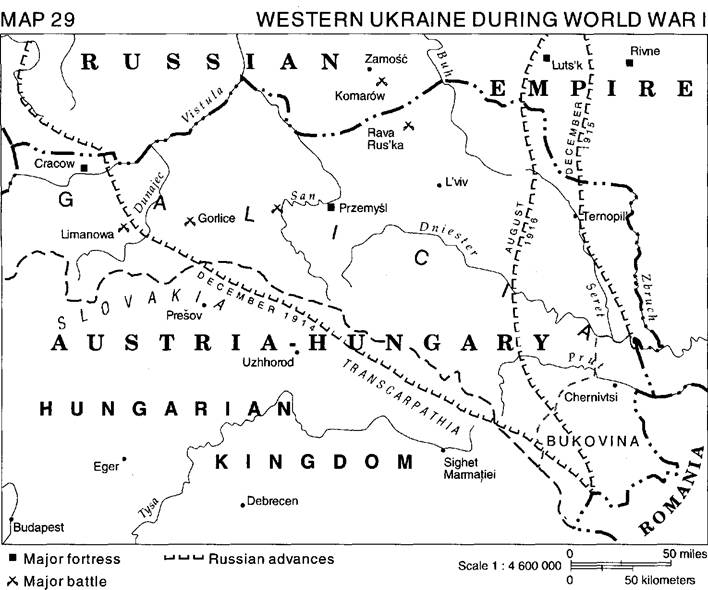
local russophile movement had expressed a sense of kinship with Russia, in early 1914 both the Hungarian and the Austrian governments held treason trials of suspected russophile and Orthodox subversives in Transcarpathia (at Sighet Marmajiei/Syhit Marmaros'kyi, December 1913 to February 1914) and Galicia (L'viv, March 1914). Then, with the outbreak of war in August, the Polish viceroy in Galicia ordered the arrest of several Russophiles whom he suspected - and in some cases rightly so - of being subversives within Austria.
During the first few days of August, the Austro-Hungarian Army (under Field Marshal Conrad von Hotzendorff) ventured into Russian territory, but beginning on 5 August a series of swift Russian counterattacks not only pushed back the Habsburg troops but enabled the Russians to enter Austria-Hungary. The Russian advance was rapid: by 3 September, tsarist armies had captured L'viv, and two days later they reached the San River. This meant that all of Ukrainian-inhabited Galicia as well as Bukovina came under tsarist Russian control. During their rapid and ignominious retreat, the Habsburg troops, especially units of the Hungarian national army (honveds), took revenge upon many inhabitants whom they considered Russian spies.
Peasants in eastern Galicia quite naturally identified themselves, if asked, as rus'kyi, in the sense of Rusyn, but to untutored Austrian and Hungarian ears this sounded like ‘Russian.’ Consequently, several thousand people - Russophiles, Ukrainophiles, and unsuspecting Greek Catholic or Orthodox peasants - were summarily shot, hanged, or herded off to internment camps in the western half of the empire, the most infamous being at Talerhof, near Graz, in Styria. It is from this period that the deep hatred between Ukrainophiles and Russophiles in Galicia derives, each side having accused the other of aiding and abetting the local Poles and Austrians in their anti-‘Russian’ fervor.The tsarist army pushed into Galicia as far west as the Dunajec River during September, and following some reverses in Bukovina it regained that province in November. Russian troops even penetrated several Carpathian passes and reached a few Rusyn-inhabited mountainous areas in northeastern Hungary (present-day eastern Slovakia and Transcarpathia). It was the capture of eastern Galicia and northern Bukovina, however, which the Russians considered a great political as well as military achievement. These territories were regarded in tsarist society as ‘Russian’ lands, ‘temporarily separated’ from the homeland but now after centuries finally ‘reunited’ with ‘mother Russia.’ To underscore this conception, Tsar Nicholas II himself paid a triumphant visit to L'viv in the spring of 1915.
In its newly acquired territory of Galicia, the Russian government installed a civilian administration headed by Count Georgii Bobrinskoi, a cousin of the head of the Galician-Russian Benevolent Society, founded in St Petersburg before the war. The tsarist officials turned for support to the local Russophiles (Semen Ben- dasiuk, Volodymyr Dudykevych, luliian lavors'kyi) who had remained in Galicia or had just returned from the Russian Empire, where they had emigrated before the war or fled after the outbreak of hostilities. Even some local Polish leaders (Professor Stanislaw Grabski and the former viceroy Leon Pininski), who had expected Russia to create a Polish state, worked with the Russians. In Bukovina, the tsarist army was welcomed by local Russophiles (especially the Gerovskii brothers, Aleksei and Georgii), as well as by the Orthodox hierarchy in Chernivtsi, which asked its priests ‘to pray for the tsar and for the victory of the Russian army, which did not come as enemies, but as saviours from Austrian oppression.’1
The Ukrainophiles were considered the enemy by tsarist officials. Ukrainian cultural institutions and cooperatives were closed, Russian replaced Ukrainian in schools, and in Galicia plans were made to dismantle the Greek Catholic church. Those leaders who had not already fled westward before the tsarist army’s advance were arrested and deported to the Russian Empire, including the Greek Catholic metropolitan of L'viv, Andrei Sheptyts'kyi, and the president of the now-closed Shevchenko Scientific Society, Professor Mykhailo Hrushevs'kyi, arrested in Kiev soon after his return there at the end of 1914. Russia’s efforts to liquidate the Ukrainian movement in eastern Galicia ended abruptly, however, in June 1915, when the Austro-Hungarian Army, with German help, drove the tsarist forces out of most of Galicia and Bukovina. During the rapid Russian retreat, local russophile leaders persuaded more than 25,000 Galicians to flee eastward. The tsarist government settled this group around Rostov, near the mouth of the Don River, where they remained until the end of the war. The tsarist army was able to hold on to the region of Galicia between the Seret and Zbruch Rivers (including Ternopil') for most of the war.
With the return of Austrian rule to most of Galicia and Bukovina in the summer of 1915, many persons suspected of having cooperated with the Russians were arrested and deported to the Talerhof internment camp. Two new treason trials were held in Vienna (1915 and 1916), at which more than thirty Russophiles from Galicia and Bukovina, including two parliamentary deputies (Dmytro Markov and Volodymyr Kurylovych), were found guilty and sentenced to death. The sentences were commuted to life imprisonment, but all were released from prison in 1917. At these trials, several Ukrainophiles gave testimony, thereby further embittering relations between the two national orientations.
Ukrainian institutions functioned once again following the return of Austrian rule. Again there was an interruption in the summer of 1916, when a successful Russian offensive (led by General Aleksei Brusilov) brought much of Bukovina and about one-third of eastern Galicia under tsarist control. Within a few months, however, the tsarist forces were driven back, although they continued to hold Galicia’s Ternopil' region, between the Seret and Zbruch Rivers, and virtually all of Bukovina. In both these areas, the Russians again set up a civil administration. This time, the local ukrainophile movement suffered less, owing to the fact that among the tsarist administrators were several Dnieper Ukrainians, including the historian Dmytro Doroshenko, who in 1917 became general-governor of Russian- controlled Bukovina and far eastern Galicia. Russian rule in these regions did not come to an end until late 1917, which meant that for most of the war Galicia and Bukovina were military zones along the eastern front.
Ukrainian political activity in Vienna
Because Galicia and Bukovina were in the war zone, the center of Ukrainian political life in the Austro-Hungarian Empire was transferred to the imperial capital of Vienna. In general, as the war progressed and as Austria-Hungary’s military fortunes waned, Ukrainian political demands increased. Nonetheless, it should be remembered that most Ukrainian leaders remained loyal to the idea of a Habsburg Empire until the very last months of the war.
Vienna was also a center for refugees from Dnieper Ukraine and the new headquarters of the Union for the Liberation of Ukraine (Soiuz Vyzvolennia Ukrainy), established in L'viv in August 1914. Since the Union was beholden to Austria for its hospitality and even for some financial aid from the Habsburg government, the liberated Ukraine it projected could not include Galicia, Bukovina, or Transcarpathia. In practice, the organization engaged in educational work to raise the national consciousness of Dnieper-Ukrainian prisoners of war held in Austria.
In contrast, Ukrainians from Galicia and Bukovina were politically engaged. On 5 may 1915, they founded in Vienna the General Ukrainian Council (Zahal'na Ukrains'ka Rada). Headed by the parliamentary deputy Kost' Levyts'kyi, this group called for an independent Ukrainian state based on territories in the Russian Empire, but only for autonomy in Galicia and Bukovina. With this goal in mind, the council pressed the old demand for the division of Galicia into separate Polish and Ukrainian provinces.
While the Austro-Hungarian government welcomed calls for the creation of an independent state in Dnieper Ukraine, which creation would weaken its Russian enemy, it was not about to sanction a division of Galicia. Tampering with Galicia would clearly alienate Poles both within and beyond the province, and the Habsburgs wanted to cultivate their support. Indeed, in November 1916 Austria and Germany announced their intention to create a Polish kingdom from lands they had captured from the Russian Empire. Although Vienna would not go as far as to include Galicia in the new Polish kingdom, the province was to receive greater autonomy. Given this larger scenario, the Ukrainian demand for a separate province in eastern Galicia was simply out of the question. Galician-Ukrainian political leaders protested vigorously, and within a few weeks after the death of Emperor Franz Joseph on 21 November 1916, the new emperor, Charles (reigned 1916-1918), promised that the Ukrainian demands would be settled favorably, but after the war. Once again Vienna adopted what had become its standard response to political problems - procrastination.
Austria’s nationalities, however, were no longer in the mood to wait or to be satisfied with promises. This became evident in 1917, when the Austrian parliament, closed by imperial decree since the beginning of the war, was allowed to reconvene. Deputies from each of the empire’s nationalities immediately put forth demands for greater autonomy. The Ukrainian Parliamentary Representation, led by levhen Petrushevych, declared unequivocally that his people’s continued subordination to the Poles within the boundaries of one province would be a violation of their national rights as well as of the principle of the self-determination of nations. The government tried to appease Petrushevych and his colleagues by appointing the first Ukrainian ever to the imperial cabinet, Ivan Horbachevs'kyi, as minister of health.
Yet by 1917 Austria’s half-hearted efforts at compromise held less interest, because momentous events were taking place elsewhere that would alter the future of Europe as well as affect profoundly the fate of Ukrainians within and beyond the boundaries of the Austro-Hungarian Empire. The Entente’s war aim was clear: to liberate the Slavic and Romanian peoples from foreign domination, that is, from Habsburg rule. In April 1917, the United States joined the Entente, and American support in supplies and soldiers gave an enormous boost to the cause of the Entente. Of even greater immediate significance were the events of 1917 in the Russian Empire. There, in March, a revolution broke out that toppled the centuries-old tsarist regime. It was followed by other developments that overshadowed events in the Habsburg Empire and had a profound and lasting impact on Ukrainians everywhere.
More on the topic World War I and Western Ukraine:
- Alpers Edward A.. The Indian Ocean in World History. Oxford University Press,2014. — 182 p., 2014
- Introduction
- Cold War Legacies
- In the history of Inner Asia, by which I mean the history of steppe empires from the Xiongnu (established in 209 bce) to the Manchu conquest of China (1644 ce),
- Conclusion
- The Russian Problem
- Settlements
- Conclusion