Singeing the Sultans Beard
The Knights of Malta were not alone in harassing the powerful Ottoman Empire. The war with Muscovy ended in 1582 and the Cossacks who took part quickly found themselves without employment.
Most participants had not been paid during the last year of the war, when the Sejms of the Polish-Lithuanian Commonwealth refused to vote more funds for Batory,s army. The Cossack regiments and many other units broke up feeling betrayed, and with the captured booty of war spent they found themselves looking for income. Raids and attacks on Muslim territory resumed with greater intensity, many of Batory s men joining the Cossacks. Theyhad become a more organized and powerful force and could raise an army of several thousand men, any larger forces being prohibited by the demographics of the frontier. Towards the end of the 16th century the Ukrainian provinces of Volin, Podilia, Bratslav and Kyiv consisted only of some 700,000 inhabitants—less than two persons per square kilometer.44 Most of the population was concentrated in the more settled areas of the interior, leaving much less for the southern frontier where the Cossacks drew their main strength. Fewwished to settle in the dangerous regions where a man went into the wheat fields, with musket and sword, and natural population growth was slow due to Tatar raids and invasions. The slave trade was not only a profitable enterprise—another motive seems to have been to keep the population of Ukraine low, as was pointed out by the Polish Chronicler Bielski: “The Turks are anxious that the (Cossack) lands remain empty and that the population not increase so that they may be safe in Constantinople.”45Ignoring treaties signed by kings and tsars, the Cossacks resumed their steppe campaigns in 1582 by attacking the Crimean Khans envoys from Muscovy, relieving them of valuable gifts and merchandise.
A year later a Cossack force of unknown size began to move against Moldavia in order to intervene on behalf of yet another pretender to the throne. The force could not have been very large since their way was successfully blocked by the royal Starosta of Bratslav, forcing them to turn south towards the Ottoman installations on the Dnister River. Here they proceeded to cause major damage. Storming the walls OfYaghirliq and Tighina (Bendery) the Cossacks took and destroyed both Turkish strongholds. The vigor and military prowess of the Zaporozhian Cossacks was gaining them an international reputation. The Italian Carolus Gamberini, who was in the service of the Papal nuncio in Warsaw, mentions the campaign in a 1586 report based on accounts by a Cossack “captain,” who was “a soldier of great valor and fame in these parts.” The Cossack claimed (with either his or Gamberini s evident exaggeration) that “Five or six thousand Turks were slain in that battle, with scarcely ten Cossacks killed. The fortress (Tighina) was destroyed to its foundation, and 40 pieces of artillery were taken.”46Gamberini was probably commissioned by the Pope to prepare a report on the Cossacks, who were beginning to come to his attention. Perhaps they reminded him of the Knights of Malta, who two decades before had held back an entire Ottoman army. The Zaporozhian Cossacks had sent emissaries to the Pope in 1583 suggesting an anti-Ottoman coalition of Christian powers in which they were willing to take part as an independent army. The intention was repeated to Gamberini by the Cossack “captain,” who “assured himself of discovering a means of gratifying an old desire: to carry out a memorable undertaking against the Turks—for the glory of God and the name of the Cossack people.”47
The destruction of Tighina drew the wrath of Sultan Murad III, who threatened King Batory with war. Already the king had to scrape together all available men to block a Tatar advance on Kyiv, led by Khan Mehmet Giray II in retaliation
for the Cossacklooting of his emissaries in 1582.
To pacify the Sultan, Batory had a number of Cossacks beheaded in Lviy as recounted by Gamberini s Cossack:He was bitter about the interference of the Polish King—his master (i.e., in whose service he was)—with Cossack efforts to attack the Turks, who were the common enemy. The Cossacks had received no recognition for their actions against the Turks, but rather had been harassed became of them. The last insult followed the conquest of Tiahynia (Tighina), an important Turkish fortress... the King in response to some claims sent to his court by the Turks, responded by beheading 22 brave Cossacks who happened to be in his hands.48
The Sultan had a solid case against King Batory The Ukrainian territory and the steppe up to the Crimean border was claimed by the King of Poland as part of his kingdom and was recognized as such by both the Sultan and the Khan. It followed that the Cossacks were officially the King s subjects and he bore responsibility for their attacks on the Sultans and the Khan s domains. In reality, the Polish Commonwealth claimed a region where no Polish soldier had ever set foot, and which was independent of Poland, Lithuania-Rus, or Muscovy. The Zaporozhian Cossacks recognized and owed no allegiance to any ruler, considering themselves a sovereign body, and entered into pacts and alliances with whomever they saw fit.
The Cossacks responded to Batory s executions by attacking the fortification at Ochakov and burning it to the ground. They continued into Crimean territory destroying Tatar “uluses” (villages) and driving off large herds of horses and cattle. Threatened with war, Batory sent an emissary to locate the herds, who was led into the steppe by the Cossacks and drowned. A Tatar army sent to attack Ukraine was met by a Cossack force and routed, and in the following year Zaporo- zhian raids on the Crimea intensified. Formal protests to King Batorywere to no avail and Khan Islam Giray II decided to take matters into his own hands.
In 1586 he led a Tatar army to attack the Zaporozhian Sich but nothing came of the invasion. While attempting to cross the Dnipro near the Tavolzhansky rapids where the river flows in a single calm narrow channel, the Tatars were met with musket fire and all attempts to dislodge the sharpshooters failed. Severalhundred Cossackmusketeers concealed in the underbrush on the bank of the Dnipro were sufficient to prevent a large Tatar force from crossing. This was a standard Zaporozhian defense strategy and was also described by the papal envoy Erich Lassota in 1593 when he visited the Sich. “At [Tavolzhansky] there were about 400 Cossacks concealed everywhere in the underbrush along the right bank. They had pulled their boats or czalny, on to shore. The camp (Kosh) had sent them to block the passage of Tatars if any of them, as they had already, attempted to try to cross.”Batory died in 1586 and, taking advantage of chaotic conditions in the Commonwealth that followed, the Zaporozhian Cossacks intensified their raids on the Tatars and the Turks. A force—probably no more than several hundred men—set off for one of their favorite targets, Ochakov. When night fell several Cossacks scaled the walls and, silencing the sentries, opened a gate to the waiting main force, which was concealed beyond the walls. The fort was sacked and destroyed, with the loss of the entire garrison. The Cossacks proceeded to Moldavia but after forcing the Hospodar to retreat they in turn had to withdraw, in the face of a strong Ottoman force which came to his rescue.
The Turks and Tatars retaliated by attempting a coordinated invasion ofUkraine and the southwestern lands of the Commonwealth. In 1589 a force led by Khan Islam Giray II was met and defeated by the Zaporozhians at the Kamianka tributary of the Dnipro, and when the Khan attempted to move west his path was blocked at a Dnister River crossing where he was wounded by a Cossack sharpshooter. The Ottoman advance from the Danube also headed back when it was confronted by a strong Polish Commonwealth force led by Hetman Jan Zamoyski.
The Cossacks had developed an early warning system against Tatar surprise attacks by putting the great kurgan mounds or “mohylas” (graves), as Ukrainians call them, to good use. Great torches of straw and tar were installed on the high mounds, beginning in the southern steppe and leading to the outskirts of Ukrainian settlements to the northwest. Cossack sentries were stationed on each mound and when the Tatars were spotted a torch would be lit sending billowing black smoke into the clear prairie sky. The signal would be picked up by the next mound, and so on down the line, until the Sich and the Cossack towns along the Dnipro were alerted to the danger.About this time the Zaporozhian Brotherhood decided to take the fight to the sea, something that few European powers were willing to do. Were they following the example of the Knights of Malta? Perhaps, but for the next century their raids on the Black Sea and the destruction of Ottoman ports and slave markets would catch the attention of all Europe. The Ottoman Empire was the strongest single naval power in the Mediterranean and the Black Sea, and already by the end of the 15th century it possessed 92 galleys with a total fleet of some 500 vessels including transports. During their war with Venice (1499-1502) the Ottomans introduced two giant ships carrying big guns—the largest vessels yet seen—each weighing 1800 tons. They could also build ships with astounding speed—the loss of almost the entire Mediterranean fleet at the sea battle of Lepanto, for example, was made up within a single year. In order to deal with the imposing Ottoman men-of-war, the Zaporozian Cossacks developed a simple yet effective strategy—the original sea wolf-pack method of naval warfare. Ottoman galleys would be followed and ambushed at sea by several dozen “tchaika” riverboats, sprayed with small cannon fire, and then quickly boarded and overcome in hand-to-hand fighting.
The first Zaporozhian Cossacknaval attack came on land in 1590 against the Crimean port of Evpatoria (Kozlov) led by the ottoman Zakhar Kuloha.
Arriving undetected by sea they destroyed the enemy ships in the harbor and attacked the city plundering the many rich shops and merchants’ stores. They were taken by surprise with the unexpected arrival of a large Tatar force and when Ataman Kulaha was killed in street fighting the Cossacks retreated to their boats with the loss of most of the booty. Other ventures soon followed and proved to be more successful. Bilhorod on the Dnister estuary was stormed and set on fire, and the Bukhora merchants trading in Azovwere attacked and deprived of their merchandise.The Cossacks soon came to the attention of Pope Clement VIII as well as the Holy Roman Empire under the Austrian Hapsburgs. Clement VIII had served as the Papal envoy in Poland for several years and was aware of the Cossacks and their activities. The war between Persia and the Ottoman Empire ended in 1590 with Armenia, Georgia and the Caspian region falling under Sultan Murad Ill’s domain, and he now turned his attention to Hungary which under Rudolph II had defied his authority. Sporadic Aghtinghad already broken out when under the urging of the Pope, an anti-Ottoman league began to be formed which included the Hapsburg domains, Transylvania, Wallachia and Moldavia. France and the Polish-Lithuanian Commonwealth, however, remained Ottoman allies and refused to join what they saw as a Hapsburg coalition. Moreover, the Polish aristocratic system of governance had become dysfunctional. All decisions of the Sejm had to be arrived at with a unanimous vote, which in practice was usually impossible, particularlywhen dealing with controversial matters. Now following Batory s death the Sejm was split on the royal vote, and two kings were elected to replace him—Zygmunt Vasa of Sweden (with a Jagellonian mother) and the HapsburgArchduke Maximilian. The conflict and chaos which followed were finally resolved by force of arms, when Zygmunt Vasas supporters won a victory in the battle of Byczyna on 24 January 1588 in which Cossacks played an important part. The Sejm (and the Senate) was also proving itself incapable of defending the realm since it was becoming impossible to raise an effective standing army due to the nobility’s reluctance to part with its money. Even when sufficient funds were approved they could only be dispensed after a declaration of war, by which time it was too late to gather a sufficient force.
Large payments were also made in tribute payments. The Porte now threatened war against the Commonwealth if it did not agree to an annual payment similar to what was received by the Crimean Khans. The Crown HetmanJan Zamoyskiwas sent to Constantinople to plead with the Sultan’s Vizier, where he found that he had little choice but to accept the Ottoman demands: Poland was to pay an annual tribute and reimburse the Porte for any damage caused by Cossack attacks, and in return there would be no Ottoman and Crimean invasion. The Polish Sejm now passed a motion, “The Regulation Concerning the Cossacks of Down Under and Ukraine,” meant to control Cossack activities, but this was an empty gesture since they were now masters of the entire Ukrainian frontier. The Cossacks were conducting independent military and political activities, and were entering into agreements with foreign powers and ignoring any resolutions passed in Warsaw.
The Hungarian War broke out in 1593 and two emissaries were sent to the Cossacks of Ukraine and the Zaporozhian Sich, one from Pope Clement VIII and the other from Emperor Rudolph II. Both were aware that Cossack exploits against the Tatars and the Turks were in a direct contravention of the Commonwealth’s policies and wishes. In fact, the year before the Polish Sejm had declared the Zaporozhian Cossacks as “enemies of the state” but to little avail. Most Cossacks continued to commute between the towns and the lower Dnipro region, and the designation of“Zaporozhian” Simplyindicatedwhere a Cossack happened to reside at the time. Rudolph’s emissary, Erich Las- sota von Steblau, was sent to the Zaporozhian Sich on Bazavluk Island in January 1594 where he arrived on 9 June. His personal diary provides some detailed descriptions of the Zaporozhian army.49 After describing Kyiv, which was still in ruins and mainly uninhabited, he mentions meeting a Muscovite envoy to the Sich who was bringing gifts from Tsar Fedor I. Here he was met by a party of Cossacks who escorted him to the Sich stronghold, where upon arrival he was greeted by a salute from their heavier guns. There were only several hundred Cossacks in the Sich at the time dispersed among the “kurens” or communal wooden barracks, and it was a week later that Hetman Bohdan Myko- shynsky returned with the main force from an expedition, which had left with 1,300 men in 50 “tchaika” boats. A large Tatar force was preparing to cross the Dnipro River near Ochakov, escorted by an Ottoman fleet of 8 galleys, 15 smaller caravels, and 150 small sandal boats. After skirmishes on land and on the estuary the Cossacks were powerless to prevent the Tatar army from crossing and continuing on its way to Hungary. They first passed through Moldavia, with the support of the ruler Aaron who had become an Ottoman ally, and entering Galicia unopposed the Tatars began to loot and destroy one town after another, causing unprecedented damage and slaughter of the population. The Polish government had reneged on its commitment to prevent the Tatars from entering Hungary, earning the Poles “eternal shame in all of Christendom” as exclaimed by the Lithuanian-Rus Vice-ChancellorJarosha Volovich when he heard of the invasion.
Lassota was empowered by Rudolph II to pay the Cossacks 8,000 gold ducats but little else if they would go to Moldavia and attack Ottoman possessions. More, he promised, would be paid for good service rendered. Discussions between the two sides went on for a week, and the offer was finally reJected after first being accepted by the rank and file—“it was not their custom to commit themselves to service and set out under such uncertain conditions/’ as they pointed out. Specifically they gave three reasons for refusing the contract: they had lost most of their horses to a Tatar raid; they could only raise a force of3,000 fit Cossacks; and thirdly 8,000 gold ducats was not enough to provide supplies for such a long campaign, “especially since many of the men were poor.” Probably the Tsar’s envoy, whom the Cossacks had seen first, offered a more attractive deal. The Imperial envoy offers a rare eyewitness account of the direct democracy which was practiced by the Za- porozhian Cossacks when faced with a decision.
We were given an audience in the “kolo” (circle, the Cossack council) and presented, in writing, our instructions for recruitment. Thereupon they asked us to withdraw, read the letter aloud and demanded that each Cossack give his opinion of the matter. However, even after several requests from the Hetman, they continued to be silent. Then they broke up into two groups (as is their custom when dealing with important matters) and formed two “kolos.” One consisted of the officers and the other of the rank-and-file, whom they call “chern.” After a lengthy discussion the “chern” agreed to enter His Imperial majesty’s service and, in their traditional sign of consent, they threw their caps into the air. Then the mob rushed over to the other “kolo,” that of the officers, and threatened to throw into the river and drown anyone who disagreed with them. The officers, however, also agreed because they did not wish to contradict the stronger, more numerous and more dangerous “chern,” which when infuriated does not accept any opposition.50
with this equipment there is no need to hire and maintain special cannoneers.51
Lassota mentions the Cossacks firing rockets and heavy gun salutes as they were leaving the Sich, and refers to them as the “knightly company of Zaporozhiansf who also sent men carrying a letter to the Emperor, explaining that they nevertheless would fight the Tatars, “because of the example of our forefathers who earned their bread by knightly pursuits, and because we are men who always stand ready at the service of Your Imperial Majesty and all Christendom.” Clearlythe Cossacks were not Simplybandits living for loot as they are described at times. War booty was certainly a part of their “income” but social customs were also at play. It was virtually unthinkable that a home- coming, a wedding (especially ones own) or a christening not be accompanied by lavish gifts. Besides, Turkish weapons and Ottoman carpets were highly prized, so much so that they were hung on walls as decorations rather than placed on bare floors.
By the time ofLassotas visit the Zaporozhian Sich had already assumed its familiar form. Built on an island of the Dinipro it was surrounded by a wooden palisade armed with artillery, and a large square in the center called a “maidan” was surrounded by “kuren” single-story log barracks. These housed the garrison, who were normally full-fledged members of the Brotherhood easily recognized by the hairlocks on their shaved heads. The “kuren” was a company platoon commanded by a “kuren ataman” and could have anywhere from 5 to 30 occupants, depending on how many were away on expeditions. Each “kuren” was named after a Cossack region such as Poltava, Baturin, Cherkassy, Irklivsk, 38 in all. During a battle members of a “kuren” fought together, which tended to enhance the already high morale of a Cossack regiment, but with the growth in numbers a “kuren” could number 100 men, as membership became nominal without a Cossack actually having to reside in the log barrack. The nomenclature of the 38 “kurens” indicates with some precision the actual territory under Cossack Controlwhich consisted of eastern Podilia and Volin, the Kyiv, Poltava, and Chernihivprovinces of today s central Ukraine, east Ukrainian territory around the Donets and Don rivers, and a part of southern Belarus to the north. Although Lassotas diary is silent on the matter the Zaporozhian Sich was out of bounds for women unless they were captives waiting to be exchanged or ransomed. The strict ban on keeping women in the communal barracks, however, did not have any special significance since a similar ban also existed when embarking on a campaign. Togetherwith the prohibition on alcohol during a campaign the ban on women was simply a disciplinary precaution.52
Although at first agreeing to the Emperor’s offer, they changed their minds after hearing further opinions from some individuals during more “kolo” meetings. Lassota also gives an indication of the Cossacks’ up-to-date military equipment, their concept of equality, and the worth of the individual and recommends them for any future service with the Emperor:
First, I assume that the war begun with the Turks will last more than a year or two. Therefore, it would not be wise to reject such brave and valiant men who from their youth are trained in warfare and have such a good knowledge of their enemies, the Turks and Tatars, with whom they deal almost daily. Second, the maintenance of such an army is easier than that of other nations’ troops, because their officers do not receive any additional payments which usually adds up to no mean sum. They also have their own ammunition and artillery and since many of them know how to deal
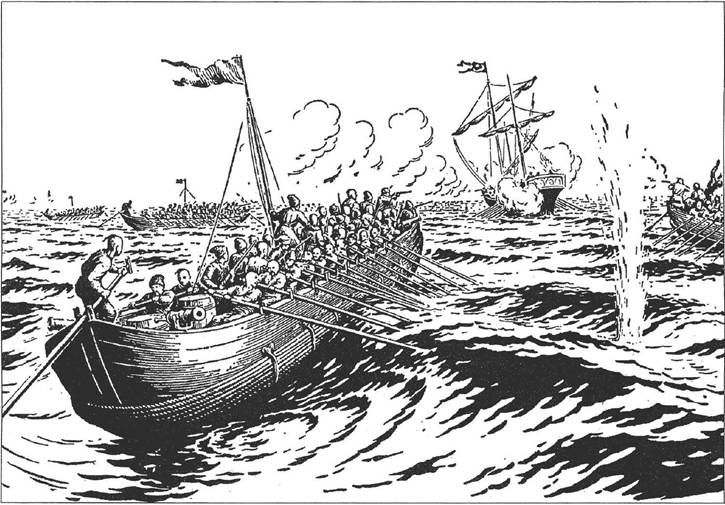
Cossack “tchaika” boats attacking Turkish galleons on the Black Sea. With bundles of hollow reeds tied to their sides the boats were virtually unsinkable.
Cossack involvement in the Hungarian War was high on the coalitions agenda, and after dispatching two letters Pope Clement VIII instructed his Croatian legate Alexander Co- mulovich to also negotiate an anti-Ottoman agreement with the Cossacks. Given Poland s pro-Ottoman orientation Co- mulovich was to go to Ukraine and Secretlymeet Cossack leaders. As instructed by the Pope: “If you... come to believe that the Poles will not like any movement on the part of the Kozaks, then you will have to conceal your intentions.... [To] avoid interference you will select a place for the negotiations on the border of Poland... such as Kaniv, Korsun or Cherkasy.”53
In his letters the Pope had already admonished the Greek Orthodox Cossacks to “defend the common Christian Commonwealth, to protect the holy religion....” In April 1594 Co- mulovich met the leader of a 2,500 man Cossack force, Semery Nalyvaiko, in Kamianets and secured his agreement to attack the Turks, on condition he receive IOO florins for supplies. With the agreement concluded, Nalyvaiko attacked and captured the Turkish citadel of Parkassy on the Dnister River and raided Ottoman possessions lying between Tighina and Akkerman. The Porte protested, and the Polish Senate responded with a letter of 26 April 1594 reassuring the Sultan of the friendship between Warsaw and the Sublime Porte, describing the Cossacks as enemies of both the Polish State and the Ottoman Empire.54
In February 1594 the Prince of Transylvania, Zygmunt Batory, signed a military treaty with Rudolph II, and in Wallachia the Voevoda Michael the Brave revolted against the Sultan and joined the coalition. Only the Hospodar of Moldavia, Aaron, who was still playing a double game, hesitated. Although he had given Comulovich a pledge to break his ties with Sultan Murad III, he also helped the Tatar horde cross into Hungary when the Zaporozhians failed to stop them at Ochakov. In preparation for a major campaign, the Zaporozhians, who were led by their ataman Loboda, joined forces with Nalyvaikos mixed force of town Cossacks and other freebooters, and in October marched into Moldavia flying two imperial banners they had received from Lassota on his trip to the Sich. With 12,000 men the reinforced Cossack army crossed the Dnister and headed towards the Prut River where they captured and destroyed Tsetsora (Cecora). Following HospodarAarons retreating army they next took his capital Jassy, inflicting heavy losses on the Moldavians. The Cossack victories and participation in the war were probably a decisive factor in Prince Bathory,s great victory over the Turks at Mantin, and Sinan Pashas defeat at Bucharest at the hands of Michael the Brave ofWallachia. In the three battles that followed, Aarons army was also badly defeated with the loss of most of his artillery, and the Moldavian Hospodar saw no option but to switch allegiance and join the anti-Ottoman alliance. Togetherwith the Cossacks, the Moldavians stormed the Ottoman forts at Tiahy- nia, Akkerman, and Kilia and in August 1595 a combined Wallachian, Transylvanian Moldavian, and Cossack army inflicted a defeat on the Turks at Calugareny The victories were not to last. The Wallachians and Transylvanians were defeated by fresh Ottoman troops and as the Sultan s ally the Polish King sent Hetman Zamoyski into Moldavia to install a local boyar named Jarema Movila (Mohila) as the new hospodar. Movila swore allegiance to the new Ottoman Sultan Mehmet III, but with Zamoyskis troops stationed in Moldavia the principality became a Polish protectorate. Loboda and Nalyvaiko gave Zyg- munt Batory assistance in Transylvania for a few more months, but faced with greater forces they returned to Ukraine.
Many of the greatest Cossack achievements against the Turks were on the Black Sea, and the Zaporozhians soon realized that it was easier to attack by sea than by land. The defensive walls were usually not as strong along the water, and a small force of “tchaika” boats could easily come up during the night and catch the defenders by surprise. The river boats were fast and could be made seaworthy by tying bundles of reeds along the sides, which made them difficult to sink. Preparations for a raid would begin months in advance, with a “rada” or council meeting to decide if an expedition was to take place. Following a favorable decision, an ataman was elected to lead them and the building of the “tchaikas” would begin using planks which were held in storage. The Sieur de Beauplan left a detailed description of the “tchaika” boats and the Cossack tactics used at sea against enemy ships. A typical “tchaika” was about 6½ meters long, 3½-4 meters wide, and about 4½ meters deep and was put together with nails and waterproofed with tar. A description of the “tchaikas” in action during a Prussian Campaign in 1635, when 1500 Zaporozhian Cossacks were led by AtamanVovk (“Wolf”), was recorded by King Wladyslav s commander, Prince Radziwill:
And it is plainly a wonder that they face a turbulent sea on such small vessels, lined with reed bindings in such a way that they are rarely overcome by the waves. Their boldness ensures their safety. When the wind rises high foamy waves and it seems that they will be wrecked, they bob on the waves, protected from the water by those woven bindings that are lashed to both sides.... Pillau (a Baltic port) saw for itself how a high wind and a storm arose and scattered them without inflicting any damage. Returning to their ranks, they gathered before the port once again in their previous order.55
They were also very maneuverable, with two prows each provided with a steering paddle, and could change directions without having to turn around. The “tchaikas” were powered by 20-30 oars, with two men per oar, and a small rudimentary sail attached to a mast, and could cover the 560 kilometer distance to Asia Minor in less than two days which gave them an average speed of about 20 kilometers per hour. Each “tchaika” carried about 50 Cossacks each armed with two muskets, a saber, a dagger, and pistols. The boat was mounted with 4-6 falconet swivel guns attached to the sides and the prows and was provisioned with millet, dried fish, gunpowder, and lead shot. Alcohol was forbidden on pain of summary execution: on the boat commander’s orders, the guilty Cossackwas simply thrown overboard and told “take a good drink, you son-of-a- bitch, if you are so thirsty! ”
Once at sea the Cossackswould try to avoid detection and reach their destination as quickly as possible. The choice of whether to engage the enemy usually rested with the Cossacks, since the “tchaika” boats sat low in the water and could remain out of sight behind the horizon. During the night, unknown to the enemy, the Cossacks would maneuver their boats so as to have the sun at their backs. At dawn, on a given signal, they would launch an attack out of the sun, swivel guns blazing. Once within musket range, half of the rowers would commence firing and enemy vessels would usually be captured by boarding parties in hand-to-hand combat. The crucial maneuver was to move under the galleys’ guns as quickly as possible, where they would be safe from artillery fire. If outnumbered the Cossacks would try to take the enemy by surprise in a midnight attack. Ottoman shipping, however, was often protected by galleys with long-range guns, and by the early 17th century Cossack casualties could be high, as reported by Beauplan: “Upon these occasions they Commonlylose two-thirds of their men and seldom come off with half, but they bring rich booty such as Spanish reales’ (gold coins), Arabian sequines (cloth), carpets, cloth of gold, cotton, silks and other commodities of great value.”56
The Cossacks soon became a terror of Muslim shipping in the Black Sea, and even the Ottoman men-of-war learned to be wary of them. Not all raids on Ottoman possessions have been recorded, but some of the major ones are known. One of the earliest campaigns on the Black Sea was launched in the summer of 1606 against coastal Ottoman cities and towns, including the strongholds at Kilia and Akkerman. Ten galleys were also captured with equipment, provisions and crew. The height of the campaign was the spectacular sea assault and capture of the major Ottoman-Bulgarian port of Varna, where most inhabitants were put to the sword and booty taken was reportedly valued at 180,000 gold “zlotys.” A Ukrainian ballad has survived which commemorates the conquest of Varna.
On Sunday morning crowds gathered
For a Cossack meeting.
Theybegan to consult on how to capture Varna.
From the field or from the sea;
Or from the small river?
The patrol captured a Turk, an old fortune-teller
They questioned him how to capture Varna:
From the field or from the sea:
Or from the small river?
Neither from the field nor from the sea,
But from the small river.
They hurried and rowed in boats,
Their oars glittering.
They fired their muskets, seven-span long,
And half a hundred cannon (and)
Began to ConquerVarna.
Varna has long been renowned
But the Cossacks were more renowned; they seized Varna
And captured the Turks in it.”57
Other raids followed. In the autumn of 1608, Cossacks captured the Tatar fort of Perekop and burned it to the ground after pillaging it, and in the autumn of the following year 16 “tchaikas” destroyed Danubian citadels at Izmail, Kilia and Akkerman but had to withdraw quickly when a large Ottoman force arrived. In the summer of 1612 the Crimean Tatars led by Khan Giray III in turn ravaged Podilia, but was attacked by Cossacks near Bila Terka and routed, with some 5,000 prisoners destined for the slave markets liberated. The following year it was the Cossacks who destroyed Tatar towns and surrounding areas, freed the slaves and took war booty. An Ottoman fleet sent to intercept the Cossacks at Ochakovwas attacked at night and destroyed.
Not all expeditions were successful. In the spring of 1614, a Cossack maritime expedition was caught unawares in a heavy storm. Many “tchaikas” were sunk with heavy casualties and the event is still remembered in “The Duma of Olexa Popovich,” which has come down to us. The storm was called upon the Cossacks because of great sins committed by one Oleksa Popovich (son of a priest), and immediately subsided once he confessed his sins before the Cossacks. In spite of the losses suffered during the gale, a heavy attack was mounted in the summer of 1614 on the north shore of Asia Minor, an event which had not been witnessed for centuries. A strong force of 2000 Cossacks crossed the Black Sea in 40-50 “tchaikas” and began to sack and pillage the wealthy coastal towns and villages in the vicinity of Trabzon (Trebizond). In keeping with the usual practice no mercy was shown to the local population, but freed slaves and other prisoners who were willing to join them were often taken back in the empty spaces left by the killed Cossacks, or were freed outright. Next Sinope was attacked, as recorded by the Ottoman chronicler Mustafa Naima.
They (the Cossacks) attacked the fortress of Sinope, situated on the Anatolian coast and known as the lovers’ city because of its luxurious surroundings. Having conquered the ancient local castle they slaughtered the garrison, robbed and devastated the Muslim houses, and in the end burned down the whole city.58
The entire arsenal was also destroyed, including the galleys and other ships that were anchored in the port. The Ottoman Sultan Ahmed I ordered his grand Vizier Nasukh Pasha to be hanged for incompetence, but in the end relented and had him beaten with iron maces. The Ottoman admiral Ahmed Pasha decided to ambush the returning Cossackfleet at the mouth of the Dnipro, by the Ochakov fortress. His fleet was spotted and the Cossacks split into two groups. One group decided to portage their boats around the Ottoman fleet, but was attacked by Tatars and suffered heavy losses while the other lightened their boats by throwing much of the booty overboard, engaged the enemy fleet and managed to break through. Twenty Cossacks were taken prisoners and sent to Turkey, where they were interrogated and tortured by Ahmed Pasha’s men. Afterward, the citizens of Trebzon took their vengeance upon them in the streets.
The Sultan sent a letter of protest to his ally the Polish King Zygmunt III, with a veiled threat—either he take steps to eliminate the Cossacks or else he himself would do the job. Not willing (and financially unable) to attack the Cossack settlements and the Sich “down under,” the King “ordered” a halt to all raids and revoked once again all Cossack “privileges.” They were, after all, theoretically under the King’s authority, based on the Royal Charter of 1572. The threats, however, fell on deaf ears. In spite of the official politically correct declarations of “loyalty,” in actual fact the Cossacks did not recognize Polish Roman Catholic authority, and in the spring of 1615 a large force of 4,OOO Cossacks in some 80 “tchaika” boats slipped past the Turkish galleys on a moonless night and entered the Black Sea. Their destination was no less than Constantinople, the capital of the Ottoman Empire. Crossing the Black Sea undetected they landed between the city’s two ports, Nesebur (Mesembria) and Ankhialo, and dividing into two groups they captured both ports and set them on fire. The billowing smoke was visible at a great distance, and was seen by the Sultan himself even though he was away on a hunting trip at the time. Apowerful fleet was assembled and sent to pursue the Cossacks, but reaching the Danube delta another surprise awaited the Turks. Without warning the “tchaikas” turned on the Ottoman men-of-war and under protective musket fire the Cossacks began to scale the tall ships. Desperate hand-to-hand fighting broke out but the Ottoman crew and troops were no match for the Cossacks. The entire Ottoman fleet fell into their hands when their commander surrendered on the Cossackpledge that he would be ransomed for 30,000 gold pieces, but he died shortly afterwards from wounds received in the fighting. All galley slaves were set free in the usual manner, and those with military experience were allowed to join the Cossacks. On their way back they captured the fortress of Ochakov for good measure, capturing much needed provisions.
The Sultan was busy with the Persians and in retaliation sent the Crimean Khan to attack the Ukrainian frontier and southern provinces of Rus. A Tatar horde invaded Podilia and Volin in the autumn of 1615 and began to plunder and devastate the region at will. This became one of the most deadly invasions by the Tatars of territory claimed by the Polish Commonwealth. The Polish Crown Hetman had no troops to oppose them, and a royal proclamation to the nobility went unheeded. After seizing a large number of prisoners for the slave markets and other booty, and putting much of the remaining population to the sword, the Tatar Horde returned safely to the Crimea. By now the Polish Commonwealth had lost all respect in the eyes of neighboring powers, as was expressed in a letter by Khan Janibeg Giray to King Zygmunt III: “Making war is not for you! It is not your business. For those who want to invade and mark war—this is how war is waged!”59
The Sultan also sent a large naval force into the Dnipro estuary to attack the Zaporozhian Sich. As the Ottoman fleet was making its way upstream through the narrow channels of the rivers its CommanderAli Pasha had to make a choice: either split his fleet and proceed along the two channels which flowed past the river islands, or else sail along a single channel in single file formation. Either maneuver exposed his fleet to a simultaneous assault on both sides, and this is what occurred. The boats were suddenly attacked by the “tchaikas” hidden in the reeds and completely overpowered.60 A dozen large galleys and about one hundred smaller boats were captured and Ali Pasha barely escaped with his life. With “tchaikas” reinforced by the captured Ottoman men-of-war the Cossacks attacked the Crimean coast and stormed the slave port of Kaffa, burning it to the ground. Many of the liberated slaves had been captured in the previous great Tatar invasion of Podilia and Volin, and no doubt included many of the Cossacks’ relatives and friends. The attack on the Ottoman fleet and Kaffa was led by Petro Sa- haidachny, of future fame in the Moscow campaign and later in the battle of Khotin.
As a result of the Cossack raid fighting broke out in Moldavia between the Porte and the Polish Commonwealth. After several defeats the Crown Hetman Zolkiewski succeeded in mobilizing enough of the nobilities’ forces and with his meager Crown troops managed to prevent the Turks from advancing into Commonwealth territory. The Armistice which followed was quickly broken in 1616 when 2000 Cossacks mounted an expedition and attacked the northern shores of Asia Minor and for the second time sacked Trebzon. A fleet of six galleys and other smaller craft was dispatched under the command of Chikola (Cicala) Pasha, a Genoese sailor who had sought service with the Sultan. The Cossacks met the enemy fleet head on which was routed with the loss of three galleys and other ships. As the Cossack expeditionary force was returning home it learned that the Sultan had dispatched a second, larger fleet to Ochakov under Admiral Ibrahim Pasha to intercept their return to the mouth of the Dnipro. The Cossacks decided to take the Turks by surprise, and Sailingbacktowards Constantinople they attacked and laid waste to the Bosphorus, penetrating and sacking the environs of the Ottoman capital. This was a feat in which no major power had succeeded, and greatly impressed the French envoy, Philippe de Harlay Compte de Cesy, who witnessed the attack:
The Cossacks are constantly at hand on the Black Sea where they are making incredible conquests considering their weak forces, and their reputation is such that the Turkish soldiers have to be beaten with sticks to make them go to war against them, in the few galleys that the Sovereign Lordship (the Sultan) is dispatching, with great difficulty.61
Having suffered losses the Cossacks decided to head east to the Sea of Azov and avoid a fight with Ibrahim Pashas fleet, which was lying in wait for them at the Dnipros mouth. Realizing what had happened and knowing that the Saporozhian Sich would be largely undefended, the Ottoman commander decided to attack the Cossack stronghold. Finding the Sich deserted he burned it to the ground, later expressing surprise at the simple lifestyle which he found in the Cossack “kuren” barracks. He returned in triumph to Constantinople bringing news of the destruction of the Sich, with several small cannons and a few “tchaika” boats as proof of his “victory.”
The Cossack expeditions of 1616 provoked an Ottoman invasion of Moldavia but were prevented from advancing further into Podilia by the Polish crown army, which was stationed there under the command of Hetman Zolkiewski and Supportedbythe nobility’s private forces. An armistice arrived at was immediately negated by a second Cossack naval excursion. The Sultan was becoming annoyed, and in the following year a large Tatar horde invaded Volin followed by an Ottoman army advancing from the west. This time the Hetman was reinforced by Prince Wladyslav s army, which had been preparing to invade Muscovy, and by the nobility s serving men. Zolkiew- ski’s army succeeded in blocking the Ottoman force led by Isk- ender Pasha, but neither side wished to risk a confrontation. Taking advantage of the stalemate the Tatars advanced into Galicia and under the Commonwealth army’s very noses began to plunder the territory. Another armistice was soon negotiated. Iskender Pasha turned back and Zolkiewski moved against the Cossacks to force them into submission and demobilize a part of their army. Cossack services, however, were needed in a Moscow campaign and a “status quo” arrangement was arrived at, following which a Cossack naval expedition in the autumn of 1617 again did great damage to the Turks when an Ottoman fleet was routed in a sea battle and its admiral, a relative of the Sultan, was killed. In the spring of the following year another sea expedition involving also the Don Cossacks took place and provoked the usual Tatar and Turkish retaliation, leading to the great Ottoman invasion and the battles of Tsitsora (Cecora) and Khotyn, which would soon follow.
Sultan Osman II advanced on Moldavia with a large army with most of the Black Sea fleet, and taking advantage of the absence of the Turkish fleet, a flotilla of 16 Cossack “tchaikas” attacked the suburbs of Constantinople in a commando-like raid in August 1621, and with a larger fleet again in the spring of 1622. The following year some 30 “tchaika” boats sailed to the Crimea, and then to the Bosphorus, gaining Somewarbooty and creating a mild panic in the capital itself. It seems the gains were not very good since upon returning to the Sich they set off again for the open sea, but this time they were intercepted by Ottoman men-of-war. A fire-fight broke out and several Cossacks were captured and brought before the Sultan, together with a dozen or so severed Cossackheads which, by the Sultan’s decree, fetched 50 ducats each. An Englishman who was a witness reported that the new Sultan Mustafa I ordered the heads to be exhibited to the public in celebration of the triumph, and to show that the Cossacks could be defeated.
It was in the following year in the summer of 1624 that the greatest attacks on the Ottoman capital took place with three large raids launched in succession. Afewyears before, the Crimean Khan Mehmet Giray the Sultan’s vassal had revolted against his master and called for Cossackhelp. The new Sultan Murad IV responded by sending his Black Sea fleet to re-occupy the Ottoman Crimean port Kaffa and to depose the Khan.62 This was an opportunity too good to pass, and on 9 July 1624 at the crack of dawn a large Cossack flotilla of some 70-80 “tchaikas,” each carrying 50 men, set out for the open sea. After two to three days they were in the Bosphorus channel, and disembarking on the European shore they launched a large-scale military operation. Biiyiikdere, Yenikoy and Istinye were captured and destroyed and other detachments turned their attention to the luxurious villas lining the shore, which in the space of sixhours were stripped of all valuables. The Sultan personally took charge Ofwhatevervessels and military units were available and an improvised fleet of several hundred boats sailed out, expecting the Cossack “tchaikas” to flee at the sight of such a large fleet. The Cossack boats, however, formed a semicircle and waited for the Turks to attack. Firing several ineffectual salvos and not daring to lose his fleet in a direct attack, Halil Pasha ordered a withdrawal towards Constantinople, allowing the
Cossacks to sail out leisurely into the open sea with rich spoils of war. Before departing they sat before Constantinople in defiance until dusk, letting the Sultan and the dignitaries of “the capital of the world” take a good look at who they were dealing with.
When the booty was unloaded in the Sich and distributed in the traditional manner, just two weeks later a larger fleet of 150 vessels set out for the Ottoman capital. As the Cossack “tchaikas” were emerging from the mouth of the Dnipro River they were attacked by a Turkish fleet of 25 men-of-war and up to 300 smaller craft. A naval battle broke out which lasted for several days, but in the end the Ottoman admiral was forced to withdraw and the Cossack fleet proceeded to Constantinople. Again much of the territory around the Ottoman capital was put to the torch, the Pharos lighthouse was destroyed, and the city awaited what they thought would be a Cossack assault. The several thousand Cossacks were evidently in no position to launch an assault on Constantinople’s walls, and after three days the Cossack flotilla departed, loaded with much booty. A third large expedition departed on 16 August of the same year, and after having to wait for a month until violent storms subsided on the Black Sea, they sailed once again for the Ottoman capital. Nothing is known about this third Cossack sortie, but presumably it also ended successfully, since a Cossack defeat would have been recorded in Ottoman archives. As recorded by Beau- plan several years later:
These are the people (the Cossacks) that often and almost each year travel on the Black Sea to the great misfortune of the Turks. They have often pillaged the Crimea which is Tartarie, ravaged Anatolia, sacked Trebizond and even went to the exit of the Black Sea, within 3 leagues (“lieues”) of Constantinople where they put everything to fire and blood and returned with great booty....63
By the early 17th century the Zaporozhian Brotherhood had become known in Europe as the premiere, and most effective fighting force against the powerful Ottoman Empire along with the Knights of Malta. Their effectiveness was due to a combination of high morale, which was made possible by a democratic discipline based on personal motivation and voluntary commitment, together with the high fighting quality of the individual Cossack. All who went on campaigns were members of the Zaporozhian Brotherhood, hand-picked following a lengthy period of training, usually begun in boyhood at the family homestead. The Zaporozhian training was a “finishing school,” which was sought even by many young noblemen. Beauplan describes the Cossacks as men of a Sturdybuild, who could endure heat and cold, hunger and thirst, and who greatly loved their freedom (“nasha volia”), without which they would not wish to live.64 Their effectiveness and high morale allowed them to win battles with relatively small numbers. Beauplan was not the only observer who knew of the Cossacks. The French envoy in Constantinople for example, reported on a naval battle which took place in 1625 between the Cossacks and the Turks, commenting that he could not find words to describe Cossack daring. He ended his report byrecommending that the French government at a price of50,000 “ecus,” employ the Cossacks to attack the Ottoman Empire which would be greatly weakened as a result. Cossacknaval activities were also reported in the first issue of the official French weekly Gazette de France in early May 1631: the position of Turkey has deteriorated because the Kozaks on their boats entered the Black Sea trying to reach Constantinople. On their way they destroyed Mizena and other cities which belong to the Sultan.65 Perhaps the greatest recognition of the Cossack daring was paid by the Ottoman chronicler Mustafa Naima, who wrote: “It can safely be said that a more courageous people who... have less fear of death cannot be found anywhere in the world. As those who know Maritime matters say, this riffraff, by their adroitness and courage in such naval battles, are more dangerous than any other nation.”66